




Abstract
The purpose of this article is twofold: to bring back to discussion the importance of strategy as a key element for international new ventures (INVs) to achieve higher international performance and to assess the relevance of contingency perspective, particularly two organizational contingency factors (internationalization duration and internationalization preparation), in moderating the strategy–performance relationship. The framework developed addresses the effects of four competitive strategies (cost leadership and innovation-based, marketing-based, and quality- and service-based differentiation) as determinants of INVs’ international performance. In addition, internationalization duration and internationalization preparation are included as moderators of these relationships. The hypotheses were tested using a sample of 319 INVs. The findings show that marketing and quality and service differentiation strategies are associated with higher INVs’ international performance and that internationalization duration and internationalization preparation play relevant moderating effects.
Keywords
Introduction
Since the early 1990s, academics and practitioners have witnessed the expansion of firms considered as outliers in the context of the traditional internationalization process view (Johanson & Vahlne, 1977; Johanson & Wiedersheim-Paul, 1975). Such firms were found to start their internationalization process since or soon after their foundation (e.g., Knight & Cavusgil, 2004; McDougall et al., 2003; McDougall & Oviatt, 1996) and have been assigned different labels. The most common terms are “international new ventures” (INVs; Oviatt & McDougall, 1994) and “born globals” (BGs; Rennie, 1993). Although Coviello et al. (2011) acknowledge that the two terms have been used almost interchangeably in the literature, in this article we will stick to the INV label. An INV is defined as “a business organization that, from inception, seeks to derive significant competitive advantage from the use of resources and the sale of outputs in multiple countries” (Oviatt & McDougall, 1994: 49). More specifically, the operational definition followed here corresponds to new ventures that get a substantial amount of sales coming from foreign countries (at least 25%) within 6 years after foundation (Oviatt & Mcdougall, 1997).
This new phenomenon led to the emergence of a new research field, International Entrepreneurship (IE), combining both international business and entrepreneurship literatures (e.g., Knight, 2001; McDougall & Oviatt, 2000; Oviatt & McDougall, 2005). Such field was defined as “the discovery, enactment, evaluation, and exploitation of opportunities—across national borders—to create future goods and services” (Oviatt & McDougall, 2005: 540). Our research falls within the purview of entrepreneurial internationalization, the first IE stream identified by Jones et al. (2011). The focus is put on the link between strategy and international performance in INVs.
In fact, although strategy was envisaged as a fundamental issue in the early IE literature, it was somehow overlooked more recently, becoming an under-studied subject. Several authors (e.g., Rialp et al., 2005; Rialp-Criado et al., 2010) have stressed the need for a deeper analysis of the role played by strategy in INVs internationalization processes. Similarly, the reviews undertaken by Keupp and Gassmann (2009) and Jones et al. (2011) converge in showing that competitive strategy should be granted more attention in IE literature. Coviello (2015) also argues that further work is required to disentangle INVs’ strategic intent from other types of actions that are interpreted as firm’s strategy.
In addition, by drawing from the contingency perspective (Reid, 1983; Turnbull, 1987), this research also addresses the influence of two organizational contingency factors (internationalization duration and internationalization preparation), as moderating the relationships between INVs’ competitive strategies and their international performance.
As for INVs’ internationalization duration, most literature focus on the very early phases of internationalization, overlooking what happens later (Jones et al., 2011; Zettinig & Benson-Rea, 2008). Although it is clear that during the internationalization process INVs evolve in terms of resources, activities, processes, and performance (Crespo et al., 2015; Jones & Coviello, 2005), there are few studies comparing INVs in recent-entry and post-entry internationalization phases (Gerschewski et al., 2018; Ibeh et al., 2018; Jones et al., 2011; Khan & Lew, 2018; Morgan-Thomas & Jones, 2009; Sleuwaegen & Onkelinx, 2014). The way competitive strategies lead to higher performances depends on the preparation activities carried out by INVs (Li et al., 2004; M. M. Miller, 1993). This organizational characteristic has been analyzed only as a determinant of strategy and international performance (Knight, 2001) or as a tool for INVs to implement their strategy to achieve higher international performance (Knight, 2000). However, since internationalization preparation requires specific investments and resources, it can be analyzed as an organizational contingency factor enabling a better fit between strategy and resources to achieve international performance.
Therefore, this article is intended to contribute to address these shortcomings. More specifically, it has two objectives: (1) to advance the debate about the importance of different competitive generic strategies for INVs to achieve superior international performance and (2) to assess the relevance of the contingency perspective in shaping this strategy–performance relationship, namely by examining the relevance of two organizational contingency factors (internationalization duration and internationalization preparation).
The present research makes four main contributions to the IE field and specifically to extant knowledge about strategy–international performance links in INVs. First, by including simultaneously cost leadership and three types of differentiation strategy (innovation-, marketing- and quality- and service-based), as determinants of INVs’ international performance, it enables to identify the influence of such strategies on INVs’ performance. More specifically, marketing differentiation and quality & service differentiation emerge as those strategies which lead INVs to reach superior international performance.
Second, internationalization duration is analyzed as an organizational contingency factor that impinges upon the strategy–performance relationship. By implementing a multi-group moderation analysis, the competitive strategies that lead recent-entry versus post-entry INVs to achieve higher international performance are compared. The findings provide an empirical foundation to provide INVs’ founders and managers with recommendations regarding the strategic approaches most likely to lead to better international performance in different life cycle phases.
Third, it was found that internationalization preparation is an additional organizational contingency factor affecting the relationship between competitive strategies and international performance. Again, the recourse to a multi-group moderation analysis technique enabled to identify how internationalization preparation affects the competitive strategies–international performance link. The results provide empirical support for INVs’ managers to understand the relevance of internationalization preparation activities to align strategy with resources and knowledge to achieve higher performance in international markets.
Fourth, the proposed framework is tested using a sample of 319 INVs from Portugal. This European Union member is a small-size country with a limited domestic market for most types of goods and services, which leads many firms to internationalize. Particularly relevant is the fact that the field research was carried out during the major financial and economic crisis that forced Portugal to request for an International Monetary Fund assistance program between April of 2011 and May of 2014. Since the research about the internationalization of Portuguese small- and medium-sized enterprises (SMEs), and particularly about Portuguese INVs, is scarce, this study also contributes with additional knowledge about INVs’ behavior in Portugal.
The article is structured as follows. After this introductory section, an overview of the literature is provided in section “Theoretical background and conceptual framework,” along with the presentation of the research framework and hypotheses development. In section “Research method,” the methodology used in the empirical research is set forth. Thereafter, the results of the empirical analysis are presented. In sections “Discussion” and “Conclusion,” a brief discussion of the main issues raised by our findings and the key conclusions and managerial implications are offered.
Theoretical background and conceptual framework
Relationships between strategy and international performance
Strategy-making as a firm-level process encompasses a range of activities undertaken to design and implement the firm’s strategic mission and goals. These activities include analysis, planning, decision-making, and management and are imbued with the organization’s culture and shared value system (Bartlett & Ghoshal, 1998; D. Miller & Friesen, 1978, 1983; Porter, 1980). According to the resource-based view (RBV), a firm’s competitive strategy is contingent on its resources and capabilities, which in turn impinge upon its performance (Grant, 1991; Mahoney & Pandian, 1992).
From the beginning, IE literature has been concerned with strategy issues. Strategy considerations were used to contrast between INVs and domestic new ventures (DNVs; McDougall, 1989; McDougall et al., 2003). McDougall (1989) suggested that INVs pursue more aggressive marketing- and distribution-based entry strategies, whereas DNVs, defined as the new ventures with operations in the domestic market only, are more likely to follow product expansion and customer specialization strategies. McDougall et al. (2003) found that INVs compete on the basis of differentiation strategies, putting a stronger emphasis on product innovation, quality, strategy, and marketing differentiation strategies.
Some authors suggested that the sheer existence of a competitive strategy (e.g., Julien & Ramangalahy, 2003; Knight, 2001; Martin et al., 2017) is relevant to achieve higher international performance, while others have underlined the need to follow a particular strategy such as niche strategy (e.g., Coviello, 2015; Knight & Cavusgil, 2005). However, research comparing the effects of different strategies on INVS’ international performance is in short supply, in spite of few exceptions (e.g., Falahat & Migin, 2017; Knight & Cavusgil, 2004).
Contingency perspective
Overview of the theory
In addition to this lack of studies focusing on the relationship between strategy and international performance, there is no consensus on the type of strategy that is more suited for INV to achieve higher international performance (Rialp et al., 2005). Some authors argue that central to this assortment of strategic determinants of performance is the contingency nature of international performance (Cavusgil & Zou, 1994; Crick & Spence, 2005; Dimitratos et al., 2004; Lado et al., 2004; Robertson & Chetty, 2000; Rundh, 2015). According to the contingency perspective, international performance or success depends on the context in which the firms are operating, and no single strategy is suitable for all situations (Robertson & Chetty, 2000; Rundh, 2015). Success, or high performance, can be achieved following more than one way, and therefore, the selection of the strategy depends on circumstances (Ruekert et al., 1985). Consequently, the best approach to follow is contingent on a diversity of relevant environmental and internal factors (Rundh, 2015).
In the general management field, this perspective is rooted in Lawrence and Lorsch’s (1967) work, while in international business relevant pioneering contributions have been made by Reid (1983), who proposed a contingency view of internationalization, and Turnbull’s (1987) criticism to the Uppsala model. Turnbull (1987) argues that the firm’s internationalization process is influenced by its operating environment, industry structure, or its own marketing strategy, with the objective of achieving superior performance. Some research on SMEs or specifically on INVs’ internationalization process (Dess et al., 1997; Dimitratos et al., 2004; Ibeh, 2003; Jones, 1999; Roberts, 1999) has also espoused a contingency perspective, suggesting that the firm’s internationalization process depends on several moderating, contextual factors.
Nevertheless, most empirical research drawing from a contingency perspective focuses on firm’s adaptation to specific characteristics of domestic or international markets environment (Ju et al., 2018; Rasheed, 2005; Roth & Morrison, 1992); relevant factors include heterogeneity, dynamism, uncertainty, risk or competitive intensity, or some particular characteristics of the industry (Bell, 1995; Boter & Holmquist, 1996; Martin & Javalgi, 2016; Robinson & Mcdougall, 2001). For instance, Boter and Holmquist (1996) suggest that small firms operating in high-tech sectors tend to follow a rapid internationalization process, such as the one exhibited by INVs. Martin and Javalgi (2016) emphasize the role of competition intensity as contingency effect on the relationship between entrepreneurial orientation and INVs performance. Other authors (Dimitratos et al., 2004; Rasheed, 2005) find empirical evidence for the role played by domestic and international markets characteristics in moderating the relationship between entrepreneurship or international entry modes and international performance.
Following the arguments of several authors (e.g., Fuchs & Köstner, 2016; Hultman et al., 2009; Zeriti et al., 2014), this study adopts the contingency perspective to address how the competitive strategies–international performance link may be influenced by organizational contingency factors, specifically in the case of INVs.
Organizational aspects as contingency factors
The relevance of external characteristics as contingency factors affecting the fit between strategy and international performance is well documented (e.g., Cavusgil & Zou, 1994; Dess et al., 1997; Dimitratos et al., 2004). Therefore, this research focuses particularly on internal contingency factors, namely two organizational factors that, to the best of our knowledge, have never been analyzed as moderators of the relationship between competitive strategies and international performance in the case of INVs. The relevance of organizational aspects as contingency factors that affect performance has been previously highlighted by the literature. Lumpkin and Dess (1996) expanded the contingency factors that may help to explain how entrepreneurial firms succeed, namely by including other organizational factors such as firm size, structure, strategy, strategy-making process, firms resources, culture, and top management team characteristics. Specific organizational contingency factors affecting international performance were addressed by empirical research (Jantunen et al., 2008; Khavul et al., 2010; Lu & Beamish, 2006; Martin et al., 2017; Rhee & Cheng, 2002). For instance, Lu and Beamish (2006) find that SME’s age at the time of internationalization through foreign direct investment (FDI) moderates the relationship between FDI strategy and performance. Jantunen et al. (2008) conclude that international growth strategy moderates the relationship between several strategic orientations (entrepreneurial orientation, learning orientation, and international growth orientation) and international performance, while Khavul et al. (2010) highlight the relevance of organizational entrainment, that is, the fit between the INVs and their most important international customers, for the positive relationship between internationalization and performance. Martin et al. (2017) also identify ambidextrous innovation (both incremental and radical) as a contingency factor affecting the relationship between marketing capabilities, on one hand, and competitive strategy and positional advantage, on the other hand.
Taking the line of reasoning presented above, the current research investigates the role played by two organizational contingency factors—internationalization duration (recent entry vs post entry) and internationalization preparation (high vs low)—as moderators of the relationship between INVs’ competitive strategies and international performance. Figure 1 presents the initial conceptual model supporting our research. It is hypothesized that several generic competitive strategies influence international performance (as direct effects), but these relationships are affected by the two internal contingency factors mentioned above.
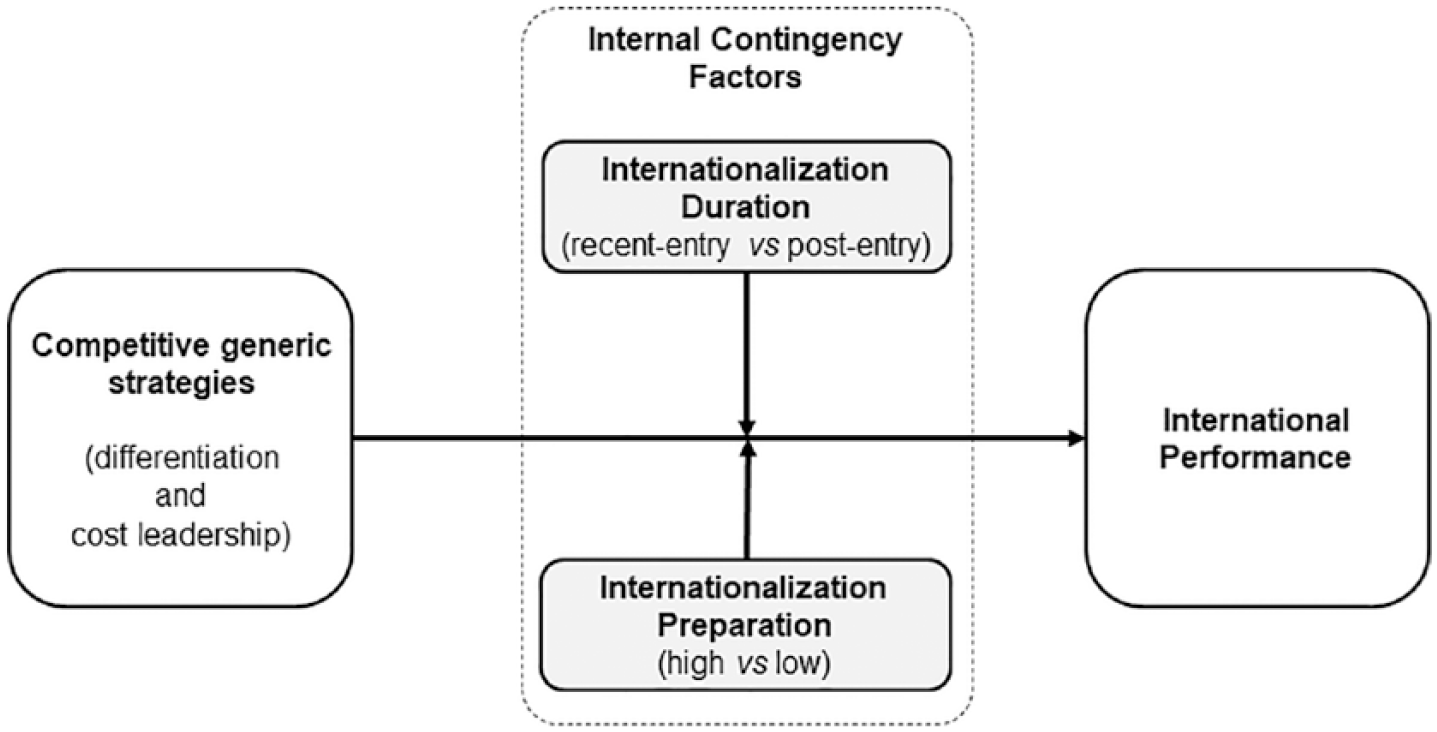
Initial conceptual framework.
Competitive strategies
Porter’s (1980) typology specifies three competitive strategies: differentiation, cost leadership, and focus. Firms that implement a differentiation strategy emphasize the uniqueness of specific dimensions supposedly valued by the buyers, such as quality, design, marketing, service, or innovation. When a firm pursues a cost leadership strategy, the goal is to present the lowest price in the industry, exploring factors such as economies of scale or value chain management. Finally, by following a focus strategy, the firm purportedly adapts to meet the specific needs of a particular industry segment, following a differentiation or cost leadership pattern applied to such segment.
Strategic decisions were found to have a positive and significant influence on SME performance (Bloodgood et al., 1996; Julien & Ramangalahy, 2003; Knight, 2000, 2001; Martin et al., 2017) as well as on INVs’ survival (Khan & Lew, 2018; Mudambi & Zahra, 2007). Also, drawing from Porter (1980), Namiki (1988) goes further suggesting that exporting SMEs generally select one of the four main strategies: marketing differentiation, segmentation differentiation, innovation differentiation, and product-oriented service (customer service and high-quality products). He found that those firms which follow segmentation differentiation and innovation differentiation strategies achieve higher performances, measured through export growth and profitability (Namiki, 1988).
In a literature survey carried out by Rialp et al. (2005), several strategic factors were identified as facilitators of the early internationalization phenomenon; these include the following: flexibility to adapt to rapidly changing external decisions, product differentiation, technological innovativeness, quality leadership, and niche focus. In the case of firms’ innovativeness, there is some evidence confirming its positive effects on firm performance (Cillo et al., 2010; Hult et al., 2004; Kropp et al., 2006; Salomo et al., 2008). Similarly, innovative firms can be more internationalized or exhibit higher export intensity (Podmetina et al., 2009). Knight and Cavusgil (2004) also found that international performance of BGs was a function of product development, quality focus, global technological competence, and leveraging foreign distributor competences. Knight (2000) concluded that marketing leadership is positively related to firm performance through the mediation of globalization response.
It emerges from the above review that available empirical evidence suggests that differentiation strategies lead INVs to achieve higher performances, irrespectively of the specific type of strategy espoused. Therefore, the following is proposed:
Hypothesis 1 (H1): A firm’s innovation differentiation strategy is positively associated with its international performance.
Hypothesis 2 (H2): A firm’s marketing differentiation strategy is positively associated with its international performance.
Hypothesis 3 (H3): A firm’s quality and service differentiation strategy is positively associated with its international performance.
It is often argued that entrepreneurial activities are not likely to be associated with cost leadership strategies, since these usually require a high volume of activity for success. However, empirical evidence is not crystal clear on this regard. Dess et al. (1997) hypothesized that entrepreneurial firms that follow cost leadership strategies will have lower performance than those espousing differentiation strategies. The results contradicted their expectations: firms that implement a cost leadership strategy achieved higher performances than those following a differentiation strategy. Other studies on INVs (Beal & Yasai-Ardekani, 2000; Falahat & Migin, 2017; Hughes et al., 2010) conclude that both cost leadership and differentiation-based strategies are positively related to superior performance. Hughes et al. (2010), for instance, found that when high-technology INVs adopt a marketing differentiation strategy or a cost leadership strategy, they positively influence the achievement of marketing and cost leadership positional advantages, respectively, which in turn has a favorable influence on the venture’s export performance. In contrast, it is possible to argue that INVs may be at disadvantage in following a cost leadership strategy, namely due to their lack of resources to appropriately manage their value chains, to explore their upstream and downstream linkages, and to explore economies of scale to reduce costs (Amorós et al., 2016; Roth & Morrison, 1992). Therefore, INVs following a cost leadership strategy are likely to be less profitable (Knight, 2015; Knight & Cavusgil, 2005). While recognizing that the literature is not convergent, the following hypothesis is advanced:
Hypothesis 4 (H4): A firm’s cost leadership strat-egy is positively associated with its international performance.
Moderating effects of contingency factors
Internationalization duration
There is evidence indicating that INVs fine-tune their strategies as the internationalization process unfolds (e.g., Hallbäck & Gabrielsson, 2013; Spence & Crick, 2009), for instance, by using the experiential knowledge obtained during the internationalization process itself (Jones & Coviello, 2005; Spence & Crick, 2009). The very foundations of competitive advantage may change too, initial bases being replaced by other stemming from international business knowledge and improved organizational routines (Autio et al., 2000; Gerschewski et al., 2018; Ibeh et al., 2018; Jones & Coviello, 2005; Zhou & Wu, 2014).
Earlier literature has discussed the relationship between distinct types of strategy and INVs’ performance (e.g., Bloodgood et al., 1996; Knight, 2000, 2001; Namiki, 1988). The critical question remains as to whether the strategies leading to superior international performance keep unchanged as new ventures progress in internationalization processes, and therefore, whether internationalization experience works as an organizational contingency factor moderating the strategy–performance linkage (Ibeh et al., 2018). Extant research on the analysis of change in strategic decisions and issues along INVs’ internationalization process is limited (Gerschewski et al., 2018; Ibeh et al., 2018). In a seminal longitudinal study, McDougall and Oviatt (1996) report that the new ventures which have increased their internationalization during a 2-year period show significant positive relationships between strategy change and venture performance. But this study did not identify the specific sort of changes operated in strategy. As the new venture grows and internationalizes, the key issues may change from opportunity discovery and product delivery to efficiency and rationalization (Churchill & Lewis, 1983; Zhou & Wu, 2014). Therefore, to keep high international performance, INVs may need to change their strategies.
There is a stream of literature arguing that differentiation strategies are more suited for the initial phases of internationalization process (e.g., Namiki, 1988; Rialp et al., 2005), namely those differentiation strategies based on innovation and marketing (Hallbäck & Gabrielsson, 2013). Conversely, in later phases of internationalization, when INVs become more mature, they start to explore economies of scale and may be more likely to emphasize low cost, due to the evolution of their industry life cycle with increasing cost-based competition (McDougall et al., 2003). The international experience acquired by the founders or managers during the internationalization process may allow them to learn about foreign markets and the way of doing business there, enabling the realignment of strategy to improve INVs’ performance (García-Canal et al., 2018; Gerschewski et al., 2018; Khan & Lew, 2018).
Therefore, it seems that the internationalization duration impinges upon the way INVs select strategy to achieve higher international performance. Taking this line of argument, the following hypotheses are presented:
Hypothesis 5a (H5a): Internationalization duration moderates the relationship between innovation differentiation strategy and international performance in such a way that it will be stronger in the recent-entry than in the post-entry phase.
Hypothesis 5b (H5b): Internationalization duration moderates the relationship between marketing differentiation strategy and international performance in such a way that it will be stronger in the recent-entry than in the post-entry phase.
Hypothesis 5c (H5c): Internationalization duration moderates the relationship between quality and service differentiation strategy and international performance in such a way that it will be stronger in the recent-entry than in the post-entry phase.
Hypothesis 5d (H5d): Internationalization duration moderates the relationship between cost leadership strategy and international performance in such a way that it will be weaker in the recent-entry than in the post-entry phase.
Internationalization preparation
Internationalization preparation involves a set of “preparatory activities such as the conducting of market research, the commitment of resources to international marketing operations and the adaptation of products to suit [foreign] conditions” (Knight, 2001: 161). This kind of activities is particularly important for INVs when compared to domestic businesses, since the conditions of international markets are distinct and much more complex than those faced in the domestic market (Bloodgood et al., 1996; Knight, 2000). There is a stream of research supporting the positive effect of preparing internationalization moves (Ibeh, 2003; Knight, 2000, 2001). Cavusgil and Zou (1994) found that ventures that plan their export activities are more committed to international ventures, allocate more resources to these ventures, and therefore can achieve higher export intensity levels. Knight (2000, 2001) also found that the preparation of internationalization has a significant positive influence on international performance. International market search, namely through systematic exploration of export possibilities and frequent visits to foreign markets, is shown to influence export success (Moini, 1995).
The interaction between competitive strategy and such preparatory activities is likely to foster the achievement of higher international performance, since the success in implementing a specific strategy is contingent on a skillful preparation to enable timely mobilization of INVs capabilities, resources, and knowledge (Knight, 2001; Li et al., 2004). According to the RBV, firm strategy is determined by its resources and competencies. The decision regarding a firm’s strategy is based on its specific set of tangible and intangible assets (Barney, 1991; Wernerfelt, 1984). Hence, firms with abundant resources, as well as capabilities and knowledge (for instance obtained through internationalization preparation activities), can increase the chances of survival and growth, since these resources can support their competitive advantages (Wu et al., 2008). Since international preparation activities require investments as well as the commitment and adaptation of firms’ resources, they are easier to perform when firms have superior resource endowments. According to the previous arguments, it may be proposed that:
Hypothesis 6a (H6a): Internationalization preparation moderates the relationship between innovation differentiation strategy and international performance in such a way that it will be stronger when internationalization preparation is high than when it is low.
Hypothesis 6b (H6b): Internationalization preparation moderates the relationship between marketing differentiation strategy and international performance in such a way that it will be stronger when internationalization preparation is high than when it is low.
Hypothesis 6c (H6c): Internationalization preparation moderates the relationship between quality and service differentiation strategy and international performance in such a way that it will be stronger when internationalization preparation is high than when it is low.
Hypothesis 6d (H6d): Internationalization preparation moderates the relationship between cost leadership strategy and international performance in such a way that it will be stronger when internationalization preparation is high than when it is low.
The model encompassing the six hypotheses developed above is presented in Figure 2.
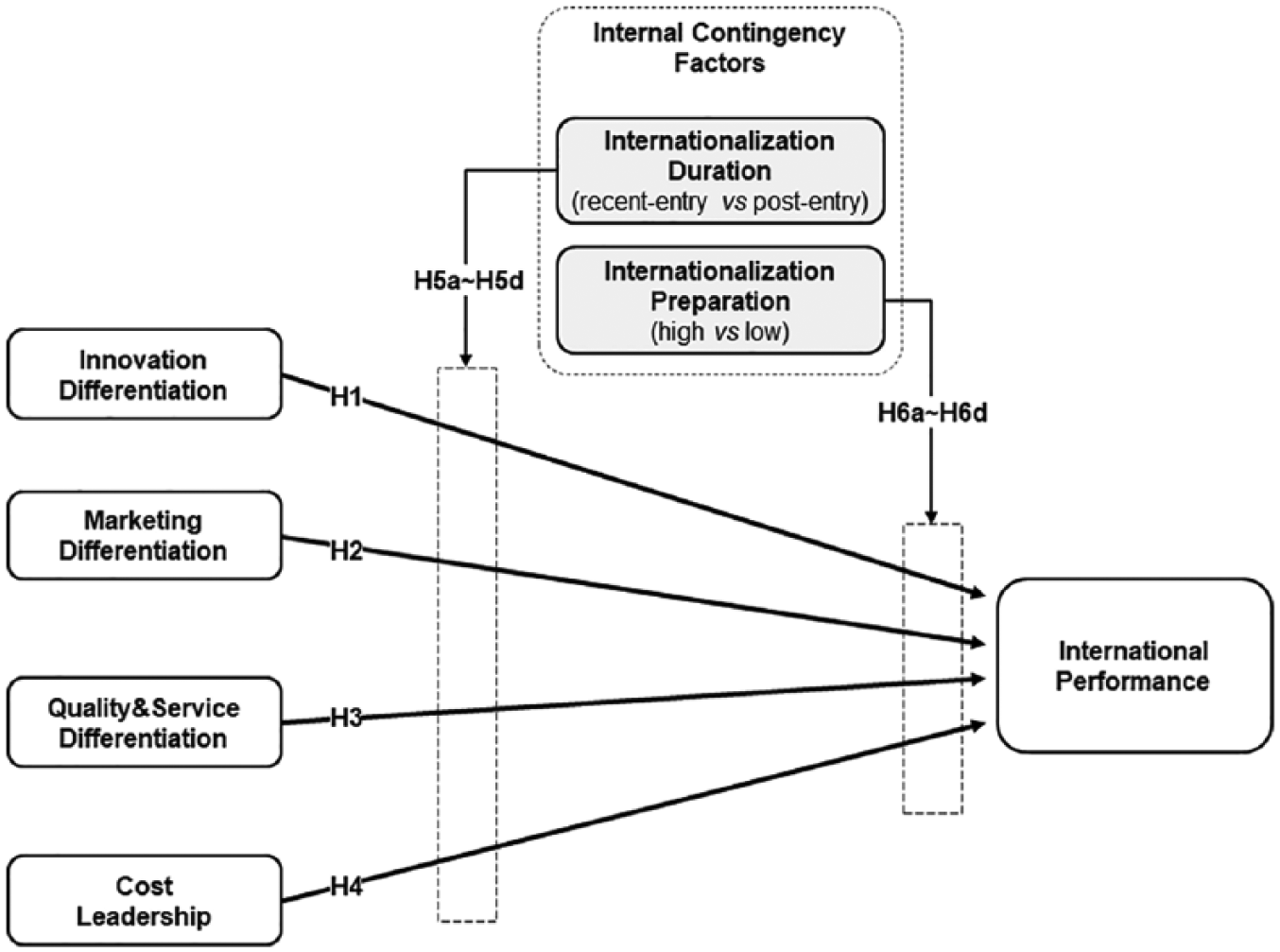
Conceptual framework of constructs and linkages.
Research method
Sample and data collection
The empirical data were collected through an online structured questionnaire, using the key-informant technique. The initial population consisted of a multi-industry set of nationwide Portuguese new ventures established between 2000 and 2009, still active in 2009, and employing more than five people. At the date of extraction (late June 2011), these were the most recent data included in the database, since it originates from the mandatory data that have to be provided by companies until the end of third quarter of the year, regarding the previous year. Following the suggestion of Zhou et al. (2007), the minimum weight of foreign sales was defined as 10%. The contacts were obtained through eInforma D&B (Dun & Bradstreet) database, which includes the main financial data from Portuguese firms, as well as firm demographics and contact details. Micro enterprises (with less than five employees) were excluded to distinguish businesses from liberal professionals. The decision to consider a 10-year span in the year of foundation of new ventures included in the population was intended to encompass ventures at different stages of the life cycle. The firms were initially contacted by phone to explain the purpose of the study, identify the key-respondent, and get a direct e-mail to send the invitation. A total of 1993 firms were found to be eligible. The questionnaire was pretested with a dozen firms’ sample, and data collection was carried out between November 2011 and February 2012. A total of 416 usable responses were received, a response rate of about 21%. This was in line with or even higher than the results of other studies in this field (e.g. Gerschewski et al., 2018; Knight & Cavusgil, 2004; Mcdougall, 1989; Sapienza et al., 2005). Following INVs operational definition presented above, based on Oviatt and McDougall (1997) and commonly used in the literature (e.g. Gerschewski et al., 2018; Jones et al., 2011; Knight & Cavusgil, 1996; Kuivalainen et al., 2007; Monferrer et al., 2015; Oviatt & McDougall, 1997), the sample used was reduced to 319. The majority of respondents were the founders, owners, or chief executive officers (CEOs; 71.5%), followed by other senior management positions such as sales managers, international managers, export managers, or financial managers (16.3%). To assess informants’ quality, we followed Atuahene-Gima (2005) procedure and respondents were asked to indicate on a 7-point scale (1 = very limited; 7 = very substantial) their degree of knowledge about the issues addressed in the questionnaire. The mean for the degree of knowledge was 5.59 (SD = 1.09). This suggests that respondents had enough knowledge about the issues addressed in this research.
Regarding the main characteristics of the respondent firms, the final sample exhibits a mean of 24.7 full-time employees (SD = 34.9) and an average turnover of €2.98 million (SD = 9.34 million; median turnover of €1.12 million only). The average weight of exports in total turnover is 55.9% (SD = 29.1%). The largest industry segments are manufacturing industries (46% of the sample), services (25%), commerce (17%), and construction (11%). The sample includes firms with a mean of 6.6 years (SD = 2.7 years), that in average took 1.4 years (SD = 2.0) to begin the internationalization process, and have an international experience of 5.2 years (SD = 2.6).
To perform the multi-group moderating analysis, the INVs were grouped according to their internationalization duration or to their level of internationalization preparation. As regards internationalization duration, firms that start their internationalization process within 4 years were categorized as recent-entry INVs (n = 145), while firms that start that process after 5 years were classified as post-entry INVs (n = 174). This criterion takes into consideration the operationalization of post-entry performance of INV implemented by Gerschewski et al. (2018). For internationalization preparation, the distribution of the respondents for a composite score calculated as an average of their items was used to split firms in a low internationalization preparation group (n = 120) and a high internationalization preparation group (n = 199) taking the mean as the break-point.
Measures
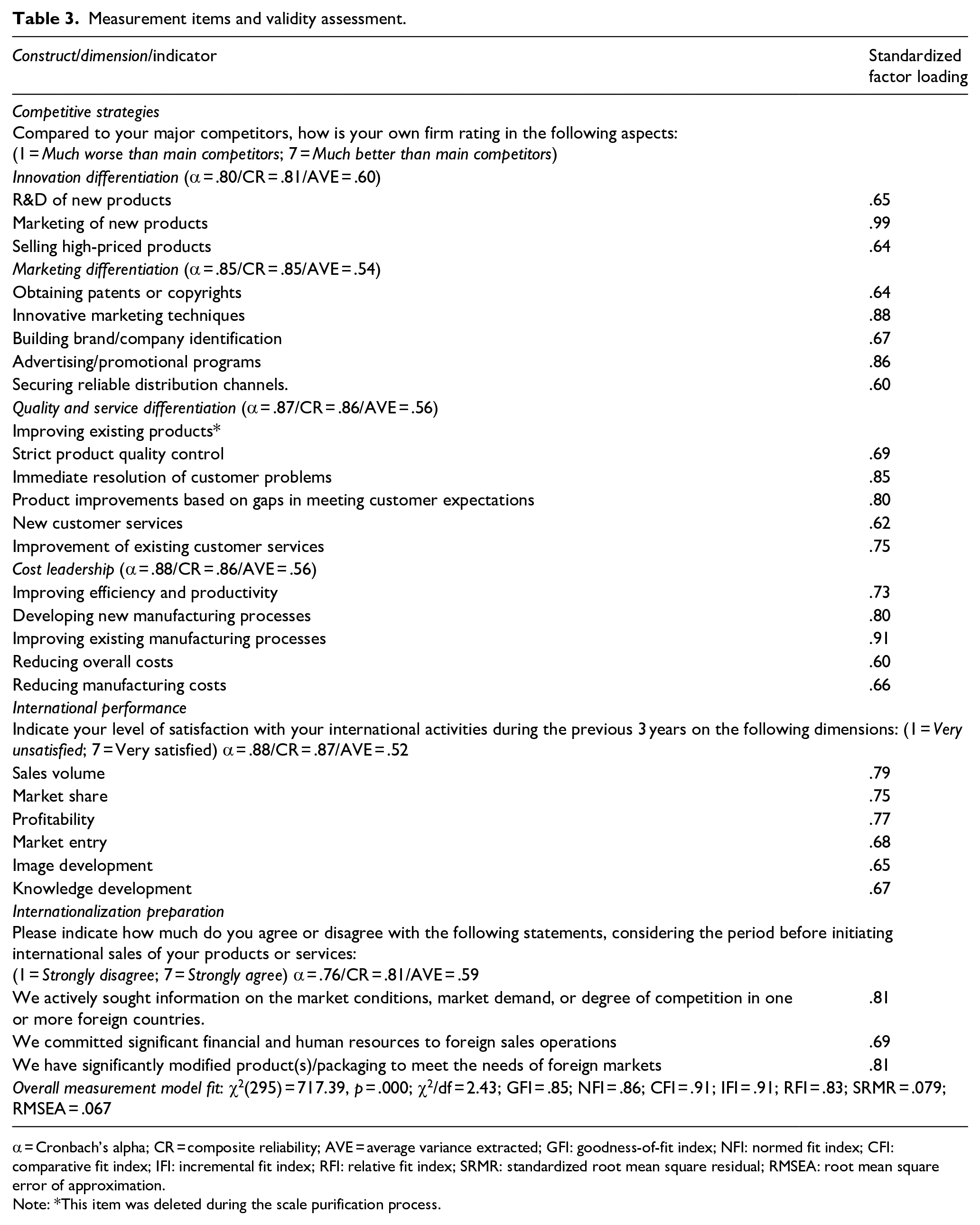
In this study, all the constructs used are multi-item scales based on validated instruments from the literature, based on seven-point Likert-type scale survey items, usually ranging from “1 = strongly disagree” to “7 = strongly agree.” For all the variables included in the model, the unit of analysis was the firm. Table 3 provides information regarding the measurement items and their reliability and validity assessment.
The measurement of competitive strategies was performed using a group of 23 items adapted from Beal (2000). This resulted from a combination of two elements: (1) a set of 12 items which have been used by several authors (e.g., Dess & Davis, 1984; D. Miller, 1988) to operationalize Porter’s (1980) competitive generic strategies and (2) a set of 11 items designed to express the multiple orientations of differentiation-based strategies, as suggested by D. Miller (1988) and Mintzberg (1988). Afterwards, an exploratory factor analysis was performed to identify specific competitive strategies.
As for the outcome variable, international performance, it was measured as a subjective variable, adapted from Jantunen et al. (2008). It evaluates respondents’ satisfaction with six aspects of their companies’ international activities during the preceding 3 years. The decision to use a subjective measure of performance was based on three main considerations. First, the fact that entrepreneurs and managers have been very unfavorable to disclose objective financial or performance data to researchers (Francis & Collins-Dodd, 2000). Second, the view that the subjective perception of firm’s performance in international markets is more suitable than objective measures (Andersen & Skaates, 2002; Madsen, 1989). Third, there is evidence of high positive correlation between objective and subjective measures of performance (e.g., Shoham, 1998; Stam & Elfring, 2008; Gerschewski & Xiao, 2015). Our approach is in line with other research in the field, namely Jantunen et al. (2005, 2008), Brouthers et al. (2015), Gerschewski et al. (2015), and Thanos et al. (2017).
Internationalization preparation construct was measured through a 3-item scale developed by Knight (2001), which assesses the conscious activities regarding the internationalization decision.
Three control variables were included in this study: firm size, industry, and degree of internationalization. Firm size was measured by the number of employees. Regarding industry, drawing from the original D&B database, manufacturing firms were coded as “1” and firms from other industries (including services for families and for businesses, construction, and commerce) were coded “0.” Finally, firm’s degree of internationalization was operationalized as the percentage of firm’s exports in the total turnover (Fernández-Olmos et al., 2016).
Nonresponse and common-method bias
To test for nonresponse bias, the responses of early and late respondents (first 75%/last 25% of returned questionnaires) were compared for all constructs included in the theoretical model and for several firm characteristics, namely number of employees, industry, age of the firm, degree of internationalization, and age when internationalization started (Armstrong & Overton, 1977). In addition, respondents and nonrespondents were compared using secondary data such as number of employees, industry, age of the firm, and degree of internationalization. In both procedures, no significant differences were found between the two groups. Therefore, nonresponse bias was not a problem (Armstrong & Overton, 1977).
Since data were collected from a single informant of each firm using a cross-sectional survey, common-method bias is a concern (Podsakoff & Organ, 1986). For this reason, when developing the questionnaire, several procedures were followed to limit the potential for common-method bias (Podsakoff et al., 2003; Podsakoff & Organ, 1986). For instance, in both the invitation mail and the introductory page of the questionnaire, respondents were informed about the use of procedures to ensure the anonymity of respondents and the confidentiality of the information provided. In addition, the respondents were not aware of conceptual model, the sequence of questions was randomized throughout the questionnaire, and construct items were organized in sections and not in variables. In addition, respondents were stimulated to respond as sincerely as possible, underlining that there were no right or wrong answers (Podsakoff et al., 2003; Podsakoff & Organ, 1986). Finally, the description of the scales included not only the extreme values (“1” and “7”) but also the midpoint (“4”), which can reduce common-method bias (Podsakoff et al., 2003; Podsakoff & Organ, 1986; Spector, 1987). Two ex-post checks were also performed. First, Harman’s one-factor test was implemented (Malhotra et al., 2006; Podsakoff et al., 2003), including all the study variables into an exploratory factor analysis. This procedure resulted in seven factors with eigenvalues above 1 (accounting for a total variance explained of 64.1%), the first factor accounting for 26.15% of the total variance only. Second, the marker variable test was also performed (Lindell & Whitney, 2001; Malhotra et al., 2006). The questionnaire included a question about the influence of the economic crisis on the answers, which is a variable theoretically not linked to the variables included in the study. The average correlation of this variable with the variables included in the framework was .075. Taking this marker variable, namely the second smallest correlation between this variable and the study main variables (rM = .04), the common-method bias-adjusted matrix of correlations was computed by using the equation: rA = (ru − rM)/(1 − rM), where ru is the original correlation value, rM is the correlation of the marker variable, and rA is the adjusted correlation. The comparison between original and adjusted matrices revealed that there are no relevant differences (Δr = .021), since the pattern of correlations (significant and nonsignificant) remain similar (Lindell & Whitney, 2001; Malhotra et al., 2006). These results indicate that the relationships among the variables were not caused by common-method variance (Podsakoff & Organ, 1986).
Validity and reliability of scales
Before assessing the validity and reliability of constructs, competitive strategy constructs need to be developed, since several items regarding competitive methods are contradictory and cannot be included in a single multi-item construct.
Following the procedure of Beal (2000), an exploratory factor analysis was carried out with varimax rotation on the 23 items initially used to specify the competitive generic strategies, to identify the competitive strategies’ dimensions. This analysis resulted in a four-factor solution accounting for 68.7% of the variance. This value is higher than the reference value of 60.0% (Hair et al., 2009). The results of Bartlett’s test of sphericity (p = .000) and the Keiser–Meyer–Olkin measure of sampling adequacy (KMO = .87) were strong and significant, thus suggesting that factor analysis is adequate for these data (see Table 1). Bearing in mind both the original study of this scale (Beal, 2000), and the meaning of the items included in each factor, a name was assigned to each factor. Factor 3 was labeled as “cost leadership” and was the only factor that presented the same five items as Beal’s (2000) original study. The other three factors were named with three distinct differentiation strategies: factor 1 was labeled “quality & service differentiation” (since it includes items that were originally allocated to two distinct dimensions, quality differentiation, and service differentiation (Beal, 2000), factor 2, “marketing differentiation,” and factor 4, “innovation differentiation.”
Initial Factor Loadings for Competitive Strategies.
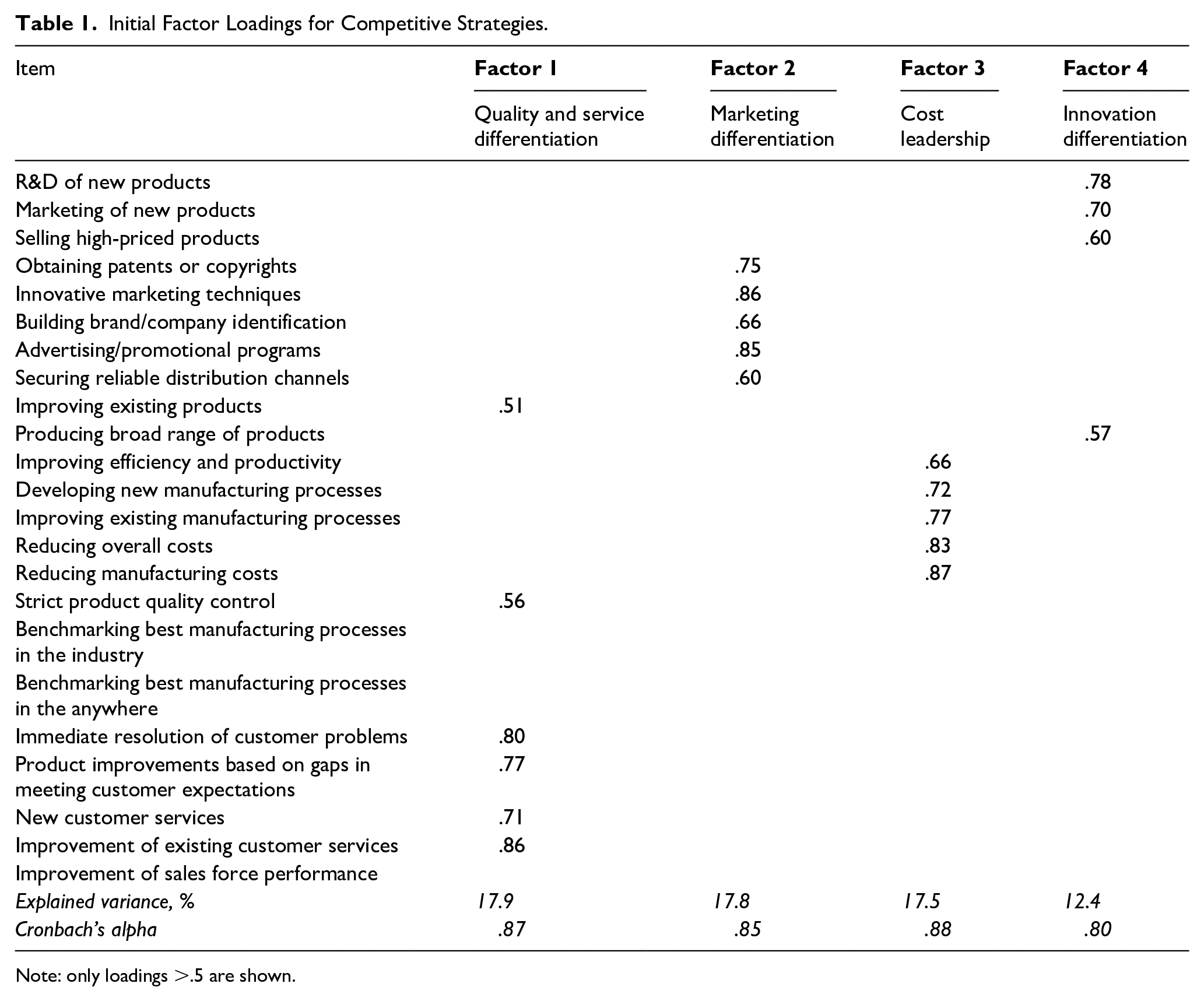
Note: only loadings >.5 are shown.
After this preliminary procedure for competitive strategies, a confirmatory factor analysis (CFA), using maximum likelihood estimate, was performed to assess the unidimensionality, validity, and reliability of each latent variable (Bagozzi & Yi, 2012). The AMOS 22 software was used. Scales were purified through an interactive process, and some items were dropped. All the items included in the constructs exhibit loadings above the .60 cutoff (Bagozzi & Yi, 1988, 2012), which provides evidence of unidimensionality and convergent validity (Hair et al., 2009). All the constructs exhibited good Cronbach’s alphas (α) and composite reliabilities (CR) levels (see Table 3): innovation differentiation (α = .80/CR = .81), marketing differentiation (α = .85/CR = .85), quality and service differentiation (α = .87/CR = .86), cost leadership (α = .88/CR = .86), internationalization preparation (α = .76/CR = .81), and international performance (α = .88/CR = .87). Furthermore, all the constructs meet of discriminant validity tests (Fornell & Larcker, 1981), since all the constructs included in the conceptual framework showed values for average variance extracted (AVE) above the .50 threshold, and the square root of AVE from each construct was higher than the values of correlations estimate (r2) between all the pairs of constructs included in the model (see Table 2).
Descriptive statistics and correlation matrix.
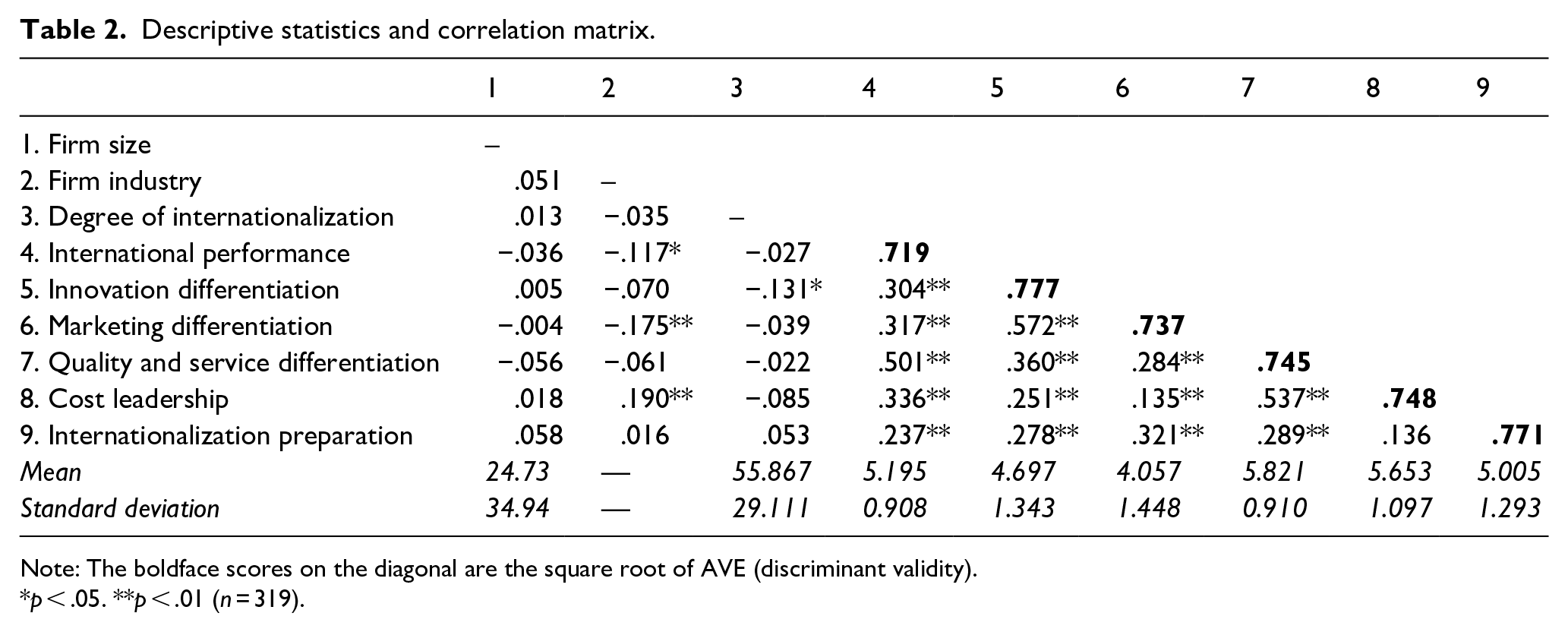
Note: The boldface scores on the diagonal are the square root of AVE (discriminant validity).
p < .05. **p < .01 (n = 319).
To check for possible collinearity problems among the variables, variance inflation factors (VIF) were calculated. The VIF ranged from 1.009 to 1.629, well below the cutoff of 10, indicating that multicollinearity was not a serious problem in this model (Hair et al., 2009).
Results
The data were analyzed in three phases. First, descriptive statistics and inter-variable correlations were calculated to inspect sample’s characteristics. Then, structural equation modeling (SEM), using the AMOS software, was performed, and the two-stage approach recommended by Anderson and Gerbing (1988) was followed. Before including latent variables in the structural model, they need to be evaluated in measurement models (Anderson & Gerbing, 1988; Fornell & Larcker, 1981; Hair et al., 2009). Afterwards, a structural model was developed to test the direct effects of research hypotheses presented in the conceptual framework. In the third phase, two multi-group analyses were performed to test the moderating hypotheses related with the role of both organizational contingency factors: internationalization duration (recent-entry vs post-entry) and internationalization preparation (low vs high).
Measurement model
The overall measurement model showed a good fit (Table 3). The chi-square test was significant, χ2(295) = 717.39, p = .000, and the chi-square/degree-of-freedom ratio was slightly above 2.0 (χ2/df = 2.43), indicating a good fit (Iacobucci, 2010; Kline, 2005). In addition, all the other indices showed appropriate fitting, namely goodness-of-fit index (GFI) = .85, normed fit index (NFI) = .86, comparative fit index (CFI) = .91, incremental fit index (IFI) = .91, relative fit index (RFI) = .83, standardized root mean square residual (SRMR) = .079, and root mean square error of approximation (RMSEA) = .067.
Measurement items and validity assessment.
α = Cronbach’s alpha; CR = composite reliability; AVE = average variance extracted; GFI: goodness-of-fit index; NFI: normed fit index; CFI: comparative fit index; IFI: incremental fit index; RFI: relative fit index; SRMR: standardized root mean square residual; RMSEA: root mean square error of approximation.
Note: *This item was deleted during the scale purification process.
Direct effects
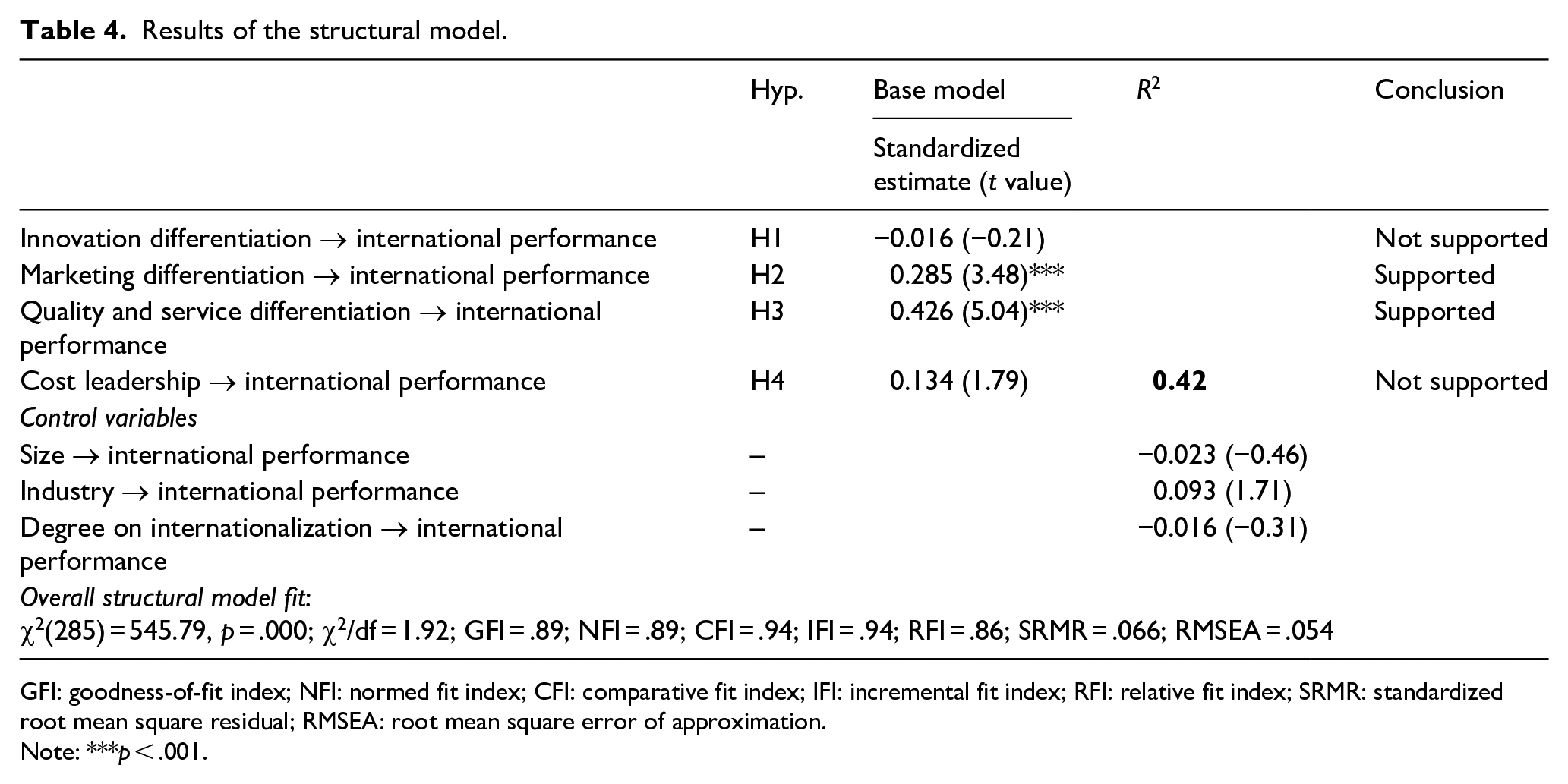
The standardized parameter estimates and t-values for the direct hypothesized paths and the fit indices of the model are presented in Table 4. The structural model showed a good fit. All the fit indicators consistently point in the same direction: the ratio chi-square/degrees of freedom is a little below 2.0 (χ2/df = 1.92), GFI = .89, NFI = .89, CFI = .94, IFI = .94, RFI = .86, SRMR = .066, and RMSEA = .054. Overall, the model explained a considerable amount of the observed variance of international performance (42%).
Results of the structural model.
GFI: goodness-of-fit index; NFI: normed fit index; CFI: comparative fit index; IFI: incremental fit index; RFI: relative fit index; SRMR: standardized root mean square residual; RMSEA: root mean square error of approximation.
Note: ***p < .001.
Concerning hypotheses testing of direct effects, no support was found for H1, which suggested a positive relationship between innovation differentiation and international performance (β = −.016, p = .74). Conversely, the other differentiation strategies exhibited positive and significant relationships with the INV’s international performance: marketing differentiation strategy (β = .285, p < .001) and quality and service differentiation strategy (β = .426, p < .001). Therefore, both H2 and H3 were supported. Finally, the hypothesized positive relationship between the cost leadership strategy and INV’s international performance (H4) was not supported (β = .134, p = .095). As to the control variables, none of them showed a significant relationship with INV’s international performance.
Moderation effect of contingency factors
Internationalization duration
This research examined the moderating effect of internationalization duration on the relationships between each of the four competitive strategies identified and international performance, by comparing the strength of the direct effects between two groups of INVs: those that internationalized recently (recent-entry; n = 145) and those exhibiting a longer internationalization history (post-entry; n = 174). Since the purpose was to use a discrete moderator variable, a multi-group CFA was performed using AMOS 22 (Byrne, 2010; Chen, 2007; Laukkanen et al., 2013). This method is a well-recognized and commonly accepted method for assessing moderating effects in structural equation model (SEM; Byrne, 2010; Chen, 2007; Hair et al., 2009; Stone & Hollenbeck, 1989; Wang, 2008). A multi-group model was defined in which all factor loadings were constrained as equal between the two groups of INVs. This constrained model showed a good fit: the ratio χ2/df = 1.77, GFI = .82, CFI = .91, IFI = .91, and RMSEA = .049. These results indicated that the items used in each group properly measure the latent variables included in the measurement model.
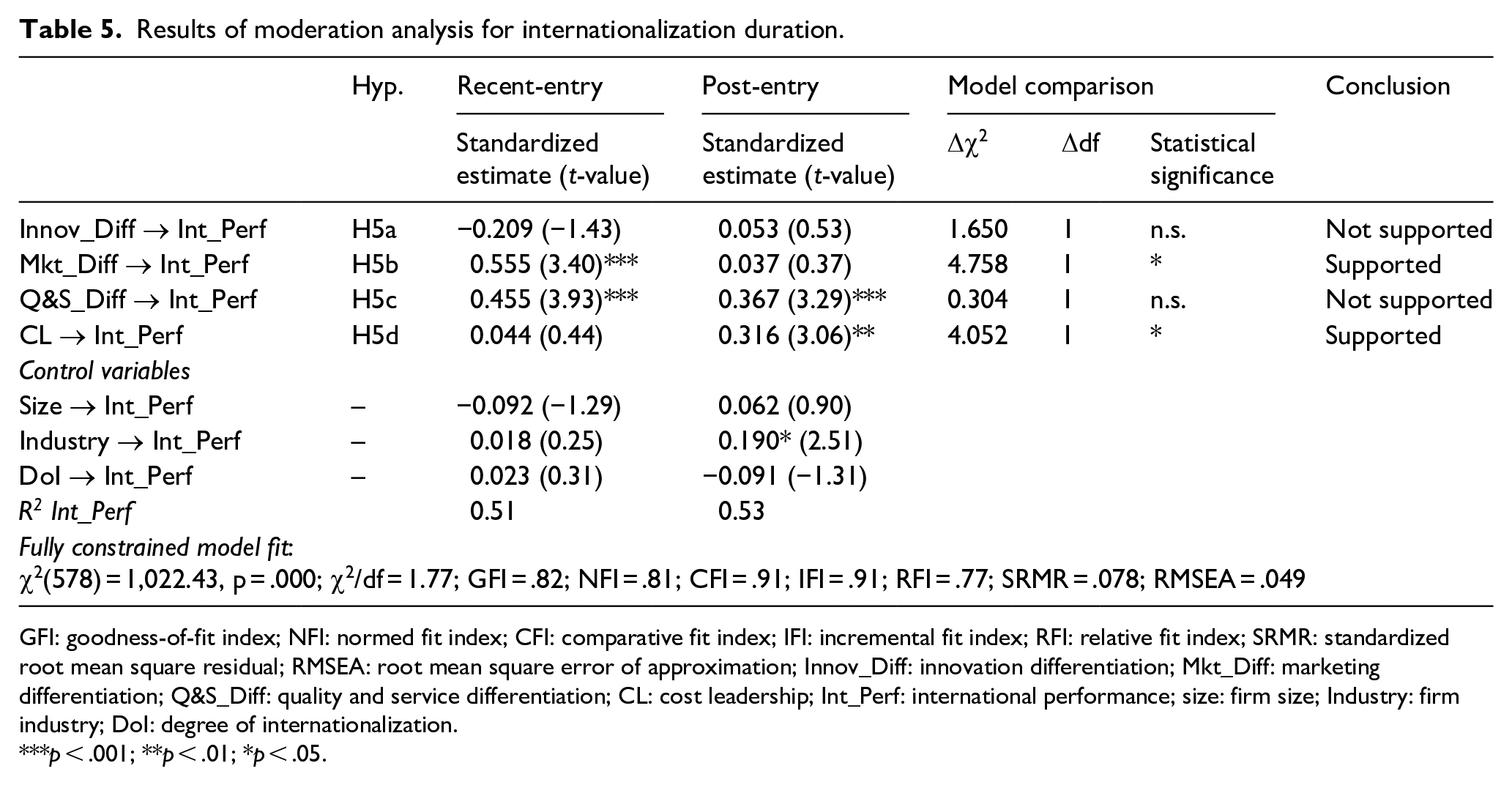
Afterwards, the structural model was also tested for multi-group invariance, by comparing the model in which all the paths are set equal between the two groups and the unconstrained model. Results showed that the structural weights were different between the two models (Δχ2 = 46.53; Δdf = 26; p < .01), and therefore, the path differences needed to be analyzed. The results of the structural model for each group, as well as the results of specific constrained models where each path was constrained as equal between recent- and post-entry groups, are presented in Table 5.
Results of moderation analysis for internationalization duration.
GFI: goodness-of-fit index; NFI: normed fit index; CFI: comparative fit index; IFI: incremental fit index; RFI: relative fit index; SRMR: standardized root mean square residual; RMSEA: root mean square error of approximation; Innov_Diff: innovation differentiation; Mkt_Diff: marketing differentiation; Q&S_Diff: quality and service differentiation; CL: cost leadership; Int_Perf: international performance; size: firm size; Industry: firm industry; DoI: degree of internationalization.
p < .001; **p < .01; *p < .05.
The results of multi-group structural models for the relationships between each competitive strategy and INVs’ international performance across groups showed interesting findings. For the recent-entry group, the competitive strategies associated with high international performance were marketing differentiation (β = .555, p < .001) and quality and service differentiation (β = .455, p < .001). For the post-entry group, the quality and service differentiation strategy was still relevant (β = .37, p < .01), together with the cost leadership strategy (β = .32, p < .01).
Regarding the moderation effect of internationalization duration, the results indicated that two strategies exhibit distinct relevance patterns for recent-entry INVs and post-entry INVs. The relationship between marketing differentiation strategy and international performance showed a significant difference between these two groups (Δχ2 = 4.758; Δdf = 1; p < .05), hence the relationship was stronger for recent-entry INVs (β = .555) than for post-entry INVs (β = .037). On the opposite direction were the results of cost leadership strategy: the existing significant difference between the groups (Δχ2 = 4.052; Δdf = 1; p < .05) was due to the higher strength of the relationship of the post-entry INVs (β = .316) compared to recent-entry INVs (β = .044). These results support H5b and H5d.
The hypothesized moderating influence of internationalization duration on the relationship between the other two strategies (innovation differentiation and quality and service differentiation) and INVs’ international performance failed to achieve a chi-square difference in the two groups; therefore, H5a and H5c were not supported.
Internationalization preparation
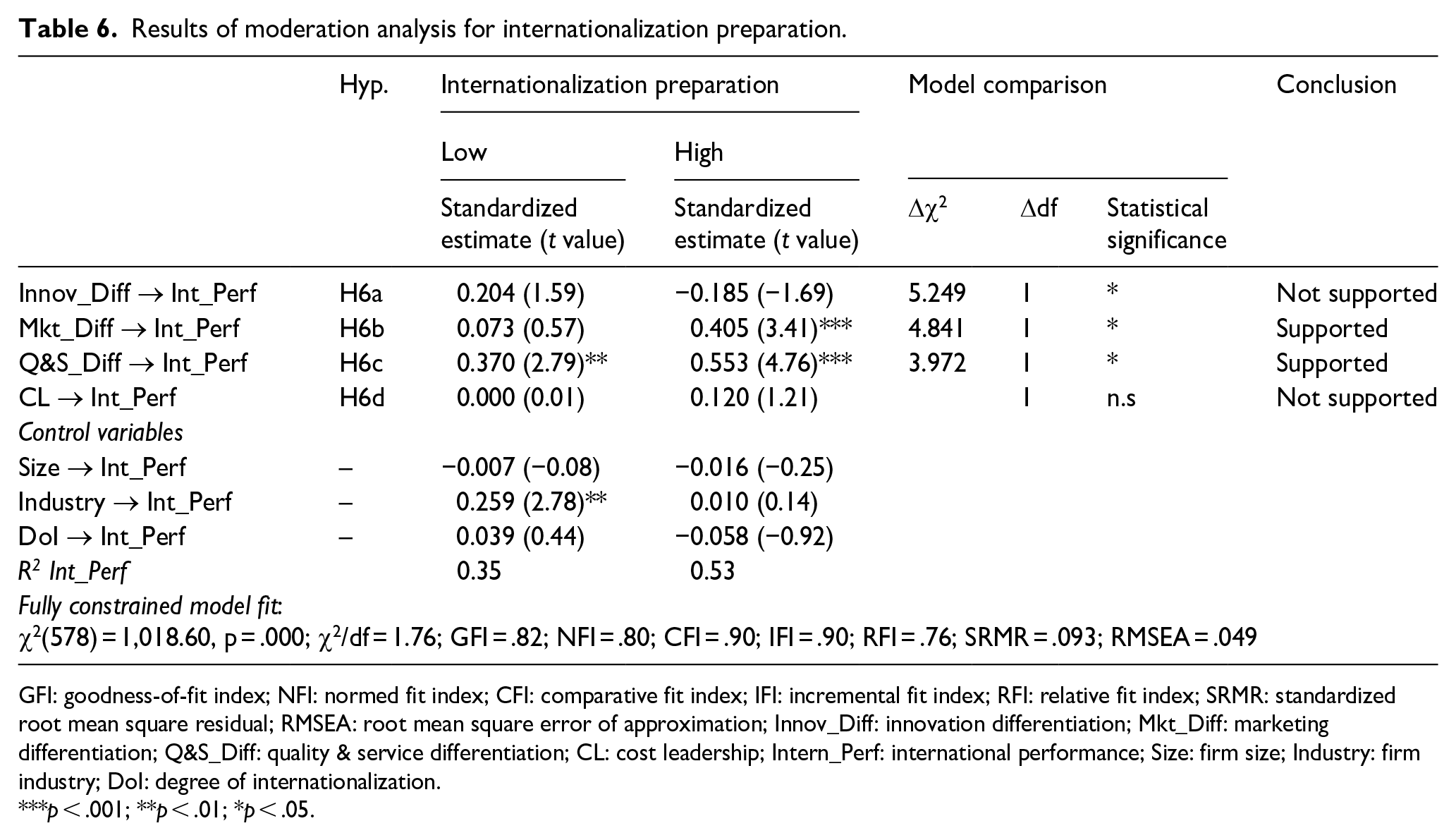
Following a similar procedure, the moderating effect of internationalization preparation on the relationships between the competitive strategies and international performance was tested. Since internationalization preparation is a multi-item measure, to keep the coherence with the previous moderation method, there was a need to calculate a composite using an average score of items. Afterwards, the sample was divided into high (High-IP; n = 199) and low (Low-IP; n = 120) internationalization preparation groups by following the median split procedure (Hair et al., 2009; Hancock & Mueller, 2006). Again, the constrained model for these two groups showed a good fit: the ratio χ2/df = 1.76, GFI = .82, CFI = .90, IFI = .90, and RMSEA = .049. Hence, the items used in each group measure properly evaluate the latent variables included in the measurement model. The results of moderation analysis for internationalization preparation are presented in Table 6.
Results of moderation analysis for internationalization preparation.
GFI: goodness-of-fit index; NFI: normed fit index; CFI: comparative fit index; IFI: incremental fit index; RFI: relative fit index; SRMR: standardized root mean square residual; RMSEA: root mean square error of approximation; Innov_Diff: innovation differentiation; Mkt_Diff: marketing differentiation; Q&S_Diff: quality & service differentiation; CL: cost leadership; Intern_Perf: international performance; Size: firm size; Industry: firm industry; DoI: degree of internationalization.
p < .001; **p < .01; *p < .05.
The results regarding the moderating effects of internationalization preparation on the relationship between competitive strategies and INVs’ international performance provided interesting findings. For the High-IP group, the competitive strategies associated with superior international performance were again marketing differentiation (β = .405, p < .001) and quality and service differentiation (β = .553, p < .001), whereas for Low-IP group only the quality and service differentiation strategy remained significant (β = .370, p < .001). The three differentiation strategies exhibited significant dissimilarities of strength between these two groups of INVs. In two of these strategies, the moderation effect of internationalization preparation is in line with the hypothesized sign. Hence, marketing differentiation (Δχ2 = 4.841; Δdf = 1; p < .05) was a stronger predictor of international performance for INVs that show high IP (β = .405) than for INVs with Low-IP (β = .073). Also, the relationship between quality and service differentiation and international performance was stronger for High-IP (β = .553) than for Low-IP INVs (β = .370), exhibiting significant difference between groups (Δχ2 = 3.972; Δdf = 1; p < .05). These results supported H6b and H6c.
In contrast, innovation differentiation strategy showed a positive and stronger relationship with international performance in Low-IP group (β = .204) than in the High-IP group of INVs, for which the relationship is negative (β = −.185); thus, H6a was not supported although the difference between groups was significant (Δχ2 = 5.249; Δdf = 1; p < .05). It was also found that internationalization preparation did not moderate the relationship between cost leadership strategy and international performance; therefore, H6d was not supported. This means that the role of cost leadership strategy was not significantly different between the High-IP (β = .120, p > .05) and the Low-IP (β = .000, p > .05) groups.
Discussion
The heart of this article is to respond the following questions: Which competitive strategies lead INVs to achieve higher international performance? Do internal contingency factors (international duration and international preparation) impinge upon the strategy–performance relationships as organizational contingency factors? Our research findings shed a new light on the relevance of specific competitive strategies à la Porter (1980) as determinants of INVs’ performance. Instead of analyzing strategy as a single variable, like previous studies in IE (e.g., Julien & Ramangalahy, 2003; Knight, 2001), or focusing on preselected strategy types (e.g., Knight & Cavusgil, 2004), this research started with a large set of competitive behaviors, adapted from Beal (2000), drawing not only from the operationalization of Porter’s (1980) generic competitive strategies but stemming also from the operationalization of different approaches of differentiation strategy.
As regards the relationships between the competitive strategies adopted by INVs and their international performance, the results are very interesting and somewhat puzzling. The first finding is that, for the total sample, only differentiation strategies lead INVs to achieve higher international performance. This result is at odds with other research on SMEs (Beal & Yasai-Ardekani, 2000; Lechner & Gudmundsson, 2014), and specifically on INVs (Hughes et al., 2010; Falahat & Migin, 2017), that indicate that both differentiation and cost–leadership strategies may be related to higher performance. In fact, our finding provides support to the argument that cost leadership requires upfront investment and/or a high volume of activity which may not be feasible in the case of INVs. Therefore, it suggests that differentiation strategies may be more appropriate for entrepreneurial firms as pointed out by Sandberg and Hofer (1987) and Lechner and Gudmundsson (2014).
A closer look at the results highlights that two differentiation strategies, based on marketing as well as on quality and service, lead INVs to achieve superior international performance. This finding corroborates extant literature (Knight & Cavusgil, 2004; Martin et al., 2017; Rialp et al., 2005), arguing that differentiation strategies are an interesting option for entrepreneurial firms to compete internationally. This is particularly the case when fulfilling customers’ needs entails specific quality, service, or marketing requirements (Bhidé, 2000; Lechner & Gudmundsson, 2014).
A surprising finding is the lack of support to Hypothesis 1, regarding the relationship between innovation differentiation strategy and INVs’ international performance. Our finding goes against a stream of research suggesting that firms following innovation strategy are likely to be more successful (e.g., Cillo et al., 2010; Hult et al., 2004; Terziovski, 2010; Zahra & Covin, 1993) or achieve higher export performance (e.g., Hughes et al., 2010; Martin et al., 2017; Namiki, 1988; Podmetina et al., 2009).
A possible explanation for our puzzling finding is related to methodological considerations. In this research, the innovation differentiation strategy was tested concurrently with other types of competitive strategies for all the firms in the sample. Several studies finding that innovation differentiation strategy leads firms to achieve higher performance used cluster analysis instead (e.g., Hagen et al., 2012; Namiki, 1988). In these cases, the sample of firms considered is divided in sub-samples exhibiting a common specific characteristic (innovation differentiation in this particular case). Although this characteristic was shared by a small number of companies in the sample (but relevant as cluster), a strategy may still achieve relevance for the whole sample. Other research (e.g., Beal, 2000) has tested each possible strategy individually and not simultaneously. Therefore, we cannot rule out that the significance of innovation differentiation strategy might have been affected by the method followed. This clearly demands further research to ascertain the influence of the methodological approach.
Be as it may, the interpretation of the finding demands a closer look at the specific context in which the surveyed firms are embedded. In fact, Portugal is considered as an “intermediate” country in the European context, or a “moderate innovator” according to the Innovation Union Scoreboard (European Commission, 2015). This is particularly relevant because the European Union is the main international market for most of the firms surveyed. Together with the short-term orientation of many INVs, this may explain the low significance of innovation differentiation strategies on performance, since Portuguese INVs have limited in-house capabilities, R&D investments, and do not benefit from a national system of innovation dynamic enough to provide them with the missing assets required to bet on an innovation strategy. The problem is compounded by the fact that they compete in more sophisticated foreign markets, in which more aggressive and innovative competitors are already present. Therefore, it does not come as a surprise Portuguese INVs to adopt other strategies, namely those based on marketing and on quality and service, thereby offsetting lower innovative capabilities with a close attention to customers’ needs. Interestingly, this reasoning may also apply to the cost leadership strategy. Marketing and quality and service differentiation strategies are less demanding than innovation differentiation or cost leadership strategies. With regard to the latter, Portuguese firms are increasingly facing competitors from less developed countries, thereby constraining the effectiveness of pure low-cost strategies. Therefore, those Portuguese INVs which are betting on marketing and “customer satisfaction” strategies are more likely to achieve superior performance.
The above comments provide a new light on the analysis of competitive strategies for INVs. They suggest that strategies leading to better performance outcomes may be contingent upon the country of origin of the INVs concerned (Dimitratos et al., 2004; Ibeh, 2003). This opens an unexplored research field: international comparisons regarding the influence of competitive strategy on INVs’ performance. This is an interesting research avenue that falls in the comparative entrepreneurial internationalization stream of research, using Jones et al.’s (2011) typology.
Another contribution of our research is the identification of the moderating influence of internationalization duration on the link between INV’s competitive strategies and performance. Such influence was found to be significant for marketing and cost leadership strategies. Our findings confirm that INVs fine-tune their strategies as internationalization unfolds, to adjust to internal and environmental changes, with a view to improve international performance (Hallbäck & Gabrielsson, 2013; Spence & Crick, 2009). This also corroborates the conclusions of recent qualitative literature arguing that INVs’ entrepreneurial orientation evolves over time and along the internationalization process (e.g., Gabrielsson et al., 2014; Gabrielsson & Gabrielsson, 2013; Gerschewski et al., 2018; Hallbäck & Gabrielsson, 2013; Ibeh et al., 2018). Consistent with the contingency perspective followed in this research, results show that internationalization duration moderates the competitive strategy–performance link: while the recent-entry group is better off by implementing marketing differentiation and quality and service differentiation strategies, the post-entry group achieves better performance by following quality and service differentiation and also cost leadership strategies. Although these results confirm a seminal work of McDougall and Oviatt (1996), where they identify the relevance of strategy change, our research goes further, since it identifies the specific competitive strategies adopted in each phase. It also suggests that in general terms, differentiation strategies are more suited for the initial phases of the internationalization process, as pointed out by other studies (e.g., Namiki, 1988; Rialp et al., 2005). Again, innovation differentiation is the exception, the arguments developed above still holding.
The finding regarding the fact that INVs in post-entry phases focus on cost leadership strategy to achieve high international performance is quite interesting. It lends further credence to the arguments that, as organizations mature and their internationalization process get more established, INVs tend to shift the focus toward efficiency, exploring economies of scale and adopting low-cost approaches. This may be also stimulated by the evolution of their industry life cycle, with increasing low-cost competition (McDougall et al., 2003). Therefore, INVs in post-entry phases have more resources and hence are more able to explore this strategy. This finding also confirms the results reached by Cavusgil and Zou (1994) and Hughes et al. (2010). This study also contributes to the IE literature through its findings regarding the moderating effect of internationalization preparation on the strategy–performance relationship. This research confirms the contingency perspective and supports the positive influence of those activities aimed at planning and preparing the internationalization decisions, in line with previous research (Ibeh, 2003; Knight, 2000, 2001). However, we go further by identifying the strategies for which the role of internationalization preparation is more favorable. Results indicate that when the internationalization preparation is low, only those INVs that compete by quality and service differentiation can achieve high international performance, whereas when such preparation is higher, INVs can successfully compete by both, marketing differentiation and quality and service differentiation strategies. As other authors argue (e.g. Knight, 2001; Li et al., 2004), the fit between competitive strategies and the groundwork of preparing internationalization activities is critical to achieve higher international performance. Our findings show that such preparatory activities are mainly relevant for INVs following marketing differentiation. They need to allocate more resources to become more committed to internationalization (Cavusgil and Zou, 1994), what is again related to the RBV: to achieve high international performance, the alignment between strategy and the required resources is needed (Barney, 1991; Wernerfelt, 1984).
Conclusion
This research was spurred by the perception of the need for a deeper analysis of the role played by strategy on INVs’ internationalization processes (Rialp et al., 2005; Rialp-Criado et al., 2010) and by the need to understand how contingency factors can affect INVs’ strategy–performance relationship (Dimitratos et al., 2004; Ibeh, 2003; Martin et al., 2017; Turnbull, 1987). Instead of following the traditional approach that addresses direct relationships between competitive strategy, as an individual construct, and performance (e.g. Julien & Ramangalahy, 2003; Knight, 2001; Martin et al., 2017), this research provides a simultaneous comparison between four generic competitive strategies. It also espouses a contingency perspective by investigating the role of organizational contingency factors—internationalization duration (recent-entry vs post-entry) and internationalization preparation (Low-IP vs High-IP)—as moderators of the competitive strategy–performance link.
The research provides interesting results: it confirms that (1) differentiation strategies are more suited to lead INVs to achieve higher international performance and (2) contingency factors play an important moderating role. There is, however, a puzzling aspect regarding the first finding: innovation differentiation strategy does not show a significant relationship to international performance. This counter a wide set of literature arguing that innovation strategy has a positive effect on firm performance, specifically in the case of INVs (e.g., Hughes et al., 2010; Knight & Cavusgil, 2004; Podmetina et al., 2009). A possible explanation for this regards contextual factors, since the conditions provided for anchoring INVs’ development in Portugal are not similar to those exhibited by more technology-advanced countries.
Empirical research for the total sample confirmed that only two differentiation strategies (marketing-based and quality- and service-based) positively impact on INV’s international performance. The analysis of moderating role of organizational contingency factors provides interesting results. While for recent-entry INVs, marketing and quality and service differentiation strategies are associated with high international performance, and for post-entry INVs, cost leadership strategy and quality and service differentiation strategies appear to lead to better performance. These findings provide, in our view, a relevant contribution to enhance the understanding about the process how INVs can achieve higher international performance. They suggest, as pointed out in the discussion, that appropriate strategy choices may be contingent upon the characteristics of the environment in which INVs are born, as well as upon the internationalization phase they actually stand. Similar findings were obtained for internationalization preparation as a contingency factor. By comparing the INVs that invest more and less in internationalization preparation activities, this research highlights that internationalization preparation moderates the competitive strategy–performance nexus; for instance, INVs that follow a marketing differentiation strategy exhibit a stronger need to appropriately prepare internationalization decisions to achieve higher performance levels.
This research provides interesting theoretical implications. Previous research has pointed out that external contingency factors moderated the competitive strategy–performance relationship. Our research indicates that internal factors, in particular internationalization duration and internationalization preparation, also play a relevant moderating role. This suggests that further theoretical (and empirical) research should focus on understanding how firm-specific contingency aspects, related to firms’ organizational characteristics and managerial decisions, may influence the process through which strategy is translated into performance, especially in the case of INVs.
Our results have also significant managerial implications. First, the strategies that clearly lead INVs to higher international performances are marketing differentiation and quality and service differentiation. While there is not a “best” kind of strategy, these two types show superior results in terms of international performance. Second is clear that INVs’ strategy is not static; it evolves with the firm and the environment, since INVs in the early phases of internationalization follow different strategies from the ones in post-entry phases. Third, it is important to prepare the internationalization process, since INVs with low preparation activities only achieve high international performance if they follow quality and service differentiation strategy. It is important to bear in mind, as pointed out in the discussion about innovation strategies, that strategy may need to be calibrated taking into account the characteristics of the national business and innovation environment the firm is engaged in.
The above comment leads to the identification of the main limitations of this research. First, it is restricted to a single country (Portugal). Second, the competitive strategies included in the analysis are the result of a specific exploratory factor analysis. A different data set may lead to another strategy pattern and therefore to distinct results. Third, the model only explains 42% of the variance of INVs’ international performance. This shows that the process is very complex and that there are several other relevant actions that may influence the performance of INV (Crespo et al., 2015).
This study is intended to stimulate the debate on INVs’ competitive strategies, since this particular type of companies presents specificities in terms of competitive strategies and internationalization patterns. In line with theoretical implications, an additional research path might be the analysis on how other firm specific factors, for instance, managers’ experience or background may moderate the strategy–performance link. Other different moderating factors might be also examined, for instance, INVs presenting high degrees of internationalization versus INVs with lower levels of internationalization, or even comparing the manufacturing and service INVs. This may lead to different conclusions regarding the relevance of each competitive strategy for achieving high international performance. Another possible future research avenue concerns the inclusion of some industry characteristics as contingency factors, since the environment may have a significant impact over the type of strategy adopted by INVs (e.g., Lumpkin & Dess, 2001; Martin & Javalgi, 2016; Robinson & Mcdougall, 2001).
Footnotes
Declaration of conflicting interests
The author(s) declared no potential conflicts of interest with respect to the research, authorship, and/or publication of this article.
Funding
The author(s) disclosed receipt of the following financial support for the research, authorship, and/or publication of this article: The authors gratefully acknowledge financial support from FCT—Fundação para a Ciência e Tecnologia (Portugal), national funding through research grant (UID/SOC/04521/2019).