



Abstract
Aim. This study aimed to evaluate the knowledge, attitude, and practices of parents residing in Pakistan toward pits and fissure sealants in children. Materials and Methods. This descriptive, cross-sectional study was carried out between November 2022 to March 2023. An online questionnaire was distributed through various social media platforms. Independent t-test and Multiple Linear Regression analysis were performed. Results. A total of 570 participants were recruited. For protection against tooth decay, most of the participants 456(80%) believed that fissure sealants should be placed to protect teeth from decay. Placement of fissure sealants was considered to be a cost-effective measure by majority of the 480 (84.2%) respondents. Conclusion. Fissure sealants are one of the most effective preventive measures against tooth decay. The knowledge, attitude and practice of parents were some being aware of fissure sealants and some were not. It appeared to support the placement of fissure sealants for their children.
Introduction
Dental caries is one of the most prevalent and preventable diseases worldwide regardless of age, gender, and socioeconomic status. Presently, the global prevalence of dental caries is more than 2 billion in permanent teeth. 1 Moreover, about 514 million children have estimated to suffer from dental caries in primary teeth. 1 The burden of dental caries is found to be greater in low and middle-income countries as compared to high-income countries. 2 Although dental caries is not a life-threatening condition, it has detrimental effects on physical and mental well-being. 3 In developing countries, dental caries is a troublesome condition primarily due to a lack of dental health services along with limited knowledge about preventive dentistry. 4
Preventive dentistry is a branch of dentistry that focuses on preventing the occurrence of dental diseases such as dental caries by professional fluoride therapy, fluoridated water, and pits and fissure sealants. The pits and fissures are anatomically the sites most prone to carious attacks on a tooth. 5 This is due to favorable factors in the pits and fissures such as decreased cleaning by toothbrush bristles, and stagnation of plaque increases the risk of developing dental caries. 6 The occlusal site which has the greatest number of pits and fissures is the site most prevalent for dental caries. 7 Pit and Fissure sealants or Dental Sealants are one of the most successful and commonly used modalities in terms of preventive dentistry to tackle dental caries in children with primary and permanent teeth. 8
Pits and fissures sealants are materials introduced into the pits and fissures that act as a protective barrier to prevent and arrest dental caries. Different studies have been carried out that demonstrate the effectiveness of pits and fissure sealants, concluding this preventive modality to be the most effective in terms of offering maximum protection.9,10 Moreover, it has been demonstrated that the placement of pits and fissure sealants decreases the risk of caries development by 35% after 3 years in the first permanent molars in urban areas. 11 Furthermore, a systematic review reports the significant effectiveness of the placement of pits and fissure sealants on permanent first molars. 12 Such findings provide strong evidence in terms of benefits associated with the placement of pits and fissure sealants. However, studies have reported limited application of pits and fissure sealants, especially, in developing countries due to lack of parents knowledge, attitude, and practices. 13
Parents play a crucial role in terms of the oral health of children, as their decisions and motivation toward dental treatments affect their children’s oral health as pits and fissure placement is a type of preventive dental treatment. The oral health of children is also affected by the knowledge and attitudes of their parents toward dental treatments. 14 One study found low level of practice of parents in terms of their children receiving dental sealers was 34%. 15 Moreover, another study stated that knowledge and attitude of parents toward preventive dental treatments was generally low. 16 Therefore, the knowledge, attitude, and practices of parents play a significant role in oral health of their children. It has been shown that parents who do not take care of their own oral hygiene are less likely to be vigilant about their child’s oral health. 17 Lack of knowledge regarding basic risk factors associated with the development of caries is a worrying factor in developing countries.
In a developing country like Pakistan where dental caries is highly prevalent, educating parents regarding preventive dentistry can improve the oral health of their children. A wide gap exists in terms of socioeconomic status that drives the discrepancy in taking care of oral health. Limited studies have been carried out in Pakistan exploring the knowledge and attitudes of parents toward pits and fissure sealants application in their children’s teeth. In order to improve the oral health of children and educate parents regarding the use of pits and fissure sealants, this study aimed to evaluate the knowledge, attitude, and practices of parents toward pits and fissure sealants in children.
Materials and Methods
Study Design
This cross-sectional descriptive study was carried out in the Department of Prosthodontics at Altamash Institute of Dental Medicine, Pakistan where parents who visited for their dental treatment were asked questions mentioned in the preformed questionnaire. The duration of the study was from November 2022 to March 2023. The participants recruited for this study were parents of children aged between 5 and 12 years, residing in Karachi, Pakistan. The ethical approval was granted by the Ethical Review Committee of Altamash Institute of Dental Medicine, Pakistan (AIDM/ERC/10/2022/01). This study was conducted in accordance with the De-claration of Helsinki. For sampling, the non-probability convenience sampling method was used. For sample size calculation, OpenEpi software (version 3.1) was used, keeping the desired percentile at 50 and a confidence interval of 95%. The sample size for this study was calculated to be 316 participants. 15 The target population of the study were parents who had children aged between 6 and 12 years of age.
Validation of Questionnaire
The questionnaire was constructed by the authors team consisting of experts using binary scale for response of the participants. Initially, a total of 30 participants were invited to conduct the pilot study where the questionnaire was completed. The responses of the participants were recorded and analyzed for validity. The participants were asked to provide their feedback regarding the questionnaire and this feedback was analyzed by the experts of the study. The crohnbach’s alpha value was calculated to be 0.79. The content validity of the questionnaire was expressed as CVI. A total of 4 experts were responsible for evaluation of the questionnaire for CVI. We found that the CVI of each item ranged from 0.819 to 1.000. The total CVI for the questionnaire was 0.918.
Designing the Questionnaire and Distribution
An online questionnaire was formulated using Google Forms. The questionnaire had a total of 21 comprising 4 sections: (1) Demographic characteristics, (2) Knowledge, (3) Attitude, and (4) Practices. The demographic section of the questionnaire consisted of questions regarding age, gender, occupation, whether the respondent is the father or mother of the child, and level of education. The second section of the questionnaire had questions regarding knowledge of fissure sealants such as the definition of fissure sealants, teeth for the placement of sealers, age group for children where sealers can be placed, and how long sealers last. The third section of the questionnaire consisted of questions about the attitude toward sealers such as whether sealers can harm the teeth, oral hygiene habits after placement of sealers, esthetic outcomes after placement of sealers, and whether the tooth can decay or not after placement of sealers. Lastly, questions regarding practices were asked such as can sealers offer protection against caries, eating habits after placement of sealers, replacement of sealers if worn out, and whether it is advantageous or not to place sealers on the teeth. The questionnaire was formulated in English Language and distributed online amongst the participants using social media platforms such as Facebook ©, Twitter ©, WhatsApp ©, Emails ©, Instagram ©, and LinkedIn ©. For the response of the individuals, only frequencies were recorded without scoring of knowledge, attitude and practice questions. Complete case analysis was performed since the missing data was minimal. The participants with missing data were excluded from the study.
Inclusion and Exclusion Criteria
The participants for this study were recruited on the basis of predetermined eligibility criteria:
Inclusion criteria
Parents aged 18 years and above with children.
Both males and females.
Exclusion criteria
Parents with no children.
Participants declined to participate.
Not able to comprehend the English language.
Informed Consent
Before participation in this study, the nature of the study was explained to the participants. The participants were instructed that the data collected during the study will be kept anonymous and kept confidential. Written and Verbal consents were obtained from the patients who consented to be part of the study. The participants were then recruited voluntarily for participation in this study.
Data Analysis
The data collected were analyzed by SPSS (Statistical Package for Social Sciences) version 25.0. Mean and standard deviation was calculated for the demographic variables. Spearman’s Correlation Analysis were performed between to determine the association between demographic characteristics and responses of the participants. A P-value of ≤.05 was considered to be statistically significant.
Results
In this cross-sectional study, we recruited a total of 570 participants. The response rate of found to be 86.7%. The mean age of the participants was 31.74 ± 9.02. Regarding the gender distribution, there were 264 (46.3%) Males and 306 (53.7%) Females in this study. Regarding the level of education, most of the participants had graduate (49.5%) and postgraduate (34.7%) education. In terms of occupation of the participants, the majority of the participants were healthcare professionals (35.8%), Others (17.9%), and Business (11.6%) as their occupations, as presented in Table 1.
Sociodemographic Characteristics of the Participants (n = 570).

Knowledge
The overall mean of knowledge of parents was 2.16 ± 0.50. About the definition of fissure sealants, the majority of 384 (67.4%) believed that fissure sealants are defined as “Carious lesions that are deep which are covered by tooth-coloured materials,” however, 114 (20.0%) participants answered, “I don’t know.” Regarding the type of teeth where the fissure sealants can be placed, most of the 264 (46.3%) participants believed it to be placed on both permanent and deciduous teeth, with about 138 (24.2%) answering that fissure sealants are placed on permanent teeth. For the age of placement of fissure sealants on teeth, about 180 (31.6%) respondents answered 7 to 10 years, 162 (28.4%) answered 3.6 years, and 144 (14.7%) answered Above 10 years as the appropriate age range. About the longevity after placement of the fissure sealants, respondents chose the following options: 1 to 2 years (30.5%) and 3 to 5 years (26.3%), however, about 126 (22.1%) participants did not know. Regarding the use of local anesthesia, the majority of the 372 (65.3%) answered “No” for the use of local anesthesia when placing fissure sealants. Concerning the use of a handpiece for placement of fissure sealants, just over half of the participants (52.6%) answered “Yes,” as presented in Table 2.
Responses of Participants Regarding Knowledge Toward Pits and Fissure Sealants (n = 570).

Attitude
The overall mean of attitude of parents was 1.69 ± 0.26. About possible damage caused by the placement of fissure sealants, the majority of 450 (78.9%) participants answered “No” that placement of fissure sealants does not cause any damage to teeth. Regarding anxiety amongst children after placement of fissure sealants, just over half the respondents (53.7%) participants answered “No,” whereas about 46.3% answered “Yes.” Regarding brushing teeth after placement of fissure sealants, most of the 474 (83.2%) participants believed that children do not need to brush their teeth after placement of fissure sealants. Regarding the impact of fissure sealants on esthetics, the majority of 384 (67.4%) participants believed that fissure sealants do not affect esthetics, however, 186 (32.6%) answered “Yes.” Concerning the decay of teeth after placement of fissure sealants, about 354 (62.1%) participants answered that there will be “No” decay, but 216 (37.9%) did believe that decay would still occur, as presented in Table 3.
Responses of Participants Regarding Attitude Toward Pits and Fissure Sealants (n = 570).

Practice
The overall mean of practices of parents was 1.29 ± 0.24 For the protection of teeth against decay, the majority of the 456 (80.0%) participants believed that fissure sealants should be placed to protect teeth from decay. Furthermore, in terms of protection against decay, most of the 462 (81.1%) participants agreed that regular visits should be planned with dentists for the protection of teeth against decay. Regarding the frequency of eating, many 372 (65.3%) participants believed that children cannot eat as much as they want without having the fear of tooth decay. Regarding the justification of fissure sealant placement in terms of cost, the majority of the 480 (84.2%) respondents agreed fissure sealants are cost-effective. Moreover, the majority of the 480 (84.2%) participants believed that if fissure sealants have worn off, they should be replaced, as presented in Table 4.
Responses of Participants Regarding Practices Toward Pits and Fissure Sealants (n = 570).

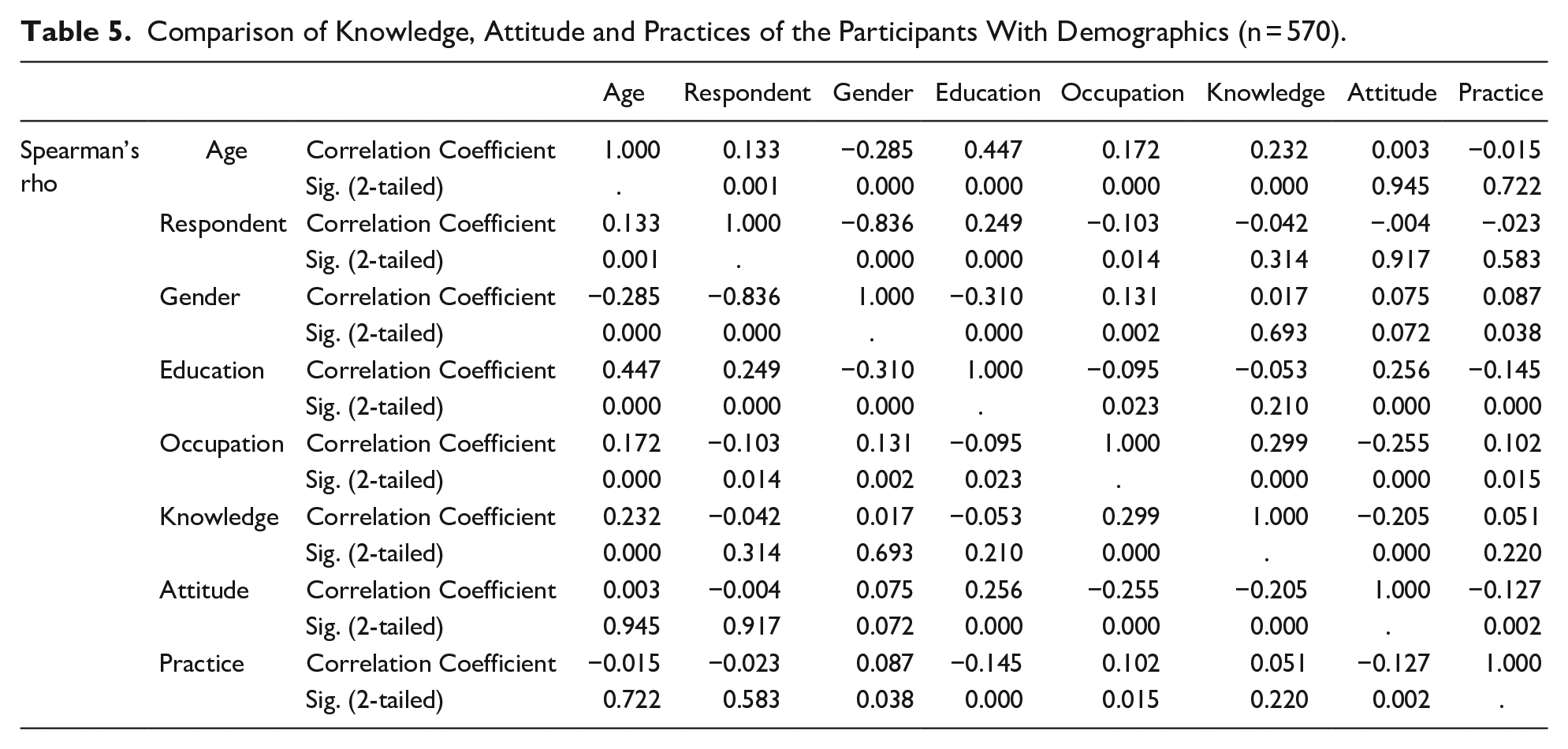
Spearman’s correlation was used to evaluate the association of the knowledge, attitude, and practices of the participants with the demographics. There was a statistically significant association between Age and Knowledge (P-value ≤ .001), Education with Attitude (P-value ≤ .001), and Practices (P-value ≤ .001), Oc-cupation with Knowledge (P-value ≤ .001), Attitude (P-value ≤ .001), and Practices (P-value ≤ .001), and Gender and Practices (P-value = .038) as presented in Table 5.
Comparison of Knowledge, Attitude and Practices of the Participants With Demographics (n = 570).
Discussion
Dental caries is one of the most prevalent diseases worldwide that affects people of every age and gender. For children, parents are the decision-makers when it comes to taking care of oral health. Now, for the parents to make a decision to improve and maintain good oral health of their children, it is of paramount importance that they have sound knowledge of preventive dentistry. In our study, we found that most of the parents are knowledgeable and aware of pits and fissure sealants. However, many parents did not frequently practice the placement of pits and fissure sealants on their children.
Dental caries has been following a declining trend in high-income countries, however, in countries like Pakistan, prevalence is on the rise. 18 In terms of children, some studies have suggested a high frequency of dental caries has been found among school-going children. 19 Many children are not concerned about their oral hygiene, so the decision then falls onto the parents as to what measures they can take for their oral health.
The mean knowledge score of 2.16 suggests moderate level of knowledge of the participants. In our study, we found that most of the participants were aware of the definition of fissure sealers. However, 20% of the participants were not aware of the definition of sealants. This lack of awareness presents a significant opportunity for educational initiatives aimed at improving public knowledge about this preventive dental procedure. For the placement of fissure sealers, most of the participants in our study believed it can be placed on both permanent and deciduous teeth. These are in line with the best practices are fissure sealants can be applied to both deciduous and permanent teeth to prevent dental caries. However, in contrast to these findings, one study reported that more participants in the study did not know on which teeth are fissure sealants placed with only 5.4% participants having acceptable levels of preventive dentistry. 20 Lack of knowledge of such preventive treatments can be one of the primary reasons for it. Furthermore, in our study, most of the respondents believed that 7 to 10 years is the most appropriate age for the placement of fissure sealants. This age range coincides with the period when children typically consume high cariogenic diet and do not pay much attention to oral hygiene. In a study by Munteanu et al they report similar findings as 7 years of age was found to be most appropriate for placement of fissure sealants. 21 Such young age is primarily influenced by the intake of a carbohydrate-rich diet with less attention toward taking of oral hygiene, thereby, being an appropriate age for fissure sealants placement.
Regarding any possible damage to teeth, most participants in our study believed that the placement of fissure sealants does not damage the teeth. Similar results have been reported in a study by Tahani et al where most of the parents believed that fissure sealants do not damage the teeth. 16 However, myths regarding dental treatments have always concerned individuals who, therefore, avoid dental treatment. Concerning the longevity of fissure sealants, most individuals believed that fissure sealants have a short life of 1 to 2 years. Such conclusions have also been stated in a study from a dentist’s perspective where they also believe that fissure sealants have a short life. 22 Therefore, dentists do recommend regular visits of the patients to evaluate the status of fissure sealants and whether they need to be replaced or not.
After the sealants have been placed, most of the parents in our study answered that children now do not need to brush their teeth. These findings contrast with a study by Tahani et al where most of the parents believed that even after the placement of fissure sealants, children should still brush their teeth. 16 Proper oral hygiene practices, including regular brushing, remain crucial for reducing plaque and calculus accumulation, even in the presence of fissure sealants. Moreover, this study reported the knowledge scores were 2.6 ± 2.7 out of 10 regarding pits and fissure sealants for preventing dental caries. 16 Food accumulation still can occur even in the presence of fissure sealants therefore, brushing is required to decrease the accumulation of plaque and calculus. Moreover, after the placement of fissure sealants, most of the participants of our study believed that tooth decay would not occur now. Different studies do report that after the placement of fissure sealants, the chances of developing caries are significantly reduced.23,24 Good oral hygiene habits should still be practiced with regular brushing and visiting a dentist. In a study by Lakshmanan and Gurunathan they reported that 71% of the participants agreed that pits and fissure sealants are effecting in preventing dental caries. 15 Moreover, active carious lesions can also arrest when fissure sealants containing fluoride are placed directly over them. 25 Nevertheless, even after the placement of fissure sealants, children should actively take part in maintaining optimal levels of their oral hygiene by proper brushing regimen.
In our study, most of the parents agreed that fissure sealants should be placed on the teeth of the children to protect them against dental caries. Similarly, in a study by Nair and Singh they found that about two-thirds of parents selected fissure sealants as the best option for protection against dental caries. 26 Placement of fissure sealants is a conservative approach that requires minimum or no preparation on the teeth and offers good longevity in terms of protection against dental caries. 27 However, awareness regarding fissure sealants as a preventive dentistry modality still needs to be addressed, especially in low-middle-income countries focusing on rural areas. Regarding diet, most of the parents in our study considered that children should be careful with their diet even after the placement of fissure sealants. In a study by Damodhar et al they stated that a coarser diet such as consumption of a mixed diet had a poor retention rate of fissure sealants as compared to a softer diet such as consumption of vegetables alone. 28
In this study, it was observed that a great number of parents did have knowledge of fissure sealants. However, the implementation of such preventive measures for their children is needed to be reinforced. Future studies should focus on carrying out large-scale surveys in order to evaluate the knowledge of fissure sealants in other cities of Pakistan among parents. Moreover, studies should also focus on reasons to unravel why some parents were not aware of fissure sealants and why they did not want them to be placed on their children’s teeth.
The strength of our study includes that we constructed and used a well-structured questionnaire to record the responses of the parents. About the limitations of this study, firstly, we used a non-probability convenience sampling method with a small sample size of patients, therefore, is a risk for biasness. Secondly, this study did not investigate the reasons behind parents’ poor dental sealant-related attitude. Lastly, this study focused solely on individuals undergoing fissure sealants and did not include other preventive measures.
Conclusion
This study concludes that parents have sufficient knowledge and positive attitude about the use of fissure sealants in children. However, some parents did not have knowledge about fissure sealants and did not practice the placement of fissure sealants for their children. Therefore, measures should be taken to educate and encourage parents regarding preventive dentistry for their children for better oral health.
Supplemental Material
sj-docx-1-gph-10.1177_2333794X231214090 – Supplemental material for Parental Knowledge, Attitude and Practices Toward Dental Sealants as Preventive Strategy for Dental Caries in Children: A Cross Sectional Study
Supplemental material, sj-docx-1-gph-10.1177_2333794X231214090 for Parental Knowledge, Attitude and Practices Toward Dental Sealants as Preventive Strategy for Dental Caries in Children: A Cross Sectional Study by Ayman Iftikhar, Abhishek Lal, Aimen Imran, Mariam Wasif, Naseer Ahmed and Artak Heboyan in Global Pediatric Health
Footnotes
Acknowledgements
The authors want to take this opportunity to express their appreciation to the patients who agreed to participate in this study. The authors are grateful to the research development and review cell of Altamash Institute of Dental Medicine Karachi, Pakistan, for guidance and support in this study. The authors’ team also oblige the Yerevan State Medical University after Mkhitar Heratsi, Yerevan, Armenia, for supporting this project.
Author Contributions
AI: contributed to conception or design; contributed to acquisition, analysis; drafted the manuscript; gave final approval; Agrees to be accountable for all aspects of work ensuring integrity and accuracy. AL: contributed to conception or design; contributed to acquisition, analysis; drafted the manuscript; gave final approval; Agrees to be accountable for all aspects of work ensuring integrity and accuracy. AI: contributed to conception or design; contributed to acquisition, analysis; drafted the manuscript; gave final approval; Agrees to be accountable for all aspects of work ensuring integrity and accuracy. MW: contributed to conception or design; contributed to acquisition, analysis; drafted the manuscript; gave final approval; Agrees to be accountable for all aspects of work ensuring integrity and accuracy. NA: contributed to conception or design; contributed to acquisition, analysis, interpretation; critically revised the manuscript; gave final approval; Agrees to be accountable for all aspects of work ensuring integrity and accuracy. AH: contributed to conception or design; contributed to interpretation; critically revised the manuscript; gave final approval; Agrees to be accountable for all aspects of work ensuring integrity and accuracy.
Declaration of Conflicting Interests
The author(s) declared no potential conflicts of interest with respect to the research, authorship, and/or publication of this article.
Funding
The author(s) received no financial support for the research, authorship, and/or publication of this article.
Ethics Approval
Ethical approval for this study was obtained from the Ethical and review committee of Altamash Institute of Dental Medicine.
Informed Consent
Informed consent has been obtained.

Supplemental Material
Supplemental material for this article is available online.
References
Supplementary Material
Please find the following supplemental material available below.
For Open Access articles published under a Creative Commons License, all supplemental material carries the same license as the article it is associated with.
For non-Open Access articles published, all supplemental material carries a non-exclusive license, and permission requests for re-use of supplemental material or any part of supplemental material shall be sent directly to the copyright owner as specified in the copyright notice associated with the article.
