




Abstract
This study investigated multi-children parents’ (MCPs) experiences of support in their parental role by participating in parental group for MCPs. Focus group interviews were performed with 20 MCPs consisting of 9 mothers and 11 fathers, with a mean number of children of 2.35 per family. Each interview lasted about 1 hour, and it was analyzed by content analysis method. One theme was revealed: parental group for MCPs gives access to reflection and development on MCP issues. This related to 2 categories: support in the MCPs’ role through internal development and support in the MCPs’ role through external influences. The study’s conclusion highlights the support of MCPs in their parental role by attending a parental group for MCPs and should be offered to achieve empowerment. Clinical implications are that a mix of men and women with different numbers of children of various ages of siblings should compose parental groups for MCPs.
Keywords
Background
When a new child comes to a family, the conditions of that family changes. Parents become multi-children parents (MCPs) when more than 1 child is included within the family. In the phenomenon of becoming an MCP, parents may need support.1,2 The need for support and understanding from the people who are the closest increase when families are in crisis, and families often form this natural support.2,3 Parents value family-focused support, which promotes control and active involvement in decision-making. 4
For most people, becoming a parent is an overwhelming experience, which leads to a change of lifestyle and identity.5-8 These changes are sometimes described as stressful and vulnerable.8-12 The first period in a child’s life is considered the most important phase regarding development. 13 The way the parent manages the first 12 months of parenting affects how the parent develop coping strategies and how they provide care for their child.14,15 The state’s responsibility is to provide parents with assistance in fulfilling this responsibility through access to preventive health care and parental advice. 16 How support systems for families are organized differ all over the world. In addition, the need among parents differ, and parental support programs have to be adapted to the parents that it is intended for and their culture. 13 Early intervention programs and parental support and its benefits has been highlighted.9,11,13,17 Child health care in Sweden is targeted to children from birth to school start, at 6 to 7 years old, and their parents, in supporting to promote children’s health, development, and well-being. 18 Parental support is an activity that is aiming to strengthen the parental role and provides knowledge of children’s health and social development. Parental support is optional and supposed to be available for all parents, and it should be based on the wishes and needs of the parents. Parental groups are one kind of parental support and are available to first-time parents in Sweden. Such groups aim for early health promotion, prevention, and support for parents and children to promote health factors and reduce risk factors. 19 Sometimes child health care organizes parental groups for a specific group such as for the parents of twins, adopted children, or young parents. This varies from different Child Health Care Centers, and the individual staff at such places who initialize such a group. 20 A study in Taiwan reported that a support group for parents of preterm infants who applied empowerment strategies increased the parental level of confidence in performing successful parental roles and using resources to solve child-rearing problems. 21 Since 2002, there are parental groups for MCPs in southwest of Sweden for parents who are about to become or already are MCPs. Participation in a parental group for MCPs may give empowerment to the MCP in their parental role.22,23 Empowerment involves a process of discovering and developing the inherent capacity to be responsible for one’s own life. Human beings become empowered when they have enough knowledge to make sound decisions, enough control and resources to implement their decisions, and enough experience to evaluate the effectiveness of their decisions. 24 When people discover and develop inherent capacity to be responsible for their own life, they are empowered. 25 Reinforcing empowerment improves parents’ ability to perform as a parent, 26 improves family function, 27 supports parents to develop the ability to make healthy choices, 28 helps solve problems in the family, 29 and enables them to take better care of their children’s health. 30 In health promotion, empowerment is described as a process through which people gain greater control over decisions and actions taken that affect their health. 31
Parents described in a study that parental education is an opportunity to exchange experiences with other parents and receive support from other adults. 32 Another study also identified that parents were overall satisfied with the content regarding children’s physical and psychological development. 6 First-time mothers participating in parental education did not seem to be affected in their experience of parental skills but expanded their social network of new parents. 33 First-time mothers who had participated in prenatal classes indicated the need for an improvement in parents’ preparation for parenthood, the importance of including fathers in prenatal education, and that inadequate preparations remain a concern to both women and their partners. 34 Parents participating in prenatal groups could experience support in preparation for giving birth but not for parenthood, 35 and mothers participating in maternity groups expressed that they wanted fellowship and found it important to share experiences with other mothers. 36 Parental groups seem to be popular and have great potential to establish one’s social network. 37 Participation in a parental group was found to be meaningful, enhanced the feeling of safety and security in the parental role, and created a support network. 38 One study found that parents participating in parental education groups gained confidence in themselves as new parents and access to relevant information on childbirth, the transition to parenthood, and on child health development. Plus, the parents developed a social network. 39 Parents reveled that participating in a well-functioning parental education group could be one factor that facilitates the transition to parenthood. 40 Although there are previous studies on parental groups, there is limited knowledge found of their significance of parental support when there is a sibling arriving to the family. The aim of this study was to investigate MCPs’ experiences of support in their parental role by participating in a parental group for MCPs.
Method
Design
The study had a qualitative design with an inductive approach.41,42 Focus group interviews were used to gain knowledge about MCPs’ experiences of support in their parental role by participating in a parental group for MCPs. A semistructured interview guide was used, which gave the moderator freedom to let the MCPs hold a conversation between themselves. 41
Setting and Sample
In this study, a parental group for MCPs was a collaboration between Maternity Care Center, Child Health Care Center, and Open Preschool. Specific goals were to strengthen MCPs in their parental role and increase the opportunities for families to get to know new families and create networks. Main discussion topics in the parental group for MCPs were sibling relations, the new family situation, sleeping habits, parenthood, and children’s development of independence. MCPs in a parental group for MCPs met on 2 occasions before childbirth and on 2 occasions after childbirth. The meetings took place at a Child Health Care Center and/or at the Open Preschool. After 4 group meetings, MCPs could borrow the Open Preschool premises for a few times to meet on their own to facilitate networking. 43
Inclusion criterion in this study was participation in a parental group for MCPs meeting during the calendar year of 2013 or 2015. The periods for data collection were selected considering that the MCPs should have their participation in the parental group for MCPs in the forefront of their mind but also have gained a perspective on their impressions. The years 2013 and 2015 were chosen because this study was carried out in 2 steps, first with the mothers and then with the fathers. The recruitment of MCPs took place during August to September 2014 and October to November 2016. The families were recruited from a region in southwestern Sweden. There were 48 (of 48) families from 2013 and 26 (of 26) men from 2015 who were asked to participate. All MCPs who accepted participation in this study in the 2014 focus group interviews were women. Therefore, the data collection was completed by 11 men in 2016/2017. See Table 1 for the process of selection. For information on the demographics of the MCPs, see Table 2.
Process of Selection.

Demographics of MCPs.
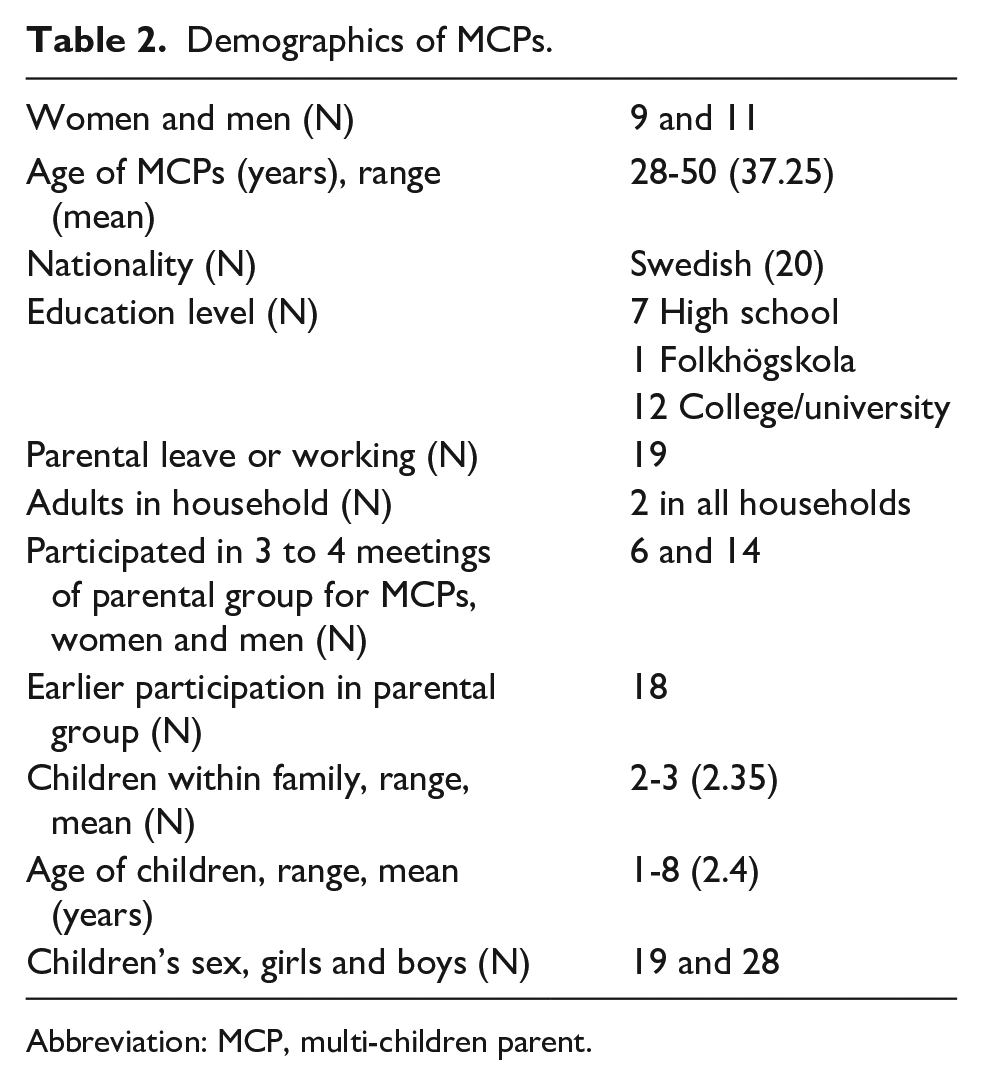
Abbreviation: MCP, multi-children parent.
Out of 74 MCPs, 20 (27%) were recruited for this study. Twenty-six MCPs did not accept participation due to the following: unavailable at the time of a focus group interview (6), not having time at all (11), unknown (5), moved (1), lack of a babysitter (1), excluded due to bias (1), and declined participation (1). MCPs who were not available at the time for the focus group interviews all accepted individual interviews if it would become applicable. Nine MCPs did not show up to scheduled focused group interview due to the following reasons: sickness of child (1), unable (5), personal illness (2), and unknown (2).
Data Collection
In total, 5 focus group interviews were conducted in this study. Two focus group interviews (one group with 6 participants and the other group with 3 participants) were conducted in September 2014, 2 focus group interviews (4 participants in both groups) in November 2016, and 1 focus group interview (3 participants) in January 2017. It was desirable with homogeneous focus groups, which were fulfilled by participation in a parental group for MCPs, and the focus groups were of the same gender. The same moderator (KO) conducted all of the focus group interviews, with one observer in 2014 (VJ) and another in 2016/2017 (SN). The observer checked the time and completed a member check at site. Each focus group interview lasted about 1 hour. The premises of the Open Preschool was chosen for the focus group interviews, since the authors considered the location to be a neutral, undisturbed, familiar, and accessible place for the MCPs and suitable from a recording point of view, which all are important when selecting sites for interviews. 41 The moderator and observer seats were marked in advance, while the MCPs chose seats themselves. The size of the table was chosen according to the size of the focus group, and thereby the distance between the MCPs were approximately the same on the different occasions. The purpose of the study was read out loud by the moderator, and then remained visible on the table throughout the interviews. The moderator kept track of the topic “MCPs experiences of support in their parental role by participating in a parental group for MCPs” as it was discussed. If the conversation drifted, the moderator reminded the group of the aim of the study, and if the conversation dropped, the moderator asked open-ended follow-up questions, for example, “Tell me more about it?” Each participant was asked to give final comments and a brief summary of what was perceived as most essential in the focus group interview. After the member-check, the participants were given the opportunity to make eventual corrections. The audio of all focus group interviews was digitally recorded and then transcribed verbatim.
Data Analysis
The analysis process was performed by using an inductive qualitative content analysis described by Graneheim and Lundman. 44 The focus group interviews were transcribed verbatim and read as a whole a number of times to obtain a holistic sense of the participants’ experiences. Meaning units that responded to the aim of this study were selected and condensed into shorter statements without losing the core meaning. Through reflective and collaborative discussions among the authors (KO and SN), the condensed meaning units were labeled into codes. Each code reflected several condensed meaning units. The codes then formed subcategories and categories that emerged into one theme. See Table 3 for examples of the process of analysis.
Example of the Process of Analysis.
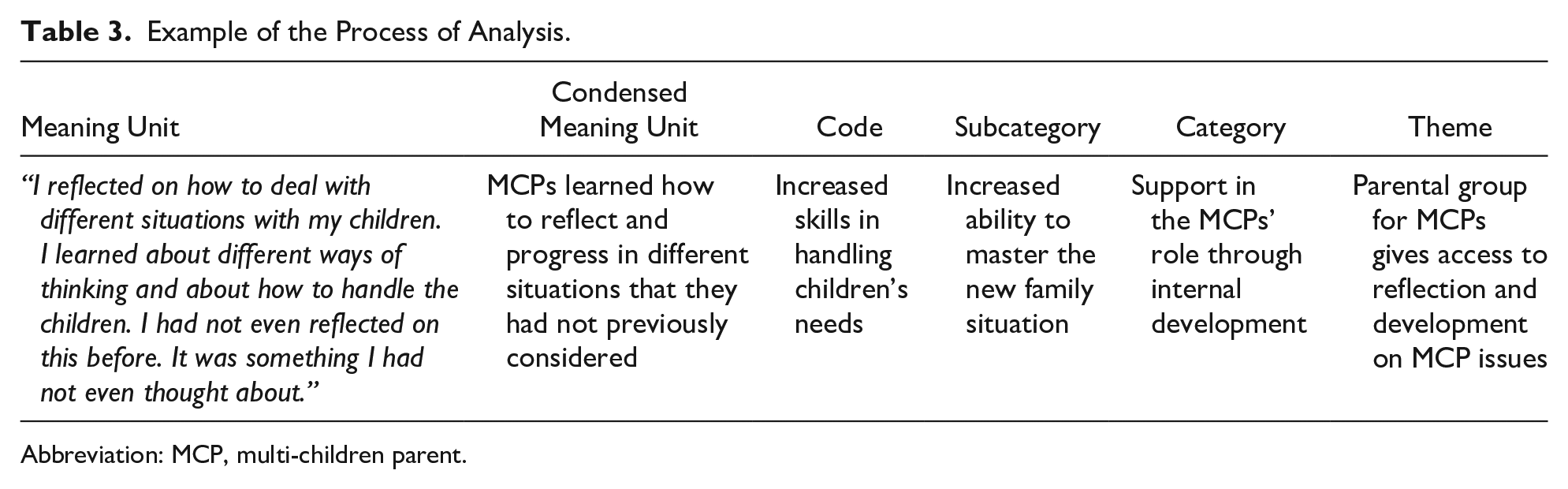
Abbreviation: MCP, multi-children parent.
Ethical Approval and Informed Consent
According to Swedish law, the Research Ethical Review Board’s approval was not required for research carried out within higher education at the advanced level (SFS 2003:460). 45 However, this study was performed according to the World Medical Association Declaration of Helsinki. 46 The research body responsible for this study was the University of Gothenburg, Gothenburg, Sweden. Written consent was obtained from the manager of the open preschool after written information about the study had been given. The participants were given oral and written information about the study and about participation being voluntary, their right to withdraw from the study at any time, and that all information would be treated confidentially according to guidelines of the Ethical Review Board. 47 Written and oral informed consent were obtained prior to focus group interviews from all participants, and all agreed to the digital audio recording of the interviews.
Results
Major Theme
The content analysis of the focus group interviews in this study revealed one theme: Parental group for MCPs gives access to reflection and development on MCP issues. This related to 2 categories and 4 subcategories, as seen in Table 4.
Results.
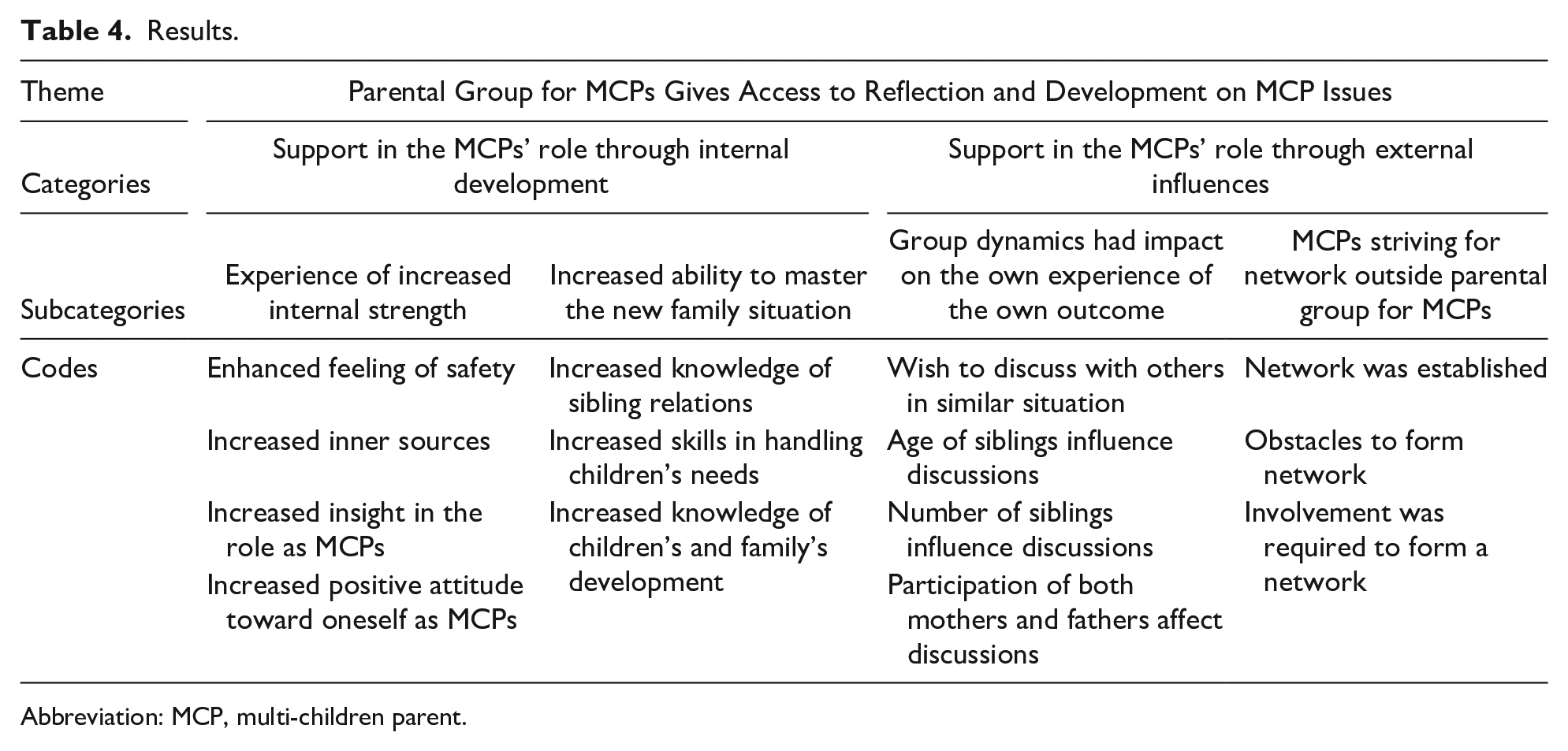
Abbreviation: MCP, multi-children parent.
Support in the MCPs’ Role Through Internal Development
The category support in the MCPs’ role through internal development emerged from 2 subcategories: the experience of increased internal strength and the increased ability to master the new family situation.
Experience of Increased Internal Strength
Participants described an enhanced feeling of safety and inner confidence by participating in a parental group for MCPs. MCPs could enhance their inner resources and experienced insight in their MCP role, and thereby managed this role better. They experienced that their situation was normal and could thereby enhance their positive attitude toward oneself as an MCP. They described that it was a nice sensation to feel normal, to sense that they were not alone in the situation, and to know there were others to turn to.
I felt safe and very calm after the meetings. It was very nice to hear from others that I am not crazy. To feel that I am okay and normal.
Increased Ability to Master the New Family Situation
By participating in a parental group for MCPs, MCPs experienced that they gained more knowledge of sibling relations and the older siblings’ reactions when a new sibling arrived to the family.
From our discussions, I learned how to handle different reactions of the older sibling toward the new sibling. I learned about reactions that the older sibling could have.
The MCPs improved their knowledge about the older siblings’ development and realized that changes must be implemented when the conditions within the family had changed. Thus, they enhanced their capacity and skills to handle different situations regarding the new family situation, which could strengthen them in their actions as MCPs.
The participants got an opportunity to reflect and discuss their own role as an MCP. They developed new ways of thinking, got perspectives, and could reflect on their own actions regarding how they would like to act. By exchanging experiences and discussing with each other, a process started within the MCPs. They could come to their own conclusions and solutions that could strengthen and develop their role as an MCP.
I found my own solution. I started processing and then I could find my own conclusions.
Each one could also inspire each other to dare to try other ways of acting. If only one MCP from the family participated, the conversation and reflection often continued together with the partner outside parental group for MCPs.
The perceived usefulness of a parental group for MCPs varied among participants. Some MCPs expressed that they had not learned enough, not learned anything new, or that their issue had not been discussed, for example, changes in couple relationship. They also expressed a desire to gain more knowledge, and that they wanted to meet when they had a little perspective. There was a suggestion for the parental group for MCPs to continue for a longer period.
I would like to have a meeting when I have come further, when I have landed more in the new family situation. I am facing other problems after some time.
The MCP described that through participation in a parental group for MCPs, they could gain knowledge that could give them support in their parental role and thereby gain increased ability to master the new family situation.
Support in the MCPs’ Role Through External Influences
The category of support in the MCPs’ role through external influences emerged from 2 subcategories: group dynamics had impact on the own experience of the own outcome and MCPs striving for network outside parental groups for MCPs.
Group Dynamics Had Impact on the Own Experience of the Own Outcome
This study revealed that other MCPs in the parental group for MCPs had an impact on how the experience of participating in a parental group for MCPs would play out. MCPs with similar situations experienced greater exchange from each other, and thereby an increased opportunity to develop their own MCP role. The age of the older sibling as well as the number of children within the families had impact on the discussions.
We were 2 MCPs who had siblings, who were a little older than the others. We could discuss our children and our situations. We had a different discussion than other MCP with younger children. The other MCP in the parental group for MCPs could not understand or relate to my situation.
MCPs who had younger children or less children expressed that they had greater exchange from discussions that occurred with MCPs with older children or more children than themselves, as opposed to the other way around. Participants witnessed that dynamics of the group were of importance as were the experiences of support from other MCPs. They talked about the importance of empathy for each other, and that there was a willingness to share experiences with each other. When interaction between the MCP was perceived as enriching, it was easier to discuss, and MCPs had greater exchange of the conversation. This was not always fulfilled.
I had like to become friend with other MCP. I had liked that there were some other MCP in the group whom might have suited me better.
Participants in this study thought that discussions were different if both mothers and fathers participated in the parental group for MCPs. Mothers expressed a lack of participating fathers and had a wish for more fathers to take part. They thought that men also should attend parental groups for MCPs and expressed a lack of fathers’ views regarding the MCPs’ role. Multi-children fathers (MCFs) also expressed a lack of other MCFs in parental groups for MCPs and could sometimes feel alone in the group, especially when sex and intimacy was discussed.
I had appreciated if there were more fathers participating. Maybe just as many as the mothers.
Descriptions that participants in this study gave stated that group dynamics had an impact on the outcomes experienced by the MCPs in a parental group for MCPs.
MCPs Striving for Network Outside Parental Group for MCPs
This study revealed that through participation in a parental group for MCPs, MCPs were given opportunity to discuss, vent, share experiences, and socialize with other MCPs. Participants described that when they had parental leave, they were in need of meeting with other MCPs in the same situation and that new network was formed. They continued to meet in different forms and some acquired long-lasting friendships.
I still hang out with other parents from the parental group for MCPs.
There was a desire from MCPs to form a network, but there were also obstacles to do so, such as lack of time, illness, age difference of the older siblings, lack of commitment, and no need of a new network. MCPs could experience that there was no continued network due to limited involvement of other MCPs in the group, which constituted an obstacle to their own involvement. It could lead to no network and/or a network declining into nothing.
For me, there was no bandwidth left to the social part with other MCP.
Participants witnessed that extra involvement from one or more MCPs was required for networking. In addition, other MCPs were required to engage and participate in the network. There were MCPs who expressed a wish for networks that never arose.
According to results in this study, MCPs were given support in the MCPs’ role through external influences such as other MCPs attending a parental group for MCPs. This interaction with environment and the social processes that arise could be promotive for MCPs in their parental role.
Discussion
Multi-children parents in this study witnessed about enhanced feelings of safety, increased insight regarding their role as an MCP, and increased inner confidence by participating in parental group for MCPs. This led to feeling empowered and gaining internal strength. One study showed that about half the participating parents felt more secure and safe in their parental role by attending a parental group and a few parents felt less safe and secure in their parental role after participating in a parental group. 38 No MCPs in our study felt less safe and secure in their parental role as an MCP.
Participation in a parental group for MCPs made MCPs understand that their new situation resembles that of other MCPs. The participants expressed that they thereby felt normal as MCPs and could be empowered in their parental role. Another study showed that there was a difference in the process of becoming a parent and becoming an MCP, and the strengthening of inner capacity was different but equally important. 37 However, both mothers and fathers could experience stress in different areas in their early parenthood. Mothers experienced more stress in terms of incompetence regarding parenthood, role restriction, spouse relationship problems, and health problems in comparison to fathers. Both first-time fathers and MCFs experienced greater stress in social isolation than mothers. 48 Similar results showed that fathers felt less worried when they had shared their experiences with other members of the parental group, and that both mothers and fathers experienced that being part of a group gave them strength and self-confidence by feeling normal. 35 This study showed that participation in a parental group for MCPs can increase the sense of calmness for both mothers and fathers in their new role as an MCP.
In this study, MCPs described that by attending a parental group for MCPs, they underwent a process of increasing knowledge about sibling relations, increasing skills in handling children’s needs, and increasing their knowledge of child and family development. These new prerequisites gave MCPs an increased ability to master the new family situation. Empowerment is a process where a person recognizes, promotes, and enhances their own ability to meet their needs, solve their problems, and mobilize their resources to get in control of their own situation.28,49 The participants in this study expressed that it was a nice feeling to be able to take control over the new family situation.
If only one MCP from the same family was participating in a parental group for MCPs, the MCP who participated talked to the partner who did not, and that gave reassurance to the nonparticipating MCP and made it easier to master the new family situation together as a whole. When one member of the family is affected, it also affects the other family members. 3 Therefore, the continuing information, discussions, and transformations within the family is important, not only time spent during attending a parental group for MCPs.
In this study, some MCPs missed discussions and support regarding changes in a couple’s relationship within the family. Also in other studies, some parents lacked in-depth discussions about what happens in a couple’s relationship and family life when they underwent the transformation into parents.34,37,40 Parenthood could create a complicated interplay between the parents, which could be stressful. 6 It seems as couple’s relationship is a topic that parents in all kinds of parental groups have missed out of and group leaders need to reflect on and be more open to discuss.
Multi-children parents in this study described that the composition of the parental group was important since it had an impact on the group dynamic, which had an impact on an individual’s own outcome. They wanted to have contact with other MCPs who had similar situations, such as the age of an older sibling or number of children within the family. MCPs need other kinds of information than first-time parents, for instance, MCPs already knew about children’s health but wanted social contacts and discuss with other like-minded parents. 37 Parents suggested more homogenous parental groups with first-time parents and MCPs separately.6,38 Multi-children mothers (MCMs), who had participated in a parental group of mixed first-time parents and MCPs, interpreted that the parental group was a compensation of what they had missed out on before, such as networking and preparation for parenthood. 35 It could be a risk if the parent feels alone and different from other parents in the group. 37 We suggest that MCPs are benefitting from participating in parental groups with other MCPs in order to meet with MCPs in similar situations to continue their development in parenthood.
In this study, MCPs also witnessed the benefits of sharing experiences from other MCPs with more children than themselves. A study revealed that first-time mothers thought it was particularly useful with information from MCM and therefore preferable to mix first-time mothers with MCM in parental groups for mothers. 36 A literature review concluded that it is not realistic that one standardized program in parental education would be satisfying and meeting all different parents’ needs. 50 In another study, nurses thought that they should work more with groups where parents have special needs in common. 32 One example of such a group was the Solihull Approach, which was a parental group for parents of children with common to moderately complex difficulties. 51
Multi-children parents have already faced the challenge of undergoing the transformation into parenthood and could be able to share experiences and give support to first-time parents. This is not likely to work out the other way around. We suggest that it is of interest to MCPs to participate in a group with other MCPs for the benefit of those with more children and/or older siblings than themselves as well as interact with homogeneous group constellations in a parental group for MCPs.
In this study, MCPs wanted mixed-gender groups with the possibility to discuss topics within the gender. In another study, some partners expressed a need for mothers to meet on their own to discuss specific topics, which would be perceived as sensitive if the fathers participated in the discussions. 35 Mothers who had participated in a parental group for only mothers mentioned that there ought to be a similar offer for fathers, 36 and fathers who had participated in a parental group for only fathers found them educational and resulted in their increased involvement. Fathers had their own way of speaking within the group, and discussions continued at home with the mothers. 52 Parents have emphasized the difference between genders and thought it would be preferable with separate groups between genders in order to better prepare the partner for parenthood. 40 From this study, we suggest that in a parental group for MCPs, mixed-gender groups are to be preferred, but within certain topics, for instance, sex and intimacy, it is desirable to discuss within the gender.
In this study, both mothers and fathers expressed a lack of men in parental groups for MCPs. Two other studies found that, in general, mainly mothers participate in parental groups. Both mother and fathers hinted that parental groups are targeted toward mothers and generally not that many fathers participate.34,52 One of these studies also described that partners are committed and support the woman who will give birth and must, therefore, feel included during pregnancy, childbirth, and in meetings with child health care. 52 The other study described that men feel involved in their partner’s pregnancy but feel excluded from visits at maternity centers, parental groups at maternity centers, and available literature on the subject. 34 Another study revealed that the role of the father is not much discussed in parental groups, and mothers are concerned about fathers sharing in the child’s upbringing if it is not discussed. 6 Mothers in this study showed concern about fathers missing out on the opportunity to discuss parenthood together with other MCPs. Fathers who participated in a parental group for MCPs felt included.
This study revealed that the opportunity to interact with other MCPs made it possible for MCPs to affirm each other. Participation in a parental group for MCPs promotes social networking, which is a part of empowering the MCP in their parental role. 25 Other studies with first-time parents or mixed groups with first-time parents and MCPs showed that parents often found that the greatest benefit from parental groups was the opportunity to meet other parents and exchange experiences. They emphasized the importance of support by enabling discussions of their own insecurity with other parents, getting confirmation, and creating contacts.32,36 Meeting other parents and socializing, venting, and discussing with each other is more important than the information received by parent education.39,40 We suggest that support from other MCPs can empower MCPs.
This study revealed that the MCPs continued to socialize outside of their parental group for MCPs, and some MCPs formed long-lasting relationships. Another study revealed that friendship made during parental classes is unique and supports mothers’ mental health and enhances self-efficacy. Becoming friends during sharing experiences that go deep is of significance. 8 Mothers have described a feeling of security to have a social contact that lasts for several years and that is always there. 36 In this study, mainly mothers testified about long-lasting friendships made through participation in parental group for MCPs.
This study revealed that MCFs had a wish for a new opportunity to reconnect with other MCFs, possibly through a continuing parental group for MCPs targeted for MCFs, after about half a year after the baby’s birth because that is when most fathers start their parental leave. 53 MCFs had lost contact with other participating fathers in the parental group for MCPs during this time.
Methodological Considerations
Trustworthiness in this study was achieved by considering credibility, dependability, and transferability. 44 Member-checks took place at the site, and both moderator and observer took part in all focus group interviews. 41 Sampling was based on a purposive selection of participants, which assured that all enrolled had experience participating in a parental group for MCPs as an MCP. The participants remembered their participation in the parental group for MCPs well, and the time of the interviews had no impact of their experiences. Nobody who participated in only 1 or 2 meetings of a parental group for MCPs were included in this study. They may have had different experiences and perceptions than those who participated regularly, a fact that may have implications for potential selection bias. The fact that only 20 out of 74 MCPs (27%) took part in this study may have influenced the result even though saturation was reached after the fifth focus group interview. A fact that may have implications for affecting group dynamics during focus group interviews in this study is that in the first 2 focus group interviews, only women participated, and both the moderator and the observer were women. In the remaining 3 focus group interviews, only men participated, and the moderator was female and the observer was male. On the other hand, the first author (KO) acted as moderator in all interviews, which was favorable for continuity. 44 In 2 focus group interviews, there were 3 participants. This may have influenced the interaction between them. 41 In the process of analysis, the authors have taken into account the awareness of that it is impossible to be completely free from pre-understanding, and that it may have had an impact on the interpretation in the process of analysis. Both authors took part in the process of analysis that could counteract personal bias. Parental groups for MCPs have not changed in terms of staff, content, or location between 2013 and 2015, and this increases dependability in the analysis. Context, selection process, demographic data, data collection, process of analysis, and rich and vigorous presentation of results with quotations are carefully described in this study, and saturation was reached after the fifth focus group interview. This makes the results transferable to similar activities in the same area of activity. 44
Conclusion
This study reveals that parental groups for MCPs gives access to reflection and development on MCP issues. MCPs gain support in their parental role by internal development and external influences. Targeted parental groups for MCPs result in an increased internal strength and increase the ability to master the new family situation. Group dynamics are important for the MCPs’ own outcome, and MCPs striving for network outside parental groups for MCPs could give access to discussions and reflections with others in a similar situation, which could empower MCPs in their parental role. Commitment from participants in parental group for MCPs results in new networks. The results highlight that parental group for MCPs should be offered to MCPs in purpose to support empowerment in their role as MCP.
Based on findings in this study, clinical implications are that mixed groups of men and women with a different number of children and ages of siblings should compose parental groups for MCPs, but at least 2 MCPs in the same parental group for MCPs should have similar family conditions.
Further research that evaluates if parents’ participation in a parental group for MCPs is affecting their children’s health is desirable.
Footnotes
Author Contributions
Both authors took part in the study conception and design, collection and analysis of the interviews and drafting of the manuscript. Both authors read and approved the final manuscript.
Declaration of Conflicting Interests
The author(s) declared no potential conflicts of interest with respect to the research, authorship, and/or publication of this article.
Funding
The author(s) disclosed receipt of the following financial support for the research, authorship, and/or publication of this article: This study was financially supported by the Stiftelsen Sahlgrenskaringens Stipendiefond.
