



Abstract
Objective. To track the BP (blood pressure) trajectory of healthy infants during the first year of life of healthy infants born in Northeast Brazil. Methods. In this cohort study, BP was assessed by oscillometry at the first 24 hours of life and 12 months of age. Results. Systolic blood pressure (SBP) and diastolic blood pressure (DBP) increased with age (P < .001) and were not influenced by gender (SBP: P = .178 and DBP: P = .623) or type of delivery (SBP: P = .827 and DBP: P = .106), when compared between the first 24 hours of life and 12 months of age. Conclusion. The data from the present study increased knowledge about the trajectory of BP during the first year of life. The increase in BP between the first month and the first year of life was not influenced by gender or type of delivery.
Introduction
The transition phase to extrauterine life is characterized by a complex biological process that involves several physiological events, including changes in systolic blood pressure (SBP) and diastolic blood pressure (DBP) levels. 1 Although defining normal blood pressure (BP) during childhood is a challenge, monitoring BP during the neonatal period is an important strategy to assess cardiovascular function.1 -3
Adequate monitoring allows BP classification and provides information to define cardiovascular prognosis and risk factors for deleterious effects in early childhood, such as diabetes, dyslipidemia, and target organ damage.3,4 Children with high BP are 2.1-fold more likely to develop hypertension in adulthood when compared to children with normal BP. 5 The early monitoring of BP, even in the neonatal period, allows therapeutic interventions to be carried out before the development of symptoms, as well as the progression of complications. 6
Despite its importance, BP monitoring performed on an outpatient basis presents difficulties related to the ability to assess the basic components of cardiovascular function, making it difficult to develop adequate treatment strategies. 7
Although blood pressure levels differ between race and ethnic groups and are determined by genetic and environmental factors, 8 few studies have evaluated the distribution of blood pressure levels in Brazilian infants.6,9 Thus, the aim of this study is to follow the BP trajectory of healthy babies during the first year of life.
Materials and Methods
This cohort study was carried out with 42 healthy infants in a university hospital in Northeast of Brazil between April 2018 and December 2019. The study protocol followed the Declaration of Helsinki and was approved by the Research Ethics Committee (number 1.933.952), according to Resolution 466 / 12 of the National Health Council. All parents or legal guardians signed an informed consent form.
Newborns with a gestational age between 37 and 41 weeks, with physical and clinical examinations predicted for their age and without a diagnosis of perinatal asphyxia, were eligible for the study. Gestational age was determined by the first day of last menstrual period or ultrasound performed in the first trimester of pregnancy. Neonates who had heart disease, endocrine alterations, malformations, history of hospitalization in a neonatal intensive care unit after birth, residents far from the city of the maternity hospital, who did not complete the 2 proposed blood pressure assessments, or who were born to mothers who used illicit drugs, who developed preeclampsia or diabetes during pregnancy were excluded from the study.
The sample selection was non-probabilistic and systematic, considering all live births between April 2018 and December 2019 who met the inclusion criteria. In Figure 1, we can see the flowchart of selection of study participants.
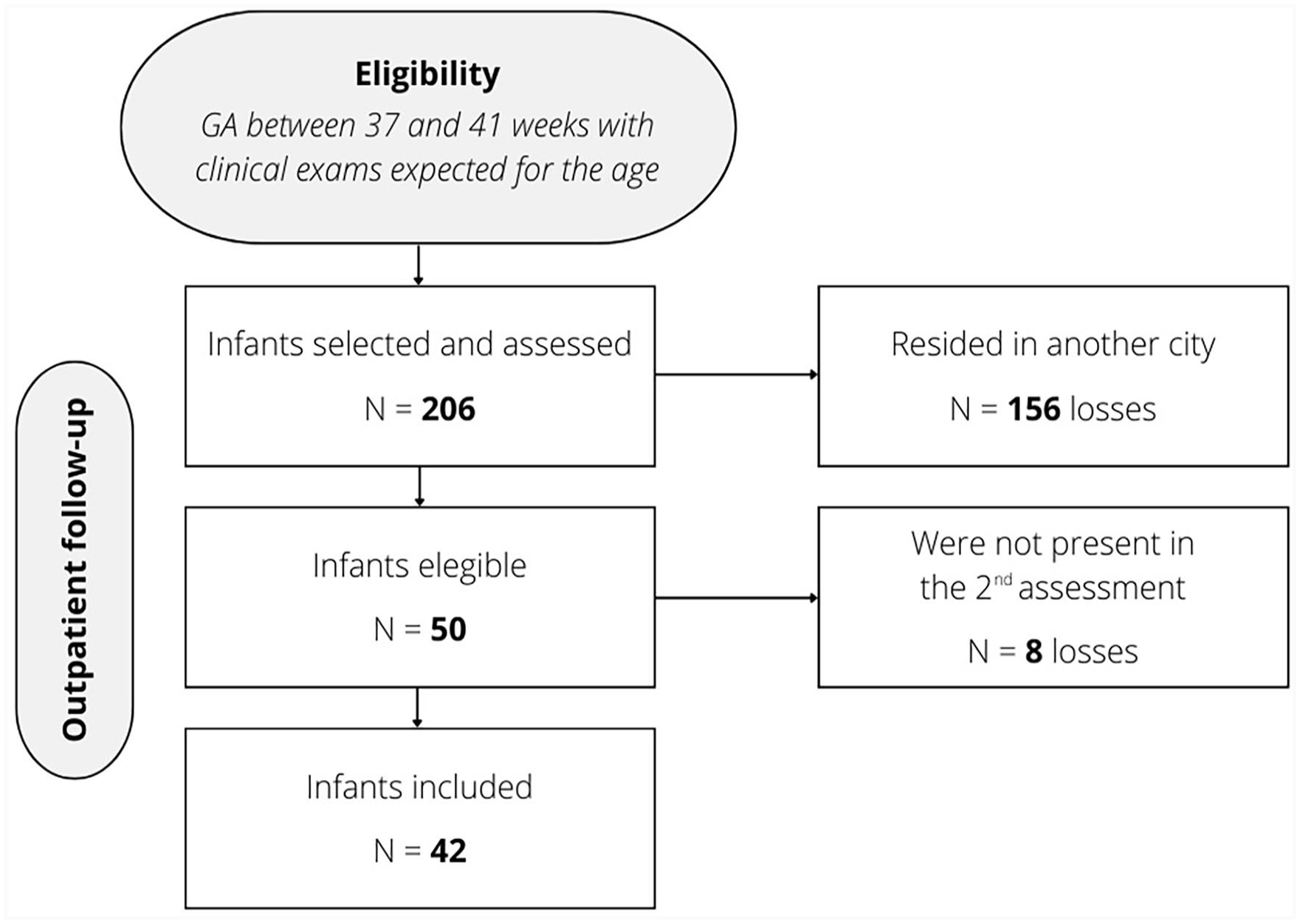
Selection of participants.
Procedures
BP and anthropometric data were evaluated with the infants at rest, accompanied by their mothers on the first day and first year of life. Data regarding the type of delivery and the child’s health were obtained from the child’s health booklet or during an interview with the parents or legal caregivers during the first assessment.
The length of the infants was measured with an infantometer (CARCI®, Brazil, maximum distance: 1 m, accuracy: 5 mm) according to the Brazilian Ministry of Health, 5 and weight status was assessed with them undressed and laid down on an electronic pediatric scale (Welmy® class III®, model 109E, Brazil).
In the first evaluation, BP was measured with a non-invasive multiparametric oscillometric device model (DX2022®). 10 An appropriately sized cuff was placed at the midpoint between the olecranon and acromion of the right upper limb (supported by a surface at heart level) with the infant awake and in the supine position. When the 12 months were completed, they were evaluated in the supine position on a bed inclined at 15° trunk. Cuff size was selected when its width covered at least two-thirds of the baby’s upper limb (distance between the olecranon and acromion) and 80% of the biceps circumference. 2 Three successive BP measurements were automatically performed with 2-minute intervals. The average of 3 measurements was used in the analysis. 2
Data Analysis
Data analysis was performed using SPSS 20. software (SPSS, Inc., Chicago, IL, USA). For quantitative variables and frequencies, descriptive statistics were presented as mean, median and standard deviation, while categorical variables were presented as percentages. Shapiro-Wilk test verified data normality. Wilcoxon test compared BP values between the first day and the first year of life, while Mann-Whitney test compared BP values between genders and type of delivery. A P value less than .05 was considered significant for all statistical analyses.
Results
Of the 206 babies evaluated, 42 met the inclusion criteria and completed both oscillometric assessments (Figure 1). Anthropometric characteristics at birth and variables related to the moment of delivery are shown in Table 1.
Anthropometric Characteristics of the Sample (n = 42).

Abbreviations: M, male; F, female; g, grams; cm, centimeter; SD, standard deviation n: number.
Systolic blood pressure (SBP) and diastolic blood pressure (DBP) increased according to time of life, and their medians were significantly higher in the first year of life compared to the first day of life (P < .001) (Table 2).
Infant Systolic and Diastolic Blood Pressure Values (n = 42).

Abbreviations: SBP, systolic blood pressure; DBP, diastolic blood pressure; mmHg, millimeter of mercury.
Wilcoxon test of systolic and diastolic blood pressure measurements from the first day to the first year of life in boys and girls.
The 10th, 50th, and 90th percentiles of SBP and DBP were not significantly different between genders within the first 24 hours of life (SBP: P = .178 and DBP: P = .623) and first year of life (SAP: P = .571 and DAP: P = .553). Figures 2 and 3 represent the monitoring of systolic and diastolic blood pressure, respectively, through the time.

Systolic blood pressure monitoring in the first year of life.

Diastolic blood pressure monitoring in the first year of life.
The type of delivery (vaginal or cesarean) did not influence BP in the first 24 hours of life (SBP: P = .581 and DBP: P = .617) and 12 months of age (SBP: P = .827 and DBP: P = .106).
Discussion
Our results indicated a significant increase in BP during the first year of life. Similar to our study, Matsouka et al . 6 tracked blood pressure levels during the neonatal period and found increased blood pressure levels during the first month of life. However, the blood pressure levels found in the present study were lower than those in the Brazilian study by Vilarim and Alves, 9 which identified normative blood pressure levels for Brazilian newborns. These findings highlight the importance of establishing adequate reference values for BP during this stage of life. 11
Tracking possible BP changes and trajectories over a prolonged period can identify trends in blood pressure behavior 6 and risk factors. 3 Elevated BP levels during childhood can also predict high BP during adulthood. 12 According to the new update of the childhood hypertension guideline published in 2020, children aged 1 to 13 years have normal systemic blood pressure when they have blood pressure values <90th percentiles. Values of systolic and/or diastolic blood pressure ≥90 th percentiles, which were previously considered to be prehypertensive, are now considered to be high values. 2
Several factors influence blood pressure levels in babies, such as type of delivery, sex and birth weight.11,13 However, in the present study, the type of delivery did not influence blood pressure levels within the first 24 hours after birth and at 12 months of age. In contrast, previous studies suggested that cesarean delivery was associated with low SBP.14 -16 Furthermore, no difference was found between boys and girls in any evaluation performed, probably because gender did not influence the blood pressure of healthy term infants. 17
Oscillometric blood pressure measurement is a challenge in infants as it requires standardization (eg, cuff size and baby position) 18 and is influenced by agitation 4 or crying. 19 Despite these difficulties, our results reinforce the use of non-invasive methods to determine blood pressure levels in childhood.2,5 Nevertheless, studies with methodological rigor investigating the distribution of blood pressure in Brazilian infants are scarce, indicating the need for more research in this population.
Among the limitations of the study, the exclusion of infants who live far from the maternity hospital stands out. Most mothers who attended the hospital were low-income mothers. Previous experiences with low-income families revealed low adherence to outpatient follow-up due to lack of time and money. Therefore, we delimited our inclusion criteria to families residing in the municipality of the maternity hospital. The adherence of families to outpatient follow-up has already been investigated, and several factors were related to the discontinuity of follow-up, such as lack of transport and time.20,21 Future studies should be aware of the factors that lead to the discontinuation of the selected sample.
Conclusion
The data from the present study increased knowledge about the trajectory of BP during the first year of life. The increase in BP between the first month and the first year of life was not influenced by gender or type of delivery.
Footnotes
Author Contributions
All authors contributed substantially to the study design, development and read and approved the final version of the paper. NSOH, MCLC,,CCSX, VAA and AMN, developed the study. SAP, CAM and IGA provided critical insights and reviewed the final version.
Declaration of Conflicting Interests
The author(s) declared no potential conflicts of interest with respect to the research, authorship, and/or publication of this article.
Funding
The author(s) disclosed receipt of the following financial support for the research, authorship, and/or publication of this article: This study was supported by the Coordination of Superior Level Staff Improvement, (CAPES) Grant/Award Number: Code 001.
Ethical Approval
This cohort study was carried out with 42 healthy infants in a university hospital in Northeast of Brazil between April 2018 and December 2019. The study protocol followed the Declaration of Helsinki and was approved by the Research Ethics Committee (number 1 933 952), according to Resolution 466/12 of the National Health Council. All parents or legal guardians signed an informed consent form.
Consent to Participate
All study participants provided their consent through an informed consent form before the enrollment.
