



Abstract
Introduction and Objectives
Hypospadias is a congenital disorder in boys in which the urethral meatus is located on the ventral penis. The incidence rate of hypospadias is increasing, however, there is still no literature regarding how significant is the role of maternal and environmental factors to the risk of hypospadias, especially in Indonesia. This study aims to analyze the maternal and environmental factors during pregnancy to the risk of hypospadias.
Materials and Methods
This study was an analytical observational study with a case control design. The subjects were mothers who gave birth to children with hypospadias, compared to normal, who visited the urology, pediatric-surgery, plastic-surgery, and pediatric clinic at Hasan Sadikin General Hospital.
Results
A total of 120 samples (60 cases and 60 control) were included in this study. There were 14 maternal factors, which 5 of them found significantly correlated with hypospadias, including maternal occupation as an industrial worker (P = .003; OR:4.789), pregnancy-enhancing drugs usage (P = .004; OR: 5.783), smoking consumption (P = .034; OR: 2.294), mosquito-repellant usage (P = .0001; OR: 82.600), and preterm birth (P = .013; OR: 2.895). There were 2 environmental factors, and one of them was significant, which was the distance from home to industrial/rice fields/waste areas, approximately 780 m (P = .0001; OR: 6.102). Based on multivariate analysis, we found that maternal occupation, mosquito repellent usage, and the distance from home to industrial area had a strong relationship in predicting hypospadias occurrence.
Conclusion
Several maternal and environmental factors were found significantly correlated to hypospadias occurrence. Among these, mosquito-repellant usage was found to be the most significant factor.
Introduction
Hypospadias is a congenital disorder in boys in which the urethral meatus is located on the ventral side of the penis.1,2 The penile shape of hypospadias patients is typically curved and is shorter than normal boys. This disorder, if kept uncorrected, would lead to fertility disturbance in the future. 2 This congenital disorder affects 1 in 200 to 300 children in the United States. Its prevalence in Indonesia is still not entirely known. A study from the past 10 years (2010-2019) in the Hasan Sadikin General Hospital found 243 cases of hypospadias. An analysis of prevalence and the tendency of hypospadias found an increase of 0.25 cases per 10 000 births annually. 3
The causative factors of hypospadias are still unknown, although it is known that urinary tract development occurs in the 7th to 16th weeks of gestation and is highly influenced by androgen levels. 4 The etiology of hypospadias is multifactorial including genetical, maternal, placental, fetal, and environmental factors. 5
Maternal factors that might contribute to the incidence of hypospadias, according to the study by Baskin et al 6 and Aschim et al 7 include maternal age during pregnancy, hypertension in pregnancy, smoking history, low folic acid supplementation, and vegetarian diet during pregnancy. Contributing factors during pregnancy such as maternal age, placental insufficiency, and medications during pregnancy have an effect on the increased rate of hypospadias. 8 In addition, hypospadias is also associated with low birth weight, which is correlated with the theory of placental insufficiency as the cause of the increased rate of hypospadias. Placental hCG production insufficiency and androgen receptor disturbances might explain the occurrence of hypospadias. Medications such as valproic acid, loperamide, peroxetin, ibuprofen, and corticosteroids might increase the risk of hypospadias. 8
Environmental factors include the role of endocrine-disrupting chemicals (EDC), particularly anti-androgen, which referred to an exogenous substance that could alter the hormonal balance and cause adverse effects on the organism or the lineage. 9 Most exogenous chemical substances have estrogenic and anti-androgenic effects and may disrupt the balance of androgen/estrogen in a developing male fetus and may affect external genital differentiation. Most of these exogenous chemical substances are lipophilic and might remain in the body fat for years; these agents could be exposed to the fetus through the placenta during pregnancy or in newborns during breastfeeding, eventually affecting the newborn’s health. Most of these chemical substances are man-made, such as the industrial pollutant, pesticides, plastics, and cosmetic products. 10
The incidence rate of hypospadias keeps increasing due to the economic model and lifestyle changes. To date, there is still no literature regarding how significant is the role of maternal and environmental factors to the risk of hypospadias, especially in Indonesia. Therefore, this study aimed to analyze the maternal and environmental factors during pregnancy to the risk of hypospadias.
Methods
This study was an analytical observational study with a case-control approach conducted from April 2021to March 2022. The subjects were mothers who gave birth to children with hypospadias, compared with the control group (mothers who gave birth to a normal child without hypospadias), who visited the urology, pediatric-surgery, plastic-surgery, and pediatric clinic in Hasan Sadikin General Hospital. Sampling was conducted with systematic sampling. Maternal and environmental factors were 2 main factors in causing hypospadias.
The inclusion criteria for the case group include the biological mother of hypospadias patient registered in the urology, pediatric-surgery, plastic-surgery, or pediatric clinic of Hasan Sadikin General Hospital from 2009 to 2022; aged 0 month to 10 years, and; agreed to participate in the study. The inclusion criteria for the control group include the biological mother of the patient at the pediatric clinic from April 2021to March 2022 in the Hasan Sadikin General Hospital, with normal external genitals following examinations; aged 0 month to 10 years, and; agreed to participate in the study. The exclusion criteria include children with other congenital abnormalities. The data were obtained from the urology, pediatric-surgery, and plastic-surgery clinics of Hasan Sadikin General Hospital, while the data from the control group were obtained from the pediatric clinic.
Data analysis was conducted to compare the data in each group. Shapiro-Wilk and Kolmogorov Smirnov, were used in the normality of data. The significance test to compare categorical data was tested with the Chi-square or Fisher tests. Then, for the analysis of presumed risk factors, the authors estimated crude odds ratio (OR) for each exposure, maternal and environmental factors.
The bivariate analysis followed by an analysis to determine the effect or relationship between several independent variables on the dependent variable. The analysis continued with multivariate analysis to find the most influential risk factor. Multivariate analysis is done used binary logistic regression analysis because of the dependent variable is nominally binary. The independent variable included in the logistic regression model is the independent variable where the bivariate analysis has a P-value of less than .25. A P-value < .05 means statistically significant.
Results
A total of 60 mothers with children suffering from hypospadias and 60 mothers with children without hypospadias were included in this study. There were 14 maternal factors in this study, which 5 of them found significantly correlated with hypospadias, including maternal occupation as an industrial worker (P = .003; OR: 4.789), pregnancy-enhancing drugs usage (P = .004; OR: 5.783), smoking consumption (P = .034; OR: 2.294), mosquito-repellant usage (P = .0001; OR: 82.600), and preterm birth (P = .013; OR: 2.895). For the environmental factors, there were 2 factors included in this study, and one of them was significantly correlated to hypospadias, which is the distance from home to industrial/rice fields/waste areas, approximately 780 m (P = .0001; OR: 6.102) as shown in Tables 1 and 2. From this study, we found that mosquito-repellant was the most significant factor in causing hypospadias, which found 68 times more at risk than other factors.
Bivariate Maternal Risk Factors.
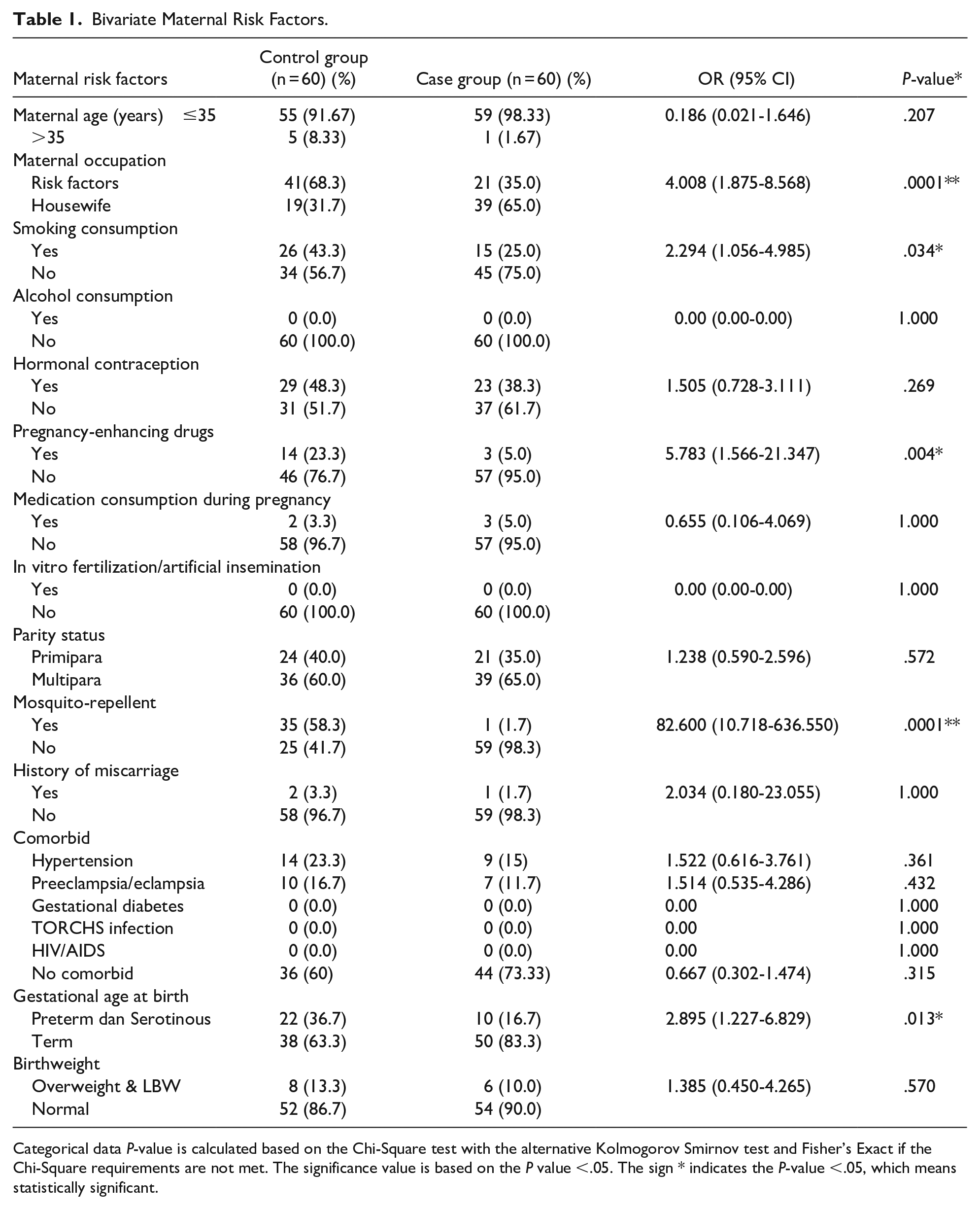
Categorical data P-value is calculated based on the Chi-Square test with the alternative Kolmogorov Smirnov test and Fisher’s Exact if the Chi-Square requirements are not met. The significance value is based on the P value <.05. The sign * indicates the P-value <.05, which means statistically significant.
Bivariate Environmental Risk Factor.

Categorical data P-value is calculated based on the Chi-Square test with the alternative Exact Fisher test if the requirements of the Chi-Square are not met. The significance value is based on the P-value < .05. The * sign indicates the P-value <.05, which means statistically significant.
There are several risk factors that will increase the likeliness of hypospadias in children (Table 3). Mothers who work in the industrial area had the possibility of having children who develop hypospadias by 4.789 times greater than mothers who work as a housewife. Pregnancy-enhancing drugs usage was positively associated with the possibility of hypospadias by 5.783 times greater than the control group. Smoking consumption had the possibility of hypospadias by 2.294 times greater than the control group. A using of mosquito-repellent caused 82.600 times higher risk of hypospadias than the control group. Preterm birth had the possibility of hypospadias by 2.895 times greater than the control group. In mothers who live near the industrial area or rice fields or waste-management areas, the risk of hypospadias was 6.102 times greater than the control group. Among the significant factors (P-value < .05), mosquito-repellent usage had the highest risk of hypospadias occurring in their children (82.600 times greater), followed by distance of house to industrial area (6.102 times greater).
Maternal Risk Factors >2 Variables.
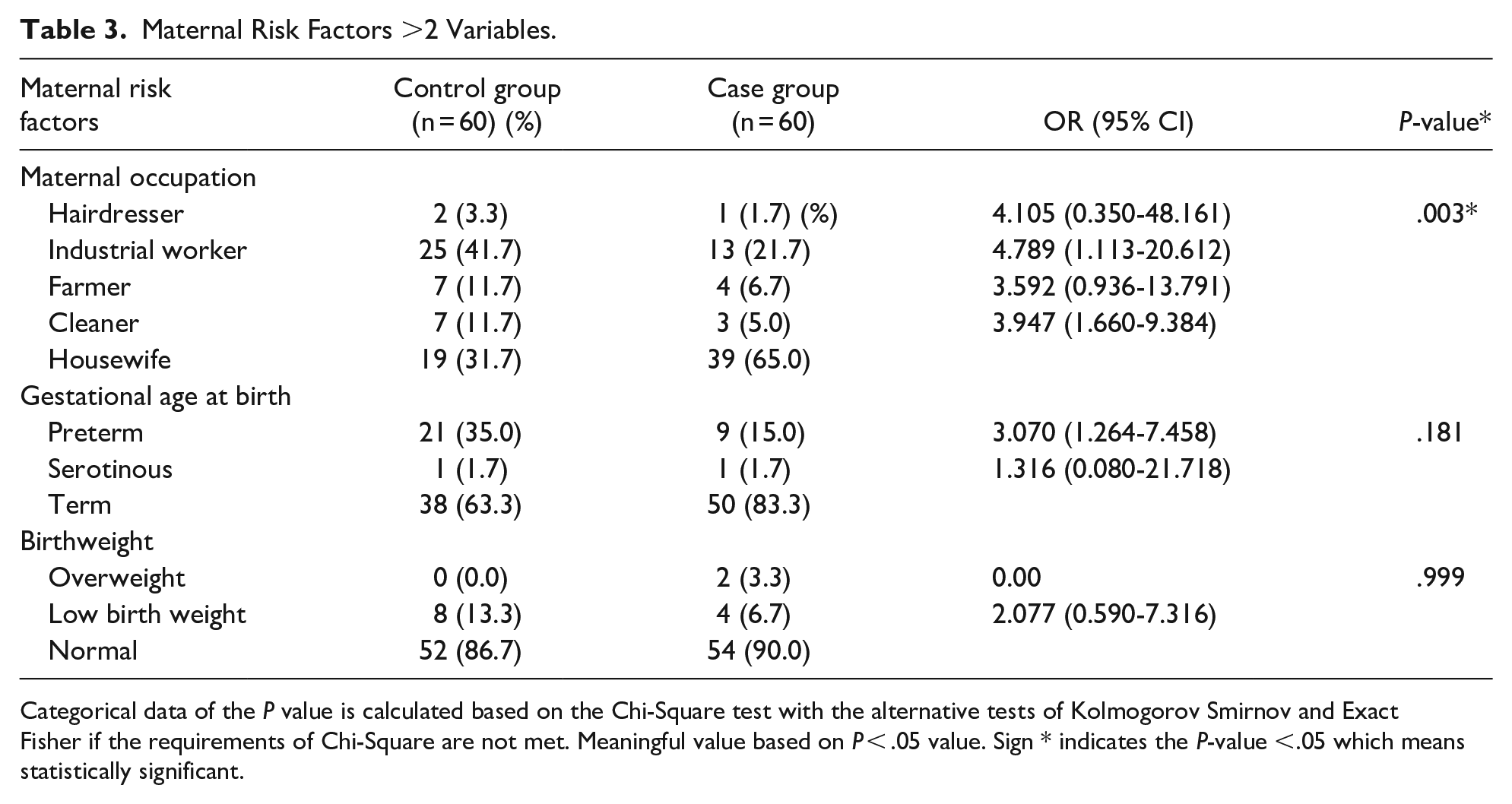
Categorical data of the P value is calculated based on the Chi-Square test with the alternative tests of Kolmogorov Smirnov and Exact Fisher if the requirements of Chi-Square are not met. Meaningful value based on P < .05 value. Sign * indicates the P-value <.05 which means statistically significant.
The results of statistical tests in group above obtained information that the P value of the mother’s occupation variable was less than .05 (P value < .05) which means statistically significant, thus it can be explained that there is a significant difference in proportion between the variables of mother’s work in the group cases and controls. While the P-value on the variables of time of delivery and birth weight is more than .05 (P-value > .05), which means that it is not statistically significant, thus it can be explained that there is no significant difference in proportion between the variables of time of delivery and birthweight in case and control groups.
Maternal occupation was statistically significant as a risk factors of hypospadias. Based on statistic count, we found that the probability of a patient with a mother working as an industrial worker to be affected by Hypospadias is 4.789 times compared to a housewife. We found mothers’ jobs as industrial workers are the most significant risk factors compared to farmers, hairdressers and cleaners.
From the multivariate analysis (Table 4) in the initial model, not all of the P-values of the variables were less than .05 (P < .05). This indicates that simultaneously the overall of maternal age, mother’s occupation, cigarette consumption, pregnancy-enhancing drugs usage, mosquito repellent usage, time of delivery, exposure to cigarettes from the environment and distance from home to the industrial area did not affect the incidence of hypospadias. Based on Final model, it can be concluded that statistically only the maternal occupation, mosquito repellent usage, and the distance from home to industrial area have a strong relationship in predicting the incidence of hypospadias.
Multivariate Analysis.

Multivariate Analysis with Binary logistic regression. The free variable included in the logistic regression model is a free variable which has a value of P < .25 in bivariate analysis.
Discussion
In this study, we found significant maternal risk factors in the incidence of hypospadias, which include maternal occupation during pregnancy, pregnancy-enhancing drugs, smoking consumption during pregnancy, history of mosquito-repellent usage, gestational age at birth, and the distance of patient’s home to industrial/rice fields/waste areas.
According to the literature, maternal age is one of the most influential factors in the incidence of children with hypospadias. A study by Shekar and Avadhani stated that maternal age is significantly associated with the incidence of hypospadias. 11 In addition, a study by Tangkudung et al also suggested a similar result, maternal age during pregnancy is associated with hypospadias, maternal age above 35 years old tends to result in hypospadias 4.17 times higher. 12 This result is in line with the study that a pregnant mother aged above 35 years old with a risk factor of poor placental blood flow due to vasculature stiffness. Hence, the nutritional intake to the fetus was impaired, resulting in fetal growth and metabolic process inhibitions. 13 However, the maternal age during pregnancy in our study was not a significant maternal factor in the incidence of hypospadias since most of our subjects were under 35 years old, with a mean age during pregnancy of 26 years old in the case group and 27 years old in the control group.
In this study, cigarette consumption has a significant effect on the risk of hypospadias. A significantly increased risk of developing hypospadias was also found in fathers who smoked. In previous studies, fathers who smoke have been associated with multiple birth defects and specifically with hypospadias.14,15 This can occur due to passive exposure to the mother, or exposure to active tobacco consumption by the mother can affect offspring by epigenetic effects on germ cells (eg, DNA repair, apoptosis, chromatin structure), whereas exposure to oocytes or embryos to contaminated semen may also has a role in the mechanism of hypospadias. 15 According to Eftekhar et al, exposure to cigarettes during pregnancy will affect fetal development due to some chemical compounds in cigarette smoke such as nicotine and carbon monoxide which interfere with blood flow to the fetus by crossing the placental barrier. 15
In this study, pregnancy-enhancing drugs usage had a significant effect on the incidence of hypospadias. Anti-abortion agents, such as medroxyprogesterone acetate and medications to suppress premature birth (ritodrine and nifedipine), are classified as drugs that might increase the incidence of hypospadias. Our result is consistent with other studies, showing potential etiological effects from several medications in causing cryptorchidism and hypospadias. 16 Furthermore, drugs during pregnancy containing estrogen diethylstilbestrol (DES) will cause disturbances in the formation of urethral organogenesis, especially in the ventral part of the penis. Estrogen and progesterone suppress DHT, causing imperfect external urethral meatus. 17
Similarly, in the usage of mosquito-repellent, our result showed that it has a significant effect on the incidence of hypospadias. A study by Dugas et al found a risk of hypospadias associated with mosquito-repellent exposure. Mosquito-repellent generally contains N-diethyl-m-toluamide (DEET) or permethrin which is toxic in hight dosage and able to cross the blood-placental barrier. A combination of DEET, permethrin, and pyridostigmine bromide in insect-repellent will cause testicular germ cells apoptosis, low birth weight, and hypospadias. 18 In addition, mosquito-repellant might also contain phytoestrogen and corticosteroid substances that prevent the conversion of testosterone into dihydrotestosterone (DHT), which plays a key role in the urethral closure. Substances in the mosquito-repellant also play a role in shortening the period or anogenital organ formation. 19
In this study, the other significant maternal risk factor was the preterm gestational age at birth. The association of hypospadias with LBW and prematurity, from LBR and prematurity univariate analysis, showed an effect in the incidence of hypospadias. Prematurely born babies may indicate growth retardation due to less nutritional intake from the maternal placenta and less hCG production, affecting androgen synthesis, which affects the development of the male genital. 20
The distance of the house, which was relatively close to the industrial area/rice fields/waste area, was also a significant contributing factor in the incidence of hypospadias in this study. Based on studies regarding the effect of pesticides on the increased risk of hypospadias, several stated that a part of the pesticide’s material is associated with increased risk of hypospadias. According to Kalfa et al, 21 fetal exposure to endocrine-disrupting chemicals (EDC) (in this case, pesticides) during pregnancy between the first and third trimesters leads to the birth of a child with hypospadias. 22 A study showed a higher incidence rate of hypospadias in families living near landfills in Europe, and mothers with a history of pesticides exposure have a higher risk of having a child with hypospadias.13,23 Kalfa et al reported an increased incidence of genital development anomalies due to pesticides. Other studies reported that pesticides exposure within a radius of 2600 ft or 780 m might cause cellular injury. If pregnant women are exposed to pesticides within 3 months, especially in the gestational age of week 6 to 16, fetal development can be affected to the point of malignancy. 24 As exogenous chemical substances, industrial pollutants, plastics, pesticides, and cosmetic products have estrogenic and anti-androgenic effects and can disrupt the androgen or estrogen balance in the developing male fetus. It can causes impaired differentiation of the external genitalia. Most of these exogenous chemical substances are lipophilic and remain in the body fat for years; these agents may be exposed to the fetus from the placenta. 10
Conclusion
Maternal and environmental factors were found significantly correlated to hypospadias occurrence. Maternal occupation as an industrial worker, pregnancy-enhancing drugs usage, smoking consumption, mosquito-repellant, and preterm birth were the maternal factors, and the distance from home to industrial/rice fields/waste areas (780 m) was the environmental factors. Among these factors, Mosquito-repellant usage was found to be the most significant factor (68 times) in causing hypospadias.
Footnotes
Author Contributions
SS and JS: conceptualized the study, gave final approval, critically reviewed the manuscript for important intellectual content.
DS: Data collected, drafted the initial manuscript, and revised the manuscript.
All authors approved the final manuscript as submitted and agree to be accountable for all aspects of the work.
Declaration of Conflicting Interests
The author(s) declared no potential conflicts of interest with respect to the research, authorship, and/or publication of this article.
Funding
The author(s) received no financial support for the research, authorship, and/or publication of this article.
