




Abstract
Rapid infant weight gain is a risk factor for later obesity. The objective of this study was to examine primary care pediatricians’ beliefs and practices around rapid infant weight gain. Primary care pediatricians (N = 16) participated in a semi-structured interview about infant growth. Interviews were transcribed, analyzed for themes using the grounded theory and the constant comparative method then reliably coded for the presence of each theme. Three themes were identified, pediatricians (1) are uncertain about the concept, definition, and implications of excessive or rapid infant weight gain (N = 16, 100%), (2) are more comfortable with management of inadequate versus excessive or rapid weight gain (N = 10, 62.5%), and (3) perceive the primary cause of excessive or rapid infant weight gain to be overfeeding (N = 10, 62.5%). In conclusion, pediatricians are uncertain about the concept, definition, management, and long-term risks of rapid infant weight gain. Interventions to increase awareness and pediatrician sense of competence in management of rapid infant weight gain are needed.
Background
Excessive or rapid weight gain in infancy, most often defined as an increase in weight-for-age z-score of >0.67 standard deviations over a period of months, is common, occurring in approximately 20% of United States (US) infants. 1 Rapid weight gain in infancy is a risk factor for later childhood obesity1,2; therefore, prevention efforts have begun focusing on infancy. 3 Primary care pediatricians are crucial to weight gain prevention efforts in early life, 4 as they are in a position to partner with families around the promotion of health behaviors. In the US, general outpatient primary care of infants is typically provided by general pediatricians. In response to the childhood obesity epidemic, the American Academy of Pediatrics (AAP) has put forth guidelines for the primary care pediatrician.4,5 These guidelines recommend “monitoring for infants who gain excessive weight,” but they do not provide specific parameters that define “excessive weight” or how to treat it. 4 This represents a practice shift for the primary care pediatrician, whose foremost concern in previous generations was monitoring for infant growth faltering, or failure to thrive, rather than faster patterns of growth.
It is unclear if primary care pediatricians perceive excessive or rapid infant weight gain as problematic. 6 Excessive or rapid infant weight gain does not necessarily equate to “infant obesity” or a weight-for-age greater than the 95th percentile, 7 but while an infant may not be greater than the 95%ile for age and sex at a single point in time, the trajectory of weight gain puts them at increased risk of later obesity. 8 The systematic screening and identification of infants with excessive or rapid weight gain is important for early obesity prevention efforts. However, a widely accepted definition of rapid infant weight gain is lacking, 9 particularly the timeframe over which weight gain should be assessed, making the task of identifying these infants even more challenging. Understanding the beliefs and practices of pediatricians around excessive or rapid infant weight gain is important to identify critical shortcomings in guidelines and electronic medical record systems, which may be allowing these infants to go unrecognized, thereby missing important opportunities to intervene on early warning signs of obesity. Therefore, the objective of this study was to qualitatively identify, in a locally representative sample of primary care pediatricians, their beliefs and practices around excessive or rapid infant weight gain.
Methods
Participants and Recruitment
Primary care pediatricians from Southeastern Michigan were invited to participate in a semi-structured interview which was described as “seeking to understand physician perceptions and practices around infant growth.” The convenience sample was recruited via email sent to the listservs of local primary care pediatricians affiliated with 2 health systems which included approximately 120 general pediatricians. Inclusion criteria were being a primary care pediatrician who had completed residency training, ability to communicate comfortably in English, seeing infants “regularly” in their practice, and working within an hour radius of the study site for interviewer travel. Two sets of emails were sent out, with a total of 17 responses. One potential participant was lost to follow up and did not complete data collection. Recruitment efforts were stopped after interviews became saturated (as described below). Participants were compensated $50 for their time.
Ethical Approval and Informed Consent
The Institutional Review Board approved this study as being exempt (HUM00160745). Each participant was given a letter from the study team discussing the risks and benefits of the study.
Measures
Participants completed a questionnaire reporting demographic and practice characteristics: age, gender, race, ethnicity, status as a parent (yes vs no), medical degree, number of years in practice, current professional employment status, practice type, number of infant well-child exams performed weekly, and percentage of their population covered by Medicaid (public insurance).
Semi-Structured Interview
Pediatricians completed a semi-structured interview, which was developed by the study team, and piloted with a convenience sample of 3 pediatricians. The script (Table 1) was informed by infant growth monitoring and early obesity prevention guidelines.4,10,11 The study visit was completed by 1 of 3 female interviewers (KA, KL, and a research assistant who did not meet criteria for authorship, MQ) with female gender identity, who held either Masters or Doctor of Medicine degrees, and were completing their medical training in a pediatric subspecialty fellowship (KL, MQ) or in their final year of medical school (KA). Two of the interviewers had prior experience in conducting semi-structured interviews. All interviewers underwent training by a study team member (MP), as we have done in our prior work,12,13 to administer the interview in a standard neutral manner, and to avoid leading responses. Interviewers most often had not previously met or did not have an established relationship with the participants (13/16). Three participants had previously encountered their interviewer in a patient care or educational context in which they had not worked closely together. The interviewers introduced themselves in their present role (fellow or medical student) and described the purpose of the interview as “wanting to learn more about how primary care pediatricians manage infant growth.” Interviews were conducted in a quiet and private area of the participant’s choosing, most often their office with no one else present. The interviews were audio-recorded, and later transcribed verbatim. Interviews were continued until they were deemed to be saturated in response patterns by the study team. 14
Semi-structured interview questions.

Analysis
Univariate statistics were calculated to describe the sample.
Qualitative analysis was undertaken by 3 readers from the study team who independently read the interview transcripts and generated themes using grounded theory and the constant comparative method, 14 as we have done in prior work.12,15,16 Over a series of group meetings, readers discussed and refined the themes to reflect the most coherent, salient, and saturated final themes and to analyze deviant cases. Five themes were initially identified, however 2 were found to be not pertinent to the research question, as they have previously been well described in the literature. These 2 themes were: (1) pediatricians use growth curves to monitor growth and educate parents about infant growth,17-19 and (2) parents, especially breastfeeding mothers, are concerned about insufficient weight gain in their infant.20-22 Once the final themes were identified, coding schemes were developed to categorize each theme as being present versus not present in each participant’s interview. Two coders (MP and KO) independently applied the coding schemes to 20% of the transcripts, and reliability was established (Cohen’s kappa >0.7). The coding scheme was then independently applied to the remainder of the interview transcripts.
Results
Descriptive statistics of the sample are provided in Table 2. Participants were on average 42 years (range 31-63 years), the majority were female (69%), and were parents themselves (94%). Most physicians self-identified as white race (75%) and non-Hispanic ethnicity (94%). All participants were a Doctor of Medicine and had been in practice on average 13 years (SD 11.2, range 2-34 years). Most physicians practiced in a hospital or health system setting (69%), and the majority saw more than 6 infants each week for well-child visits (88%).
Participant demographics and practice characteristics (N = 16).

Three salient themes and some subthemes were identified through qualitative analysis. Themes are presented below and with illustrative quotes in Table 3.
Quotes illustrative of themes.
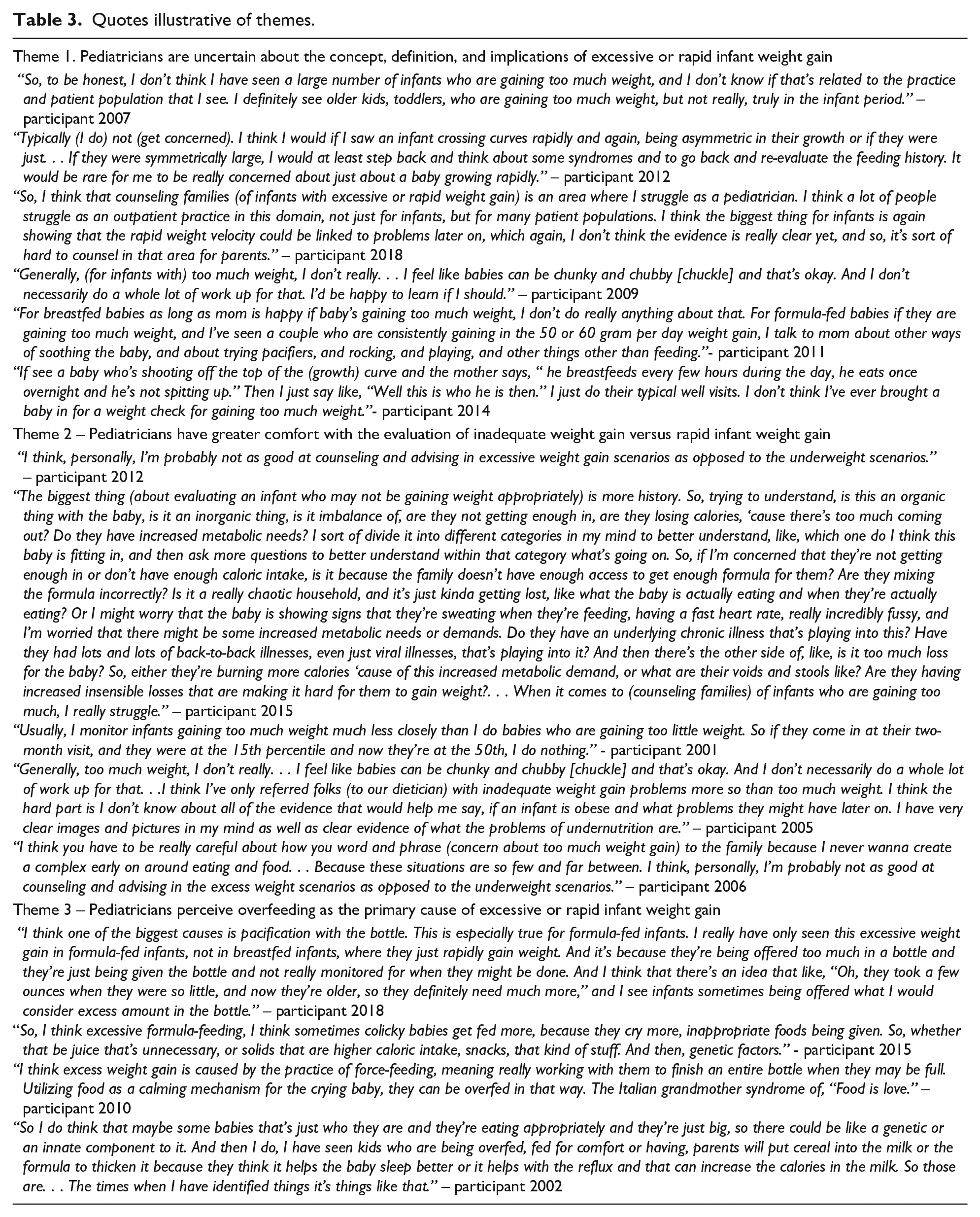
Theme 1: Pediatricians are Uncertain About the Concept, Definition, and Implications of Excessive or Rapid Infant Weight Gain (n = 16, 100%)
Many pediatricians reported that they were unsure if they believed in the concept of excessive or rapid weight gain in infancy. Most described seeing it rarely in their practice, and could only recall a few cases. Some described that the current evidence on excessive or rapid infant weight gain was not compelling enough to be concerned about it, and others stated that they were not aware of any literature. Only 2 pediatricians mentioned seeing excessive or rapid infant weight gain frequently in their practice. Most were uncertain about their belief in the concept of “infant obesity,” with many expressing concerns that labeling an infant as obese, overweight or having excessive or rapid infant weight gain may lead to stigma, be distressing to families, and have negative connotations.
All pediatricians had difficulty defining rapid infant weight gain. Many described “crossing percentile lines,” but did not give a specific time frame, z-score change or weight gain amount. Others described knowing it when they see it on the growth chart and also by examining the patient. A few described it as a trajectory of weight gain that crossed above the 95%ile, but did not discuss a time frame or a starting point for that weight gain. Others described a weight gain of greater than 45 g per day in the first 2 months of life as excessive. None of the pediatricians mentioned rapid infant weight gain in terms of weight-for-age z-scores.
Some pediatricians were unsure or doubtful that steeper infant growth trajectories were associated with later childhood growth trajectories or adult outcomes. While a few suspected excessive or rapid weight gain in infancy to be associated with increased risk of childhood obesity and later adverse outcomes, others discussed that they did not worry about excessive weight gain in infants because of the belief that they would “settle out” eventually. Some described the potential consequences of infant overweight or rapid weight gain to be different than adult outcomes of excess weight, such as cardiovascular disease and metabolic syndrome.
Theme 2: Pediatricians have Greater Comfort with the Evaluation of Inadequate Weight Gain Versus Excessive or Rapid Weight Gain (n = 10, 62.5%)
Pediatricians expressed more confidence in their ability to diagnose and evaluate insufficient weight gain versus excessive or rapid weight gain. Many described increased concern about infants with insufficient weight gain. A handful of pediatricians described adequate weight gain in the first few weeks of life as 20 to 30 g per day. Almost all described a detailed evaluation and management plan for an infant with insufficient weight gain. For instance, that they would take a detailed feeding history, evaluate milk transfer if breastfeeding, have infants come back for additional visits for weight checks, and consider referrals if indicated (eg, Occupational Therapy, Lactation, Endocrinology). Pediatricians described seeing infants who struggled with insufficient weight gain frequently in their practices. They also described that they often worry about these infants and as a result follow them more closely.
On the other hand, many pediatricians expressed that they were uncomfortable counseling parents of infants with excessive or rapid infant weight gain, especially breastfed babies, as they were thought to self-regulate better than bottle or formula fed babies. In addition to lacking parameters, they felt that they did not know what evaluation steps to take unless an infant was “off the charts” and there was concern for an endocrine or genetic issue, such as Prader-Willi syndrome. They described taking an in depth feeding history, then counseling parents about following the infant’s hunger and satiety cues, not feeding to soothe, and about appropriate formula mixing. Few described having the infant return for additional visits for weight checks, or a referral to a dietician. Most spoke about management of rapid infant weight gain with uncertainty, and relatively unelaborated answers in comparison to the management of insufficient weight gain, for which their answers were confident and elaborated.
Theme 3: Pediatricians Perceive Overfeeding as the Primary Cause of Excessive or Rapid Infant Weight Gain (n = 10, 62.5%)
Most pediatricians attributed excessive or rapid infant weight gain to overfeeding. Specifically, they noted that parents may not be reading the infant’s hunger and satiety cues appropriately, and therefore are feeding the baby “whenever they cry.” Others discussed using feeding to soothe an infant, thereby leading to excessive caloric consumption. Others discussed families putting rice cereal in a bottle to increase caloric density with the hopes of getting an infant to sleep longer at night, or giving excessive volumes. They discussed that older infants, may be provided with foods that are energy-dense, rather than a well-balanced diet. Pediatricians discussed the infancy period as a time to set up good “lifelong habits” for eating and feeding. Participants most often discussed overfeeding only in terms of milk feeding (breast milk or formula), but sometimes also mentioned feeding highly palatable solid foods to older infants (ie, crackers) to calm them at times.
Pediatricians less often mentioned other possible causes of excessive or rapid infant weight gain. A few noted that cultural expectations and ideals can influence a family’s feeding behaviors, especially the notion that a “chubby baby” is a healthy baby, or that parents aimed to have a baby “at the top of the charts,” thinking that the 99th percentile was equivalent to an “A+.” Some physicians also mentioned genetics as a contributing factor to the infant’s growth trends, in particular that having “big” parents may increase an infant’s risk for being large in general. Some discussed psychosocial stressors (ie, single parent status, concerns for food insecurity) as being closely tied to feeding behaviors, and using this as an opportunity to educate parents around healthy feeding habits.
Discussion
This qualitative study of pediatrician’s beliefs and practices around infant growth identified 3 salient themes around the subject of excessive or rapid infant weight gain. To our knowledge this is the first qualitative study to investigate pediatricians’ beliefs and practices around infant growth to uncover insights about rapid infant weight gain. Pediatricians in this study were uncertain about the concept, or diagnosis of excessive or rapid infant weight gain, and expressed greater comfort and confidence in the management of inadequate weight gain compared to excessive weight gain in infancy. Lastly, pediatricians in this study primarily attributed excessive or rapid infant weight gain to overfeeding.
With regard to the theme of pediatrician uncertainty about the concept and diagnosis of excessive or rapid infant weight gain, this theme echoes work done in the United Kingdom with health care providers around the prevention of obesity starting in infancy. 23 Primary care pediatricians in general may be under-informed about this diagnosis for several reasons. First, as previously mentioned, the AAP 4 lacks guidance around the definition of rapid infant weight gain. While the research literature has robustly described complex risk factors for rapid infant weight gain over the last 20 years (ie, lower socioeconomic status, underrepresented race/ethnicity, first born children),1,2,24-26 as well as risks of rapid infant weight gain (ie, cardiovascular disease, as well as child and adult obesity),27-29 this knowledge has not been adequately translated for clinical practice. Participants in our study expressed an interest in learning more about excessive infant weight gain. Without sufficient educational initiatives and guidelines for pediatricians around the diagnosis of excessive or rapid weight gain in infancy, it is unlikely that this can be reasonably incorporated into clinical practice. Furthermore, there lacks a standardized definition and specific parameters that define “excessive weight” or rapid infant weight gain, leaving pediatricians to rely on “eyeballing” growth charts to determine who may be at risk. Even in the research literature, multiple definitions of rapid infant weight gain are used, 9 many of which use a measure of increase in standard deviation in weight-for-age z-score on the WHO growth chart over a certain period of time, is impractical for a busy pediatrician to calculate during a visit. A clear working definition of excessive or rapid infant weight gain is necessary for the translation of research into practice. This may be a prime opportunity to harness the electronic health record to calculate the infant’s change in weight-for-age z-score from one well visit to another, and populate this along with the vital signs, akin to body mass index z-score percentile in older children. Future studies should investigate the feasibility and impact of providing pediatricians with a straightforward way to recognize rapid weight gain in infancy, as related to clinical practices and confidence.
With regard to the theme that pediatricians are more comfortable with the diagnosis and management of insufficient (vs excessive) weight gain in infancy, this may align with the emphasis on insufficient weight gain in pediatric training. Multiple practical and detailed guidelines exist around the diagnosis and work up of insufficient weight gain in infancy, or growth faltering.30-33 This is likely because insufficient weight gain can pose an immediate threat to the infant’s health; or represent a potentially life-threatening underlying issue. Infants are frequently admitted to the hospital for work-up of insufficient weight gain or growth faltering; 34 however it is likely only in the most extreme cases that infants are hospitalized for excessive weight gain. Thus, management of insufficient weight gain is part of “bread and butter” pediatrics training, whereas rapid infant weight gain may be overlooked. While excessive or rapid infant weight gain may not pose an immediate threat to an infant’s health and well-being, the long term consequences can be concerning including increased risk of adiposity, cardiovascular disease and obesity.28,35,36 Management strategies for excessive or rapid infant weight gain proposed by the AAP 4 and American Heart Association 11 include taking a detailed feeding history, assessing infant’s sleep patterns, encouraging breastfeeding, assessing family food literacy, referring to a dietician, and monitoring with frequent weight checks, yet few of these are evidence-based. Additionally, these resources are not widely available to primary care pediatricians, and are buried in guidelines around childhood obesity prevention. Given the ongoing epidemic of childhood obesity, a practice shift towards greater concern for rapid infant weight gain could have a significant impact of children’s long-term health outcomes. Primary care pediatricians may benefit from straightforward and practical guidelines around the primary prevention of obesity starting in infancy. Additional availability of dieticians specializing in responsive infant feeding practices are also needed. The Pregnancy and Birth to 24 Months project guidelines from the United States Department of Agriculture, 37 expected to be published in 2020, will include important dietary guidance for infants, which will be helpful for pediatric healthcare providers. Primary care pediatricians may also support developmentally appropriate active play and movement, including tummy time, through parent education which may be important to mitigate excessive weight gain in infancy and later in childhood38,39-41 Promoting early gross motor development may set the stage for on-going engagement in physical activity throughout childhood. Further community and healthcare resources to support physical activity in infants are necessary.
Pediatricians in this study also perceived over-feeding as a primary cause of excessive and rapid infant weight gain. They felt that parents may not accurately read infants’ feeding cues, and may feed babies to soothe them, resulting in increased caloric consumption. Parenting behaviors that may lead to rapid infant weight gain, including overfeeding, have been the target of several behavioral intervention studies.3,42-44 These are rooted in theory that increased parental ability to read their infant’s hunger and satiety cues, may provide the scaffolding for infants to build additional self-regulation skills. 45 For example, feeding to schedule, which may result in overfeeding, is associated with increased weight gain in the first months of life. 26 A recent randomized controlled trial, 3 that used a multi-component intervention including education about responsive parenting techniques across domains (infant feeding, sleep, emotional regulation) found a decreased incidence of rapid infant weight gain at 6 months and lower risk of overweight at 12 months in the intervention group. However, other work by Lakshman et. al described an intervention aimed at limiting excessive formula intake, in an effort to encourage responsive feeding, which was successful at slowing weight gain up until 6 months of age; however, this was not sustained beyond the intervention and did not significantly reduce rapid infant weight gain in the first year of life. 42 Other modifiable and non-modifiable risk factors for rapid infant weight gain have also been described, however much of the literature remains conflicting1,8,9,46,47 For example, exclusive breastfeeding (vs bottle or formula feeding) has been associated with decreased44,48 and increased 49 odds of rapid weight gain. Other work examining formula composition has found an association between formula type, particularly protein content, and risk of rapid weight gain,9,47,50 irrespective of feeding behaviors. 51 These works suggest that the contributors to rapid infant weight gain are likely complex and multifactorial, and may or may not include overfeeding alone. Education around modifiable risk factors for the prevention of rapid infant weight gain should ideally begin in the prenatal period, and continue throughout infancy, although more research in this area is needed to disentangle possible contributors to rapid weight gain. In order for health care providers to deliver this education, they must first be educated themselves with clear evidence-based guidelines, parameters and policy statements from key stakeholder organizations, which at present are lacking.
Strengths of this study include the relatively diverse sample of primary care pediatricians and the in-depth qualitative nature of the data. Study results may not be applicable to other pediatric health care providers in other geographic areas. In addition, the skewed distribution of our results did not allow for correlations between participant characteristics and themes identified. Future work should examine whether pediatrician characteristics (eg, years in practice, practice demographic composition) may be associated with beliefs and practices around infant growth.
Conclusions
Pediatricians in this study expressed uncertainty about the concept, diagnosis, and management of excessive or rapid weight gain in infancy. While behavioral interventions around responsive parenting have been found to decrease risk of rapid infant weight gain, there is a lack of educational opportunities for primary care pediatricians. In order to help parents develop responsive parenting skills, pediatricians may need additional educational opportunities and guidelines about rapid infant weight gain, which are currently lacking.
Footnotes
Author Contributions
MP conceptualized, designed the study, drafted the initial manuscript and reviewed and revised the manuscript. KL participated in conception of the study, data collection, and revised the manuscript. PD and KO participated in data analysis and interpretations, and reviewed and revised the final manuscript. All authors approved the final manuscript as submitted and agree to be accountable for all aspects of the work.
Declaration of Conflicting Interests
The author(s) declared no potential conflicts of interest with respect to the research, authorship, and/or publication of this article.
Funding
The author(s) disclosed receipt of the following financial support for the research, authorship, and/or publication of this article: This work was supported by the American Heart Association (17F17FTF33630183), and the Charles Woodson Research Fund at the University of Michigan. The funding sources did not have any role in the study design, data collection, analysis or interpretation of data, the writing of this report or the decision to submit the article for publication.
