



Abstract
Background: The Coronavirus Disease 2019 (COVID-19) pandemic remains serious public issue. COVID-19 vaccine is a vital strategy to prevent this critical pandemic. However, unwillingness to take this vaccine are key barriers to manage the COVID-19 pandemic. The control of this pandemic will depend principally on the people acceptance of COVID-19 vaccine. Therefore, this systematic review and meta-analysis was intended to determine the acceptance rate toward COVID-19 vaccine in Africa. Methods: African Journals OnLine, PubMed, Cochrane Review, HINARI, EMBASE, Google Scholar, Web of Science, and Scopus were used to retrieve related articles. The Preferred Reporting Items for Systematic Review and Meta-Analysis (PRISMA) guidelines were used for this study. Random-effect model, a funnel plot, Egger’s test, I2 statistic, subgroup analysis was done. The study was performed by using a STATA version 11 statistical software. Results: A total of 22 studies with 33,912 study participants were included in this systematic review and meta-analysis. From this finding, the pooled prevalence of acceptance toward COVID-19 vaccine among adults in Africa was 48.93% (95% CI: [39.49, 58.37]). The subgroup analysis revealed that the pooled prevalence of COVID-19 vaccine acceptance among adults in Africa was highest (66.03%, 95% CI [62.84, 69.22]) in Southern Africa, and Lowest (24.28%, 95% CI [3.26, 45.30]) in Northern Africa. Conclusion: This study showed that the estimate of the pooled prevalence of acceptance toward COVID-19 vaccine among adults in Africa was very low. All concerned bodies should be actively involved to improve the acceptance rate of COVID-19 vaccine.
Introductions
The COVID-19 remains a worldwide challenge, 1 since it has been declared by the WHO as a pandemic. 2 It has been stated to be a global community health emergency. 3 It has affected all individuals over all nations, and continents. 4 It has led to substantial morbidity and mortality.5,6 There is also an extensive economic crisis in addition to considerable deaths and morbidity related to this pandemic. 7 COVID 19 has spread quickly in Africa and worldwide. Different measures have been applied across countries and this caused a secondary social and economic effect on children and their households. 8 The pandemic has deteriorated mental health in families with children <18. 9 COVID-19 has also devastatingly influenced children’s development worldwide. 10 It is also substantially interrupted child vaccination. 11 It is a major mental health issue of the population, 12 which has an enormous impact on youth mental health. 13 It has a significant stress on healthcare systems, patients, and healthcare workers. 14 Moreover, the COVID-19 pandemic’s influences tuberculosis (TB) or human immunodeficiency virus (HIV) treatment and prevention services significantly. 15
The COVID-19 pandemic is a vast encounter and put a substantial problem on the African continent. 16 This burden requires urgent measures to control globally. 17 COVID-19 may put a considerable burden on the poor and vulnerable populations. 7 Initially, due to the lack of a COVID-19 vaccine, different prevention strategies were employed worldwide. 18 Several measures are being applied by African’s which include limits on large gatherings, travel bans, school closures, augmented testing, and country lockdown. 7 However, the pandemic is continuing its burden worldwide. Thus, when a safe and effective vaccine is available, the government should be equipped to distribute a COVID-19 vaccine with opportunity for equitable access. 19 The willingness for COVID-19 vaccination is found to be determined by information about vaccine efficacy, individual variety, and vaccine development. 20 There is a debate concerning the safety and efficacy of COVID-19 vaccines and this may lead to low vaccination rates. 21 Despite researchers working speedily and collaboratively for the development of vaccine, the need of the population for a COVID-19 vaccine might be delayed by vaccine hesitancy. 22 The COVID-19 response and the community health benefits’ of an effective vaccine might be determined by the individuals unwillingness for this vaccine. 23 Moreover, vaccine hesitancy may challenge the actual effectiveness of COVID-19 vaccine. 24 Only a low percent of the parents had accepted to vaccine their children against COVID-19. 25 Additionally, many parents are not willing to enroll their child in a clinical trial for a COVID-19 vaccine. 26 Thirty-five percent of the caregivers were unwilling to vaccinate their children against COVID-19. 27 This would impact the achievement of herd immunity for COVID-19 and extend the effects of the pandemic by far. 28
Recognizing the adult acceptance rate regarding COVID-19 vaccine will support for the development and application of effective approaches to enhance vaccination for this pandemic. 29 Minimizing the vaccine hesitancy for COVID-19 vaccine and using strategies to control the pathogen may be as remarkable as discovering a safe and effective vaccine. 30 It is essential to initiate offering public health education about COVID-19 vaccines preceding the availability of this vaccine to improve their perception regarding COVID-19 vaccination. 28 Besides, it is an ethical and a humanistic responsibility to confirm that this vaccine is safe for the community. 31 It is crucial to warrant healthcare workers and population to have access to reliable and sufficient information concerning this vaccine to raise its acceptance rate. 32 Since the attitude of the healthcare workers toward COVID-19 vaccine were found to influence their own use of the vaccine and their intention to suggest a vaccine to their patients, future education needs to be prioritized for them to be accepted by the population. 33
Methods
Research Questions
What is the level of acceptance toward COVID-19 vaccine among adults in Africa?
Study Setting
This systematic review and meta-analysis included only studies conducted in Africa.
Search Strategies
African Journals OnLine, PubMed, Cochrane Review, HINARI, EMBASE, Google Scholar, Web of Science, and Scopus were used to retrieve related articles. During this, the search was done by using the keywords such as; “willingness,” “acceptance,” “hesitancy,” “Intention,” “COVID-19,” “SARS-CoV-2,” “vaccine,” and “Africa.” To integrate these keywords; Boolean operators “AND” and “OR” were used.
Eligibility Criteria
In this systematic review and meta-analysis; all cross-sectional studies done among adults in Africa and articles published in English language up to June 14, 2021 were used as an inclusion criteria. Whereas, articles in which the outcome variable was not clearly defined and measured, articles with poor quality were excluded from this systematic review and meta-analysis.
Outcome Measurement
In this systematic review and meta-analysis, primary outcome was the prevalence of acceptance toward COVID-19 vaccine among adults in Africa, which was reported within the included studies. The acceptance of COVID-19 vaccine was measured by using a dichotomized “Yes” and “No” questions. The participants were asked “Did you have the intention to accept COVID-19 vaccine if it is available in the future?”
Data Extraction
All studies obtained from all databases were exported to Endnote version 8 software and the duplicates were removed. Finally, all studies were exported to Microsoft Excel spreadsheet. The Titles and abstracts of studies retrieved using the search strategy and those from additional sources were screened to identify studies that satisfy the inclusion criteria. Then studies that satisfied the inclusion criteria by title or abstract screening went through a full text review for eligibility and data extraction.
Data Synthesis and Reporting
This systematic review and meta-analysis done on the acceptance rate of COVID-19 vaccine was conducted by using the PRISMA flowchart diagram,34,35 and PRISMA checklist. 35
Quality Assessment
This systematic review and meta-analysis have included cross-sectional studies. The quality of all included articles were determined by the Newcastle–Ottawa Scale (NOS) quality assessment criteria for cross-sectional studies.36,37 At this time, the modified NOS for cross-sectional studies was used to include studies and articles with ≥5 out of 10 considered as a high quality score. 38
Statistical Analysis
The acceptance toward COVID-19 vaccine among adults in Africa was pooled using a random-effect model. Heterogeneity was determined by using I2 statistics.39-41 Moreover, publication bias was checked by funnel plots and the Egger’s test. The Egger’s test P value <.05, it was considered as significant evidence of publication bias. 42 Sensitivity analyses and subgroup analysis were performed to identify possible moderators of the heterogeneity.
Ethics Approval and Consent to Participate
Not applicable. This is because the study is a Systematic Review and Meta-analysis. There is no data collected from the people for the purpose of this study. The study was performed by reviewing the recently published articles.
Result
Different search strategies, African Journals OnLine, PubMed, Cochrane Review, HINARI, EMBASE, Google Scholar, Web of Science, and Scopus were used to retrieve the related articles. Using them, a total of 3766 articles were identified. From this, 2382 articles were excluded because of duplication. From 1384 articles left, 1311 articles were excluded by the titles and abstracts due they were unrelated. Out of 73 articles certain for full text screening, 25 were excluded due to lack of full text. Furthermore, 48 full-text articles were checked for eligibility and 26 articles were excluded with a reason (21 because of outcome variable was not defined and measured well and 5 because of poor quality). Lastly, 22 articles were met the eligibility criteria and included in to this systematic review and meta-analysis (Figure 1).

PRISMA Flowchart diagram of the study selection for systematic review and meta-analysis on the acceptance toward COVID-19 vaccine in Africa.
Characteristics of the Included Studies
A total of 22 cross-sectional studies published up to June 14, 2021 were included in this systematic review and meta-analysis. The largest sample size was 10,618 from south Africa, southern Africa, 43 while the smallest sample size was 234 from Ghana, western Africa. 44 The largest and smallest acceptance rates of adults toward COVID-19 vaccine were 80.9% from Ethiopia, eastern Africa, 45 and 13.52% from Egypt, Northern Africa, 46 respectively. Furthermore, the estimated pooled prevalence for this acceptance rate of COVID-19 among adults in Africa has been included 33,912 study participants (Table 1).
Characteristics of the studies included in the Systematic Review and Meta-analysis on the level of acceptance toward COVID-19 vaccine among adults in Africa.

Publication Bias
The publication bias was assessed by using Egger’s test and funnel plot. From Egger’s test, a P-value was .237. Since Egger’s test was statistically insignificant, this suggests that there was no publication bias. Concerning to the funnel plot, it shows the symmetrical distribution of the included articles, while this suggests there is no evidence for publication bias for this meta-analysis (Figure 2).
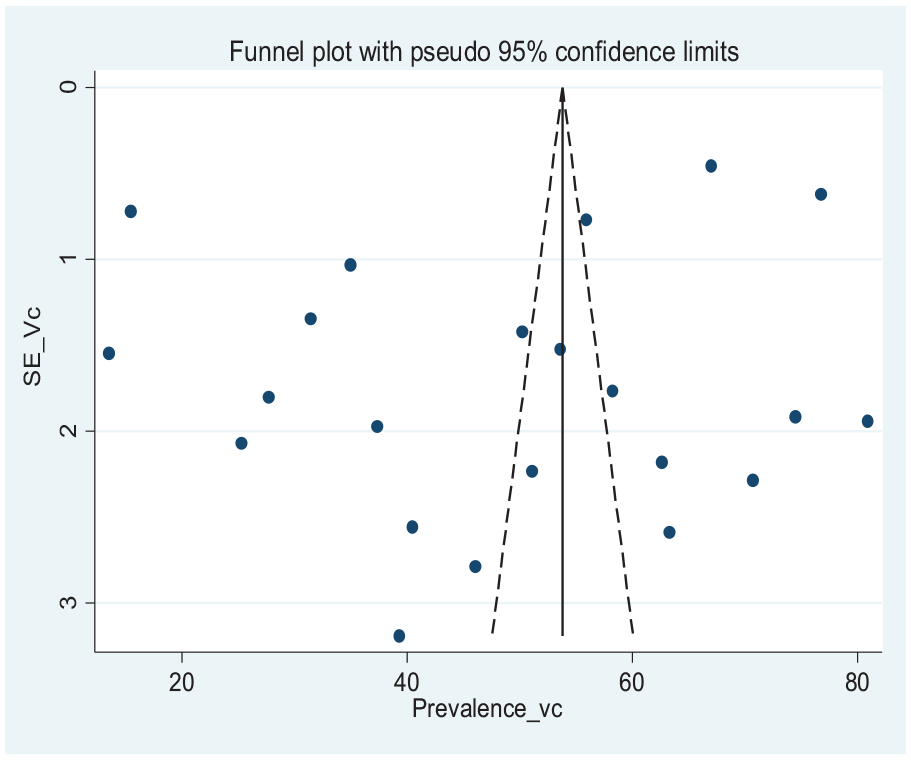
Funnel plot with 95% confidence limits of the pooled prevalence of acceptance toward COVID-19 vaccine among adults in Africa.
Sensitivity Analysis
The results of a sensitivity analysis revealed that no single study was influenced the overall acceptance toward COVID-19 vaccine among adults in Africa (Figure 3).

The results of sensitivity analysis of 22 studies conducted on the acceptance toward COVID-19 vaccine among adults in Africa.
Acceptance Rate of COVID-19 Vaccine
This meta-analysis was used the random effect model to estimate the pooled prevalence of acceptance toward COVID-19 vaccine among adults in Africa, and it was 48.93% (95% CI [39.49, 58.37]). The level of heterogeneity was (I2 = 99.7%, P = .000) (Figure 4).

Forest plot of pooled prevalence of acceptance toward COVID-19 vaccine among adults in Africa.
Subgroup Analysis
The subgroup analysis was desired to be performed due to the presence of a significant level of heterogeneity among the included studies. To check the sources of heterogeneity, subgroup analysis was done by using subregion and publication year to assess the pooled prevalence of acceptance toward COVID-19 vaccine among adults in Africa.
Subgroup Analysis by Subregion
The pooled prevalence of acceptance toward COVID-19 vaccine among adults in Africa was (57.44%, 95% CI [42.75, 72.13], I2 = 99.5%, P = .000) in Eastern Africa, (52.45%, 95% CI [42.76, 62.13], I2 = 97.2%, P = .000) in Western Africa, (31.10%, 95% CI [7.26, 54.94], I2 = 99.8%, P = .000) in Middle Africa, (66.03%, 95% CI [62.84, 69.22], I2 = 49.4%, P = .160) in Southern Africa, and (24.28%, 95% CI [3.26, 45.30], I2 = 99.2%, P = .000) in Northern Africa (Figure 5).

Subgroup analysis by subregion on the pooled prevalence of acceptance toward COVID-19 vaccine among adults in Africa.
Subgroup Analysis by Publication Year
The pooled prevalence of acceptance toward COVID-19 vaccine among adults in Africa was (38.69%, 95% CI [17.29, 60.10], I2 = 98.7%, P = .000) for studies published in 2020, and (50.54%, 95% CI [40.40, 60.68], I2 = 99.7%, P = .000) for studies published in 2021 (Figure 6).

Subgroup analysis by year of publication on the pooled prevalence of acceptance toward COVID-19 vaccine among adults in Africa.
Discussion
COVID-19 pandemic remains a serious public problem and, to date, it has not been controlled effectively worldwide. Different strategies were implemented to manage and control it but have not been effective to halt the pandemic. Because of this, COVID-19 vaccine was developed and found better than other strategies implemented. COVID-19 vaccine is a vital strategy to slow this critical pandemic. However, hesitance toward this vaccine is a major barrier to manage the COVID-19 pandemic. Because of this, the control of this pandemic will depend principally on the people acceptance of COVID-19 vaccine. Therefore, this systematic review and meta-analysis was intended to determine the acceptance rate of COVID-19 vaccine in Africa.
This systematic review and meta-analysis were done by using comprehensive search strategies to include studies involving African adult individuals. It was done based on PRISMA guidelines and checklists. The quality of the included studies was determined by using the modified NOS assessment. Based on this assessment, all studies with high methodological quality were included. All included studies were observational studies (cross-sectional). Regarding publication bias, it was assessed by using Egger’s test and funnel plots.
This is the first systematic review and meta-analysis done on the level of acceptance of COVID-19 vaccine among adults in Africa. This information has significant implications for the government, researchers, health care policymakers and implementers, communities, and healthcare providers. This systematic review meta-analysis showed that the estimate of the pooled prevalence of acceptance rate of COVID-19 vaccine among adults in Africa was 48.93% (95% CI: [39.49, 58.37]).
This finding was lower when compared with the study conducted in Turkey (84.6%), 64 South Carolina (60.6%), 65 United States (66.0%), 66 China (63%), 67 Australia (80%), 68 Saudi Arabia (64.72%), 69 UK (86%), 70 Japan (65.7%), 71 Israel (85%), 72 Bangladesh (74.6%), 73 Iran (64.2%), 74 Italy (86.1%), 75 France (77.6%), 76 China (60.4%), 77 Vietnam (76.10%), 78 Pakistan (70.25%), 79 Latin America and the Caribbean (80.0%), 80 and United States (63.7%). 81 This might be due to the differences in the sociodemographic characteristics of the study population and the awareness level of the study participants toward the COVID-19 vaccine. Furthermore, government, healthcare providers, and the stakeholder’s commitment toward the prevention strategies of COVID-19 could have significant contributions for the acceptance of COVID-19 vaccine among the participants. This finding was consistent when compared with the study conducted in Kuwait (53.1%), 82 Palestine (40%), 83 Malaysia (48.2%), 84 England (55.8%), 25 Greece (57.7%), 85 and Saudi Arabia (48%). 86 However, this finding was higher when compared with the 2 studies conducted in Jordan (36.8%), 87 and Jordan (37.4%). 88 This could be due to the differences in the sociodemographic characteristics of the study population.
The subgroup analysis was desired to be performed due to the presence of a significant level of heterogeneity among the included studies. To check the sources of heterogeneity, subgroup analysis was done by using subregion and publication year to assess the pooled prevalence of acceptance toward COVID-19 vaccine among adults in Africa. The pooled prevalence of acceptance toward COVID-19 vaccine among adults in Africa was (57.44%, 95% CI [42.75, 72.13]) in Eastern Africa, (52.45%, 95% CI [42.76, 62.13]) in Western Africa, (31.10%, 95% CI [7.26, 54.94]) in Middle Africa, (66.03%, 95% CI [62.84, 69.22]) in Southern Africa, and (24.28%, 95% CI [3.26, 45.30]) in Northern Africa. Whereas, the pooled prevalence of acceptance toward COVID-19 vaccine among adults in Africa was (38.69%, 95% CI [17.29, 60.10]) for studies published in 2020, and (50.54%, 95% CI [40.40, 60.68]) for studies published in 2021.
Overall, according to the findings of this systematic review and meta-analysis, the estimate of the pooled prevalence of acceptance toward COVID-19 vaccine among adults in Africa was less than 50%, which indicates there are critical issues to manage and control this pandemic in Africa. Primarily, long-term restriction of movement was employed as a strategy to stop the spread of COVID-19. 89 However, there was a crucial necessity to develop effective vaccines as the most controlling method to halt COVID-19 since it was extensive globally. 90 Because of this, scientists struggled to provide a proven treatment for COVID-19. Because of the lack of highly effective therapies against COVID-19, the development of vaccines against COVID-19 was a priority to stop the pandemic. Nevertheless, the achievement of this method relies on people’s willingness for immunization. 91 Furthermore, vaccines were being developed by numerous countries for the aim of a permanent solution for this pandemic. 71 It is believed that the availability of COVID-19 vaccine with wide uptake might contribute to the development of herd immunity and guard the most vulnerable individuals against COVID-19 89 and the public may think that their personal protection behaviors can replace COVID-19 vaccination to avoid COVID-19. They may trust commitment to these precautions is satisfactory for the prevention of COVID-19. 92
Since the pandemic is leading a considerable effect on all citizens, it requires a cooperative response. 93 Nevertheless, vaccine hesitancy remains a blockade to population vaccination against this pandemic. 94 It can be a barrier to the distribution of COVID-19 vaccines. 95 This is a significant impending issue for this pandemic. 96 Even, COVID-19 survivors were revealed to be refusing or uncertain toward this vaccine. 93 Since COVID-19 vaccines were hastily developed worldwide, the population may be more concerned for the safety of the vaccine than the risk of COVID-19 infection which likely contribute to vaccine hesitancy. 94
Conclusions
This systematic review and meta-analysis showed that the estimate of the pooled prevalence of acceptance toward COVID-19 vaccine among adults in Africa was very low. With this level of acceptance toward COVID-19 vaccine, it would be enormously problematic to manage and control this pandemic. Besides, this may extend the era of this pandemic.
Furthermore, this finding would have a significant contribution for governments, healthcare providers, stakeholders, health policy-makers and implementers, researchers, and for the entire population. All concerned bodies should be actively involved to improve the acceptance rate of COVID-19 vaccine, which could minimize the morbidity and mortality associated with this pandemic, and also to halt the era of this pandemic. It is substantial to initiate offering health education to the population regarding COVID-19 vaccination to enhance their acceptance rate toward this vaccine. The population needs to be conscious regarding the importance, safety, and efficacy of COVID-19 vaccine.
Footnotes
Author Contributions
Addisu Dabi Wake has contributed to the conception of the study, drafting or revising the article, writing the manuscript, gave final approval of the version to be published, and agreed to be accountable for all aspects of the work.
Declaration of Conflicting Interests
The author declared no potential conflicts of interest with respect to the research, authorship, and/or publication of this article.
Funding
The author received no financial support for the research, authorship, and/or publication of this article.

Data Sharing Statement
The data used to support the findings of this study are available from the corresponding author on reasonable request.