




Abstract
Objective:
This systematic review and meta-analysis will investigate the pooled prevalence of hypertension and associated factors among bank workers in Africa.
Methods:
Studies published with full texts in English will be searched in the PubMed/MEDLINE, Cumulative Index to Nursing and Allied Health Literature, African Journals Online, and Google Scholar databases. Checklists from the Joanna Briggs Institute will be used to assess the studies’ methodology quality. Data extraction, critical appraisal, and screening of all retrieved articles will be conducted by two independent reviewers. Statistical analysis will be performed using STATA-14 software packages. A random effect will be employed to demonstrate pooled estimates of hypertension among bank workers. For determinants of hypertension, an effect size with a 95% confidence interval will be analyzed.
Results:
Data extraction and statistical analyses will begin after identifying the most pertinent studies and evaluating their methodological quality. Data synthesis and the presentation of the results are scheduled for completion by the end of 2023. After the review is completed, the results will be presented at relevant conferences and published in a peer-reviewed journal.
Conclusion:
Hypertension is a major public health concern in Africa. More than 2 out of 10 people aged older than 18 years suffer from hypertension. A number of factors contribute to hypertension in Africa. These factors include female gender, age, overweight or obesity, khat chewing, alcohol consumption, and family history of hypertension and diabetes mellitus. To address the alarming rise in hypertension in Africa, behavioral risk factors should be given primary attention.
Protocol registration:
This systematic review and meta-analysis protocol is registered in PROSPERO with the registration ID and link as follows: CRD42022364354;CRD-register@york.ac.ukhttps://www.york.ac.uk/inst/crd
Introduction
Hypertension (HTN) is defined as two or more readings of a systolic blood pressure (BP) measurement of ⩾130 mmHg or diastolic BP measurement of ⩾80 mmHg. 1 It is the leading preventable cause of cardiovascular disease (CVD), disability (damage to heart, kidney, eyes, brain damage as a result of stroke, large blood vessel(aorta), and peripheral blood vessel), 2 and death worldwide. 3 There has been an increase in the number of adults with HTN globally since 1975, rising from 594 million to 1.13 billion in 2015, largely in low- and middle-income countries (LMICs).4,5 According to a global view of HTN prevalence among 182 countries, HTN burden varies widely and ranges from 13% to 41%. 6 Globally, 7.6 million deaths occur each year because of high BP, which represents 13.5% of all deaths. 7
Worldwide, an estimated 1.28 billion adults aged 30–79 years have HTN, most (two-thirds) found in low- and middle-income countries.5,8,9 Globally, 1.5 billion people are expected to have HTN by 2025, and 74.7 million live with HTN in Sub-Saharan Africa, which is expected to rise to 125.5 million by 2025. 10 Furthermore, it is predicted that HTN in Africa’s population will increase to 216.8 million by 2030.11 –13 The number of DALYs (disability-adjusted life-years) lost due to HTN increased from 95.9 million to 143.0 million. 14
According to a study, CVD costs in low- and middle-income nations were over USD 3.7 trillion, or almost 2% of their gross domestic product (GDP), between 2011 and 2015. 15 The cumulative lost output due to non-communicable disease in LMIC was estimated to be USD 7.28 trillion over 2011–2025, with a loss of USD 500 billion annually, or around 4% of GDP. 15 People with HTN spend USD 1920 more annually than those without HTN. When compared to the non-hypertensive population, the adult population with HTN is predicted to pay an additional USD 131 billion annually. 16
The estimated prevalence of HTN in Africa is around 30.8%, 12 and in Sub-Saharan Africa, it is between 30.0% and 31.1%.17,18 Regarding the age group, approximately 46% of adults over the age of 25 suffer from HTN.11,19,20 In the developing world, about one in three adults has HTN on average, and by 2025, it is expected that three out of four people in low- and middle-income countries will have the HTN.18,21 The Pan-African Society of Cardiology (PASCAR) identified 10 points for African ministers of health to achieve a 25% reduction by 2025 in HTN burden.20,22
A study revealed that poor BP regulation in developing nations is linked to elevated rates of illiteracy, limited access to healthcare facilities, unhealthy eating habits, poverty, and expensive prescription costs. 23 Moreover, HTN causes are heterogeneous, and the pathophysiology of the condition is thought to be influenced by the interaction between a person’s genetic composition and other environmental circumstances. 24 The known risk factors for HTN include older age, 25 being overweight or having a body mass index ⩾25,25–27 diabetes mellitus (DM), 27 living a sedentary lifestyle, 28 smoking, drinking alcohol,25,29 stress, 30 having a positive family history or having susceptible genes, 27 consuming saturated fats, eating too much salt, and not eating enough fruits and vegetables. 31
Bank employees are those staff members (manager cadre, cashier, clerical, and guard/security)32,33 whose employment is characterized by sedentary behavior in nature, including prolonged computer use, television viewing, sitting in the office and in vehicles such as buses, trains, planes, and ferries, all of which entail an energy expenditure between 1.0 and 1.5 metabolic equivalents. 34 Chronic disorders such as diabetes and CVD are brought on by this sedentary behavior, which is linked to higher depression and obesity/overweight rates.35–39 Study also shown that bank employees are predisposed to HTN due to factors including their age, 40 salt consumption, 40 lack of information regarding HTN, and physical inactivity. 33 As a result, they are at risk of HTN.
Many studies have shown that bank employees have a higher HTN frequency than the overall population.41–44 Several researches on HTN prevalence and its risk factors among bank employees in Africa have produced inconsistent findings. According to a study, HTN among bank employees in African nations ranges from 12.4% to 52.4%.33,42,45–47 There is no reported systematic review and meta-analysis that shows the risk factors and pooled prevalence of HTN specifically among bank workers population in Africa to generate updated information, despite the fact that different epidemiological studies were conducted and reported wide variation in the prevalence of HTN and associated factors among bank workers.
This systematic review and meta-analysis aims to provide the combined prevalence of HTN and its contributing factors among African bank employees. The findings may help African ministries of health to identify gaps and make decisions to achieve the 10 action plans of the PASCAR developed regarding HTN to achieve a 25% decline by 2025. In addition to this, health planners and policymakers as well as the community themselves can use it to prevent HTN alarming rise in Africa.
Objectives and review questions
This investigation aims at:
1) determining the cumulative level of HTN among bank workers in Africa and
2) synthesizing data on the contributing factors to HTN.
The following review questions provide a framework for this systematic review and meta-analysis:
1) What is the aggregate level of HTN among African bank workers?
2) What are the contributing factors to HTN among African bank employees?
Methods
Reporting of the review findings
As part of the protocol development process, Preferred Reporting Items for Systematic Review and Meta-analysis (PRISMA)-P guidelines were followed. 48 The results will be reported using the PRISMA-2020 standard. 48 The PROSPERO database has recorded this systematic review with ID number CRD42022364354. In preparation for the submission of this article, a preliminary database search is being conducted as well as a data extraction sheet being developed. The reporting flowchart is presented in Figure 1.
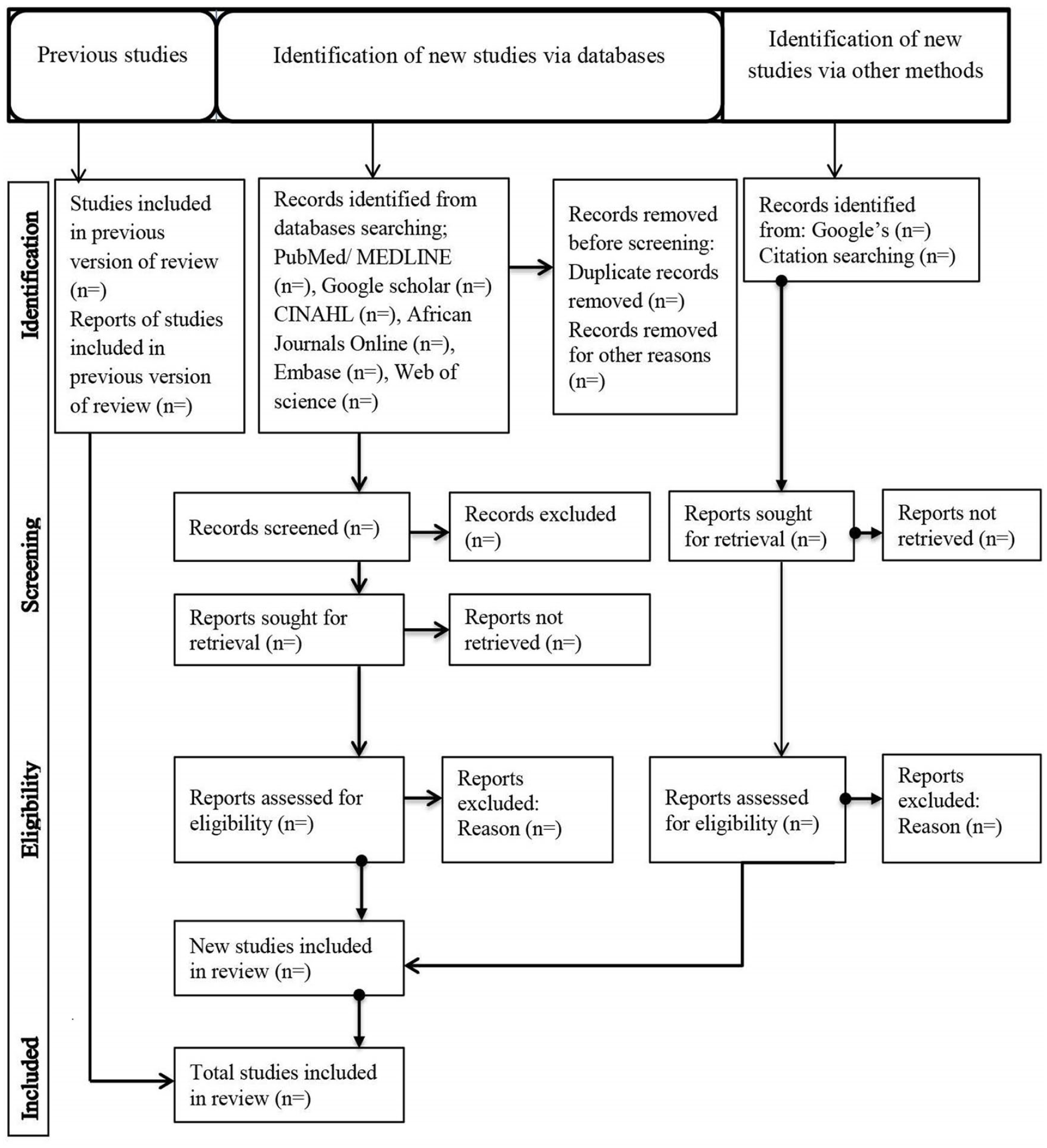
PRISMA flowchart.
Inclusion criteria
Cross-sectional, cohort, and case–control study designs will all be included in this review. Although the search will not be language specific, it will only return results for articles written in English. The prevalence of HTN and associated factors among bank workers will be reported in studies published in peer-reviewed journals and unpublished in peer-reviewed journals, findings from countries or national surveys, and studies conducted in Africa will all be considered in this review. Studies published from the beginning until 2023 will be included in the review. To ensure that all papers reporting on HTN prevalence among bank workers and related factors from the start to the present will be taken into account for the review.
Exclusion criteria
Studies that do not provide information on the prevalence of HTN and associated factors, or those for which it is impossible to obtain the necessary information after contacting the authors, will be excluded from investigations into the pooled prevalence of HTN among bank workers in Africa. The following items will also be excluded: articles published in other language except English, conference proceedings, qualitative studies, commentary, editorial letters, case reports, case series, and monthly and annual police reports.
CoCoP and PEO search guide
Outcome/condition: Prevalence of HTN
Exposure: All HTN predictors/associated factors. The associated factors are characteristics or exposures that increase HTN risk.
Population: Bank workers
Context/setting: Africa
Search strategy and sources of information
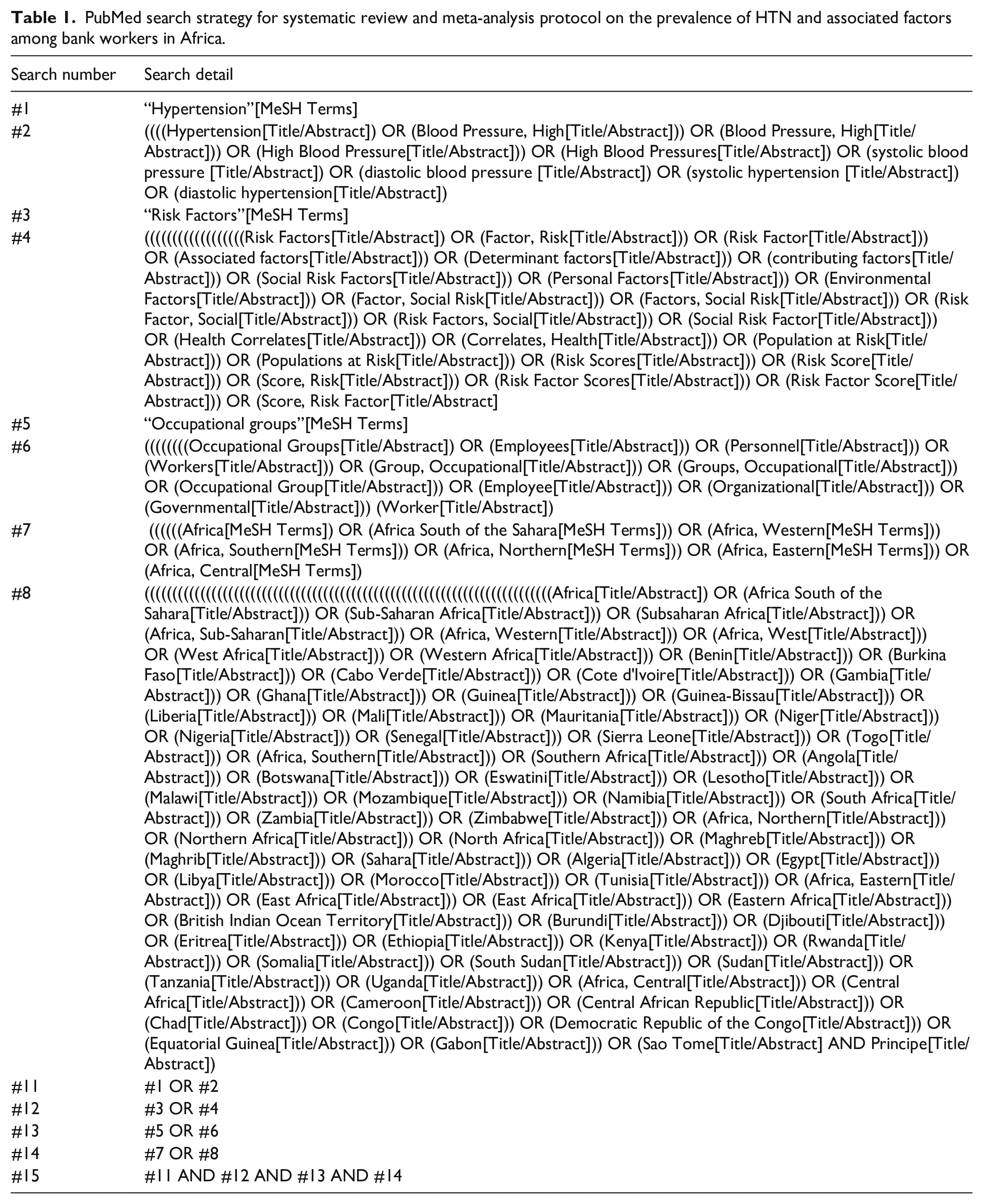
The review used published studies on prevalence of HTN and related factors among African bank employees. In the following electronic databases, studies published from the start until 2023 are systematically searched and identified: PubMed/MEDLINE, Cumulative Index to Nursing and Allied Health Literature, African Journals Online, and Google Scholar databases. Medical Subject Headings, keywords, and free-text search terms are all employed in PubMed advanced searching. HTN, associated factors, bank workers, and Africa will be utilized as substitute terms and merged using Boolean operators as search phrases.
We will consult with an experienced librarian to ensure the comprehensiveness of the studies. The references to the publications that have been found will be screened using snowballing to find other additional studies that may be relevant. Moreover, experts, researchers, and pertinent organizations will be approached for recommendations on other existing studies. The reference management software (EndnoteTM, Thomson Reuters, Toronto, ON, Canada) will then import the electronic database search results and eliminate any duplicates (Table 1).
PubMed search strategy for systematic review and meta-analysis protocol on the prevalence of HTN and associated factors among bank workers in Africa.
Selection of studies
Based on the inclusion and exclusion criteria, two authors (AAS and FYJ) will review the studies to determine which ones to include. The following methods will be used as a guide for the review. The titles of the articles retrieved through the search will first be evaluated. Second, an abstract screening of their eligibility will be done based on the predetermined inclusion and exclusion criteria. Lastly, these chosen titles’ abstracts will be incorporated into the final round of full-text screening. Using Microsoft ExcelTM, the data charting and screening procedure will be carried out. Only studies that have been approved by both authors will be included in the full article review. Any differences between the authors will be settled by conversation or consultation with a third reviewer (AHM). A final list of articles for data extraction will be created after all eliminated studies have given their justifications for exclusion.
Data extraction and management
Following the identification of all eligible articles, two independent reviewers (AHM and AAS) will extract the relevant data on a Microsoft Excel spreadsheet. A data extraction format was developed based on the Joanna Briggs Institute (JBI) data extraction form for systematic reviews and research syntheses.49,50 Prior to the actual data extraction, the data extraction process will be independently tested in Microsoft Excel with all members of the review team.
For each included article, the data extraction tool will contain information on the first author’s last name, year of publication, the setting where the study was conducted or country, region, study design, study period, sample size, response rate, population, proportion of HTN, related factors, effect size of risk factors (odds ratio), posture during BP measurement, number of times measured, interval between frequency, readings used for BP analysis, device use, and how HTN was defined. Disagreements between data extractors will be handled throughout extraction in order to come to a consensus. In the event that a consensus cannot be achieved, the authors will consult with a third reviewer (FYJ).
Quality assessment
Two reviewers will evaluate the listed studies independently (AHM and AAS). The quality of the articles will be evaluated using the JBI checklists51,52 for prevalence or proportion studies. The tool has nine parameters: (1) an appropriate sampling frame, (2) an appropriate sampling technique, (3) an adequate sample size, (4) a description of the study subject and setting, (5) adequate data analysis, (6) the use of valid methods for the identified conditions, (7) valid measurement for all participants, (8) the use of appropriate statistical analysis, and (9) an adequate response rate. 53
The tools include options such as yes, no, not applicable, and unknown. The score will be one for yes responses and zero for unclear, not applicable, and no answers. In the end, a study that obtains a score of 5 or higher will be considered high quality and added to the final study.54,55 The disagreement between two authors will be resolved by one author (FYJ) during the critical appraisal.
Statistical analysis
Data will be presented in graphs and tables based on the findings of the selected study. Due to its adaptation to the Metan program, STATA 14 will be utilized for data entry and analysis. The pooled prevalence of HTN among bank workers will be demonstrated using the random effect model. 56 Since the random-effects model considers sources of between-study variance, we will use the Freeman–Tuckey variant of the arcsine square root transformation of proportions to avoid variance variability.57,58
Measuring heterogeneity based on statistical findings, outcome presentations, and methodological will be done using the I2 statistic and a chi-squared test in accordance with Cochran’s Q statistic with a 5% significance level. 59 I2 values of 25%, 50%, and 75% are considered indicative of low, moderate, and high heterogeneity, respectively. 60 When I2 > 50% and p value less than 0.05, the existence of heterogeneity will be declared. 60 Subgroup analyses and meta-regressions will be performed to investigate sources of heterogeneity. 61 Furthermore, a sensitivity analysis will be conducted to determine the impact of single studies on pooled estimates. 61 Fixed-effect models will be used if studies have no statistical, outcome, and methodological heterogeneity.
The effect size will be used to estimate whether there is a relationship between the related factors and HTN among bank workers. When the p value is less than 0.05, the statistical significance level for effect size is determined.
Publication bias
Egger’s test 62 and funnel plots will be used to analyze the potential risk of publication bias and small study effects. When the p value is statistically significant (p < 0.10), publication bias is declared. At least 10 studies needed to examine publication bias. 63 The trim-and-fill method suggested by Duval and Tweedie will be applied if there is proof of publication bias.63,64
Ethical considerations
As this study is a protocol for a systematic review and meta-analysis that mainly uses data that have already been published and excludes any participation of patients, ethical approval and informed consent are not necessary.
Results
Data extraction and statistical analysis will begin after selecting relevant studies and assessing their methodological quality. By 2023, the data synthesis and presentation of the findings will be completed. Upon completion of the review, final results will be published in a peer-reviewed journal and presented at relevant conferences.
Discussion
This protocol will provide a detailed summary of the evidence on factors associated with HTN prevalence among bank workers in Africa. Findings from this review will therefore provide up-to-date evidence for understanding the burden and contributing factors of HTN among bank employees in Africa. This analysis also indicates the direction in which health policies should be directed to decrease HTN burdens in Africa. This will reduce mortality related to HTN in Africa.
As a limitation, heterogeneity is expected in this systematic review and meta-analysis. This is because we will consider various study designs from various geographic regions of the nation. EMBASE and Web of Sciences databases will not be included in the search technique because Ethiopia does not have access to these databases. The search technique can only find articles published in English; however, there may be articles published in other languages. Only observational studies are considered in this systematic review; gold standard randomized clinical trials and quasi-experimental researches are not included.
Conclusion
HTN is a major public health concern in Africa. More than 2 out of 10 people aged older than 18 years suffer from HTN. A number of factors contribute to HTN in Africa. These factors include female gender, age, overweight or obesity, khat chewing, alcohol consumption, and family history of HTN and DM. To address the alarming rise in HTN in Africa, behavioral risk factors should be given primary attention.
Supplemental Material
sj-docx-1-smo-10.1177_20503121231172001 – Supplemental material for A systematic review and meta-analysis protocol on hypertension prevalence and associated factors among bank workers in Africa
Supplemental material, sj-docx-1-smo-10.1177_20503121231172001 for A systematic review and meta-analysis protocol on hypertension prevalence and associated factors among bank workers in Africa by Abdulkerim Hassen Moloro, Abubeker Alebachow Seid and Fikiru Yigezu Jaleta in SAGE Open Medicine
Supplemental Material
sj-docx-2-smo-10.1177_20503121231172001 – Supplemental material for A systematic review and meta-analysis protocol on hypertension prevalence and associated factors among bank workers in Africa
Supplemental material, sj-docx-2-smo-10.1177_20503121231172001 for A systematic review and meta-analysis protocol on hypertension prevalence and associated factors among bank workers in Africa by Abdulkerim Hassen Moloro, Abubeker Alebachow Seid and Fikiru Yigezu Jaleta in SAGE Open Medicine
Footnotes
Acknowledgements
We thank Samara University for providing free Internet and library access.
Author contributions
The study topic was established by AHM and AAS. They also came up with the first draft, the search plan, created the data extraction form, and edited and approved the final paper. FYJ improved the database search method and data extraction form, as well as edited and approved the final draft.
Declaration of conflicting interests
The author(s) declared no potential conflicts of interest with respect to the research, authorship, and/or publication of this article.
Funding
The author(s) received no financial support for the research, authorship, and/or publication of this article.

Supplemental material
Supplemental material for this article is available online.
References
Supplementary Material
Please find the following supplemental material available below.
For Open Access articles published under a Creative Commons License, all supplemental material carries the same license as the article it is associated with.
For non-Open Access articles published, all supplemental material carries a non-exclusive license, and permission requests for re-use of supplemental material or any part of supplemental material shall be sent directly to the copyright owner as specified in the copyright notice associated with the article.
