




Abstract
Nursing is a respect for dignity and treating every person equally. Qualifying competent and ethical nurses requires the incorporation of a professional code of ethics with clinical nursing practice. However, no study was conducted on the relationship between professional ethics and clinical nursing practice. Therefore this study aimed to determine correlation between professional ethics and pediatrics clinical practice from an achievement perspective. Accordingly, cross-sectional study design was conducted at Mizan-Tepi University using nursing students’ academic achievements at professional ethics and pediatric practice. Collected data were entered into Epi info 7. SPSS version 21.0 was used to calculate spearman’s rho correlation (rs) and coefficient of determination (R2) at P < .05. A total of 316 study participants comprising of 209 (66.14%) male and 107 (33.86%) female nursing students included in the current study. Nursing students’ academic achievements at professional ethics was significantly and positively associated with achievements at pediatrics clinical practice (rs = 0.4-0.6), P < .001. Linear regression results revealed 25% to 26.7% coefficient determination for regular students and 18% to 22.9% for summer nursing students. To sum up, there was a significant positive association between achievements of students at professional ethics and pediatrics clinical practice. Therefore increasing students’ academic achievement in professional ethics can further improve their achievements at pediatrics clinical practice. However, academic achievement in professional ethics explained 22.35% of the variability in achievements at pediatric clinical practice. 77.65% of the variability in pediatrics clinical practice was due to other factors that deserve another study.
Introduction
Professional conduct is behaving and acting in a professional manner. 1 Nursing profession requires knowledge of professional conduct to direct practice and to deliver high-quality care.2-5 The professional code of ethics is based on human and ethical issues related to the therapeutic nurse-patient relationship. 3 Likewise, nursing is a respect for human rights, dignity, culture, the right to life, and to be treated with respect without any background. 6
However, advances in technology and the expansion of nursing roles have led to complex ethical dilemmas in nursing. 7 The situation arises when nurses know the right thing to do, but different limitations make doing the right thing tough. 8 The ethical dilemma often encounters when patients, families, and their health-care providers disagree about medical decisions and plans of care that affect personal values and moral norms. 9
This leads to the failure of nurses’ adherence to ethical principles in practice. 10 Understanding and communicating beliefs and values help nurses to prevent and resolve emerging ethical dilemmas. 11 Nurses are aware of the ethical dimension of their daily nursing practice though they may face difficulties in putting ethical dimensions into practice. 12
Moreover, ethical dilemmas in pediatrics practice are often more complex than in adult practice. 9 It is the responsibility of nurse educators to enable nursing students in the areas of nursing ethics principles, ethical analysis, ethical theories, and ethical decision-making to produce ethical practitioners. 2 Hypothetically, nurses at all times maintain standards of professional conduct, protect the public, and hence can escalate public confidence. 6 There is a continuous need of applying the code of ethics in the nursing profession. 13 The course of professional ethics aimed to addresses important topics such as medico-legal ethics, bills of right, code of ethics, advocacy role, and advanced directives. Teaching ethics to nursing students enhance their involvement in providing high-quality care and enable them to duly encounter ethical issues. 14 However, the course of ethics is usually delivered during a pre-clinical year. 15 This may be difficult for students to rehearse and apply ethical codes and principles in clinical setup which further may affect their future professional values. Moreover, the depth, mode of delivery, teaching methods may play also play a role. Nevertheless, there was no study conducted on the relationship of students’ academic achievement at a professional course of ethics and their involvement in clinical practice in Ethiopia. Therefore, the present study aimed to determine the relationship of ethics course and pediatrics clinical attachment from the perspective of students’ achievements at Mizan-Tepi University (MTU).
Materials and Methods
Study Design, Setting, and Period
A retrospective cross-sectional study design was conducted using the performance of MTU nursing students at a course of ethics and pediatrics clinical practice. MTU, College of Health Science is found in South Nations, Nationalities and People’s Region (SNNPR), 585 km away from Addis Ababa. Data were collected from October 01 to 14/2020.
Source and Study Population
The 2 recent batches of regular (2016 and 2017) and summer (2015 and 2016) of nursing students were the source population. Students who fulfilled the inclusion criteria were the study population.
Inclusion and Exclusion Criteria
All students with a paired score of professional ethics course and pediatrics clinical practice performance were included. Students with only either of the result, who were dropped from their batch or added to another batch, were excluded.
Study Variables
Dependent and independent variables
Student achievement of at (professional ethics course and pediatrics clinical practice) was the outcome variable. Batches, admission type, sex of students were independent variables.
Data Source and Measurement of VARIABLES
Data were accessed with permission obtained from MTU, College of Health Science, and the department of nursing. The obtained data were Carbon Copy (Cc) of the final performance of students submitted to department of nursing and the office of the registrar. The students’ achievement both at professional ethics and pediatrics clinical practice scored out of 100% were treated as continuous variables. Batch (2015-2017), admission type (regular and summer), and sex (male and female) of students were analyzed as categorical variables.
Sample Size Determination
All the recent 2 batches of 2016 and 2017 regular nursing students and 2 batches of 2015 and 2016 summer nursing students who fulfilled the inclusion criteria were included. Accordingly, the study employed a total of 316 including 243 regular nursing students and 71 summer nursing students.
Sampling Procedure
A survey of all recent 3 batches of 2016 and 2017 regular nursing students and the 2 batches of 2015 and 2016 summer nursing students were purposively selected as these batches were all taught by experienced and expert nurse educators.
Data Collection Tool
Data were collected using data extraction checklist presented as Supplemental File.
Data Collectors and Data Collection PROCEDURE
Data were collected by 3 academic staffs of nursing department. Training of about 4 hours was given prior to the data collection processes.
Data Processing and Analysis
The collected data were entered into Epi Info version 7 and imported to SPSS version 21.0 for analysis. Checking for all necessary assumptions, the analysis was undergone. Descriptive statistics (frequency and mean) were calculated for students’ performance based on sex, batches, and mode of admission. Spearman rho correlation (rs) was computed to identify the association between students’ achievement at a professional course of ethics and pediatric clinical practice. Linear regression was used to obtain a coefficient of regression to identify the percentage of variation in pediatrics clinical practice achievement explained a professional course of ethics. The prediction equations for linear regression was also derived as required. The statistical significance was determined at P < .05.
Results
Characteristics of Study Participants
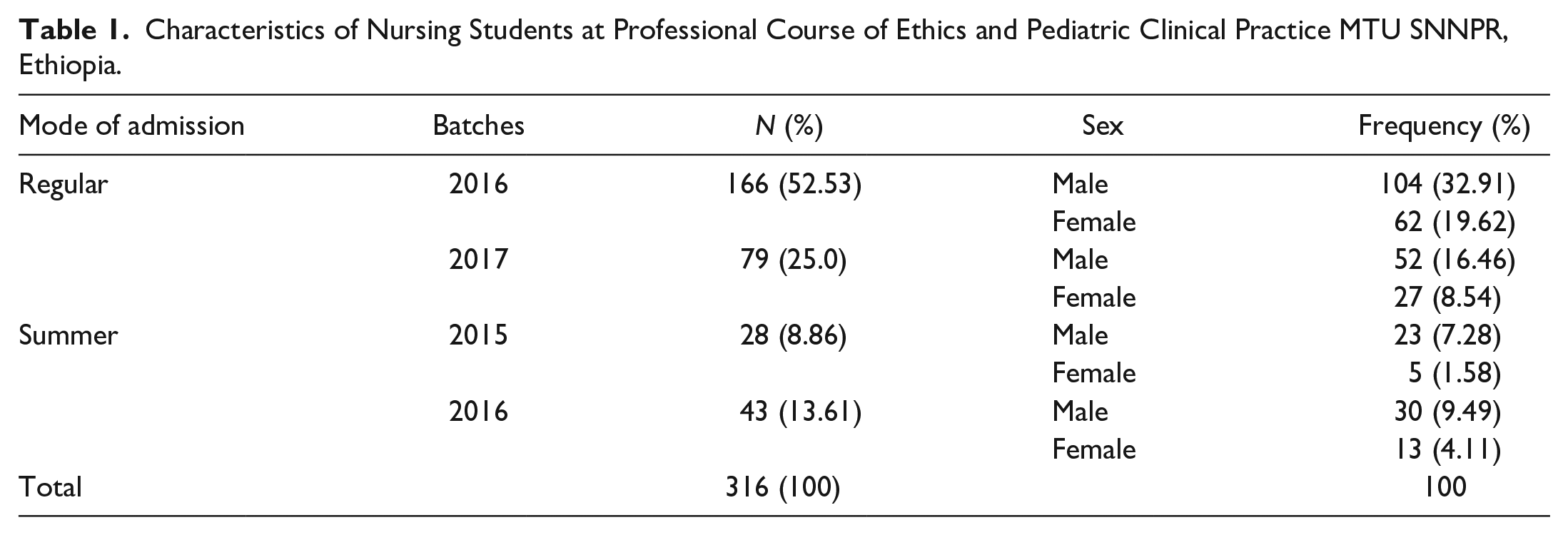
The study included a total of 316 study participants comprising of 209 (66.14%) male and 107 (33.86%) female nursing students. For both admission types, males were dominant in numbers (Table 1).
Characteristics of Nursing Students at Professional Course of Ethics and Pediatric Clinical Practice MTU SNNPR, Ethiopia.
Achievements of Nursing Students
The mean achievements of nursing students at pediatrics clinical practice were almost the same across the 2 batches for summer nursing students. However, there was a slight difference at both professional ethics and pediatrics clinical practice across both batches and admission types (Figure 1).

Performance of nursing students at professional course of ethics and pediatric clinical practice MTU SNNPR, Ethiopia.
Relationship between Professional Ethics and Pediatrics Clinical Practice
The spearman’s rho correlation result showed a positive moderate correlation between students’ academic achievement and pediatrics clinical practice. The correlation coefficient (rs) slightly increased across batches for both summer and regular nursing students (Table 2).
Spearman’s Rho Correlation between Professional Course of Ethics and Clinical Practice Results of Students at Pediatrics at MTU, SNNPR.

Abbreviations: Rs, coefficient of determination.
The linear regression analysis result showed a relatively low coefficient of determination (R2) across batches and admission types. Nevertheless, the R2 of regular students was relatively higher than that of summer students. This indicated that the academic achievement of professional ethics better explained regular students’ achievement at pediatrics clinical practice (Table 3).
Linear Regression Analysis Results of Students’ Performance at Professional Course of Ethics and Pediatric Clinical Practice Performance at MTU SNNPR.

Abbreviations: B, constant; Y, practice result; X, theory result; R2, R-square.
Discussion
The present study summarized the correlation between students’ academic achievement at a professional course of ethics and pediatrics clinical practice. To the investigator’s knowledge, this was the first study on relationship of these courses to may bridge theory with practice in the process of preparing ethical and competent nurse practitioners.
The current study revealed a moderate (rs = 0.4-0.6) and a positive association between nursing students’ academic achievement at professional course of ethics and pediatrics clinical practice performance.
This finding was similar with the findings of different studies conducted on related fields.16,17 This showed an increase in the academic achievement of professional ethics increased students’ pediatric clinical performance. This may be due to a better understanding of professional ethics can build students’ confidence to deal with real-life situations related to medico-legal ethics, ethical principles, ethical dilemmas, and bills of rights.
According to the linear regression analysis result, only 18% to 26.7% of the variability in students’ pediatrics clinical achievement was explained by professional ethics academic achievement. This was relatively low (18%-26.7% vs 64%) compared with the finding of the study conducted in the Philippine. 16 That means, 73.3% to 82% of the variability in pediatrics clinical performance was explained by other factors. Though it deserves another study, using case studies, simulations, and role-plays may enhance students’ comprehension related to the ethical-decision making process.
Stressing on related ethical issues during seminar presentations and bedside discussions with real-life situations might be useful. Furthermore, well orientation of students to clinical environments, building good communication among students, teachers, and clinical preceptors may ease the engagement of students in the clinical practice. This in turn may improve students’ performance in the process of qualifying ethical and competent nurses who protect the public.
Conclusion
The correlation of nursing students’ academic achievement at professional ethics was moderately and positively associated with their pediatrics clinical achievement. Therefore increasing students’ academic achievement in professional ethics can further improve their achievements at pediatric clinical practice. However, academic achievement in professional ethics explained 18% to 26.7% (average of 22.35) of the variability in achievements at pediatric clinical practice. The variability accounted for 73.3% to 82% (average of 77.65) was due to other factors. This deserves another study.
Strength and Limitation
This was the first study to explain the correlation between nursing students’ achievements at professional ethics and pediatrics clinical practice. The finding can be cautiously generalized for other Ethiopian Universities as harmonized nursing curriculum, admission criteria, and Hospital environment for practice are relatively similar. The major limitation of this study was other confounders such as qualification of nurse educators, students’ pre-university level academic performance, and socio-demographic characteristics were not controlled. Furthermore, there was no control group of students who did not have an ethics course.
Supplemental Material
sj-pdf-1-gph-10.1177_2333794X211003799 – Supplemental material for Correlation of Students’ Academic Achievements at a Professional Course of Ethics and Pediatrics Clinical Practice at Mizan-Tepi University, South Nations, Nationalities and People’s Region, Ethiopia
Supplemental material, sj-pdf-1-gph-10.1177_2333794X211003799 for Correlation of Students’ Academic Achievements at a Professional Course of Ethics and Pediatrics Clinical Practice at Mizan-Tepi University, South Nations, Nationalities and People’s Region, Ethiopia by Lalisa Chewaka Gamtessa in Global Pediatric Health
Footnotes
Acknowledgements
I am grateful to Mizan-Tepi University, College of Health Sciences, and nursing department for their necessary support. My appreciation also goes to my data collectors without whom this work would have been impossible
Author Contributions
LCG: Solely responsible for conceptualization, design, software, data acquisition and analysis, drafting and revising the article, gave final approval of the version to be published, and accountable for all aspects of the work.
Declaration of Conflicting Interests
The author(s) declared no potential conflicts of interest with respect to the research, authorship, and/or publication of this article.
Funding
The author(s) received no financial support for the research, authorship, and/or publication of this article.
Ethical Approval and Informed Consent
This study was conducted after obtaining a permission letter (with ref no. Nur/27/1/2013) from MTU, College of Health Science and Department of nursing. This study was conducted in accordance with the Helsinki Declaration. 18 However, secondary data were retrieved and a consent to participate was not applicable. 19 Furthermore, no identifiable data was accessed and reported for this work.

Data Availability
Analyzed data for this manuscript can be accessed from the author on a reasonable request.
Supplemental Material
Supplemental material for this article is available online.
References
Supplementary Material
Please find the following supplemental material available below.
For Open Access articles published under a Creative Commons License, all supplemental material carries the same license as the article it is associated with.
For non-Open Access articles published, all supplemental material carries a non-exclusive license, and permission requests for re-use of supplemental material or any part of supplemental material shall be sent directly to the copyright owner as specified in the copyright notice associated with the article.
