




Abstract
Background
Foodborne diseases (FBDs) are a major public health concern in both developed and developing countries, as they comprise a broad spectrum of diseases and account for a significant proportion of morbidities and mortalities worldwide. In Ethiopia, the food and drinking establishments contribute to the incidence of foodborne diseases often associated with outbreaks that end up threatening global public health security.
Objective
To assess sanitation and hygienic status and associated factors among food and drinking establishments in Burayu town, Oromia, Ethiopia, 2022
Methods
An institution-based cross-sectional study design with a systematic sampling technique was used. Data were collected from 257 food and drinking establishments’ managers/owners using questionnaires and observational checklists
Results
The study revealed that 47.9% of the food and drinking establishments were in poor sanitation and hygienic status. The study showed that male managers (AOR: 9.29, 95% CI: 2.97-21.14), managers less than 40 years old (AOR: 1.24, 95% CI: 1.03-4.36), more than five years services (AOR: 3.66, 95% CI: 1.66-8.07), lack of clean basin (AOR: 2.92, 95% CI: 0.10-11.47), absence of liquid waste drainage system installations (AOR: 3.26, 95% CI: 0.12-0.62) were significantly associated with poor sanitation and hygienic status of food and drinking establishments.
Conclusion and Recommendation
The findings indicated that high prevalence of poor sanitation and hygienic status of the food and drinking establishments. Therefore, the establishments should avail waste drainage system, clean basin, renew the establishment providing the service for many years and encourage female empowerment to fulfill and maintain sanitation and hygienic status of their establishments.
Background
Food and drink establishments are restaurants, hotels, cafeterias, groceries, bakeries, tea houses, tela houses, arike houses, teji houses, etc, which provide food and drink services to a relatively large number of users in the form of breakfast, lunch, dinner, and beverages. The necessary conditions and measures for food drinking establishment (FDE) are the location of the establishment, which must be away from any source of hazards; the availability of safe water, kitchen, dining room, and food storage sites; and a utensil washing site, latrine, and waste management system. Building structures and their interiors should permit good hygienic practices, including protection against cross-contamination of food surfaces between and during operations. 1
Globally, estimated 600 million foodborne illnesses and 420,000 deaths occur each year due to poor food handling practices. 2 One out of 10 people fall ill after consumption of contaminated food, with the highest burden occurring in Africa, followed by Southeast Asia. 3 In Africa, it is estimated that 92 million people fall ill from consuming contaminated foods, resulting in 137,000 deaths each year. 4 Among food-borne diseases, the diarrheal disease killed an estimated 2 million people annually between 2009 and 2015, and an average of 13,405 food-borne disease outbreaks. Globally, more than 50% of the total food poisoning cases were attributed to improper food handling procedures.2,5 Approximately 4675 (52%) of these were attributed to food service establishments. 6 The estimated economic cost of food-borne illness in terms of pain and suffering, reduced productivity, and medical expenses are substantial, in the range of $10–83 billion each year. 7
Like other developing countries, Ethiopia is affected by the increasing burden of food-borne diseases; major food safety concerns are caused by physical, chemical, and microbiological contaminants. Several studies reported that lack of basic infrastructure, understaffing, lack of knowledge of hygiene, absence of potable water, use of unhygienic material, not keeping food at a safe temperature, lack of proper storage facilities, and unsuitable environments for food operations (such as proximity to sewers and garbage dumps), poor sanitary practices in food storage, handling, and preparation can create an environment in which bacteria and other infectious agents easily grow, multiply and transmit in food and drinking establishments contribute to outbreaks of foodborne illnesses.8–11
Burayu town is urbanizing at a very fast rate and is the center of business and many people living area. Similarly, there is a high expansion of food and drinking establishments observed in the town. In the town, there are a lot of formal and informal food and drink establishments exist that provides the service without knowing the sanitation and hygiene status, which was important to have a specific intervention plan to improve the sanitation and hygiene of the FDE and decrease foodborne disease. To our knowledge, no previous study done in Burayu town. Therefore, this study was designed to assess the status of sanitation, hygiene, and their associated factors among food and drinking establishments in Burayu town, Oromia, Ethiopia.
Methods
Study Area and Period
The study was conducted in Burayu town, Oromia, Ethiopia. Burayu town is located in the west, 15 km from Addis Ababa, the capital city, and has an estimated total population projection of 10,529 males and 55,092 females. The residence of the town largely depends on trade and employment both in government and NGOs. According to the Burayu town administration office 2018 report, there are 8(eight) kebeles in Burayu town. Burayu town is bounded by (relative location
Study Design and Population and Selection Criteria
Institutional-based cross-sectional study design was conducted. All randomly selected food and drinking establishments in selected kebeles of Burayu town that prepare food and drinks and supply for consumption or for sale were included in the study. Establishments that provided temporary services, street food venders, present canned and packed foods sellers and local “telabet” were not included in this study.
Sample Size Determination
The sample size was determined based on a formula to estimate a single population proportion considering a 95% confidence interval, a 5% accepted margin of error, and taking p = 57.4% (0.574) the prevalence of food establishments in a condition of poor sanitation and hygiene status in Addis Ababa, Ethiopia.
11
Sample size (n) = (Ζα/2)2pq/d2, n = (1.96)20.574*0.426/(0.05)2 = 3.8416*0.2445/0.0025 = 0.9392712/0.0025 = 376. Since the total number of food and drinking establishments in Burayu town (N) was 623, the sample size was corrected using the correction formula: n = n/1 + n/N = 376/1 + 376/623 = 234. After 10% non-respondents were added the final sample size n = 234 + 23 =
Sampling Techniques
In Burayu Town, there are 8 kebeles, from which 6 kebeles were selected by the lottery method. In this 6 kebele, there were 623 food and drinking establishments. The total sample size allocated to each kebele was proportional to the estimated number of food and drinking establishments per kebele. The “K” value became 2 (623/ 257). The first food and drinking establishment was selected using a lottery method and every second establishment number was included. If the manager of selected FDE was not convenient, the next FDE was sampled. By using a list of food and drinking establishments as a sampling frame, 257 food and drinking establishments were selected by using a systematic random sampling method until the total sample size needed in each specific kebele was obtained (Figure 1).

Sampling strategy of food and drinking establishment in Burayu Town, Oromia, Ethiopia, 2022.
Data Collection Methods
The data were collected using structured questionnaires and an observational checklist adapted from Ethiopia Food, Medicine and Health Care and Control Proclamation (EFMHCA) guidelines and reviewed in different studies.7,11 Four data collectors who had a BSc degree in environmental health and one public health officer who was a supervisor were trained by principal investigators for two consecutive days. The tool was modified to obtain information on the main variables: sociodemographic, facilities of the establishments and environmental factors. Face-to-face interview was performed on the establishments’ managers/owners. Using a checklist, the data collectors assessed the kitchen conditions, toilets and water supply and drainage system, washing and waste disposal facilities through observation at the time of data collection. The principal investigator was responsible at all stages of the procedure.
Operational Definitions
Food and drinking establishments: establishments engaged in the work of providing food and drinking services to virtually large groups of customers in breakfast, lunch, dinner or drinks. These establishments are hotels, restaurants, cafeterias, snack houses and juice houses. 12
Sanitation and hygienic status:—measured using 24-item questions depending on the cutoff mean. A score greater than the mean was considered good sanitation and hygienic status, whereas a score below the cutoff mean value was considered poor sanitation and hygienic status. 11
Data Quality Control
The questionnaire was first prepared in English, translated and contextualized into the Afan Oromo language and returned to English for consistency. To ensure the quality of the data, the questionnaire was pretested before the actual data collection on 5% of the sample size in food and drinking establishments that were not included in the study. Two days of training was given for data collectors and supervisors regarding data collection tools and methods, the content of questionnaires and their context, interviewing technique and filling out questionnaires and technique of study subject selection. Ethical issues and the purpose of the study and the training were given by the principal investigator.
The principal investigator and supervisors monitored the data collection process, completeness, accuracy and consistency of the data collection period. Intensive supervision was performed by the principal investigator and supervision.
Data Analysis
All data were checked for correctness of information and code. Data were entered by Epi data version 3.1 and exported to BIM SPSS version 21 for data analyses. The analysis involved descriptive statistics to assess sanitation and hygienic status of food and drinking establishments and to identify associations of factors; logistic regression (bivariate and multivariable) analysis was undertaken. Variables with a p-valve of less than 0.25 in the bivariate analysis were considered candidates for the multivariable analysis. The extent of the association between the different variables related to sanitation and hygiene was measured using AOR at the 95% CI. Statistical significance was considered at a P value less than 0.05.
Ethical Approval and Consent to Participate
Ethical clearance to undertake the study was obtained from Kotebe University of Education Menelik II Medical and Health Science College Review Committee. A formal letter was written to the Oromia Health Bureau to Burayu Town Administration health office-concerned officials who were informed about the purpose of the study. Informed consent was obtained from the manager/ownership of the establishment after a brief explanation of the benefit of the study. Confidentiality of the respondent was maintained; he/she assured that no problem would face their establishment as this information would not pass to any third body with identification of their establishment.
Results
Sociodemographic Characteristics of Food and Drinking Establishment
The study assessed a total of 257 food and drinking establishments with a response rate of 100%. The majority 83(32.3%) of food and drinking establishments were hotels, followed by bar and restaurants (38.1%), snack and butcher shops (18.7%), groceries (9.3%) and juice houses and pastries (1.6%). Of the total, 246 (98.8%) food and drinking establishments had renewed licenses. A total of 210 (81.7%) of the participating managers were male, and the age of the respondents representing the food establishments ranged from 20 to 54 years, with a mean age of 33.52 years and a standard deviation of ±7.978. Nearly all (90.3%) of the food establishment managers were found to have at least reading and writing abilities. However, only 42.4% and 44.4% of the food establishment managers and food handlers, respectively, had received training in sanitation and hygiene in the past 1 year. Furthermore, only 34.2% of the managers owned the food establishment building (Table 1).
Sociodemographic Characteristics of Food and Drinking Establishments in Burayu Town, Oromia, Ethiopia, 2022.

Food and Drinking Establishment Kitchen Conditions
In this study, the research assessed the overall kitchen condition and related factors of food and drinking establishments. All of establishments 257 (100%) have a kitchen room. Out of total, 198 (77%) kitchen was attached to the main house, 59 (23%) detached to the main house and easily cleanable kitchen construction status was in 147 (57.2%) establishments, and the remaining 110 (42.7%) kitchen room was roughly cleanable. A total of 152 (59.1%) food handlers had worn over gowns, and 147 (57.2%) of the establishments maintained good conditions, with no joint holes or cracks in which dirt and insects could be longed. Most 257 (100%) of the establishments installed privately owned municipal pipe water supplies, and among the 257 food and drinking establishments, 182 (70.8%) kitchens had access to running tap water for food preparation and equipment washing in the kitchen, and 236 (91.8%) of the establishments had tankers for water storage during the time of shortage (Table 2).
Kitchen Condition and Related Factors for Food and Drinking Establishment in Burayu Town, Oromia, Ethiopia, 2022.

Toilet and Washing Facilities of Food and Drinking Establishment
Out of total establishments, 213 (82.9%) had dry pit latrine, 177 (68.9%) were washing basins provided to use after toilets near toilets, and 209 (81.3%) were provided for hand washing. Approximately 244 (94.9%) food and drinking establishments were basins for the washing of utensils used for food and drinking display and preparation, and 184 (71.6%) had utensils and equipment stored in containers on modern shelves, which can protect against contamination (Table 3).
Toilet and Washing Facilities of Food and Drinking Establishment in Burayu Town, Oromia, Ethiopia.

Waste Handling and Disposal Conditions of Food and Drinking Establishment
One hundred ninety-one (74.3%) of the food and drinking establishments refused receptacles and placed them in a durable manner; 183 (71.2%) of the establishments’ receptacles fit to cover, and 207 (80.5%) were appropriate refuse transport to the final disposal before filling. On the other hand, 202 (78.6%) was the stagnation of liquid waste due to blockage or careless handling, which can aid fly breeding and can affect the sanitation and hygienic status of the establishment (Table 4).
Waste Handling and Disposal Conditions of Food and Drinking Establishment in Burayu Town, Oromia, Ethiopia.

Sanitation and Hygiene status of Food and Drinking Establishment
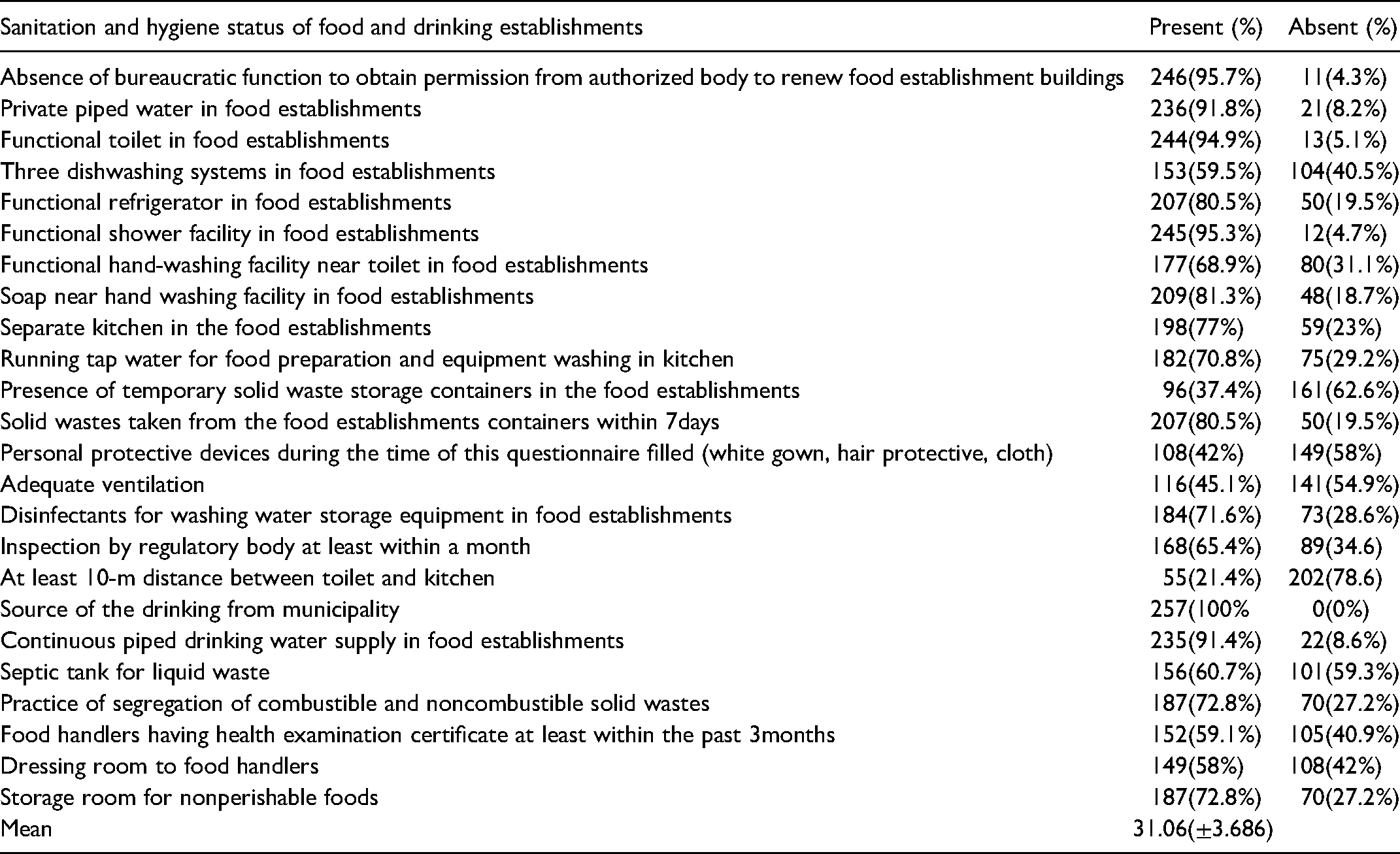
Almost all 246 (95.7%) of the observed food and drinking establishments obtained permission from the authorized body. Most Of the assessed food and drinking establishments, 65.4%, 60.7%, and 37.4% had an inspection by regulatory body at least within a month, a septic tank for liquid waste, and the presence of temporary solid waste storage containers/receptacles, respectively. Furthermore, 72% of the food establishments had practice of segregation of combustible and noncombustible solid wastes. Although 42% of the food handlers had personal protective devices such as white gowns and hair protective cloths, only 59.1% of the food handlers had health examination certificates at least within the 3 months prior to the study. Moreover, only 58% of the food handlers had a dressing room. From the observed food establishments, 72.8%% and 45.1% of these had storage room for nonperishable food items and adequate ventilation, respectively (Table 5)
Sanitation and Hygiene status of Food and Drinking Establishment in Burayu Town, Oromia, Ethiopia, 2022.
The Prevalence of Sanitation and Hygiene status of Food and Drinking Establishment
The overall sanitation and hygienic status of food and drinking establishments was categorized as good and poor depending on the cut valve of mean 31.06 with a standard deviation of ± 3.686. Based on the cutoff point, the prevalence of poor sanitation and hygiene status was 123(47.9%) whereas 134(52.1%) of food and drinking establishments had good sanitation and hygiene status, (Figure 2).
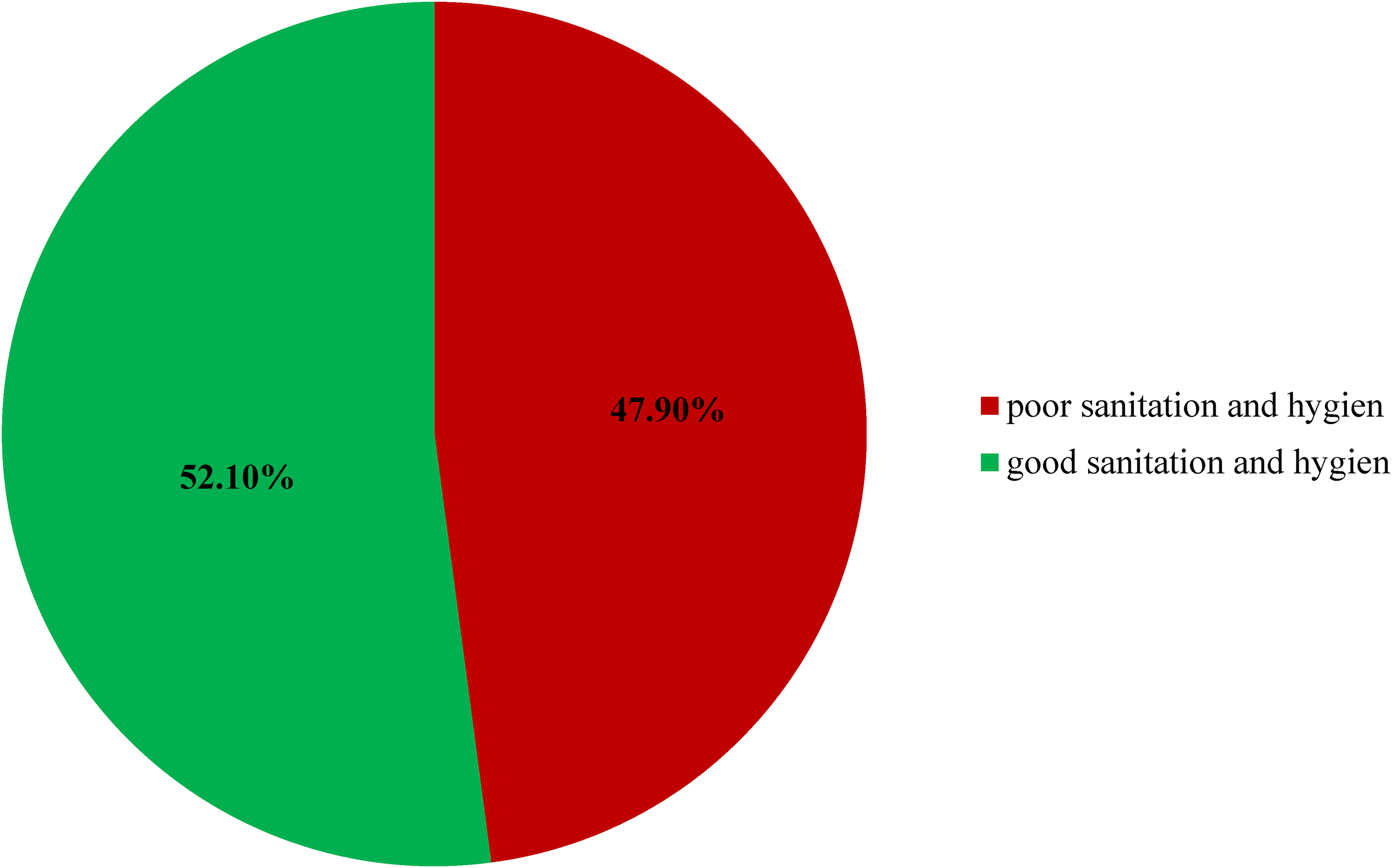
The prevalence of sanitation and hygiene status of food and drinking establishment in Burayu Town, Oromia, Ethiopia, 2022.
Factors Associated with Sanitary and Hygienic status of Food and Drinking Establishments
In the binary logistic regression analysis indicates that 8 predictors; age of the managers, sex of the managers, educational status of managers, presence of trained food handlers about sanitation and hygiene, presence of how long visiting/inspection, presence kitchen type, presence of basin cleanness, and presence of liquid waste drainage system installation, were significantly associated (P value<.05 at 95% CI) with sanitation and hygiene status of the food and drinking establishments.
In the multivariable analysis, the food and drinking establishments managed by male were 9.29 times more likely to be poor sanitation and hygienic status when compared to food and drinking that female managers (AOR: 9.29, 95% CI: 2.97-21.14). The food and drinking establishments which managed by less than 40 years managers were 1.24 times more likely to be poor sanitation and hygienic status as compared to food and drinking that above 40 years manager (AOR: 1.24, 95% CI: 1.03-4.36).The food and drinking establishments that had more than five years’ service were 3.66 times chance to be poor sanitation and hygienic status than those with less than five years of service (AOR: 3.66, 95% CI: 1.66-8.07). The analysis also indicate that food and drinking establishments that lack the clean basin were 2.92 times more likely to be poor sanitation and hygienic status than those had clean the basin (AOR: 2.92, 95% CI: 0.10-11.47). In addition, the absence of liquid waste drainage system installations in the food and drinking establishments were 3.26 times increased the chance of poor sanitation and hygienic status when compared to counterpart (AOR: 3.26, 95% CI: 0.12-0.62) (Table 6).
Factors Associated with Sanitary and Hygienic status of Food and Drinking Establishment in Burayu 2022.

Statistical significance at P < .001 = ***, P < .01 = ** and at P < .05 = *.
Discussion
The current study showed the the prevalence of poor sanitation and hygiene status of food and drinking establishment in Burayu town. The study revealed that food and drinking establishments had poor sanitation and hygiene status was 47.9% %. This finding is lower than the study conducted in ArbaMinch town that reported 67.40%, 13 Addis Ababa 58.8%, 14 Addis Ababa 57.4% 11 and Adwa town 53.3%, 15 The possible reasons might be that government the food and drinking establishments’ regular inspection, cleaning materials and educated food handlers more available in central parts of the country.
This study identified factors associated with sanitation and hygiene status such as sex and age of the managers, years of service, cleans of the basin and liquid waste drainage system installation were significantly associated with poor sanitation and hygiene status. The present study showed that the food and drinking establishments managed by male were nearly 10 times more likely to be poor sanitation and hygienic status when compared to food and drinking those female managers. This finding is in line with the study reported in Addis Ababa. 16 In contrast, the present finding differ from the studies conducted in Adwa town did not indicate the association of male manager. 9 This may be due to lower practice of males in sanitation in their daily activities than females.
The present study indicated that establishments with more than five years of service were significantly associated with poor sanitation and hygienic status compared to those with less than five years of service establishment. This finding was not similar to the study findings in Adwa town, which reported that establishments with less than five years of service were less likely to be associated with good sanitation and hygienic status. 9
On the other hand, lacks of clean basins were significantly associated with poor sanitation and hygienic status compared to clean basins. In fact, the clean basin expresses one of the important factors which had safety on sanitation and hygienic status better than unclean basin. In addition, this study was indicated that absence of liquid waste drainage system installation significantly associated with poor sanitation and hygiene status. This could be explained by the presence of liquid waste drainage, which may reduce the surrounding environment contamination and prove the sanitation of food and drinking establishments.
In the present study, the food and drinking establishments who managed by more than 40 years old managers were nearly 1.24 times more likely to be poor sanitation and hygienic status when compared with counterpart. This might be due to old age managers lose the control of each facilities and activities in the establishment because of family, tireless of serving and overload of the duties.
In this study 42.4% of manager received the training in sanitation and hygiene. This finding is higher than study conducted in Addis Ababa 31.2%. 11 However, this finding lower study conducted in Adwa town 47.6%. 15 As different studies revealed that managers received training on sanitation and hygienic status have a direct influence on the sanitation and hygiene condition of food establishments through ensuring an availability and cleanliness of sanitary facilities and proper waste management.11, 17 Regarding latrine facilities, all food and drinking establishments had toilets, out of this majority 82.9% were dry pit latrine. This finding greater than study conducted in Jimma that reported 92.5% had latrine facilities. 18 However, only 62.6% latrines were clean &comfortable for users.
The Strength and Limitations of the Study
The study is conducted on randomly selected food and drinking establishments which is important for the generalizability of the findings. Using observational checklists may increase the quality of data collection in addition to face to face interview. However, the study did not assess attitudes and knowledge of the food handlers directly that can influence sanitation and hygienic of the establishments. The cross-sectional study design effect and respondents’ bias may affect the acceptance of the results. Due to resource scarcity, the assessment of the sanitation and hygienic status were not supported by laboratory examinations.
Conclusion
The sanitation and hygienic status of food and drinking establishment of the town of Burayu was high poor sanitation and hygienic status. The study showed that male managers, manager less than 40 years old, more than five years’ services, lack of clean basin, absence of liquid waste drainage system installations were significantly associated with poor sanitation and hygienic status of food and drinking establishments. Therefore, the food and drinking establishments should install the liquid waste management system, avail clean basin, female empowerment, renew of food and drinking establishments that providing the service for more than five years to fulfill and maintain sanitation and hygienic status their establishments. The government should be allocating adequate support to manage liquid waste management to food and drinking establishments to upgrade sanitation and hygienic status, thereby enhancing the health of residents. Moreover, the managers of the food and drinking establishments should pay attention to fulfilling sanitation and hygienic status.
Supplemental Material
sj-docx-1-hme-10.1177_23333928221144553 - Supplemental material for Sanitary and Hygienic Status and Associated Factors Among Food and Drinking Establishments of Burayu Town, Oromia, Ethiopia
Supplemental material, sj-docx-1-hme-10.1177_23333928221144553 for Sanitary and Hygienic Status and Associated Factors Among Food and Drinking Establishments of Burayu Town, Oromia, Ethiopia by Alqeer Aliyo, Jonse Daba and Menelik Legese in Health Services Research and Managerial Epidemiology
Footnotes
Acronyms and Abbreviations
Acknowledgment
We would like to express my deepest gratitude to Kotebe University of Education Menelik II Medical and Health Science College and Department of Public Health Nutrition for giving me this chance to conduct this study. Our great appreciation also extends to the librarian and Department of Public Health Nutrition, Internet Center coordinators for their support and patience in getting the literature
Authors’ Contributions
All authors made a significant contribution in the conception, study design, execution, acquisition of data, analysis and interpretation, or in all these areas; took part in drafting, revising or critically reviewing the article; gave final approval of the version to be published; have agreed on the journal to which the article has been submitted; and agree to be accountable for all aspects of the work.
Availability of Data and Materials
Data essential for the conclusion are included in this manuscript. Additional data can be obtained from the corresponding author upon reasonable request.
Consent for Publication
Not applicable.
Competing of Interests
We declare that we do not have any conflicts of interest related to all activities pertaining to this research work.
Declaration of Conflicting Interests
The author(s) declared no potential conflicts of interest with respect to the research, authorship, and/or publication of this article.
Funding
The author(s) received no financial support for the research, authorship, and/or publication of this article.

Supplemental Material
Supplemental material for this article is available online.
Author Biographies
References
Supplementary Material
Please find the following supplemental material available below.
For Open Access articles published under a Creative Commons License, all supplemental material carries the same license as the article it is associated with.
For non-Open Access articles published, all supplemental material carries a non-exclusive license, and permission requests for re-use of supplemental material or any part of supplemental material shall be sent directly to the copyright owner as specified in the copyright notice associated with the article.
