




Abstract
Background
One of the important interventions in the infantile period is the selection of appropriate infant sleeping position. Unsafe infant sleep position is associated with sudden unexpected death in infancy. Yet, little is known about the practice of infant sleep position in Ethiopia. This study aimed to assess the practice of infant sleep position among mothers attending mother and child health service in Jimma town public health institutions, South West Ethiopia, 2022.
Methods
An institutional based cross-sectional study design was conducted on 409 women attending Maternal and child health service in Jimma town public health facilities. The data were collected using a pre-tested and semi- structured questionnaire. Binary Logistic regression was used to analyze the association between the practice infant sleeping positions and explanatory variables. The strength of association was evaluated using an odds ratio at a 95% confidence interval and a P-value ≤ .05 was considered to declare significant associations.
Results
Four hundred nine women participated in the study, with a response rate of 97%. The practice of recommended infant sleeping position (supine position) in this study was 33.5% [95% CI (28.9% - 38.6%)]. Being married Adjusted odds ratio (AOR) 2.6; 95% CI (1.04-6.48)), residence (AOR 1.88; 95% CI (1.1-3.31)) multi gravidity (AOR 1.6; 95% CI (1.02-2.59)) and having good knowledge of sleeping position (AOR 1.55; 95% CI (1.01-2.38)) were significantly associated with the practice of infant sleep position
Conclusion
The practice of medically recommended infant sleep position in this study was low. Being married, residence, multi gravidity and having good knowledge of sleeping position were significantly associated with the practice of infant sleep position. Therefore, considering these associated factors during health care provision and disseminating information on safe sleep practices for mothers is needed. Also, different stakeholders, including the federal ministry of health, health professionals, and health institutions at different levels, need to give attention to such problems in addition to the service to reduce infant mortality
Introduction
The selection of an appropriate sleeping environment and arrangement is one of the important interventions in the infantile period. Safe infant sleeping arrangements refers to the arrangements provided by the mother or the primary caregiver in order to avoid injury and /promoting the general health of the child.1,2
Unsafe infant sleep position is related to sudden unexpected death in infancy (SUDI) and other sleep-related deaths. 3 Non-supine baby sleep position was known as a crucial modifiable risk issue for sudden surprising death in infancy. There was a decrease in infant mortality rates from SUDI in several countries after the success of international public health campaigns advising on the safe baby sleep position.1,4 According to the guidelines given by the American Academy of Pediatrics(AAP), the arrangements that are considered to be safe for the infants are, use of firm surface, regular parental care, breast feeding, appropriate position, safe place, and safe home environment. 5
According to the American Academy of Pediatrics, the recommended sleeping position for infants aged one year or less is supine position. The main justification for recommending that babies sleep on their back and not on their side is that the tendency infants have to roll over onto the tummy while sleeping on the side; thereby placing them at increased risk of SIDs. 3
Sleeping other than supine position, like prone position by infants has been related to increased risk of SIDS. The SIDS refers to the unexpected and unexplained death of children under 1 year of age, even after reviewing the clinical history, assessing the circumstances of the place of death and a postmortem examination. 3 Death from SIDS can occur anytime during a baby's first year, and the peak incidence is between 2 and 4 months of age, but the majority (90%) of SIDS deaths occurs before a baby reaches 6 months of age. It occurs more often in males than females.4,6
Even though there is a huge decrease in infant mortality rate from an estimated rate of 65 deaths per1000 live births in 1990 to 29 deaths per 1000 live births in 2018 globally, Africa is still showing the big number which is 47.45 as of African macro trend report. 7
Ethiopia is one of the countries with a high infant mortality rate. Like many developing countries there is no deep study regarding mortality related to SIDS which is directly associated with infant sleeping position as a result of infant sleeping position, as choosing infant sleeping position is related to maternal knowledge and practice there is no much study assessing those factors in Africa especially in Ethiopia distinctly in Jimma Town. In addition, there is no single research in Ethiopia neither at national nor regional level which delineates the magnitude of unsafe infant sleeping position practice being practiced among mothers despite having high under one year population.
Method and Materials
Study Area
The study was conducted in Jimma town public health institutions, Jimma, Oromia regional state, south-west Ethiopia. Jimma town is 346 kilometers from Addis Ababa. In the town, there are five public health centers and two hospitals that provide services for the community, such as curative, preventive, and admission services. According to the 2007 census of Ethiopia, the total population of Jimma is 182 942 with 91 771 males and 91 171 females. There are seven public health care institutions in Jimma town. From the seven, two are hospitals, and the rest are health centers.
Study Design and Period
An institutional based cross-sectional study design was conducted in those selected health institutions. The study was conducted from June 01-July 1 2022.
Population
Source population
All women who gave birth in the past year and attended MCH served in Jimma Town public health institutions were the source population.
Study population
Mothers who gave birth in the past 1 year and attended MCH serve in selected Jimma town health care institutions during the data collection period were the study population.
Sampling Technique and Sample Size
Sample size
The sample size was determined by the assumption that 50% prevalence considering the absence of previous data on specific study population and with 5% margin of error, 95% confidence interval (CI) and a non-response rate 10%. Based on this assumption the actual sample size of the study was determined using the formula for single population proportion.
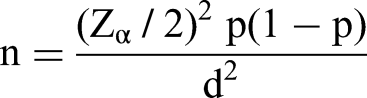
Zα/2 Standard (1.96)
P = expected proportion of infant sleeping position = 50% = 0.5
d = margin of error = 5% = 0.05
Therefore

Sampling Techniques
From all 7 public health care institutions (5 HC and 2 hospitals) found in Jimma Town, the three public health care institutions (2 HC and 1 hospital) were selected by lottery method, and then proportional allocation was done for the health institutions in terms of the previous monthly report number of their MCH service. A systematic sampling technique was used to select study subjects who attended MCH services during the data collection period. The previous monthly report number of MCH services in selected public health care institutions was taken as a total population, which is 2430. Then, to obtain the sampling interval (k-value), use the formula k = N/n, where k is the constant value, N is the previous monthly report number of MCH service, and n is the sample size. The first study subject was selected by lottery method. Data were collected for every sixth woman who attends MCH services in the selected health care institution.
Study Variables
Dependent variable
The practice of Infant sleeping position
Independent variables
Operational Definition
Data Collection Methods and Instrument
Data were collected by face-to-face interview using a pre-tested, semi-structured questionnaire from the respondents. The tool was first prepared in English and then translated to the local language (Afan Oromo). The tool comprises socio-demographic, obstetrics characteristics, relationship to the infant, knowledge of women regarding sleep position, source of information, and practice of sleeping position. Three bachelor of sciences (BSc) and one master of sciences (MSc) midwife professionals were selected for data collection and supervision, respectively. A one-day training was given for both data collectors and supervisors about the methodology and questionnaire by the investigators.
Data Quality Control
The qualities of data were assured before data collection, during data collection and after data collection. Prior to the data collection, the questionnaire was pre-tested on 5% of the sample size. And day training was given for data collectors and supervisors. During data collection, close follow up was done by supervisor and principal investigator. After data collection, data was checked for completeness and using epi data also helps to automatically detect errors made during data entry.
Data Analysis
The collected data were analyzed descriptively and by binary logistic regression using SPSS version 25. Descriptive statistics were done and presented using narratives, tables, and figures. Binary logistic regression was used to find the crude association between the practice of infant sleep position and explanatory variables. Explanatory variables that had a P-value of less than .25 and fulfill the assumption of logistic regression from bi-variable logistic regression were considered for the multivariable logistic regression model. The strength of association was evaluated using an odds ratio at a 95% confidence interval and a P-value ≤ .05 was considered to declare significant associations.
Ethical consideration
Ethical clearance and permission were obtained from the Ethical review committee of Jimma University, school of midwifery. Study participants were informed about the objectives, benefits, risks and their right to the decision of participating in the study. Also, the study subjects were informed their responses will be coded and used only for only research purposes. Participants name was made anonymous to affirm confidentiality throughout the study. Moreover, informed written consent was taken before data collection started.
Results
Socio Demographic Characteristics
Four hundred nine mothers were participated in this study, giving a response rate of 97%. The mean age of the mothers were 26.8 ± 4.78 standard deviation (SD) years, with a minimum of 18 and a maximum of 48 years. The majority of respondent's religion were Muslim (52.6%), followed by Orthodox (28.8%). The educational status of the respondents varies from illiterate to graduate and post-graduate. While seventy-five (18.3%) of them were illiterate, three hundred and thirty-four (81.7%) of the mothers could at least read and write, and of those, 98 (29.3%) had graduated from higher education institutions. Concerning occupation, (53.3%) of respondents were housewives. Three hundred twenty-eight (77.8%) lived in urban areas, whereas eighty-one (22.2%) lived in rural areas (Table 1).
Socio-Demographic Characteristics of Mothers Attending Mother and Child Health Service in Jimma Town Public Health Institutions, Ethiopia 2022.

Obstetric History of the Study Participants
One hundred twenty (29.3%) of the mothers were prim gravida and376 (91.9) study participants had at least one ANC visit during their pregnancy. Three hundred seventy four respondents give birth at health institutions (Table 2).
Obstetric History of Mothers Attending MCH Service in Jimma Town Public Health Institutions, Ethiopia 2022.

Factor Associated with Practice of Infant Sleeping Position among Mothers Attending MCH Service in Jimma Town Public Health Institutions, Ethiopia 2022.

*Statistically significant at P < .05, 1 = reference category.
From the table those have * shows that variables which had a significant association with practice of sleeping position in multivariate logistic regression.
Knowledge of Sleeping Position
One hundred eighty six (45.5%) of study participants had a good knowledge about sleeping position while the other 223(54.5%) had a poor knowledge (Figure 1).
The practice of infant sleep position
The practice of recommended sleeping position (supine position) in this study was 33.5% [95% CI (28.9% – 38.6%)].While the other 272(66.5%) of respondents reported that they had not practiced the recommended infant sleep position (Figure 2).
Factors Associated with the Practice of Infant Sleeping Position
In bivariate logistic regressions six variables include: Marital status crude odds ratio (COR) = 3.01(1.23-7.38), residence COR = 1.9(1.12-3.28), not having ANC visit COR = .33(0.12-0.87), gravidity COR = 1.74(1.07-2.80), Place of birth COR = 2.6(1.05-6.44), Number of children COR = 1.46(1.05-2.23) and having good knowledge of sleeping position, COR = 1.8(1.18-2.72) were significantly associated with the practice of sleeping position. However, in multivariate logistic regressions only four variables, being married Adjusted odds ratio (AOR) 2.6; 95% CI (1.04-6.48)) P- value 0.04, residence (AOR 1.88; 95% CI (1.1-3.31)) P- value .02, multi gravidity (AOR 1.6; 95% CI (1.02-2.59)) P- value .05 and having good knowledge of sleeping position (AOR 1.55; 95% CI (1.01-2.38)) P- value .05 were significantly associated with the practice of infant sleep position (Table 3).
Discussion
The practice of medically recommended infant sleeping position (supine position) in this study was 33.5% [95% CI (28.9% – 38.6%)]. The finding was lower than a studies conducted in Istanbul, Turkey (46%), 10 in United States(61%), 11 in Riyadh, Saudi Arabia (61.9%) 12 and in Brazil (55.4%). 13 This variation is possible due to variation in study design, socioeconomic and cultural differences in the populations assessed in these studies. The current study was conducted in cross sectional study, but the study conducted in Brazil was cohort and the data come from a population-based study with a high follow-up rate. On the contrary, the finding of the current study was higher than the study conducted in Pediatric Outpatient and Well– baby clinics of the University of Port Harcourt Teaching Hospital (UPTH), Port Harcourt, Nigeria (18.1%). 9 This variation is possible due to variation in year of study, the sample size, socioeconomic and cultural differences in the populations assessed in these studies.
The current study indicated that there was a strong association between being married marital status and the practice of medically recommended infant sleeping position. Married respondents were 2.6 times more likely to have good practice of infant sleep position than their counterparties. The finding was supported by a study conducted in Cheyenne, United States. 14 These findings could possibly be due to involvement of a partner in acquiring health education and choosing infant sleep position.
In this study there was a strong association between women's residency and the practice of medically recommended infant sleep position. Women living in urban areas were two times more likely to practice medically recommended infant sleep position than those living in rural areas (AOR 1.88; 95% CI (1.1-3.31)). The finding was supported by a study conducted in Canadian Maternity Experiences Survey. 15 This is probably due to the accessibility of better information and awareness about infant sleep position in urban areas than in rural areas. Therefore, the ministry of health and/or other stakeholders should focus to address health information's for the rural community.
Another independent variable which had significant association with the practice of medically recommended infant sleep position was Gravida. Multigravida women were 1.6 times more likely to practice medically recommended infant sleep position than prim gravida (AOR 1.6; 95% CI (1.02-2.59)). This is possible because multigravida women's had an experience on how to sleep their infant as compared to primipara. 16
In this study having good knowledge of sleeping position were significantly associated with the practicing safe sleeping position. This study was supported by previous studies and the AAP recommendations.3,17 Additionally, study conducted on African-American mothers, it was found that receiving information of correct sleep position from multiple sources was significantly correlated with correct practice. 11 Also study conducted in Georgia showed a high correlation between the knowledge of the recommended infant sleep position and the practice of “back to sleep”. 18
Limitations
Being the first study to assess the situation in Ethiopia and the study area in particular is the major strength of this study. In addition, the study tried to include public health facilities where most pregnant women in Ethiopia receive maternal and child health care services. However, the study was limited to addressing mothers who attended MCH services at private health care institutions. Additionally, this study does not include the health care providers’ view and analysis of parents’ sleep positions (supine vs not) with qualitative data as a mixed methods approach.
Conclusions
The practice of the medically recommended infant sleep position was very low compared with the previous studies and global recommendation. Nearly two-thirds of study participants do not practice the internationally recommended infant sleep position. Being married, residence, being multi-gravid, and having good knowledge of sleeping positions were significantly associated with the practice of infant sleep positioning. Therefore, considering these associated factors during health care provision and disseminating information on safe sleep practices for mothers is needed. Also, different stakeholders, including the federal ministry of health, health professionals, and health institutions at different levels, need to give attention to such problems in addition to the service to reduce infant mortality.

Knowledge of mothers attending mother and child health service regarding infant sleeping position in Jimma town public health institutions, Ethiopia 2022.
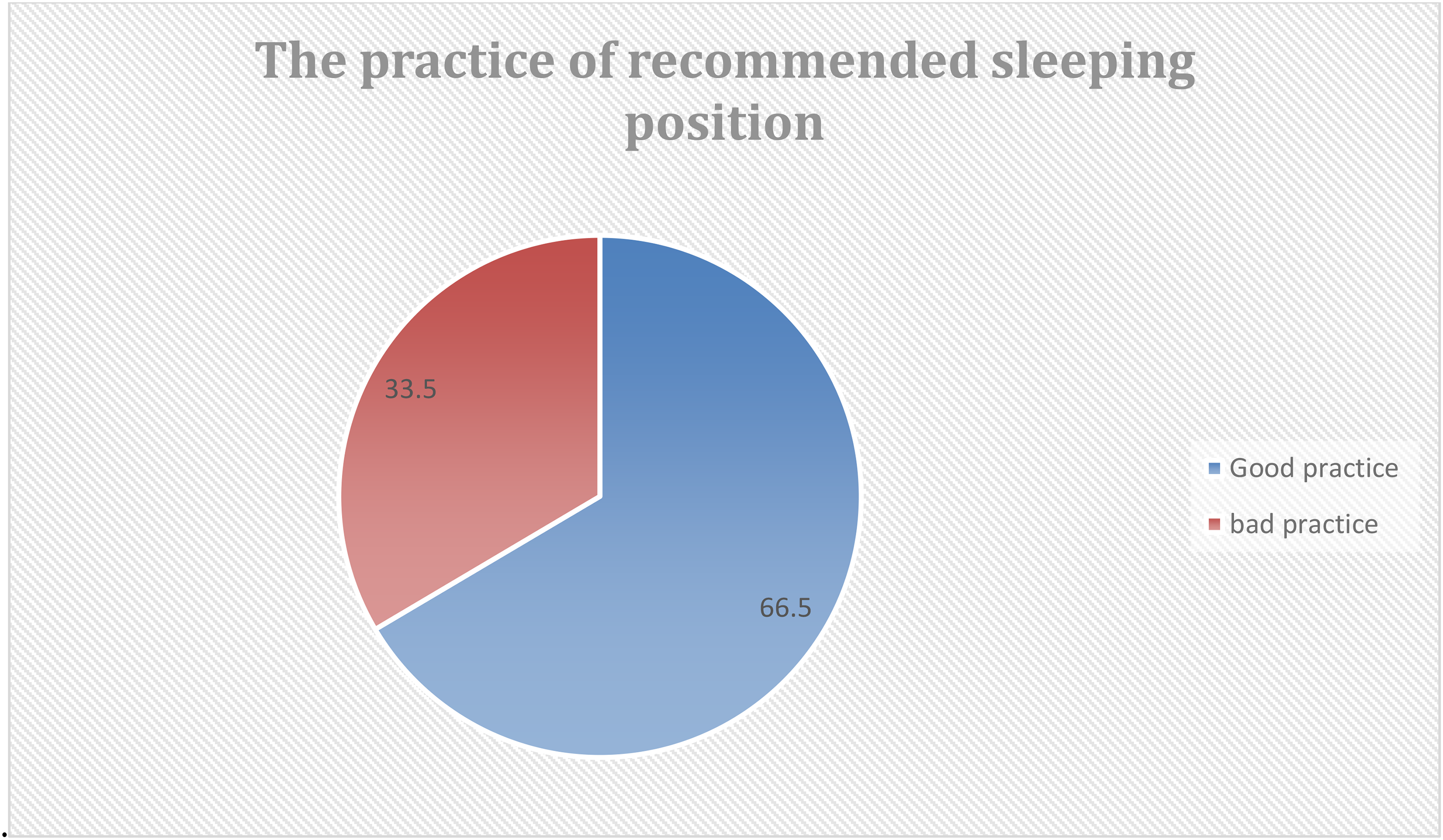
Infant's sleeping position practice among mothers attending mother and child health service in jimma town public health institutions, Ethiopia 2022.
Footnotes
Abbreviation and Acronyms
Author's Contributions
All authors contributed to the study conception and design.
Availability of Data and Supporting Material
The datasets used and analyzed during the current study are available from the corresponding author on reasonable request.
Declaration of Conflicting Interests
The author(s) declared no potential conflicts of interest with respect to the research, authorship, and/or publication of this article.
Ethical Consideration
Ethical clearance and permission were obtained from the Ethical review committee of Jimma University, school of midwifery. Study participants were informed about the objectives, benefits, risks and their right to the decision of participating in the study. Also, the study subjects were informed their responses will be coded and used only for only research purposes. Participants name was made anonymous to affirm confidentiality throughout the study. Moreover, informed written consent was taken before data collection started.
Funding
Institution of health science, Jimma University. In this study, the funders did not have any role in the study design, data collection, analysis, or interpretation of the data, or in the writing of the manuscript.
