




Abstract
Superintendents play a vital role in the districts and communities they serve, which is especially true in many rural contexts that function not only as a site for PreK–12 education but also as a community hub for a range of supports and services. Instability in the role can be threatening to district improvement, but research on the topic has been limited and too often focused exclusively on large districts and relying only on large longitudinal datasets. Our explanatory, sequential mixed methods study begins with an examination of demographics and turnover trends across 600 rural Texas school districts to investigate the realities of turnover in Texas rural superintendency. However, we also identified and interviewed a sample of rural superintendents we classified as “leavers” or stayers” to examine how unique personal factors influence decisions to stay or go. Findings illuminate the multifaceted and idiosyncratic factors that contribute to rural superintendent turnover with implications for policy and leadership preparation and development.
Keywords
Introduction
Superintendents are executive leaders that play many important roles within districts and communities including that of instructional leader, manager, democratic leader, and communicator (Callahan, 1962; Björk et al., 2018; Fusarelli & Fusarelli, 2005; Kowalski & Brunner, 2011). The job is complex, time-intensive, and stressful given the many demands, pressures, politics, and uncertainties (Gmelch, & Torelli, 1994; Robinson & Shakeshaft, 2015, 2016). The COVID–19 pandemic and increased polarization in American society has added to the challenges and stress of the superintendency (Schafft et al., 2022; Schwartz & Diliberti, 2023). Stable district leadership is critical for short and long-term district success under such conditions while chronic turnover can create instability, undermine reforms, and threaten coherence. Thus, superintendent turnover has been considered an area of concern for more than a century.
A common narrative about superintendent tenure has emerged: it is rocky, short-lived, and subject to shifting political winds tied to school board dynamics and intractable problems of local governance. More than 60 years ago, Callahan (1962) noted similar concerns: Tenure of the school superintendent is an uncertain one and his position is attended with vexatious conditions. These upheavals are so frequent and the discussions which find their way into the public press, so painful to the victim and disturbing to the school system, as to excite more than ordinary interest . . . That the official life of the superintendent is a short one has been amply demonstrated (p. 53).
Tekniepe (2015) noted comparable concerns for rural superintendents navigating “turbulent environments involving elected boards, faculty and staff, community stakeholders, and fiscal constraints” (p. 1). Non-peer reviewed research and media reports add to the short-lived superintendent narrative. In the Life Of (ILO) Group (2022) reported that 37% of the nation’s 500 largest districts underwent or were undergoing superintendent changes between March 2020 and January 2022. 1 Likewise, the media regularly reports on turnover. For example, the Austin American-Statesman reported that the Austin Independent School District had 4 superintendents between 2020 and 2023 (Heath, 2023). In 2008, the Associated Press (Taylor, 2008) reported that Kansas City, Missouri’s school district had 25 superintendents over 40 years. Yet, the short-lived superintendent narrative is not empirically supported when looking beyond a set of outlier districts.
Few clear answers exist as to turnover trends across time and context and why superintendents leave or stay. As White (2023) noted, “claims related to superintendent turnover . . . have historically been based on conjecture or surveys and web searches conducted at intermittent times throughout history with a limited and often nonrepresentative sample of respondents or data points” (pp. 272–273). A lack of a national longitudinal database of superintendents has limited research efforts (DeMatthews et al., 2024b; White & Jerman, 2025), while most studies do not view superintendents as people with families, interests, and values navigating career and personal life decisions in context-specific and idiosyncratic ways. This study is informed by these shortcomings in the literature and anchored by three guiding research questions:
What are the rates of superintendent turnover in rural, town, suburban, and urban districts across Texas?
What individual- and district-level factors help to explain turnover among rural superintendents?
What factors do rural superintendents identify as reasons for staying or leaving their district?
Our focus on rural superintendents is strategic given the dearth of research focused on rural districts and given they make up the majority of all districts in the U.S. serving approximately 20% of the student population (National Center for Education Statistics, n.d.). Moreover, prior research has highlighted high levels of educator turnover in rural Texas (DeMatthews et al., 2023).
In the balance of this article, we provide an overview of the literature on superintendent turnover and the concept of job-embeddedness (Mitchell et al., 2001), which we used to explore factors influencing superintendent decisions to stay or leave. Next, we describe our explanatory sequential mixed-methods approach, where we first quantitatively examined rates of superintendent turnover in Texas across locales and factors that specifically predict turnover in rural Texas districts. Following the quantitative analyses, we conducted qualitative interviews to elucidate the superintendent-specific individual factors that cannot be captured through quantitative analyses but likely contribute to staying and leaving. We explain in detail how we identified, recruited, and selected superintendents for this study. We also share findings from superintendent interviews to describe how a complex, intertwined set of factors shaped their decisions to leave or stay. Finally, we conclude with a discussion of key findings and implications for future research, policy, and superintendent preparation.
Theoretical Framework
Superintendent Turnover
Superintendent tenure typically begins when a democratically-elected local school board makes a hiring decision and ends when the superintendent either voluntarily decides to leave the district or when the school board decides to not renew the superintendent’s contract or terminate the superintendent prior to the end of their contract. Superintendents who voluntary leave do so for several reasons, including retirement, taking a new position at another district, resigning, or changing professions. Few national studies examine superintendent turnover rates—and all have limitations (AASA studies [e.g., Finnan et al., 2015; Glass, 1992; Tienken, 2020] ILO Group, 2022; Schwartz & Diliberti, 2022; White, 2023; Yee & Cuban, 1996).
In a relatively dated study of the nation’s largest 25 school districts between 1900 and 1990, Yee and Cuban (1996) found that superintendent tenure declined throughout the century with “multiple cycles of decline, stability, and increase embedded within an overall downward trend in longevity over the century” (p. 624). From 1965 to 1990, the average tenure shifted from 6 years to 5.8 years, reflecting a stable superintendent workforce in large districts. In one of the most comprehensive national studies using a newly created 4-year national superintendent dataset, White (2023) found that between 2019–20 and 2022–23, the pooled turnover rate was 16.1% with roughly 62% of districts having the same superintendent for all four years. Thirty-three percent of districts had one superintendent turnover event and 5% had two or more turnover events during the 4-year study period. Other national studies focus on larger districts for a few years (ILO Group, 2022) or rely on surveys with a low response rate (e.g., Tienken, 2020).
Single-state studies from California, Missouri, and Texas provide insight into superintendent turnover. Grissom and Anderson (2012) found that among 215 California superintendents beginning their tenure in 2006, only 55% remained in the same position within 3 years. The study included surveys from school board members. School boards that rated their own functioning and superintendent performance as “high” had lower rates of non-retirement superintendent departures 3 years later. Superintendents who left districts tended to move to larger urban and suburban districts with higher pay and away from remote rural districts. In another study, Grissom and Mitani (2016) found that superintendent turnover in Missouri was generally higher in districts with lower test scores although there were low levels of turnover in the lowest performing districts. Higher paid superintendents were more likely to stay, which was more strongly correlated in high performing districts. When superintendents moved, those moves were associated with substantial salary gains in districts with more student enrollment and higher student achievement. In Texas, DeMatthews et al. (2023) found that the turnover rate among superintendents between 2010–11 and 2020–21 ranged from 20.4% (high in 2015) to 15.9% (low in 2020 and 2021). Rural areas and towns had proportionally greater high-churn districts (characterized by four or more superintendents during an 11-year span) than low-churn districts (three or fewer superintendents during an 11-year span), whereas the converse was true for districts located in cities and suburbs. Leadership instability is a concern in Texas rural districts, but there have been few studies investigating factors that contribute to turnover among rural superintendents—a gap our study addresses directly.
School board dynamics may also be a factor associated with superintendent turnover. Researchers have long reported that when voters become dissatisfied with local school policies, school boards, and/or superintendent leadership, they exercise their power by removing board members, which can ultimately lead to superintendent removal (Iannaconne & Lutz, 1994). Several studies highlight these phenomena in rural districts (Tekniepe, 2015; Yates & Jong, 2018). Voter dissatisfaction with school board members, school policies, and/or superintendent leadership can prompt politically-driven school board turnover with downstream effects on a superintendent’s evaluation and employment (Alsbury, 2003, 2008; Feuerstein, 2002; Lutz & Iannoccone, 1978; Rogers et al., 2024). In an increasingly polarized society and with powerful special interests becoming more involved in local school board elections, right-wing groups and donors like Mom’s for Liberty and Patriotic Mobile have, at times, influenced board membership (Hixenbaugh, 2022; Strauss, 2023). As board ideologies shift, so too can district priorities with implications for voluntary and involuntary superintendent turnover (Blissett & Alsbury, 2018).
Job-related stress and burnout among education leaders has been a growing body of research, although few studies focus on superintendents (Gmelch & Torelli, 1994; Robinson & Shakeshaft, 2016; Schwartz & Diliberti, 2022, 2023). In a 2015 national survey including 1,865 superintendents (28.5% response rate), Robinson and Shakeshaft (2016) found that almost 95% of superintendents felt nervous or stressed in the past month. Forty-one percent reported that stress-inducing events were fairly or very common. Commonly reported stressors included changing state/federal regulations, time commitments, inadequate school finance, work-life balance, and accountability policies. More recently, Schwartz and Diliberti (2022) found that nearly 95% of superintendents believed their job had gotten harder over the past decade and that job-related stress and community politics were the most common reasons for considering leaving their positions. In another recent national survey, nearly 80% of superintendents reported that work was “often” or “always” stressful during the 2022–23 school year (Schwartz & Diliberti, 2023). Nearly 90% of superintendents reported that the “intrusion of political issues and opinions into schooling” was a stress factor in their jobs, above educator and student mental health, staffing shortages, district budgets, and state accountability requirements. Nearly 80% of superintendents reported that their work was “often” or “always” stressful and only 50% felt they were coping with the stress “well” or “very well.” In another national study, Rogers et al. (2024) reported that superintendents were increasingly confronting contentious, culturally divisive environments which in some instances were culminating in threats and significant stress.
Job-Embeddedness
Superintendent turnover research has primarily focused on turnover rates, destinations following voluntary turnover, and job-related stressors that might explain turnover which are aligned to literature focused on voluntary employee turnover dating back to the mid-twentieth century. As March and Simon (1958) noted, “Under nearly all conditions the most accurate single predictor of labor turnover is the state of the economy . . . When jobs are plentiful, voluntary movement is high; when jobs are scarce, voluntary turnover is small” (p. 100). They noted that other factors “pushed” employees out of their positions such as job dissatisfaction or “pulled” them to other positions, such as more attractive job opportunities and higher pay. Researchers also argued that labor market conditions as well as what is considered an attractive job opportunity is different for each person. As an extreme example, Gerhart (1990) noted, “one could think of a separate labor market for each person . . . that stem from variations in skills, abilities, experience, and so on” (pp. 467–468). The empirical research on superintendent turnover, however, does not fully consider an individual’s skills, abilities, experiences, or their perceptions of the labor market at a given time.
Turnover models that emphasize voluntary turnover as driven by employee perceptions of the labor market and job attitudes have predictive value, but these links are consistently weak (Maertz & Griffeth, 2004). Often, individuals have negative job attitudes and job alternatives in a labor market they view as strong but decide to stay in their jobs (Campion, 1991). These instances prompt attention to non-work-related factors, such as family attachments and conflicts between work and family roles. Consequently, researchers have found that employees voluntarily leave jobs, even when they are satisfied and with no labor market insights or job opportunities, if they experience a shock, like a spouse receiving a new job in a different location or a sick family member requiring attention (Lee & Maurer, 1999). To date, the literature on superintendent turnover does not consider superintendents’ personal lives, family commitments, or how non-work life influences or explains their employment decisions.
Job-embeddedness, described as a “net or a web in which an individual can become stuck” (Mitchell et al., 2001, p. 1104), is a useful construct incorporating broader influences beyond job attitudes and employee perceptions of the labor market. Job-embeddedness has three components: (1) Links, which represent the formal and informal connections an employee has with work activities and/or their co-workers; (2) Fit, which represents the employee’s comfort in their job and the degree to which they believe their job and community are in alignment with other aspects of their lives; and (3) Sacrifice, which represents the potential material and psychological cost of breaking those links when leaving the position. Researchers have widely used job-embeddedness to explore voluntary turnover across a variety of workplace settings (Burrows et al., 2021; Fasbender et al., 2019; Porter et al., 2019). In a meta-analytic review of 65 studies, Jiang et al. (2012) found that job-embeddedness was negatively related to turnover intentions and actual turnover after controlling for traditional turnover explanations (e.g., job attitudes, job opportunities) although the concept had differing predictive value across contexts.
Rural Districts and Superintendents
Context matters for any employee’s decision to stay or leave given an employee’s experiences and job opportunities. Thus, we briefly add nuance to rural schools and the rural superintendency. We caution the reader about the term “rural” and note that it does not have a commonly held definition and the districts, schools, and communities within rural areas are far from monolithic. According to the U.S. Census Bureau (2016), rural is defined as a space that is not in an urban area while the U.S. National Center for Education Statistics (NCES) (2006) created a school classification system outlining four locale types (urban, suburban, town, rural) with three rural subcategories: fringe, distant, and remote. 2 Of importance to this study, each rural district is unique with implications for the superintendent labor market, job opportunities, and job-embeddedness. Research on superintendent turnover suggests that superintendents tend to move to larger, more affluent, and more White school districts. Rural districts tend to be small with the median enrollment hovering at just below 500 students, although states vary (e.g., 90% of districts are under 500 students in Montana, North Dakota, and Vermont) (Lavalley, 2018). White students make up roughly 72% of the rural student population nationwide (NCES, 2012), but, in many states, roughly 50% or more of rural students are students of color (e.g., New Mexico, 85%; Alaska, 45%) (Lavalley, 2018). Typically, rural students outperform urban peers on the National Assessment of Educational Progress and in graduation rates, but rural academic achievement also varies by states, with some states performing well below national averages (Lavalley, 2018).
Rural districts can confront a range of opportunities and challenges. Historically, many rural districts benefit from smaller class sizes, a strong sense of student and family belonging, high levels of parent engagement, and strong extracurricular activities (Croft & Moore, 2019; McShane & Smarick, 2018). Researchers have found that rural districts tend to report higher levels of inexperienced and ineffective teachers relative to suburban districts; and these districts may struggle to recruit and retain science teachers, special education teachers, and other positions (NCES, 2012; Sutcher et al., 2019). Some rural districts are confronting shrinking populations following decades of disinvestment (Maselli et al., 2020), while the physical distance from metropolitan areas can limit access to resources like universities, professional consultants, high-quality professional development opportunities, and a system of affordable transportation (Goldhaber et al., 2021; Johnson & Howley, 2015). Moreover, some rural locales continue to have limited access to broadband internet (Johnson et al., 2014).
Increased polarization around LGBTQ+ issues, critical race theory, COVID–19 schooling and vaccination politics, book removals and other culture war issues have also complicated the work of superintendents (Jochim et al., 2023), including rural districts. Some rural areas have been subject to increased political polarization and increasingly strong support for Republican party candidates and issues (Johnston et al., 2020). Increasing ideologically and socially-driven partisan divergence has likely complicated local governance and the work of the superintendent. A recent study within rural districts in Pennsylvania revealed that while these districts faced a range of serious problems before the pandemic (e.g., persistent poverty, funding disparities, declining enrollments, lack of broadband access), school district equity initiatives were “hampered by increasingly contentious and politicized local debates” (Schafft et al., 2022, p. 55). To one degree or another, these are the contextual variables many rural superintendents confront in their work. Superintendents in smaller districts often report feeling very connected to the local community and have expert knowledge of local issues, which often leads them to closely balance, negotiate, and weigh their decisions in relation to their context (Hyle et al., 2010). As human beings, superintendents consider these contextual variables and their personal preferences and family commitments to make decisions about whether to stay or go. In sum, context and a variety of personal and professional variables within and outside of the superintendent’s control undoubtedly shape their decisions to stay or go, which require further investigation.
Methods
In this study, we used an explanatory, sequential mixed-methods design to examine rates of superintendent turnover and understand the individual factors that contribute to voluntary superintendent turnover in rural Texas districts. An explanatory, sequential mixed-methods design can be used to analyze quantitative data first and then explain quantitative results with additional qualitative data (Creswell & Plano Clark, 2017). In the first, quantitative phase of the study, we rely on the Texas Education Research Center (ERC) longitudinal data to determine the demographics and turnover trends among Texas superintendents by district locale, with a focus on rural communities. The state has approximately 1,200 districts total and more than 650 rural districts. We also used public data requests to identify the names and districts of rural superintendents who recently transferred districts (between 2021 and 2022) and superintendents with at least 3 consecutive years of experience in their district to interview for the qualitative portion of this design. We rely on these data to answer the study’s first and second questions focused on rates of superintendent turnover across rural, town, suburban, and urban districts across Texas and factors related to turnover. In the second, qualitative phase, we rely on interviews with rural superintendents to answer the study’s third question focused on factors that contribute to staying and leaving. Below, we further outline the methods of this study.
Quantitative
Sample
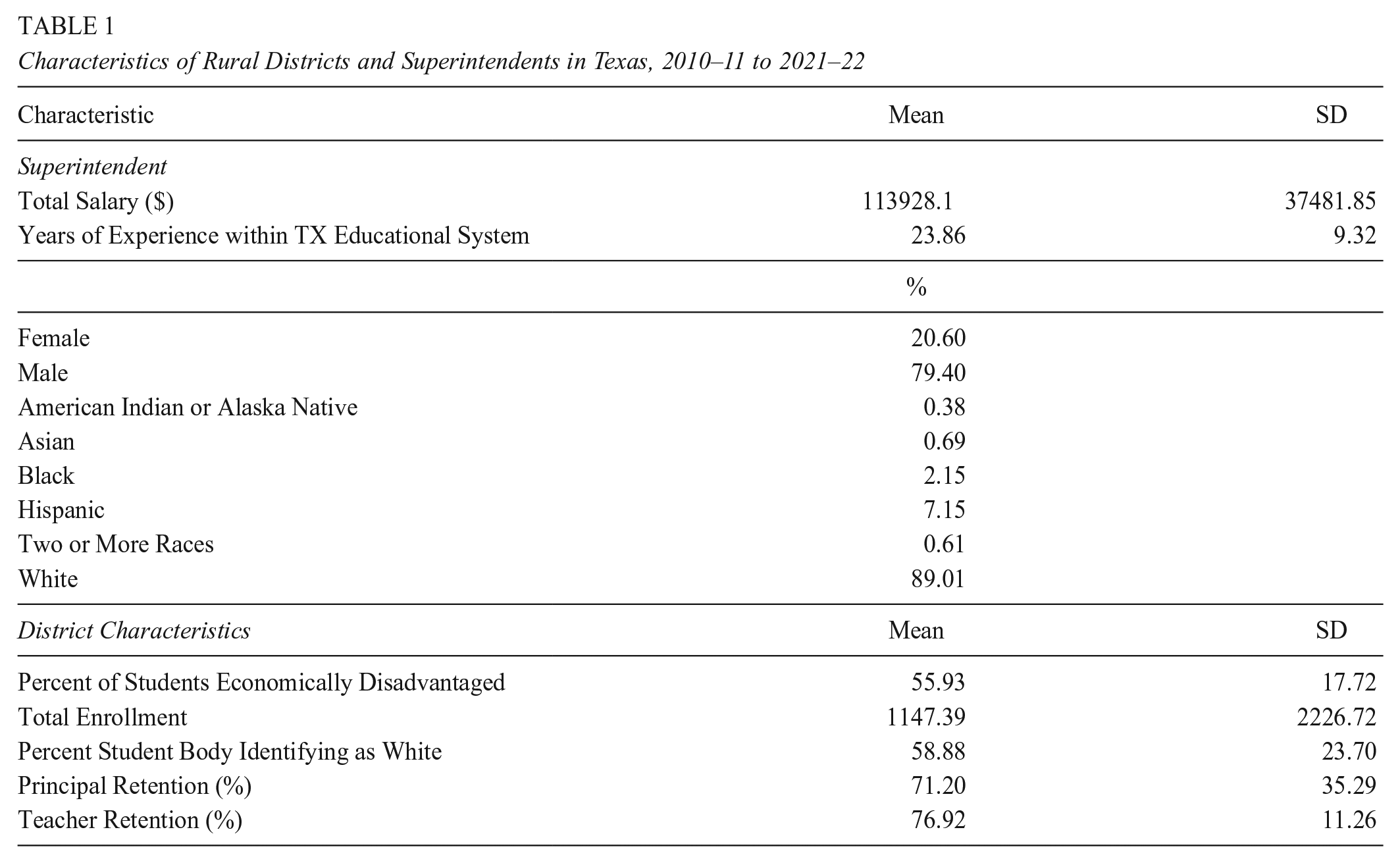
As stated above, data for the quantitative analyses were provided by the Texas ERC and public record requests from the Texas Education Agency (TEA). The Texas ERC is a research and evaluation center that provides access to high-quality, longitudinal data from the Texas PK–12, Texas higher education, Texas workforce, and other data for the state of Texas. 3 For this study, we focus on superintendents serving in rural communities from the 2010–11 through 2021–22 school years, including data on superintendent sociodemographics, district demographics, locale, and annual district-level turnover for principals and teachers. Table 1 provides descriptive statistics for our sample at the district-level. The vast majority of rural superintendents identified as White (89%) and male (79.4%). On average, rural superintendents had nearly 24 years of professional experience in the Texas Educational System. Rural districts in Texas had varying levels of diversity. The median percentage of the student body who identified as White was 64.72%; however, this ranged from 0 to 97.8%. Similarly, the percent of students who were economically disadvantaged ranged from none to 100%, although the median was 55.9%. The average rural district size was 1147 students, but 9 rural districts served fewer than 20 students and the largest served 27,583 students. Total enrollment was log transformed to account for its right-skewed distribution. Data through the ERC were cleaned and analyzed using Stata v.17.0.
Characteristics of Rural Districts and Superintendents in Texas, 2010–11 to 2021–22
Quantitative Analytical Approach
To answer our second research question, we fit conditional logistic fixed-effect models with standard errors clustered at the district level to account for the lack of independence among observations over time to investigate how different factors at the individual- and district-levels relate to rural superintendent turnover in Texas between 2010–11 and 2021–22 for traditional public school districts. In rural Texas, 97.8% of districts are non-charters, and therefore the focus of this analysis. The outcome variable, or superintendent turnover is a dichotomous variable indicating whether a superintendent left their district at the end of the school year. We used district fixed effects to eliminate unmeasured time invariant district characteristics, such as working conditions, that could be associated with turnover and the election of superintendents to schools. Fixed effect models provide a means for controlling for omitted variable bias, as subjects serve as their own controls. In all models, we used p < .05 as the cutoff for statistical significance. Conditional logistic fixed-effect models control for time-invariant unmeasured heterogeneity in the sample; however, unobserved factors that vary over time can bias the estimated coefficients. More simply, “conditional” means that the model accounts for unobserved individual-level factors that are constant over time by removing their influence from the analysis, allowing for a more accurate assessment of how time-varying factors related to superintendent turnover.
The first model includes dummies for each year of the study and adds the superintendent characteristics of salary (group mean centered at county- and year-level) and quantiles of years of experience working in the Texas school system (with the first quartile as the reference group). The second model adds the superintendent demographic variables of race (Black, Hispanic, White, and Other; White serves as the reference group) and gender (female and male, where the latter serves as the reference group). The third model adds district characteristics of percent of student body that is White, percent economically disadvantaged, and total enrollment. The final model adds rates of principal turnover and teacher turnover. To choose our final model, we relied upon Bayesian information criterion (BIC), where lower values indicate a better fit to the data. We also investigated the need for interactions between gender and experience and salary and gender, but none were significant in the final model. Again, all models include dummies for each year of the study.
Results are presented as odds ratios for ease of interpretation. Similar to standard logistic regression, an odds ratio greater than one indicates an increased likelihood of the outcome—superintendent turnover—with a higher value of the predictor, while an odds ratio less than 1 indicates a decreased likelihood of superintendent turnover. Importantly, the estimated odds ratio is conditional on the sample and on the model specifications and should not be compared to results from studies using different datasets, different samples, or a different set of explanatory variables (Norton & Dowd, 2018). There were small changes in sample size as we added more variables to the model due to some superintendents missing data on key predictors. As a robustness check, we re-ran the models with only the subsample of observations included in model 4. Results for regular school districts– both the odds ratios and levels of significance—were nearly identical.
Qualitative
Site and Participant Selection
Texas was an important site for this study because it has over 600 rural school districts providing a rich context for examining rural superintendent voluntary turnover. Across those 600 districts, more than 20 rural superintendents transferred from one district to another during the study period and approximately 400 (n = 386) remained in their district for 4 consecutive years. We recruited each of these 20 superintendents who transferred districts for participation in this study which we classified as “leavers.” Of the 20 superintendents, 6 agreed to participate. We also identified another set of rural superintendents who had stayed at their districts for at least 3 years. We recruited these superintendents which we classified as “stayers” and, ultimately, 5 agreed to participate in the study. Leavers and stayers are referenced as “L” or “S” plus the participant number (exp. L1, S4) in both figures and when referencing quotes. While superintendent tenure in their district was the primary recruitment criteria, we also sought to identify a diverse group of superintendents in terms of their racial and demographic backgrounds, geographic location in Texas, district demographics, and school accountability rating. Table 2 outlines the participant and district demographics for both leavers and stayers.
Rural Superintendent Demographics
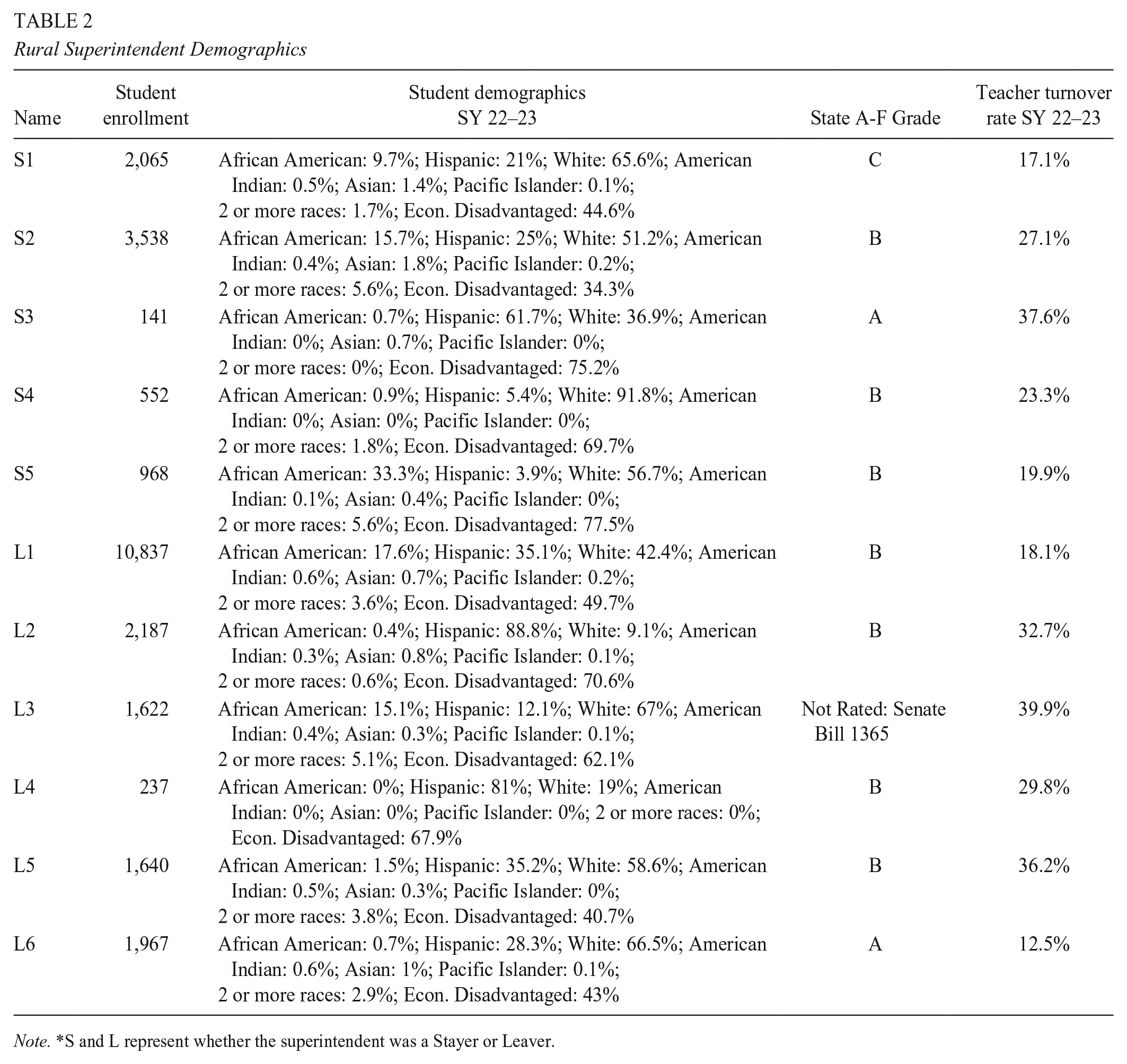
Note. *S and L represent whether the superintendent was a Stayer or Leaver.
Data Collection
Qualitative data collection occurred during the 2022–23 school year. Each superintendent was interviewed at least once. The interview protocol had a series of open-ended questions and was piloted with two former superintendents prior to the study to strengthen the protocol. The interview questions primarily focused on their professional career pathways (e.g., prior professional experiences), their perceptions of their current district and community context, and their justifications for either recently leaving their prior district or continuing to stay within their district beyond three years. Appendix A includes the interview protocols for leavers and stayers. Given that this study was conducted during the COVID–19 pandemic, we were sensitive to the heightened workloads of superintendents and thus tried to limit any additional burdens on the participants. Interviews ranged from 13 to 55 minutes in length. However, we probed the participants on the extent to which the pandemic impacted their employment decisions as well as more recent political trends in Texas that emerged (e.g., book bans, anti-critical race theory rhetoric, anti-trans student legislation).
Data Analysis
Data were analyzed throughout the course of the study and began immediately following interviews. The research team regularly checked in after interviews to discuss initial interpretations. After data collection was completed, we read and revised interview transcripts for accuracy and to remove all names and identifiable information. We continued to read and reread transcripts until we were adequately immersed in the data. Next, we began inductive coding. Then, using our job-embeddedness framework, we coded all sources in two cycles (Miles et al., 2014). First, we coded independently and then met to discuss how codes were being applied and to address any misalignment and discrepancies. An additional round of coding took place to further refine emergent themes proceeding the initial round of coding. For example, while we found clear evidence of links, fit, and sacrifice in alignment to our theoretical framework, we also identified instances where multiple “links” were coupled together as justifications for participants to stay or leave. Similarly, for both fit and sacrifice, rural superintendents often coupled multiple sacrifices together to explain their desire to leave. Several stayers noted that being in a district with limited resources and having to be a public figure in a small community was a collective sacrifice. In addition, rural superintendent identity emerged as a common theme influencing stayers and leavers decisions, which was not part of our theoretical framework.
We also identified subcodes tied to fit (ambition, barriers, interconnectedness), links (awareness, cultivation, visibility), and sacrifice (public figure, relationships/family, resources/workload). These subcodes helped us better understand the nature of job-embeddedness and common and dissimilar aspects of rural superintendents’ experiences and perceptions. We sought to bolster the trustworthiness of our qualitative analysis in several ways. First, the lead researcher has prolonged research engagement in the educational leadership community and has spent more than a decade engaged in education leadership research in Texas, including a longitudinal analysis of the Texas superintendency with the two co-authors. These experiences provided consistent engagement and insight into key aspects of superintendent tenure in the state as well as familiarity with many of the state’s districts. Second, we engaged in reflexive memoing and bi-weekly conservations about data and how we were making sense of the data. Third, we applied a member checking strategy to validate our findings, which included talking to two recently retired superintendents and one current rural superintendent in Texas. Finally, we provided participants with opportunities to review transcripts and our findings.
Limitations
This study has several limitations. Our quantitative and qualitative findings are limited to one state, Texas, so we cannot generalize to states that may have different contexts. Our quantitative findings may be more generalizable to rural districts in other states because they may share similar geographic, economic, and labor market conditions, but as we previously noted, “rural” is not monolithic and varies greatly across contexts. Our quantitative dataset does not include some potentially important predictors of superintendent turnover, including superintendent age, school board stability, and voting patterns that might impact local school board elections. The qualitative portion of this study included a small sample of mostly White male superintendents in a state with hundreds of rural school districts spread out across one of the largest and most diverse states in the nation. While we cannot generalize our findings to other educational contexts, qualitative research does not seek to generalize beyond the uniqueness of each context and participant.
Findings
In what follows, we present findings from our quantitative analysis to answer our first research question. Although we find that turnover has been relatively stable in rural school districts, specific characteristics of the superintendent and the district context increase the likelihood of turnover. Next, we present findings from the qualitative portion of the study to better understand factors that contribute to rural superintendents opting to stay or leave their district. We highlight the influence of links, sacrifice, and fit on superintendents’ decisions to leave and stay as well as several novel findings that prompt voluntary turnover for the participants in the study.
Quantitative Results
In comparison to other locales, turnover rates were relatively more stable in rural districts (Figure 1). Specifically, turnover rates in city districts vacillated throughout the study period and there were numerous years with superintendent turnover around 25% in cities. During our study years, there was an overall downward trend in turnover among superintendents serving in rural communities, from 18.26% in 2011 to 14.80% in 2021, although turnover peaked in 2016. Additionally, turnover among superintendents in suburban and town districts experienced a downward trend. Despite this downward trend, which is positive, some rural districts experienced substantial instability in the superintendency. Among the 605 rural districts present in every year of the study, 14.1% (n = 85) of districts had 4 superintendents, and 10.1% had 5–7 superintendents (n = 61). Most rural districts, or 65.1% (n = 394) had 2–3 superintendents during the study period. Nearly 10.7% (n = 65) of rural districts had only one superintendent during the study period.
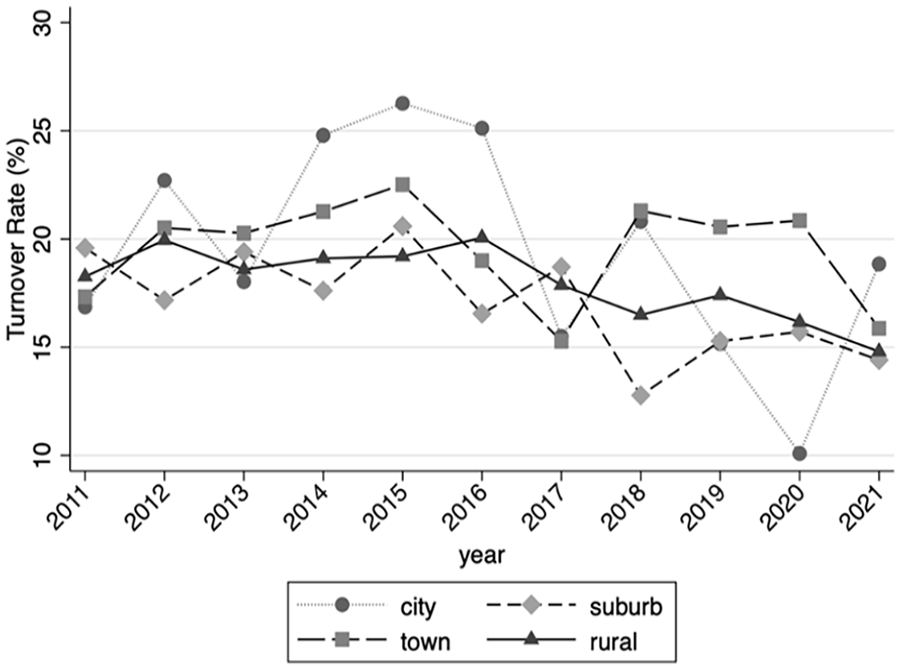
Turnover Rates by Locale in Texas, 2010–11 to 2021–22
Table 3 summarizes the results from our quantitative analysis. Interpreting the best-fitting final Model 4, the analysis indicates that, among rural public school districts, both demographic characteristics of the superintendent (including salary, experience, and to a lesser extent gender) and contextual characteristics of the district (including turnover among educators) were related to an increase in the likelihood of annual turnover. Specifically, for every $1000 increase in salary, turnover is less likely in a given year (OR = 0.984, p < .001). Each additional increase of $1000 in salary is associated with an 1.6% decrease in the odds of a superintendent leaving their position among rural superintendents. Additionally, the odds of a rural superintendent leaving are significantly higher in districts with more experienced superintendents than in districts with the least experienced superintendents in the Texas system. Compared to the first quartile of years of experience, or the least experienced superintendents with a range of 0–19 years of experience, the odds increase by a factor of 2.00 (p < .001) for those in the third quartile of experience, or those with 25–30 years of experience in the Texas educational system. For those in the highest quartile, or most experienced with 31–55 years in education, the odds of leaving increase by a factor of 4.945 (p < .001) compared to the least experienced rural superintendents. However, caution should be taken when interpreting results of superintendents in the fourth quartiles, as these superintendents were all eligible for retirement. While just around half of superintendents eligible for retirement based on the rule of 80 (a state policy where age plus years of service are used to determine retirement eligibility) actually left their administrative leadership position of their district yearly, all those in the 4th quartile of experience were eligible for retirement, when examining data from 2018-2022.
Results from Conditional Logistic Fixed-Effect Models of Superintendent Turnover within Public Rural School Districts

Note. *Results for year dummies are suppressed for simplicity of presentation.
p < .05; **p < .01; ***p < .001.
Additionally, if a district has a female compared to a male superintendent, the odds of turnover are generally lower (OR = 0.775, p < .1); however, with the addition of retention variables in the final model, gender became insignificant. The likelihood of turnover also declines in districts with higher percentages of principal retention and teacher retention. Holding all other variables in the model constant, we found a 1.2% decrease in the odds of turnover for a 1% increase in principal retention (p < .001) and a 1% decrease in the odds of turnover for a one-percent increase in teacher retention (p < .05). However, superintendent race, district size, percent of students identified as White in the district, and percent of students identified as economically disadvantaged were not significant predictors of turnover.
Qualitative Findings
The quantitative results provide important insights into recent trends in superintendent stability across rural districts in Texas compared to districts in city, suburban, and towns. The findings point to important factors, such as gender and years of experience, that increase the likelihood of a superintendent leaving their district. However, the quantitative findings provide little insight into the “why” superintendents stay or leave their district and the models may also be excluding key explanatory variables. Qualitative findings for this study paint a more complex and nuanced picture for the factors that influence superintendent turnover. Links, sacrifice, and fit were key factors shaping superintendent decisions to stay or leave their district. While we break these three factors apart, we found strong connections between each one, which we point out in various places. In addition, we found a strong rural superintendent identity to be an important factor in how superintendents understood links, sacrifices, and experiences. In what follows, we examine how these factors individually and collectively inform superintendent decisions to stay or leave.
Links
Links were the most common reasons superintendents reported wanting to work in rural districts and why they opted to stay on the job (in comparison to sacrifice and fit). When discussing why they have stayed in their current or in prior jobs, both leavers and stayers used words like “connections,” “community,” “embedded,” “relationships,” and “trust” to describe their links with their school boards, school personnel, students, families, and the broader community. A closer examination of links revealed two important findings. First, both leavers and stayers had what we identified as a strong rural superintendent identity, which emerged in how they elevated the importance of knowing people in deep, significant ways versus what might be more unfamiliar in larger districts. Second, school board relationships were the most important link for each superintendent and the most common reason to stay (if the relationships were positive) or leave (if they were negative or turning in the wrong direction).
Mostly all participants reported a strong sense of purpose and value in leading in rural communities. Each viewed the rural superintendency as a specific job separate from leading in larger districts. The rural superintendency was described as embedded within community and a position each participant clearly enjoyed and derived great purpose from. They reported being “hands on” and valued regular opportunities to interact and even know everyone in their community. For example, Leaver 4 (L4) noted “I can walk on campus and know 80% of my kids by name and interact with them about what they are doing on a daily basis. That is still what makes this job enjoyable.” L4 added that he could have “chased dollars at any point” but was willing to make that financial sacrifice (discussed later) for the joy of having strong links and staying in a smaller district with less resources.
Links to schools was mentioned by other superintendents as a critical component to staying within their district. Stayer 2 (S2) valued being in a small district because it enabled him to be on campuses regularly. Similarly, S5 noted that the small community enables a great amount of trust. He said, “We have a very supportive community, and I think that’s because we’re small and they know the staff, and they trust the staff. There’s a big amount of trust there.” Each superintendent reported the importance of being visible and present at both school and community events and locations. Some purposefully visited the “Hay and Feed Store” to talk with local farmers or did a “Tour of Churches” where they delivered coffee and cookies to speak with community members, especially if it was time to pass a bond. As L3 noted, “It’s all about the human connection.” One superintendent, a stayer, had the strongest links. She was born, raised, married, and worked in the district throughout her life. She said, “I’m from here. My husband has several businesses here, so that’s one reason I have not left.” This stayer could not imagine leaving her community regardless of job opportunities or pay highlighting her unique links and overarching values.
Although links were the central area of focus for all the participants and included linkages with all the aforementioned stakeholders, one linkage was consistently described as being most important for both stayers and leavers: the linkage with the school board. Seven of 11 participants spoke at length about board relationships and underscored the immense value of a healthy, positive relationship with the school board and the inherent problems of a negative relationship. S1’s comments reflected other participants’ perspectives: Having a good relationship with the board, having the board that’s going to work well with you, there’s nothing that’s going to keep the superintendent as much as having a good relationship like that—it will make you leave if you’re not having a good relationship.
S4 highlighted that a happy board was difficult to create and not something to just give away. He noted, “When you have seven bosses, it’s very difficult to keep seven people happy, right?” As we will point out later, board dynamics change with implications for a superintendent’s perception of fit.
Sacrifice
The superintendents in this study reported an array of sacrifices associated with their personal and professional links and, also, to what they believed was part and parcel of the rural superintendent identity. Sacrifices associated to links were partly driven by the participants’ beliefs about the difficulty of rural district leadership in Texas. The participants talked about having a “24/7” job serving as a “public figure” under a set of conditions created by the state of Texas that was unfair and unjustifiable, particularly as it relates to school finance and the job expectations of a rural superintendent. L5 said, “The reality is that, with more and more mandates and things that come down that are required of leadership, it is very hard to stay in rural settings because you have to be a jack of all trades.” Similarly, S3 noted, It’s [the rural superintendency] all consuming. There’s a lot of talk about caring for yourself . . . but what’s really difficult for me is the trainings, the meetings, the sessions, the webinars, whatever you want to call it, that, you know, you sit and they talk about the superintendents that take better care of themselves. They’re all big district people. They’ve never been in a 1A district and don’t understand that, literally, if I don’t do something, it won’t get done . . . It’s a huge commitment. It’s a really, really big challenge.
Other superintendents reported a relentless nature of the job. S1 emphasized the need to “wear many hats” and do many jobs. In response to a recent question from a colleague asking, “Who’s your human resource person?”, S1 said, “You’re looking at him.” He noted that in a rural district, a superintendent must do “so many things” with “No fewer requirements from the agency [Texas Education Agency] having 2,000 kids . . . as Houston ISD who has 200,000.” The widely held belief among participants that the rural superintendency was a “24/7” role without adequate support was not just a sacrifice in terms of professional workload. The workload impacted their personal and professional lives causing significant sacrifices and a potential incentive for moving to a larger, better funded district. S3 noted that new rural superintendents were often stunned to learn the scope of their work. She said, “There’s a lot of shocking things being learned by those superintendents about what the reality [of the rural superintendency] is.” As they struggled to recruit talented school personnel and gather adequate resources in more remote districts, many felt it was worth leaving or looking to other districts where they could focus more on working with schools and school personnel rather than just holding things together.
These job demands meant superintendents spent less time with their families. In some cases, superintendents had long commutes, lived away from their aging parents, and spent extensive time away from their family. For example, S3 sacrificed to stay on the job as did her husband. She said, I have the most incredible husband . . . We have our house bought and paid for, where our son grew up and everything . . . the majority of time, I live in the district. I have a rental house there and he lives at our house in our hometown . . . we see each other on the weekend.
She noted that her family understood her intense need to serve, but that it was still a great sacrifice for them both. Other superintendents reported that the geographic isolation of their district from metropolitan amenities (e.g., jobs, hospitals, universities, cultural spaces) made it difficult for their families and caused them to make sacrifices that weighed heavily on their minds.
Pay and district resources were also potential sacrifices for working in a rural district, especially those in smaller, more remote locales. Both leavers and stayers mentioned that low pay was a sacrifice and that increased pay elsewhere was an incentive to leave. For example, L4 said, “I mean, if everybody’s honest, we all look at jobs based on finances.” Superintendent leavers tended to move to districts for significant pay raises as described in Table 4. They also tended to move to districts with greater enrollment and higher property wealth. As L2 explained, It’s property wealthy . . . I never had the chance to work in a school district where we weren’t actually drawing money from the state to supplement what we were collecting locally, and I wanted to see why it was that all the research shows that having that extra money and all equates to better performance and to see what would happen if somebody who actually understood the system would come in to maximize how powerful it could be.
District Differentials for Leavers a

Note.
.“Leavers” refers to superintendents who began work in a new district in 2022–2023.
.Data on superintendent pay is publicly available from the Texas Education Agency for every superintendent over the last 10 years (https://rptsvr1.tea.texas.gov/adhocrpt/adpea.html).
.Distance in miles was found via Google Maps, plugging in “[X] School District” to “[X] School District”; time was pulled from the fastest route suggested.
.Difference in student enrollment was found using the Texas Education Agency’s Texas Academic Performance Reports, which capture district student enrollment. Student enrollment difference was calculated using enrollment from the 2021–22 SY of the superintendent’s former district and from the 2022–23 SY of the superintendent’s current district.
L2’s response highlights the incentives some superintendents might recognize, prompting them to seek new positions.
Fit
Fit was the least discussed factor across interviews possibly because both leaver and stayer superintendents reported a strong sense of fit within their jobs. The high sense of fit may reflect their rural superintendent identity and a shared belief that it was their job to work closely with people in schools and the surrounding community. None of the participants noted that fit was a primary cause for leaving a district at any point in their careers although several noted that fit can change over time. However, fit was complicated in that it took time to learn about the context of the community and that fitting too much could be a “double-edged sword” in a very tight knit community.
Each of the superintendents reported valuing “community” and working with school personnel. They also discussed the importance of having a skillset to learn about a community upon arrival so that fit can happen and so that they would not make missteps and offend their community. For example, S2 noted that small communities are different from larger ones. He said, “There is a lot of interconnectedness and I think a special part of the work here is how do we protect that sense of community and the legacy that we have while we grow?” L5 noted that, as a rural superintendent, “You have to embrace and become part of the community, as much as they will let you in.” S2 added that being accepted does not happen overnight, “It takes a period of time to kind of be quiet and to fit into the culture, to be present in the culture, before your kind of accepted and trusted because you’re an outsider.”
As superintendents fit into their districts and communities, they noted that close ties could have drawbacks and even cause an overall sense of fit to erode. For example, S4 noted, “some of the very things that make this the greatest place I’ve ever worked are also the same things that give us our greatest challenges.” This superintendent was referring to the opportunities to meet virtually everyone in the community and work hand-in-hand with educators and leaders. These close ties gave them insights into what was happening and a strong bond with many individuals and groups, which, over time, could be hard to maintain. S3 explained this challenge: It doesn’t take much in a small district to get cross with a board member or two and a community member or two. In a small district, there’s no place to hide those things. It’s going to be very public. It’s going to be very out there.
The quote reflects the sense that one wrong turn or disagreement can not only sour one relationship, but also be the talk of the town leading to further disruption that might not happen in a much larger context.
Ambition and desires for new challenges and opportunities emerged as aspects of fit that may not have initially been present early in the superintendent’s tenure but evolved as they developed their skillset and as their work in the district changed. Both leavers and stayers commented on the challenges that existed within their districts when they arrived and their successes along the way. These challenges were broad and included “raising student achievement” and “fixing plumbing issues.” After successfully addressing the myriad of challenges they reportedly encountered, many desired new challenges which prompted them to look elsewhere. Some superintendents reported that there were no more challenges “left to conquer,” which depleted their sense of fit. For example, L5 noted in reference to their prior district: I hit 10, as far as happiness, and my happiness kind of started to decline slowly because I no longer felt as though I was as necessary because, once things are running like a machine, you know, a machine runs by itself.
In L5’s new district, he noted, “I’m a 10 out of 10 [in terms of happiness] because the challenges are still here.” The allure of a new district and new challenges created a shift in a rural superintendent’s sense of fit over time, as they felt they did all they could in their districts. Relatedly, several superintendents mentioned their legacy, the legacy of their work, or the sustainability of their efforts as important to their sense of fit and when it might be time to move. These superintendents wanted to make sure the district was in “good shape” and would continue to be successful after they left. They understood that leaving prematurely would jeopardize their legacies and sacrifices. Several reported a strong fit until they knew their legacy was solidified.
Several superintendents assessed fit based on personal goals, especially as they considered family factors. For some, leaving their former district was tied to their children being grown, which, for them, presented the opportunity to move to a particular area they wanted to be a part of. L4 explained, Location was a huge factor . . . you know, the important factors for me, early on in my career, were my kids. Number one . . . as I got later into my career, it was more about trying to use your talents that you’ve learned over the 28 years and try to help something.
For L4, his drive to give back to a new community and his personal desire to live in a more remote rural locale with greater access to the outdoors motivated his move now that his children were done with secondary schooling. As he explained, “As you can see behind me [gestured to a buck head on the wall behind him], I’m a pretty big outdoorsman . . . so it’s a pretty big factor [for the move].” Other leavers shared L4’s personal orientation towards their reasons for moving districts. For L6, his move was about increasing his children’s access to different social and cultural opportunities, as well as increasing his wife’s access to metropolitan amenities. For others, like L1, who expressed his and his family’s love for his former district, saying, “The district I was in, while I loved it—it’s beautiful and our family loved it very much,” leaving was about being a part of a district while it grows and returning home to be near extended family, he continued, “It [his former district] wasn’t growing at all . . . I was looking for an opportunity where I could grow with a district and, also, my wife and I both have a lot of family in this area.” These decisions, reflected personal life goals associated with leaving districts, became a primary fit factor being weighted over professional life fit.
Discussion
A small body of research has focused on superintendent turnover (DeMatthews et al., 2023, 2024a; Finnan et al., 2015; Glass, 1992; Grissom & Anderson, 2012; Grissom & Mitani, 2016; Schwartz & Diliberti, 2022; Tienken, 2020; White, 2023; Yee & Cuban, 1996). This study contributes to that body of research by providing a longitudinal analysis of superintendent turnover trends in Texas across all districts and by further exploring individual factors that prompt rural superintendents to leave or stay in their district. Generally, the quantitative part of this study found that turnover was relatively stable across rural districts and experiencing a downward trend, although stability in leadership was more pronounced in certain rural districts. These findings reflect recent trends identified in rural Texas districts (DeMatthews et al., 2023). In particular, we highlight that a quarter of rural districts have had higher rates of turnover with 146 rural districts having as many as four to seven superintendents in the 11-year study period.
We provide these descriptive findings as important evidence that researchers, state leaders, school boards, and communities should be concerned with, especially if their district has elevated rates of superintendent turnover.
The qualitative part of this study helps to bridge the schism between similar quantitative studies evaluating turnover and the unique personal and professional factors that shape voluntary turnover for individual rural superintendents, a focus that has largely been ignored in superintendent turnover research. The findings from this study support a growing body of research in education that has considered the concept of job-embeddedness rather than simply focusing on job satisfaction and job alternative constructs (Shibiti, 2019; Watson, 2018), although we have not identified any other studies focused on superintendents. We found that links, or the relationships an employee has built in and around their workplace, were a key factor in keeping rural superintendents in their current position. Many reported feeling deeply embedded and responsible to their community, they valued personal interactions with educators, students, and community members, and invested time and energy to learn how to lead within these spaces. These findings align with prior research on the rural superintendency, which highlights the importance of relationships and community (Tekniepe, 2015; Yates & Jong, 2018). Not surprisingly, we found that the superintendents in this study believed that the rural superintendency required an emphasis on deep, personal relationships within the community—something we called the rural superintendent identity. Above all else, school board relationships were viewed by each superintendent as the most important link and fit issue. Where positive relationships existed between the board and the superintendent, turnover was reported to be very unlikely.
The importance of links and the rural superintendent identity made the job enjoyable for most of the participants, but also created many personal and professional sacrifices. Sacrifices reflected the material and psychological costs of leaving their job. All of the superintendents viewed the rural superintendency as an intense, multi-faceted position that required one individual to work “24/7,” be a “jack of all trades,” and “wear many hats.” Moreover, the small size of their districts and their concerns about Texas’s system of school finance and governance created, in their eyes, a set of serious and relentless constraints. Under these difficult conditions, the rural superintendents felt they were given the short end of the stick in comparison to larger and more affluent districts. The demands of being a rural superintendent, therefore, interfered with their personal and family commitments. Moreover, the remote locations of many districts meant that many superintendents had to commute far distances, rent homes away from their families, or require that their family sacrifice access to amenities in metropolitan areas. All leavers went to larger districts with greater pay, which may reflect a preference for more money as reported in the literature (DeMatthews et al., 2023; Grissom & Anderson, 2012; Grissom & Mitani, 2016), a preference to reduce the amount of sacrifices they must make by moving to a more affluent and larger district, or some combination of the two.
Prior research has discussed the importance of educators, principals, and superintendent fit within rural communities and how outsiders can often struggle to build relationships which, in turn, leads to turnover (Tekniepe, 2015; Yates & Jong, 2018). Fit reflects how an employee’s personal and professional goals align to the organizational culture and the surrounding community. In this study, we found that superintendents were intentional about learning about their community to ensure fit and reduce potential conflict given strong ties within smaller communities. They viewed their job as partly being in the community building these ties, which included attending community events and visiting stores and churches. While all participants reported that they were able to establish a strong sense of fit upon arrival and all reported being proud of their work within the district, many felt that personal and professional aspects of fit shifted over time. Many leavers felt that they had accomplished all of their goals and they felt less of a fit once their efforts had been solidified. Consequently, their sense of fit decreased because they felt less needed and subsequently desired new challenges—potentially another component of a rural superintendent identity. Both leavers and stayers also understood that, in a small community, fit could shift based on a disagreement, suggesting that fit and close ties were a two-way street. Finally, for some, fit equated to being home, meaning that no job opportunity or pay would prompt them to leave, given their roots.
These findings provide new and important insights for understanding voluntary turnover among superintendents generally, and rural superintendents specifically. However, we would be remiss by not pointing out several non-findings or factors we expected to play a greater role in voluntary turnover, especially in Texas. The superintendents in this study did not consider the job market or economy as a factor shaping their decision to leave or stay. They also did not feel like the COVID–19 pandemic had an impact on their decision to leave their role. Ongoing culture wars—heavily documented in the Texas media and discussed daily on the floor of the Texas legislature during the study—were not described as relevant to the superintendents’ employment decisions. Many of the superintendents felt that these issues were not relevant in their small communities given the close ties that existed among educators and community members. Or, perhaps the superintendents opted not to share their true beliefs with the research team. While we cannot say what is in the hearts and minds of our participants, we believe we had forthright conversations and that strong community ties limited the potential for culture war disruptions.
Implications and Conclusion
This study has important implications for future research, policy, and superintendent preparation and development. For researchers, our findings emphasize that, while turnover rates are typically not higher for rural superintendents in Texas, many rural districts still experience high levels of turnover. As our study highlights, these superintendents often wear many hats, which sometimes informs decisions to stay or leave rural districts. Turnover can be extremely destabilizing. In addition, our study highlights that each superintendent is unique as are the ways in which they make sense of their context and personal preferences. Yet, most superintendent turnover research relies on longitudinal datasets and quantitative analyses that ignore the human aspects that prompt voluntary turnover. Future research should address these shortcomings by focusing in on districts experiencing higher rates of turnover and how superintendents within these districts weigh their job opportunities.
We were not able to identify any causal mechanisms of superintendent turnover in the quantitative analysis; however, our use of longitudinal data following individual superintendents over more than ten years provides more robust results by eliminating the threat to internal validity inherent in cross-sectional analyses. Additionally, fixed effects models provided a means for controlling for any omitted time-invariant (constant) district characteristics, however, unobserved factors that vary over time, such as who is elected to the school board, could have biased the estimated coefficients. Nevertheless, this study builds on prior work (DeMatthews et al., 2023) by centering the experience of rural superintendents, an often under-researched area. Future quantitative research could include large scale surveys of superintendents measuring constructs associated with the job embeddedness framework, which are currently not available. The qualitative part of this study was limited by a very small sample size of leavers and stayers during one school year immediately following the COVID–19 pandemic and an increasingly polarized American society. Most superintendents in this study identified as men, which means our study was likely not sensitive to aspects of job-embeddedness that differ for women in the superintendency—and prior research has indicated divergent gender-based experiences of superintendents in rural contexts (Klatt, 2014).
Additional qualitative research that includes a larger and more diverse sample of superintendents over a longer period would likely elucidate a greater understanding of voluntary turnover. Future studies might also consider a case study approach and include a review of district documents, board meetings, and surveys and interviews with community members, board members, and educators to better understand community context and the superintendent’s fit. This type of qualitative work could help uncover additional aspects of voluntary turnover and highlights the extent to which what is outwardly perceived as voluntary turnover really was involuntary turnover or stark warning signs that the superintendent should leave or be fired.
This study also has important insights into policy. Each superintendent highlights the difficulty of rural district leadership due to financial constraints, geographic isolation, and a small bureaucracy to support significant state accountability requirements and other regulations. Given our study was situated in Texas, the Texas Education Agency (TEA) might consider additional efforts to reduce the burden on small districts and their superintendents, which might include creating special networks of rural superintendents that the state can partner and learn with and from. TEA and other state education agencies (SEAs) might also consider examining high churn school districts and provide support to new superintendents within them. Many states with rural superintendent associations may or may not convene with their SEAs. We highly recommend that SEAs listen to these associations and provide platforms for these groups and their superintendents to provide recommendations. Policymakers might also consider ways to create cross-district hiring and resource sharing opportunities that can help keep aspiring superintendents in small rural districts and address the heavy workload of superintendents that might seek a larger district for greater resources and support.
For preparation and development, our study makes clear that the rural superintendency is demanding and requires a superintendent to be a “jack of all trades.” While the notion of doing it all is problematic and should not be so in a just society, it will likely go unchanged in Texas and beyond in the near future. Thus, superintendent preparation programs could help prepare aspiring superintendents in ways that enable them to build networks of expertise and support through cohort-based models. In addition, preparation programs and state associations for superintendents can partner to develop in-service professional development and lower cost consultancies to support those small districts with great need but limited resources. Moreover, these associations and universities cannot ignore the circumstances of rural districts to privilege larger suburban and urban districts, which, from our vantage point, is too often the case. State associations and public universities have a moral and ethical obligation to serve their state and not focus only on areas where they get the most attention, recognition, or the biggest bang for their buck. Such strategizing promotes the marginalization of thousands of children in rural communities and the educators and leaders working under difficult conditions to serve them.
In sum, we believe that a greater focus on rural superintendent turnover is of great significance and has important equity implications for those who commit to serving in these important roles and the students attending these far too often under resourced schools. Every child deserves a high-quality superintendent and every superintendent deserves a position that enables them to maintain a healthy lifestyle. We hope greater attention to the rural superintendency and factors that contribute to voluntary turnover—particularly when it is harmful—will lead to common sense policy changes and investments in Texas and beyond.
Footnotes
Appendix A
Declaration of Conflicting Interests
The author(s) declared no potential conflicts of interest with respect to the research, authorship, and/or publication of this article.
Funding
The author(s) disclosed receipt of the following financial support for the research, authorship, and/or publication of this article: This work was supported by the Holdsworth Center.

Note. This manuscript was accepted under the editorial team of Kara S. Finnigan, Editor in Chief.
Notes
Authors
DAVID E. DEMATTHEWS is W. K. Kellogg Endowed Professor of Educational Leadership at the University of Texas at Austin, 1912 Speedway, Austin, TX 78712;
ALEXANDRA AYLWARD is an assistant professor of educational leadership in Department of Educational Studies at the University of Nevada, Reno, 1664 N. Virginia St. Reno, NV 89557-0299;
TORRI D. HART is a doctoral candidate in the Department of Educational Leadership and Policy at the University of Texas at Austin, 1912 Speedway, Austin, TX 78712;
PEDRO REYES is the Ashbel Smith Professor of Education Leadership and Policy at the University of Texas at Austin, 1912 Speedway, Austin, TX 78705;