



Abstract
This mixed methods research explores superintendents’ beliefs about and engagement in state education policymaking processes. Through interviews with 58 superintendents and a national survey of superintendents, I find that superintendents feel their voices have value in state policymaking spaces; however, actual policy engagement is relatively low. Three factors shape superintendents’ state policy engagement: (1) personal and professional capacity, (2) proximity to State Capitol building, and (3) perceived weight of voice, which superintendents often associated with district size. Leadership preparation programs, professional organizations, researchers, and policymakers may draw on this work to reduce inequalities in superintendents’ access to education policy spaces.
District leaders can advance educational equity by shaping, interpreting, and implementing policy. For example, Hanushek and Luque (2003) and Mingat and Tan (2003) found that district leaders’ strategic policy actions related to class size and teacher salaries can affect student performance, and Turner and Spain (2020) showed how district leaders’ academic tracking policy decisions influence students’ equitable access to educational opportunities. As evinced by these studies, district leaders—particularly superintendents who are responsible for managing district finances and operations—have some discretion over the local implementation of education policies; however, policy implementation decisions are undoubtedly shaped by state policy and funding. Particularly in the United States—where a right to education is not guaranteed by the U.S. Constitution—state constitutions compel state governments to maintain and operate public schools and provide for the majority of school funding needs (Black, 2020). While engagement and involvement of state governments in education policy has ebbed and flowed throughout history, state policymakers continue to “exercise considerable influence on important dimensions of local schools” (Malen, 2003, p. 210; Perera, 2023). For example, governors have increasingly made education a part of their political platform (FutureEd, 2025b; Perera, 2023) and the number of education-related bills that state legislators have filed has increased substantially over the past 50 years (FutureEd, 2025a; Mullins, 2025). Within this context, where education policy is being developed primarily by state policymakers with little experience in education beyond their personal experience as a student or parent of a student (White et al., 2023b), the expertise of superintendents is essential to the creation of state policies that advance educational equity.
Acknowledging that state policy influences local practices and educational environments in public schools in the United States (Grissom et al., 2021; Leithwood et al., 2004), researchers have explored how school and district leaders make sense of and implement state education policies in ways that contribute to or constrain progress toward educational equity and social justice (Alsbury & Whitaker, 2007; Callahan & Shifrer, 2016; Carraway & Young, 2015; Coburn, 2005; Mavrogordato & White, 2017; 2019; O’Laughlin & Lindle, 2015; Theoharis & O’Toole, 2011; Werts & Brewer, 2015). While much of this research has focused at the school level (i.e., principals), a growing body of research has drawn attention to superintendents shaping, interpreting, and communicating state education policies, as well as allocating resources and devising administrative rules to guide state policy implementation that fosters educational equity (Coviello & DeMatthews, 2021; DeMatthews et al., 2017; Donaldson et al., 2021; Kowalski, 2005; Kruse et al., 2018; Leh et al., 2023; Woulfin et al., 2016). However, this research has primarily focused on the interpretation and implementation of state education policy after an education issue has been defined and acted upon by state policy actors. Indeed, Woulfin et al. (2016) emphasized the role of the superintendent “in mediating and brokering ideas from the state policy environment” and contended that superintendents must be “aware of their role in interpreting and shaping others’ interpretation of educational policies” (p. 135). Strikingly, little research has examined superintendents’ role in proactively engaging in education policy in state-level policy spaces—shaping policy before it is enacted.
Moreover, superintendents are often expected to use “political acuity to enhance their effectiveness” and be “political strategists” within their local communities (Kowalski & Björk, 2005, pp. 82–83). Research on superintendents as political actors has primarily been constrained to the micro-political context of the local district and surrounding community. For example, Boyd (1974) called for superintendents to influence policy through recommendations to local school boards. Yet, superintendents aiming to “advance educational equity must not only do so at the local level, but also the state-level” (Sampson, 2019, p. 175). Research on superintendents’ macropolitical engagement (Hurst, 2017; Szolowicz & Wisman, 2021), including their engagement in state-level education policymaking spaces, is scarce.
Recognizing that superintendents are “no longer able to choose whether or not to get involved in the political arena” (Edwards, 2006, p. 138), this research aimed to explore superintendents’ beliefs about and engagement in education policy in contexts outside of their local district—specifically, in state policy spaces where policies that shape the day-to-day work of schools and the educational experiences of students are designed, refined, and enacted. Three research questions guided this work:
What are superintendents’ beliefs about engaging in state K-12 education policymaking?
How, if at all, do superintendents engage with state K-12 education policymakers and participate in K-12 education policymaking processes?
What, if any, relationship exists between state and local contexts and superintendents’ beliefs about and engagement in state education policy processes?
To explore these questions, I employed a mixed methods sequential explanatory design (Ivankova et al., 2006). I conducted a national survey of superintendents to explore superintendents’ beliefs about their role as state-level policy actors, their levels of engagement with state policymakers and state policymaking processes, and the role that formal and informal education and social networks played in both their beliefs and engagement in state policy processes. I also conducted semi-structured interviews with 58 superintendents across two states to more deeply understand their beliefs about and engagement in state education policymaking processes, as well as the ways that local and state contexts enhanced or constrained the ways they thought about, and then actually did, engage in state education policy processes. This work can help guide leadership preparation programs and other organizations supporting current and aspiring superintendents to effectively prepare superintendents to engage in state policymaking spaces. Additionally, the findings from this study can inform instructors and leaders in colleges of education, researchers, superintendents, and state and local policymakers of barriers superintendents’ face in engaging in state policymaking spaces, and inform dialogue around inequalities in superintendents’ access and ability to shape and inform state education policy.
Conceptual Framework
In what follows, I describe my conceptual approach to examining superintendents’ engagement in state education policymaking spaces, which is through the interconnected lenses of new localism (Crowson & Goldring, 2009) and superintendents as embodiments of the larger places they represent (Jayne, 2011). I also provide a brief conceptualization of the components that comprise state policymaking processes.
Shaping Policy Through the Lens of New Localism
State policymakers have become “increasingly, and at times aggressively, involved in efforts to influence schools” (Malen, 2003, p. 195). Most recently, policymakers in many states have introduced and enacted anti-transgender and “Don’t Say Gay” policies, legislation to limit teaching about race and racism, and bills that limit reading materials in schools (Anderson, 2021; Meyer et al., 2022; Mintzer, 2023; Pendharkar, 2023; Schoenbaum & Murphy, 2023). However, as state actors have become increasingly involved in education policymaking, superintendents’ involvement in and influence over education policy does not have to wane (Henig, 2009). To the contrary, as state actors’ take more active roles in education policymaking, superintendents may take concerted steps to share their expertise and knowledge in ways that help policymakers understand policy problems and shape policy solutions. Moreover, superintendents play a “pivotal role [. . .] in mobilizing resources, giving legitimacy to a [state] reform effort” (Cuban, 1984, p. 12). In fact, research suggests that state policymakers highly value the voices of superintendents when making education policy decisions (White, 2018).
Drawing on this lens, my inquiry builds on Crowson and Goldring’s (2009) framework of new localism in an era of centralization. In particular, while superintendents must often comply with prescriptive state education policies (Henig, 2009), they have been called upon to engage in policy actions that shape policy to their own contexts (Crowson & Goldring, 2009). New localism does not deny or refute centralizing education reform; rather it “refocuses attention upon local districts [. . .] in the context of national and even global educational objectives” (Crowson & Goldring, 2009, p. 1). However, very little research has focused on local district leaders voicing the needs of their local districts in the policymaking process; rather, research has primarily examined superintendents’ policy implementation and shaping of state policy to their own context (Rorrer et al., 2008)—after the policy issue has been defined and policy solutions decided upon. This “top-down” approach to the policy process (Mazmanian & Sabatier, 1983; Van Meter & Van Horn, 1975) “takes statutory language as the starting point,” failing to “consider the significance of actions taken earlier in the policymaking process” (Matland, 1995, p. 147). For example, focusing on advancing an agenda of educational equity, scholars have called on district leaders to establish equity as the “unifying principal through which to channel all external and school level policy mandates, and the subsequent programmatic changes, decision-making, and outcomes interpretations that follow” (Tillman & Scheurich, 2013, p. 461). While research and efforts to continue to push for equity in the policy implementation process are critically important, this study aims to expand our understanding of if and how superintendents are positioned to influence policy before statutory language has been established within state policy.
In focusing on engagement in policymaking processes, it is important to keep in mind the body of literature suggesting that superintendents, serving at the pleasure of a locally elected school board, are in a vulnerable position to engage in political arenas where policy is being made (Björk & Gurley, 2005; Coviello & DeMatthews, 2021; Kruse et al., 2018). The precariousness of the work of superintendents has been fortified in recent years as political stances related to how school districts should approach the COVID-19 pandemic and social issues such as racism and gender identity and sexuality have proliferated (White et al., 2023a). Within this context, superintendents, on the one hand, are “street-level bureaucrats” that answer to their local communities and school boards and are responsible for developing and implementing sound local policy (Lipsky, 1980; Spillane et al., 2002). On the other hand, a growing state role in education policy coupled with an intensifying focus on the privatization of K-12 education in the U.S. has created “an erosion of localities as sites for both pragmatic leadership and political mobilization” (Henig, 2009, p. 112). As such, superintendents’ engagement with policy processes has begun to look “more and more like the political and administrative interactions surrounding such other local services as housing, welfare, and community development,” necessitating broader policy participation “if the supporters of public education are to hold their own” (Henig, 2009, pp. 126–127). This study positions superintendents as key policy informants (Grossman, 2010) who are capable of proactively impacting state policy as it is developed, both on their own and in collaboration with others (Sabatier & Weible, 2014).
Superintendents as “Avatars”
As the chief operating officers of one of the most important public institutions within a community, superintendents are highly visible leaders. School districts not only provide an essential public service to their community by providing free, high-quality education, available to all students in the community, but they are often one of the largest employers in their local community and often serve as a hub for civic, social service, and recreational purposes and enrich community connectedness. In this way, superintendents are similarly positioned as mayors of local communities (Marland, 1970)—exceptionally visible community leaders who serve the public and are held accountable for providing essential public service to their constituents. As such, coupled with the concepts of new localism, I extend Jayne’s (2011) concept of “mayors as avatars” to superintendents. Jayne (2011) draws on McNeill’s (2001) concept of mayors as “personal representatives of their city” (p. 805) to posit that mayors can serve as “avatars” that contribute to understandings of the “diversity and complexity of spatiality of local political leadership” (p. 808).
Similar to gaps in superintendent research, research on mayors often focuses on local political leadership, and has neither “adequately considered the role of mayors in broader political and economic structural change” nor
developed detailed and sustained accounts of the ways in which mayors perform a role that is messy, complicated, and underpinned by complex, political, economic, social, cultural, and spatial practices, and processes in different cities (and different spaces and places within those cities) (Jayne, 2011, p. 802).
Extending Jayne’s (2011) framework to superintendents offers a view of superintendents as embodiments of their local districts, operating from local political logics within broader political contexts—in the case of this study, state policy spaces. In their role as “avatars,” superintendents serve as representatives of their districts and key policy informants who are capable of proactively impacting state policy as it is developed, both on their own and in relation with others (Sabatier & Weible, 2014).
Components of State Education Policymaking Process
For the purposes of this study, I conceptualize engagement in state policymaking spaces in four stages: (1) problem identification: identifying problems that can be addressed through policy and expressing demands for government action, (2) agenda setting: shaping and informing which issues state policymakers focus on; (3) policy formulation: identifying possible policy solutions; and (4) policy legitimation: communicating the strengths and weaknesses of policy solutions and engaging in political support for a policy solution (Dye, 2001; Smith & Larimer, 2017). It is important to note that these four stages are not linear; however, this relatively simple heuristic of stages of the state policy process provides “a broad outline of policy processes as well as a way of organizing policy research” (Smith & Larimer, 2017, p. 29). As described in the subsequent section, survey and interview questions focused on superintendents’ beliefs and actions about their engagement in these four stages, primarily focusing on the extent to which they communicate with state education policymakers throughout the policymaking process.
Methods and Data
This study employs a mixed methods sequential explanatory design (Ivankova et al., 2006), drawing on interviews with superintendents and a national survey of superintendents. Guided by Ivankova et al. (2006), a priori mixed methods explanatory research design decisions focused on the (a) stages in the research process where qualitative and quantitative data and analyses were integrated and (b) sequence of data collection and analysis (Creswell et al., 2003). At the outset of the study, I formulated research questions that could only be answered with both forms of data (Tashakkori & Teddlie, 2010). At the intermediate stage of the study, preliminary analyses of survey data informed coding and analyses of interview data (Creswell et al., 2003). Finally, at the interpretation stage of study, I made sense of the qualitative and quantitative data simultaneously (Onwuegbuzie & Teddlie, 2003). Regarding sequence, I collected the data in two consecutive phases: qualitative, followed by quantitative. However, the process of making sense of themes and patterns across the two data sources occurred simultaneously.
Data Sources and Collection Procedures
In the qualitative phase of the study, I used a multiple case study approach (Yin, 2009) to explore superintendents’ beliefs about and approaches to state policy engagement, and if and how local contexts are associated with particular beliefs about and engagement in state policymaking processes. In Spring 2019, I conducted interviews with superintendents across two case study states: Ohio and Virginia. The states of Ohio and Virginia were selected as cases for three primary reasons. First, these two states are often characterized as “microcosms” and “bellwether states” of U.S. politics writ-large (Burns, 2012; McLelland, 2015). Second, both Ohio and Virginia are compelling settings for a study of educational leadership given they have a range of rural, urban, and suburban districts, as well as racially and socioeconomically diverse communities. Finally, Ohio and Virginia have distinctive K-12 school district structures: while Ohio is a state with relatively decentralized districts of varying sizes, Virginia school districts are more centralized, with primarily large county- or city-based districts. This dichotomy allowed me to explore if and how state and local contexts such as district size and local capacity may contribute to superintendents’ beliefs about and engagement in state education policymaking.
Prior to study recruitment, I developed and piloted a semi-structured interview protocol. Working with three recently retired superintendents, I explored whether the issues I aimed to explore for this research study were adequately captured by my semi-structured interview questions. The pilot included both cognitive interviews, as well as a post-interview discussion around question wording and order, interview techniques, and whether questions should be modified, added, or removed (Malmqvist et al., 2019; van Teijlingen & Hundley, 2001). The final semi-structured interview protocol is available in Appendix A.
In Spring 2019, I recruited superintendents to participate in a 60-minute semi-structured interview. To recruit superintendents, I curated a list of all superintendents in Ohio and Virginia for which public contact data was available (n = 739). Through a stratified random sampling process (Sheppard, 2020) that aimed to maximize within-state variation in superintendent backgrounds and demographics, as well as district size, demographics, and urbanicity, I selected approximately ten percent of superintendents from the curated list. Superintendents were recruited to participate in an interview via an e-mail invitation, and non-responders received two follow-up invitations. Superintendents were offered a $50 Amazon gift card as a token of thanks for participating in the interview; however, only 50% of interviewees accepted the gift card, which aligns with methodological research on political elites that suggests some elites often have rules about accepting compensation (Kertzer & Renshon, 2022).
All superintendents who responded to the recruitment e-mail were interviewed. In total, I conducted semi-structured interviews—ranging from 40 to 85 min—with 58 superintendents from Ohio (n = 28) and Virginia (n = 30) between June and October 2019. Superintendents were provided with the option to be interviewed face-to-face, via phone, or via online videoconferencing software. Table 1 details response rates in each round of recruitment, interview modalities, district locale of interviewees, and demographic characteristics of interviewees. The gender and racial makeup of interviewees was reflective of the broader population of the case study states. In 2019–2020, women comprised 19.5% of superintendents in Ohio and Virginia (White, 2023) and women comprised 18% of this study’s interviewees. Reflective of the racial makeup of the interviewees, of which 5% identified as Black or Hispanic, Black and Hispanic/Latinx superintendents comprised less than 5% of the superintendent population in both states (White, 2025 restricted access to state datasets). While 4.3% of school districts in Ohio and Virginia are classified as urban, superintendents leading urban districts were overrepresented among interviewees (15.0%); rural superintendents were underrepresented (65.8% across Ohio and Virginia vs. 52.0% of interviewees).
Superintendent Interview Recruitment and Sample.

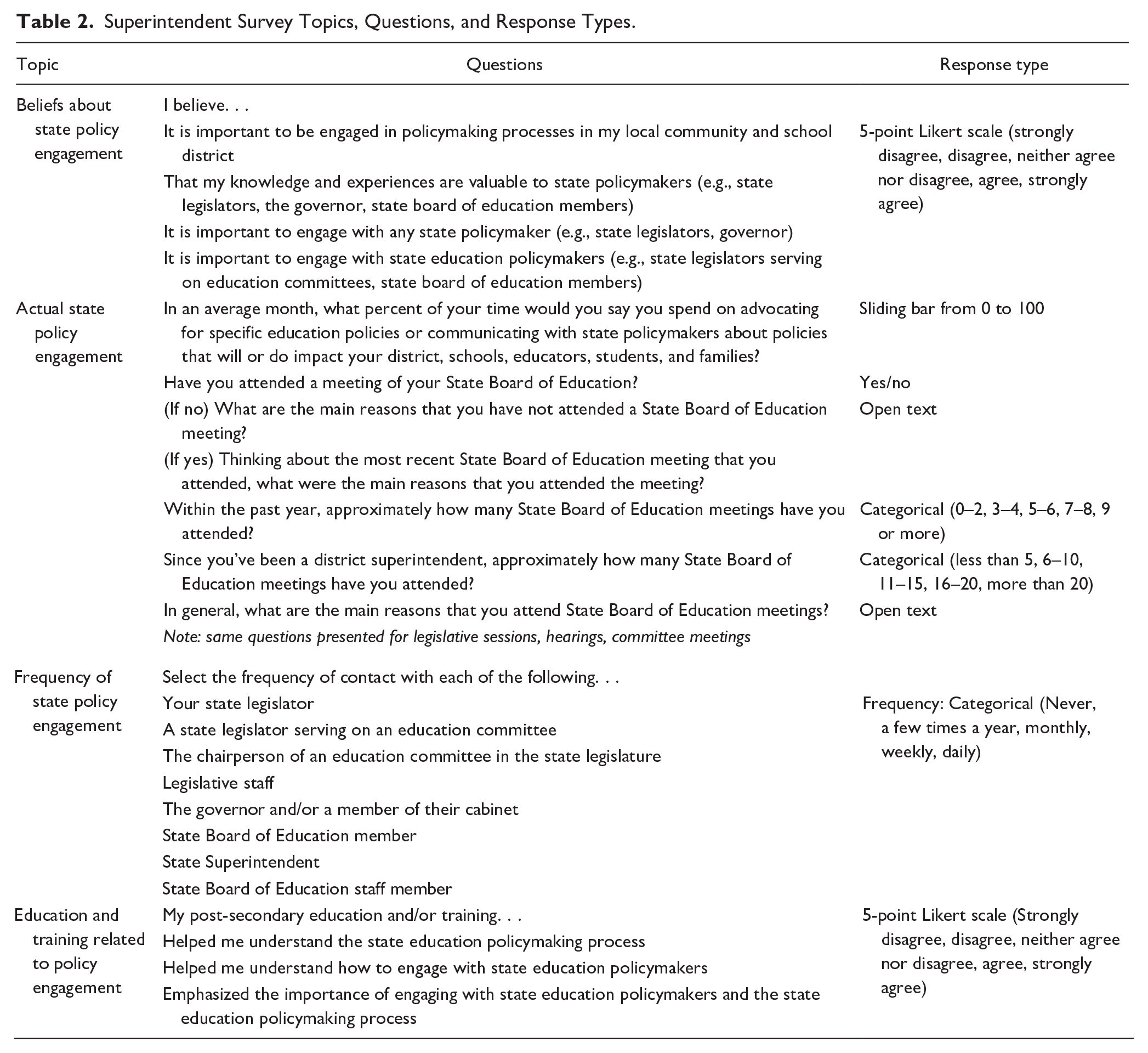
The purpose of the quantitative phase of the study was to broadly explore superintendents’ beliefs about and actual engagement in state policy processes via a national survey of superintendents. The first draft of the survey was developed in Spring 2019, prior to conducting the qualitative interviews. To enhance reliability and validity of the survey as a tool to help answer my research questions, the survey questions were developed in partnership with experts in research on K-12 school district leadership as well as superintendent practitioners and leaders at superintendent support organizations that served as a conduit between superintendents and state policymakers on a daily basis (Leedy & Ormrod, 2019). The final survey was estimated to take approximately 15–20 min and was broken into three sections which, alongside question items and response types, are shown in Table 2.
Superintendent Survey Topics, Questions, and Response Types.
To conduct the national survey of superintendents, I developed a database of names and e-mails of all public school district superintendents in the United States whose information was publicly available either via public-facing superintendent directories published by state education agencies or state associations of superintendents, or through district websites (n = 12,553). Subsequently, I distributed my survey to all superintendent contacts via Qualtrics in Spring 2020. I followed best practices for access and design in research with occupational elites—defined as “actors whose institutional roles afford them higher levels of influence over public policy” (Kertzer & Renshon, 2022, p. 9). In particular, I addressed issues of anonymity and duration (Goldstein, 2002) by sharing with respondents the approximate time commitment (15–20 min) in my recruitment e-mails, and clearly stating that all survey responses would be kept confidential (i.e., not shared with anyone other than the Principal Investigator), no personally identifiable information would be utilized in the analysis or writing up of results, and survey data would be maintained within a secure, password-protected environment. I followed political elite research methodological recommendations to initiate multiple follow up messages (Vis & Stolwijk, 2020) and sent non-responders two reminder e-mails.
Seven percent of superintendents responded to the survey. This response rate is typical of occupational elites, who are more difficult to access (Kertzer & Renshon, 2022) and is line with response rates of surveys conducted by the American Association of School Administrators (e.g., Kowalski et al., 2010; Tienken, 2020) and other national superintendent surveys (e.g., White, 2023; White et al., 2023a). Given that superintendents were leading through crisis at the time the survey was distributed, it is also possible that the survey response rate was negatively impacted by the onset of the COVID-19 pandemic. Nonetheless, as shown in Table 3, survey respondents were relatively representative of national superintendent demographics. Survey respondents were broadly representative of superintendents across the United States. In particular, 44 states were represented among survey respondents. Respondents from nine states made up 50% of the survey sample: Illinois (8.4%), Texas (8.2%), California (6.8%), Pennsylvania (6.1%), Wisconsin (4.7%), Ohio (4.7%), New York (4.2%), Washington (3.9%), and Indiana (3.7%). This distribution is similar to that of all K-12 public school districts in the U.S., with 50% of school districts coming from nine states. 1 In an attempt to ensure superintendents felt that their identity could not be revealed from their survey responses, survey respondents were not asked to identify the name or geographic location of their school district. As such, understanding the distribution of survey respondents across geographic locale in this study was not plausible.
Participant Demographics, Compared to National Superintendent Demographics.

Source. *National data drawn from 2019 to 2020 superintendents within White (2023); National Superintendent Database and AASA American Superintendent 2020 Decennial Study.
Analytical Approach
Qualitative Analysis
Interviews conducted in person or via the phone were recorded via voice recorder, and those conducted via online videoconference were recorded within the videoconferencing software (Zoom). All interview recordings were transcribed verbatim, and transcripts were entered into Dedoose, a qualitative data analysis software. My analytical approach began with a deductive coding process that focused on applying codes based on the research purpose and questions (Bingham, 2023) This type of deductive coding, in which codes based on research questions are applied to the transcripts (Bingham & Witkowsky, 2022), is appropriate for organizing interview transcript data. For example, superintendents’ responses to the question “Do you think that superintendents, in general, should be involved in the making and discussion of education policies at the state level as you are?” were coded as “beliefs about role/involvement.” Sub-codes were then applied indicating whether the interviewee felt superintendents should (a) be more or less involved than they currently are and (b) whether superintendents should be involved all the time, sometimes, or never. As another example, responses to the question “To what extent would you say you are involved in the making of and discussion around various state education policies in [state]?” was coded as “Actual involvement in state policymaking processes.” Subsequently, I applied sub-codes related to frequency of involvement.
Next, I engaged in inductive coding, employing the constant comparative method (Glaser & Strauss, 1967) to identify emergent themes among superintendents within and across states (Miles et al., 2014). To simultaneously preserve the uniqueness of each superintendent and generate cross-cutting themes, I followed a within- and across-case synthesis of interviews through analytic memoing (Miles et al., 2014; Yin, 2009). The constant comparative method involved inductive coding of transcripts, comparing excerpts across codes, and condensing inductive codes into broader categories when appropriate (Charmaz, 2014). One example of an emergent code was “contexts that impact state policy involvement.” Within this code, I identified three contexts that numerous superintendents discussed: capacity, size of district, and geographic proximity to policymakers. Within the capacity code, four sub-codes emerged: financial resources, human resources, time, and education/training; and, within these three codes, I coded whether they contributed to or inhibited involvement in state policymaking.
Once all transcripts were coded, I explored patterns in code applications across the two states to examine if beliefs about and engagement in policy varied across the case study sites (Glaser & Strauss, 1967). Finally, I developed categorical matrices to consider quotes that provided illustrative examples related to each pattern or theme. To connect interviewees to their local context and demonstrate how the full sample of superintendents informed the findings, all direct quotes presented in the findings of this paper include the de-identified transcript number, state, district locale, and superintendent gender and race within a parenthetical.
Quantitative Data Analysis
Survey data was exported from Qualtrics and imported into STATA for cleaning and descriptive analyses. Descriptive analyses are valuable when they identify “socially important phenomena that have not previously been recognized” as well as when they are “used to diagnose issues that warrant the immediate attention of policymakers, practitioners, and researchers” (Loeb et al., 2017, pp. 1, 3). Data cleaning included removing incomplete cases (i.e., respondents who consented to completing the survey but did not answer a single survey question) and formatting Likert-scale responses to categorical, numerical responses that allow for quantitative analysis. Descriptive analysis of the survey data focused on gaining a broad understanding of superintendents’ beliefs about and engagement in state education policy spaces from a national sample. In particular, I explored variation in Likert scale responses for survey questions on beliefs about the importance of engagement with state policymakers, frequency of engagement, and the role of postsecondary education in preparing them to engage with state policymakers.
Results
While most superintendent survey respondents rated their voices as highly valuable in state policymaking spaces, actual engagement in state education policymaking was quite limited. Qualitative data analyses identified three factors that shaped superintendents’ state policy engagement: (1) personal and professional capacity, including money, time, human resources, and education/training, (2) geographic proximity to state policymakers, and (3) perceived weight of voice, which superintendents often associated with district size. In what follows, I describe these themes and elaborate on how superintendents’ beliefs about and engagement in state education policymaking varied by state and local contexts.
Superintendents’ Beliefs About Engaging in State Education Policymaking Processes
As shown in Figure 1, 91% of superintendents agreed or strongly agreed that their knowledge was valuable to state policymakers, 95% of superintendents believed it was important to be engaged with any state policymakers, and 97% felt it was important to be explicitly engaged with state education policymakers—the same proportion who believed it was important to be engaged in local policymaking processes (97%). Among superintendent interviewees who elaborated on their beliefs about state policy engagement, 10% shared that they did not need to be involved in state policy processes (OH: 7%, VA: 13%), 21% indicated they should be involved sometimes or in specific circumstances (OH: 18%, VA: 23%), and 40% shared that they should be involved all the time (OH: 39%, VA: 40%). Regardless of their current frequency of involvement, 53% of interviewees explicitly stated that superintendents should be more involved in state education policy spaces than current levels of engagement (OH: 54%, VA: 53%).
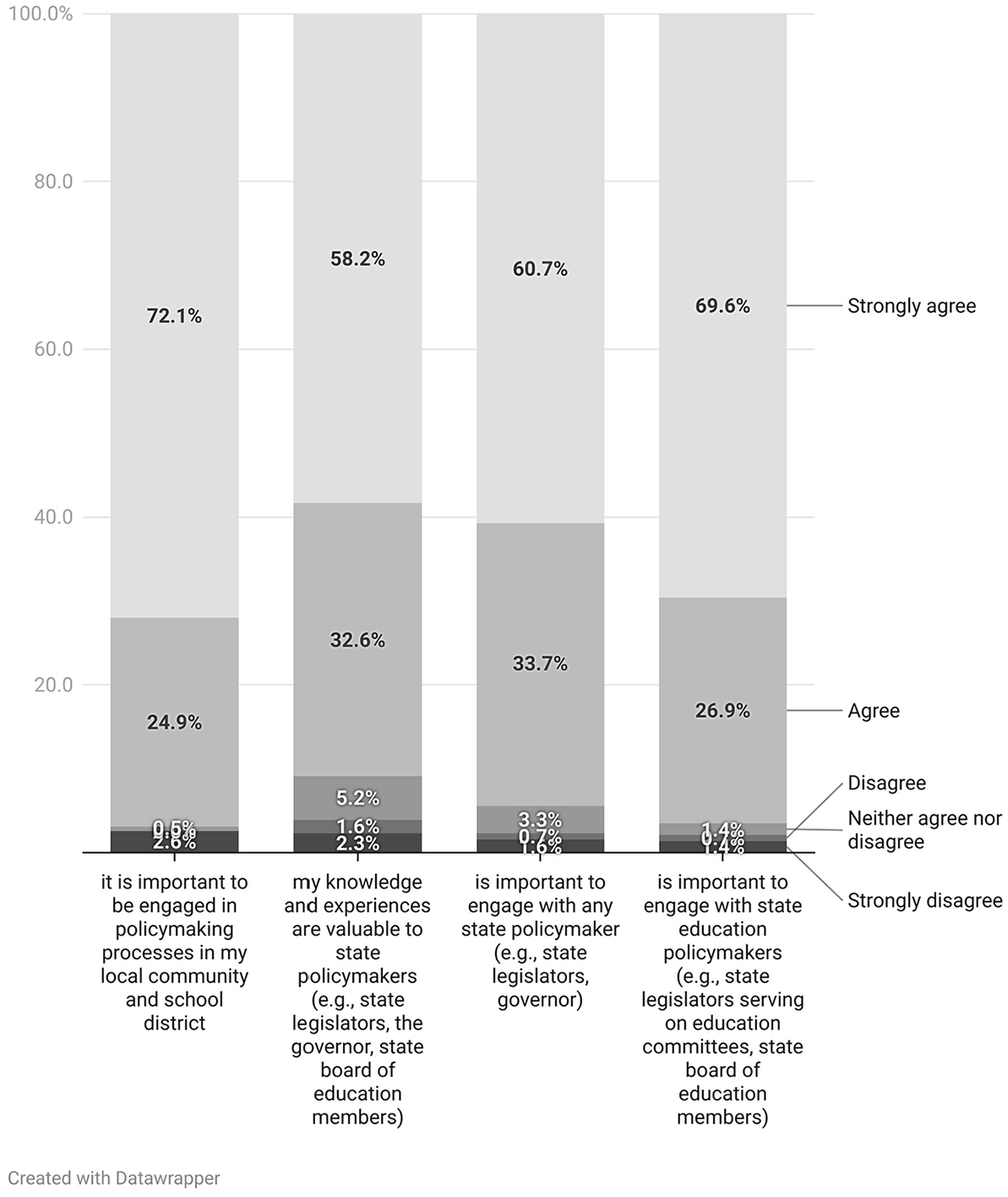
Superintendents’ level of agreement with “I believe. . .” statements related to policy engagement.
When engaged in state education policymaking processes, superintendents most often focused on three areas: (1) school finance (57%), (2) student-centered issues such as assessment, mental health, safety and security, dual enrollment, graduation requirements, and special education (40%); and (3) teacher-related issues such as licensure, evaluation, pay and teacher shortages (17%). With regard to school finance, superintendents expressed a need to be involved in state education budget bill development to ensure that their district was not impacted by state cuts to education funding or unfunded mandates. One superintendent shared: “there hasn’t been a year that budget hasn’t been an emphasis for me. And I don’t see that changing anytime soon” (4: VA, suburb, female, White).
A broad focus on involvement in education policy related to student-centered issues was evident from superintendents who made statements such as, “if it’s an interest to you or it affects your school, your kids, you get involved more” (37: OH, rural, male, white); and, “If it’s something that’s gaining attention or momentum somewhere we’ve got to be, for the good of our kids, we’ve got to be involved or at least aware and have knowledge of the initiative” (2: VA, rural, male, white). Some superintendents were more specific about their involvement in certain policy areas such as student assessment and accountability and teacher workforce policies. One superintendent indicated, “I do pay attention a lot to anything that’s related to testing. . . anything that is related to HR on how it changes the licensure. . .student issues when it comes to discipline” (20: VA, rural, male, white). Several superintendents described state policy engagement related to teacher licensure, certification, and pay. For example, one superintendent shared that he e-mailed his legislator about “teacher evaluation, and the number of administrators and the percentage of their time that will be dedicated to that” (50: OH, suburb, male, white).
Superintendents discussed three key reasons for being involved in state education policy processes: (1) it is part of the job, (2) they are experts and can provide concrete examples of how the policy will impact students, and (3) wanting to set an example for others. Analyses exploring variation based on district locale and state did not reveal any clear patterns of variation across these reasons.
Engagement as Part of the Job
For many superintendents, engaging in state policymaking processes was seen as part of their job responsibilities. One superintendent stated, “if we’re not speaking up for ourselves and for our kids, then we’re not doing our jobs” (33: OH, rural, male, white). Similarly, some superintendents were compelled to be engaged in state policy processes as part of their commitment to improving public schools writ-large, not just for their district. One superintendent shared that superintendents need to “flex our local muscle more to be involved” and reported that her “job is larger than just running the school district, it’s also advocating for the school district down in the state house and around the community” (31: OH, suburb, female, white). Another superintendent echoed this sentiment, sharing that it was his “job to advocate for our schools and to hold them [policymakers] accountable for the decisions that they make.” He also shared that “sometimes that’s a tough conversation [. . .] but at some point in time we are not going to lay our kids on an alter to be sacrificed and looked over” (17: VA, city, male, white).
Engagement to Share Expertise and Concrete Examples
Some superintendents emphasized the importance of providing expertise to policymakers, sharing thoughts such as “we are the most reliable and knowledgeable voices of our schools and communities” (48: OH, rural, male, white) and “most of the folks up there recognize that they’re not educators. It’s a lot of attorneys and folks who’ve never been in a classroom necessarily. So I think it’s great whenever we can get involved” (7: VA, town, male, white). One superintendent also stated, a lot of legislators are not educators and so if you can provide them the facts that they need during the general assembly meetings, it’s worth their weight in gold for them. (20: VA, rural, male, white)
Similarly, some superintendents discussed the importance of providing concrete examples and stories about the potential impacts of their policy decisions. One superintendent described a situation in which he told a state policymaker, That’s a great idea, but let me tell you an instance where that really won’t work. Your good intentions are going to have some unintended consequences and possibly impact this child in this way or this family in this way. (56: VA, rural, male, white)
Engagement as Civic Responsibility and Setting an Example
Several superintendents described their involvement in state policy spaces as a civic responsibility or saw it as setting a good example for students. Superintendents shared sentiments like, “I would tell them [students], ‘Democracy is a verb. You should be involved.’ And I want to set an example, and I do think students see that, and they’ve said that to me” (53: OH, rural, male, white). From a broader perspective, some superintendents echoed a common mantra in democratic societies of “if you don’t vote, you can’t complain.” In particular, one superintendent explicitly stated that if they were not involved, they did not “feel like we have the right to then complain about it later” (9: VA, suburb, female, white); and another shared, “if I don’t go out there and advocate for us, then shame on me because then I can’t complain when the bill gets passed or doesn’t get passed” (4: VA, suburb, female, white). In a similar vein, one superintendent wanted to ensure that policymakers could not place blame on superintendents for their decisions, stating, [Policymaker] told me one time [. . .] ‘you don’t call and tell me, I don’t know that I don’t agree with you, or I do agree with you. Call and tell me your opinion, or email me.’ [. . .]. I think in the absence of hearing anything, silence is acceptance. (25: VA, rural, male, white)
Reasons for Limiting Engagement in State Policymaking Processes
Among superintendents that were less compelled to engage or less positive about engaging in state policymaking processes, pessimism was often rooted in not feeling as though the effort was worth their time. One superintendent asked, “why bother because we’ve had years when people don’t listen?” He then critiqued those who shared about their involvement with state policymakers, stating “I’ve just kind of gotten tired of it. If I spend an hour talking with a legislator, I’d rather spend an hour working with our kids here or on something that mattered locally?” (22: VA, town, male, white). Another superintendent felt it was not part of his job, stating, “We weren’t hired to form state education policy. We were hired to enact state policy” (51: OH, town, male, white).
Some superintendents indicated that they limited their engagement in state policymaking processes because they perceived their voice as having little impact or rarely got facetime with their legislator. For example, one superintendent shared that they “just don’t see the benefit in taking time away from being in the district” if they only were able to talk with a legislative aid (28: OH, rural, female, white). Similarly, some superintendents shared that policymakers should actively seek out superintendents, rather than superintendents begging for their time. One superintendent stated, “I don’t think we should go to Richmond, hat in hand, and tell them what we need. I think they should ask us to come” (19: VA, city, female, white). Others reported that the weight of their singular voice did not have much impact, making statements such as “I realize I’m one voice of thousands that they listen to. Does my voice carry weight? No. But does the superintendent of [district] carry a little bit of weight? Yes.” (56: VA, rural, male, white); and “I wish that we had more of a voice from a state perspective in terms of what we’re accountable for, so that we could help as opposed to react” (30: OH, suburb, female, Latina).
Finally, a subset of superintendents felt an obligation to be involved in state education policymaking spaces, even though they did not have a strong desire to do so, did not have enough time, or felt vulnerable to political backlash. Some superintendents saw state policy engagement as “a necessary evil” (47: OH, suburb, male, white). Others shared that they were “involved out of necessity,” feeling that “if we don’t do something, it’s sink or swim for us” (17: VA, city, male, white). Similarly, some superintendents felt an obligation to be involved so they did not get “blindsided.” For example, even though he was “spread so thin” in terms of work at his more than 30 school sites, one superintendent conveyed frustration when he would “read something one day and go ‘oh crap, that passed?’” (11: VA, rural, male, white). Another superintendent stayed out of state policy issues in order to be responsive to their local elected board and avoid political backlash, sharing: You really only should be involved if you are willing to speak to your convictions. Because superintendents in Ohio report to locally elected boards [. . .] superintendents are often very cautious to kind of go with the flow because they don’t want to jeopardize their seat. So maybe superintendents in these other districts can get more involved through their advocacy organizations as opposed to maybe direct advocacy that leaves them feeling too vulnerable because we’re doing nobody any good if we all just get fired because we speak up. (40: OH, city, male, white)
Superintendents’ Actual Engagement in State Education Policymaking Processes
While many superintendents acknowledged the importance of being engaged in state education policymaking processes—even those who were less optimistic about the investment in and impact of engagement—superintendents had minimal engagement in legislative sessions and state board of education (SBE) meetings, often just a few times a year. The majority of superintendent survey respondents indicated that they attended two of fewer SBE meetings (85%) and state legislative sessions, hearings, or committee meetings (62%) per year. About one-quarter (23%) of superintendents attended three or four, and 15% attended five or more legislative sessions, hearings, or committee meetings per year. Frequency of engagement was lower for SBE meetings, where just 9% of superintendents attended three to four meetings, and 6% attended five or more meetings per year.
Moreover, superintendents corresponded with state education policymakers relatively infrequently—often just a few times a year (see Figure 2). When superintendents did interact with state policymakers, they primarily engaged with their local representative, who may or may not be in a strong position of power over state education policymaking. District superintendents rarely communicated with state policymakers who have the most power over education policymaking processes, such as education committee chairpersons and members who are on the front lines of deciding whether education bills advance in state policymaking process, or state superintendents and SBE members who often have the power to propose and vote on state rules and regulations for public schools. This finding runs counter to survey patterns shown in Figure 1, where the proportion of superintendents that felt it was just as important to engage with any state policymaker (95%) as it was to engage specifically with state education policymakers (97%).
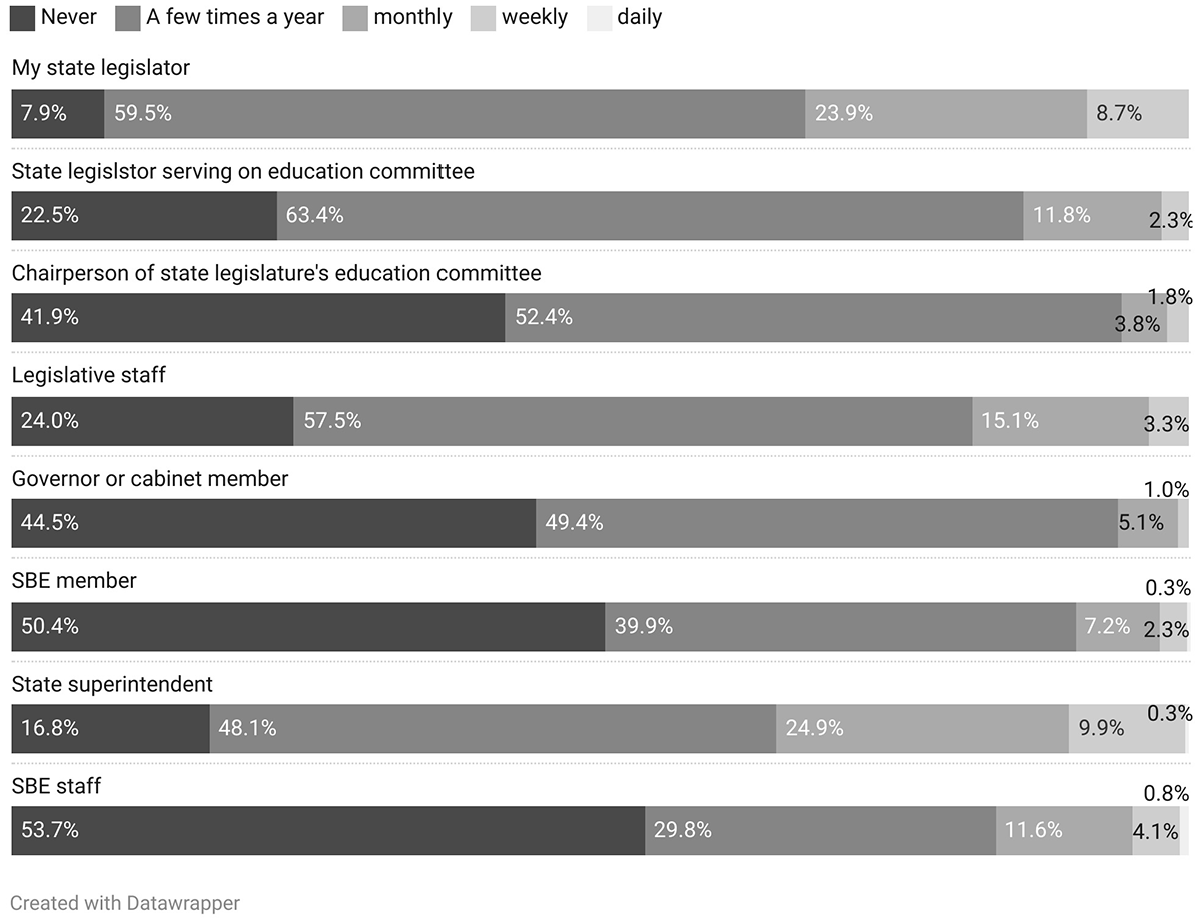
Frequency of superintendents’ interaction with state education policymakers.
Interviews with superintendents revealed that a key reason that superintendents rarely corresponded with state policymakers was because they were frustrated with lack of engagement and follow through by state policymakers. One superintendent shared, “When I’ve communicated, it’s ‘Thanks, but we don’t really want to engage with you. We’ve made up our mind’” (43: OH, town, male, white) and “Everybody gets so frustrated about the lack of follow through. . .I think superintendents should be very involved in policy, but it’s so difficult because you just feel like you’re trudging up a hill” (32: OH, suburb, male white).
Contexts That Influence State Education Policy Engagement
Three aspects of superintendents’ local contexts emerged as influential in their engagement in state education policymaking processes: (1) personal and professional capacity, (2) geographic proximity to state policymakers, and (3) perceived weight of voice, which superintendents often associated with district size. Looking across the two case study states, issues related to personal and professional capacity and geographic proximity to state policymakers were universal challenges; however, weight of voice was mentioned more often by superintendents in Ohio. Additionally, while Virginia superintendents frequently discussed the strength of working collaboratively with one another and their state association of superintendents, Ohio superintendents rarely mentioned collaborative policy engagement.
Personal and Professional Capacity
A major barrier to superintendents’ engagement in state education policymaking processes was personal and professional capacity (e.g., time, resources) as well as district staffing. As one superintendent pointed out, “I think there’s where it takes a lot of time, it takes energy, and a lot of times just trying to plan this call today was troubling” (31: OH, suburb, female, white). Other superintendents shared, “we don’t have the days off to take to advocate, and so we’re reluctant to do so” (10: VA, suburb, male, white); and “I would spend more time if I had more time. We’ll have an issue at school or my other job responsibilities take over, and then I can’t go to Richmond and I’m very frustrated” (9: VA, suburb, female, white).
This sentiment was particularly common for superintendents in smaller districts. One superintendent of a relatively small district specifically shared they were crunched for time, making statements such as “The superintendent is 24-7, 365, and in small districts you don’t have staffing” (43: OH, town, male, white). Small districts superintendent also shared that they were constrained by a lack of human resources, sharing sentiments such as, “I’m in a one-horse town and an 800 student district and I don’t have a Bob, and I don’t have a Meryl, and I don’t have these people and it’s just me [. . .] You don’t have as much time” (44: OH, town, male, white). Both large and small district superintendents recognized that districts with more resources to hire someone to engage with state policymakers were more often heard by state policymakers. For example, a superintendent of a small rural district in Virginia explained that “all of the larger [districts] have lobbyists that look out for their interests” (23: VA, rural, male, white). A superintendent of a large district explained what this looked like, stating, When we would push back on things, [policymakers] had to listen, because it was such a large [district], but also a lot of that was achieved through our lobbyist who constantly was meeting with legislators who were staying on top of policy, who bring everything back to him in the Reader’s Digest version. (6: VA, city, female, Black)
Some superintendents shared that when they were working on local issues—particularly ballot initiatives—they were hesitant to get involved at the state level due to limited capacity. For example, one superintendent shared “we’re going to be on the ballot in March, so that’ll be my first ballot issue in five years as superintendent. And while we’re on the ballot, that’s all I have time for” (28: OH, rural, female, white). Compared to urban district superintendents, rural district superintendents described having limited capacity because they did not have any other central office staff and must manage a wide variety of local issues on their own.
In some cases, especially in Virginia, superintendents credited their state association of superintendents with reducing capacity-related barriers to involvement. For example, one superintendent shared, Last year there were 300-some legislation deals. How do you have time to go through 300 and some legislative bills? Thank goodness for them [the state association] to kind of tease into them further and say, ‘we need to look at this one, this one, this one.’ So, then we focus on 10 or so [bills], versus 350. (13: VA, rural, male, white)
Another Virginia superintendent expressed that they were “really thankful for the superintendent organization” because “if you’re hearing with one voice what 133 superintendents want then it does hold a little bit of weight and we push it forward” (5: VA, suburb, female, white).
Survey data provided insight into another personal and professional capacity issue that superintendents faced: education and training to engage in state policymaking processes. As shown in Figure 3, only about one-third of superintendent survey respondents agreed or strongly agreed that their postsecondary training helped them (a) understand the state education policymaking process or (b) how to engage with state education policymakers. Similarly, about two-thirds of superintendent survey respondents indicated that their postsecondary education did not emphasize the importance of engaging with state education policymakers and the state education policymaking process. Similarly, all interviewees were asked if and how they learned to engage in state policy spaces. Across all 58 interviews, zero interviewees indicated that they received formal training about policy or policy engagement. As one superintendent shared, they learned how to engage in state policymaking processes via “Experience. Talking with others. Spending a lot of time with older, experienced superintendents and having discussions with them. And trial and error.” (50: OH, suburb, male, white).
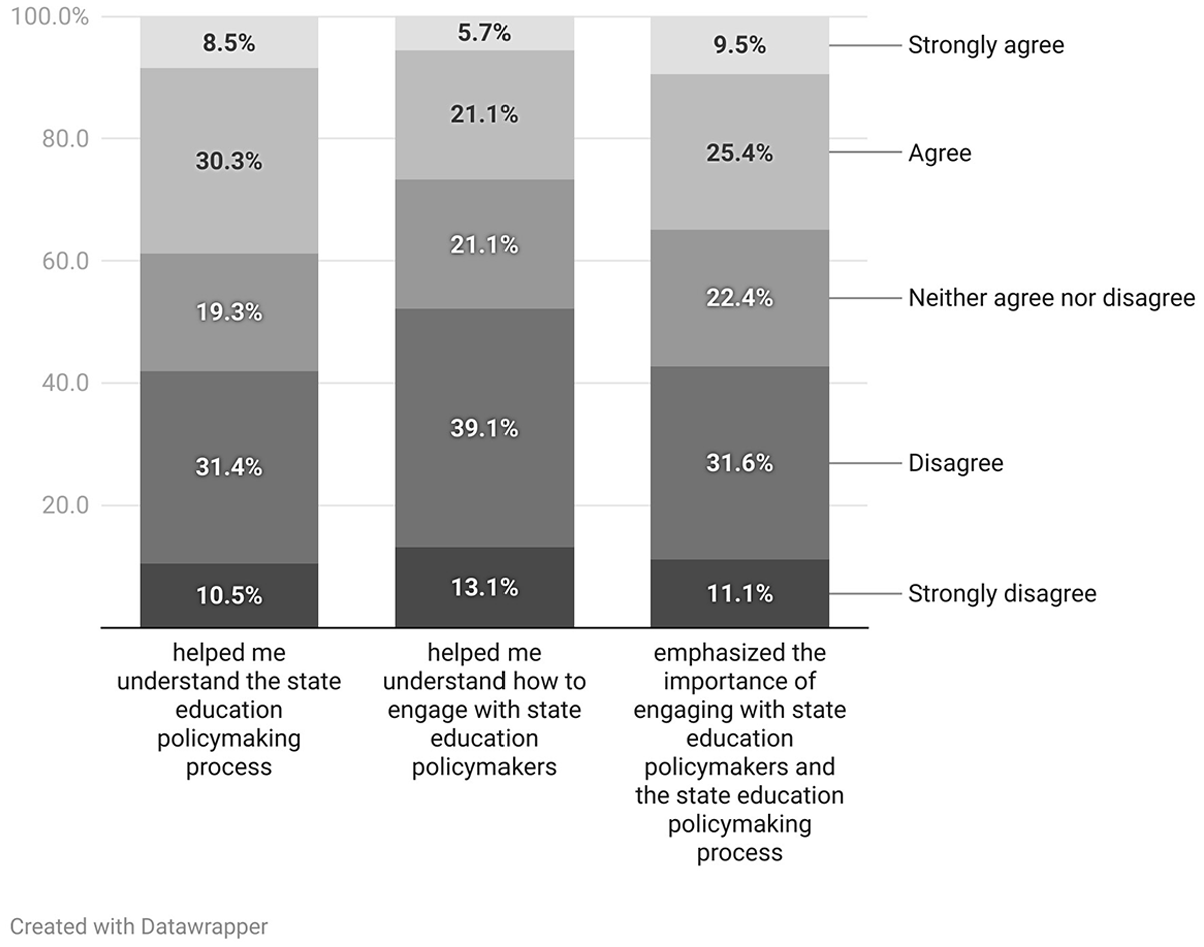
Distribution of superintendent responses to survey question stem: “My professional education. . ..”
Geographic Proximity to State Policymakers
Superintendents in districts closer in geographic proximity to their State Capitol building were often more likely to be engaged in state education policymaking processes. One superintendent shared, I run a district that’s close to the Capitol, so for me it’s a 30-minute drive. . . Some of my colleagues run much smaller districts with no support staff and they’re two and a half or three hours away. It’s not really feasible for those folks” (29: OH, town, male, white).
Similarly, another superintendent shared, “when we have [legislative] breakfasts, I shoot down [redacted] street. [. . .] I am literally three miles from the statehouse” (39, OH, suburb, female, white). This superintendent also shared that she previously served in a district about two hours away from the Capitol and, in that district, she rarely met with state policymakers.
Superintendents leading districts in remote areas of their state shared the challenges of distance and the amount of time required to access state policymaking spaces. One superintendent shared that the drive to the State Capitol was “about three hours and it’s only a three-minute time to testify. And so that’s a long day just to testify for three minutes” (20: VA, rural, male, white). Another superintendent stated that they tried to be engaged “from a distance,” but that it was “not the same as being in their office and speaking to them [state policymakers] directly” (7: VA, town, male, white). There was awareness that superintendents closer to the Capitol “are probably more involved because they are just closer in proximity,” with one superintendent sharing, “I know the superintendent of [district close to Capitol] and the superintendent is way more involved in lobbying and politics” (14: VA, rural, female, white).
When engagement with state policymakers required a lot of out-of-district time, rural, remote, or small district superintendents often shared that the local community or school board did not value their engagement. One superintendent reported, When I first got to the [area], they [the board] didn’t believe in coming to Richmond. They really didn’t. The frank piece of it is we’re closer to nine other state capitals than we are to Richmond. (56: VA, rural, male, white)
Another superintendent commented that to speak to state policymakers at the State Capitol was “an overnight trip” that involved ten hours of driving round-trip. He shared that he was “envious of the superintendents that are closer to Capitol that say, “Yeah, I ran up right before lunch” and I’m like, “Yeah, I had to leave before breakfast to get here.” (2: VA, rural, male, white)
District Size and Weight of Voice
District size was a factor that many superintendents felt either enabled and amplified or constrained and muted their voice in state education policymaking spaces. Particularly among superintendents in small districts, there was a shared sentiment that their state education policy engagement was limited due to a perceived lack of weight of their voice at the state level. One superintendent compared his prior experience in a smaller district where he “may not have had quite an audience with them [policymakers]” to now, as “the superintendent of a district that’s the county seat, I’m a little more visible” (49: OH, suburb, male, white). Similarly, a superintendent described a larger district that had substantial sway in policymaking processes, stating that the district was “big enough that the way they go is the way the state will go.” Further, she shared that larger district superintendents “carry a lot of weight when you have that many schools, and that many people in that area. A small school system doesn’t really carry a lot of brawn when it comes to anybody giving a crap what we want” (14: VA, rural, female, white).
Frustration among superintendents from smaller school districts who perceived their voice did not hold much weight often led to disillusionment about engagement. One superintendent shared, I guess I’ve become a little disenfranchised because after so many years of trying to point out things that I saw that might need to be fixed [. . .] and nobody was listening. It’s almost, why bother anymore? Why waste my time doing that? I have other stuff to do. Because at the end of the day, if I scream loudly and I’m in [small district] or [my district], people don’t listen. If the superintendent in [large district] screams, he’s going to be heard. He doesn’t have to scream. He can whisper, and he’s going to be heard. (22: VA, town, male, white)
Discussion and Implications
This research examined superintendents’ beliefs about and engagement in state education policymaking processes, detailing the ways that superintendents, like mayors, “perform a role that is messy, complicated and underpinned by complex, political, economic, social, cultural, and spatial practices and processes” in different spaces (Jayne, 2011, p. 802). Superintendents in this study described varied reasons for performing this role, with some seeing it as part of their job responsibilities or a mechanism through which they can set an example for students around democratic engagement. Nearly all superintendents in this study perceived their voice as being valuable to state policymakers, and often described their engagement in state policymaking processes similarly to how mayors have been described as “avatars”—contributing to state education policymakers’ understandings of the local context in which prospective policies would be implemented, and the implications such policies would have on students, educators, families, and communities. Superintendents’ acknowledgement of the power that large district superintendents have in state policymaking processes suggests that superintendents’ engagement in state policymaking processes occurs in relation to both their local spaces as well as other superintendents.
While most superintendents in this study believed that their voice was valuable in state policymaking spaces, the majority of superintendents in this study indicated that they should be more involved. Actual engagement in state policy processes among superintendents in this study was quite limited—often to just a few times a year—and, when engagement did occur, state policy actors with significant power of education policymaking were rarely the point of contact. This orientation is particularly important as state actors have become increasingly involved in the minutiae of public schooling—ranging from the types of books students can access to the types of bathrooms students have access to. Some superintendents in this study described how they worked to share their experiences and knowledge with policymakers in the hopes that they can shape policy solutions by helping policymakers acquire a clearer understanding of policy problems. Yet, this approach was not universal; some superintendents were frustrated by a lack of responsiveness from state policymakers, felt that they lacked the capacity to engage, or perceived that their voice as lacking power or value in state education policymaking spaces. Differences in superintendents’ beliefs about and engagement in state policy processes were not significantly different across the two states of study. However, local context—particularly the size and capacity of a district as well as the distance to the State Capitol building—did have an impact on superintendents’ engagement in policymaking processes.
Improve Access to and Education About State Policymaking Processes
This research exposed a number of barriers to state policy engagement shared by superintendents. Proximity to the State Capitol building was a key issue identified by superintendents in both states included in this study. While the COVID-19 pandemic pushed state governmental bodies to expand virtual engagement in policy processes, many have shifted away from this. However, a commitment to providing multiple avenues of meaningful engagement should be maintained to enhance access for districts located a further distance away from their State Capitol building. To ensure superintendents have equitable access to engage in state policymaking processes, state legislators serving on education committees and state board of education members may consider traveling to different parts of the state to conduct business. This practice could also provide an opportunity for state policymakers to partner with superintendents to engage with students, families, and community members that could be directly impacted by their policy decisions. School boards may also consider ways of supporting superintendents’ access to state policymakers such as encouraging and supporting superintendents to find time on a regular basis to be in contact with their policymakers and potentially ensuring superintendents have financial resources to be a part of statewide policy networks and attend professional meetings, legislative sessions, and state board of education meetings where they can be in communication with state policymakers.
Overwhelmingly, superintendents in this study indicated that they were unprepared to engage in state education policymaking spaces. About two out of every three survey participants reported that their education and training did not emphasize the importance of engaging in state policymaking processes and did not help them understand state policymaking processes or how to engage with state policymakers. Leadership preparation programs and superintendent support organizations should consider ways to prepare superintendents to effectively engage in state policymaking spaces. Both formal and informal training opportunities should support superintendents’ development of knowledge, skills, and dispositions for effective political leadership, including the technical and inter-personal aspects of education policymaking and practices for establishing relationships and engaging state policymakers in conversation. The Emergent Framework for Political Leadership in the Superintendency (Cheatham & Lo, 2023) may be a valuable tool for superintendent development and support programs to consider as they work to enhance the ways they prepare superintendents to engage in state-level policy work. The framework outlines skills such as “influencing, interpreting and implementing education laws and policies,” dispositions of “informed,” “active,” and “connected,” and knowledge such as “awareness of education issues in national and global media” as critical to effective political leadership for superintendents at the macro (national and state) level (Cheatham & Lo, 2023). Educational opportunities to develop skills to engage in policy spaces should emphasize a broad understanding of the individuals and groups with power in state policymaking processes, and support superintendents in developing effective approaches to communication, networking, and relationship-building among diverse state policymakers.
When helping aspiring and current superintendents learn to engage in state education policymaking spaces, the contentious political climate that superintendents are currently operating within cannot be ignored. Superintendents across the United States are increasingly being fired (White, 2025) by local school boards, often without cause and motivated by school board members’ political or policy positions (e.g., Andruss, 2023; Atterbury, 2022; Dana, 2023; Kingkade, 2022; Uphaus, 2022; VanderHart, 2021). Within this context, leadership preparation programs and superintendent support organizations should support superintendents’ skill and disposition development related to proactive, effective communication with local school board members and constituents about the value and outcomes of state policy engagement efforts. Moreover, leadership preparation programs and superintendent support organizations should ensure superintendents have access to support networks in cases where school board or local community members may be averse to their superintendent’s state policy engagement efforts.
Finally, superintendents’ engagement in state policy processes will vary over time and place. For example, policy engagement in states with part-time legislatures or state boards of education who meet a few times a year may be substantially different than in states with full-time, year-round legislatures. Additionally, superintendents in some states may need to be more involved if state government actors are engaged in policymaking that is not equity-oriented, or who are actively working to dismantle public education and negatively impact students’ access to high quality educational opportunities. Maintaining and expanding superintendents access to state policy processes, thus, will require different degrees of support depending on tate context; and the process of providing support must undergo continuous evaluation and adjustment to ensure timely and meaningful engagement that proactively informs state education policymaking processes.
Addressing Issues of Capacity and Differential Weighting of Superintendent Voice
This study revealed that superintendents in larger districts often have more financial capacity and human resources to shape and influence state education policy. State associations of school administrators play an important role in advocating for all districts, and often have a strong voice in state policy processes; however, superintendents should have equitable access to opportunities to communicate how policies may impact their specific community. Leadership preparation programs and professional associations can play a pivotal role in preparing superintendents—regardless of the size of the district they serve—to engage in state policy spaces by building their personal and professional capacity through curricular and real-world opportunities to understand the importance of engaging in state policymaking processes. Moreover, state associations of superintendents may consider the ways in which they support districts that are smaller in size or further away from the State Capitol identify ways to facilitate policy engagement of these superintendents.
This study revealed that many superintendents face more than one barrier to state policy engagement. For example, many of the superintendents that lived further from their State Capitol were located in small, rural districts that also had limited resources and time to spend on state policy engagement. Both state organizations and state policymakers should consider how superintendents with multiple barriers to engagement can be supported and identify avenues of collaboration and networks that provide all superintendents an opportunity to have their voice be a part of state education policymaking conversations. These efforts are especially important in states like Ohio where the size of school districts varies widely, and superintendents in smaller districts may feel like their voice carries little weight in state policy spaces.
Conclusion
In this study, I examined superintendents’ beliefs about and engagement with state education policymakers and uncovered multiple barriers superintendents face in engaging in state education policymaking processes. Given that the superintendency is a predominantly White, male profession (Tienken, 2020; White, 2023), future research should further explore variation in beliefs about and engagement in state policymaking processes based on superintendent gender and race. Additionally, given the well-documented gender and racial inequities faced by education leaders at both the school and district level (e.g., Weiner & Higgins, 2023), future research may also consider if and how other education leaders—such as central office administrators and school leaders—engage in state policymaking process and how engagement may look different based on gender, race/ethnicity, and other identity markers. Researchers may also consider exploring if and how leadership preparation programs prepare all education leaders to engage in policy spaces. For example, do faculty and instructors of courses and training for current and aspiring superintendents focused on policy and politics take a one-size-fits-all approach to policy engagement, or does the curriculum acknowledge and subsequently address the possibility that women superintendents and superintendents of color that engage in state policymaking processes may do so in the face of gender and racial discrimination and biases? Further research could also help inform specific types of formal training and education experiences (e.g., case studies simulations, online versus in person, short versus longer duration classes) that superintendents may benefit from.
Within this study, urban district superintendents were overrepresented, and rural district superintendents underrepresented among interviewees. Yet, patterns in the interview data made it clear that superintendents in rural districts faced multiple barriers to engaging in state policy spaces. As such, future research may focus explicitly on rural superintendents’ approaches to policy engagement, seeking to more deeply understand if and how superintendents in more remote areas of the nation overcome barriers to engagement in policy spaces. Studies in other states would be particularly useful to obtain an understanding of the experience superintendents located in states that are more geographically expansive than Virginia and Ohio who may have to travel even further to State Capitols. Additionally, at the time of this study, Republicans held a supermajority in Ohio state government (i.e., Republican Governor with majority Republican Senate and House of Representatives) and Democrats held a supermajority in the Virginia state government. As such, future research may consider examining if and how state political contexts and the interaction between state and local politics (e.g., majority Democrat state in a local school district with a majority of voters identifying as Republican) may influence superintendents’ involvement in state policy spaces. Additionally, researchers may explore how the alignment between superintendents’ personal political identities and their state’s political majority may influence their engagement in state policy spaces.
The timing of survey data collection for this study coincided with the COVID-19 pandemic, with interviews being conducted before the pandemic occurred, and surveys being conducted shortly after the pandemic shut down nearly all U.S. K-12 public schools. As such, superintendents responding to the survey may have been less engaged in state policy processes as they were focused on keeping students and educators safe; however, it is important to note that the survey asked superintendents to specify their engagemetn in state policy spaces over the last year – which included the nine months prior to the pandemic. Alternatively, some superintendents may have been more engaged in state policy processes, as decisions by Governors and legislatures related to school closure, masking, and vaccines significantly impacted the work of schools. Research should continue to explore superintendents’ experiences with and engagement in state policymaking processes over time, particularly as state actors have become more actively engaged in shaping and enacting policies that are associated less with the academic work of public schools and more with pushing political agendas (e.g., Pendharkar, 2023; Reuters, 2023).
Finally, future research should more deeply explore the ways that superintendents’ policy engagement informs or influences state policymakers’ decisions. As district leaders engage in policy spaces and advocate for the needs of students and families, understanding the barriers they face and developing guidance, support, and networks that allow superintendents to overcome these barriers could allow for meaningful engagement with state policymakers in ways that lead to more informed, equitable, and just education policy. Given the increasing involvement of the state in shaping education policy and practice at the local level, considering ways to amplify superintendents’ voices, support effective engagement in policy spaces that contributes to the development of equitable education policies, and ensure equity in access to state policymaking spaces is more important than ever.
Footnotes
Appendix A
Declaration of Conflicting Interests
The author declared no potential conflicts of interest with respect to the research, authorship, and/or publication of this article.
Funding
The author(s) disclosed receipt of the following financial support for the research, authorship, and/or publication of this article: The research reported in this manuscript was made possible (in part) by a grant from the Spencer Foundation (#201900244). The views expressed are those of the author and do not necessarily reflect the views of the Spencer Foundation.
