




Abstract
Using the Early Childhood Longitudinal Study - Kindergarten Cohort 2011, we examine (i) whether more preschool attendees in a kindergarten classroom relate to higher academic and social skills for children who did not go to preschool, (ii) whether more preschool attendees in the classroom moderate the benefits of preschool attendance (child N = 11,360; class N = 2,460; 67% White; 51% males; Mage = 5.6 years), and (iii) whether more preschool attendees in the classroom relate to teachers’ perceptions of children’s skills and their instructional content. In contrast to prior analyses using the 1998 cohort of the ECLS-K, we found no evidence of an association between the classroom percentage of preschool-attending peers and children’s academic, executive function, and behavioral and prosocial skills. However, we found that the percentage of preschool peers was associated with teachers’ perceptions of children’s reading skills and teachers’ instructional time spent on advanced reading content.
Keywords
Early childhood education (ECE) programs can influence a wide array of cognitive and social-emotional outcomes (Bassok et al., 2019; Campbell et al., 2014; Heckman et al., 2013; K. Magnuson & Duncan, 2016; Shea, 2021; Weiland & Yoshikawa, 2013). However, researchers have often found that the impacts of preschool on skills only last during the early school years and tend to fade in later grades (e.g., Lipsey et al., 2018; Puma et al., 2012; Yoshikawa et al., 2016). In turn, some emerging literature has attempted to understand the contexts and mechanisms in later schooling environments that may contribute to sustained early learning gains.
Bailey et al. (2017) introduced the “sustaining environments hypothesis,” suggesting that the persistence of preschool effects may be more likely when children are exposed to high-quality, aligned learning environments in the years following preschool. These factors encompass child and family-specific aspects (e.g., income), community and neighborhood conditions, as well as later schooling environments (e.g., school and teacher quality, full-day kindergarten, peer environments). Such elements have been shown to be powerful predictors of children’s access to preschool, school quality, and early skills (e.g., Bustamante et al., 2022; Chetty et al., 2016; Currie & Thomas, 2000; Gormley & Gayer, 2005).
An expanding body of empirical research testing the sustaining environments hypothesis has examined the moderating effects of school quality indicators, including teacher quality, time spent on advanced instruction, full-day kindergarten, and class size. Although there is a growing set of studies testing this hypothesis, findings on the factors that might influence the sustained development of preschool attendees are inconclusive (e.g., Bailey et al., 2020). This lack of clear evidence leaves open questions about which aspects of subsequent educational settings might sustain the advantages gained from preschool.
The potential for peer effects in children’s post-preschool classrooms, particularly those stemming from preschool attendance, has not been extensively investigated. As public preschool programs have expanded, an increasing number of children are entering kindergarten with preschool experiences and, presumably, more advanced school readiness skills (e.g., academic, executive function, social, and behavioral skills). Preschool-experienced peers could directly affect the learning outcomes of other children in the classroom through their interactions; they might also indirectly influence their classmates by encouraging teachers to introduce more advanced content (Bailey et al., 2017). Consequently, the combined preschool experiences of a child’s classroom peers may establish a sustaining environment, influencing child outcomes (Phillips et al., 2017).
Put another way, children who attend preschool may change future classroom learning environments through spillover effects. In this case, the advantages of preschool could extend beyond the participating children to their nonparticipating classmates. Several studies have found some indications of spillover or indirect effects of preschool attendance (Burchinal et al., 2023; Dmitrieva et al., 2007; Dodge et al., 2017; Garces et al., 2002; Heckman & Karapakula, 2019; List et al., 2019; Neidell & Waldfogel, 2010). A recent study by List and Uchida (2024) randomly assigned preschool access and elementary school classmates. Their findings indicated that children’s cognitive gains from preschool were more likely to be sustained when a greater proportion of preschool peers were in the same elementary school. However, questions remain regarding the specific mechanisms through which the peer environment might serve as a sustaining factor for preschool effects. Identifying these underlying mechanisms would offer valuable insights for schools aiming to build upon the short-run benefits of preschool (e.g., Stipek et al., 2017).
We use the nationally representative Early Childhood Longitudinal Study–Kindergarten 2011 cohort (ECLS-K:2011) to examine these possibilities. We replicate and extend the work of Neidell and Waldfogel (2010) who tested for preschool peer effects in the ECLS-K 1998 cohort by further examining whether preschool peers in a classroom sustain the benefits of one’s own preschool attendance and whether teachers’ perceptions and instructional practices change in response to having a greater proportion of preschool participants. Specifically, we ask three research questions:
Does the percentage of preschool peers in a kindergarten classroom relate to children’s outcomes (i.e., math, reading, executive function, behavioral function, and prosocial skills) in the spring of kindergarten?
Does the percentage of preschool peers in a kindergarten classroom moderate the benefit of preschool attendance for children who themselves attended preschool?
Does the percentage of preschool peers relate to teachers’ instructional content (i.e., time spent on basic math and reading vs. advanced math and reading) and their perceptions of student skills (i.e., teacher-rated math, reading, behavioral function, and prosocial skills)?
We use school-fixed effects analyses to account for family and student selection into schools and neighborhoods. This effectively restricts our models to estimating comparisons between children who attend the same elementary school but are assigned to different classrooms with varying levels of preschool peer exposure. This helps to reduce unobserved differences between children that could bias our results. In the following sections, we review the previous literature on peer effects in ECE settings, before detailing methods and results. Finally, we conclude with implications for developmental theory and ECE policy.
Preschool Peers as a Sustaining Environment
One common explanation for fadeout is that children who attended preschool enter public school environments with poor financial resources, lower-quality instruction, and a set of peers who were not afforded similar early learning opportunities (Currie & Thomas, 2000; Lee & Loeb, 1995; Reynolds et al., 2004). The sustaining environments hypothesis predicts that preschool gains are more likely to be preserved or amplified if the subsequent environments provide continuous support and stimulation for children’s development (Bailey et al., 2017). Evaluations of the sustaining environment hypothesis have primarily focused on the moderating effects of structural quality indicators, with most studies finding modest to null effects (e.g., Bailey et al., 2020; Bassok et al., 2019; Claessens et al., 2014; Jenkins et al., 2018; K. A. Magnuson et al., 2007; Mashburn & Yelverton, 2019; Pearman et al., 2020; Swain et al., 2015). A subset of these studies tested the moderating role of peer’s preschool attendance in kindergarten and early-grade classrooms (Botvin et al., 2024; Burchinal et al., 2023; Unterman & Weiland, 2024). Some studies found evidence of moderating roles of preschool peers in later grades (Botvin et al., 2024; Curenton et al., 2015; Zhai et al., 2012), but others did not (Bailey et al., 2020; Burchinal et al., 2023; Jenkins et al., 2018; Unterman & Weiland, 2024).
Research has shown that student performance and behavior are influenced by the abilities of their peers. Several correlational studies have reported positive associations between peer ability and child academic outcomes during preschool (DeLay et al., 2016; Henry & Rickman, 2007; Justice et al., 2011, 2014; Mashburn et al., 2009) and negative relations between preschool peers’ behaviors and child behavioral outcomes after preschool (Dmitrieva et al., 2007). Extensive experimental and quasi-experimental evidence from the K–12 and postsecondary literature has suggested that children reap small to moderate gains in cognitive and behavioral outcomes from a high-achieving peer group (Ammermueller & Pischke, 2009; Duflo et al., 2011; Lavy, Silva, & Weinhardt, 2012; Lefgren, 2004). By contrast, being surrounded by low-ability peers or those with behavioral issues has adverse effects on student outcomes, where teachers spend more time on behavioral management or need to teach more remedial or basic content (Carrell & Hoekstra, 2010; Dmitrieva et al., 2007; Lavy, Paserman, & Schlosser, 2012; Lavy, Silva, & Weinhardt, 2012; Xu et al., 2020).
Preschool experience has been shown to have significant effects on children’s cognitive, social, and behavioral outcomes (Bassok et al., 2019; Campbell et al., 2014; Heckman et al., 2013; K. Magnuson & Duncan, 2016; Shea, 2021; Weiland & Yoshikawa, 2013). Research indicated that while preschool attendance may enhance children’s academic skills (Gormley & Gayer, 2005; Phillips et al., 2017; Weiland & Yoshikawa, 2013), effect sizes are moderate-to-large for academic outcomes, ranging from .38 to .62 (e.g., Gormley & Gayer, 2005; Phillips et al., 2017; Weiland & Yoshikawa, 2013), and moderate for executive function, ranging from .21 to .28 (e.g., Weiland & Yoshikawa, 2013). Compared to research on academic skills, relatively few studies have identified positive effects of preschool programs on social and behavioral outcomes, and the evidence in this area is less robust and convincing than that for academic outcomes (e.g., Phillips et al., 2017; Raver et al., 2011). Consequently, classrooms with a higher percentage of preschool attendees might experience amplified positive cognitive, social, and behavioral outcomes.
With the increasing scale-up of ECE programs, the field has begun to document spillover effects from ECE program participants to nonparticipants (Dodge et al., 2017; Garces et al., 2002; Heckman & Karapakula, 2019; List et al., 2019; Neidell & Waldfogel, 2010). In a study similar to ours, Neidell and Waldfogel (2010) tested the peer effects of preschool attendance in the kindergarten classroom using the ECLS-K:1998. They found that a higher percentage of preschool peers in kindergarten classrooms was associated with positive spillover effects on all children’s reading and math achievement at the end of the year, but they found no effects on behavioral and social skills. Using the same ECLS-K:1998 data but restricting the sample to classrooms with at least 50% of its students being sampled, Dmitrieva et al. (2007) found similarly positive preschool peer effects on children’s kindergarten academic skills. They also reported more externalizing problems associated with a higher percentage of preschool peers in kindergarten classrooms. Thus, the existing findings suggest that while preschool may improve academic achievement, it could potentially decrease social skills and behavioral functioning when a higher proportion of the population attends preschool in subsequent learning environments. However, peer effects are likely further constrained because of the small main effects of preschool on children’s development.
A different set of findings emerged from a more recent study. Using data from an urban county in Virginia, Burchinal et al. (2023) observed that kindergarten classrooms with a higher number of children who attended preschool were associated with larger vocabulary and inhibitory control gains for children who did not attend preschool. In contrast, children who attended preschool did not experience benefits from being in classrooms with more preschool peers. Still, a null preschool peers result in this single context may not be generalizable to the broader population of kindergarten children.
Teachers’ Instruction and Perceptions of Student Skills as Mechanisms
The peer effects literature has long identified teachers’ instruction as an important channel through which classroom peer effects operate. Yet, the results from empirical studies testing for such mechanisms have been mixed. For example, Duflo et al. (2011) and Lavy, Paserman, and Schlosser (2012) found that teachers adjusted their level of classroom instruction based on children’s achievement. Teachers assigned to a class of higher-achieving children displayed more effort (defined as less absenteeism; Duflo et al., 2011), whereas teachers with more low-skilled children showed less effective instructional practices (e.g., instilling knowledge and analytical and critical skills; Lavy, Paserman, & Schosser, 2012). 1 However, Burchinal et al. (2023), Booij et al. (2017), and Feld and Zölitz (2017) found no evidence that teachers adjusted their teaching practice either based on preschool peer classroom compositions or to the achievement of children (see also Engel et al., 2016). Overall, it is unclear whether teachers adjust their practice based on classroom composition and children’s skills in their classroom.
In line with the peer effects literature, the sustaining environments hypothesis posits that preschool peers may affect student outcomes through teacher’s instructional content (Bailey et al., 2017). 2 A higher percentage of preschool children could raise the achievement level of the class, which may incentivize teachers to provide more challenging material and activities to meet children’s learning needs. Several studies have shown that children benefit from exposure to advanced rather than basic academic content in kindergarten, although basic content has been offered more frequently (Bassok et al., 2019; Claessens et al., 2014; Engel et al., 2013, 2016).
The sustaining environments hypothesis also suggests that preschool peer composition may affect teachers’ perceptions of students’ skills. However, the literature in this area suggests that teachers do not accurately identify children’s skill levels (Ready & Wright, 2011; Südkamp et al., 2012; Urhahne & Wijnia, 2021). Teachers in different contexts either under- or over-estimate children’s skill levels in their classes (Ready & Wright, 2011; Südkamp et al., 2012; Urhahne & Wijnia, 2021). In the context of ECE, Vitiello and Williford (2021) found that preschool teachers’ perceptions were less accurate when evaluating children whose skills were farther away from the class mean. Moreover, when children enter public school, kindergarten teachers are often unaware of the extent of their knowledge (Engel et al., 2013; Sarama & Clements, 2015); teachers in preschool and kindergarten classrooms often perceive students’ competencies differently (Abry et al., 2015). Thus, the presence of more preschool attendees in the classroom may raise the overall skill level or increase attention on behavioral management and perhaps reduce the variance of student ability to the extent that teachers are more aware of students’ actual skills and “calibrate” their perception of student ability. No study, to date, has tested whether a higher percentage of preschool peers in a classroom may lead teachers to better judge students’ skills.
Taken together, kindergarten teachers often offer basic content that most children already acquired before kindergarten (e.g., Claessens et al., 2014) and do not accurately assess students’ skills (e.g., Urhahne & Wijnia, 2021). However, teachers’ instructions and perceptions might be influenced by classroom composition, such as the share of children who already attended preschool. Indeed, the transition into formal school can be a major adjustment for many children, and kindergarten teachers may notice if their classroom becomes populated by “school-ready” pre-K attendees. We test whether a higher percentage of preschool peers in the class may help teachers recognize higher classroom-level average skills and adjust their instruction. We examine both teachers’ perceptions of students’ skills and instructional content as mechanisms through which classroom peer effects operate.
Present Study
Our study examines the association between classroom preschool peer composition and student outcomes in kindergarten and the moderating effects of preschool peers on the persistence of preschool skill advantages. 3 We hypothesize that a higher percentage of preschool peers in a kindergarten classroom may lead to small peer effects on academic outcomes (i.e., reading, math, executive function) for children who did not attend preschool, and null or small sustained gains for children who attended preschool based on the current literature. We do not have a strong hypothesis for how preschool peers may influence behavioral function and prosocial outcomes of preschool attendees and nonpreschool attendees given limited findings for the peer effects and small effect sizes for preschool attendance on these skills (Ansari, 2018; Dmitrieva et al., 2007; Little, 2021; Neidell & Waldfogel, 2010). Still, if the benefits of preschool are not large, neither spillover effects nor sustained gains would be observed. Additionally, we examine teachers’ perceptions of children’s skills in their classes and their instructional content to test whether teachers are responsive to having higher percentages of preschool children in their classrooms. Given the mixed evidence regarding the degree to which early-grade teachers adapt their content for children’s skill levels (e.g., Engel et al., 2016), we do not have a priori hypotheses here. Note that the ECLS-K:2011 did not sample all children in the classroom, thus limiting our ability to comprehensively study classroom peer effects. To address this issue, we follow the methodology and assumptions of prior peer effects studies using the ECLS-K:1998 (Neidell & Waldfogel, 2010). Further details are provided in the following section.
Method
Data
We used the restricted version of ECLS-K:2011 dataset, a nationally representative sample of 18,150 children in about 970 schools entering kindergarten in the fall of 2010. The data were collected by the National Center for Education Statistics (NCES) using a complex survey sampling design. The ECLS-K:2011 contains extensive information on children, parents, teachers, and schools from kindergarten through the fifth grade. We used data from the kindergarten year (2010–2011), which includes information collected from parents, teachers, school administrators, and direct assessments in the fall and spring of kindergarten. The data also include population weights to generate nationally representative estimates.
Following Neidell and Waldfogel (2010), we restricted our sample to first-time kindergarteners (excluded 105 cases) with preschool information (excluded 521 cases). We also excluded cases in classrooms with only one sampled student because no peer effects can be calculated (N = 63 cases). Additionally, we restricted our sample to those with complete teacher identifications and spring scores (N = 5,750). Our final analytic sample had 11,360 children, roughly two-thirds of the original sample, with an average age of 5.6 years old (i.e., 67.19 months), about 67% White, and approximately 51% were male. 4 There are 2,456 classes nested in 821 schools.
Measures
Preschool Peers Composition
Our key independent variable was the percentage of preschool peers in each kindergarten classroom. We used information from the parent survey in the fall of kindergarten, in which parents reported the type of childcare their child received before kindergarten. Following previous literature (e.g., Bassok et al., 2019), preschool enrollment was defined by a broad set of classroom-based early childhood education experiences (e.g., day-care center, nursery school, preschool, prekindergarten program, or Head Start), 5 for at least five hours per week. Children who did not attend preschool were defined as those who received parental care or nonparental care at home, such as family childcare homes, babysitters, and relative care.
The percentage of preschool peers in a classroom was calculated by dividing the total number of preschool attendees by the total number of sampled children (rather than the class size) in a classroom, excluding the index child. We used the number of children sampled in each classroom because not all children enrolled in a class were sampled in ECLS-K:2011. Based on the number of children linked to each teacher and teacher-reported class size, the ECLS-K:2011 sampled, on average, 36% of all children within a classroom. Although we followed the method used by Neidell and Waldfogel (2010), this sampling limitation of the ECLS-K could affect the precision and generalizability of the findings. The validity of this construct is contingent on the assumption that each child had an equal probability of being selected for the study within a selected classroom. Specifically, in the ECLS-K, each child had an approximately equal probability of inclusion in the study within each selected school (for schools with 28 or more children) (Tourangeau et al., 2018). 6 Because the study sampling design does not guarantee random sampling within kindergarten classrooms, we conducted several additional analyses to ensure that ECLS-K participants were not sorted systematically into classroom groupings.
We scaled the percentage of preschool peers in 10-percentage-point units, which has a mean of 5.78 (57.8 %) and a standard deviation of 3.47. We also created a set of indicator variables for whether 0 to 20%, 21% to 40%, 41% to 60%, 61% to 80%, and 81% to 100% of the class enrolled in preschool to explore nonlinear or threshold relationships. As a sensitivity check, we followed Neidell and Waldfogel’s (2010) method to correct the measurement error caused by incomplete classroom-level information about students. Specifically, we adjusted the coefficients and SEs using the following formula:

Where
Spring Student Outcomes
We used five academic and socioemotional assessments of student skills measured in the spring of kindergarten as our study outcomes: reading, math, executive function (EF), behavioral function, and prosocial skills. The reading and math skills were IRT scale scores collected by ECLS-K:2011 survey administrators through direct assessments. The reading assessment consisted of questions on print familiarity, letter recognition, and recognition of common words. The math assessment consisted of questions on number sense, properties, operations, measurement, geometry and spatial sense, data analysis, patterns, algebra, and functions. The reliability coefficients of both measures ranged from .86 to .95 across all grades (Tourangeau et al., 2018). Both the reading and math scores were continuous and standardized with a mean of 0 and standard deviation of 1.
The other outcome variables we used were derived from multiple assessment measures. We first used exploratory factor analysis to group the measures, resulting in three domains: EF, behavioral function, and prosocial skills (Wold et al., 1987). We coded all measures such that larger values represented higher levels of skills in that domain. A detailed description of the procedure can be found in Online Appendices 1.1–1.3. After grouping with factor analysis, we created composite scores for the three domains to increase the power to detect effects and reduce the risk of multiple hypothesis testing. We first standardized each measure within a given domain and then took the equally weighted average of all the measures’ z-scores (similar approaches have been used in other ECE studies, e.g., Deming, 2009). We describe each composite score and the specific measures used to construct them. Bivariate correlations of each composite score are available in Online Appendix 1.4.
The EF composite score was constructed using the working memory and cognitive flexibility measures. Working memory was measured by ECLS-K:2011 assessors using the Number Reversed subtest from the Woodcock-Johnson III Tests of Cognitive Abilities (Tourangeau et al., 2018). The assessor read an increasingly longer series of numbers to the child, who was asked to repeat the numbers in reverse order during the test. Cognitive flexibility was measured by assessors using the dimensional change card sort (DCCS) task (Zelazo, 2006). Children were asked to sort cards into trays based on rules that changed in the middle of the task. They were then presented with cards of two target pictures that varied along two dimensions—shape or color. Children matched a series of bivalent test pictures to target pictures, with more dimensions added to increase difficulty. This measure has been widely used in research (Beck et al., 2011; Zelazo, 2006), though reliability for working memory and cognitive flexibility was not reported in ECLS-K:2011.
The behavioral function composite score was constructed by teacher ratings of internalizing and externalizing problem behaviors. Internalizing problem behaviors were measured by four items on a 4-point Likert scale: how often a child shows apparent presence of anxiety, loneliness, low self-esteem, and sadness. We created a single measure of internalizing problem behaviors by averaging all the survey items with missing values coded as zero. Externalizing problem behaviors were measured by five items: how often a child (1) argues, (2) fights, (3) becomes angry, (4) acts impulsively, and (5) disturbs ongoing activities. All items were rated on a 4-point Likert scale. Similarly, we created a single measure of externalizing problem behaviors by averaging all the survey items. These two measures had a mean reliability of .89 for internalizing problem behaviors and .78 for externalizing behaviors (Tourangeau et al., 2018). The values were reverse coded so that higher values represent better behaviors before constructing the composite score.
The prosocial skill composite score was constructed with teacher-rated interpersonal skills (five items), self-control (four items), and approaches to learning (seven items). All items were rated on a 4-point Likert scale. Higher scores on the interpersonal skills measure indicate that the child interacted with, shared, and respected others in a positive way. Higher self-control scores indicate that the child exhibited behaviors indicative of self-control. Higher scores of approaches to learning suggest that the child displays the following behaviors very often: keeping belongings organized; showing eagerness to learn new things; working independently; easily adapting to changes in routine; persisting in completing tasks; paying attention well; and following classroom rules (Rock & Pollack, 2002). These measures had a mean reliability of .82 for self-control, .87 for interpersonal skills, and .81 for approaches to learning, respectively (Tourangeau et al., 2018). We averaged all the survey items within each measure to obtain the measures of interpersonal skills, self-control, and approaches to learning.
Fall Student Achievement
We used classroom-level average fall scores to descriptively understand the baseline skill composition of our sample and its relationship with the percentage of preschool peers in the classroom. We constructed the same set of measures described previously drawn from the fall of kindergarten. The reading and math scores were IRT scores from direct assessments conducted in the fall of kindergarten. The composite scores of EF, behavioral function, and prosocial skills were constructed the same way as the corresponding spring scores.
Teachers’ Perception of Student Skills
We used four variables to measure teachers’ perceptions of student skills in reading, math, behavioral function, and prosocial skills in the fall of kindergarten. Teachers assessed children’s reading and math skills on the Academic Rating Scale, which was developed for the ECLS-K:2011 (Tourangeau et al., 2018). Children were assessed on multiple items in reading and math on a scale from 1 (not yet) to 5 (proficient). Eight items were included in math and nine items in reading. Skills not introduced in the classroom and not taught were coded as missing. We averaged the values of all items in reading and math to obtain teachers’ overall ratings of a student. We then aggregated teachers’ individual ratings to the class level to obtain teachers’ overall perception of student academic skills in the class. We used the same composite scores of teacher-rated student behavioral function and prosocial skills, as described previously, to measure teachers’ perceptions of children’s behavioral function and prosocial skills.
Reading and Math Instructional Activities
We calculated the average days per month that teachers spent on basic and advanced content activities following the procedure used by Claessens et al. (2014). There were eight items in reading and eight items in math from the teachers’ surveys in the spring of kindergarten (see more details about the measures in the beginning section of the Online Appendix). We rescaled teachers’ responses to indicate the number of days per month a teacher reported teaching that content in the following way: never (0 day), once a month or less (1 day), two or three times a month (2.5 days), once or twice a week (6 days), three or four times a week (14 days), and daily (20 days). The final items represent the average number of days teachers spent on reading and math activities each month (Claessens et al., 2014). Additionally, we identified four items as advanced and four items as basic for both reading and math, based on their alignment with the Common Core standards and endorsement by more than 15% of teachers (Common Core State Standards Initiative [CCSSI], 2010). 8
Control Variables
We controlled an extensive set of child, family, and teacher characteristics, following Neidell & Waldfogel (2010). 9 We used the following child and family covariates: age, gender, race/ethnicity, birth weight (i.e., babies weighing less than 5 pounds, 8 ounces or 2,500 grams), home language, mother’s age at birth, the proximity of grandparents, mother’s education, father’s education, mother’s employment status, mother’s occupational prestige score, family residence urbanicity, number of siblings, income, poverty status, numbers of books owned, WIC status (i.e., the Special Supplemental Nutrition Program for Women, Infants, and Children [WIC] aims to protect the health of low-income women, infants, and children up to age five who are at nutrition risk), whether parents read to their child, and whether the family receives food stamps. For classroom and teacher covariates, we included class size, gender, age, race/ethnicity, education, years of experience in kindergarten, whether the teacher passed the school board exam, and whether the teacher had an early education certificate. These variables were collected from the child assessment, parent interviews, and teacher surveys in the fall of kindergarten. Most covariates had a missing rate below 10%. We conducted multiple imputations using chained equations to avoid the bias that may arise due to missing data in covariates. We followed the imputation model from von Hippel (2007) and generated 20 imputed datasets to account for all covariates in our analysis (i.e., demographics and preschool participation).
Analytic Approach
Our primary concern when estimating the relation between the percentage of preschool peers in a classroom and child outcomes is that the composition of preschool peers might correlate with other observed and unobserved child, family, teacher, and school characteristics that simultaneously influenced student outcomes. To address this concern, we use school-fixed effects, exploiting the variation in the percentage of preschool attendees in different classrooms within a school. 10 This specification accounts for student selection into schools by comparing children across classes within the same school, thus eliminating bias caused by time-invariant school and neighborhood characteristics, measured or unmeasured, that vary between schools. 11 This allows us to better isolate the association between preschool peers and child outcomes. We also control for an extensive set of child, family, and teacher characteristics to further reduce any remaining bias caused by the nonrandom assignment of preschool children into classrooms. Our main analytic model is as follows:

where
In this model, our coefficient of interest is

where the coefficient on the interaction term, captured by
For the teacher-level analyses, we aggregated the child-level data to the classroom level and used the same specifications to predict teacher-level outcomes (i.e., teacher perception of student skills and instructional content level), adjusting the error term for clustering at the school level. We included the weight “W1_2P0” for student-level analyses to account for missingness in direct child assessment data and parent-reported data, and “W12T0” for class-level analyses to account for non-responsiveness in teacher survey items and maintain the nationally representative features of the sample. 13 For all of our key regression models, outcome variables were standardized, so the effects of the preschool peer variable can be interpreted as the SD increase per 10 percentage point increase in the share of children observed in a kindergarten classroom who attended preschool.
Note that we did not include fall student achievement as a covariate in our main child- and teacher-level analyses because they are outcomes of preschool attendance and thus considered “bad controls,” which could induce spurious correlations in our model (Angrist & Pischke, 2008). We propose that the percentage of preschool attendees influences children’s spring scores in kindergarten, with fall scores capturing the initial impact of preschool participation at the beginning of the academic year. These scores subsequently mediate the relationship between our independent variable (percentage of preschool peers) and the spring scores, which represent the cumulative outcome at the end of the year. We were concerned about inadvertently controlling for part of the effect we aimed to measure. Yet, we also recognize the value of examining change over time as a critical aspect of understanding the persistence of preschool benefits. Our sensitivity checks included fall scores into our model, allowing us to assess their impact on the estimation of spillover effects and the persistence of benefits over time. This is detailed in Online Appendix 4.
Selection Into Classrooms
While our main specification reduces bias from student selection into schools using school-fixed effects, it is still possible that children may select into classrooms based on their own characteristics or the characteristics of the teacher (e.g., more experienced teachers may be assigned to classrooms with a higher percentage of preschool attendees), which could alternatively explain any peer effects on child outcomes. To rule out these possibilities, we conducted two balance checks to confirm that: (1) there was no correlation between the percentage of preschool peers and children’s initial skills (measured by fall achievement scores) and child and family characteristics; and (2) there was no correlation between the percentage of preschool peers and teacher characteristics. These results, presented in Appendices 2.1 and 2.2, suggest that there was no selection from key child, family, and teacher characteristics with the inclusion of school-fixed effects. However, the results reported should still be interpreted with caution because we cannot fully rule out classroom sorting from unobserved factors.
Results
Descriptive Statistics
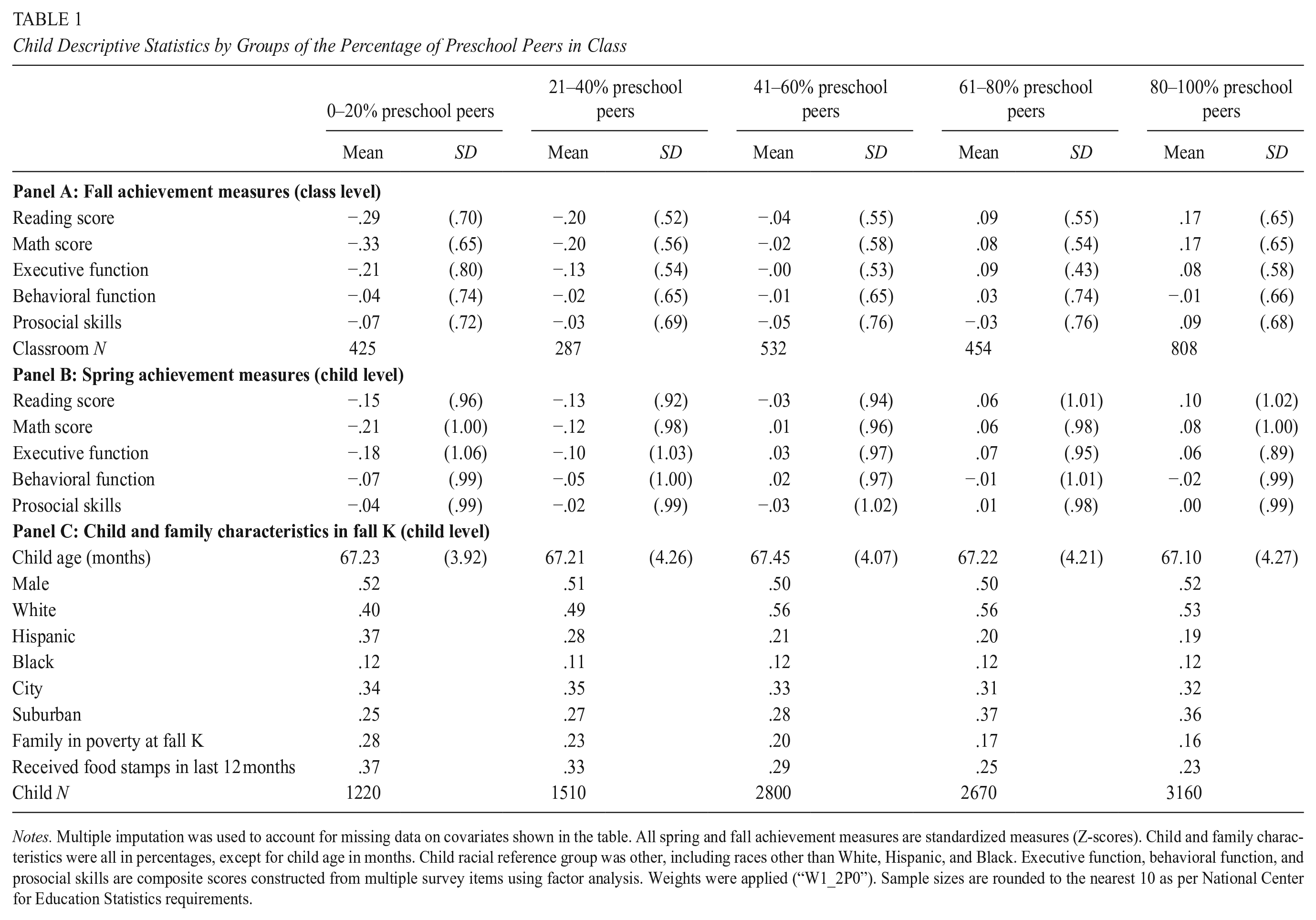
Table 1 presents summary statistics of all outcome variables and selected child and family characteristics by the percentage of preschool peers in the focal child’s kindergarten classroom. Specifically, we show the breakdown of all variables in classrooms with 0 to 20%, 21% to 40%, 41% to 60%, 61% to 80%, and 81% to 100% preschool peers. Most children in our sample (76%) were in classes with at least 40% preschool attendees.
Child Descriptive Statistics by Groups of the Percentage of Preschool Peers in Class
Notes. Multiple imputation was used to account for missing data on covariates shown in the table. All spring and fall achievement measures are standardized measures (Z-scores). Child and family characteristics were all in percentages, except for child age in months. Child racial reference group was other, including races other than White, Hispanic, and Black. Executive function, behavioral function, and prosocial skills are composite scores constructed from multiple survey items using factor analysis. Weights were applied (“W1_2P0”). Sample sizes are rounded to the nearest 10 as per National Center for Education Statistics requirements.
Panel A includes the average standardized class fall scores for each outcome measure. We averaged class-level fall scores using all classrooms within each of the preschool peer percentage groups (columns of Table 1). The distribution of all five outcome measures suggested that preschool attendees were high-achieving peers, as classrooms with a higher percentage of preschool children had higher average scores in reading, math, executive function, behavioral function, and prosocial skills at the kindergarten entry. To formally test the relation between the percentage of preschool peers and classroom achievement, we also regressed average class fall scores on the percentages of preschool peers group indicators (Online Appendix 3). We observed significantly higher fall class-level achievement in classrooms with more than 40% of preschool peers. For example, classrooms with 41%–60% of preschool peers had .15 SD (p < .001) higher reading scores than classrooms with less than 20% of preschool peers. Reading skills were even higher when classrooms had 61%–80% (b = .25; p < .001) and 81%–100% (b = .28; p < .001) of preschool peers.
Panel B presents the standardized spring outcome measures at the child level. Similar to the pattern observed for fall class-level scores, children in classrooms with a higher percentage of preschool peers scored higher in all five achievement measures in the spring of kindergarten. Panel C of Table 1 presents the selected child and family characteristics of all children in our sample. Overall, children in classrooms with more preschool peers came from more advantaged families. For example, children who were White and lived in suburban areas were more likely to be in classrooms with a higher percentage of preschool peers. They were also less likely to be in poverty or receive food stamps (complete child and family characteristics are available in Online Appendix 2.1).
Table 2 displays descriptive statistics for teacher perceptions of student skills and their instructional activities. Perhaps surprisingly, we observed no clear changes in teachers’ instructional content (measured by the average number of days teachers spent on basic and advanced reading and math activities per month) across classrooms with differing percentages of preschool children. However, teachers in classrooms with higher percentages of preschool children rated children’s reading, math, learning, and social skills more favorably than those in classrooms with a lower percentage of preschool children.
Teacher-Level Descriptive Statistics by Groups of the Percentage of Preschool Peers in Class

Notes. Italicized teacher instructional items are classified as advanced reading and math activities. Multiple imputation was used to account for missing data on covariates shown in the table. Behavioral and prosocial skills are composite scores constructed from multiple survey items using factor analysis aggregated at the class level. The teacher’s racial reference group was other, including races other than White, Hispanic, and Black. Weights were applied (“W12T0”).
Relation Between Preschool Peers and Student Outcomes
We first examined the association between the percentage of preschool peers in a classroom and student outcomes in the spring of kindergarten. In columns 1 through 5 of Table 3, we present models that include the percentage of preschool peers and individual preschool status for each of our five outcomes, and columns 6 through 10 then add the interaction term of preschool attendance and percentage of preschool peers to test whether the percentage of preschool peers differentially relates to preschool attendees. All models include school-fixed effects, and the full set of child, family, and teacher covariates.
Associations Between Preschool Peers and Student Spring Outcomes

Notes. The percentage of preschool peers is in 10 percentage point units in the analysis. Columns 1 to 5 present models where spring scores were regressed on the % of preschool peers with school-fixed effects and all individual and teacher-level covariates. “Inc” indicates that school-fixed effects and covariates were included. Individual level covariates include child age in months; child gender (male); race: Hispanic, Black, & Asian (White as a reference group); location: city & suburban (rural as a reference group); family in poverty at fall K, received food stamps in last 12 months; mother received WIC; parent read to child every day; family in poverty at fall K; mother not in the labor force; mother employed full-time; mother is high-school graduate; grandparents live close; maternal age at birth; speak English at home; child is low birth weight (<5.5 lbs.); numbers of siblings; numbers of books owned by the child. The teacher level covariates include teacher’s race (White or Hispanic), teacher’s age, teacher’s gender (male), years teachers taught in kindergarten, teacher has a bachelor’s degree, teacher has an early ED certificate, teacher passed exam for National Board, and class enrollment. Columns 6 to 10 present models that regressed spring scores on the % of preschool peers and the interactions between the % of preschool peers and preschool attendance with school-fixed effects and all individual and class-level covariates. For coefficients that were adjusted following Neidell and Waldfogel’s (2010) method, see Online Appendix 5. The sample was restricted to first-time kindergarteners and classes with more than one sampled student and included children who had no missing values on dependent and preschool-related independent variables. Multiple imputation was used to account for missing data on covariates in the analysis. Weights were applied (“W1_2P0”). Robust standard errors were adjusted for clustering at the class level. Sample sizes are rounded to the nearest 10 as per National Center for Education Statistics requirements.
p < .1, *p < .05, **p < .01, ***p < .001.
Results shown in columns 1 through 5 showed that preschool attendance was associated with higher scores in reading (b = .06; p < .001), math (b = .07; p < .05), and executive function (b = .05; p < .05) but lower scores in behavioral functioning skills (b = .09; p < .001) and prosocial skills (b = .05; p < .05). Our key predictor, the percentage of preschool peers in the classroom, produced small coefficients across the five models tested, but none of these relations were statistically significant.
Next, we added the interaction term of preschool attendance and the percentage of preschool peers to test for moderation (columns 6 to 10). We observed mainly positive coefficients on the interaction terms except for executive function but none that were significant at any level. When the interaction was included in the models, the main effect of the percentage of preschool peers was close to zero for each outcome tested, suggesting little evidence for spillover effects on children who did not attend preschool.
Teachers’ Perceptions of Student Skills and Instructional Activities
Finally, we examined whether the preschool composition of the classroom is associated with teachers’ perceptions of student skills and their instructional practice. The results, estimated at the classroom level, are shown in Table 4. These models include school-fixed effects and the full set of covariates. The results show that teachers did perceive children to have higher reading skills when the classroom had a higher concentration of preschool children. In column 2 of Table 4, we found that a 10-percentage-point increase in the percentage of preschool peers in a classroom was associated with a .026 SD increase in teachers’ perceptions of children’s reading skills (p < .05).
Associations Between Preschool Peers and Teachers’ Perceptions of Student Skills

Note. Outcome measures were standardized. Teacher perceptions of student skills were derived from teacher-reported measures. The % of preschool peers is in 10-percentage-point units in the analysis. All models used aggregated values at the classroom level. Models included school-fixed effects and control for all child and teacher-level covariates (see Table 3 note). Multiple imputation was used to account for missing data on covariates. Weights were applied (“W12T0”). The sample was restricted to classrooms with no missing data on the % of preschool peers and outcome variables. Robust standard errors were adjusted for clustering at the school level.
p < .1, *p < .05.
We also found a positive association between the percentage of preschool peers and teaching more advanced reading content—namely reading multi-syllable words (b = 1.84; p < .05) in Table 5; this indicates a 1.84-day increase in advanced reading instruction when teachers had more preschool attendees in the class. However, we saw no evidence that teachers changed their perceptions of children’s math skills and their instructional activities for math when more preschool peers were in the class, and other reading instructional content measures. We also found no changes in teachers’ perceptions of their classroom’s executive function, behavioral, and prosocial skills when they had more preschool attendees in the class.
Associations Between Preschool Peers and Teachers’ Instructional Content

Note. All teacher instructional content measures were derived from teacher-reported measures. All models used aggregated values at the classroom level. Models included school-fixed effects and control for all child and teacher-level covariates (see Table 3 note). Multiple imputation was used to account for missing data on covariates. Weights were applied (“W12T0”). The sample was restricted to classrooms with no missing data on the % of preschool peers and outcome variables. Robust standard errors were adjusted for clustering at the school level.
p < .05,
Sensitivity Checks
Adding Fall Measures of Child Skills
We first tested whether our results changed when controlling for fall measures of child skills and behaviors (see Online Appendix 4.1). Although it is not our preferred specification because fall skills are temporally downstream from preschool attendance, a key predictor in our model, including fall achievement, might enable us to explore any factors not explained by prior achievement and thus might be explained by preschool peer effects. We found that when fall measures of child skills were included, the coefficients of preschool attendance and the percentage of preschool peers for reading and math in columns 1–3 changed from positive to negative relations, but they were not statistically significant. We did not observe substantive differences between the results in Table 3 and Online Appendix 4.1 for our other outcome measures.
We also tested whether our teacher perception and instructional content results changed when controlling for fall achievement (see Online Appendix 4.2). In these models, all coefficients and standard errors of the percentage of preschool peers became smaller but were still significant. The relation between preschool peers and teacher instruction in advanced reading activities became slightly smaller and shifted to marginally significant.
Adjustments for Measurement Error in Peer Composition
Shown in Online Appendix 5, we present the adjusted coefficients and standard errors that account for the measurement error that might occur from only observing a small sample of children in each classroom from which to calculate the percentage of preschool peers. All the adjusted coefficients are larger than the nonadjusted coefficients such that the associations between preschool peers and students’ outcomes were more pronounced but remained statistically nonsignificant.
Additional Sensitivity Checks
We did three additional tests. First, we tested if there are nonlinear relationships between the percentage of preschool peers and children’s outcomes. We ran the same set of models shown in Table 3 but replaced the continuous measure (i.e., the percentage of preschool peers) with indicators of whether 21% to 40%, 41% to 60%, 61% to 80%, and 81% to 100% of the class enrolled in preschool (with 0 to 20% as the reference group) shown in Online Appendix 7. These results are all null.
Second, to address concerns about the extent to which teachers accurately assess children’s academic skills, we examined the associations between student direct reading and math assessments and teachers’ perceptions of reading and math skills (Online Appendix 8). The results show that the direct assessments were significantly associated with teachers’ perceptions of student skills but were not highly correlated (r = .18 for math; r = .22 for reading). Direct assessments of reading and math are highly correlated, as are teachers’ perceptions of students’ reading and math.
Third, we tested the robustness of our findings with respect to the definition of preschool exposure. We descriptively examined the distribution of the hours/dosage of preschool experienced by the preschool sample and then ran our primary analyses restricted to children who spent 10 or more hours per week in preschool. As shown in Online Appendix 9, we did not find any significant results when imposing this sample restriction. These differences (i.e., prior significant results becoming null) are likely attributable to the limited sample included in the analysis (3270 children, 276 classrooms).
Discussion
Our study examined the possibility that, as preschool programs are scaled up to serve a greater portion of the population, kindergarten cohorts with greater preschool experience could create a different subsequent learning environment in their kindergarten classroom, as larger percentages of children enter kindergarten with stronger early-learning skills. Because classroom-level processes can operate through both peer interactions and teachers’ perception and instruction, we also tested whether teachers perceive their classes with more preschool-attendee children as more skilled and whether they increase the difficulty of their instructional content as the percentage of children in their classroom with preschool experience increases. Our analyses used a nationally representative sample of kindergarten children, and we employed school-fixed effects controlling for a wide range of teacher, family, and child characteristics.
Overall, we found that the percentage of preschool peers in a child’s kindergarten classroom was not associated with children’s academic, executive function; behavioral function; and prosocial skills in that year. The percentage of preschool peers did not moderate the effects of preschool attendance on preschool attendees either. However, we found that a higher percentage of preschool peers was associated with improved teachers’ perceptions of students’ reading skills, and teachers spent more time on advanced reading content.
Null Relations Between Preschool Peers and Student Outcomes for Children Who Went to Preschool and Those Who Did Not
Adding to the mixed evidence base in this area, we did not find any association between a kindergarten classroom’s preschool peer composition and student outcomes in kindergarten. Importantly, this null relation was observed regardless of the focal child’s preschool status, suggesting that preschool peers in our sample did not act as a sustaining environment for preschool boosts, nor did we observe evidence of spillover effects on non-preschool attendees. Our null results of the spillover effect hypothesis are consistent with findings from comparable models in Neidell and Waldfogel (2010) using the ECLS-K:1998 (i.e., school-fixed effects models without controlling for fall achievement). However, Neidell and Waldfogel (2010) found significant preschool spillover effects on reading and math skills when they controlled for fall achievement, whereas we did not. Note that fall scores serve as mediators between preschool attendance and spring scores. Our further tests with fall scores included show even smaller coefficients (Online Appendix 4) than those in our main results (Tables 3 and 4).
The differences in our results and those reported by Neidell and Waldfogel (2010) likely stem from a couple of main factors. First, the definitions of preschool enrollment differ across these two datasets. Although their study and ours reported similar average preschool attendance rates (approximately 58%), the way the researchers operationalized preschool exposure differed from our study, and the survey item wording differed across the two waves. For instance, while the ECLS-K:1998 survey items categorized primary nonparental care into nine distinct categories (no nonparental care; relative care in child’s home; relative care in another home; nonrelative care in child’s home; nonrelative care in another home; Head Start program; center-based program; two or more programs; location of care varies), the ECLS-K:2011 consolidated some categories, incorporating Head Start into the center-based care response, merging certain nonrelative care categories, and expanded items about relative care to three rather than two categories. 14 We followed the definition of preschool exposure from Bassok et al. (2019)—participation in classroom-based ECE (e.g., daycare, nursery schools, preschools, prekindergarten programs, Head Start, or nonrelative care in another home) for at least five hours per week. Importantly, their study compared preschool attendance across the two waves. They noted differences across the two waves in specific categories, such as a higher public pre-K attendance in 2010 compared to 1998 (19% vs. 11%). In contrast, Neidell and Waldfogel (2010) defined preschool enrollment broadly as any center-based care (including Head Start, daycare, nursery school, preschool, and prekindergarten programs). They categorized parental, relative, or nonrelative care as the alternative, whereas we defined nonrelative care not in the child’s home as preschool enrollment and nonrelative care in the child’s home as an alternative. 15 Thus, differences in findings between Neidell and Waldfogel (2010) and ours using different datasets might be attributed, at least in part, to differences in how preschool enrollment is defined, measured, and categorized. Due to these data differences, our findings also do not align with the results from another study using the 1998 cohort by Dmitrieva et al. (2007). They found that children in classrooms with more preschool-experienced peers demonstrated higher academic skills and increased externalizing problems during both fall and spring kindergarten, restricting the sample to classrooms with at least 50% of children sampled in a class.
Second, our balance checks differ from Neidell and Waldfogel (2010); they only assessed mean differences in variables between classes above or below a 59% median preschool enrollment threshold. Our checks are more nuanced, examining how varying preschool peer percentages impact student outcomes. Significant peer effects were only evident in the results from their main models that included covariates; models without covariates did not show peer effects. It is, therefore, possible that certain unobservable characteristics of children or their classes were associated with either the presence of preschool peers or children’s outcomes in their study.
We also did not find evidence for the moderation of classroom preschool peers on preschool attendees’ outcomes at the end of kindergarten. This aligns with several other studies testing for evidence of sustaining environments, finding null or very small moderating effects of kindergarten and elementary school quality factors (Bailey et al., 2020; Burchinal et al., 2023; Jenkins et al., 2018). It should be noted that our measure of the peer environment is imperfect; as with other studies using older ECLS-K data (e.g., Neidell & Waldfogel, 2010), our study uses the data with an average of six children per classroom and no information on classroom instructional quality. Nevertheless, research using other data with precise measurement of the peer environment, ideally from high-quality ECE interventions tested through random assignment, could help to better understand whether peer effects of preschool attendance exist and whether they operate as a sustaining environment. These null findings also suggest a need for research using high-quality ECE programs, which could provide clearer insights into the potential peer effects of preschool attendance and their role in sustaining or enhancing early educational outcomes.
Teachers’ Perceptions of Student Reading Skills and Reading Instructional Activities Are Positively Correlated to the Percentage of Preschool Peers in a Class
In addition to peer-to-peer classroom processes, we also explored teacher-level classroom processes in response to preschool experiences, examining the extent to which teachers altered their perceptions of preschool children’s entering skill levels and whether they adjusted the difficulty of the curriculum based on these skills or the classroom percentage of preschool peers. We found that teachers may have been aware of student ability, at least in reading, and assigned more class time to advanced content when they had a higher percentage of preschool attendees in their class. Note that we used the classroom-level teacher ratings of individual students’ math, reading, behavioral, and social skills, and they were not measures of the accuracy of those ratings. Thus, based on the variables used in the analysis, our findings suggest that teachers’ ratings of students’ reading tend to be higher when they have a greater percentage of children who attended preschool in their class, but these effects were small in magnitude.
Our findings are consistent with other peer effects studies, such as Duflo et al. (2011) and Lavy, Paserman, and Schosser (2012), who found that teachers adjusted their level of classroom instruction on reading multi-syllabus words based on children’s achievement. However, the finding on teachers’ instruction is not consistent with the study of Burchinal et al. (2023), which found that more children with preschool experiences in a kindergarten classroom did not change CLASS instructional support. Certainly, the uptick in advanced instruction in classrooms with a higher percentage of preschool attendees is noteworthy, given that multiple studies have found that more time spent on advanced instruction correlates with stronger academic outcomes in early-grade classrooms (e.g., Bassok et al., 2019; Engel et al., 2016; Jenkins et al., 2018). However, our findings suggest that these small boosts in advanced instructional content were not likely enough to move the needle on student outcomes, given that we observed virtually no associations between the preschool peers measure and any of our tested child achievement and behavioral measures. Future research should focus more on how instruction is delivered and the degree to which teachers use effective instructional methods for children’s learning.
We did not find evidence that the percentage of preschool peers changed teachers’ perception of student math, executive function, behavioral, and prosocial skills, nor did it change their instructional content. The overall null findings regarding teachers’ outcomes might be an indication of teachers’ content focus and the difficulty teachers may be experiencing in differentiating their instruction to meet the varying needs of the range of students in the class (e.g., Bassok et al., 2019; Engel et al., 2016; Jenkins et al., 2018).
Teacher Findings Contribute to the Field of ECE
These findings point to the need to increase our understanding of the ways that teachers can adapt their instructional content to children’s learning needs. Indeed, previous research suggested that teachers did not adjust their math instruction because they were unaware of children’s math ability, lacked the appropriate tools to assess student math skills, or had to follow local math standards that emphasize basic content (Engel et al., 2013; Sarama & Clements, 2015). Some evidence suggests that proactively informing teachers in early-grade classrooms about their children’s math skills can improve learning outcomes. Clements et al. (2013) found that a randomly assigned “follow-through” group, which helped teachers build on the skills children gained during a preschool math curricular intervention, had better outcomes than children in the control condition or children who received only the preschool curricular intervention. Certainly, early-grade curricular and instructional alignment has received substantial focus from ECE researchers and policymakers in recent years (e.g., Koppich & Stipek, 2020). Our work provides further suggestions that these efforts might provide some enhanced learning outcomes for children in kindergarten classrooms.
Our results align with the meta-analysis by Bailey et al. (2020), which indicated that factors within subsequent educational environments failed to consistently maintain the benefits gained from preschool programs. As such, our findings further underscore the need for more research to understand how public preschool programs and elementary schools can support children to succeed.
Limitations and Future Directions
This study is not without its limitations. First, the ECLS-K data only includes preschool enrollment status from the parent survey (e.g., center-based care and Head Start), which was used to calculate the percentage of preschool peers. We did have limited information about the type of preschool programs attended and the quality of those preschool programs. Second, our key identifier of the percentage of preschool peers in a classroom was calculated by dividing the total number of preschool attendees by the total number of sampled children in a classroom rather than the actual class size because of the ECLS-K’s sampling design. This provides us with a smaller sample size in each classroom (an average of 6.49 students in a classroom), and the calculation likely contains measurement error, though we did address this using Neidell and Waldfogel’s (2010) adjustment approach (see Online Appendix 5). Given this sample limitation, our results should be interpreted with caution. Third, our results for teachers’ perceptions of children’s skills and their instructional activities were generated using teacher-reported measures. We cannot rule out whether some teachers were able to assess children’s skills more accurately, regardless of whether the children attended preschool. 16 Despite these limitations, our study provides population-level evidence using a nationally representative sample, but future research should test this inquiry in different early childhood education program settings using more precise measures of peer composition.
Conclusion
Utilizing a nationally representative sample of young children entering kindergarten from the ECLS-K:2011 and employing school-fixed effects to control for unobserved confounding factors as rigorously as possible, our findings suggest that being in a kindergarten classroom with a high percentage of preschool-experienced peers does not directly benefit the outcomes for either preschool attendees or non-attendees. However, we found that a higher percentage of preschool attendees in a kindergarten classroom positively influenced teachers’ perceptions of children’s reading abilities and led to more time spent on advanced reading content. As public preschool programs continue to expand, our population-level evidence indicates that teachers may adjust their instruction to accommodate the skill levels of children in classrooms with more highly skilled students. However, additional instructional support is likely necessary for teachers to adapt to the enhanced school readiness skills of children after attending preschool.
Supplemental Material
sj-docx-1-ero-10.1177_23328584251318306 – Supplemental material for Do Preschool Peers Create a Sustaining Environment in Kindergarten? Evidence from the ECLS-K:2011
Supplemental material, sj-docx-1-ero-10.1177_23328584251318306 for Do Preschool Peers Create a Sustaining Environment in Kindergarten? Evidence from the ECLS-K:2011 by Zhiling Meng Shea, Qing Zhang, Jade Marcus Jenkins and Tyler W. Watts in AERA Open
Footnotes
Acknowledgements
Opinions reflect those of the author and do not necessarily reflect those of AERA or NSF. We are grateful for the comments and feedback we received from meetings of the Consortium on Early Childhood Intervention Impact and the Association for Education Finance and Policy.
Declaration of Conflicting Interests
The author(s) declared no potential conflicts of interest with respect to the research, authorship, and/or publication of this article.
Funding
This research study was supported by grant funding from the National Institute of Child Health and Human Development (1R01HD095930-01A1). This research was supported by a grant from the American Educational Research Association, which receives funds for its “AERA-NSF Grants Program” from the National Science Foundation under NSF award NSF-DRL #1749275.
Open Practices
In alignment with the principles of transparency and reproducibility in research, we have adopted the following open practices for the study “Do Preschool Peers Provide a Sustaining Environment in Kindergarten Classrooms? Evidence from the ECLS-K: 2011.”
1. Data sharing
While we utilize data from the Early Childhood Longitudinal Study - Kindergarten (ECLS-K), access to this dataset is governed by the National Center for Education Statistics (NCES) and requires compliance with their data use agreement. Researchers interested in replicating or extending this work can obtain access to the ECLS-K dataset by applying directly through the NCES website.
2. Code availability
To facilitate reproducibility, all code used for data analysis, preprocessing, and visualization is made available in a publicly accessible repository through OPEN IC PSR ( ). The code repository includes detailed documentation to guide the replication of the study’s findings.
3. Open access publication
The findings of this study will be published in AERA Open to ensure broad accessibility to our research.
By adopting these practices, we aim to support the reproducibility, accessibility, and impact of our research while fostering collaboration within the scientific community.
Notes
Authors
ZHILING SHEA is an assistant professor at the University of Maine at Farmington,186 High Street, Farmington, Maine 04938; email:
QING ZHANG is a researcher at the University of California, Irvine, 3200 Education Bldg, Irvine, CA 92697; email:
JADE JENKINS is an associate professor at the University of California, Irvine, 3200 Education Bldg, Irvine, CA 92697; email:
TYLER WATTS is an associate professor of developmental psychology in the Department of Human Development at Teachers College, Columbia University, 525 West 120th Street New York, NY 10027; email:
References
Supplementary Material
Please find the following supplemental material available below.
For Open Access articles published under a Creative Commons License, all supplemental material carries the same license as the article it is associated with.
For non-Open Access articles published, all supplemental material carries a non-exclusive license, and permission requests for re-use of supplemental material or any part of supplemental material shall be sent directly to the copyright owner as specified in the copyright notice associated with the article.
