




Abstract
When it comes to understanding the consequences of school absenteeism, how missing school might be linked to student-teacher relationships remains relatively unexplored. Our work helps to further detail this context by specifically investigating whether teachers’ perceptions of students are different based on how frequently those students are absent. We explore this in early elementary school—a period marked by high rates of student absenteeism not witnessed again until early adolescence. Using a nationally representative dataset of children in kindergarten through second grade, we found that teachers felt less close with students who had more absences compared to students with fewer absences. Findings also suggested teachers had lower perceptions of absent students’ classroom social skills compared to the perceptions that they held for less-absent students. Finally, teachers had lower ratings of learning approaches as well as lower ratings of language and math abilities for students who were more absent. Recommendations for policy and practice are discussed.
Students who miss more school hurt their own growth and progress in numerous ways, including lower testing performance, greater feelings of alienation, and higher levels of lifelong distress (Anderson & Romm, 2020; Easton & Engelhard, 1982; Finning et al., 2019; Gershenson et al., 2017; Gottfried, 2009, 2010, 2014; Gottfried & Kirksey, 2017; Kirksey, 2019; Moonie et al., 2008; Roby, 2004). A common misbelief is that these consequences are issues that mainly pertain to adolescence (Gottfried & Hutt, 2019; Robinson et al., 2018). Yet data show that children in the earliest years of education are missing a disproportionate amount of school days (Balfanz & Byrnes, 2012; Gottfried & Hutt, 2019). In fact, of all years of elementary school, children in the earliest grades are experiencing the highest levels of absenteeism (Balfanz & Byrnes, 2012). More so, the sizes of the effects of missing school in the earliest years of schooling are as large as those in later years (Chang & Romero, 2008; Connolly & Olson, 2012; Ehrlich et al., 2018), thereby suggesting that the consequences of absenteeism are damaging particularly in early years of schooling.
Given these consequences, policymaking has provided the scaffolding for a sharpened focus on how absenteeism plays out within schools (Gottfried & Hutt, 2019). Notably, the Every Student Succeeds Act (ESSA) incentivized the majority of states to hold schools accountable for student absenteeism rates as a metric of school performance (Jordan & Miller, 2017). As a result, as schools themselves became held accountable for absences, researchers and policymakers have focused on what at school might be driving absenteeism and what the consequences are (Gottfried & Hutt, 2019). For instance, recent studies have emerged within which school-level factors, programs, and processes have been evaluated. School programs that have been associated with less absenteeism included mentoring, transportation, meals, and texting (Childs & Grooms, 2018; Gottfried, 2017; Kirksey & Gottfried, 2021; Page & Smythe-Leistico, 2019). These studies focus on a schoolwide level of analysis. Yet clearly the structure of U.S. education—particularly in the earliest years of elementary school—places children in classrooms. Our understanding of absenteeism in the context of the classroom, however, remains limited.
Overall, research on classrooms and absenteeism is sparse, which helps to explain our obscured portrait of classroom dynamics with respect to absenteeism. What has been established is that individual student absenteeism is associated with lower outcomes for their classmates. For instance, when children miss days of instruction in elementary school, their classmates have lower state standardized test scores (Gottfried, 2011) and are more likely to be chronically absent themselves (Gottfried, 2019). In addition to academics, Gottfried and Ansari (2022) found a negative relationship between a student’s level of absences and other students’ academic outcomes; when students were absent, their classmates had lower levels of achievement in addition to weaker executive function. Clearly, the extant evidence suggests that student absenteeism predicted weaker outcomes for other students, and therefore, further unpacking absenteeism in the classroom context is critical. That said, few classroom dynamics with regards to absenteeism have been examined, though several have been identified as predictors of more absences, including classmate composition and familiarity (Gottfried, 2013; Gottfried et al., 2016; Kirksey & Gottfried, 2018; Kirksey & Elefante, 2022), degree of special education services provided (Gottfried et al., 2019), and air ventilation (Mendell et al., 2013).
When considering the dynamics of absenteeism and classrooms, almost entirely missing from the conversation is teachers. Of the few existing studies that have considered teachers and students’ absences, the work has focused on how teachers might influence student absenteeism, rather than how student absenteeism might influence teachers. Gottfried et al. (2022) found that students who shared the same race/ethnicity as their teachers had fewer absences. Liu and Loeb (2021) found that teachers with higher measured academic effectiveness (i.e., value-added scores) had students with fewer absences. Gershenson (2016) also found that teachers with a similar measure of academic effectiveness had students with fewer absences. Finally, Ladd and Sorenson (2017) found that teachers with more years of experience had children with fewer absences. It seems well established, then, that certain teacher characteristics and qualifications are associated with fewer student absences, analogous to—as mentioned above—how classmate attributes are associated with student absences.
Yet while we have some evidence that teacher factors correlate with student absenteeism, there is little evidence beyond this on the ways that absenteeism plays out in the dynamics between teachers and students. This study builds upon this issue by examining the perceptions that teachers have on students. In the context of the present study, we examine whether teachers perceive absent students differently compared to other students in the same classroom. It has been well established that teacher perceptions correlate with students’ educational experiences, as described below. However, students need to be present for these perceptions to develop. When we consider how frequently young children miss school, it is surprising that no attention has been paid to the ways that teachers perceive these students and how these perceptions might change when children are not there. Because teacher perceptions can have an impact on lifelong outcomes for students, understanding the role of absenteeism in teacher perceptions would serve as an integral opportunity for policy recommendations and interventions as well as teacher professional development. In this regard, we addressed the following three research questions:
The first question allowed us to examine whether there are findings to support a commonplace assumption that teachers have a negative view of their relationships with students who tend to be more absent. The second and third questions explored whether there were findings to support the assumption that teachers have negative perceptions of the social interactions and academic abilities of students who are more absent. Importantly, all our research questions focused on measures of teacher perceptions. In other words, we were interested in how a student’s absenteeism may be correlated to the teacher’s own feelings about the student, rather than more objective measures about the student’s behavior and competencies. As teacher biases and perceptions can impact a student’s experience in the classroom both academically (Kenyatta, 2012; Moorman & Wicks-Smith, 2012; Soumah & Hoover, 2016) and socially (Hughes et al., 2006), our research has critical implications for how to support students with higher rates of absences.
Importance of Teacher Perceptions
A plethora of research highlights the significant role of teachers on student experiences and outcomes in the classroom, even more than the school environment as a whole (Hattie, 2003; Kyriakides et al., 2013; Rowe, 2003). For instance, Hattie (2009) found that up to 30% of a student’s achievement was based upon the role of the teacher. Despite a universal agreement on the impact of teachers on student outcomes, a much smaller—yet growing—body of research has focused on teacher perceptions of their students and how those views are shaped. An understanding of teacher perceptions is essential given that such perceptions often dictate how teachers engage with and instruct students. Rosenthal and Jacobson (1968), for example, coined the term “Pygmalion effect,” arguing that teacher perceptions of students affect actual student performance. More recent studies have also noted the impact of teacher perceptions on student academic and social experiences and outcomes (Hughes et al., 2006; Kenyatta, 2012; Moorman & Wicks-Smith, 2012; Soumah & Hoover, 2016).
Notably, positive teacher perceptions are important to cultivate as it relates to young children’s development. Hughes et al. (2006), in a study of first graders, found that teachers’ actual classroom treatment of a student was correlated with their perceptions of that student. Moreover, the authors also found that a teacher’s perception of a student’s behavior influenced the views other students had of that particular student, thereby resulting in changes to social successes or struggles for the student. Taking this one step further, the study also found that students may select their friends based upon whether or not the teacher has a positive perception of a student, thereby highlighting how teacher perceptions are intertwined with child development, both in terms of individual growth as well as classroom social outcomes. Furthermore, the effects of teacher perceptions in these early schooling years have long-term ramifications on development. Berry and O’Connor (2010) found that kindergarteners perceived more positively by their teachers retained stronger social skills as they progressed through elementary school and into middle school.
In addition to perceptions linking to social and developmental outcomes, teacher perceptions of students’ academic abilities can influence outcomes and can indeed shape teachers’ behaviors towards those students (Rubies-Davies, 2010). For example, negative teacher perceptions of student academic ability resulted in discriminatory in-class instructional practices in which teachers were less likely to select low achievers during call-and-response activities (Cotton, 1989; Good, 1987). The studies also found that teachers provided those students with less wait time and hurrying to provide them with the correct answer, which stood in direct contrast to how they treated students they perceived to be higher achieving. Furthermore, these studies also found that teachers were more likely to criticize students they perceived to be lower achieving rather than highlighting their wins; again, this stood in contrast to how they highlighted wins for students they perceived as higher achieving. In addition to teachers’ academic perceptions being linked to how students are treated in the classroom, they also have the potential to directly impact students’ outcomes. This is especially true for young children. For example, one study found that kindergarten students had improved academic performance and enjoyed school more when their teachers perceived them more positively (Birch & Ladd, 1997). McCormick and O’Connor (2015) added that more positive teacher perceptions positively impacted students’ achievement as they progressed through elementary school. While these studies may not always explore the accuracy of teachers’ views of students, they do provide strong evidence of the power of teacher perceptions.
Group Differences
Some studies have also noted that teacher perceptions vary based upon student demographics such as race and ethnicity (Contreras, 2011; Ready & Wright, 2011). Likewise, McKown and Weinstein (2008) found that teacher perceptions of student academic ability, in some cases, resulted in an increase in racial achievement gaps. Hughes et al. (2006) discovered teachers rated and perceived their relationships with Black children and parents less favorably than they did with those of their White and Hispanic children and parents. Consequently, a teacher’s perception of a student’s academic ability can weigh heavily on a student’s success and experience in the classroom and even into the years following that particular experience (Berry & O’Connor, 2010; Kim, 2021).
Teacher Perceptions and Absenteeism
Although one body of research notes the significance of teacher perceptions of students and another body highlights the impact of absenteeism, an understanding of teachers’ perceptions of absent students is nonexistent. Here we develop insights as to why absenteeism might be linked to teachers’ perceptions. Because absenteeism is, in part, an indicator of weaker engagement, lower social skills, and lower academic performance (Battistich et al., 2004; Curby et al., 2009; Ewing & Taylor, 2009; Hamre & Pianta, 2001; Rudasill et al., 2010), we also consider teachers’ perceptions in these three areas: perceived relationships, perceived social ability, and perceived academic ability.
Perceived Relationships
We propose that a major factor negatively correlating to teachers’ perceived relationships is student nonpresence in class. For teachers, student presence is necessary to develop close relationships. When students are absent from school, it becomes more challenging for teachers to build those close relationships with students, as absent students themselves tend to exhibit feelings of alienation when in school (Gottfried, 2014). In addition to absenteeism being correlated to teachers’ perceptions of closeness, another issue may be conflict. Absent students might be more likely to engage in conflict behaviors when in the classroom (Kerney, 2008). As absences arise, students might be more conflict-prone, thus impacting a teachers’ perception of conflict with that student. A compounding factor of this finding is that absenteeism may create a cycle of conflict that is difficult to break, resulting in student alienation from the teacher or school altogether and, hence, a lowered feeling of closeness. For example, Ciuladiene and Kairiene (2017) found that some absent students avoided teachers in order to avoid conflict. This conflict avoidance, however, may lead to further absenteeism behaviors (Kerney, 2008), which could lead to even lower perceptions of closeness and higher perceptions of conflict between teachers and absent students.
Perceived Social Ability
In this study, we propose that teachers’ perceived social skills of students might be lower if students have a reduced presence (and opportunity for interaction) in the classroom. Teachers may perceive absent students as having weaker social interactions in class such as how they behave with others and communicate and engage in classroom activities. Further, as mentioned previously, teachers may not provide certain students with opportunities to respond to questions or engage in instruction, which might impact opportunities for students to display positive prosocial behaviors in the classroom. This is especially important in the early grades, when socialization with classmates through such activities as group work is found to be essential to student outcomes (David Pearson et al., 2008). Collectively, these factors could create an environment in which teachers perceive the more absent students to be less capable socially.
Perceived Academic Ability
We also propose in this study that teachers may have varying perceptions of student academic ability based on absenteeism. Given that it is fairly well-established in research and fairly ubiquitous knowledge in practice that absent students perform worse over time, teachers may bring those preconceived notions of absenteeism to the classroom. Moreover, student absenteeism itself might impact teacher perceptions of whether or not a student is willing or able to perform well on classroom assignments due to being absent when learning the instructional material (Deckman, 2017). Nevertheless, teacher perceptions may be accurate when, as described by Gottfried and Kirksey (2017), absent students miss vital opportunities to learn. In this case, teachers may rate absent students as having lower academic ability because it is true.
Group Differences
In this study, we also investigate teachers’ perceptions of students based upon the varying demographic differences between students. This is important given the growing literature that shows some students are more likely to be absent and thus more likely to perceived less well by teachers. For example, García and Weiss (2018) found that students of color were more likely to miss more than 3 days of school per month. More so, students with an Individualized Education Program (IEP) were more likely to be chronically absent than their non-IEP and nonminority classmates (U.S. Department of Education, 2016). Consequently, teacher perceptions of at-risk studies could be more negative from the onset, creating a potential barrier for positive perceptions of student social or academic skills by teachers based solely upon student demographics.
Method
Source of Data
To address our three research questions, we used data from the Early Childhood Longitudinal Study, Kindergarten Class of 2010-11 (ECLS-K:2011). The ECLS-K:2011 was a longitudinal data collection effort sponsored by the National Center for Education Statistics (NCES) at the U.S. Department of Education. The study followed a large, nationally representative sample of elementary school children, beginning in fall of kindergarten in 2010. The data were drawn from direct assessments of children, parent interviews, and educator and administrator questionnaires. Data were collected in the fall and spring of kindergarten, and then the spring of each school year after that.
In our study, we focused on kindergarten, first-grade, and second-grade school years. The reason for this is that our key independent variable—absenteeism—was only reported in the same way during these years; beginning in third grade, the measure was not consistent. To arrive at our final sample, we imputed missing data using chained multiple imputation (Royston, 2004), with a total of 20 imputed datasets on all variables. In the imputation and analyses, we employed a base weight at the child level, adjusted for nonresponse on several base-year measures. Table 1 provides descriptive statistics of the sample in the spring of kindergarten (N = 14,370).
Descriptive Statistics for the Kindergarten Year (N = 14,370)

Outcomes: Teacher Perceptions
For Research Question 1, the outcomes in our analyses were teacher reports of relationships with students in the dataset. In the spring of each year, NCES asked 15 questions about student-teacher relationships. The answers that teachers provided about these questions enabled for the development of conflict and closeness scales. All information about these two scales is publicly available in Tourangeau et al. (2018). The conflict scale was based on eight questions, with each item rated a scale of 1 to 5 (with 5 being the highest level of conflict). It measured teachers’ perceptions of negative and conflictual aspects of their relationships with the student in the ECLS-K sample. As reported in the publicly available user’s manual, the alpha coefficient ranged from .87 to .90 across all three waves. Likewise, the closeness scale was based on seven questions, with each item rated a scale of 1 to 5 (with 5 being the highest level of closeness). It measured affection, warmth, and open communication that the teacher perceived with the student in the ECLS-K sample. The alpha coefficient ranged from .86 to .90 across all three waves, again, as reported in the public user manual.
For Research Question 2, we used four measures of teacher reports of students’ social skills as the outcome variables. Teachers rated how often students exhibited externalizing problem behaviors, internalizing problem behaviors, self-control, and interpersonal skills. NCES created these scales and placed them into the dataset files. Detail is available in Tourangeau et al. (2018). The externalizing behaviors scale included five questions about the frequency with which a child argues, fights, gets angry, acts impulsively, and disturbs ongoing activities. The internalizing behaviors scale included four questions about the extent that the child exhibits anxiety, loneliness, low self-esteem, and sadness. A self-control scale measure included four questions about how well the child controls his/her temper, respects others’ property, accepts his/her peers’ ideas, and handles peer pressure. Finally, the interpersonal skills scale included five questions about how well the child gets along with others, forms and maintains friendships, helps other children, shows sensitivity to the feelings of others, and expresses feelings, ideas, and opinions in positive ways. All skills were rated on a scale of 1 to 4 (with 4 being the highest) and had an alpha in the range of .78 to .91 (Tourangeau et al., 2018). Thus, higher ratings of self-control and interpersonal skills correspond to higher social skills, while higher ratings of externalizing and internalizing problem behaviors correspond to lower social-emotional competence.
For Research Question 3, we used three measures of teachers’ reports of academic abilities of students in the sample. The first measure asked teachers to rate the frequency with which students demonstrate appropriate approaches to learning. Like the scales above, NCES created this scale, and it included seven questions about how well the child keeps his/her belongings organized, shows eagerness to learn new things, adapts to change, persists in completing tasks, pays attention, and follows classroom rules. The alpha fell in the range of .78 to .91, and the scale was also on a 4-point scale (with 4 being the highest level of learning behaviors).
The second and third scales were adapted from Cimpian et al. (2020). The survey asked teachers to rate student proficiency in language and literacy skills and mathematical thinking (ranging from “not yet demonstrated” to “proficient”). While the dataset only reported results for individual items, we used the items to create overall scores for both language and math on a 5-point scale (1 as no evidence of this, and 5 as proficient). For literacy there were 18 question items administered to the teacher, ranging from using complex sentence structures, to composition, to reading books fluently for that grade level (alpha was .95 in kindergarten and .97 in first grade). For mathematical thinking, there were 16 question items administered to the teacher, and they included ability to problem solve, counting and estimation, and understanding of math properties (alpha was .95 in kindergarten and .96 in first grade). Note that these language and math perceived abilities scales were reported during kindergarten and first grade only; thus, we had smaller sample sizes for these two outcomes.
Independent Variables
Absenteeism
The key predictor in our analyses was student absenteeism. The dataset included the number of days a student was absent during the school year. The data were coded into six ranked categories: 0, 1–4, 5–7, 8–10, 11–19, or 20 or more absences. Per Gottfried (2014), we recoded the data by taking the 0 and 20 for the end categories and the midpoints of the other categories: 0, 2.5, 6, 9, 15, and 20. In addition, we wanted to identify the students who were chronically absent to see if teachers perceived them differently from students who attended school more frequently. We created a binary indicator to represent chronic absenteeism, as defined by having 11 or more absences in a school year (Gottfried, 2014). This is a definition of chronic absence that corresponds to using ECLS-K data to examine absenteeism.
Control Variables
As shown in Table 1, child variables included the student’s birth sex and race/ethnicity, which we supplemented with an additional variable as to whether Black, Hispanic, and Asian students shared the same race/ethnicity with the classroom teacher. Other demographic variables included whether the primary home language was non-English and whether the student had a disability. Additionally, we included data on whether the child attended center care prior to 4 years old, attended prekindergarten, and attended full-day kindergarten. In addition, as shown in Table 1, family characteristics included whether the parent had a partner or spouse, the number of siblings in the household, and whether the mother was employed full time. We also incorporated measures of parental involvement in school, including whether the parent attended parent-teacher conferences and informal meetings, was responsive via phone/email, initiated contact with the teacher, and volunteered at school. Given that our most robust modeling strategy (described next) includes classroom fixed effects, we were only able to include child and family characteristics as control variables since classroom fixed effects holds all other classroom and school variables as constant.
Analysis Plan
For all three research questions, a baseline regression model would be as follows:

where Y represents a teacher-reported perception about student i in classroom c in school s in year t. ABS is the predictor variable for student absenteeism, and we examined models where ABS represents days absent as well as where ABS represents chronic absenteeism. Control variables consist of I for individual child characteristics and F for family characteristics. κ is a term denoting indicators for school year. The error term is clustered at the classroom.
Although we included a variety of child and family control variables in our model, we could not account for every factor that might bias the relationship between absenteeism and teacher perceptions of that student. Therefore, we utilized fixed effects to account for variation at different levels of analysis, namely, classroom fixed effects. In early elementary school, students most commonly have a single classroom teacher for most of the school day. Accordingly, a more robust comparison might be to consider how teachers’ perceptions of different students might vary across children within the same classroom, given that the same teacher is rating multiple students in the same classroom. Thus, our preferred model—the one presented in all tables of our study—included classroom fixed effects in place of school fixed effects:

This model controls for all differences between teachers and classrooms, which can vary even within a single school. Moreover, since all our outcomes are teacher-reported, classroom fixed effects allow us to examine how the same teacher rates multiple students in the same classroom. Because children are in the same classroom throughout the day and year, classroom fixed effects are effectively teacher fixed effects. Therefore, what classroom fixed effects help us address in this case are differences in absenteeism between students with the same teacher. In doing so, we can control for teacher as well as classroom context. For example, some teachers might experience overall low levels of conflict in their daily routines. Yet with classroom fixed effects, we can parse out the difference in perceived conflict rated by the same teacher but between students within the same classroom, even if that classroom falls relatively low on the conflict spectrum. By removing this source of bias, we can better isolate the relationship between absenteeism and conflict as it varies across students.
Note that we only observe the teacher once in the ECLS-K dataset. That is, we can only observe the teacher with that single classroom in a single year. There are no repeated observations on the teacher over time—the dataset is not organized in this way. Additionally, note that the outcomes are teachers’ subjective perceptions. Therefore, it is not possible to make comparisons between different students’ outcomes over time who experience the same teacher in different years—we can only examine each year as its own outcomes. Thus, while our fixed effects strategy does improve the precisions of our findings, this work remains descriptive as we cannot put forth conclusions based on repeated observations on teachers over time.
Results
Absenteeism and Teachers’ Perceived Relationships
Our first research question addressed whether teachers perceived their relationships differently with students who were more or less absent from school. Note that all coefficients and clustered standard errors are presented for all independent variables from Table 1. In Table 2, the key explanatory variable is number of days absent, while the outcome is teacher-perceived conflict with student i. Within the table, results indicated there was no significant association between conflict and absenteeism (column 1). In column 2, the key predictor is now a binary indicator for chronic absenteeism. The association was small and not significant. Hence, the evidence here suggests that teachers did not perceive more conflict with absent students, across definitions of absenteeism.
Teacher Perceptions of Student-Teacher Conflict

Note. Standard errors are in parentheses, clustered at the classroom level.
p < .05, ***p < .001.
The models in Table 3 mirror those in Table 2 in terms of the empirical approach of classroom fixed effects, but with student-teacher closeness as the outcome—our second measure of the student-teacher relationship. The results show a significant negative relationship between closeness and absenteeism. That is, teachers reported feeling less close to students who were more frequently absent compared to students who were less frequently absent. While this study is descriptive, the standardized coefficient, or effect size “es,” of this coefficient in the first column is –.06σ. The associations became larger when replacing our key explanatory variable with an indicator for being chronically absent (es: –.01σ) . That is, teachers perceived feeling less close to absent students, particularly those who were chronically so.
Teacher Perceptions of Student-Teacher Closeness

Note. Standard errors are in parentheses, clustered at the classroom level.
p < .05, **p < .01, ***p < .001.
Absenteeism and Teachers’ Perceived Social Skills
Our second research question explored whether teachers’ perceived levels of students’ social skills differed between students who were more or less frequently absent. Results are shown in Table 4. For the sake of clarity, the table only presents findings from our classroom fixed effects models. In addition, Table 4 only presents the absence measure from each regression rather than showing all control variables. That is, each cell in the table represents the estimate from a unique regression — with outcome designated by row and absenteeism measure designated by column, though all control variables from Tables 2 and 3 were also included in each model. In the table, the first column shows results for models with absenteeism as days absent, while the second column represents models with chronic absenteeism.
Teacher Perceptions of Social Skills

Note. Standard errors are in parentheses, clustered at the classroom level. Covariates (not shown) include all student and family characteristics from Table 1. All models utilize year and classroom fixed effects.
p < .01, ***p < .001.
We did not find a link between student absenteeism and teacher perceptions of student externalizing behaviors or self-control. This is evidenced by the lack of statistical significance on these coefficients. Given the nature of these scales as described in our data section, this finding appears to be consistent with the finding from Table 2, namely, a lack of statistical significance on most conflict regressions. It does not appear, then, from our findings thus far that teachers perceive absent students as having a higher degree of conflict or negative social behaviors.
We did see a significant association between higher levels of absenteeism and teacher perceptions of student internalizing behaviors as well as with interpersonal skills. Namely, within a single classroom, teachers reported more internalizing behaviors for students with more days absent (first column, es: .10σ) and for students who were chronically absent (second column, es: .07σ). Teachers also tended to give lower ratings of interpersonal skills for students with more days absent (first column, es: .04σ) or who were chronically absent (second column es: –.06σ).
Absenteeism and Perceived Academic Ability
Our third research question asked whether teacher perceptions of academic abilities were different for students with more absences. Analogous to Tables 4 and 5 displays the results of classroom fixed effects analyses, with teacher-reported academic ability outcomes designated by row and absenteeism variables designated by column. As in Tables 4 and 5 only presents the coefficients for absenteeism measures.
Teacher Perceptions of Academic Skills

Note. Standard errors are in parentheses, clustered at the classroom level. Covariates (not shown) include all student and family characteristics from Table 1. All models utilize year and classroom fixed effects.
p < .001.
Results were significant across outcomes. This suggests that, within a classroom, teachers gave lower ratings of approaches to learning for students who had more absences (first column, es: –.10σ) or who were chronically absent (second column, es: –.07σ). Similarly, teachers gave significantly lower ratings of language skills for students with more absences (first column, es: –.12σ) and who were chronically absent (second column, es: –.10σ). Finally, teachers gave significantly lower ratings of math skills to students with more absences (first column, es: –.13σ) and who were chronically absent (second column, es: –.10σ). The associations were greater when considering students with chronic absenteeism, as consistent throughout this study. Recall that the latter findings were only available for the kindergarten and first grade waves of data.
Sensitivity Analyses
We conducted several additional analyses to test the robustness of our results, as presented in Table 6. First, we performed the classroom fixed effects regressions using a squared term for number of days absent in order to see if there was a possible nonlinear relationship. As shown in Table 6, panel A, the results for all models showed squared terms with coefficients approximated zero and were not statistically significant, suggesting that the relationship between absenteeism and the various outcomes was linear. This result is in line with prior research on the linear effects of absenteeism (Gershenson et al., 2019).
Tests of RobustnessPanel A: Squared Days Absent and Teacher-Reported Outcomes

Note. Standard errors are in parentheses, clustered at the classroom level.
p < .05, ***p < .001.
Panel B: Chronic Absenteeism (Excluding Students with Zero Absences) and Teacher-Reported Outcomes

Note. Standard errors are in parentheses, clustered at the classroom level.
p < .01, ***p < .001.
Panel C: Teacher Perceptions of Academic Skills, Controlling for Prior Test Scores

Note. Standard errors are in parentheses, clustered at the classroom level.
p < .001.
Panel D: Teacher Perceptions, Controlling for Prior-Year Outcomes

Note. Standard errors are in parentheses, clustered at the classroom level.
p < .05, ***p < .001.
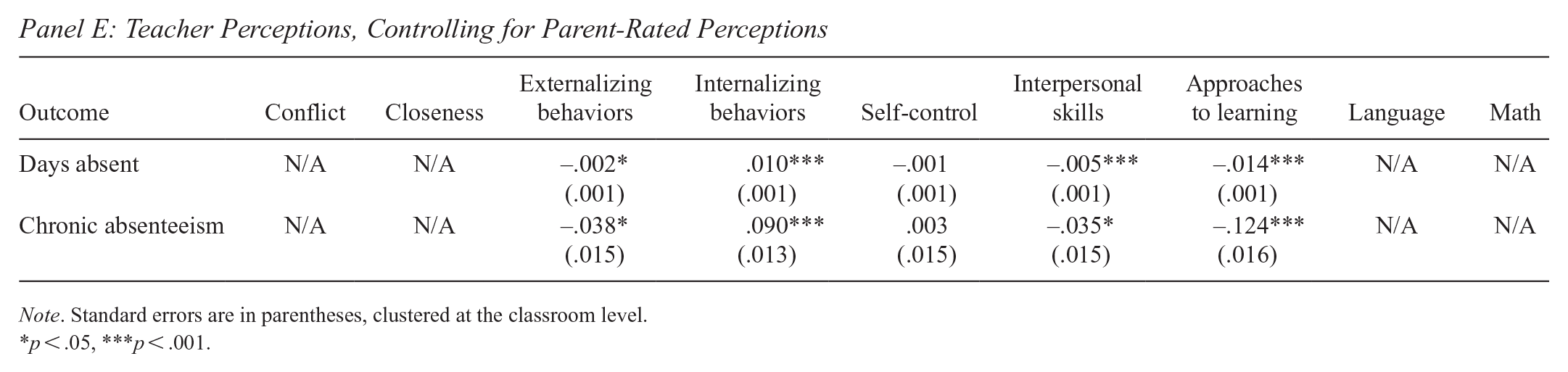
Panel E: Teacher Perceptions, Controlling for Parent-Rated Perceptions
Note. Standard errors are in parentheses, clustered at the classroom level.
p < .05, ***p < .001.
Next, we were concerned that our results may have been biased by students with perfect attendance, who may contrast sharply with chronically absent students. If teachers viewed these groups of students very differently, then we could have overestimated the difference between chronically absent students and all those who are not. In panel B, after removing students with zero absences from the sample, we ran the models again. The statistical significance of our results did not change, while the magnitude of effects changed only slightly, implying that our results were robust to the inclusion of students with perfect attendance.
Our next test was to ensure that a child’s achievement from the previous year was not driving the relationship with their current teacher with regards to academic perceptions. We ran the regressions from Research Question 3 using a one-wave lagged achievement variable to represent a more objective measure of child academic ability, captured in the prior year. In panel C, comparing our original results in the first two columns to the new results in the second two columns, we see that prior year’s achievement did not change current year’s teacher’s academic perceptions of each student.
As a next test of robustness, we included the prior-year outcomes (i.e., teacher’s reported measure) as control variables. This might help to account for student factors from prior years. We recognize there is a subjective element to each teacher, and thus this would not be as direct of a test if the outcomes were more objective, like standardized state test scores. That said, we had the ability to explore this, which we did in panel D of Table 6. The results are robust to including prior-year outcomes as control variables.
As a final test in Table 6, we included parent-reported perceptions of their children in the model as control variables. These only exist for social skills and approaches to learning—parents did not rate children on conflict or closeness or on language and math skills. As shown in panel E, including control measures for parent-rated perceptions did not change the original findings.
Absence Measures
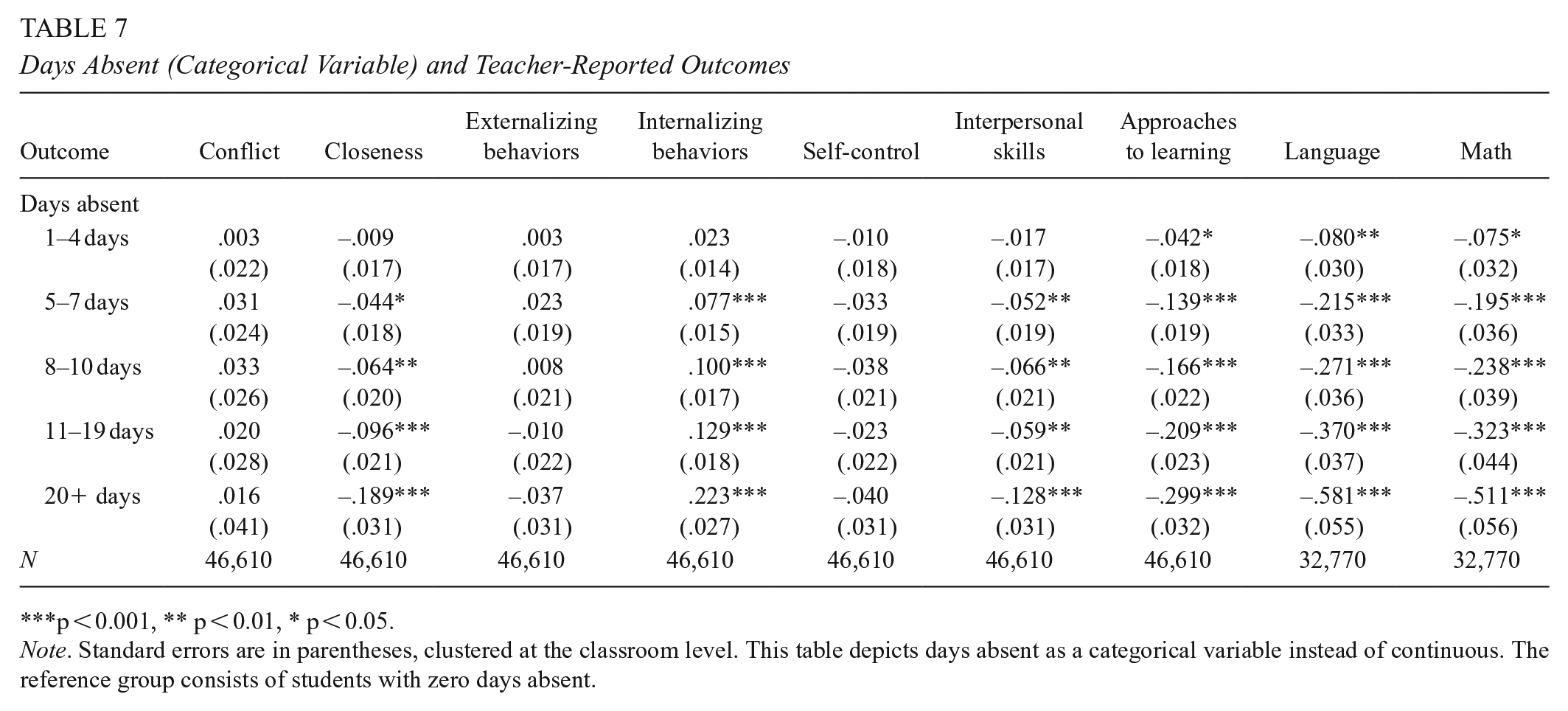
Table 7 explores the measurement of absenteeism in further detail. Recall from the description of how the variables were constructed that we followed the coding of Gottfried (2014), who was the first to develop a days absent measure using the ECLS-K dataset. However, it was based on answer choices, which was then aggregated into a single days absent measure. Here, we broke out those answer choices and examined each separately as it related to teacher perceptions. As shown in Table 7, the results were robust to our original findings in Tables 2 to 4. As before, student absenteeism was linked to lower perceptions of closeness, higher perceptions of internalizing behaviors, lower perceptions of interpersonal skills, and lower perceptions of academic approaches and ability. In fact, this occurred for students who were absent starting with 1 day, as shown in the academic approaches and ability regressions.
Days Absent (Categorical Variable) and Teacher-Reported Outcomes
p < 0.001, ** p < 0.01, * p < 0.05.
Note. Standard errors are in parentheses, clustered at the classroom level. This table depicts days absent as a categorical variable instead of continuous. The reference group consists of students with zero days absent.
Interestingly and as one might surmise, the coefficients were increasingly larger as students missed more days of school, which underscores even weaker perceptions for highly absent students. The effect sizes also grew alongside the increase in the magnitude of the coefficients. For instance, for the closeness regressions, the effect sizes changed from –.03σ with the “5–7 days” coefficient to –.06σ on the “20+ days” coefficient. Growth of effect sizes (and not just magnitude of coefficients) are evident throughout the table. For instance, internalizing effect sizes grew from .06σ to .08σ, interpersonal skills grew from –.03σ to –.04σ, approaches to learning grew from –.03σ to –.08σ, language skills grew from –.04σ to –.11σ, and math skills grew from –.04σ to –.10σ. This later finding for language and math skills underscores a robustness in the analysis, given that these two scales represent similar perceptions of academic ability of students. Overall, however, all of the findings truly underline the importance of how perceptions dramatically grow for the most-absent students.
Group Differences
Finally, we examined interaction effects between absenteeism and student race and ethnicity, as well as disability. Given the absenteeism disparities by race/ethnicity and disability described in the introduction, as well as the fact that teacher perceptions of students can be racially and ethnically biased (McKown & Weinstein, 2008), we wanted to explore the possibility that teacher perceptions were largely being driven by these student characteristics. We found no significant differences by race/ethnicity or by disability when a race, ethnicity, or disability measure was interacted with absenteeism, suggesting that teacher perceptions of the student depended more on students’ absenteeism than their demographics. Given the large number of race and ethnicity and disability interaction regressions, we did not present this table, though it is available upon request.
Discussion
Students clearly need to be present in school. Research unequivocally shows that absenteeism leads to worse outcomes for children across multiple measures (Anderson & Romm, 2020; Easton & Engelhard, 1982; Finning et al., 2019; Gershenson et al., 2017; Gottfried, 2009, 2010, 2014; Gottfried & Kirksey, 2017; Moonie et al., 2008; Roby, 2004). Moreover, these impacts are felt as early as kindergarten (Gottfried, 2014). Research also indicates that teacher perceptions and expectations matter for child success, namely, that positive perceptions predict stronger outcomes for students, and negative perceptions correlate with lower outcomes (Hughes et al., 2006; Kenyatta, 2012; Moorman & Wicks-Smith, 2012; Soumah & Hoover, 2016). These two issues—absenteeism and teacher perceptions—have been siloed, and all dynamics between teacher and student prior to this study have been assumptions. Our study contributed new insights by examining whether teachers held different perceptions for more frequently absent students.
Our study found that teacher perceptions did, in fact, differ for students who were more absent. Specifically, teachers reported feeling less close with highly absent students. They also viewed absent students as exhibiting more internalizing behaviors and displaying fewer interpersonal skills. Finally, when it came to academics, teachers perceived absent students as displaying fewer positive learning behaviors as well as having lower proficiency in literacy and math. Note that teachers did not report having more conflict with absent students; nor did teachers perceive absent students as having more externalizing behaviors.
Our findings have several important implications. While we know that missing school has an adverse effect on student outcomes, our findings demonstrate that the classroom context continues to be different for absent students, as actualized in this study as different teacher perceptions. As a first implication, our work provides insight that there is a classroom ecosystem when it comes to exploring absenteeism—namely, the outcomes resultant from missing school are not restricted to the individual engaging in this behavior. Rather, student absenteeism is linked to differences in teachers’ perceptions, ranging from weaker relationships to lower perceived social skills and academic ability. In other words, the dynamics of how the classroom functions are different when students are absent. Prior research suggested that these dynamics were different between absent students and their classroom peers. Our work provides further evidence by now examining absent students and their teachers. When we do not take a rich perspective of the classroom context into account, our understanding of the influence of absenteeism remains partial at best.
A second and related implication around measuring and understanding absenteeism arises when we consider an indirect correlation between absenteeism and student success. Namely, from this study, there appears to be evidence that absenteeism puts students at a double disadvantage in school. As mentioned, absent students harm their own outcomes directly by missing opportunities to learn when present in school (Gottfried & Kirksey, 2017). But here, our work provides suggestive evidence that absent students may ultimately be hurt in schooling through absenteeism’s correlation with lowered teacher perceptions. That is, absent students have teachers who view them less positively, and our introduction laid out how teacher perceptions can ultimately have a link to children’s growth and development in school. Hence, while absenteeism is associated with weaker individual outcomes, our results also indicate that lower teacher perceptions might be associated with lower student outcomes, once again.
Taken together, these first two implications can motivate practice and our thinking around supporting absent students. Namely, this study highlights that absenteeism is both an individual and a classroom issue and, when considering the latter, not simply between student and classmate but also between student and teacher. Hence, our study would urge reconsideration of how absenteeism is not only understood but also addressed in schools. Put another way, supports for child absenteeism should be provided to the child and also to teachers. As one example, we might engage teachers in professional development to self-reflect about how they form perceptions about students. Given that perceptions are ultimately subjective, it may be useful for teachers to receive bias training specifically around how they may be (unintentionally) changing perceptions for students who miss school. This could be an immensely important practice when taking into account that there are also demographic disparities in who is absent, such as by race and ethnicity (McNeely et al., 2021), or by other family dynamics and neighborhood conditions (Childs & Lofton, 2021). That is, if teachers have lower perceptions for absent students, and absent students tend to be more likely to be from an underrepresented racial minority group, then teachers might be adjusting perceptions in a systematic way by race and ethnicity, as it is tied in with absenteeism. In this case, we suggest that there might be an opportunity for teachers to learn best practices about how they perceive absent students, when to identify bias in these perceptions, and what resources they need from schools to best support them and their students.
Another implication of our study pertains to the student-teacher relationship, namely, the findings from our first research question. While teachers reported feeling less close to students who were more frequently absent, the link with perceived conflict was nonexistent in our findings. Likewise, teachers viewed these students as displaying more internalizing behaviors (e.g., being withdrawn) but not externalizing behaviors (e.g., acting out). Together, these findings suggest that absenteeism is associated with perceived withdrawal and loss of closeness. In other words, student absenteeism is associated with a cooling down in the temperature of the student-teacher relationship. The fact that our findings suggest this cooling down rather than a rise in perceived aggressive behaviors can help provide motivation for considering effective teaching practices for frequently absent students. For instance, our study might suggest implementing classroom community-building strategies to foster closeness, rather than teaching strategies for managing challenging (mis)behavior. This recommendation is timely given the growing research and data finding an increasing number of young children (Lima et al., 2013) and teachers (Miller, 2022) are facing socioemotional and connection-making challenges, such as declines in mental health in the wake of COVID-19 (Santibañez & Guarino, 2021), which could also be impacting student outcomes (Klein et al., 2022). As such, our work suggests that there may be early educational opportunities for teachers to engage in mental health practices that leverage closeness in the classroom and focus on engagement and community building rather than behavior modification.
As a final implication, our results were significant even after controlling for how teachers reported a child’s parents’ involvement in school. Put differently, teachers appeared to have less positive views of absent students regardless of their views on how active the parents were at school. However, research has consistently found parent involvement to be a vital component to improving student attendance (Epstein & Sheldon, 2002; Sheldon, 2007; Sheldon & Epstein, 2004). As such, these findings illuminate how absenteeism is not simply a family matter, and we cannot put the impetus only on parents and families to address absenteeism and mitigate its negative effects (Gottfried & Hutt, 2019). Certainly, young children rely on their parents and relatives to get them to school, and thus parents are critical when considering their role in mitigating absenteeism and supporting absent students (Gottfried & Hutt, 2019). However, our results reveal a much more complex understanding of the way that absenteeism plays out, including parents but also teachers and their perceptions. Thus, while acknowledging the complexity of parent involvement and the impact it may have on student absenteeism, teachers can also receive development, supports, and resources to best connect with parents as a means for improving student attendance (Cankar et al., 2012; Hamlin, 2021). While it is beyond the scope of our study to identify specific ways that teacher development can better connect with parents, we would urge professional development practices to be designed in a way to best understand family circumstances (Childs & Loftin, 2021).
Limitations
Our study has contributed new insights about teacher-student dynamics with regard to absenteeism, though there are several limitations. First were several data limitations with regard to teacher observations. For instance, our study only observed teachers once in the dataset, meaning that we could not observe teachers with different classes in different school years. We also only had one teacher assessment per child each year for the set of outcomes (i.e., spring)—ideally, we would have also had fall assessments from each teacher on each outcome in each year. Additionally, we could not observe if a student had the same teacher in different school years. If this were possible, we could examine students over time, their varying absence patterns, growth during a single year, and teacher perceptions.
Alternatively, this study could be replicated on a dataset of high school students, where teachers would have different classrooms throughout the same day. The data requirements for this, however, would be large, as this would require perceptions about multiple students throughout the day. Thus, our work remains descriptive, and while that is not a limitation outright, it does limit the scope of our conclusions. More causal work could certainly contribute to an understanding of the role of absenteeism in teacher perceptions.
Second, while we examined teacher perceptions of absent students, there were not any measures of teachers’ responses to their own perceptions. Namely, there was not information on how perceptions shape their teaching practices, particularly around absenteeism. For instance, teachers were not asked to provide any detail on what types of supports and resources they provided to absent students or whether they engaged parents. All of these questions would be fruitful avenues of further study, perhaps supplementing this current study with qualitative work.
Next, while all of the outcomes in our study represented teacher perceptions, this does not necessarily mean that they were biased. For example, teacher perceptions of the academic abilities of absent students may represent accurate observations. In contrast, determining the nature of the student-teacher relationship will always be an exercise in subjectivity and self-report. Yet here, too, the teacher’s view on her relationship with an absent student may align with the student’s own perspective. While our study cannot parse out these particular nuances, it provides an initial look at the patterns of teacher perceptions on absent students. Future research can examine the alignment between subjective measures and more objective ones.
Another limitation of our study is the timing of measurements. Teacher ratings of outcomes took place in the spring of each school year, thereby representing their perceptions of students at that time. Absenteeism was also measured in the spring as the number of days absent up to that point. However, the dataset does not provide information on when those absences took place. If most of the student’s absences occurred during the spring (or leading up to the spring), they may have happened too late to have made much of an impression on the teacher’s perceptions, or they may have missed the data collection period altogether. We also cannot be certain that a teacher did not form fixed opinions of an already-absent student early on in the school year.
Finally, we know that the COVID-19 pandemic has changed the ways we think about education, including issues of absenteeism. However, we know less about how teacher perceptions of absenteeism have changed. Perhaps teachers have become more understanding of children who miss school. On the other hand, teachers may also have different expectations of attendance when school is in person versus online. Further research should examine this critical area of inquiry.
Footnotes
Declaration of Conflicting Interests
The author(s) declared no potential conflicts of interest with respect to the research, authorship, and/or publication of this article.
Funding
The author(s) received no financial support for the research, authorship, and/or publication of this article.

Authors
MICHAEL GOTTFRIED is a professor in the Graduate School of Education at the University of Pennsylvania, 3700 Walnut Street, Philadelphia, PA 19104; e-mail:
PHIL KIM is a PhD student in the Graduate School of Education at the University of Pennsylvania. 3700 Walnut Street, Philadelphia, PA 19104; e-mail:
TINA L. FLETCHER is a senior program officer at the Walton Family Foundation. She earned her PhD in education policy at the Graduate School of Education at the University of Pennsylvania.