




Abstract
Research and policy have focused predominantly on the individual consequences for students who miss school. Yet absenteeism does not occur in a vacuum, and less work has focused on how student absenteeism correlates to classroom dynamics. Practically no attention has been paid toward teachers. We propose in this study that student absences make it challenging for teachers to enjoy the very function of their jobs and thus experience more dissatisfaction at work as a result. We find that teachers have lower job satisfaction when more of their students are absent. However, we find statistically significant differences only for broad aspects of teacher satisfaction—job enjoyment, usefulness, and belief in the profession—rather than differences among other related measures of teaching.
Of all elementary school years, it is during kindergarten where children are missing the most school—absenteeism rates that are not surpassed until early adolescence (Balfanz & Byrnes, 2012; Bauer et al., 2018). Research has established that absenteeism in kindergarten leads to lower academic and behavioral performance (Chang & Romero, 2008; Gottfried, 2014), leading to long-term declines in school success. For instance, highly absent kindergartners are less likely to meet state proficiency standards in third grade (Applied Survey Research, 2011; Ehrlich et al., 2018) and are more likely to be retained (Connolly & Olson, 2012). Clearly, children who miss school in kindergarten not only do less well in that year but also potentially dampen future outcomes.
Although the individual student-level consequences of absenteeism have been well documented, less attention has been paid to how students’ absences might also change classroom dynamics. It does seem likely that absenteeism permeates the ecology of the classroom and hence merits continued investigation. Namely, when students miss school, the instructional pace is disrupted (Bonesrønning, 2008; Gottfried, 2011; Lazear, 2001). This disruption not only compromises the academic progress of the absentee but also necessitates subsequent remediation efforts that may divert instructional resources from the collective educational goals of the entire class (Gottfried, 2011).
In this way, absences can affect both teachers and classmates. Although some research has examined the effects of students’ absences on other classmates, little attention has been paid to how student absenteeism affects teachers. The decline in classroom quality resultant from a student missing school certainly affects other children who become disengaged (Gottfried, 2011, 2014). Accordingly, we speculate that student absenteeism could also relate to teachers, potentially in a similar manner. With regards to student absenteeism, we focused directly on teachers by looking at how absent students might link to teachers’ feelings of job satisfaction. We asked the following research questions:
Research Question 1: Do teachers with more absent students feel more dissatisfied with their jobs?
Research Question 2: Do these associations exist for other correlates of job satisfaction?
Research Question 3: Do the findings vary for novice versus experienced teachers?
The classroom is inherently a group structure, and any degradation to this setting might reduce the satisfaction for all. This lower satisfaction emerges as disengagement for other children (Gottfried, 2011), and we hypothesize here that lower satisfaction emerges for teachers as feeling worse about their jobs. The lack of good student attendance has the potential to decrease collaborative synergy, diminishing the richness of interactions and instruction. In other words, student absenteeism might contribute to a potentially suboptimal classroom environment—and more bluntly, working conditions for the teacher. Yet we know little about these dynamics.
Additionally, a focus on job satisfaction is a necessary yet overlooked component of the teaching profession. A lack of teacher job satisfaction creates numerous challenges for schools. For instance, teachers experiencing dissatisfaction are prone to diminished morale and burnout (Skaalvik & Skaalvik, 2011). This, in turn, compromises the quality of instruction (Klusmann et al., 2008; Kunter et al., 2013). Furthermore, teacher job dissatisfaction changes school culture, affecting professional relationships, collaboration, and overall organizational cohesion (Ingersoll, 2001; Smith & Ingersoll, 2004). High levels of teacher dissatisfaction are also associated with increased turnover rates, exacerbating instability (Blömeke et al., 2017; Klassen & Chiu, 2011). Consequently, teacher job dissatisfaction constitutes not merely an individual concern but a systemic challenge with far-reaching implications for the holistic functioning of schools.
In exploring teacher satisfaction, it is important to acknowledge that there is a lack of a unanimously supported measure of teacher satisfaction (Skaalvik & Skaalvik, 2009). Thus, although the literature conceptually agrees that job satisfaction is defined as positive or negative assessments about the quality of their work or employment experience (Locke, 1976; Weiss, 2002), how to quantify this is less well understood. To this end, we contribute to the field by examining other dimensions of the teacher’s job that may correlate with satisfaction, laid out in our framing in the following. In doing so, we can provide a more comprehensive understanding of the ways in which student absenteeism may correlate with teachers’ experiences on the job.
Finally, our third research question explores variation by teacher experience. New teachers, grappling with the challenges of acclimating to the profession, may experience heightened dissatisfaction given the challenges of novice teaching (Nguyen & Kremer, 2022). In contrast, experienced teachers, although resilient in managing classroom dynamics, are integral to institutional stability. Job dissatisfaction among seasoned educators may erode institutional knowledge, disrupt mentorship structures, and contribute to a decline in overall instructional quality. Consequently, although both new and older teachers’ dissatisfaction poses challenges, the nuanced implications underscore the necessity for targeted strategies addressing the unique needs of teachers at different career stages.
How Student Absenteeism Changes Classroom Dynamics
Little attention has been paid to how student absenteeism might affect the classroom setting. What has been established in this area has been links between student and classmates. Namely, individual student absenteeism is associated with lower outcomes for their classmates. In elementary school, when students are absent, their classmates have lower test scores (Gottfried, 2011). In addition, absent students have classmates who are more likely to be absent (Gottfried, 2019) and lower levels of measured executive function (Gottfried & Ansari, 2022).
One explanation for these consistent negative findings is that the classroom is not a silo of individual students, and thus neither is absenteeism. Rather, the classroom (and learning) experience truly is collective, particularly in elementary school, where students are in the same physical room throughout the day and year. Thus, given that absent students require remediation and are often disengaged upon return (Gottfried, 2014), the feeling of collectiveness of the classroom is compromised among other students. Namely, the shared environment is disrupted—and more so as more students are absent—and this diminishes the overall quality of the classroom in two ways: as (a) slowed pace of instruction and (b) increased disengagement (Gottfried, 2011). In other words, absenteeism among children not only impacts the individual learner but also permeates the ecology of the classroom, instigating disruptions in instruction and diminishing dynamics. This analysis underscores the importance of a comprehensive understanding of absenteeism’s ripple effects.
Student Absenteeism and Teacher Job Satisfaction
This is the first study to examine the link between student absenteeism and teacher job satisfaction. Although we hypothesize that teachers will feel less job satisfaction when they have students with more absences, the literature has not discussed specifically why this might be the case. Therefore, we outline four potential ways that student absenteeism might be linked to teacher job satisfaction.
First, based on a survey of K–12 teachers in Australia, teachers reported feeling satisfied with their jobs when they were instructing students, working with students, and seeing educational growth (Dinham & Scott, 1998). Consequently, student absenteeism runs counter to this. For instance, absenteeism can create pedagogical challenges that make teachers feel less satisfied with their job. That is, when students miss time from school and then return, this may cause a disruption in the classroom. It is theorized that peer disruptions interrupt the normal flow of instructional activities (Bonesrønning, 2008; Lazear, 2001). In terms of absenteeism, when absent students return to the classroom, it is theorized that they often require remediation (Connell et al., 1994; Finn, 1993; Monk & Ibrahim, 1984). This requires teachers to slow the pace of regular instruction to catch up absent students. In addition, this causes other, nonabsent students to feel disengaged from instructional material. This could diminish job satisfaction in two ways. First, teachers may feel less satisfied if they have to repeatedly reteach material to students who were absent. This can be time-consuming and may lead to dissatisfaction, and with these slowdowns, teachers may feel that they are not able to cover the planned curriculum effectively. Second, if repeating material causes other students to be disengaged, this might create an even more taxing instructional setting because of also having to address the educational disengagement of nonabsent students.
A second potential mechanism that might link student absenteeism and teacher job satisfaction is a disjointed classroom setting. This might arise for three reasons. First, as mentioned previously, surveyed teachers found satisfaction in interacting and engaging with students (Dinham & Scott, 1998). When students are absent, these opportunities for interaction are limited, potentially diminishing the overall satisfaction of teaching. That said, it must be acknowledged that it is possible that satisfaction might be enhanced when teachers have limited interactions with some students with whom they do not connect or may cause classroom disruptions. Second, a lively and engaged classroom can contribute to a positive teaching experience. When students are frequently absent, the classroom atmosphere may become less vibrant, and teachers might miss the energy and enthusiasm that come from a fully attended class. Third, empirical research has suggested that absent kindergarten students often return to school disengaged (Gottfried, 2014), and this may lead to behavioral issues. In turn, if more students are absent, teachers might be spending more time on discipline rather than focusing on instruction, and in a national data set of elementary and secondary teachers, time spent on discipline has been empirically linked to reduced job satisfaction (Ingersoll, 2001).
A third potential mechanism that might link student absenteeism and teacher job satisfaction is emotional stress and exhaustion, as shown empirically in a sample of Norwegian elementary and middle school teachers in Skaalvik and Skaalvik (2014). It goes without saying that teachers are invested in the success of their students. When students are absent, teachers may worry about their academic progress and whether they are keeping up with classroom material. This concern for the well-being and success of students can contribute to job satisfaction, and frequent absences may exacerbate stress felt about the job itself. Teachers may perceive themselves as less effective if a significant number of students are frequently absent. Empirical research of elementary and middle school teachers in both Norway and Sweden suggests that this perception can influence their confidence, sense of self-efficacy, and satisfaction with their teaching abilities (Skaalvik & Skaalvik, 2014; Toropova et al., 2021). Relatedly, teachers might experience feelings of frustration or loss of control. That is, teachers may feel frustrated if they believe that factors that are often outside of their control, such as student absenteeism, are impeding their ability to create an optimal learning environment. This latter point may be particularly true in this study in which children are in elementary school, and thus, parents have significant agency in getting children to school, as shown empirically in Robinson et al. (2018).
Finally, teachers might feel dissatisfied with their jobs because of having more absenteeism in the classroom due to the pressures felt by policy and accountability. Because there is increasing empirical national evidence that more states hold schools accountable for absenteeism (Jordan & Miller, 2017), the responsibility, conceptually, might fall on teachers to address this issue (Gottfried, 2019). Therefore, when students are more frequently absent, teachers may be concerned about how absences might increase pressure at the job. This might be reflective of how No Child Left Behind affected teachers’ sense of anxiety at work given a focus on testing accountability. In this instance, more absences may increase teachers’ sense of a high-stakes job and fear of consequences.
We have conceptualized this framework as one that links student absences directly to a measure of teacher satisfaction. However, as guided by our second research question, we acknowledge that there are other ways to capture teachers’ attitudes about teaching and school. Therefore, we acknowledge that absenteeism might also be linked to other measures of how teachers perceive the workplace, and fortunately, in the data set we employ, there are multiple measures. For instance, teachers might feel differently about their teaching practices (Gottfried & Ansari, 2019) or about children in their classrooms if they have to spend more time on behavior remediation, as described previously. Or it may be possible that teachers feel differently about their schools’ culture and climate depending on the extent of absenteeism and the supports they may or may not receive from the school administrators. Although we hypothesize that that the most direct link will be to teacher satisfaction, we do examine other areas of how teachers perceive their work and workplace.
Method
Data Source
Our study relied on data from the 2010–2011 Early Childhood Longitudinal Study–Kindergarten Class (ECLS-K:2011). The National Center for Education Statistics (NCES) at the U.S. Department of Education used a three-stage stratified sampling design to create a nationally representative sample of kindergarten students and their schools, including public and private schools that had kindergartens (i.e., children were in school, not early care centers). The first round of data collection was in fall and spring of the 2010–2011 school year and continued once annually in the spring through fifth grade. ECLS-K:2011 collected a wide range of data on children and their families, teachers, administrators, and schools.
This study focused on teacher responses on the fall and spring surveys, when students were in kindergarten, and hence the conclusions to our study are germane to kindergarten teachers, and we do not expect our findings to be generalized to teachers in older grades, where teaching experiences may differ. The baseline year was the only time teachers were asked questions on their background and their views on school readiness, school climate, and school environment. Importantly, they were asked some questions in both survey rounds. Our final sample included teachers who were surveyed in both rounds of the baseline year. In total, there were 2,370 kindergarten teachers in our sample.
Some variables in ECLS-K:2011 contained missing values based on nonresponse to some questions on the survey. We followed conventional approaches for addressing missing data in this sample. We ran chained multiple imputation on all independent variables to impute 20 sets of plausible values in observations with missing data (Royston, 2004). This process has been conducted in the methods of other research dealing with national, longitudinal data sets (Freeman & Kirksey, 2023). As per the reporting rules of NCES, sample sizes have been rounded to the nearest 10. To ensure that our results are nationally representative, we used the appropriate survey weights provided by ECLS-K:2011 in all analyses.
Measures
Outcomes
Our outcome measures come from teacher responses on the teacher questionnaires related to views on school readiness, school climate, and school environment. The teachers in the study completed self-administered hard-copy questions about themselves, students in the study, and their classrooms. Questions on the spring survey included a matrix of questions with a 5-point Likert scale ranging from strongly disagree to strongly agree. In total, there were 26 questions across these two sections of the survey. Additionally, the fall survey asked three general teacher satisfaction questions in the fall that were then repeated on the spring survey. We included these fall questions as a control.
We used both individual responses to survey items and composite indices of responses as our outcome measures. Survey items were grouped into several scales using exploratory factor analysis. Our analysis yielded six distinct factors, found in Appendix 1 (available on the journal website) with accompanying questions from the survey. After reviewing the factors and corresponding questions, we named the factors based on the central theme of questions.
Our factors first and foremost include teachers’ reported job satisfaction, which is our outcome for Research Question 1. For Research Question 2, we included teachers’ perceptions of teaching efficacy, teaching prejudices, school culture/goals, school supports, and school challenges. In more detail, the first factor represents general teacher job satisfaction, such as job enjoyment, feeling like teachers are making a difference, and confidence in teaching as a career path (eigenvalue = 2.11; Cronbach’s α = .77). The second factor characterizes teacher efficacy, describing the extent teachers believe they can help students learn (eigenvalue = 2.57; Cronbach’s α = .72). The third factor looks at teacher prejudices on how they think students learn (eigenvalue = 2.11; Cronbach’s α = .63). We also look at three school-related perceptions that teachers may have of their jobs: school culture/goals (eigenvalue = 2.64; Cronbach’s α = .83), school supports (eigenvalue = 2.17; Cronbach’s α = .71), and school challenges (eigenvalue = 1.65; Cronbach’s α = .52). Although there have been different opinions on the acceptable value of Cronbach’s α, it has been generally recommended to have a starting value of at least .50 with a maximum value of .95 to prevent unnecessary redundancy (Streiner, 2003). All of our Cronbach’s α scores for our factors meet this threshold.
Classroom absenteeism
Our key predictor was the percentage of the class absent on a given day. As part of the kindergarten surveys, teachers were asked to report the average number of absent students per day. Teachers also reported the total number of students in their classroom. Using this information, we calculated the percentage of students who were absent per day. Approximately, 5% of students in our sample were absent on a given day. Note that Gottfried and Ansari (2019) used the same measure of average student absences and found no differences in classroom characteristics with and without absences in the ECLS-K kindergarten year. We replicated this and found our data to be consistent, which is logical given that they are the same measures in the same data set.
Control Variables
Table 1 presents the list of control variables used in this study. These variables include teacher demographics (gender, race/ethnicity, age), teacher background (degree attainment, qualifications, prior subject area coursework), and classroom demographics (student gender, race/ethnicity, special learner status, and classroom performance). All these variables were derived from teacher surveys.
Descriptive Statistics
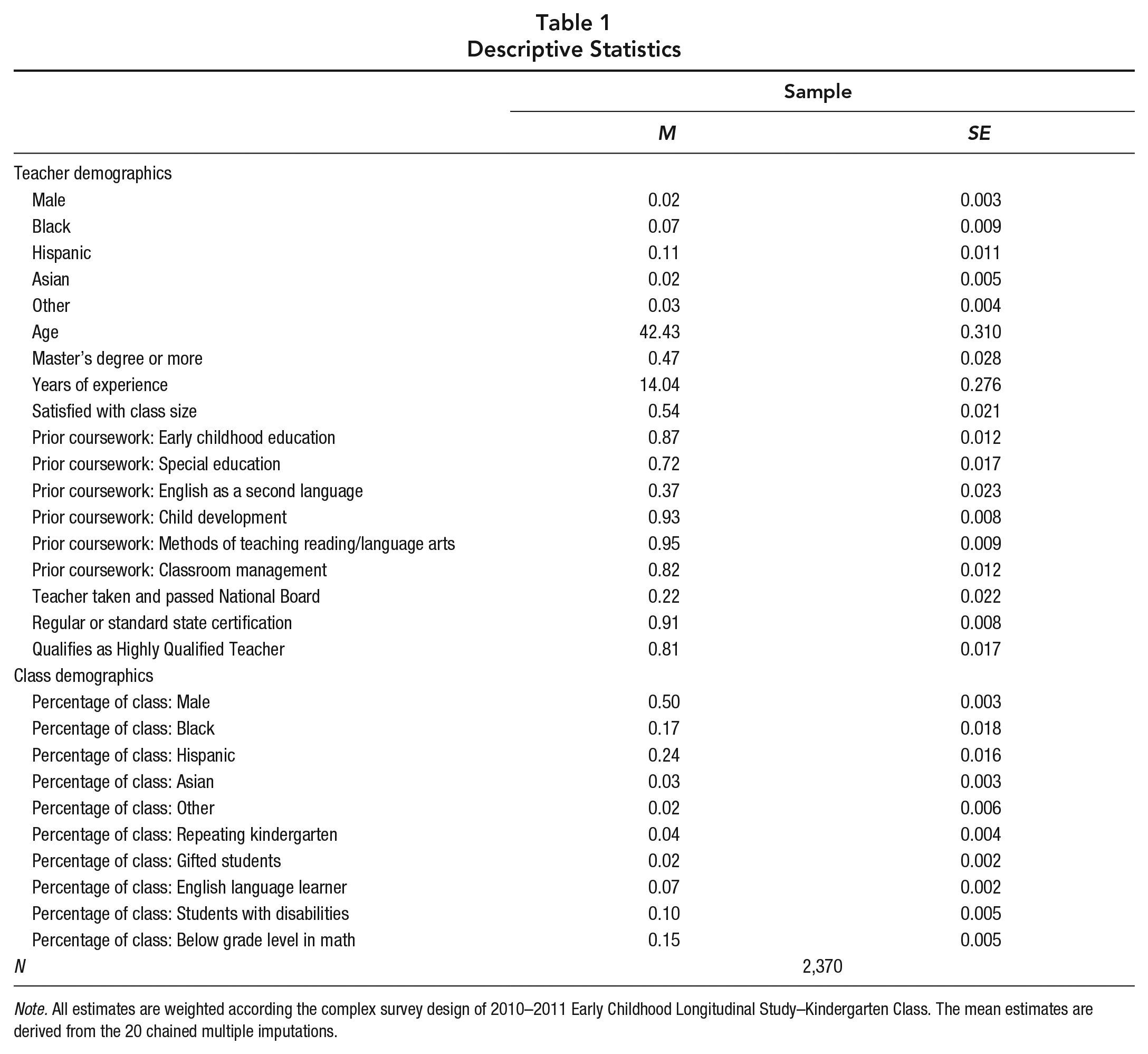
Note. All estimates are weighted according the complex survey design of 2010–2011 Early Childhood Longitudinal Study–Kindergarten Class. The mean estimates are derived from the 20 chained multiple imputations.
Analysis Plan
We used several sets of models to estimate whether classroom absences are associated with teacher work satisfaction. The baseline model was an unadjusted model of regressing teacher satisfaction for teacher/classroom i in school k on our absence measure of the average percentage of students absent in on a given day:

where Y represents one of our teacher satisfaction outcomes measured in the spring and ABS is the average percentage of student absent on a given day. The error is school-level clustered.
From this, we then expanded our equation to include all control variables:

New in this model is T as a vector of teacher characteristics and C as a vector of classroom characteristics. Our model also included a fall measure of the spring outcome.
We then included school fixed effects:

The term dk is a school fixed effect, which is an indicator variable that identifies in which school the teacher had taught. By including school fixed effects, we are able to effect compare satisfaction measures among teachers within the same school. The reason why school fixed effects are important is because absence patterns and general levels of teacher satisfaction vary from school to school (Johnson et al., 2012). Therefore, it would be important to compare teachers’ satisfaction levels across different schools when the school climates may differ. Or it may be the case that teachers who are predisposed to be less satisfied might work at a school that has higher absenteeism rates. Therefore, comparing teachers across schools once again might obscure the association with classroom absenteeism.
Additionally, school-level fixed effects allow us to control for unobservable school characteristics not captured by the survey. By comparing teachers within the same school, we are better able to detect differences among teachers who have theoretically similar types of students and school experiences. It should be noted that any school-level variable would be dropped from the analysis because of this fixed effect. Therefore, all variables are at the classroom or teacher level. Given this analysis plan, the purpose of this study is descriptive in nature, not causal.
Results
Before addressing our first research question, we began by initially predicting our index of teacher satisfaction in the fall on children’s absenteeism for this year. We did so because we wanted to assess whether classroom assignment might be an issue, which would bias our main results. In this model, teacher satisfaction at the start of the school year (i.e., captured in the fall survey) predates children’s absenteeism for that school year. Therefore, there should be no statistical association between fall satisfaction as an outcome and children’s absenteeism for that year (which occurs after the measure of fall satisfaction was surveyed). If there is a link, this would indicate potential omitted variable bias. For instance, at the start of the school year, if principals place teachers that are known to be less satisfied with their jobs with a greater concentration of students who are likely to be absent, then this would bias our main findings because less satisfied teachers and more likely absentees would be placed together before the absences would have occurred.
To test this possibility, we relied on our aforementioned analysis plan and ran three models. As shown in Table 2, the coefficient on our key predictor is negative and statistically significant in the first two models—namely, models where we compared teachers across all schools in the data set. However, these models are naïve because teachers are not assigned to classrooms across schools but within schools. Hence, the importance of school fixed effects comes into play. The coefficient loses significance with the inclusion of school fixed effects—that is, when we only compare teachers in classrooms within the same school, which is the correct way of thinking about how teachers are matched with classes. Not only does this make the most sense logically for how to compare teachers, but this analysis underscores the importance of controlling for school context in our analysis. Another point is that spring absenteeism is being used to predict fall satisfaction. In this way, our results do not demonstrate a concerning pattern of classroom assignment of students to teachers in the same school in kindergarten, which is consistent with prior research using ECLS-K:2011 (Aizer, 2008; Fletcher, 2010; Guarino et al., 2013).
Predicting Fall Teacher Satisfaction
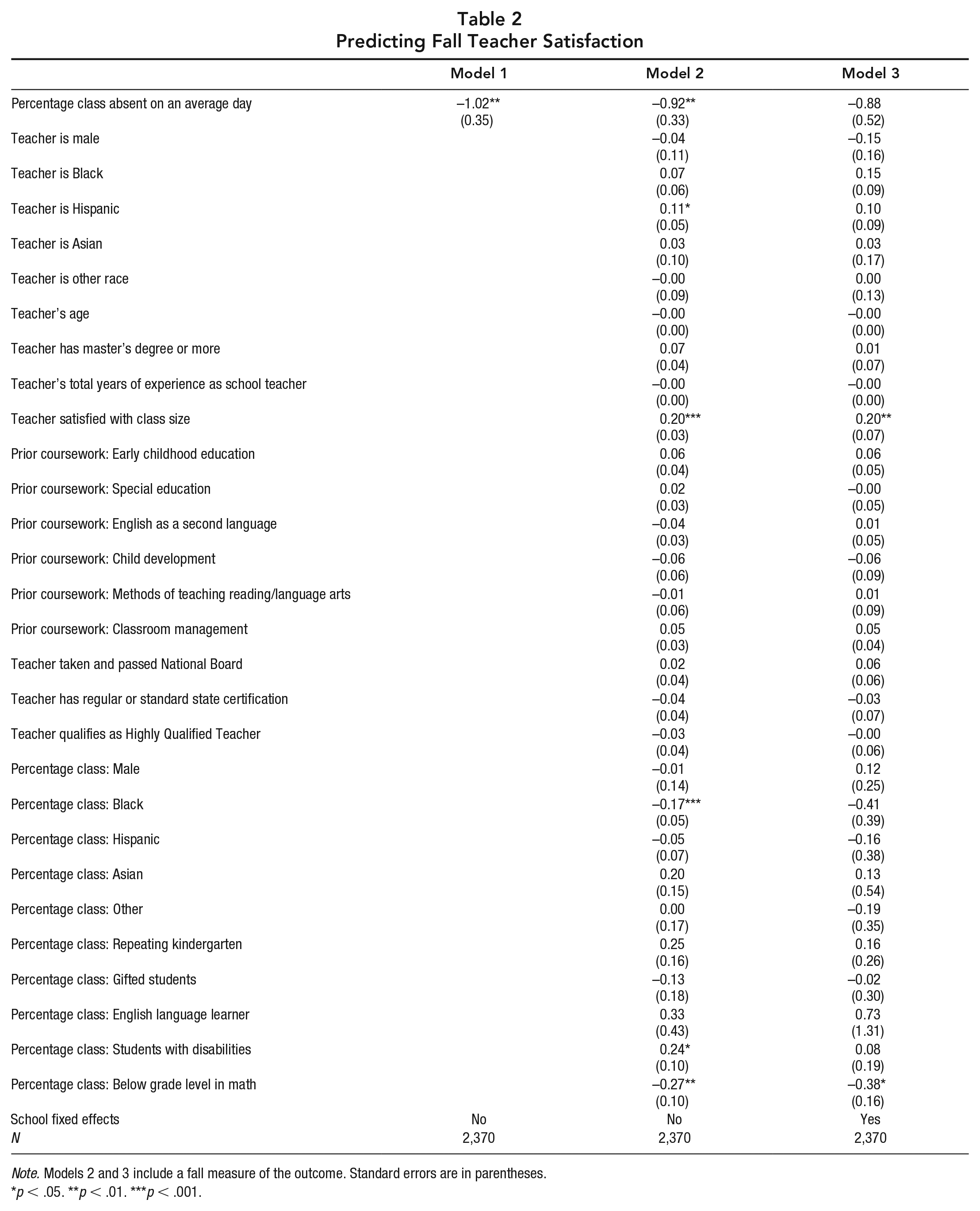
Note. Models 2 and 3 include a fall measure of the outcome. Standard errors are in parentheses.
p < .05. **p < .01. ***p < .001.
Classroom Absenteeism and Teacher Satisfaction
We examined whether average classroom absences predicted teacher satisfaction in the spring, controlling for fall satisfaction. Table 3 presents our results for all three models described in the analysis plan. Across all three models, the coefficient on the percentage of absent students is negative and statistically significant. Namely, as a teacher has a higher classroom average of absent students in the classroom, their level of job satisfaction declines across the year. Importantly, the coefficient nearly doubles in magnitude when including school fixed effects (Model 3), meaning when comparing teachers in the same building, those with more absent students have lower rates of teacher satisfaction all else constant. Note that across our list of covariates, our key predictor was one of very few statistically significant predictors of teacher satisfaction, especially in the school fixed effects model that compared teachers in the same school.
Predicting Spring Teacher Satisfaction
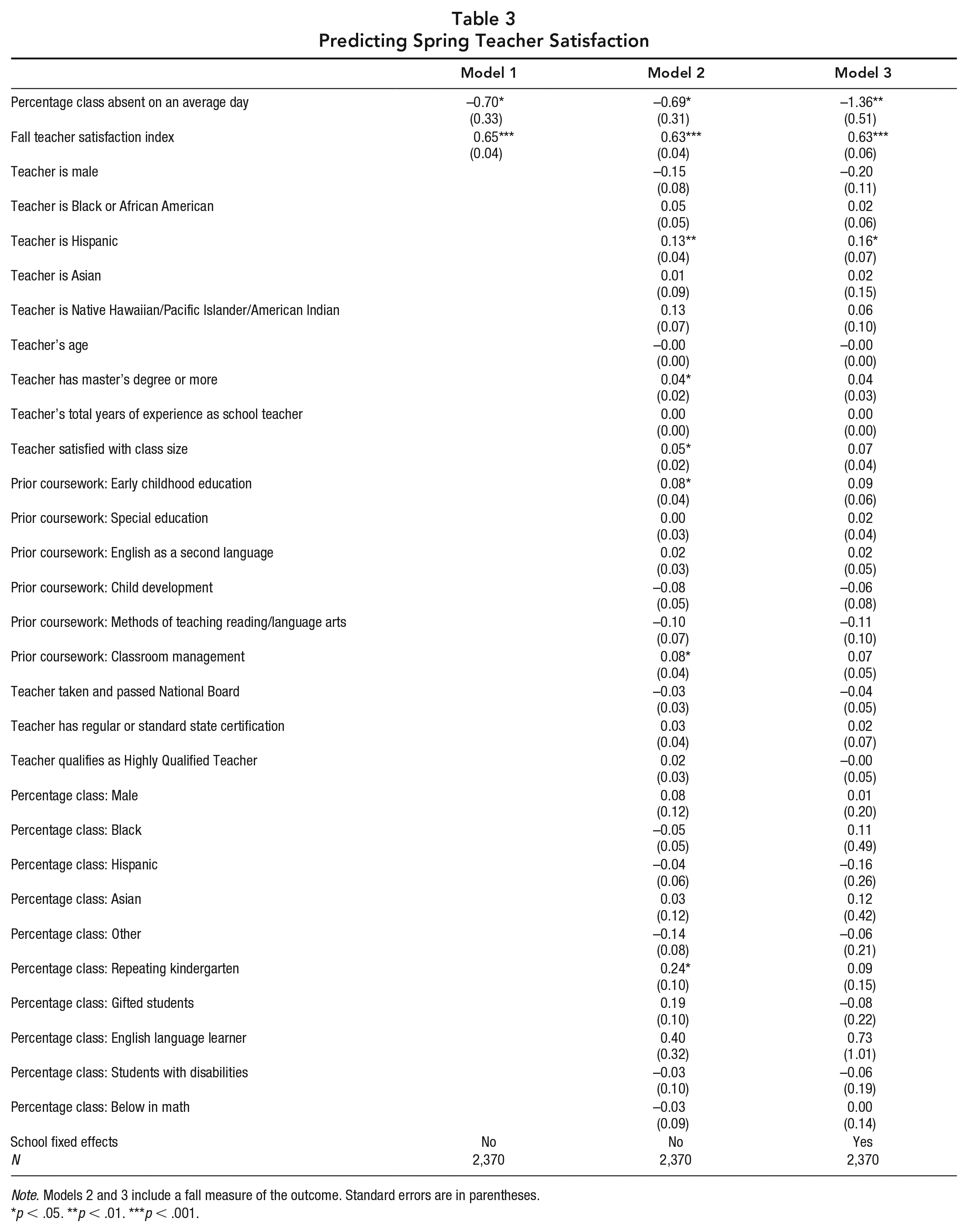
Note. Models 2 and 3 include a fall measure of the outcome. Standard errors are in parentheses.
p < .05. **p < .01. ***p < .001.
Classroom Absenteeism and Related Measures of Teaching
Table 4 presents different ways of measuring a teacher’s experiences on the job. Given the importance of school fixed effects in our first research question, we only present school fixed effects models here. Our first column presents the school fixed effects results from Table 3. The next five columns present alternative job satisfaction measures. The percentage of students absent was not predictive of any of the other five factors.
Alternative Measures of a Teacher’s Job
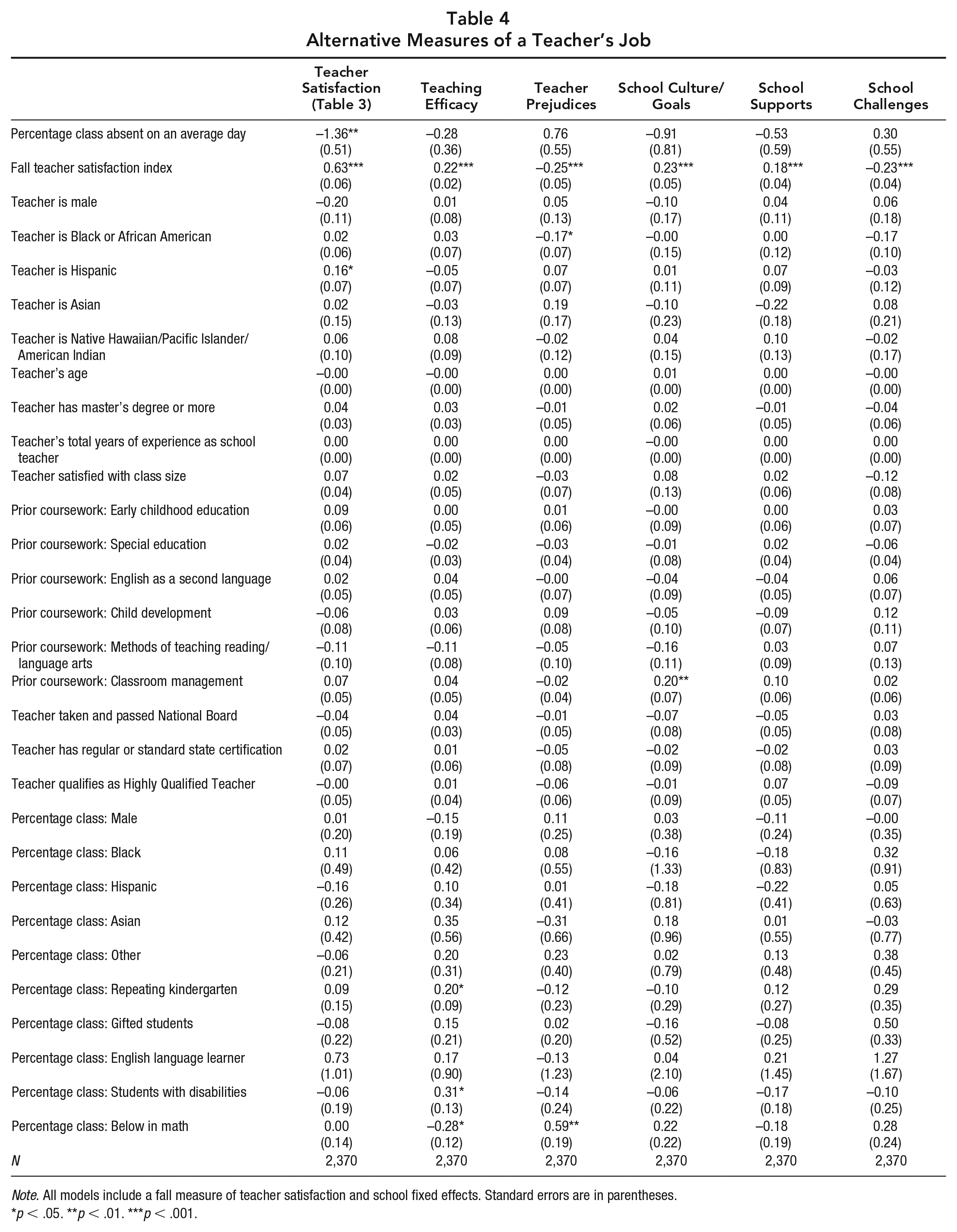
Note. All models include a fall measure of teacher satisfaction and school fixed effects. Standard errors are in parentheses.
p < .05. **p < .01. ***p < .001.
As a further check, we ran our main model with each individual question as the outcome for all 26 questions on the spring survey (see Appendix 1 available on the journal website). Our key predictor was only statistically significant for questions that comprised the teacher satisfaction index. These questions speak to broad aspects of teacher’s satisfaction—job enjoyment and usefulness—rather than other dimensions of teaching. Additionally, this finding underscores the importance of factor analysis in identifying underlying constructs within the data to aggregate similar variables into one composite index.
The Interplay of Teacher Experience, Classroom Absenteeism, and Teacher Satisfaction
Finally, we were interested in the role of teacher experience in the associations between student absenteeism and teacher satisfaction. It is possible that teacher experience and seniority in the school could influence both general teacher satisfaction and student classroom assignment in ways that might bias our estimate. Table 5 presents results using school fixed effects, where we separated teachers by years of teaching experience to compare the regression coefficients across these two groups. The top panel only includes teachers with 5 years or fewer of total teaching experience (approximately 22% of our sample), and the bottom panel includes teachers with more than 5 years of experience (approximately 78%). The bottom two rows of the table display the difference between the coefficients of interest in the two models and the p value of the difference as a test of statistical significance. Although there are some differences between these two groups in terms of direction and magnitude of coefficients, we do not find evidence of a statistically significant difference by teacher years of experience.
Predicting Differences by Years of Experience
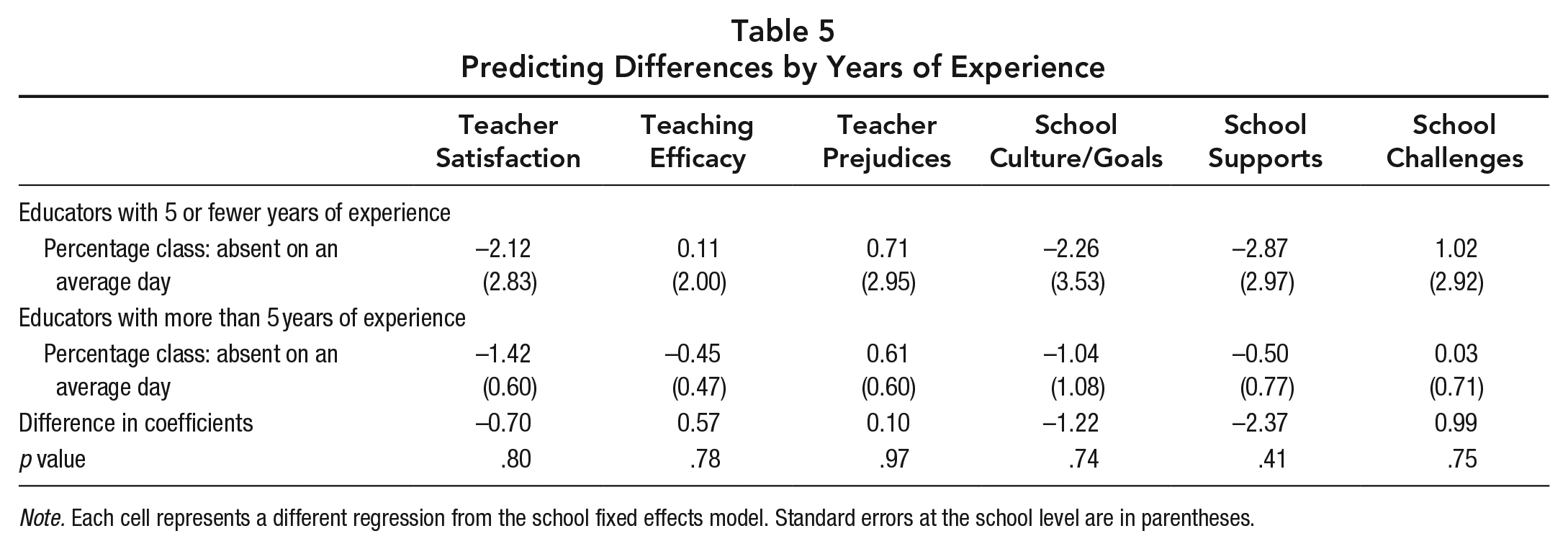
Note. Each cell represents a different regression from the school fixed effects model. Standard errors at the school level are in parentheses.
Discussion
Although there is clear and compelling evidence linking student absenteeism to less optimal achievement and behavior in both the short and long terms (e.g., Chang & Romero, 2008; Connolly & Olson, 2012; Ehrlich et al., 2018), there is less known regarding the extent to which student absenteeism is associated with different aspects of classroom dynamics. In particular, we know very little about how teachers respond to student absenteeism in their classroom and whether student absenteeism correlates with their job satisfaction. To address this gap in knowledge, we used nationally representative data from the ECLS-K:2011 cohort to examine the associations between student absenteeism and the job satisfaction of approximately 2,370 kindergarten teachers. In doing so, several themes emerged that we elaborate on in the following.
To begin, the current investigation builds on the acknowledgment that teachers’ job satisfaction is one of the critical factors that influences their attitudes and classroom practices (e.g., Ingersoll, 2001; Ingersoll & Smith, 2004). Although teachers derive satisfaction from various aspects of their job, including working with students, seeing students’ progress, and collaborating with colleagues (Dinham & Scott, 1998), the profession of teaching brings with it many challenges and stressors. Such stressors affect teachers’ commitment to the profession, with those who express less satisfaction with their jobs displaying less engagement and a greater likelihood of leaving the profession (e.g., Li et al., 2019; Skaalvik & Skaalvik, 2011). It is in this context that the current investigation sheds light on one of these challenges and sources of stress that contributes to teachers’ overall satisfaction with the profession: student absenteeism.
When taken together, the results of this study demonstrate that student absenteeism poses an important challenge for teachers as early as kindergarten, taking a toll on their overall job satisfaction. The findings reported herein underscore the fact that an increase in the number of students who are absent from school not only disrupts student learning (see Chang & Romero, 2008; Connolly & Olson, 2012; Ehrlich et al., 2018; Gottfried, 2019; Gottfried & Ansari, 2019) but also extends our understanding by illustrating how student absenteeism also alters teachers’ experiences. At the same time, however, the results of the current study also demonstrate a clear distinction in the ways in which absenteeism links to classroom dynamics and teachers’ overall experiences. Although student absenteeism results in lower satisfaction among kindergarten teachers, it does not result in differences in their day-to-day practices, biases, assessment of school culture and supports, or perceptions of school challenges. Accordingly, these nuanced findings demonstrate the specificity of how student absenteeism may relate to classroom dynamics.
It is important to note that our findings, although derived from prepandemic data, have important implications for the current educational landscape, which is witnessing record levels of student absenteeism (Dee, 2024) and lower levels of teacher satisfaction (Merrimack College, 2022). More specifically, the links observed in this study indicate that the higher rates of student absenteeism today are potentially contributing to the increased dissatisfaction among teachers. As student absenteeism persists and potentially worsens, it is likely to exacerbate growing teacher shortages by contributing to lower satisfaction among educators (Blömeke et al., 2017; Klassen & Chiu, 2011). Thus, addressing absenteeism is not only critical for improving student outcomes but also for bolstering the workforce that faces a host of postpandemic challenges.
Additionally, even though novice and experienced teachers are known to deal with different types of challenges that pose different types of implications (Nguyen & Kremer, 2022), our results reveal that the outcomes are more similar than different. Put differently, both novice and experienced teachers who grapple with regular student absenteeism demonstrate lower job satisfaction across the school year relative to novice and experienced teachers who have fewer absent students. Despite the distinct experiences, student absenteeism emerges as a common challenge that has similar implications for the job satisfaction of both groups of educators. Thus, our study findings demonstrate a need for a more holistic approach, as opposed to more targeted and focused strategies, to address student absenteeism. Such an approach has the potential to yield a broad positive impact across teachers of all experience levels, contributing to a more satisfied and engaged workforce. For example, investing in professional development programs focused on strengthening relationships with students and families, implementing trauma-informed teaching, and supporting the diverse needs of students, including those at risk of absenteeism, could prove beneficial. Initiatives that improve working conditions for teachers, such as reducing administrative burden and increasing staffing support to better address absenteeism-related challenges, can also empower more regular school attendance and, in turn, improve teacher satisfaction. And given that barriers to attendance often extend beyond school doors, it is also critical to strengthen connections between schools, families, and community organizations.
Although our study represents the first attempt to unpack the links between student absenteeism and teachers’ job satisfaction, the results reported herein need to be interpreted considering several limitations. First, although teachers reported on the number of absent students in their classrooms on a typical day, they did not report whether the same students were consistently absent or the reasons for their absence. This is of note because it has potential ramifications for the ways in which classroom absenteeism links to teachers’ job satisfaction. For example, the assessment and remediation practices used by teachers for consistent school absenteeism among the same group of students are likely to differ from those applied when addressing school absenteeism among different groups of students. Second, although we proposed several potential mechanisms to elucidate the associations between student absenteeism and teacher job satisfaction, the ECLS-K:2011 did not measure these possibilities. Accordingly, continued consideration of these mechanisms is necessary to help better understand why student absenteeism is ultimately associated with lower job satisfaction among teachers. Doing so would also present important insight into new potential targets for intervention and prevention.
Lastly, although our study offers a national snapshot of the associations between classroom absenteeism and kindergarten teachers’ reports of job satisfaction across the school year, our results are not causal. That said, our results do suggest that classroom absenteeism is predictive of teacher satisfaction and not the reverse (i.e., teachers who are predisposed to be less satisfied do not work at schools that have more absenteeism). Additionally, our results remained consistent after adjusting for a broad set of covariates and school fixed effects, indicating that our findings are robust across different model specifications. At the same time, however, replication with different methods and samples are necessary to generate more definitive conclusions regarding the links between absenteeism and teachers’ job satisfaction.
With these limitations and future directions in mind, the results of the current investigation extend our knowledge regarding the outcomes of student absenteeism (e.g., Chang & Romero, 2008; Connolly & Olson, 2012) by offering some of the first insight into the links between student absenteeism and teachers’ job satisfaction. In the main, our results make clear that teachers experience lower job satisfaction when there is a higher number of kindergartners absent in their classroom. Importantly, these associations are unique to teacher job satisfaction and do not extend to other dimensions of teaching and teacher experience, and our results remain consistent across both novice and more experienced teachers.
Supplemental Material
sj-pdf-1-edr-10.3102_0013189X241292331 – Supplemental material for Do Teachers With Absent Students Feel Less Job Satisfaction?
Supplemental material, sj-pdf-1-edr-10.3102_0013189X241292331 for Do Teachers With Absent Students Feel Less Job Satisfaction? by Michael A. Gottfried, Arya Ansari and S. Colby Woods in Educational Researcher
Footnotes

Authors
References
Supplementary Material
Please find the following supplemental material available below.
For Open Access articles published under a Creative Commons License, all supplemental material carries the same license as the article it is associated with.
For non-Open Access articles published, all supplemental material carries a non-exclusive license, and permission requests for re-use of supplemental material or any part of supplemental material shall be sent directly to the copyright owner as specified in the copyright notice associated with the article.
