




Abstract
Troubled by the inequities in competitive grantmaking, we use critical quantitative methods to analyze the FY2023 federal academic earmarks as a potential mechanism for racialized change work. Specifically, we ask: To what extent does Congress distribute academic earmarks in ways that reinforce or weaken the racialized stratification of resources across organizations in the field? Accordingly, we identify distribution patterns of academic earmarks, considering the allocation of dollars and types of earmarks (i.e., general capacity-building versus specialized grants) across colleges and universities, between White-serving institutions and minority-serving institutions (MSIs), and among MSIs. Based on our analysis, Congress favored a racially reproductive funding portfolio, driven by smaller and more restrictive allocations, not fewer earmarks. However, the distribution of earmarks among MSIs defied normed expectations, as Congress did not privilege whiter, more prestigious MSIs, signaling the potential of pork-barrel politics for racially reparative work.
Keywords
Recent scholarship has implicated competitive federal grantmaking (e.g., the National Science Foundation [NSF] and National Institutes of Health grants) as one mechanism underlying the reproduction of racialized organizational hierarchies (Bol et al., 2018; Chen et al., 2022; McCambly & Colyvas, 2022; Taffe & Gilpin, 2021). In particular, federal funds are stratified via organizational routines and criteria that disadvantage minoritized scholars and institutions’ access to resources—a hallmark of racialized organizations (Ray, 2019). As a result, funders routinely favor well-resourced, historically white-serving institutions 1 (WSIs) within the competitive grantscape, and minority-serving institutions (MSIs) perpetually receive the least grant funding over time. Moreover, when MSIs secure funding, the resources are often less generous and more restrictive in scope and carry greater administrative burdens (Dorsey, Bradach, & Kim, 2020; McCambly & Colyvas, 2023; McCambly et al., 2022; Ray et al., 2023). The scholarship spotlighting these inequities, however, has focused on competitive grantmaking. We extend this work by considering noncompetitive grantmaking, specifically congressional earmarks to colleges and universities (commonly referred to as academic earmarks) and their place in the (de)legitimatization of racialized inequity in higher education.
Specifically, we argue that academic earmarks could be leveraged to bolster MSIs’ infrastructure, including their grant-seeking and grant-management capacity, and overall research enterprise, which could lessen the accumulated effects of long-term public divestment and chronic underfunding via competitive mechanisms that favor WSIs—a form of axiological redlining or the inequitable delivery of public policy benefits based on racialized norms of institutional worth and worthiness. To this end, we take up federal earmarks as a potential mechanism for racialized change work (RCW). RCW refers to purposeful organizational or political intervention on the underlying structures that chronically reproduce racialized inequities embedded in organizational hierarchies and routines (McCambly & Colyvas, 2023). Nevertheless, to contextualize the need for bolstering MSIs’ infrastructure, the median endowment for the ten highest-endowed Historically Black Colleges or Universities (HBCUs) is around $165 million. In contrast, the median endowment for the 10 highest-endowed WSIs is around $22.5 billion. This disparity is due to the structurally racist funding mechanisms underlying HBCUs’ histories, which has also prevented HBCUs from achieving Carnegie classification as research-intensive (R1) universities—a signifier highly correlated with securing external funding and other policy benefits. All this said, though, Congress has created various federal programs designed to build MSIs’ institutional capacity, including, for example, the Developing Hispanic-Serving Institutions Program and the Promoting Postbaccalaureate for Hispanics Americans Program (Aguilar-Smith & Doran, 2024). However, rooted in meritocratic logics without sufficient budgets to meet the needs of all potential beneficiaries, these programs, like nearly all federal grant programs, carry multiple barriers to equitable funding outcomes (Aguilar-Smith, 2023).
In contrast to competitive grants, “earmarks are appropriations for specific amounts, directed by lawmakers to specific recipients, outside the competitive award processes normally used by federal agencies to distribute grants” (Brainard & Hermes, 2008, p. 5). And promisingly, recent tranches of academic earmarks have been touted for their transformative potential for capacity-building and research development, particularly for “less prestigious institutions” (Nietzel, 2021, p. 6). For instance, the American Council on Education argued that earmarks enable institutions “to launch or be in something that [they] could not otherwise do. . . . The money itself can be transformational for individual schools” (Knott, 2023, p. 8). However, the transformational potential of this political move hinges on who gets these earmarks. Troubled by inequities in competitive grantmaking and committed to uncovering possibilities for enduring racialized change, we examine the 2023 fiscal year (FY2023) tranche of federal academic earmarks and consider to what extent and via what mechanisms federal earmarks played a role in RCW across higher education. More specifically, we ask: To what extent does Congress distribute academic earmarks in ways that reinforce or weaken the racialized stratification of resources across organizations in the field?
Literature Review
To situate this study and our comparisons between WSIs and MSIs, we first briefly describe MSIs—their racialized identities and funding conditions. Afterward, given our central contention that academic earmarks have the potential to undermine racialized inequities in competitive grantmaking and enable racialized transformation, we overview studies critical of the competitive grantscape. Then, we review the limited empirical research on academic earmarks as a public policy issue and situate academic earmarks as a subset of the broader study of federal earmarks—or congressional pork and pork-barrel politics. However, given the present study’s focus, we emphasize—where possible—research about academic earmarks.
Racialized Identities and Funding Disparities Across Institutional Types
As an umbrella term, MSI encompasses multiple types of racialized postsecondary institutions, including mission-created and enrollment-dependent institutions (Gasman et al., 2015; Mercer & Stedman, 2008; see Table 1). The former group includes HBCUs and Tribally Controlled Colleges and Universities (TCCUs). In the context of de facto and de jure state-sanctioned racial/ethnic segregation, these institutions were founded with the explicit mission to enroll and educate African American/Black and Indigenous students, respectively (Allen & Jewell, 2002; Guillory & Ward, 2008). By contrast, the latter group (i.e., enrollment-dependent MSIs) represents U.S. colleges and universities recognized by the federal government for matriculating set thresholds of racially/ethnically minoritized and low-income students, including, for example, Hispanic-Serving Institutions (HSIs), Asian American Native American Pacific Islander-Serving Institutions (AANAPISIs), and Predominantly Black Institutions (PBIs). Contingent on enrollment demographics, most HSIs and AANAPISIs, were predominantly White institutions or what we refer to as WSIs originally, becoming MSIs relatively recently following (a) the formal recognition of these institutions in the early 1990s (in the case of HSIs) and mid-2000s (in the case of AANAPISIs) and (b) ongoing racial/ethnic demographic shifts in the United States (Gasman et al., 2015). With such origins, enrollment-dependent MSIs, in particular, often maintain whiteness through their tacit rules, norms, and routines (Garcia, 2019; Scott et al., 2022).
Federal Eligibility Criteria for Types of Minority-Serving Institutions (MSIs)

Note. Institutions can (and do) satisfy the eligibility criteria for federal designation as more than one type of MSI.
Despite their distinctive historical foundations and complicated racialized organizational identities, MSIs collectively act as key access points to higher education for minoritized communities and help advance racial equity (Gasman et al., 2015; Mercer & Stedman, 2008). Additionally, keen to this study, these racialized organizations fulfill this crucial role often with shoestring budgets, given their chronic federal, state, and local underfunding compared to WSIs (Lee & Keys, 2013; Ortega et al., 2015; Wolanin, 1998). Indeed, baked into the legislative criteria for formal designation as an HSI, AANAPISI, and PBI is that the institution operates with low expenditures—a signal of an underfunded, resource-constrained organization. Importantly, as we discuss immediately below, this funding disparity or, more aptly, this racialized inequity, between MSIs and WSIs extends to the competitive grantmaking arena.
Racialized Inequities in Competitive Grantmaking
The unequal distribution of resources, including competitive federal research grants, across the stratified system of U.S. higher education is well-documented, with general survey texts of U.S. higher education even noting this pattern (e.g., Thelin, 2019). Recently, however, critically oriented scholarship has exposed inequities within competitive grantmaking, clarifying how this funding model can—and often does—function as a mode of reproduction underlying racial inequities in higher education (Bol et al., 2018; Chen et al., 2022; McCambly & Colyvas, 2022; Taffe & Gilpin, 2021). For instance, in their critical quantitative analysis, McCambly and Colyas (2022) used the construct of frame-enactment bundles to analyze how grantmaking policies reproduce or diminish institutionalized racial inequities. Specifically, they found that federal grantmakers’ adoption of an equity-conscious frame increased funding to MSIs but also institutionalized new mechanisms of administrative burden by doubling down on hegemonic measures of methodological “rigor,” which circumscribed agency and access to resources in racialized ways. Multiple policy studies foretell this outcome, pointing out the patterned and racialized contrast between low-burden policy designs directed at WSIs (given their alignment with White-centered, “quality” metrics) and high-burden designs directed at minoritized organizations (given their misalignment with White-centered “quality” metrics; Dorsey, Kim et al., 2020; McCambly & Mulroy, 2022; McCambly et al., 2022; Ray et al., 2023). And the literature on philanthropic grantmaking highlights this pattern, providing evidence of how Black, Indigenous, and People of Color–led organizations routinely receive the least resources while simultaneously beholden to the highest burdens (Devich et al., 2021; Dorsey, Bradach, & Kim, 2020; Dunning, 2023; Duran, 2005; Kohl-Arenas, 2019; McClure et al., 2017; Mumford, 2022). Recognizing the inequity within the competitive grantscape, we turned to academic earmarks as an opportunity for RCW.
Federal Academic Earmarks and Pork-Barrel Politics
First, journalistic media has robustly covered the growth and distribution of federal earmarks as well as controversies surrounding pork-barrel funding, which critics have described as “pet projects lawmakers insert into federal government spending bills” (Dervarvis, 2007, para. 2). Specifically, in the mid- to late 2000s, media stories often documented (a) incidents of waste and corruption linked to earmarks, (b) ongoing debates about continuing this political practice, and (c) measures to curb lobbying for these politicized funds (e.g., Brainard & Hermes, 2008; Dervarvis, 2007, 2009; Greenberg, 2001; Guess, 2008a, 2008b; Mervis, 2006; Nixon, 2010, 2012). Amidst this context, the American Association of Universities (AAU; 2008) issued a formal statement opposing earmarks, contending that they jeopardize the quality of academic research by circumventing the peer-review process. Others, however, expressed concern that a moratorium on earmarks would adversely affect MSIs (Dervarvis, 2007, 2009). Nonetheless, Congress moved to ban earmark spending (Congressional Research Service, 2018), resulting in an earmark moratorium from 2011 to 2021. Under the Biden administration, however, the conversation around earmarking reignited, with one side continuing to lambast earmarks and the other arguing for the benefits of “congressionally directed spending” or “community project funding” (e.g., Bauer-Wolf, 2022; Gravely, 2021; Knott, 2023; Krienghbaum, 2018; Mervis, 2022; Nietzel, 2021). For example, Knott (2023) pointed to the transformational potential of this funding for U.S. colleges and universities, and Leckrone (2023) shared examples of compelling projects Congress recently supported at community colleges via earmarks.
Empirical research adds to the substantial media attention on federal earmarks. This scholarship has three primary strands: (a) research documenting the trajectory and changes in earmarks as a political practice over time; (b) analyses of the driving mechanisms underlying earmarking; and (c) the effects of earmarks, primarily academic earmarks, on political/funding ecologies. Within the first strand, a few publications historicize and contextualize these politized appropriations (e.g., Doyle, 2011; Porter & Walsh, 2006; Savage, 2000). For instance, Doyle (2011) documented the general rise and fall of federal earmarks and several earmark reforms. Focused on reforms, Doyle attended to cases of abuse and corruption related to earmarks, explaining how some stakeholders view earmarks as “the currency of corruption in Congress,” “no-bid contracts,” and “a gateway drug to out-of-control-spending.” Meanwhile, Kunz and O’Leary (2012) contextualized the role of federal earmarks within state budgets. This line of scholarship argues that although earmarks represent a small fraction of federal appropriations, they benefit state governments’ bottom lines, particularly during fiscally austere times.
A second line of inquiry identifies possible mechanisms underlying the distribution of federal earmarks (e.g., Balla et al., 2002; Cook, 1998; de Figueiredo & Silverman, 2006; Payne, 2007; Savage, 1991). Several studies focus on Congress members’ influential role, primarily via their committee assignments, and the power of lobbyists in distributive politics. For example, Balla et al. (2002) examined the role of partisanship in the distribution of academic earmarks, finding that majority party membership helps explain the total earmark dollars a college within a House district receives. Altogether, the literature suggests that Congress members’ committee membership, party leadership, and seniority help explain the distribution of this funding.
Finally, studies examine the effects of academic earmarks on state appropriations and research productivity. Regarding the former, a pair of studies found that federal earmarks correlate with moderate increases in state funding for higher education (Delaney, 2011, 2016). More specifically, federal academic earmarks have neutral or complementary relationships with nearly all types of state spending on higher education (Delaney, 2016). Regarding the latter, Payne (2002) tested the impact of earmarks on research output, finding that for every $1 million increase in federal earmarks, the number of articles increases, but the number of citations per article decreases. Thus, Payne argued that academic earmarks increase research quantity, not quality. However, we push back on this inference, given the often racialized politics of citation. Moreover, these types of quality arguments or fears about noncompetitive grantmaking dovetail with broader patterns in the field whereby concerns about quality or rigor are used as political dog whistle warnings against threats to whiteness in debates, for example, over policies ranging from student financial aid to the rules governing promotion and tenure (McCambly & Mulroy, 2022; Settles et al., 2022).
Collectively, empirical research on federal earmarks helps explain the distribution of this money and its corresponding impact. With such foci, this body of scholarships largely overlooks the more foundational question of who is (and, by extension, who is not) benefiting from this federal investment. In other words, what is the distribution of academic earmarks across institutional characteristics, and is this distribution equitable, or does it, even if implicitly, uphold the racialized status quo? Additionally, published studies say little about the ends to which Congress channels these politicized dollars. Addressing these critical gaps, we identify distribution patterns of academic earmarks, considering the allocation of actual dollars and types of earmarks (i.e., general capacity-building versus specialized grants) across colleges and universities, including between WSIs and MSIs and among MSIs.
Conceptual Lens
In this study, we analyze academic earmarks’ racialized policy outputs—the relative racial (in)equity in the delivery of policy benefits—as an understudied factor in educational finance and grantmaking. We deploy Ray’s (2019) theory of racialized organizations (TRO) to conceptualize the organizational landscape of higher education and McCambly and Colyvas’ (2023) framework of RCW to guide our critical quantitative analysis of the extent to which the distribution of academic earmarks maintains or undermines the racialized status quo.
Ray’s (2019) TRO takes into account “the way race influences organizational formation, hierarchies, and process” (p. 28) and posits four tenets. The first tenet defines racialized organizations as meso-level social structures that limit minoritized racial groups’ agency and collective efficacy while magnifying the agency of oppressors. The remaining three tenets describe mechanisms that reproduce racialization via routine organizational forms and functions that, in turn, shape the agency of racial groups. Two of these tenets are particularly relevant to our analysis. First, racialized organizations create rules and norms that legitimate inequitable resource distribution by differentiating White and minoritized organizational types. Hence, a field of racialized organizations adheres to norms, policies, and routines that disproportionately award resources, legitimacy, and agency to White-serving organizations like WSIs at the expense of minoritized organizations like MSIs.
Such resource distribution patterns are common across higher education because, as Ray posits in his third tenet, whiteness acts as an organizational credential via the field’s prevailing rules and criteria. In practice, this means an organization’s claim or proximity to whiteness ascribes status and legitimates “bureaucratic means of allocating resources by merit” (Ray, 2019, p. 41). These rules of the field drive processes of competitive grantmaking toward axiological redlining as funders disproportionately direct resources to whiter organizations, driven by normed assumptions about these institutions’ superior quality and infrastructures rooted in their whiter, wealthier foundations. In this way, their whiteness works as a self-sustaining and self-aggrandizing credential (McCambly & Colyvas, 2022; McCambly & Mulroy, 2022; Ray, 2019).
While TRO describes racialized organizations and their mechanisms of reproduction, we rely on McCambly and Colyvas’s (2023) conceptualization of RCW to analyze political interventions’ (i.e., academic earmarks) potential to weaken racialization as an institutionalized mechanism of inequality. Pulling from institutional theory (e.g., Hallett & Ventresca 2006; Powell & Rerup, 2017), RCW points to Ray’s (2019) subtenets of racialized organizations as modes of reproduction, specifically mechanisms routinely maintaining the inequitable distribution of resources and agency along racial lines. RCW, then, “refers to focused attention on dismantling schema-to-resource connections that magnify agency of [White organizations] at the expense of minoritized organizations (McCambly & Colyvas, 2023, p. 206). As such, RCW allows scholars to identify possibilities for undoing modes of reproduction that support racialized schema-to-resource linkages. For example, in her study of philanthropic grantmaking over time, McCambly (2023) demonstrated material shifts toward more equity-centered investment patterns when funders introduced accountabilities that weakened their race-evasive decision-making routines.
Given our conceptual grounding, federal earmarking as a political practice offers a prime case for understanding possibilities for RCW in higher education for two key reasons. First, though a highly political and contested but informal practice, earmarks follow a different set of rules than most federal grantmaking, as Congress does not rely on the peer-review process to allocate this money. Second and relatedly, competitive federal grantmaking depends on highly institutionalized criteria and procedures for determining merit correlated with White-serving infrastructure (McCambly & Mulroy, 2022; Settles et al., 2021). Meanwhile, although racialization, no doubt, emerges routinely throughout congressional decision-making, earmarking is a mechanism unfettered by formalized and institutionalized peer-reviewed criteria or standards of merit rooted in whiteness. This study thus applies and advances work on racialized organizations by considering if/how infrastructural policymaking—and pork-barrel investment—can serve as a pathway toward undermining the racialization underpinning competitive federal grantmaking and, ultimately, positively shift racialized outcomes.
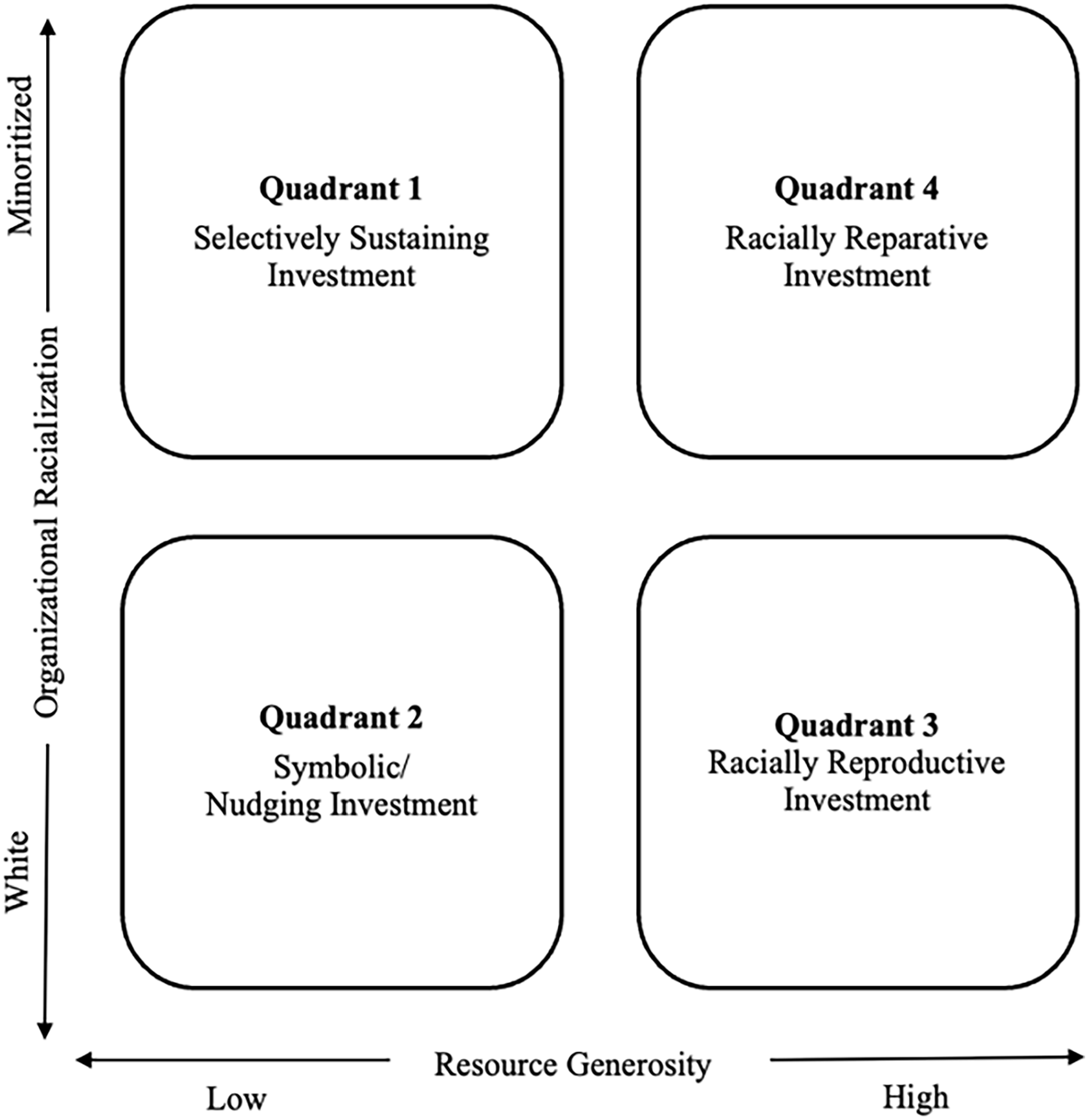
Drawing on this logic, Figure 1 applies RCW to analyze an organization’s funding portfolio as a racialized policy output. The y-axis represents the spectrum of organizational racialization from White to minoritized, while the x-axis captures the spectrum of resource generosity from low to high. In this case, resource generosity comprises both the magnitude (i.e., the sum of material benefits) and the restrictiveness (or lack thereof) of the grant (i.e., the degree of freedom organizations have to use resources). In practice, the most resource-generous investments are large pots of no-strings-attached funds, while the least resource-generous (or most restrictive) investments are small sums of high-burden funds. And combinations of the two can result in moderate to constrained generosity, including large but administratively burdensome grants and small but unrestricted grants.
Racialized investment two-by-two matrix.
Following suit, the quadrants represent the relative racialization and generosity of funders’ portfolios. Quadrant 1—selectively sustaining investment—describes a portfolio of constrained generosity delivered to minoritized organizations. We call this selectively sustaining because this type of investment often helps keep underresourced, minoritized organizations afloat but does not build their overall institutional infrastructure and capacity. Furthemore, while funders provide these organizations with much-needed money, the investment often carries high administrative burdens or significant restrictions, which limit the recipients’ agency to determine and meet their most pressing needs. For instance, an agency could make a moderate-sized grant to a minority-serving community college solely for a industry-focused training program with high evaluation requirements. While the institution may be hungry for the funds, this particular program might not be the highest need, and when the grant runs out, the college must shoulder all future maintenance.
Quadrant 2— symbolic/nudging investment—describes a portfolio of constrained generosity to WSIs. While wealthier WSIs generally do not need this revenue to stay afloat, it provides symbolic legitimacy and nudges WSIs to pursue projects that otherwise might not receive attention. For example, a private foundation might extend an R1 institution a grant for a STEM summer bridge program for minoritized youth, which the institution could have foreseeably funded itself.
Quadrant 3—racially reproductive investment—describes a portfolio of highly generous, low-burden investments in WSIs, a pattern that supports the racialized status quo. The NSF’s long-standing support of places like John Hopkins University and the University of Michigan’s research enterprise exemplifies such investment (NSF, n.d.).
Finally, Quadrant 4—racially reparative investment—represents a prime possibility for RCW. In this scenario, funders deliver generous resources to minoritized organizations without high administrative burdens. For instance, MacKenzie Scott’s unrestricted philanthropic gifts, totaling $560 million, to 23 HBCUs in 2020 could represent a racially reparative form of investment (Gasman et al., 2021).
Analytic Questions, Data, and Methodology
We apply a critical quantitative methodology to analyze the FY2023 tranche of federal academic earmarks. Our methodological orientation adheres to common tenets across critical intellectual traditions that acknowledge the role of power in shaping social realities and mechanisms through which racial categories (including racialized organizational categories) are continually formed via discourse, politics, and power (Bell, 1991; Kincheloe & McLaren, 1994; Tabron & Thomas, 2023). In line with critical scholarship, we also take seriously the commitment to asking questions that matter to advancing more equitable educational futures (McCambly & Peko-Spicer, in press; Philip et al., 2018; Rios-Aguilar, 2014). To this end, we use quantitative data on academic earmarks to understand the extent to which powerful actors (i.e., Congress members) distribute funds across racialized organizational types in ways that perpetuate or undermine organizational racialization. By disaggregating racialized organizational categories and exposing the (in)equitable distribution of these funds, we problematize how powerful actors use social constructions of race, even if implicitly, to stratify resources over time. In service of this aim, we break our inquiry into the following analytic questions:
1) How does the distribution of academic earmarks, measured in terms of generosity, vary by recipients’ racialized organizational identity and other intersecting institutional characteristics?
2) How do funding levels vary for capacity-building versus specialized earmark grants? a. How does the distribution of these qualitatively different earmark types vary by recipients’ racialized organizational identities?
Data Sources and Variables
We used public data on the FY2023 tranche of federal earmarks, which Inside Higher Ed aggregated and shared with us. 2 These data included the funding bill, funding agency, recipient name and state, total earmark dollar amount, and short descriptions of each funded project. Using institutions’ names and states, we matched the earmark data to the Integrated Postsecondary Education Data System (IPEDS), which allowed us to include the following independent variables for analysis: MSI designation (i.e., AANAPISI, HBCU, HSI, PBI, and TCCU); sector (public and private); 3 and Carnegie Classification, specifically degree-granting level and research activity levels, and continuous variables for institutions’ endowment holdings and Pell Grant recipient enrollment rates. We also cross-checked specific MSI designations (e.g., HSI and AANAPISI status) using Rutgers Center for MSIs’ 2022 list of MSIs (Rutgers Center for MSIs, 2022). Table 2 provides descriptive statistics across Carnegie Classification categories, including WSI and MSI representation.
Summary Statistics of Institutional Characteristics by Degree-Granting Status/Research Activity

Note. For rows where not relevant (“NR”) is listed as the standard error, the “mean” represents the proportion of institutions that possess the listed characteristic (row) at the indicated degree-granting status/research activity type (column).
Design
According to Ray’s (2019) theory of racialized organizations and empirical work demonstrating the role of proximity to White organizational traits in an institution’s grant-seeking competitiveness (Chen et al., 2022; Dorsey, Bradach, & Kim, 2020; McCambly & Colyvas, 2022; McClure et al., 2017), resources are hoarded and shared by how a racialized organizational type (de)legitimates organizations as deserving or valuable investments, partners, and actors—not the presence of individual White students on campus. Thus, we conducted a series of ordinary least squares (OLS) regressions to analyze, first in the aggregate and then by MSI subtypes, the distribution of academic earmarks to MSIs relative to WSIs.
However, even within an MSI subtype, not all institutions have the same resources and functions (Aguilar-Smith, 2023; Núñez et al., 2016; Williams et al., 2020). For example, within the HSI population, the University of California, Santa Barbara has an endowment of $278 million, whereas Hostos Community College has an endowment of approximately $1.3 million as of 2023. Considering TRO in the context of the intragroup heterogeneity within this racialized set of institutions, there is reason to suspect that colleges and universities with traits similar to those of elite White institutions are those most likely to receive funding. In this way, isomorphism in fields moves towards whiteness rather than encouraging the types of functions and forms that best serve minoritized students and communities. Indeed, this is a critical issue in competitive federal funding schemas; they systematically overinvest in wealthy WSIs and legitimate doing so based on these organizations’ relatively more robust institutional capacities that support “rigorous” or “high-quality” efforts (e.g., McCambly & Mulroy, 2022; Settles et al., 2022).
We disaggregated funding outcomes in three ways to explore whether this funding pattern is reproduced in a non-competitive grantmaking. Using Equation (1), we first regress earmark amounts on standard degree-granting and research activity classifications. Second, we regress earmark amounts on the relative resources measured in terms of institutional endowment (as a proxy for institutional wealth) and Pell Grant recipient enrollment rate (as a proxy for student wealth). Third, using Equation (2), we interact MSI status with categorical and continuous measures of institutional type. We estimated these models using robust standard errors and controlling for sector (i.e., public versus private) and total student enrollment:


The dependent variable Y is the earmark dollar amount a college or university received; if it received no funding, it takes a value of 0. CHAR takes a value of 1 if it meets the criteria for the institutional characteristic (e.g., HBCU or 2-year institution); γ are sector fixed effects to control for expected differences by sector; α is a control for institutional size (i.e., total student enrollment); and ε is the error term. The subscript i denotes the specific institution. In the second model, we regress earmark dollars on the aggregate dummy variable for MSI status, a second institutional characteristic (e.g., R1 institution or institutional endowment), and the interaction between the two variables.
In service of our second set of analytic questions, we distinguished capacity-building earmarks—unrestrictive, no-strings-attached monies directed at building an institution’s infrastructure, including, for example, its endowment holdings, equipment, or facilities—from specialized earmarks—restrictive monies directed at a specific program or project, such as creating a center, funding a research project, or establishing/expanding a particular student support structure. 4 As described in the literature review, grantmakers routinely award minority-led and minority-serving organizations fewer resources with greater restrictions or burdens, often viewing them, from a racialized organizational lens, as riskier and less-trusted investments (Dorsey, Kim, et al., 2020; McCambly et al., 2022). We also note how, by funding only specific programming or projects, the grantor often limits potentially transformative capacity-building efforts.
To analyze the relative resource generosity in this dataset, we coded each of the 806 earmark grants Congress awarded to a public or not-for-profit institution of higher education in 2023 based on its funding type (i.e., capacity-building versus specialized grants). Specifically, as a research team, we explored the complete list of project descriptions to confirm that we could apply top-level codes reflective of the grantmaking literature to the data. More specifically, we reviewed the data to ensure we could reliably and systematically differentiate earmark grants between (a) general, unrestricted operating funds or capacity-building grants; and (b) specialized, project-based, or strings-attached grants that dictate specific services or products. After creating detailed coding definitions, one author coded 25% of the data alongside a graduate student researcher, engaging iteratively in calibration until we reached 100% consistency in our coding decisions. We coded the data with the institutional identity masked to avoid potential bias. We used the coded data to nuance the prior analyses, using t-tests to examine the differences in means between capacity-building and specialized earmark grants and the difference in means between earmarks delivered to WSIs and MSIs within each funding type.
Findings
In line with our analytic questions, we first examine the distribution of academic earmarks across the field and pay keen attention to differences in the distribution of this federal funding between WSIs and MSIs as well as among WSIs and MSIs. Afterward, we look at how Congress allocates this money, precisely the extent to which they award capacity-building versus specialized grants, and to whom they offer these qualitatively distinct types of investment.
Congress Maintained Racialized Inequities Between MSIs and WSIs
Our first analytic question asked: How does the distribution of academic earmarks, measured in terms of generosity vary by recipients’ racialized organizational identity and other intersecting institutional characteristics? We took up this question from a racialized organizational lens, which would predict that resources skew toward whiter organizations. We tested this expected correlation in Figure 2—a scatterplot mapping White student enrollment deciles by total earmark dollars received. This figure demonstrates that as an institution’s relative whiteness increases, so too do the total earmark dollars awarded per decile.

Association between White enrollment deciles and total earmark dollars.
Drilling down into this finding, we wanted to understand if the relative generosity of the earmark grants or the number of earmark grants drove this inequity. Figure 3 shows how the differential size of the average earmark grant (measured in total dollars) drives this pattern, at least descriptively. More precisely, Panel (a) demonstrates that while the average earmark grant awarded to institutions in the first and second deciles of White enrollment hovers close to $2 million, those awarded to institutions in the 9th and 10th deciles are more than triple those averages, hovering above $6 million. Note that the direction of this finding bears out in the means of the earmark grants to MSIs and WSIs. Specifically, the average earmark grant delivered to an MSI was $2,269,769, while the average earmark grant a WSI received was $3,951,186—a difference in means of $1,681,417.

Association between White enrollment deciles and earmark count, mean (per institution).
By contrast, when examining the distribution of funding by the number of earmark grants Congress awarded an individual institution, there is a more even distribution with a slight downward slope (Figure 3, Panel [b]). In other words, Panel (b) indicates that while the number of earmark grants distributed across colleges and universities was closer to equitable, the overall delivery of this federal funding in terms of total dollars was not; whiter organizations received the most earmarks dollars on average. Additionally, note the precipitous drop in the number of earmark grants to institutions in the tenth decile in Panel (b). In this particular decile, there is only one small R1 (i.e., North Dakota State University)—a point relevant to our subsequent analyses.
Based on these figures, it appears that the latest round of federal academic earmarks reify a racialized status quo in which an institution’s relative whiteness correlates with access to resources. However, in our regression analyses, we test the significance of these descriptive correlations and seek to understand the mechanisms and distribution of this funding further. Beginning with Table 3, we find that MSIs receive $277,992 fewer earmark dollars (p < .05), on average, than WSIs when controlling for total student enrollment and control (public/private). Moving to columns 2 through 6 of Table 3, we analyze the distribution of federal earmarks across MSI subtypes (i.e., AANAPISIs, HBCUs, HSIs, TCCUs, and PBIs). Results indicate that AANAPISIs (–$498,879, p < .05), HSIs (–$444,249, p < .01), and PBIs (–$264,994, p < .01) received disproportionately fewer earmark dollars, on average, relative to their representation in the IPEDS universe. By contrast, HBCUs received greater benefits than expected relative to their representation in the IPEDS universe, receiving $483,299 more earmark dollars, on average, than non-HBCUs. TCCUs also received $215,919 more in earmarks on average—a practically though not statistically significant number due to the small sample size of TCCUs within the IPEDS universe (n = 35).
Predicting Earmark Dollars by MSI and MSI Subtype

Note. Robust standard errors in parentheses. All regressions are reported with robust standard errors and have enrollment level and sector fixed effects (FE).
p < 0.05. ***p < 0.01.
Congress Distributed Resources Progressively Among MSIs
In Tables 4 and 5, we disaggregate our analysis of earmark funding to MSIs across five mutually exclusive categories: 2-year institutions; nondoctoral 4-year/master’s institutions; and three levels of doctoral-granting institutions according to research activity—doctoral/professional universities (R3s); doctoral universities with high research activity (R2s); and doctoral universities with very high research activity (R1s). Beginning with Table 4, we find that 2-year institutions were at a distinct disadvantage in receiving earmark dollars across all tested conditions, receiving approximately $500,000 less than their 4-year counterparts. Notably, in column 3, we regressed 2-year status on earmark dollars while adding a variable for MSI designation and an interaction between 2-year status and MSI designation. Per this model, 2-year colleges received an average of $508,355 (p < .01) fewer earmark dollars than their 4-year peers. Also, while not statistically significant, we found that MSI designation and the interaction term had practically meaningful negative coefficients (–$218,425 and –$89,029, respectively). Descriptively, this means minority-serving community colleges receive the least amount of earmark funding on average.
Predicting Earmark Dollars Interacting 2-Year and 4-Year/Master’s-Granting Institutional Types With MSI Designation

Note. Robust standard errors in parentheses.
p < .1. **p < .05. ***p < .01.
Predicting Earmark Dollars Interacting Doctoral-Granting-Types With MSI Designation

Note. Robust standard errors in parentheses.
Endowment wealth represented in thousands.
p < .1. **p < .05. ***p < .01.
Moving to nondoctoral 4-year/master’s-granting institutions, we find a different pattern. Column 4 demonstrates a non-significant negative coefficient on 4-year/master’s status (–$115,936). Adding a control for MSI designation in column 5 shows a significant negative coefficient on MSI designation (–$264,480, p < .05) and a still nonsignificant negative coefficient (–$89,197) on 4-year/master’s status. The final regression in this series, which includes the interaction term, offers the most telling results. MSI designation still has a significant, negative coefficient (–$518,961, p < .05), meaning that the estimated total earmark dollars are always less for an MSI than a WSI overall. However, 4-year/master’s-granting MSIs received, on average, $503,188 (p < .05) more than other kinds of MSIs (e.g., minority-serving community colleges and minority-serving research institutions). This regression also estimates that 4-year/master’s-granting WSIs received $209,897 (p < .05) less than other types of WSIs on average. In short, when we separate earmarks delivered to WSIs and MSIs, we find distinct funding patterns for 4-year/master’s-granting institutions.
A similar pattern emerges in Table 5 regressions for R3s, as demonstrated in columns 1 through 3. Column 1 estimates a significant negative coefficient for R3s (–$234,814, p < .05). Column 2 adds in MSI designation (–$278,681, p < .05) and maintains a significant negative coefficient for R3s (–$241,897, p < .05). Once again, when we add the interaction between research activity classification and MSI designation, a more complex story emerges; the regression estimates that MSI R3s received $565,564 (p < .05) more, on average, than their WSI non-R3 counterparts. However, on average, WSI R3s received $353,409 less than WSI non-R3s, and MSI non-R3s received $303,692 less than MSI R3s.
The divergent pattern at MSIs and WSIs evident in the distribution of earmarks to 4-year/master’s granting institutions and R3s continues but with contrasting contours when analyzing the earmarks R1s and R2s received. The results for R2s are hazier overall. As displayed in column 6 of Table 5, when MSI designation, R2 classification, and the interaction term are all included in the regression, MSIs receive $254,203 (p < .05) less than WSIs on average. But the positive coefficient for R2 classification ($775,490) and the interaction of MSI designation and R2 classification (–$533,867) are not statistically significant. Also, the coefficient for R2 classification is not significant in other models.
Moving to R1s, we identify an inverse pattern. Column 4 conveys that R1s, on average, receive $3,939,000 (p < .01) more than non-R1s—a notable finding given the size of this coefficient, the greater resources concentrated at R1s, and the current underrepresentation of MSIs among R1s. Adding MSI designation to this regression yields a non-significant, negative coefficient (–$88,705) (see column 8). Furthermore, upon adding the interaction between MSI designation and R1 classification, the coefficient on R1 classification increases ($4,318,000, p < .01), and the coefficient for the interaction term becomes practically significant (though statistically insignificant, possibly due to the small number of MSI R1s currently in the IPEDS universe), with MSI R1s receiving $2,484,749 less than WSI R1s and other types of MSIs on average. When viewed in light of the findings for 4-year/master’s granting and R3s, a picture emerges; earmark funding patterns are lower across the board for MSIs but also different in shape and priority. While the traditional preference for under-funding open/broad-access, teaching-focused institutions and overfunding exclusive, elite R1s appears to hold for WSIs, this pattern does not seem to hold among MSIs.
We further explore the distribution of earmark funding by accounting for continuous measures of institutions’ relative wealth (i.e., endowment percentile) and percent of Pell Grant recipients in Table 6. Looking first at endowment percentiles, columns 1–3 show a positive correlation between endowment percentile and earmark dollars across all conditions. Interestingly, in column 2, which includes the MSI indicator, the coefficient for endowment percentile is still positive ($18,196, p < .01), but there is a non-significant, negative coefficient for MSI designation (-$123,939). Column 3 helps make sense of this result, as it estimates that institutions receive, on average, an additional $21,363 (p < .01) earmark dollars for every additional percentile of institutional endowment, a positive coefficient for MSI designation ($509,806, p < .05), and a negative coefficient (-$14,988, p < .05) for the interaction between MSI designation and endowment percentile.
Predicting Earmark Dollars Interacting Resource/Wealth Indicators With MSI Designation

Note. Robust standard errors in parentheses.
p < 0.1. **p < 0.05. ***p < 0.01.
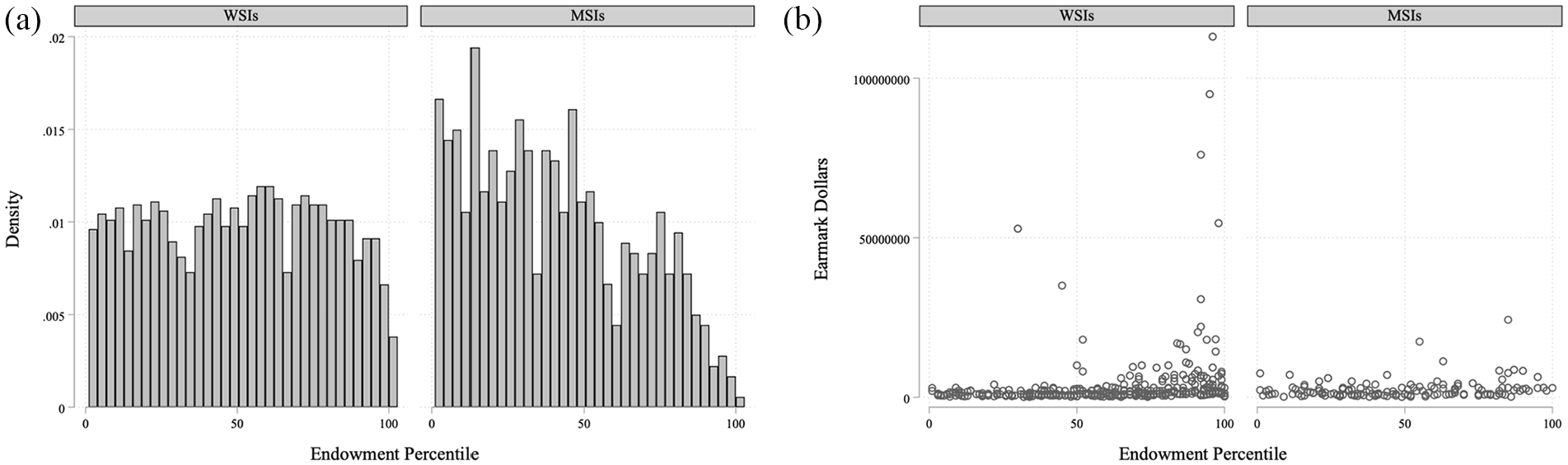
Figure 4 helps contextualize these results. The histogram (Panel [a]) emphasizes that, on average, MSIs skew lower than WSIs in terms of their distribution on a scale of endowment percentiles. The scatterplot (Panel [b]) displays an observable bias in the distribution of federal earmark funds toward higher endowment percentiles at WSIs—a hardly detectable bias at MSIs.
White-serving institutions’ and minority-serving institutions’ endowment assets.
This trend reverses when analyzing the relationship between earmark dollars and an institution’s Pell Grant recipient enrollment rate. Column 4 of Table 6 estimates that institutions receive $4,177 (p < .05) fewer earmark dollars on average for each percentage point increase in Pell Grant recipient enrollment. However, by column 6, we see an inverse relationship to that of endowment when we introduce both an indicator for MSI designation and the interaction between MSI designation and Pell Grant recipient enrollment. Overall, MSIs are predicted to receive $1,106,000 (p < .01) less than WSIs on average, and each percentage point of Pell-eligible enrollment correlates with $7,794 (p < .01) fewer earmark dollars (at WSIs). However, the interaction between MSI designation and Pell Grant recipient enrollment indicates that Congress awards an additional $19,425 (p < .01) earmark dollars per each additional percentage point of Pell-eligible enrollment at MSIs (not WSIs).
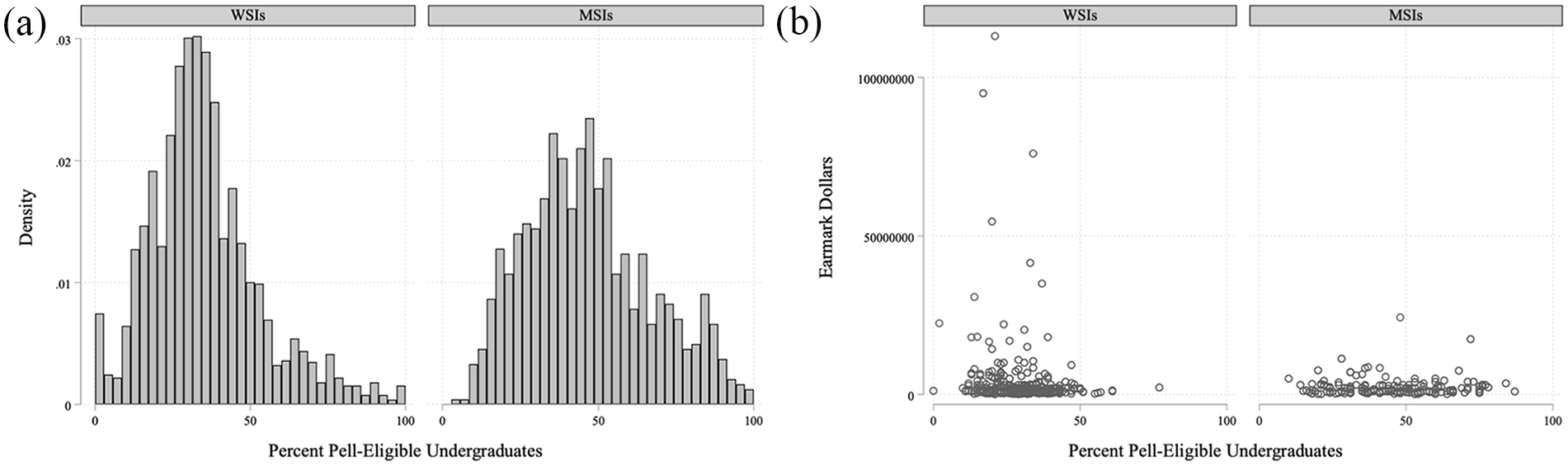
Figure 5, once again, illuminates this pattern, with the histogram (Panel [a]) demonstrating that MSIs, as expected, skew towards higher enrollment rates of Pell recipientss than WSIs. Meanwhile, the scatterplot (Panel [b]) shows that Congress awarded exceedingly few earmark grants to WSIs with Pell recipient enrollment rates greater than 50%. Instead, the largest earmark grants skew toward lower Pell-eligible enrollment rates at WSIs. While the earmark grants to MSIs are still noticeably lower than WSIs, their distribution is more evenly distributed and skews slightly toward larger earmarks to larger Pell Grant recipient populations.
White-serving institutions’ and minority-serving institutions’ Pell Grant recipient undergraduate enrollment.
Racialized Inequities Driven by Generosity in Amount and Burden
In our second set of analytic questions, we asked: How do funding levels vary for capacity-building versus specialized earmark grants, and how does the distribution of these qualitatively different earmark types vary by recipients’ racialized organizational identity? Recall our two categories of interest are (a) largely unrestrictive earmarks, which we refer to as “general capacity building grants”; and (b) more restrictive/burdensome, project-specific earmarks, which we refer to as “specialized grants.” For example, whereas general capacity-building grants may list the earmark’s purpose as “infrastructural,” “facilities and equipment,” or “endowment,” specialized grants typically had more limited purposes such as “workforce development, applied research and outreach center in health science, and cybersecurity” or “poultry science workforce development activities.”
Descriptively, Congress awarded 325 general capacity-building grants and 481 specialized grants across all institutions. Specifically, MSIs received 80 general capacity-building grants and 166 specialized ones (246 total), while WSIs received 245 and 315 (560 total), respectively. In other words, Congress awarded a greater proportion of general capacity-building grants to WSIs than MSIs, with such grants representing approximately 44% of WSIs’ total allotment compared to 33% at MSIs. In terms of total dollars, general capacity-building earmarks were substantially larger than specialized earmarks on average at $3,079,215 and $1,522,807, respectively—a statistically significant difference in means (diff = $1,556,408, p < .01; see Table 7).
T-Test of Means Comparing Earmark Dollars by Grant Type

We further break down this difference in general capacity-building and specialized earmarks by considering the differences in means between WSIs and MSIs within each earmark type. As shown in Table 8, the average general capacity-building earmark grant awarded to a WSI was $3,394,634, while that awarded to an MSI was $2,113,245 (diff = $1,281,389, p < .1). In other words, MSIs generally received over a million dollars less in general capacity-building earmarks than WSIs during the 2022–2023 round of congressional earmark funding to colleges and universities. By contrast, the average specialized earmark grant awarded to a WSI was $1,637,045, while MSIs received $1,306,031, on average, for such grants (diff = $331,013, p < .01). Subsequently, MSIs generally received smaller earmark grants. However, the difference for specialized earmarks was smaller than in the case of general capacity-building grants. Figure 6 illustrates this variation in the differential distribution between general capacity-building and specialized earmark grants by plotting earmark awards by dollar amounts across WSI and MSI subtypes.
T-Test of Means Comparing Capacity-Building Earmark Dollars by Serving-Type


Distribution of earmark dollars by MSI subtype.
Discussion
Taking an RCW lens, we analyzed the distribution of the FY2023 tranche of academic earmarks as potentially racialized policy outputs, considering the total allocation of dollars and the types of earmarks (general capacity-building versus specialized grants) across colleges and universities, including between WSIs and MSIs and among MSIs. We found confirmatory evidence that, in the aggregate, these earmarks adhered to an expected racialized pattern of inequity favoring WSIs. As such, we do not find evidence that this round of earmarks exemplifies a racially reparative investment (see Figure 1). However, as we dove deeper into analyses, we found signs of promise for the potential of pork-barrel politics to move toward racially reparative work. We discuss this further in light of our conceptual lens below.
As in the case of competitive grantmaking, White-serving research institutions—typically the most well-resourced, elite organizations—still reign, disproportionately collecting earmark dollars compared to MSIs. Indeed, as Figures 2 and 3 show, the relative generosity of academic earmarks (in terms of total dollars) explains the inequitable resource distribution to MSIs. That is, our results reveal that Congress allocates these politicized grants relatively evenly across racialized categories of colleges and universities in terms of sheer number/count but shortchanges MSIs in terms of generosity—in both total dollar amounts and the relative restrictiveness of awards. We thus characterize this funding pattern as a combination of (a) selectively sustaining investment, in which the grants going to MSIs are less generous and more restrictive; and (b) racially reproductive investment, whereby WSIs receive more generous and less-restrictive grants.
Interestingly, when comparing patterns in earmark funding within MSIs to those within WSIs, we found that while WSIs with less wealth (measured by endowment) and higher rates of Pell Grant recipients received fewer total dollars, the opposite was true among MSIs overall. Among MSIs, Congress targeted institutions with limited institutional wealth and higher student financial need (as signaled by their relatively low endowments and high enrollment share of Pell Grant recipients, respectively). More specifically, among MSIs, Congress directed earmarks primarily to 4-year/master’s granting institutions and R3s—not more research-active MSIs (i.e., MSI R1s and R2s). This counterintuitive outcome breaks both empirical patterns in competitive grantmaking and patterns that TRO might predict. As such, this finding motivates future work about if and how the lack of formalized and inequitable criteria endemic to competitive grantmaking left room for other types of political or community preferences—and what those preferences or mechanisms are.
The TRO tenet of whiteness as an organizational credential would predict that even among MSIs, organizations with the strongest claims to White organizational forms would be the best resourced. And while this still could be the case in terms of underlying resources, we see a break from this prediction specific to earmark funds. Notably, this particular mode of reproduction underlying racialized organizations may be less deeply institutionalized within pork-barrel politics than the competitive peer-reviewed grantmaking context rooted in the norms of a historically White profession. As such, while inequities are reproduced overall—perhaps due to the interests of a disproportionately White Congress with “elite” academic pedigrees (Congressional Research Service, 2022; Schaeffer, 2023)—the troubling within-group inequities are not recreated. To this end, should Congress shift earmark resources to MSIs over WSIs and/or increase earmark spending to rectify the racialized underresourcing of MSIs, this within-MSI pattern offers a compelling template for supporting racially reparative work by weakening the racialized stratification of resources within the field, including those within the minority-serving larger umbrella.
Separately, beyond favoring 4-year/master’s granting institutions and R3s, Congress also seemingly distributes earmarks among MSI types (i.e., HBCUs, TCCUs, HSIs, AANAPISIs, and PBIs) in varied ways. As a reminder, only HBCUs and TCCUs have positive coefficients ($483,299 and $215,919, respectively; see Table 3), which suggests that Congress favors these mission-created MSI types. Once again, attention to these particularly underfunded MSI types is promising, as these colleges and universities were founded to serve Black and Indigenous communities (Allen & Jewell, 2002; Guillory & Ward, 2008). In stark contrast, Congress appears to most severely underfund PBIs, with these institutions typically receiving $264,994 (p < .01) fewer earmark dollars than the universe of potential recipients. Yet, enrolling a minimum of 40% of Black-identified undergraduates, PBIs, like HBCUs, play a major role in the higher education of Black communities (Johnson, 2020; Jones, 2019). Thus, the notable opposing levels of support for HBCUs and PBIs raise concern. Similarly, the underresourcing of community colleges across all types, and even more so among minority-serving community colleges, is also of concern. Community colleges play an integral role in the education of poverty-affected students, students of color, and adult learners across these identities frequently underserved at 4-year institutions (American Association of Community Colleges, 2023; Kisker et al., 2023).
Turning to the types of earmarks Congress awards or, more precisely, to whom they offer what, the story thickens. Again, Congress provides WSIs substantially more general capacity-building grants than MSIs. In contrast, among MSIs, Congress doles out far more specialized grants. Although critics have often lambasted federal earmarks for contributing to waste and overspending because of their limited oversight (Brainard & Hermes, 2008; Mervis, 2006), specialized grants are still more restrictive than general capacity-building ones. Consequently, in line with previous research, we find evidence that earmarks directed to racially minoritized institutions (i.e., MSIs) are often more burdensome and restrictive in scope than those offered to WSIs on average, amounting to an inequitable policy output. For example, whereas general capacity-building grants may list the purpose as “infrastructural,” specialized grants typically have narrower purposes, such as “workforce development,” which may or may not align with the institution’s most pressing needs. Moreover, this distribution suggests that Congress views institutions closer to whiteness as seemingly safer investments—places where it is less “necessary” to provide oversight and direction. In other words, Congress affords WSIs greater agency to use earmark dollars in ways that the institution sees fit while circumscribing the agency of MSIs, disproportionately providing them money for more specific projects or ends. Such infrastructural investments are a token of trust and a fundamental piece of a racially reparative policy output. Racially reparative outputs destabilize institutionalized inequities by reducing modes of reproduction—in this case, the agency and capacities derived from institutional wealth concentrated at WSIs. Instead, the MSI-directed earmarks fit the mold of selectively sustaining investment, as Congress provided MSIs with smaller, more restrictive sums. While these sums may help shore up the institution’s financial health, they do so within a limited scope of allowable activities and often with outcomes that will require additional institutional expense down the road.
Together, our findings demonstrate that, on the one hand, the current distribution of academic earmarks empowers the racialized and inequitable stratification of resources within the field of higher education. On the other hand, the differentiated funding patterns by continuous variables of institutional wealth and student need offer some reason for hope. Specifically, while competitive funding criteria that valorize whiteness remake racialization within the field, earmarks, as a noncompetitive process, hold the potential to break this structure. At their fullest potential, Congress could leverage earmark dollars to provide MSIs the capital needed to undermine modes of reproduction that keep many of these institutions in a perpetual state of struggle with limited infrastructure and capacity to fully access the range of opportunities and resources within the field.
Implications for Policy and Future Research
Despite the heated debates surrounding pork-barrel politics, our findings suggest academic earmarks could offer a route toward racially reparative work. Of course, federal earmarks are just one piece of a much larger role that Congress can play in addressing inequities reproduced through the systemic, inequitable capacities of racialized institutions of higher education. To advance equity within the resource-stratified field of higher education and enact racialized change work, Congress should prioritize distributing academic earmarks to MSIs rather than to already well-resourced WSIs. Furthemore, our findings underline the need to reconsider the kind of funding offered to MSIs. Specifically, to curb the reproduction of inequality, it merits, at a minimum, issuing MSIs earmarks as generous (in terms of total dollars) and as agentic (i.e., general capacity-building grants) as those afforded to White-serving R1s.
Also, our findings emphasize the need to support minority-serving community colleges better, particularly as these institutions are “perversely affected in dual ways, or multiply marginalized, within the existing architecture of U.S. higher education in general and within the competitive grant landscape more specifically” (McCambly et al., 2023, p. 9). Indeed, as community colleges, they are underfunded compared to 4-year institutions (Community College Research Center, 2022), and as MSIs, they receive inequitably less public support than their WSI counterparts (Lee & Keys, 2013; Ortega et al., 2015; Wolanin, 1998). Hence, Congress’s minimal investment in minority-serving community colleges overall, particularly via earmarks, further marginalizes these chronically underresourced but at-promise colleges.
In addition to congressional earmarking, we also acknowledge the federal government would need to take up other, systemic opportunities for reparative work. In particular, an intentional application of our racialized investment framework among higher education lobbyists, private philanthropic grantmakers, staffers on the Hill, and other policy advocates has the potential to support more consistent advocacy toward reparative rather than reproductive resourcing models. Indeed, there has been increased calls federally under the Biden administration and separately in private philanthropy to support both community colleges and HBCUs. However, as has long been the case in philanthropic and federal funding, racialized administrative burdens and generosity can curb ostensibly progressive intentions (see, e.g., McCambly & Colyvas, 2022). As such, our racialized investment framework can act as an advocacy and analytic tool with immediate applications for policymakers and advisors whose aim is to support long-term capacity building among community colleges and MSIs, including HBCUs. Such applications could include private grantmakers, Hill staffers’, or public higher education systems’ intentional use of their political capital (e.g., via advocacy and analysis, direct grantmaking, or collective use of lobbying resources) to counteract the inequities and racialized burdens that manifest in federal earmarking and other policy processes. Moreover, employing this framework in higher education policy analysis—both peer-reviewed and white papers—could itself facilitate a political shift by differentiating the intention and outcomes of the four types of investments we identified: selectively sustaining, racially reproductive, nudging/symbolic, and racially reparative investments.
This study also opens several avenues for additional empirical research. For one, our finding about the inverse pattern of resource distribution (via earmarks) between HBCUs and PBIs demands further attention as we think about, for instance, how access to organized lobbying may leave PBIs out of sight and how state systems might better account for this need. Additionally, while we analyzed the distribution of types of earmarks (i.e., general capacity-building versus specialized earmarks) across institutions and between WSIs and MSIs, future research should delve more deeply and describe more explicitly the types of projects Congress funds and, more so, identify potential differences among recipients in terms of funded projects. Finally, we examined the distribution of this politicized funding and the subsequent implications for the reproduction of inequality, meaning we were not focused on identifying political mechanisms underlying this distribution—a topic we take up in other work. Based on existing research, we have strong reason to suspect that factors like partisan politics and committee membership will matter to the racialized distribution of earmarks. Hence, future studies ought to empirically examine factors underlying the distribution of academic earmarks.
Conclusion
As a field of racialized organizations, higher education is rife with taken-for-granted inequities in institutional funding, capacity, and agency. These inequities affect all aspects of student and academic life. Most recently, scholars have drawn attention to the racialized distribution of competitive federal grantmaking—a critical source of institutional revenue which is itself a major factor in rankings and prestigious memberships (e.g., the AAU), and a powerful determinant of faculty and graduate student career trajectories. While federal earmarking receives little attention in higher education literature, we lift up this noncompetitive funding source as a possible mechanism for destabilizing the racialized delivery of competitive grants and racialized status quo overall. While our analyses show that Congress favored a racially reproductive funding portfolio, we also found evidence that the distribution of earmarks among MSIs defied normed expectations, as Congress did not seem to privilege whiter, more research-focused MSIs. While we are unlikely to see Congress take action to fully remedy the deeply inequitable endowments between MSIs and WSIs, greater attention to the potential of noncompetitive funding as a force for equity among lobbyists, policymakers, and professional associations (some of whom have lobbied against earmarks) could move these earmark portfolios from racially reproductive to racially reparative work.
Finally, this study offers tools for policymakers and grantmakers across contexts to consider overall funding patterns and how these allocations intercede with how the field answers the questions: Who has the resources to pursue and fulfill their mission(s)? Who has more or less agency to use their resources fully? By bringing these institutional factors to the foreground, we push back on taken-for-granted practices that reproduce predictable racialized and inequitable patterns. Indeed, we argue this funding regime is reproductive at multiple levels. Policymakers use racialized norms and criteria of deservingness and institutional worth to distribute resources across colleges and universities. Access to and freedom to deploy these resources, in turn, plays a determining role in the infrastructure underlying student life, faculty activity, and institutional “worth” and “worthiness.” The inevitable outcome is a state of axiological redlining in which a self-sustaining and pernicious relationship between wealth and normed perceptions of institutional worth and worthiness maintains racialized and inequitable public investments. This critical quantitative analysis demonstrates how racialized organizational identities predict both historical wealth inequities and ongoing inequities in policy outputs that often escape scrutiny. In doing so, we foreground how critical quantitative analyses can be used to expose mechanisms of racialized maintenance in the field and emphasize the potential of noncompetitive grantmaking—including academic earmarks—as a potential policy intervention to address the racialized status quo.
Footnotes
Acknowledgements
We extend our warmest gratitude to trusted colleagues for their constructive input including our anonymous reviewers, the AERA Open Editors, and especially Dr. Sarah Peko-Spicer for her generative feedback and the Quant4What Collective for its formative influence on our work. We would also like to thank Crystal Couch for her diligent work supporting this research.

Notes
Authors
HEATHER M
STEPHANIE AGUILAR-SMITH is an assistant professor of counseling and higher education at the University of North Texas, P.O. Box 310829, Denton, TX 76203-5017; email: