




Abstract
Latinx/a/o senior leaders remain underrepresented in the executive ranks, and more research is needed to adequately address equity gaps in higher education leadership. By employing a systematic literature review approach, we examined 57 pieces of scholarship that focused on the experiences of senior Latinx/a/o leaders in postsecondary education. This exploration was aimed at equipping higher education scholars and practitioners with the tools to understand how Latinx/a/o leaders navigate challenges and opportunities in higher education. We identified three major themes: 1) scholarship focusing on individual traits and important identity-based differences; 2) research describing the environmental and structural conditions that shape these leaders’ realities; and 3) literature describing these individuals’ leadership pathways. As an effort to make this body of work more accessible to researchers and decision-makers, we provided implications for research and practice to shape the field of Latinx/a/o leadership in higher education.
Keywords
Although Latinx/a/o student enrollment and graduation rates are increasing across postsecondary education (HACU, 2022), Latinx/a/o senior 1 leaders remain underrepresented throughout the executive ranks of colleges and universities (Quezada & Martinez, 2021). According to Melidona and colleagues (2023), Latinx/a/o college presidents (i.e., those at community colleges, technical colleges, and bachelor’s degree–granting institutions) represent less than 6% of all presidencies compared to 73% for Whites. Latinx/a/o faculty also represent less than 6% of full-time faculty compared to 73% for Whites (National Center for Education Statistics, 2023). Demographic data on senior leaders has been difficult to track as not all institutions have the same definitions for senior-level roles. However, most reports written on Latinx/a/o leadership highlight racial underrepresentation across the leadership ranks and not just the presidency and the professoriate (Excelencia in Education, 2017).
Moreover, these gaps remain persistent across institutional types and are further magnified when accounting for gender identity, with less representation among women and nonbinary Latinx/a/o leaders (Burmicky, 2022a). This phenomenon poses a threat to our collective efforts to ensure that all students see themselves reflected at the highest levels of educational leadership (González, 2021). Furthermore, racial underrepresentation in senior leadership reveals systemic inequities embedded in the leadership pipeline by acknowledging the role that whiteness and racism play in shaping higher education leadership (Bensimon & Associates, 2022; Harris, 2019).
Equity gaps in higher education leadership are not coincidental and have instead been enacted by design (Burmicky, 2022b). These inequities are the consequence of the history of systemic exclusion of racially and ethnically minoritized people in the United States, such as the case of Latinx/a/o communities in higher education. According to León and Martínez (2013), a great deal of research on Latinx/a/o leadership only became possible once a few Latinx/a/os began to hold significant leadership positions in the past two decades. Even though scholars have recently begun to explore Latinx/a/o senior leaders in higher education (Ortega et al., 2023), research on this topic remains underdeveloped, and it is criti-cal to examine this body of work as an effort to provide re-commendations to sufficiently address leadership disparities in the field of education.
Given this educational imperative, as well as the need to conduct more research on what is known about senior Latinx/a/o leaders as opposed to just presidents and faculty, we conducted a systematic review of literature in higher education focused on Latinx/a/o senior leaders. We defined senior leaders in higher education as individuals who hold or have held executive leadership roles at any institution of postsecondary education in the United States (i.e., community colleges, bachelor’s-degree-granting institutions). Roles include academic and student affairs administrative appointments, including but not limited to senior directors, deans, vice presidents, provosts, and presidents/chancellors/CEOs. This exploration led us to better understand how Latinx/a/o senior leaders have been studied in higher education literature. The following research questions guided our systematic literature review:
What does scholarship in higher education leadership reveal about Latinx/a/o senior leaders?
What implications can be gained from this scholarly body about how Latinx/a/o senior leaders navigate challenges and opportunities in higher education?
We approached this study from a transformative paradigmatic perspective (Mertens, 2007) and Rodríguez et al.’s (2018) model of Latino educational leadership as a framework, given that both allowed us to analyze the extant scholarship from a critical lens.
Background
Given the focus of our study, it is important to first define the term “Latinx/a/o” before diving into additional context. Throughout this manuscript, we use the term Latinx/a/o to refer to all people of Latin American and Caribbean descent who reside in the United States. This term is inclusive of AfroLatinx/a/o, undocumented/DACAmented, 2 LGBTQ+, and formerly incarcerated people (Ryu et al., 2021). At the same time, when referencing the work of other pieces we analyzed, we employ their terminology (e.g., Hispanic, Latino).
Although scholarship in higher education has examined the leadership pathways of senior leaders of color—mostly college presidents—the experiences of Latinx/a/o senior leaders remain understudied. Scholars have conducted other systematic reviews/content analyses of senior leaders in higher education. For example, Burmicky and McClure (2021) conducted a literature review on presidential leadership at broad access institutions. Their review examined pieces written on college and university presidents more broadly to find applications that speak directly to leading broad-access institutions. Gasman and colleagues (2015) conducted a study on senior leaders at elite higher education institutions. Although their study included other data from the American Council on Education (ACE) as a part of their analysis, they conducted a literature review related to diversity in academe, with an emphasis on elite institutions. Jackson and O’Callaghan (2009) conducted a review of the literature on glass ceiling effects in higher education. Their exploration focused on the types of research questions, methods, and frameworks that have been used to study glass ceiling effects. Their articles addressed the systematic underrepresentation of women and people of color in higher education leadership. Although these reviews of the literature addressed core issues in senior leadership in higher education, none of them focused exclusively on senior Latinx/a/o senior leaders.
Data show senior leaders of color, including Latinx/a/o college presidents, remain highly underrepresented. ACE released new data from their longitudinal survey in spring 2023, and Latinx/a/o presidents represent a small fraction of all college presidencies in the country—5.8% (Melidona et al., 2023)—despite the substantial growth in enrollment and graduation rates of Latinx/a/o students across all institutions of higher education.
Our effort to conduct a systematic review of the literature is grounded in the belief that as a field, we must recognize and address the issues and barriers that Latinx/a/o leaders continue to face in an effort to achieve greater racial representation at the highest levels of leadership (Ortega et al., 2023). Our work is fueled by the understanding that most of the research shows that Latinx/a/o senior leaders experience systemic barriers that negatively impact their success (Perez, 2016; A. Reyes, 2018; Roman-Buday, 2021). Some of these barriers include but are not limited to racism, White supremacy, sexism, lack of opportunity, and professional workplaces that ascribe to Eurocentric values (Burmicky, 2022a; Muñoz, 2009). Our study elevates the importance of surveying the literature to develop research-informed solutions that can create better outcomes for all current and future leaders in higher education, especially those who ascribe to historically marginalized identities. At its core, our research aims to equip higher education scholars and practitioners to understand how Latinx/a/o leaders ascribe meaning to their identities while overcoming systems of oppression. To our knowledge, this is the first systematic review of the literature concerning senior-level Latinx/a/o leaders in higher education.
Epistemological Stance and Theoretical Framework
Informed by the transformative paradigm (Mertens, 2007), we situate our systematic review in critical or emancipatory theory. We define critical or emancipatory theory as the use of equity-driven and social justice–oriented frameworks that emphasize the need for social change, which rests in working closely with the communities that this research is intended to serve or liberate: Latinx/a/o communities. Our alignment with the transformative paradigm is associated with philosophical and theoretical underpinnings concerned with addressing inequalities and injustice in society using culturally and racially affirming methodological approaches and conceptual frameworks. As critical Latinx/a/o scholars who are directly engaged with communities, associations, and policy organizations that actively advocate for Latinx/a/o interests in education, we found this approach and epistemological stance to be aligned with our scholarship and practice.
To move us closer to critical or emancipatory theories that examine Latinx/a/o communities, we drew from Rod-ríguez et al.’s (2018) model of Latino educational leadership. Through a synthesis of critical and emancipatory theories that have studied People of Color in education (e.g., critical race theory, Latino critical race theory), Rodríguez and colleagues used this collection of theories to move beyond deficit notions about Latinx/a/o leaders in education. Guided by Latino educational leadership, we address issues of inequity and social injustice in our exploration of the literature and offer antideficit implications for research and practice that put the onus on interlocking systems of oppression rather than individuals. For example, a foundational understanding of Latino educational leadership is that “leadership in effect is power” (Rodríguez et al., 2016, p. 139). Therefore, acknowledging the racialized realities of Latinx/a/os in the United States and the system of oppression that prevails along the educational pipeline is critical to this concept. As such, we relied on Latino educational leadership to explore critical lenses within the pieces we identified in our search with the goal of moving beyond traditional leaders-hip approaches that are most relevant for advancing senior Latinx/a/o leaders.
Methodological Approach: Systematic Literature Review
To examine the state of the literature on Latinx/a/o senior leaders in higher education, we engaged a systematic literature review approach. Systematic literature reviews function as a “form of secondary level analysis (secondary research) that brings together the findings of primary research to answer a research question” (Newman & Gough, 2020, p. 4). These reviews analyze scholarship on a given phenomenon and influence practice, as well as policy, relative to a subject matter (Nordenbo, 2010). In this case, we believed that developing a comprehension of the existing research on Latinx/a/o senior leaders in the context of postsecondary education would lead to tangible implications for those interested in diversifying the field given the scarcity of Latinx/a/o individuals in these roles (Quezada & Martinez, 2021). The general contours of engaging in a systematic literature review involve the following process: developing a research question, generating a conceptual framework, creating selection criteria and strategy, selecting studies based on these criteria, and analyzing the projects for patterns before reporting findings (Newman & Gough, 2020). Next, we discuss how we followed these steps in the current study, articulating the decisions we made to bind the research along the way.
Data Collection: Selection Criteria and Strategy for Selecting Scholarship
Key to conducting a systematic literature review is developing selection criteria and a strategy for locating scholarship (Newman & Gough, 2020). To answer our central research question, we decided to seek out literature focused on the lived experiences of senior-level Latinx/a/o administrators and/or have participant samples made up exclusively of senior-level Latinx/a/o professionals. We followed other bodies of literature that defined senior-level Latinx/a/o administrators as including those who have titles in academic and student affairs units like those of directors, deans, provosts, and presidents. We were open to including books, book chapters, peer-reviewed journal articles, dissertations, and/or theses. Casting a wide net would be beneficial given the specificity of our research question and the limited scholarship on the topic. From our previous understanding of the literature base, we knew many studies in existence to be dissertations, for example. Of note, we decided to bind the study to research published between January 1, 2000, to Spring 2022 (when we searched for the scholarship). Selecting this time period allowed us to consider what Latinx/a/o leadership meant in the past couple of decades, especially given the changing attitudes toward Latinx/a/o leaders both in and outside of postsecondary education.
To search for literature, we used electronic retrieval databases, including Academic OneFile, Education Research Complete, Educational Resources Information Center, PubMed, PsycINFO, ProQuest Central, Ingenta Connect, Social Science Premium Collection, and Gale Academic OneFile. Given the differing terminology that authors employ, we used a combination of the following terms to identify scholarship: Latinx, Latina, Latino, or Hispanic; higher education or postsecondary education; and leadership. One example combination was Latinx, higher education, and leadership. Employing these terms led to 2,428 total results across all searches. As a three-person research team, we then reviewed titles and abstracts to examine which ones met the criteria listed previously. Given the higher number of pieces, we divided up the results between the three of us for efficiency. In reviewing the abstracts, we checked that the pieces we included focused specifically on senior Latinx/a/o leaders in higher education settings. Although we identified most as clearly not fitting the inclusion criteria, we brought any pieces that we were unclear about to the team to discuss and make a collective decision. For instance, we talked about and ended up excluding Bensimon et al. (2019) as the study focused on Latinx/a/o STEM faculty but it was not clear if these faculty members held roles of senior-level leadership. Similarly, we also noticed the work of Felix (2021) appeared in searches; though in reviewing the title and abstract that we believed his research on race-conscious leadership in policy implementation to potentially align with our criteria, we excluded it from the final sample because the campus implementers in the study were not all at a senior level of leadership.
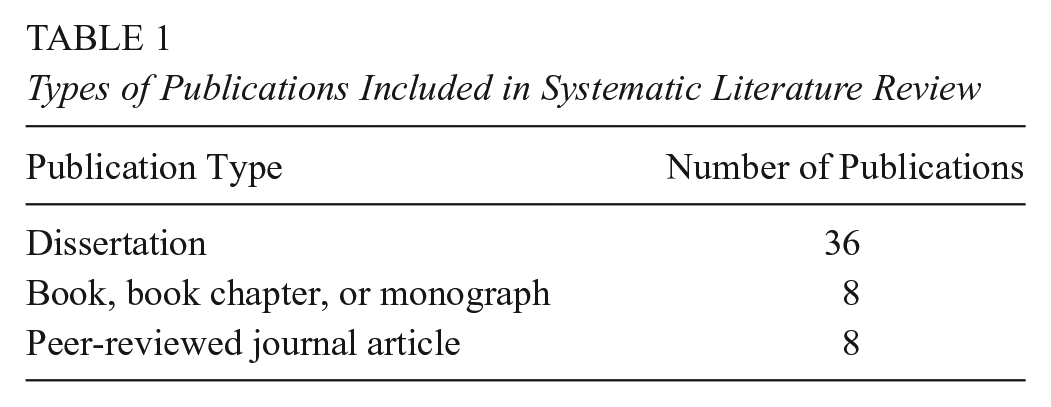
Of significant importance, we also engaged in forward (looking at who has cited the piece) and backward searching (examining the reference list) after we narrowed down the 2,428 results to make sure we did not miss anything (Duran, 2019). This meant that we may have included dissertations, as well as articles published based on the same dissertation data. However, we did not believe this would skew analysis because this happened rarely, so it did not skew the frequency of concepts. In total, we narrowed down the results to 57 pieces of literature that fit our criteria. The full list of articles alongside several of the rubric categories we included can be found in the link to the supplementary material, and we also break down the types of publications in Table 1. A visualization of the process is included in Figure 1.
Types of Publications Included in Systematic Literature Review

Visualization of the systematic review process.
Analytical Strategy
After collecting the publications for this review, we then moved on to constructing a literature review matrix to begin our analysis. The intention of the literature review was to capture salient aspects of the scholarship we identified for us to later code. In a shared literature review matrix (Excel spreadsheet), we outlined the following categories as column headers: research questions/purpose statement; paradigm and/or theoretical framework; methodology; popu-lation/sample; data collection tools and analysis type(s); main findings; and limitations. Having these categories as column headers was helpful because it allowed us to see trends and commonalities across all the pieces. For exam-ple, as underscored in our Discussion section, having these column headers helped us learn that there are various theoretical/conceptual perspectives and methodologies reflected in the sample. We used these observations to elaborate in our discussion about the most common methodologies employed for the study of Latinx/a/o senior leaders, as well as future considerations regarding the availability of various theoretical/conceptual frameworks to study this population.
We also included a column where we wrote keywords, phrases, and statements describing our initial interpretations of how a particular piece of scholarship related to our research question. We split the task of filling out the literature review matrix among the three researchers. Each researcher had the task of reading through their sections of the found scholarship and filling out the Excel categories using their own words or direct quotes from the literature. Any questions that came up during this individual process were then brought to the team for discussion and clarification.
After we filled out the literature review matrix, we then engaged in an inductive open coding process where we individually assigned codes to all 57 pieces of scholarship. Example codes that we identified during this process included facing social prejudice, the positive role of mentoring, and influences of organizational culture. After we concluded this step, we came together to articulate which trends we saw across the team’s initial analysis. Through these conversations, we developed focused codes, those that better articulated the patterns in the research. We developed six categories through this process (e.g., the role of context in shaping experiences and leadership, as well as significant influences on the pathway to leadership). Following the creation of these six categories, we individually memoed to further hone in on our analysis and then came together to determine the major themes answering our research questions.
Researcher Positionalities
Our researcher positionalities influenced how we made meaning of our research (Creswell & Poth, 2018). Next, we describe the role that our positionalities played in the study. Jorge identifies as a cisgender Latino man who serves as faculty in higher education at a historically Black college. Prior to joining the professoriate, Jorge served as a higher education practitioner for several years. These experiences gave Jorge firsthand insights into higher education leadership contexts. In addition, Jorge’s research agenda is focused on leadership in higher education, with an emphasis on racially minoritized leaders and marginalized sectors in higher education. Antonio identifies as a queer cisgender Latino man who is deeply committed to understanding how legacies of oppression have shaped the experiences of minoritized individuals in higher education. Relevant to this study, Antonio was particularly interested in the subgroup differences that existed in Latinx/a/o leadership, as well as the intersectional systems of marginalization that informed senior leadership experiences. Natalie identifies as a cisgender, heterosexual, AfroLatina social worker with over 15 years of experience creating retention programs for underserved student populations as a student affairs leader. Natalie’s research interests explore AfroLatine identity development, mental health, and educational equity. Investigating the systematic exclusion of Latinx/a/o leaders across diverse institutional types captivated her attention, proving especially pertinent to this study.
Findings
In reviewing the available scholarship on Latinx/a/o senior-level leaders, we found that researchers described central influences, characteristics, and opportunities availa-ble for this population. Using our conceptual framework (Rodríguez et al., 2018), we seek to highlight themes that bring to light how structural conditions constrain or enable Latinx/a/o senior leadership—taking an antideficit and structural analysis to do so. The three themes that we identified were as follows: scholarship focusing on individual traits and important identity-based differences of Latinx/a/o senior-level leadership; research describing the environmental and structural conditions that shape these leaders’ realities; and literature describing these individuals’ leadership pathways. We chose to highlight these themes as they were proportionally represented across all 57 pieces we analyzed, and they each contained several patterns within them. In Figure 2, we comprehensively showcase our findings by demonstrating each theme and the patterns that exist within them.

Summary of findings analyzed in the literature on Latinx/a/o senior leaders in higher education.
Of note, certain pieces of literature addressed more than one theme, and they are sometimes highlighted across various sections of the findings to reinforce their contributions to senior Latinx/a/o leaders in higher education.
Individual Traits and Identity-Based Differences
The first theme that we identified in our systematic literature review concerned the presence of scholarship exploring leadership by focusing on Latinx/a/o senior leaders and their individual traits or identities. This literature base examined the identities that Latinx/a/o senior leaders held, noting particular social identities (e.g., gender, ethnicity) and how these informed how they practiced leadership. Additionally, this research highlighted the defining qualities of Latinx/a/o senior leadership, including attention to resilience, self-efficacy, and persistence, among others.
Individual Traits
To begin, one of the most common patterns that existed across the 57 pieces of scholarship involved the individual traits and qualities that senior Latinx/a/o leaders held that informed how they practiced leadership. For instance, as Kobaissi (2015) described in their study on successful Latino higher education administrators in Western U.S. community colleges, these indivi-duals held “self-described personality and distinguishing characteristics” that allowed them to craft their career paths (p. 60). Participants articulated how tenacity, resilience, ambition, and being a harsh critic of themselves informed their leadership pathways. Other pieces of scholarship highlighted similar traits that senior Latinx/a/o leaders possessed. Namely, studies examined how these individuals made it to their respective career levels because of how they exhibited characteristics such as being self-efficacious, resilient, and persistent—especially in the face of systemic barriers, a topic we cover in the following findings.
Self-efficacy was a key concept that researchers explored relative to Latinx/a/o senior leaders (Cohen, 2019; Inglebris-ton, 2019; Montas-Hunter, 2012; F. Rodriguez, 2005; M. Rodriguez, 2016; Suarez-McCrink, 2002; Suárez-McCrink, 2011). In fact, this trait appeared most commonly compared to other characteristics across the various studies and stories shared. These authors frequently referenced the formative work on self-efficacy by Bandura (1997) to frame their arguments. Cohen’s (2019) dissertation, for example, specifically sought to comprehend which motivators played a role in shaping the self-efficacy of Hispanic women in Central Texas. Through personal (e.g., family) and professional (e.g., volunteering) motivators, participants in this study developed the self-efficacy needed to “realize their true potential and worth in a community” (Cohen, 2019, p. 75), moving them toward senior leadership. Similarly, Montas-Hunter (2012) referenced Bandura’s conceptualization of the sources of self-efficacy and described how identity is critical to developing efficacious behaviors. As emphasized throughout the scholarship on Latinx/a/o leaders’ traits, the influence of these individuals’ Latinx/a/o identities was critical to their leadership practices.
Agency (Castellanos, 2021) and resilience (Gomez de Torres, 2013; Ramos, 2008; A. Reyes, 2018; Roman-Buday, 2021) were two other central concepts highlighted in the literature. As communicated by these authors, having agency and practicing resilience was imperative in overcoming the obstacles that affected Latinx/a/o leaders, especially at the senior level. An example of this came through in Gomez de Torres’s (2013) study on Latina leaders in California community colleges; naming how these individuals succeeded—that is, achieved the goals they set for themselves—despite the odds, the author shared, “One way or another all participants coped and learned from their experiences; they were resilient. With their home and cultural values, they managed to create for themselves ways of achieving goals that they have set for themselves despite the odds they faced” (p. 124). It was the resilience that these Latina leaders developed as a result of their backgrounds that led to their success, a pattern present across the scholarship. These qualities were connected to their culture, emphasizing the centrality of their Latinx/a/o identities as they moved through their careers. Whether it was the invisibility they felt as Latinx/a/o people in higher education (Roman-Buday, 2021) or having to break through the adobe ceiling (a term used to describe the challenges Latina leaders face; Ramos, 2008), agency and resilience were imperative for Latinx/a/o leadership.
In addition to self-efficacy, agency, and resilience, scholars acknowledged other individual traits that Latinx/a/o leaders possessed and fostered that allowed them to negotiate their identities in meaningful ways. Examples of these included literature that identified the importance of passion (Lourido-Habib, 2011), confidence (Marrero-Lopez, 2015), and authenticity (Pierce, 2020). Pierce’s (2020) article on Latina administrative leaders in higher education, for example, stands out as she emphasized how authenticity was a quality that her participants valued. Although Latina leaders may have faced the inclination to try to assimilate to dominant culture, they emphasized the importance of authenticity and staying true to one’s background allows others to connect with them and also minimizes the energy that it takes to try to change others’ opinions of them. Holding an authentic core enabled them to be successful, making them good at their positions while holding onto their cultural values; in turn, this perspective echoed the broader scholarship within this subtheme that showed Latinx/a/o leaders could name how the traits that sparked their trajectory were intricately tied to their Latinx/a/o identity and community.
Identity-Based Differences
In addition to highlighting traits and qualities that these leaders held, scholars acknowledged how specific social groups within the Latinx/a/o community experienced their leadership. This area of literature encapsulates how senior Latinx/a/o leaders describe the influence of their social identities on their work. Of note, this pattern includes the specific social identities that authors highlighted in their writing regarding Latinx/a/o senior leaders; in the next finding, we articulate how the oppressive systems connected to these identities affected these communities. What this finding attends to is the interest in learning who Latinx/a/o leaders are and their general experiences regarding leadership given their specific identity-based differences. For instance, a couple of pieces we reviewed specifically offered demographics of Latinx/a/o senior leaders investigating aspects such as where they were located, what their education levels were, and disaggregated data based on identities (de lo Santos & Vega, 2008; Hernández, 2013). Later we address how scholars attended to gender, race/ethnicity, and socioeconomic status, among others.
Perhaps unsurprisingly, central identities of interest in the literature reviewed involved race and ethnicity (Avila & Pankake, 2018; Fernández, 2013; Gallegos, 2012; Gar-cia, 2014; Leos, 2019; Lopez, 2013; Medrano, 2017; Montas-Hunter, 2012; Perez, 2016; A. Reyes, 2018). What these bodies of knowledge addressed was how the specific ethnic or racial groups that people identified with affected their leadership. For example, Leos’s (2019) dissertation featuring three Latina senior student affairs officers brought to light how race and gender were salient aspects of these leaders’ identities that inspired them toward achievement, wanting to ascend their career trajectories while making an impact. Specifically, these participants referenced their racial heritage (in addition to gender) as a catalyst for desiring to make change. Other scholars elected to explore specific ethnic groups and how their ethnicity shaped their leadership, including those that centered Mexican American/Mexican/Chicano (Avila & Pankake, 2018; Gallegos, 2012; Garcia, 2014; Lopez, 2013; Medrano, 2017; Perez, 2016; A. Reyes, 2018) and Puerto Rican (Fernández, 2013) leaders. Like Leos’s (2019) work, scholarship in this area described ethnic culture and background as having sparked participants’ leadership practices and desires. Of particular interest to us as researchers, the available literature did not readily identify the experiences of Afro-Latinx/a/o individuals, electing more to discuss racism broadly (a pattern we attend to in our second finding) rather than anti-Blackness or colorism.
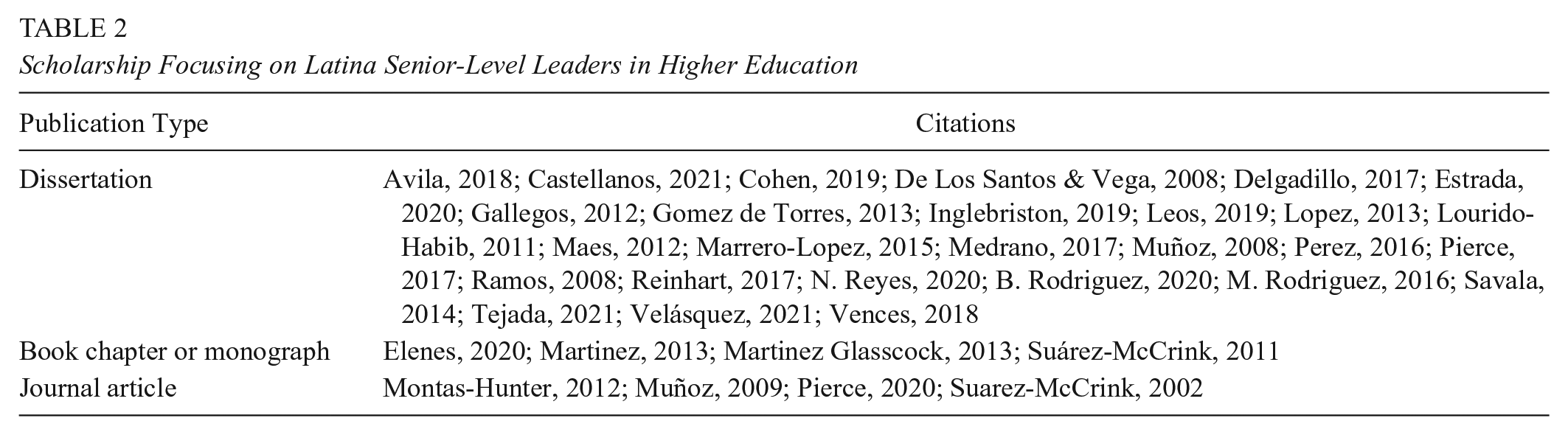
Moreover, a significant amount of the scholarship we analyzed investigated how gender influenced the realities of senior Latinx/a/o leaders. However, it is important to note that the amount of research attending specifically to Latina women far outweighed the literature on Latino male leaders and topics of masculinities (Burmicky, 2022a; Ortiz, 2016). As consistent with the broader literature on Latinx/a/o senior leaders, the majority of scholarship on Latinas in these positions specifically is in dissertations. For all the pieces focusing on Latina women broken up by publication type, see Table 2.
Scholarship Focusing on Latina Senior-Level Leaders in Higher Education
What was present in this large body of research is explorations of how gendered norms were common in the levels of leadership that individuals occupied and, also, how these women’s gender inspired their styles of leadership. An example of this appeared in B. Rodrigu-ez’s (2020) dissertation on Latina presidents at 4-year institutions. As one of her research questions involved how gender (and ethnicity) affected their leadership de-velopment and trajectories, the results that we identified described how these Latinas saw their womanhood as instrumental to their presidential leadership. Specifically, they noted how they sought to challenge and overcome gender stereotypes/standards, together with desiring to se-rve minoritized groups. Interestingly, Burmicky’s (2022a) research on Latino college presidents revealed how men in these positions also benefited greatly from the women in their lives.
Less common identities that authors highlighted in their work involved socioeconomic struggles (Gomez de Torres, 2013), having accents and being foreign-born (Estrada, 2020; Gomez de Torres, 2013), spirituality/religion (A. Reyes, 2018), and identifying as an immigrant (F. Rodriguez, 2005). Like the literature that addressed gender, race, and ethnicity, these pieces both explored the barriers that leaders faced connected to these identities but also how they drew inspiration and attributed their trajectory to these identities. This focus was apparent in A. Reyes’s (2018) dissertation on Mexican(o)/Chican(o) California community college CEOs where he spotlighted “a strong sense of spirituality based on Catholicism, indigenous mysticism, and liberation theology” that his participants possessed (p. 59). Namely, these individuals described how “acceptance of faith and fortune” related to their spiritual beliefs was part of their journey toward being a CEO (p. 61). On top of these insights, authors exploring the role of social identities in the leadership practices and trajectories of Latinx/a/o senior-level leaders also commented on the structural barriers they encountered relevant to these identities, part of the focus of our subsequent findings.
Influence of Environmental and Structural Conditions
In addition to individual traits and identity-based differences, our exploration of the literature suggested that there are environmental and structural conditions that shape the leadership trajectories of Latinx/a/o senior leaders. A significant number of pieces focused on institutional settings (e.g., community colleges, Hispanic-serving institutions), key geographic contexts (e.g., California, Texas, US/Me-xico border), and interlocking systems of oppression (e.g., White supremacy, racism, patriarchy, tokenism) that influenced their experiences and outcomes. In what follows, we explain how each of these environmental and structural conditions were discussed in the literature.
Institutional Settings of Interest
Several scholars discussed the experiences of Latinx/a/o senior leaders in community colleges and Hispanic-serving institutions (HSIs; e.g., Avila, 2018; Cohen, 2019; Doran, 2019; Lourido-Habib, 2011; Medrano, 2017; Reinhart, 2017). Community colleges were the most studied sector within the body of work of Latinx/a/o senior leadership, and many of these studies were focused on lessons learned for how to lead community colleges as a Latinx/a/o leader. For example, Muñoz (2008, 2009) focused specifically on the factors that have the greatest impact on Latina community college presidents, as well as the barriers that Latinas overcome in their path to the presidency. This type of career exploration (and preparation) among community college Latinx/a/o senior leaders was noted across various other works (e.g., Burmicky, 2021; Reinhart, 2017; A. Reyes, 2018). Given that Latinx/a/o leaders faced systemic challenges that inhibited their professional advancement (e.g., racism, stereotyping, microaggressions), they relied heavily on mentorship, especially mentors with marginalized identities (e.g., women, Latinx/a/o; e.g., Roman-Buday, 2021); pursuit of higher education, especially terminal degrees (e.g., Burmicky, 2022a; Muñoz, 2009); and support from their institution to pursue professional development (e.g., leadership institutes; Suárez-McCrink, 2011).
The pieces that took place at HSIs were much fewer and had a bigger emphasis on how Latinx/a/o leaders acknowledged their institution’s history and context for leading and responding to student issues. For instance, through the use of individual interviews and historical data (e.g., oral history, social media archives), Doran (2019) examined how former University of Texas at San Antonio, an HSI, president Ricardo Romo responded to and supported the students who participated in a hunger strike. Doran’s analysis took into consideration Romo’s background as a student of the Civil Rights Movement and native of San Antonio, a predominantly Latinx/a/o city. This piece acknowledged not only the context and history of this particular HSI and its city but also how President Romo’s identity as a Chicanx leader influenced his perceptions and responses to the student strike. A different study by Medrano (2017) examined the role that mentoring at HSIs played in the career path of first-generation Mexican American women. Similar to Doran (2019), Medrano acknowledged how HSI contexts shaped both the educational and leadership environments of the participants. Reinhart (2017) was one of the few who collected data from Latina presidents who were solely from community colleges with HSI designation. Burmicky (2022a) also collected data from Latino male presidents who were in community colleges with HSI designation, but his data also included presidents from other types of institutions (i.e., bachelor’s-degree-granting institutions, predominantly White institutions). Across the board, both pieces that took place in community colleges and HSIs emphasized mentoring as a key tool for professionals to overcome systemic barriers and build their self-confidence.
Salient Geographic Contexts
In terms of geographical contexts, scholars spotlighted states like California and Texas the most (e.g., Castellanos, 2021; Delgadillo, 2017; López, 2013; Perez, 2016; Pierce, 2020; A. Reyes, 2018; N. Reyes, 2020). This geographic pattern is not surprising given that these two states are home to the largest percentage of Latinx/a/o individuals in the country (Passel et al., 2022). Another noteworthy context highlighted in the literature was border regions, especially the US/Mexico border (e.g., Velásquez, 2021). A common thread across these studies was that the majority focused on the career experiences and trajectories of Latinx/a/o senior administrators at institutions in these key regions. For example, Perez (2016) conducted a study among student affairs senior-level Latinas in Texas. In this study, Perez used location as a means for identifying participants who could speak of their mentoring experiences as Latina (more specifically, Mexican and Chicana) student affairs professionals. Through a phenomenological approach, Reinhart (2017) explored the factors that influenced aspiring Latinas’ need to reach the role of Texas community college presidents. A. Reyes (2018) used theories such as critical race theory and community cultural wealth to review the motivating influences that contributed to the leadership practices of Chicanx/a/o and Mexicanx/a/o California community college executive leaders. Many of these pieces noted that despite the growth of Latinx/a/o students in these locations, senior Latinx/a/o leaders continue to navigate barriers throughout their ascension to the presidency, especially since White and Eurocentric norms and ideologies continue to shape policies and practices at these institutions (Elenes, 2020; Roman-Buday, 2021).
Interlocking Systems of Oppression
Lastly, various studies were conducted to understand how senior Latinx/a/o leaders navigated interlocking systems of oppression—mainly racism, White supremacy, patriarchy, and sexism. Most studies highlighted the necessity to leverage various forms of social capital to overcome these barriers, including but not limited to family, culture, navigational capital, resistance capital, and aspirational capital (A. Reyes, 2018). As underscored by Roman-Buday (2021), many Latinx/a/os are denied opportunities for advancement as a result of these barriers, which are prevalent across all types of institutions. A prominent theme across several studies was the acknowledgment of patriarchy (often referenced as machismo) and sexism as a pervasive barrier that inhibits the trajectory of Latinx/a/o leaders, more specifically leaders who identify as women. This trend led us to identify a proliferation of studies centered on Latinx/a/o leaders who identify as women (e.g., Delgadillo, 2017; Tejada, 2021; Vences, 2018), as highlighted in our first finding. As an example, Lourido-Habib (2011) noted that some Latina presidents in this study were treated poorly by peers who were Latino men, even more so than non-Latino men, mainly because of the role that machismo played in Latinx/a/o culture. Overall, most studies focused on Latina senior leaders provided countless examples of the ways in which oppressive forces such as patriarchy and sexism added yet another layer of challenges to the career ascension of these individuals (Muñoz, 2009). Similarly, many studies also focused on the pervasive role that racism and White supremacy played in inhibiting the career ascension of Latinx/a/o leaders. Given these challenges, we identified several pieces that applied critical theories focused on historically marginalized populations that challenged systems of oppression, including but not limited to critical race theory (as well as Latino critical theory), borderlands theory, intersectionality, and community cultural wealth (e.g., Burmicky, 2022a; Leos, 2019; Marrero-Lopez, 2015; A. Reyes, 2018; Velásquez, 2021; Vences, 2018). Scholars often cited these theories as a means to interrogate systems of oppression, as well as to apply an asset-based approach to describe how Latinx/a/o senior leaders overcame various barriers to their career ascension.
Literature Describing Latinx/a/o Senior Leaders’ Leadership Pathways and Values
Our systematic review showed that there are several pathways to leadership for Latinx/a/o senior leaders in higher education, which allowed us to detail factors that contributed to how Latinx/a/o leaders navigated challenges and opportunities in higher education. In this section, we discuss some of the pathways to leadership, including leadership institutes and programs, direct and indirect mentorship, educational attainment, family support, lived experiences, and cultural and leadership values.
Leadership Institutes and Mentorship
In Table 3, we outlined several studies that elevated the importance of leadership preparation institutes. Roman-Buday (2021) argued that many leadership programs do not address the specific challenges faced by Latinxs/as/os in higher education and do not provide opportunities to strategically increase the number of Latinx/a/o professionals at those levels. F. Rodriguez (2005) contended that leadership development programs create pathways for Latinx/a/o executives to penetrate glass ceilings in higher education; their study found that institutes that covered central topics, such as (a) strategic planning, (b) enrollment management, (c) budget development, (d) participatory governance, (e) collective bargaining, (f) technology, (g) governing board–president relations, (h) facilities planning, (i) institutional advancement, and (j) community relations, demystified the role of presidency and provided prospective executives with the skills and confidence to pursue presidency (F. Rodriguez, 2005). For many presidents, leadership programs afforded them with the social capital and mentorship they needed to take on the path to presidency (Villarreal, 2020). However, leadership institutes alone are not enough to close the Latinx/a/o executive leadership equity gap in higher education (Roman-Buday, 2021). Table 3 provides a visual representation of these leadership institutes and their respective founding organizations and/or institutions.
Leadership Institutes as Named by the 57 Pieces of Scholarship on Latinx/a/o Senior-Level Leaders in Higher Education

In addition to leadership institutes, so too were direct and indirect mentorship relationships formative across studies. Drawing from a college presidency survey, F. Rodriguez (2005) emphasized that the three main principles to achieving college presidency are leadership programs, exposure to varying college experiences with diverse levels of responsibility, and mentorship. Mentorship provides mentees with a safe space to explore new ideas with tenacity (Alcocer & Martinez, 2017). Twenty-two of the studies in this systematic review found mentorship as a major theme in their findings. Roman-Buday (2021) found that mentorship encourages leaders to model successful behaviors (i.e., those that allow them to excel at their roles), identify potential barriers, understand written and unwritten rules of navigating higher education, recognize and cultivate key partnerships, and most importantly, expand their professional networks. In a mixed-method study conducted by Muñoz (2008), an overwhelming majority of participants—77%—stated they had a mentor prior to assuming their role as president. However, Savala’s (2014) study suggested that mentoring college students is also critical to bridging the diversity gap and creating a pipeline for Latinxs/as/os in higher education. As stated by one of Savala’s (2014) participants, it is important to expose undergraduate students to career pathways in higher education early on. According to Savala’s research, there is a need for more high-impact practices that foster adequate mentors to support and advocate for Latinxs/as/os leaders throughout their academic and professional careers to navigate political climate, leadership challenges, and gender/racial discrimination in higher education (Avila, 2018; Burmicky, 2021; Castellanos, 2021; Cohen, 2019; Savala, 2014).
Latina executives face different challenges in higher education than their male counterparts such as gender bias, cultural barriers, familial responsibilities/ expectations, and lack of support and mentorship opportunities (Avila, 2018, Castellanos, 2021; Cohen, 2019; Delgadillo, 2017; De Los Santos & Vega, 2008; Elenes, 2020; Tejada, 2021). Several works documented that due to gender bias and a need for a more Latina-inclusive organizational culture, Latina executives benefit from a more proactive approach to mentorship (Elenes, 2020; Tejada, 2021). As scholars have highlighted, Latina leaders should seek individuals who are willing to take the extra step to advocate on their behalf (Burmicky, 2021; Estrada, 2020; Tejada, 2021). Similarly, Pierce (2017) emphasized the importance of cross-cultural/gendered/racial mentorship. Pierce’s (2017) research suggested that the quality of the mentor and their ability to utilize a strength-based model to empower their protege is transformational in their leadership trajectory.
Role of Education, Family, and Lived Experiences
According to Villarreal (2020), there are four critical strategies for Latinx/a/o leaders' advancement in higher education: (1) prepare yourself professionally by obtaining a doctoral degree, (2) establish relationships to build social capital, (3) take responsibility by believing in your skillset, and (4) be intentional by mapping out a strategic professional plan to move up the ladder (Villarreal, 2020). Several pieces underscored that familial/spousal support is equally essential. Namely, several pieces reiterated that family support in the form of motivation, encouragement, shaping their ethnic/racial identity, influencing personal values, setting expectations, and receiving knowledge plays a vital role in Latinx/a/o leadership in higher education (Burmicky, 2022a; Cohen, 2019; Kobaissi, 2015; B. Rodriguez, 2020; F. Rodriguez, 2005; M. Rodriguez, 2016; Savala, 2014; Velásquez, 2021; Vences, 2018; Villarreal, 2020). On the other hand, family responsibility also served as the greatest barrier for some Latinx/a/o women in leadership (Cohen, 2019; N. Reyes, 2020; M. Rodriguez, 2016; Roman-Buday, 2021; Villarreal, 2020). Latinx/a/o mothers/caretakers in leadership experience unique challenges in higher education such as difficulties balancing domestic and work responsibilities, challenges relocating for work, insufficient support, male chauvinism, community pressures, self-esteem issues, and financial concerns (Cohen, 2019).
Cultural and Leadership Values
Leaders in several studies identified servant leadership and its beliefs as important values throughout the systematic reviews. Servant leadership stems from the desire for a leader to serve first and lead second (Flores, 2013; Villarreal, 2020). The values of servant leadership were deeply embedded in 17 of the studies as Latinx/a/o leaders shared similar values such as respect, honesty, service, and generosity (Avila & Pankake, 2018; Castellanos, 2021; Cohen, 2019; Estrada, 2020; Flores, 2013; Hernández, 2013; Leos, 2019; Lopez, 2013; Maes, 2012; Medrano, 2017; Pierce, 2017; Rodríguez et al., 2016; N. Rodriguez, 2005; Savala, 2014; Suarez-McCrink, 2002; Velásquez, 2021; Villarreal, 2020). Additionally, Flores (2013) found that many Latinx/a/o leaders expressed how volunteerism, community activism, and desires to improve society shaped their leadership style and persistence in higher education. They viewed their roles in leadership less like work and more as connected to their mission to create a more just and equitable society for future generations (Flores, 2013). For some leaders, servant leadership combined with educational equity was the driving force in their journey to presidency (Maes, 2012).
Cultural values were also an important theme throughout the review. For example, Estrada (2020) stated that Latinx/a/o leaders’ culture and background played a significant role in their progression to leadership. As emphasized in several pieces, many Latinx/a/o leaders credited their culture and background as essential to their success, including their ability to relate to people of diverse backgrounds, understand the barriers and challenges of students who come from historically marginalized communities, and develop inclusive leadership approaches that resonate with diverse students and families, including first-generation college students, adult learners, English learners, and immigrant students, to name a few (Muñoz, 2009; F. Rodriguez, 2005). In what follows, we provide implications for research and practice rooted in our main findings.
Discussion
Through our analysis, various methodological, theoretical, and conceptual frameworks came to the forefront. Regarding methodologies, the predominant approaches in this systematic review encompassed qualitative studies (50), supplemented by a limited number of mixed methods (2), quantitative (2), and literature reviews (3). The qualitative studies included diverse data collection techniques ranging from testimonios, narrati-ve interviews, autoethnographies, and autobiographies. From an emancipatory lens, the predominance of qualitative data among researchers is justified as it allows for comprehensive and in-depth exploration and understanding of equity or the lack thereof for senior Latinx/a/o leaders in US colleges and universities. Furthermore, as highlighted in our introduction, few datasets have focused on collecting quantitative data on Latinx/a/o higher education leaders, leaving many researchers with no choice but to study these leaders through qualitative approaches. As more data becomes available on the demographics of Latinx/a/o higher education leaders, it is critical for researchers to also conduct quantitative and mixed methods studies in this topical area.
Additionally, the prominence of dissertations, constituting 35 of the reviewed articles, raises critical questions about the challenges Latinx/a/o scholars encounter in accessing and contributing to peer-reviewed journals. Although dissertations represent significant scholarly efforts, the prevalence of this format suggests potential barriers for Latinx/a/o scholars and/or scholars studying Latinx/a/o issues in navigating the complex landscape of academic publishing. Systemic bias may hinder the seamless transition from dissertation research to publication in peer-reviewed journals. For example, some journals or academic presses may find Latinx/a/o issues in higher education too nuanced or narrow to publish in their volumes and/or collections; others may not be interested in publishing pieces that touch on a specific racial group and instead may choose broader topics that include all racially minoritized groups. The limitations imposed by traditional academic structures and historical preferences may perpetuate disparities in scholarly visibility and impact. Access to publishing outlets beyond dissertations is crucial for fostering academic diversity and ensuring the representation of diverse perspectives in scholarly discourse. Addressing these challenges requires a concerted effort to dismantle systemic biases, promote inclusivity, and create supportive environments that encourage Latinx/a/o scholars to contribute their unique insights to the broader academic community. Addi-tionally, a critical examination of the existing publishing infrastructure is essential to identify and rectify barriers that hinder the equitable dissemination of knowledge generat-ed by Latinx scholars. As underscored by Rodríguez et al. (2018) model, it is critical to interrogate existing structures of oppression (e.g., traditional academic publishing processes, preference for certain topics) to produce the type of knowledge and epistemological breakthroughs that are needed in the academy, especially those rooted outside of white and Eurocentric traditions. Aligned with our epistemological stance and theoretical framework, our findings call for academic publishing outlets, editorial boards, and associate editors to implement inclusive approaches to encourage the production of scholarship for the benefit of historically marginalized communities.
The analyzed pieces utilized 49 diverse theoretical frameworks that underpinned the exploration of senior-level Latinx/a/o leadership in higher education. Spanning a wide spectrum, these theories reflect the complexity and multifaceted nature of navigating higher education as a Latinx/a/o leader. From established paradigms such as Latino critical race theory (LatCRT) and Chicana feminist thought to innovative lenses like cultural intelligence (CQ), applied critical leadership (ACL), over-the-ivy walls analysis, and glass ceiling theory, the review brings forth a comprehensive range of theoretical lenses. The inclusion of intersectionality, self-efficacy, and social cognitive theories, among others, further added layers of depth to the analytical landscape. This methodological pluralism not only highlights the versatility in approaching the research topic but also signifies a commitment to capturing the intricate interplay of cultural, social, racial, and organizational factors that shape the experiences of Latinx/a/o leaders. By drawing on a diverse array of theories, the systematic review contributes to a holistic understanding of the challenges, opportunities, and complexities inherent in senior-level leadership within higher education for the Latinx/a/o community.
This systematic review holds particular significance as it seeks to shift focus from deficit notions to acknowledging the influence of interlocking systems of oppression. Thus, the limitations identified in this review are intricately tied to systemic barriers facing Latinx/a/o senior leaders. Notably, the geographical distribution of studies, primarily concentrated in states like Texas and California, suggests a connection to the prevalence of Hispanic-serving institutions (HSIs) in these regions, as well as the growing Latinx/a/o population in these states. The preponderance of studies in areas with higher Latinx/a/o populations underscores the challenging but potentially more navigable pathways for Latinx/a/o individuals to ascend to senior leadership roles. In essence, the regional concentration reflects the nuanced interplay between systemic challenges and opportunities, whereas the presence of HSIs might, albeit difficult, provide a higher likelihood for Latinx/a/o individuals to progress into senior leadership positions compared to regions with lower Latinx/a/o populations.
Implications for Research and Practice
In reviewing the existing literature on Latinx/a/o senior leaders, we see many directions forward for research and practice to shape the field of Latinx/a/o leadership in higher education. To begin, we look to the future as we see the possibilities for scholarship in this particular area. For instance, we find it important to acknowledge that most of the literature that we were able to locate through this systematic approach was overwhelmingly in the form of doctoral dissertations. We reflect on this pattern by both remarking on how this line of inquiry is important enough for individuals to make into their culminating doctoral experience but, at the same time, wonder about what this form of dissemination means for shaping practice and policy in higher education. To put it simply, is knowledge about these critical issues (e.g., the realities that Latina senior-level leaders face) getting to the people and decision-makers who would perhaps benefit from it the most? Namely, we as authors contend that there may be a dissemination gap that currently exists concerning Latinx/a/o senior leadership—with dissertations not being as likely to reach those who can act upon study implications. With this in mind, we see a need for scholarship to be disseminated in other formats whether it be peer-reviewed journals or other “unconventional” outlets that have more digestible formats, such as policy briefs, book chapters, or opposite editorials 3 (op-ed) (to name a few). We believe that these different types of dissemination will ensure that research is finding its way into the hands of people who can enact changes to better create conditions for Latinx/a/o senior leaders.
Next, we turn toward explaining particular areas of study that people may take up based on the patterns or gaps we noticed in our systematic literature review. As noted in our findings, the scholarship does display an interest in learning about the individual-level differences that inform Latinx/a/o senior-level leaders’ leadership. An example of this is the predominant focus on Latina leaders, an important area of study. From here, we find it important to encourage researchers to continue to bring attention to the multiple forms of oppression Latinx/a/o leaders experience. When it comes to gender, for instance, in what ways do cisgender Latino leaders maintain a patriarchal system, and how do gender noncomforming or trans Latinx/a/o leaders navigate higher education environments? Related, although authors named race as a central interest of their research, we saw little attention to the presence of anti-Blackness that exists in the academy and shapes the life conditions of leaders who identify as Afro-Latinx/a/o. We also see the need to explore anti-Blackness among senior Latinx/a/o leaders and contexts in higher education, as well as phenotype and colorism. This is another system that requires further attention as it was minimally discussed in the literature but not interpreted or analyzed as such, among others (e.g., nativism, classism).
In addition to expanding the focus on individual-level identities, the field would be more informed if research addressed different environments and settings that Latinx/a/o leaders exist within. Our review unearthed the large amount of scholarship conducted at HSIs, community colleges, and to some extent, predominantly White institutions (PWIs). Yet, it is also important to validate the experiences and circumstances encountered by Latinx/a/o senior-level leaders in different types of institutions, such as historically Black colleges and universities, tribally controlled universities, and Asian American and Native American Pacific Islander–serving institutions. Given that racial realities are unique on these campuses, so too would be the contexts in which people practice leadership. Similarly, our review showcased that we know quite a bit about the realities of senior-level Latinx/a/o leaders working in states such as California and Texas. Yet, we also see value in conducting research in areas of the country where Latinx/a/o populations are often overlooked (e.g., the Midwest, East Coast, and the Great Plains). Such scholarship could review another layer of systemic exclusion that educational scholars have not explored. Furthermore, it is worth highlighting that although many of these studies collected data from California and Texas, not enough attention was given to the contextual analysis of these states but more so to the lived experiences of their participants. We encourage scholars to also condu-ct greater contextual analyses of these regions in relation to Latinx/a/o leaders to further expand their knowledge of these settings.
Another thread of scholarship that people can pursue involves the theories, frameworks, and concepts that people utilize to make meaning of these leaders’ experiences. Though not the focus of this review, we certainly noticed patterns in the theories and frameworks that researchers employed to ground their studies (e.g., LatCrit, intersectionality, community cultural wealth). Several of these theories aligned with our Latino educational leadership framework as these are critical and emancipatory theories that have studied People of Color in education, and they highlighted several assets Latinx/a/o senior leaders bring to education. Therefore, guided by recommendations such as those offered by Schilling (2017), scholars could consider conducting a content analysis of the theoretical foundations that people use in their studies on Latinx/a/o leadership to see how researchers’ study design decisions lead to particular understandings of literature. Studies such as these can thus be instrumental in developing future directions in research.
Lastly, although not central to answering our research questions, we also identified common methodologies that have been used for the study of senior Latinx/a/o leaders. Within qualitative methodologies, the approaches used included phenomenology, grounded theory, narrative inquiry, ethnography, testimony, autobiography, general qualitative approach, case study, historical methods, portraiture, and Delphi method. For quantitative methodologies, the approaches were descriptive statistics, survey design, and geographic information systems. There was one mixed methods piece that used interviews and a questionnaire. We encourage future research to take these methodologies into consideration as a means to further expand their application and/or perhaps consider other methodologies that have not been used for the study of senior Latinx/a/o leaders.
Concerning practice, we also see such potential in individuals mobilizing lessons from this systematic literature review to inform initiatives targeted toward developing leadership pipelines and bolstering leader self-efficacy for Latinx/a/o people. In our last finding, we illustrated the large body of scholarship that discusses the influence of practices like leadership institutes or mentoring. Yet, we question how the content of these relationships or programs reflects the complex realities of senior-level Latinx/a/o leaders. Specifically, it is our hope that those in the position of organizing leadership or mentorship programs would be encouraged to publish assessment reports about the effectiveness of these programs. As demonstrated by our second finding, senior-level Latinx/a/o leadership is not only shaped by individual traits or differing identities but also by systemic barriers and forms of marginalization. Therefore, the content of these programs must also acknowledge the presence of structures of oppression and what it takes to dismantle these in favor of bolstering leadership for these individuals. Similarly, it would behoove these programs to particularly center how those with multiple minoritized identities experience leadership and contexts differently. This could take the form of separate leadership institutes altogether for women or for those who identify as Afro-Latinx/a/o, for example. These experiences are not only worth documenting but also assessing to provide publicly available reports about their effectiveness.
Lastly, we are also particularly mindful that a lot of work must be done by those who set the conditions for Latinx/a/o senior-level leaders, including White colleagues. As argued by Behm Cross (2017), whiteness has shaped the American academy. Thus, it is the responsibility of those who hold majority identities to intentionally take steps to address systemic barriers faced by Latinx/a/o leaders. How are we as a profession training other senior-level leaders who do not identify as Latinx/a/o leaders or governing boards across contexts (e.g., community colleges, HSIs) to best support these individuals? In these cases, we as authors highly encourage these individuals to refer back to the literature to plan these forms of training or education.
Conclusion
We identified several patterns in the literature that allowed us to dive deeper into the experiences of senior Latinx/a/o leaders in postsecondary education. This exploration helped us understand how these leaders negotiate their identities while taking into account their own identities and contexts, namely the influence of environmental and structural conditions. As reflected in the 57 pieces of scholarship we reviewed, it is clear that the topic of senior Latinx/a/o leaders in higher education has received notable empirical attention. These pieces have shed knowledge about the lived realities of Latinx/a/o leaders in various contexts and environments, and overall, this research has been deliberate about highlighting the challenges and barriers that these leaders face across the board, especially when accounting for systems of oppression such as racism, sexism, and patriarchy, to name a few. At the same time, our exploration led us to suggest several ways in which this body of work can be expanded, and it is our hope that our implications for future research and practice are taken into consideration for moving this topic forward.
As we look at the future of senior Latinx/a/o leaders in higher education, this systematic review provides researchers, policymakers, and practitioners with a research-informed guide that highlights key issues and opportunities regarding senior Latinx/a/o leaders in higher education. For researchers, it is important to take this piece as an orienting or foundational tool of our current understanding of Latinx/a/o leaders in higher education, which could also lead to identifying key gaps in the literature that merit further investigation. For policymakers, it is critical to use this piece as a guide for implementing equity-driven policies that address the systematic barriers highlighted by these pieces, more specifically policies that acknowledge the intersecting identities and realities of these leaders. For practitioners, it is important to think about ways in which this body of knowledge could be mobilized into the hands of decision-makers, especially those who have the power and agency to create more inclusive environments for leaders at the margins. As highlighted by our findings, much of this scholarship is currently in the form of dissertations; however, we believe that much of this knowledge needs to be included in the decision-making process of our institutions, associations, and organizations committed to advancing Latinx/a/o leadership across the board.
Supplemental Material
sj-docx-1-ero-10.1177_23328584241242752 – Supplemental material for Latinx/a/o Senior Leaders in U.S Higher Education: A Systematic Review of the Literature
Supplemental material, sj-docx-1-ero-10.1177_23328584241242752 for Latinx/a/o Senior Leaders in U.S Higher Education: A Systematic Review of the Literature by Jorge Burmicky, Antonio Duran and Natalie Muñoz in AERA Open
Footnotes
Declaration of Conflicting Interests
The author(s) declared no potential conflicts of interest with respect to the research, authorship, and/or publication of this article.
Funding
The author(s) received no financial support for the research, authorship, and/or publication of this article.

Supplemental Material
Supplemental material for this article is available online.
Notes
Authors
JORGE BURMICKY is an assistant professor of higher education leadership and policy studies at Howard University; 2441 4th Street NW, Room 207, Washington, DC 20059; email:
ANTONIO DURAN is an assistant professor of higher and postsecondary education at Arizona State University, H.B. Farmer Education Building, 1050 S Forest Mall, 310A, Tempe, AZ 85281; email:
NATALIE MUÑOZ is a tenure-track assistant professor at Rutgers University-Newark Department of Social Work; 360 Dr. Martin Luther King Jr. Blvd, Office #417, Newark, NJ 07103; email:
References
Supplementary Material
Please find the following supplemental material available below.
For Open Access articles published under a Creative Commons License, all supplemental material carries the same license as the article it is associated with.
For non-Open Access articles published, all supplemental material carries a non-exclusive license, and permission requests for re-use of supplemental material or any part of supplemental material shall be sent directly to the copyright owner as specified in the copyright notice associated with the article.
