




Abstract
Children need rich language learning experiences in school to build language and reading skills. Research suggests that various effective ways to support teacher provision of these experiences. The Classroom Promotion of Oral Language cluster randomized controlled trial (n = 1,360 students; 687 intervention, 673 control) examined whether a teacher professional learning intervention targeting oral language in the first years of school led to improved student outcomes compared to usual teaching practices. The intervention comprised face-to-face professional learning and ongoing support. The primary outcome was student reading ability at Grade 3; secondary outcomes included oral language, reading, and mental health at Grades 1 and 3. No differences were detected between the intervention and control arms. Implications of results and future directions are explored.
Keywords
Importance of Language Skills for Student Literacy and Learning and Outcomes
Oral language has been defined as the “ability to engage successfully with a range of communication partners via the spoken word, in order to conduct a wide variety of personal, social, educational, commercial and professional relationships. Such engagement should be reciprocal at the level appropriate to the nature of the interpersonal relationship and should confirm to a range of developmental, cultural, and socio-linguistic norms” (Snow, 2009, p. 102). Oral language competence is central to children’s learning (Dickinson et al., 2010). It is a predictor of future learning and the primary tool by which learning takes place in the classroom; part of the process and the product of learning (Dubois et al., 2020; Snowling & Hulme, 2012; Young et al., 2002). In the early years of schooling, wide-ranging oral language skills (across phonology, morphology, syntax, semantics, and pragmatics) need to be engaged synergistically as the foundation for the acquisition of literacy skills, 1 including the ability to decode, understand text of different types, write, spell, and learn from text across the curriculum (Castles et al., 2018; Konza, 2014; Munro, 2011; Nation, 2019; Snowling & Hulme, 2012). To actively engage in education, develop literacy skills, and apply them in other areas of the curriculum, children first need to understand oral language and use it effectively. For example, the literature shows consistent evidence of a strong relationship between language proficiency and the acquisition of numeracy skills and achievement in mathematics (Abedi & Lord, 2011; Chen & Chalhoub-Deville, 2016; Purpura & Reid, 2016; Toll & Van Luit, 2014).
The link between language and literacy is reciprocal throughout the school years, with improvements in one domain advantageous to the skills in the other (Muter et al., 2004; Snow, 2016; Snowling & Hulme, 2012). As noted by Castles et al. (2018), however, “the writing system matters” in this equation because “the ultimate goal of reading—comprehension—is not a unitary construct but a multifaceted process” (p. 38). They further note that even in languages such as English that have a deep orthography, pronunciation remains strongly determined by spelling-sound relationships. This point is reinforced by Nation’s (2019) recent reconceptualization of Gough and Tunmer’s (1986) Simple View of Reading, a framework that represents reading comprehension as the product of decoding (word recognition) and language comprehension. Nation draws on the profiles of students who struggle with reading comprehension for different underlying reasons and suggests that “it might be that our visual representation needs to be more complex, with some underlying language factor feeding into both components, and/or bi-directional connections between decoding and linguistic comprehension” (2019, p. 67).
Long-Term and Broader Impact of Oral Language and Literacy Difficulties
Oral language development is also linked with children’s social-emotional and behavioral development, and difficulties in these areas often co-occur (Bretherton et al., 2013; Clegg et al., 2015; Levickis et al., 2018). Language difficulties in preschool and the early elementary school years have been found to be associated with social-emotional and behavioral difficulties, although fluidity and variability exist in the development of both (Levickis et al., 2018). Language and literacy proficiency also affects mental health and overall well-being as children progress through school. Children who do not master literacy in the early years of schooling may display a range of behavioral, social, vocational, and social-emotional difficulties into adolescence and adulthood (Law et al., 2009; Schoon et al., 2010).
Difficulties with oral language and literacy are some of the most common developmental problems in the school-aged population (Bishop & Snowling, 2004; Tomblin et al., 1997), with serious ramifications for individual life trajectories and broader population-level social and economic costs (Conti-Ramsden et al., 2018; Law et al., 2009). Given how important oral language competence is for reading success, strategic teaching efforts to promote student oral language skills in the early years of school should lead to improved reading and literacy skills, mental health and social and emotional well-being, and academic trajectories.
Teacher Knowledge of Oral Language and Literacy
To meet the oral language needs of all students and to implement effective language and reading instruction, teachers need to understand the linguistic basis of oral language and written text and be able to teach this to novices (Arrow et al., 2019; Binks-Cantrell et al., 2012; Konza, 2014). Recommendations arising from three international inquiries into the teaching of reading suggested that students should be explicitly taught skills that contribute to oral language knowledge, including phonemic awareness, phonics, vocabulary, comprehension, and fluency, as well as being given regular opportunities to engage with quality children’s literature (National Institute of Child Health and Development, 2000; Rose, 2006; Rowe, 2005). Findings from the inquiries indicated that effective teaching of reading is informed by an in-depth knowledge of language content, how to teach it (pedagogy), knowledge of how students learn, and an understanding of the relationship between reading and oral language proficiency. The fundamental contribution of early oral language development to longer-term literacy outcomes has been further emphasized in more recent literature (e.g., Cervetti et al., 2020; Dickinson, 2011; Dickinson et al., 2010; Konza, 2014). The need for teachers to “understand the links between oral language and subsequent reading development” has been highlighted in particular “so they can support the oral skills of all their students . . . particularly those whose skills are not as advanced as their peers” (Konza, 2014, p. 158). This intrinsic relationship between oral language and literacy means that effective reading instruction requires teachers to have explicit knowledge of oral language constructs and conventions (e.g., defining such terms as phoneme and morpheme) and an implicit ability to apply this knowledge (e.g., phoneme or morpheme awareness; Binks-Cantrell et al., 2012).
However, despite the research supporting the importance of language content knowledge, evidence indicates that preservice and practicing teachers often lack the requisite explicit knowledge of language and literacy, or the relevant pedagogic knowledge, to adequately teach it (e.g., Bos et al., 2001; Pittman et al., 2020; Stark et al., 2016). Many new-graduate teachers in the United States and Australia report having a low level of readiness and confidence for teaching early reading and reading-related skills, including oral language (Meeks et al., 2017). Although it is widely acknowledged that improvements in teacher preparation for implementation of effective reading instruction are needed, it has also been argued that preparation needs to extend beyond the explicit knowledge of language content they will be teaching to also include specific, targeted, ongoing expert guidance on exactly how to apply their knowledge and skills and adapt to diverse student needs (Hindman et al., 2020; Hudson et al., 2021). The process for improving preparedness to teach language and early reading should be focused on preservice and practicing educators (Moats, 2020); however, the study described in this paper focused on improving the knowledge and skills of the existing workforce.
Professional Learning and Teacher Effectiveness
Professional learning (PL) 2 is considered an effective approach for improving educators’ content and pedagogical knowledge and teaching quality (Basma & Savage, 2018; Desimone, 2009; Markussen-Brown et al., 2017; Timperley et al., 2007). Desimone (2009) observes that there is a broad consensus in the literature regarding the features of PL that increase teacher knowledge and skills as well as strengthening student outcomes. These include a content focus, active learning, coherence, duration, and collective participation. Several studies emphasize the importance of PL interventions that allow teachers to relate prior knowledge to new understanding through a series of sustained or related experiences rather than one-off workshops/presentations (Pianta, 2011; Villegas-Reimers, 2003). Individualized guidance and regular follow-up support and feedback on implementation of evidence-based practices in classrooms improve teaching quality (Pianta, 2011; Villegas-Reimers, 2003). Finally, opportunities for teachers to reflect on their practice, participate in collaborative discussion, and develop and share new knowledge and beliefs about content and pedagogy inform their development and practice (Darling-Hammond & McLaughlin, 2011).
Teacher PL and Student Reading Outcomes: Mixed Evidence
Studies related to the impact of teacher PL on student reading achievement, more specifically, have reported variable findings in terms of magnitude and interpretation of findings. Recent discussions of the target magnitude of effect sizes (i.e., the overall strength of a phenomenon) in field-based education intervention research suggest that conceptions of “meaningful” effect sizes need to be reconsidered. Studies are more likely to demonstrate a larger effect on outcomes that are measured soon after the intervention is completed and are closely aligned to the intervention (Kraft, 2020). Kraft argues that it is appropriate to consider a treatment effect of 0.2 or greater as large (and 0.05 to less than 0.2 as medium), especially for students’ achievement outcomes that are the result of cumulative decisions and sustained effort over time and are derived from measures that are distal to the intervention. However, this is a significant departure from Cohen’s (1988) widely applied benchmarks, whereby an effect size of 0.2 is considered small, 0.5 is considered medium, and greater than 0.8 is considered large.
In a systematic review and meta-analysis of teacher professional development and elementary student literacy growth, Basma and Savage (2018) report an effect size of 0.225 (Hedges’ g) and note that several of the studies reviewed lacked methodological rigor. In a meta-analysis of the effectiveness of language- and literacy-focused PL for educators working with 3- to 6-year-old children, Markussen-Brown et al. (2017) report a pooled standardized mean difference of 0.3 for phonological awareness and 0.12 for alphabet knowledge (calculated from a subgroup of 9 and 11 trials, respectively). However, some studies have reported more promising findings. Larger effect sizes (e.g., d = 0.33 and 0.36) were demonstrated in Snow et al.’s (2014) previously conducted randomized controlled trial (RCT) examining the extent to which a teacher PL intervention concerning strengthening oral language competence helps improve student oral language and reading performance in the first 2 years of school. An even larger treatment effect (d = 0.88) was demonstrated in Gillon et al.’s (2019) study investigating the impact of a teacher PL and class-level intervention on improving students’ phonological awareness, letter knowledge, and vocabulary knowledge immediately after the PL intervention was delivered in their first year of school. However, this study employed the weaker before and after study design, without a control group, and did not include any follow-up to monitor the longer-term impact of the intervention (Gillon et al., 2019).
Despite the substantial ongoing investment into, and widespread use of, teacher PL interventions across the education sector, evidence of impact on student performance from large-scale RCTs focusing on teacher PL is mixed (Basma & Savage, 2018; Desimone, 2009; Meiers & Ingvarson, 2005; Pianta, 2011). Findings from several large RCTs examining the impact of PL on teacher knowledge, instructional practice, and student achievement have been reported in U.S. Department of Education publications. For example, Garet et al. (2008) examine the impact of two teacher PL interventions in early reading instruction on the reading achievement of students in 90 high-poverty schools (involving 270 Grade 2 teachers). Findings indicated that although the interventions had a positive impact on teacher knowledge of reading instruction (effect sizes = 0.37 and 0.38) and one of the three instructional practices promoted by the intervention (effect sizes = 0.33 and 0.53), there was no evidence of an impact on student outcomes. Similarly, another two U.S. Department of Education–commissioned RCTs of PL interventions focused on mathematics content knowledge were conducted (Garet et al., 2010, 2016). They were both large studies involving Grade 7 teachers from 77 schools (Garet et al., 2010) and Grade 4 teachers from 94 schools (Garet et al., 2016), but only one demonstrated a positive impact on teacher knowledge (effect size = 0.63; Garet et al., 2016). Although there was an impact on some aspects of instructional practice in both studies, this did not translate to improved student achievement.
The extent to which PL is an effective vehicle to change teacher knowledge or skills and improve student skills (Desimone, 2009) in language and literacy has not been adequately tested. Rigorous research into the links between teacher knowledge, classroom practice and interactions to foster student language and literacy development, and student outcomes is necessary if these relationships are to be understood with relevant practices and then leveraged for scale (Binks-Cantrell et al., 2012; Dickinson, 2011).
This Study
This RCT (Goldfeld et al., 2017) was designed with three aims. The main aim was to examine whether the Classroom Promotion of Oral Language (CPOL) intervention, a specifically designed teacher PL that targeted oral language learning in the first 2 years of schooling, improves teacher knowledge and practice and, subsequently, oral language and reading outcomes for early years’ school children over regular teaching practice (student outcomes). This RCT was informed by the importance of oral language competence for children’s learning and acquisition of reading skills (Dubois et al., 2020; Snowling & Hulme, 2012; Young et al., 2002). The theory of change for this RCT was based on the frameworks proposed by Desimone (2009) and Guskey (2002) for designing and researching teacher PL that improves teacher knowledge and skills and/or changes their attitudes and beliefs. Teachers then use their new knowledge, skills, attitudes, and beliefs to improve the content of their instructional practice, which, in turn, increases student learning. The second aim of this RCT was to evaluate the level of teacher and school leadership engagement with the components of the CPOL PL intervention (i.e., process outcomes). The third aim of this RCT was to evaluate the cost of the resources used to deliver the CPOL PL intervention (i.e., intervention costs).
Two a priori defined secondary outcomes of this RCT have already been reported: teacher knowledge and teacher practice (Eadie et al., 2022; Goldfeld et al., 2021). This trial demonstrated that the CPOL PL intervention improved teacher knowledge in the short to medium term across areas important to the teaching of oral language and early reading instruction (Goldfeld et al., 2021). Improvement in knowledge was demonstrated by teachers in areas most aligned with the intervention content (morphology, phonemic awareness, sentence structure, and narrative discourse) and aligned with the prerequisite skills for reading identified in previous studies (Castles et al., 2018; Konza, 2014). These findings confirm that teacher oral language knowledge is amenable to change. However, findings from this RCT also demonstrated that the CPOL PL intervention and the improvement in teacher knowledge did not translate into changes in teacher instruction, as measured by an examination of their use of language in the classroom (Eadie et al., 2022). The current paper focuses on student outcomes and whether improvement in student outcomes would follow from changes in teacher knowledge.
The primary research question for this RCT is as follows:
(1) By Grade 3, do students in the CPOL PL intervention arm show improved reading achievement, compared with students in the control arm receiving regular teaching instruction?
The secondary research questions for this RCT are as follows:
(2) Do students in the intervention arm show improved (a) oral language, (b) reading comprehension, and (c) mental health at the end of Grade 1 and improved (d) writing skills, (e) language, and (f) numeracy by the end of Grade 3, compared with students in the control arm receiving regular teaching instruction?
(3) What is the level of teacher engagement with the components of the CPOL PL intervention?
(4) What is the economic cost of implementing the CPOL PL intervention?
Method
Previous Study
This trial used an adapted version of the Oral Language Supports Early Literacy (OLSEL) teacher PL program, which was first piloted in a smaller-scale cluster RCT conducted in 14 disadvantaged Catholic schools in Australia (n = 1,254 students; Snow et al., 2014). The OLSEL intervention comprised 6 days of PL for teachers and principals, school-based continuing contact with the research team, and completion of a postgraduate unit on early language and literacy by a staff member from each research school. Results indicated that students in the research arm (whose teachers had attended the PL) performed significantly better on oral language and reading measures than did students in the control arm who received standard teaching (Snow et al., 2014). Given these promising results, this trial was then conducted at scale in a larger number of schools in the Catholic and the government education sector across an Australian state. In contrast to the OLSEL program, the CPOL teacher PL intervention was designed for scalability, a necessary approach given the importance of designing an intervention that could be undertaken within reasonable school resource allocation and therefore would likely be supported by policymakers.
Study Design
This was a cluster RCT of CPOL, a teacher-led whole-of-classroom oral language promotion intervention, compared to usual teaching practice. Randomization was at the school level. The full protocol with methodological details has been published elsewhere (Goldfeld et al., 2017), but we provide the key details here.
Ethics and Trial Registration
Ethics approval was granted by the Monash University Human Ethics Committee (#CF13/2634-2013001403) and later transferred to the University of Melbourne (#1545540). The trial was registered prior to the intervention implementation (ISRCTN77681972).
Study Setting
This RCT was a multisite trial conducted in the state of Victoria, Australia. Participating elementary schools were within a geographic radius of approximately 150km from Melbourne. The schools were from the Victorian Government Department of Education and Training and the Catholic Education Commission of Victoria Ltd. (now Catholic Education Melbourne), which together account for 90% of all elementary school students in Victoria (Department of Education and Early Childhood Development, 2013).
School Recruitment
Seventy-two schools were recruited to the trial in 2014. All participating schools met the eligibility criterion of having ≥10% of children developmentally vulnerable in the language and cognitive domains of the 2009 and/or the 2012 Australian Early Development Index (now the Australian Early Development Census; Department of Education and Training, 2015a), a measure of early childhood development. School principals indicated support on behalf of their teaching staff for participating in the trial by responding to a call for expressions of interest.
Class and Teacher Selection
Following recruitment of the 72 schools, one foundation (first year of school) class from each school was randomly selected to be the index class. Data were collected only from teachers and students in these classes.
Student Consent
Once the index class was identified, informed consent was sought from a parent/guardian of the students in those classes via a hard-copy letter sent home by the teacher. Parent information statements were translated into relevant languages as required. They included opt-out consent for participants in Catholic schools and a combination of opt-in and opt-out consent for participants in government schools, as per each sector’s consent policy.
Randomization and Blinding
Participating schools were randomly assigned in a 1:1 ratio after baseline data collection to the intervention or control arm. Computer-generated block randomization was used, stratified by school sector (government or Catholic). Only the research staff (project coordinator and research assistant), CPOL implementation coaches, intervention facilitators, and schools themselves were aware of the randomization allocation. Schools were asked not to disclose this information, and all other personnel involved in the trial (i.e., outcome data collection staff, study statistician, and investigator team members) were blind to school arm allocation until the data collection was complete.
Intervention Arm
CPOL Teacher PL
All teachers (foundation to Grade 2) in schools randomized to the intervention arm were invited to attend 4 days of face-to-face PL over a period of 10 months. In addition, two supplementary components enhanced implementation and sustainability: (a) a self-directed online learning network of teachers and (b) intermittent access to support from a CPOL implementation coach who undertook face-to-face, telephone, and online communications.
PL Days
The face-to-face PL days for teachers focused on oral language skills important for the transition to literacy (Munro, 2011). The intervention content was informed by the Ideas, Conventions, Purposes, Ability to Learn, Expressive and Receptive Language (ICPALER) framework (Munro, 2011), an explicit conceptual and pedagogical framework that teachers can draw upon to promote a range of expressive and receptive language skills in their classrooms. It considers the underlying expressive and receptive language skills (e.g., phonological, morphological, semantic, syntactic, and discourse) that a child has mastered, helping teachers develop strategies that facilitate students developing more sophisticated language skills. Four language elements were emphasized in the PL intervention: phonemic and phonological awareness, vocabulary knowledge, awareness and application of story grammar to narratives, and comprehension and use of longer and more complex sentences. The face-to-face PL days for teachers were held between May 2014 (when the students were in foundation) and February 2015 (when the students were in Grade 1). An overview of the face-to-face PL content is shown in Table 1.
Overview of face-to-face PL sessions
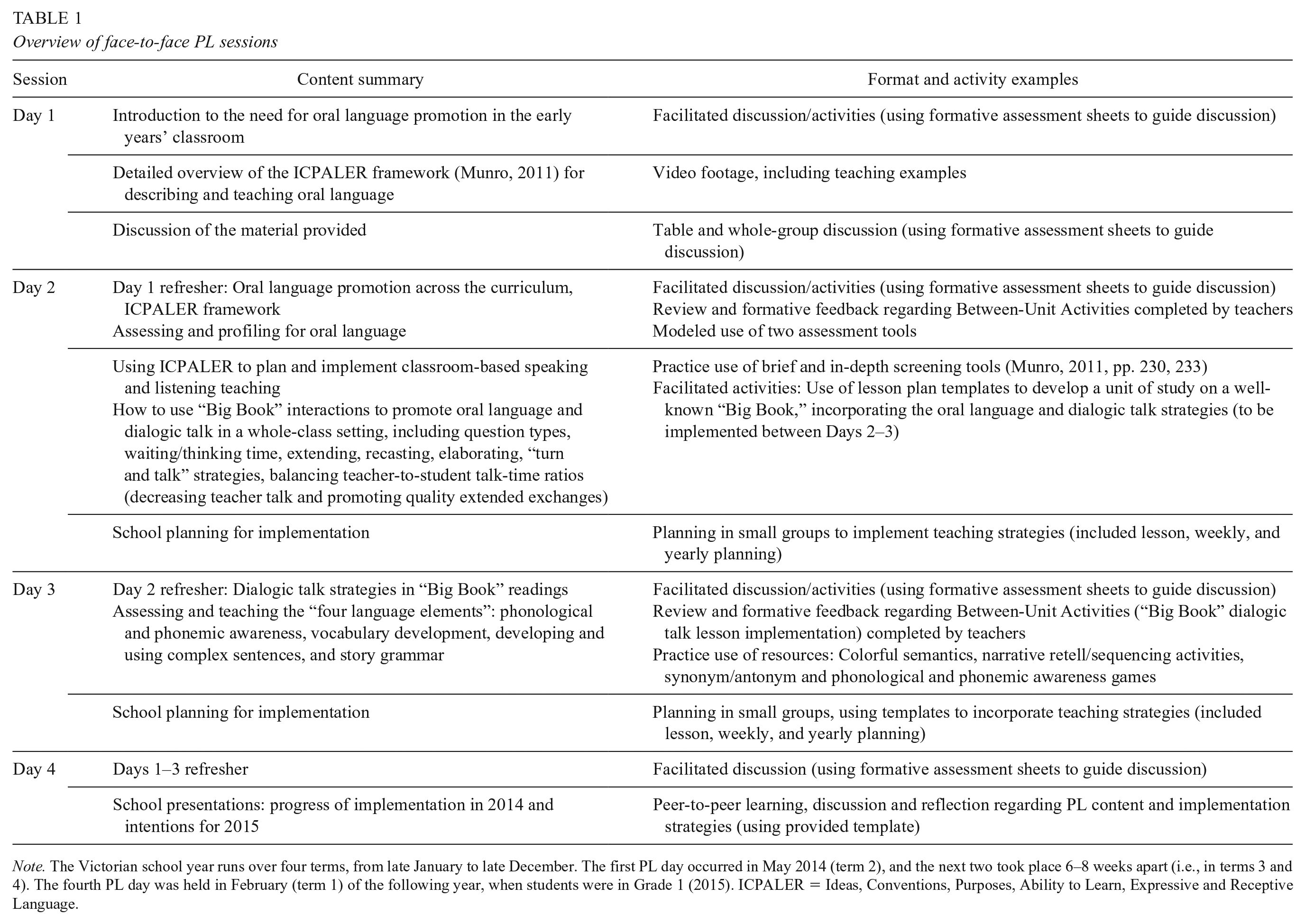
Note. The Victorian school year runs over four terms, from late January to late December. The first PL day occurred in May 2014 (term 2), and the next two took place 6–8 weeks apart (i.e., in terms 3 and 4). The fourth PL day was held in February (term 1) of the following year, when students were in Grade 1 (2015). ICPALER = Ideas, Conventions, Purposes, Ability to Learn, Expressive and Receptive Language.
Online PL Network
Teachers in intervention schools had access to a secure website containing downloadable PL notes and teaching resources, simple discussion threads, and a “frequently asked questions” section. Additional video footage was also available on the website, providing a clear overview of the PL theoretical framework and exemplars of teaching practice from schools implementing the strategies.
CPOL Implementation Coaches
Teachers in intervention schools had access to ongoing support from two implementation coaches with content expertise in oral language development and pedagogy (one an elementary school literacy leader and the other a speech-language pathologist). Both implementation coaches were recruited specifically for the role because of their experience in helping schools implement change in school-wide processes and classroom practice. The implementation coaches provided online and telephone communication and face-to-face school visits throughout the 2-year intervention period. They participated in whole-school planning meetings and assisted teachers with planning for classroom instruction and delivery of screening procedures for students.
Control Arm
Schools in the control arm conducted classroom teaching as usual. These schools were only exposed to their usual opportunities for PL. After the intervention phase of the study was complete and all teacher and student data had been collected, teachers in control schools were offered the opportunity to attend a 1-day workshop provided by the research team as a goodwill gesture.
Student Outcome Measures
A summary of the student outcome measures collected, the instruments used, and the data collection schedule are presented in Table 2.
Student outcome measures and data collection schedule

Note. A T-unit is defined as one major clause with all the subordinate clauses attached to it (Hunt, 1965). All main clauses beginning with a coordinating conjunction were counted as separate T-units. X = routinely collected by schools or education departments (researchers to access via linkage or provided by project partners). O = data collected by researchers. ATSI = Aboriginal and Torres Strait Islander; CELF-4 = Clinical Evaluation of Language Fundamentals (4th ed.); EOI = English Online Interview; ICSEA = Index of Community Socio-Educational Advantage; NAPLAN = National Assessment Program Literacy and Numeracy; NIH = National Institute of Health; RPT = Reading Progress Test; SEHQ = School Entrant Health Questionnaire; SEIFA = Socio-Economic Indexes for Areas; TPVT = Toolbox Picture Vocabulary Test; VCAA = Victorian Curriculum and Assessment Authority.
Process Measures
A process evaluation was conducted to evaluate the level of teacher engagement with the components of the CPOL intervention. Data were collected on attendance and via implementation coach observations, paper-based evaluation forms, and web analytics.
CPOL Intervention Cost
Resources used to deliver the CPOL intervention were evaluated by using provider and research team records. Teachers in all schools also reported their time spent on other PL activities over the 2-year intervention period to assess whether CPOL was associated with a reduction (cost-saving) in other PL activities. Time of all staff to provide the intervention was valued at relevant hourly wage rates (Department of Education and Training, 2015b). Travel-related expenses were valued at AUD$0.8 per kilometer traveled (Royal Automobile Club of Victoria, 2015). Overheads costs, to reflect additional costs of building, equipment, and services used by program staff, were estimated as 20% of total program costs. Costs were valued in 2016 AUD$ from a government perspective and discounted at 5% where relevant.
Sample Size and Power Calculations
This study was powered to find a difference between the intervention and control arms in the National Assessment Program Literacy and Numeracy (NAPLAN) Reading score at Grade 3 (the primary outcome; see Table 2) of 0.3 SD (i.e., 22.47 points, based on an SD of 75), with a 90% power and 5% type 1 error. An effect size of 0.3 SD was considered meaningful at a population level because a difference of 22.47 points equates to approximately a 6-month difference in progress. Allowing for an average intraclass coefficient of 0.08, an average cluster size of 17, and a potential attrition rate of 20% by the time students were in Grade 3, 700 students per arm (1,400 in total) were required in the study from 42 clusters (StataCorp, 2015).
Analysis
Populations of Analysis
Primary analysis was conducted in accordance with the intention-to-treat (ITT) principle, with student data analyzed in the study arm to which their school was randomly allocated, where outcome data were available. Per-protocol (PP) analysis was also conducted, whereby analysis was restricted only to those students:
who were exposed to 2 years of the intervention teaching and whose index teachers (or replacement) had been exposed to at least 3 intervention days (intervention students only),
whose Grade 1 teachers had been exposed to at least 3 intervention days (intervention students only),
whose school had sent at least one teacher to all 4 intervention days (intervention students only),
whose teacher did not work in any of the intervention schools during the 2-year intervention phase (control students only), or
who remained in a school in the same arm for the 2-year intervention period.
Additional PP restrictions around absence and previous employment of the teachers were not applied, as this information was not available for all the schools randomized.
Data Analysis
Baseline characteristics of the students and schools were summarized by study arm. Categorical variables are presented as the number and proportion in each category. Continuous variables are summarized as means and SD. Analysis of all continuous outcome variables, including the primary outcome, was conducted by using a mixed-effects linear regression model. These models included a fixed effect for school sector (government or Catholic), a fixed effect for intervention, and a random intercept for school. Results are presented as the unadjusted mean difference between arms, 95% confidence interval (CI) and p-value. Mean differences adjusted for potential confounders (student’s age when outcome was collected, gender, language background other than English [LBOTE], presence of language or literacy difficulties at baseline, presence of “very high” behavioral concern at baseline, whether or not student’s mother completed high school, whether the school Index of Community Socio-Educational Advantage [ICSEA] is < 1.5 * SD below the mean) are also presented. Although underpowered, we explored the presence of an interaction between intervention and school sector to determine whether the intervention effect varied across government and Catholic schools.
Frequency and patterns of missing data were examined, and sensitivity analyses were conducted by using multiple imputation to handle missing data (Sterne et al., 2009). A single model was used to impute all the missing data, using multivariate normal imputation, including all the students randomized. Multiple imputation was conducted separately in the two treatment arms, using multivariate normal imputation applied to all outcomes simultaneously, including baseline measures as auxiliary variables. Fifty imputed data sets were generated. All data analyses were conducted with the Stata software package (StataCorp, 2015).
Results
Progress of all participants through the RCT is presented in Figure 1. There were 1,362 students recruited. Two students from the intervention arm withdrew from the study before outcome data were collected, leaving 1,360 participants (687 intervention; 673 control). The characteristics of 1,362 participants (i.e., the ITT sample) at baseline are presented in Table 3. The demographic characteristics of the students, families, and schools in the two study arms were similar, as expected due to random allocation, and therefore baseline tests of imbalance are not recommended (De Boer et al., 2015).

Consolidated Standards of Reporting Trials (CONSORT) participant flow diagram
Comparison of intervention and control arm characteristics at baseline

Note. ATSI = Aboriginal and Torres Strait Islander; EOI = English Online Interview; ICSEA = Index of Community Socio-Educational Advantage; LBOTE = language background other than English; SDQ = Strengths and Difficulties Questionnaire; SEIFA, Socio-Economic Indexes for Areas.
Primary and Secondary Student Outcomes
The results from the ITT analysis are presented in Table 4 and show little evidence of a group difference in the NAPLAN Reading score at Grade 3 (primary outcome) before or after adjustment for potential confounders (Intervention 423.52 [SD 86.61] vs. Control 426.59 [87.77]; adjusted difference = −12.90 [−36.47; 10.67]; p = 0.283). Similarly, there was little evidence of a difference between the intervention and control arm on any of the secondary student outcomes (end of Grade 1) from the unadjusted or adjusted analysis (see Table 4). These results were similar following multiple imputation for missing data.
Results of unadjusted and adjusted regression analyses comparing the two trial arms on primary and secondary outcomes at Grades 1 and 3 in the ITT population

Note. Mixed-effects linear regression model includes a fixed effect for school sector (government or Catholic) and a random intercept for school. Mixed-effects linear regression model includes a fixed effect for school sector (government or Catholic), a random intercept for school, a fixed effect for student’s age when outcome is collected, gender, LBOTE status, presence of language or literacy difficulties at baseline, presence of “very high” behavioral concern at baseline, whether or not student’s mother completed high school, whether or not school’s ICSEA value < 1.5 SD below the mean ICSEA. CI = confidence interval; ES = effect size; ICSEA = Index of Community Socio-Educational Advantage; LBOTE = language background other than English; MD = mean difference; RPT = Reading Progress Test; SD = standard deviation; SDQ = Strengths and Difficulties Questionnaire.
Adjusted effect sizes for the differences between the intervention and control arms for each of the outcomes was small (Cohen, 1988) or medium (Kraft, 2020), and the direction of the effect was not consistent (see online Supplemental Figure S1). The PP analysis results were consistent with those in the ITT population (see online Supplemental Table S1 and online Supplemental Figure S2 for the PP population regression and effect size results, respectively).
Process Outcomes
Attendance at PL
Two hundred twenty-one teachers attended the 4 PL days (n = 170, 163, 147, and 145 across Days 1–4, respectively), and the mean number of days attended was 2.83. School-level attendance was maintained throughout the first year of the intervention, with all 36 schools represented at Days 1 and 2 (100% attendance) and only one school not represented at Day 3 (97% attendance). However, five schools were not represented at Day 4 (86% attendance) in the second year. The index teacher attendance dropped from 100% at Day 1, to 95%, 92%, and 80% attendance at Days 2–4, respectively. Mean number of days attended by index teachers was 3.67. Twenty-eight (77.8%) schools had a school leadership team member (e.g., principal, assistant principal, or literacy leader) attend at least one of the PL sessions, but only eight schools had leadership at every session. Two schools sent only one classroom teacher (i.e., index teachers only) to the PL days, and one school’s index teacher attended only the first day.
CPOL Implementation Coaches
The CPOL implementation coaches were available for participating teachers to use throughout the full 2-year intervention period as intended and contacted all schools to organize a visit/support. Thirty-one schools (86%) were visited by an implementation coach at least once, while five schools (14%) were not visited.
Online PL Network
The online component of the CPOL intervention was available for use throughout the intervention period as intended. However, it was not well utilized. Ten (4.5%) attendees created an online forum account, and the eight available videos were not frequently accessed (range was 5–132 plays) or watched to completion (mean percentage video watched was 27%). The web pages containing downloadable teaching resources were more frequently accessed (e.g., Day 3 resources had 1,047 views, and Days 1 and 2 resources had 268 views).
Satisfaction
Paper-based evaluation forms were completed by PL participants at the conclusion of each day to measure their satisfaction with intervention components. Response rates ranged between 83% and 91% across the 4 days of PL. Despite some dissatisfaction with the video format used on the first day of the intervention (M = 3.79, SD = 1.04), overall satisfaction with the PL was high, with mean ratings across the 4 days ranging between 4.1 and 4.5 out of 5. Participants also rated the overall usefulness of the face-to-face PL days and the implementation coaches highly, with mean scores of 4.24 (SD = 0.81) and 4.08 (SD = 0.95).
CPOL Intervention Costs
The total cost of implementing the CPOL intervention was AUD$241,294, or AUD$6,703 per school. This sum comprises the cost of running the 4 PL days (48% per student), setting up and monitoring the website and online forum (2%), supporting schools over the 2-year intervention period (26%), and handling overhead costs, such as equipment and office space used by implementation staff (24%). To compare costs to individual outcomes in this paper, the cost of implementing the CPOL intervention can be presented as cost per student (e.g., AUD$351 per student in the intervention arm). However, the intervention potentially benefits other students in the intervention schools that were not in the index classes because the benefits of PL to index and other teachers will apply to students in other classes. If costs are distributed over all children in early school years, the average cost of the CPOL intervention per student would be much lower (e.g., AUD$59 per student, assuming that a school has three classes per grade and that each class has an average of 19 students). There was no statistically significant difference in the time (in hours) that teachers spent on other PL activities between intervention and control schools (MD = 30 hours; p = 0.9).
Discussion
We aimed to determine whether teacher PL intervention that focused on oral language learning in the first 2 years of schooling would improve oral language, literacy and mental health outcomes for students compared with usual teaching practice. We found no evidence of impact on these student outcomes, with no differences between the intervention and control arms detected. Therefore, within the short time frame of the CPOL intervention (2 years), there is no evidence to support the cost-effectiveness of the intervention to improve student outcomes. Despite the short- to medium-term improved teacher knowledge (Goldfeld et al., 2021) and a well-attended PL program, we did not find a commensurate impact on teachers’ use of language in their classroom instruction (Eadie et al., 2022) or student outcomes when taken to scale (with 72 schools), unlike the original OLSEL intervention on which this effectiveness trial was based (in 14 schools; Snow et al., 2014).
These results replicate findings from previous trials of teacher PL interventions in oral language, early reading instruction, and mathematics, a number of which have failed to demonstrate a sustained change in teacher knowledge and classroom practices and/or long-lasting positive student outcomes following intervention (Bos et al., 2001; Garet et al., 2008, 2010, 2016). Further, Arrow et al.’s (2019) study examining the language and linguistic knowledge and instructional practices of teachers in New Zealand found that even teachers with high levels of explicit linguistic knowledge did not necessarily apply that knowledge to their teaching practice. This suggests that delivering PL intervention to teachers may not be sufficient to change teacher practices and student outcomes.
A number of explanations could account for the lack of translation from teacher knowledge (Goldfeld et al., 2021) to teachers’ actual use of language in classroom instruction (Eadie et al., 2022) and student outcomes in our scaled-up intervention trial. For example, the content and/or delivery of the CPOL PL intervention may have weaknesses or flaws. However, given the promising results demonstrated in the earlier OLSEL study (Snow et al., 2014) and the attention given to the evidence base from which the PL was derived, this does not seem the most likely explanation. Alternatively, the content and efficacy of the CPOL PL may be appropriate, but proper implementation of the intervention at scale is problematic. The implementation of effective interventions into practice is a perennial issue that crosses professional paradigms and is well documented (Century & Cassata, 2016). An Australian Council for Educational Research report examining the links between teacher PL and student learning outcomes emphasizes the influence of school contextual factors on the implementation and sustainability of the intended outcomes of PL (Meiers & Ingvarson, 2005), and these may have influenced our findings in ways that we did not measure. The Australian Council for Educational Research report indicates that PL is strongly influenced by the context in which teachers practice and that the day-to-day realities of school life can obstruct teaching and student learning. Further, teachers can struggle to find the time they need for planning, collaboration, and reflection (Meiers & Ingvarson, 2005). Leadership support and commitment over time are therefore considered a crucial mediating influence on implementation of change (Meiers & Ingvarson, 2005) but were not measured in this trial.
It is also possible that the implementation of the CPOL intervention in our study was compromised by insufficient support for teachers. Specifically, in the previously conducted OLSEL trial, a high level of support was embedded in the study, with an “oral language leader” nominated in each participating school to support implementation and enroll in a master’s-level subject at university focusing on classroom oral language and literacy learning in the early school years (Snow et al., 2014). However, the same high level of support was not incorporated into this larger-scale trial because of resourcing limitations. In fact, attendance at the face-to-face PL sessions dropped over time, and not all teachers took full advantage of the implementation coach and online PL network components of the CPOL intervention. In the implementation research field, the provision of support strategies for end users (individuals and organizations) putting learning into practice is considered “vital to change efforts” (Century & Cassata, 2016, p. 186). More specifically, the amount of implementation support provided to teachers is important, and after being trained in a new practice, newly graduated and highly experienced educators often struggle when trying to apply the new knowledge and practices in the classroom and to the curriculum (Albers & Pattuwage, 2017). It is possible that the level of support necessary to effect student change was underestimated and underutilized in this trial, which was designed with an emphasis on implementation scalability.
Finally, although the CPOL intervention was conducted over 2 years, this time may have been insufficient to allow teachers to understand, accept, and use new practices; for these practices to influence student learning; and for impact on student outcomes to become evident (Meiers & Ingvarson, 2005). Change in the education context takes time to become embedded and for student outcomes to then become apparent. As has been noted by Meiers and Ingvarson (2005), “a longitudinal view of changed is needed” if the impact of PL is assessed by measuring student learning (p. 4).
It may be that an even more comprehensive and multifaceted approach to improving student oral language and literacy outcomes is necessary, whereby a range of well-tested, well-implemented, universal, and targeted interventions is required to bring about change. For example, teacher PL, such as the CPOL intervention, focused on ensuring quality, evidence-based oral language, and literacy classroom instruction. This should be implemented alongside a more targeted, purposeful intervention approach that is responsive to variations in oral language ability in the classroom and intended to meet the needs of those students who do require more intensive, specific, and individualized support (Grosche & Volpe, 2013). Alternatively, bodies accrediting initial teacher education programs could be encouraged to incorporate features of high-impact oral language and literacy instruction into their requirements, so that graduating teachers enter classrooms better equipped to maximize the performance of their students. This notion is reflected in the current climate in the United States, where laws requiring preservice teachers (and, increasingly, in-service teachers) to use reading instruction that is grounded in research have recently been enacted by many states (Solari et al., 2020). In addition, educational policy initiatives at the federal, state, and local levels encourage schools to make evidence-based decisions, with a strategic focus on translating evidence around the science of reading into instructional practice and raising student reading outcomes (Solari et al., 2020). Similarly, in Australia, there is increasing interest in advancing the use of evidence in education and equipping teachers to use research-informed, high-quality instruction in schools (Australian Education Research Organisation, 2021).
Teacher and student learning processes are complex, and it is therefore challenging to identify the ways in which PL might influence changes in teacher knowledge and practices that are sustained and of sufficient quality to ensure that improved student outcomes follow (Burchinal et al., 2010; Meiers & Ingvarson, 2005; Villegas-Reimers, 2003). Although we acknowledge the inherent complexity of this field of research, the need for implementation and systematic evaluation of evidence-based practice in the “real-life” classroom context is nevertheless critical. Therefore, the role of implementation in high-quality educational practice requires further exploration. The notion that a certain level or threshold in the quality of practice and teacher-student classroom interactions is required to be reached and then maintained to see positive student outcomes has been discussed in the early childhood literature (e.g., Burchinal et al., 2010; Pianta, 2011) and may also be relevant here. Notwithstanding possible improvements to teacher preservice education, it may be that the lynchpin to affecting outcomes is a minimum amount of practice change following PL to improve student outcomes.
Strengths and Limitations of Study
The strength of this study lies in its design, ensuring that it is one of the few methodologically rigorous studies evaluating the impact of teacher PL on student outcomes. Importantly, this study included educator (Goldfeld et al., 2021) and student outcomes. The use of data routinely collected by schools for submission to their education departments as outcomes minimized the data-collection impost in this study. Combined with brief face-to-face classroom assessments, this presents a potentially efficient model of research in schools that can be implemented at scale as well as minimizing the amount of missing data.
Study limitations included a potential bias associated with only including schools whose leaders opted-in to the study. The eligibility criteria for schools may limit the generalizability across education systems, with varying school starting ages and teacher preservice education experiences. The movement of teachers and students from participating schools affected our capacity to deliver the full “dose” of the intervention to students, with unknown impact on outcomes (i.e., we may have under- or overestimated the impact). Finally, some of our student outcome measures (e.g., mental health and numeracy) may not have been sufficiently sensitive to detect intervention impact.
Implications and Conclusions
The CPOL intervention was not effective in advancing student outcomes. Neither oral language, literacy, nor mental health at the end of Grade 1 nor numeracy, reading, and writing skills at Grade 3 compared to usual teaching practice. However, this trial has provided important insights into the challenges of implementing change in classroom teacher practices and student outcomes at scale. Rigorous testing of PL interventions is an increasing area of interest in Australia and internationally. Given the limited robust evidence to date, this study’s null findings make an important contribution to the education and health literature. They are a reminder of (a) the importance of undertaking rigorous trials to test the effectiveness of educational interventions and (b) the challenge of improving equitable reading outcomes for children at the population level to achieve the national standard of reading skills (Australian Curriculum, Assessment and Reporting Authority, 2017). Indeed, it may well be that, even at their best, whole-of-classroom interventions are necessary but not sufficient if we are to equitably address important child learning outcomes. Alongside the outcome findings, our process evaluation findings suggest that a high level of support, including classroom-based coaching and specific guidance on how to incorporate new knowledge into the curriculum and daily classroom routines, may be needed to improve implementation of evidence-based teacher practices and interventions to achieve sustainable and scalable change in practices over time and advance student outcomes (Carlisle & Berebitsky, 2011; Neuman & Wright, 2010; Timperley et al., 2007; Wasik & Hindman, 2011). The globally reported inequalities in educational outcomes (UNICEF Office of Research, 2018)—likely to be made worse by the COVID-19 pandemic—would suggest that the robust testing of educational interventions at scale with real and sustained attention to implementation across the school ecosystem is urgent and essential.
Supplemental Material
sj-docx-3-ero-10.1177_23328584221131530 – Supplemental material for Classroom Promotion of Oral Language: Outcomes From a Randomized Controlled Trial of a Whole-of-Classroom Intervention to Improve Children’s Reading Achievement
Supplemental material, sj-docx-3-ero-10.1177_23328584221131530 for Classroom Promotion of Oral Language: Outcomes From a Randomized Controlled Trial of a Whole-of-Classroom Intervention to Improve Children’s Reading Achievement by Sharon Goldfeld, Pamela Snow, Patricia Eadie, John Munro, Lisa Gold, Ha N. D. Le, Francesca Orsini, Beth Shingles, Judy Connell, Amy Watts and Tony Barnett in AERA Open
Supplemental Material
sj-png-1-ero-10.1177_23328584221131530 – Supplemental material for Classroom Promotion of Oral Language: Outcomes From a Randomized Controlled Trial of a Whole-of-Classroom Intervention to Improve Children’s Reading Achievement
Supplemental material, sj-png-1-ero-10.1177_23328584221131530 for Classroom Promotion of Oral Language: Outcomes From a Randomized Controlled Trial of a Whole-of-Classroom Intervention to Improve Children’s Reading Achievement by Sharon Goldfeld, Pamela Snow, Patricia Eadie, John Munro, Lisa Gold, Ha N. D. Le, Francesca Orsini, Beth Shingles, Judy Connell, Amy Watts and Tony Barnett in AERA Open
Supplemental Material
sj-png-2-ero-10.1177_23328584221131530 – Supplemental material for Classroom Promotion of Oral Language: Outcomes From a Randomized Controlled Trial of a Whole-of-Classroom Intervention to Improve Children’s Reading Achievement
Supplemental material, sj-png-2-ero-10.1177_23328584221131530 for Classroom Promotion of Oral Language: Outcomes From a Randomized Controlled Trial of a Whole-of-Classroom Intervention to Improve Children’s Reading Achievement by Sharon Goldfeld, Pamela Snow, Patricia Eadie, John Munro, Lisa Gold, Ha N. D. Le, Francesca Orsini, Beth Shingles, Judy Connell, Amy Watts and Tony Barnett in AERA Open
Footnotes
Acknowledgements
The CPOL RCT is a research collaboration between the University of Melbourne, Deakin University, La Trobe University, Murdoch Children’s Research Institute, Catholic Education Commission of Victoria (now Catholic Education Melbourne), Victorian Government Department of Education and Training, and The Royal Children’s Hospital Education Institute. NAPLAN data was provided by the Catholic Education Commission of Victoria, the Victorian Government Department of Education and Training, and the Victorian Curriculum and Assessment Authority (VCAA). The VCAA was not associated with and does not endorse the analysis, comments, or findings in this publication. We thank all the teachers and schools for their contributions to this study.
Funding
The work is supported by the Australian Research Council Linkage Project scheme (grant number LP: 130100308) and by the Ian Potter Foundation (Reference: 20130004). The work is also supported by Catholic Education Commission of Victoria (now Catholic Education Melbourne), Victorian Government Department of Education and Training, The Royal Children’s Hospital Education Institute, and Murdoch Children’s Research Institute (MCRI). Research at the MCRI is supported by the Victorian Government’s Operational Infrastructure Support Program. SG is supported by a NHMRC Practitioner Fellowship (GNT1155290). LG was supported by a NHMRC Early Career Fellowship (1035100). The funding bodies had no role in relation to the design and conduct of the study; collection, management, analysis, and interpretation of the data; preparation, review, or approval of the manuscript; and decision to submit the manuscript for publication.

1.
The distinction between reading and literacy is important. For the purposes of this paper and in line with the Simple View of Reading (Gough & Tunmer, 1986), reading comprehension is the product of the ability to decode and draw meaning from the printed word and includes the associated higher-level skills of sentence and text comprehension (Buckingham et al., 2013). Literacy refers to a broader set of skills, including reading, writing, spelling, and being able to create and engage with a range of text types, for different purposes and in different contexts (Buckingham et al., 2013; Snowling & Hulme, 2012).
2.
In the education literature, the terms professional development and professional learning are often used interchangeably but may be differentiated in the following way: Professional learning refers to the growth of teacher expertise, while professional development refers to the processes, activities, and experiences that provide opportunities to extend teacher professional learning (Markussen-Brown et al., 2017). In this manuscript, we have opted to use the term professional learning (PL) wherever possible.
Authors
SHARON GOLDFELD is a pediatrician, professor at the University of Melbourne, director of the Royal Children’s Hospital’s Centre for Community Child Health (CCCH), and co-group leader of Child Health Policy, Equity and Translation at the Murdoch Children’s Research Institute. Her research interests are made up of complementary, synergistic, and cross-disciplinary streams of work focused on investigating, testing, and translating sustainable policy-relevant solutions that eliminate inequities for children.
PAMELA SNOW is a professor of cognitive psychology La Trobe University, Australia. She is a speech-language pathologist and a psychologist, and her research interests are the language and literacy profiles of vulnerable children and adolescents and the application of best evidence in early years’ reading instruction.
PATRICIA EADIE is the director of the REEaCh Hub (Research in Effective Education in Early Childhood) at the University of Melbourne. Her work includes a focus on implementing high-quality teaching practices and adult-child interactions to maximize children’s learning and development outcomes, and her research has focused on typical and delayed communication and cognitive skills in young children.
JOHN MUNRO is a professor of educational psychology and exceptional learning at the Australian Catholic University. His research interests are in gifted learning and talent development, creativity, literacy, math learning and learning difficulties, instructional leadership, school improvement, and learning internationally.
LISA GOLD is an associate professor at Deakin University, Australia. She conducts empirical research into the economics of maternal and child health and development, with a focus on evaluating interventions to improve population health and well-being and reduce inequalities.
HA N. D. LE is a research fellow at Deakin University, Australia. Her research focuses on the economics of maternal and child health and development, especially evaluating interventions to improve population health and well-being.
FRANCESCA ORSINI is a biostatistician and senior researcher in the Clinical Epidemiology and Biostatistics Unit (CEBU) at Murdoch Children’s Research Institute. Her research focuses on clinical trials in a range of areas, including allergy, vaccines, preterm neonates, cerebral palsy, public health, and education.
BETH SHINGLES is a researcher in the Policy and Equity Group at the Murdoch Children’s Research Institute. Her research interests include large-scale school-based trials and how schools implement best-evidence practice in early years’ oral language and literacy instruction.
JUDY CONNELL is the manager of Learning Diversity Catholic Education Melbourne. She is responsible for the administration of key program deliverables, policy development, and targeted funding for 500+ Catholic schools in Victoria, and she is the National Catholic Education Commission (NCEC) representative to the Commonwealth Government Joint Working Group (JWG) on disability.
AMY WATTS is a researcher in the Policy and Equity Group at the Murdoch Children’s Research Institute. She is a speech-language pathologist, and her research interests include oral language development, literacy instruction, and how schools support students with additional health and developmental needs.
TONY BARNETT is a doctoral candidate at the University of Melbourne and is an honorary fellow at the Murdoch Children’s Research Institute. His interests include developing programs of research and evaluations that build the evidence base about the need for, and effectiveness of, policies and programs at the education and health interface.
References
Supplementary Material
Please find the following supplemental material available below.
For Open Access articles published under a Creative Commons License, all supplemental material carries the same license as the article it is associated with.
For non-Open Access articles published, all supplemental material carries a non-exclusive license, and permission requests for re-use of supplemental material or any part of supplemental material shall be sent directly to the copyright owner as specified in the copyright notice associated with the article.


