




Abstract
We compared students from schools with an enriched school library—that is, one with a larger and more up-to-date book collection—with students from schools with a typical school library. We tested effects of an enriched school library on reading motivation, reading frequency, and academic skills. Fourth- and fifth-grade students of 14 schools with an enriched library (n = 272) were compared to fourth and fifth graders from 10 control schools (n = 411). Assignment to the experimental group was external and not determined by participants within schools. Students from schools with enriched libraries scored on average half a standard deviation higher on a standardized reading comprehension test than students from control schools. Mediation analysis revealed that for girls, this effect may have been obtained as a result of an increase in reading motivation and reading frequency. For boys, only reading frequency was a significant mediator.
It is therefore important to evaluate tools that can be used to stimulate reading practice in schools, such as making books easily accessible by creating classroom libraries (e.g., Fractor, Woodruff, Martinez, & Teale, 1993). It would align with Krashen’s (2011) theory that access to interesting material is a main tool to stimulate reading practice in schools. The book collections in Dutch schools are often outdated and not likely to stimulate reading pleasure (Oberon, 2010). A nationwide program in the Netherlands, financially supported by the Dutch Ministry of Education and implemented by Art of Reading, (Kunst van Lezen), was initiated to improve the quality of school libraries and to thus promote greater interest in reading in children. This study is unique in that it tested the effects of an enriched school library, initiated by an external authority and not by the schools themselves, on students’ academic performance.
Effects of an Enriched School Library on Academic Achievement
The availability of engaging reading materials may be the most powerful way to challenge reading reluctance and poor reading performance (e.g., Krashen, 2011). There is some support for this in the literature: There is, for instance, evidence from a large-scale survey among students ages 8 to 16 in England that students use the school library more if it contains books that interest them and that users of the school library enjoy reading more (Clark, 2010). In the same vein, there are studies, albeit mainly correlational, corroborating positive relations between an enriched school library and students’ reading performance (e.g., Francis, Lance, & Lietzau, 2010; Lance, 1999; Mullis, Martin, Foy, & Drucker, 2012; Scholastic, 2008). Only one study, by Neuman (1999), in a much younger age group than our target group, tested experimentally how providing high-quality children’s books to child care centers in combination with a short training (10 hr) of the staff influences young children’s literacy. After 8 months, children from day care centers where the books and training were provided significantly outperformed children in comparable day care centers without the intervention on four out of six measures of early literacy development.
The current research tests the effect of an enlarged up-to-date book collection for students in the higher grades of primary education on reading motivation, reading frequency, and reading and mathematics proficiency. The intervention group was composed of schools participating in a nationwide project with the aim to enrich the school library. New books are added to the school library, resulting in a modern collection that contains at least five books per student (Oberon, 2011). To guarantee an attractive book collection over the years, each year 10% of the collection is renewed. For a fee (approximately €10 per student annually), employees of a local public library take care of the book collection in the participating schools and are available for 4 hr per week to assist students in selecting books that match not only their interest but also their reading level, as matching of text complexity and students’ ability seems important for students’ reading development (Mesmer, Cunningham, & Hiebert, 2012; O’Connor et al., 2002). Schools with enriched libraries are responsible for scheduling daily time for free reading in the classroom and organizing book promotional activities, such as the teacher’s reading to the students or book reviews presented by students or the teacher. We therefore expected that schools with an enriched school library not only would have more books available per student but also would spend more time reading during school hours than control schools.
Gender Differences
There is an abundance of studies showing that girls are more motivated to read than boys, in both primary school (e.g., Logan & Johnston, 2009; McKenna, Kear, & Ellsworth, 1995; McGeown, Goodwin, Henderson, & Wright, 2012; Wigfield & Guthrie, 1997) and secondary school (OECD, 2010). In line with the difference in reading motivation, girls in the upper half of primary school read more than boys, and their reading ability is on average higher (Logan & Johnston, 2009; OECD, 2010, 2013). Social explanations of gender differences in reading motivation are most evident. Leisure-time reading is more valued by significant others, such as parents and teachers, when it concerns girls (e.g., McGeown et al., 2012; Retelsdorf, Schwartz, & Asbrock, 2015). Furthermore, boys are strongly attracted to competing activities, such as sports and gaming (e.g., Gentile, 2009; Hofferth & Sandberg, 2001), and may therefore have a more negative attitude toward reading than girls. It is also possible that their more advanced reading and language skills make reading less challenging for girls, which might make reading a more rewarding activity for girls as compared to boys (e.g., Becker, McElvany, & Kortenbruck, 2010; Morgan & Fuchs, 2007). Due to boys’ reluctance to read, an enriched school library might have less impact on boys as compared to girls. In particular, when the majority of books are narrative fiction (Peijen & Dessauvagie, 2013), the new collection might not be equally beneficial to boys and girls since boys seem to have a preference for nonfiction (Clark & Foster, 2005; Coles & Hall, 2002). To assess any gender differences in effects of an enriched school library, we analyzed effects for boys and girls separately.
Present Study
In sum, the aim of this study was to test whether an enriched school library, with a large, modern book collection and more genres, affects academic skills and, in particular, reading skills. Schools were eligible for the experimental condition when an enriched library had been available for at least 6 months. We expected that any increase in academic skills and, in particular, reading ability due to an enriched library follows from an increase in reading motivation and time students spent reading self-selected books (reading frequency). Another aim was to assess whether the enriched library had a similar impact on boys and girls.
Summarizing, the aim of this study was threefold: (a) testing to what extent enrichment of the book collection in schools is a boost for academic skills development, in particular, reading; (b) testing whether the students’ reading motivation improves and reading frequency increases due to the enriched school library and whether these increases explain any effects of an enriched school library on academic achievement (Becker et al., 2010; Mol & Bus, 2011; Morgan & Fuchs, 2007); and (c) testing whether boys and girls benefit to the same extent from the enriched school library and whether in both groups academic skills improve as a result of increased motivation and more reading.
Method
Design
It was not possible to randomly allocate schools to the intervention or control condition. This would be problematic if the interest and willingness to invest in the school library in fact reflected a stronger reading culture prior to participating in the project. In other words, it would be difficult to ensure that schools with and without an enriched school library are comparable and do not differ in other respects and that any effects can be assigned to the enriched school library. We diminished this disadvantage of a quasiexperimental design by selecting experimental schools where, just as in randomized control trials, enrichment of the school library was an exogenous decision. We selected schools in which an enriched library has not been determined by participants—that is, the students, parents, teachers, or administrators—within the schools. Instead, their placement in the treatment condition— an enriched school library—was determined externally by an independent agency. In this case, the city council had elected to make an enriched library at all schools in their city a priority and provided the required financial support to bedizen the school libraries. The intervention involved that the collection of books in school libraries was enlarged and 10% was renewed every year. A similar collection was available for all experimental schools, including about 20% informational books. The collection contained an equal amount of books for Grades 1 to 6. Schools received assistance from professional librarians in administering the school library. Participation in this school library project did not imply particular activities to facilitate increased engagement with books. It was up to the school staff to initiate such activities or not. There was no selection into the program as none of the schools in the city refused the offer from the city council. In other words, improvement of the school library was imposed on the schools in the experimental condition and was not a priority of staff and management of the schools themselves following from making language education a priority. As an enriched school library was an exogenous variable in the experimental group in this study, we were better able to test the causal impact of an enriched school library than in regular quasiexperimental studies (Murnane & Willett, 2011). For controls, we recruited regular schools that were willing to participate in research but had, unlike the experimental schools, not received an exogenous incentive for an enriched school library and were not yet participating in the project.
Participants
Fourteen schools in the city where the council had made an enriched library a priority agreed to participate in this research. Twenty-one schools refused to participate for various reasons (e.g., too busy with other activities, too time-consuming). After recruiting experimental schools, we invited as control schools 20 regular schools from various cities that had not received an exogenous incentive for an enriched school library and were not yet participating in the school library project. Ten schools refused to participate for various reasons (e.g., too busy with other activities, illness of teachers). All participating schools were regular public schools, each following its own policy to obtain targets prescribed by the Dutch Ministry of Education, Culture, and Science (2015) as is common in the Netherlands. There typically is large variation among schools in time spent on language education (M = 8.4 hr per week, SD = 3.0 hr; Meelissen et al., 2011) and the materials used to teach a topic. These differences are dependent on the preferences of the staff within a school and are influenced by external agencies only if schools participate in special programs or interventions. At the time of the research, there were not such programs running in the experimental or control schools. In experimental schools, an enriched library had been available for 14 months on average (SD = 6 months). Two of the control schools actually started to participate in the nationwide school library project in the 2 years after our study, indicating that the schools in the control group were not different in the sense that they did not value the importance of reading education or were unwilling to invest in reading education. Participants in this experiment were fourth (n = 377) and fifth graders (n = 306), 272 from schools with an enriched school library (the experimental schools) and 411 from control schools (53% girls; age, M = 9.83, SD = 0.74).
Measures
School Characteristics
To test whether the two groups of schools were comparable in language and literacy outcomes but differed on characteristics related to the intervention, we collected the following data about schools and curriculum.
Number of books per student
We asked teachers from all schools to estimate the number of books available in the school library, excluding study books, and the number of students. We calculated the total number of books available per student per school.
Reading frequency in the classroom
Teachers were asked to report how many minutes per week students spend on reading self-selected books in the classroom, which is a reflection of classroom practice and not of students’ choice.
School evaluation by the Dutch Inspectorate of Education
The Dutch Inspectorate of Education is a government agency that evaluates school quality. Whereas the Dutch Inspectorate of Education does not evaluate the school curriculum, this agency does evaluate whether students’ achievement in language and literacy and other school topics is in line with what can be expected based on the schools’ student population (Dutch Inspectorate of Education, 2015). Schools are evaluated every 4 years, and we have used the most recent publicly available report to assess whether student achievement in the experimental and control schools is at the expected level.
Average score on the final exam
We used the average score on the standardized test administered in the final grade, in 2010, the year before the intervention was implemented. This test includes spelling, reading comprehension, vocabulary, math, study skills, history, biology, science, and geography (van Boxtel, Engelen, & de Wijs, 2011; data retrieved from Ministry of Education, 2013). We assessed, on the basis of this test, whether the schools’ academic level in the experimental and the control group was comparable prior to the intervention.
Percentage of students for which the school receives additional funding
Schools in the Netherlands receive additional funding for students if their parents have a low educational level. The percentage of students for whom schools receive additional funding is publicly available (Dienst Uitvoering Onderwijs [Education Executive Agency of the Dutch Ministry of Education], 2014), and we used this percentage as an indicator of the socioeconomic status of the school population.
Reading Motivation
A reading motivation scale (Aarnoutse, 1990) was applied including 27 yes/no questions, like “Do you think books are boring?” and “Do you read a lot at home?” Negative items (10) were recoded and a sum score was computed (maximum score is 27, α = .92). Higher scores reflected more enthusiasm for reading.
Reading Frequency
A title recognition list was used to assess familiarity with books as a measure of reading frequency (Mol & Bus, 2011; Stanovich & West, 1989). The title recognition list follows a quick-probe logic in which a list of titles of popular books appropriate for the age level is presented. Participants check titles with which they are familiar without necessarily having read the book. Print exposure checklists tap into knowledge about books that can be obtained by reading books but also by reading-related activities, such as visiting libraries and bookstores. The way the list is assembled (only the very popular books are included) implies that the majority of these books are available in the libraries of both the experimental and control schools. To discourage participants from guessing, the checklist also contained fake titles (i.e., foils). The checklist in this study contained the names of 26 real Dutch titles and 17 fake titles (α = .89). Percentage correct was calculated for the real titles and foils. The proportion of foils was subtracted from the proportion of real titles. Higher scores reflect more print exposure.
Reading Comprehension
A standardized reading comprehension test (Cito Reading Comprehension; Feenstra, Kamphuis, Kleintjes, & Krom, 2010; Weekers, Groenen, Kleintjes, & Feenstra, 2011) was part of the assessment program in fourth and fifth grades of all participating schools. Based on individual test scores compared to national norms, pupils scored in one of the following five categories: 0 = lowest 10%, 1 = 15% well below average, 2 = 25% right below average, 3 = 25% right above average, and 4 = highest 25%. Since students were from different grades, we preferred these standardized scores to raw scores.
Mathematics
A standardized mathematics test (Cito Arithmetic and Mathematics; Janssen, Verhelst, Engelen, & Scheltens, 2010) was administered as well. Students’ mathematics scores were coded in the same way as the reading comprehension scores. Since students were from different grades, we preferred the standardized scores to raw scores.
Procedure
All students for whom parental consent was obtained (40% of students) were included in the study. We received more consent in the control group compared to the experimental group (47% versus 30%), probably because there were other studies running in the experimental group. The percentage of participating students was rather low not because parents objected to the study but because they forgot to return the consent form. Indicative is that only few parents (less than 2%) returned the consent form declining participation. For the 272 students from experimental schools for whom we obtained parental consent, the students’ parents received an e-mail with a link to an online questionnaire and were instructed to let their children complete the questionnaires individually. The time it took students to fill in the questionnaire was registered by the program. Data for the control schools included the same questionnaires for reading motivation and reading frequency but were administered on paper during school hours. The session was supervised by trained research assistants or the first author. The standardized reading comprehension and mathematics tests were administered by the teachers as part of the progress monitoring system in both the experimental and the control schools. We obtained the test results from the teachers.
Finally, the low participation rate of students in both the experimental and the control group is a potential threat to the external validity of the study. Therefore we asked schools to provide anonymous reading comprehension scores of all fourth and fifth graders, including the students who did not participate in the study. Five experimental (n = 250) and three control schools (n = 172) were able and willing to provide these scores. To gain insight in the external validity of our findings, we compared the reading comprehension scores of the full student population of intervention and control schools.
Data Analyses
Ten students missed reading motivation and reading frequency data because they were absent during the administration of questionnaires. Reading comprehension scores were missing for four students and mathematics scores for five students because these students’ standardized tests were not administered. Students were included in the analyses if they had complete data for the specific analysis, resulting in some variation in number of students across analyses.
Because students were grouped within schools, even a weak intraclass correlation can substantially deflate standard errors of regression coefficients. Therefore, when regressing reading motivation, reading frequency, reading comprehension, and mathematics on grade, gender, and the presence of an enriched school library, we preferred multilevel models to simple ordinary least squares. We first inspected the random effects of schools, and insofar as there were school-level effects, we tested whether some of the variation was attributable to the school library (Luke, 2004). In a next step, we entered the student-level covariates gender and grade. Reading motivation, reading frequency, and reading skill were standardized prior to the analyses to enable a comparison of coefficients across outcome measures. As the parameter estimates show the effect of an independent variable in terms of the standard deviation of the dependent variable, they can be interpreted as effect sizes (e.g., Uchikoshi, 2005). We used a two-level model (student, school) with only manifest (directly measured) variables. Reading motivation, reading frequency, and academic skills were measured at the student level (Level 1), whereas the enriched school library was measured at the school level (Level 2). Following the multilevel structural equation modeling approach (Preacher, Zyphur, & Zang, 2010), we tested whether effects of an enriched school library on academic skills resulted from an increase in reading motivation and reading frequency using the Mplus software (Version 7.31; Muthén & Muthén, 1998–2012). The effects of the enriched school library on reading motivation, reading frequency, and academic skills were tested at the school level, as were the indirect effects (e.g., the effect of the enriched school library on reading frequency via reading motivation). The effects of reading motivation and reading frequency on academic skills were tested at the student level (Preacher et al., 2010).
Results
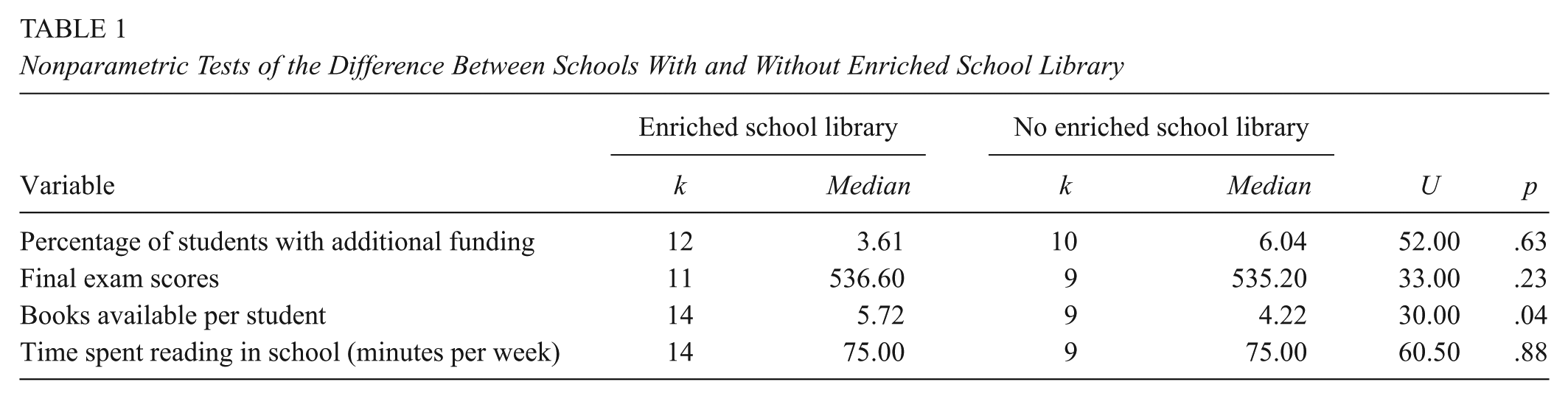
To help in evaluating whether experimental and control schools were comparable, we compared the two sets of schools on the percentage of students for whom they received additional funding and the final exam scores of the schools. Due to small numbers and non-normal distributions, we used the nonparametric Mann-Whitney test for the comparisons on the school level. Results of the comparisons are displayed in Table 1. There were no differences in the percentage of pupils for whom the schools received additional funding or in the final exam score in the years prior to the implementation of the enriched school library. According to the Dutch Inspectorate of Education, student achievement in language and literacy was insufficient in one experimental and two control schools, a nonsignificant difference between conditions (Fisher’s exact test, p = .55). According to the teachers, there were more books available per student in the schools with an enriched school library as compared to schools with an average library. There was a large variety in time spent on free reading. On average, teachers did not report that students in the experimental schools spent more time on reading self-selected books in school than students in control schools.
Nonparametric Tests of the Difference Between Schools With and Without Enriched School Library
There were no differences between the experimental and control schools in terms of the distribution of students over grades (χ2 = .42, p = .52), the proportion of boys and girls (χ2 = 1.22, p = .27) or the students’ age (experimental, M = 9.89, SD = .77; control, M = 9.79, SD = .72), t(675) = −1.77, p = .08. However, the two conditions differed as expected in reading motivation, frequency of reading according to students’ familiarity with books, and reading and mathematics skills, favoring students from schools with an enriched school library. See Table 2 for an overview. As indicator of the external validity of our findings, we conducted a sensitivity analysis comparing all Grade 4 and 5 students of five experimental and three control schools that were willing to provide anonymous reading comprehension data for students not participating in this study. In line with the results presented in Table 2, there was a significant difference between the full student populations of experimental (n = 250, M = 2.56, SD = 1.29) and control schools (n = 172, M = 2.24, SD = 1.31), t(420) = −2.48, p = .01, d = .25.
Overview of Differences Between Students From Schools With and Without Enriched School Library

p < .001.
Inspecting bimodal correlations (see Table 3), we found low to moderate correlations between reading motivation and reading frequency (r = .18), between reading motivation and reading comprehension (r = .40), and between reading frequency and reading comprehension (r = .33). The performance in mathematics was strongly related to reading comprehension (r = .50), probably due to the narrative format of the mathematics problems in this test.
Bimodal Correlations Between All Included Variables
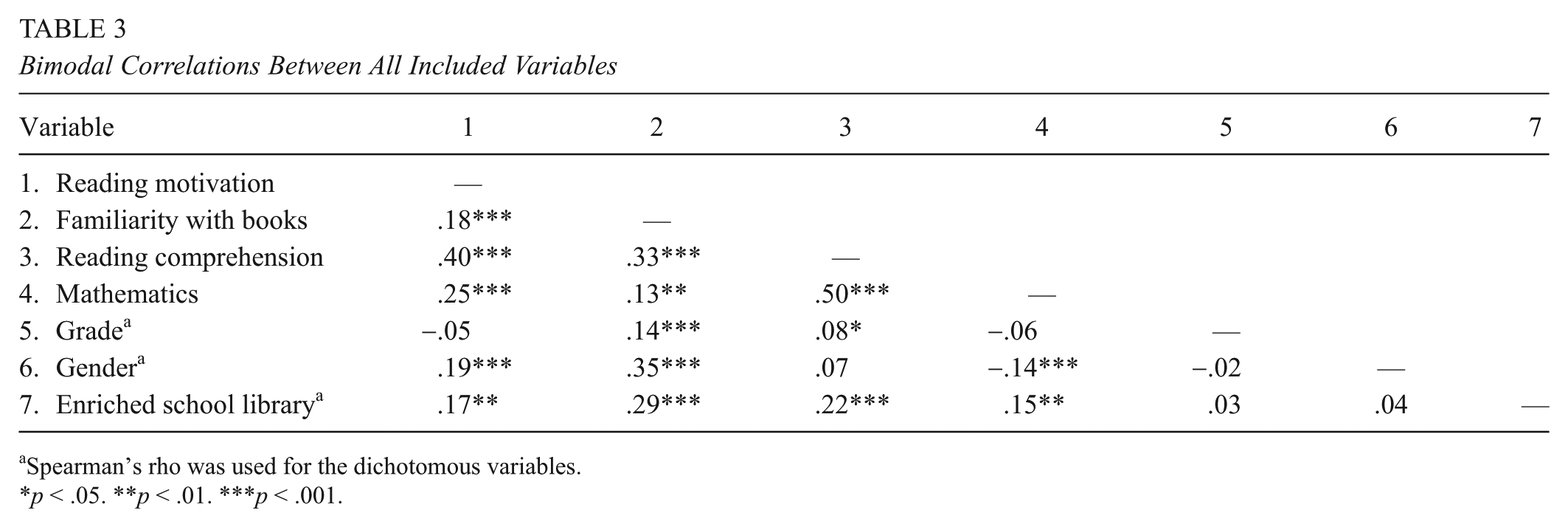
Spearman’s rho was used for the dichotomous variables.
p < .05. **p < .01. ***p < .001.
Multivariate Analyses
In multivariate analyses, we tested effects of school library controlling for grade level and gender by regressing reading motivation, familiarity with books, reading achievement, and mathematics on grade level, gender, enriched school library, interactions between school library and grade, and interactions between school library and gender. For all outcome measures (i.e., reading motivation, familiarity with books, reading comprehension, and mathematics), inclusion of a random intercept for school resulted in a significant improvement of the model fit compared to the baseline model (χ2 > .8.72, p < .001). The variance explained by school characteristics equaled 11.5% (reading motivation), 19.5% (reading frequency), 10.0% (reading comprehension), and 5.5% (mathematics), thus emphasizing the need to use multilevel models in data analysis.
There were main effects for grade on familiarity with books and reading comprehension; for gender on reading motivation, reading frequency, and mathematics; for the enriched school library on reading comprehension; and for reading comprehension on mathematics. There were no interactions between grade and an enriched school library, which we have therefore excluded from Table 4, but there were significant interactions between gender and an enriched library for reading motivation and familiarity with books. See Table 4 for the final models.
Regressing Reading Motivation, Familiarity With Books, Reading Comprehension, and Mathematics on Grade Level, Gender, and the Presence of an Enriched School Library

Note. Dependent variables were standardized.
This variable was entered only in the model with mathematics as dependent measure to control for effect of reading performance on mathematics scores.
p < .05. **p < .01. ***p < .001.
Grade had a significant effect on familiarity with books, reading comprehension, and mathematics, meaning that students in Grade 5 knew more book titles than students in Grade 4 and had relatively higher scores on the norm scores of a standardized reading comprehension test and relatively lower scores according to norm scores on the mathematics test. The tests are standardized for each grade separately so the effect of grade on the test scores is surprising. However, the lack of an interaction between grade and an enriched school library makes it unlikely that the main effect for grade would influence the effects of an enriched school library. Gender was significantly related to reading motivation and familiarity with book titles, indicating that girls were more motivated for reading and more enthusiastic readers than boys. Conversely, boys outperformed girls on the mathematics test. There was a main effect of an enriched school library on reading comprehension but not on the mathematics test, meaning that with an enriched library, students were better at reading but not at mathematics. As there was no interaction between school library and gender, effect sizes for girls (estimate of fixed effect [Est.] = .53, p <.001) and boys (Est. = .43, p = .02) were similar (see Figure 1).

Effects of an enriched school library with the control group as baseline for boys and girls separately.
For motivation, there was no main effect of the enriched school library, but there was for familiarity with books. The significant interaction between gender and enriched school library for both reading motivation and familiarity with books indicates that an enriched library promoted motivation and familiarity with books more in girls than in boys. Testing effects of the enriched library for boys and girls separately, we found that for girls, the enriched library was a moderately strong predictor of reading motivation (Est. = .53, p < .01) and a strong predictor of familiarity with books (Est. = .85, p < .001). This indicates that on both variables, girls in schools with enriched school libraries scored over half a standard deviation higher than girls in schools without an enriched school library. For boys, there was a moderately strong effect of the enriched school library on familiarity with books (Est. = .50, p < .01), albeit smaller than the effect for girls, and no significant effect on reading motivation (Est. = .18, p = .28). The interaction between gender and an enriched school library for reading motivation and familiarity with books is shown in Figure 1.
Mediation Analysis
We found support for a multilevel multiple-mediation model for girls (see Figure 2). The effect of the enriched school library on reading comprehension was fully mediated by the effects of an enriched library on reading motivation and familiarity with books. Both indirect effects were significant: for familiarity with books the indirect effect was .22, with a 95% CI ranging from .13 to .31; for reading motivation the indirect effect was .17 with a 95% CI ranging from .08 to .27. In other words, the combined effect of motivation and familiarity with books fully mediated the effect of the enriched school library on the girls’ reading performance. For boys, by contrast, there was a smaller indirect effect of familiarity with books (.12, 95% CI [.04 - .20]) and no effect of reading motivation (.06, 95% CI [-.05 - .16]); see Figure 3.
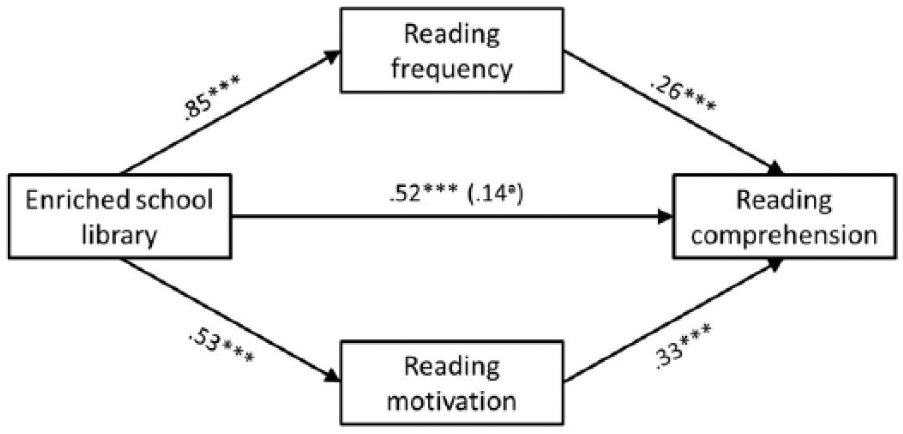
Results for girls. The relation between an enriched school library and reading comprehension was fully mediated by reading frequency and reading motivation.

Results for boys. The relation between an enriched school library and reading comprehension was mediated by reading frequency but not by reading motivation.
Discussion
An enriched school library including more books per student as compared to regular school libraries seems beneficial for students’ performance: Students from schools with an enriched school library scored about half a standard deviation higher on a standardized reading comprehension test. That is, almost 70% of the students from schools with an enriched school library outperformed students from schools without an enriched library (Cohen, 1988). The enriched school library typically affected reading comprehension skills but not mathematics skills. Even though teachers from schools with an enriched library did not report more free reading than teachers from control schools, results of the title recognition test indicate that there are differences in time spent on reading. Both boys and girls from schools with an enriched school library are more familiar with titles of age-appropriate fiction books, indicating that they read more than students from control schools. Since enrichment of the school library in the experimental schools in the current study was determined externally by an independent agency—in this case, not a researcher but the city council—it is plausible that the enriched school library is accountable for better reading results. It is unlikely that an overall stronger reading culture in the experimental schools motivating the adoption of an enriched school library resulted in better reading results.
We hypothesized that, due to an enriched school library, students’ interest in reading would improve and they would read more, and due to more practice, they would become more proficient readers (Becker et al., 2010; Mol & Bus, 2011; Morgan & Fuchs, 2007). For girls, data strongly aligned with this model. Reading interest and familiarity with books were full mediators between an enriched library and the girls’ reading proficiency. As reading motivation and familiarity with books were each, controlling for the other variable, significant moderators, we can exclude that these variables are manifestations of the same behavior.
For boys, data only partly aligned with this model. Due to an enriched school library, boys read more as appears from their familiarity with books, which had a positive effect on reading comprehension skill. Contrary to girls, however, they did not report being more motivated to read. In other words, they read more, but the enriched school library did not make boys more enthusiastic about reading to the same extent as it made girls more enthusiastic. There may be several explanations for the finding that boys in experimental schools did not report to be more motivated for reading compared to boys in control schools. Boys may be aware that reading is less valued by significant others when it concerns boys and may therefore be less likely to respond affirmatively to questions such as “Do you like to read in your leisure time?” even though they had positive experiences with reading. It is also possible that boys are less inclined to respond positively to questions about their enthusiasm for reading because they may consider reading as a feminine activity (e.g., McGeown et al., 2012; Retelsdorf et al., 2015).
Given the correlational nature of the relation between reading interest, familiarity with books, and reading proficiency, we may also argue that reading comprehension mediates the relation between the enriched school library and reading frequency or that relations between reading motivation, reading frequency, and reading comprehension are reciprocal (Mol & Bus, 2011; Morgan & Fuchs, 2007). Irrespective of which model fits best, our findings corroborate the theory that the availability of a large collection of attractive books is an important factor in stimulating an upward spiral of increasing motivation, reading frequency, and comprehension (cf. Krashen, 2011).
Limitations and Future Directions
As any research not using randomized designs, this study cannot provide conclusive causal evidence. However, we were able to select experimental schools in which placement in the treatment condition was determined externally and not by participants, that is, the students, parents, teachers, or administrators within the schools. As the enriched school library was an exogenous variable and schools were, apart from that, comparable in language education, findings may, despite the quasiexperimental design, be taken as an indicator for the causal impact of an enriched school library (Murnane & Willett, 2011). Another limitation may be that a different procedure was followed in assessing reading motivation and reading frequency: In the experimental condition, students filled in an online questionnaire at home, whereas students in the control condition completed a printed version at school under supervision of the researchers. However, there is strong evidence that findings are comparable. First of all, the time it took students to fill in the online questionnaire at home was similar to the time it took students to fill in the questionnaires in the classroom. On average, students spent 14.2 min (SD = 8.5 min) to fill in the reading motivation questionnaire and title recognition list at home, which is about the same time as it took students in the control condition. Second, we did not find any relation between the time it took to fill in the title recognition test and their score (r = .02, p = .79), as might be expected when students access external information (for example, the Internet) to complete the list.
An important question that remains relates to which elements of an enriched school library cause effects on students’ reading proficiency. Is it the collection itself and its appeal to students, or do effects depend on the activities that are elicited by an enriched school library? Although we tried to collect data about the impact of the enriched school library on the practices within schools, we observed that the impact of the enriched library on activities in the school varies highly depending on preferences of the staff. For instance, we did not find an overall effect of the enriched library on minutes per week to be spent on free reading. There were schools with enriched libraries in which students spent 3 hr per week reading self-selected books, whereas in other schools with enriched libraries, less than half an hour per week was reserved for the same activity. In informal discussions, teachers reported activities to facilitate increased engagement with books (e.g., book presentations by the teacher, reading to the class, book reviews by students), but activities seemed to be very diverse across schools in the control and experimental conditions. On the basis of these observations, we may conclude that the enriched school library does not have a clear and consistent impact on the language curriculum. On the other hand, despite the similarity in free reading in the classroom as reported by teachers, students from experimental schools were more familiar with age-appropriate books as compared to students from control schools. This seems to indicate that students in schools with an enriched school library spent more time reading. In explanation of the inconsistency between teachers’ reports and students’ scores on the title recognition test, we may assume that students took more books home to read in leisure time. It is also possible that the time for reading in school is the same but more productive in schools with an enriched school library because reading is more engaging as students can easily find interesting books. Studies using observational data collection methods may provide more insight in curricular differences that influence the reading development.
Conclusions
The final conclusion of the National Reading Panel (National Institute of Child Health and Human Development, 2000)—“It would be difficult to interpret this collection of studies as representing clear evidence that encouraging students to read more actually improves reading achievement” (chap. 3, p. 26)—was controversial. Krashen (2001), for instance, commented that free reading is at least as effective as, and often better than, traditional instruction. The present study is unique in that it tested whether an enriched school library, initiated by agents outside the schools, can support reading achievement. Our findings corroborate the conclusion that reading practice is vital: Students from schools with an enriched school library are familiar with more book titles and have higher levels of reading achievement than students from schools without an enriched school library. The difference was approximately half a standard deviation in favor of schools with an enriched school library, which is slightly below the effect sizes Krashen (2001) reports in response to the National Reading Panel, ranging from 0.57 to 1.01 for free reading interventions. On the other hand, effects of the enriched school library were stronger than the effects in studies that encourage reading by providing books to families during the summer holiday. Kim (2006), for instance, reported effect sizes ranging from .13 to .22, and Allington and colleagues (2010) effect sizes ranging from .14 to .21.
The present study provides support for the importance of a large and modern book collection. There is also evidence for the theory that such a collection raises interest in reading and boosts, mediated by greater interest, reading achievement. The collection may be the key element, but we cannot exclude that other aspects are important as well, such as more opportunities for silent reading during school hours, book promotional activities, or support from employees of the library in selecting books. Regardless of the actual underlying mechanisms, the enriched school library seems to have the potential to stimulate the reading development of students and may prevent that students become “aliterate” (that is, being able to read but not motivated to do so). A library with a rich and varied collection is vital for students’ reading proficiency and thereby for a successful academic and professional career of the students. In other words, school quality partly depends on the quality of the school library.
Footnotes
Acknowledgements
For this research, A. G. Bus received a grant from Art of Reading (Kunst van Lezen), a project funded by the Dutch Ministry of Education, Culture, and Science (OCW).
Authors
THIJS M. J. NIELEN is a PhD student in the field of learning problems and impairments at Leiden University. His research focuses on the development of reading motivation and interventions to prevent aliteracy.
ADRIANA G. BUS is a professor of education and child studies at Leiden University, specializing in reading problems and impairments. Her research interests include storybook reading, e-learning, reading promotion, and differential effects of interventions. Her mailing address is Department of Education and Child Studies Leiden University, P.O. Box 9555 2300 RB Leiden, The Netherlands and email address is