



Abstract
In the effort to “flatten the curve” of the COVID-19 pandemic, teachers were required to adapt their curricula, pedagogy, and relationships with their students to remote learning structures. Using data gathered through an online qualitative survey of over 800 Chicago teachers in July 2020, this article will examine the ways that the shift to remote learning challenged teachers’ relationships with their students during the spring of 2020. By utilizing social presence theory and considering the significance of emotional connection in teacher-student relationships, the study captures some of the relational challenges that teachers experienced during the initial months of remote instruction. The study identifies increased individualization, deeper holistic understandings of students, and a diversity of mechanisms of engagement as pedagogical techniques that allowed teachers to maintain and even improve their relationships with students.
The teaching profession has long been associated with emotional work and connection, however, the pandemic and summer of protests against racial injustice amplified the need for teachers to emotionally engage with their students. Accordingly, the extended period of remote instruction required that teachers learn new ways of connecting with students, both socially and emotionally and called into question what qualities were necessary for a meaningful teacher–student relationship building process. In this novel context, teachers relied on their “injunction to adapt” in order to migrate face-to-face (FtF) relationships to the virtual space (Everitt, 2018). Many of the informal paths through which teachers build relationships and develop intimacy became awkward and difficult, if not impossible. Though many studies focus on students’ perceptions of teacher presence and availability, this study contributes to the literature on supportive virtual teacher–student relationships by detailing teachers’ perceptions of their own experiences finding connection and intimacy. In this article, I utilize social presence theory to capture some of the relational challenges that teachers experienced during the initial months of remote instruction.
My motivation for exploring teacher–student relations during a time of crisis comes from an interest in humanizing educational interactions and exchanges. The well-documented racial/ethnic disparity between teacher and student populations in the United States, as well as the implications of those disparities, has long encouraged educational researchers to find ways to see and teach children of color as full human beings (Delpit & Ladson-Billings, 1996; Ladson-Billings, 1995; Moll et al., 1992). The removal of social protections, social blinders, and the restructuring of daily life, made it difficult if not impossible to ignore a social partner’s emotional well-being and life transformations. That is, stress, grief, and terror entered the classroom through collective experiences of uncertainty and instability, affecting classroom participants’ ability and capacity to engage.
Teacher–Student Relationships and Intimacy
Relationships between teachers and students are of a particular and powerful kind. Teachers’ relationships with their students can encourage cognitive, emotional, and behavioral engagement, making teachers key players in youths’ development of social and emotional skills, sociopolitical awareness, and ability to cope with trauma (Dods, 2015; Furrer & Skinner, 2003; Mirra & Morrell, 2011; Pianta et al., 2012; Verduzco-Baker, 2018). Success in their role as socialization agents requires that teachers are able to establish strong and supportive, and thereby intimate, relationships with students.
However, building intimacy and permitting vulnerability is a dynamic process that evolves and shifts based on the interpersonal interactions of relationship participants (Reis & Shaver, 1988). The establishment of intimacy relies on a perception of the other as trustworthy, receptive, and accessible, which can be facilitated or hindered by differences in the social positioning—race, class, and or other status-holding identifications—of the participants. This is especially important when considering that in most major districts in the United States, the demographics of the teaching population does not match the student population. This discrepancy in concert with systemic biases and inequalities, contributes to disparate outcomes in discipline, expectations, and as a result academic success (Artiles, 2011; Cobb, 2017; Ladson-Billings, 1995; Morris & Perry, 2017; Picower, 2009).
Despite such challenges, strong teacher–student relationships, whether in-person or online, require intimacy (Cho, 2005; Darder, 2009; Song et al., 2016; Song et al., 2018; Yin et al., 2019). Not only do students benefit from supportive emotional connections to teachers but positive teacher–student relationships also increase teachers’ feelings of self-efficacy and well-being. Within this positive feedback loop, positive relationships likely fuel more effective teaching since holding students’ trust and respect allows teachers to motivate and engage their classroom. Strong teacher–student relationships are then mutually beneficial, encouraging student engagement and supporting teacher well-being and confidence (Milatz et al., 2015; Spilt et al., 2011). In a time of high stress, teachers may be compelled to increase their intentional efforts toward connection with their students in order to develop trust and maintain engagement.
Immediacy, Social Presence, and Online Education
Regardless of the established significance of teacher–student relationships, once the pandemic required schools initiate remote instruction, connections were strained due to mental and emotional stress and digital inequalities (Beaunoyer et al., 2020). Much of what we currently know about teaching and crisis in the United States, generally discusses teaching in the wake of tragedy, such as after a natural disaster or post-9/11, or in the midst of trauma for an individual student, rather than the experience of teaching during ongoing and collective crisis. This literature reveals that teachers are often called on to be counselors and therapists, managing their own as well as their students’ emotions, trauma, and stress (Alisic et al., 2012; Alvarez, 2010; Gay, 2007; Powell & Holleran-Steiker, 2015). These additional roles further the call for teachers to be present, relational, and available to their students.
Although it has not been linked to the emotional toll of teaching during crisis, virtual education research regularly questions how teachers can counter the emotional sterility of the virtual environment. That is, how can teachers generate the types of intimacy that are facilitated in the classroom by immediacy behaviors, or actions that generate feelings of closeness and reduce psychological distance?
In the physical classroom, intimacy can be facilitated through immediacy behaviors such as the use of humor, eye contact, and physical closeness (Aragon, 2003). However, in the virtual space, many nonverbal and casual communication tactics that signal availability are absent (Eisenbach et al., 2018; Ghamdi et al., 2016; Song et al., 2016). This may be especially true for behaviors that are strongly associated with intimacy such as warmth or receptiveness. When students do not, or cannot, turn on their cameras, teachers have a more difficult time communicating through body language, facial expressions, or informal interactions.
In response, teachers may need to engage in relational virtual displays and pedagogical methods, or e-immediacy behaviors, that create opportunities to increase social presence and the possibility for virtual intimacy (Ghamdi et al., 2016; Mennecke et al., 2010). Social presence describes the perception of psychological involvement with others online and has been associated with transactional presence, a measure describing teachers’ perceived availability and connectedness (Shin, 2010; Song et al., 2018). Social presence theory, then, allows for understanding of “the relative salience of interpersonal relationships” in the online interaction (Öztok & Kehrwald, 2017, p. 261; emphasis in original). Defined in this way (as Öztok argues social presence has taken on several meanings), social presence is an antecedent to intimacy in online education. While in the physical classroom availability and access are presumed variables, both availability and access have to be intentionally established in the virtual classroom before intimacy can be achieved. Teachers that generate greater social presence, by increasing students’ perceptions of closeness despite a lack of physical proximity, produce more efficacious learning experiences and greater teacher–student relationship satisfaction (Song et al., 2016).
Teacher displays of vulnerability through high-quality contact or self-disclosure, the act of purposefully sharing personal information, or have a greater impact on the quality of connection as compared with FtF classes (Kovacs et al., 2021; Song et al., 2016; Song et al., 2018). Song et al. (2016) interpret this to mean that teachers’ communication practices and ability to connect is actually more important when instructing online. Therefore, traditionally FtF teachers may have to challenge scripts dictating classroom-appropriate emotional displays in order to be successful online (Hochschild, 1998; Stark & Bettini, 2021; Wharton, 2009). Although studies find there are rarely explicit or stated rules, teachers feel a professional expectation to abide by particular emotional display rules that require them to continuously monitor their emotional displays (Stark & Bettini, 2021; Thoits, 1989; Wharton, 2009; Zembylas, 2007). Unfortunately, vulnerability does not seem to come naturally in the online learning environment and despite its importance, teachers tend to engage in fewer immediacy behaviors when teaching online, reducing emotional evocation and estranging instructors from students.
Increasing Social Presence in Crisis
Effective social presence enables students to recognize their teacher’s humanity. By conveying personal information, or making themselves readily available, teachers establish human connection, which in turn leads students to more deeply engage in the classroom and motivates enhanced communication (Cayanus et al., 2009; Shin, 2002). Additionally, Cayanus et al.’s (2009) findings suggest that expressing some negativity or sharing negative experiences, dispersed between positivity, may enhance teacher approachability. Through e-immediacy behaviors teachers become more than simply instructors. By engaging in processing the pandemic and uprisings together, teachers and their students could participate in the reciprocal process of empathic understanding—learning each other as human, emotional, and fallible (Pedro & Kinloch, 2016; Zembylas, 2007). Together, teachers and students have the power to renegotiate display rules in the creation and maintenance of their own intimacies or affective connections.
Studies on social presence and teacher immediacy in virtual classrooms often examine classroom settings where teachers and students have little to no valuable or personal information about each other, complicating the initiation of relationship building (Song et al., 2018). In contrast, most of the teachers in this study’s sample spent at least 6 months in FtF instruction with the students they discussed. This means that teachers and students were entering the remote education arena with established relationships that were then transformed by the transition from physical to virtual instruction. Since this period of remote learning was an emergency response, the teachers in this study, unlike those studied in much of the existing research, never intended to and were not trained to support virtual teaching. Their success was not guaranteed. Therefore, in this study, I address the following: What, if any, methods and practices allowed educators to develop the social presence necessary to maintain strong connections with students during the initial months of sudden and unplanned remote instruction?
Research Context
Chicago Public Schools (CPS) is a large urban district that served over 350,000 students at the start of the 2019–2020 academic year. That year, 76.4% of students were listed as part of the free/reduced-price lunch program and 10.8% are identified as White (cps.edu). In comparison, during this same year, 52% of teachers in the city of Chicago identified as White (illinoisreportcard.com). CPS elementary schools include Grades 1 to 8 and high schools include Grades 9 to 12. In this study, prekindergarten and kindergarten educators will be included with elementary educators.
CPS shut down in-person instruction on March 17, 2020 (CPS, 2020a). The district began remote instruction the week of April 13th, often utilizing Google Classroom (CPS, 2020b). At this time, CPS announced that it would make laptop computers available for students that needed them. As a result, the district planned to distribute over 100,000 devices. The district also distributed 12,000 internet access devices to students with temporary or unstable living conditions.
CPS has demonstrated that social–emotional learning (SEL) is a districtwide priority and key mechanism for district improvement (see CPS, 2017). In an effort to recognize the impact that a nationwide pandemic might take on youth mental health, the district decided that teachers should relax their grading policies in order to “ensure the grades of students experiencing hardship are not negatively impacted due to circumstances beyond their control” (CPS, 2020b). This survey was administered at the close of the school year in July 2020, after the district had been operationally remote for 3 months.
Method
Procedure and Sampling
Members of the Chicago Teachers Union (CTU) were invited to complete an online survey discussing their experiences during the transition to remote instruction. The link to this survey was distributed in the regular CTU newsletter. Union membership includes approximately 25,000 classroom teachers, counselors, support staff, special education professionals, and arts/specials educators within CPS as well as several unionized charter schools (CTU Local 1). Despite discrepancies between union membership and the reported number of CPS teachers (22,000), CTU is representative of CPS, as only an estimated 1% of CPS teachers do not belong to the union (C. Caref, personal communication, November 23, 2021). Participation was voluntary and uncompensated. The response rate was approximately 5.5%, yielding 1,200 responses over 10 days beginning July 19, 2020. Submissions that were less than 75% complete were dropped from the analytic sample. These submissions often left the majority of open-ended questions unanswered.
The resulting sample (n = 859) is largely representative of the entirety of CTU membership (22,000) in terms of race/ethnicity, school socioeconomic status, and school location (see Tables 1 and 2). However, the sample is skewed toward veteran educators. Novice teachers were underrepresented in the sample. This may be because novice and early career teachers may have been more overwhelmed during this time period due to lack of experience or may not have a strong relationship with the union.
Educator Demographics: Survey Sample Versus Chicago Teachers Union

Note. CTU data was obtained from CTU administration.
Survey participants were allowed to check all categories that applied, therefore, percentages may not total to 100%. bChicago Teachers Union uses Hispanic as a comparable category; Latine is used as a gender-neutral alternative to Latino/a for individuals of Latin American descent that is more consistent with conventional Spanish-language pronunciation than Latinx. cChicago Teachers Union uses Asian as a comparable category.
School Types Represented by Participating Educators
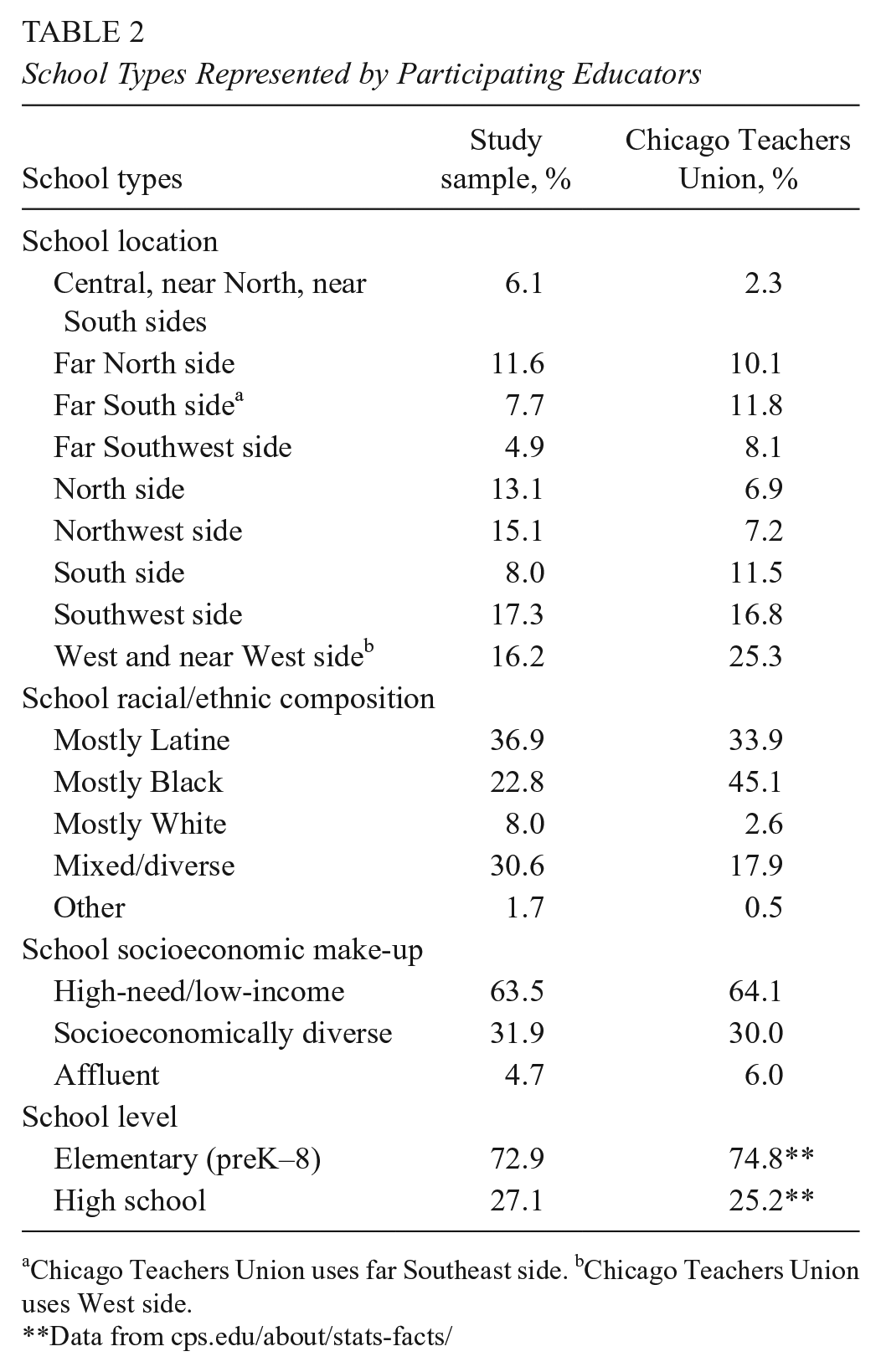
Chicago Teachers Union uses far Southeast side. bChicago Teachers Union uses West side.**Data from cps.edu/about/stats-facts/
The online qualitative survey was administered in English through Qualtrics. The use of a qualitative survey had significant advantages during the COVID-19 pandemic. Qualitative surveys allow for much of the richness of data collected from interviews from larger and more diverse samples and increases reach and accessibility (Braun et al., 2020; Jansem, 2010). Additionally, with opportunities for interaction limited by the pandemic, a qualitative survey allowed educators to have private, self-directed opportunities to express themselves and share their unique experiences.
The survey contained 20 items and took an average of 45 minutes to complete. The first seven multiple-choice questions asked participants about their demographics and teaching experience. Educators were asked to report the area where their school was located based on colloquial geographic areas of Chicago (i.e., far North side, West side, far South side, etc.), their teaching experience in years, subject(s) taught, the demographic make-up and SES of their school, and their own racial-ethnic identification. For questions on subject and identity, participants were permitted to select more than one response. Following, respondents were presented with a series of open-ended questions, one rank choice question, and two Yes/No/Maybes. Teachers were then asked to comment on their experiences transitioning to remote learning and any challenges or concerns about returning to the classroom. The final questions on the survey asked participants about their future curricular plans.
The data analyzed for this article explores educators’ responses to the following open-ended question: “Think about your role and responsibilities as a teacher before and after the transition to remote learning. How would you describe your relationships with your students while remote teaching as compared to when you met in a classroom?” This question aimed to reveal how educators were in contact and relating to their students when unable to commune with them in a physical classroom, and sometimes not at all.
Coding and Analysis
To begin inductive qualitative analysis of the data, 100 question responses were reviewed, which generated 13 codes in accordance with a thematic analysis approach (Braun & Clarke, 2012). These themes were then applied to all responses with room for new themes to emerge, if necessary. Given the exploratory and descriptive nature of this study, thematic analysis was chosen for its ability to identify common characteristics in data regarding lived experiences.
The themes captured comparative relationship quality (consistent, worsened, and improved), factors that contributed to quality changes (more personal, detached, and less interactive), as well as other mentions that facilitated teacher–student contact (parental involvement, pedagogical methods, and leveraged prior relationships) and levels of buy-in from students (engagement and inaccessibility). Mentions of issues with technology or tech literacy and explanations of methods educators used to engage their students were additionally recorded. See Table 3 for full code descriptions.
Code Descriptions

Given that teacher–student relationships were expected to wither in the virtual space, I aim to establish a counternarrative that emphasizes positivity and possibility. Therefore, in this article, I will focus on the themes related to cases coded as improved in which teachers mentioned that at least some of their relationships grew stronger, more personal, or more vulnerable. Many but, not all, excerpts coded improved were also coded more personal. For a broader focus that leaves room for multiple mechanisms to produce improved relationships, I focus on all relationships that improved, not only those that became more personal.
Results
Overall, teachers missed their classrooms and the kinds of relational interactions that FtF settings allow. Casual relational interactions were cited as key to the school socialization experience, both between teachers and students and among students. Their absence led teachers to express FtF learning as better for students than remote instruction. Exemplifying this sentiment, one teacher shared, The classroom is a more conducive learning environment albeit exhausting. Providing on demand and immediate support from teachers and peers is always available in the classroom. It was not as easy and simple to provide effective support during distance learning. We all missed the communal classroom culture of even just saying good morning, or [I like] those new shoes or that’s a cool bow you have in your hair. Kids need that interaction and support from their teachers and friends. School is where kids start learning how to interact with people in addition to academic engagement. (180; White, low-income mostly Latine elementary school, 10+ years of experience)
As shared earlier, the classroom functions as a community whose established routines and culture were disrupted by the shift to remote learning. For this teacher, remote learning prohibited friendly interactions (“just saying good morning or [I like] those new shoes”) that would help youth learn about social interaction. That is, remote learning debilitated schools’ function as a place to develop social and social emotional intelligence. For many respondents the absence of casual relationship building opportunities, teaching to Black boxes when students did not turn on cameras, and a lack of consistent attendance made it difficult to maintain relationships with students or encourage educational socializing. Deprived of familiar aspects of intimacy, teachers described their interactions with their students as “detached” or stated they felt they “couldn’t reach” their students: In remote learning, it is close to impossible to know our students. We miss all the nonverbal cues, we miss the results of assessments we could give face to face, and we miss the opportunities for quick (and longer) individual conferences with students—places where we learn a great deal about their thinking as well as how they are feeling. In my school, we were not permitted to divide a class into groups and visit each one as they worked. I hope at least that part changes this fall. In addition, we are not permitted to have individual conferences with students. I see the logic of that policy, but I can’t coach a kid in literacy in front of other kids. (64; White teacher in socioeconomically and racially/ethnically diverse elementary school, 10+ years of experience)
This “logical policy” of preventing individual student-teacher conferences, reflects a conflation of sexual and emotional intimacy that results in closeness between teachers and their students being stigmatized (Cho, 2005). The fear of inappropriate intimate connection when teachers were not supervised nor surveilled hampered connection as well as personalized and differentiated instruction. When connection was prevented in this way, the online education setting proved ineffective.
Despite the general feeling that relationships were distant or even absent, several teachers were able to compensate for the distance produced by the online environment and admitted that some of their relationships with their students actually improved and became more personal. This group included just over 10% (n = 91) of teachers sampled. Given their overrepresentation in the sample as well as in the district, teachers who saw improvement with some of their students tended to be White veteran teachers in high-need elementary schools (see Tables 4 and 5 for details). Teachers working in affluent or mostly White schools were least likely to report improved relationships. However, Black (n = 158) and Latine-identified (n = 164) teachers were almost twice as likely to report improved relationships. That is, 15.2% (n = 24) and 13.4% (n = 22) of Black and Latine educators, respectively, stated that their relationships improved with at least some of their students compared to 8.87% (n = 44) of White-identified (n = 496) respondents. Although this is a finding that deserves further dedicated research, this greater propensity to connect may stem from the unique investment Black and Latine teachers have in their race-matched students (McKinney de Royston et al., 2020; Griffin, 2018; Griffin & Tackie, 2017).
Educator Demographics for Educators Who Stated Relationships Improved

Survey participants were allowed to check all categories that applied, therefore, percentages may not total to 100%. bChicago Teachers Union uses Hispanic as a comparable category; Latine is used as a gender-neutral alternative to Latino/a for individuals of Latin American descent that is more consistent with conventional Spanish-language pronunciation than Latinx. cChicago Teachers Union uses Asian as a comparable category.
School Types Represented by Educators who Stated Relationships Improved

Teachers who were able to develop improved relationships with their students did so through (1) increased individualized attention and emotional concern for their students; (2) developing deeper and more holistic understandings of their students; and (3) providing a diversity of ways for students to engage.
Increased Individualization and Emotional Concern
In order to make up for the absence of unstructured interaction, teachers who reported improved relationships met with their students in one-on-one sessions, small groups, or spoke to them over the phone. For these teachers, remote instruction created an opportunity to spend quality time with their students and differentiate or adjust their course plans based on student needs. During this dedicated time, teachers were able to check in with students not only about academics but also about their mental well-being as affected by the pandemic and racialized civil unrest. One-on-one conversation, inherently more intimate than a public forum, shifted the dynamics, depth, and possibilities for teachers’ relationships with students: While I had a great relationship with my students, remote learning brought [me] even closer to each of my students and their families due to the amount of increased 1:1 interactions. The students and parents reached out to me about more than just school issues. I’m still getting calls from students and parents for help with non-school issues. (384; Black teacher in socioeconomically and racially/ethnically diverse elementary school, 10+ years of experience)
Here we see that this teacher’s roles and responsibilities expanded as they learned more about their students and accepted more of students’ lives in the virtual classroom and they became a source of information and support for students and their families.
When able to talk privately or in smaller groups, teachers were able to make more space for students’ emotions, especially fears surrounding the pandemic: Though we did value socio-emotional growth of the students while we were in person before remote learning (advisory lessons, classroom contracts, etc.), I feel that SEL became even more important while we were remote learning. Students wanted to “just talk” to me and/or the rest of the kids in the class, and I allowed time to do so at the beginning and end of each class period. I know some kids were feeling anxious not only about not being able to see their friends, but also what the virus was doing or could potentially do to them and/or family. I was very much a counselor to them during remote learning, and I learned a LOT more about their personal lives during that time (i.e. younger siblings “attending” class, bringing pets to the screen to show us all, etc.). It was almost as though academic material took a step back and SEL took the spotlight. (464; Multiracial teacher in mostly Latine socioeconomically diverse elementary school, 10+ years of experience)
With an increased focus on social emotional well-being this teacher was able to give their students a place to process worries and fears they may not have had other outlets for. Similarly, other teachers mentioned increasing their focus on social emotional learning and mental health.
Explicit instruction on emotional regulation and mental well-being was a purposeful and necessary focus that received less emphasis during FtF instruction: The role of my position became an advocate of coping skills. Relationships with students focused on health and well-being of the individual. I did everything in my power to create lessons that uplifted the child/family spirits. I didn’t focus my lessons on mental health while teaching in the classroom. (698; Black teacher in high-need/low-income racially/ethnically diverse elementary school, 10+ years of experience)
As reflected in other literature on teaching during crisis (Alisic, 2012; Alisic et al., 2012), extending the classroom space in this way, required this teacher to act as a counselor. Teachers commented that some students came to rely on them, contacting them regularly to discuss both school and personal matters. Students opened up to teachers about issues going on at home and this gave teachers the opportunity to bond with quiet students as well as those that had been seen as disruptive in the FtF classroom. Exemplifying the possibility that could come from teacher and student disclosure, one educator shared: “The bond with my students has strengthened. I shared my raw feelings with them and they reciprocated. No judgment, just support and empathy.” (145; Black teacher in high-need/low-income racially/ethnically diverse elementary school, 10+ years of experience). This teacher self-disclosed their own anxieties to their students, a vulnerability that was supportively reciprocated. Another said, My relationship with my students was the thing holding remote learning together! I think the kids that did participate in their learning to a high level (attend live Meets, watch the videos, complete assignments, ask questions) were kids that did so because of the relationship we had built throughout the year. They wanted to see me and their friends, they knew my expectations, and they wanted to have some sense of comfort during a stressful time. The students that really struggled, I was able to get in touch with a couple of them, and they shared their issues. Being scared and stressed, having no adults at home to help them, family members being sick, I even had a couple students get COVID. I think in those situations, my relationship became more of a sounding board, or a counselor. (194; White teacher, low-income mostly Latine elementary school, 7–9 years of experience)
This teacher also functioned as a counselor for their students, listening to their fears of the moment and the realities of their lives. Teachers such as the ones quoted in this section, compensated for the lack of shared physical space by expanding their social and emotional involvements with their students thereby making clear that they were available—a key aspect to establishing strong social presence.
In response to teachers creating space for emotion and vulnerability and increasing their availability, students recognized and took advantage of opportunities to make intimate disclosures during check-ins, emails, and phone calls with teachers: It depends on the student . . . with some students I developed stronger relationships. They sent me “chatty” emails when I asked how they were doing, perhaps out of boredom, but still, I learned more about some students and don’t think I would have been able to elicit the same kinds of information when they were always around the listening ears of their peers. (214; White teacher, low-income mostly Latine high school, 7–9 years of experience)
These disclosures show students’ willingness to trust and confide in their teachers—potentially in ways that might embarrass them in front of their classmates—exemplifying the uniqueness and significance of the nonfamilial teacher–student relationship. As noted by the following teacher, these relationships were only possible if both teachers and students contributed to developing intimacy.
Deeper Understanding of Students’ Lives
By increasing individualized contact with students, teachers were able to get to know their students beyond their academic identities. Video conferencing with students allowed teachers to see into their students’ homes. One teacher stated that they became closer with their students because they “went into their homes daily and they came into my home daily” (543; White teacher in a high-need/low-income racially/ethnically diverse elementary school, 10+ years of experience). Sharing home life can require vulnerability and, in this case, this vulnerability was reciprocated. Another teacher agreed that because remote learning allowed teachers and students to open up their homes and private spaces to each other, they were able to see their students in new and fuller ways and in return, their students were able to see them as more than instructors: I think that I was able to understand my students a bit better. It was like I became a person to them and their families. Look at it this way it’s like I invited them into my space and they invited me into theirs. I feel parents were able to better see how the students performed and their strengths and deficits as well. (792; Black teacher in mostly Black high-need/low-income elementary school, 10+ years of experience)
When students witnessed teachers’ private spaces they were able to see their teachers as humans with lives and interests beyond the classroom. In the following quote, the teacher shares some of the new information that video conferencing enabled teachers and students to share with each other: Our relationships were great before we left and still great after. For the kids that did log on! We felt a like a community then and when we were online I did feel we got stronger because it was all new and we were all learning, doing, and going through things together. Like they heard my dog barking and wanted to see her which was cute. I feel like the kids and I in remote got to know things we may not have known. Like a kid was always in front of Blackhawks posters. I knew he liked hockey but didn’t know he was the biggest fan. Those types of fun things or if the mom walked by [I’d say,] Hola señora Rodriguez and she’d wave. We all shared this new experience which [brought us] closer (398; White teacher in mostly Latine high-need/low-income elementary school, 10+ years of experience)
Here, normal occurrences like a dog barking or a mother walking around the house, contributed to humanizing the learning experience.
By being let in to their students’ homes and getting to know their students’ families better, teachers were better able to accommodate and adjust to students needs and circumstances. This teacher notes that in addition to the personal touch, the unique experience of living through a pandemic brought them closer with their students: There was a huge shift in our relationship. Some I lost communication with all together (except for assignments). I worry about them . . . Others we build a bond that I think will last a lifetime. Some students had real concerns for their families and were depressed. We . . . really tried to boost those that needed it, back off on work when students needed it, applaud those that needed it, and bring back around those that we were losing . . . With pictures and videos and Google Meets I saw snapshots of these students’ lives I never would have IN school. It was a very different relationship, but with a lot of hard work, it was still a good relationship. Maybe better because we were all struggling together. This class will have a special place in my heart forever! (21; White teacher in mostly Latine socioeconomically diverse elementary school, 10+ years of experience)
The influx of personal information now available to teachers, gave educators an opportunity to be more responsive and considerate of student need and circumstances. Although, the teacher quoted above lost contact with several students, they were still able to establish “a bond that . . . will last a lifetime.” The emphasis in the latter part of this comment reflects the ways teachers valued the opportunity to craft genuine and strong relationships.
These exceptional and often unexpected relationships were developed through validating students, including personal contributions that brought students’ home lives into the virtual classroom, and bonding through hardship. As one teacher said: “We became closer because we bonded over the fear of COVID and uncertainty” (195; Black teacher in mostly Latine high-need/low-income elementary school; 10+ years of experience). Being at home allowed students to share parts of their lives that they cannot bring to school. While it took “a lot of hard work,” teachers seemed to appreciate getting to know their students in a new and more holistic way. This new way of knowing students allowed for greater responsiveness, more vulnerability, increased emotional connection and gave teachers an opportunity to change their feelings about some of their students: I found that I built stronger, better relationships with some of my students during remote learning. I would give lots more written feedback on work they completed because I had more time [to] respond and less work to respond to. My students kept “Pandemic journals” and I learned so much about them as I read their weekly writings. I would have “back and forth” conversations with them through Google Classroom about their lives, their feelings, their struggles. Some students who were quiet in class and who I honestly didn’t know very well came alive when they wrote, and they shared so much more than they would have in a busy class. I formed much stronger relationships with those quieter students, and came to know them better. One young man who I judged to be a “pain” in class and was one of my least favorite students came to the Meet sessions a little early some days. We started to have conversations and I developed a much stronger, more understanding relationship with him. I think of him in a much more positive light after our remote learning experiences. I miss seeing my students every day in-person but I feel that remote learning actually helped me build some solid positive relationships with students that I had overlooked or judged negatively in the context of a busy, pressure packed day at school. (291; Multiracial teacher in mostly Latine high-need/low-income elementary school, 10+ years of experience)
Prior experience with students was often beneficial to success in remote, but the transition also provided some teachers with a fresh start. Teachers reported that certain students were better or worse behaved when attending school from home. Five teachers explicitly mentioned students who performed better after being removed from the distractions of the classroom. Whether it was getting to know quiet students better, noting positive behavioral changes, or learning more about students’ home lives, the transition allowed teachers to experience their classes differently: I know that this [is] probably going to sound strange, but it allowed me to get to know some of them more than I did in the classroom. I had a challenging class this last year and there were disruptions and behavioral issues that were happening. These tended to take up a lot of attention. When we shifted into remote learning I got to hear from my quieter students and focus more on each individually. I incorporated daily questions, videos, feedback, posted their work and pictures and videos to maintain a sense of community, worked on Second Step, called and talked with them. Because of the social-emotional focus, I saw some of my quieter ones from class come out of a shell. I am in no way saying that remote learning was better than being in class or even an option, but this is my observation from my particular group of students in this particular case. (637; Black teacher in socioeconomically and racially/ethnically diverse elementary school, 10+ years of experience)
The two teachers quoted immediately above found that within the remote space, students they previously found to be disruptive were less so and students that were often quiet found ways to speak up. These changes were aided by changes in format that gave students new ways to engage with school and communicate with their teachers.
Diversity of Ways to Engage
Building strong relationships with students could be a burdensome and exhausting experience. Unable to commune with their entire class, some teachers made individualized efforts to reach students. Having to adjust their traditional practice in the moment, teachers expended energy innovating new ways to reach as many students as they could. This approach permitted greater equity in teacher–student contact so that they reached out to all students rather than focusing on students who for one reason or another, attract greater attention in the classroom: Thankfully, I think I had pretty solid relationships with my students prior to remote learning starting, which facilitated the transition. In some ways, relationships were harder: there was less time for informal talks and just checking in with students, and it was much harder to create a sense of community as a class. In some ways, though, my relationships with students got better: because I couldn’t rely on informal chats, I had to be more methodical about reaching out to students, which ensured that I was more equitable in my attention, as well as more creative with the ways I tried to connect with them (like making class challenges, using polls and surveys, sending letters, having a non-school related “opener” at the beginning of class, using CPS social media). I also had a little less on my plate in terms of grading and time in front of students, which meant that I had the energy to expend on cultivating these relationships with students. I didn’t always have the time and space I needed for that during normal teaching. (51; White teacher in mostly Latine socioeconomically diverse high school, 7–9 years of experience)
A more intentional and “methodical” approach increased and diversified the avenues through which students could participate. Remote learning therefore allowed teachers to utilize new technological platforms and use a variety of techniques to engage students. Similar to students whose behavior changed as a result of increased personalized and emotional attention, students surprised their teachers by benefitting from the change in format and took advantage of having options on how they engage with material: In classroom: 30+ students, lots of time spent on classroom management, difficult to form individual relationships in the 15 minutes of small groups time that each student received each week. Remote learning: much less time spent on management, all students had some form of participation they were comfortable with (speaking aloud, typing to all in the chat, typing to me in the chat and having me either read it aloud or keep it to myself); small groups of students came on to have discussions of current events like race, share projects they have been working on, etc. I felt that my relationship with most students was better during remote learning than it was in person. (124; White, socioeconomically and racially/ethnically diverse elementary, 4–6 years of experience)
These alternative forms of engagement provided teachers with additional feedback about how their students felt most comfortable engaging. For example, as shown above students who were less comfortable speaking up were able to participate by typing into chat boxes or meeting individually with teachers.
Increasing the variety of ways that students could engage in school, often increased students access to their teachers, and in turn increased social presence. This teacher was available to students for academic and relational interaction: I got to know them better on a personal level. Because of scheduled office hours three times a day, and lunch time “chat and chew” we had time to just talk, and be. The quiet students who didn’t say much ended up being super competitive when we played Kahoot. Students distracted by the silly kid across the room didn’t have that distraction. We focused a lot on current events happening in their neighborhood, and even planned a virtual protest in a matter of days. Student engagement was at an all-time high. (471; Latine teacher in mostly Latine high-need/low-income elementary school, 10+ years of experience)
Another, similarly recognized the role accessibility played in relationship building: I contacted my students and parents weekly and made myself available to them even after hours. My increased accessibility strengthened my relationships with my students and their families (73; Black teacher in mostly Black socioeconomically diverse high school, 10+ years of experience)
Supporting research on social presence, by making themselves generally available and specifically available for emotional and personal connection, teachers increased student engagement.
Exemplifying all the above trends that contributed to positive relationships, this teacher shows surprise at being able to become closer to their students. The shift to remote learning and the ability for students to engage differently, receive individualized attention, and share their full selves with a trusted adult changed the dynamics of the classroom. These shifts and improvements were possible despite teachers and students already having some sense of each other and previously established relationships.
My students expressed desire to meet longer than 1 hour. They requested that remain [remote]. They further expressed the desire to continue working online. My challenging students who had issues focusing and doing poorly were surprisingly more attentive and eager to answer questions and continue online. I even provided a surveying asking my students about their experiences and feedback, and 100% came back with positive results of their experience with e-learning. (693; Latine teacher in mostly Latine high-need/low-income elementary school, 10+ years of experience)
Although, remote learning was not necessarily better, according to this last teacher, it had its silver linings (Kim & Asbury, 2020).
Discussion
Despite the sudden nature of this remote context, this study shows that at least some traditionally FtF teachers were able to maintain and strengthen relationships without significant training. This intimates that pedagogical methods that heighten social presence may have come more naturally to these teachers than the literature suggests. I identify increased individualization and attention to emotional well-being, more holistic understandings of students, and a diversity of methods of engagement as mechanisms through which teachers maintained and improved their relationships with students. These particular aspects of social presence signaled availability, access, and care—therefore serving as a bridge across the disconnection inherent in virtual education.
As expected, the teachers who experienced improved relationships increased their intentional efforts to connect. Individual and small group meetings allowed teachers to have vulnerable conversations and learn more about students’ lives and feelings while opening multiple lines of communication (email, chat, phone, and video calls) provided many students with the opportunity to confidently communicate and perhaps also increase engagement (Elhay & Hershkovitz, 2019; Martin & Dowson, 2009; Song et al., 2016; Taladriz, 2019; Zhang, 2015). Future virtual educational classrooms should utilize the flexibility that technology allows and allow students to engage as they are most comfortable.
Teachers, in both physical and virtual classrooms, are called to provide psychological support (Wang et al., 2020). Success and effectiveness providing such support requires skills beyond traditional pedagogical training and may not be comfortable for all educators. Counseling students takes time and emotional expenditure and must also be balanced with teaching academic skills. How the educators in this sample negotiated these responsibilities, and whether they consider psychological support as part of their practice, is likely a factor in their relationship satisfaction and success (Alisic, 2012). Additionally, it is often the case that teachers develop secondary traumatic stress from devoting emotional energy to students experiencing trauma (Stamm, 1995). In the case of the current global pandemic, we must consider the ways that the possibility of secondary traumatic stress compounded with the trauma teachers may have been facing as individuals simultaneously worried about their students as well as their own and their family’s safety.
In the postpandemic era and as the nation continues to confront racialized violence and inequality, teachers will need training and support in order to effectively emotionally engage with their students. However, the recognition of this emotional component of the classroom can serve to strengthen teacher–student connection. As evidence to support the literature, teachers in this sample expressed that being vulnerable and commiserating over fear and hardship enabled greater intimacy and trust from their students (Cayanus et al., 2009; Zembylas, 2007).
Human connection and some degree of intimacy are integral to the success of online education. By increasing social presence through diverse forms of contact, encouraging emotional human connection, and individualizing instruction, teachers were able to maintain student engagement and deepen relationships in an historic moment. The responses from sample participants supports the prospect that strong teacher–student relationships may be a buffer for both students and teachers in times of uncertainty (Kim & Asbury, 2020; Kovacs et al., 2021).
Limitations and Future Considerations
After past crises in the United States, it has often been those that most need help that end up “invisible and silent” (Gay, 2007). In order for teachers to deepen connections they often relied on students, or students’ caregivers, to take initiative (Kovacs et al., 2021). Many teachers reached out to students and guardians only to never receive a response. Teachers in this sample could only discuss their relationships with the students they were able to maintain contact with. Therefore, the mechanisms in this article are only effective when some level of student buy-in already exists and are unlikely be the catalysts of a relationship.
Teachers who were unable to informally or individually communicate with students were disadvantaged with regard to their success in garnering engagement and promoting achievement (Eisenbach et al., 2018; Picciano, 2019; Song et al., 2016). Students had to show up in order to participate in the dyadic relationship-building process (Reis & Shaver, 1988; Song et al., 2016). Findings that only some students could be reached or were responsive encourages research on initiating virtual connection to consider students experiencing negatively affected mental health, grief, demands of familial responsibilities, or food or housing insecurity who may not have had the mental, emotional, or technological capacity to invest in school or relationship building.
Although many teachers admitted to eschewing academic content in order to more deeply consider their students’ mental wellness, it is unclear if the newly intimate connections between teachers and some of their students actually facilitated or enhanced learning. Opportunities to teach criticality, especially of oppressive forces, should not be forgone for the sake of a soft notion of care (Cho, 2005). Doing so only does a disservice to the student. The reality of emotional care absent academic, pedagogical, or political care results in White teachers pitying and therefore being easy on students of color rather than balancing understanding of circumstances and care for well-being with high expectations (Delpit, 2006). Care cannot be an excuse to eschew rigor. While this study does not suggest that greater intimacy and care facilitated deeper learning, prior research suggests relationship satisfaction and social presence facilitate academic improvement in the virtual classroom (Pianta et al., 2012; Zhan & Mei, 2013).
Moving forward, research on education during the pandemic should ask how teachers’ experiences with remote learning, will affect their future pedagogy. That is, how, if at all, will teachers continue to provide a diversity of mechanisms of engagement or seek individual interaction in the FtF classroom? Virtual schools and trainings for virtual educators should encourage teachers to intentionally include individual check-ins and opportunities for informal communication. Doing so may contribute to teacher satisfaction and student engagement (Spilt et al., 2011). Future analyses should also more deeply consider differences between teacher experiences to possibly highlight myriad effects of resource disparities between schools and teacher professional orientations.
Schools are social spaces and the shift to remote learning threatened that integral aspect of education. The absence of traditional social relations greatly affected teachers’ experience of the classroom. However, these data show that many teachers and students found other ways to relate to each other that may enhance how both approach their relationships in the future—relationships that are likely an important part of supporting the transition back to FtF learning.
Footnotes
Acknowledgements
Research was approved by the University of Chicago Internal Review Board. Any possibly identifying information has been removed for the safety of participants. This research was funded by Institute of Education Sciences Pre-doctoral Fellowship, Center for the Study of Race, Politics, and Culture at the University of Chicago, and University of Chicago Social Sciences Department.

Author
HILARY N. TACKIE is a doctoral candidate in the Department of Comparative Human Development at the University of Chicago. Their work focuses on classrooms as spaces of empowerment and humanization of teacher–student interaction.