




Abstract
The relationships that students have with teachers and peers are important for their academic, social, and behavioral development. How teachers relate to students may affect students’ peer relationships and thereby foster or hamper students’ development. To shed more light on the teacher’s role with respect to peer relationships, this meta-analysis assessed the association between the quality of teacher–student and peer relationships (n = 297 studies; n = 1,475 unique effect sizes). We took student behavior into account, as it is known to affect both types of relationship. In addition, design characteristics such as positive versus negative aspects of relationships, type of informants, and educational level were considered. Results showed that negative aspects of the teacher–student relationship in particular were predictive of peer relationships. Moreover, teacher–student relationship quality partially mediated the association between student behavior and peer relationships. For teachers, preventing or reducing negative aspects in their relationships with students who have behavioral problems can positively affect classroom peer relationships.
Students’ relationships with classroom peers are crucial for their development, both academic (e.g., Morris et al., 2013; Wilson et al., 2011) and social (e.g., Ladd, 2006; Ladd & Troop-Gordon, 2003). Peer relationships in classrooms may be determined not only by the characteristics of students and the behavior they exhibit with peers but also by how a teacher relates to a specific student in class (e.g., Farmer et al., 2011). In the past two decades, increasing attention has been paid to the association between these two types of relationships, and specifically to the role teachers play in the formation of peer relationships (e.g., Bierman, 2011; Farmer et al., 2011; Farmer et al., 2018; Gest & Rodkin, 2011; Hughes & Chen, 2011; Luckner & Pianta, 2011). Farmer et al. (2011) referred to the teacher’s influence on peer relationships as the teacher’s “invisible hand” to highlight the relative lack of attention research had paid to teachers in this regard. From this perspective, teacher–student relationships are viewed as a pedagogical tool that could be used to intervene in peer relationships and thus as generally preceding peer relationship quality (e.g., Bierman, 2011). Although experimental studies that manipulate teacher feedback have confirmed the role of teachers in how peers perceive a student (Brey & Pauker, 2019; Huber et al., 2018; Schwab et al., 2016; White & Jones, 2000), the evidence from correlational studies is somewhat inconclusive, as the strength and direction of effects vary with study design, as we argue below (see Research Designs). Results seem to be affected by whether data are collected cross-sectionally (e.g., Weyns et al., 2018), by which aspect of the teacher–student relationship is featured (i.e., positive vs. negative; e.g., Hendrickx, Mainhard, Oudman, et al., 2017), by who reports on relationship quality (i.e., teacher, student, or peers; e.g., Wilson et al., 2016), and by the educational level of the students (e.g., preschool, primary, or secondary education; e.g., Wolters et al., 2012). Importantly, results seem to depend on whether measures of student behavior are included in the analysis, as student behavior may affect the quality of teacher–student relationships and peer relationships in similar ways and may therefore confound associations between the quality of the teacher–student relationship and peer relationships. In the current meta-analysis, we examined the strength and directionality of the association between teacher–student and peer relationships, the contribution of student behavior to this association, and the role of design characteristics.
Teacher–Student Relationships
Teachers and students interact both within and outside the classroom, and these interactions feed into the quality of teacher–student relationships. Interactions may concern only short behavioral exchanges; relationships, on the other hand, encompass more generalized interactional patterns (e.g., Hendrickx et al., 2016; Pianta, 1999). Dyadic teacher–student relationships can be characterized quantitatively by, for example, the amount of interaction a teacher has with a specific student, as well as by more qualitative indicators, such as the type and tone of feedback a teacher generally provides to a student (e.g., Hendrickx, Mainhard, Oudman, et al., 2017; McAuliffe et al., 2009). Rather than directly measuring classroom interactions, the quality of teacher–student relationships is usually assessed by mapping teachers’ or students’ general perceptions of the other in terms of positive and negative relational concepts, such as friendliness, closeness, support, and conflict. In addition to these concepts of positivity and negativity, conceptualizations of teacher–student relationships often also include aspects of interpersonal (in)dependence (i.e., research based on attachment theory, e.g., Pianta, 1999), or interpersonal agency or directiveness (i.e., research based on interpersonal theory, Wubbels et al., 2016; or self-determination theory, e.g., Aelterman et al., 2019). However, it seems that qualities such as closeness and conflict are particularly associated with student development and well-being (e.g., Mainhard et al., 2018; Sabol & Pianta, 2012; Wubbels et al., 2016). Recent meta-analyses have indicated that closeness, warmth, and low levels of conflict in teacher–student relationships are correlated with student well-being, as well as learning engagement and academic performance (Quin, 2017; Roorda et al., 2011; Roorda et al., 2017). In line with these results, the current meta-analysis focused on concepts related to closeness, support, warmth, and conflict in dyadic teacher–student relationships and interactions.
Peer Relationships
In contrast to the relationships students form with adults such as parents and teachers, peer relationships are unique because they are voluntary and, in principle, horizontal (Bukowski et al., 2018). Friends influence each other in their interactions as they change their behavior in response to one another (Santos & Vaughn, 2018). In this way, positive peer relationships play an important role in healthy socioemotional and cognitive development as well as in the degree of internalizing and externalizing behavior a student exhibits (e.g., Berdan et al., 2008; Bukowski et al., 2018; Ladd, 2006; Wilson et al., 2011). Similarly to teacher–student relationships, peer relationships can be characterized by quantitative indicators, such as the amount of positive and negative interaction, or by qualitative indicators, that is, how much a child is liked by peers (e.g., Santos et al., 2014). Peer relationship quality is frequently measured by means of sociometric assessment, where peers nominate classmates whom they like or dislike (Cillessen & Bukowski, 2018). In the current meta-analysis, in addition to peer reports, we also included studies that made use of student, parent, or teacher reports of affective indicators of a student’s peer relationships, such as likeability or friendship.
Mechanisms Connecting Teacher–Student Relationship Quality to Peer Relationships
Teachers may affect peer relationships in various ways, both directly via network-related teaching and indirectly via their everyday teaching practices, without having an intention to influence peer relationships (Gest & Rodkin, 2011). In a more direct and explicit fashion, teachers may set classroom rules, formulate expectations of behavior, create possibilities for collaboration or interactions between certain students, and may help socially struggling students develop appropriate social behavior (Bierman, 2011). In addition to such explicit pedagogical interventions, teachers may influence students’ peer relationships indirectly, via their everyday classroom interactions and the relationships they build with individual students (Bouchard & Smith, 2017; Farmer et al., 2011; Hymel et al., 2015). For example, teachers may affect a student’s peer relationships by promoting the student’s social skills, by building the student’s confidence in forming peer relationships, or by shaping peers’ perceptions through their own interactions with the student. The most prominent mechanisms that have been put forward in previous research are rooted in attachment theory, social learning theory, and social referencing theory.
Attachment
Based on attachment theory (Bowlby, 1982), it has been suggested that the teacher–student relationship affects the quality of a student’s peer relationships via the student’s expectations and beliefs about relationships. Attachment to the teacher is viewed as a secondary or extended attachment bond, in addition to the primary attachment bond with parents (Pianta et al., 2003; Verschueren & Koomen, 2012). Teachers continue to shape and revise these expectations and beliefs and possibly fine-tune them to the classroom context (Davis, 2003). The teacher can function as a secure base that allows a student to develop confidence, competence, and resilience, from which the student can explore peer relationships. When attachment is secure, the teacher is a safe haven for the student and, as such, available for comfort whenever the student feels threatened, for example, in interaction with peers (Hamre & Pianta, 2001; Pianta & Nimetz, 1991; Troop-Gordon & Kuntz, 2013; Verschueren & Koomen, 2012). When the teacher–student relationship is characterized by conflict, the student is less likely to refer to the teacher for emotional security to support or stimulate their confidence or resilience, and is thus at increased risk of encountering social problems (Pianta et al., 2003).
Social Learning
Similar to attachment theory, social learning theory (Bandura, 1971) has given rise to the assumption that teachers shape students’ behavior with their peers. Social interaction is characterized by reciprocity and mutual influences (e.g., Kenny et al., 2006; Rubin et al., 2006), and therefore a student may behave differently depending on whom they interact with (e.g., Endedijk et al., 2020; Friedlmeier, 2009); that is, the student may behave differently depending on the teacher. Teachers can thus shape a student’s interactive behaviors and students can build their behavioral repertoires, which they can subsequently use in interactions with peers. Particularly students who struggle socially, such as students experiencing difficulties with the formation of peer relationships, may learn better social skills from the teacher as a model of appropriate interactive behaviors (Whitby et al., 2012). However, when the teacher–student relationship is of low quality, the student will be less inclined to pay attention to the teacher’s behavior and to refer to the teacher as a model, and will therefore encounter fewer possibilities to learn the social skills needed to form peer relationships (Bandura, 1971).
Social Referencing
A third conceptualization of how teacher–student relationships may affect students’ peer relationships is offered by social referencing theory. Although the notion of social referencing was originally put forward in the field of developmental psychology (Feinman, 1982; Walden & Ogan, 1988), social referencing now tends to be viewed as a general sociopsychological process (Walle et al., 2017). In classrooms, social referencing is targeted at the teacher, who has a central social position in the class and whose responsibility it is to organize classroom processes (Farmer et al., 2011; Mainhard et al., 2018). The teacher’s behavior functions as a conduit for information about the current state of (classroom) affairs and about the students involved in specific situations and interactions (Baldwin & Moses, 1996; Dijksterhuis & Bargh, 2001; Hughes & Im, 2016). The teacher’s behavioral cues also affect how peers evaluate a student who interacts with the teacher, with more positive teacher–student behavior or feedback resulting in better peer relationships and more negative teacher–student interactions resulting in lower quality peer relationships (Hendrickx, Mainhard, Boor-Klip, et al., 2017a, 2017b; Hughes et al., 2001).
In sum, these three perspectives explain how the quality of the teacher–student relationship may affect peer relationships. On the one hand, social referencing suggests that the teacher first influences peers’ perceptions of a specific teacher–student relationship and, as a result, how the peers subsequently evaluate that student (Hughes et al., 2001); on the other hand, attachment theory and social learning theory assume that the student themselves learns how to establish positive peer relationships through their relationship with the teacher (see Figure 1).
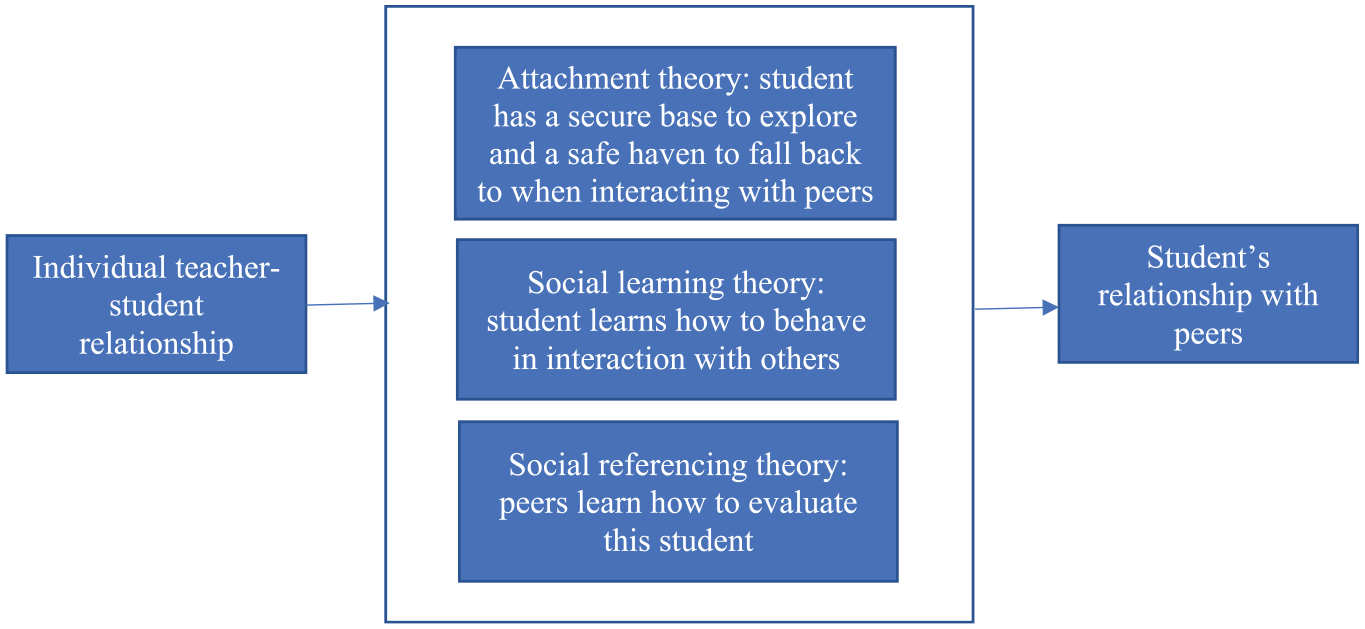
Theoretical model of the association between teacher–student and peer relationships.
Student Behavior
When studying teacher–student and peer relationships, it is important to take student behavior into account. A student’s general behavior may affect all the student’s social relationships in a similar way. For example, teachers respond more negatively to students who exhibit more behavioral problems (e.g., Buyse et al., 2008; Doumen et al., 2008; Spilt & Koomen, 2009). Similarly, students are often less liked by classroom peers when they frequently show problematic behavior, such as being aggressive or impulsive (e.g., Ekornås et al., 2011; Farmer et al., 2015; Koster et al., 2010; Nepi et al., 2015). However, studies with sophisticated designs that control for students’ internalizing, externalizing, and/or prosocial behavior have shown conflicting results regarding both the existence and the directionality of the association between teacher–student and peer relationship quality. For example, although de Wilde et al. (2016) and Brendgen et al. (2006) did not find a longitudinal association between teacher–student and peer relationships, Leflot et al. (2011) found that peer relationships predicted teacher–student relationships, Reavis et al. (2010) found that teacher–student conflict predicted peer victimization, and de Laet et al. (2014) found that sociometric popularity and teacher–student support predicted each other over time. Furthermore, a few studies have suggested that the teacher–student relationship mediates the association between student behavior and peer relationship quality. For example, Runions (2014) showed that reactive aggression was connected to peer victimization via teacher–student conflict. In addition, Hendrickx, Mainhard, Boor-Klip, et al. (2017b) found that the association between (overt and relational) aggression and peer dislike was mediated by teacher dislike as perceived by peers. Therefore, in this meta-analysis, besides examining the mutual influences between teacher–student and peer relationships, we examined the role of prosocial, externalizing, and internalizing student behavior in the quality of both teacher–student and peer relationships, and tested whether the teacher–student relationship mediates the association between student behavior and peer relationship quality.
Research Designs
Direction of Effects Between Teacher–Student and Peer Relationship Quality
Many cross-sectional studies have shown that students who have a negative relationship with the teacher are also evaluated more negatively by peers and experience less support from their classmates (e.g., Fredricks et al., 2018; Hernández et al., 2016; León & Liew, 2017). Although such findings may suggest that the teacher has an important role in the quality of peer relationships, the association may also be reversed such that teachers are affected by established peer relationships. Based on peer interactions they witness, teachers may, correctly or incorrectly, infer the quality of a student’s peer relationships (Pittinsky & Carolan, 2008). This may in turn lead to changes in the teacher’s perception of and interactions with the student, thereby affecting the teacher–student relationship. There is indeed evidence for such processes, where prior peer rejection predicted subsequent lower teacher preference (Mercer & DeRosier, 2008). However, compensation effects have also been found, with teachers increasing their positive interactions with a rejected student (McAuliffe et al., 2009).
Longitudinal studies are valuable to better understand the sequence of the associations between teacher–student and peer relationships. The few existing longitudinal studies showed that teacher–student relationships are predicted by peer relationships, in addition to peer relationships being predicted by teacher–student relationships (e.g., de Laet et al., 2014; Hughes & Chen, 2011; Kiuru et al., 2015). Two studies even found that teacher–student relationship quality was only predicted by, and not predictive of, peer relationship quality (Leflot et al., 2011; Weyns et al., 2018). Weyns et al. (2018) found that, when concurrent student engagement and teacher support in the previous year was controlled for, peer acceptance during the previous year predicted teacher support, in both Grade 5 and Grade 6. Therefore, effects of peer relationships on the quality of the teacher–student relationship must also be considered.
Experimental studies are important to shed more light on possible causal effects. The few experimental studies that have been conducted found that children who were shown receiving positive teacher feedback in a video vignette were more often preferred or liked by peers than those who were shown receiving negative teacher feedback, independent of whether this feedback was academic (Huber et al., 2018; Schwab et al., 2016), nonverbal (Brey & Pauker, 2019), or behavioral (White & Jones, 2000). White and Jones (2000) even suggested that neutral feedback could serve to heighten classmates’ awareness of a student’s inappropriate behavior. Note, however, that all four of these studies manipulated teacher behavior in order to assess the effect on peer relationships; therefore, these studies do not rule out that peer relationships may also influence the teacher–student relationship. Nonetheless, these experimental studies emphasize the potential role of teachers in peer relationship formation.
Positive and Negative Aspects of the Teacher–Student Relationship
Interestingly, there is accumulating empirical evidence indicating that the role of the teacher in peer relationships could be different for positive and negative aspects of the teacher–student relationship. Negative and conflictual aspects of relationships appear to be more strongly associated with peer relationships than positive aspects, such as teacher warmth or closeness (Hendrickx, Mainhard, Boor-Klip, et al., 2017b; Hendrickx, Mainhard, Oudman, et al., 2017; Huber et al., 2018; Ladd et al., 1999; McAuliffe et al., 2009; White & Jones, 2000). As suggested by Hendrickx, Mainhard, Boor-Klip, et al. (2017b), this more pronounced association may be due to a contrast effect, as negative interactions or a negative relationship with a teacher may stand out more from usually friendly classroom interactions, compared with positive teacher–student interactions and relationships. In the present meta-analysis, we therefore distinguished between positive and negative aspects of the teacher–student relationship.
Informants
The nature of the informant reporting about a given student’s relationship with teachers and/or peers may affect findings in several respects. First, when the informant for both types of relationships is the same, the association between the two types of relationships might be partly spurious due to same-rater biases (Lance et al., 2008). Second, teachers, students, parents, and peers may each observe and value different aspects of the teacher–student relationship (see Donker et al., 2021). Social referencing theory posits that the teacher–student interactions that are most relevant for peer relationships are the ones that are actually witnessed by peers (Hendrickx, Mainhard, Boor-Klip, et al., 2017a, 2017b; Hughes et al., 2001). This suggests that peer or observer reports of the teacher–student relationship may be more strongly associated with peer relationships than reports of other informants. In the present meta-analysis, we therefore controlled in all analyses for whether the same informant was used, and tested whether the type of informant for the teacher–student relationship moderated the strength of the association between teacher–student and peer relationship quality.
Educational Level
The quality of the teacher–student relationship may have a different impact at different educational levels. The role of the teacher–student relationship is expected to be most prominent in preschool and primary education, in comparison with (middle or) secondary education, as younger students are often taught by the same teacher for almost all subjects. As a result, the teacher–student relationship may have more pronounced consequences for the student as other teachers cannot compensate for potentially negative effects, for example. In addition, in secondary school students become increasingly independent, whereas elementary school students are more focused on their teachers (Buhrmester & Furman, 1987; Hargreaves, 2000; Lynch & Chicchetti, 1997). This implies that the teacher is generally less important for the peer relationships of secondary school students compared with primary school students.
The Current Study
Several theoretical models suggest an important role for teachers in the quality of students’ peer relationships; however, the empirical evidence so far is inconclusive. To gauge the strength of the association between the quality of teacher–student relationships and the quality of peer relationships, we conducted a meta-analysis. This meta-analysis also took student behavior into account; this is important as student behavior may affect the quality of teacher–student and peer relationships in similar ways and may therefore confound associations between the quality of teacher–student relationships and the quality of peer relationships. The main research question guiding our analyses was: In what way is teacher–student relationship quality related to peer relationship quality and how is student behavior related to both outcomes? We hypothesized (Hypothesis 1) that there is a positive association between the quality of teacher–student relationships and the quality of peer relationships, and that teacher–student relationships are longitudinally predictive of peer relationships. Moreover, we hypothesized (Hypothesis 2) that certain design characteristics of the included studies moderate the association between teacher–student and peer relationship quality. The design characteristics considered were as follows: (a) whether positive or negative aspects of the teacher–student relationship were assessed, (b) the informant for the teacher–student relationship, and (c) the educational level. Stronger associations were expected for negative compared with positive aspects of the teacher–student relationship, for peer or observer reports compared with student or teacher reports, and for preschool and primary students compared with secondary students. Finally, we hypothesized (Hypothesis 3) that teacher–student relationship quality mediates the effect of student behavior on peer relationship quality.
Method
Literature Search
This study was preregistered in PROSPERO under registration number CRD42018112879. Here, we specified the literature search, the inclusion criteria, and the coding of the studies. Supplemental Appendix 1, available in the online version of this article, shows the search string. The keywords “peers” or “classmates” were combined with “teacher” or “educator” and used in combinations with terms relating to affective relationships, such as “support,” “closeness,” or “conflict,” in line with earlier reviews about teacher–student relationships (e.g., Roorda et al., 2011; Roorda et al., 2017). The databases PsycInfo, Eric, Scopus and Web of Science were used to retrieve relevant studies. To ensure that all the sourced papers had undergone rigorous peer review, we screened titles, abstracts, and keywords of peer-reviewed, English-language SSCI journal articles. The time period of the search was from the January 2000 until August 2020; given the extensive return of possible papers (N = 8,293 papers, comprising 4,341 unique studies and 3,952 duplicates), the decision was made not to further extend the search period.
Inclusion Criteria
There were five inclusion criteria. First, the study had to be an empirical study; second, the sample had to be drawn from preschool, primary, or (middle or) secondary education (ages 3–18 years); third, the study had to report measures of affective aspects of both the teacher–student relationship or interactions and peer relationships; fourth, analyses had to be performed at the level of the individual student, such that individual scores were included for each participant on both teacher–student relationships and peer relationships; and fifth, peer relationships had to be assessed in terms of relationships with classmates. These inclusion criteria are applied to enable inferences regarding how classroom processes affect individual relationships, as opposed to solely measuring classroom social climate (i.e., at the level of the class), and in order to focus on peer relationships in the classroom as opposed to at school in general, during free time, or in sports clubs. Measures of (problem) behavior were coded separately in the meta-analysis; however, it was not required for a study to include such a measure.
Coding of Studies
Information about study setting, study population, methods, effect sizes, and quality of the study were coded (see online Supplemental Appendix 2). Multiple effect sizes were included for a single study if multiple informants for each concept were used, or if several time points were included. Multiple effect sizes could also be included for one study if multiple behavioral concepts or multiple teacher–student relationship/peer relationship concepts were measured. When multiple papers used the same sample and focused on the same concepts, the effect sizes were included only once in our analyses. When multiple papers analyzed different concepts within the same sample, they received the same unique sample identifier.
Study Selection and Interrater Reliability
Studies for this meta-analysis were selected using a step-by-step procedure (see Figure 2). Two researchers independently screened all titles and abstracts and then full texts according to the inclusion criteria. In weekly meetings, they compared their sorting results and discussed discrepancies until agreement was reached. Authors were contacted by email or Research Gate if no full-text version was available, if correlation coefficients were not available, or in case of possible sample overlap with other papers. If necessary, a reminder was sent after 2 weeks. This procedure resulted in the inclusion of 297 studies in this meta-analysis (see online Supplemental Appendix 3 for the reference list). Of these studies, 32% were published between 2018 and 2020 (n = 94) and 62% between 2014 and 2020 (n = 184).
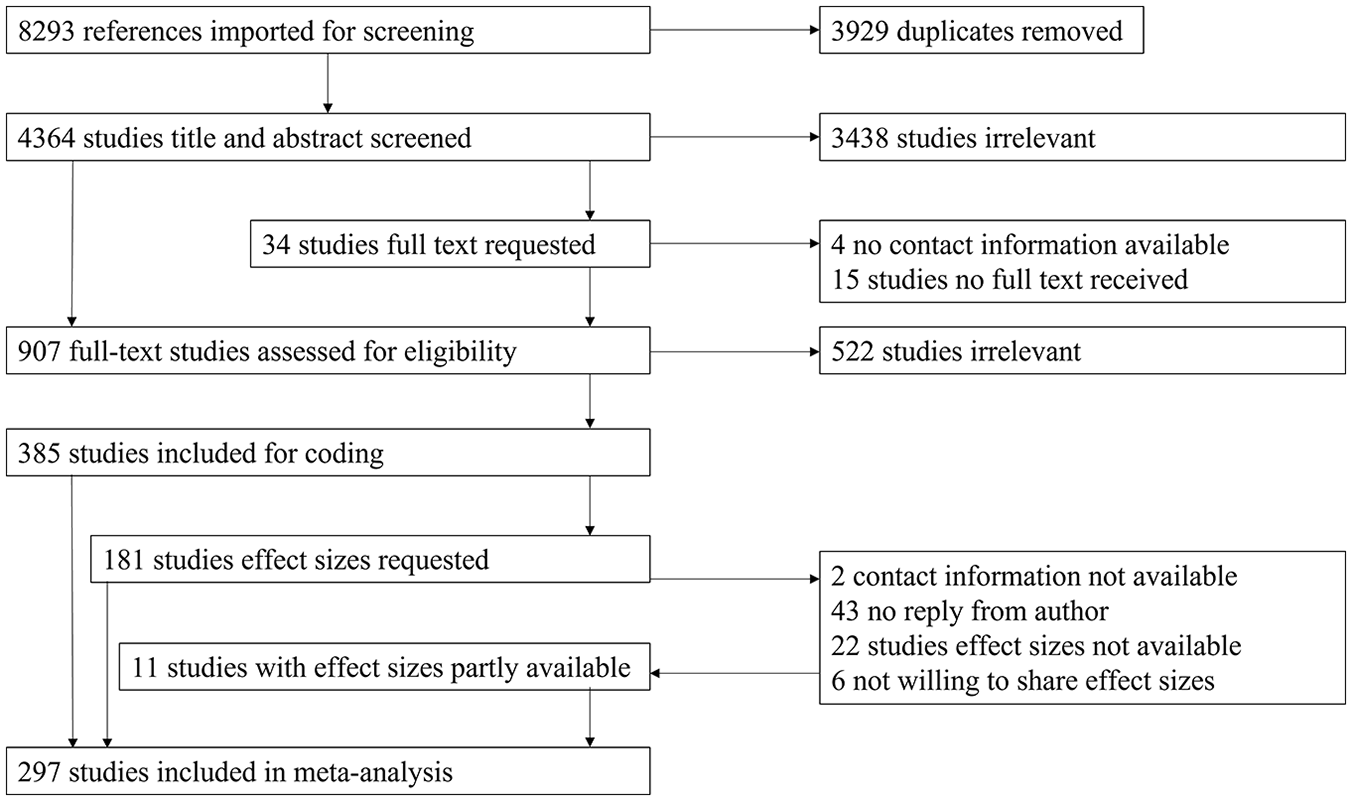
PRISMA model of the selection and inclusion of studies.
Included studies were coded by the first author and three research assistants based on a piloted coding scheme to extract all important study characteristics (e.g., sample size and measurement information) and effect sizes needed for the analyses (see online Supplemental Appendix 2). The research assistants were trained, and began coding after reaching a minimum of 85% agreement on three training days. Fifteen percent of the studies were randomly selected and double coded (n = 35). Disagreements, questions, or problems were discussed in a weekly meeting, with the aim of refining the coding appointments (Belur et al., 2021) and reaching 100% agreement before including studies in the analysis. For 80% of the double-coded studies there was absolute agreement regarding the number of effect sizes; across all double-coded studies, there was an average of 87% agreement on the coding of study characteristics, ranging from 64% to 97%, with only three cases of agreement below 80% due to typographical mistakes. A final check of all study coding was conducted by the primary researcher, focusing on coding errors and typographical mistakes.
Summary of Included Effect Sizes
The final sample consisted of 1,475 unique effect sizes for the association between teacher–student relationship quality and peer relationship quality, stemming from 240 unique samples reported in 297 papers. Within a sample, the number of included effect sizes varied from 1 to 135, with an average of 6 effect sizes per unique study sample. Sample sizes varied from 24 to 150,822 students per sample. In total, the included effect sizes were based on N = 651,014 students, about 17,161 classes, and at least 7,702 schools (not all studies reported the number of schools or classes included).
Analyses
Metaregression analyses were performed, in which the correlation between teacher–student relationship quality and peer relationship quality was the dependent variable. To account for same-rater biases (Lance et al., 2008), in all analyses, information regarding whether the same informant was used for both teacher–student and peer relationship quality (coded “yes/no”) was included as a covariate. As multiple effect sizes were nested within a sample, we used a three-level meta-analysis (van den Noortgate et al., 2015). This method allowed us to take into account all associations between teacher–student and peer relationships that were available in the included study samples, instead of using only one (pooled) correlation per sample. This enabled us to measure the source of variance between effect sizes within studies, while at the same time being able to control for dependence between effect sizes from the same study (van den Noortgate et al., 2015). Model fit comparisons (see Table 1) showed that a three-level model was warranted, as there was significant variance in effect sizes within study samples,
Comparing the fit of different multilevel models
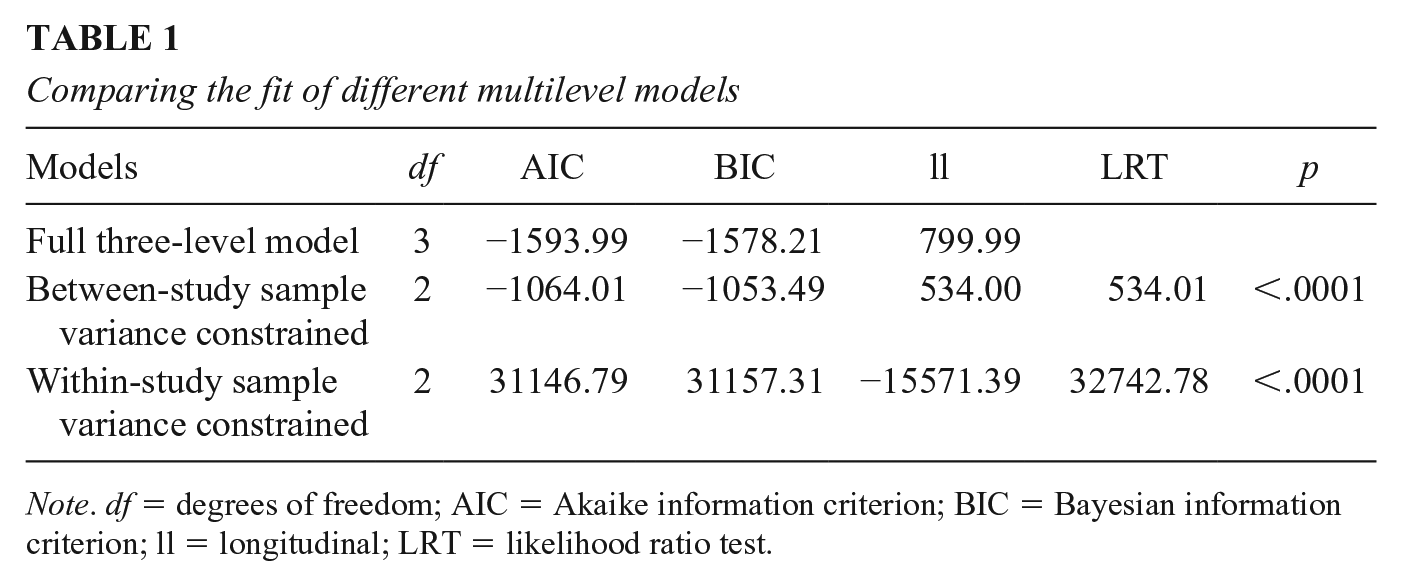
Note. df = degrees of freedom; AIC = Akaike information criterion; BIC = Bayesian information criterion; ll = longitudinal; LRT = likelihood ratio test.
The effect sizes were divided into three subsamples based on the time lag between measurements. In the first group of effect sizes, the cross-sectional subsample, peer relationship quality and teacher–student relationship quality were assessed at the same time point. In a second subset, the teacher-first subsample, teacher–student relationship quality was assessed at an earlier time point (i.e., Time 1) and peer relationship quality was assessed at a later time point (i.e., Time 2). In a third subset, which we refer to as the peer-first subsample, teacher–student relationship was coded at Time 2 and peer relationships at Time 1. The fact that teacher–student and peer relationships could be measured at multiple time points meant that different effect sizes from one unique study sample could belong to different subsamples, resulting in both cross-sectional, teacher-first and peer-first effect sizes. Behavioral problems were always coded at Time 1 if measured at both time points, to be able to control for student behavior in the association between teacher–student and peer relationships.
We used meta-analytic structural equation modeling (i.e., MetaSEM; Cheung, 2015) to examine the mediating role of teacher–student relationships in the association between student behavior and peer relationships (Hypothesis 3). Meta-analytic SEM with multiple effect sizes per sample—that is, three-level meta-analytic SEM—is not yet implemented in the MetaSEM package; therefore, we followed the two-stage procedure suggested by Cheung (2015 and personal communication). We first pooled correlations across studies to obtain the asymptotic sampling covariance matrix. To account for the multilevel structure of the data, we used robust variance estimation with bias-reduced linearization adjustment (Pustejovsky & Tipton, 2018). Given the complexity of these analyses, it was not possible to take into account the type of behavior or design characteristics (positive or negative aspects of the relationship, informant, and educational level) as moderators in this mediation analysis. We used a multigroup MetaSEM model to compare the estimates between the following subsamples: (a) cross-sectional data with same informant for teacher–student and peer relationships; (b) cross-sectional data with different informants; (c) longitudinal teacher-first data with the same informant; and (d) longitudinal teacher-first data with different informants. We estimated several models in which we progressively constrained parameters across groups and performed likelihood ratio tests to identify the simplest model with the best fit. All paths were free across groups in the free model. In theoretical model, paths that were assessed identically across groups, which should theoretically be equal, were constrained to equality. In the informant constraints model, we additionally constrained the paths between the same and different informant subsamples. In the time constraints model, we constrained the time-lagged paths between the cross-sectional and teacher-first subsamples. Finally, in the all constrained model we used both the informant constraints as well as the time constraints across groups. Model comparisons showed that the theoretical model had the best fit (see Table 2). In this model, constraints were made between all four subsamples on the association between student behavior and teacher–student relationship, and between the same and different informant subsamples for the association between student behavior and peer relationships. The mediation analysis was performed on this theoretical model.
Model fit
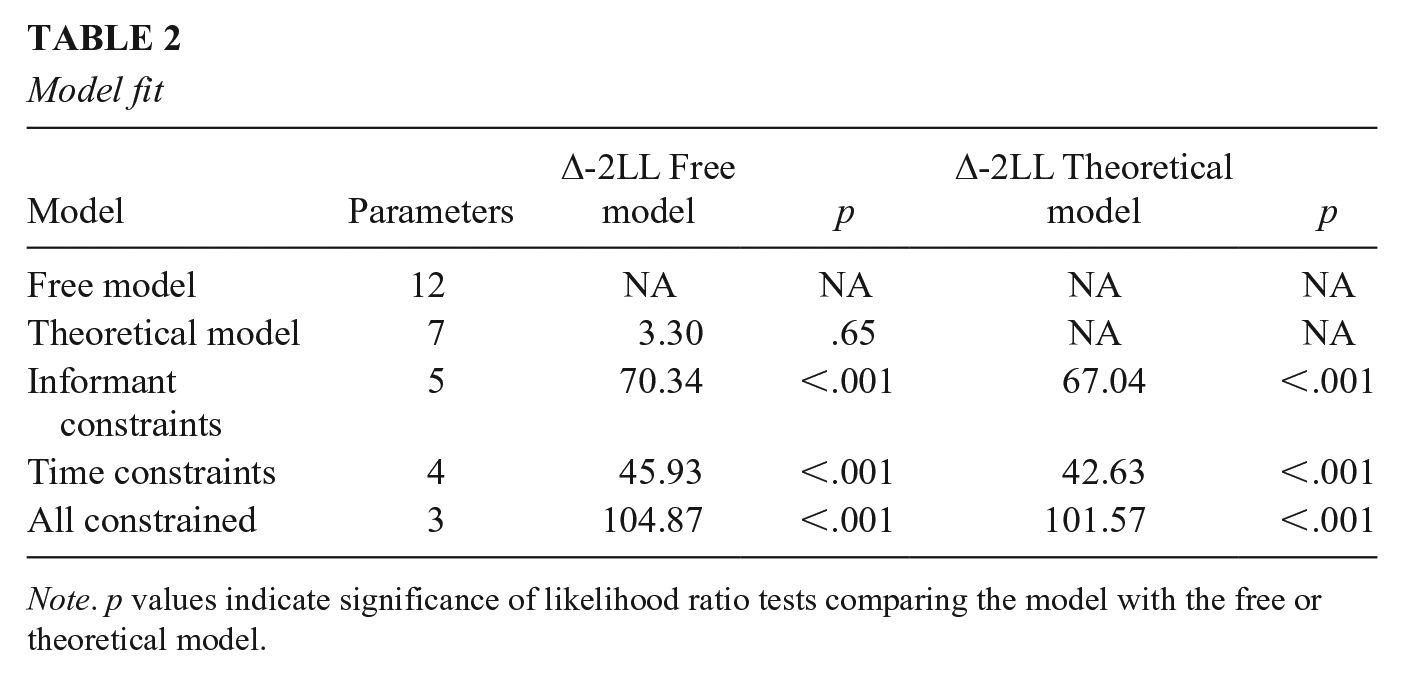
Note. p values indicate significance of likelihood ratio tests comparing the model with the free or theoretical model.
Publication Bias
Publication bias was evaluated visually using funnel plots, computed with the metafor package in R (Viechtbauer, 2010). Large positive effect sizes with large standard errors seemed to be missing in the funnel plots. To apply Egger’s test (Egger et al., 1997) to the multilevel models, a meta-regression was performed on each type of effect size (i.e., teacher-student with peer relationship effect size, behavior with teacher-student relationship effect size, and behavior with peer relationship effect size) with sampling variance as moderator. The moderator effect of sampling variance was significant in all three models (ps < .001) with a negative association between the sampling variance and the outcomes. These findings indicate that the effect sizes are smaller in studies with a larger variance in effect sizes. Rather than publication bias, this would suggest a potential underestimation of the overall effect.
Results
Association Between Teacher–Student and Peer Relationship Quality
Effect sizes of the individual studies can be found in Table 3. The estimated overall association between teacher–student and peer relationships was r = .28, 95% CI [.26, .30], p < .001. According to guidelines for meta-analytically derived correlations in social sciences proposed by Gignac and Szodorai (2016) and Paternson et al. (2016), which suggest r = .10, r = .20, and r = .30 as small, medium, and large effect sizes, respectively, this can be considered a relatively large effect.
Effect sizes per study

Note. N = number; TP = teacher–student with peer relationship effect size; BT = behavior with teacher–student relationship effect size; BP = behavior with peer relationship effect size; pre = preschool; pri = primary school; sec= secondary school; cross = cross-sectional; long = longitudinal; exp = experiment.
See online Supplemental Appendix 3 for the references listed in the table.
To test whether the overall effect size of the association between teacher–student and peer relationships was different for cross-sectional compared with longitudinal effect sizes, the three subsamples (cross-sectional, teacher-first, and peer-first) were compared, while controlling for same-rater effects. This analysis showed that, as expected, for both the teacher-first subsample (b = −.05, 95% CI [−.07, −.03], p < .001) and the peer-first subsample (b = −.07, 95% CI [−.09, −.05], p < .001), longitudinal effect sizes were smaller than the cross-sectional associations, F(2, 1421) = 31.15, p < .001. A comparison of the estimates of the peer-first subsample with the teacher-first subsample revealed that the association between teacher–student and peer relationships was significantly larger for the teacher-first subsample than for the peer-first subsample (b = −.02, 95% CI [−.04, .00], p = .015). This suggests that teacher–student and peer relationships are moderately strongly related and that they also predict each other over time, with a somewhat stronger predictive power of teacher–student relationships toward peer relationships than vice versa.
Design Characteristics
Positive Versus Negative Aspects of Teacher–Student Relationships
To test whether the association between teacher–student relationship quality and peer relationship quality was different for negative aspects of the teacher–student relationship (e.g., conflict) compared with positive aspects (e.g., closeness), a moderator analysis was performed, while controlling for same-rater effects. As expected, the association between teacher–student and peer relationships was stronger when the teacher–student relationship was assessed with a negative relationship concept, compared with a positive relationship concept, b = .05, 95% CI [.04, .07], p < .001, F(1, 1420) = 41.06, p < .001. Moreover, an interaction effect was found between the teacher–student relationship concept and the three time subsamples, F(2, 1417) = 3.24, p = .040. Compared with the cross-sectional subsample, associations were stronger for negative relationship concepts in the teacher-first subsample (b = .04, 95% CI [.00, .08], p = .019) and marginally stronger in the peer-first subsample (b = .03, 95% CI [−.01, .08], p = .076), but there was no significant difference between the teacher-first subsample and the peer-first subsample (b = −.01, 95% CI [−.06, .04], p = .666). In sum, negative aspects of teacher–student relationships had a stronger association with peer relationship quality compared with positive aspects, and these effects were more pronounced over time.
Type of Informant
While controlling for same-rater effects, the association between teacher–student relationship quality and peer relationship quality differed depending on the informant of the teacher–student relationship, F(3, 1419) = 22.15, p <.001. However, no interaction effect was found between the type of informant and the three time subsamples, F(6, 1411) = .31, p = .932. When the person reporting on the teacher–student relationship was a teacher, this resulted in significantly larger effect sizes of the association with peer relationships compared with when the informant was a student (b = .04, 95% CI [.01, .07], p < .001), a classmate (b = .16, 95% CI [.10, .22], p < .001), or an external observer (b = .14, 95% CI [.09, .19], p < .001). Student reports, in turn, resulted in stronger associations compared with classmate reports (b = .12, 95% CI [.07, .16], p < .001) and observer reports (b = .09, 95% CI [.05, .14], p < .001). Finally, classmate reports did not lead to different estimates from observer reports (b = .02, 95% CI [−.03, .08], p = .331).
Educational Level
Effect sizes in our analyses were based on different educational levels, namely, preschool (n = 124), primary school (n = 841), secondary school (n = 234), a combination of preschool and primary school (n = 110), or a combination of primary and secondary school (n = 116). Overall, the different educational levels did not differ in the strength of the association between teacher–student relationship quality and peer relationship quality, F(4, 1419) = .82, p = .513, while controlling for same-rater effects. However, the association between teacher–student and peer relationship quality did differ between educational levels when cross-sectional, teacher-first, and peer-first subsamples were compared, F(8, 1409) = 3.59, p < .001. Both in the peer-first and teacher-first subsamples, the effect size for primary schools was larger compared with preschool (resp. b = .10, 95% CI [−.02, .23], p = .011, and b = .13, 95% CI [−.01, .26], p = .004), and compared with secondary school (respectively, b = .08, 95% CI [−.01, .17], p = .010, and b = .11, 95% CI [.02, .19], p < .001), as well as compared with studies consisting of both primary and secondary school students (respectively, b = .08, 95% CI [−.04, .20], p = .035, and b = .10, 95% CI [−.03, .22], p = .019). Moreover, in the teacher-first subsample, the effect size for secondary schools was smaller compared with effect sizes in studies with both preschool and primary school students (b = −.07, 95% CI [−.19, .04], p = .047). In sum, although the association between teacher–student and peer relationships was comparable across educational levels, there are some indications that the associations over time are somewhat stronger in primary school than at other educational levels.
Student Behavior
Student Behavior and Teacher–Student Relationships
The overall association between student behavior and teacher–student relationships was r = .25, 95% CI [.23, .28], p < .001; that is, a medium to large effect size. To estimate whether associations between student behavior and teacher–student relationships differed for prosocial behavior, internalizing behavior, and externalizing behavior, the type of behavior was included as a moderator in the analyses, while controlling for same-rater effects. The association between student behavior and teacher–student relationships varied between different types of student behavior, F(2, 988) = 45.83, p < .001: for prosocial behavior there was an average effect size of r = .25 (95% CI [.21, .28], p < .001), for internalizing behavior r = .07 (95% CI [.04, .11], p < .001), and for externalizing behavior r = .21 (95% CI [.19, .24], p < .001). Compared with internalizing behavior, the association was stronger for both prosocial behavior (b = .17, 95% CI [.13, .22], p < .001) and externalizing behavior (b = .14, 95% CI [.10, .18], p < .001). In addition, this association was slightly stronger for prosocial behavior than for externalizing behavior (b = .03, 95% CI [.00, .07], p = .039). In sum, student behavior was moderately positively associated with teacher–student relationship quality: students exhibiting more prosocial behavior or less externalizing behavior generally also had higher quality teacher–student relationships.
Student Behavior and Peer Relationships
The overall association between student behavior and peer relationships was r = .27, 95% CI [.25, .30], p <.001; that is, a medium to large effect size. While controlling for same-rater effects, the association between student behavior and peer relationships differed for the three types of student behavior, F(2, 942) = 33.82, p < .001: for prosocial behavior there was an average effect size of r = .31 (95% CI [.27, .35], p < .001), for internalizing behavior r = .17 (95% CI [.13, .20], p < .001), and for externalizing behavior r = .18 (95% CI [.15, .22], p < .001). The association with peer relationships was stronger for prosocial behavior compared with both internalizing behavior (b = .14, 95% CI [.09, .19], p < .001) and externalizing behavior (b = .12, 95% CI [.09, .16], p < .001). There was no statistically significant difference between associations of internalizing and externalizing student behavior with peer relationships (b = −.02, 95% CI [−.05, .02], p = .307). In sum, student behavior was moderately positively associated with peer relationship quality; particularly students showing more prosocial behavior had better relationships with peers.
Teacher–Student Relationship as Mediator of Student Behavior
To test whether student behavior affects peer relationships via teacher–student relationships, a mediation model was tested based on the theoretical model (see Figure 3). Table 4 illustrates the coefficients by subsample, and shows comparisons of estimates between the four subsamples (cross-sectional different informants, cross-sectional same informant, teacher-first different informants, and teacher-first same informant). All four subsamples showed that teacher–student relationships partly mediated the association between student behavior and peer relationships. Despite the differences in strength between the subsamples, all paths in all four subsamples were significant (ps < .001), indicating that student behavior predicts teacher–student relationship and peer relationship quality, and that teacher–student relationship quality predicts peer relationship quality. This suggests that even when student behavior is controlled for, teacher–student relationships are predictive of peer relationships. Moreover, we found the hypothesized indirect effect of student behavior on peer relationship quality via teacher–student relationship quality in all four subsamples with small effect sizes (ps < .001). Despite these small effect sizes, this mediation effect increased the association between student behavior and peer relationship from a moderate to a large effect size in the cross-sectional same informant subsample. These findings suggest that teachers play a small role in the association between student behavior and peer relationships via the quality of the relationship they themselves build with students.
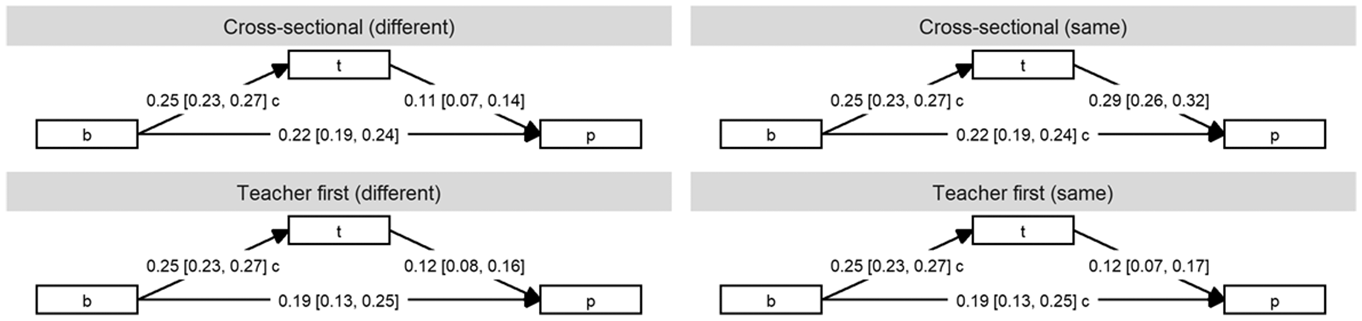
Mediation model coefficients by cross-sectional or teacher-first subsample with different or same informants and only cross-sectional constraints.
Theoretical model results for teacher-first subsample with different informants (long diff), teacher-first subsample with same informant (long same), cross-sectional subsample with different informants (cross diff), and cross-sectional subsample with same informant (cross same)
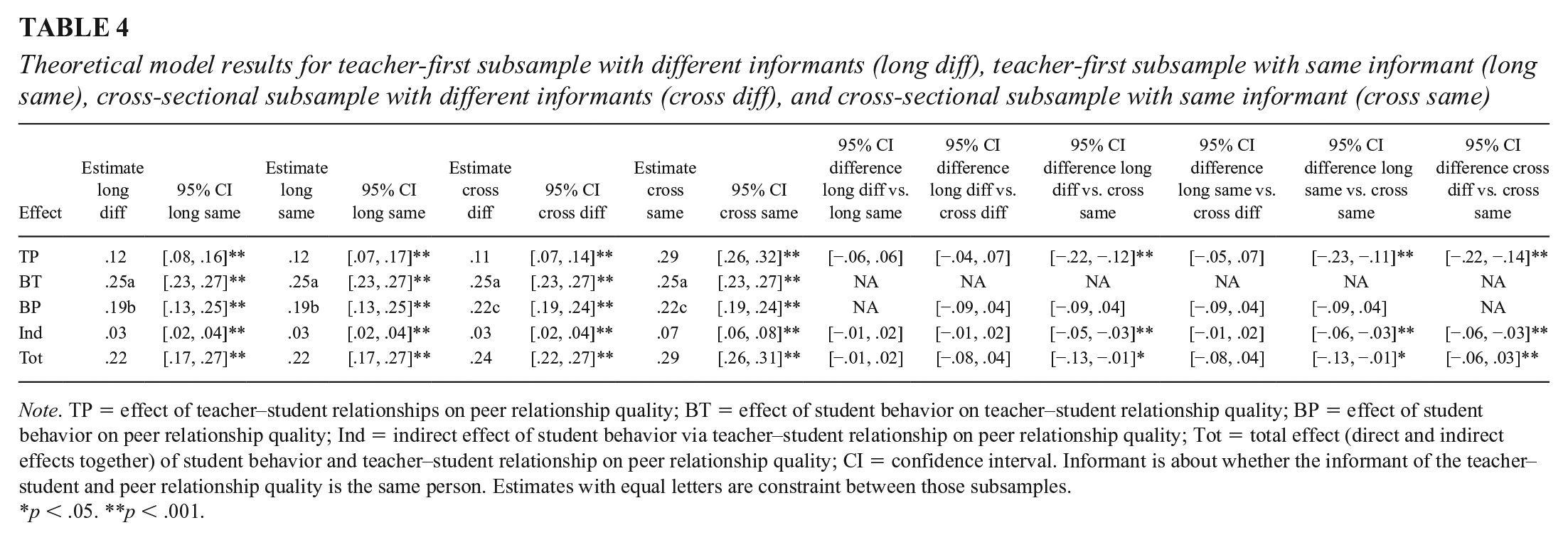
Note. TP = effect of teacher–student relationships on peer relationship quality; BT = effect of student behavior on teacher–student relationship quality; BP = effect of student behavior on peer relationship quality; Ind = indirect effect of student behavior via teacher–student relationship on peer relationship quality; Tot = total effect (direct and indirect effects together) of student behavior and teacher–student relationship on peer relationship quality; CI = confidence interval. Informant is about whether the informant of the teacher–student and peer relationship quality is the same person. Estimates with equal letters are constraint between those subsamples.
p < .05. **p < .001.
Discussion
In the present meta-analysis, we studied the association between teacher–student relationship quality and peer relationship quality. In addition, we studied the role of student behavior in this association; specifically, we assessed the mediating role of teacher–student relationships in the association between student behavior and peer relationship quality. One major finding was that the teacher–student relationship indeed played an important role for peer relationships. This was especially the case for negative aspects of the teacher–student relationship, such as conflict, as opposed to positive aspects, such as closeness. Moreover, teacher–student relationships and interactions mediated the association between student behavior and peer relationship quality, indicating that the way in which a teacher deals with a student’s behavior may subsequently affect peer relationships.
The Association Between Teacher–Student and Peer Relationship Quality
This meta-analysis confirmed that teacher–student relationships and peer relationships are moderately to strongly associated and predict each other over time. More important, longitudinal findings suggest that the teacher–student relationship affects peer relationships more strongly than the other way around. This is in line with our hypothesis based on theoretical mechanisms such as discussed in attachment theory (e.g., Pianta et al., 2003; Verschueren & Koomen, 2012), social learning theory (Bandura, 1971), and social referencing theory (Hughes et al., 2001). On the other hand, results indicated that teacher–student relationship quality can also be predicted by established peer relationships. Therefore, transactional processes might underlie the association between teacher–student and peer relationship quality. The importance of affective teacher–student relationships for peer relationship quality extends earlier findings regarding the role of the teacher–student relationship in positive student outcomes, such as increased academic achievement, increased engagement, and diminished behavior problems (Cornelius-White, 2007; Quin, 2017; Roorda et al., 2011). Although our meta-analysis is based on studies with correlational designs, this general direction of effects is also reflected in the few studies that have intervened experimentally in teacher–student interactions to change peer perceptions (see Brey & Pauker, 2019; Huber et al., 2018; Schwab et al., 2016; White & Jones, 2000). Thus, as theorized by Farmer et al. (2011), among others, teachers may indeed have the opportunity to unintentionally affect a student’s peer relationships through their own relationship and interactions with that student. According to a recent meta-analysis by Kincade et al. (2020) concerning effective elements of teacher–student relationship intervention programs, the largest improvements in teacher–student relationships can be achieved when teachers use proactive direct practices, such as praise, demonstrating respect, spending one-on-one time with students to build relationships, coaching student emotions, getting to know students personally, or by reviewing their internal representations of the teacher–student relationship. In sum, beyond the direct attempts of teachers to improve peer relationships in the classroom, teachers also can and will affect peer relationships via their everyday interactions and relationships with students.
Student Behavior
Our findings showed that, in general, all types of student behavior were moderately to strongly predictive of both teacher–student relationship quality and peer relationship quality, with the exception of internalizing behavior. Interestingly, students’ prosocial behavior was somewhat more predictive of the teacher–student relationship than externalizing behavior, whereas internalizing student behaviors hardly affected the quality of teacher–student relationships. Nonetheless, students with externalizing behavior problems are particularly at risk of developing negative teacher–student relationships. Through negative interactions with these students, including negative or corrective teacher behavior, the teacher may draw negative attention to these students among their classmates, resulting in lower quality peer relationships (Hendrickx, Mainhard, Oudman, et al., 2017; Runions, 2014). As our analyses indicate, peer relations are in principle less strongly affected by externalizing and internalizing behavior compared to prosocial behaviors. The teacher’s actions may therefore emphasize negative aspects of interaction, which peers may not have focused on otherwise.
Tapping into this possible chain of effects, our mediation analyses show that the quality of the teacher–student relationship mediates the association between student behavior and peer relationships. That is, students who showed higher levels of prosocial behavior or lower levels of problem behavior also had a higher quality relationship with their teacher; furthermore, this predicted peer relationship quality in addition to a direct effect of student behavior. Although the indirect effect size was relatively small, for the cross-sectional same informant subsample the effect size changed from moderate to strong due to this indirect effect of the teacher–student relationship. These findings suggest that, for students both with and without behavior problems, the teacher has a significant hand in students’ peer relationship quality via their own relationship and interactions with the students. This is in line with social referencing theory (Hughes, 2012), suggesting that the teacher functions as an affective filter by differentially reacting to students’ (problematic) behavior. Alternatively, it may be that students themselves engage differently in the formation of peer relationships due to their experiences in the teacher–student relationship. In line with attachment theory, students may have developed higher or lower levels of confidence, competence, and resilience in their interactions as a result of the teacher–student relationship (e.g., Pianta et al., 2003); or, in line with social learning theory, students may have had more or fewer opportunities to learn from the teacher’s prosocial interactions (Whitby et al., 2012).
Positive and Negative Aspects of the Teacher–Student Relationship
Importantly, the association between teacher–student relationships and peer relationship quality was significantly stronger for negative aspects of the teacher–student relationship, such as conflict, than for positive aspects, such as warmth and closeness. This confirms some earlier suggestions (e.g., Hendrickx, Mainhard, Boor-Klip, et al., 2017b; Hendrickx, Mainhard, Oudman, et al., 2017; Huber et al., 2018; Ladd et al., 1999; McAuliffe et al., 2009), and may be due to negative interactions being more salient among the typically friendly interactions in the classroom (Hendrickx, Mainhard, Boor-Klip, et al., 2017b). Therefore, based on the current meta-analysis, we suggest that, rather than trying to primarily (further) increase positive aspects such as warmth and closeness, it is especially important to try to proactively prevent negative or disruptive student behavior, thereby avoiding conflictual and negative teacher–student interactions such as corrective teacher feedback or punishment. For example, during class, teachers could try to prevent negative interactions by using proactive strategies such as coaching and validating emotions (Kincade et al., 2020), or they could aim to respond sensitively by emphasizing desired behavior in a friendly way and by offering emotional support (e.g., Buyse et al., 2008) and keeping corrective feedback minimal. Teachers could also try to discuss behavioral expectations with students outside the view and awareness of their classmates, instead of during class. Further research is recommended to shed more light on how teachers can be specifically supported in reducing negative teacher–student interactions.
Type of Informant
When corrected for same-rater bias, teacher and student reports of the teacher–student relationship were most strongly associated with peer relationship quality, compared with peer or observer reports. From the perspective of social referencing, this is somewhat surprising, given the assumption that peer relationships are informed by peers’ perceptions of the student’s relationship with the teacher (Hendrickx, Mainhard, Boor-Klip, et al., 2017a; Hughes et al., 2001). A possible explanation for these stronger associations could be that teachers and students are better able to make a reliable assessment of the teacher–student relationship, compared with peers or observers (Donker et al., 2021), as they are able to take their interaction history into account. Alternatively, Hendrickx, Mainhard, Boor-Klip, et al. (2017a) suggested that it is not the classmates’ shared opinion of the teacher–student relationship that is informative for a particular peer relationship, but rather how a specific classmate perceives a specific student’s relationship with the teacher. For example, some students might actually have a negative perception of peers who are liked by the teacher, as they might view such peers as the “teacher’s pet” (i.e., the teacher’s favorite; Babad, 2009), and so dislike these peers. To test these individual differences in peer perceptions of teacher–student relationships, studies at the dyadic level rather than the class level are needed. Therefore, in future research, it is important to consider which informant can provide the best assessment of the teacher–student relationship; this may depend on the process under investigation. That is, if the focus is on the association between teacher–student and peer relationships, it may be important to consider triangulation or an intraindividual perspective in which both teacher–student and peer relationships are measured and analyzed not on a group level but for each classmate separately in dyadic designs (see Hendrickx, Mainhard, Boor-Klip, et al., 2017a).
Educational Level
In our study, associations between teacher–student and peer relationships were similar across educational levels. Only the longitudinal effects between teacher–student relationships and peer relationships were stronger in primary school than in preschool and secondary school. The absence of a clear difference between educational levels is in contrast with our expectation of stronger associations in primary education due to younger students having the same teacher for all subjects and due to the higher reliance of primary school students on their teacher (e.g., Hargreaves, 2000). This absence of a difference between primary and secondary education could be due to the lack of information in many studies about whether students had the same teacher most of the time or had several teachers. As educational systems across the world differ (with or without a preschool and with or without a middle school), it is recommended that future studies provide clear information about the number of different teachers a student is taught by. Nonetheless, based on this meta-analysis, there is currently no evidence for a difference between educational levels in the association between teacher–student and peer relationship quality.
Strengths and Limitations
One key strength of the current study is that we investigated not only the association between teacher–student and peer relationships, but also an important explanation for the association between these relationships: student behavior. We were able to establish not only that teacher and peers are distinctly affected by student behavior (Buyse et al., 2008; Doumen et al., 2008; Farmer et al., 2011; Spilt & Koomen, 2009) but also that the teacher–student relationship is predictive of peer relationships independently of student behavior. Moreover, by studying the association between these three variables, we were able to establish that the teacher functions, at least in part, as a mediator for student behavior.
Nonetheless, this study also had some limitations, with the most important of these being that we could not take into account the nesting of children in classes and schools. Educational studies have intrinsically nested designs, in which two children within a class share more variance than two children from different classrooms or even different schools. We analyzed the data at the lowest level possible (bivariate correlations), for two reasons. First, many studies included in the meta-analysis did not use a multilevel design to analyze multilevel data, and therefore, the effect sizes available to us were not controlled for the nested structure of the data. Second, although the analyses we performed were already advanced in nature, current analysis software unfortunately does not readily allow researchers to include the nestedness of the data in a meta-analysis. Not taking into account the nesting in classrooms in schools could have resulted in the attribution of classroom variance to differences between students, resulting in an inflated Type I error and therefore an overestimation of the effect sizes.
Another limitation is that because of the large number of studies, not all studies were double coded, which poses a potential threat to the internal validity. The largest risk during the coding is change in coding practices or drift between and within individuals over time (Belur et al., 2021; Sgammato & Donoghue, 2018). We think that our procedure of weekly discussions and a final check by the principal researcher largely averted this risk and we therefore do not expect that this practice had a large, if any, impact on the findings.
Future Directions
To better understand the interplay of teacher–student relationship quality and peer relationship quality, longitudinal research using cross-lagged designs is needed. The current meta-analysis indicates that a complex transactional relationship between teacher–student and peer relationship quality is likely, and that student behavior has an important role in this transaction. At present, there exist only a few studies that have examined such cross-lagged relationships (e.g., de Swart et al., 2021; Demol et al., 2020; Hughes et al., 2011; Kiuru et al., 2015), and only de Laet et al. (2014) took student behavior into account. In de Laet et al.’s study, prosocial behavior did not predict changes in peer likeability and teacher–child support.
Furthermore, there is a need for studies that disentangle the different perspectives on teacher–student and peer relationships provided by different informants. The current meta-analysis suggested differences between reports of teacher–student relationships from teachers and students compared with peers or observers. Teachers or students as informants might be more valuable for a reliable assessment of their teacher–student relationship as they can take their interaction history into account. Alternatively, peer reports might be more valuable for insight into classroom processes when not only teacher–student relationships but also peer relationships are assessed. Importantly, for peer reports to offer additional insight, they should be measured and analyzed at an intraindividual, dyadic level, where each classmate’s report of each student is taken into account separately (see Hendrickx, Mainhard, Boor-Klip, et al., 2017a).
Conclusion and Practical Implications
The findings of this meta-analysis confirm that teacher–student and peer relationships reciprocally predict each other and that teachers partly mediate the association between student behavior and peer relationships. Although more experimental studies are needed to make more causal inferences, our findings indicate that teachers have the potential to make a difference in students’ peer relationships, especially in the case of students with behavioral problems. Our results suggest that, in particular, negative teacher–student relationships and corrective teacher feedback may have negative consequences for a student’s peer relationships. Therefore, teachers may wish to focus on preventing or reducing negative interactions with students who are at risk of negative peer relationships rather than increasing friendly interactions. Furthermore, our results indicate that it is possible that teacher’s relationship with a student is also affected by the student’s peer relationships. Being aware of this possibility may help teachers consciously counteract negative interactions with students who have peer relationship difficulties. Finally, in their classroom interactions, teachers may inadvertently draw peers’ attention to a student’s behavioral problems, where these peers may have otherwise focused more on the prosocial behaviors of that student. In sum, if teachers use their invisible hand wisely, they may support students in forming positive peer relationships.
Supplemental Material
sj-pdf-1-rer-10.3102_00346543211051428 – Supplemental material for The Teacher’s Invisible Hand: A Meta-Analysis of the Relevance of Teacher–Student Relationship Quality for Peer Relationships and the Contribution of Student Behavior
Supplemental material, sj-pdf-1-rer-10.3102_00346543211051428 for The Teacher’s Invisible Hand: A Meta-Analysis of the Relevance of Teacher–Student Relationship Quality for Peer Relationships and the Contribution of Student Behavior by Hinke M. Endedijk, Linda D. Breeman, Caspar J. van Lissa, Marloes M. H. G. Hendrickx, Larissa den Boer and Tim Mainhard in Review of Educational Research
Footnotes

Note
This study has been financially supported by a grant from the Netherlands Initiative for Education Research (NRO) of the Dutch Research Council (NWO), Project Number 405-18-632.
Authors
HINKE M. ENDEDIJK is an assistant professor in Educational Science, Leiden University, Wassenaarseweg 52, 2333 AK Leiden, The Netherlands; email:
LINDA D. BREEMAN is a research coordinator and is dedicated to improving vulnerable people’s health and well-being. Email:
CASPAR J. VAN LISSA is an assistant professor and applies insights from data science to developmental psychological research questions, and the synthesis of research findings in meta-analysis. Email:
MARLOES M. H. G. HENDRICKX is an assistant professor and studies interpersonal interactions and relationships in (teacher) education. Email:
LARISSA DEN BOER is an educational and research assistant in higher education. Email:
TIM MAINHARD is an associate professor and studies social dynamics in educational settings and consequences for student and teacher outcomes. Email:
References
Supplementary Material
Please find the following supplemental material available below.
For Open Access articles published under a Creative Commons License, all supplemental material carries the same license as the article it is associated with.
For non-Open Access articles published, all supplemental material carries a non-exclusive license, and permission requests for re-use of supplemental material or any part of supplemental material shall be sent directly to the copyright owner as specified in the copyright notice associated with the article.
