




Abstract
Research has established that qualities of student–teacher relationships impact children’s self-concept, however, the role of teacher and child gender in these relations is unclear. This study used data from 4169 children aged 10–11 years and 3343 teachers from Wave 4 of the Longitudinal Study of Australian Children to examine the relationship between child and teacher gender, qualities of the student–teacher relationship and students’ self-concept. A nested structural equation model was constructed to test the concurrent and predictive effects student gender had on student–teacher relationships and students’ self-concept. Moreover, analysis of the model examined the extent to which relationships were mediated by student enjoyment of school and student perceptions of their teacher. For boys, closeness with their teachers did not predict their self-concept although conflict in their relationships negatively affected self-concept. For girls, both closeness and conflict predicted self-concept, with conflict having a greater effect on self-concept than closeness.
Introduction
For the last two decades, student–teacher relationships have been a focus of educational research (Sabol & Pianta, 2012). Affective qualities of student–teacher relationships are important for children’s development and well-being (Roorda, Koomen, Spilt, & Oort, 2011). Particularly for children who are at risk of school failure, an emotionally supportive relationship with a teacher can have positive outcomes (Hamre & Pianta, 2005).
Research has focused on the role of the student–teacher relationship in helping to shape student self-concept, which can have long-lasting implications for the child (Sabol & Pianta, 2012). The aim of the current study is to extend the existing research on student–teacher relationships by investigating the role of teacher and child gender on student–teacher relationships in Australia.
Student–teacher relationships
Although the parent–child relationship plays a large role in children’s social-emotional competence in the years prior school (Ranson & Urichuk, 2008), after the start of formal schooling, interpersonal relationships in the school setting influence children’s development, particularly in relation to self-concept (Pianta, Hamre, & Stuhlman, 2003). Indeed, meta-analyses show that aspects of the student–teacher relationship impact student outcomes, including motivation to learn, behaviour and cognitive skills (Allen, Witt, & Wheeless, 2006; Cornelius-White, 2007).
Pianta, Steinberg, and Rollins (1995) describe three important aspects of student–teacher relationships; closeness, conflict and dependency. Closeness involves warm interactions and open communication. Conflict involves negativity and discord. Dependency involves children’s clinginess and tendency to over-rely on the teacher. Doumen et al. (2012) assert that these three relationship dimensions have been established in numerous research studies with various sample characteristics (Pianta, 2001) and in a variety of countries (Beyazkurk & Kesner, 2005; Gregoriadis & Tsigilis, 2008; Koomen, Verschueren, & Pianta, 2007). Closeness, conflict and dependency in the student–teacher relationship have primarily been measured with the Student–Teacher Relationship Scale (STRS; Pianta, 1996, 2001).
Student–teacher closeness, conflict and dependency are related to children’s early academic and social-emotional adjustment to school (Baker, 2006; Burchinal, Peisner-Feinberg, Pianta, & Howes, 2002; Liew, Chen, & Hughes, 2010). Close, supportive relationships between students and teachers are related to engagement in classroom activities (Meehan, Hughes, & Cavell, 2003) whereas student–teacher relationships characterised by high conflict and dependency are associated with student grade repetition, peer rejection, externalising behaviours and negative school adjustment (Hamre & Pianta, 2001; Ladd & Burgess, 2001; Pianta et al., 1995). In fact, the quality of student–teacher relationships in the early years of school predicts long-term academic achievement, even after controlling for child characteristics (Hamre & Pianta, 2001). These findings suggest that student–teacher relationships play a significant role in many aspects of children’s development and outcomes.
Student–teacher relationship quality
Research shows that teachers and students perceive the quality of their relationships differently because internal representations of relationships reflect both relationship-specific appraisals and more stable individual perceptions about self and others (Hughes, 2011). For example, when students perceive that they are accepted by peers, there are improvements in student psychological well-being, even when their peers report a lower level of acceptance (McElhaney, Antonishak, & Allen, 2008). Thus, it has been argued that student-perceived support from teachers may be more important to student adjustment than the actual support from teachers received by students (Murray, Murray, & Wass, 2008).
Furthermore, Doumen et al. (2012) found that teacher judgements of closeness, conflict and dependency were highly stable over time (Murray, 2008). Study findings have also revealed that different aspects of the student–teacher relationship were related to different student outcomes (Harrison, Clarke, & Ungerer, 2007). Higher levels of closeness predicted higher levels of student engagement in the classroom, whereas higher levels of conflict predicted lower child engagement and less cooperative participation and task involvement. Higher conflict was related to lower student independence, while high dependency predicted lower student independence, yet higher student cooperation and task involvement.
It is clear that the quality of student–teacher relationships is related to student outcomes. Moreover, it has been suggested that the way that students think about themselves (their self-concept) is one important mechanism by which student–teacher relationships influence later outcomes (Colwell & Lindsey, 2003). However, what accounts for this relation remains important to examine.
Student–teacher relationships and students’ self-concept
According to Shavelson’s Hierarchical model (Shavelson, Hubner, & Stanton, 1976), domain-specific self-concept perceptions are organised hierarchically with the general overarching self-concept at the apex (Bong & Skaalvik, 2003; Byrne, 2002). Harter (1999) suggests that a person develops an overarching general self-concept, with four discrete domains; physical, academic, social and self-esteem. More recently, researchers have identified other domains of self-concept, including scholastic competence, athletic competence, physical appearance, peer acceptance, close friendships, romantic relationships, job competence and conduct/morality (Hadley, Hair, & Moore, 2008).
Harter (1999) suggested that children’s relationships with their teachers can influence children’s self-concept and explained that when teachers are affectionate, emotionally available, involved and supportive, children will repeat and internalise these positive aspects of the relationship by developing positive self-evaluations. However, when teachers are unresponsive, discouraging, rejecting, punitive, or neglectful, children may be more likely to develop negative self images and view themselves as unlovable, incompetent and unworthy (Harter, 2006).
A meta-analysis by Roorda et al. (2011) suggests that various demographic characteristics of students and teachers could influence the association between the student–teacher relationship and student outcomes. Thus, the quality of the student–teacher relationship was more influential for students from a lower socio-economic background (SES), and student–teacher conflict had a particularly pronounced negative impact on students with learning difficulties.
With regard to teacher characteristics, Martin and Marsh (2005) found that for junior and middle high school students, academic motivation and engagement were not related to their teacher’s gender. Furthermore, a meta-analysis of learner-centred student–teacher relationships showed a significant moderating effect of teacher gender on student outcomes with person-centred teacher variables such as empathy, warmth and self-awareness with both male and female teachers, with a larger association for female teacher samples than for male teacher samples or even mixed or non-specified samples (Cornelius-White, 2007). Clearly, more research is needed to clarify and interpret the impact of teacher gender on the influence of student–teacher relationships on student self-concept.
There are few studies examining relations between the quality of student–teacher relationships and self-concept (Verschueren, Doumen, & Buyse, 2012). One study of preschool children found that teacher–child interactions characterised by more positive child emotions were related to more positive self-perceptions in children (Colwell & Lindsey, 2003). Evidence from a longitudinal study by Leflot, Onghena, and Colpin (2010) indicated that supportive teacher–child interactions (as reported by teachers) were related to more positive academic and social self-concept in students. Results of several cross-sectional studies have shown that supportive student–teacher interactions are related to more positive self-concept in students, particularly in the areas of academic and global self-concept (e.g. Colwell & Lindsey, 2003; Demaray, Malecki, Rueger, Brown, & Summers, 2009; Hardre & Reeve, 2003; Patrick, Mantzicopoulos, Samarapungavan, & French, 2008; Valeski & Stipek, 2001).
Another longitudinal study involving seven year-olds found that children’s social self-concept, even after controlling for beginning levels of self-concept, was positively associated with teacher involvement and autonomy support and negatively associated with teacher structure (Leflot et al., 2010). Students’ academic self-concept was associated with teachers’ autonomy supportive behaviours. Students’ behavioural and global self-concepts were unrelated to student–teacher interactions and no gender differences emerged. This study provides evidence for the direction of effects, and that different aspects of student–teacher relationships predict different domain-specific areas of self-concept.
The role of gender in student–teacher relationships and students’ self-concept
Findings are mixed regarding gender difference in the relation between student–teacher relationships and student self-concept (Leflot et al., 2010). One meta-analysis revealed more positive self-concept for boys compared to girls, with this difference increasing with age (Kling, Hyde, Showers, & Buswell, 1999). When looking at domain-specific self-concept, research finds that girls generally have more positive perceptions of their behavioural conduct and literacy abilities. In contrast, boys have more positive perceptions of their physical ability and math skills (e.g. Eccles, Wigfield, Harold, & Blumenfeld, 1993; Jacobs, Lanza, Osgood, Eccles, & Wigfield, 2002). In relation to gender difference in the student–teacher relationship, teachers report having more positive interactions with girls than boys (e.g. Baker, 2006).
Some evidence suggests that different aspects of the student–teacher relationship could have different effects on self-concept for boys and girls (Roorda et al., 2011). Colwell and Lindsey (2012) examined the relation between preschool children’s self-reported self-concept and observed teacher–child interactions. It was found that boys who had cooperative relationships with teachers had high self-perceptions; however, girls who had cooperative relationships with teachers had low self-perceptions. Interestingly, boys who spent more time with teachers and who were aggressive had low self-perceptions, whereas no such relationships existed with girls. Colwell and Lindsey (2003) also found gender differences where positive interactions between the teacher and the child were linked to a low self-concept for girls and high self-concept for boys.
Although some studies found evidence for gender differences in the relation between student–teacher relationships and student self-concept, Leflot et al.’s (2010) study failed to find such differences in teacher-reports of the quality of the student–teacher relationship and self-reports of student domain-specific self-concept. Given the contradictory findings on gender differences in the relation between student–teacher relationships and student self-concept, the current study aims to investigate these relations further. This investigation is important as recent PISA results have shown a gender disparity in academic performance that highlights issues surrounding global self-concepts of boys and girls (OECD, 2014). Australia has been identified as one of the countries with such a disparity and it is thus imperative to examine whether gender differences exist in student–teacher relationships that affect self-concept in the early years of school.
Study questions
As emphasised by previous research findings discussed above, student–teacher relationships play an important role in predicting students’ global self-concept (Furrer & Skinner, 2003; Hardre & Reeves, 2003; Leflot et al., 2010). However, the literature lacks evidence of the way in which closeness and conflict in student–teacher relationships are influenced by students’ perception of teachers, students’ enjoyment at school and teacher gender. In addition, the way in which relationship quality impacts boys’ and girls’ self-concept also needs to be examined. Hence, the research questions in this study are:
RQ1. How do the relationships between boys and girls and their teachers, predict students’ self-concept? RQ2. How do boys’ and girls’ perceptions of their teachers and their enjoyment at school predict students’ self-concept? RQ3. How do boys’ and girls’ perceptions of their teachers and their enjoyment at school predict student–teacher relationships and students’ self-concept? RQ4. How does teacher gender influence the predictive role of student–teacher relationships on students’ self-concept?
Method
Sample
The current study draws on data from children and teachers participating in Growing up in Australia: the Longitudinal Study of Australian Children (LSAC), which is a major study that began in 2004 that has been following the development of a Kindergarten cohort (4- to 5-year-old children in 2004) and a Birth cohort (families with 0- to 1-year-old infants in 2004) (Australian Institute of Family Studies [AIFS], 2014). A two-stage clustered sampling was used for the LSAC data with postcodes as the primary sampling units and children as the secondary sampling units (AIFS, 2011). The current study uses data collected from the Kindergarten cohort at Wave 4, which included 4164 children aged 10–11 years and 3343 teachers with most teachers reporting on one child only. The children are referred to as the Study Child. The percentage of response rate for Wave 4 (in comparison to Wave 1) was 83.5 per cent. The possible bias of the non-response rate has been weighted against and noted in some extreme cases in the LSAC data.
Procedures
Child data were obtained via a Self-Report Interview in the LSAC study, which consisted of items answered by the Study Child and administered by an interviewer via Audio Computer-Assisted Self Interview (ACASI). Teacher data were obtained via a mail-back questionnaire completed by the child’s teacher.
Participants
The overall data were checked for listwise missing data, normality and outliers. In order to arrive at a data set for the planned analysis, only those cases were retained that had responses from both students and their teacher to questions regarding their relationship. This resulted in 3286 responses from students and their teachers forming the data set that was analysed.
Children
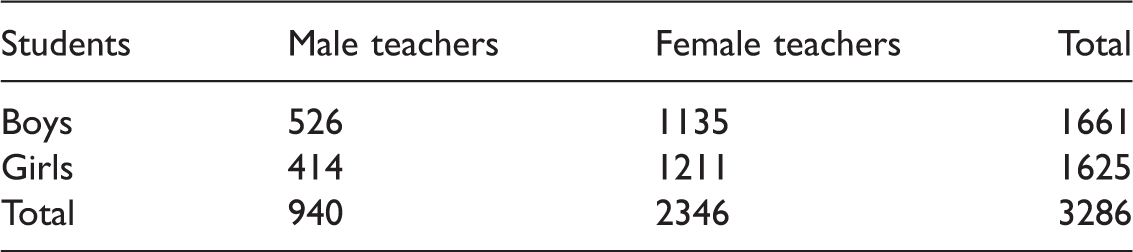
The study sample (N = 3286) included 50.5 per cent boys (n = 1661) and 49.5 per cent girls (n = 1625). Boys were coded as 1 whilst girls were coded as 2 in the raw data. Children had a mean age of 10.31 years (SD = 0.46).
Teachers
Distribution of number of boys and girls against number of male and female teachers in the study.
Measures
In this section, all measures used for data collection in this study are discussed. However, reliability and fit indices of the measures are reported later in this article in the preliminary analysis section.
Child self-concept
Children’s self perception of their own self-concept was measured using items adapted from the Marsh Self-Description Questionnaire I (Marsh, 1990). The measure consisted of 17 items which assessed children’s self perception of their appearance, ability, socialisation skills and popularity at home and school. Items were assessed on a five-point scale (false = 1, mostly false = 2, sometimes false = 3, sometimes true = 4, true = 5), and included statements such as ‘I have many friends’ and ‘I do lots of important things’.
Child enjoys school – satisfaction and liking
Children’s enjoyment at school was assessed using a 12-item subset of the Longitudinal Surveys of Australian Youth (LSAY) Attitudes to School Survey (Marks, 1998). Items were measured on a four-point scale (1 = strongly disagree to 4 = strongly agree) with higher scores indicating a higher level of school satisfaction and included statements such as ‘My school is a place where … I feel happy’ or ‘… I like learning’.
Child perception of teachers – relationship with teachers
Children’s perception of their teachers was assessed using an eight-item version of the People in My Life (PIML) Teacher Affiliation Scale (Ridenour, Greenberg, & Cook, 2006). Items were measured on a four-point scale (1 = almost never or never true to 4 = almost always or always true) with higher numbers indicating increased level/degree of truth or relevance of the statement to the individual, and included statements such as ‘I like my teachers’ and ‘My teachers respect my feelings’. This measure was originally designed to assess parent and peer attachment but has been adapted by Ridenour et al. (2006) to assess student–teacher attachment. It should be noted though that the responses to this measure might not have been solely focused on the teachers who participated in this study.
Student–teacher relationship quality
The quality of student–teacher relationships was measured by teachers responding to a 14-item version of the STRS (Pianta, 1991). This version included items for both conflict and closeness – the latter as represented by warmth and open communication. An example of an item for conflict is ‘This child and I always seem to be struggling with each other’ and an example for closeness is, ‘I share an affectionate, warm relationship with this child’. Items were rated on a five-point scale (1 = definitely does not apply to 5 = definitely applies) with higher scores indicating higher levels of relationship quality.
Analyses
Two main types of analyses were completed – Rasch analysis (including principal component analysis (PCA) of residuals) followed by structural equation modelling. In order to meet the parametric requirements of structural equation modelling, Rasch analysis using WINSTEPS version 3.74.0 (Linacre, 2012) was a useful method to transform the ordinal data in this study obtained from measures of student perceptions of teachers, school enjoyment and self-concept along with teacher perceptions of student–teacher relationship into interval data. It was also a useful way of confirming the dimensionality of each measure used in this study by examining the PCA of residuals available in Rasch analysis.
Rasch and PCA of residuals
Initially, Rasch analysis (Rasch, 1960) was performed on each of the measures reported in this study in order to obtain estimates of reliability as well as composite measures for each of the variables in the research questions. Results of the Rasch analyses include information about infit and outfit mean squares with values close to +1 for both items’ and persons’ measures (similar to Cronbach’s Alpha) being seen as desirable as they indicate good fitting measures to scale (Bond & Fox, 2015). Similarly, the infit and outfit t values should also show a spread of close to zero and standard deviations within the stipulated range of +2 and −2, indicating good construct validity for measures within the population of this study. Another indicator of good-fitting data to the Rasch model is the reliability index. A reliability index of close to 1 is desirable as it indicates a conforming and viable model and item separation shows how distinctly well spread items are on a scale of measure. The same underlying principles of item reliability apply to person reliability. Person performance should be widespread along the scale of appropriately difficult items, meaning persons who respond to a measurement scale with specific abilities should respond to a similar measurement scale in the same manner. The spread of persons is indicated by person reliability indexes (Bond & Fox, 2015).
PCA of residuals within Rasch analysis allows for extraction of the common factor that explains the most residual variance under the hypothesis that there is such a factor (Smith, 2002). This means that if a factor does not show substantial common variance, then there should not be any meaningful structure in the residuals. Rasch’s PCA does not require factor rotation nor oblique axes that are commonly needed in the traditional PCA conducted in SPSS. The Rasch PCA basically does the opposite of a traditional PCA whereby it looks at the residuals of unexplained variances to explain the secondary dimensions, components or contrasts. The Rasch PCA identifies the opposing response patterns and interprets the contrast between positive and negative loadings to provide a view of the items to see whether the residuals provide a meaningful structure. A lack of structure points to the residuals contributing to a unidimensional scale (Bond & Fox, 2015).
Structural equation modelling
Based on the research questions outlined previously, a nested structural equation model was developed and analysed by way of multi-group analysis (one for 1661 boys and another for 1625 girls) to explore whether student perception of teachers and their enjoyment at school influenced student–teacher relationships in predicting student self-concept. Teacher gender was then added to this model as the final full SEM model to explore moderation effects of teacher gender on the student and teacher variables in the models for boys and girls. The model was analysed using AMOS version 20.0 (Arbuckle, 2011). Modification indexes of interim analysis results identified misspecifications in terms of co-variances between STR Conflict and Closeness and between Child Enjoys School and Child Perception of Teacher. In the boys’ model, modification indexes indicated that the model could be improved by adding a path between Teacher Gender and Child Enjoys School. To arrive at the final model, all non-significant paths were removed after chi-square difference tests indicated that the model could not be improved further. This nested model allowed for a view of the relationships that exist for boys and girls in this study.
A number of goodness of fit indexes have been reported in this study to assess model fit. A non-significant χ2 (p > .001) is preferred as it shows a small discrepancy between the hypothesized model and the population. Other goodness of fits that are reported in this study includes the goodness of fit index (GFI) (Joreskog & Sorbom, 1986), comparative fit index (CFI) (Bentler, 1990) and the root mean square error of approximation (RMSEA) (Bollen, 1989). These indices were chosen because they provide stringent measures of fit in consideration of sample variances and have been frequently quoted as the sufficient indicators of fit along with the traditional chi-squares (Hu & Bentler, 1999). The criteria for testing mediation effects using a bootstrap method followed those that were set out in Shrout and Bolger (2002) and MacKinnon (2008). A 95 per cent bias-corrected confidence interval that includes a non-zero interval was taken as showing a reliable mediation effect with the number of bootstrap iterations set at 1000 in AMOS.
Results
Rasch and PCA of residuals
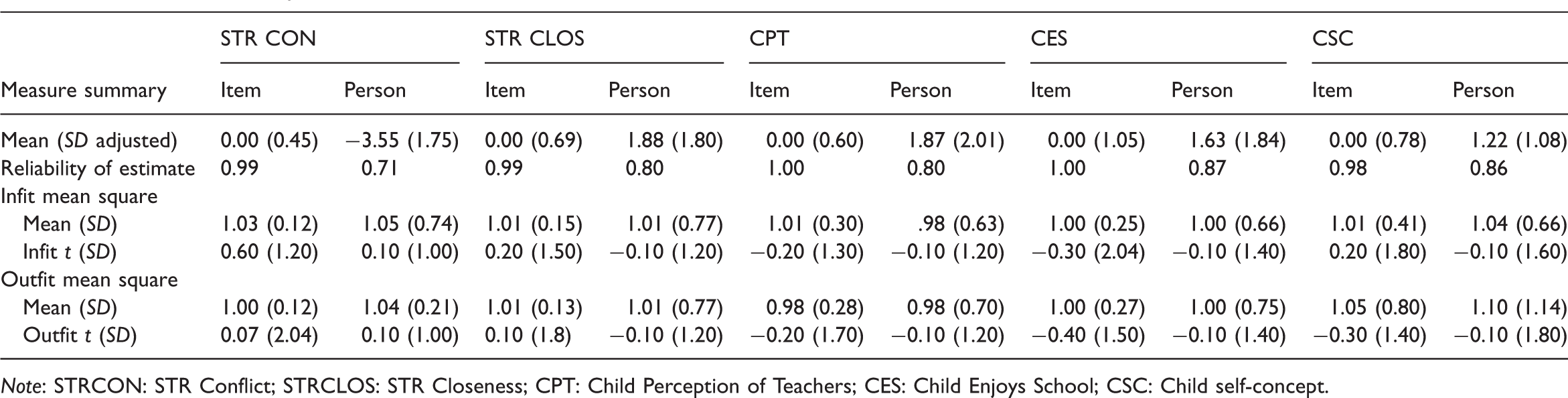
Summary of Rasch item and person reliability estimates for measures of STR Conflict, STR Closeness, Child Perception of Teachers, Child Enjoys School and Child Self-concept.
Note: STRCON: STR Conflict; STRCLOS: STR Closeness; CPT: Child Perception of Teachers; CES: Child Enjoys School; CSC: Child self-concept.
Rasch analysis of the data obtained for student perception of teacher and enjoyment at school also showed good fitting measures to the Rasch model with item separation reliabilities of 1.00 and person reliabilities 0.80 and 0.87, respectively. The measures were each unidimensional in nature, one measuring student perception of teacher and the other measuring student enjoyment at school. The PCA confirmed these results with 43 per cent of unexplained variance showing random structures in the contrasts of item loadings.
Rasch analysis of data for student–teacher relationship of conflict and closeness revealed two factors in the PCA residuals with 43 per cent of variance explained by student–teacher relationship conflict and 38 per cent of variance explained by student–teacher relationship closeness with clear structures in the contrasting residuals. Separate Rasch analyses were undertaken again on each of the measures, one consisting of items on conflict and the other consisting of items on closeness. Each of the measures showed a good fit to the Rasch model with item separation reliabilities of 0.99 and person reliabilities of 0.71 (STR Conflict) and 0.80 (STR Closeness).
A single Rasch person estimate for each of the student and student–teacher relationship measures was generated as the composite scores for further analysis planned in this study. The Rasch person estimates were in the form of transformed logarithm scores known as logits. The original codes (1 for male and 2 for female) were used for teacher gender measure. Normality tests were conducted on the Rasch transformed data and teacher gender raw score, which showed very small levels of kurtosis and skewness, and hence, a very small departure from normality (Tabachnick & Fidell, 2013). Tabachnick and Fidell noted that small departures of normality on a fairly large sample would not impact on the results of a study and their interpretations.
Comparisons between boys and girls
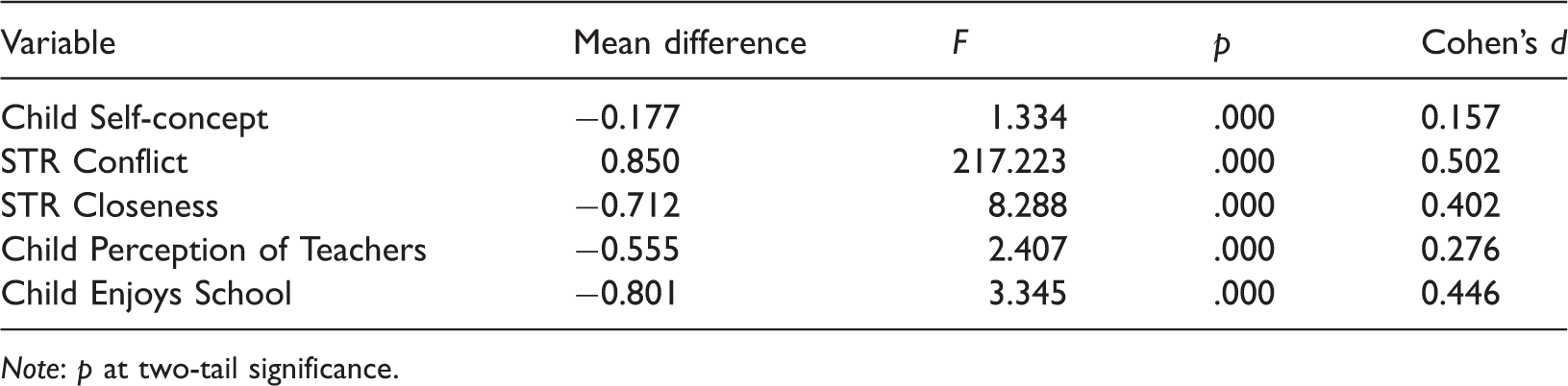
One way comparisons of variables between 1661 boys and 1625 girls.
Note: p at two-tail significance.
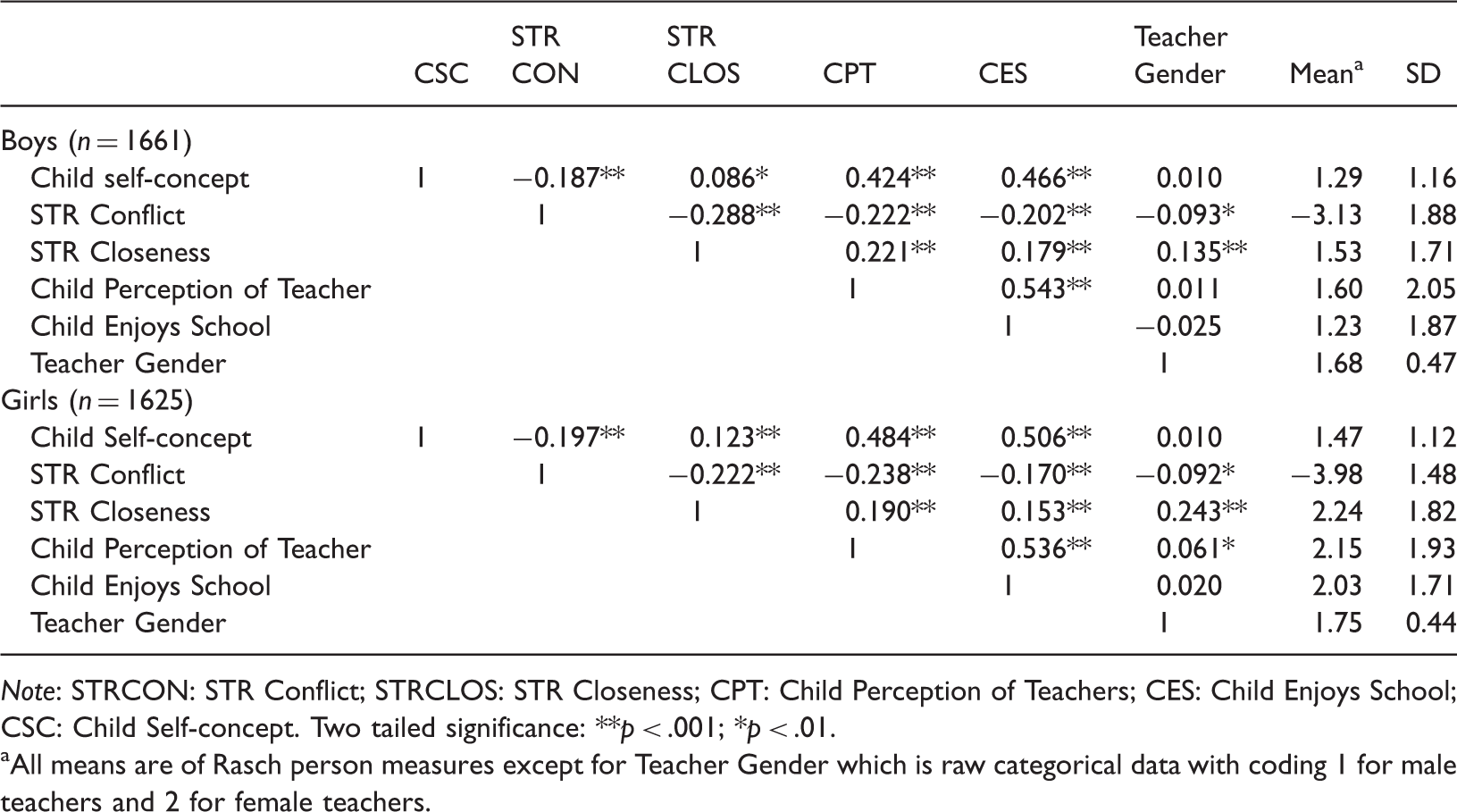
Intercorrelations, means and standard deviations for boys and girls.
Note: STRCON: STR Conflict; STRCLOS: STR Closeness; CPT: Child Perception of Teachers; CES: Child Enjoys School; CSC: Child Self-concept. Two tailed significance: **p < .001; *p < .01.
All means are of Rasch person measures except for Teacher Gender which is raw categorical data with coding 1 for male teachers and 2 for female teachers.
Intercorrelations of variables for boys and girls
The inter-correlations with two-tailed significance, means and standard deviations of variables for 1661 boys and 1625 girls are presented in Table 4. The results showed that Child Self-concept had a small and negative correlation with STR Conflict for both boys (r = −0.19 and girls (r = −0.20), which indicated that both boys and girls with lower self-concept were more likely to report conflict in their student–teacher relationships. Child Self-concept had a small correlation with STR Closeness for girls (r = 0.12) and for boys (r = 0.09). This result showed that girls and boys who have higher self-concept tend to have closer relationship with their teachers. Child Self-concept also had moderately large positive correlations with Child Enjoys School for both boys (r = 0.47) and girls (r = 0.51) with similar results for correlations between Child Self-concept and Child Perception of Teacher. These correlations showed that boys and girls with higher self-concept enjoy school more and have better perception of their teachers. Furthermore, STR Conflict and STR Closeness had significant moderate correlations with Child Perception of Teachers and Child Enjoys School for both boys and girls.
Teacher Gender had no correlations with Child Self-concept for both boys and girls. Teacher Gender had a positive correlation with STR Closeness for boys (r = 0.14) and girls (r = 0.24), showing that female teachers are closer with boys and girls (more than male teachers). Teacher Gender had a negative but small correlation with STR Conflict for boys (r = −0.09) and girls (r = −0.09), indicating that male teachers more than female teachers have conflicts with both boys and girls. Interestingly, Teacher Gender had a very small correlation with Child Perception of Teacher for girls (r = 0.06). The small correlations that were found between STR variables, student variables and teacher gender, suggest low incidents of multicollinearity needed to infer mediation and moderation effect in path analysis (MacKinnon, 2008). This lends confidence to the structural equation models discussed in the next sections.
Structural equation modelling
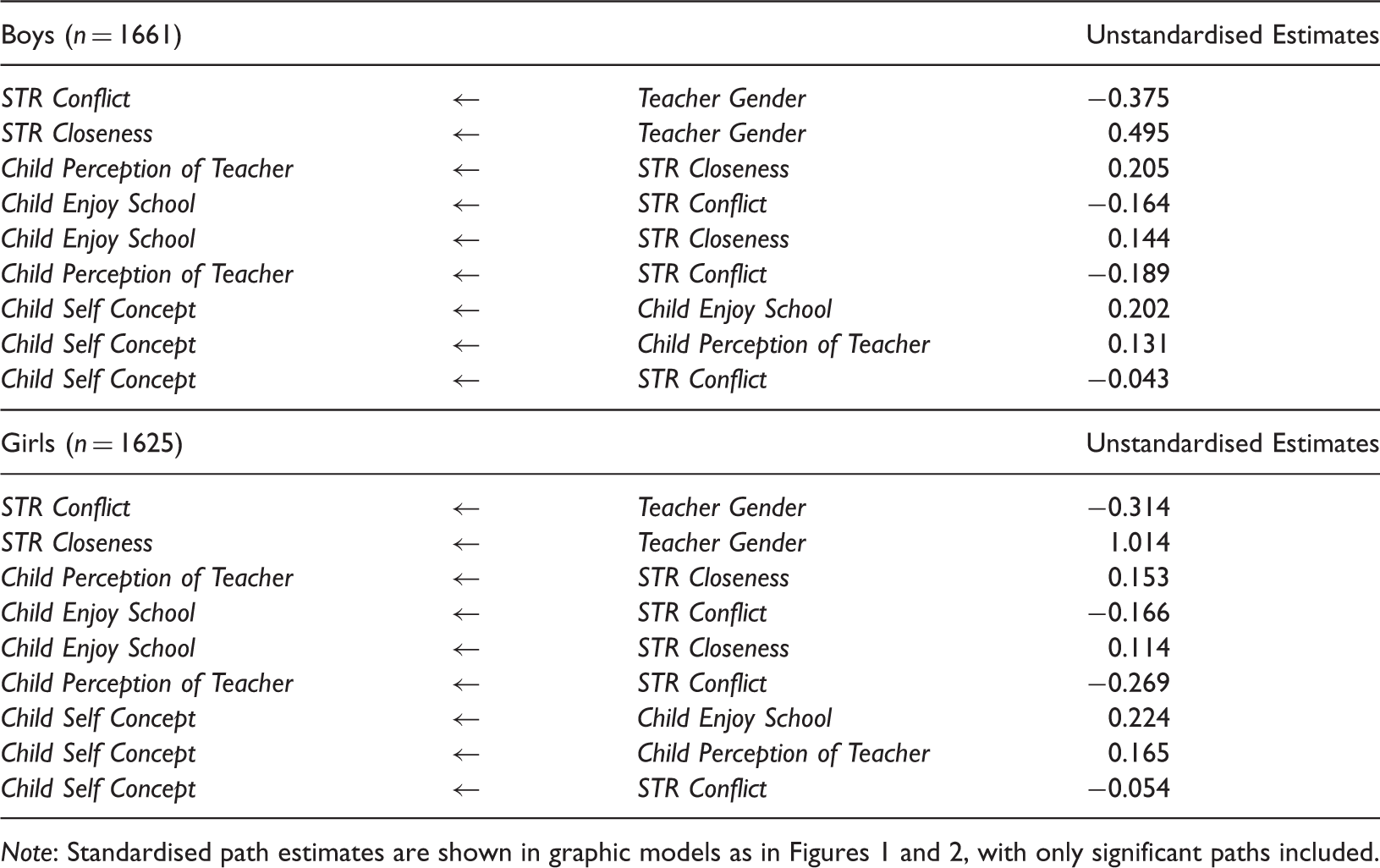
Unstandardised path estimates of multi-group nested models for boys and girls in this study.
Boys’ SEM model
Figure 1 shows the model for boys. The model accounted for 26 per cent of variance in Child Self-concept, indicative of a large effect size. The model also consisted of eight per cent of variance in Child Perception of Teacher that is explained by STR Conflict and STR Closeness. In addition, STR Conflict and STR Closeness and Teacher Gender explained six per cent of that variance in Child Enjoys School. Worthy of note is the non-significant path between STR Closeness and Child Self-concept (though this path was shown as significant in the correlation estimates). The significant negative path between STR Conflict and Child Self-concept also reduced more than half the regression weight from (−0.18 to −0.08). Both these changes were indicative of indirect effects that were present in the model.
Final SEM model for 1661 cases of boys with and squared multiple correlations. STR Conflict and STR Closeness are co-variates with a regression weight of −0.28. Child Enjoys School and Child Perception of Teacher are co-variates with a regression weight of 0.51. Teacher Gender is moderator variable for STR Conflict, STR Closeness and Child Enjoys School.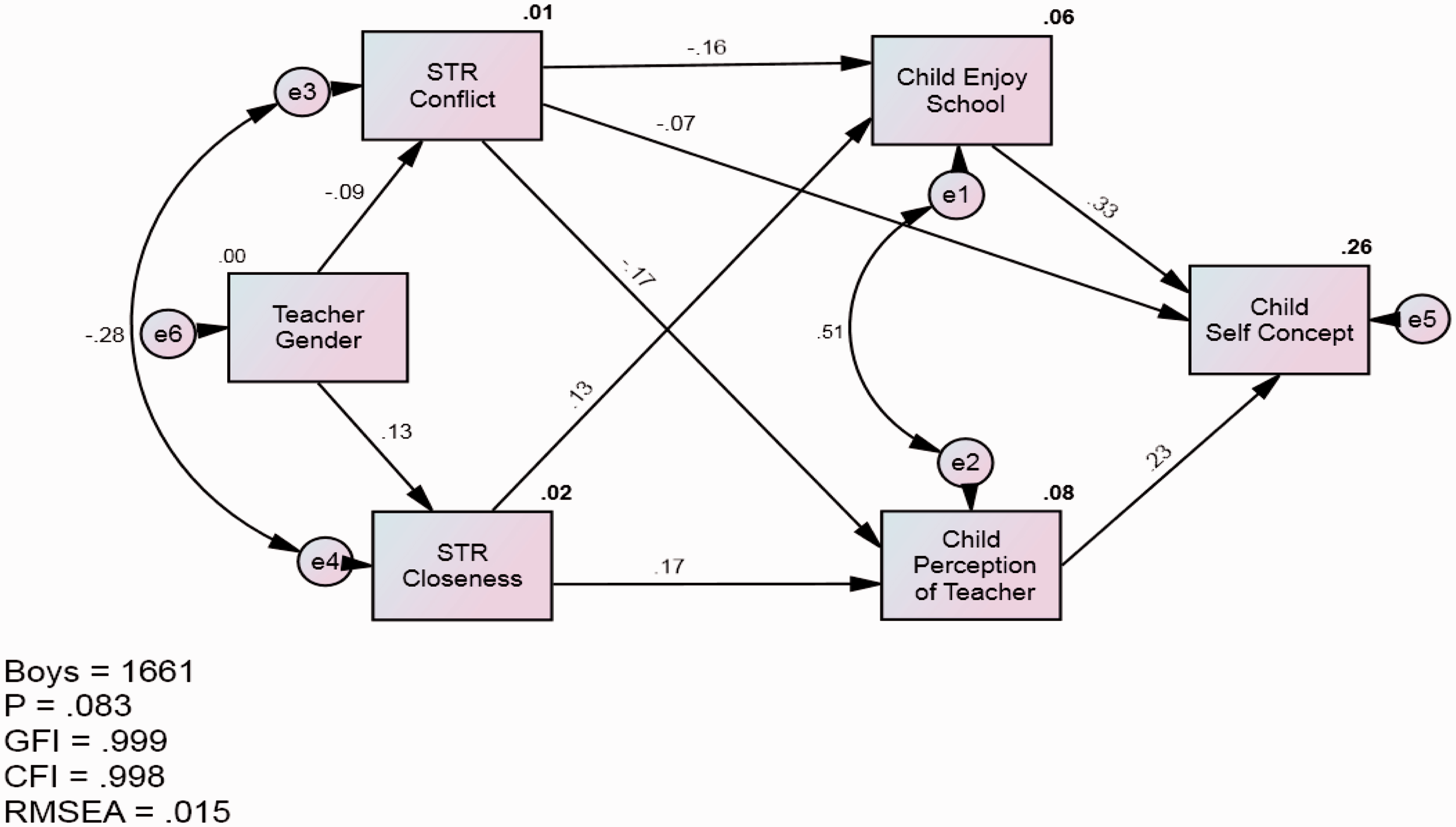
The first instance of mediation was found where both Child Perception of Teachers and Child Enjoys School mediated STR Closeness’ negative prediction of Child Self-concept, The second instance of mediation in the model was found where both Child Perception of Teachers and Child Enjoys School mediated STR Conflict’s negative prediction of Child Self-concept. The third instance of mediation existed where STR Closeness and STR Conflict mediated Teacher Gender in affecting both Child Perception of Teachers and Child Enjoys School. The indirect effects show that female teachers have a positive effect on boys’ perception of teachers and their enjoyment at school. These results are additional to that of Teacher Gender’s moderation interaction with STR Conflict and STR Closeness in influencing Child Self-concept, where a negative relationship with STR Conflict shows male teachers tend to have more conflict with boys than the female teachers, and a positive relationship with STR Closeness shows that female teachers tend to be closer with boys than the male teachers.
Girls’ SEM model
Figure 2 shows the model for girls. The model accounted for 32 per cent of variance in Child Self-concept, indicative that the model explains more about the differences in child concepts for girls more than boys in this study. The model also consisted of 8 per cent of variance in Child Perception of Teacher that is explained by STR Conflict and STR Closeness. In addition, STR Conflict and STR Closeness and Teacher Gender explained 4 per cent of that variance in Child Enjoys School. Interestingly, Teacher Gender explained 6 per cent of STR Closeness in the girls’ model with a large unstandardised estimate of 1.01, almost twice the size of the unstandardised path for boys (0.50) – refer to Table 5 for unstandardised estimates. Of importance as well, are the non-significant paths between both STR Closeness and STR Conflict with Child Self-concept, which are the reverse from the correlation estimates for girls. The changes from significant to non-significant paths are indicative of full mediatory effects that might be present in the model.
Final SEM model for 1625 cases of girls with standardised estimates and squared multiple correlations. STR Conflict and STR Closeness are co-variates with a regression weight of −0.21. Child Enjoys School and Child Perception of Teacher are co-variates with a regression weight of 0.51. Teacher Gender is moderator variable for STR Conflict and STR Closeness, with a stronger effect evident for closeness for girls.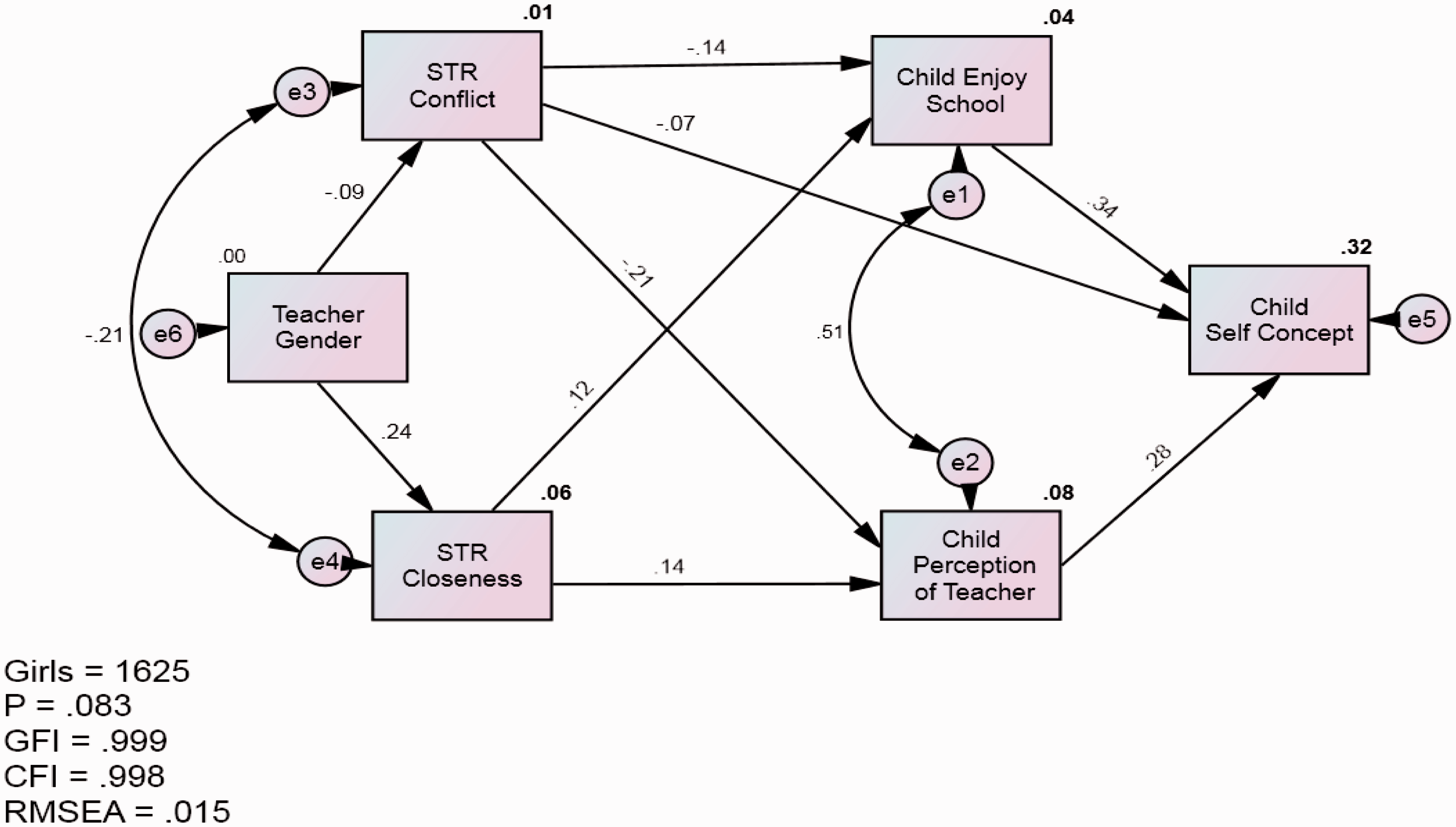
The first instance of mediation in the model for girls was found where both Child Perception of Teachers and Child Enjoys School mediated STR Closeness’ prediction of Child Self-concept. The second instance of mediation existed where both Child Perception of Teachers and Child Enjoys School mediated STR Conflict’s negative prediction of Child Self-concept. The third instance was where STR Closeness and STR Conflict mediated Teacher Gender in affecting both Child Perception of Teachers and Child Enjoys School. Similar to the boys, these indirect effects were small but still significant within the 95 per cent percentile.
The fourth instance and different to that of the boys – Teacher Gender – indirectly affected girls’ self-concept. Close examination of the indirect effects showed that more closeness and less conflict in girls’ and female teachers’ relationships seem to indirectly affect girls’ self-concept, whereby an increase in relationship closeness equates to an increase in girls’ self-concept.
Discussion
This study sought to examine the role of teacher and child gender on student–teacher relationships. Our findings support previous research by Leflot et al. (2010) suggesting that supportive relationships play a role in children’s wellbeing at school, and extend current understandings about the role teacher gender plays in children’s school enjoyment, conflict and closeness.
Overall, gender differences emerged in terms of means and standard deviations for various constructs in the analyses. Thus, girls had higher overall self-concept than boys, boys had more conflict with their teachers, whereas girls had closer relationships with their teachers, and girls had a more positive perception of their teachers and reported higher school enjoyment than boys. Although initial correlation analyses showed moderate to strong associations between student–teacher relationships and students’ perceptions of teachers, their enjoyment at school and their self-concept, these analyses also showed minimal differences between boys and girls with the exception of a small correlation between closeness and self-concept for boys. However, results of the more complex SEM analyses uncovered a more detailed picture in terms of the strength and patterns of relationships between constructs and their effects on self-concept for boys and girls.
The first research question examined how the relationships between boys and girls and their teachers predicted students’ self-concept. For boys, closeness with their teachers did not predict their self-concept; however conflict in their relationships affected self-concept negatively. This result supports previous research findings that boys who had cooperative (Colwell & Lindsey, 2012) and positive (Colwell & Lindsey, 2003) relationships with teachers displayed more positive self-concept. Additionally, the finding that student–teacher relationship closeness did not seem to be as important for boys as for girls supports other research findings that student–teacher closeness had a greater impact on school-related outcomes for girls compared to boys (Van Campen, Ewing, & Taylor, 2009). For girls, both closeness and conflict predicted self-concept with conflict having a greater negative effect than closeness. This result contrasts previous, somewhat surprising, findings that girls who had cooperative (Colwell & Lindsey, 2012) and positive (Colwell & Lindsey, 2003) relationships with teachers had more negative self-concepts.
The second research question explored how boys’ and girls’ perceptions of their teachers, and their enjoyment at school predicted self-concept. Findings from the current study indicated that for both boys and girls, their perception of teachers and enjoyment of school significantly predicted their self-concept. These findings support Harter’s (1999) ideas that when teachers are affectionate, emotionally available, involved and supportive, children internalise these positive aspects of the relationship by developing positive self-evaluations. Our findings support other empirical research finding relations between positive teacher–child and positive self-perceptions in children (Colwell & Lindsey, 2003; Leflot et al., 2010).
The third research question examined how boys’ and girls’ perceptions of their teacher and their enjoyment at school affected the relation between student–teacher relationships and students’ self-concept. Results from SEM showed that boys’ self-concept was higher when they were in a close relationship with their teachers because the relationship was affected by their strong perception of teachers and enjoyment of school. Boys’ self-concept was also higher when they were not in a conflicting relationship with teachers, again because their relationship was affected by how boys perceived their teachers and their enjoyment of school. Results for girls showed that girls’ self-concept was higher when they were in a close relationship with their teachers because, like the boys, their relationship was affected by their perception of their teachers and their enjoyment at school. This result indicated that girls’ self-concept was higher when they were not in a conflicting relationship with their teachers because their relationship was affected by how the girls perceived their teachers and their satisfaction with schooling interactions. These results support other findings that children who form close relationships with their teachers enjoy school more (Birch & Ladd, 1997; Hamre & Pianta, 2006) and are more engaged in school (Skinner, Furrer, Marchand, & Kindermann, 2008).
The final research question asked how teacher gender influences the predictive role of student-teacher relationships on students’ self-concept. There were two main differences in our findings, in terms of teacher gender on boys and girls. Firstly, boys’ enjoyment at school was directly affected by teacher gender, suggesting that female teachers positively contributed to boys’ enjoyment at school. Secondly, the current study found male teachers tended to have more conflict with boys and female teachers tended to be closer with boys. This finding is in contrast to previous research such as that of Martin and Marsh (2005) who found that high school students’ motivation and engagement was not influenced by the gender of their teacher. Male teachers also tended to have more conflict with girls while female teachers reported closer relationships with girls. However, the finding that female teachers had a positive effect on both boys’ and girls’ perception of their teachers and their enjoyment of school, is in line with previous research such as that by Carrington, Tymms, and Merrell (2008).
The current study adds to the number of cross-sectional studies examining the link between student–teacher relationships and student self-concept (Doumen, Buyse, Colpin, & Verschueren, 2011; Leflot et al., 2010). Future research could make use of the longitudinal design of LSAC to allow for more in-depth examinations of relationships and self-concept over time and the possibility that more accurate direction effects could be established using different waves of longitudinal data, as suggested by Colwell and Lindsey (2003).
The results of this study have implications for teaching practice, particularly in relation to pre-service teacher training and professional development. Sabol and Pianta (2012) discuss the importance of engaging teachers in pre-service training programs to help develop positive relationships between students and teachers. Leflot et al. (2010) suggest that teachers need professional development in relationship building, in addition to their formal teaching practices.
For example Spilt, Koomen, Thijs, and van der Leij (2012) provide evidence that a reflection-focused intervention (where teachers reflect on their interactions with students) improves teachers’ observed sensitivity, which could contribute to better student–teacher relationships. Hughes (2012) also suggests that schools should implement screening programs for low quality student–teacher relationships, in order to provide support and training in this area. Given our finding about the negative impact of student–teacher conflict on students’ self-concept, these suggestions of early screening and reflective professional development are relevant.
In conclusion, the current study contributes to the body of knowledge in the area of student–teacher relationship and self-concept by emphasising the importance of developing not only close relationships with both boys and girls, but even more notably, relationships low on conflict. The main limitation of this study is that, given the study design, students’ responses may not have been solely focused on the teachers who responded to the questionnaire in this study. The relationships that are highlighted, hence, need to be interpreted cautiously. Nevertheless, this study brings to light new information about the effect of students’ school enjoyment and their perspective of teachers and how these aspects play a mediating role in fostering students’ positive self-concept. Results of the study also provide evidence to encourage institutions and policy makers to further support and guide teachers in the development of high quality student–teacher relationships, especially those aimed at reducing student–teacher conflict.
Footnotes
Acknowledgements
The authors would like to acknowledge the assistance provided through the CRN skills development activities.
Declaration of conflicting interests
The author(s) declared no potential conflicts of interest with respect to the research, authorship and/or publication of this article.
Funding
The author(s) disclosed receipt of the following financial support for the research, authorship, and/or publication of this article: This study was supported by the Charles Sturt University-led Excellence in Research in Early Years Education Cooperative Research Network (in partnership with Queensland University of Technology and Monash University).