



Abstract
With the recent escalation in interior immigration enforcement across the United States, immigrant and U.S.-born children are increasingly exposed to coercive measures that have been shown to disrupt their development. This study examines the relationship between immigration-related arrests and the educational outcomes of Hispanics—a group that is overwhelmingly targeted by immigration authorities. Using data on the number of U.S. Immigration and Customs Enforcement arrests at the Metropolitan Statistical Area level, we estimate the impact of immigration enforcement on Hispanics’ school enrollment. We find that increases in the arrest rate are accompanied by substantial declines in enrollment among Hispanic youth, including U.S.-born, foreign-born, and individuals in mixed-status families. Additionally, we do not find evidence of this relationship among other racial/ethnic groups, suggesting that the impact is concentrated among Hispanic individuals. Our results advance our understanding of the unintended consequences of immigration enforcement on educational outcomes and show that ethnicity is a crucial factor in this process.
Between 2014 and 2018, U.S. Immigration and Customs Enforcement (ICE) conducted over half a million arrests throughout the interior of the country. The increasing capacity of ICE to conduct enforcement actions over the past 20 years has been facilitated through their broad statutory authority, a push toward data-driven enforcement strategies, and policies that encourage cooperation with state and local law enforcement. While the core mission of ICE is focused on arresting and removing unauthorized immigrants, these enforcement actions have broad unintended consequences on immigrants, regardless of their legal status, and the communities where they reside. The overarching immigration enforcement strategy has disproportionately strained the economic mobility and overall well-being of Latino immigrants and their communities.
Coercive immigration enforcement actions have adverse consequences for the education of children and youth living in the communities they target. These efforts, which have intensified over the past few decades, obstruct children’s longer term human capital accumulation, alter schools’ demographic compositions, and widen existing academic disparities (e.g., Amuedo-Dorantes & Lopez, 2017b; Bellows, 2019; Dee & Murphy, 2020; Kirksey et al., 2020). These effects, however, materialize over time and are driven by underlying and persistent short-term channels, such as the day-by-day and month-by-month variations in immigration enforcement actions. We hypothesize, following the deportation pyramid and social–ecological frameworks, that heightened immigration enforcement negatively influence the education enrollment decision for Hispanic youth regardless of citizenship status. In this study, we examine how local immigration enforcement efforts affect school enrollment among foreign-born and U.S.-citizen Hispanic youth, including those living in mixed-status families, and, thus, contribute to our understanding of the unintended consequences of immigration policy. 1
Although enforcement efforts aim to curtail unauthorized immigration, these actions can also affect U.S.-citizen Hispanics through ethnic targeting and increased psychoemotional distress. Research shows that authorities often rely on personal characteristics such as ethnicity and occupation to judge individuals’ legal status, regardless of their actual documentation. Hispanics, individuals in low-wage occupations, and those with police records are significantly more likely to be perceived as unauthorized immigrants by the general public and immigration authorities (Flores & Schachter, 2018; García, 2017). This perceived illegality could explain, at least in part, why individuals of Latino descent are overrepresented in the population of deported immigrants and why ICE’s interactions with U.S. citizens continue to increase (Cantor et al., 2019; ICE, 2020). Concurrently, research on the targeting of the Hispanic community by immigration authorities has found that both U.S.-born and foreign-born individuals suffer psychological distress due to the increased risk that immigration enforcement activities pose to them, their families, and others in their community (Szkupinski Quiroga et al., 2014). Taken together, this evidence suggests that the adverse impacts of immigration enforcement are likely not limited to unauthorized immigrants but that they also spill over to other groups in their communities.
Using data on local arrests conducted by ICE across the country, we conduct a quasi-experimental analysis to evaluate the degree to which immigration enforcement impacts enrollment among Hispanic youth. Leveraging data obtained from the Current Population Survey (CPS), we find that an increase in the rate of ICE arrests within a Metropolitan Statistical Area (MSA) has a significant and negative impact on school enrollment among U.S.-born and foreign-born Hispanics. We also explore this relationship among U.S.-born and foreign-born Hispanic youth living in mixed-status families. We find that aggressive immigration enforcement is associated with a reduction in enrollment among Hispanic youth, including those who are U.S.-born citizens. However, and in line with the literature, we find that the impact of immigration arrests on school enrollment is greatest among foreign-born Hispanic youth and those in mixed-status families.
Our focus on school enrollment as the outcome of interest is motivated by its implications for students’ long-term investments in human capital and life outcomes, and the allocation of funding for schools throughout the country. From the students’ perspective, declines in enrollment (i.e., dropping out of school) are indicative of disruptive shocks that could have significant long-term consequences for their human capital accumulation, employment opportunities, and involvement in criminal activities (Anderson, 2014; Bjerk, 2012). Studying the impact of immigration enforcement measures on school enrollment expands our understanding of these policies and their consequences for individuals’ long-term well-being. At a broader level, several states base their school funding decisions on enrollment data, and many more are transitioning from attendance-based measures in the wake of the COVID-19 pandemic and recent conversations surrounding education inequities (Blagg, 2021). 2 In states that base school funding decisions on measures of attendance, such as California, school districts with a higher proportion of minority, low-income, and at-risk students who usually exhibit higher absenteeism rates are at a higher risk of being underfunded (Blagg, 2021). Moving forward, the prominence of enrollment in determining schools’ funding is likely to increase, hence the importance of understanding factors affecting it.
Previous studies on immigration enforcement and educational outcomes have provided a wealth of knowledge and insights into the impacts of several policies implemented at the federal, state, and local levels. We contribute to this literature in several ways. First, we use a direct measure of immigration enforcement efforts that intricately captures the effects of changes in policies, priorities, and resources devoted to detaining and removing unauthorized immigrants. Our strategy to focus on immigration-related arrests conducted by ICE at the local level is complementary to approaches applied in previous research, which uses the activation of one or more policies to proxy for enforcement in a given jurisdiction (e.g., Amuedo-Dorantes & Lopez, 2017b; Bellows, 2019; Dee & Murphy, 2020; Pivovarova & Vagi, 2020). This outcome-based approach, or what Amuedo-Dorantes and Antman (2021) refers to as “de facto” immigration policy, allows us to capture the result of variations in enforcement timing and intensity, something that a more rigid indicator for policy activation achieves with relatively limited success. Other studies have used direct enforcement measures to gauge the impact of immigration enforcement on educational outcomes. Kirksey et al. (2020), for example, uses local data on deportations to estimate the impact on several educational gaps across racial groups. However, this measure presents its unique challenges: There is a lag between the time of an individual’s apprehension and their removal, not all arrests lead to deportation, and not all deportations are the result of community-wide coercive measures. Similarly, Santillano et al. (2020) examines the effect of immigration raids on Head Start enrollment but does not account for the size or intensity of the raids. We argue that using data on the number of ICE arrests allows us to identify the impact of coercive immigration enforcement on Hispanics’ education more precisely. 3
Admittedly, our strategy presents its own caveats, the foremost being that the activation of a policy is more likely to be exogenous than changes in the level of arrests, which could be confounded by unaccounted local factors or existing trends. In our case, local conditions may be correlated with the variation in arrests and school enrollment. We address this concern by including MSA, calendar month, year, and state-year fixed effects in our model and examining potential anticipation effects and nonrandom variation in arrests in the identification and robustness checks section below. Still we remain cautious about interpreting our estimates as causal, although we do not find evidence that these empirical threats are a significant source of concern, and our findings are in line with existing literature.
As an empirical contribution, we leverage the monthly CPS data to capture the impact of immigration enforcement on school enrollment throughout the academic year. This approach allows us to account for arrests that occur during the month of observation and those in previous months. Prior research on absenteeism and student mobility highlights the advantage of observing changes in educational outcomes that occur throughout the academic year. Empirical work on absenteeism has shown that even one absence is enough to decrease students’ math and language scores within an academic year (Aucejo & Romano, 2016; Goodman, 2014; Gottfried, 2014). This effect may be too subtle to measure annually given that the impact of changes in immigration enforcement on attendance and enrollment are immediate and, in many cases, short-lived. 4 The literature on reactive mobility finds that minority students affected by family and environmental shocks are more likely to switch schools during the academic year relative to similarly situated White students (Hanushek et al., 2004; Ream, 2003). Studies that use annual data to estimate the effects of immigration enforcement across a larger time interval cannot identify high-frequency outcomes that occur within shorter time intervals. We address this by estimating the short-run effects of changes in immigration enforcement with monthly data.
Finally, we identify the relationship between immigration enforcement and school enrollment among both U.S.-born and foreign-born Hispanics. Our consideration of different family typologies provides empirical evidence that supports the basic intuitions developed in the deportation pyramid and social–ecological models. And, while immigration enforcement is mainly aimed at unauthorized immigrants, gauging the differential effect by birthplace contributes to a better understanding of the unintended spillover effects of immigration enforcement.
Background
After decades of immigration enforcement efforts being concentrated almost exclusively along the southwestern border, since 9/11, U.S. immigration authorities have ramped up the enforcement of immigration laws to detain and deport undocumented immigrants in the country’s interior. This realignment in immigration enforcement priorities was achieved through the enactment of the 2002 Homeland Security Act, which placed U.S. Customs and Border Protection, ICE, and the U.S. Citizenship and Immigration Services under the newly created Department of Homeland Security. Since then, the federal government has spent over $333 billion in immigration enforcement agencies and activities (American Immigration Council, 2021), which resulted in approximately 5.8 million deportations between fiscal years 2002 and 2019 (U.S. Department of Homeland Security, 2020, table 39).
The level of immigration-related apprehensions and deportations, however, has not remained constant throughout this period. While roughly two million immigrants were removed during the Bush administration, over three million deportations were conducted during the Obama years at an average rate of 382,823 deportations per year. More recently, between 2017 and 2019, the Trump administration removed close to a million immigrants at a rate of 325,231 individuals per year (U.S. Department of Homeland Security, 2020, table 39). The scale of these flows was made possible by the activation of a compendium of enforcement programs that used labor, criminal, legislative, law enforcement, and interagency cooperation tools, including E-Verify mandates, 287(g) agreements, omnibus immigration laws, and the Secure Communities program. 5
While the increase in immigrants’ targeting and criminalization has affected undocumented immigrants, their families, and communities, the effects are overwhelmingly more prevalent among Hispanics, who compose 77% of the undocumented immigrant population but more than 95% of deportees (ICE, 2020; Passel & Cohn, 2019). Furthermore, over four million U.S.-born children, the majority of whom are Hispanic, live in a household where at least one parent is unauthorized and at risk of being detained and deported (Capps et al., 2016).
The risk of deportation, family separation, and increased family stressors place Hispanic children in a vulnerable position that likely distracts them from school or forces them to stay home after the apprehension and removal of an immigrant family member (Chaudry et al., 2010). Notwithstanding the evidence of adverse impacts of immigration enforcement on Hispanics on multiple outcomes, our understanding of the immediate effects on schooling is still notoriously limited. In this study, we address this gap by analyzing the role of immigration-related arrests on Hispanics’ school enrollment.
Conceptual Framework
To conceptualize the effect of immigration enforcement on school enrollment, our study incorporates two related and overlapping frameworks used in the migration literature. The first builds on Dreby’s (2012) deportation pyramid model, which considers the burden of deportation policies on children. The second uses the social–ecological framework to account for the relationship between individual, family, community, and society (e.g., Brabeck et al., 2016; Suárez-Orozco et al., 2011).
Drawing from public health, the deportation pyramid framework illustrates the widespread and multidimensional impact of immigration enforcement policies on children, regardless of U.S. citizenship (Dreby, 2012). The model places family dissolution at the top as the most severe consequence of parental deportations on children of unauthorized immigrants. At the base of the pyramid are the indirect impacts of deportations, such as associating immigration with illegality and denials of immigrant heritage, which may affect citizen and noncitizen youth alike. The sections in the middle of the pyramid indicate short- and long-term effects, including fear of family separation, financial instability, routine changes, and emotional distress. In this study, we consider the burden imposed by immigration enforcement on the well-being of children, including their school enrollment, through their exposure to immigration-related arrests.
We compliment the deportation pyramid using the social–ecological framework to capture the various dimensions in which individual, family, and community characteristics moderate the impact of immigration enforcement on children. At the macro level, there are factors such as policies, legislation, and the underutilization of social services that affect children’s development. At the micro-level, children deal with family dynamics and school contexts, and individual-level factors such as worries about deportation. The interaction of these factors is likely to shape all aspects of development, including socioemotional health, mental well-being, cognitive development, and school performance (Suárez-Orozco et al., 2011).
In line with the deportation pyramid and social–ecological models, we expect immigration arrests to affect children’s school enrollment in several ways. In extreme cases, the apprehension and deportation of undocumented immigrants may prevent their children from residing in the United States altogether in an attempt to avoid family dissolution. In other cases, even before the deportation of a relative occurs, children with legally vulnerable family members experience higher stress, anxiety disorders, and depression than in nonimmigrant households (Capps et al., 2007; Chaudry et al., 2010; Coffey et al., 2010; Zayas, 2015), potentially leading to school disruption and interpersonal problems at school. At the family level, children with ties to undocumented immigrants may suffer the burden of increased immigration enforcement irrespective of citizenship status. Latino children, for example, report fear of family instability and separation even when all family members are documented (Dreby, 2012, 2015). These findings demonstrate that the connections families have to undocumented immigrants and deportees negatively affect children’s outcomes. In our analysis, we gauge whether school enrollment is one of such outcomes.
Prior Research on Immigration Enforcement and Educational Outcomes
Research on immigration enforcement has documented adverse effects of increased immigration enforcement on individuals’ health, education, economic well-being, and civic engagement (e.g., Amuedo-Dorantes & Lopez, 2017a, 2017b; Amuedo-Dorantes & Bucheli, 2020; Bellows, 2019; Dee & Murphy, 2020; Vargas & Benitez, 2019; Vargas & Ybarra, 2017; Wang & Kaushal, 2019). Central to our analysis are the adverse effects of immigration policies on the schooling outcomes of Hispanic youth. The literature on immigration enforcement and education has mainly focused on the activation of specific policies, such as Secure Communities, 287(g) agreements, and state laws to study their impact on various academic outcomes. Notable exceptions include Amuedo-Dorantes and Lopez (2017b), which uses an aggregate index to capture a compendium of federal and local policies, Kirksey et al. (2020), which uses the geographical distribution of migrants’ deportations, and Sattin-Bajaj and Kirksey (2019), who gauge the impact of ICE apprehensions on elementary school absenteeism. Regardless of the enforcement measure considered, this literature overwhelmingly finds that the intensification of immigration policies harms the educational outcomes of pupils throughout the country.
One of the main outcomes that the literature has explored is school enrollment. Using annual CPS data between 2000 and 2013, Amuedo-Dorantes and Lopez (2017b) finds that the adoption of immigration enforcement measures raises Hispanics’ probability of dropping out of school in subsequent academic years. Furthermore, the authors show that exposure to stricter immigration policies increases the likelihood of grade repetition among younger students. At an aggregate level, Dee and Murphy (2020) estimates that counties that signed 287(g) agreements with ICE between 2000 and 2011 experienced a decline in Hispanic student enrollment by 5% within the first year and up to 10% thereafter. This impact is attributed to the displacement of approximately 300,000 Hispanic students over time. Similar patterns have been documented by Amuedo-Dorantes and Lozano (2019) in Arizona after the enactment of state law SB 1070—one of the most restrictive immigration pieces of legislation in the country at the time. In other cases, families affected by enforcement measures, such as immigration raids, remain in the same communities but keep their children away from school, at least temporarily. For example, Santillano et al. (2020) identifies a 10% drop in Hispanic enrollment in Head Start after an immigration raid occurs but ascribes this effect to deterrence rather than displacement as the main channel.
Another strand in the immigration enforcement literature explores the impact of coercive policies on standardized tests and achievement gaps between different student groups. Bellows (2019) analyzes the effect of the Secure Communities roll-out on Hispanic, non-Hispanic White, and Black students and finds that the program’s activation has caused the county-level academic achievement of Hispanic and Black students to decrease. Exploiting a more granular geographical distribution of enforcement efforts, similar research also finds evidence that these coercive measures have widened the racial/ethnic achievement gap. Kirksey et al. (2020) finds that deportations occurring within 25 miles of a school district lead to widening disparities in math achievement and chronic absenteeism between White and Hispanic students. The authors attribute this effect to the fear, trauma, and anxiety that these events create on students and their families. It is within this context that we aim to contribute to our understanding of how immigration enforcement might affect Hispanics’ school enrollment.
Data
School Enrollment, Individual, and Household Controls
The primary data set used in our analysis comes from the public version of the basic monthly files of the CPS between 2014 and 2018. The CPS is a nationally representative survey conducted monthly by the Census Bureau, capturing information on individual and household-level demographics, employment, education, and program participation. This month-by-month snapshot allows for the analysis of individual and household indicators at the local and national levels.
The outcome central to our study is school enrollment, which in the CPS is self-reported retrospectively for the week prior to the date of observation. This variable captures high school or college enrollment among all civilian respondents between the ages of 16 and 24 years. 6 To gauge the relationship between immigration arrests and school enrollment, we restrict our sample to Hispanic youth between the ages of 16 and 24 years, living in an MSA identified in the CPS, and surveyed during the academic year—that is, between August and May—considering that respondents not attending school during the summer months are coded in the CPS as not enrolled in school. Because we are interested in high school or college enrollment, we do not restrict the sample based on high school completion.
In line with the social–ecological model and existing empirical evidence, we also gather data on parental and household characteristics from the CPS to account for potential family-level determinants of school enrollment, including income, parental educational attainment, and family size. To this end, we link children to parent(s) and other relatives using the CPS interfamilial identifiers. Focal youth who cannot be linked to at least one of their parents in the same household, approximately 25% of observations, are dropped from our sample. We utilize these child-to-family links to determine parents’ and other relatives’ foreign-born status, whether the child lives in a single-parent household, family size and income, sibling characteristics, and parental high school completion. Foreign-born status variables for children and relatives are constructed using the information on individuals’ birthplace. 7
Table 1 presents descriptive statistics for the entire sample of Hispanic youth (
Descriptive Statistics

Note. ICE = U.S. Immigration and Customs Enforcement; MSA = Metropolitan Statistical Area.
Table 1 also presents summary statistics for the sample demographic characteristics. The average age is 19 years, and approximately half of the sample are women. Almost a fifth of our sample is foreign born, but more than 40% have at least one close relative born abroad. On average, individuals live in households with 4.5 members and have 1.5 siblings. Finally, in terms of parent characteristics, over 30% of children in the sample live in a single-parent household, which is significantly higher than the national rate of 23% (Kramer, 2019), and 71% have at least one parent who graduated high school.
Immigration Arrests
Data on the number of immigration-related arrests conducted by ICE in the U.S. interior comes from the TRAC at Syracuse University. TRAC compiled these data through the submission of FOIA (Freedom of Information Act) requests and court litigation. 8 The database details the number of immigration-related arrests by county and month-year between October 2014 and May 2018. We cross-walk the monthly number of arrests in each county to its respective MSA observed within the public use file of the CPS. 9 Overall, the average monthly rate of arrests per 1,000 foreign born is 0.29 (see Table 1). To visualize the intensity of immigration enforcement during our entire study period, Figure 1 presents a heat map for the rate of ICE arrests per 1,000 foreign-born residents by MSA. The figure shows a high level of geographic variation across MSAs. Areas such as Brownsville, TX; Louisville, KY; and Jackson, MS experienced more than 50 arrests per 1,000 foreign-born residents throughout the study period. In contrast, MSAs such as Santa Fe, NM; the New York–Newark–Jersey City area, and the San Francisco–Oakland–Berkeley area experienced less than 3.5 arrests per 1,000 foreign-born residents.

ICE arrests per 1,000 foreign-born residents in 2014 by MSA (October 2014–May 2018).
Methodology
Our analysis addresses three central questions. First, do immigration arrests affect school enrollment among Hispanic youth at various age groups? Second, do immigration arrests differentially affect school enrollment among U.S.-born and foreign-born Hispanic youth? Third, do immigration arrests differentially affect school enrollment among Hispanic youth in mixed-status families? We examine these questions by estimating the following linear probability model via ordinary least squares:

The dependent variable
The model expressed in Equation (1) provides the foundation for our identification strategy. We use it to evaluate the degree to which Hispanic youth are affected by immigration arrests across nationality, nationality of family members, age groups, and gender. We leverage the model to disentangle the effect of immigration arrests on foreign-born and U.S.-Born Hispanic youth, both of which may reside in mixed-status families. 12
As a robustness check, we evaluate Equation (1) using samples restricted to non-Hispanic Whites, Blacks, and Asians available for the age group of interest. We also verify that the relationship is not geographically concentrated in states with the highest levels of immigration enforcement by repeating the analysis on the sample that does not include Arizona. Finally, we adjust for Trump administration fixed effects, counting 2017 and 2018 as one period and years before that as a separate period. This takes into account the significant escalation in anti-immigration rhetoric and efforts, not only arrests, during the Trump administration that contributed to a more adverse climate for immigrants and U.S. Hispanics.
Results
In this section, we present our empirical estimation of Equation (1) specified across different subsamples.
Immigration Arrests and Hispanic Youth
Table 2 reports the estimates from our analysis with the pooled sample of Hispanics and across two age groups. Additionally, we expand the model to include
Impact of Immigration Arrests on School Enrollment Among Hispanics by Age Group

Note. The dependent variable is a binary indicator of whether the individual was enrolled in school the week prior to the survey. The independent variables of interest are measured as the number of ICE arrests in a month per 1,000 foreign-born MSA residents in 2014. All model specifications include a constant, calendar month, year, MSA, and state-year fixed effects, as well as the following individual and household controls: age, sex, foreign-born status, whether the individual completed high school, family size, an indicator for single-parent households, whether at least one parent completed high school, race, and family income. The sample is restricted to individuals surveyed in months included in the academic year (i.e., August–May). Standard errors clustered at the MSA level in parentheses. FB = foreign born; HS = high school; FE = fixed effects; MSA = Metropolitan Statistical Area; ICE = U.S. Immigration and Customs Enforcement.
p < .1. **p < .05. ***p < .01.
Table 2 also presents the estimates for control variables included in the model. It shows that among Hispanic youth, age is negatively correlated with the likelihood of enrollment—a result that has been previously documented in the literature (e.g., Lofstrom, 2007). The estimates also show that Hispanic women, age 16 to 18 years, are 2 percentage points more likely to attend school relative to Hispanic men; while Hispanic women, age 19 to 24 years, are 11 percentage points more likely to attend school relative to Hispanic men. Foreign-born status also has a strong negative correlation with school enrollment among older Hispanic youth. We explore this dimension more closely in the proceeding sections.
Immigration Arrests and Foreign-Born Status
In this section, we disentangle the impacts of immigration arrests among U.S.-born and foreign-born Hispanics. We expect that the impact of ICE arrests on enrollment is heightened among foreign-born Hispanics as they and their families are more likely to be the target of immigration enforcement operations. The results presented in Table 3 supports this hypothesis. Row 1 shows the average marginal effect of ICE arrests on the probability of school enrollment by age group. 14 In rows 2 and 3, we interact our ICE arrests variable with an indicator for individuals’ foreign-born status.
Marginal Effects: Impact of Immigration Arrests on School Enrollment Among Hispanics by Age Group and Foreign-Born Status

Note. The dependent variable is a binary indicator of whether the individual was enrolled in school the week prior to the survey. The independent variable of interest is measured as the number of ICE arrests in a month per 1,000 foreign-born MSA residents in 2014. All model specifications include a constant, calendar month, year, MSA, and state-year fixed effects, as well all the controls included in Table 2. The sample is restricted to individuals surveyed in months included in the academic year (i.e., August–May). Standard errors clustered at the MSA level in parentheses. FE = fixed effects; MSA = Metropolitan Statistical Area; ICE = U.S. Immigration and Customs Enforcement.
p < .1. **p < .05. ***p < .01.
Row 1 shows the marginal effect of ICE arrests among U.S.-born Hispanics, with a coefficient of −0.04 on the 16- to 24-year age group, indicating that a 1 standard deviation increase in arrests is associated with a 1.3 percentage point decrease in their likelihood of school enrollment. This relationship appears to be exclusively driven by individuals in the 19- to 24-year age range, as the impact on younger Hispanics is negative but not statistically significant. Although immigration policies are, in principle, not directed at U.S. citizens, several factors make it plausible for an increase in ICE arrests to affect citizen Hispanics’ school enrollment. The deportation pyramid model underscores the possibility that both U.S.-born and foreign-born children may be affected by the intensification of immigration enforcement. First, as mentioned above, ICE overwhelmingly targets Hispanics: Over 95% of migrants deported during our study period were of Latino descent (ICE, 2020). Second, the number of U.S. citizen encounters with ICE has increased substantially in recent years. 15 Between the Obama administration’s last year and the Trump administration’s first year, ICE encounters with U.S. citizens increased almost fivefold—more than any other nationality (Cantor et al., 2019). Third, immigration authorities’ diminished prosecutorial discretion, particularly during the Trump administration, has made most unauthorized immigrants a priority for removal. 16 This context makes it highly likely that Hispanics of any legal status, or their families and friends, will come into contact with immigration authorities and thus become more responsive to the widespread escalation in immigration-related arrests.
In row 2, we focus on the marginal effect of arrests on foreign-born Hispanics. In this case, a 1 standard deviation increase in ICE arrests lowers the school enrollment likelihood by 1.4 percentage points for foreign-born individuals aged 16 to 18 years and by 3.3 percentage points among older Hispanics. The impact of arrests on foreign-born individuals is thus almost twice that on U.S.-born Hispanics.
Immigration Arrests and Mixed-Status Families
An additional channel through which a more restrictive environment toward immigrants may affect Hispanic youth school enrollment is their relatives’ foreign-born status. Family members born abroad could be direct targets of immigration enforcement measures or be at risk of detention and deportation, leading to a child’s forced separation from their relatives and, in particular, their parents. Forced child–parent separation is a recognized potentially traumatic event found to trigger posttraumatic stress disorder symptoms among children of deported parents (Rojas-Flores et al., 2017), regardless of the child’s citizenship. Consistent with the deportation pyramid model, both U.S.-born and foreign-born youth are more likely to exhibit higher levels of anxiety, depression, and aggression after the deportation of their parents (Allen et al., 2015). Even a perceived increase in the risk of parental deportation may lead to a deterioration in the quality of parent–child relationships, a higher prevalence of negative emotions, and an eroded ability for parents to provide for their children financially (Brabeck & Xu, 2010). It is plausible that this psychological and emotional distress caused by an increase in immigration-related arrests and relatives’ foreign-born status affects individuals’ school enrollment.
Table 4 displays the results for Equation 1 restricted to U.S.-born Hispanics when interacting the rate of ICE arrests with an indicator variable that accounts for the presence of foreign-born relatives in an individual’s nuclear family. We present the estimated marginal effects from this exercise by age group. 17
Marginal Effects: Impact of Immigration Arrests on School Enrollment Among U.S.-Born Hispanics by Age Group and Relatives’ Foreign-Born Status

Note. The dependent variable is a binary indicator of whether the individual was enrolled in school the week prior to the survey. The independent variable of interest is measured as the number of ICE arrests in a month per 1,000 foreign-born MSA residents in 2014. All model specifications include a constant, calendar month, year, MSA, and state-year fixed effects, as well as all the controls included in Table 2. The sample is restricted to individuals surveyed in months included in the academic year (i.e., August–May). Standard errors clustered at the MSA level in parentheses. FE = fixed effects; MSA = Metropolitan Statistical Area; ICE = U.S. Immigration and Customs Enforcement.
p < .1. **p < .05. ***p < .01.
Row 1 displays the marginal effect of arrests on individuals with U.S.-born relatives. It shows that an increase in arrests hurts the school enrollment of U.S.-born Hispanics, even when they only live with U.S.-born relatives. However, the results are statistically significant for individuals in the 19- to 24-year age group. A 1 standard deviation increase in the rate of ICE arrests decreases these individuals’ likelihood of attending school by 3.2 percentage points. Next, row 2 presents the marginal effect of arrests among U.S.-born Hispanics living with foreign-born relatives. The estimates are similar to those observed in row 1, that is, a one standard deviation increase in the arrest rate is associated with a drop in the school enrollment probability by 3.1 percentage points. In line with the social–ecological model, these results point at the interplay between community or social conditions (i.e., immigration-related arrests) and individual-specific characteristics, including age and ethnicity.
Immigration Arrests and Gender
We also investigate whether differential impacts of immigration arrests exist based on an individual’s gender. Table 5 addresses this question by presenting marginal effects by gender after interacting the rate of ICE arrests with a gender indicator. 18
Marginal Effects: Impact of Immigration Arrests on School Enrollment Among Hispanics by Age Group and Sex

Note. The dependent variable is a binary indicator of whether the individual was enrolled in school the week prior to the survey. The independent variable of interest is measured as the number of ICE arrests in a month per 1,000 foreign-born MSA residents in 2014. All model specifications include a constant, calendar month, year, MSA, and state-year fixed effects, as well as all the controls included in Table 2. The sample is restricted to individuals surveyed in months included in the academic year (i.e., August–May). Standard errors clustered at the MSA level in parentheses. FE = fixed effects; MSA = Metropolitan Statistical Area; ICE = U.S. Immigration and Customs Enforcement.
p < .1. **p < .05. ***p < .01.
According to the marginal effects presented in column 1, a 1 standard deviation increase in immigration-related arrests is related to an average 1.2 percentage points drop in the likelihood of school enrollment among Hispanic men in the 16- to 24-year age group. Among Hispanic women in the same age group, the impact of a similar change in ICE arrests almost doubles to a 2.2 percentage point drop in school enrollment. When splitting the sample by age cohort, column 2 shows that the impact of arrests is similar across boys and girls in the 16- to 18-year age range, although the coefficients are not precisely estimated. Among older individuals—that is, those in the 19- to 24-year age cohort—column 3 suggests that the observed differential impact is driven by Hispanic women, who experience a 3.5 percentage point lower probability of school enrollment when exposed to a one standard deviation increase in the ICE arrest rate. Alternatively, men in the same age group appear to experience a smaller drop in school enrollment, although the coefficient is not statistically significant.
Taken together, these results show that women disproportionately suffer the adverse effects of increased ICE arrests—a finding that suggests that police-based immigration enforcement may accentuate existing gender disparities in access to education among Hispanics.
Identification and Robustness Checks
Potential Anticipation Effects
A source of empirical concern is the possibility that individuals anticipate local surges in immigration-related arrests and relocate or adjust their behavior accordingly. This situation could bias our estimates on ICE arrests downward if Hispanic families more likely to be affected by immigration enforcement preemptively move to areas where they expect fewer ICE arrests to take place in the future or keep their children from going to school in anticipation of a surge in arrests. To assess this possibility, we reestimate our main model while controlling for ICE arrests recorded in future periods. In this way, we consider the coefficients on future arrest rates as a falsification test that captures the relationship between enrollment rates and upcoming changes in immigration enforcement. If, in fact, anticipation effects drove our results, the coefficients on these placebo controls would be negative and statistically significant, similar to those obtained above.
We present the results of this test in Table 6, which incrementally adds the rate of ICE arrests per 1,000 foreign-born in future periods to our model. In column 1, we only include the lagged and contemporaneous arrest rates, and by column 6, we add our monthly measure of arrests up to 5 months into the future. Column 7 presents the estimates when the lagged arrest rates are excluded from the model. Regardless of the specification being used, we observe that the only negative and significant coefficient is on arrests conducted in the previous month
Identification Checks: Anticipation Effects and Placebo Tests
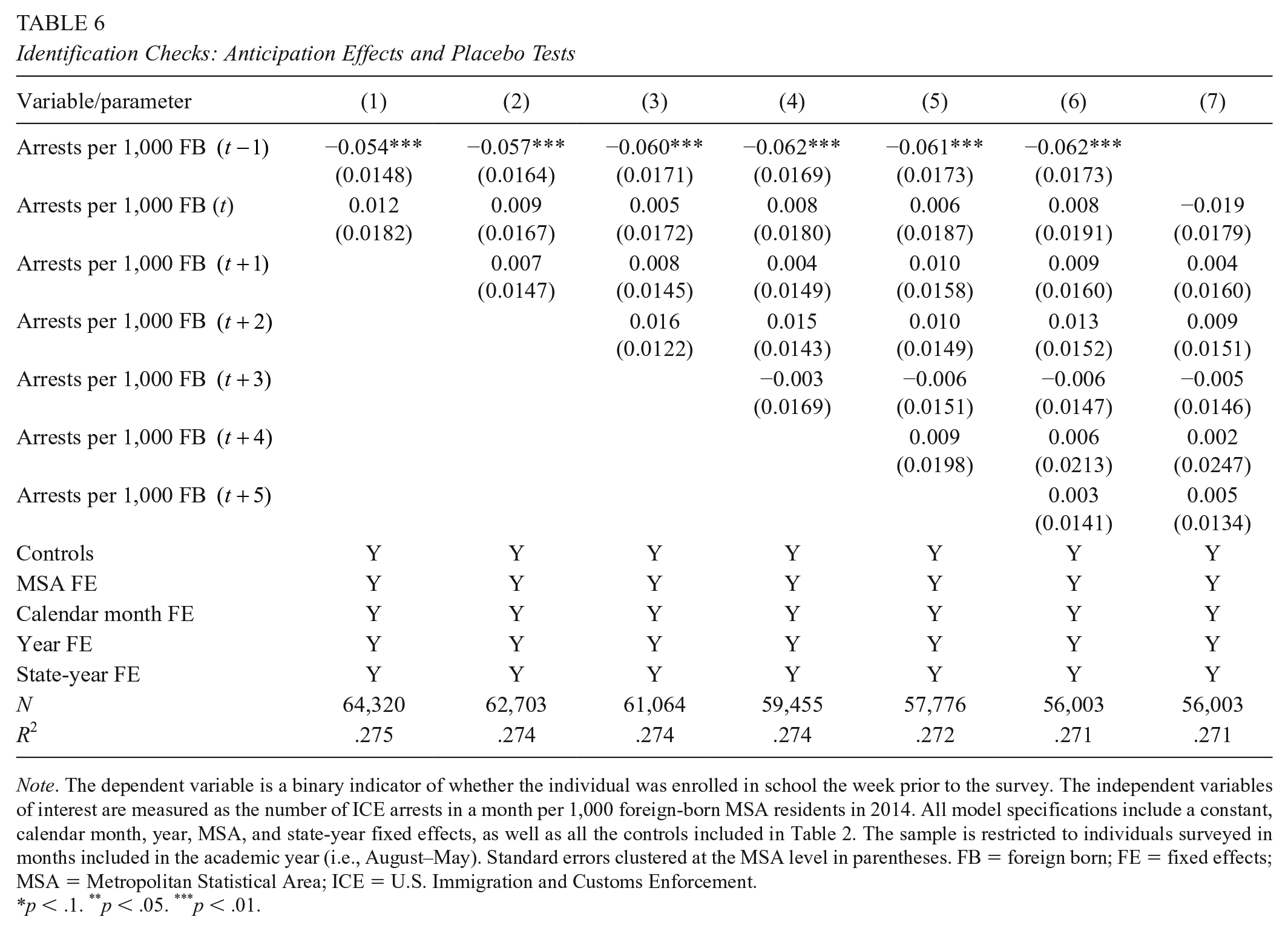
Note. The dependent variable is a binary indicator of whether the individual was enrolled in school the week prior to the survey. The independent variables of interest are measured as the number of ICE arrests in a month per 1,000 foreign-born MSA residents in 2014. All model specifications include a constant, calendar month, year, MSA, and state-year fixed effects, as well as all the controls included in Table 2. The sample is restricted to individuals surveyed in months included in the academic year (i.e., August–May). Standard errors clustered at the MSA level in parentheses. FB = foreign born; FE = fixed effects; MSA = Metropolitan Statistical Area; ICE = U.S. Immigration and Customs Enforcement.
p < .1. **p < .05. ***p < .01.
Nonrandom Assignment of ICE arrests
Another potential threat to the empirical evaluation of a policy is the nonrandom distribution of the policy in question, particularly when it is correlated with the outcome of interest. In the case of immigration-related arrests, our identification strategy requires that ICE arrests are not driven by Hispanic school enrollment or by a third factor correlated with both, such as the flow of unauthorized immigrants. Previous studies have addressed this concern by gauging whether outcomes of interest or correlated variables can predict the activation of a policy. Amuedo-Dorantes and Lopez (2017b) use MSA-level data to model the activation year of immigration enforcement policies as a function of lagged controls and the share of Hispanic children repeating a grade or dropping out of school. We examine whether this is the case by regressing different forms of the annual rate of immigration arrests on lagged MSA-specific characteristics obtained from the American Community Survey for the 2014–2017 period, including outcomes correlated with our dependent variable of interest. Specifically, we estimate the following model:

where the dependent variable
We report the estimation of Equation (2) in Table 7. The results across all specifications show that most variables that likely proxy for the relative size of the unauthorized youth immigrant population affect future rates of ICE arrests. The only factors that appear to be positively correlated with future arrest rates are the overall unemployment rate and the proportion of the population below the poverty line. To account for this correlation in the main analysis, we control for income and include state-year fixed effects that capture time-varying local economic conditions, including unemployment rates. This suggests that, although ICE arrests are not randomly distributed, their direct or indirect correlation with our outcome of interest is not a significant source of concern in the estimation of the impact of immigration enforcement on Hispanics’ school enrollment.
Identification Check: Predicting Immigration Arrests With Lagged MSA Characteristics

Note. The dependent variable is the rate of immigration arrests per 1,000 people in the reference population. Specifications 1 and 3 use the MSA foreign-born population as a reference, and specifications 2 and 4 use the MSA foreign-born Hispanic population. Specifications 1 and 2 use the contemporaneous reference population to estimate the rate of arrests while specifications 3 and 4 use the population in 2014 (prior to our study period). All model specifications include a constant, year, and MSA fixed effects. Robust standard errors in parentheses. FB = foreign born; FE = fixed effects; MSA = Metropolitan Statistical Area.
p < .1. **p < .05. ***p < .01.
Robustness
Finally, in Table 8, we verify whether other racial groups that are not disproportionately targeted by immigration enforcement efforts experience the same adverse effects from immigration arrests on school enrollment that Hispanics do. We estimate Equation (1) on the CPS sample of non-Hispanic White, Black, and Asian youth separately. We also check whether the results are driven by states with the highest levels of immigration enforcement, such as Arizona, or by differences in the application of immigration policies between the latter years of the Obama administration and the early years of the Trump administration.
Robustness Checks: Impact of Immigration Arrests on School Enrollment Among Different Groups

Note. The dependent variable is a binary indicator of whether an individual between the ages of 16 and 24 years was enrolled in school the week prior to the survey. The independent variables of interest are measured as the number of ICE arrests in a month per 1,000 foreign-born MSA residents in 2014. Specifications 4–6 are restricted to Hispanic individuals in the sample. Results in column (6) reproduced from column (1), Table 2 for comparison. All model specifications include a constant, calendar month, year, MSA, and state-year FE, as well as all the controls included in Table 2. The sample is restricted to individuals surveyed in months included in the academic year (i.e., August–May). Standard errors clustered at the MSA level in parentheses. FB = foreign born; FE = fixed effects; MSA = Metropolitan Statistical Area; ICE = U.S. Immigration and Customs Enforcement.
p < .1. **p < .05. ***p < .01.
Columns 1 to 3 show the estimated impact of ICE arrests on school enrollment among non-Hispanic Whites, Blacks, and Asians aged 16 to 24 years. As can be seen, we are unable to find a statistically significant estimates for arrests on any of these racial group’s school enrollment, further emphasizing the targeted nature of immigration enforcement and how the Hispanic community bores the brunt of its consequences. This result is in line with previous research that only finds an impact of deportations near schools on the White–Hispanic chronic absenteeism and math achievement gaps, not on the White–Asian or White–Black gaps (Kirksey et al., 2020). It is important to note that although we find no statistically significant estimates for arrests among other groups besides Hispanics, this does not imply that immigration enforcement does not affect the educational outcomes of other minorities. In fact, previous research has found that the activation of immigration enforcement policies may affect students from different racial groups, mainly Blacks, in areas such as English language arts achievement, although the effects may be small (Bellows, 2019).
To conclude, we explore whether the observed adverse effects of ICE arrest on Hispanics’ education are driven by jurisdictions with the highest immigration enforcement levels or by differences in the application of enforcement policies through time. In column 4, we repeat the analysis by dropping the state of Arizona from the sample, as its anti-immigrant policies have created one of the harshest climates for immigrants in the country, even drawing attention from federal authorities for its discriminatory practices. 19 In column 5, we incorporate presidential administration fixed effects to account for differences in immigration policy application under different presidents. In both cases, the estimated adverse impact of ICE arrests on Hispanics’ school enrollment is persistent and similar to those presented in previous tables. Overall, these findings indicate that the consequences of intensified immigration enforcement are not a recent phenomenon, exclusive to the Trump administration, or driven by Arizona; however, they seem to be exclusively suffered by Hispanics.
Summary and Conclusion
The intensification of immigration enforcement and policies that target Hispanic immigrants increased the need to understand the unintended consequences for both immigrants and U.S. citizens. Our analysis contributes to this understanding by revealing that immigration-related arrests in the interior of the country have ultimately hindered school enrollment among Hispanic youth regardless of place of birth. We find that immigration arrests have the largest impact on school enrollment among Hispanic youth between the ages of 19 and 24 years and that Hispanic youth who are foreign-born or living in a mixed-status family are especially responsive to changes in immigration arrests. Finally, we provide evidence that these estimates are concentrated on Hispanics and robust to several model specifications and identification checks.
Several limitations in this study provide a foundation for future research. First, the focus of our analysis is limited to a rather narrow time frame given the availability of immigration arrests data. Extending the analysis to a period when many immigration enforcement measures were first implemented would provide new evidence into the effects of specific enforcement policies, including noncoercive measures such as employment verification mandates. Second, future research should also examine how policies aimed at mitigating the adverse effects of immigration enforcement work to moderate its impact on educational outcomes. Third, highly specialized and administrative data can be leveraged to expand the analysis to other educational outcomes such as attainment and student behavior. These opportunities could provide fresh insights into the ever-changing socioeconomic and political landscape immigrants and their families experience.
The transition into the Biden administration has raised expectations about the potential reshaping of the immigration enforcement apparatus. In his first weeks in office, President Biden attempted to temporarily halt deportations, reprioritize enforcement policies, and sent a new comprehensive immigration bill to Congress to provide a pathway to citizenship for undocumented immigrants, strengthen family reunification, and reform the immigration court system. While Biden’s approach to reshaping the U.S. immigration system claims to be an about-face from the Trump administration, there remains a concern about how this will ultimately affect immigrants, their families, and communities. There has been a long history, and arguably a deeply rooted anti-immigrant culture, embedded within the agencies that enforce U.S. immigration policies. Nonetheless, as policies change and priorities are retooled, the agencies that have historically pursued aggressive immigration enforcement strategies will likely remain for the foreseeable future.
The results from this study contribute to a body of literature documenting the educational disparities observed among Hispanic youth in immigrant families. It also provides evidence that U.S. immigration policies and strategies are not inconsequential; they have the potential to affect the educational and human capital development of foreign-born and U.S.-born Hispanic youth. Additionally, this study adds to the growing evidence, shown throughout the literature, that the U.S. immigration enforcement strategy interferes with the ability to insure equal educational opportunities for some of our most vulnerable populations. The broader implications of our findings emphasize that the U.S. immigration enforcement strategy, purporting safety and security, has established institutional and structural barriers for upward and intergenerational mobility among Hispanics.
Footnotes
Appendix
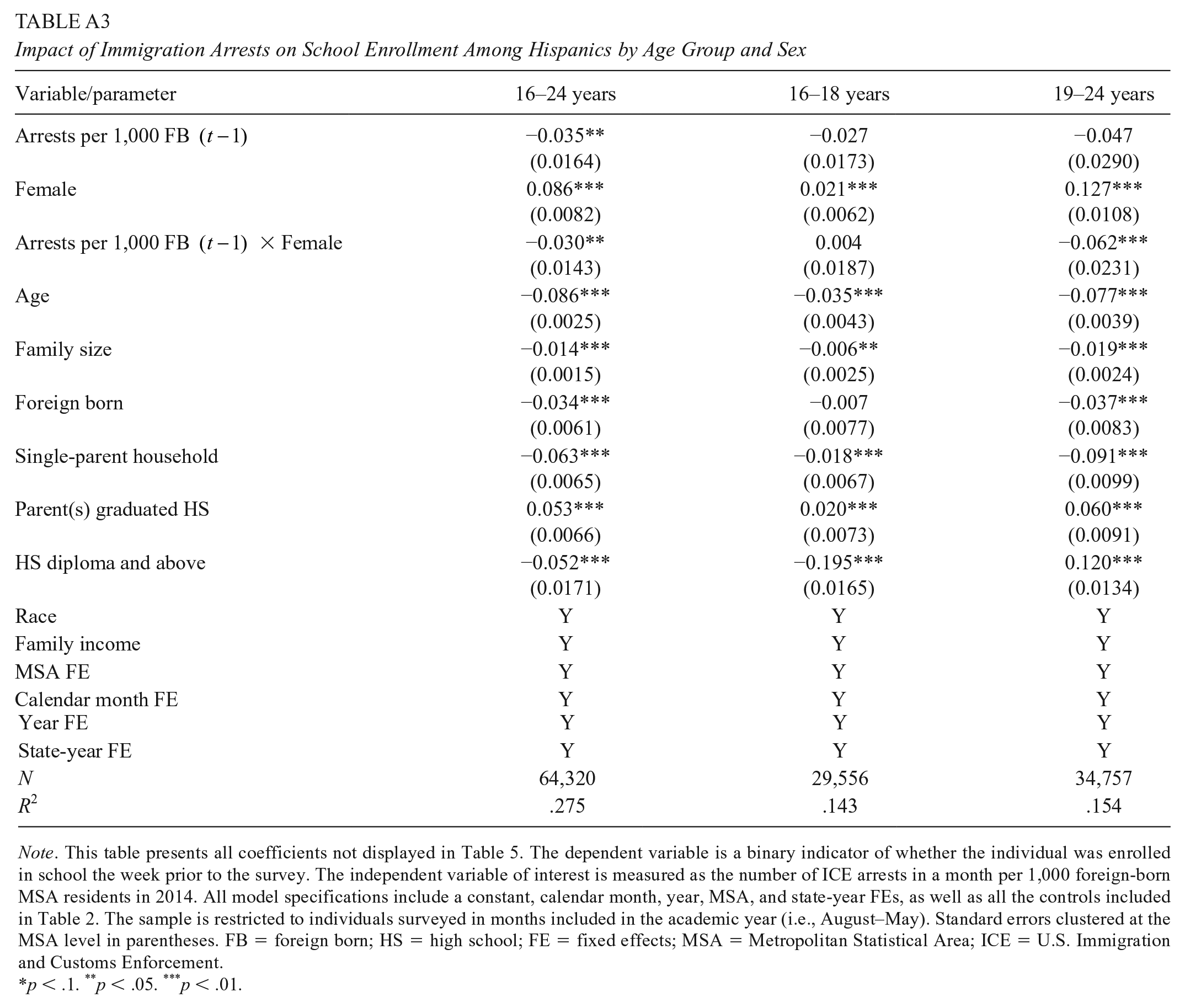
Impact of Immigration Arrests on School Enrollment Among Hispanics by Age Group and Sex
| Variable/parameter | 16–24 years | 16–18 years | 19–24 years |
|---|---|---|---|
| Arrests per 1,000 FB | −0.035** (0.0164) | −0.027 (0.0173) | −0.047 (0.0290) |
| Female | 0.086*** (0.0082) | 0.021*** (0.0062) | 0.127*** (0.0108) |
| Arrests per 1,000 FB × Female | −0.030** (0.0143) | 0.004 (0.0187) | −0.062*** (0.0231) |
| Age | −0.086*** (0.0025) | −0.035*** (0.0043) | −0.077*** (0.0039) |
| Family size | −0.014*** (0.0015) | −0.006** (0.0025) | −0.019*** (0.0024) |
| Foreign born | −0.034*** (0.0061) | −0.007 (0.0077) | −0.037*** (0.0083) |
| Single-parent household | −0.063*** (0.0065) | −0.018*** (0.0067) | −0.091*** (0.0099) |
| Parent(s) graduated HS | 0.053*** (0.0066) | 0.020*** (0.0073) | 0.060*** (0.0091) |
| HS diploma and above | −0.052*** (0.0171) | −0.195*** (0.0165) | 0.120*** (0.0134) |
| Race | Y | Y | Y |
| Family income | Y | Y | Y |
| MSA FE | Y | Y | Y |
| Calendar month FE | Y | Y | Y |
| Year FE | Y | Y | Y |
| State-year FE | Y | Y | Y |
| N | 64,320 | 29,556 | 34,757 |
| R 2 | .275 | .143 | .154 |
Note. This table presents all coefficients not displayed in Table 5. The dependent variable is a binary indicator of whether the individual was enrolled in school the week prior to the survey. The independent variable of interest is measured as the number of ICE arrests in a month per 1,000 foreign-born MSA residents in 2014. All model specifications include a constant, calendar month, year, MSA, and state-year FEs, as well as all the controls included in Table 2. The sample is restricted to individuals surveyed in months included in the academic year (i.e., August–May). Standard errors clustered at the MSA level in parentheses. FB = foreign born; HS = high school; FE = fixed effects; MSA = Metropolitan Statistical Area; ICE = U.S. Immigration and Customs Enforcement.
p < .1. **p < .05. ***p < .01.
Acknowledgements
We thank Catalina Amuedo-Dorantes, Francisca Antman, Jose Fernandez, and other attendees and presenters at the Diversity Initiative for Tenure in Economics Research Conference 2021 for helpful comments and feedback. This research received no specific grant from any funding agency in the public, commercial, or not-for-profit sectors. The data and analysis files for this article can be found at 
1.
While the literature has provided a broad definition for mixed-status families, we designate mixed-status families when at least one immediate family member’s birth place status (U.S. born and foreign born) differs from the respondents observed in our sample. Alternative definitions in the literature include households with a U.S.-citizen child and at least one non-U.S. citizen parent (Xu et al., 2016) and households with U.S.-citizen and unauthorized immigrant members (Vargas, 2015).
2.
See, for example, proposed Texas state bill HB 1246 filed during legislative session 87(R) in January 2021 to use enrollment instead of attendance for school funding decisions. Available at: https://capitol.texas.gov/BillLookup/Text.aspx?LegSess=87R&Bill=HB1246.
3.
ICE arrests used in our analysis come from the Transactional Records Access Clearinghouse (TRAC) at Syracuse University. This variable includes apprehensions conducted within communities and through custodial transfers. The inclusion of both types of arrests creates a more comprehensive measure of immigration-related arrests.
4.
Journalistic accounts of an ICE raid in Las Cruces, NM in 2017 note that absences in the public schools system spiked by 60% in the days following the raid and returned to its normal level the week after. It is estimated that as a consequence of this operation, 2,000 students missed at least a day of school (Blitzer, 2017). This episode is also referred to in Sattin-Bajaj and Kirksey (2019) and .
5.
6.
7.
Although the CPS collects self-reported information on individuals’ citizenship status, there is evidence that data collected through administrative surveys tend to overstate the number of naturalizations and to produce significantly lower estimates of the noncitizen population (Van Hook & Bachmeier, 2013).
9.
10.
11.
12.
It is important to note that the mixed-status designation depends only on immediate family members (i.e., siblings, parents, spouses, and children) who reside in the same household and not extended family members or others who may reside in the same household.
13.
14.
All regression coefficients presented in Table A1 in the .
15.
ICE defines an “encounter” with an individual as “the interview, screening, and determination of his/her citizenship, nationality, and lawful presence [. . .], and legal right to remain in the United States of America. An encounter, detainer, or charging documents issued by ICE does not necessarily result in the individual being placed into ICE custody.” (AIC v. DHS [2013] as cited in Cantor et al., 2019)
16.
Executive Order 13768, “Enhancing Public Safety in the Interior of the United States” published in January 2017, outlined immigrant categories that were prioritized for removal. Among others, this order targeted those who have “committed acts that constitute a chargeable criminal offense,” which may include immigrants who entered the country without inspection.
17.
All regression coefficients can be found in Table A2 in the .
18.
Table A3 in the presents all regression coefficients.
19.
Fernanda Santos and Charlie Savage. “Lawsuit Says Sheriff Discriminated Against Latinos,” The New York Times. May 10, 2012.
Authors
JOSE R. BUCHELI is an assistant professor of economics in the Department of Economics, Applied Statistics, and International Business at New Mexico State University. His research focuses on labor, development, education, and immigration.
JOAQUÍN ALFREDO-ANGEL RUBALCABA is an assistant professor in the Department of Public Policy at the University of North Carolina at Chapel Hill. His areas of interest include the economics of health, labor, and immigration.
EDWARD D. VARGAS is an assistant professor in the School of Transborder Studies at Arizona State University. His primary areas of interest are the effects of poverty and inequality on the quality of life, focusing specifically on health, immigration status, and social policy, and how these factors contribute to the well-being of vulnerable families.