




Abstract
Student parents are among the least likely student groups to complete college. Regression models were run using 2003–2019 American Time Use Survey data to explore time poverty among college students. Results indicate that students with children under 13 years had significantly less discretionary time and free time, spent significantly less time on their education, enrolled part-time at significantly higher rates, and spent significantly more time studying while simultaneously caring for children, compared with students without children under 13 years. The strength of these relationships was strongest when children were younger. Parents with children under 6 years, and mothers of children of all age-groups, had significantly higher time poverty than other groups, yet spent significantly more time on education after controlling for discretionary time, at the cost of significantly less free time for themselves. Results suggest that improving college outcomes for student parents may require consideration of time poverty.
Keywords
Student parents are a significant minority group in higher education, one that is at greater risk of dropout. Twenty-two percent of all undergraduate students are parents; of the 3.8 million students raising children in college, about 70% are mothers (Reichlin Cruse et al., 2019). Postsecondary outcomes are significantly worse for student parents than students without children, even though student parents earn higher GPAs (grade point average) on average (Nelson et al., 2013; Reichlin Cruse et al., 2019). While significantly fewer women than men drop out, the gap in dropout rates between parents and nonparents is larger for women, suggesting parenthood may increase dropout risk more strongly for women than men (U.S. Department of Education, Institute of Education Sciences, & National Center for Education Statistics, 2009). Determining factors that affect student parent postsecondary achievement is critical, as the outcomes of student parents are important because of the impact they can have on students’ families’ financial stability and their children’s later educational attainment (Wladis et al., 2018).
Studies have investigated which factors predict student persistence in college, and the relationship between parenthood and college outcomes, yet little is known about the specific issue of time poverty (Giurge & Whillan, 2020), and even less when applying the idea of being time poor in terms of insufficient time for college (Wladis et al., 2018). While findings show that parents (especially mothers) have higher rates of time poverty than their childless peers (Chatzitheochari & Arber, 2012; Kalenkoski et al., 2011; Wladis et al., 2018), and while there is evidence that time spent on education correlates with outcomes (Oreopolous et al., 2018; Stinebrickner & Stinebrickner, 2007; Svanum & Bigatti, 2006; Wladis et al., 2018), little research has directly explored the relationship between parenthood, time poverty, and the amount of time parents have to devote to their studies. To address this gap, this study uses a national sample to investigate whether student parents have higher rates of time poverty, whether such time poverty may be related to the amount of time that they spend on their education, and how this relationship may vary by the age of students’ children and by gender.
Research Questions
This study explores how college students’ roles as parents may interact with gender to predict both time poverty and time devoted to postsecondary educational studies.
Specifically, we ask the following research questions:
Theoretical Framework and Prior Research
Time Poverty
Time is a finite resource, and individuals allocate time to different life tasks in order to maximize their welfare (Becker, 1965). In line with this, Vickery (1977) defined the concept of time poverty as having insufficient time to maintain physical and mental well-being; Vickery averred that defining poverty solely on income would lead to social support programs that perpetuate inequality by underestimating the poverty experience. Giurge and Whillan (2020) contend that time poverty is a significant issue facing society, it is a widespread threat to well-being and economic development, and there is a strong need to investigate various aspects of time poverty in representative samples. However, the concept of time poverty has yet to be widely applied to or investigated in higher education. To this end, we use Wladis et al.’s (2018) adaptation of time poverty for higher education; in this context, defining it as insufficient time for studying and completing college course work.
Time poverty can be measured relatively (e.g., perception of sufficient time) or absolutely (e.g., amount of discretionary time that a person has compared with others in the group of interest). Both approaches exist in prior research (see, e.g., Goodin et al., 2005, for absolute measures and Kalenkoski et al., 2011, for relative measures). Discretionary time is the amount of time left over after performing some set of necessary activities; activities classified as necessary varies in the research literature. In this study, we focus on absolute measures of time poverty, following the model of studies that classify discretionary time as time available after completing personal and family care (e.g., sleeping, eating, grooming, paid work, housework, and child care; Ås, 1978; Kalenkoski et al., 2011; Kalenkoski & Hamrick, 2013; Wladis et al., 2018). We hypothesize that student parents have more time poverty (lower amounts of discretionary time and lower quality of discretionary time) than comparable nonparent students, that these higher rates of time poverty lead them to spend less/lower quality time on their studies, and that this decreased time for college leads to slower degree progression and potential higher college dropout (Wladis et al., 2018).
Time Poverty and Parenthood
Considering time as a finite resource, some past studies have found that households with children are more time poor (Kalenkoski et al., 2011), with mothers in comparison with fathers more time poor (Chatzitheochari & Arber, 2012; see review in Zilanawala, 2013). Time poverty encompasses both quantity and quality of time. For example, mothers are more likely than fathers to provide nighttime child care and to experience interrupted sleep patterns (Venn et al., 2008), which can lead to lower rates of cognitive performance (Reynolds & Banks, 2010). The quality of available time may also be lower when it occurs at less useful times (Fagan, 2001), when it is “contaminated” by other activities (e.g., child care; Chatzitheochari & Arber, 2012), or when it is fragmented (Giurge & Whillan, 2020), all of which occur more often for mothers (Mattingly & Bianchi, 2003). On average, parents spend more hours on unpaid work, which translates into having less leisure time (with mothers having less leisure time than fathers), and they are less satisfied with their work–life balance (Pew Research Center, 2013).
Time Poverty and Academic Outcomes in College
Time poverty may manifest itself in two key areas of college success: the inability to enroll full-time and inadequate and/or fragmented time to devote to coursework. Research supports that academic momentum (i.e., the speed with which undergraduates progress in college) significantly affects their likelihood of completing a degree (Attewell et al., 2012; Attewell & Monaghan, 2016; Belfield et al., 2016; Davidson & Blankenship, 2016). Additional research indicates that students who initially have high academic momentum in their major are more likely to earn their degree (Denley, 2016; Jenkins & Cho, 2014). And, an international comparison of two Russian and eight U.S. public universities confirms that initial academic momentum is associated with lower dropout rates (Kondratjeva et al., 2017).
Despite research indicating that high academic momentum is important for degree completion, time-to-degree has increased in the past three decades (Belfield et al., 2016; Bound et al., 2010; Complete College America Postsecondary Analytics, 2013; Klempin, 2014). More than 80% of third term community college students report being part-time for at least some portion of their college experience (Center for Community College Student Engagement, 2017). Part-time enrollment means longer time to degree, less engagement with faculty and their peers, and results in lower persistence and completion rates than full-time students (Center for Community College Student Engagement, 2017; Fain, 2017; Jaggars & Xu, 2011). This is particularly true for first-generation college students who are more likely to have children, and work part-time and experience lower enrollment intensity (Chen & Carroll, 2005; Choy, 2001; Mangan, 2015).
Enrollment, whether full- or part-time, is only the first step. Students also need time to attend class and study. Earlier studies have shown mixed results for the relationship between the amount of weekly reported study time and GPA for college students (see review in Ashby Plant et al., 2005; McFadden & Dart, 1992; Pascarella & Terenzini, 1991; Schuman et al., 1985). However, recent studies support that the quantity and quality of time dedicated to academic work is directly related to college success (e.g., Astin, 1993; Barbarick & Ippolito, 2003; Michaels & Miethe, 1989; Svanum & Bigatti, 2006; Wladis et al., 2018). One study found that students who study daily and who spend more than 15 hours a week on their schoolwork were more likely to get A grades than their classmates who did not (Student Monitor for the Association of American Publishers, 2005, as cited in Marketing to Women, 2005). Stinebrickner and Stinebrickner (2007) report that study quantity plays a central role in determining college grade performance. Oreopolous et al. (2018) found a highly positive relationship between how often students log in to work on their courses and how many credits they earned, as well a strong positive relationship between study time and GPA.
It is likely (at least in part) that because of time limitations, parents (especially mothers) have lower rates of college persistence and completion (Choy, 2002; Horn & Carroll, 1996; U.S. Department of Education et al., 2009). Yet despite this potential, few studies have explored time poverty among college student parents or its linkage to increased risk of college attrition. To our knowledge, only one previous study (Wladis et al., 2018) has explored the time poverty of student parents directly and its link to students’ college outcomes. In that study, at a large urban university, student parents were found to have significantly less time available for college and rated the available time they had for their studies as lower quality compared with their childless peers; these time differences directly explained differences in college persistence and academic momentum. In this study, we seek to explore whether patterns of discretionary time among student parents are similar while utilizing a nationally representative example.
Student Parents and College Outcomes
Among students who began college in 2003–2004, more than half (53.4%) had attained a degree or certificate by 2009, largely bachelor’s degrees; however, among student parents, that number dropped to 32.6%, and most earned certificates (U.S. Department of Education et al., 2009). Attewell et al. (2011) found that even after controlling for race, gender, academic preparation, socioeconomic status, financial aid and work, students with nontraditional profiles (delayed college entry after high school, part-time enrollment, and financially independent or married or have dependents) have considerably lower graduation prospects. Students who become parents at a young age are less likely than any other group (single or married, without children) to have earned a college degree by the age of 24 years or to be enrolled in college (Osgood et al., 2005). In one study, a third of low-income single mothers and 29% of low-income married women with children took more than 10 years to get a degree, compared with 16% of all women and 13% of all men; another study put their time to completion at anywhere between 6 and 15 years (Attewell & Lavin, 2007; Center for Women’s Policy Studies, 2004). Research suggests that parents with young children are less motivated than parents of older children, due in part to the more time and labor-intensive nature of child care for young children (Lovell, 2014). Students who become parents likely suffer from a loss of academic momentum: stopping, dropping out, or attending on a part-time basis (Adelman, 1999, 2006). Between 30% and 37% of college students report spending significant time on dependent care, and a similar percentage (29%) cite caring for dependents as a potential reason for not reenrolling (Center for Community College Student Engagement, 2014).
Financial poverty and time poverty likely play an interrelated role, as student parents are more likely to face intense economic challenges; and thus, also work more to support their families (Noll et al., 2017). Nearly half of all student parents work full-time while attending college and more than half (57%) of student parents are classified as low income, increasing the risk of dropout (Miller et al., 2011). In addition to being low-income and working full-time, student parents are more often women, first-generation college students, need financial assistance, have more student debt, attend school part-time, need remedial coursework, and enroll in community colleges (Gault et al., 2014; Miller et al., 2011; Noll et al., 2017).
Methodology
Data Source and Sample
This study uses the combined 2003–2019 American Time Use Survey (ATUS) data set, conducted by the U.S. Department of Labor’s Bureau of Labor Statistics. ATUS is nationally representative and includes detailed information about time use as well as information about college enrollment, which allowed us to identify college students in the data set. Respondents are asked to provide detailed information about their activities over the past 24 hours. ATUS data include information collected from 436,500 interviews conducted from 2003 through 2019 and can be linked to the U.S. Current Population Survey, which includes information about employment, earnings, and demographic data. ATUS participants are selected from U.S. Current Population Survey households, using stratification by household composition and race/ethnicity, and responses are weighted to account for stratification, nonresponse, and day of the week covered by the time-use questionnaire.
Measures
Several measures were used as proxies for time poverty in this study. Discretionary time was used to denote time available to be spent on education and on other activities such as leisure, volunteering, or exercise; education time was used to denote time actually spent on education (class attendance, homework, commuting, and education-related administrative tasks); and free time was used to denote discretionary time remaining after deducting education time. Each of these was measured in minutes per day and treated as a continuous variable in all models. Part-time enrollment was also explored as a potential partial (and imperfect) proxy for time poverty, since it is so readily available in college institutional data sets, and therefore might be useful to institutions hoping to target interventions to “time poor” students using the data that they have readily available; it was coded as a binary variable using federal definitions. Part-time enrollment has also been correlated with other negative college outcomes such as persistence and time-to-degree in several studies, which also makes it an important variable to track in this study (Moore & Shulock, 2009; Shapiro et al., 2016).
We also looked at other measures of time spent on education that might shed some light on the quality of time that student parents have for their studies. For all students, we coded uncontaminated academic time as the proportion of time that a student spent either attending class, studying, or doing academic work outside of class, while no children under 13 years were present. This included the student’s own children as well as other children in the household, so it was not limited only to parents, but might have included siblings, children that live outside the household, and so on. This measure gives some perspective on how the quality of time that students have for their studies may be affected by child care responsibilities. We use the word “uncontaminated” in the sense that the time spent focused on academic tasks was not “contaminated” by child care responsibilities (terminology from Chatzitheochari & Arber, 2012). 1
The primary independent variable of interest was parenthood, which was measured in several different ways, including a binary measure of whether a student had children, the number of children that they had, and the age of their youngest child. Control variables were included in the analysis to account for factors that may significantly affect time poverty or correlate strongly with educational outcomes, including gender, race/ethnicity, age, citizenship, marital/live-in-partner status and the number of other adults in the household, income, time spent on paid work, and time spent on “housework.” 2
The summary statistics for the sample of students in ATUS (2003–2019), broken down by gender and by parental status, are shown in Table 1.
Summary Statistics for ATUS Sample Data Used in This Analysis

Source. U.S. Department of Labor, Bureau of Labor Statistics, ATUS 2003–2019.
Note. Standard errors calculated using successive difference replication with 160 replicates, weight used is TUFNWGTP. Only college students in the ATUS sample were used for analysis (n = 11,195). ATUS = American Time Use Survey.
Analytical Approaches and Data Analyses
For ATUS data, successive difference replication on 160 replicates was used to calculate standard errors, in addition to weights used to calculate point estimates. Only the subset of ATUS data consisting of college students was used for the models. The ATUS data set does not have significant missing data.
All statistical analyses reported here were conducted using Stata. For dichotomous outcomes (e.g., part-time enrollment), binary logistic regression was used, represented by the following equation:

While binary logistic regression was used for all predicted probabilities reported, because of the difficulty of interpreting odds ratios correctly, we have limited our reporting of these model coefficients to the online Supplemental appendix and have instead reported linear probability model coefficients in the body of this article for binary outcomes, with the aim of improving interpretability. For continuous outcome variables (e.g., total nondiscretionary time, education time, free time) as well as linear probability models for binary outcome variables, linear regression models were used, represented by the following equation:

For both equations,
We also explored the interaction of parenthood with gender, using models like the following:


where
Results and Discussion
Base Models for Overall Average Effects, Using Different Measures of Parenthood
Results from base models (average effects with no controls) indicate that students with children had on average 60.0 fewer minutes per day of discretionary time, spent 29.5 fewer minutes per day on their education, had 30.5 fewer minutes of free time per day, and were 7 percentage points more likely to enroll part-time, compared with students without children (see online Supplemental Tables A1 and A2). These differences were highly statistically significant (α = .001). Controlling for discretionary time (see online Supplemental Table A2), there was no longer significant difference in time spent on education. Students with children were, however, still significantly more likely to enroll part-time. Similar time patterns were observed if the number of children was used as a measure of parental status (see online Supplemental Tables A1 and A2): for each child that a student had, they had on average 28.6 fewer minutes of discretionary time per day, spent on average 12.2 fewer minutes per day on their college education, had 16.4 fewer minutes of free time per day, and were 4 percentage points more likely to enroll part-time. These differences were highly statistically significant (α = .001). After controlling for discretionary time (see online Supplemental Table A2), there was no longer significant difference in time spent on education per day; however, the number of children that a student had was still significantly associated with enrolling part-time.
Compared with students with no children under 13 years, 3 students with at least one child under the age 1 year had 147.1 fewer minutes of discretionary time per day, spent 56.8 fewer minutes per day on their education, had 90.3 fewer minutes of free time per day, and their probability of enrolling part-time was 18 percentage points higher. Each of these differences was highly statistically significant (α = .001). Yet, after controlling for discretionary time, students with at least one child under 1 year spent 14.8 more minutes per day on their education compared with students with no children under 13 years, although they were still significantly more likely to enroll part-time.
For students whose youngest child was between the age 1 and 5 years, they had 112.2 fewer minutes of discretionary time per day, spent 42.1 fewer minutes per day on their education, had 70.0 fewer minutes of free time per day, and their probability of enrolling part-time was 17 percentage points higher, compared with students with no child under 13 years. Each of these differences was highly statistically significant (α = .001). Yet again, after controlling for discretionary time, students with at least one child 1 to 5 years spent 12.5 more minutes per day on their education compared with students with no children under 13 years, although they were still significantly more likely to enroll part-time.
For students whose youngest child was between the age 6 and 12 years, they had 67.2 fewer minutes of discretionary time per day, spent 32.3 fewer minutes per day on their education, had 34.9 fewer minutes of free time per day, and their probability of enrolling part-time was 11 percentage points higher, compared with students with no child under 13 years. Each of these differences was highly statistically significant (α = .001; for free time only at α = .01). After controlling for discretionary time, students with at least one child between 6 and 12 years spent about the same amount of time per day on their education compared with students with no children under 13 years, but they were still significantly more likely to enroll part-time.
Gender and Parenthood
We next considered the extent to which the patterns observed for student parents versus nonparents relate to gender, by including gender in the base models (see online Supplemental Table A3). Results show men on average have 47.7 to 48.6 more minutes of discretionary time per day and 50.7 to 51.2 more minutes of free time per day, yet they spend roughly the same amount of time on their education and enroll part-time at roughly the same rates as women with the same parental status. This suggests that, on average, women spend a significantly higher proportion of their discretionary time on their college education, so that the equal time spent on education by gender hides stark disparities in time poverty by gender. Women are spending roughly the same amount of time on their education as men but are doing so at the cost of significantly less free time for themselves.
So far, our analyses explored only average effects in base models and have not yet included control variables—these base models showed us what the actual disparities by gender and parental status were. However, to get a sense of whether these disparities exist when we control for other characteristics, we also analyzed the relationships further using full models with control variables. In these analyses, the measure of parenthood was based on age of the youngest child; this was chosen because similar patterns were shown with each of the three different measures of parenthood that were previously explored, and this specific measure provided more differentiated information. Our initial analyses showed that both parenthood and gender separately predict discretionary time, education time, free time, and part-time enrollment to some extent. However, it may be that there are interactions between gender and child age that are not captured by these models (e.g., women may be disproportionately affected by having young children, but less so when they have older children). We explored this in Table 2, where we modeled the relationship between parental status (by age of the youngest child), student gender, and the interaction between these two factors and discretionary time, education time, free time, and enrollment intensity. And, the final column of Table 2 uses as the dependent variable the proportion of academic time (attending class, studying, etc.) that a student was able to spend while not simultaneously caring for children under 13 years (i.e., uncontaminated academic time). This should reveal ways in which parenthood may also relate to the quality of the time that students can devote to their academic work.
Linear Regression and Linear Probability (Part-Time Enrollment) Model Coefficients Showing the Relationship Between Parenthood and Discretionary Time, Education Time, Free Time, Enrollment Intensity, and Uncontaminated Academic Time, by Gender, With Controls (ATUS 2003–2019)

Source. U.S. Department of Labor, Bureau of Labor Statistics, ATUS 2003–2019.
Note. Standard errors calculated using successive difference replication with 160 replicates, weight used is TUFNWGTP. Only college students in the ATUS sample were used for analysis (n = 11,195). Control variables included race/ethnicity, age, presence of spouse or partner in the household, total household earnings, total work hours, total housework hours, as well as time diary day of the week, month of the year, and year. ATUS = American Time Use Survey.
p < .10. *p < .05. **p < .01. ***p < .001.
Table 2 shows that student parents have significantly less time (of all types) and are significantly more likely to enroll part-time; the impact of parenthood on these outcomes is stronger when children are younger. There are significant interactions between parenthood and gender to better visualize these Figures 1 to 4 show the predicted discretionary, education and free time, the proportion of students enrolled part-time, and the proportion of time individual students spent on educational tasks while no children under 13 years were present (uncontaminated academic time), broken down by gender and age of the youngest child (for the reference groups, based on the models in Table 2). Provided in online Supplemental Table A5 are pairwise comparison testing for each combination of child age and student gender to assess the significance of the patterns in Figures 1 to 4. 4 We note that all these results include controls for ethnicity, age, marital status, household income, work hours, and time spent on non–child care housework, so the differences observed can be interpreted as comparing students who are similar with respect to these characteristics.

Predicted discretionary and education time (min/day) by age of the youngest child and gender (ATUS 2003–2019), based on full model with controls in Table 2 for reference categories.

Predicted free time (minutes/day) by age of the youngest child and gender (ATUS 2003–2019), based on full model with controls in Table 2 for reference categories.
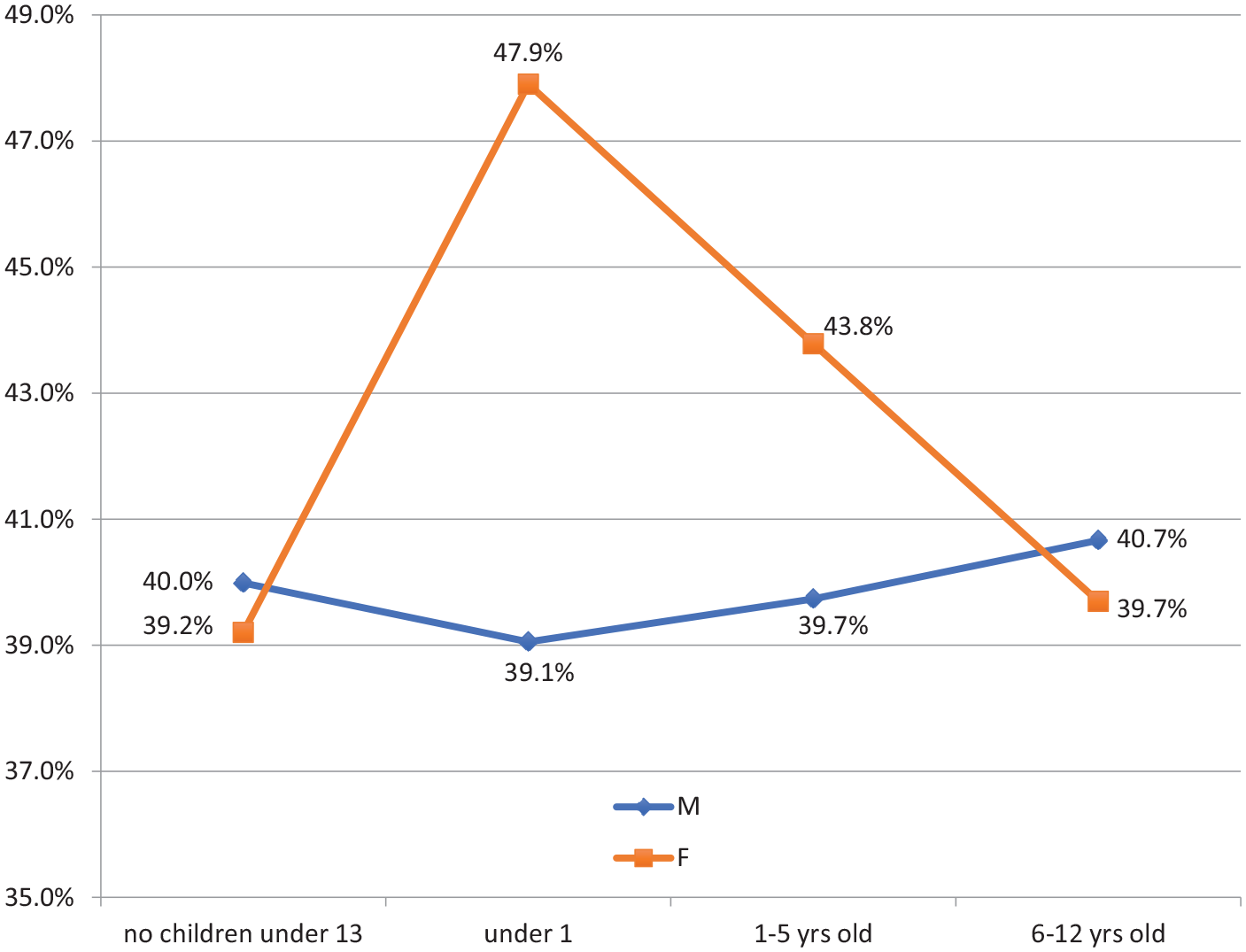
Predicted probability of part-time enrollment by age of the youngest child and gender (ATUS 2003–2019), based on full model with controls in Table A4 in online Supplemental appendix for reference categories.

Predicted percentage of education time with no child under 13 years present, by age of the youngest child and gender (ATUS 2003–2019), based on full model with controls in Table 2 for reference categories.
Discretionary Time (Figure 1)
The overall gap between men and women is highly significant. The general shape of the graph for both men and women reveals a significant trend whereby discretionary time is the highest for those without children under 13 years, and the lowest for parents with the youngest children. The increase in the gender gap when moving from those with no children under 13 years to those with children under 6 years is significant; similarly, the increase in the gender gap for parents with children 1 to 5 years versus 6 to 12 years was also significant.
Education Time (Figure 1)
Men with children aged 1 to 12 years spent significantly less time on their education than other men. In contrast, women spent significantly less time on their education when they had children under the age 6 years (and particularly when they had children under 1 year), but women with children 6 years and older spent the same amount of time on their education as those without children. This difference in trends between men and women is significant.
Free Time (Figure 2)
There is a highly significant overall gender gap. Both men and women with preschool-age children (under 6 years) have significantly less free time than others of their gender. Parents with children under 1 years had the least free time, with women in this group having significantly less free time than men; for men, their free time increased if their children were 1 to 6 years, whereas for women there was no difference. In addition, while men with children over 6 years have roughly the same free time as men without children, women with children up to 12 years still have less free time than women with older or no children. The differences in these patterns by gender are significant.
Part-Time Enrollment (Figure 3)
For men, the age of their children (or whether they have children at all) has no significant relationship with their part-time enrollment patterns. In contrast, for women, having preschool-age children (under 6 years) makes them significantly more likely to enroll part-time than women with older or no children. This difference in trends by gender is significant.
Proportion of Uncontaminated Academic Time (Figure 4)
Men and women have the same proportion of uncontaminated academic time when they have no children under 13 years, and both men and women have significantly lower proportions of uncontaminated academic time when they have children under 13 years than when they do not. The primary difference is that for parents with children of all ages under 13 years, the proportion of uncontaminated time that women are able to spend on core academic tasks is significantly lower than for men, with the differences greatest when children are youngest. The differences in slopes between men and women as we move from the groups with no children under 13 years to any other group are also significantly different, suggesting that women are significantly more likely to do schoolwork while children under 13 years are present, than men.
If we explore the potential relationship between having young children on students’ quality of time for their studies, similar patterns are observed. Not only do women with preschool-age children (under 6 years) spend less time on their studies than men but they also spend a higher proportion of their time doing academic work for college while simultaneously caring for children. While all parents lost a significant proportion of their time on academic work to multitasking when children were present, this proportion was significantly greater for mothers than fathers, with the gender gap greatest when children were under 1 year, and still persisted even when children were older. This is in line with other research that has shown that mothers are more likely than fathers to have activities “contaminated” by child care responsibilities (Chatzitheochari & Arber, 2012). Contaminated time likely has a negative impact on the quality and extent of academic work that can be done during that time (see Meyer et al., 1997), and whatever negative impact exists from this effect will be felt more strongly by parents than nonparents and by mothers than fathers.
Discretionary Time as a Mediator Between Parenthood and Education Time/Enrollment Intensity
The patterns observed thus far suggest that discretionary time may mediate the relationship between parental status (including age of the youngest child), gender, and time spent on education or enrollment intensity. Table 3 shows the impact of including discretionary time as a covariate in the models predicting education time and part-time enrollment on the coefficients for age of the youngest child and gender when including controls. Discretionary time is a highly significant predictor of time spent on education. After controlling for discretionary time, parents of preschool-age children spent more time on education than their peers with older children or no children; in fact, the relationship between the age of the youngest child and the amount of time spent on education was reversed. Thus, the lower rates of time spent on education by parents with young children can entirely be explained by their lower rates of discretionary time. (We note that this finding seems to refute Lovell, 2014, who suggested that student parents with younger children were less motivated.) Adding discretionary time to the model also reduced the strength of the relationship between having children under age 13 years and enrolling part-time, suggesting that discretionary time explains part of the difference (but not all) in the part-time enrollment rates of parents versus nonparents. Parents are likely to schedule around their children’s activities and available child care, such that their time is less flexible, which may dictate a need for part-time enrollment. Sobel test statistics (see Table 4) show that discretionary time highly significantly mediates the relationship of parental status to education time and to part-time enrollment.
Discretionary Time as a Mediator of the Relationship Between Child Age, Parent Gender, and Time Spent on Education: Linear Regression Models of Education Time and Part-Time Enrollment Intensity, With and Without Controlling for Discretionary Time (ATUS 2003–2013)

Source. U.S. Department of Labor, Bureau of Labor Statistics, ATUS 2003–2019.
Note. Standard errors calculated using successive difference replication with 160 replicates, weight used is TUFNWGTP. College students in the ATUS sample were used to calculate models (n = 11,195).
Control variables included race/ethnicity, age, presence of spouse or partner in the household, total household earnings, as well as time diary day of the week, month of the year, and year. ATUS = American Time Use Survey.
p < .10. * p < .05. ** p < .01. *** p < .001.
Mediation of the Relationship Between Age of the Youngest Child and Education Time/Part-Time Enrollment by Discretionary Time (Based on Full Models in Table 4; ATUS 2003–2019)

Source. U.S. Department of Labor, Bureau of Labor Statistics, ATUS 2003–2019.
Note. Standard errors calculated using successive difference replication with 160 replicates, weight used is TUFNWGTP. Only college students in the ATUS sample were used for analysis (n = 11,195).
Control variables included gender, race/ethnicity, age, total household earnings (adjusted for household size), native born/citizenship categories, as well as time diary day of the week, month of the year, and year.
p < .10. *p < .05. **p < .01. ***p < .001.
Relationship Between Time Poverty Outcomes and Measures of Household Help
The amount of help a student has in the household may affect a student parent’s quantity and quality of time for their college studies. We initially explored whether or not being a single parent related to the various time poverty outcomes, but we obtained mixed results (with single parents actually having more discretionary time, spending more time on education, and enrolling less often part-time; although they did have a higher proportion of academic time in the presence of children under 13 years). One reason for these mixed results may be that students do not necessarily get their primary child care help from their spouses/partners. Of the total 4,735 student parents in the sample, 2,012 were single parents (without a spouse/partner living in the household); however, 50% of those single parents had one or more adult relative living in the household with them (and 39% had two or more). Single parents were more likely to live in multigenerational households than parents with a live-in partner (50% vs. 21%). To measure the extent of adult help a student parent may have had, we ran analyses using the number of adult relatives in the household, including all relatives who were 18 years of age or older. For these next analyses, we include only student parents. Table 5 details the coefficients for each model, showing the relationship between our measure of household help and discretionary time, time spent on education, part-time enrollment, and the proportion of uncontaminated academic time.
Linear Regression Model Coefficients Showing the Relationship Between Number of Adult Relatives Living in the Household (hh) and Time Poverty Measures, With Controls (ATUS 2003–2019)

Source. U.S. Department of Labor, Bureau of Labor Statistics, ATUS 2003–2019.
Note. Standard errors calculated using successive difference replication with 160 replicates, weight used is TUFNWGTP. Only college students in the ATUS sample were used for analysis (n = 11,195). Control variables included number of children, gender, race/ethnicity, age, total household earnings (adjusted for household size), native-born/citizenship categories, as well as time diary day of the week, month of the year, and year.
p < .10. *p < .05. **p < .01. ***p < .001.
Table 5 indicates that for each additional adult relative in the household, student parents had 13.6 extra minutes of discretionary time per day and that they spent 13.3 additional minutes on their education. Each additional adult relative in the household also increased the probability that a student would enroll full-time instead of part-time by 2.2 percentage points and decreased the proportion of a student’s academic time contaminated by child care by 4.7 percentage points. These differences are all significantly different. After controlling for discretionary time, the difference in total time spent on education, part-time enrollment, as well as the proportion of academic time contaminated by child care all significantly decreased, although nonsignificant differences still remained, suggesting that the increased discretionary time does not entirely explain the relationship between the number of adult relatives in the household and these outcomes; discretionary time explained much more of the difference for time spent on education than for the other variables. It may be that students who live with members of their extended families are also more likely to spend time on education, to take steps to prevent their academic work time from being contaminated by child care, and to enroll full-time, for reasons other than increased available discretionary time (such as family pressure to finish a college degree, or certain cultural norms that may be more common for students who live in extended family units). Sobel tests do confirm, however, that discretionary time significantly mediates the relationship between the number of adult relatives in the household and the three outcome variables examining quantity/quality of time for college, even if that mediation is partial rather than complete.
Limitations
This study only looks at the relationship between discretionary time and time spent on education or part-time enrollment, as well as distributions of free time by parental status and gender. While these are important equity issues in and of themselves, this study does not attempt to empirically link these outcomes to other college outcomes such as persistence or academic momentum. At present, there is no nationally representative data set that links time use to these kinds of academic outcomes. Additionally, time measures in these studies are retrospective and self-reported and may be affected by desirability bias or inaccurate recollections of time use. It is unclear whether other methods of calculating time use, such as the experience sampling method, may result in more accurate time use data than those used here (see, e.g., Sonnenberg et al., 2012), but it may be important for future studies to replicate these methods using alternate measures of time use.
Furthermore, there are some limitations in the ATUS data set itself. Only interviewees under age 50 years are asked about student status during interviews, so there may be students, and student parents, over the age 50 years that are not well-represented in the data set. We note that only 8% of college students in the United States are currently over the age 40 years (Chronicle of Higher Education, 2020), so this only impacts the generalizability of these findings for a small proportion of the population; however, caution should be exercised in extending these findings to students over the age of 50 years. Additionally, ATUS conducts interviews year-round, including weekends and during the summer break, so students who were a part of the survey may have spent no time on their studies during the 24-hour period about which the ATUS study interviewed them; this does introduce some variability into the data that may suppress detection of effects. However, we found no significant difference in terms of which groups identified as students during the summer months versus other times of year, and we have controlled for day of the week, month of the year, and year in all analyses, so we do not expect the difference in the timing of the interviews to have affected the overall trend of model outcomes.
Furthermore, it is important to note that time poverty is likely not the only factor that distinguishes students with children from those without, or the only factor that might explain differences in outcomes between parents and nonparents. Because the aim of this study has been to explore potential relationships between parenthood and time poverty while holding other potentially confounding factors constant, this study included income, age, academic preparation, ethnicity, and gender (among other factors) as control variables, precisely because each of these factors have been linked to college outcomes and has been found in the literature to differ between parents and nonparents. However, to truly understand all the factors that distinguish the experiences of student parents from those of nonparents, it is necessary for future studies to explore various other factors in more depth and to investigate how these various factors may interplay with one another to predict college outcomes for student parents.
Finally, one factor that has consistently been identified in prior research on student parents is income poverty—student parents often have more financial limitations because of the expenses of providing for their families; they often need to work more to pay living expenses, which often disqualifies them for financial aid. Income poverty and time poverty are strongly intertwined, as students with higher incomes can purchase more child care or household help, and students with lower incomes may work more and thus, have less time for school. For instance, a recent report from the New York Federal Reserve examining the impact of COVID-19 (coronavirus disease 2019) found that households with children were more likely to suffer job loss and food insufficiency and were also more likely to rely on external supports including government benefits, charitable aid, and help from family and friends (Armantier et al., 2020). In this study, we have controlled for household income while exploring student time poverty to isolate the patterns associated with time poverty specifically. However, it seems clear that more complex relationships between time poverty and income poverty exist and may be worth pursuing in future research. 5
Implications
This study’s results suggest that student parents (particularly those with preschool-age children) have significantly less time for their studies than comparable peers without children and that this is linked to the amount of time that these students spend on their education, as well as the intensity of their enrollment. Student parents have on average 1 less hour per day in discretionary time, or 7 hours per week; in a typical 15-week term, the equivalent of a 105 hour deficit each semester. Women are particularly likely to have less time for education after having children, and when their children are young, they are particularly likely to enroll part-time; this part-time enrollment is significantly more prevalent than among women with older or no children, or among men. This finding is of note, as part-time enrollment has been shown to result in lower persistence and completion rates (Center for Community College Student Engagement, 2017; Fain, 2017; National Student Clearinghouse Research Center, 2019). Student parents also had lower quality of academic time, with significantly larger proportions of their academic time spent in the company of children under 13 years; these proportions were even worse for mothers than for fathers. In this study, however, student parents showed a high commitment to their education in comparison with nonparents with comparable amounts of discretionary time; parents (especially mothers) choose to spend a greater proportion of their discretionary time on their education in comparison with their childless peers. Furthermore, student parents’ quantity and quality of time for college were significantly related to the number of adult relatives in the household, suggesting that available child care help is likely a major factor in determining how much time, and the quality of time, student parents have available to dedicate to their education.
Results from this study, when combined with previous findings (Wladis et al., 2018) and research noting the positive relationship between time spent on studies and college outcomes (Oreopolous et al., 2018; Stinebrickner & Stinebrickner, 2007; Svanum & Bigatti, 2006) and the potential negative impact of part-time enrollment on outcomes (Center for Community College Student Engagement, 2017; Fain, 2017; National Student Clearinghouse Research Center, 2019) suggests that interventions aimed at improving college outcomes for student parents’ may need to consider time poverty more directly in order to provide these students with more time for their studies. In particular, we found both that parents of young children (under age 6 years) are the most time-poor, and those student parents spend a significant proportion of their academic time simultaneously caring for children; since data that shows over half (53%) of student parents have children who are under age 6 years (Reichlin Cruse et al., 2019), one area that may need to be targeted to support student parents is child care. Colleges, with federal and state support, may address student time needs by augmenting the huge unmet need for on-campus college child care for student parents (Miller et al., 2011; Nelson et al., 2013). Over the past 15 years, the amount of available child care on campus in the United States has shrunk, even as the number of student parents has grown (Gault et al., 2014). In 2015, less than half of all two and four year campuses offered on-campus childcare, a decrease of 6-9 percentage points from 2003-2005 (Institute for Women’s Policy Research, 2015), and even those colleges that offer on-campus daycare centers often have far too few slots to meet student demand, meeting only about 5% of student need (Miller et al., 2011). Increasing on-campus child care may serve to increase the time student parents devote to their studies, particularly for mothers, and thus help alleviate their time poverty.
Furthermore, most of the research and policy efforts aimed to support student parents have focused on the consequences of tangible forms of poverty (i.e., financial poverty), rather than time poverty. A feasible way to address this is for time poverty measures to be included in addition to income poverty measures in student need calculations for financial aid, to provide necessary additional support to reduce parental time poverty (e.g., to pay for child care, to work less). Because the present system for calculating need-based aid does not include the impact of unpaid work on the ability of students to engage in their education studies, parents (and particularly mothers) are disproportionately underidentified and underserved by current college aid need formulas. Some scholars have already attempted to develop combined measures of time and income poverty (see, e.g., Zacharias et al., 2014), and the results of this study confirms that this may be an important line of inquiry for higher education administrators and policymakers to pursue.
Results from this study suggest that one critical area for future research is for randomized controlled trials to provide student parents (mothers in particular) with resources that allow them to carve out more time for their studies and to measure the impact—it could then be tested whether alleviating time poverty results in students spending more time on their education, enrolling full-time at higher rates, accumulating credits more quickly, and persisting in college to obtain degrees at higher rates. Furthermore, there is a need for future studies to explore the complex relationship between time poverty and income poverty and how they interact to impact college outcomes. For example, students who have more income can also pay for more child care and household help, which may allow them to spend more time on their studies; however, students may also choose to work fewer hours where possible, and this may lower their time poverty and provide more time for college while simultaneously increasing their income poverty and exposing them to other income poverty–related risks. A clearer picture of the relationship between time and income poverty is needed to determine when financial aid for student parents is optimized so that they can minimize their outside work and pay for sufficient child care, so as to maximize their time in school and improve their college persistence and progression toward a degree.
If effective policies can be identified to support student parents, the benefits are intergenerational. Student parents often cite a desire to improve their economic situation, as well as to motivate their children, as reasons for pursuing a college degree, and ample research shows that parental education strongly predicts children’s outcomes (Adelman, 2006; Wilsey, 2013). In addition to increased earnings and access to additional resources, attending college can significantly change parenting behaviors and orientation toward education; parents with some postsecondary education were more involved in the schooling of their children, explaining part of the increased likelihood that their children fulfill their educational potential (Attewell & Lavin, 2007; Jones-DeWeever & Gault, 2008). Therefore, addressing the time poverty of student parents could be considered an equity issue, both in terms of student parents and their college comparable peers, and in fostering a two-generational approach, whereby opportunities are created to address the needs of vulnerable parents and children together (Hughes, 2017).
Conclusions
This study shows that having children, and particularly young children, correlates strongly with lower rates of discretionary and free time, with lower quality of academic time, and with higher rates of part-time enrollment, particularly for mothers, who spend more time on education than fathers despite having less discretionary time. Available discretionary time mediates the relationship between parental status and part-time enrollment. These results suggest that interventions intended to increase the college completion rates of student parents may need to consider and address the time that student parents have available for their studies.
Supplemental Material
sj-docx-1-ero-10.1177_23328584211011608 – Supplemental material for Time Poverty and Parenthood: Who Has Time for College?
Supplemental material, sj-docx-1-ero-10.1177_23328584211011608 for Time Poverty and Parenthood: Who Has Time for College? by Katherine M. Conway, Claire Wladis and Alyse C. Hachey in AERA Open
Footnotes
Acknowledgements
We would like to thank project managers Emma Wilson and Shristi Karim and postdoctoral researcher Cathy Manly for their work on this project. This research was supported by the CUNY William P. Kelly Research Fellowship and the National Science Foundation (Grant Numbers: 1431649 and 1920599). Opinions reflect those of the authors and do not necessarily reflect those of the granting agency.
1.
We note that this does not rule out the possibility that this time was contaminated by other responsibilities, such as work, household tasks that do not involve children, or distractions from other family members or high-density living situations even when children are not present.
2.
Housework in this study has been defined to encompass all unpaid work necessary to sustain the household, except child care (e.g., cooking, cleaning, household errands, grocery shopping, paying bills, household maintenance).
3.
We also explored models in which we broke up the age of the youngest child into the following categories: under 1 year, 1 to 5 years, 6 to 12 years, 13 years or older, and no children. There were some differences between students with no children and students with children 13 years or older, with the general pattern that students with no children tended to have more discretionary and free time and to enroll part-time less often, but these differences were not significantly different in most models, and so we combined these categories. One reason for the decision to divide these categories is related to child care demands and standard categorizations in higher education. For example, when colleges do offer financial aid for child care, it is typically only offered to students with children under 13 years.
4.
We do not add error bars to these figures, because they are not sufficient for assessing the significance of the difference between two values on the graph, or the significance of the differences in slope on the graphs—to assess these differences, we need to have the information from the regressions that have been presented in online Supplemental Table A5, which we summarize here (see e.g., Austin & Hux, 2002, for a discussion of this).
5.
We did run some models that included different measures of income poverty with the aim of trying to tease apart the relationship between income and time poverty in more detail. In the ATUS data set, generally students with higher incomes also have higher time poverty; however, this is only an average effect—there are students with high time and income poverty, and students with low time and income poverty as well, and there is insufficient information about the reasons for work and income variation to tease out the potentially confounding effects or interactions between time and income poverty. The main limitation with the income data in the ATUS data set is that it is not clear the extent to which higher income (and the work hours that correlate with it on average) is necessary for individual students to meet living expenses or to what extent it is voluntary. More nuanced data that could help us better understand the relationship between income and time poverty would need to capture the extent to which work hours and hours spent on child care (or other tasks) are allocated according to necessity, and to what extent they are voluntary on the part of students. Students who are time poor because they voluntarily choose to raise children full-time or to work increased hours at their job likely have very different needs and outcomes than students whose time poverty is involuntary (i.e., they have to work more than they want to in order to make ends meet; or they do not have access to quality affordable child care).
Authors
KATHERINE M. CONWAY is a professor in the Business Management Department at Borough of Manhattan Community College/City University of New York. Her research focuses on issues of student access and retention in higher education. She is particularly interested in student success in community colleges, among nontraditional students and online learners.
CLAIRE WLADIS is a professor in the Mathematics Department at Borough of Manhattan Community College/ and in the Urban Education Department of the Graduate Center City University of New York. Her research focuses on issues of access and retention in higher education for nontraditional students or students who have traditionally been underrepresented in higher education and in STEM (science, technology, engineering, and mathematics) fields.
ALYSE C. HACHEY is an associate professor in the Department of Teacher Education at the University of Texas, El Paso. Her research interests are at both ends of the education pipeline: childhood cognition and curriculum development and postsecondary online learning and retention, particularly for college populations often designated at high-risk of dropout.
References
Supplementary Material
Please find the following supplemental material available below.
For Open Access articles published under a Creative Commons License, all supplemental material carries the same license as the article it is associated with.
For non-Open Access articles published, all supplemental material carries a non-exclusive license, and permission requests for re-use of supplemental material or any part of supplemental material shall be sent directly to the copyright owner as specified in the copyright notice associated with the article.
