




Abstract
Teacher collaboration is often assumed to support school’s ongoing improvement, but it is unclear how formal learning opportunities in teacher workgroups shape informal ones. In this mixed methods study, we examined 77 teacher collaborative meetings from 24 schools representing 116 teacher pairs. We coupled qualitative analysis of the learning opportunities in formal meetings with quantitative analysis of teachers’ advice-seeking ties in informal social networks. We found that teachers’ coparticipation in learning-rich, high-depth meetings strongly predicted the formation of new advice-seeking ties. What is more, these new informal ties were linked to growth in teachers’ expertise, pointing to added value of teachers’ participation in high-depth teacher collaboration.
Introduction
Teacher collaboration shows great promise for supporting teachers’ instructional improvement. Indeed, teacher collaboration is commonly used in the United States and beyond as a part of school improvement efforts (Public Agenda, 2017) . Two robust research findings point to its potential as an organizational structure to support teacher learning. First, there is a frequently observed concurrence of higher-than-expected student outcomes and strong teacher communities (Langer, 2000; Lee & Smith, 1996; McLaughlin & Talbert, 2001; Ronfeldt et al., 2015), suggesting that teacher collaboration is necessary to foster and sustain improvement. Second, research on professional development indicates that site-based teacher teams bolster teachers’ engagement with new instructional practices (Garet et al., 2001; Wilson & Berne, 1999), pointing to collaboration’s role in supporting innovation. Together, these findings suggest that collaboration enhances teachers’ professional learning.
Although these studies imply that investments in teacher collaboration are a good use of resources, important questions remain. In particular, not all collaborations are created equal—allocating time for teachers to gather does not always yield desired outcomes—yet research often falls short of identifying the kinds of interactions that support meaningful learning during those encounters, let alone how to develop them. Furthermore, the reach of teacher collaboration is unclear: does it only benefit teachers while they are actively working together, requiring an ongoing investment? Or, does the influence of strong collaborations extend beyond formal workgroup meetings?
The duration of impact matters to those seeking to meaningfully change instruction. Ideally, for the investment in collaboration to influence ongoing instruction, educators would seek each other’s knowledge and expertise beyond formally organized meetings. Studying learning interactions beyond meetings, however, requires another type of analysis. To this end, recent research explores teachers’ advice-seeking social networks to understand their potential influence on learning and, in turn, on instructional change. When teacher social networks are characterized by strong (as opposed to weak or absent) interpersonal ties, they support professionalization and learning on numerous fronts. In addition to their more immediate learning benefits, strong collegial relationships increase teacher retention (S. M. Johnson et al., 2005), their depth of engagement in their work (Horn & Little, 2010), and their sense of efficacy (McLaughlin & Talbert, 2001), all of which influence learning over time.
From a broader organizational perspective, the existence of strong collegial ties supports the transfer of complex information, facilitates diffusion of innovation (Frank et al., 2004), and aids educators’ individual and collective learning (Bryk & Schneider, 2002), which, in turn, enhances improvement efforts. Generally, teachers are more likely to change their instructional practices when ideas are presented by a trusted colleague rather than by an unknown expert (Kilduff & Tsai, 2003). In sum, social network research illustrates how teachers’ informal relationships support professional development and instructional improvement by creating a sense of connectedness around a collective enterprise. Yet despite these compelling findings, we know little about how teachers form strong social networks, again leaving leaders with little guidance on transforming instruction in durable and sustainable ways.
The present study specifies types of collaborative interactions that stand to support teachers’ learning and links them to subsequent changes in teachers’ informal advice-seeking social networks. It thus lies at the intersection of research on teacher collaboration and research on teachers’ social networks, motivated by our interest in supporting productive formal interactions that might shape informal ones, with the supposition that both contribute to ongoing professional learning in schools.
Prior Work
We are interested in knowing how formal teacher workgroups contribute to collegial tie formation, thus changing the shape of teachers’ informal social networks. We revisit some of the important findings from teacher social network research, alongside relevant research in teacher collaboration.
Earlier teacher social network studies show the teacher-to-teacher characteristics associated with tie formation—the building of collegial networks. These include
Physical proximity: Teachers develop stronger ties with colleagues who teach in nearby classrooms or whom they meet with regularly (Kadushin 2012; Spillane et al., 2017; Wimmer & Lewis, 2010);
Perception of expertise: Teachers develop stronger ties with colleagues whom they perceive as having greater professional knowledge (Penuel et al., 2009; Spillane et al., 2018; Wilhelm et al., 2016); and
Homophily: Teachers develop stronger ties with colleagues who share important similarities like age, gender, race, years of teaching experience, grade(s) taught, and content area (Coburn et al., 2010; Frank et al., 2014; Moolenaar, 2012; Spillane et al., 2015; Spillane et al., 2012).
These characteristics describe the conditions under which interpersonal ties are likely to form, but they offer little guidance for leaders who hope to foster stronger social networks in their schools.
However, one notable case study offers additional insight. A study by Coburn et al. (2010) explored how organizations and individuals interacted to influence tie formation as a district implemented a new elementary mathematics curriculum. Tracing the teachers’ social networks for 3 years, they found that tie formation shifted with the district’s organizational changes: as the district introduced teacher collaborative time, teachers developed stronger ties, and they more often turned to each other to discuss substantive issues of mathematics teaching and learning. This suggests that formal teacher workgroups can positively contribute to informal networks. Indeed, this aligns with earlier findings around social ties: collaborative meetings put teachers in physical proximity to one another and also provide opportunities to recognize their colleagues’ expertise and develop shared instructional visions that support homophily.
Although this finding is promising, many scholars identify wide variation in teacher collaboration, suggesting that there may be similar variation in the ways that collaborative meetings shape teachers’ interpersonal tie formation. Many aspects of teacher collaboration have been studied: their variability across school contexts (Louis et al., 1996; McLaughlin & Talbert, 2001); trust, harmony, and conflict in teacher workgroups (Achinstein, 2002; Bryk & Schneider, 2002; Grossman et al., 2001; Sutton & Shouse, 2018; Westheimer, 2008); the potential impacts of collaboration on classroom instruction (Langer, 2000; Levine & Marcus, 2010; Vescio et al., 2008); their potential to enhance formal professional development (Garet et al., 2001; Wilson & Berne, 1999); and their role in mediating teachers’ implementation of policy (Coburn, 2001; Datnow et al., 2013; Horn, 2007; Horn et al., 2015). Recently, researchers have looked at particular within-group dynamics, examining how facilitators can strengthen collaboration to enhance learning (Andrews-Larson et al., 2017; Henry, 2012; Little & Curry, 2009; Kane, 2020).
Across these studies, researchers have shown that teacher collaboration varies in its purpose and quality (Horn & Kane, 2015; Little, 1990; McLaughlin & Talbert, 2001). For instance, some teachers gather to trade classroom stories (Little, 1990) and get emotional support (B. Johnson, 2003), to satisfy administrators’ requests (Hargreaves & Dawe, 1990), or to divide and conquer planning tasks (Horn et al., 2017).
These findings describe the various ways teachers might gather together, but they do not necessarily capture the quality of interactions that might shape teachers’ learning. “Trading classroom stories,” for instance, does not adequately describe how much teachers learn about problems of practice. As more recent scholarship shows, stories work differently in relationship to teachers’ understandings: the teller can vent frustrations through a vivid account of a suffered indignity, garnering sympathy and support; or the teller might offer crucial images of classroom life and present novel, nuanced views of teaching and learning, helping listeners gain new insights (Horn, 2005, 2010; Segal, 2019). The first kind of story may foster homophily, contributing to a group’s shared identity, while the second reveals the teller’s expertise, making them a desirable colleague to seek advice from. In other words, the quality of teachers’ interactions may differentially influence how ties form—and the kind of ties that form—as a result of collaboration.
As we have stated, our work is motivated by a need for clearer guidance on supporting meaningful and enduring teacher collaboration. To make progress on this, we further explore the relationship between the depth of formally organized collaboration time and the shifts in informal advice-seeking social networks. Our study includes qualitative data on teachers’ professional meetings as well survey data about their networks. It includes 116 teachers and 77 meetings, offering a unique insight into the relationship between formal collaborative meetings and informal networks.
Anticipating our key results, we find that teachers are more likely to seek advice from one another after attending what we call high-depth meetings together. Furthermore, these ties are likely to persist after the teachers stop attending these meetings due to assignment change, resource reallocation, or other forms of organizational churn. We shed light on how interactions within formally organized collaborative meetings shape the informal relations of social networks, linking two potentially powerful resources for teachers’ ongoing learning. Simultaneously, looking across the effects of high-depth meetings and informal advice-seeking networks, we find some evidence that teachers’ expertise—including their ideas about students’ capabilities, mathematical knowledge for teaching, and instructional expertise—are influenced by those with whom they interact the most.
The primary effect of the high-depth meetings lies in how they shape the underlying social structure of the school. Within a relatively short time frame (1 year), we find a slight secondary effect on teachers’ expertise; based on these findings, we conjecture that high-depth meetings and stronger collegial ties stand to have a significant effect on teachers’ practices if sustained over time.
Conceptual Framework: Locating Teacher Learning Opportunities Through GPS and Maps
Broadly speaking, we are interested in teachers’ learning opportunities in schools, although we look at them on two different time scales. To coordinate these perspectives, we use a metaphor from navigation: global positioning systems (GPS) and maps. When navigating by GPS, travelers focus on turn-by-turn moves, getting a sense of pace and direction at a very immediate time scale. When navigating by map, travelers focus on the overall arrangement of places in relation to one another, along with various possible routes between them. Both navigation tools represent the same problem—how to get from one point to another—though each offers different kinds of information. The GPS is dynamic and does not require travelers to determine their route, instead offering real-time information about how to navigate. The map is static, but it helps travelers consider options and see the relationships between where they are and where they want to go.
Our travelers are researchers, administrators, and leaders who want to know both the turn-by-turn dynamics of what high-depth learning opportunities would sound like during teacher collaboration, while at the same time getting a sense of how that might rework possible information networks between teachers. That is, the learning opportunities captured in the teacher community literature provide a sense of pace and direction at a very immediate, turn-by-turn time scale (like a GPS), while social network literature focuses on the overall social arrangement of actors in relation to one another, pointing out the existence, direction, and strength of social ties (like a map).
As we described, prior work suggests how teacher collaboration might influence teachers’ social networks: teachers are more likely to develop social ties with colleagues who are in close proximity, whom they perceive as having expertise, and with whom they experience homophily—as a result of shared identities, whether social (e.g., age, gender, race) or institutional (e.g., grade level taught). These support tie formation, as represented in Figure 1, along two dimensions: from individual characteristics to organizational structures on one hand, and from emergent relationships to deliberate relationships on the other. Using this framework, we propose adding to this list a predictor of tie formation that is an organizationally structured, deliberate relationship: the depth of interactions in formally organized collaborative meetings.
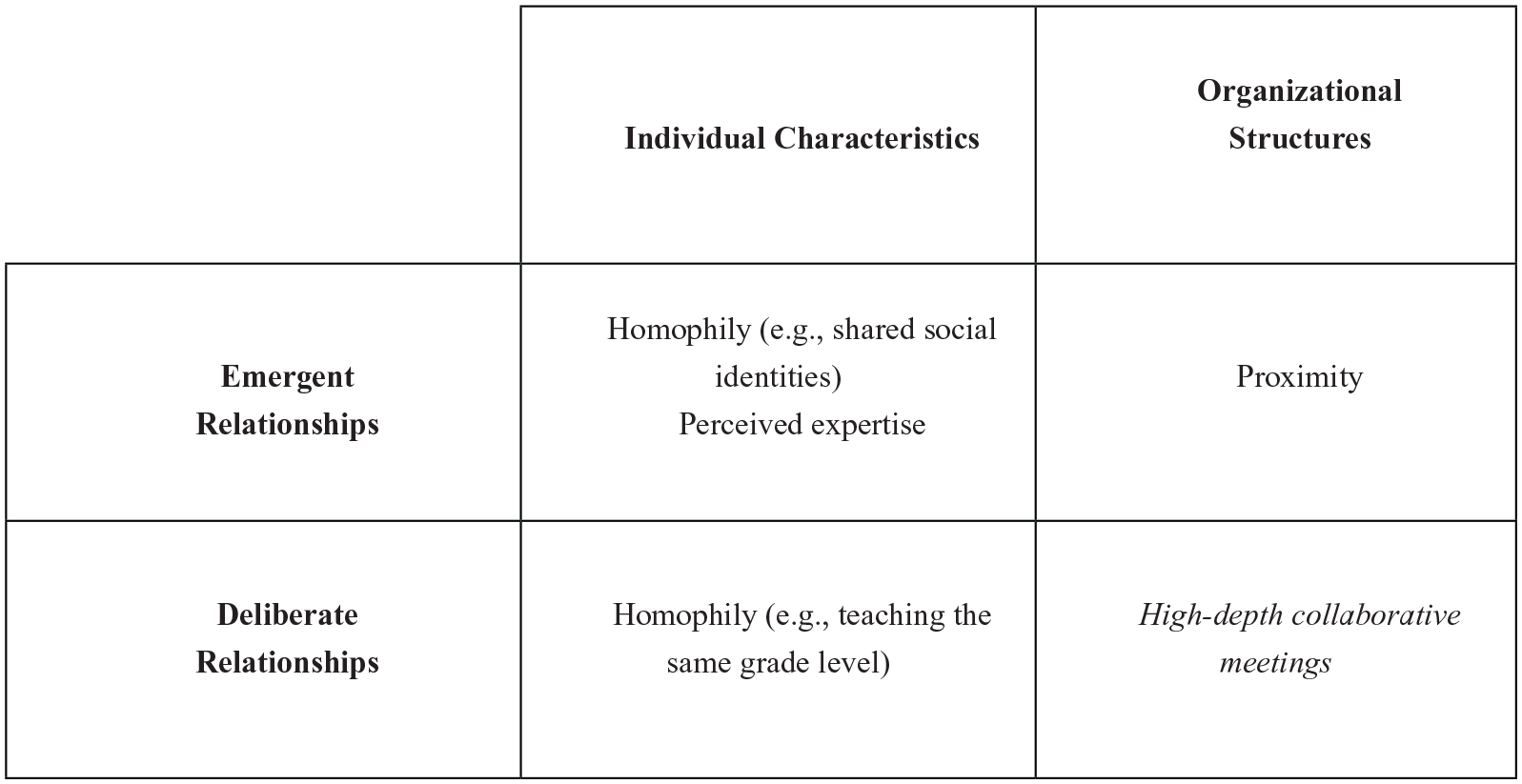
Conditions that support teachers’ social tie formation in schools. For example, school organizational structures can support social ties through emergent relationships (e.g., as a result of physical proximity) and deliberate relationships (e.g., as a result of high-depth collaborative meetings).
Our study thus refines Coburn et al.’s (2010) earlier case study reporting that teacher collaboration enhances social networks. We do so by identifying particular types of interactions that spark broader professional relationships. To explore the relationship between (1) teachers’ conversations in formal workgroup meetings and (2) their subsequent advice-seeking behavior, our conceptual framework coordinates these two literatures—connecting the GPS to the map—foregrounding how teachers’ social interactions in a formal meeting contribute to informal advice seeking. This allows us to relate the depth of teacher workgroup conversations to the quality of teachers’ advice-seeking social networks, with the assumption that stronger manifestations of either can support productive learning organizations.
To capture the turn-by-turn dynamics, we are particularly interested in the depth of learning opportunities in teachers’ collaborative conversations. Accordingly, we draw on research that delves into how teachers’ talk shapes professional learning opportunities—studies that go inside teacher communities to examine how knowledge is rendered, elaborated, and engaged during workgroup interactions (Little, 2003). As conversations unfold, participants draw on and reinstate important conceptual resources for their pedagogical reasoning on core instructional issues. For instance, as teachers deliberate about how long to spend on a unit on proportional reasoning, they might share activities, tell stories about previous students’ challenges in learning about this topic, or discuss current students’ understandings. All these consist of conceptual resources that can offer new insights to participants. As they provide language, stories, and examples to support ideas about what to teach and how to teach it, they negotiate shared understandings of teaching and learning through their interactions (Garner, 2018; Hall & Horn, 2012; Horn, 2010; Horn & Kane, 2015, 2019; Horn & Little, 2010; McLaughlin & Talbert, 2001; Little, 2003; Vedder-Weiss et al., 2018).
Identifying High-Depth Meetings
As we have mentioned, our analysis focuses on how collaborative meetings stand to support new forms of practice and understanding—what we call learning opportunities (Greeno & Gresalfi, 2008). Our emphasis on “opportunities” foregrounds the group processes over the particular impact on individuals. To operationalize learning opportunities, we note how meetings (a) provide teachers with conceptual resources to interpret teaching issues and (b) mobilize them for future work (Horn et al., 2015; Horn & Kane, 2015). Through this analysis of conversational content and processes, we identify what teaching ideas are communicated and their implications for teachers’ future action.
The notion of learning opportunities specifies the extent of professional knowledge sharing and reconstruction at an interactional level. Specifically, when teacher collaborative meetings exhibit what we consider high-depth interactions, they are rich with opportunities to reconsider extant understandings and imagine different alternatives for future action around important educational issues. For this reason, in an earlier analysis, we coded a sample of 77 meetings from 24 workgroups across 16 schools according to their density of learning opportunities across. We purposively sampled middle school mathematics teacher workgroups who “collaborate well,” but nonetheless found that only about one third of meetings sustained interactions that supported rich, dialogic learning opportunities (Horn et al., 2017). For example, in low-depth meetings, teachers’ talk was dominated by the monological broadcasting of ideas, such as “We should teach Lesson 4.1 and do the unit rate lesson we did last year,” mainly followed up by clarifying questions. In high-depth meetings, however, the same statement would be followed up with questions that demanded sustained attention and dialogue, such as “How did you introduce that lesson? Because it took my class a long time to get through.” Extrapolating from our purposive sampling procedure, we concluded that high-depth meetings remain relatively rare among teacher workgroups, even in districts committed to instructional change.
Social Network Organization and Professional Learning Opportunities
To connect learning opportunities in workgroups to social tie formation, we need to better understand how social networks influence teachers’ professional learning. Looking at prior work, we see that within social networks, teachers form informal subgroups (or cliques) based on their collegial ties. 1 These, in turn, influence teachers’ attitudes, behaviors, and engagement with instructional improvement efforts. This level of engagement influences how much teachers’ instructional practice changes (Penuel et al., 2006). Informal subgroups also shape individual teachers’ commitment to these efforts, with individuals’ sense of collective responsibility influenced by subgroup behaviors (Penuel et al., 2009). In this analysis, we examine how much teachers’ participation in different kinds of workgroups predicts their advice-seeking ties.
Put more formally, our research questions are
Because we hope to support the spread of teacher learning opportunities beyond formal workgroup collaboration, our research questions seek to infer cause. Of course, we recognize that any inference we make in this observational study may arise from alternative explanations associated with variables we omitted. For example, any relationship between coparticipation in meetings and advice seeking may stem from interests that teachers shared prior to the meetings. To alleviate some of these concerns, we condition our analysis on advice-seeking behavior prior to meeting attendance, which presumably would capture alternative explanations such as prior shared interests. We recognize that conditioning on prior relationships as well as other covariates does not account for all possible alternative explanations, so we quantify how much of our estimated effects must be due to bias to invalidate our inferences (Frank, 2000; Frank et al., 2013). With these precautions taken, we find that our primary inferences are at least moderately robust with regard to potential omitted variables. This helps inform the conclusions we make regarding our research questions.
Research Design and Method
Research Context
This study took place in the context of a larger project investigating instructional improvement in middle school mathematics in urban school districts. Starting in 2007, the Middle-School Mathematics and the Institutional Setting of Teaching (MIST) project investigated large-scale support of mathematics teachers’ development of ambitious and equitable instruction. Originally, the research team identified four urban school districts investing in viable strategies toward this goal. In Year 5 of MIST (2011–2012), we narrowed our focus from four school districts to two; we continued partnerships with Districts B and D because of their investments in high-quality mathematics curricula and teacher professional development. Undoubtedly, this made them unusual cases in the spectrum of U.S. urban school districts. Despite our “best case” selection (Yin, 2017), the districts did not uniformly exhibit shared visions for improvement—most notably, and to different degrees, there were variations in coherence and relational trust. Indeed, an ongoing challenge in our partnership work involved overcoming organizational disjunctures (Cobb et al., 2018).
In MIST, we followed each district’s instructional improvement efforts from strategies in the central office to implementation in schools and classrooms. Within each district, we selected a representative sample of 12 middle schools to document and understand change over time across a variety of school settings. At each participating school, we collected various qualitative and quantitative data, including interviews with math teachers, instructional coaches, and principals; observations of classroom instruction and teacher workgroup meetings; measures of pedagogical and instructional expertise; and social network surveys to capture math teachers’ advice-seeking behavior.
Like many districts seeking to make large-scale changes, both districts included teacher collaboration as a key strategy for instructional improvement. To study this, we began collecting additional data on teachers’ collaborative meetings in Year 5 of MIST. In both districts, teachers were expected to meet regularly; principals typically organized weekly meetings by grade level and content area (e.g., sixth-grade math teachers). From our representative sample of schools, we used an internal sampling technique (Bogdan & Biklen, 1992) to purposively sample “well-functioning” teacher workgroups. Specifically, we asked key informants in the districts to nominate workgroups who collaborated well; we then interviewed participants to refine our selection to eliminate groups nominated for other qualities, such as compliance with school leaders’ administrative requests. By oversampling for well-functioning workgroups in districts seeking to improve middle school mathematics instruction, we could examine the connections among teacher collaboration, teachers’ advice-seeking networks, and various measures of teachers’ expertise. Our sampling scheme allows us to observe the most likely link between formal meetings and informal networks.
To study shifts in teachers’ advice-seeking networks, our outcome network was measured in Year 6 of the study (2012–2013). In our analytical sample, we excluded repeated advice-seeking pairs from Year 5 (2011–2012), honing in on how coparticipation in formal meetings might affect the formation of new advice-seeking relationships. To further understand the effects of teacher collaboration through high-depth meetings and informal advice-seeking, we also investigate how teachers’ exposure to their colleagues’ expertise in Year 6 influenced their pedagogical expertise in Year 7.
Data Collection and Measures
To examine the effects of teachers’ workgroup conversations on their advice-seeking networks, we use data from (1) surveys identifying teachers’ advice-seeking networks and (2) video recordings of collaborative meetings from each focal workgroup. To understand the effects of collaboration on teacher learning, we use data from (3) measures of teachers’ expertise, including instructional quality assessment (IQA; Boston & Wolf, 2005), mathematical knowledge for teaching (MKT; Hill et al., 2004) and vision of students’ mathematical capabilities (VSMC; Jackson et al., 2017). We also control for additional variables, including (4) teachers’ background characteristics (e.g., gender, race, and years of experience); and (5) school organizational and contextual factors (e.g., grade level, workgroup meeting participation, school accountability pressure, number of math teachers).
Advice-Seeking Networks
To measure advice-seeking networks in participating schools, we administered an online survey to all mathematics teachers and administrators or instructional coaches who worked directly with mathematics teachers. The survey asked participants to list individuals whom they turned to for advice about teaching mathematics; participants could nominate up to 10 colleagues, though only 6% listed as many as 10. Following network analysis conventions, we refer to the teacher taking the survey as the ego, and the person to whom they turn for advice as the alter. This results in an advice-seeking tie between the ego and alter. Each ego can have ties with multiple alters (up to 10), and any alter may be nominated by multiple egos. The ties are directional, though they can be reciprocal when two colleagues nominate each other. To generate our data set, we assume that there is a possible tie between each ego and alter. For each possible pair, we coded the tie as present (1) if the ego nominated the alter, or absent (0) if they did not.
New advice-seeking ties
To examine the relationship between collaborative meetings and advice-seeking ties, we focus on new ties formed among our participants in Year 6. Starting with the advice-seeking ties in Year 6, we excluded the ties that were also present in Year 5. The resulting data set represents new advice-seeking ties in Year 6. Our final analytic sample includes 456 new advice-seeking ties for 116 math teachers and coaches across 24 schools (see Appendix A).
School Organizational Context
We looked at the formal school organizational context and how they related to teachers’ informal advice-seeking behavior. Recall that we selected a set of focal workgroups from our representative sample of schools and studied them more closely to understand teachers’ learning opportunities in collaborative meetings. We video-recorded between four and six meetings from each focal workgroup. Our sample of meetings from Year 6 of the study consists of 36 meetings from eight workgroups at six schools.
Learning opportunities in collaborative meetings
To characterize the depth of the meetings, we coded each one according to teachers’ learning opportunities (Horn et al., 2017). For the present analysis, we distinguish between meetings that are high-depth versus those that are low-depth. Participants in high-depth meetings developed pedagogical concepts in conversation as they discussed their students, instruction, and content. Often, they connected these concepts to future instruction; for example, teachers in some high-depth meetings examined student work to understand their thinking, then planned future instruction to address identified misunderstandings. On the other hand, participants in low-depth meetings discussed plans for future instruction without developing pedagogical concepts. For instance, teachers often discussed which topics they intended to cover in the coming week, but without discussing how to teach different topics or why their strategies would appropriate. We consider high-depth meetings to have greater potential to support teacher learning and instructional improvement, as their characteristic dialogical conversations offered teachers more insights to their colleagues’ expertise.
Coparticipation in collaborative meetings
To connect the social network data with the teacher collaboration data, we generated variables indicating the number of high-depth and low-depth meetings each pair of teachers coattended. Each teacher attended between two and six of the recorded collaborative meetings during Year 6. To determine this, we used a list of teachers participating in each meeting and cross-referenced it with the video recordings. To illustrate, consider Susan and Jordan, who co-attended three meetings: one high-depth and two low-depth. For the variable indicating coparticipation in high-depth meetings, we assign a value of 1 to the pair. For the variable indicating coparticipation in low-depth meetings, we assign a value of 2 to the pair. These two variables are our focal independent variables, which provide an estimate of the relative number of high-depth and low-depth meetings a pair of teachers participated in together.
Teachers’ Relative Expertise
To account for the likely flow of knowledge from greater to lesser expertise (Wilhelm et al., 2016), we generated variables of relative expertise between egos and alters. We collected data on three forms of pedagogical expertise: IQA, MKT, and VSMC. To assess differences between ego and alter, we subtracted ego expertise from alter expertise for each measure.
Instructional quality assessment
The first measure of expertise is the IQA (Boston & Wolf, 2005), which was used to code videotaped observations of teachers’ classrooms to understand the quality of their mathematics teaching. Our research team videotaped teacher participants during 2 consecutive days of instruction. The IQA evaluates critical elements of ambitious mathematics instruction, including the cognitive demand of the task, the degree to which teachers maintain cognitive demand during the lesson, and the quality of classroom discourse. Using a set of eight rubrics, we combined teachers’ scores into one overall IQA score for each lesson. For the present analysis, we selected the higher IQA score from the 2 days to represent teachers’ instructional expertise.
Mathematical knowledge for teaching
The second measure of expertise is MKT, which is assessed by the learning mathematics for teaching instrument (LMT; Hill et al., 2004). The LMT is a multiple-choice assessment aimed at measuring educators’ core content knowledge and pedagogical content knowledge. LMT items assess participants’ ability to select representations that highlight key features of mathematical concepts, interpret students’ solutions, and break down students’ misconceptions across two domains: number concepts and operations (NCOP) and patterns, functions and algebra (PFA). The LMT is a norm-referenced assessment; within each domain, raw scores are translated into scale scores that are expressed in terms of standard deviations from the mean. We used the average of participants’ NCOP and PFA scores to represent their overall mathematical knowledge.
Vision of students’ mathematical capabilities
The third measure of expertise is educators’ VSMC (Jackson et al., 2017), which characterizes how they describe students’ learning potential. The VSMC measure uses a semistructured interview protocol to assess the extent to which participants view all students—including specific groups of students, like English learners—as capable of participating in rigorous mathematical activity. Because teacher expectations are consequential for pedagogical decision making, this measure coded participants’ explanations of why students succeed or struggle in mathematics, along with their framing of appropriate instructional responses. Participants’ responses were coded into three categories: unproductive—describing student ability as a fixed characteristic; productive—focusing on the relationship between student performance and instructional activities, with student ability described as a malleable trait; or mixed—wavering between productive and unproductive descriptions. VSMC is especially salient in this analysis because teachers often convey their views of students’ mathematical capabilities in collaborative meetings (Horn, 2007); it is unnecessary to observe colleagues’ instructional practice to glean what they think students are capable of.
Ego-Level Controls
Female
This indicates whether the ego identified as female.
Years of mathematics teaching
This is a continuous variable of the number of years the ego has taught mathematics.
Pair-level Controls
Same gender
This indicates whether the pair of teachers identified with the same gender.
Same race
This indicates whether the pair identified with the same race.
Same grade level
This indicates whether the pair taught the same grade level.
School-Level Controls
District
To account for possible systematic differences between our partner districts (District B and District D), we included a variable to indicate the school’s district, using District B as the reference district.
Number of math teachers
This is a continuous variable that represents the number of mathematics teachers in the school.
Whether school met AYP status in 2012
This dummy variable represents whether the school made adequate yearly progress (AYP) at the end of Year 5, which indicates the amount of accountability pressure on the school in Year 6. Schools that did not reach their state-mandated accountability goal (i.e., did not meet AYP) likely felt more pressure to raise test scores than schools that did meet AYP.
Analytic Approach
Following other social network analyses of workplace learning (e.g., Frank, 2011; Frank et al., 2011; Matous & Todo, 2015), we examine the relationship between teachers’ formal and informal learning opportunities from two perspectives. First, we estimated a multilevel selection model to examine how the depth of formal workgroup meetings predicts the formation of new advice-seeking ties. That is, we examined the likelihood that teachers formed new advice-seeking ties with colleagues in their high-depth and low-depth workgroup meetings. Second, we present a multilevel influence model to examine how teachers’ advice-seeking behavior predicts changes in their expertise. Specifically, we explore the degree to which teachers’ expertise—their VSMC, MKT, and IQA—were influenced by the expertise of colleagues with whom they attended meetings and from whom they sought advice. The selection and influence models are the two most common models of network analysis (Frank et al., 2018). Here, we leverage our data to estimate both in our study, with an emphasis on the selection model as our primary finding. Taken together, these models offer a deeper understanding of the dynamic interplay between colleagues’ knowledge and relationships over time. All statistical analyses were performed using HLM 6 (see Appendices D and E for HLM code).
Selection Model
Our first analysis examines the ways that formal workgroup meetings affected the formation of informal advice-seeking relationships. We model the likelihood that teacher i sought advice from colleague i′ in school j as a function of whether they attended high-depth meetings and low-depth meetings together, as well as differences in their expertise (in terms of IQA, MIST, and VSMC). The model includes covariates for the pair of teachers, the teacher-seeking advice, and the school:
Level 1: Pair of teachers

Learning opportunities (formal workgroup meetings)

Relative expertise

Level 2: Ego (teacher i seeking advice)

Level 3: School
In this model, we are primarily interested in θ4 and θ5, which indicate the effects of meeting coparticipation on the formation of new collegial ties.
Influence Model
Our second analysis examines whether teachers’ expertise—as operationalized by VSMC, MKT, and IQA—are affected by exposure to colleagues’ expertise. As previously described, teachers’ VSMC indicates the extent to which participants view all students, including groups of historically marginalized students, as capable of participating in rigorous mathematical activity. Teachers’ MKT indicates their knowledge of mathematics, including common student strategies and misconceptions. Teachers’ IQA represents a composite score for their enactment of ambitious instruction. We hypothesized that teachers’ expectations about mathematics teaching and learning are social norms developed within the teacher community.
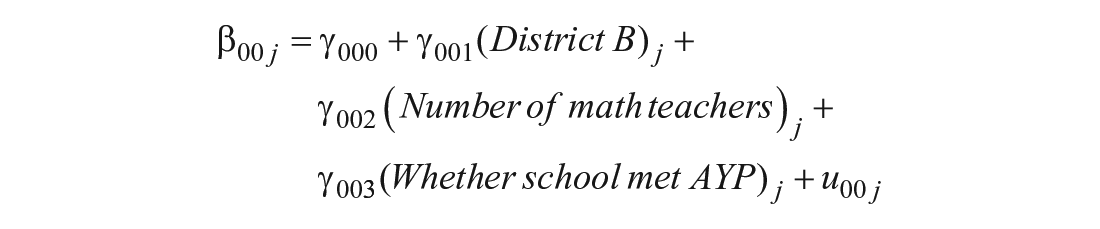
To understand the degree to which teachers’ expertise is affected by exposure to colleagues’ expertise, we developed separate influence models for each measure. We illustrate the influence models with the following model for VSMC:
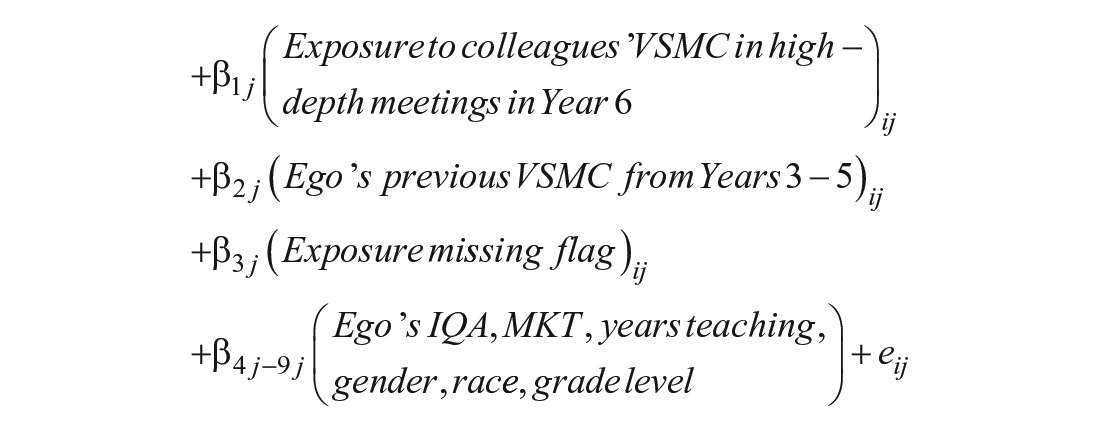

Here, the exposure to colleagues’ VSMC reflects the degree to which a teacher-seeking advice (i.e., an ego) was “exposed” to their colleagues’ VSMC during high-depth meetings. β1 reflects the effect of that exposure. The value of an individual teacher’s exposure is the sum of VSMC scores of colleagues with whom they attended high-depth meetings, weighted by the number of meetings they coattended. For example, consider Ashley, who attended three high-depth meetings with José and attended one high-depth meeting with Becky. José has a VSMC of 2, indicating a productive VSMC score; Becky has a VSMC of 1, indicating a mixed VSMC score. These scores combine to make Ashley’s exposure term: 2 × 3 + 1 × 1 = 7. Social network analysis uses a contagion metaphor, with Ashley being “exposed” to Jose’s productive VSMC during three meetings (2 × 3) while also being exposed to Becky’s mixed VSMC in one meeting (1 × 1). In this model, a large value for β1 would indicate that teachers are affected by their colleagues’ visions for students’ mathematical capabilities—that is, that such visions are “catching.” In this sense, our influence model is an extension of conventional measures of centrality, because the exposure term accounts for the attributes of network members instead of just the number or structure of ties (Frank et al., 2018; Friedkin, 1998).
To understand how much teachers’ formal and informal interactions shaped their expertise in Year 6, we controlled for their previous expertise from Year 5. However, due to fluctuations in teachers’ participation over the course of the study, we had many missing cases within the Year 5 expertise data (approximately 30%). To reduce the impact of missing data, we used participants’ most recent VSMC, MKT, or IQA score across the previous 3 years (Years 3–5); this is associated with the term β2.
The term β3 is associated with a control variable for participants whose exposure terms are missing—for instance, if they nominated individuals for whom VSMC, MKT, or IQA data are not available. The terms β4–9 are associated with six additional control variables, including the ego’s grade level, gender, race, years of mathematics teaching, and other measures of expertise (i.e., those not already controlled for by β2). The term β0j represents a random effect for schools, as used in multilevel modeling (Raudenbush & Bryk, 2002).
Network Dependency
When modeling advice-seeking behavior, we violate the assumption of independent observations, for example, Ashley may be nominated by both Becky and José because of something unique to Ashley. Therefore, it is standard procedure in network analyses to account for dependencies in the data. In this analysis, we follow the procedure used in other inquiries on data from the same project (Wilhelm et al., 2016). Our use of a reduced sample—using only new advice-seeking ties in Year 6—likely accounted for some of the structural dependencies in the network data. To address residual structural dependencies, we used geographically weighted degree statistics to control for alter’s in-degree and ego’s out-degree distribution (Snijder et al., 2006, pp. 112–113). Based on this model, GWDC represents degree counts with geometrically decreasing weights based on η:
Results
Recall that our research questions seek to identify (1) the effect of teachers’ coparticipation in high-depth meetings on the formation of new advice-seeking ties and (2) the effects of teachers’ collaboration on their expertise. The following describes the ways we modeled these phenomena, which affirmed that coparticipation had an effect on tie formation and provided some evidence of teacher collaboration supporting increases in VSMC, MKT, and IQA.
Selection Model
Our first analysis examined the effect of formal workgroup meetings on informal advice-seeking relationships (see Table 1). Attending high-depth workgroup meetings was strongly predictive of new tie formation. In other words, having rich collegial conversations in formal meetings increased the likelihood that teachers would seek out new advice from a coparticipant outside regularly scheduled meetings. This is true, even when controlling for teachers’ relative expertise.
Multilevel Selection Model for Formation of Advice-Seeking Ties Between Colleagues

Note. IQA = instructional quality assessment; MKT = mathematical knowledge for teaching; VSMC = vision of students’ mathematical capabilities; AYP = adequate yearly progress; GWDC = geometrically weighted degree count. The final analytic sample included 454 pairs among 116 teachers in 24 schools. The intraclass correlation in the unconditional model is
p < .10. *p < .05. **p < .01 ***p < .001.
In our baseline selection model (Model 1), we found strong homophily effects at the pair level: Teachers were more likely to make new advice-seeking ties with others who taught the same grade, are of the same race, or attended meetings together, regardless of the depth of the meeting. This is consistent with other research (Spillane et al., 2017; Wilhelm et al., 2016). At the ego level, female teachers (β = 1.078) were more likely than male teachers to form new advice-seeking ties. At the school level, we found no differences in advice-seeking behavior based on district, AYP status, or the number of math teachers at the school. The ICC in this model represents the proportion of variation in nominations received that is at the school level (9.3%); almost all the variation is within schools.
Our main focus, however, is whether coparticipation in high-depth and low-depth meetings affects the formation of new advice-seeking ties when controlling for teachers’ relative expertise (Model 2). Teachers are more likely to seek new advice from colleagues who coparticipated in the high-depth collaborative meetings (as opposed to low-depth meetings) controlling for teachers’ relative expertise. Since our outcome is binary (i.e., whether a pair formed a new advice-seeking tie or not), we can more readily interpret this effect by transforming the coefficient from Table 1 (β = 1.719) to an odds ratio: Consider two pairs of teachers who are similar in most respects, but differ in the number of high-depth meetings they attended together. For the pair attending one high-depth meeting, the odds that they form a new advice-seeking tie are 5.58 times larger than the odds of forming a new advice-seeking tie for the pair that attended no high-depth meetings together. Notably, the effect of attending high-depth meetings together is nearly as strong as the effect of teaching the same grade level (β = 1.755), one of the strongest and most consistent predictors of interactions among teachers (Frank et al., 2018). Additionally, the effect of attending high-depth meetings together is much stronger when controlling for teachers’ relative expertise.
In further analyses (Appendix C), we differentiated the estimated effect of participating in one high-depth meeting versus two high-depth meetings. We found a much stronger effect on teachers’ advice-seeking behavior for pairs who attended two high-depth meetings together (β = 2.213) as opposed to attending just one high-depth meeting together (β = 1.355). This suggests the potential for a cumulative effect of attending multiple high-depth meetings together.
In summary, teachers were more likely to seek advice from new colleagues when they attended high-depth meetings together, especially if they attended multiple high-depth meetings together. Teachers were also more likely to seek advice from colleagues who demonstrated a greater capacity for ambitious instruction as measured by IQA. Our findings suggest that the dialogical interactions that characterize high-depth meetings help colleagues see each other as resources for improving instruction, and they also highlight teachers with notable instructional expertise. In this way, participating in high-depth meetings may change teachers’ emergent behavior in finding new sources of teaching expertise and support from colleagues.
As we described in our literature review, homophily and proximity are known to contribute to tie formation. It is therefore notable that the high-depth meetings had a distinct effect on tie formation that cannot be explained solely by the homophily and proximity engendered by any meeting. That these were advice-seeking ties is also notable. Informal advice-seeking signals teachers’ willingness to disclose uncertainty and questions to their colleagues. In general, advice-seeking does not necessarily support teachers’ learning; indeed, advice-seeking can fall anywhere on Little’s (1990) continuum of collegial interactions. But because advice-seeking increased as a direct result of high-depth meetings, we conjecture that these new advice-seeking ties at least indicate a deprivatization of practice (a necessary condition for instructional change)—and at best indicate important resources for teacher learning.
Before proceeding, we recognize there could be other factors that attract teachers to high-depth meetings and to form new advice-seeking relationships. In light of the “best-case” selection of both the MIST districts and the teacher workgroups, there may be other organizational conditions that tend to co-occur with high-depth meetings and lead to stronger advice-seeking networks. For instance, the workgroup at Magnolia Middle School frequently engaged in rich discussions of students’ work as part of a data-use cycle developed by the instructional coach and assistant principal (for closer analysis, see Garner & Horn, 2018). The same factors that supported Magnolia’s consistently high-depth meetings—such as the coach’s pedagogical expertise, high-quality curricular resources, and a school-level focus on data use—may have also supported changes in the teachers’ advice seeking. Yet other workgroups in our sample had similar features, but did not engage in high-depth meetings or have significant changes in advice-seeking patterns (Garner, 2018). Though this does not preclude the possibility of other explanatory factors that are not captured in our data, qualitative analyses of workgroup meetings suggest that high-depth meetings have an important relationship with teachers’ advice-seeking networks.
Furthermore, using the techniques of Frank et al. (2013) to invalidate our inference, 53% of the estimated effect of attending high-depth meetings on advice-seeking behavior would have to be due to bias from omitted alternate explanations or other sources (calculations conducted at Konfound-it.com using an estimated effect of 1.719, standard error of 0.411, sample size of 456 and 12 covariates). In other words, to invalidate our inference, one would have to replace 53% of our sample (about 242 pairs of teachers) with cases for which there was no relationship between co-attending a high-depth meeting and new advice seeking. While not conclusive, this inference is more robust than two-thirds of the published observational studies reviewed by Frank et al. (2013).
Influence Model
Our second analysis examined the degree to which teachers’ expertise is influenced by conversations with colleagues during high-depth workgroup conversations; the results are presented in Tables 2, 3, and 4. Our findings indicate that engaging with colleagues’ VSMC and MKT has a borderline statistically significant effect on teachers’ VSMC and MKT, respectively (p < .10). Similarly, the influence of colleagues’ instructional quality (IQA) was borderline statistically significant (p = .108), though somewhat weaker than the influence of VSMC and MKT. This is consistent with other findings of small to moderate, but pervasive, effects of teachers’ influences on one another (Frank et al., 2018). The unconditional intraclass correlation [ICC] represents the correlation between teachers’ VSMC in Year 6 in the same school without control variables. That is, 17.5% of variation of teachers’ VSMC in Year 6 can be explained by school membership. Although the majority (82.5%) of variance is within schools, the school variance component is statistically significant. Therefore, we used a multilevel model to estimate the changes of teachers’ VSMC score within schools. Using similar logic and calculations, the ICC for MKT and IQA were 9.3% and 12.7%, respectively.
Multilevel Influence Model of High-Depth Meetings on Teachers’ Visions of Students’ Mathematical Capabilities (VSMC) in Year 6

Note. IQA = instructional quality assessment; MKT = mathematical knowledge for teaching; AYP = adequate yearly progress. The intraclass correlation in the unconditional model is
p < .10. *p < .05. **p < .01 ***p < .001.
Multilevel Influence Model of High-Depth Meetings on Teachers’ Mathematical Knowledge for Teaching (MKT) in Year 6
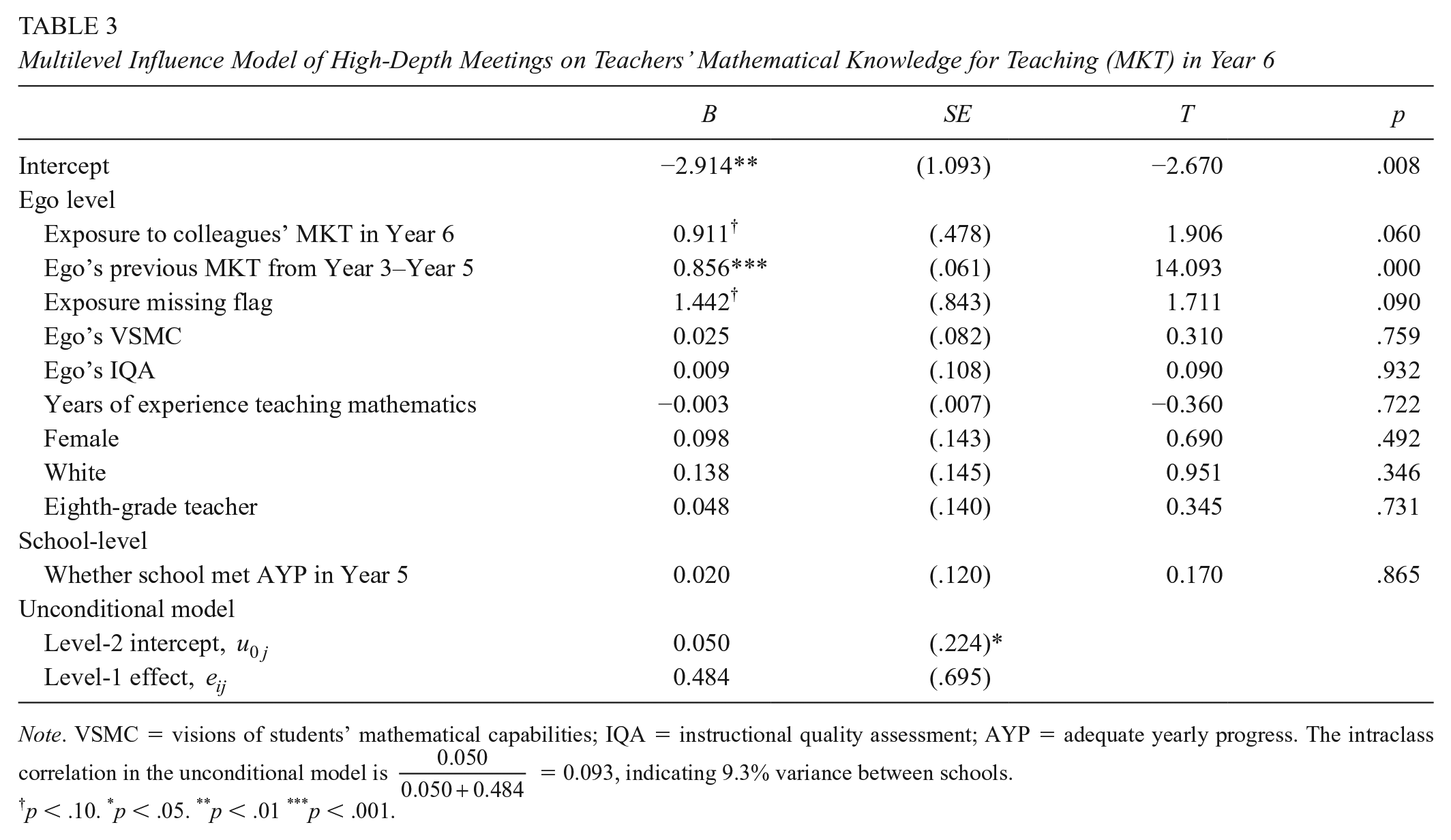
Note. VSMC = visions of students’ mathematical capabilities; IQA = instructional quality assessment; AYP = adequate yearly progress. The intraclass correlation in the unconditional model is
p < .10. *p < .05. **p < .01 ***p < .001.
Multilevel Influence Model of High-Depth Meetings on Teachers’ Instructional Quality (IQA) in Year 6

Note. VSMC = visions of students’ mathematical capabilities; IQA = instructional quality assessment; AYP = adequate yearly progress. The intraclass correlation in the unconditional model is
p < .10. *p < .05. **p < .01 ***p < .001.
These findings suggest one potential benefit of high-depth teacher workgroup meetings. Qualitative analyses of high-depth meetings (e.g., Garner & Horn, 2018) reveal that they involved conceptually rich discussions about students, mathematics, and teaching. Teachers in high-depth workgroups positioned students as mathematical sense makers and shared ideas about the sort of mathematics that students are capable of. As teachers identified, elaborated, and addressed instructional challenges, their understandings of students’ learning difficulties and students’ mathematical thinking—the heart of the VSMC and MKT measures—were conveyed to colleagues. This form of teacher knowledge, then, is shared in high-depth meetings, perhaps more so than the details of instruction (represented in the IQA measure).
For this reason, our influence model may not be sufficiently sensitive to capture shifts in instruction. As noted earlier, the IQA measure comes from eight rubrics that are combined into one score; this results in a rather blunt instrument for assessing instructional quality. High-depth meetings that directly support practices measured by individual IQA rubrics could result in increases on one or two IQA subscores; this is unlikely to lead to significant increases in teachers’ composite IQA scores.
Furthermore, our data set may lack sufficient longitudinal power to demonstrate significant changes on instructional quality. Munter and Correnti (2017) argue that teachers’ shifting beliefs about mathematics teaching are a leading indicator of future instructional improvement. This suggests that the results of our influence model—that is, that teachers developed more productive VSMCs and higher MKT through high-depth meetings—may indicate the potential for instructional improvement in future years, which is beyond the scope of our data set.
Discussion
If educational leaders want to transform schools, activities and organizational norms that support ongoing learning are crucial. While teacher collaboration holds great promise for this work, investing in it may be necessary (but not sufficient), since not all collaboration is equally impactful. Previous descriptions of teacher workgroups describe their scope of activities, purposes, and interpersonal dynamics, but our analysis focuses specifically on the opportunities for learning they afford participants and how that shapes collegial relationships. By examining the details of learning opportunities in formal teacher workgroups and relating them to new informal advice-seeking networks, this study shows how investing in high-depth meetings carries over to teachers’ sustained and ongoing learning through the formation of new advice-seeking ties. As we previewed in Figure 1, this finding contributes an organizational and deliberate condition for social tie formation, putting it within school leaders’ purview.
As prior research shows, the proximity offered by any meeting stands to create new ties. However, in high-depth meetings characterized by dialogic exchanges, teachers’ expert contributions may foster homophily that goes beyond shared identifications from social categories like race, gender, or grade level, toward a shared vision for instruction of “good math teaching.” This new instructional vision can inform teacher identity (Chen et al., 2018), becoming a source of homophily, and resulting in new ties.
Returning to our metaphor of the GPS and the map, when turn-by-turn interactions support learning opportunities, they may support affinities that had previously gone unnoticed or undeveloped. This, then, shifts the maps of broader informal advice-seeking networks within the school, as teachers seek out advice from newly identified sources of wisdom.
Of course, our study design has limitations, which future research can address. First, because we oversampled high-depth meetings, we avoided some of the micropolitical issues that can make teacher collaborations devolve (Achinstein, 2002; Hargreaves & Dawe, 1990). Second, we do not have any data on nonsampled groups, even though they also held meetings as a part of our partner districts’ efforts. Studies that address issues of micropolitics and draw on a more representative sample of teacher meetings stand to add much to our understanding of how high-depth meetings might contribute to social tie formation. Third, while our study has adequate power to detect effects in the selection model with degrees of freedom defined by the number of pairs of actors, it may be relatively underpowered for the influence model with degrees of freedom defined at the individual level (Stadtfeld et al., 2018). Thus, we take our findings regarding the influence of expertise as more exploratory, but nonetheless encouraging. Finally, because this was an observational study, we did not randomly assign pairs of teachers to high-depth meetings, a design which, while challenging, would have alleviated concerns about previously existing sources of homophily in our sample.
Despite these limitations, our study strongly suggests that investing in high-depth teacher meetings brings returns beyond the immediate investment. High-depth meetings support a broader re-mapping of advice-seeking networks, even after the meetings are over; this is worth further investigation. Practically, school leaders should cultivate high-depth interactions in meetings, in terms of who is present (such as a coach), what activities the group engages in (such as looking at video or student work), and how short-term pressures (such as test scores) are integrated with deeper goals of teacher learning. For this reason, we conclude that investments in teacher collaboration should be accompanied by supports to make the interactions meaningful for professional learning.
Of course, teachers have agency in the new ties they create, but school leaders can bring teachers together and support their work in ways that foster meaningful and ongoing learning. The significance of the depth of interactions in collaboration echoes other well-known phenomena in education. Just as pushing students’ desks together does not in itself guarantee high-depth groupwork, merely allocating time for teachers to collaborate does not in itself ensure high-depth meetings. Identifying ways to support that depth is worthwhile. Since the investment in high-depth collaboration endures even after the meetings are over, we suspect that fostering quality interactions pays long-term dividends in teachers’ professional learning.
Footnotes
Appendix A
Descriptive Statistics in the Selection Model a

| M (%) | SD | Minimum | Maximun | |
|---|---|---|---|---|
| Pair level | ||||
| Whether pair formed a new advice-seeking tie | 0.08 | 0.27 | 0 | 1 |
| Whether teachers are same gender | 0.54 | 0.50 | 0 | 1 |
| Whether teachers are same race | 0.68 | 0.47 | 0 | 1 |
| Whether teachers teach same grade level | 0.23 | 0.42 | 0 | 1 |
| Formal workgroup meetings | ||||
| Number of low-depth meetings co-attended | 0.12 | 0.48 | 0 | 3 |
| Number of high-depth meeting co-attended | 0.48 | 0.16 | 0 | 2 |
| Relative expertise | ||||
| (Alter IQA-Ego IQA) | 0.01 | 0.68 | −1.92 | 1.92 |
| (Alter MKT-Ego MKT) | 0.01 | 0.94 | −2.96 | 2.96 |
| (Alter VSMC-Ego VSMC) | −0.01 | 1.07 | −2.00 | 2.00 |
| Individual level | ||||
| Years of experience teaching mathematics | 9.68 | −8.164 | 1 | 41 |
| Female | 76.01 | |||
| White | 63.64 | |||
| Black | 19.19 | |||
| Other race | 17.17 | |||
| Grade 6 teacher | 21.21 | |||
| Grade 7 teacher | 19.19 | |||
| Grade 8 teacher | 44.44 | |||
| Multi-grade teacher | 15.15 | |||
| School level | ||||
| Number of math teachers at the school | 3.96 | 1.9 | 1 | 8 |
| Whether school met AYP in Year 5 | 57.7 | |||
| Whether school was in District B | 50.00 | |||
| Whether school was in District D | 50.00 | |||
Note. IQA = instructional quality assessment; MKT = mathematical knowledge for teaching; VSMC = vision of students’ mathematical capabilities; AYP = adequate yearly progress.
The final analytic sample included 454 pairs among 116 teachers in 24 schools.
Appendix B
Appendix C
Multilevel Selection Model for Formation of Advice-Seeking Ties Between Colleagues by Number of High-Depth Meetings
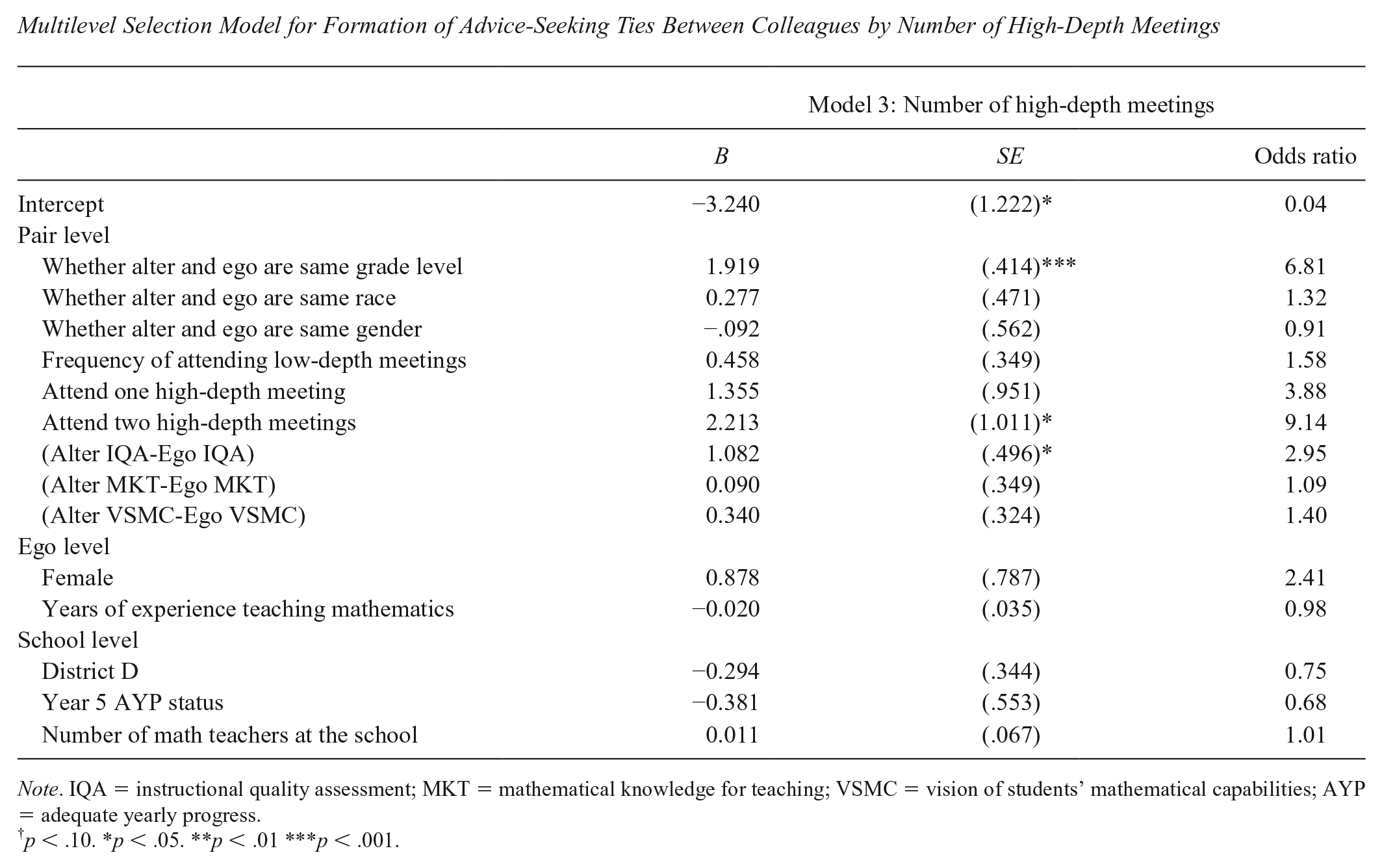
| Model 3: Number of high-depth meetings | |||
|---|---|---|---|
| B | SE | Odds ratio | |
| Intercept | −3.240 | (1.222)* | 0.04 |
| Pair level | |||
| Whether alter and ego are same grade level | 1.919 | (.414)*** | 6.81 |
| Whether alter and ego are same race | 0.277 | (.471) | 1.32 |
| Whether alter and ego are same gender | −.092 | (.562) | 0.91 |
| Frequency of attending low-depth meetings | 0.458 | (.349) | 1.58 |
| Attend one high-depth meeting | 1.355 | (.951) | 3.88 |
| Attend two high-depth meetings | 2.213 | (1.011)* | 9.14 |
| (Alter IQA-Ego IQA) | 1.082 | (.496)* | 2.95 |
| (Alter MKT-Ego MKT) | 0.090 | (.349) | 1.09 |
| (Alter VSMC-Ego VSMC) | 0.340 | (.324) | 1.40 |
| Ego level | |||
| Female | 0.878 | (.787) | 2.41 |
| Years of experience teaching mathematics | −0.020 | (.035) | 0.98 |
| School level | |||
| District D | −0.294 | (.344) | 0.75 |
| Year 5 AYP status | −0.381 | (.553) | 0.68 |
| Number of math teachers at the school | 0.011 | (.067) | 1.01 |
Note. IQA = instructional quality assessment; MKT = mathematical knowledge for teaching; VSMC = vision of students’ mathematical capabilities; AYP = adequate yearly progress.
p < .10. *p < .05. **p < .01 ***p < .001.
Appendix D
Appendix E
Acknowledgements
The authors want to thank Jim Spillane for his comments on an earlier version of this analysis. The work reported on has been supported by the National Science Foundation (NSF) under Grant No. DRL-1119122. The opinions expressed do not necessarily reflect the views of the NSF.

Notes
Authors
ILANA HORN is a professor of mathematics education at the Vanderbilt University Peabody College. Her research interests are secondary mathematics teachers’ learning, particularly in urban schools using qualitative and mixed method designs.
BRETTE GARNER is an assistant professor of mathematics education in the Moridge College of Education at the University of Denver. Her research interests are secondary mathematics teachers’ learning through design-based research interventions.
I-CHIEN CHEN is a research associate at the Michigan State University. She uses a sociological lens to understand how social contexts, interpersonal relationships and intervention programs enhance students’ and teachers’ learning in STEM (science, technology, engineering, and mathematics).
KENNETH A. FRANK is Michigan State University Foundation professor of sociometrics. His interests are in the study of schools as organizations, social structures of students and teachers and school decision making, and social capital using social network analysis, sensitivity analysis and causal inference, and multilevel models.