




Abstract
Mutual learning between teachers and their colleagues plays a vital role in their professional growth. However, previous studies show that collaborative teacher learning tends to be confined to small groups, and that it is difficult to make it explicit, showcase, or transfer teachers’ tacit knowledge. This study explores this problem by creating a digital system that allows teachers to create, display, and trade their knowledge products; 508 teachers from one K–12 school created and traded their knowledge products, while 1,148 teachers from other schools participated in the knowledge product transaction on the digital system. Using social network analysis, we discovered that teachers use this method to generate a lot of interaction and that teachers who taught similar subject areas communicated more with one another. There is a significant correlation among each teacher’s number of created knowledge products, knowledge products sold, and the number of knowledge products purchased from others. The study has potential to contribute to research on teacher learning, thinking, and actions.
Introduction
Teachers cooperate to support other teachers’ professional learning (McLaughlin & Talbert, 2006; Stoll & Louis, 2007). Teachers may have the opportunity to work together in their daily work, to exchange ideas and experiences (McLaughlin & Talbert, 2006). For example, when teachers collaborate in teaching the same class or prepare teaching materials together, relationships and collaborations arise between them. To increase experience sharing and exchange between teachers, many schools promote matching between experienced teachers and novice teachers to stimulate mutual learning (Butler et al., 2004). Research shows that when teachers work in collaboration, they can better understand how to design learning materials, share each other’s resources, and develop new teaching methods (Doppenberg et al., 2012; Little, 2002). Collaborative teacher learning is defined as a teacher’s communication and collaboration with his or her colleagues in a learning activity that leads to changes in the teacher’s cognition or behavior (Doppenberg et al., 2012; Meirink et al., 2007). However, previous studies have shown that, in daily work, teachers often communicate with limited numbers of colleagues, or hardly communicate (Doppenberg et al., 2012). Even when teachers are in the same school and teach the same subject area, they often have little time or opportunity to communicate with each other, let alone with teachers who teach different subject areas (Little, 2002).
Collaborative teacher learning is a rather complicated process in practice, which deserve further investigation (Borko, 2004; Romeu et al., 2016). Nonetheless, there is currently limited research available on how teachers learn in collaborative settings (Elliott et al., 2011). In addition, in a generally hierarchical school setting, school policies forcing communication among teachers could inhibit teachers’ motivation to learn from each other (Stoll & Louis, 2007). Meanwhile, the teachers’ tacit knowledge, such as their teaching experience, strengths, and skills, is difficult to display or share explicitly, further limiting teachers from learning from one another (Elliott et al., 2011; Torff, 1999).
In the meantime, knowledge management has been considered a necessary condition for the success of learning organizations (Sedighi & Zand, 2012). With asynchronous and synchronous knowledge exchange technology, a knowledge network enables its participants to communicate with more people anywhere and at any time, overcoming the limitations of traditional centralized, static knowledge-sharing systems. There was evidence that online and offline knowledge management and interaction eventually can be led to the formation of the teachers professional learning community (PLC), which is considered an essential environment for teacher professional development (Goldie, 2016).
Digital technologies afford a better opportunity to cocreate knowledge. Thus, building a digital platform for knowledge cocreation can help to promote communication, interaction, and learning between teachers, and helps teachers better articulate their tacit knowledge. In this study, we designed and developed a system platform for a school where its teachers could create, publish, and trade knowledge products. We encouraged the teachers from the school to turn their knowledge and experience into knowledge products, and we created an opportunity for the teachers to exchange their ideas by selling their knowledge products to teachers from other schools. With the support of digital technology, each teacher can easily participate in the process of creating, sharing, and exchanging knowledge products. At the same time, with the support of the digital system, the procedural data of teachers can be recorded. In collaborative teacher learning, a knowledge network is constructed by the creation and transaction of knowledge products, which facilitates the justified exchange of knowledge.
Social network analysis (SNA) is a method that can be used to effectively analyze and explain knowledge cocreation and collective learning in an organization, and to assess participants’ knowledge contribution degree (Tirado-Morueta et al., 2020). With SNA, it is easier to identify whether the participant is mostly a learner or a mentor in a knowledge network (Fishman et al., 2003). Previous research proposed a new method of investigating teachers’ knowledge which is using the SNA method to investigate the type of knowledge required for teaching and classifying knowledge issues (Koponen et al., 2019). Hence, this approach can help us to understand better the process of collaborative teacher learning and knowledge exchange. To understand the process, the relationships, and the effects of collaborative teacher learning when using the mode of creating knowledge products, we explored the following questions:
How does collaborative teacher learning occur in the knowledge management process? ● What is the difference in collaborative teacher learning status between teachers from the internal group and those from the wider school community in the network of knowledge exchange? ● What is the relationship between the quantity of knowledge products created and sold, and those purchased by individual teachers?
How active are the teachers in the knowledge product exchange process?
Literature Review and Related Work
Collaborative Teacher Learning
Teacher learning involves cognitive and emotional changes leading to changes in teaching practices (Fishman et al., 2003). Learning is often conceptualized as a change in cognition and reflection, regardless of the learner’s age (Vygotsky, 1978). Teacher learning not only comes from a large amount of postemployment training but also comes from the common practice between peers. Teachers’ learning needs more peer exchanges and discussions. The availability of colleagues’ expertise can help teachers adjust, expand, supplement, substitute, and improve their own knowledge or teaching practices (Borko, 2004). Collaborative teacher learning is based on the principles of situated learning theory and Jarvis’s adult learning theory (Lohman & Woolf, 2001). Situated learning theory states that knowledge includes community practice and the ability of individuals to participate in these practices (Lave & March, 1993).
Previous studies have shown that establishing small teams of teachers who interact with each other frequently helped to improve their teaching effectiveness (Fernandez et al., 2003; Puchner & Taylor, 2006). Studies also show that the way in which teachers interact with each other via the internet has a positive effect on teacher identity, self-identity, and organizational identity (Niesz, 2010). In addition, the development of early learning communities is beneficial for teachers with different cultural backgrounds (Clausen et al., 2009). However, knowledge of the process of collaborative learning by teachers is still limited (Tillema & Orland-Barak, 2006). Many experienced teachers continue to develop their knowledge and skills, but few have the opportunity to share them with their peers (Zhang et al., 2011). Teachers often find there are few effective ways to demonstrate their knowledge, and communicate with and learn from colleagues (Lai & Peng, 2020).
In most circumstances, teachers enhance learning by exchanging ideas, opinions, knowledge, and experience (Wu et al., 2018), and during this kind of collaboration, new ideas are generated or created by individuals or groups (Bartell, 2001; Peters & Armstrong, 1998). Teachers summarize their own experience by creating new knowledge. Teachers, like students, are knowledge creators, who learn through interpretations of their existing knowledge and events (Putnam & Borko, 1997). Therefore, this study proposes that learning among teachers calls for a knowledge network based on the system of teachers’ knowledge management and creation, through which tacit knowledge could be made explicit and visible, stimulating and encouraging more teacher participation in communication and learning.
Knowledge Network and Teacher Knowledge Contributions
Knowledge networks are often constructed by computers and networks as a self-organizing system that promotes the participation of individuals in the practice, sharing, and exchange of achievements (Etemad & Lee, 2003). Without limitations such as the time and place constraints of traditional face-to-face communication, knowledge networks encourage individuals to share their ideas both synchronously and asynchronously (Faraj et al., 2008; Jeon & Lee, 2020). Knowledge networks can be used not only to explore the connections between knowledge but also to explore the relationships between the people behind the knowledge (Hansen, 2002).
A knowledge network is a visible network structure consisting of nodes and links. Nodes represent each participant in the knowledge network, and the links represent the knowledge relations between the networks. Knowledge networks distribute the weight of knowledge connections by shifting the count of knowledge (Phelps et al., 2012). In previous studies, knowledge networks have been used to support knowledge sharing and interpersonal relationships among participants (Chatti et al., 2007). Participants have the right to choose their own needed knowledge, so the entire knowledge network does not need a unified centralized distribution of information. A knowledge network based on individual contributions and mutual exchange is different from a traditional knowledge system based on a static central database (Oostervink et al., 2016).
As mentioned above, knowledge networks have been used to understand the collaboration and communication in an organization. Previous research shows that in a company’s internal service platform, the contribution of employees to the community gradually shifted from being learners to guides (Kaisti & Pirinen, 2016).The application of a knowledge network to explaining the empirical study of organizational learning is still rare (Lou et al., 2013), and as yet, there has not been any research to study collaborative teacher learning from the perspective of knowledge networks. In addition, knowledge contribution refers to the knowledge-sharing behavior of participants that can be quantified in the process of knowledge exchange (Chang & Chuang, 2011; Lan et al., 2012). Quantity and quality are two important aspects of knowledge contribution (Durmuşoğlu, 2013). The research results signify that degree centrality has a significant relationship with the quality of shared knowledge (Sedighi & Hamedi, 2016). There are several dimensions that can be used to assess participants’ contribution to a knowledge network, by analyzing the knowledge network through SNA. Knowledge networks can be classified as internal or external (Birkinshaw & Hagström, 2000). These different types of knowledge network structures promote knowledge sharing and advocate overall integrated learning. This study not only explores collaborative teacher learning within the organization but also considers the impacts of external teachers’ participation on internal teachers’ knowledge sharing, knowledge exchange, and knowledge contribution within the whole knowledge network.
The Design of the Experiment
In this study, to deepen the communication among teachers, we set up an organizational learning platform for a middle school. Teachers could make tacit knowledge explicit by means of knowledge product creation, promote organizational learning among their companions, and expand learning groups. During the experiment, the teachers summarized and visualized their tacit knowledge into knowledge products. The number of knowledge products each teacher published determined the amount of knowledge contribution they made to collaborative teacher learning. The knowledge products purchased by others were recognized in terms of product quality through multiple evaluation, exchange, and transaction methods, which determined the quality of the teachers’ knowledge contributions. Effective communication and knowledge flow are essential for achieving collaborative teacher learning, and are also important conditions to form a learning organization (Booth, 2012; Guskey, 2002; Liebowitz et al., 2007). After completing the experiment, we used the collected social network data for analyzing the knowledge network, knowledge contributions, and core members’ characteristics and explored the whole process of collaborative teacher learning.
Participants
The participants were divided into two main groups: an internal group (of 508 teachers) and an external group (of 1,148 teachers). The teachers of the internal group included all the teaching faculty from one K–12 school in Beijing. This selected school was established in 1952 as a public school and is famous for its high-quality education provided by its outstanding teachers. Among the 508 teachers, 40 of them had doctorate degrees (7.87%), 272 had master’s degrees (53.54%), and 196 had undergraduate degrees (38.58%). The teaching faculty had an average of 12.4 years of teaching experience. There are more than 4,000 students and 272 student-led clubs at the school. These 508 teachers created their knowledge products and published them on the virtual platform created for them. The external group included 1,148 teachers from schools around the country, who volunteered to participate in this collaborative teacher learning program.
Experimental Procedure
The entire experimental process is shown in Figure 1. First, teachers from the internal group created knowledge products and released them on the virtual system platform. They had 1 month to design their knowledge products and post them to the platform. After that, a 3-day face-to-face trading event was organized, where the teachers of the internal group could meet, share, exchange, and trade their knowledge products with their fellow teachers in both groups, including the 1,148 teachers from the external group. The teachers presented their products using posters and had conversations with those who were interested in their products. If a teacher was interested, he or she could purchase the product (knowledge unit) immediately using the virtual platform. All transactions were recorded in the system, allowing for SNA of the exchanges. Interviews were conducted with 20 teachers regarding their experiences of the event. In addition, we conducted semi-structured individual interviews with 20 teachers regarding their experiences of the event. The interviewees were selected from 10 teachers with the highest transaction value, five teachers with an average transaction value, and five teachers with a less transaction value for the interview. The interview included questions on five themes: the learning significance of creating knowledge products, the experience of sharing products, the gains of communicating products, the evaluation and learning gains of peer products, and the value of product transactions for learning.

The experimental process.
Data Analysis
This study used SNA to examine the transactions, communications, potential networking, and collaborative learning processes during the 3-day event. This study used open-source software Gephi, which is particularly suited for networks with node properties (Cleveland & McGill, 1984; Heymann & Le Grand, 2013; Reychav et al., 2018). The Gephi focused on the visualization of the network using node-link diagrams, real-time interactions with data, and the building of a visual language (Brandes, 2001). It can make use of colors and sizes to create informative visuals, equivalent to geographical maps (Boyack et al., 2005).
To analyze the potential networking and collaborative learning processes, we collected the data of 769 knowledge products created and distributed by the 508 teachers. We coded each teacher, recorded transaction buyers and sellers, and organized the data into a knowledge exchange matrix. Apart from this, according to the data statistics, the knowledge product’s average price was 3.5 dollars, and a total of 8,319 transaction records. Besides, the social sciences statistical software (SPSS 24.0) was used to analyze the relationship between the number of knowledge products released by a teacher and the number of purchased products using the Pearson correlation (Pearson, 1920).
There are five predefined topics for teachers to create the product: teaching resources, teaching content, teaching skills, teaching management, communication skills, and classroom organization. Teaching resources include teaching software, teaching tools, courseware resources, film resources, and so on. Teaching skills mainly have teacher knowledge explanation skills, teacher experiment operation skills, and teacher–student interactive dialogue skills in the classroom. Teaching management includes organizing group activities, organizing students’ independent learning activities, organizing student demonstrations, organizing student evaluation activities, and so on. Communication skills mainly include the strategies and methods of daily communication between teachers and students. Classroom management includes classroom space layout, classroom discipline management, classroom time management, and other aspects.
Analyses and Result
Analysis of Core Teachers and Cohesive Subgroups
During the research, we analyzed the questions “How active are the teachers in the knowledge product exchange process?” All the transactions between the teachers were recorded and made into matrix data files, which were then converted into social network diagrams in Gephi. Figure 2 presents the transaction activities between the teachers.
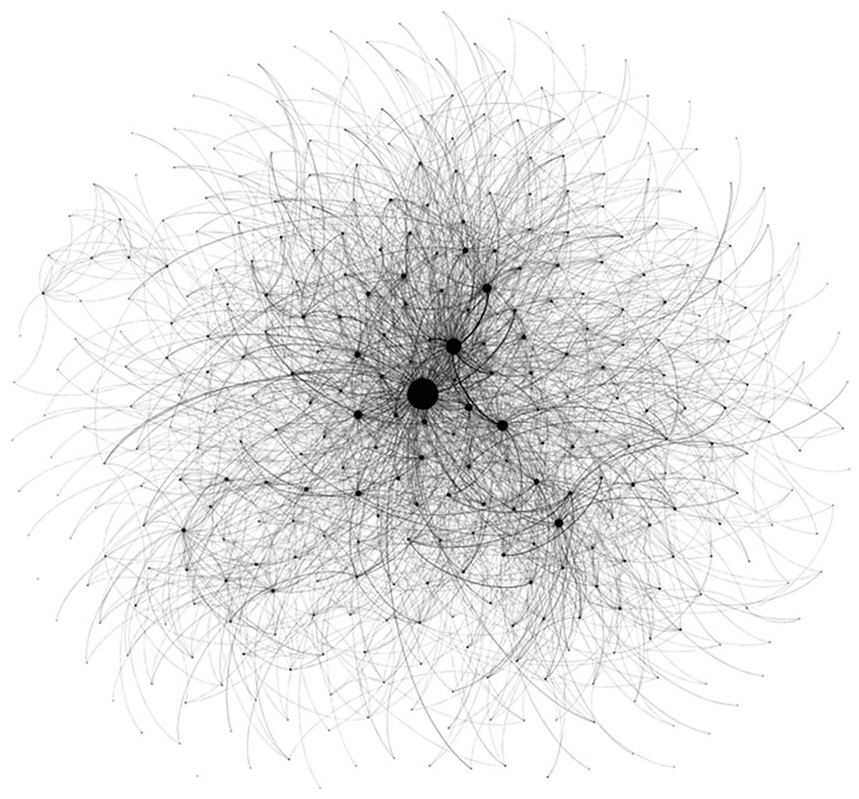
Internal teacher knowledge network map.
We extracted the transaction records of 508 teachers from all exchanges and transaction records first, and then analyzed the core nodes with the highest level of association, which represented the most important knowledge sources and partners of the whole collaborative teacher learning network. To some extent, they increase the knowledge transfer across the entire network. In a previous study, Wasserman and Faust (1994) proposed several ways to measure the relevance of employees in social networks and the assessment dimensions of central staff. Using a similar approach, we listed 10 central teachers in the knowledge network, which can be considered the main source of learning in the school’s internal knowledge network. Degree centrality is defined as the number of links on a node, which determines the relative importance of the vertices in the graph (Palmatier et al., 2006). The out-degree declared in rows is the number of links in the knowledge network initiated by a specific person. The in-degree value is how many times a person has purchased knowledge products initiated by others. To make the visualization more intuitive, we assigned the node size according to the degree value. The value of the node size was from 1 to 50, as Figure 2 shows.
As shown in Table 1, among the 10 core teachers of the knowledge network, one has a doctor’s degree (10%), two have masters’ (20%), and seven have bachelor’s degrees (70%). Those with undergraduate degrees were more prominent among the 10 core teachers. The average working age of the 10 core teachers (18 years) exceeded that of the overall sample (12.4 years).
The Top 10 Core Teachers.

Cohesive subgroups in the network are part of the overall promotion of learning among employees. Research shows that employees in the same subgroup share common concerns. To find sticky subgroups, we used the subnetwork density to identify and color-mark all the subgroups in the entire network. As a result, as Figure 3 shows, four highly aggregated cohesive subgroups were found from teachers teaching different subjects: languages (green), mathematics (black), biology (red), and politics (blue). This shows that the same disciplinary backgrounds increase teachers’ mutual learning.

Cohesive subgroups of the internal teacher knowledge network map.
It is noteworthy that Teacher 152 (the biggest pink point in Figure 3), as the principal of the National Day School, and also as the language teacher, was the core of the most important nodes of the internal teacher socialization network. It can be seen that principals have extensive exchanges with faculty members in collaborative teacher learning activities. The high rate of interactions between principals and other members in the internal knowledge network is obvious.
Analysis of the Whole Knowledge Network
During the research, the question “What is the difference in collaborative teacher learning status between teachers from the internal group and those from the wider school community in the network of knowledge exchange?” was analyzed. A total of 1,148 teachers from other schools participated in this collaborative teacher learning program, and were involved in a total of 8,319 purchasing transactions. According to the statistical matrix data, a visualized network diagram was generated by SNA and arranged by the algorithm of Fruchterman Reingold (Heckman, 1977). Similarly, the node size was weighted in accordance with the degree value and assigned a number from 1 to 50, as Figure 4 shows. A comparison of the relevant parameters based on SNA was made between the two groups, as shown in Table 2. The graph density represents the network’s relationship density, and is a parameter with a value between 0 and 1. If everyone learns from it, the value of the network is 1; if there is no relationship between network members, the value of the network is 0. The graph density of the internal teacher knowledge network was 0.017. The graph density of the whole knowledge network (including external teachers) was 0.003. The average degree of internal teacher knowledge network was higher than the whole teacher knowledge network, which included the external teachers. The whole teacher knowledge network was less dense, but more diverse. There was no significant center in the whole network as there was in the internal network, and the core nodes were more fragmented.

The whole knowledge network map.
Comparison of Knowledge Network.

Analysis of Correlations
During the research, the question “What is the relationship between the quantity of knowledge products created and sold, and those purchased by individual teachers?” was analyzed. This was an effective way to distinguish positive and negative correlations using Pearson’s correlation (Siemens, 2014).
We counted the sales of 508 teachers, each teacher’s number of created knowledge products, knowledge products sold, and the number of knowledge products purchased from others. As shown in Table 3, the number of created knowledge products and the number of knowledge products sold (r = .461, p < .01) showed a significant correlation. The number of created knowledge products and the number of knowledge products purchased (r = .262, p < .01) also showed a significant correlation. The number of knowledge products sold and the number of knowledge products purchased (r = .670, p < .01) showed a significant correlation.
The Correlation Matrix of Knowledge Products.

p < .05.
Discussion and Conclusion
This study explored teacher exchanges by means of knowledge product creation and transactions, and used SNA to explore the process of collaborative teacher learning and the organizational characteristics demonstrated in the process.
In this collaborative teacher learning program, 508 inside teachers created and released 768 knowledge products, and 1,148 outside teachers participated in the project, with a total of 8,319 exchanges and transactions. The entire social network had a density of 0.003, and the average degree reached 5.75. We found that creating knowledge products stimulates and promotes the transformation of teachers’ tacit knowledge into explicit knowledge, and collaborative teacher learning among larger groups is promoted by product exchanges and transactions (Leonard & Sensiper, 2011; Reber, 1989).
During the interview, teachers said that through creating knowledge products, they were more motivated and dedicated to discovering, reflecting on, refining, and organizing their tacit knowledge of the teaching process and transforming it into regular and systematic knowledge. During a 1-month preparation time, the creation of knowledge products was itself a sort of self-teaching experience. Teachers increase communication with each other through equal trade of knowledge products. Teachers do not buy other teachers’ products easily, but only when they fully understand. At the same time, many teachers expressed the importance of clarity for the product introduction. When standing in front of their product posters, teachers needed to explain their product in a concise and attractive way, to draw other’s attention in a limited amount of time. The teachers said that our fellow customers were very cautious, they would not make a decision until they had repeatedly communicated with me about the products, which is a good thing since we both benefited a lot from the in-depth discussion and idea exchange.
During the interview, a teacher pointed out, “Generally, careful consideration was given before purchasing other teachers’ knowledge products. At the same time, after paying for the purchase, they will also seriously study the content of the product and apply it to future teaching.” In addition, many teachers emphasized the sense of accomplishment and affirmation they gained when their products were purchased by fellows. Using empirical methods, this study explored collaborative teacher learning through knowledge product creation in a group of teachers for the first time (Putnam & Borko, 2000; Siemens, 2014).
We further discovered the differences between teacher products with different purchase times. For example, the product “Classroom Partition Space Design” was purchased by 76 teachers. This knowledge product presents the placement and combination of classroom desks and chairs in 10 different types of classroom activities. The teachers are very careful to accumulate a large number of classroom layout photos. The product “Students’ self-learning strategy,” the purchase of this product has reached 49 teachers’ purchases, which is a relatively large number of purchases. The main content of the product contains 18 strategies for students to learn independently, and five notes are added behind each strategy. This is the result of the teacher’s 5 years of education and teaching experience. The product “Interest is the biggest internal motivation” was only purchased by one teacher. This knowledge product presents the teacher’s experience and discoveries in the way of story description. However, due to its simplicity and lack of pertinence, only another teacher bought the product.
During the interview, teachers thought that they have grown up in four aspects. First, teachers sum up past experience and published knowledge products. Second, the teachers explain their knowledge products on the spot. Explaining their own products and trying to persuade other teachers to buy them will help teachers’ professional growth. Third, the reasons from other teachers to buy or not to buy help teachers to think further. Fourth, teachers buy other teachers’ products, communicate, and discuss with other teachers.
SNA showed that in the knowledge network, the core teachers did not necessarily have higher education degrees; on the contrary, those with lower degrees had a better performance. The core teachers had a longer average time of teaching experience. Core teachers are more willing to share and interact with their colleagues. By analyzing the products released by the core teachers, we found that these teachers not only released knowledge products closely related to their own subject but also released knowledge products in topics such as classroom management experience, teaching methods and tactics, and teacher–student communication skills. By exchanging and trading knowledge products, the exchange of teacher knowledge can be generated to a greater extent, and the role of core teachers can be maximized in terms of communication and sharing. This finding is consistent with several studies in different fields (Birkinshaw & Hagström, 2000; Sedighi & Hamedi, 2016).
Utilizing cohesive subgroup analysis, we found that teachers with the same subject background are more collaborative in their learning, especially teachers of mathematics, language, biology, and politics. This conclusion is the same as in previous studies; collaborative teacher learning often takes place among well-connected teachers (Little, 2002). At the same time, it was obvious that the principal was the core of interactive relationships of the internal collaborative teacher learning network, which indicated that the principal had a close relationship with teachers in professional exchanges. However, the density of the entire knowledge network was reduced with external teachers’ participation in the collaborative learning, demonstrating more diversified characteristics of the core nodes. At the same time, the entire knowledge network was no longer organized around any specific individual. Because the external and internal teachers had not known each other before they met at the fair, their transactions were based on a weak instead of strong relationship between the participants (Palmatier et al., 2006), which created more diverse focuses, and increased the possibility of exchanges and transactions for every product. In this case, even some minority knowledge products which could easily have been ignored received extensive attention.
Limitations and Suggestions for Further Research
The study explores collaborative teacher learning from the perspective of knowledge product creation and studies the characteristics of collaborative teacher learning in an organization through the SNA approach. However, some limitations need to be taken into account. First, this study is based on the National Day School, which is a quite outstanding school, where the teachers are generally highly professional and motivated. The overall motivation and proficiency status of teachers in this school does not necessarily represent the status of those in other schools, and this factor needs further attention in subsequent studies (Heckman, 1977). Second, the event cycle for teachers to prepare, create, and publish their own knowledge products was 1 month, which is a limited period of time, and the promising results do not necessarily guarantee a long-term effect (Berk, 1983). It is hard to tell whether the knowledge network will inspire teachers to create more knowledge products and exchange these within a wider scope in the long run. Finally, in this study, teachers need to price their knowledge products and pay to buy knowledge products. This way of creating, sharing, and trading knowledge products is a novel experience for teachers. From the teachers’ point of view, the price of knowledge products was not high, which thus does not affect their purchase intention. Moreover, some teachers may have not fully understood the whole process, nor adapted to this decentralized way of interaction, which is worth further discussion in the following study.
The results of this study provide several valuable references for researchers, system developers, and educators. First of all, this study indicates that providing opportunities for teachers to transform their roles by transforming their teaching experience into knowledge products can stimulate teachers’ initiative in collaborative learning. SNA provides us with a new perspective and tool to analyze complex collaborative teacher learning and observe organizational relationships within a school. In addition, how to adjust the organizational strategy and intervene in the process of collaborative teacher learning based on the analysis results deserves further exploration by researchers.
For system developers, the teacher transaction and learning platform developed in this study could help every teacher to create, manage, publish, and share their knowledge products. The platform has a large enough capacity to involve more teachers in the online exchange and transactions, providing the infrastructure for subsequent collaborative teacher learning platform developments and research. Subsequent studies may further explore the recommendation function for homogeneous content based on the same subject, or that of interdisciplinary heterogeneous content, and study the connection between different push strategies and collaborative teacher learning.
Finally, for educators, this approach of collaborative teacher learning in the form of knowledge product creation distinguishes itself from the extensive top-down training model (Freeman, 1989). Schools can turn this approach into a new method of teacher training, motivating teachers to participate more actively (Kunnari & Ilomäki, 2016; Sluijsmans et al., 2004). At the same time, this method also has a reference value for the improvement of teacher evaluation (Gibbs, 1995; McWilliam, 2008). Analyzing a teacher’s performance respectively in strong relationship and weak relationship social network could help to provide a more diverse basis for teacher evaluation, and addresses the limitations of single and standardized teacher evaluations (Conley & Glasman, 2008; Darling-Hammond et al., 1983). Provided with opportunities for display and interaction, as in this study, teacher autonomy will be activated and new communications based on collaborative teacher learning will develop.
Footnotes
Declaration of Conflicting Interests
The author(s) declared no potential conflicts of interest with respect to the research, authorship, and/or publication of this article.
Funding
The author(s) received no financial support for the research and/or authorship of this article.
Animal and Human Studies
None. This study only uses the data logs on the platform, and we do not collect additional personal information. The data of this research come from a teacher training activity, and all the teachers have agreed to collect the data. In addition, the collected information has been processed in an anonymous coding manner to replace the real name.
