




Abstract
Negativity bias is a cognitive bias that results in negative events being perceptually more salient than positive ones. For hearing care, this means that hearing aid benefits can potentially be overshadowed by adverse experiences. Research has shown that sustaining focus on positive experiences has the potential to mitigate negativity bias. The purpose of the current study was to investigate whether a positive focus (PF) intervention can improve speech-in-noise abilities for experienced hearing aid users. Thirty participants were randomly allocated to a control or PF group (N = 2 × 15). Prior to hearing aid fitting, all participants filled out the short form of the Speech, Spatial and Qualities of Hearing scale (SSQ12) based on their own hearing aids. At the first visit, they were fitted with study hearing aids, and speech-in-noise testing was performed. Both groups then wore the study hearing aids for two weeks and sent daily text messages reporting hours of hearing aid use to an experimenter. In addition, the PF group was instructed to focus on positive listening experiences and to also report them in the daily text messages. After the 2-week trial, all participants filled out the SSQ12 questionnaire based on the study hearing aids and completed the speech-in-noise testing again. Speech-in-noise performance and SSQ12 Qualities score were improved for the PF group but not for the control group. This finding indicates that the PF intervention can improve subjective and objective hearing aid benefits.
Introduction
Hearing aid outcomes can be affected by a variety of factors (Bannon et al., 2023; Knudsen et al., 2010). Factors such as hearing aid experience, hearing aid expectations, self-reported hearing difficulty, speech-in-noise abilities, and duration of hearing aid use can influence hearing aid benefit and satisfaction (Convery et al., 2019; Cox et al., 2007; Davidson et al., 2021; Ferguson et al., 2016; Saunders & Jutai, 2004). In addition, evidence suggests that factors such as the process of intervention, counseling, and positive attitudes toward hearing aids can play a significant role for hearing aid outcomes (Ferguson et al., 2016; Kemker & Holmes, 2004). For example, Abrams et al. (1992) demonstrated that counseling-based aural rehabilitation together with hearing aid use resulted in a greater reduction of self-perceived hearing handicap than did hearing aid use alone.
There is now a growing body of evidence reporting narrative effects on both subjective and objective hearing aid outcomes. According to Bruner (1991), a narrative refers to the constructed “story” shaped by an individual who is either participating in or observing an interaction. This narrative serves as a means to explain and justify the specific sequence of actions that occurred during that interaction. When a hearing care professional interacts with a client, they have the ability to create a narrative that the client is meant to understand and interpret. In an early study, McClymont et al. (1991) investigated the likelihood the patients reported “false-positive” preferences between two identical hearing aids. Having been led to believe that the identical hearing aids were different, 64% of the study participants reported a difference between the devices. In a more recent study comparing two fitting processes / narrative conditions where participants were given two different hearing aid processes, one “interactive” and the other “diagnostic,” Naylor et al. (2015) found that participants preferred one or the other fitting and related their preference to sound quality despite there being no acoustical differences between the two fittings. Similarly, a line of studies introducing positive framing at the fitting visit / trial onset showed that the positive narratives can lead to better hearing aid outcomes (Bentler et al., 2003; Dawes et al., 2013; Dawes et al., 2011; Rakita et al., 2022). For example, in a study utilizing both subjective and objective outcome measures, Bentler et al. (2003) showed that individuals reported more benefit from hearing aids described as consisting of “digital” technology compared to acoustically identical “analog” technology. In later studies, Dawes and colleagues (2013; 2011) showed an effect in favor of a “new” hearing aid as compared with a “conventional” one on speech-in-noise performance. Along the same lines, Rakita et al. (2022) observed that communication of a positive narrative about hearing aids prior to hearing aid fitting led to improved speech-in-noise performance in comparison to a negative or neutral narrative. Unknown to the participants of Bentler et al., Dawes et al., and Rakita et al., the hearing aid conditions under comparison were acoustically equivalent. Taken together, these studies therefore illustrate the importance of controlling for narrative effects when evaluating hearing aid performance. Naylor et al. (2015) and Bentler et al. (2003) also alluded to potential clinical implications of such narrative effects, whereby suitable narratives could be used to maximize treatment benefit.
Recently, with the aim of improving hearing aid satisfaction and benefit, Lelic et al. (2023) proposed that, rather than the hearing care professional taking care of suitable narratives at the initial fitting / trial onset, hearing aid users could be asked to focus and reflect on positive listening experiences for a brief period following hearing aid fitting. The positive focus (PF) intervention has a potential to overcome “negativity bias,” that is, the phenomenon that negative events can be subjectively more prominent than positive events (Rozin & Royzman, 2001). Indeed, Lelic et al. (2023) showed that, by focusing on positive listening experiences and reporting them via an app for 2–3 weeks following hearing aid fitting, subjective hearing aid outcomes—as measured using the International Outcome Inventory for Hearing Aids (IOI-HA), the Hearing-Related Lifestyle Questionnaire (HEARLI-Q), ecological momentary assessment (EMA), and the Client-Oriented Scale of Improvement (COSI)—were improved in experienced hearing aid users. Research into positive psychology has shown that internalizing beneficial experiences (e.g., repeatedly sustaining a focus on emotionally positive experiences) improves self-reported cognitive and emotional capacities as well as happiness (Hanson et al., 2021). Lambert et al. (2012) observed that sharing positive experiences had a greater impact on positive emotion benefits such as happiness and life satisfaction compared to merely writing these experiences down in a diary. As such, in addition to focusing on positive listening experiences, sharing them likely played a role for the improvement of hearing aid outcomes in Lelic et al. (2023).
While Lelic et al. (2023) showed positive effects of the PF intervention on subjective hearing aid outcomes, it is not known if the PF intervention affects objective hearing aid outcomes. Previous studies that showed narrative effects on hearing aid outcomes indicate that this may be the case (Dawes et al., 2013; Dawes et al., 2011; Rakita et al., 2022). Although, one of the key differences between the PF and other narrative interventions lies in the origin (e.g., reflecting on own experiences vs. narratives told by others), both types of intervention induce a psychological effect related to hearing aid treatment.
Here, we hypothesized that this psychological effect is not limited to subjective experiences but contributes to overall hearing aid outcomes. Therefore, the primary purpose of the current study was to investigate whether the PF intervention improves speech intelligibility in noise (i.e., an objective hearing aid outcome). A secondary aim was to confirm that the PF intervention improves subjective hearing aid outcome as measured using the Speech Spatial Qualities scale (SSQ12).
Methods
Ethical clearance for conducting the study was obtained from the Research Ethics Committee of the Capital Region of Denmark (case no. H-18056647).
Study Design
A randomized, single-blind, parallel-arm study design was used. The participants were blinded to the true purpose of the study, which was to evaluate whether the PF intervention improves speech intelligibility. All participants were instructed that the purpose of the study was to learn about their experiences with hearing aids in everyday life, and how hearing aid use affects speech intelligibility. The participants were further unaware that they belonged to one of the two groups (Control or PF). The PF group was subjected to the “PF” intervention, whereas the control group did not receive such an intervention. The details of each group's task are described in the “Field Trial” subsection. The study flow is depicted in Figure 1. The study consisted of two laboratory visits at WS Audiology in Lynge, Denmark and a 2-week field trial.
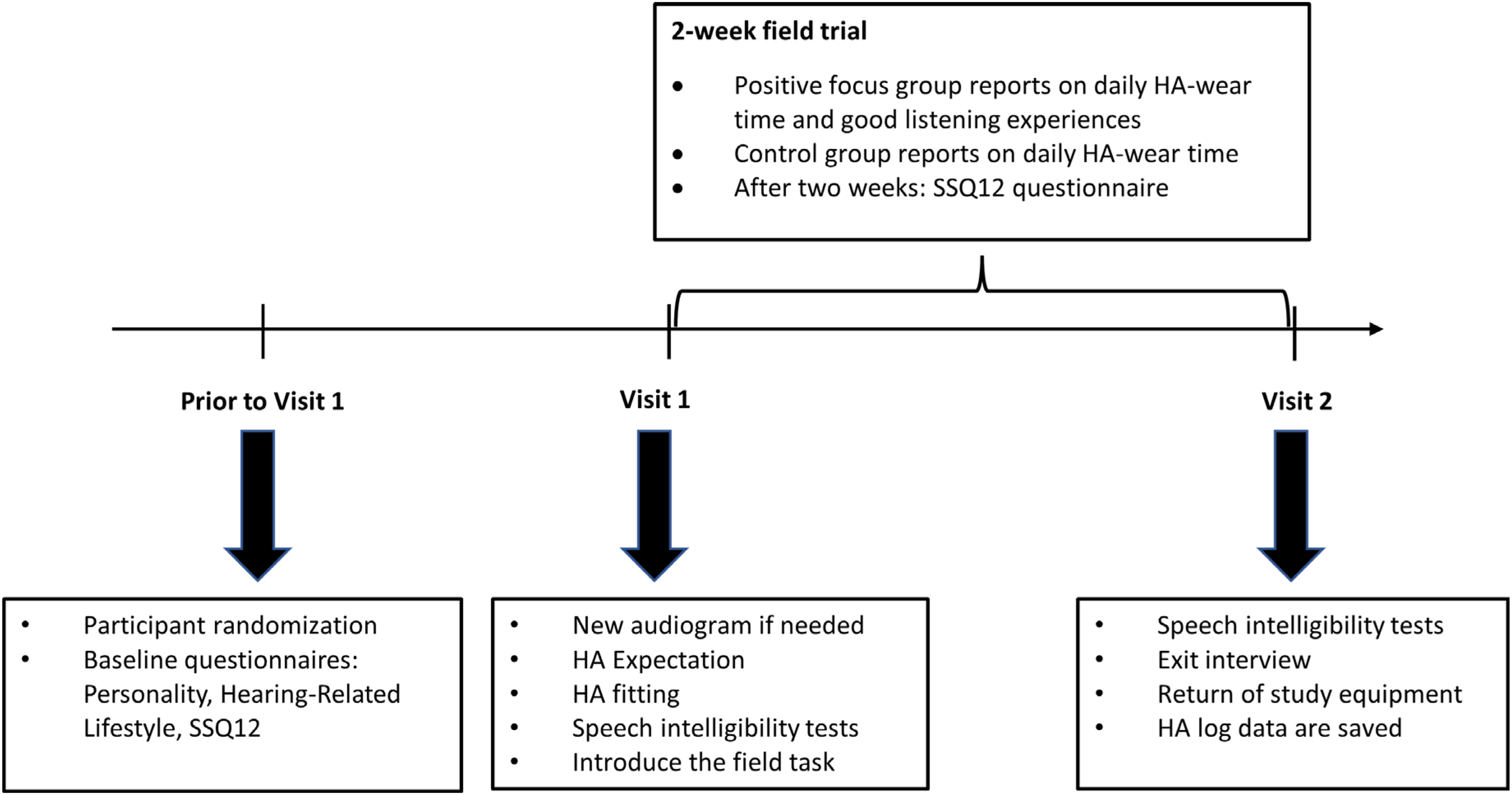
The study flow. Abbreviations: HA=hearing aid; SSQ12=short form of the Speech, Spatial and Qualities scale.
Participants
Thirty participants were randomized into a control group (N = 15; age: 71 ± 9 years; 8 males, 7 females) or a PF group (N = 15; age: 70 ± 9 years; 10 males, 5 females). All participants were experienced bilateral hearing aid users (> 1 year). Other inclusion criteria were a bilateral sensorineural hearing loss within the hearing aid's fitting range and fluency in Danish. The exclusion criteria were fluctuating hearing loss, severe cognitive impairment (as judged by the study lead) that would preclude the ability to perform the necessary tasks, complex hearing disorders such as Ménière's disease, and participation in the previous study involving the PF intervention (Lelic et al., 2023). The participants were recruited from a database of participants by conducting a search for individuals who matched the inclusion criteria and who were not enrolled in other studies already. The database automatically randomizes the order of the identified participants to avoid that they are alphabetically or numerically sorted. The identified participants were then contacted, starting with the first one on the list until the desired sample size (N = 30) was reached. The participants were informed about the study both orally and in writing. Before the trial commenced, the participants gave written informed consent.
Baseline Assessments
Prior to coming to the laboratory for the first visit, all participants received an e-mail with links to the baseline questionnaires implemented in Enalyzer (www.enalyzer.com). They were asked to fill out these questionnaires before the first visit. In the case that participants did not do so, they had the opportunity to fill out the questionnaires in the laboratory as part of their first visit.
The baseline questionnaires comprised:
The Big Five Inventory (BFI) 44-item inventory (John et al., 1991; John et al., 2008) that assesses the big five factors (dimensions) of personality: extraversion vs. introversion, agreeableness vs. antagonism, conscientiousness vs. lack of direction, neuroticism vs. emotional stability, and openness vs. closedness to experience. The English version of the questionnaire has high reliability and good external validity (Rammstedt & John, 2007). The questionnaire was translated to Danish using the forward-backward translation approach as described in Lelic et al., 2023. The HEARLI-Q questionnaire (Lelic et al., 2022) that is based on the Common Sound Scenarios framework (Wolters et al., 2016) and that assesses hearing-related lifestyle. The questionnaire outcomes are richness of hearing-related lifestyle (score between 0 and 100), hearing demand (score between 0 and 100), hearing difficulty (score between 0 and 4), and hearing aid satisfaction (score between 1 and 5). The questionnaire outcomes have excellent day-to-day reliability and good-to-excellent longer term reliability. The SSQ12 questionnaire (Noble et al., 2013) that assesses hearing abilities in various complex listening situations. The SSQ12 is the 12-item short form of the 49-item SSQ questionnaire (Gatehouse & Noble, 2004) that evaluates three different domains: speech, spatial, and general qualities. The average SSQ12 score has been shown to yield comparable results to the average 49-item SSQ score, while exhibiting a greater sensitivity to differences in hearing status, as evident from a slightly steeper slope of the SSQ12 scores (Noble et al., 2013). The participants in the current study were asked to rate the questionnaire items based on how they hear with hearing aids.
The BFI and HEARLI-Q were administered to check that the two groups were balanced in terms of personality, lifestyle, hearing demands, hearing difficulty, and satisfaction with own hearing aids. The SSQ12 questionnaire was administered at baseline to compare the SSQ12 scores between participants’ own hearing aids at the outset and the study hearing aids at the end of the trial.
Visit 1
During the first laboratory visit, a new audiogram was obtained if the one on file was older than one year. As hearing aid expectation has been shown to influence hearing aid outcomes (Ferguson et al., 2016), the participants were asked about their overall hearing aid expectations (Stuart Gatehouse, 1994) before being fitted: “If you were to wear this hearing aid, how much do you think it would help with your hearing?”. The response alternatives were (a) “no real help at all”, (b) “some help but not very much”, (c) “a great help”, and (d) “I would expect this hearing aid to return my hearing to normal”.
The participants were then fitted with Widex MOMENT MRB2D 440 receiver-in-canal hearing aids by an audiologist who performed all the fittings for this study. The hearing aids were fitted to the participant's hearing loss using Compass GPS (version 4.4) fitting software. The fitting was performed according to the Widex recommendations, where a feedback test is conducted and in situ hearing thresholds (Sensogram) are measured to account for the individual acoustic properties of the ear canal (Kuk, 2012). Receivers and ear tips were selected based on the fitting software's recommendation or the audiologist's clinical expertise. The participants were all bilaterally fitted with the same test device by the same audiologist to exclude the variability of hearing aid brand, model, and fit. The participants could use the MOMENT smartphone app for streaming. This app has an option for creating personalized programs, but the participants were instructed not to use the app for that purpose.
Following the fitting, the speech intelligibility tests were conducted, and participants were introduced to the field task.
Speech Intelligibility Tests
First, the participants completed the Danish Hearing in Noise Test (HINT) (Nielsen & Dau, 2011; Nilsson et al., 1994), followed by the Danish Dagmar, Asta & Tine (DAT) corpus (Nielsen et al., 2014). These speech tests were included to evaluate different aspects of speech intelligibility. While the HINT makes use of everyday sentences, the DAT corpus consists of low-context sentences with two short target words each. Moreover, for the HINT measurements unmodulated speech-shaped noise was used, while for the DAT measurements competing DAT sentences uttered by two other talkers were used. In terms of reliability, the reported within-participant SD is 0.92 dB for HINT (Nielsen & Dau, 2011) and 1.4 for DAT (Nielsen et al., 2014) for participants with hearing impairment.
During the speech intelligibility testing, the hearing aid sound classifier was turned off to ensure stable test conditions. The sound classifier was turned back on before the participants left the laboratory. A mandatory break of at least 15 min was held between the HINT and DAT measurements to lower the chances of fatigue affecting the results.
HINT
The Danish HINT consists of ten 20-sentence lists spoken by a male talker presented against unmodulated speech-shaped noise. Speech was presented at 0o azimuth, at approximately 1-meter distance from the participant. The starting level of the speech was 70 dB SPL and then varied adaptively by four dB for the first four sentences and by two dB steps for the remaining sentences. Sentence scoring was used to converge at 50%-correct performance, that is, the speech recognition threshold (SRT) in dB signal-to-noise ratio (SNR). The final SRT was calculated by taking the mean presentation level of sentence five to sentence 20. The level of the noise was kept constant at 70 dB SPL and presented uncorrelated from five loudspeakers to the sides (90o, 270o) and behind (135o, 180o, 225o) the participant. The noise was played back for 30 s before the presentation of the first sentence, allowing for the adaptation of noise-handling features. The participants were instructed to repeat what they heard and to guess if they were unsure. Two training lists were presented prior to the actual measurements to familiarize the participants with the procedure. The HINT sentence lists were counterbalanced across participants, and for all participants each list was used only once.
DAT
The DAT corpus is based on the English Theo, Victor & Michael speech corpus (Helfer & Freyman, 2009). It is typically used for competing-speech measurements, where the target sentence is presented against two masker sentences uttered by other talkers. The DAT corpus consists of thirty 20-sentence lists uttered by three female talkers (10 lists each). Each sentence is composed of a carrier sentence with two short unique target words (nouns): “[Name] thought about a [noun] and a [noun] yesterday.” An example of a sentence is: “Dagmar thought of a starling and a car door yesterday.” The name Dagmar is used as call sign, that is, to identify the target sentence. The masker sentences start with the names Asta and Tine.
The target sentences were presented at a fixed level of 64 dB SPL from 0o azimuth, at approximately 1-meter distance from the participant. Masker sentences were presented from 45o and 315o azimuth with a starting level of 54 dB SPL. The participants were instructed to repeat the two target words and to guess if they were in doubt. An adaptive procedure with 2-dB steps combined with sentence scoring (both target words identified correctly) was applied to measure the SRT in dB target-to-masker ratio (TMR). The SRT was calculated as the average of the TMRs of trials 5–20. The participants completed two training lists prior to the actual measurements. The target sentence lists were randomized, and the masker lists were counterbalanced to ensure that the target and masker lists were never identical. For all participants, each target list was used only once.
Field Trial
The participants were instructed to wear their hearing aids for two weeks after fitting and to send a daily text message reporting the number of hours they had used their hearing aids for. In addition, only the participants in the PF group were exposed to the “PF” intervention. That is, they were instructed to focus on positive listening experiences and to summarize them in the daily text message.
The specific instructions to the control group were: “For the next two weeks, you will be wearing these hearing aids instead of your own. During these two weeks, I’d like to know approximately how many hours you wore the hearing aids for during each day. Therefore, I’d like you to send me a text at the end of the day, with the approximate number of hours you wore the hearing aids.” An example of a text could look like this: “8 h.”
The specific instructions to the PF group were: “For the next two weeks, you will be wearing these hearing aids instead of your own. During these two weeks, I am very interested to hear about the situations in which the study hearing aids helped you. Therefore, I would like to ask you to focus on the good listening experiences you encounter and, at the end of the day, to report them to me by text. A good experience can be anything from being able to hear birds or water dripping from a tap to understanding speech in noisy environments. Don’t be afraid to repeat situations, I’d love to hear about any experience more than once, if you encounter it multiple times. In addition to this, I would like to know approximately how many hours during that particular day you wore the hearing aids.” Please include this in your text at the end of the day. An example of a text could look like this: “8 h. I was able to hear birds clearly, and conversations at work went smoothly.”
The participants received the above instructions verbally and in writing. In case a daily text did not come two days in a row or participants in the PF group reported negative experiences, the study lead followed up with the participant to find out what had hindered them from reporting and to remind them of their task. After the 2-week period, the participants received the SSQ12 questionnaire via e-mail and were asked to submit it before coming to the laboratory for Visit 2. Alternatively, the participants could fill out the questionnaire upon their arrival.
Visit 2
During the second visit, the speech intelligibility tests were conducted once more in the same manner as described above. The tests were followed by a semi-structured exit interview, during which the participants were asked about their general experiences with the trial. The four specific questions that were asked were: (1) “Can you name some situations where you’ve had good listening experiences?”; (2) “Can you name some situations where you’ve had difficult listening experiences?”; (3) “By participating in this study, did you become more aware of situations that are problematic or good for you?”; and (4) “Do you prefer the study hearing aids or your own?” At the end of the visit, the participants returned the study hearing aids, and the hearing aid log data were saved.
Data Analysis
The primary purpose of the study was to evaluate whether the PF intervention improves speech intelligibility as measured by HINT and DAT. A secondary purpose was to assess whether the PF intervention improves subjective SSQ12 scores.
The planned analysis to address the primary purpose was mixed-effects linear regression with the dependent variables group (control or PF), time (Visit 1, Visit 2), and group x time interaction. We hypothesized that the group x time interaction would be significant, with greater improvement in the measured scores for the PF group. The sample size calculations were based on regression coefficients from HINT data from another (internal) study where two hearing aid programs were compared. These coefficients were: intercept = -2.8, βgroup = 0.7, βvisit = 0.1, βinteraction = -1.5, and normally distributed standard errors with mean = 0 and standard deviation = 1. Based on 1000 simulations of HINT data with the aforementioned coefficients, 30 participants (15 in each group) would allow for significant interaction (α = 0.05) - of the same magnitude as in the other study - between group and visit to emerge with a power of approximately 86% using mixed-effects regression analysis.
Baseline data of the two groups were compared to ensure that they were balanced. That is, age, degree of hearing loss, duration of hearing aid experience, BFI scores, and HEARLI-Q scores were compared using analyses of variance. All data were visually inspected to ensure that they fit a normal distribution. If not, the ladder of powers was applied to transform the data into normally distributed. We conducted the ladder of powers by first visualizing the original data transformed by the following functions: cubic, square, square root, log, 1/square root, inverse, 1/square, and/or 1/cubic. Then, the transformed data that fit an approximate normal distribution were chosen for the analysis. It is indicated in the results section if a transformation was applied to the data before analysis. Gender and own hearing aids (i.e., number of Widex hearing aid users) were compared using χ2 tests. Any imbalances in these baseline characteristics were controlled for when analyzing the post-fitting data.
The hearing aid use data were analyzed using mixed-effects linear regression. The dependent variables were group (control or PF) and report type (self-report or hearing aid log).
The SSQ12 data were first grouped into the Speech, Spatial and Qualities domains as described by Noble et al. (2013). Then, the mean scores for these domains were analyzed using mixed-effects linear regression. The dependent variables were group (control or PF), hearing aid (own or study hearing aids), and group x hearing aid interaction.
For exit interview responses, we extracted the number of good and difficult listening experiences that were named by each participant (questions one and two). Next, we analyzed these data using mixed-effects linear regression, where the number of experiences was the dependent variable, and group (control or PF) and situation type (good, difficult) were the dependent variables. χ2 tests were conducted to analyze the binary responses to questions three and four.
For all mixed-effects linear regression analyses, participant ID was treated as a random effect, covariates were added in case of any imbalances in the baseline data, and the residuals were visually inspected to ensure that they fit an approximate normal distribution and that they met the homoscedasticity criterion. When homoscedasticity was violated, regression with robust standard errors was conducted.
All statistical analyses were done in Stata (v. 15, StataCorp, College Station, TX, USA).
Results
Baseline Characteristics
The two groups were comparable across all baseline characteristics except for the BFI neuroticism trait where the control group scored higher than the PF group (Table 1). Hence, when analyzing the post-fitting data, the baseline BFI neuroticism score was controlled for.
Comparison of Baseline Characteristics Between the two Groups.

HA = hearing aid; BFI=Big Five Inventory. aHearing loss was calculated as the mean hearing threshold across 250, 500, 1000, 2000, 4000, and 8000 Hz in the better hearing ear. bAnalysis was done on log transformed data. cSignificant difference.
Compliance and Positive Listening Experiences
Eight participants in the PF group sent the expected 14 texts during the 2-week period, while five participants sent 13 texts and two participants 12 texts. In the control group, 13 participants sent the expected 14 texts, whereas two participants sent 13 texts. Hence, both groups generally adhered to the task, although the control group was slightly more compliant. Follow-ups were necessary in five cases and only for the PF group. In one case, the follow-up was made due to the participant not sending daily texts two days in a row. In the remaining four cases, it was necessary to remind the participants of the task of focusing and reporting on positive listening experiences even if they were repetitive. This was needed because these participants’ texts included challenging situations (N = 2) or writing “the same as yesterday” instead of summarizing the day's experiences (N = 2).
The types of positive listening experiences varied between reports and participants. Some examples are: “…On the way home I heard rustling leaves and the rustling of the trees. Perceive many sounds when I walk through a shopping center - people talking, walking, and their canes etc. Extraction from the kitchen hood makes less noise - it runs automatically all the time,” “a meeting out in the city with new people and a new location, great to be able to focus throughout the meeting and not get tired along the way,” “could hear my boyfriend talking on a hike even though he was walking in front of me,” “attended a confirmation party with 45 guests; no problems with carrying on a conversation at our table with 6 people,” “hear traffic noise from the street that I have not noticed before,” “can hear the sparrow singing.”
Hearing Aid use
The hearing aid log data revealed a similar distribution of sound levels for the two groups. The control group spent 51% ± 9%, 46% ± 8%, and 3% ± 2% of the time in environments with soft, normal, and loud sound levels, respectively. The PF group spent 50% ± 13%, 46% ± 9%, and 4% ± 4% of the time in environments with soft, normal, and loud sound levels, respectively. The reported and logged daily hearing aid use data are shown in Figure 2. The plots show similar hearing aid use pattern for the two groups. The hearing aid log data, however, show a lower number of hours than the self-reports. Detailed statistics can be seen in Table 2.

Daily hearing aid use data. The subjective data stem from the daily text messages. The objective data stem from the hearing aid logs. The subjective data were averaged across all reports from each participant. HA=hearing aid. Significant differences are indicated by an asterisk (*).
Results from the Mixed-Effects Regression Analyses.

The reference categories are the ones appearing first in the parentheses after the categorical variables. Significant effects are indicated by an asterisk (*).
PF=positive focus; HINT=Hearing in Noise Test; DAT=Danish Dagmar, Asta & Tine; SSQ12=short form of the Speech, Spatial and Qualities of Hearing scale.
Speech Intelligibility
The speech intelligibility results are shown in Figure 3, and the corresponding regression results are shown in Table 2. The HINT SRT was −2.8 ± 2.4 dB SNR and −2.4 ± 3.0 dB SNR at visits 1 and 2, respectively, for the control group, and −2.5 ± 2.8 dB SNR and −3.8 ± 1.7 dB SNR at visits 1 and 2 for the PF group. The DAT SRT was 10.3 ± 4.4 dB TMR and 9.8 ± 4.9 dB TMR at visits 1 and 2, respectively, for the control group, and 11.0 ± 4.4 dB TMR and 8.5 ± 3.9 dB TMR at visits 1 and 2 for the PF group. There was a significant interaction between group and time for both speech tests. Using the contrast post-estimation function in Stata, the test of simple effect of time revealed a HINT contrast of 0.4 (95% CI: −0.3, 1.1, p = .24) in the control group and −1.3 (95% CI: −2.2, −0.5, p = .002) in the PF group. The DAT contrasts were −0.4 (95% CI: −1.3, 0.5; p = .35) in the control group and −2.5 (95% CI: −4.1, −0.8; p = .003) in the PF group. That is, the PF group's performance significantly improved on both speech-in-noise tests, whereas there was no significant change in the control group. For the PF group, the contrasts for both speech intelligibility tests are above the previously reported within-participant SDs (e.g., “test noise” level) for listeners with hearing impairment (Nielsen & Dau, 2011; Nielsen et al., 2014).
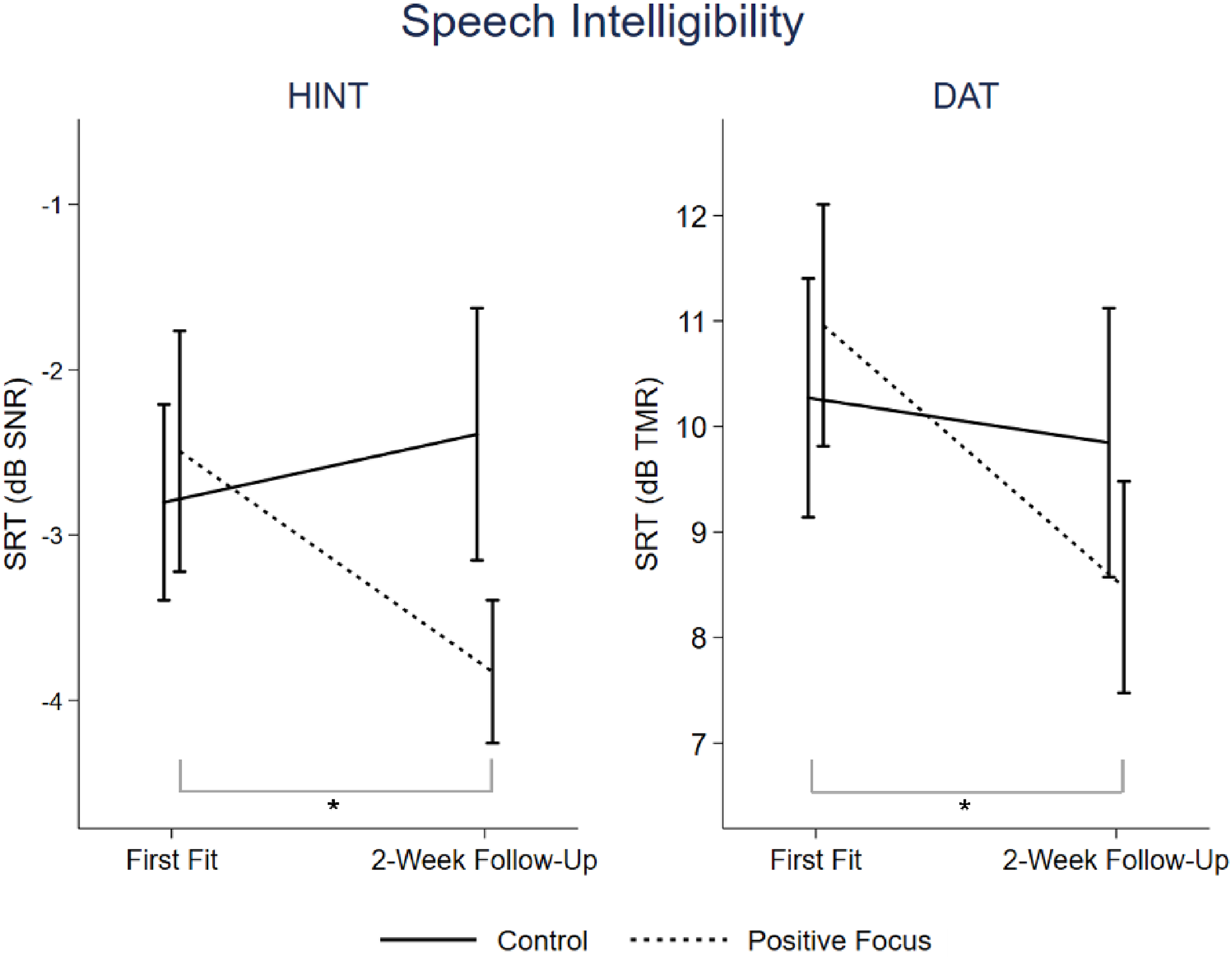
Mean speech intelligibility results for the HINT and DAT tests. Lower scores on the y-axis represent better performance. The error bars depict ±1 standard error of the mean. Improvements at 2-week follow-ups can be seen for the positive focus group. Significant interactions are indicated by an asterisk (*). HINT=Hearing in Noise Test; DAT=Danish Dagmar, Asta & Tine.
SSQ12 Results
The SSQ12 results are shown in Figure 4, and the corresponding regression results are shown in Table 2. There was a significant effect of group for the Qualities domain, where the PF group scored generally lower than the control group. There was also a significant interaction between group and time for the Qualities domain. Using the contrast post-estimation function in Stata, the test of simple effect of time revealed a contrast of −0.22 (95% CI: −0.84, 0.39, p = .48) in the control group and 0.71 (95% CI: 0.12, 1.29, p = .02) in the PF group. That is, the PF group scored significantly better with the study hearing aids two weeks post fitting as compared with their own hearing aids. No such improvement was seen for the control group. There were no significant effects for the Speech or Spatial domains.

Mean SSQ12 results. The error bars depict ±1 standard error of the mean. Improvements with the study hearing aids relative to the participants’ own devices can be seen for the positive focus group in the qualities domain. HAs=hearing aids. Significant interactions are indicated by an asterisk (*).
Exit Interview Data
At the exit interview, the control group named 1.5 ± 0.7 good and 1.1 ± 0.6 difficult listening experiences, whereas the PF group named 2.8 ± 2.0 good and 1.0 ± 0.8 difficult listening experiences. Hence, on average, both groups named more good than difficult listening experiences. However, participants in the PF group named more good listening experiences than those in the control group, whereas the number of difficult listening experiences was comparable for the two groups (see Table 2 for detailed statistics). The summary of the participants’ responses to the two questions is outlined in the Supplementary Material (Tables 1 and 2). When asked if they became more aware of situations which were problematic or good, 10 participants in the PF group answered “yes”, whereas only one participant in the control group did so (χ2 = 11.63, p = .001). Most participants did not elaborate on their binary yes/no responses. The few ones that did said that they became more aware of how much better the study devices were in comparison to their own devices. Also, they became aware of the good situations making the bad situations less important. When asked if they preferred the study hearing aids or their own ones, nine participants in the PF group and five participants in the control group stated they preferred the study hearing aids (χ2 = 2.14, p = .14). Key reasons for preferring own devices were physical characteristics such as color or ear tips, familiarity, or the availability of streaming accessories or other special functions (e.g., a telecoil).
Discussion
The results of the current study indicate that PF, an intervention that asks hearing aid users to focus on positive listening experiences, can improve speech-in-noise performance compared to no intervention. This finding complements our previous study where we showed that the PF intervention can improve subjective hearing aid outcomes (Lelic et al., 2023). Furthermore, the current results are in line with previous studies that showed effects of hearing aid narratives on measured speech intelligibility (Dawes et al., 2013; Dawes et al., 2011; Rakita et al., 2022).
In the current work, we delivered a type of intervention shown to work in positive psychology (Hanson et al., 2021). By focusing on positive listening experiences, participants can become more aware of situations in which hearing aids may help them; it is this awareness that improves hearing aid outcomes rather than beliefs that are grounded in third-party narratives. In other words, there seems to be something meaningful and powerful in reflecting on own experiences. The effects of the PF intervention may be related to “gain/loss framing:” the benefits of practicing a recommended behavior (gain framing) and potential losses if one does not practice the recommended behavior (loss framing). St. Jean et al. (2021) showed that gain-framed messages may have a positive influence on attitudes toward hearing health behaviors in younger individuals (under 40). On the other hand, Wirtz et al. (2015) showed that mood and personal relevance may be important moderators of effects of gain- and loss-framed messages—those who were in a positive mood and when the message was personally relevant were more prone to the effects of the loss-framed messages. In the context of the PF intervention, focusing on positive listening experiences highlights the benefits of wearing the hearing aids (gain). PF may, at the same time, bring attention to what would be missed if one did not wear the devices (loss). As the listening experiences are drawn from the participants’ own everyday life, the perceived benefits of wearing the device can be highly personally relevant.
At the exit interview, the participants in the PF group reported having become more aware of situations in which hearing aids were / were not helpful, and they were able to recall more everyday positive listening experiences than the control group. If the PF intervention makes hearing aids users more aware of situations where devices are / are not helpful, this has potential to enhance the effective use of hearing aids. The participants in the PF group were potentially conditioned to talk about the positive experiences because they were asked to specifically focus on them. This conditioning or awareness of the positive experiences with hearing aids is what likely led to a better overall experience / improved speech intelligibility. At the exit interview, the participants in the PF group on average reported 2.8 positive listening experiences and 1.0 negative one, whereas participants in the control group on average reported 1.5 positive experiences and 1.1 negative ones. Fredrickson (2013) described a “3-to-1 positivity ratio,” where it takes three positive experiences to counteract one negative experience to mitigate negativity bias. Broadly speaking, this fits with our findings—while the PF intervention did not decrease the number of difficult experiences, the larger number of positive experiences potentially made the difficult ones less relevant.
We observed improved SSQ12 ratings due to the PF intervention in the Qualities domain but not in the Speech or Spatial domains. The lack of effects in the Speech and Spatial domains is surprising, considering the large effects of the PF intervention on subjective ratings collected with several hearing aid outcome scales found by Lelic et al. (2023). In comparison to the SSQ12 which measures hearing abilities in complex listening situations, the questionnaires administered by Lelic et al. (2023) assess hearing aid benefit (IOI-HA and COSI) and satisfaction in everyday listening situations (HEARLI-Q and EMA). That is, the questionnaires, while all tapping into subjective constructs, measure different things. Some studies have shown speech-in-noise benefits while failing to detect SSQ improvements (Firestone et al., 2020; Wimmer et al., 2023; Wu et al., 2019). Overall, this suggests that an intervention such as PF can affect objective and subjective outcomes differentially.
Altogether, having hearing aid users focus on positive listening experiences has the potential to improve both subjective and objective hearing aid outcomes. In this context, it is worth noting that the improvement in speech-in-noise performance due to the PF intervention observed here is comparable in magnitude to the benefit that premium hearing aid features can convey (Plyler et al., 2021; Wu et al., 2019). This improvement cannot be attributed to hearing aid use alone as the two groups in this study used their hearing aids for comparable periods of time and in similar sound environments. In terms of clinical implications, by urging their clients to focus and reflect on positive listening experiences following hearing aid fitting, hearing care professionals are able to positively affect hearing aid outcomes. This could lead to greater hearing aid satisfaction and hearing aid use. In our previous study (Lelic et al., 2023), we instructed our participants to report in the moment when a positive experience occurs. In the current study, we showed that a simpler approach—summarizing listening experiences at the end of the day in a simple text message—also has an effect. In general, this approach may be more suitable, as users do not need to interact with an app at specific (perhaps inconvenient) points in time.
In the current study, we showed a speech intelligibility benefit of the PF intervention in a relatively small sample of experienced hearing aid users. Despite the small sample size, there were promising changes in the PF group, which will need to be substantiated in follow-up work and in a larger sample size. Future studies should also investigate whether a short-term PF intervention, as done in this study, can affect speech intelligibility in the longer term (e.g., months after hearing aid fitting) or if it is necessary to sustain the PF for the beneficial effects to persist. It would be of interest to look into whether the PF intervention has relevance for first-time users as well—can it help facilitate acclimatization by improving speech intelligibility performance? More broadly speaking, our finding that psychological factors can impact hearing aid outcomes has implications for hearing aid research in general. These types of effects need to be controlled for in studies where exclusively the hearing aid technology is in question.
We specifically asked the participants to focus on positive listening experiences. The types of experiences included in the instructions were audibility—and intelligibility—based. This was intentional because we wanted the participants to note these particular listening experiences and not other experiences relating to comfort, physical appearance of the device, connectivity, battery life, etc. However, it could be relevant to ask hearing aid users to focus on/report a broader range of positive experiences with their devices, such as the physical aspects and accessories, that can contribute to the user's overall experience (Picou, 2022).
We employed parallel-arm design rather than a cross-over one. While cross-over design has many strengths, it may not have been ideal for the current study. For the participants who would first get the PF intervention, it could have been difficult to “unlearn” the resultant effects when crossing over to the control intervention. An appropriate wash-out period could likely take care of some of the carry-over effects, but the appropriate length for such a period is unknown. Hence, we considered a balanced parallel-arm design to be most appropriate for our purposes. A limitation of our study is the lack of double blinding. For practical reasons, double blinding was not possible, and although a test leader bias cannot be completely excluded, we tried to minimize it as much as possible. The test leader did not look at the Visit-1 data until all participants had completed their Visit-2 measurements, and the DAT scores were not calculated at all until the study was completed. To strengthen the evidence for beneficial PF effects, future studies should ideally replicate the current findings in a double-blinded randomized controlled trial. Furthermore, disentangling the influence of positive listening experiences from other factors contributing to the effectiveness of the PF intervention (e.g., interaction with the smart phone, general reporting, audiologist's interest, etc.) is an important avenue for further investigation.
Conclusions
The current study showed that the PF intervention can improve speech-in-noise performance in a relatively small sample of experienced hearing aid users. It therefore provides further evidence of the potential value of adopting a PF approach during hearing aid treatment.
Supplemental Material
sj-docx-1-tia-10.1177_23312165241246616 - Supplemental material for Focusing on Positive Listening Experiences Improves Speech Intelligibility in Experienced Hearing Aid Users
Supplemental material, sj-docx-1-tia-10.1177_23312165241246616 for Focusing on Positive Listening Experiences Improves Speech Intelligibility in Experienced Hearing Aid Users by Dina Lelic, Line Louise Aaberg Nielsen, Anja Kofoed Pedersen and Tobias Neher in Trends in Hearing
Footnotes
Data Availability Statement
The datasets generated during and/or analyzed during the current study are available from the corresponding author on reasonable request.
Declaration of Conflicting Interests
DL and AKP are employees of WS Audiology. LLAN was a master student at University of Southern Denmark at the time this study was conducted but is now employed at GN Group.
Funding
The authors received no financial support for the research, authorship, and/or publication of this article.

Supplemental Material
Supplemental material for this article is available online.
References
Supplementary Material
Please find the following supplemental material available below.
For Open Access articles published under a Creative Commons License, all supplemental material carries the same license as the article it is associated with.
For non-Open Access articles published, all supplemental material carries a non-exclusive license, and permission requests for re-use of supplemental material or any part of supplemental material shall be sent directly to the copyright owner as specified in the copyright notice associated with the article.
