




Abstract
This study examines factors that predict engagement with LinkedIn posts, specifically analyzing the impact of hashtags, tags, post age, and follower count on three engagement metrics: reactions, comments, and reposts. A negative binomial regression analysis of a random sample of 991 LinkedIn posts reveals that tags and hashtags significantly increase the expected number of reactions, with tags also substantially increasing comments. Follower counts slightly increase engagement, while post age negatively impacts expected counts across all metrics. The three engagement metrics are interrelated: comments boost reactions and reposts, reactions drive comments and reposts, and reposts increase reactions. These findings enhance our understanding of LinkedIn engagement and social media behavior by showing how certain message elements yield differing outcomes. Our findings also offer actionable insights for professionals and educators seeking to optimize their online presence and career outcomes on the platform.
LinkedIn is a social media platform advertised as the world’s largest online professional network, with over 1 billion users across 200 countries and regions (LinkedIn Pressroom, 2024). Like other social media platforms, an integral part of the user experience is the user’s ability to post content to a public feed. Other users can react (like), comment, and repost (share) the posted content, all forms of engagement. More than 1.5 million feed updates are viewed per minute on LinkedIn (LinkedIn Pressroom, 2024).
With such communication features and consumption of feed updates, what factors increase the propensity for users to engage with a post? The current scientific literature does not provide a clear answer. While there have been studies of engagement on other social media platforms like Facebook, Instagram, and X (formerly Twitter), it is unclear how they generalize to LinkedIn. LinkedIn is a unique platform because it offers features catered to professionals, such as a job board, online professional development courses, and premium accounts with unique feature sets for recruiters, job seekers, and business owners.
Seeing how LinkedIn is a self-proclaimed professional network where professionals use it for career development purposes (Pena et al., 2022) and that its frequent usage has been proven to deliver career and job search benefits (Cho & Lam, 2020; Davis et al., 2020), users ought to know how to optimize their posts to expand their reach, connections, and professional opportunities (Healy et al., 2023). Moreover, many university career centers use LinkedIn (Osborn & LoFrisco, 2012) and educators from various fields teach it in their classes (Cooper & Naatus, 2014; Hutchins, 2016; López-Carril et al., 2025), so they can benefit from knowing how to coach their students to build an online presence via high-impact posting. It is also vital for academics to understand LinkedIn as a unique platform and how it can contribute to scholarly conversations about social media and human behavior. Therefore, this study seeks to explore factors influencing engagement with posts on LinkedIn.
Literature Review
LinkedIn as a Platform
Research on LinkedIn as a platform generally focuses on three main areas: gratifications, profiles, and business accounts, with a limited focus on posts. Smith and Watkins (2023) found that millennials use LinkedIn to share their professional achievements and monitor their peers. Other studies have explored how professors and recent college graduates use LinkedIn (Hazzam, Wilkins, Singh, et al., 2024; Hazzam, Wilkins, Southall, et al., 2024; LaPoe et al., 2017), their perceived informational benefits (Utz, 2016), users’ career expectations (Pena et al., 2022), and its effectiveness for career switching (Cho & Lam, 2020). Another significant area of LinkedIn research concerns the profile feature of LinkedIn, mainly how users present themselves (Altenburger et al., 2017; Bremner & Phung, 2015) and the impact of profile content (Banerji & Reimer, 2019; Chiang & Suen, 2015; Rapanta & Cantoni, 2017).
When studying posts, most LinkedIn studies focus on business accounts rather than individual users. For example, businesses using LinkedIn for sales-related posts experience positive outcomes (Mora Cortez et al., 2023), and action-oriented posts drive higher engagement (Sundström et al., 2021). The limited research on individual users’ posts focuses on personal medical disclosures on the platform (McChesney & Foster, 2024; Mondal et al., 2024). The lack of studies on individual users, aside from niche groups like Ibex 35 CEOs (Pérez-Serrano et al., 2020), highlights a significant gap in the research.
Predictors
In addition to the lack of understanding of typical LinkedIn users, we also need to know what elements of a post yield higher levels of engagement defined as a user reacting, commenting, or sharing another user’s post. We know that LinkedIn posts and follower counts have been linked to a firm’s sales revenues (Mora Cortez et al., 2023), so knowing how to increase a post’s engagement could amplify this relationship and yield positive professional outcomes for nonbusiness users. Among the many possible predictor variables, we consider four objectively measurable ones: the use of hashtags, tags, age of the post, and the poster’s follower counts.
Hashtags
Hashtags are a form of social tagging that allows users to embed metadata in social media posts while also serving as text in a post (Bernard, 2019). They can categorize content, enhance the post’s searchability, and facilitate interactions through their linking of topics throughout a platform. Hashtags go beyond metadata, however, and can serve many linguistic functions such as labeling discourse, expressing interpersonal insights, and serve as a form of punctuation (Zappavigna, 2015).
La Rocca and Ariteri (2022) argue in their meta-synthesis that scholars mainly study hashtags as tools for social activism and measuring user behavior. Wang et al.’s (2016) investigation of Twitter hashtags during the Occupy Wallstreet movement is an example of social activism. An exemplar of behavior metrics is Berbegal-Mirabent and Caba’s (2023) study on posting strategies for maximizing engagement on Instagram, where they found that fewer but more meaningful hashtags relevant to the brand increased engagement while having too many hashtags decreased engagement. Overall, La Rocca and Ariteri’s (2022) analysis finds that hashtags are mostly studied on Twitter and Instagram, and they call for studies on other platforms. LinkedIn is a significant platform that has not been studied.
Tags
Tagging is a feature that allows users to create a link to another user’s profile by attaching their name to a post, photo, or comment. This action notifies the tagged user, prompting them to view and respond to the content. Most tagging studies focus on motivations for tagging. For example, Kang et al. (2022) studied users’ motivations for comment tagging on Instagram. Fifty-four percent of comments had tags in them, and users reported three motivations for tagging others: to share information, to affirm their relationship, and to discuss a topic. Dhir et al. (2018) found that adolescents’ motivations for tagging others on Instagram posts were more simple: habit and entertainment. Birnholtz and Steele (2017) studied Facebook users’ motivations for the opposite behavior: untagging.
Outside of studying motivations for tagging and untagging, Kümpel (2019) found that being tagged in a Facebook news post significantly increased the tagged user’s intention to read the article and that higher tie strength positively correlated with reading intentionality. However, the study did not investigate whether tagging increases likes, comments, or reposting by the tagged user. It is possible that tagging someone to a LinkedIn news article would increase a user’s propensity to read it, but it is unknown whether it increases the three key engagement metrics.
Age of the post
The age of a post might matter too. A post that has been on LinkedIn for 2 hours might not receive as much engagement as one that has been on the platform for 3 days. Posts that sit on the platform longer, in theory, should have more time to be viewed and reacted to. However, this hunch has not been tested in the social media literature.
What has been tested is the effects of a post’s timing on engagement, specifically the day and time of a post, which have focused on Facebook and Instagram (Hanifawati et al., 2019; Singh et al., 2023). Spasojevic et al.’s (2015) analysis of 144 million posts and 1.1 billion reactions from Twitter and Facebook provide the closest insights about the importance of post age. They found that 50% of reactions to a Twitter post occurred within 30 minutes of posting. On Facebook, it took 2 hours to reach the same threshold.
None of these studies have investigated LinkedIn. Older LinkedIn posts might receive more engagement because of the extended time on the platform, but it is possible that the algorithm would prioritize newer content and incentivize higher engagement through primacy. This study therefore seeks to explore how the age of the post might relate to engagement on that platform.
Follower counts
In addition to the post’s age, follower counts might also predict engagement. Follower counts on LinkedIn include two types of connections. First-degree connections are connection requests accepted by both parties. First-degree connections can see each other’s feeds and message each other directly. By default, all first-degree connections become part of a user’s follower count (LinkedIn Help, n.d.). The second type of connection includes individuals who elect to be followers of another person’s account rather than send a connection request. A follower can see a user’s updates and shares without the ability to direct message, but the user will not see the follower’s content unless they follow back. Choosing to “follow” someone’s account rather than connect with them happens when there is no mutual recognition between the two users, such as someone wanting to follow a famous influencer’s account for their content.
Users with large follower counts act as social hubs where they can send messages to more people, have a larger market of potential customers (Kupfer et al., 2018) and more potential engagement (Hinz et al., 2011). Higher follower counts might also serve as a force multiplier for engagement by being a credibility signal, although the studies supporting this claim are mixed (De Veirman et al., 2017; Leung et al., 2022; Santee, 2024).
Studies of follower counts and engagement with posts on platforms like Instagram suggest a curvilinear relationship between the number of followers an influencer has and the level of engagement their content receives (Jain et al., 2023; Wies et al., 2023). In other words, follower counts increase engagement up to a certain point, but engagement levels decrease once follower counts peak. Both studies identified moderators for the decrease in engagement, such as higher content customization in posts, followers’ brand familiarity, and the influencer’s perceived authenticity. Mora Cortez and Ghosh Dastidar (2022) further suggest a cyclical relationship between posts, engagement, and follower counts: a post that receives more impressions gets more likes, which leads to higher follower counts and therefore more impressions.
In any case, a statistical relationship exists between follower counts and engagement with posts. The relationship is not necessarily direct, but it might be negative or curvilinear. However, the current academic understanding of this relationship is limited to Instagram and Twitter. LinkedIn, a different platform, might operate under a different algorithm or show a different relationship because of the two types of connections included in a user’s follower count. Moreover, any model that attempts to identify key predictors of engagement ought to consider follower counts because of the increased exposure that a post will naturally receive with a higher following.
Engagement
Engagement is based on three metrics in this study: reactions (likes), comments, and reposts (shares). All three metrics are objectively measurable and accessible to researchers, they encompass both passive consumption and active participation from users (Dolan et al., 2016), and they are used in other studies (Berbegal-Mirabent & Caballero, 2023; Khan, 2017; Kim & Yang, 2017; Swani & Labrecque, 2020). Each metric has unique message reception implications and psychological significance to users. This section will review each metric.
Reactions (likes)
LinkedIn’s reactions are one-click expressions that users can display in response to a post. Users can select the following expressions: “like,” “celebrate,” “support,” “love,” “insightful,” and “funny.” Noticeably, all reactions from this list are positively valanced. Reactions are similar to “likes” on other platforms because they are one-click paralinguistic digital affordances for responding to a post (Hayes et al., 2016).
Many studies have explored the emotional significance of likes. Sherman et al. (2018) found that giving and receiving likes activates brain reward centers tied to social approval and financial gain, engaging both cognitive and emotional processes. Receiving likes can boost self-esteem, influenced by one’s sense of purpose (Burrow & Rainone, 2017), while users with lower self-esteem prioritize like quality and quantity (Diefenbach & Anders, 2022). Likes also drive social comparison: receiving more likes can evoke superiority, while fewer likes can lead to envy or inferiority (Rosenthal-von Der Pütten et al., 2019). When a post lacks likes, users report feeling ignored or excluded, particularly by close or superior connections, but they may be more motivated to adapt their posting strategies, viewing social media as a game (Hayes et al., 2018).
Likes also have message reception implications. Health-related posts from expert sources with high numbers of likes were perceived as more credible than posts from a low-credibility source or with fewer likes (Borah & Xiao, 2018). A study of 64 major movies found that for every 1% increase in likes given to their pre-release trailers, their box office revenues increased by .02% during opening week, with the effect getting stronger as the release date approached (Ding et al., 2016).
Thus, likes are widely studied, and they are a meaningful form of engagement because of their psychological impact on the user and their message reception implications. LinkedIn is an online professional network where users seek to maximize their professional outcomes. If users receive more likes for their posts, they may be experiencing psychological and instrumental benefits that could yield unexplored advantages.
Comments
Users can write open-text responses, known as “comments,” to LinkedIn posts. Comments are used in all major social media platforms and are essential to the user experience. In fact, Twitter influencers who disable comments were perceived more negatively, less receptive to feedback, and less sincere than those who kept them turned on (Daniels & Wu, 2024).
Beyond credibility, researchers have studied how the presence of comments influence message reception. Emotional comments, particularly negative ones, capture the most visual attention and are most memorable during both heuristic and systematic processing (Kohout et al., 2023). Negative comments can also diminish the emotional benefits of uplifting content (Krämer et al., 2021). Positive comments, however, can mitigate or even reverse the negative effects of bad news on stock valuations (Trinkle et al., 2015). An eye-tracking study shows that disagreement in comment sections reduces the likelihood of reposting because of the user being distracted by the debate (Dutceac Segesten et al., 2022).
Overall, comments are vital to the user experience on social media and impact how users process a user’s credibility and their posts. Thus, the presence of comments is not only a key engagement metric but can also be an engagement multiplier depending on their valance. One place to discover their power is on LinkedIn, where users post content with self-presentation goals of being professional.
Reposts (shares)
LinkedIn allows users to repost public posts, with or without commentary, either to their profile for followers or privately via direct message. Reposting, which amplifies reach and visibility, is influenced by different user motivations. Users repost content for self-presentation, social connection, relational maintenance, and knowledge sharing (Ham et al., 2019; Lee & Ma, 2012; Khan, 2017). Positivity is a key driver in the decision to repost: positive news headlines increase sharing on Facebook (Trilling et al., 2017), and university posts with positive emotional content and photos are more likely to go viral (Yang et al., 2024).
Reposts might be the highest form of engagement for three reasons. On a cognitive level, reposts are more complex in their processing since they are often triggered by three message features: sensory, rational, and visual features (Kim & Yang, 2017). Meanwhile, likes are triggered by sensory features, and rational and interactive features trigger comments. On a social level, a repost will tie the content to the user’s profile, so many users report their motivations for reposting to be self-presentational (Ham et al., 2019; Lee & Ma, 2012; Swani & Labrequie, 2020). On a technical level, reposts multiply the reach of the original post, allowing it to speak to new audiences and potentially go viral.
Since LinkedIn is a professional network where users seek to attract recruiters, customers, or connections, reposts are a critical form of engagement for increasing the likelihood of reaching people outside of their network and expanding their online presence. Understanding their nature and frequency on LinkedIn is crucial for users and social media researchers.
Research Questions
So far, we have discussed four variables that might predict engagement with posts. The selected three engagement metrics are each psychologically, socially, and technically significant. We will explore how these four variables predict the three different types of engagement with three key research questions:
Research Questions 1: To what extent do the number of hashtags, tags, age of the post, and follower counts predict the likelihood of receiving reactions?
Research Questions 2: To what extent do the number of hashtags, tags, age of the post, and follower counts predict the likelihood of receiving comments?
Research Questions 3: To what extent do the number of hashtags, tags, age of the post, and follower counts predict the likelihood of receiving reposts?
The answers to these three questions can contribute to the academic literature on the four key variables and three engagement metrics from the world’s largest online professional network. Moreover, these findings will have practical implications for LinkedIn users seeking to improve their presence and outcomes on the platform.
Method
Data Collection
To investigate which factors predict engagement, we needed to acquire a sample of LinkedIn posts and their engagement data from a random selection of users. LinkedIn lacks a centralized user directory that would allow us to randomly sample from. Instead, we used search terms beyond our feed to locate content from users. For this study, we used terms such as “Dallas,” “Fort Worth,” and “Dallas Fort Worth” in the LinkedIn search function and filtered by “location” upon receiving search results. We used these terms because they were based on a location, which decreased the chance of biasing results towards any occupation or industry. Moreover, the Dallas Fort Worth metropolitan area is naturally diverse, being the fourth largest metroplex in population and having the fourth largest concentration of Fortune 500 copies in the United States (Khan & Rapp, 2022).
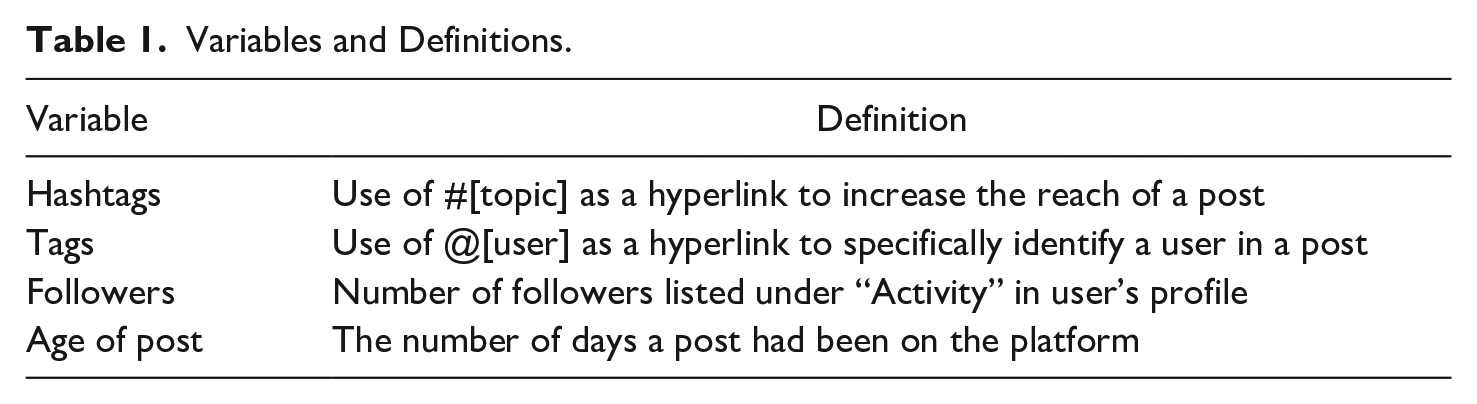
From the search results, we selected profiles based on the search term matches in either the job title or location. The user’s most recent post was collected upon accessing each profile and we recorded several metrics. First, we collected post’s text and its number of embedded hashtags and tags. We counted hashtags when they were marked with “#” and were hyperlinked. Tags were counted when they were marked with “@” or a name of another user that was hyperlinked. There were some cases where the post used “#” or “@” but they were not hyperlinked, so those did not count.
An online tool that extracts the exact date and time of LinkedIn posts was used to accurately determine the post’s date since LinkedIn does not offer precise timestamps (Fox, n.d.). The post’s age was calculated by subtracting the post date from the collection date. On average, the posts in our sample were 499 days old. Data collection occurred between January and April 2024.
We collected follower counts from each user’s profile page under “Activity.” Follower counts were selected because they include the user’s connections and follower audiences, making it the complete metric of a post’s potential audience. Plus, LinkedIn displays the exact number of followers a user has. LinkedIn displays the precise number of connections a user has up to 500, but after that, the number becomes “500+, ” making it too inexact for study.
We measured engagement with each post by collecting the number of reactions, comments, and reposts. Only one post per user was collected to ensure a varied sample. If a profile did not feature any posts, the profile was still logged in the database, but the post entry was left blank. Not all profiles had posts. To reach the final sample size of 1,001 posts, we reviewed 1,493 profiles. That means that 34% of the profiles contained no posts. All the variables that were collected and analyzed are displayed in Table 1.
Variables and Definitions.
Analysis
We identified a few outliers in our engagement metrics. For instance, the highest-performing post received 128,209 reactions, creating a wide range of 128,209 since some posts had 0 reactions. To address these outliers, we excluded the top 1% of posts based on reactions, assuming that a small portion of posts in a large sample would either go viral or attract unusually high engagement. The decision to use 1% ensured the smallest reduction in sample size while controlling for these anomalies. Removing the 10 highest-engagement posts reduced the reaction range from 128,209 to 12,230 (a reduction of 1.02 orders of magnitude), leaving a final sample of 991 posts.
We used multilevel negative binomial regression to analyze the variables since a user’s decision to comment, click the reaction button, or repost is a count outcome. We also chose the negative binomial model because of overdispersion in the data. The alpha value for all models was statistically significantly greater than zero, confirming the presence of overdispersion and confirming that negative binomial regression was the better choice for the analysis over the Poisson model. Prior to analysis, we checked the data for missing values and multicollinearity. There was no significant missing data, and multicollinearity diagnostics showed that all variance inflation factors were below 2, indicating no multicollinearity concerns.
Each post was on LinkedIn for different durations, allowing some posts more time to attract engagement than others. To account for the different number of days and eliminate bias in the regression estimates, we used the age of the post as an exposure variable. Since the exposure variable cannot be zero, we rounded posts initially coded as zero up to one.
For ease of interpretability of the effect size of the various independent variables, we reported the exponentiated betas. This means that exponentiated beta coefficients with a value above one represent a variable that increases the predicted rate of the engagement type. Those coefficients with a value below one represent a variable that decreases the predicted rate of engagement a post receives. Utilizing the incident rate ratios will allow us to more clearly understand how the different post variables work to predict the varying engagement outcomes. To evaluate model fit, we considered three statistical tests: McFadden’s R2, Cragg and Uhler’s R2, and the likelihood-ratio test statistic. We further discuss model fit in the analysis for each outcome variable.
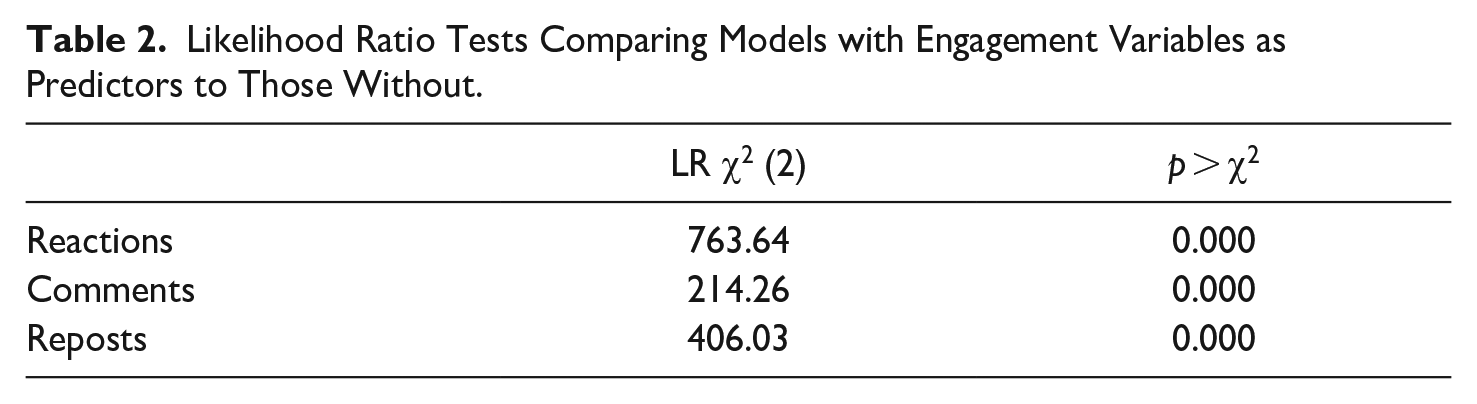
The dependent variables for our analysis are the number of reactions, comments, and reposts a post receives. We ran separate models for each possible engagement outcome. Independent variables included the number of hashtags, number of tags, follower count, and post age. In our models, we employed the outcome variables as predictor variables, as we suspect the engagement variables have a statistical relationship with other engagement variables. We post-tested the variance inflation factor to ensure no multicollinearity issues exist when including these variables. In all cases, factors were under the levels of concern. Likelihood ratio tests also show that including the outcome variables as predictor variables is a statistically significant improvement in model fit. Table 2 outlines the likelihood ratio test results for each engagement variable.
Likelihood Ratio Tests Comparing Models with Engagement Variables as Predictors to Those Without.
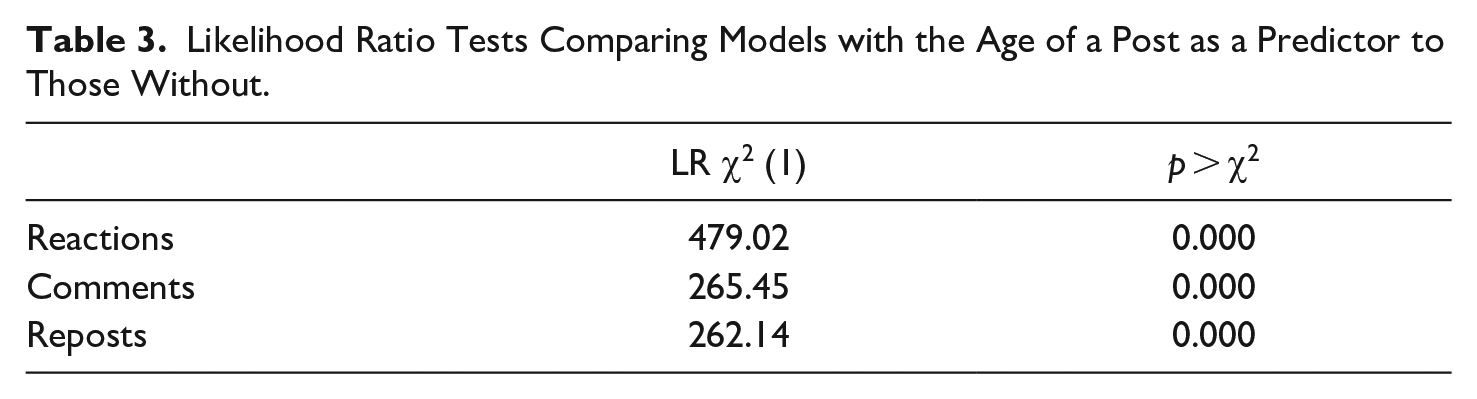
Few studies have examined the impact of a post’s age on engagement. Consequently, while we utilized it as an exposure variable, we also incorporated it as a predictor variable, as we believe it has an additional direct effect on the outcome. We conducted likelihood ratio tests to ensure we avoided redundancy in using post age as both an offset and a predictor variable. These tests assessed whether including post age as a predictor would improve the model’s fit. Results for all three tests show that including post age improves the model. Table 3 outlines the results of the LRT for each engagement variable.
Likelihood Ratio Tests Comparing Models with the Age of a Post as a Predictor to Those Without.
Findings
Descriptive Statistics
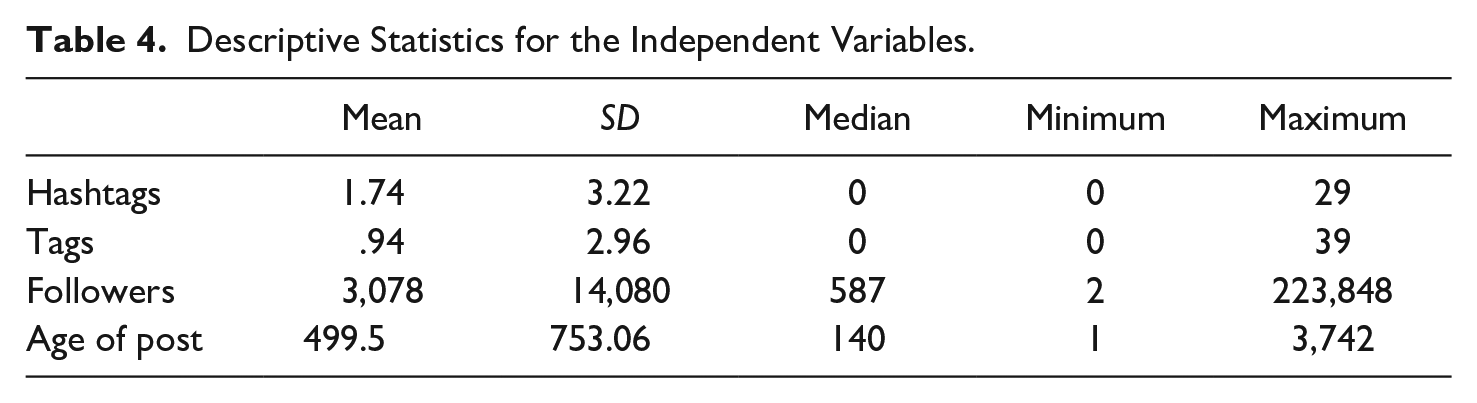
Regarding the nature of the posts, the sample averaged 1.74 hashtags and less than 1 tag per post. Thus, hashtags are standard in user posts, but tagging is less frequent. The average follower count was 3,078 per user, with a median of 587. The average age of the posts was 499.5 days (1.37 years), with a median of 140 days (4.6 months). All descriptive statistics are displayed in Table 4.
Descriptive Statistics for the Independent Variables.
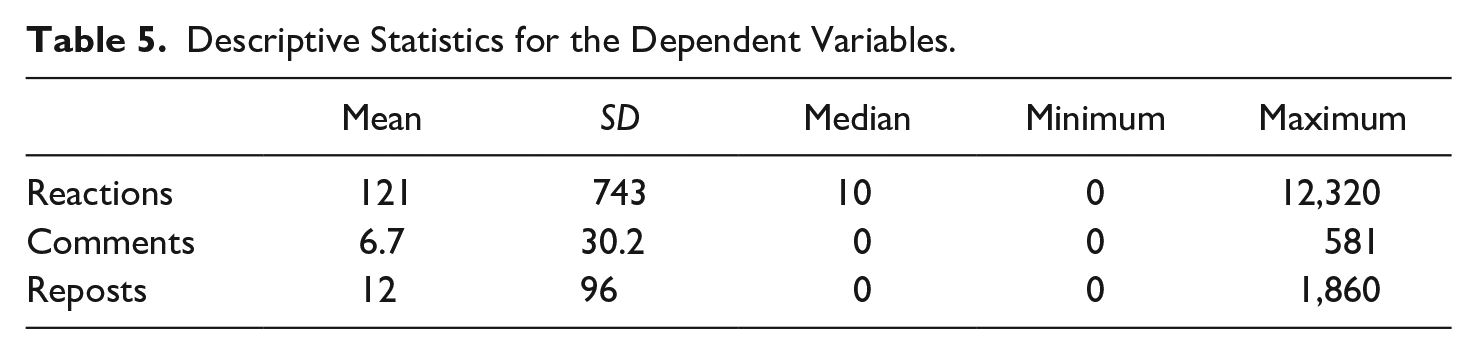
Regarding the levels of engagement, the posts had an average of 121 reactions with a median of 10. There were 6.7 comments per post on average, but more than half had 0. Reposts were more frequent than comments, with a mean of 12. Like comments, however, over half had 0. Table 5 shows the results.
Descriptive Statistics for the Dependent Variables.
Predicting Reactions
We started by conducting an analysis on the predicted number of reactions a LinkedIn post will receive. According to McFadden’s R2, the model explains 13% of the variation in the predicted rate of reactions. Cragg and Uhler’s R2 indicates that the model explains 74% of the variation in the outcome. The likelihood ratio test statistic shows that the model is statistically significant (p < .05), leading us to assume that our predictor variables explain a meaningful portion of the variance.
All the variables were statistically significant predictors, as shown in Table 6. While follower count was statistically significant, overall, the results show that a one-unit increase in followers makes little change in the predicted rate of reactions a post receives. One unit increases in comments, reposts, hashtags, and tags were all shown to increase the predicted rate of reactions a post receives. All the variables measured had incident rate ratios around one. However, tags had the largest IRR, showing that for every account tagged on a LinkedIn post, the number of predicted reactions the post received increased by a factor of 1.15.
Predicting Reactions on LinkedIn Posts.
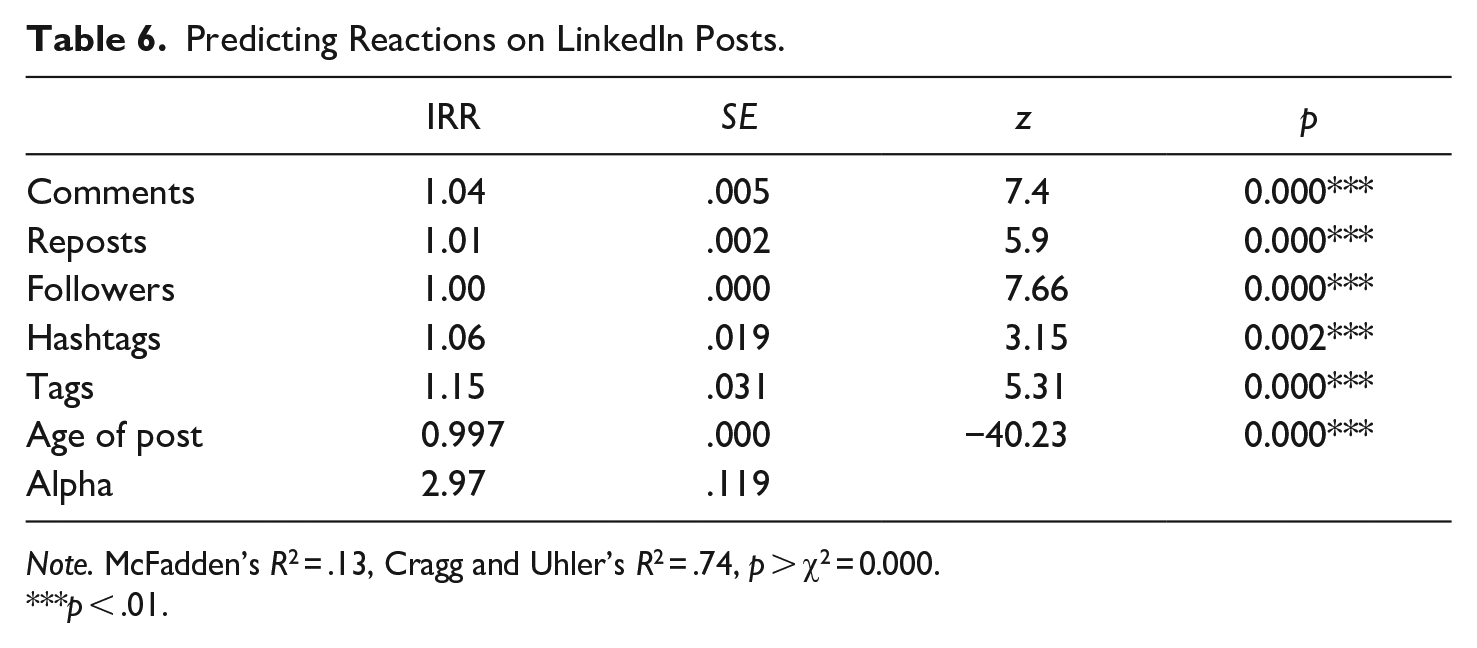
Note. McFadden’s R2 = .13, Cragg and Uhler’s R2 = .74, p > χ2 = 0.000.
p < .01.
Overall, the model’s predictor variables are all statistically significant in predicting the number of reactions a post receives. Some predictors have larger effects than others. When they are combined, they explain a moderate amount of the variance.
Predicting Comments
We ran the same test, this time employing comments as the outcome we were interested in predicting using our independent variables. According to our measures of fit, the model explains a meaningful amount of the variance in the outcome, with McFadden’s R2 reporting 11% and Cragg and Uhler’s R2 reporting 42%. The model is also overall statistically significant. Table 7 shows the results of the negative binomial regression.
Predicting Comments on LinkedIn Posts.
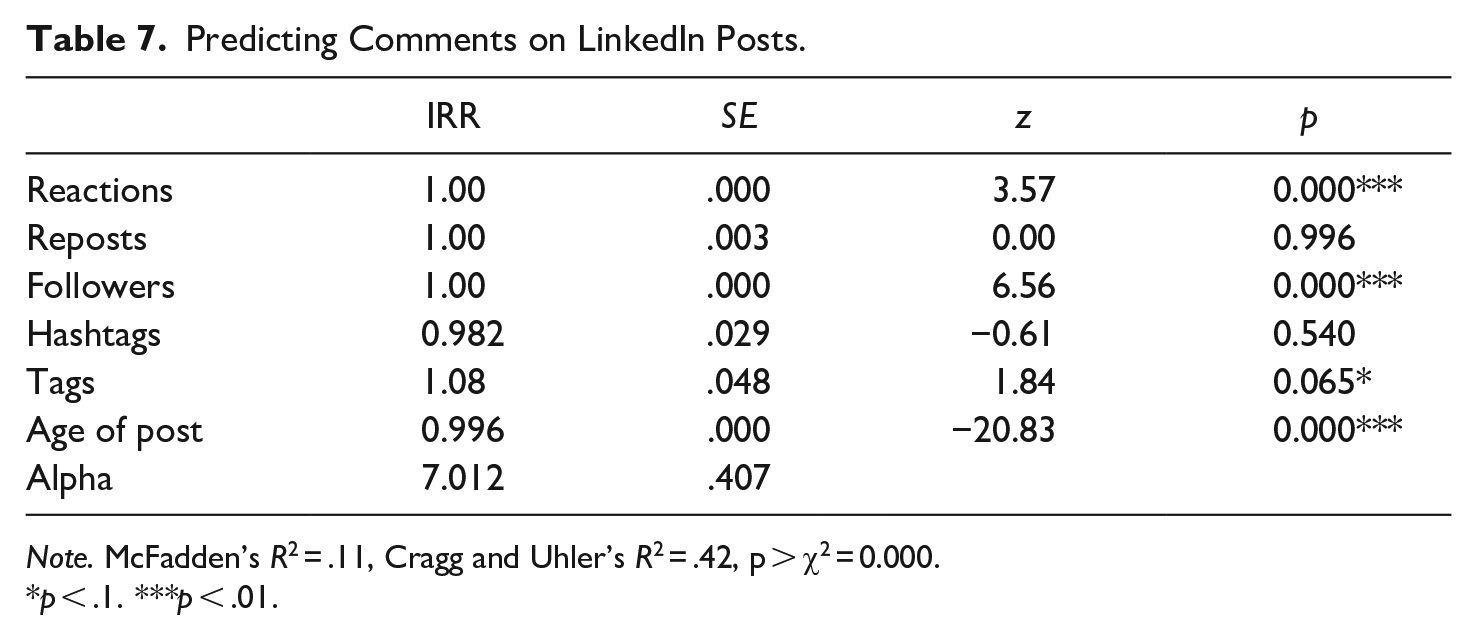
Note. McFadden’s R2 = .11, Cragg and Uhler’s R2 = .42, p > χ2 = 0.000.
p < .1. ***p < .01.
Tags, again, have the most substantial effect on the predicted outcome. For every unit increase in tags included in a LinkedIn post, the predicted rate of comments that the post receives increases by a factor of 1.08. Tags were also statistically significant in this model (p < .1).
Reactions, follower counts, and the age of the post are all statistically significant in this model. Reactions and follower counts show little to no effects in increasing comments. The age of a post decreases the predicted rate of comments that a LinkedIn post may receive. Overall, reposts and hashtags are not statistically significant predictors of comments.
Predicting Reposts
Our last model tests whether our predictor variables account for expected counts of reposts. Our resulting model explained 16% of the variance in the outcome according to McFadden’s R2 and 52% according to Cragg and Uhler’s R2. The model was statistically significant overall, as shown in Table 8.
Predicting Reposts on LinkedIn Posts.
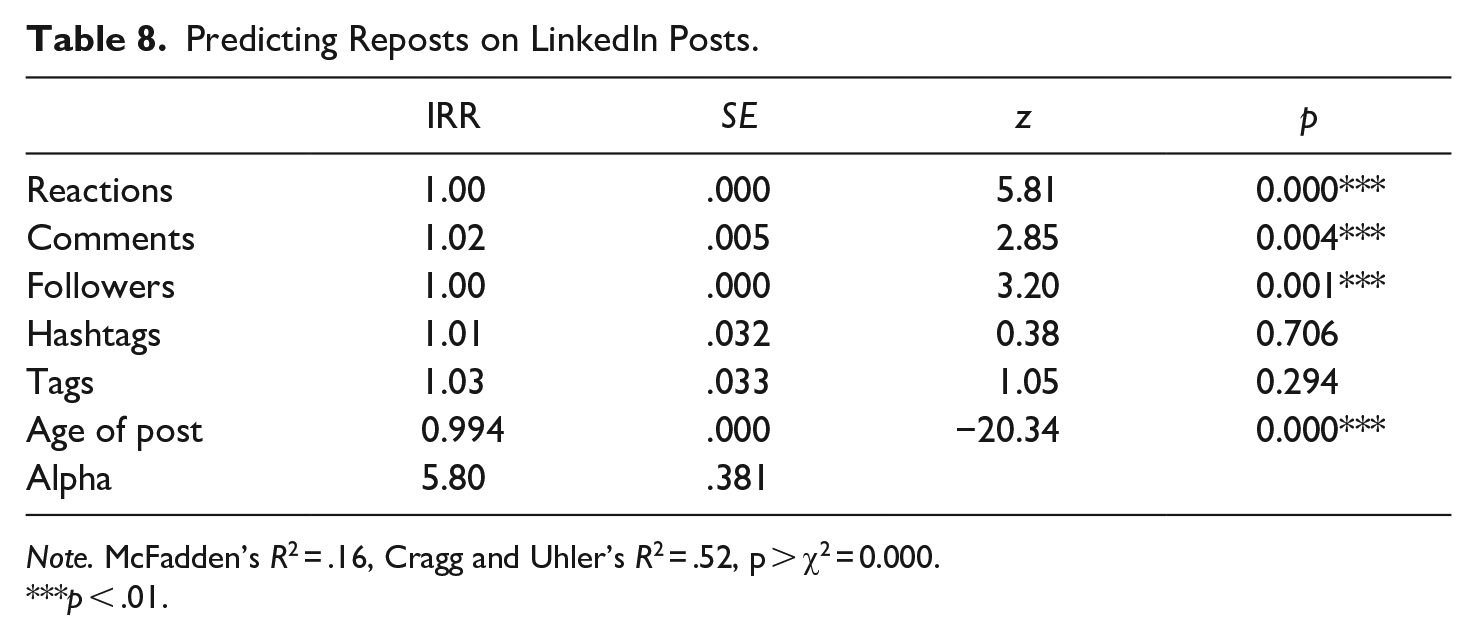
Note. McFadden’s R2 = .16, Cragg and Uhler’s R2 = .52, p > χ2 = 0.000.
p < .01.
The number of reactions, comments, followers, and the age of the post are all statistically significant predictors of reposts. Mirroring the other two models, the independent variables have incident rate ratios close to one. A single-unit increase for each of these variables alone results in little to no predicted change in the rate of reposts for a post.
Discussion
Our analysis of LinkedIn post engagement reveals two primary predictors for reactions, comments, and reposts: the post’s age and the user’s follower count. Posts that are older tend to generate lower engagement across these metrics, while accounts with larger follower counts can anticipate a relatively higher level of engagement. Although reactions and comments both emerged as statistically significant predictors, they showed only minor changes in engagement on a per-unit basis. Additionally, while hashtags demonstrated significance in boosting reaction counts, they did not hold predictive value for comments or reposts. Nevertheless, the use of tags proved to be the most substantial predictor for both reactions and comments, underscoring its notable impact on engagement outcomes. Our results contribute to a broader conversation on LinkedIn-specific behaviors and extend our understanding of engagement on the platform beyond profiles, user perceptions, and business accounts. They also yield practical implications for users seeking to maximize their professional outcomes on the platform.
Our study explores the use of hashtags outside of Twitter and Instagram as called for by La Rocca and Ariteri (2022). Our findings suggest that hashtags in LinkedIn posts increase the expected number of reactions by 6%. While hashtags can have other linguistic uses, as identified by Zappavigna (2015), users who deploy large amounts of hashtags to increase a post’s engagement might be doing it for naught. Our data show that LinkedIn users do not hashtag often. In agreement with Berbegal-Mirabent and Caballero’s (2023) findings on Instagram, fewer but more contextually relevant hashtags to increase engagement might be the best strategy on LinkedIn too.
Our study also responds to the literature on tagging. Just as Kümpel’s (2019) study found that being tagged increased a user’s intention to read a news article on Facebook, we found that tags in LinkedIn posts substantially increased the expected number of reactions by 15%. The reason why tags are a strong motivator for engagement is subject to speculation. Based on Kang et al.’s (2022) study, perhaps tags are seen as a more personal gesture of affirming a relationship, so the tagged user is likelier to reply. Additionally, witnesses seeing the affirmation of the relationship in the post may be persuaded to engage because of a bias toward responding to positive things on social media (Yang et al., 2024). Nevertheless, the mean and median number of tags used in a post were below 1, showing that users deploy them infrequently. However, the results show that if users tag others more frequently, they should expect to see more reactions and comments to their posts.
Regarding the research on post timing, the age of a post is a consistent negative predictor of expected engagement across all three metrics. The older a post is, the less is the expected engagement. While this study did not monitor the exact times of each metric across a timeline like Spasojevic et al. (2015) did, the findings do support the idea that posts have a birth window for reaching peak engagement and a decay process where those metrics continually decrease. The decay process might be explained by the social media algorithm placing primacy of newer posts and updates over older ones. There is no way to stop this inevitable decay, so users should try to post fresh content often.
In terms of follower counts, our study finds that they only marginally increase the expected number of reactions, comments, and reposts on LinkedIn. This finding supports the idea that the relationship between follower counts and engagement is not strongly linear as debated in the literature (Jain et al., 2023; Wies et al., 2023; Zhu & Hsiao, 2021). In any case, our study brings LinkedIn into the cross-platform conversation, dominated by X and Instagram, about the impact of follower counts. We can confirm that users seeking to purchase or artificially inflate their follower counts on LinkedIn should not expect to see a major increase in engagement unless they acquire a stupendous amount.
In the descriptive statistics, the average number of reactions per post was 10 times more than the average number of comments and reposts. As one-click paralinguistic digital affordances, they may indeed be given more liberally than other forms of engagement (Hayes et al., 2016). In line with Kim and Yang’s (2017) findings, the sensory nature of posts may invoke users to like more liberally as well. If a post has higher reach because of higher follower counts and users are more prone to hitting the reactions button, then this could be an explanation for higher amounts of reactions on LinkedIn. From a predictive standpoint, reactions had the highest number of significant predictors, including post age, tags, hashtags, and follower counts. Additionally, comments and reposts were weak but positive predictors of reactions. One potential explanation for this trend is that users who react may then be encouraged to comment, either to show support or to participate in a conversation. Alternatively, seeing others’ comments may prompt users to react to the original post. This interdependent relationship among engagement types, however, remains difficult for us to assess without chronological data. In any case, if receiving likes provide positive emotional value similar to earning money (Sherman et al., 2018), then users who post on LinkedIn could be getting some self-esteem gratification and advantage compared to those who do not post at all.
Comments were the least frequent form of engagement, with at least 50% of posts never receiving a comment. Perhaps LinkedIn users prefer to react to posts or to repost since both can be done in one or two clicks. Comments require typing, and perhaps that requires more of an investment from a passively scrolling user. Given that LinkedIn is a place for professionals to share their personal brand, comments could be an ideal space for them to display their personal brand without having to generate an entirely new post. Nevertheless, follower counts, reactions, and post age all contribute to slight expected increases in the number of comments. Tags increase expected comments by 8.4%, which shows that specifically prompting users in a post increases the propensity for them to react or comment just as tagging users in a news article prompts them to read it (Kümpel, 2019). Reactions, as a predictor variable, also influence the expected number of comments albeit by 0.2%. While for every unit increase they yield little to no change in the predicted number of comments, reactions might serve as social proof that nudges users to engage and if the post reaches a large enough audience, it will yield a comment. Further, as the post ages, perhaps users see less need to comment as the topic “dies,” which explains the negative relationship between the post’s age and engagement. With comments being the least frequent form of engagement, users who are able to yield them from their posts gain message reception advantages over those whose posts do not, assuming the comments are positive (Trinkle et al., 2015).
Regarding reposts, our data show that over 50% of LinkedIn posts do not get reposted. While studies suggest that reposting is the highest form of engagement for psychological and social reasons (Kim & Yang, 2017; Lee & Ma, 2012), our descriptive statistics could challenge the supremacy of reposts by suggesting that comments are instead the highest form of engagement on LinkedIn. After all, comments increase expected reposts and reactions. Reposts only increase reactions. Comments also arguably require more user investment since they require typing, while reposts can be done in a single click. In addition to comments, follower counts and reactions, again, show a statistically significant yet fractional expected increase in reposts. As the post ages, it gets reposted less because of the primacy of newer content. Moreover, while users report that their motives for reposting are self-presentational (Ham et al., 2019; Lee & Ma, 2012), our findings may suggest that users have other means of fulfilling that goal on LinkedIn.
Overall, all three of our models offer modest explanatory power of the data. All three models offer statistically significant yet low effect predictor variables. Our two strongest predictor variables are the effects of tags and hashtags on reactions. This means that every investigated engagement boosting strategies may have a small effect, but these small effects all together add up to modest increases in engagement, especially as the post gets more views.
For educators, coaches, and LinkedIn users seeking to improve their posts and professional outcomes, we can now offer a few empirically based suggestions. First, users should be selective about the hashtags that they use in their posts since their effects are curvilinear with engagement. Second, tagging is a powerful tool for prompting reactions and comments. Third, users should post frequently as older posts decay and lose engagement over time. Fourth, follower counts only marginally improve engagement, so the focus for driving engagement should be on building the post’s quality. Ultimately, posts that generate reactions have a potential to generate higher forms of engagement like comments and reposts as reactions are the digital currency that LinkedIn users tend to give each other the most. Professionals should post topics that celebrate others, seasonal observances, and personal achievements to receive more reactions (Usera et al., 2024).
Limitations and Future Directions
This study has limitations that future studies can rectify and expand upon. From a sampling standpoint, this study used search terms that would heavily draw from users in the Dallas Fort Worth metroplex. It is possible that other regions of the United States and parts of the world might show different engagement habits. The sample size was also 991 posts. While this may seem large, there are over a billion users on LinkedIn. If just .0001% of the user base posts daily, that would be 100,000 posts per day. Therefore, future studies should also seek larger sample sizes.
Regarding the nature of the posts, this study measured hashtags, tags, post age, follower counts, and engagement. In that endeavor, it did not consider the post’s topic, nor the usage of media. A future study could investigate the use of media on LinkedIn, where features of the photo or video are coded and regressed with engagement metrics. After all, including human faces in photos increases engagement (Tobarina et al., 2020), and such a study could investigate other photo or video features. Another study could do a deeper content analysis of the posts and identify common topics discussed on the platform and their engagement metrics.
Regarding reactions, LinkedIn offers several types of reactions besides just “like.” This study merely counted the number of reactions per post and did not make distinctions between the different reaction types. It is possible that users give specific reactions to certain content and that there may be some patterns to each reaction type. Moreover, knowing that reactions impact how users perceive posts (Borah & Xiao, 2018), such a study can also investigate how users perceive the post based on comparative frequencies of the different reaction types.
This study also counted the number of comments per post to measure engagement. However, much of the literature on comments considered their valance , specifically negative ones. Since LinkedIn is a professional network, it is unknown how frequently negative comments appear in posts and whether they would be increasingly or decreasingly aggressive than other platforms like Facebook. A future study could investigate comments on LinkedIn posts by investigating their valence , aggressiveness, affection, and other linguistic features. Comments influence message reception (Trinkle et al., 2015), so it would be worthwhile to discover.
Our study also does not offer any systematic analysis of the LinkedIn algorithm itself, which might serve as a mediator or moderator for engagement. While we considered the age of the post as a variable, for example, it is possible the algorithm might nullify the impact of age by giving primacy to popular older posts over less popular newer posts. The CEO of Instagram has written that the network’s Feed algorithm prioritizes content based on predicted time spent viewing a post, commenting on it, liking, sharing, or tapping on the profile photo (Mosseri, 2023). We do not have this same kind of definitive knowledge about LinkedIn’s algorithm from an authoritative source, so any comparisons are speculative. Nevertheless, future studies might be able to make stronger inferences about the algorithm by considering past user activity, time spent viewing a post, and other algorithmic factors.
Lastly, this study was an exploratory analysis of the impact of four variables on engagement, seeking to identify broad patterns in user behavior. One resulting limitation is the absence of control variables. The post topic, nature of media, timing, or one’s occupation could mediate or moderate engagement levels. Including these factors could help isolate the unique effects of the studied predictors. Future research could build on this study’s findings by incorporating control variables and exploring differing combinations of post variables to understand better what best predicts engagement.
Conclusion
What predicts engagement on LinkedIn? Our findings show that it depends on the desired engagement metric. Follower counts and newer posts increase expected engagement across all metrics. If a LinkedIn user is seeking reactions, then they should use tags and hashtags. Comments and reposts will also increase their expected reaction counts. If users are seeking comments and reposts, then prompting reactions helps both. Receiving comments on their posts will also increase their reposts. All these factors combine to increase expected engagement for a post. When their post is seen at scale, they can maximize their engagement and achieve their career goals on the world’s largest online professional network.
Footnotes
Declaration of Conflicting Interests
The author(s) declared no potential conflicts of interest with respect to the research, authorship, and/or publication of this article.
Funding
The author(s) received no financial support for the research, authorship, and/or publication of this article.
