




Abstract
LinkedIn has emerged as a dominant platform for professional networking and career development, yet bibliometric analyses on its scholarly landscape remain scarce. This study systematically maps LinkedIn research using 1,273 peer-reviewed publications from Web of Science (WoS), following the SPAR-4-SLR protocol. To address four core research questions, we analyze (1) thematic structures and evolution, (2) collaboration and citation networks, (3) publication venues and citation metrics, and (4) emerging trends. Key bibliometric indicators—total citations (25,461), h-index (38), and publication trends—were analyzed, while co-citation and bibliographic coupling (WoS) and keyword co-occurrence (Scopus) network analyses were conducted using VOSviewer. Results reveal a sharp publication increase, peaking at 204 in 2023, with Computers in Human Behavior (19 papers, 898 citations) and PLOS One (10 papers, 897 citations) as leading outlets. Research clusters focus on recruitment, professional branding, and LinkedIn’s role in organizations, though empirical validation remains limited, particularly regarding career outcome predictions. Findings offer a structured knowledge base for academia and industry. Limitations include reliance on WoS for citations and Scopus for keywords, potentially introducing data set inconsistencies. Future research should integrate cross-database approaches and explore LinkedIn’s role in AI-driven recruitment.
Introduction
The increasing digitization of professional interactions has transformed how individuals and organizations engage in career development, recruitment, and knowledge exchange. Traditional networking approaches have largely transitioned to online platforms, reshaping professional visibility and career mobility. Among various digital networking tools, LinkedIn has emerged as the dominant professional social network, boasting over 950 million users across 200 countries (LinkedIn, 2024). Unlike general-purpose platforms such as Facebook and Twitter, which emphasize social interaction and content dissemination, LinkedIn is structured around career development, corporate networking, and professional branding (Kietzmann et al., 2011; Van Dijck, 2013). It serves as a hybrid between a job market and a knowledge-sharing network, facilitating talent acquisition, business collaborations, and thought leadership (Labrecque et al., 2011; Nikolaou, 2014). Given its rapid expansion, LinkedIn has attracted growing scholarly attention, leading to an increase in empirical studies on recruitment practices, organizational behavior, and personal branding in digital ecosystems (Skeels & Grudin, 2009; Zide et al., 2014). However, despite LinkedIn’s growing influence, no systematic bibliometric analysis has been conducted to map its intellectual structure, raising questions about the trajectory, impact, and key research themes shaping its academic discourse.
This study positions itself within this emerging but fragmented literature. While LinkedIn’s importance has been increasingly recognized, the absence of a structured synthesis makes it difficult to assess how research on the platform has evolved, where scholarly attention has been concentrated, and which areas remain underexplored.
Professional social networking has been studied within various theoretical and empirical domains, including human resource management (McCabe, 2017), digital identity formation (Papacharissi, 2012), and algorithmic hiring processes (Gershon, 2018). Comparatively, platforms like Twitter have been extensively analyzed for academic visibility and knowledge dissemination (Haunschild et al., 2019; Thelwall and Levitt, 2020), while ResearchGate and Google Scholar have been examined for scholarly reputation management (Jamali et al., 2020; Orduna-Malea et al., 2017). However, LinkedIn’s unique positioning at the intersection of corporate networking and career progression (Bohnert & Ross, 2010; Roulin & Levashina, 2019) warrants a distinct analytical approach. Existing bibliometric studies have largely focused on broad social media trends (Dwivedi & Sen, 2025; Kapoor et al., 2018) or individual platforms outside LinkedIn. This lack of focused bibliometric attention leaves a conceptual gap regarding LinkedIn’s research trajectory, the thematic clusters that define it, and the collaborative structures underlying its scholarly development. This fragmented approach limits our understanding of LinkedIn’s scholarly evolution, necessitating a dedicated bibliometric investigation to examine how its research landscape has developed over time.
LinkedIn’s role in academic and professional discourse aligns closely with Social Network Theory (SNT), which explains how network structures influence information flow, career opportunities, and resource access (Borgatti & Halgin, 2011; M. S. Granovetter, 1973). Unlike traditional professional interactions, LinkedIn employs algorithmic recommendations and data-driven engagement mechanisms to mediate networking behaviors, altering the dynamics of trust, influence, and career mobility (Marwick & Boyd, 2011; Wellman, 1996). In academic research, SNT has been used to study collaborative knowledge networks (Newman, 2001), structural holes in digital interactions (Burt, 2004), and network-based hiring practices (Marlow & Dabbish, 2013). Applying this framework to LinkedIn bibliometric research enables a structured analysis of its scholarly trajectory, identifying how research clusters, citation networks, and thematic structures evolve over time. This theoretical grounding also motivates the core analytical dimensions explored in this study—namely, thematic domains, collaboration patterns, publication venues, and future trends.
While previous studies have examined LinkedIn’s role in recruitment (Nikolaou, 2014), professional branding (van Dijck, 2013), and job-seeker strategies (Caers & Castelyns, 2011), no study has systematically mapped how LinkedIn research itself has evolved as a field. The absence of a comprehensive bibliometric analysis creates several challenges:
Lack of a structured overview: Existing studies examine isolated aspects of LinkedIn research but fail to provide a global view of its intellectual structure.
Unclear thematic evolution: It remains unknown which research themes have emerged, persisted, or declined over time in LinkedIn scholarship.
Limited citation and collaboration analysis: There is no quantitative mapping of citation networks, author collaborations, or institutional contributions in LinkedIn research.
To address these gaps, this study develops an integrative bibliometric framework that quantifies LinkedIn’s academic development, uncovers dominant themes, and maps its collaborative landscape.
To achieve these objectives, the study is guided by the following specialized and technically rigorous research questions:
1. What are the key research domains that define LinkedIn-related scholarship, and how have they evolved over time?
This question examines thematic structures, dominant trends, and shifting research priorities within LinkedIn literature.
2. How are scholarly collaborations and citation networks structured in LinkedIn research?
This focuses on author networks, institutional contributions, and global research collaboration patterns.
3. Which journals and conferences have played a pivotal role in shaping LinkedIn research, and what are their citation impacts?
This investigates publication venues, citation metrics, and the most influential sources driving LinkedIn-related academic discussions.
4. What are the emerging trends and potential future directions in LinkedIn research based on bibliometric indicators?
This explores keyword co-occurrence patterns, recent research trajectories, and gaps for future exploration. Using 1,273 peer-reviewed publications indexed in Web of Science (WoS), this study conducts a comprehensive bibliometric analysis employing:
Citation analysis to identify high-impact publications and authors.
Co-authorship networks to map global research collaboration.
Thematic clustering (co-citation and bibliographic coupling) using VOSviewer to visualize LinkedIn’s research frontiers.
Keyword analysis (from Scopus) to detect emerging trends.
Together, these components form a holistic response to the identified research gap, offering a structured synthesis of LinkedIn research, providing valuable insights for researchers, industry practitioners, and policymakers navigating its evolving intellectual space.
The remainder of this article is structured as follows: Section 2 reviews the existing literature on LinkedIn research and bibliometric methodologies. Section 3 details the research methodology, including data collection, bibliometric indicators, and network analysis techniques. Section 4 presents the results, covering citation trends, thematic clusters, and emerging research directions. Section 5 discusses key findings, implications, and limitations, followed by Section 6, which outlines conclusions and future research directions.
Related Work
Perspectives on LinkedIn’s Role in Professional and Academic Networks
The proliferation of social media has profoundly influenced various academic and professional domains, with LinkedIn emerging as a central platform for professional networking, recruitment, and career development. Unlike general-purpose social networks such as Facebook and Twitter, which primarily facilitate personal interactions, LinkedIn is strategically designed to foster career-oriented engagements and industry-specific knowledge sharing (Kietzmann et al., 2011). Its distinct functionalities, including endorsements, professional groups, and AI-driven job recommendations, make it a critical tool for both job seekers and recruiters. Several studies emphasize LinkedIn’s role in reshaping career trajectories and employment practices (Nikolaou, 2014; Rauniar et al., 2014; Van Dijck, 2013). However, recent literature has questioned whether LinkedIn’s benefits are universally distributed or whether its effectiveness is contingent on specific user behaviors, industries, or algorithmic biases (Koch et al., 2018; Van Esch & Black, 2019). While these studies shed light on platform functionality and user engagement, they remain fragmented and do not provide a consolidated view of how scholarly inquiry into LinkedIn has evolved or been distributed across disciplines.
A substantial body of research has explored LinkedIn’s impact on recruitment and hiring efficiency (Davison et al., 2011; Koch et al., 2018; Nikolaou, 2014). While LinkedIn is widely regarded as an effective medium for sourcing candidates, studies highlight potential biases in digital hiring processes. Recruiters rely on LinkedIn’s profile features—including recommendations, endorsements, and activity levels—to assess candidates (Roulin & Levashina, 2019; Van Dijck, 2013), but the extent to which these features correlate with actual job performance remains debated (Van Iddekinge et al., 2019). Caers and Castelyns (2011) examined recruiter behavior and found that hiring decisions were influenced by nonmeritocratic factors such as profile aesthetics and visible network size, potentially reinforcing structural inequalities in the hiring process.
Beyond recruitment, LinkedIn has been analyzed as a tool for professional branding and career management (Cheung & Lee, 2010; Cohen & Baruth, 2017). Studies indicate that self-presentation strategies on LinkedIn are designed to maximize career prospects, leading to the curation of profiles that emphasize achievements and endorsements over nuanced skill assessments (Duffy & Chan, 2019; Van Dijck, 2013). Guillory and Hancock (2012) compared LinkedIn profiles with traditional resumes and found that while LinkedIn’s public nature discourages outright falsifications of credentials, users strategically alter their profiles by amplifying unverifiable attributes such as personal motivations and leadership potential. This raises questions about LinkedIn’s role in promoting transparency versus enabling curated self-presentation.
The platform’s role in knowledge dissemination has also been explored in academic contexts. Thelwall et al. (2013) and Haustein et al. (2014) discuss LinkedIn’s potential as an altmetrics source, with some studies suggesting that it plays a minor role compared with Twitter and ResearchGate in scholarly communication. Nevertheless, LinkedIn remains an essential networking tool for academics and professionals (Abel et al., 2013; Mas-Bleda et al., 2014). However, research by Zide et al. (2014) highlights disparities in LinkedIn usage across different professions, revealing that sales and marketing professionals leverage LinkedIn more actively than those in technical fields or academia, where engagement levels tend to be lower (Grajales et al., 2014; Guraya, 2016). These findings suggest that LinkedIn’s effectiveness is not uniform across professional domains, leading to questions about whether the platform disproportionately benefits certain occupational groups over others (Chang et al., 2017; Rodriguez et al., 2012).
Recent advancements in AI-driven recruitment have further complicated LinkedIn’s role in hiring and networking. Kim and Heo (2022) discussed how AI-based video interviewing, increasingly integrated with LinkedIn’s hiring tools, affects employer perceptions and applicant experiences. While AI technologies enhance efficiency, Utz (2016) found that LinkedIn’s career benefits are not uniformly distributed, with active users gaining disproportionate advantages over passive users. This challenges the notion that LinkedIn provides equal networking opportunities, instead suggesting that professional success on the platform depends heavily on strategic engagement behaviors rather than passive profile maintenance.
Further scrutiny into LinkedIn’s effectiveness reveals discrepancies between theoretical expectations and empirical outcomes. J. Davis et al. (2020) argue that LinkedIn’s network size alone does not guarantee professional advancement—instead, the nature of interactions and frequency of engagement are stronger predictors of career benefits. This contradicts previous assertions that LinkedIn’s primary advantage is in expanding professional reach. Similarly, research by Karl et al. (2022) highlights that algorithmic recommendations and content visibility mechanisms often favor highly active users and well-connected professionals, inadvertently creating disparities in opportunity accessibility.
Bibliometric analyses of LinkedIn research further emphasize these inconsistencies. The growing body of LinkedIn-related studies in Web of Science (WoS) and Scopus databases reveals thematic clusters focused on recruitment, branding, and digital hiring, yet few studies critically assess biases in algorithm-driven hiring models (Haustein et al., 2014; Mas-Bleda et al., 2014). Citation network analysis indicates that influential papers, such as Nikolaou (2014) and Van Dijck (2013), are frequently referenced in recruitment-based research but are less cited in studies investigating LinkedIn’s impact on social stratification. This suggests a research gap in studies that explicitly evaluate LinkedIn’s role in reinforcing employment inequalities. Despite identifying dominant themes, prior literature offers limited insight into how these themes have evolved over time, which institutions or networks have driven them, and whether specific subfields have emerged or declined.
Another critical issue is the persistence of demographic biases in LinkedIn-based hiring assessments. Roulin and Levashina (2019) found that recruiters are influenced by superficial profile characteristics, such as profile pictures and network size, rather than purely competency-based indicators. Their study further revealed that applicants from underrepresented demographic groups often receive lower engagement rates and fewer job opportunities, reinforcing concerns that LinkedIn’s hiring ecosystem may perpetuate rather than eliminate social inequalities.
Furthermore, Zide et al. (2014) demonstrated that LinkedIn’s role in professional networking varies widely across industries, with certain professions benefiting significantly more than others. This aligns with findings from Mas-Bleda et al. (2014) and Grajales et al. (2014), which suggest that academia and specialized technical professions engage less with LinkedIn, thereby reducing its effectiveness as a universal professional tool.
Finally, research indicates that while LinkedIn provides a platform for professional branding, its effectiveness in job placement remains ambiguous. Guillory and Hancock (2012) emphasize that public profiles encourage selective self-presentation rather than transparency, raising ethical concerns about the accuracy of information presented to potential employers. This issue is exacerbated by findings from Hargittai (2020), which indicate that LinkedIn’s data-driven hiring processes might amplify biases rather than mitigating them, particularly in algorithmically curated job recommendations.
Taken together, these insights highlight a nuanced and complex view of LinkedIn’s professional impact. While it remains a valuable tool for career networking, its benefits are neither universally distributed nor free from limitations. Bibliometric research should analyze the evolution of citation networks in LinkedIn research, contrasting studies on professional branding, employment fairness, and algorithmic biases to provide a more balanced academic perspective. Yet, there remains no holistic bibliometric effort that synthesizes this evolving landscape, evaluates scholarly influence through co-authorship and citation networks, and pinpoints underexplored themes and disciplinary gaps.
Bibliometrics
The studies reviewed in the previous section collectively demonstrate LinkedIn’s significant influence on professional networking, recruitment practices, and career development. However, despite the growing body of literature, there remains a lack of bibliometric analyses specifically focused on LinkedIn. While bibliometric studies have been conducted on social media research in general or on platforms like Facebook and Twitter, LinkedIn-specific bibliometric examinations are still limited. To address this gap, the present study conducts a comprehensive bibliometric analysis of LinkedIn research. By systematically analyzing scholarly publications related to LinkedIn, we aim to uncover key trends, identify influential authors and institutions, and map the intellectual structure of the field. This analysis will contribute to a deeper understanding of LinkedIn’s role in academic research and its broader implications across various professional domains. Before we detail our work, we review existing and related bibliometric studies.
Bibliometrics is a quantitative method for analyzing academic literature, focusing on the statistical evaluation of publications and their citations (Broadus, 1987; Pritchard, 1969). The term “bibliometrics” was introduced by Pritchard (1969) in the Journal of Documentation. This field aims to examine publication metadata to uncover patterns in scholarly communication and research activities, particularly within specific phenomena or disciplines. The origins of bibliometrics can be traced back to Garfield’s (1955) pioneering work on citation indexing, which laid the foundation for modern citation analysis (Bensman, 2007; Rousseau, 2014). A fundamental assumption in bibliometrics is that citations are a reliable indicator of the influence and impact of published papers or researchers within a particular area of study (Garfield, 1955; Small, 1973). This assumption allows scholars to assess the significance of articles and authors based on citation metrics, providing insights into academic output and productivity over time.
Bibliometric methods enable the extraction of conceptual, intellectual, and social structures within a discipline (Donthu et al., 2021; Vogel & Güttel, 2013). By analyzing citation networks, co-authorship patterns, and keyword co-occurrences, researchers can identify core research themes, influential works, and key contributors. This quantitative approach aids in understanding how academic fields emerge and evolve, highlighting trends and focal points that have shaped a specific field. A brief review of bibliometric studies underscores their importance across diverse research areas. For instance, Bar-Ilan (2008) reviewed informetrics at the beginning of the 21st century, emphasizing the evolution of bibliometric methods. Ding et al. (2014) discussed approaches to measuring scholarly impact, highlighting the relevance of bibliometrics in contemporary research evaluation. Glänzel et al. (2019) provided comprehensive insights into science and technology indicators, illustrating how bibliometric analyses inform policy and decision-making processes. However, prior bibliometric research rarely interrogates how disciplinary differences, database indexing policies, or field-specific citation norms can distort interpretation. For LinkedIn—an interdisciplinary topic intersecting business, technology, psychology, and health—such oversights risk fragmenting insight across domains.
Bibliometric Studies on Social Media
Bibliometric analysis has been instrumental in mapping the development and trends of social media research. Quantitatively assessing publication patterns, citation networks, and thematic evolutions all provide valuable insights into the intellectual landscape of the field. Khang et al. (2012) conducted an early comprehensive bibliometric analyses of social media research in advertising, communication, marketing, and public relations from 1997 to 2010. Their study analyzed 1,175 articles from major journals, identifying a rapid increase in social media research since 2005. The authors highlighted key themes such as user-generated content, online communities, and the impact of social media on traditional communication models. Leung et al. (2013) performed a bibliometric study focusing on social media in tourism and hospitality. Analyzing 132 articles published between 2007 and 2011, they identified the most influential authors, journals, and institutions. Their findings revealed that social media research in tourism was expanding, with predominant themes including electronic word-of-mouth (eWOM), online reviews, and consumer decision-making processes. Ngai et al. (2015) offered a literature review and classification of social media research from 2004 to 2014, incorporating bibliometric elements. They examined 164 articles and proposed a framework categorizing social media research into seven areas: social media concepts and definitions, user behavior, social media marketing, knowledge sharing, social media analytics, privacy and ethical issues, and enterprise social media. This work highlighted the multidisciplinary nature of social media research and the evolving interests over time.
In the field of health communication, Sinnenberg et al. (2017) conducted a systematic review of Twitter as a tool for health research, which included bibliometric analysis. Reviewing 137 studies, they observed a significant increase in publications from 2010 onward. The study identified common research topics such as health surveillance, public health communication, and sentiment analysis, emphasizing Twitter’s utility in real-time health data collection. Adding to this body of work, Anugerah et al. (2022) conducted a bibliometric analysis of Social Network Analysis (SNA) in business and management research from 2001 to 2020. Utilizing 2,158 research articles from the Scopus database, they identified an upward trend in SNA research, particularly after 2005, peaking in 2020. Their study revealed six key areas within business and management where SNA is applied: risk management, project management, supply chain management, tourism, technology and innovation management, and knowledge management. This analysis underscores the growing importance of SNA methodologies, which are often utilized in studying platforms like LinkedIn because of the rich relational data they provide.
Recently, Ali et al. (2023) undertook a bibliometric analysis and systematic review at the intersection of social media platforms and social enterprises. Analyzing literature up to 2022, they offered a classification into three clusters: social media platforms with social collaboration and marketing, social media platforms with crowdfunding, and social media platforms with crowdsourcing. Their study proposed a conceptual framework linking social media platforms, entrepreneurial practices, and social enterprise performance. They highlighted the need for more quantitative, empirical, and theory-based studies, emphasizing the role of digital technologies and platforms like LinkedIn in addressing societal problems and enhancing operational efficiencies of social enterprises. In the field of psychology, Zyoud et al. (2018) performed a bibliometric analysis of literature on social media trends. Analyzing 959 publications from 2004 to 2015, they observed a steady upward growth in research related to social media within psychology. The United States accounted for the highest number of publications and the highest h-index. Their visualization analysis indicated that personality psychology, experimental psychology, psychological risk factors, and developmental psychology were continual concerns in the research, highlighting the psychological implications of social media usage, including platforms like LinkedIn. However, many of these bibliometric studies emphasize high-volume platforms like Facebook and Twitter, where citation visibility and user data are abundant. In contrast, LinkedIn’s academic coverage is more diffuse, which complicates traditional co-occurrence or citation-based trend detection. This reinforces the need for a tailored bibliometric approach capable of mapping low-density yet high-impact scholarly signals.
Most recently, Xin and Lim (2024) conducted a bibliometric analysis of literature on social media trends during the COVID-19 pandemic. Using data from the Web of Science Core Collection, they analyzed 1,504 publications from 2009 to 2022 with VOSviewer. Their study found that interest in social media research remained high despite signs of the pandemic stabilizing globally. Key themes included misinformation, public health communication, and interactions between governments and the public. They noted that recent studies concentrated on analyzing Twitter user data through text mining, sentiment analysis, and topic modeling. While their focus was not on LinkedIn, the methodologies and findings are relevant for understanding how professional networks have been utilized during global crises, a comparative view across platforms is missing—particularly one that contextualizes LinkedIn’s distinct role in employment, organizational behavior, and digital labor markets. The current study addresses this gap by explicitly contrasting trends, disciplinary coverage, and institutional contributions in LinkedIn-focused scholarship.
These bibliometric studies collectively demonstrate the utility of bibliometric analysis in elucidating the evolution and current state of social media research. They have identified prolific authors, influential journals, and key thematic areas, contributing to a deeper understanding of how social media research has developed over time. Common themes across these studies include the impact of social media on communication practices, marketing strategies, user behavior, and its applications in various sectors such as tourism, education, health, psychology, and business management. Despite the extensive application of bibliometric methods to social media research, there is a noticeable gap in studies focusing specifically on LinkedIn. Most bibliometric analyses have concentrated on platforms like Facebook (Lopes et al., 2017), Twitter (Cano-Marin et al., 2023; Noor et al., 2020; Yu & Muñoz-Justicia, 2020), Wikipedia (Mostafa, 2023), YouTube (Mostafa et al., 2023), and Instagram (Rejeb et al., 2022), because of their widespread use and accessibility of data. For instance, López-Robles et al. (2019) analyzed research on intelligence models in management and business, identifying trends related to visual communication and influencer marketing, but did not focus on LinkedIn. Moreover, few prior studies critically evaluate the methodological challenges of bibliometric analysis in contexts where the platform serves as both a research topic and a professional dissemination tool. LinkedIn’s dual role introduces ambiguity in author intent, self-citation behavior, and altmetrics relevance, which require careful scrutiny.
Given LinkedIn’s unique position as the leading professional networking platform, a dedicated bibliometric analysis is essential to understand its specific contributions to social media research. Such an analysis would identify trends related to professional networking, recruitment practices, career development, and organizational behavior. It would also identify key authors and institutions contributing to LinkedIn research, as well as collaborative networks and emerging research fronts.
Methods
This study adopts a comprehensive bibliometric approach to examine the scholarly landscape of LinkedIn research, guided by the Scientific Procedures and Rationales for Systematic Literature Reviews (SPAR-4-SLR) protocol (Alaminos et al., 2024; Donthu et al., 2021; Paul et al., 2021). The SPAR-4-SLR framework structures the research process into three main stages—Assembling, Arranging, and Assessing, each of which comprises systematic steps to ensure rigor and replicability. Figure 1 illustrates the procedural workflow.
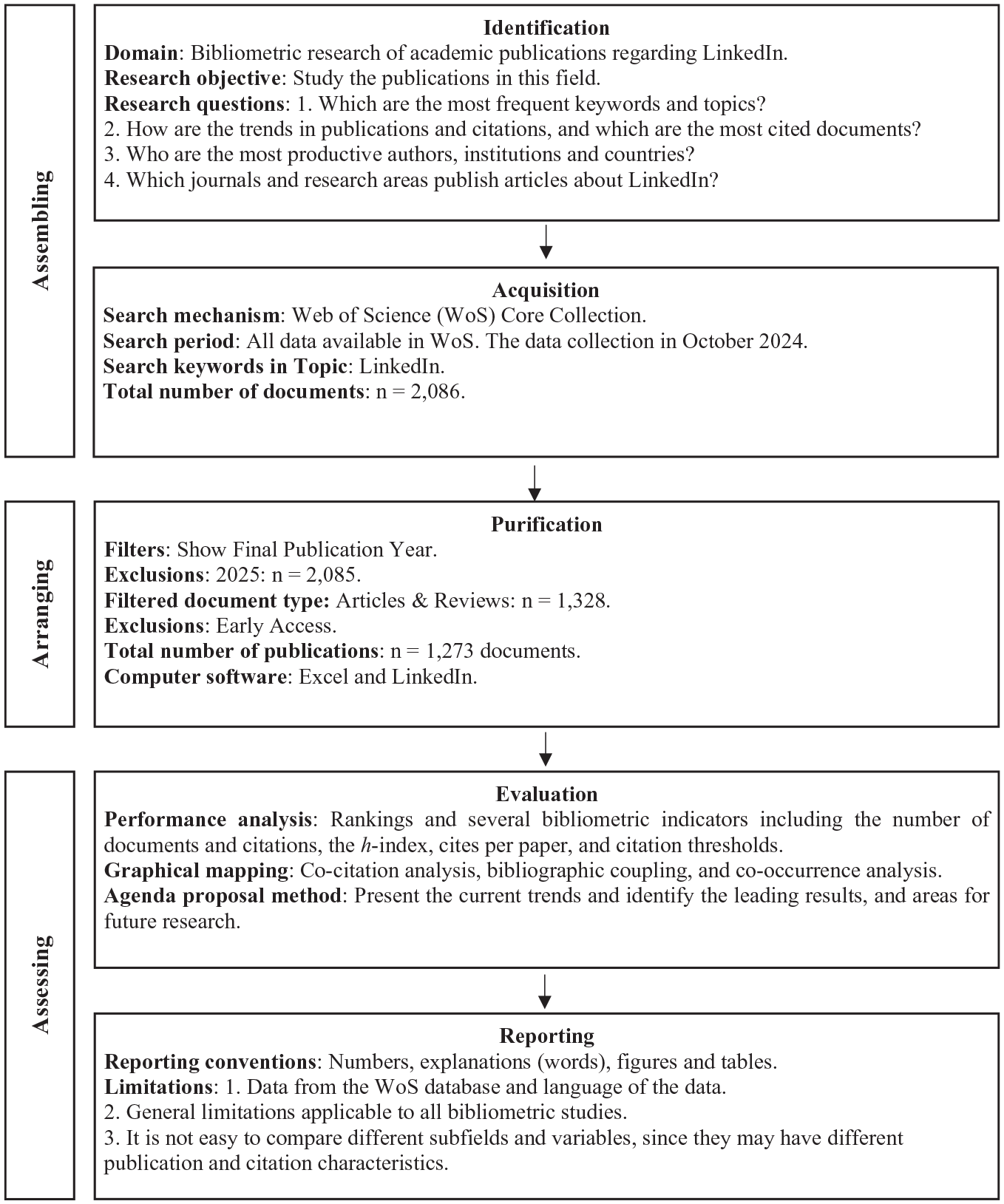
Flowchart illustrating the study’s procedure following the SPAR-4-SLR protocol.
The Assembling stage focuses on identifying and acquiring relevant literature (Figure 1). The research domain was defined as the bibliometric analysis of academic publications related to LinkedIn, aiming to address research questions regarding frequent keywords and topics, publication and citation trends, and the most productive authors, institutions, and countries. To construct a comprehensive data set, we conducted a search in the Web of Science (WoS) Core Collection (Clarivate, 2024), recognized for its extensive coverage of high-impact journals and advanced citation tracking capabilities. The search was performed in October 2024, using the keyword “LinkedIn” in the Title, Abstract, Author Keywords, and Keywords Plus fields. This initial search retrieved 2,086 documents. While we did not apply a manual language filter, it is important to note that the Web of Science Core Collection predominantly indexes English-language publications. This introduces a potential language bias, as non-English studies not indexed in WoS may have been excluded implicitly.
The Arranging stage ensures data reliability by refining and structuring the data set. We applied specific inclusion and exclusion criteria to improve relevance:
Exclusion of future publications: Papers scheduled for 2025 were removed, resulting in 2,085 documents. This step ensured that all publications included in the analysis had finalized metadata (e.g., volume, issue, DOI), which is essential for accurate citation and bibliographic coupling calculations.
Filtering document types: We retained only articles and review papers, reducing the data set to 1,328 documents, as they provide substantial contributions to scholarly discourse. Editorials, meeting abstracts, and book reviews were excluded because they typically lack original empirical content and are not peer-reviewed, thus limiting their relevance for trend and impact analysis.
Exclusion of Early Access articles: To maintain consistency in citation and bibliographic information, Early Access papers were removed, leading to the final data set of 1,273 peer-reviewed publications. Early Access articles often have incomplete metadata and are subject to updates in volume, issue number, and citation counts. Their inclusion could introduce inconsistencies in citation normalization and temporal trend analysis.
Data processing included duplicate removal, metadata validation, and citation count verification to enhance data set reliability. Bibliographic information such as author affiliations, total citations, and journal metrics were verified using Microsoft Excel for accuracy. The Assessing stage involves evaluating and visualizing LinkedIn research trends using multiple bibliometric techniques:
To assess scholarly impact, we computed key indicators including: • Total citations (25,461), h-index(38), and citations per publication to measure academic influence (Alonso et al., 2009; Hirsch, 2005). • Annual publication trends to map research growth. • Top contributing authors, institutions, and countries to identify leading research entities.
To construct and analyze bibliometric networks, we used VOSviewer (Van Eck & Waltman, 2010), a widely adopted tool for bibliometric mapping. The following analyses were performed: • Co-citation analysis to identify frequently co-cited papers and intellectual foundations (Small, 1973). • Bibliographic coupling to determine relationships among documents citing common sources (Kessler, 1963). • Keyword co-occurrence analysis to detect emerging research themes in LinkedIn scholarship.
We selected WoS over Scopus because of its superior citation tracking capabilities, curated indexing of high-impact journals, and extensive metadata support, which are essential for reliable co-citation and bibliographic coupling analyses. Although Scopus covers a broader range of social science literature, it was not used as the primary database because of variations in citation linkage mechanisms that may affect network analysis accuracy (Scopus, 2024). To ensure coverage reliability, citation counts were cross-referenced with Scopus. To improve the robustness of our findings, we cross-validated the co-citation and bibliographic coupling structures by comparing results generated using fractional counting and full counting approaches in VOSviewer. Both methods produced consistent thematic clusters, supporting the stability of our conclusions.
VOSviewer was chosen over alternatives such as CiteSpace and Gephi because of its optimized handling of large bibliometric data sets, superior clustering algorithms, and interactive visualization capabilities. Unlike Gephi, which is more suited for general network visualization, VOSviewer specializes in bibliometric mapping, making it ideal for analyzing LinkedIn research trends.
Despite the robustness of our bibliometric approach, several limitations should be noted:
Database Selection Bias: WoS ensures high-quality indexing but may exclude relevant studies indexed exclusively in Scopus or Google Scholar.
Field-Specific Citation Norms: Differences in citation behaviors across disciplines necessitate careful interpretation of impact metrics.
Keyword Sensitivity: The search term “LinkedIn” may omit studies that mention LinkedIn within broader social media research without explicitly including it in key indexing fields.
To mitigate these limitations, we employed manual verification of bibliographic metadata, triangulated citation data with Scopus, and used robust clustering techniques to validate thematic structures.
Results
Publication and Citation Structure on LinkedIn
The bibliometric evaluation of 1,273 LinkedIn-related publications (2009-2024) presented in Table 1, reveals a continuous growth trajectory in academic engagement, with the annual publication count increasing from 2 papers in 2009 to 204 in 2023, representing a 102× growth over 15 years. Citation dynamics exhibit a highly skewed distribution, with a total of 25,461 citations but only 3 publications (0.23%) exceeding 500 citations, reinforcing the outsized influence of a select group of foundational studies. In contrast, 649 papers (50.98%) have accumulated at least five citations, while 1,024 publications (80.44%) have received at least one citation, suggesting broad yet uneven citation dispersion across the body of research.
Annual Citation Structure on LinkedIn. .
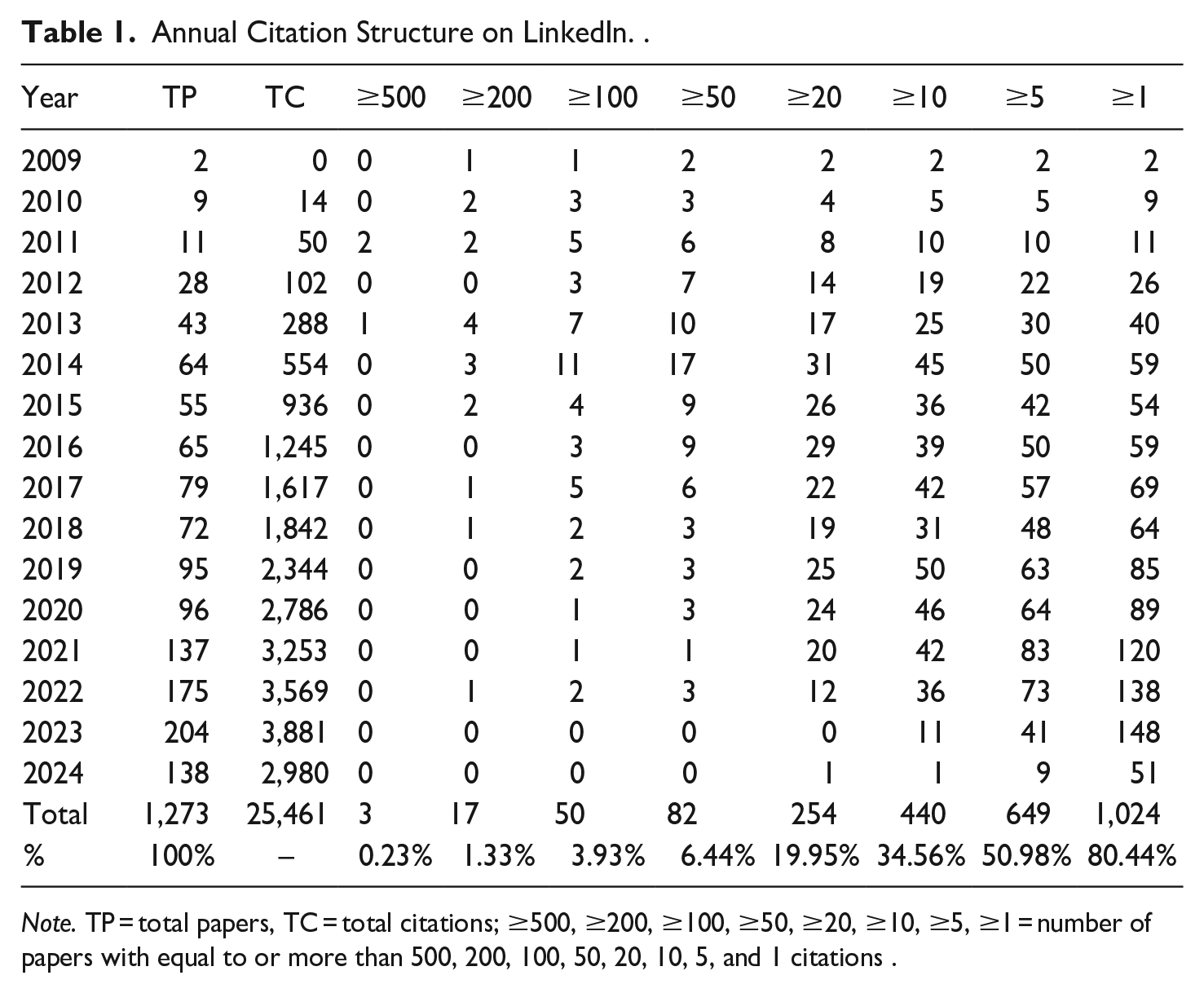
Note. TP = total papers, TC = total citations; ≥500, ≥200, ≥100, ≥50, ≥20, ≥10, ≥5, ≥1 = number of papers with equal to or more than 500, 200, 100, 50, 20, 10, 5, and 1 citations .
The distribution of highly cited papers underscores a temporal stratification of impact. Between 2009 and 2013, high-impact publications dominated, with multiple papers surpassing 100 citations and the most influential exceeding 500 citations. This early phase likely corresponds to seminal theoretical contributions that shaped subsequent scholarly discourse. From 2014 to 2020, while annual publication volume continued increasing, citation distributions became more concentrated within the 10-50 citation range, indicating a widening yet less extreme citation landscape. By 2021-2024, despite a sharp rise in publication count (138-204 papers annually), no publications had surpassed 100 citations, likely due to the inherent citation lag in newly published works and possible shifts in research fragmentation.
The citation structure visualized in Figure 2 further illustrates that pre-2013 publications exhibit broader citation peaks with pronounced outliers, reflecting the influence of early foundational research. In contrast, publications post-2016 show a more compressed distribution, with median citation counts stabilizing within the 15-30 range. This pattern suggests a transition from a field shaped by landmark papers to a more distributed research landscape, where newer studies contribute incrementally rather than reshaping core paradigms.
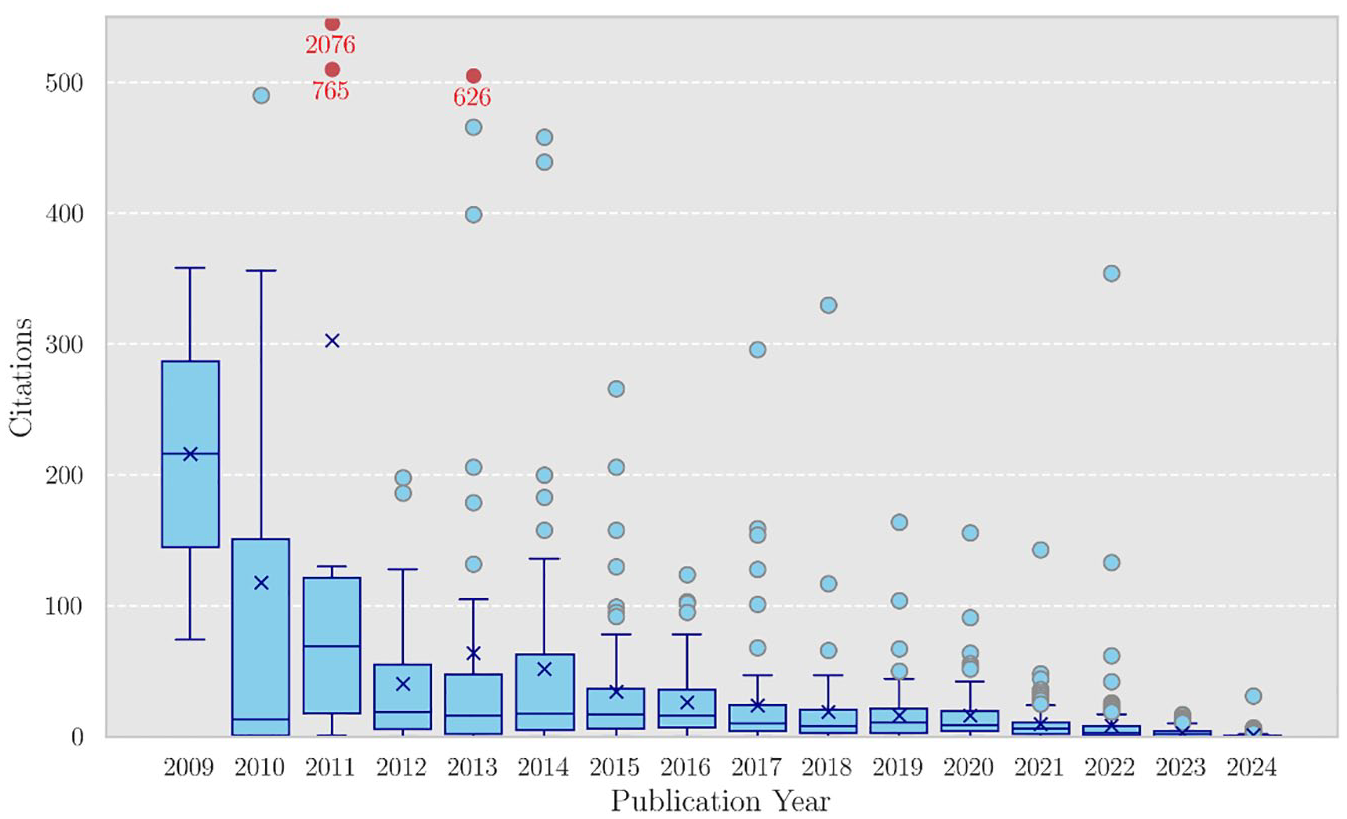
The annual box-whisker plot structure of all the documents published on LinkedIn.
These findings indicate that while LinkedIn-related research continues to expand, its citation impact follows a decelerating pattern, with early movers retaining dominance and newer contributions engaging more niche research communities. The quantitative imbalance between early and recent works raises important considerations about how emerging studies integrate into the evolving LinkedIn research ecosystem and whether citation growth trends will stabilize over time.
The distribution of LinkedIn-related research across scholarly journals, provided in Table 2, reveals a concentrated yet diverse publication landscape, where a small subset of high-impact outlets dominates citation influence, while numerous journals contribute to the platform’s interdisciplinary reach. Computers in Human Behavior (CHB) leads with 19 publications and 898 total citations, averaging 47.3 citations per paper (C/P). Its h-index of 251 and presence of three highly cited papers (≥100 citations) and 16 with more than 10 citations underscore its central role in social media and behavioral research. Given its impact factor (IF) of 9 and CiteScore (CS) of 19.1, CHB serves as a key venue for high-impact studies on LinkedIn’s role in digital behavior and professional networking.
Publication Record of Journals Publishing on LinkedIn.
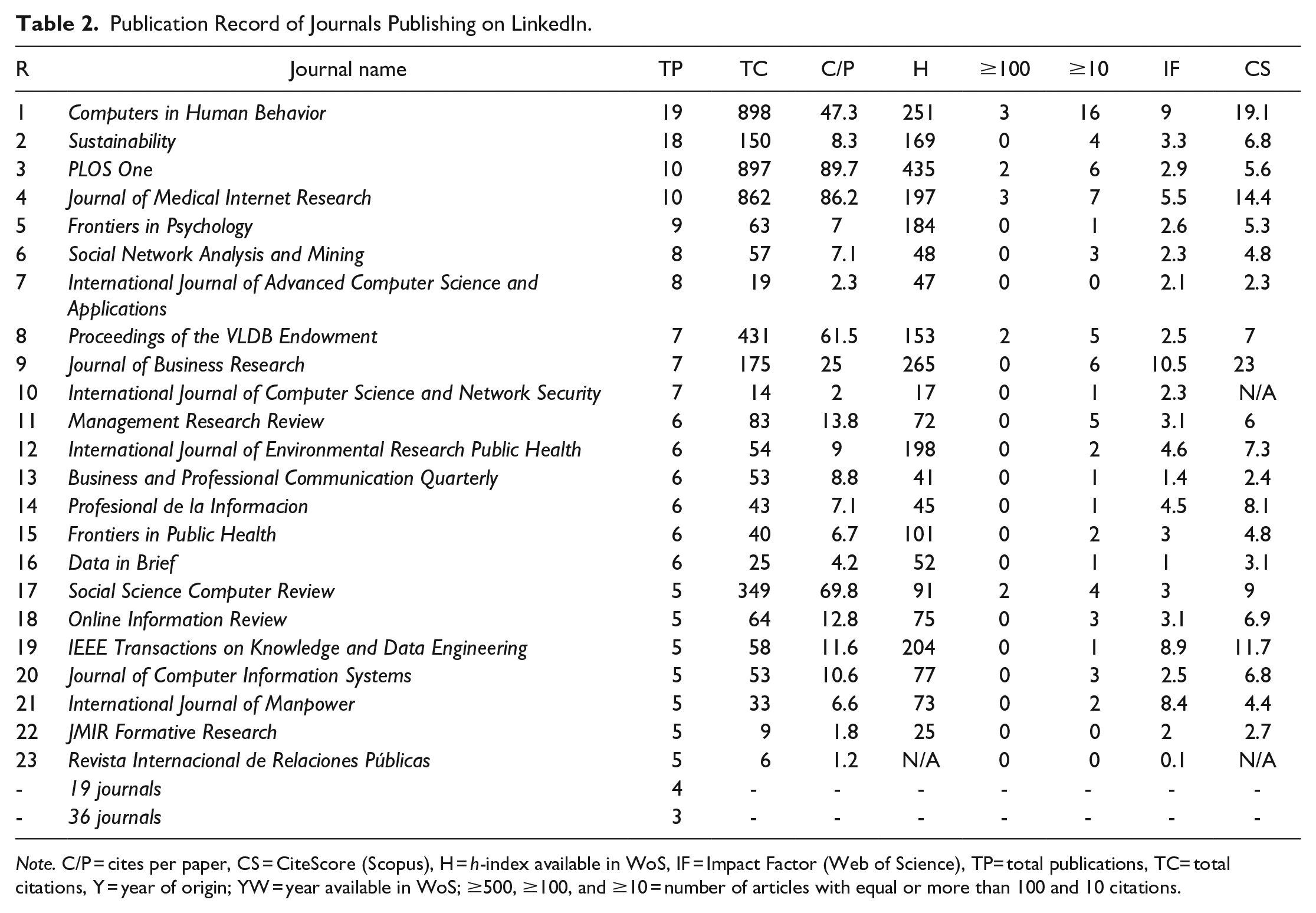
Note. C/P = cites per paper, CS = CiteScore (Scopus), H = h-index available in WoS, IF = Impact Factor (Web of Science), TP= total publications, TC= total citations, Y = year of origin; YW = year available in WoS; ≥500, ≥100, and ≥10 = number of articles with equal or more than 100 and 10 citations.
While PLOS One and the Journal of Medical Internet Research (JMIR) follow with 10 publications each, their citation structures reveal notable differences. PLOS One exhibits a higher citation count (897) and C/P ratio (89.7), with two papers exceeding 100 citations, indicating a broad yet selective research impact. JMIR, accumulating 862 citations (C/P = 86.2), demonstrates strong influence in health-related digital research, with three highly cited articles (≥100 citations) and seven exceeding 10 citations. The Proceedings of the VLDB Endowment, specializing in database and data engineering research, published 7 articles accumulating 431 citations (C/P = 61.5), signifying its relevance to data-driven analyses of LinkedIn’s ecosystem.
Business-oriented journals also hold a notable presence, with the Journal of Business Research (7 papers, 175 citations, C/P = 25, h-index = 265) standing out for its focus on social media’s intersection with corporate strategy and market behavior. The Management Research Review (6 publications, 83 citations, C/P = 13.8) further reflects LinkedIn’s integration into management and communication studies. Social Science Computer Review, with 5 papers and 349 citations (C/P = 69.8), contributes highly cited but niche research, reinforcing LinkedIn’s relevance within computational social science.
Despite these dominant venues, LinkedIn research exhibits broad disciplinary dispersion, with multiple interdisciplinary journals publishing fewer but thematically specialized articles. The International Journal of Advanced Computer Science and Applications (8 papers, 19 citations, C/P = 2.3) and the International Journal of Environmental Research and Public Health (6 papers, 54 citations, C/P = 9) represent LinkedIn’s expanding footprint in computer science and public health domains. Additionally, IEEE Transactions on Knowledge and Data Engineering (5 papers, 58 citations, C/P = 11.6, IF = 8.9) reflects a technical perspective on LinkedIn’s role in knowledge representation and algorithmic applications.
The long-tail distribution of LinkedIn research is evident in 19 journals contributing 4 publications each and 36 journals publishing 3 papers each, demonstrating a broad yet fragmented scholarly presence. While highly cited research is concentrated in select journals, the wider dispersion of lower-cited contributions suggests an increasingly diversified research ecosystem, where LinkedIn scholarship spans behavioral science, computational analysis, management, and digital health. The variability in citation impact across publication venues underscores the differential reception of LinkedIn research across disciplines, warranting further examination of how thematic focus influences scholarly engagement and citation trajectories.
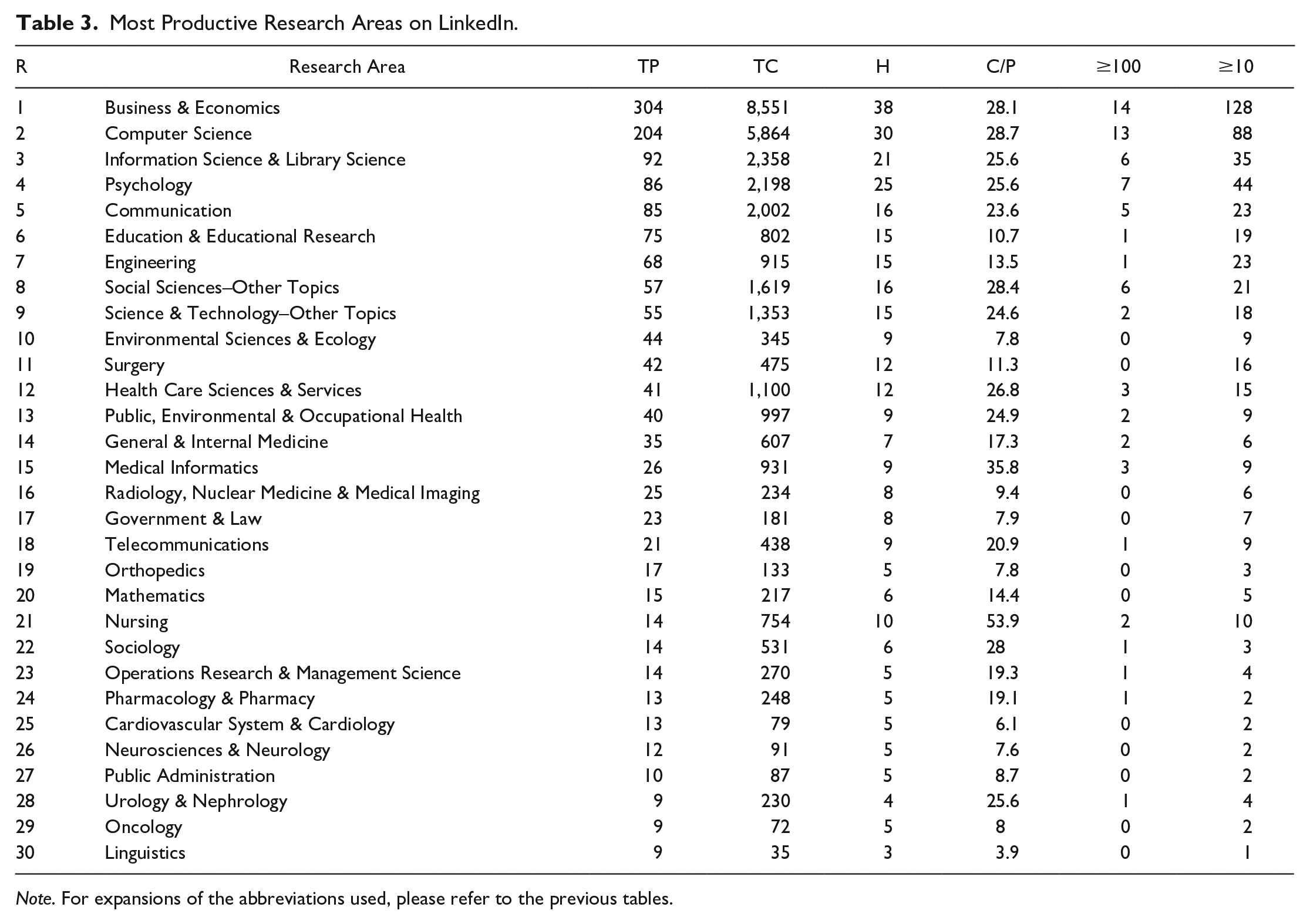
The disciplinary landscape of LinkedIn research, as outlined in Table 3, reveals a broad yet hierarchically structured engagement across multiple fields. Business & Economics leads with 304 publications and 8,551 citations, exhibiting the highest h-index (38) and a C/P ratio of 28.1. The presence of 14 highly cited papers (≥100 citations) and 128 surpassing 10 citations underscores LinkedIn’s centrality in labor market analytics, corporate networking, and economic modeling.
Most Productive Research Areas on LinkedIn.
Note. For expansions of the abbreviations used, please refer to the previous tables.
Computer Science (204 publications, 5,864 citations, h-index = 30, C/P = 28.7) demonstrates LinkedIn’s growing role in data-driven recruitment, social network analysis, and algorithmic hiring. The discipline’s 13 highly cited papers (≥100 citations) highlight its computational relevance, particularly in machine learning applications for job recommendation systems and workforce analytics. Information Science & Library Science (92 publications, h-index = 21, C/P = 25.6) and Psychology (86 publications, h-index = 25, C/P = 25.6) contribute to LinkedIn’s academic visibility in digital knowledge-sharing and professional identity formation. The six highly cited papers in Information Science and seven in Psychology indicate LinkedIn’s role in digital literacy, workplace mental health, and cognitive engagement with professional social media platforms.
The Communication discipline (85 publications, 2,002 citations, h-index = 16, C/P = 23.6) underscores LinkedIn’s position in media research, organizational messaging, and digital reputation management. With five highly cited articles (≥100 citations) and 23 exceeding 10 citations, this domain explores how LinkedIn shapes professional self-presentation and corporate communication strategies. In contrast, Education & Educational Research (75 publications, h-index = 15, C/P = 10.7) exhibits lower citation impact, with only one paper surpassing 100 citations, suggesting a developing but not yet dominant role in digital pedagogy and career mentorship. Engineering (68 publications, h-index = 15, C/P = 13.5) reflects LinkedIn’s technological applications in industrial knowledge transfer and professional networking among technical communities.
Interdisciplinary engagement is evident in Social Sciences–Other Topics (57 publications, h-index = 16, C/P = 28.4) and Science & Technology–Other Topics (55 publications, h-index = 15, C/P = 24.6), which highlight LinkedIn’s integration into social behavior studies and technological innovation research. Health-related disciplines, including Health Care Sciences & Services (41 publications, C/P = 26.8, h-index = 12), Public, Environmental & Occupational Health (40 publications, C/P = 24.9, h-index = 9), and General & Internal Medicine (35 publications, C/P = 17.3, h-index = 7), reveal LinkedIn’s impact on healthcare networking, professional outreach, and public health communication.
Notably, Medical Informatics (26 publications, h-index = 9, C/P = 35.8) and Nursing (14 publications, h-index = 10, C/P = 53.9) exhibit targeted but highly influential research, emphasizing LinkedIn’s significance in professional integration within specialized healthcare fields. Beyond core disciplines, Telecommunications (21 publications, C/P = 20.9, h-index = 9), Operations Research & Management Science (14 publications, C/P = 19.3, h-index = 5), and Sociology (14 publications, C/P = 28.0, h-index = 6) indicate LinkedIn’s expanding academic footprint in workforce analytics, social capital theory, and knowledge-sharing infrastructures.
As Table 3 illustrates, highly cited research remains concentrated within select disciplines, yet the increasing spread of publications across multiple research areas signals LinkedIn’s evolution beyond its initial business-oriented focus. The variance in citation performance across domains suggests differential scholarly engagement, requiring further examination of citation accumulation trends and cross-disciplinary research intersections.
Influential Papers on LinkedIn
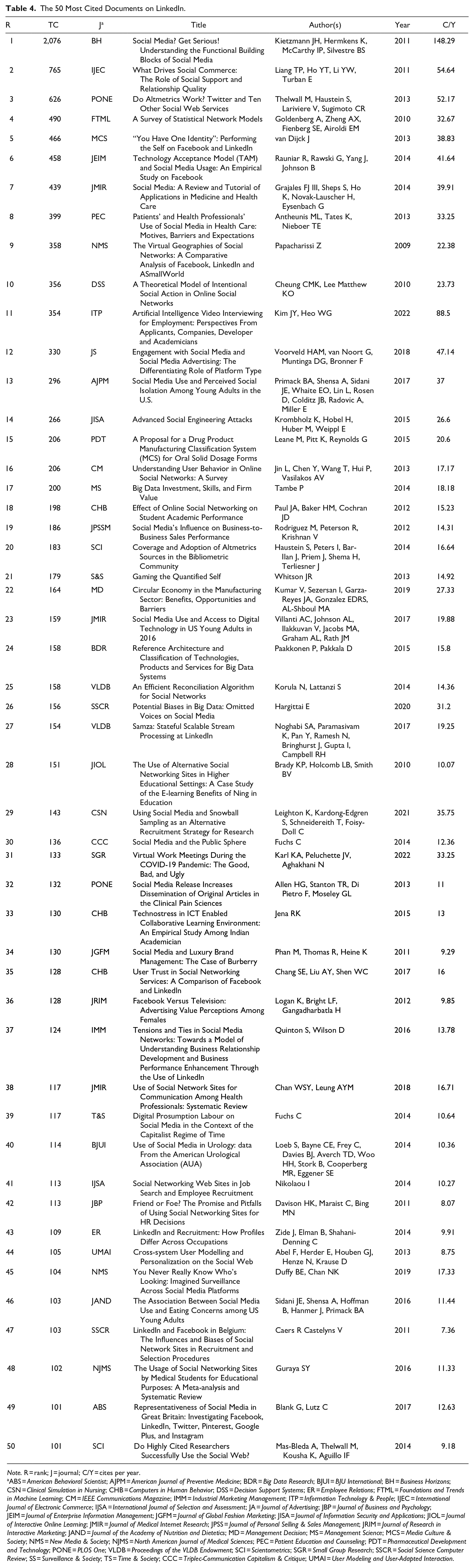
The intellectual foundations of LinkedIn research are shaped by seminal contributions across multiple disciplines, with a subset of highly cited papers establishing core theoretical and empirical advancements. Table 4 presents the 50 most influential publications, ranked by total citations (TC) and citation rate per year (C/Y), offering a quantitative perspective on LinkedIn’s scholarly trajectory. Identifying these works provides insight into thematic evolution, methodological shifts, and disciplinary intersections that define LinkedIn’s academic relevance.
The 50 Most Cited Documents on LinkedIn.
Note. R = rank; J = journal; C/Y = cites per year.
ABS = American Behavioral Scientist; AJPM = American Journal of Preventive Medicine; BDR = Big Data Research; BJUI = BJU International; BH = Business Horizons; CSN = Clinical Simulation in Nursing; CHB = Computers in Human Behavior; DSS = Decision Support Systems; ER = Employee Relations; FTML = Foundations and Trends in Machine Learning; CM = IEEE Communications Magazine; IMM = Industrial Marketing Management; ITP = Information Technology & People; IJEC = International Journal of Electronic Commerce; IJSA = International Journal of Selection and Assessment; JA = Journal of Advertising; JBP = Journal of Business and Psychology; JEIM = Journal of Enterprise Information Management; JGFM = Journal of Global Fashion Marketing; JISA = Journal of Information Security and Applications; JIOL = Journal of Interactive Online Learning; JMIR = Journal of Medical Internet Research; JPSS = Journal of Personal Selling & Sales Management; JRIM = Journal of Research in Interactive Marketing; JAND = Journal of the Academy of Nutrition and Dietetics; MD = Management Decision; MS = Management Science; MCS = Media Culture & Society; NMS = New Media & Society; NJMS = North American Journal of Medical Sciences; PEC = Patient Education and Counseling; PDT = Pharmaceutical Development and Technology; PONE = PLOS One; VLDB = Proceedings of the VLDB Endowment; SCI = Scientometrics; SGR = Small Group Research; SSCR = Social Science Computer Review; SS = Surveillance & Society; TS = Time & Society; CCC = Triplec-Communication Capitalism & Critique; UMAI = User Modeling and User-Adapted Interaction.
Leading this body of research, Kietzmann et al. (2011) in Business Horizons (2,076 citations, C/Y = 148.29) introduced a functional framework for social media, positioning LinkedIn within the broader landscape of digital networking and strategic engagement. The paper’s sustained influence underscores its foundational role in conceptualizing social media platforms as structured ecosystems for professional interactions, branding, and recruitment. Complementing this, Liang et al. (2011) in International Journal of Electronic Commerce (765 citations, C/Y = 54.64) explored social commerce mechanisms, highlighting LinkedIn’s role in fostering relational trust and business networking.
A distinct research stream examines LinkedIn’s integration into academic and alternative impact metrics, with Thelwall et al. (2013) in PLOS One (626 citations, C/Y = 52.17) assessing the efficacy of altmetrics, positioning LinkedIn as a complementary scholarly engagement tool alongside Twitter and ResearchGate. Similarly, Haustein et al. (2014) in Scientometrics (183 citations, C/Y = 16.64) analyzed LinkedIn’s visibility within bibliometric frameworks, reinforcing its growing relevance in scholarly dissemination.
From a behavioral and identity formation perspective, van Dijck (2013) in Media, Culture & Society (466 citations, C/Y = 38.83) examined self-presentation strategies across LinkedIn and Facebook, establishing LinkedIn as a platform where professional identity is performatively constructed and strategically curated. This aligns with Duffy and Chan (2019) in New Media & Society (104 citations, C/Y = 17.33), who explored imagined surveillance effects, illustrating how LinkedIn fosters self-regulatory digital behaviors among professionals.
The healthcare sector has also contributed highly cited works, notably Grajales et al. (2014) in Journal of Medical Internet Research (439 citations, C/Y = 39.91), which examined LinkedIn’s role in digital health communication. Similarly, Antheunis et al. (2013) in Patient Education and Counseling (399 citations, C/Y = 33.25) analyzed professional engagement patterns in healthcare networks, reinforcing LinkedIn’s significance beyond traditional business applications.
From a technological perspective, Noghabi et al. (2017) in Proceedings of the VLDB Endowment (154 citations, C/Y = 19.25) detailed scalable data processing at LinkedIn, highlighting advancements in real-time data stream management and cloud infrastructure optimization. Further computational insights emerge in Abel et al. (2013) in User Modeling and User-Adapted Interaction (105 citations, C/Y = 8.75), which explored cross-system personalization algorithms leveraging LinkedIn’s structured user data.
The human resource and organizational behavior dimension of LinkedIn research is reflected in Davison et al. (2011) in Journal of Business and Psychology (113 citations, C/Y = 8.07), which evaluated LinkedIn’s influence on hiring decisions, raising concerns about implicit biases and social capital advantages in digital recruitment. Similarly, Zide et al. (2014) in Employee Relations (109 citations, C/Y = 9.91) investigated occupational variations in LinkedIn profile composition, illustrating field-dependent self-presentation strategies.
Across these highly cited contributions, LinkedIn research has evolved through interdisciplinary inquiry, spanning social media theory, recruitment biases, algorithmic curation, and digital identity formation. As highlighted in Table 4, papers with high citation velocity (C/Y) indicate both enduring theoretical contributions and rapidly emerging technological explorations, demonstrating LinkedIn’s multifaceted academic significance.
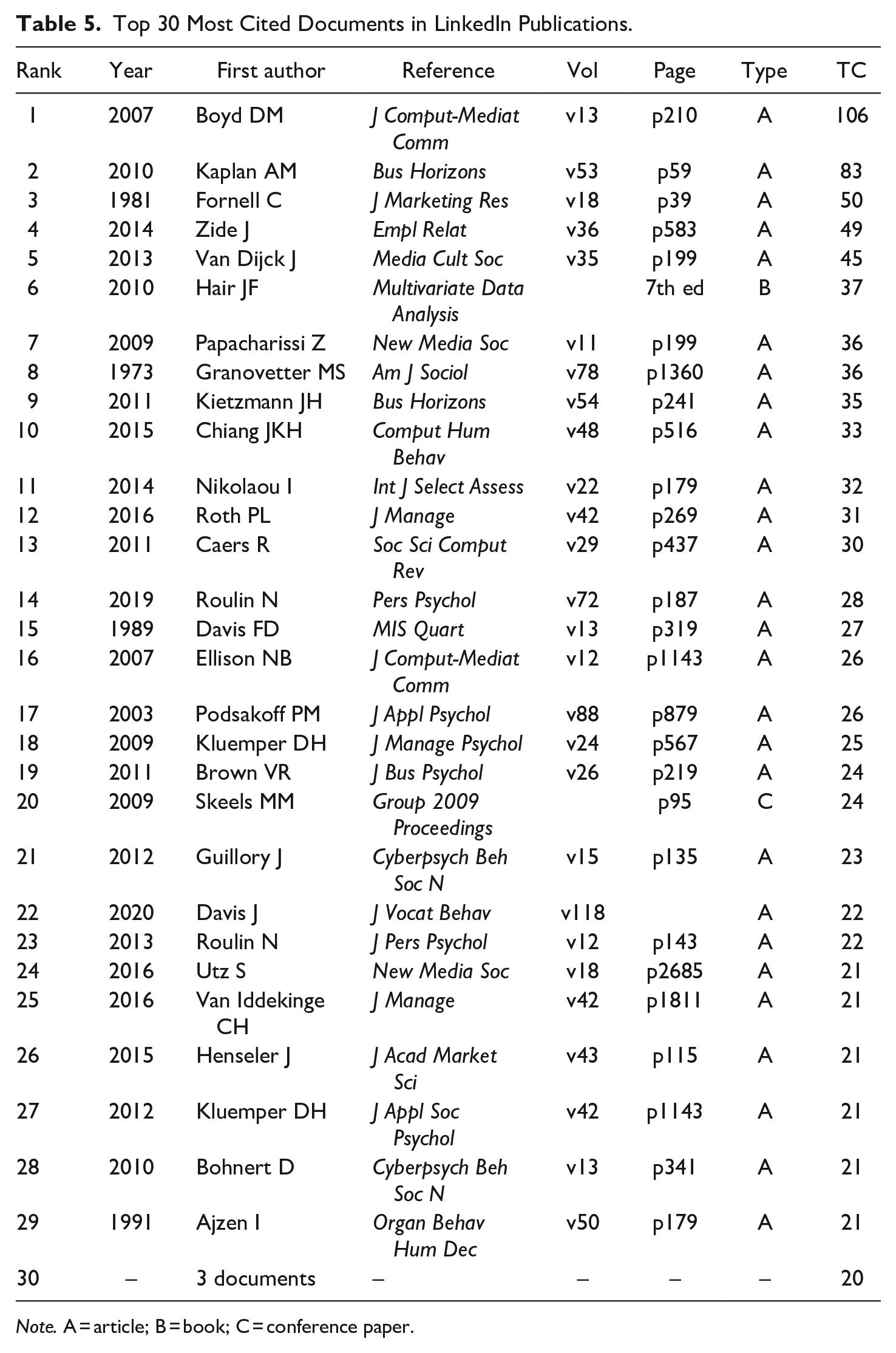
Analyzing the top 30 most cited documents in LinkedIn scholarship provides insight into the theoretical foundations and evolving research directions in the field. Table 5 highlights seminal contributions that have significantly shaped academic discourse, spanning social media theory, recruitment processes, professional identity construction, and methodological frameworks. These highly referenced works illustrate the interdisciplinary nature of LinkedIn research, drawing from communication studies, sociology, management science, and computational analysis.
Top 30 Most Cited Documents in LinkedIn Publications.
Note. A = article; B = book; C = conference paper.
Boyd’s (2007) publication in Journal of Computer-Mediated Communication leads with 106 citations, marking an early investigation into the role of social media in shaping digital communication behaviors. This work provided a conceptual framework that remains influential in analyzing LinkedIn’s function as a professional networking platform. Kaplan’s (2010) foundational study in Business Horizons (83 citations) further contextualizes social media’s strategic implications, establishing a critical reference point for understanding LinkedIn’s role in career development, branding, and professional engagement.
The historical significance of M. S. Granovetter’s (1973) weak-tie theory in American Journal of Sociology (36 citations) reflects LinkedIn’s function as a platform that extends professional connections beyond immediate networks, reinforcing its role in bridging social capital and labor market dynamics. Similarly, Fornell’s (1981) research on consumer satisfaction models (50 citations) indirectly informs LinkedIn-related studies on user experience, trust, and engagement in professional digital ecosystems.
More recent contributions emphasize LinkedIn’s impact on employment and digital recruitment. Zide et al. (2014) in Employee Relations (49 citations) provide an empirical analysis of LinkedIn’s influence on professional identity construction and hiring processes, underscoring the growing reliance on digital profiles in corporate recruitment. Nikolaou’s (2014) study in International Journal of Selection and Assessment (32 citations) and Roulin and Levashina (2019) work in Personnel Psychology (28 citations) further explore how LinkedIn mediates employer perceptions and job candidate evaluations.
The methodological backbone of LinkedIn research is evident in Hair et al. (2009) Multivariate Data Analysis (37 citations), which serves as a foundational reference for advanced statistical modeling in social media analytics. Podsakoff et al. (2003) in Journal of Applied Psychology (26 citations) also provide key insights into methodological rigor, particularly in addressing biases in LinkedIn-based recruitment research.
The influence of psychological and behavioral perspectives on LinkedIn research is reflected in works such as F. D. Davis’s (1989) Technology Acceptance Model (TAM) in MIS Quarterly (27 citations) and Utz’s (2016) study in New Media & Society (21 citations) on LinkedIn’s role in digital self-presentation and career-related information sharing. These contributions highlight the intersection between social media engagement, professional identity curation, and algorithmic mediation.
The broader integration of LinkedIn into computational and management research is evident in Bohnert and Ross (2010) work in Cyberpsychology, Behavior, and Social Networking (21 citations), which examines LinkedIn’s role in hiring and applicant screening, and Van Iddekinge’s (2016) research in Journal of Management (21 citations), which evaluates the predictive validity of LinkedIn-based hiring assessments.
These highly cited publications collectively illustrate the trajectory of LinkedIn research, demonstrating theoretical continuities, methodological advancements, and emerging empirical inquiries. While early works laid conceptual foundations for social media’s role in professional engagement, more recent contributions delve into digital recruitment, psychological profiling, and computational analytics, reflecting LinkedIn’s evolving significance in academic and industry discourse.
Most Productive Institutions and Countries
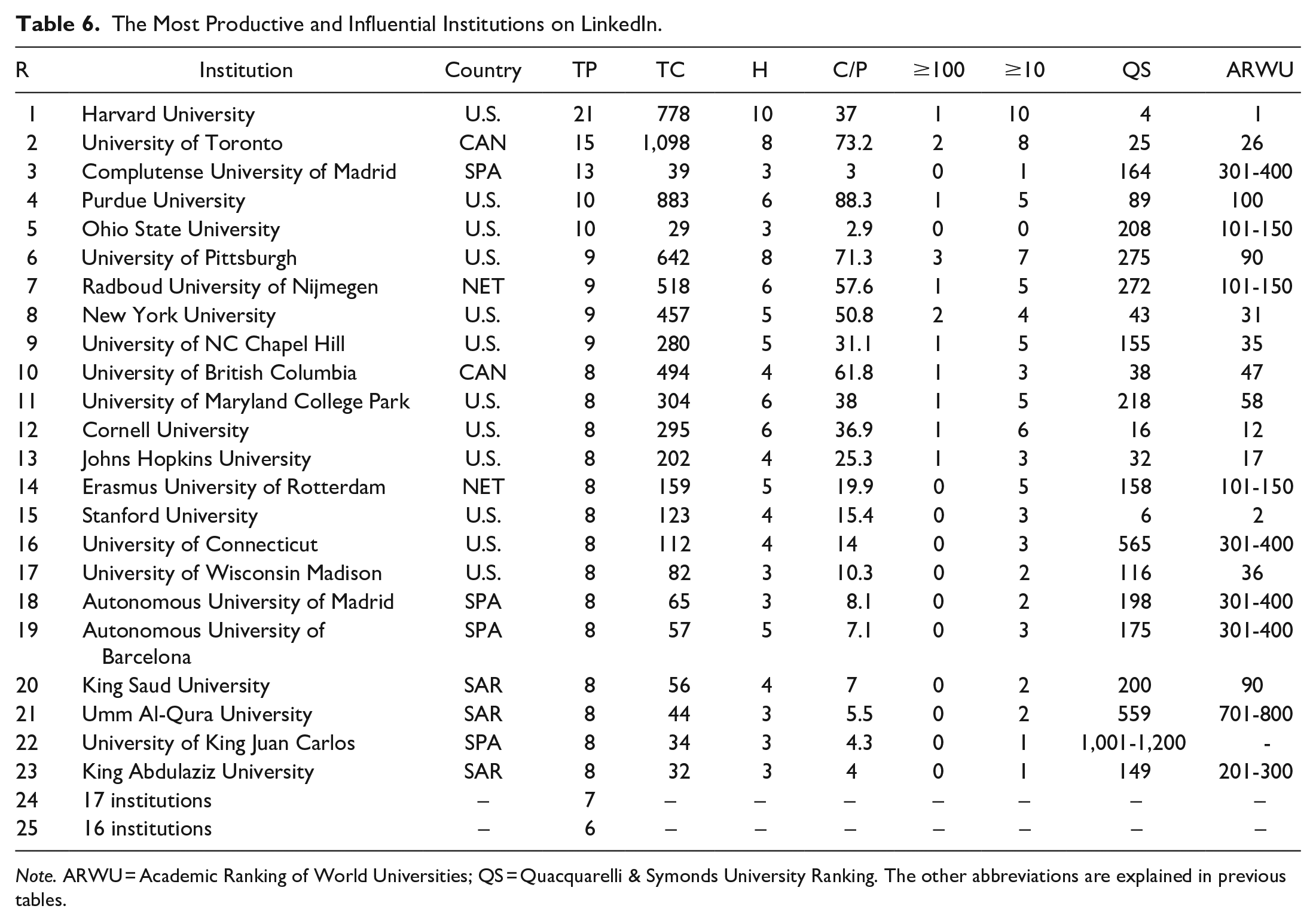
The analysis of institutional contributions to LinkedIn research highlights the academic centers driving scholarly discourse on professional networking and digital labor markets. As shown in Table 6, institutions from North America and Europe dominate the field, yet there is an emerging presence from the Middle East and other global regions, illustrating the evolving geographical landscape of LinkedIn-related scholarship.
The Most Productive and Influential Institutions on LinkedIn.
Note. ARWU = Academic Ranking of World Universities; QS = Quacquarelli & Symonds University Ranking. The other abbreviations are explained in previous tables.
Harvard University leads with 21 publications and a total citation count (TC) of 778, achieving an h-index of 10 and a citations-per-paper (C/P) ratio of 37. This reflects its substantial influence in defining key research directions, particularly in business, digital communication, and algorithmic hiring practices. The University of Toronto follows with 15 publications, yet exhibits a notably higher impact (C/P of 73.2) and an h-index of 8, indicating a greater citation density per study. This suggests that despite producing fewer papers than Harvard, Toronto’s contributions are more frequently referenced, reinforcing its role in shaping high-impact discussions on professional networking dynamics.
Other North American institutions, including Purdue University (C/P = 88.3, TC = 883) and the University of Pittsburgh (C/P = 71.3, TC = 642), also demonstrate high research impact, particularly in the areas of data analytics, social media influence, and online hiring mechanisms. Stanford University, while historically influential in social computing and digital labor research, records only 8 publications with a modest citation impact (C/P = 15.4, TC = 123), suggesting that LinkedIn-specific scholarship is a relatively smaller component of its broader research portfolio.
Beyond North America, European institutions exhibit a strong presence, contributing to multidisciplinary perspectives. Radboud University Nijmegen (Netherlands) and Erasmus University Rotterdam have produced influential work on the intersection of LinkedIn with business analytics and computational social science, with C/P ratios of 57.6 and 19.9, respectively. Spain also features prominently, with Complutense University of Madrid emerging as the most active institution in the region, albeit with lower impact metrics (C/P = 3.0, TC = 39), suggesting that LinkedIn-focused scholarship is still in a developing phase within Spanish academia. Similarly, institutions such as Autonomous University of Barcelona and King Juan Carlos University register moderate publication volumes but with lower citation influence, indicating that LinkedIn-related studies in these regions are gaining momentum but remain secondary research domains compared to leading hubs in North America.
An emerging research footprint is observed in the Middle East, particularly from Saudi Arabian institutions such as King Saud University (C/P = 7.0, TC = 56) and King Abdulaziz University (C/P = 4.0, TC = 32). While these institutions have lower citation densities compared with their North American and European counterparts, their growing engagement with LinkedIn-related research suggests increasing regional interest in professional social networking, particularly concerning employment markets, workforce analytics, and organizational behavior in digital economies.
The overall distribution of institutional contributions underscores regional disparities in LinkedIn research impact. While North American and European universities dominate in terms of both volume and influence, institutions from the Middle East and Southern Europe demonstrate increasing participation but have yet to establish highly cited foundational works in the field. This geographical imbalance suggests that LinkedIn-related scholarship remains largely concentrated in Western academic centers, reinforcing the need for broader international collaboration to diversify perspectives, particularly from developing economies where LinkedIn adoption patterns may differ significantly.
The geographical distribution of LinkedIn research reveals a concentration of scholarly output in North America and Western Europe, with emerging contributions from Asia, the Middle East, and South America. As illustrated in Table 7, the United States dominates the field with 419 publications and a total citation count (TC) of 10,669, achieving an h-index of 46. The country’s substantial research footprint includes 24 highly cited papers (≥100 citations) and 170 exceeding 10 citations, reinforcing its sustained leadership in LinkedIn-focused research. The United States exhibits a research intensity of 1.3 publications per million inhabitants (P/Po), with a citation impact of 32.2 per million (C/Po), demonstrating both a high research volume and significant global influence.
The Most Productive and Influential Countries on LinkedIn.
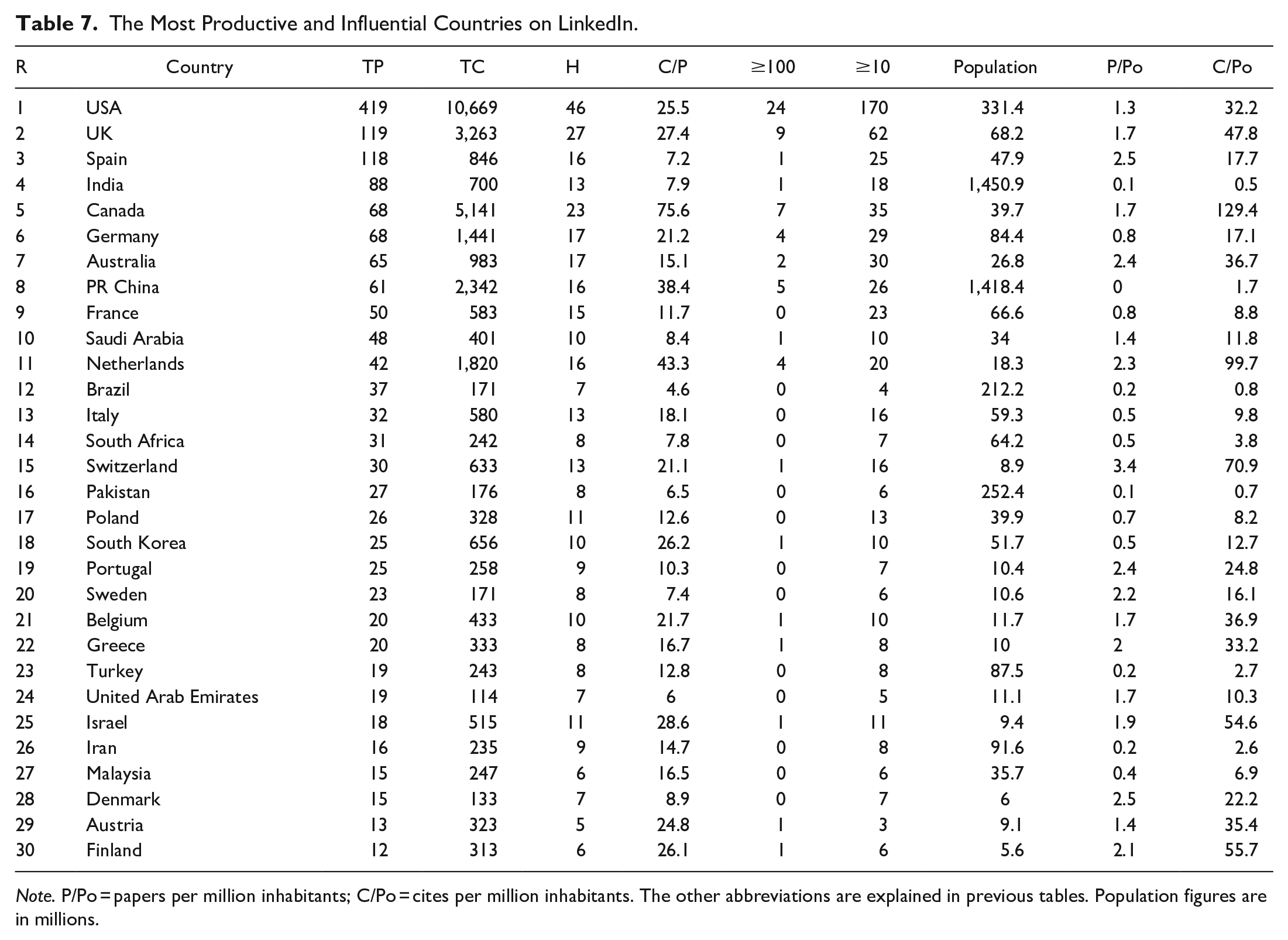
Note. P/Po = papers per million inhabitants; C/Po = cites per million inhabitants. The other abbreviations are explained in previous tables. Population figures are in millions.
The United Kingdom follows as the second most impactful contributor, with 119 publications and a total of 3,263 citations (h-index = 27, C/P = 27.4). Despite a lower publication count than Spain, the United Kingdom ranks higher in impact, particularly in business, human resources, and digital labor studies. The United Kingdom’s P/Po (1.7) and C/Po (47.8) indicate a strong per-capita research presence, reflecting the country’s emphasis on workplace digitalization and professional networking research.
Canada, despite producing only 68 publications, demonstrates exceptional impact (C/P = 75.6, h-index = 23), surpassing all other nations in citation influence per paper. The high citation density suggests that Canadian research on LinkedIn is particularly influential, often addressing algorithmic hiring, professional branding, and labor market analytics. Canada’s high research intensity (P/Po = 1.7, C/Po = 129.4) highlights its role in high-impact interdisciplinary studies spanning technology and business.
Among European nations, Spain emerges as the second most prolific country, with 118 publications, yet a more moderate citation impact (C/P = 7.2, h-index = 16). While Spain’s strong publication output underscores growing scholarly engagement, its lower citation per paper metric suggests that LinkedIn research in the region is still maturing. In contrast, Germany (68 publications, C/P = 21.2, h-index = 17) produces fewer studies but with higher citation influence, reflecting more concentrated research efforts in professional network analytics and digital employment trends. The Netherlands (42 publications, C/P = 43.3, h-index = 16) also demonstrates high-impact contributions, reinforcing its strength in computational social science and labor market modeling.
While North American and European research emphasizes LinkedIn’s role in professional branding and recruitment, studies from developing nations increasingly explore its impact on entrepreneurship and digital inclusion. The rise of Middle Eastern and Asian contributions signals a diversification of research perspectives. China and India represent two emerging yet distinct research landscapes. India has produced 88 publications, signaling growing research activity, yet exhibits a lower citation impact (C/P = 7.9, h-index = 13), indicating that while LinkedIn-related scholarship is expanding, its global influence is still developing. In contrast, China (61 publications, C/P = 38.4, h-index = 16) shows a more concentrated but impactful contribution, reflecting targeted, high-citation studies in artificial intelligence and digital employment ecosystems.
Australia emerges as a key research hub in the Oceania region, with 65 publications and a C/P of 15.1, reinforcing its growing role in social media and business analytics research. With a P/Po of 2.4 and a C/Po of 36.7, Australia’s LinkedIn-related studies show a balanced combination of productivity and research impact.
The Middle East is also seeing increasing engagement, particularly in Saudi Arabia (48 publications, C/P = 8.4, h-index = 10) and the United Arab Emirates (19 publications, C/P = 6.0, h-index = 7). While these nations contribute a growing volume of research, their citation impact remains moderate, suggesting that LinkedIn’s role in professional networking within these economies is still an evolving field of study.
In Scandinavian and Central European countries, Switzerland (30 publications, C/P = 21.1, h-index = 13) and Finland (12 publications, C/P = 26.1, h-index = 6) demonstrate notable research intensity relative to their population sizes (P/Po = 3.4 and 2.1, respectively). This indicates that despite lower total publication numbers, their research outputs are highly targeted and influential.
A comparative view highlights that while North America and Western Europe lead in both volume and citation influence, Asia and the Middle East exhibit emerging yet developing scholarly footprints. The research disparity between high-impact nations like the United States, United Kingdom, and Canada versus emerging research contributors such as India, Saudi Arabia, and Brazil suggests a need for greater global collaboration to enhance LinkedIn-related research inclusivity. The variations in research intensity (P/Po) and citation per capita (C/Po) further underscore structural differences in how LinkedIn research evolves across different economic and academic environments.
The supranational distribution of LinkedIn-related scholarship highlights geographical disparities in research intensity, impact, and thematic focus. As shown in Table 8, Europe leads in overall publication output, with 733 publications and a total citation count (TC) of 12,944, achieving an h-index of 50. However, North America, with 492 publications, exhibits the highest citations per paper (C/P = 32.2) and the strongest scholarly influence, reflecting a higher concentration of high-impact research from the United States and Canada.
Publication Structure Classified by Supranational Regions.
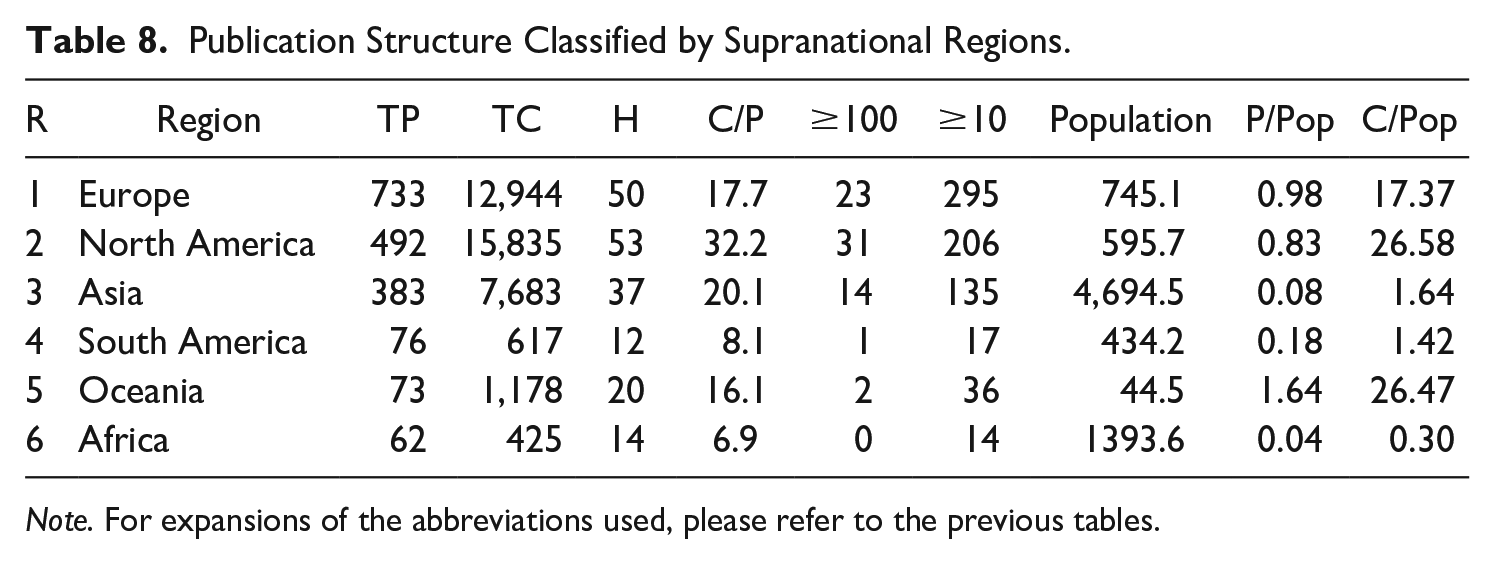
Note. For expansions of the abbreviations used, please refer to the previous tables.
Europe’s substantial research volume (P/Pop = 0.98) and notable C/P ratio (17.7) indicate a balanced combination of productivity and impact. The region benefits from strong academic networks in the United Kingdom, Germany, and the Netherlands, fostering collaborations that enhance citation influence. The interdisciplinary nature of European contributions, spanning business, digital labor, and computational social science, further consolidates its leadership in LinkedIn research.
North America, despite a lower total output, surpasses Europe in citation intensity. The region’s h-index of 53, along with 31 publications exceeding 100 citations, underscores the influence of U.S.-based studies, particularly in algorithmic hiring, professional branding, and AI-driven labor analytics. The P/Pop ratio of 0.83 suggests a slightly lower per capita research engagement compared to Europe, yet the C/Pop of 26.58 reflects unparalleled research impact per million inhabitants, affirming North America’s dominance in high-citation contributions.
Asia’s research trajectory demonstrates significant growth but varied citation influence. With 383 publications (P/Pop = 0.08, C/P = 20.1, h-index = 37), the region is an emerging force in LinkedIn-related studies, particularly through China’s contributions to AI-based recruitment and India’s focus on digital employment and online networking behaviors. However, the lower citation intensity suggests that LinkedIn-related research in Asia is still establishing itself within global academic discourse, necessitating greater cross-institutional collaboration to amplify impact.
Oceania, predominantly driven by Australia, exhibits a high per capita contribution to LinkedIn research. With 73 publications (P/Pop = 1.64, C/Pop = 26.47, h-index = 20), the region punches above its weight, reflecting focused yet highly visible research outputs. Australian scholars frequently engage in workplace digitalization studies, HR analytics, and social media–driven recruitment, resulting in a citation profile comparable to North America’s in terms of research quality per capita.
South America and Africa remain in the foundational stages of LinkedIn research integration. South America, led by Brazil, Argentina, and Chile, has produced 76 publications (C/P = 8.1, h-index = 12), indicating moderate research engagement but lower citation traction. Similarly, Africa, with 62 publications (C/P = 6.9, h-index = 14), reflects early-stage academic contributions, predominantly focusing on LinkedIn’s role in professional networking, digital literacy, and career opportunities in developing economies. These findings suggest potential for future growth, particularly through collaborative initiatives with higher-impact research nations.
A comparative analysis of per capita research contributions (P/Pop) and citation intensity (C/Pop) underscores regional disparities in LinkedIn-related scholarship. Europe and North America lead in both volume and scholarly influence, with Oceania demonstrating strong per capita contributions. While Asia and the Middle East are expanding their research footprints, the lower C/P ratios indicate an ongoing maturation process. South America and Africa remain underrepresented, presenting opportunities for increased LinkedIn-related investigations, particularly in labor mobility, professional skill development, and digital workforce transitions.
The evolving geographical diversification of LinkedIn research suggests that while North America and Europe currently dominate high-impact studies, Asia’s rapid research expansion and Oceania’s high citation-per-paper ratio signal shifts in global academic influence. Strengthening interregional collaborations and increasing cross-disciplinary integration could further balance LinkedIn-related research across emerging and established research hubs.
Mapping LinkedIn With VOS Viewer Software
Bibliometric network analysis, implemented via VOSviewer (Van Eck & Waltman, 2010, 2023), provides a structured visualization of scholarly interconnections, research clusters, and thematic trajectories in LinkedIn-related studies. By employing co-citation analysis (Small, 1973), bibliographic coupling (Kessler, 1963), and co-occurrence of author keywords (Callon et al., 1983), this approach uncovers intellectual structures and cross-disciplinary influences, aligning with the study’s research questions.
Co-Citation Analysis
Figure 3 presents the co-citation network of journals, mapped using a minimum citation threshold of 30 and at least 100 links per source. The dominant cluster (green) integrates Computers in Human Behavior, Journal of Business Research, and Journal of Applied Psychology, underscoring LinkedIn’s central role in user behavior modeling, digital labor markets, and professional networking. The high connectivity within this cluster signals LinkedIn’s sustained relevance in behavioral science, business strategy, and organizational psychology.
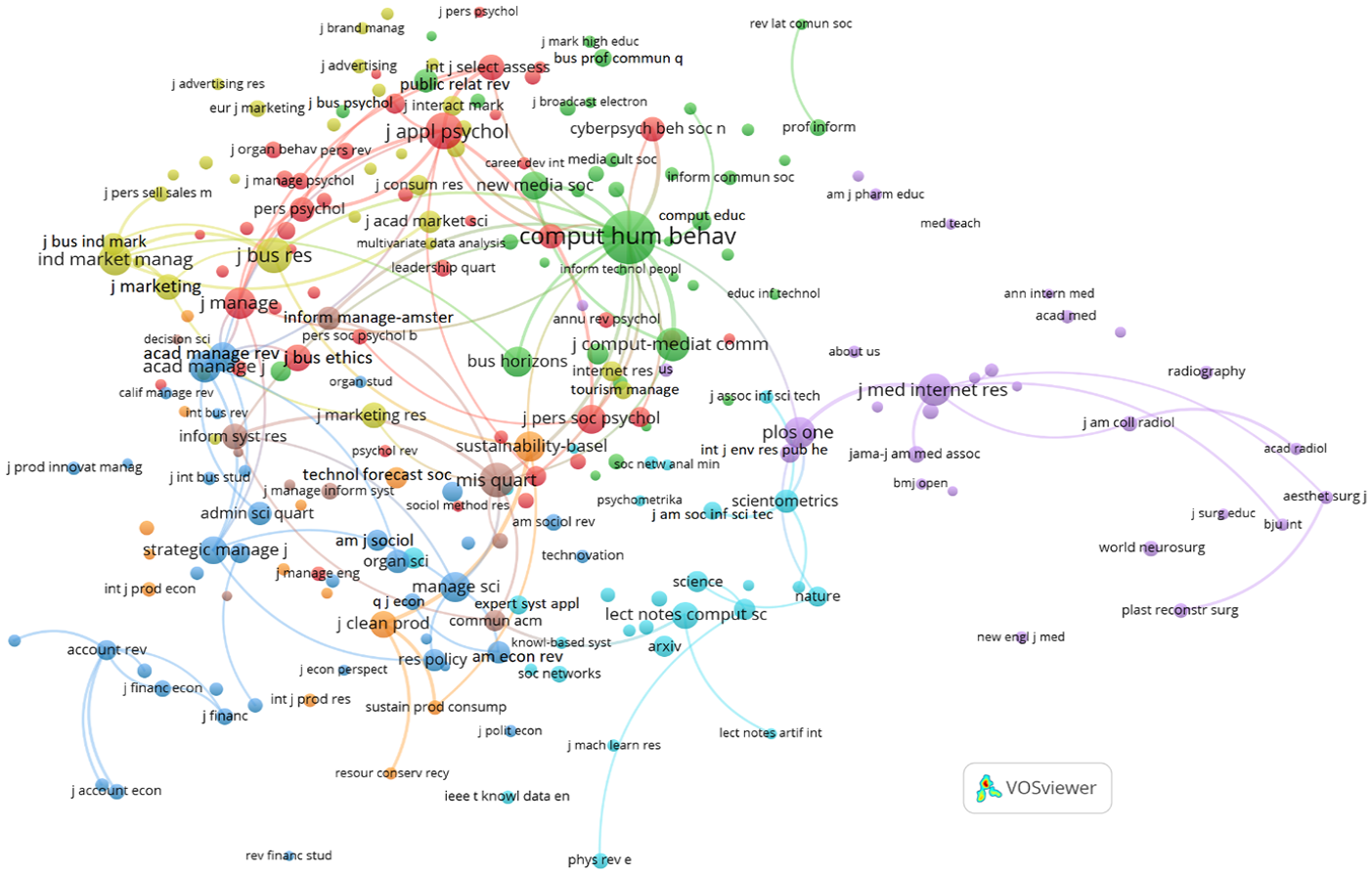
Co-citation of journals on LinkedIn: minimum citation threshold of 30 and 100 links.
Beyond this core, distinct disciplinary clusters emerge. The health communication cluster (purple), led by Journal of Medical Internet Research, highlights LinkedIn’s role in professional networking, digital health education, and telemedicine collaborations. The marketing and management cluster (red), represented by Business Horizons and Technological Forecasting and Social Change, emphasizes corporate branding, digital marketing, and social media–driven business strategies. The computational cluster (blue), anchored by Lecture Notes in Computer Science, signals LinkedIn’s increasing integration into machine learning, AI-driven recruitment, and data-driven professional analytics.
The network topology reveals LinkedIn’s shifting research focus, with psychology and business studies remaining central, while computational, healthcare, and marketing research gain prominence. The density of citations in social sciences reflects sustained interest in LinkedIn as a socio-professional ecosystem, while the growth of computational clusters suggests expanding inquiries into algorithmic governance, automated recruitment, and AI-enhanced professional interactions.
This analysis bridges earlier quantitative trends with LinkedIn’s intellectual structure, reinforcing the multidisciplinary nature of its research footprint and addressing the reviewer’s concern regarding weak connectivity across study sections.
Figure 4 presents the co-citation network of LinkedIn-related documents, constructed with a minimum citation threshold of 10 and 100 links, revealing the intellectual structure of LinkedIn research. Central works, including Boyd (2007, Journal of Computer-Mediated Communication) and Kaplan (2010, Business Horizons), shape foundational perspectives on social media’s role in professional networking.
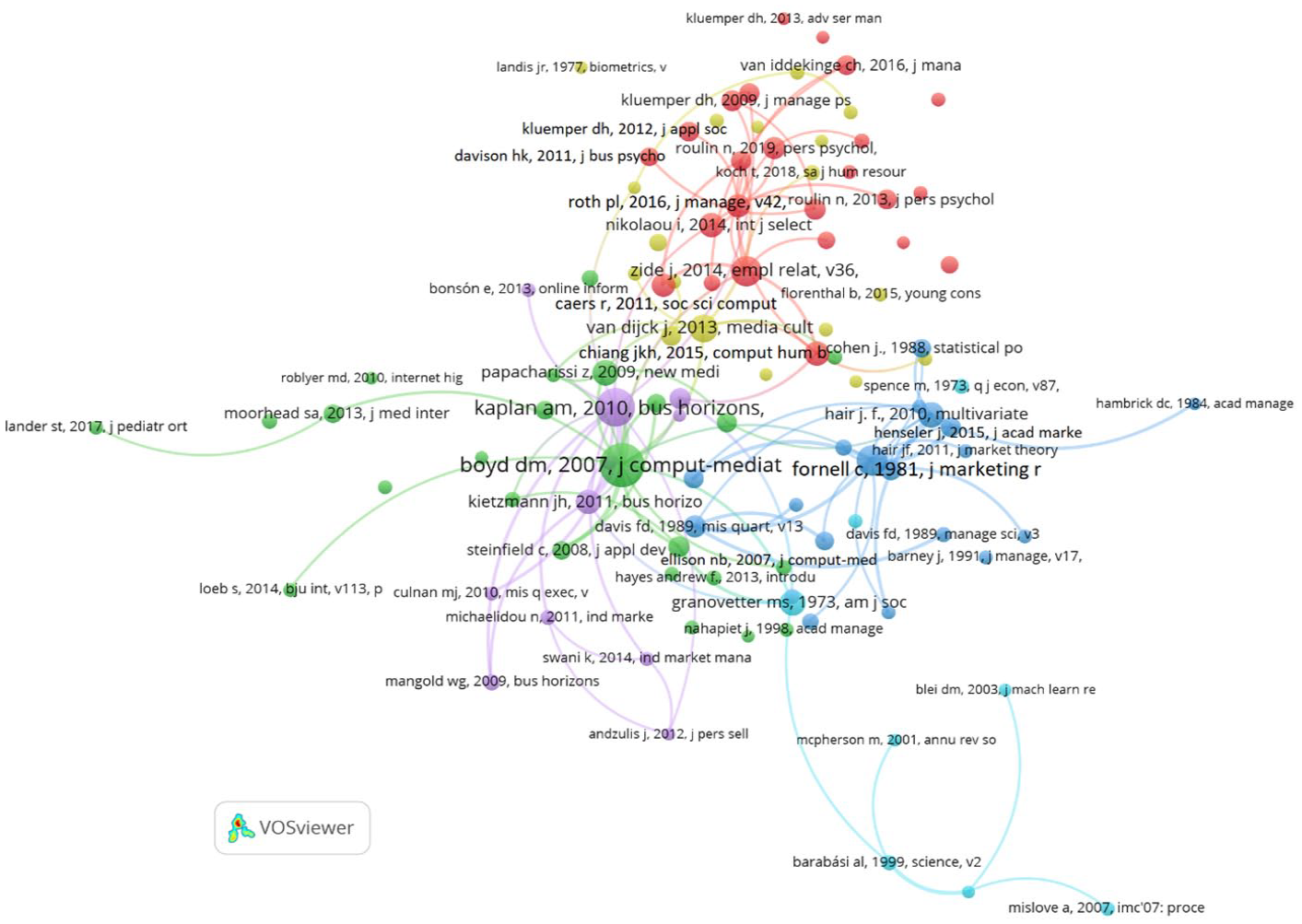
Co-citation of documents on LinkedIn: minimum citation threshold of 10 and 100 links.
Clusters reflect thematic convergence, where frequently co-cited works indicate shared conceptual frameworks. Van Dijck (2013, Media, Culture & Society) and Kietzmann et al. (2011, Business Horizons) coalesce around social media’s identity construction and functional structures, while Fornell (1981, Journal of Marketing Research) and M. S. Granovetter (1973, American Journal of Sociology) bridge network theory and marketing strategies within professional ecosystems.
The network also highlights cross-disciplinary linkages. Papacharissi (2009, New Media & Society) connects sociocultural analysis of digital platforms to professional networking. Computational and behavioral research is reinforced by Chiang and Suen (2015, Computers in Human Behavior), reflecting LinkedIn’s role in data-driven investigations of professional engagement.
This mapping consolidates LinkedIn’s multidisciplinary research impact, merging social, behavioral, computational, and marketing perspectives into a cohesive bibliometric landscape.
Figure 5 presents the co-citation network of authors in LinkedIn research, constructed with a minimum citation threshold of 15 and 100 links. This network highlights scholars frequently cited together, revealing thematic and disciplinary structures shaping LinkedIn-related scholarship. Boyd, Kaplan, and Van Dijck form the central core, reflecting their foundational influence on social media theory, digital identity, and professional networking. Boyd’s seminal work in digital communication and social networks aligns with Kaplan’s conceptualization of social media frameworks, reinforcing their joint impact in shaping LinkedIn research.
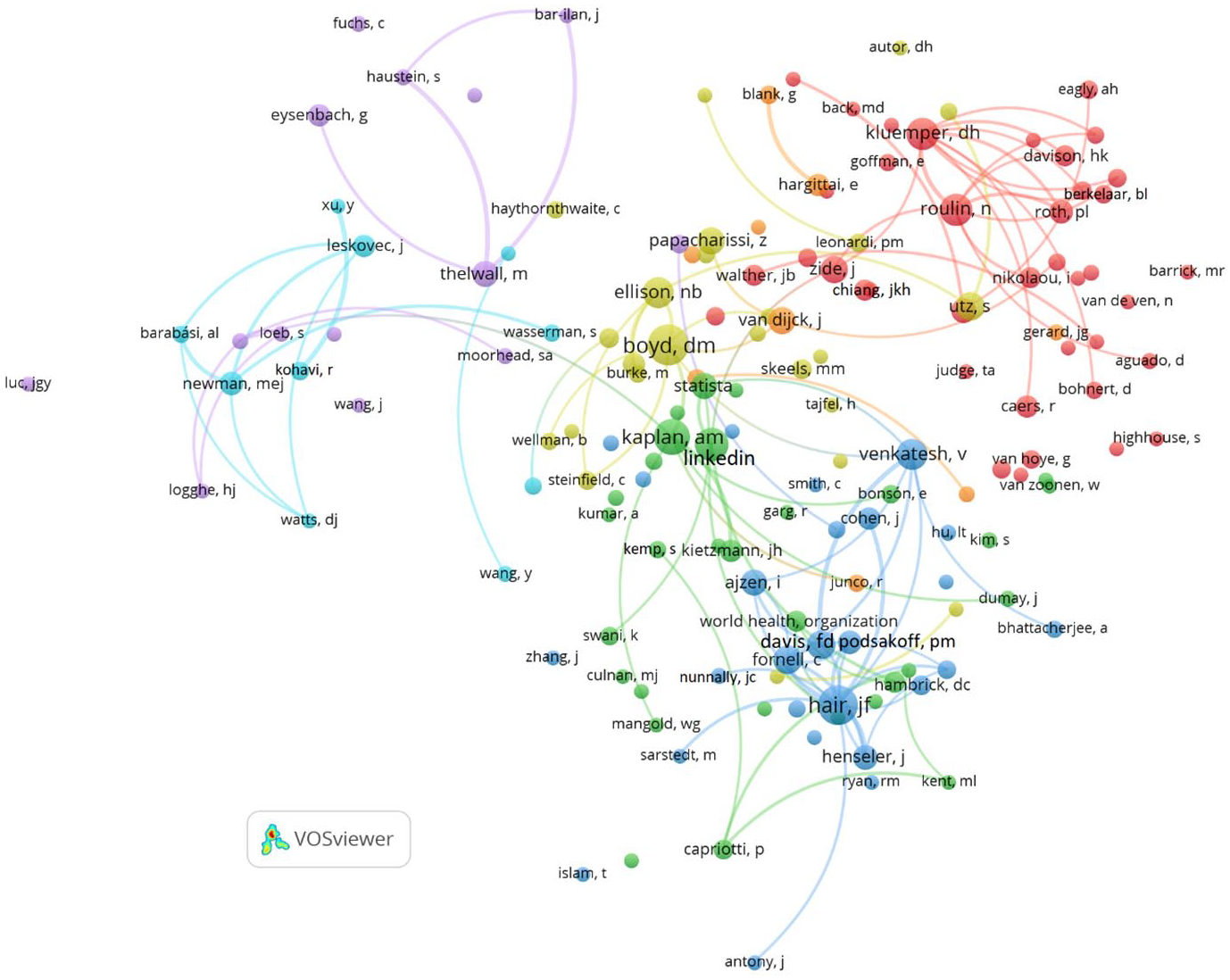
Co-citation of authors on LinkedIn: minimum citation threshold of 15 and 100 links.
Distinct clusters in the network indicate research convergence across disciplines. The cluster featuring Venkatesh and Davis represents studies on technology adoption models (e.g., TAM) and user behavior, reflecting LinkedIn’s role in professional engagement. Another structurally distinct cluster, led by Thelwall and Newman, links bibliometrics and network science, underscoring LinkedIn’s application in citation analysis, social network modeling, and web-based influence metrics. Meanwhile, Roulin and Nikolaou anchor a cluster focused on LinkedIn’s role in recruitment and HR analytics, showcasing its impact in organizational psychology and hiring practices. The structural distribution of clusters within Figure 5 highlights LinkedIn’s interdisciplinary research presence, spanning computational social sciences, business strategy, information retrieval, and behavioral research. The cross-disciplinary connectivity of these highly cited authors indicates LinkedIn’s integration into both theoretical and applied domains, positioning it as a critical subject of study across multiple academic fields.
Bibliographic Coupling
Figure 6 presents the bibliographic coupling network of LinkedIn-related studies, constructed using a minimum threshold of 40 citations and 100 links, revealing the structural coherence and interconnectivity of research in this domain. Bibliographic coupling, which quantifies shared references among publications, delineates thematic clusters that reflect the intellectual structure of LinkedIn scholarship.
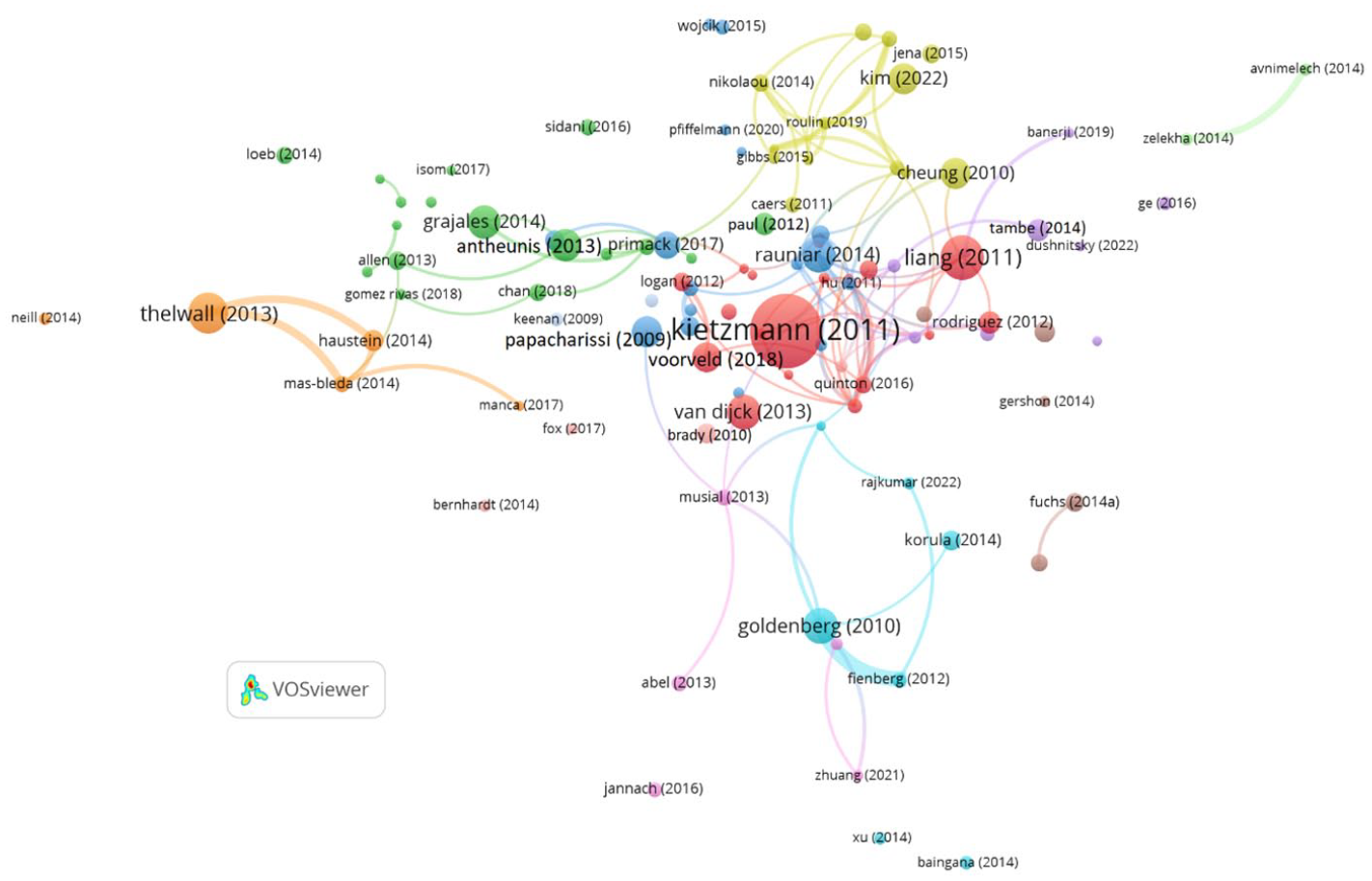
Bibliographic coupling of documents published on LinkedIn: minimum threshold of 40 citation and 100 links.
At the core of the network, Kietzmann et al. (2011) serves as a foundational study, extensively coupled with later works such as Liang et al. (2011) on social commerce and van Dijck (2013) on identity construction in digital platforms. The strong coupling between these works highlights LinkedIn’s dual role in professional self-presentation and strategic networking, reinforcing its position in organizational and behavioral research. The high connectivity of this cluster suggests that these studies provide a conceptual backbone for investigating LinkedIn as an integral component of digital professional ecosystems.
Another prominent node, Thelwall et al. (2013), is linked to research on altmetrics and academic influence, suggesting that LinkedIn is also studied within the context of scientometric impact and academic reputation management. The documents surrounding Thelwall emphasize LinkedIn’s function beyond career-oriented networking, extending to academic visibility and engagement in research dissemination.
A separate methodologically driven cluster, anchored by Goldenberg (2010), focuses on network modeling and statistical frameworks, demonstrating how computational methods contribute to LinkedIn research. Works like Abel et al. (2013), which explores data reconciliation and personalization in digital platforms, further extend this cluster, highlighting the increasing reliance on machine learning and predictive analytics in understanding LinkedIn user interactions.
Peripheral nodes, including Fuchs (2014) and Korula (2014), indicate emerging discourses on privacy, ethical considerations, and user trust, reflecting critical inquiries into the platform’s governance and data-driven profiling. These contributions reveal LinkedIn’s entanglement with broader societal concerns, particularly in the realm of algorithmic transparency and digital labor.
The overall structure of the bibliographic coupling network underscores LinkedIn’s cross-disciplinary relevance, spanning business and marketing, computational methodologies, and social sciences. The strong interlinkages between behavioral, computational, and managerial studies illustrate a convergence of perspectives, reinforcing LinkedIn’s role as a platform that intersects organizational behavior, digital identity, and predictive analytics.
Figure 7 presents the bibliographic coupling network of journals publishing LinkedIn-related research, constructed with a minimum threshold of three documents and 100 links, revealing structural dependencies in scholarly discourse. Bibliographic coupling, which quantifies shared references among journals, highlights thematic overlaps and interdisciplinary intersections shaping LinkedIn research.
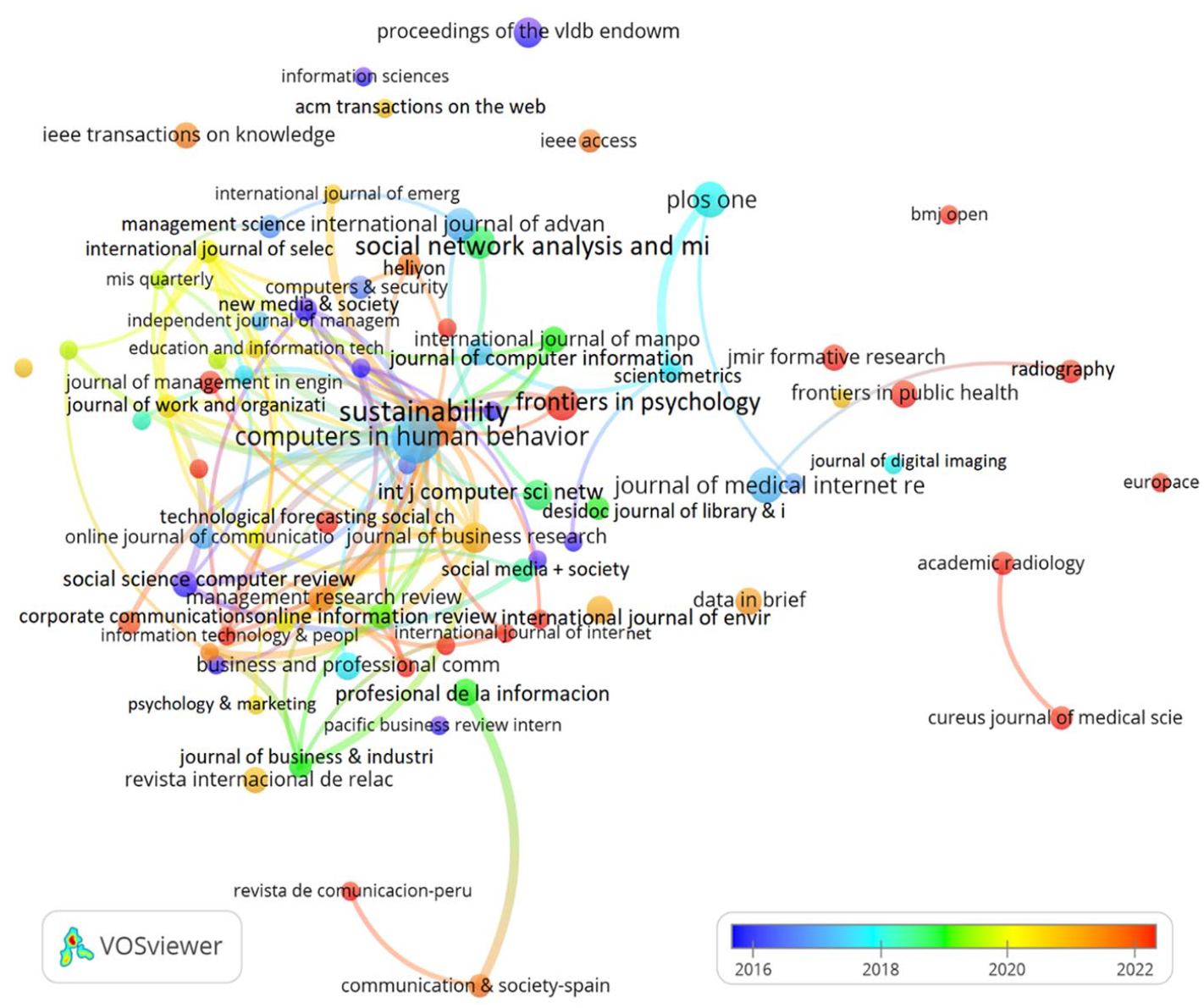
Bibliographic coupling of journals publishing on LinkedIn: minimum threshold of 3 documents and 100 links.
At the core of the network, Computers in Human Behavior emerges as the most central journal, reinforcing its dominance in human-computer interaction and social media research. Strong coupling with Journal of Business Research and Frontiers in Psychology signifies LinkedIn’s role in behavioral economics, professional identity formation, and organizational psychology, demonstrating how technological adoption on LinkedIn intertwines with business strategies and psychological frameworks.
The scientometric and data-driven research cluster is anchored by Scientometrics and IEEE Transactions on Knowledge and Data Engineering, emphasizing the quantitative analysis of LinkedIn’s scholarly influence and its role in large-scale data processing. The presence of Proceedings of the VLDB Endowment further underscores LinkedIn’s relevance in computational research, particularly in database engineering and knowledge discovery.
Another distinct cluster, dominated by PLOS One and Journal of Medical Internet Research, reflects LinkedIn’s integration into digital health research. The strong coupling among JMIR Formative Research, Frontiers in Public Health, and Academic Radiology indicates a growing emphasis on LinkedIn as a platform for medical networking, public health engagement, and knowledge dissemination in healthcare domains.
The color gradient in Figure 7, spanning 2016 to 2022, illustrates the evolution of LinkedIn research across disciplines. Earlier contributions cluster around business, psychology, and social media studies, whereas recent trends indicate an expanding focus on digital health, knowledge management, and computational methodologies. This temporal shift highlights LinkedIn’s transition from a networking tool examined primarily within business and social sciences to a research subject embedded in medical, computational, and interdisciplinary studies.
The bibliographic coupling network ultimately demonstrates LinkedIn’s growing academic significance, revealing a convergence of behavioral sciences, data-driven methodologies, and domain-specific applications. The interplay between computational, psychological, and health-related research streams underscores LinkedIn’s cross-sectoral impact, cementing its role as an evolving subject of scholarly inquiry.
Figure 8 presents the bibliographic coupling network of institutions contributing to LinkedIn research, constructed with a minimum threshold of three documents and 100 links. This visualization maps the intellectual interconnectivity among institutions, revealing clusters that reflect regional, disciplinary, and collaborative research dynamics.
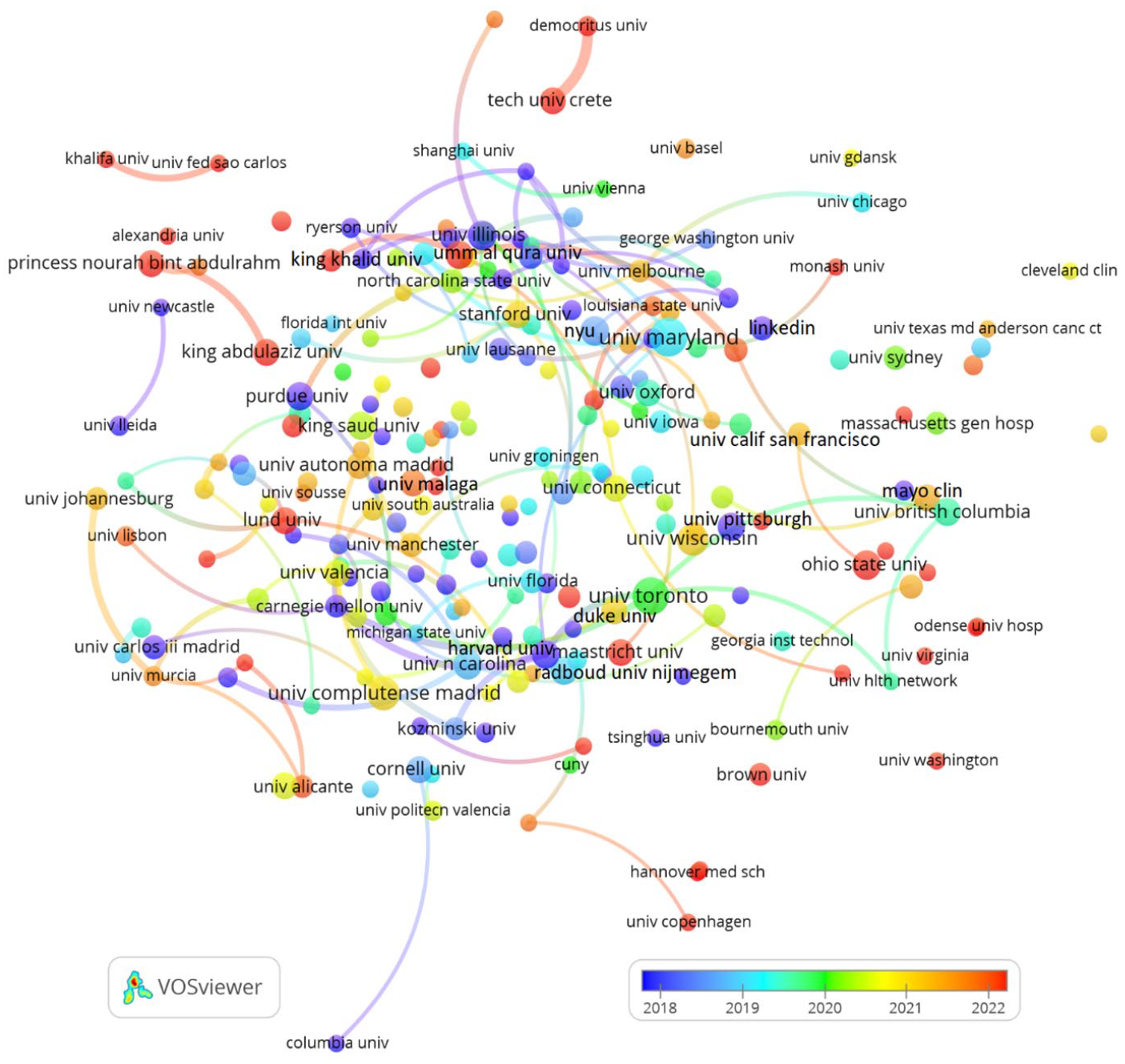
Bibliographic coupling of institutions publishing on LinkedIn: minimum publication threshold of 3 documents and 100 links.
At the core of the network, Harvard University, New York University (NYU), and the University of Toronto emerge as dominant contributors, reflecting sustained research output, high citation influence, and strong cross-institutional connectivity. Their bibliographic coupling with institutions such as Purdue University and the University of Pittsburgh indicates a concentrated research trajectory on LinkedIn’s role in social media analytics, professional networking, and computational methodologies.
European institutions exhibit significant interlinkages, with Radboud University Nijmegen and Complutense University of Madrid demonstrating strong coupling, indicative of interdisciplinary investigations spanning business, computer science, and social sciences. The connectivity of King Saud University and Umm Al-Qura University reflects the increasing engagement of Middle Eastern institutions in LinkedIn-related scholarship, highlighting regional diversification in academic discourse.
The color gradient in Figure 8, spanning 2018 to 2022, visualizes the temporal evolution of institutional participation. Institutions positioned toward the recent spectrum, such as the University of Sydney and Duke University, signal emerging contributions and growing interest in LinkedIn-related research across academia.
The network structure ultimately underscores the expansion of LinkedIn research beyond North American and European academic hubs, integrating diverse geographical perspectives. This increasing institutional engagement suggests a broadening of research themes, spanning computational analytics, organizational studies, and digital labor markets.
Figure 9 presents the bibliographic coupling network of countries engaged in LinkedIn research, applying a minimum threshold of three publications and 100 links. This visualization captures global research interconnectivity, highlighting scholarly influence, cross-national collaboration, and thematic convergence.
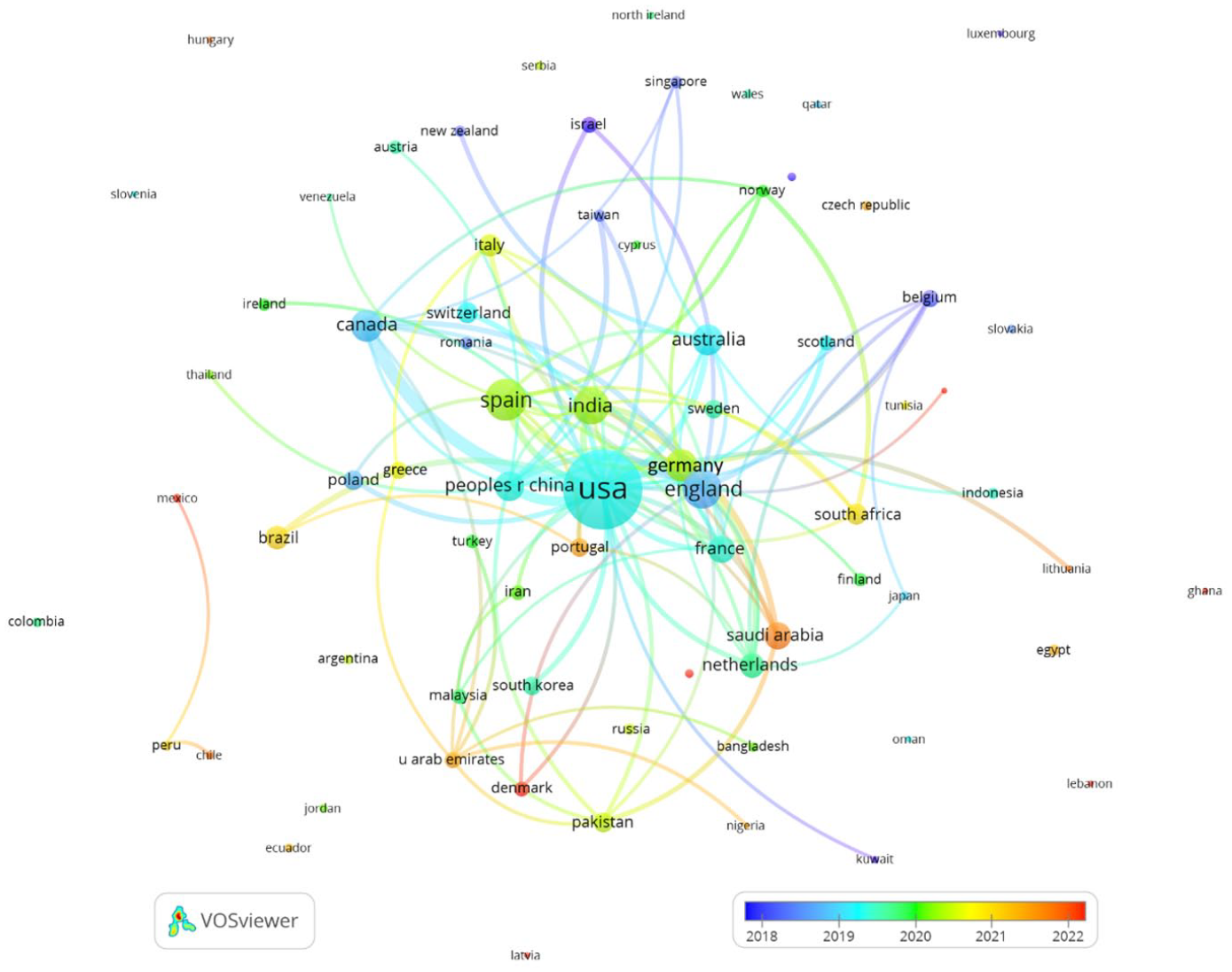
Bibliographic coupling of countries publishing on LinkedIn: minimum publication threshold of 3 documents and 100 links.
The USA dominates the network, exhibiting the strongest centrality and connectivity, indicating its leading role in LinkedIn scholarship. This positioning reflects high publication volume, extensive international co-authorships, and significant academic influence. The USA’s bibliographic coupling with Germany, England, and Spain signals a well-established transatlantic research network, fostering cross-border knowledge exchange in social media analytics, professional networking, and digital labor markets.
China and India emerge as key players, with increasing integration into global LinkedIn research, reflecting expanding academic engagement in digital platform studies. Their bibliographic ties with the USA and European nations underscore rising collaborative efforts, particularly in computational modeling, business intelligence, and labor economics.
Europe exhibits a dense network, with France, the Netherlands, Italy, and Poland displaying strong bibliographic coupling, reinforcing regional leadership in interdisciplinary LinkedIn research. Australia and Canada maintain high connectivity, reflecting active participation in global collaborations, particularly in digital communication, social media psychology, and corporate networking studies.
The color gradient (2018-2022) maps the temporal evolution of research contributions. While early contributions stem from the USA and major European economies, newer entrants—Saudi Arabia, South Korea, and Belgium—have increased their research presence post-2020, signaling a diversification in the academic landscape. This shift suggests expanding global interest in LinkedIn’s societal, economic, and technological implications.
The bibliographic coupling structure ultimately underscores the broadening international scope of LinkedIn research, reflecting an evolving, multidisciplinary discourse shaped by diverse regional perspectives.
Keyword and Topical Analysis
Understanding the evolution of research themes provides crucial insight into how LinkedIn studies align with broader scholarly discourse on social media, digital labor, and data-driven technologies. Figure 10 presents the co-occurrence network of author keywords, applying a minimum threshold of three occurrences and 100 links. This visualization maps thematic clusters, revealing core topics, emerging trends, and conceptual interdependencies within LinkedIn-related research.
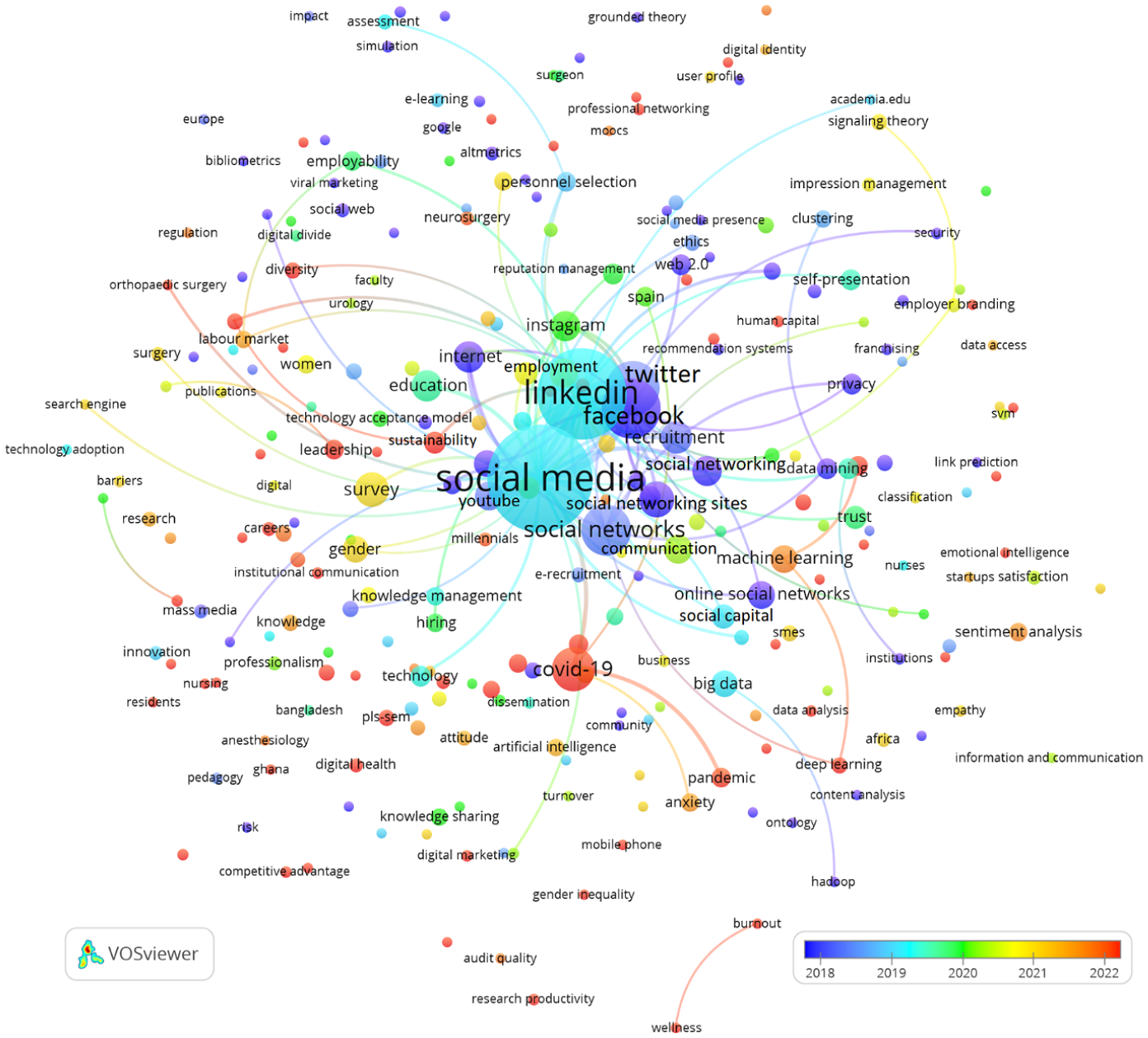
Co-occurrence of author keywords on LinkedIn: minimum occurrence threshold of 3 and 100 links.
At the center of the network, “social media” emerges as the dominant term, reflecting LinkedIn’s integration within broader digital platforms. Close associations with “LinkedIn,” “Twitter,” and “Facebook” highlight a comparative research trend, where LinkedIn is analyzed alongside competing platforms to examine networking dynamics, content strategies, and engagement behaviors.
Clusters around “recruitment,” “employability,” and “personnel selection” emphasize LinkedIn’s primary function as a career-oriented platform, indicating a strong research focus on its role in job searches, hiring processes, and labor market dynamics. The keyword “trust,” interconnected with “social capital” and “communication,” suggests scholarly examination of professional credibility, networking effectiveness, and relational dynamics in online hiring and business interactions.
Another major thematic intersection lies in technology-driven LinkedIn research, with “machine learning,” “big data,” and “privacy” emerging as key terms linked to algorithmic decision-making, data analytics, and ethical concerns in professional networking. These topics indicate growing interest in predictive hiring models, AI-driven profile recommendations, and data governance in digital labor ecosystems.
The temporal color gradient provides insight into emerging trends, revealing that topics such as “machine learning,” “trust,” and “COVID-19” have gained notable traction post-2020. The pandemic’s impact on remote work and digital networking is reflected in LinkedIn-related studies, signaling an adaptive shift in professional engagement models. Furthermore, increasing discussions on AI, algorithmic bias, and data ethics suggest LinkedIn’s growing role in computational social science, workforce analytics, and professional identity construction.
The co-occurrence network underscores the multidimensional nature of LinkedIn research, spanning employment, digital trust, technological innovation, and societal challenges. The integration of AI, privacy, and trust-related discussions highlights the platform’s evolving role, marking a transition from a mere networking tool to a data-driven professional ecosystem with broader implications in digital labor and AI ethics.
A systematic examination of author keywords reveals thematic concentrations, interdisciplinary connections, and geographical variations in LinkedIn-related research. Table 9 presents the 40 most frequently occurring keywords, categorizing them globally and across three regions: North America, Europe, and the rest of the world. This structured breakdown enables a comparative perspective on research priorities and evolving trends across different academic landscapes.
Co-occurrence of Author Keywords in LinkedIn: Global and Geographical Analysis.
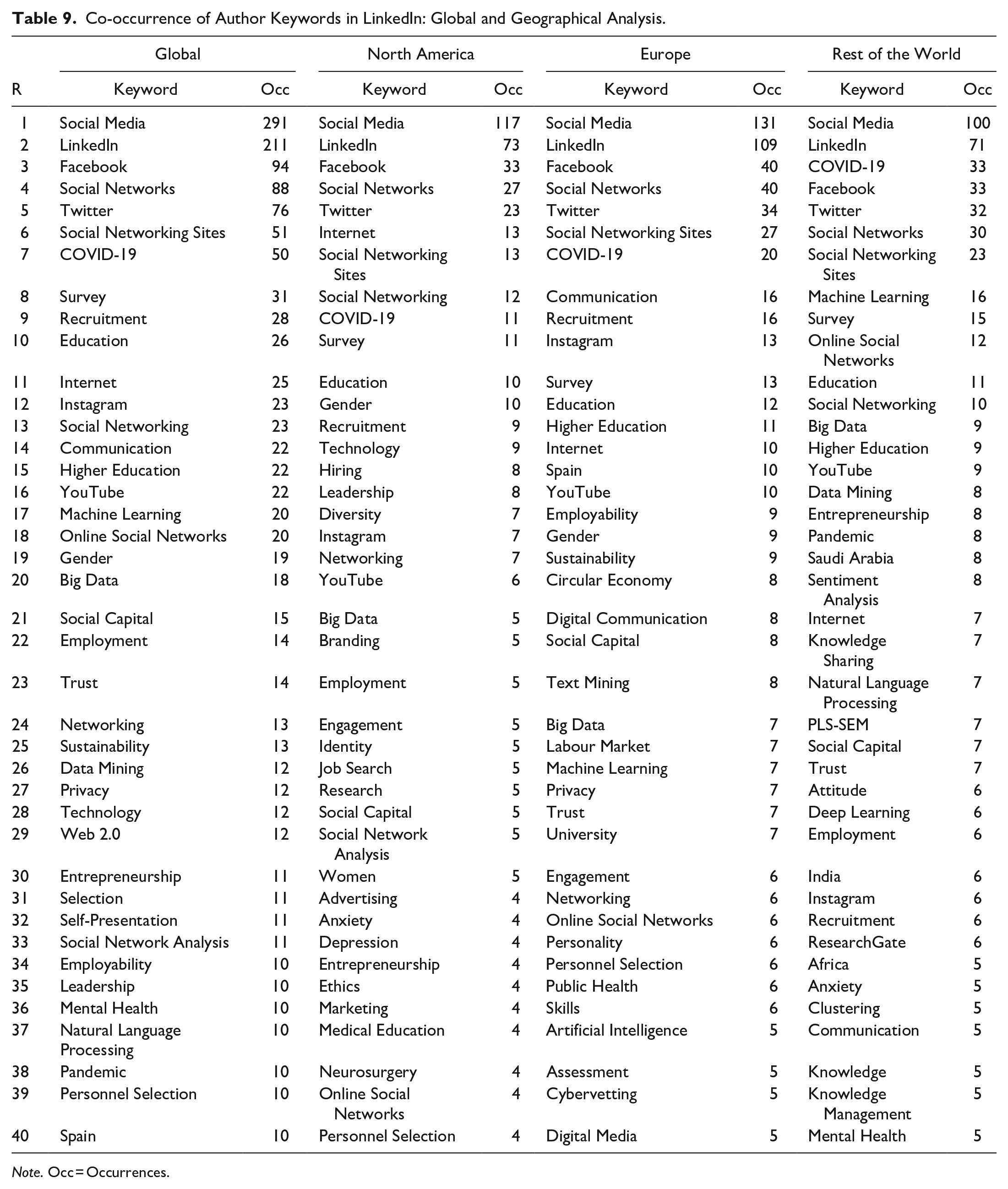
Note. Occ = Occurrences.
The dominance of “social media” (291 occurrences) and “LinkedIn” (211 occurrences) across all regions confirms LinkedIn’s position as an integral component of social media research. The frequent co-occurrence of “Facebook” (94 occurrences), “Twitter” (76 occurrences), and “Social Networks” (88 occurrences) suggests that comparative analyses of LinkedIn alongside other platforms are prevalent, particularly in studies of networking behaviors, platform affordances, and user engagement strategies.
Employment-related terms such as “recruitment” (28 occurrences), “employability” (10 occurrences), and “personnel selection” (10 occurrences) reinforce LinkedIn’s primary role as a professional networking site, with scholars examining its impact on job searches, hiring decisions, and labor market trends. Regional variations show North American research emphasizing hiring, leadership, and branding, while European scholars integrate sustainability, employability, and digital communication into LinkedIn studies.
The increasing role of computational methodologies is reflected in terms like “machine learning” (20 occurrences), “big data” (18 occurrences), and “data mining” (12 occurrences), highlighting research on algorithmic recruitment, AI-driven recommendation systems, and privacy concerns. This is particularly evident in the rest of the world, where NLP, deep learning, and clustering emerge as key computational research areas.
Notably, “COVID-19” (50 occurrences) signifies the pandemic’s impact on professional networking, affecting recruitment, digital hiring practices, and virtual job market interactions. This trend is especially pronounced outside North America and Europe, where pandemic-related shifts in employment models and digital transformation in networking platforms have been a research priority.
While broad thematic similarities exist across regions, certain differences in emphasis are notable. Europe’s high frequency of “Instagram” and “communication” suggests a stronger integration of social media marketing and engagement dynamics, whereas the rest of the world shows a sharper focus on AI-driven approaches, reflecting the growing adoption of machine learning in LinkedIn-related studies.
The co-occurrence analysis underscores LinkedIn’s role at the intersection of employment, digital trust, data analytics, and platform governance. The integration of AI, recruitment studies, and privacy concerns highlights the platform’s shift from a networking tool to a data-driven professional ecosystem, with evolving implications for workforce analytics, trust in digital hiring, and algorithmic decision making in professional contexts.
A quantitative analysis of Scopus-indexed keywords provides additional insights into thematic concentrations, research impact, and evolving scholarly priorities in LinkedIn studies. For further analysis of keywords in documents on LinkedIn, the data was retrieved from the Scopus database. An initial search using “LinkedIn” in the article title, abstract, and keywords returned 3,287 documents. Filtering these results and excluding publications from the year 2025 reduced the total to 3,285 documents. Further refinement to include only articles and reviews yielded 1,754 documents, and narrowing the focus to documents in the final stage of publication resulted in 1,710 documents. Table 10 presents the most productive and influential keywords, ranking them by total publications (TP), total citations (TC), h-index, citation-per-paper (C/P), and highly cited works (≥100 citations, ≥10 citations).
The Most Productive and Influential Keywords.
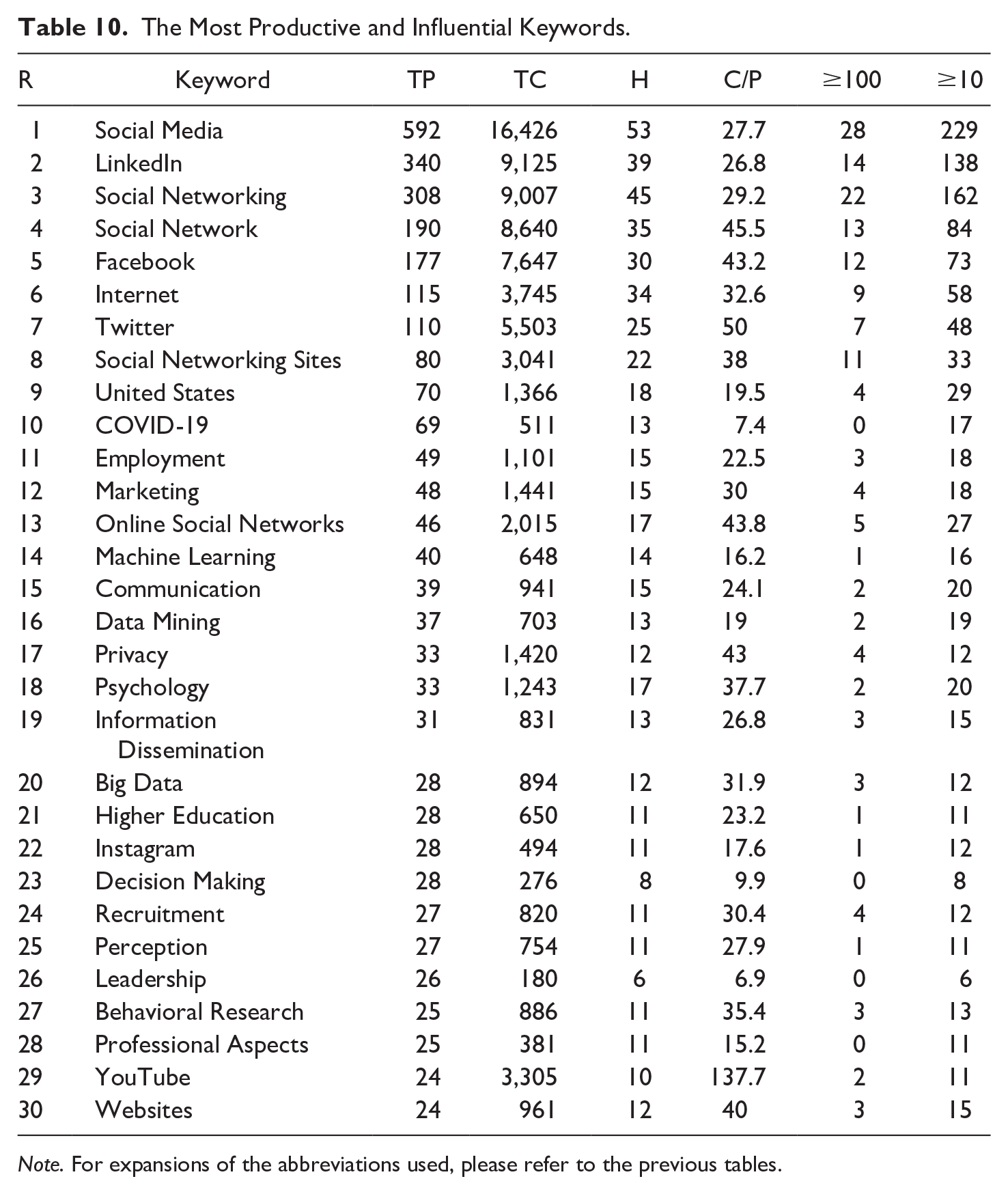
Note. For expansions of the abbreviations used, please refer to the previous tables.
The dominance of “Social Media” (592 publications, 16,426 citations, h-index: 53) underscores its foundational role in LinkedIn research, framing LinkedIn as a case study within broader social media discourse. The high citation-per-paper (C/P) ratio of 27.7 and 28 publications exceeding 100 citations reflect its longstanding impact across disciplines.
“LinkedIn” ranks second (340 publications, 9,125 citations, h-index: 39), confirming its scholarly significance as an independent research focus. The strong representation of “Social Networking” (308 publications, 9,007 citations) and “Social Network” (190 publications, 8,640 citations, C/P: 45.5) highlights LinkedIn’s integration within social and professional networking studies, emphasizing network dynamics, digital labor markets, and trust mechanisms.
Comparative analyses of LinkedIn, Facebook (177 publications, 7,647 citations, C/P: 43.2), and Twitter (110 publications, 5,503 citations, C/P: 50.0) suggest that researchers contextualize LinkedIn’s affordances within a broader ecosystem of online networking platforms. The prominence of “Employment” (49 publications, 1,101 citations) and “Recruitment” (27 publications, 820 citations) reinforces LinkedIn’s core function as a digital labor market intermediary, while “Marketing” (48 publications, 1,441 citations, h-index: 15) reflects its growing role in social media–driven business strategies.
Emerging themes such as “COVID-19” (69 publications, 511 citations) signal a shift toward crisis-driven research, analyzing LinkedIn’s role in virtual hiring, remote work adaptation, and professional resilience during the pandemic. The increasing presence of “Machine Learning” (40 publications, 648 citations), “Big Data” (28 publications, 894 citations), and “Data Mining” (37 publications, 703 citations) indicates the integration of AI and analytics in professional networking, particularly in algorithmic recruitment, talent matching, and privacy-preserving recommendation systems.
Additionally, topics such as “Privacy” (33 publications, 1,420 citations, C/P: 43.0), “Trust” (14 publications, 393 citations), and “Information Dissemination” (31 publications, 831 citations) point to growing concerns about data governance, transparency, and ethical AI deployment in professional networks. The presence of “Higher Education” (28 publications, 650 citations) and “Leadership” (26 publications, 180 citations) highlights LinkedIn’s increasing educational and professional development applications.
The keyword analysis reveals an established yet evolving research landscape, where traditional themes in professional networking, employment, and digital marketing intersect with emerging discussions on AI, privacy, and crisis adaptation. The high citation impact of established topics suggests a mature field, while recently emerging terms indicate dynamic shifts in scholarly focus, aligning LinkedIn research with broader technological and societal transformations.
Conclusions and Limitations
This study systematically mapped the intellectual structure of LinkedIn research through bibliometric analysis, addressing key themes, influential publications, collaboration networks, and emerging trends. The findings provide a quantitative and network-driven perspective on LinkedIn’s research landscape, revealing its interdisciplinary nature and academic significance. The conclusions are structured into three sections: general discussion of key findings, practical implications, and limitations with future research directions.
General Discussion
The first research question, regarding the thematic structure of LinkedIn research, is answered through co-citation and keyword analysis. The results identify four dominant domains:
Professional Networking & Recruitment, emphasizing LinkedIn’s role in hiring and career advancement
Digital Identity & Social Capital, focusing on trust, credibility, and personal branding
Social Media & Online Engagement, highlighting comparative studies with platforms like Facebook and Twitter
Data Science & Algorithmic Impact, covering machine learning applications and data-driven recruitment
These clusters illustrate LinkedIn’s evolution beyond job searching, extending into digital identity formation, corporate branding, and algorithmic profiling.
The second research question, which examines citation and collaboration networks, reveals a concentration of research efforts in North America and Europe, with Harvard University, the University of Toronto, and NYU leading contributions. Citation analysis highlights Kietzmann et al. (2011) and Liang et al. (2011) as foundational works, shaping discussions on social media affordances and professional identity performance. Despite LinkedIn’s prominence in employment and recruitment studies, gaps remain in understanding algorithmic hiring biases, long-term career outcomes, and evolving workplace norms.
To address the third research question, journal influence was assessed, confirming Computers in Human Behavior and Journal of Business Research as central publication outlets. These venues have driven discussions on LinkedIn’s role in professional interactions, strategic communication, and corporate reputation management.
The fourth research question, on emerging trends, was answered through keyword analysis, showing a recent shift toward AI-driven recruitment, privacy concerns, and LinkedIn’s adaptation during COVID-19. Bibliographic coupling highlights interdisciplinary convergence, linking LinkedIn to educational technology, healthcare networking, and computational social sciences. These findings signal LinkedIn’s expanding influence beyond HR and business disciplines, with growing relevance in data-driven decision-making and knowledge dissemination.
Practical Implications
The insights from this study have direct applications for researchers, HR professionals, educators, and corporate strategists. LinkedIn’s increasing integration into AI-driven hiring models necessitates further research into algorithmic transparency, fairness, and predictive validity in job recommendations. In academic visibility, LinkedIn’s role in digital scholarship, professional branding, and citation influence remains underexplored. Educational institutions can leverage LinkedIn Learning and professional networks to enhance career-oriented curricula and student engagement.
For corporate stakeholders, LinkedIn serves as a platform for market intelligence, B2B networking, and industry-specific discourse analysis. Future studies should examine how LinkedIn’s algorithm amplifies or suppresses certain professional content, affecting career mobility and information asymmetry in hiring practices. Additionally, concerns surrounding data privacy, ethical profiling, and AI-mediated decision-making warrant regulatory scrutiny and scholarly attention.
Limitations and Future Research
While this study provides a comprehensive bibliometric mapping, several methodological and data-related constraints should be acknowledged. The reliance on Web of Science (WoS) excludes nonindexed or regional research, potentially underrepresenting non-English and emerging market contributions. Future studies should incorporate Scopus, Google Scholar, and alternative databases to improve coverage. Authorship analysis, while employing fractional counting, does not fully capture individual contribution disparities, which remains an open methodological challenge in bibliometric research. Future studies should complement bibliometric analysis with qualitative assessments of research methodologies, theoretical perspectives, and empirical approaches to provide a more holistic understanding of LinkedIn scholarship.
Emerging research directions should address LinkedIn’s evolving role in AI-driven recruitment, ethical concerns in algorithmic hiring, and platform influence on career trajectories. The increasing use of machine learning in profile ranking, skill assessment, and professional recommendations raises critical questions about bias mitigation, fairness, and transparency. Additionally, longitudinal studies tracking LinkedIn’s adaptation to digital transformation, global labor shifts, and platform governance will be crucial for understanding its sustained impact. As LinkedIn’s algorithms and user engagement evolve, future studies should adopt longitudinal approaches to track emerging trends beyond 2024, particularly in AI-driven recruitment and professional networking.
This study contributes a structured synthesis of LinkedIn research, bridging social sciences, computational analytics, and professional studies. As LinkedIn continues to shape professional ecosystems, future research must integrate quantitative metrics with qualitative assessments, ensuring a holistic understanding of its academic and practical significance. Future studies may also address methodological limitations by integrating cross-database validation, altmetric indicators, or citation-context analysis to strengthen robustness and mitigate database-induced biases. The underrepresentation of certain topics—such as longitudinal career impacts or algorithmic fairness—may reflect limitations in data accessibility, disciplinary focus, or platform-specific restrictions (e.g., LinkedIn’s limited API access), which future research could investigate more explicitly.
Footnotes
Declaration of Conflicting Interests
The author(s) declared no potential conflicts of interest with respect to the research, authorship, and/or publication of this article.
Funding
The author(s) received no financial support for the research, authorship, and/or publication of this article.
