




Abstract
Effective Q&A management in team presentations is a crucial yet often neglected aspect in academic discourse. Building upon Usera and Fuller’s previous work, this article explores the intricacies of Q&A management for teams. It outlines three key challenges teams face in managing Q&A, introduces two common components (isolated and embedded Q&A) with strategic insights, and proposes techniques for anticipating and responding to questions. By aligning Q&A strategies with the five team presentation formats identified by Usera and Fuller, this article offers a comprehensive framework for enhancing team presentations, with implications for educators, practitioners, and researchers in public speaking.
Introduction
The art of delivering a team presentation needs further systematic study. Usera and Fuller (2024) developed a framework for understanding team presentations by identifying three foundational challenges that all team presentations face, and the five presentation formats that a team can execute to overcome them. They also provided directions for further research.
One key component they did not deeply discuss was the team’s handling of questions throughout the presentation. Business presentations often involve presenters dialoguing with the audience by answering questions and responding to comments (Stapp & Quagliata, 2022). A business presentation’s Question and Answer (Q&A) component is therefore critical because a team’s failure to handle questions adequately can instill doubts in the audience concerning the team’s content expertise, presentation preparation, and overall credibility.
In a solo presentation, the Q&A strategy is simple; the solo presenter handles all questions. This component becomes more complex in a team presentation since more than one person can answer a question. A team must then strategize how they handle Q&A to ensure they display a united front and avoid interrupting or contradicting each other.
Unfortunately, there is little strategic or academic discussion of Q&A management strategy for business presentations. The study of Q&A management of business presentations generally is sparse in the empirical literature, and most focus on academic presentations. For example, Xu (2022a) explored common lexicographical practices in Q&A sessions in academic presentations, specifically regarding differences between novice and experienced researchers. Xu (2022b) also conducted a genre analysis of questions following a conference paper presentation in computer science. Jarvis et al. (2022) analyzed gender gaps in Q&A sessions at academic conferences and found that men consume 3.5 times more of a Q&A session in question volume than women. These studies focused on academic presentations, and none talked about strategy for team presentations.
In the practitioner literature, most Q&A articles focus on answering techniques. Dyer et al. (1972) provided tips for handling Q&A sessions for big audiences of 100 to 1,000 people, such as having questions submitted in writing and “seed” questions ready if no one asks. While applicable for such large audiences, business presentations are often delivered to much smaller audiences, such as managers and executives, so their advice needs recontextualization. In a Harvard Business Review article, Webb (2020) provides tips for answering difficult questions, such as appreciating the question, starting answers with points of agreement, and anticipating possible questions through empathy. While these are helpful tips, they are only exhaustive of some issues for handling a Q&A, let alone for a team presentation. Overall, the practitioner literature needs a more systematic understanding of Q&A management for team presentations for smaller audiences.
How can a team thus effectively plan and execute a Q&A session for a business presentation? We will answer this question by first identifying the foundational challenges a team must address when executing the Q&A component. Then, we will identify two Q&A components that can occur in a business presentation and formats for managing both. Once we establish the components and formats, we will provide anticipation strategies to prepare for questions, followed by response techniques for properly handling them. We will conclude by providing future directions and implications for teaching and researching team presentations.
Foundational Challenges of Q&A
To properly prepare for Q&A, a team must address three foundational challenges. They must establish who will answer what, how they manage turn-taking, and how they will handle undirected questions.
Expertise Lanes
First, teams need to decide who will answer questions regarding specific topics. They need to establish “expertise lanes.” Expertise lanes designate subject matter areas for each team member. These lanes might be self-evident based on their speech outline. For example, if Speaker 2 presents the main point on competitor analysis, then that person should be the one to answer any questions about competitors.
However, some “gray areas” between expertise lanes might exist, so teams must plan who will cover those areas. In the same presentation, suppose Speaker 3 presents a main point about product marketing comparisons. If someone asks about pricing strategy, that might be a gray area between Speakers 2 and 3, so they should anticipate and plan who will answer questions about pricing.
The team should also anticipate any questions outside their expertise lanes. Depending on the question, teams might have to prepare to defer specific questions or assign additional expertise areas to each member outside of their planned speech outline. For example, a team might have to prepare to answer questions about the company’s history or board of directors, even if they are not mentioned in the main presentation.
Turn-Taking
Second, teams must manage their turn-taking. They need to avoid interrupting and talking over each other during Q&A. While establishing expertise lanes will help manage some turn-taking by setting categorical cues, there may still be moments in the Q&A session where two or more people can provide an answer or insight to a question. It is also common for a team member to want to “add” to their teammate’s answer. There must be no overlapping talk or interrupting to avoid confusing the audience or showing disunity.
Teams must display a united front to the audience. Team members interrupting and talking over each other makes the team look disjointed and disrespectful of each other. Members must interact like a team to succeed in a team presentation. Later, we will discuss different Q&A formats that address turn-taking issues differently.
Undirected Questions
Lastly, teams must decide how they handle undirected questions. An undirected question is posed to the whole group or not clearly addressed to one person. For example, during a Q&A session, a decision maker might ask, “Who do you think is our greatest competitor?” The decision maker might not look at a particular team member and pose it to the group entirely, making it an undirected question. It will then be incumbent on the group to decide who answers it.
A directed question, on the other hand, is addressed to a particular individual. A directed question can occur when a decision maker explicitly names a person to answer the question. For example, they might say, “So, John, tell me about the industry benchmarks you used in your pricing analysis.” In this case, the person to answer the question, John, is directly addressed. Directed questions also occur if a decision maker asks a question while a speaker delivers a main point. For example, suppose John shows a SWOT analysis for his main point. While he is delivering, a decision maker interrupts to ask, “Did you consider threats from inflation in your analysis?” In that case, it would be a directed question to John via context.
Expertise lanes might prescribe who answers an undirected question. However, there can be gray areas between lanes that teams might have to work out. Also, a decision maker might not be aware of the expertise lanes or ignore them entirely. If a speaker receives a question that falls in the expertise lane of a teammate, the speaker should redirect the question to the person who can answer it. We will discuss techniques for doing that later in this article.
The three questions discussed above are foundational for establishing a Q&A strategy in a team presentation. They can lead to two different Q&A formats a team can execute, which we will discuss in the next section.
Two Q&A Formats
There are two formats based on when the Q&A session occurs. In a presentation context, there is always the main presentation, the planned content the speakers deliver. Then, there is the Q&A session that occurs either throughout or at the end of the presentation. When the session occurs at the end of the presentation, it is an isolated Q&A. When the Q&A session occurs during the main presentation delivery, it is an embedded Q&A.
We assume that Q&A emanates from a delivered oral presentation or a written deliverable. There must also be two parties associated with Q&A: the team answering the questions and the engaged audience willing and able to ask questions related to the content. We will explore these two formats, identify their strengths and weaknesses, and suggest use cases for each.
Isolated Q&A
Isolated Q&A occurs upon the conclusion of the main presentation when there is a designated period for audience questions. Isolated Q&A is common in formal settings where the audience expects the team to present their ideas uninterrupted, such as case competitions, classroom projects, and business plan pitches. A team could request an isolated Q&A using the presentation agenda to invite listeners to hold their questions until the main presentation concludes.
Teams may prefer an isolated Q&A component due to the complexity of the content, limited time, or strategy. Allowing individuals to share their perspectives without interruption can allow the team to present their case as coherently as possible without worrying about being taken “off-topic” or “down rabbit holes.” Isolated Q&A is often preferred by both audiences and presentation teams because there is an established opportunity to ask questions at the end. Isolated Q&A may also be the prescribed setup in specific contexts, like case competitions, so it is not always a choice for a team.
An isolated Q&A session requires one person to click through the PowerPoint presentation as team members answer questions. We call this role the Controller. The Controller should click through the presentation using the mouse and keyboard at the podium for the quickest navigation. They should listen to the content of the questions and respond by clicking on the relevant slide for the speaker and audience. With the relevant slide showing, the team member has a reference point to answer the question effectively. The Controller can also answer any directed questions and display relevant information on the screen from their location at the podium.
An isolated Q&A session at the end of the presentation can be managed with a host or without a host. Each way has different implications for how teams solicit questions, who answers what, and how they prepare to answer.
Hosted Q&A
Teams can assign a host to manage their Q&A; one person takes questions from the audience and directs them to the appropriate team members. The host has five essential duties.
First, the host facilitates the team’s Q&A session by stepping forward at the beginning of the Q&A and soliciting questions. The host should immediately establish that they are leading the Q&A. Since the host will have a sustained presence throughout the Q&A session, they must be a strong and likable speaker.
Second, the host manages undirected questions by summoning a member to answer them based on their expertise lanes. The host can summon a member by stating their name. The host could also mention the member’s credibility and rephrase the question for a more sophisticated summoning. If an audience member asks a directed question, the host should merely stand by as the addressed team member answers. The host should only direct undirected questions.
Third, the host is responsible for summarizing or cleaning up teammates’ unclear or confused answers. The host should observe the questioner’s nonverbal cues as teammates answer. If the questioner still looks confused, frustrated, or uncertain, the host should use their strong speaking skills to summarize the team member’s answer or provide a more straightforward explanation. The host can also finalize answers by asking for the next question once their member finishes.
Fourth, the host should facilitate any turn management between the team members as they field a question. For example, if Member A is answering a question and Member B wants to add to the answer, Member B should provide a silent signal to the host that they want to add to the question. The host can recognize Member B to add to the answer once Member A finishes.
Lastly, hosts should answer any undirected questions that either do not fit into an expertise lane or are so simple that they can immediately answer without needing to direct. However, hosts should refrain from dominating the Q&A session by answering every question. Hosts should only answer when necessary and find a balance that enables their team members to demonstrate their expertise.
Strategic Analysis of Hosted Q&A
There are benefits to hosted Q&A. First, it addresses all the critical challenges of Q&A with one main person. The host of an isolated Q&A session establishes who answers which questions by managing member expertise lanes. Meanwhile, the host oversees the smooth transitions between speakers to determine speaking turns, thus avoiding team-internal interruptions. Also, hosted Q&A assigns one person to handle undirected questions, ultimately ensuring they get answered correctly by the knowledgeable member.
The second benefit of hosted Q&A is that it looks and feels organized. The audience knows where to direct their questions since the host is the point of contact for receiving questions. Further, the audience and team know when the answer is complete by the host’s finalization of answers. Finalizing answers signals the question’s conclusion, enabling the audience to ask the next question and save time.
The third benefit is the added goodwill from a leading speaker. A host can use their speaking skills and personality to build liking and credibility with the audience, which are keys to persuasion (Cialdini, 2006). The host can then transfer their goodwill to the next speaker before they answer. For instance, the host can “vouch” for a speaker by discussing the next speaker’s credentials or “hype” the speaker’s rigorous analysis methods used in their answer.
There are also risks. The hosted Q&A format relies on a “star speaker” to handle sensitive transitions. This position takes lots of practice and can put undue stress on one member, which opens the host to errors. For example, a host can direct a question to the wrong member. We will discuss solutions to misdirected questions in a later section. Lastly, the host risks overtaking the Q&A by being too much of a standout speaker in both charisma and time allocation. The host’s goal should be to make their teammates look credible and likable without overshadowing them.
Unhosted Q&A
Teams can also manage their isolated Q&A without a Host based on their assessment of their speaking abilities, expertise, and comfort with handling undirected questions. In unhosted Q&A sessions, the team must develop expertise lanes and a cueing system to handle undirected questions. They must manage their speaking turns and areas of expertise and finalize the topics without a host’s facilitation. They use verbal and nonverbal cues to do this.
One way to self-direct questions is by assigning expertise lanes during preparation. When a question falls directly within a team member’s expertise lane, the speaker can immediately take charge and answer the question confidently. We call these “self-directed” answers. By establishing expertise lanes beforehand, everyone knows who will answer the question, which empowers each team member to take ownership of their topics without cueing who goes. Whether a question is directed or undirected, the team members should defer to the member whose expertise lane best addresses the question.
In cases where it is not clear who answers the question because it falls between or outside of members’ expertise lanes, teams will need a communication strategy to manage speaking turns and who answers. We call these situations “communally directed questions.” In such cases, teams can use inconspicuous nonverbal cues like pointing or head nods to signal internally who speaks next. Based on collective signaling, the appropriate speaker can step forward and take ownership of the answer. Self-directed and communally directed questions can both happen in Q&A.
The team’s blocking technique, or how they physically arrange themselves in the room, should be in a U-shape for unhosted Q&A to maximize observation of each other. When members have self-directed questions, it is not necessary for them to see each other. However, having a formation where all members can see each other is beneficial for communally directed questions so they can see internal communication signals. This approach is the opposite of hosted Q&A blocking, where members are not required to see each other since the host verbally controls who speaks and when.
Strategic Analysis of Unhosted Q&A
There are three benefits to unhosted Q&A. First, no single member manages the entire Q&A session. Speaking turn management, directing questions, and remembering expertise lanes are all conducted as a team—albeit with plenty of practice to do so successfully. The second benefit is the effectiveness of self-directed questions. Self-directed questions create the appeal that all members of the team fully understand their topics, and they appear coordinated. The last benefit is that practitioners and audiences often expect an unhosted isolated Q&A because it may be the simplest to execute and most common.
There are three drawbacks of unhosted Q&A. The first drawback is the added difficulty of managing speaking turns. With multiple members believing they owe input to answers, the team leaves themselves vulnerable to answering all at once or chronologically out of order. The next drawback is the increased potential for error due to self-directing. Without a leader in Q&A, the team is more likely to fumble a smooth transition or create awkward silence by failing to recognize signals.
Lastly, unhosted Q&A requires extensive practice to navigate undirected questions successfully. Practice is necessary to ensure team members know and receive the correct nonverbal cues. Further, subliminally cueing the correct speaker requires a thorough understanding of each member’s knowledge bank, which comes through practice. Effective rehearsals are time-consuming, but they prevent members from interrupting each other and committing other unforced errors in an unhosted Q&A.
Embedded Q&A
While teams might reserve Q&A for the end of a presentation, there are contexts when Q&A happens throughout it. Decision makers might ask questions as a speaker presents, or a speaker might solicit questions throughout their main points. We call this Embedded Q&A. Instead of only saving questions for the end, speakers field questions as the presentation develops.
Embedded Q&A moments are common in business presentations for small audiences, in informal settings, or for high-level decision makers who tend to ask many questions. Embedded questions are usually directed to the current speaker, who should address the question and then return to delivering their planned content.
Embedded questions that are either voluntarily solicited by the team or involuntarily interjected by the audience can arise at any point during the presentation. We will discuss situations when it is voluntary, known as “planned Q&A stops” and involuntary, known as “abrupt Q&A stops.”
Planned Q&A Stops
Planned Q&A stops are pauses for questions planned by the speaker. Teams can strategically place Q&A stops in the presentation to ensure the audience keeps pace with their presenters. Planned Q&A stops should occur at the end of a main point before introducing the next topic or transitioning speakers. The speaker can ask if there are any questions and pause for 3-5 seconds before transitioning.
There are two benefits to planned Q&A stops. First, teams can use these iterative stops as the presentation progresses to allow cognitive processing time for audience members, maximizing content comprehension. This pausing is crucial for comprehending abstract ideas or data-heavy analysis. The other benefit is that Q&A stops are an audience engagement technique (Usera, 2023). Planned Q&A stops integrate two-way conversations with the audience as part of the main presentation. This dialogue is a means to interact with the audience directly and engage with them.
There are also risks to planned Q&A stops. Primarily, it is budgeting an unknown amount of time for open dialogue. Some presentations must adhere to strict time limits. Spending too much time answering questions can derail the main presentation’s timing and completion. The other risk is that the main presentation gets derailed because of questions that might be irrelevant or outside the presenter’s scope. Members need to practice answering questions and returning to their outline so the presentation stays focused.
Abrupt Q&A stops
Abrupt Q&A stops happen involuntarily when an audience member interrupts with a question or signals the need to ask a question immediately during a main point. The team does not know exactly when or which topics the decision maker might ask. Thus, when a question is abruptly issued, the speaker must address the question on an unplanned basis regarding its timing and topic.
Typically, the question will be about the current speaker’s topic, so that person answers it. The speaker can answer the question or use other response techniques, which we will discuss in a later section. The current speaker can direct the question to the proper member if the question is undirected. When posed with an abrupt question, the team member should succinctly address it and then return to their presentation script as planned.
The team should expect abrupt Q&A stops based on its analysis of the audience and the context. Since they occur unexpectedly, all team members can do is practice. They should practice fielding questions throughout their main points so they can get acclimated to being interrupted and potentially moving back and forth throughout their presentation slides. When abrupt Q&A stops go well, they impress the audience because they show that the team is prepared, can think quickly on their feet, and can dialogue effectively.
When abrupt Q&A stops go poorly, they can be devastating. Presentations can be overtaken by too many overall questions or by an audience member with too many concerns. Excessive questioning stalls the presentation and can be exceptionally time-consuming, which is poison in a time-constrained environment. Rehearsal is key to ensuring that members can redirect the audience’s focus to their main presentation.
The other risk is team members failing to answer questions owing to lack of knowledge or inadequate preparation. Members must thoroughly know their content and their expertise lanes. They should study both the pros and cons of their argument and show self-awareness of the strengths and limitations of their ideas. Failing to answer questions adequately hurts the team’s credibility and the audience’s likelihood of accepting the team’s arguments.
Anticipating Questions
It is one thing to have a Q&A format established; it is another to prepare for questions. Teams should strategically anticipate certain questions before the presentation to allow time for research and response planning. Upon receiving questions, it is also essential for teams to handle them effectively. We will explore how a team can adequately anticipate questions.
There are three ways that a team can effectively do this: knowing the audience’s questioning characteristics, spiking objections, utilizing linked appendix slides, and using Question Response Techniques.
Knowing the Audience’s Questioning Characteristics
Knowing your audience is essential to public speaking (Aristotle, 2004). Many public speaking textbooks thoroughly cover audience analysis (Beebe & Beebe, 2019; Cardon, 2023; Floyd, 2022; Gregory, 2021; Lucas, 2019). For this article, we want to highlight two unique factors for Q&A preparation: knowledge symmetry and the decision maker’s questioning style.
Knowledge symmetry
Knowledge symmetry compares the presenters’ expertise level to the audience’s. For example, an undergraduate might deliver a presentation in the professor’s subject matter area for a class. In that case, the professor has the knowledge advantage; the student will be unlikely to inform the professor of anything new, but it is still important for the student to present the information to demonstrate understanding for a grade. If the professor has the knowledge advantage, the student will be unlikely to get away with spurious claims and cannot make up facts without being “called out” for them in Q&A.
In some business presentations, the audience might be more knowledgeable about the topic than the presenter. For example, a manager might have a subordinate deliver a presentation about their team’s performance even though the manager already has access to the results. The manager will still want the presentation to understand the subordinate’s perspective and to see if the subordinate has a handle on the situation through their questioning. Also, consider a tech software salesperson who might try to sell a catered cloud product to a Chief Technology Officer. The CTO will be the expert on their company’s ability to handle the new technology and may already know much about the cloud product through their research. The salesperson’s pitch aims not to teach the CTO about their product but to persuade them that their product is the best choice, since the salesperson will be at a knowledge disadvantage. Common sales techniques like asking questions, finding pain points, etc. are fundamental in those scenarios (Rackham, 1988).
There can also be business presentations where the presenter has the knowledge advantage over the audience. Suppose a startup company founder with no business acumen hires a coach to present strategies for getting seed money. In that case, the coach would have the knowledge advantage. Compare the technology sales scenario to one where the decision maker is not a CTO but a restaurant’s general manager with no technology experience. In that case, the salesperson has the knowledge advantage. When a presenter has the knowledge advantage, they can make claims that are subject to less scrutiny and serve as the “expert” in the room.
There can be situations where the knowledge symmetry is roughly equal or insufficient to make a difference. Experts can present to other experts. In academic conference presentations, the presenter might know their study, but the audience knows the field. While it may be advantageous, a highly knowledgeable audience can still scrutinize any claims. In business presentations, a presenter can share their ideas with colleagues who are also knowledgeable about the subject.
Regardless, as teams prepare, they need to discern whether they have a knowledge advantage. If they do, they should prepare for more fundamental and “big picture” questions about their arguments. If they do not, they must prepare for more technical questions and have slides with technical information ready. Either way, compelling data storytelling can assist greatly.
Questioning style
Decision makers can differ in their approach to listening to presentations. As with the isolated Q&A, a decision maker might wait until the end of the presentation to ask questions. A different decision maker might prefer to ask questions throughout the presentation, creating more of an embedded Q&A scenario.
Apple CEO, Tim Cook, is known for asking a barrage of questions when listening to presentations, sometimes more than 30 per session (Kahney, 2019). At the beginning of his meetings, Amazon CEO, Jeff Bezos, holds a 30-minute silent period where attendees read a presenter’s 6-page memo so the rest of the time can be for asking questions; slideshows are not allowed in Bezos’s meetings (Hart, 2023). As one moves up the levels of management, their use of conceptual and strategic thinking becomes more important to their role (Mann, 1965). This kind of thinking makes one more inquisitive. After all, if a presenter is proposing a strategic move, the decision maker must be able to vet the idea properly. Thorough vetting usually comes through asking questions.
There are various reasons why a decision maker may prefer to “interrupt” the presentation with questions or wait until the end to ask. It can be related to personality, as some decision makers may prefer to be “straight to the point” because they are time-constrained or as a matter of habit. Other decision makers may be more “polite” by waiting until the presenter finishes. It can also be contextually driven. Consider a presentation in a conference room with all parties sitting across from each other with the slides printed as handouts informally being talked through. That setup might evoke a more “conversational” type of presentation, compared to one where the presenters are standing with a prepared script in front of a projector with the audience sitting down.
Teams can know their decision maker’s questioning habits through previous presentations or from others who have presented to that decision maker. If a team expects an embedded Q&A, they should plan for Q&A stops. If they expect an isolated Q&A, they can plan to run a hosted or un-hosted Q&A format with all the strategic implications discussed earlier.
Spiking Objections
Another way for a team to anticipate questions is to pre-emptively address any objections they think a decision maker will have in the main presentation. We call these pre-emptive moves “spiking” objections. To spike objections in a main presentation is to present a two-sided message with refutations. A two-sided message with refutations involves presenting an argument along with the possible counterarguments and refuting them accordingly in the main presentation. As one meta-analysis shows, two-sided messages with refutations are more persuasive than one-sided messages (Allen, 1991).
A team can demonstrate credibility and that they thoroughly considered their argument by delivering a two-sided message about the pros and cons of their idea. They can do this by mentioning a common objection in a main point. A speaker can say, “Now I know what you might be thinking, ‘Wouldn’t this plan be too expensive?’ Here is a chart showing your return on investment in the first two years and the large savings you will earn that will more than pay for the service.” If a speaker wants to avoid mentioning the objection specifically, they can have a slide that addresses it in their appendix.
There are benefits to spiking objections in the main presentation. They can allow the team to show awareness of both sides of an argument by mentioning them. It also allows the team to address objections on their own terms before the decision maker has a chance, which might eliminate a question they would ask. Lastly, spiking objections requires teams to research both sides of their argument deliberately and to craft substantial enough materials to overcome their argument’s limitations: a beneficial exercise regardless.
There are also risks to spiking objections. The main one is giving voice to objections that a decision maker may have yet to think of initially. A team may research counterarguments but then voice a protest that the decision maker agrees with. In essence, the team would “shoot themselves in the foot.” Another downside to spiking objections is the added time and content needed to include them in a main presentation; teams must be conscientious of time constraints.
Teams must decide whether the benefits outweigh the risks for spiking objections. In any case, it is still essential for them to explore both sides of their argument to prepare for questions.
Appendix Slides
Suppose a team wants to avoid mentioning objections in their main presentation but wants to look prepared should a decision maker voice an anticipated objection to their argument. In that case, they should use appendix slides. Appendix slides can include appendices, figures, charts, tables, and any additional information that the team does not initially show in their main presentation but wants to have available to show upon request immediately.
There are three guidelines for deciding what should be in the main presentation and what should be in the appendix. Generally, all “need-to-know” information should be in the main presentation as it will be pertinent for any decision maker to process and understand the main points. Any “nice-to-know” information should be in the appendix to save time. “Nice-to-know” information is any unnecessary background information or details for understanding the main points. This information may include technical information, tables, text-heavy elements, and anything else that could potentially lose the audience in the main presentation.
Another guideline pertains to technical information. Suppose the team is communicating technical information to a nontechnical or mixed audience. In that case, it is best to leave the technical details in the appendix to maintain simplicity and audience comprehension. If an audience member requests the technical details, the team can provide them via the appendix slides.
Lastly, teams could use appendix slides to spike objections, which brings us back to the original theme of anticipating questions. Suppose a team does not want to spike objections in the main presentation out of concern for self-generating problems to their own argument or time management. In that case, they can have slides in the appendix specifically addressing each objection. If a decision maker asks about one of the prepared objections, the presenter can navigate to that slide with the rejoinder and evidence to back up their defense.
How many appendix slides a team should prepare varies. Cosentino et al. (2017) suggest that a team has three appendix slides for every main presentation slide. We do not believe the total needs to be that many, but the presenter should be able to back up their claims and evidence using the appendix slides.
It is also crucial for teams to navigate their appendix slides efficiently. A team can have numerous appendix slides; clicking through them can be time-consuming and tedious during a presentation. Slide software programs have slide traversal features that are quicker than clicking back or forward through all slides. The Linked Appendix Slide is a solution that can be used across all platforms. This slide will have a list of links to each appendix slide that the team can click on to easily navigate to that slide. Once a decision maker poses a question that has an answer in the appendix, the team can click on that slide on the index and immediately respond. The appendix index should be displayed as the team fields questions for easy traversal. Figure 1 is an example of what a Linked Appendix Slide looks like.
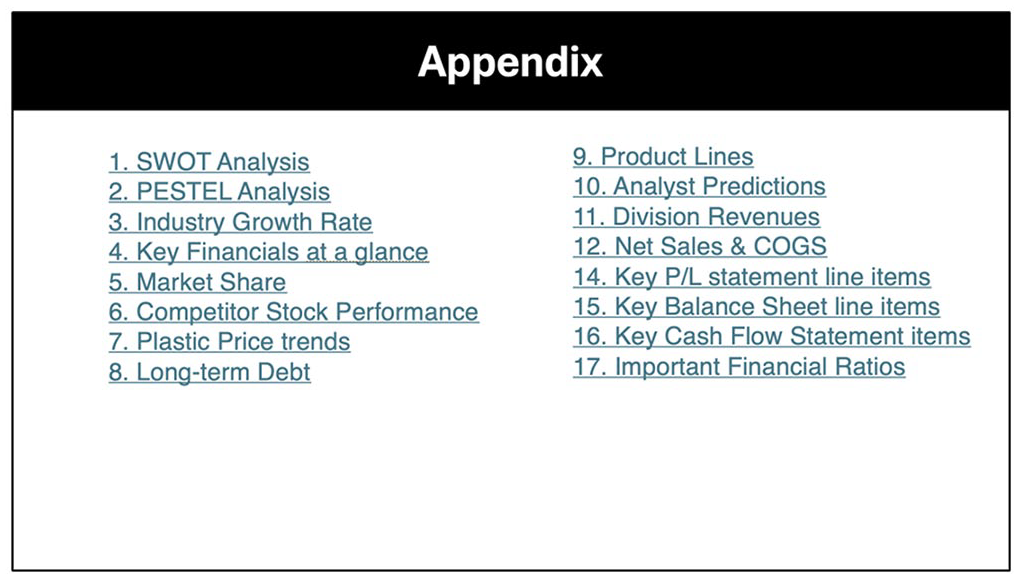
Linked appendix slide.
By having a slide with links to all appendix slides, it is easy for the team to click on one of the links leading them to their desired slide. Each appendix slide should have a “home” button that the team can easily click on once they finish their point. Figure 2 below shows one arrangement.
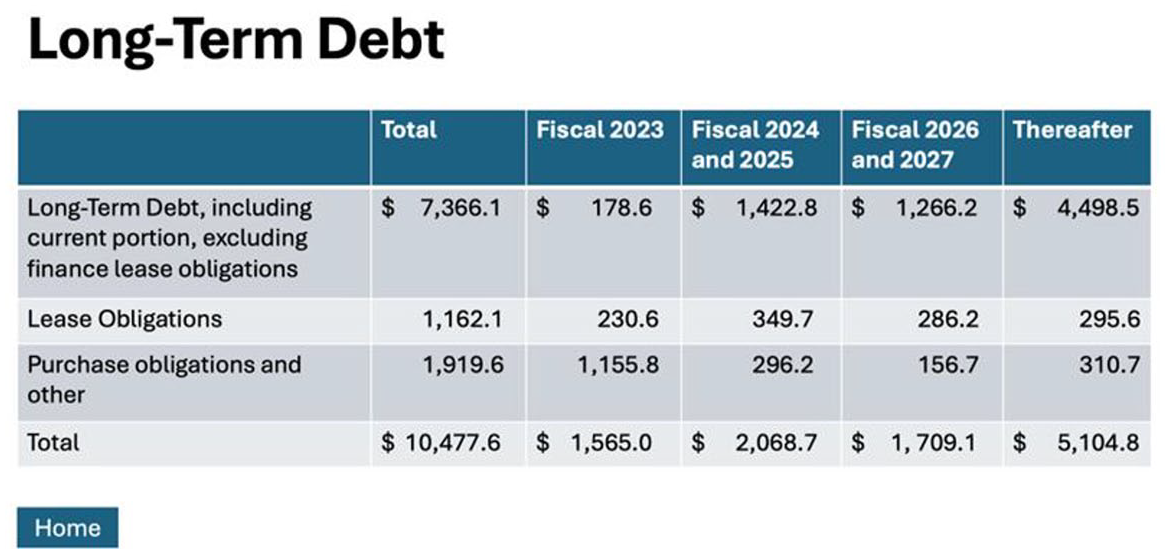
Appendix slide with Home button.
Overall, we showed three ways teams can prepare for questions before the presentation. They can scout their audience’s questioning style, character, and knowledge symmetry to the topic. They can spike objections throughout the main presentation to show foresight and preparedness to any issues an audience member may have with the content. Lastly, they can have designated slides that answer questions as needed using their appendix index.
Handling Questions
Nevertheless, it is one thing to have slides prepared with objections responded to. It is another for teams to handle different types of questions effectively. Question Response Techniques (QRTs) are pragmatic ways of handling questions. These techniques include deferring, passing, relaying, and punting the question. They apply in both isolated and embedded Q&A scenarios.
Suppose a decision maker asks, “What was your rationale for launching the marketing campaign in the winter?” A team member can defer a question by stating that they will answer it later in the presentation. They can say, “We will supply the rationale for our timeline in a later slide.” Deferring the question is often used in an embedded Q&A situation, where a question is asked during the main presentation. A team can defer a question to later in the presentation. However, if they cannot supply an answer at all, they can defer answering the question to another day or time by saying, “We do not have that information at this time, but we will get that to you in a follow-up email.”
A team member can also pass the question by redirecting it to a team member. Suppose a decision maker directs a question to Team Member A that is outside their expertise lane but within Team Member B’s. Team Member A can pass the question to Team Member B by saying, “That is a question within Team Member B’s expertise, so I am going to yield the question to her.” Team Member B can then answer the question. In a hosted Q&A format, the host will pass all undirected questions to team members. The risk of passing questions is mistakenly passing to the wrong person, so teams must establish clear expertise lanes before the presentation.
A team member can also relay the question to the entire group. If a member receives a question they do not know the answer to, they can relay it to the whole group by saying, “I don’t have an opinion on that question, but I’ll allow any of my colleagues here to voice theirs.” Any team member can then answer the question accordingly. Relaying a question might make the whole team look bad if no group member can answer it. That is a known risk to relaying. After a brief pause, if the relaying member senses no one is stepping forward to answer, they should reply by deferring the question to an email or follow-up meeting.
Finally, a team can punt the question by declining to answer it. There are a few reasons why a team would decline to answer a question. For one, a particular question and answer might “open a can of worms” that the team wants to avoid. For another, the question might be outside of the whole team’s expertise. If a decision maker asks a question that no one knows the answer to and cannot find out later, then punting the question is best. If the question has a retrievable answer that they can give later, then the team should defer the question to an email or follow-up meeting. A team should also punt a question if it lands outside of the scope of the team’s presentation. Teams should refrain from taking risks by answering questions outside their expertise lanes. Lastly, teams should punt questions if the information is unavailable for the audience owing to being classified, unpublished, patented, or other related reasons. A simple punting statement might be, “We cannot answer that question now due to legal reasons.”
Maintaining a United Front
A prime directive behind all these QRTs and question-answering is that teammates must maintain agreement. A team must maintain a united front for the decision makers, supporting each other in their answers. Teammates should avoid openly disagreeing, which can create doubt among audience members that the team is uniformly behind their message. Teammates must also avoid contradicting each other.
Suppose Team Member A says something that Team Member B knows is inaccurate. Like a second city troupe, Team Member B should creatively use a “Yes and. . .” approach to correcting Team Member A. For example, suppose Team Member A receives a question about how many employees work at their company. Here is how Team Member B can assist Team Member A:
Team Member A: There are 8,500 employees at our company.
Team Member B: While A is right that there are 8,500 people working at our company, I also want to point out that 1,500 of them are independent contractors.
There can be situations where “Yes and. . .” would be difficult to apply. In those cases, team members must decide if it is worthwhile to correct their teammates publicly. If the incorrect detail is of minor consequence, it may be wiser to let it stand to avoid the risk of displaying disunity.
If a team member does not know the answer to a question, nor does anyone else, then the team should intelligently indicate that they do not know the answer. Below is an equation for a response:

First, the respondent should share any relevant or known information showing that they know the topic and its importance. Then, they should state what is unknown to them to not “dodge” the question. If the reason why they do not know the answer is favorable or neutral to their impression management goals, then they can choose to share that reason. Regardless, the team member should offer a solution for the knowledge deficit. Usually, the best move is to defer the answer to a follow-up correspondence. If the information is immediately accessible to the decision maker via a website or report, the team can also refer them to that resource.
Here is an example. Suppose Team Member A is asked about the number of employees at their company, and they do not know the answer. Team Member A can say: “I know that there are over 5,000 people at our company, but I don’t have the exact figure since there are also many independent contractors. I will find out and send that total to you in our follow-up email.”
Overall, the team must maintain a united front by supporting each other verbally through their answers. In the cases of inaccurate information that might be pertinent, members must be savvy enough to “Yes and. . .” the inaccurate information. If they do not know the answer to a question, they should provide an intelligent response that indicates what they know and do not know while providing a solution.
Implications
Our discussion of Q&A management lends itself to the following implications regarding its conceptualization, strategy, audience analysis, and team presentation formats.
First, Q&A is a component of a presentation rather than an isolated session. Decision makers might abruptly ask questions throughout a business presentation, and teams also have the option to solicit questions throughout a presentation with Q&A stops. These scenarios are what we identified as embedded Q&A. The other option is for all questions to be held until the end, which is typical in academic presentations. We call this isolated Q&A. This conceptualization impacts how we teach students about designing and delivering business presentations. While it may be common for student presentations to mimic the conference paper model of delivering the main presentation followed by an isolated Q&A at the end, it is critical to teach our students how to handle embedded Q&A components. Requiring teams to have Q&A stops throughout their classroom presentations so they learn to manage questions, for example, could be a starting point. Such Q&A stops would make presentation days more interactive for classmates since they do not have to wait until the end to ask questions.
Second, isolated and embedded Q&A components have different strategic implications. Embedded Q&A management requires team members to prepare to answer questions, move backward and forward throughout their presentation, and anticipate being interrupted to answer questions. Isolated Q&A management requires teams to decide if they will run a hosted or unhosted format and the strategic implications of either approach. The hosted and unhosted formats each have benefits and drawbacks. Teams must make a strategic decision based on how they want to address the three fundamental issues: who answers what, how they will manage turns, and how they handle undirected questions. All Q&A preparation calls for having an appendix slide index ready and using QRTs. Teams must rehearse with mock Q&A sessions so they can practice all elements.
Third, Q&A components introduce audience factors such as knowledge symmetry and the decision maker’s questioning style that teams must plan for. The team might expect to be interrupted or have a decision maker who keeps all questions to the end. If the team anticipates particular objections from the audience, they can decide whether to spike them in the main presentation or to have an appendix slide ready. For instructors, adding these elements of analysis and preparation can teach our students the importance of anticipation and delivering two-sided messages.
Fourth, teams can combine the two isolated Q&A strategies with the five team presentation formats discussed in Usera and Fuller (2024). Usera and Fuller (2024) identified five team presentation formats: hosted, relay, hybrid, popcorn, and duo. Combine these five formats with the two isolated Q&A strategies, and many combinations can exist. For example, a team can run a hosted presentation with a hosted Q&A. In that case, they would have the presentation host also be the Q&A host. They could also run a hosted team presentation with an unhosted Q&A. In that case, the host might be the presentation controller. In another instance, a team could run relay format for their main presentation and decide to have a hosted Q&A by appointing one member to be the host. Overall, the Q&A management strategies are compatible with other team presentation formats identified in previous and future studies.
Future Directions and Conclusion
We explored Q&A management as a critical component of a business presentation, and there is still more to learn regarding the nonverbal aspects of team presenting. One major part of a team presentation is the blocking and standing of teammates. How a team stands, uses the speaking space, and deploys different formations has yet to be systematically studied. A team cannot just speak well; they must look professional in their formation and demeanor as a cohesive unit. There has yet to be much study about how a team utilizes different room arrangements to make the transitions between speakers as smooth as possible. Room analysis and stage blocking are future features that await development.
Moreover, while we have laid the groundwork for concepts such as knowledge symmetry, questioning style, and QRTs, we recognize the need for empirical studies to support and refine them. For example, there is more to theorize about knowledge symmetry. One issue is how teams maintain the knowledge advantage through credibility displays throughout the presentation, and how it can be lost perceptually through credibility mistakes. Knowledge symmetry could be perceptual and thus dynamic as the presentation develops, just like credibility is (O’Keefe, 2015). Further studies of credibility perceptions of actual team presentations are warranted. For now, this article is a survey of Q&A management issues that can supplement what current textbooks teach and point to where future research can go. Many of our Q&A management concepts can still apply to solo presentations, and that would also be worth further exposition.
Overall, effective Q&A management requires teams to strategize and rehearse accordingly. The current literature and public speaking textbooks need to explore Q&A strategy for teams, so this article serves as a first turn in that conversation. For public speaking teachers, this article can give students more sophisticated and realistic guidance on preparing for a business presentation. For practitioners, this article is another page in a playbook for case competitions or high-stakes presentations. For researchers, this article can serve as a foundation that answers some unaddressed questions about team presentations.
Footnotes
Declaration of Conflicting Interests
The author(s) declared no potential conflicts of interest with respect to the research, authorship, and/or publication of this article.
Funding
The author(s) received no financial support for the research, authorship, and/or publication of this article.
