



Abstract
Team presentations are prevalent in education and business, yet there is a notable scarcity of scholarly research and discussion on effective delivery practices. The authors bridge this gap by introducing a theoretical foundation for team presentations, enabling further exploration. They first establish prerequisites that a team must address regarding the speech outline, member roles, and transition techniques. They then categorize five distinct team presentation formats and explore each one’s strategic advantages, disadvantages, and application contexts. Lastly, the authors offer strategic implications for practitioners and proposals for future academic inquiries into the realm of team presentation theory.
How does a group design and deliver an effective team presentation? Review any mainstream public speaking textbook, popular press book, or webinar, and you will find much theory on delivering a presentation as the sole presenter. Review those same books and webinars for theory on delivering a presentation as a team member, and you will find little.
Most scholarly articles that mention team presentations discuss them as a pedagogical tool rather than a phenomenon (Braun, 2017; Haugen & Lucas, 2019; Oswal, 2002). For example, Haugen and Lucas (2019) published in Communication Teacher an activity using Monroe’s Motivated Sequence to teach effective team presentations. The article outlines “positive team-based delivery skills” for students to consider, like “stand (or sit) in an orderly fashion” and “nonverbally communicate interest in the entire presentation” (Haugen & Lucas, 2019, p. 113). An article in Harvard Business Review provides team presentation tips like “strategize in advance” and “practice as a group” (Shapira, 2021). While these may be helpful tips, they do not constitute a systematic theory of team presentations.
One book on business case competitions offers a short discussion of team presentations (Cosentino et al., 2021). It has one three-page chapter where the authors discuss deciding time distribution among members, transitioning between points, and avoiding gimmicks in the opening. It also has a chapter covering Question and Answer (Q&A) techniques such as correcting mistakes on the fly, assigning expertise lanes, and adding value to each other’s answers. Otherwise, the remaining 22 chapters discuss topics regarding research, slide design, case competition procedures, and preparation room practices. While the insights offered in the book are valuable for business case competitions, they neglect additional team presentation strategies and techniques that apply outside of that domain.
Given this short literature review, team presentations are a unique phenomenon. Unlike solo presentations, team members must share stage time and work together to maintain a united front verbally and nonverbally. Members might have different expertise areas and speaking abilities, so teams must decide the best approach to maximizing each member’s strengths and minimizing their weaknesses for the greater whole. Teams must also prepare their parts to acknowledge other speakers’ prior and upcoming contributions and to seamlessly transition between them to maintain credibility.
Thus, there ought to be a theoretical framework for team presentations that applies across multiple contexts. Since business communication educators assign team presentations in their courses (National Communication Association, 2023), consultants often deliver project proposals and updates to their clients in teams (M. Zebrowski, personal communication, October 13, 2023), and business case competitions use team presentations as deliverables (Cosentino et al., 2021), communication scholars and practitioners ought to have a theoretical framework for this practice. As experts in our field, we must be able to provide deeper insights for our colleagues, clients, and students that go beyond “practice as a group,” stand in an orderly fashion,” and “avoid gimmicks.”
To lay a theoretical foundation, we will explore five team presentation formats that strategically leverage members’ speaking and expertise lanes differently. These team presentation formats apply across multiple contexts according to what the team decides to be the most advantageous and applicable arrangement. Before we explore those five formats, we will identify our foundational assumptions and terms.
Foundations
Speech Writing Format
A common speech writing format taught in public speaking textbooks is the five-point outline (Gamble & Gamble, 2020; Lucas, 2019; Rothwell, 2022). First, the speech begins with an Introduction section that grabs the audience’s attention, states the presentation’s thesis, and previews the agenda. The following three components will be the speech’s Main Points. Main Points can vary in their design from simple to complex, but they often include a transition, preview, thesis, and supporting evidence. The fifth and final point is the Conclusion, which is an introduction in reverse: a review of the main points, a restatement of the thesis, and a clincher to leave a memorable impression on the audience.
Speech writing can be more complex than this. A speech can have five Main Points, for example, or two Main Points with several subpoints. For this theoretical exploration, we assume the components are the Introduction, Main Points, and Conclusion.
Speaking Roles
Once teams establish the speech outline, they must decide who speaks when. Presentation teams can vary in size from a duo of two to a group of eight. Regardless, there are three general speaking roles. The Opener is responsible for delivering the Introduction section of the presentation. The Main Point 1 Speaker (MP1) delivers the first Main Point from the presentation. If there is a second Main Point, then a Main Point 2 Speaker (MP2) role is available, and so forth. Main Point Speaker roles are available for as many main points as written in the speech outline. Lastly, there is the Closer, whose job is to close the presentation by delivering the Conclusion.
How teams assign speaker roles depends on speaking talent, subject matter expertise, and team size. Ideally, the team’s strongest speaker(s) should open and close the presentation as they serve as the first and last impression on the audience. Ideally, each Main Point Speaker should be a subject matter expert on their section since they must be ready to answer questions during Q&A. However, there can be times when the ideal is not possible. For example, the team’s best speaker might also be the team’s subject matter expert on Main Point 2. The five formats of team presentations offer different solutions to this puzzle.
Lastly, team size is a factor in role assignments and format decisions. We assume in this exploration that two or more members must have a speaking role in the presentation. It is not a “team presentation” if only one member delivers the entire presentation on behalf of a group. As we explore the five presentation formats, it will become apparent how different formats are optimized for different team sizes. Overall, most of the formats can accommodate teams of three to eight. The ideal team size is four to five, as it can execute four of the discussed formats with the fewest adjustments. We will address smaller and larger team sizes and speech variations later in this exploration.
Transitions
One of the unique challenges to team presentations is maintaining continuity between speakers. The Opener might establish credibility for the team and preview a logical flow for the presentation, but then they must “hand off” to a completely different speaker (MP1) who must maintain that established credibility and logical flow from the Opener. When MP1 hands off to MP2, the same thing must happen all the way to the Closer. Meanwhile, the team members must verbally and nonverbally maintain a united front to appear as a cohesive unit. From the audience’s standpoint, each speaker is a new person whom they must establish liking and credibility with. How do teams ensure that the strong first impression established by the first speaker transfers to the second speaker and the others following?
Transitions are the connecting comments and actions taken while changing speakers in a team presentation. A transition includes a logically connecting statement between the previous speaker’s main point and the next speaker’s, plus a physical hand-off to the next speaker. The hand-off will depend on the speaking setup, but it usually involves physically handing the presentation clicker, microphone, or yielding the speaking area by having the previous presenter step backward as the new presenter steps forward. There are four ways that speakers can transition between each other.
First, they can do a hosted transition, where a host facilitates the transition between the two members. Like how an award show host introduces the next presenter, the hosted transition relies on a designated speaker to serve as the facilitator between members. One of the five formats of team presentations that we will discuss later uses this transition style. There are various ways to execute the hosted transition, but the essential components should be a transition statement and the identification of the next speaker. Below is an example of a speaker completing their section followed by a hosted transition:
. . .and that is the overall picture of our proposal.
Speaker A hands clicker to back to host
Thanks, A. A has shown you how our service will ensure you save time and production costs. Now you might be wondering how much our service will cost. B, our financial analyst, will walk through the costs and the savings you will see year-over-year.
Host hands clicker to Speaker B
Thanks, Host. Our service offers three cost structures that work according to your budget. . .
In the fictional example above, the host does two things: logically relate the previous speaker’s point to the next speaker’s and identify the next speaker by name. Hypothetically, the host could spend more time elaborating on these two components. For example, the host could hype the speaker’s credentials by saying, “B, our financial analyst who specializes in cost reduction, has spent countless hours combing through your databases and developing different financial models to project your savings in the next five years.” Whether the host does this will be a strategic decision, as more elaborative transitions lengthen the speech time.
The next two types of transitions are varieties of an un-hosted transition, where the two transitioning speakers facilitate their hand-off without the help of a host. Recall that the basis of a transition statement is stating the logical connection between the main point that was just delivered and the main point that is about to be. A basic example transition statement in a solo presentation would be, “Now that you know how much the proposal costs, I will next explain how you can finance it.”
The order in which the two speakers utter the transition statement and perform the hand-off establishes the two un-hosted transition types. The first type is the overhand transition, where the preceding speaker says the transition statement before handing the clicker or microphone to the next speaker. An example is below:
Now that I have shown you the cost of our proposal, B will show how you can finance it.
Speaker A hands clicker to Speaker B
Thanks, A. There are many options we explored for financing our proposal. . . .
In the overhand transition, Speaker A is uttering the transition statement and then handing off to Speaker B. Compare this to the underhand transition demonstrated below:
. . .and that is the cost of our proposal with all programs included.
Speaker A hands clicker to Speaker B
Now that A has told you the cost of our proposal, I will show you how you can finance it. There are many options that we explored. . .
Notice the difference in the order and who utters the transition statement. In the overhand transition, Speaker A utters the transition statement and then hands it off to B. In the underhand approach, Speaker A concludes their main point, hands it to B, and then B utters the transition statement. See it exemplified in the formulas below:
Overhand Transition = Transition Statement → Hand-Off
Underhand Transition = Hand-Off → Transition Statement
Lastly, there are topical transitions. These are transitions that logically set up the next point without executing a hand-off. In a solo presentation, a speaker uses topical transitions between their main points to maintain a logical flow of ideas within the speech. There are no hand-offs to oneself in a solo presentation. In a team presentation where the same speaker(s) are delivering the next main point, no hand-off is necessary. Instead, they will still use a topical transition to maintain logical flow between their current point and the next one. Some of the proposed formats that we discuss in this article use topical transitions instead of the hosted and un-hosted options.
Transitions are important because they maintain the logical flow of the presentation’s arguments and the transfer of goodwill established by the previous speaker. When a team member deploys an effective transition, it shows that they are aware of their members’ roles, which conveys team unity to the audience. We do not argue that one type of transition is universally superior. Instead, each of the five formats of team presentations will favor certain types of transitions over others. We will explore the five team presentation formats in the next section.
The Five Team Presentation Formats
The five team presentation formats are based on group size and how they handle transitions and distribute their expertise throughout the presentation. The five formats are Relay, Hosted, Hybrid, Duo, and Popcorn. We will explore these formats, identify their strengths and weaknesses, and suggest use cases for each.
Hosted Format
A Hosted format relies on one constant speaker (the host) to open and conclude the presentation and facilitate the transitions. This format is often seen in award shows like the Oscars, where a designated host opens the show, facilitates the transitions between each award, and closes with final remarks. Similarly, a team can rely on a designated speaker to deliver the introduction and conclusion and facilitate the hand-offs between speakers throughout the main points.
A Hosted format uses hosted transitions mentioned in the previous section. Recall that hosted transitions can take many forms, but they should involve the host logically connecting the previous speaker’s points with the following speaker’s. The host also identifies the next speaker by stating their name. Additionally, the host will deliver the presentation’s introduction and conclusion. The format is illustrated in Figure 1.
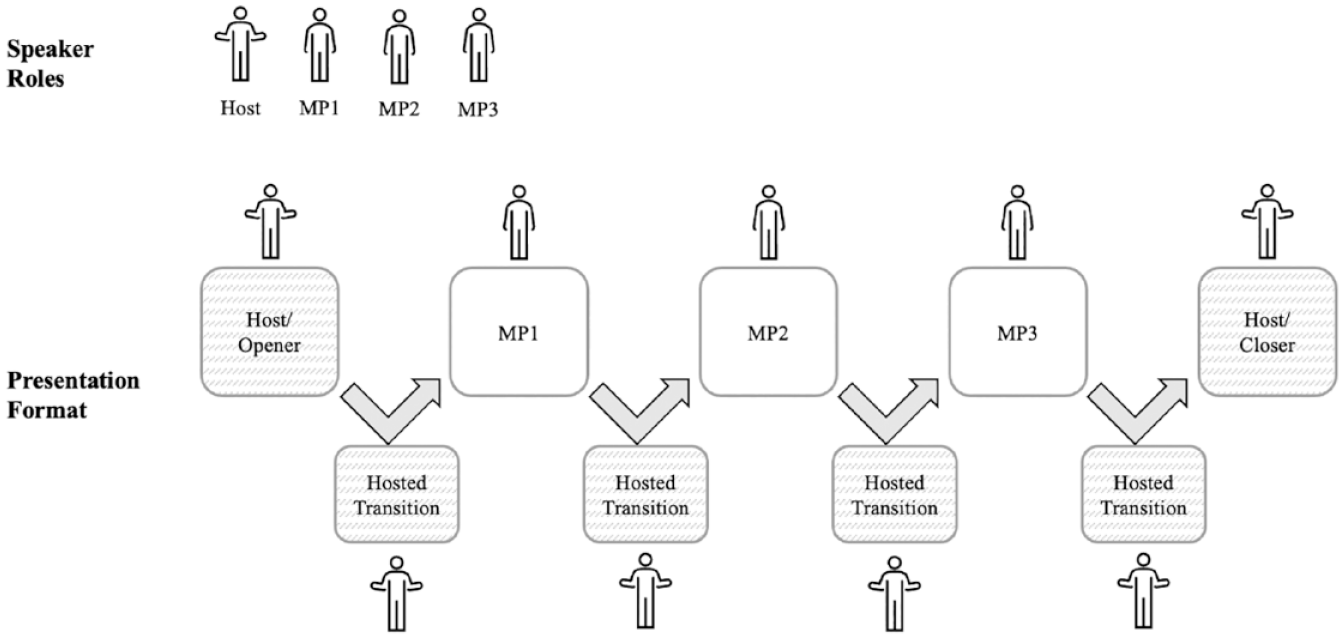
Hosted format example for a team of four.
Good hosts will excel at building credibility and liking with the audience from the start so that the audience welcomes their reappearances throughout the presentation. They may also deploy audience engagement techniques (Usera, 2023) throughout the presentation to keep the audience focused and interested. Thus, the host should be a strong speaker, if not the team’s best.
There are benefits to the Hosted format. First, it assigns one person to oversee the smooth transition between speakers. The most sensitive moment in a team presentation is the transition, as speakers can execute them poorly by forgetting to logically connect their points or even dropping the clicker on the hand-off. A host can practice these moments to mastery by being the sole person responsible for transitions and hand-offs. Moreover, a host can use their speaking skills and personality to build liking and credibility with the audience which are keys to persuasion (Cialdini, 2006). The host can then transfer their goodwill to other speakers before they speak. The host can “vouch” for a speaker by discussing the next speaker’s credentials or “hype” the speaker’s rigorous analysis methods used to develop their thesis. If a team only has one strong speaker, the host can be the tying thread that keeps the presentation engaging.
There are also risks. Hosted format relies on a “star speaker” to execute the most critical moments of the presentation: the first impression (the introduction), the flow between speakers (the transitions), and the last impression (the conclusion). If the host were to establish a poor initial impression on the audience, the host would serve more as the team’s constant curse rather than a continuous blessing. The heavy reliance on one team member to execute all sensitive phases is thus a risk of putting all the team’s eggs in one basket. Another risk can come from a different direction from a constant curse: overtaking the presentation. Suppose the host is too much of a stand-out speaker either in the quality of their delivery or in the quantity of their speech time allocation. In that case, the audience might only remember the host’s parts and cause the other members’ points to fade into distant memory. A host’s goal should be to make their fellow teammates look as credible and likable as possible without overshadowing them.
Overall, a Hosted format relies on a star speaker to conduct the introduction, transitions, and conclusion. Teams that want to utilize a strong speaker’s presence throughout a presentation would benefit most from a Hosted format. They will, however, need to recognize the risks of putting so much responsibility on one team member. If they prefer to diversify the responsibilities, they should consider using a Relay format.
Relay Format
It is natural to expect team members to share the project workload equally. A Relay format extends that inclination to the speaking responsibilities in a team presentation by spreading them equally. Assuming a team of five presenters using the sandwich outline, each presenter speaks once during their part of the presentation in this format. The format has five roles: an Opener, three Main Point Speakers, and a Closer. Unlike the Hosted format, a Relay format uses un-hosted transitions. Thus, the speakers will facilitate their own hand-offs using the overhand or underhand techniques described earlier. The name is inspired by relay races at a track and field event, where each runner must run their leg and then hand-off the baton directly to the next runner. This format is illustrated in Figure 2.
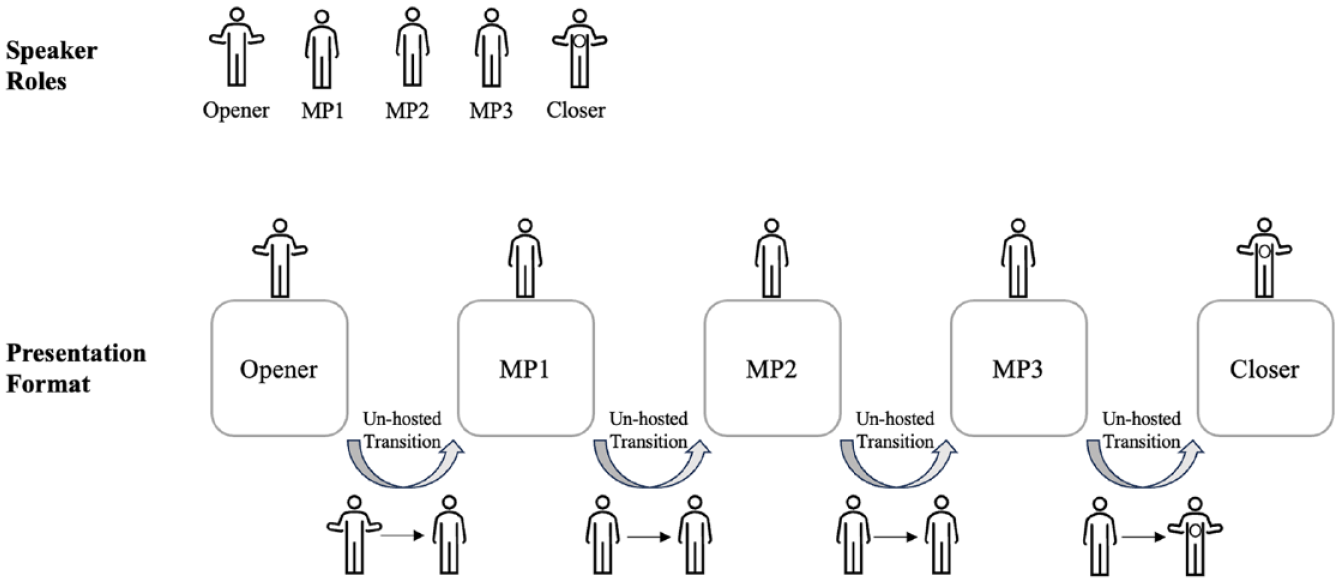
Relay format example for a team of five.
A Relay format has three advantages. First, it is the most common and natural format that audiences might expect speakers to use, so it is familiar. Second, it takes an egalitarian approach to stage time by not emphasizing one speaker over the rest of the group since each member speaks once. In contrast, the Hybrid and Hosted formats utilize one speaker more frequently. Lastly, Relay format’s use of un-hosted transitions can be quicker than hosted ones, which can reduce the presentation time.
There are risks with using the Relay format. First, if the team uses the five-point outline format with only four members, then either the Opener or Closer must deliver a main point. In that case, the Relay format loses its egalitarian advantage. Teams should then consider a different format. Second, the egalitarian nature of the Relay format might wash out a powerful speaker’s ability to shine and make a unique impact
on the audience. In that case, egalitarianism stunts the speech impact. Lastly, the pressure of executing un-hosted transitions disperses among all members, which increases the chances of mistakes during those sensitive segments. For example, the Main Point 2 Speaker might forget their connecting statement and simply say “Now I will hand it to John,” which would be a poor transition. With hosted transitions, a reliable host can ensure that those moments execute smoothly.
In conclusion, the Relay format is an intuitive presentation approach that gives each team member one opportunity to speak. It is best for teams that want to share the speaking obligations equally while trusting each member to transition effectively during those sensitive moments. If a team wants the best of both Hosted and Relay formats, they should consider a Hybrid format.
Hybrid Format
The Hybrid format utilizes the same speaker as the Opener and Closer while executing un-hosted transitions for the Main Point Speakers. Like the Hosted format, Hybrid relies on one presenter to introduce the topic and deliver the conclusion, while the rest of the team is responsible for discussing main point topics. Like the Relay format, Hybrid’s Main Point Speakers facilitate their transitions utilizing underhand or overhand techniques. It is visualized in Figure 3.
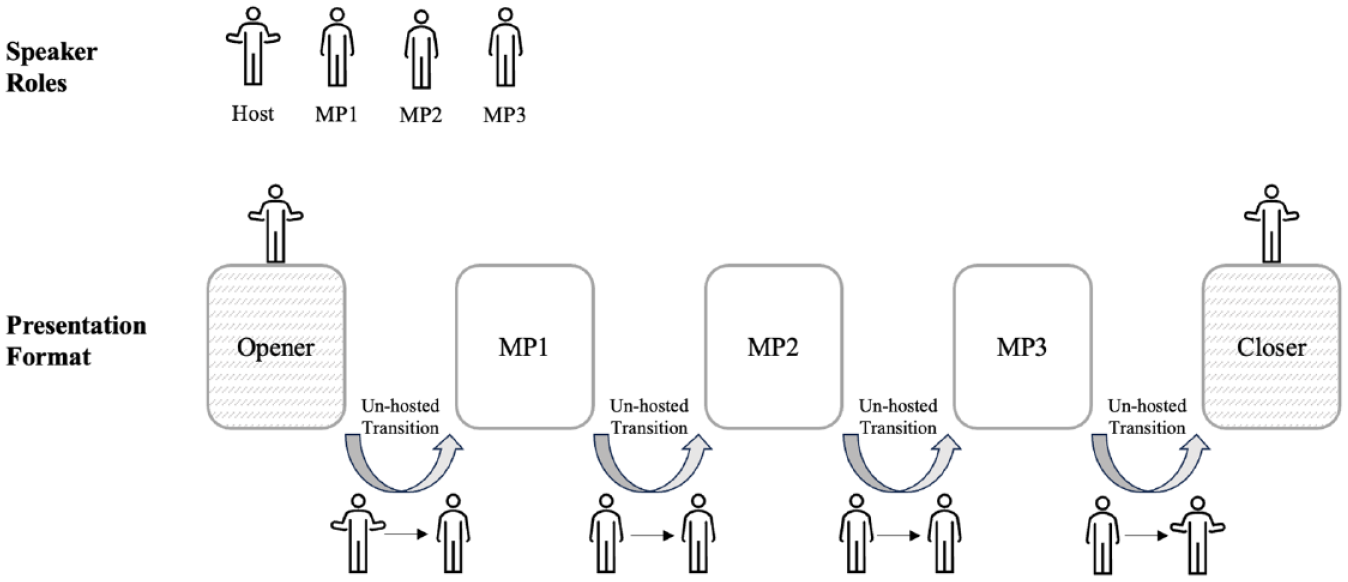
Hybrid format example for a team of four.
There are a few benefits to the Hybrid format. First, it stabilizes the introduction and conclusion by having the same speaker deliver both. The Opener/Closer can captivate the audience by leveraging their strong speaking skills to establish credibility with the audience initially and then reemerging at the conclusion with a memorable clincher. Meanwhile, the rest of the team can share sensitive presentation responsibilities by conducting their own hand-offs while the Opener/Closer remains in the background. This strategy reduces the burden for one speaker and ensures Main Point Speakers have sufficient stage time. Moreover, a Hybrid format is optimal when a team has at least one more speaker than they do main points. For instance, when a four-member team uses a five-point outline, the Hybrid format enables one person to be responsible for opening and closing while the other three members discuss a main point.
There are also risks to the Hybrid format. The Opener/Closer role is still responsible for executing some of the most critical components of the presentation. More reliance on this position puts pressure on one presenter to build credibility at the introduction and then effectively engage the audience at the conclusion. If that speaker fails at their duties, the entire presentation could fail. Also, un-hosted transitions create additional opportunities for distracting miscues between speakers discussed in the Relay format: a dropped clicker, a poor transition statement, and much more. Thus, while the Hybrid format gains the best of both worlds among the Hosted and Relay formats, it also runs the risks of both worlds.
Using a Hosted versus Hybrid format should depend on speaking talent and subject matter expertise. The distinction between these two styles is the degree to which the team elevates its best speaker. Assuming the best speaker is not a critical subject matter expert, the decision rests on whether the team wants to use hosted or un-hosted transitions. Teams should select a different format if these two considerations conflict.
Overall, the Hybrid format is a compromise between the Hosted and Relay formats. These three formats all use distinctive speaker roles with formal transitioning between them. If a team wants to design a presentation that eliminates transitions and roles, they should consider the Popcorn format.
Popcorn Format
A team should consider a Popcorn format if they want to create a more conversational and less seemingly structured team presentation. The Popcorn format is a presentation style that has every team member a speaker at every segment. On a team of five speakers, in its simplest form, all five will participate in the introduction, main points, and conclusion. There are no distinct speaker roles since every member participates at every point. A Popcorn presentation can be a scripted conversation held between members, like a skit. It can also be completely improvised. Popcorn presentations often appear on investor-pitch television shows like Shark Tank (US) and Dragon’s Den (CA). Figure 4 visualizes it.
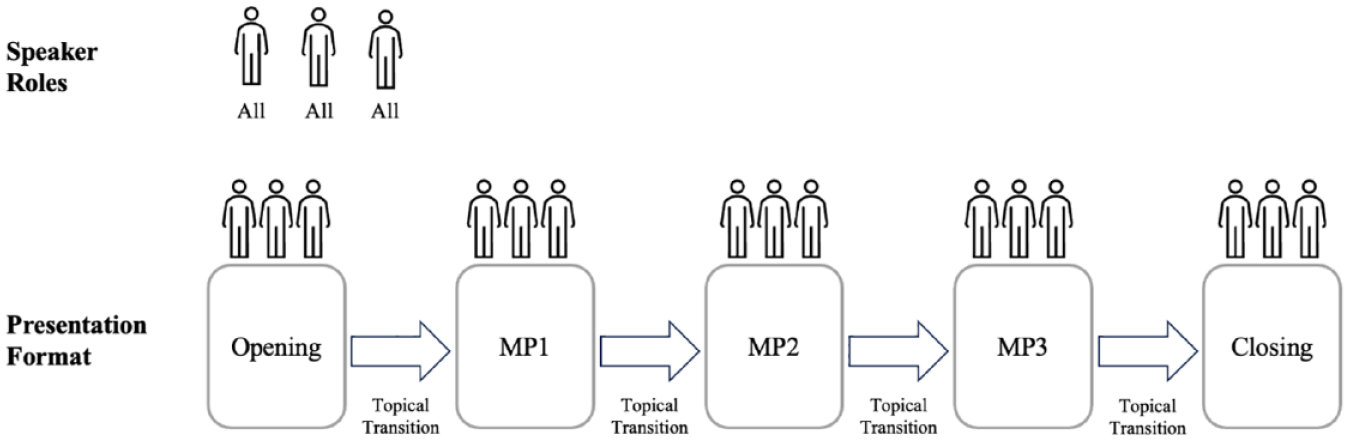
Popcorn format example for a team of three.
One distinct feature to a Popcorn format is that there are no hand-offs between speakers since all five will always have the floor during the presentation. Instead, the team transitions between each topic to logically connect their points throughout the presentation. Since there is no hand-off between speakers, any speaker can say a line at any point. The team ought to rehearse these cues and members’ lines, but they may not. Regardless of whether they rehearse, it will be unpredictable to the audience as to who will speak next. Since each speaker can “pop in” at any point, this format’s name is comparable to popping popcorn.
There are benefits to a Popcorn format. First, it can be highly engaging for the audience. With low predictability and multiple speaking responsibilities for each member, the presentation can feel conversational either because the presentation is truly improvised or because the team members deliver their scripted dialogue convincingly. Second, this format involves all team members in all main points, which one can argue is more egalitarian than a Relay format. Third, a Popcorn format can accommodate large teams that have more speakers than main points. Lastly, if a team is to deliver an impromptu presentation for an informal situation, this would be the default approach if they had no other preparation.
Like the other formats, there are risks associated with Popcorn. Most notably, this presentation style requires extensive team rehearsal for formal, high-stakes presentations. Team members must know their lines within each point and their cues for when to speak. Speakers must remain focused for the entire presentation or risk flubbing their next speaking part. Another risk of the Popcorn format is its potential chaotic and unprepared undertone when executed poorly. It could be devastating for a team that knew their material but did not practice enough to account for the complexity of a Popcorn format. Even when executed well, the Popcorn format can appear informal and conversational, which may be appropriate for only some situations. For example, situations where the audiences have low expectations for formality, such as a weekly status update presentation for peers, might prefer the more conversational approach of a Popcorn format. Other situations where there are high expectations for formality, such as a board presentation, might call for a more structured format. Lastly, if teams improvise their Popcorn presentation out of choice or forced circumstances, there are risks of team members interrupting or contradicting each other. These actions can confuse the audience and create a sense of disunity among members.
Overall, a Popcorn format relies on understanding the audience and every member mastering their speaking parts. The risks with this format are high, but it can be highly engaging when executed well. While the Popcorn format is one strategy for accommodating teams with more speakers than main points, the Duo format is another solution for large teams and small ones with only two members.
Duo Format
“Duo” is both a noun and a verb in this discussion. As a noun, it is a presentation format for teams of two. For pairs, the Duo format utilizes both speakers in each point of the presentation. Both speakers conduct the introduction, present each main point, and deliver the conclusion together. The duo takes turns speaking at each point throughout the presentation, transitioning between topics rather than speakers. Essentially, the Duo format is a two-person Popcorn presentation. It is often seen during award shows when two celebrity guests speak at the podium together, announcing the nominees and the award winner. It is exemplified in Figure 5.
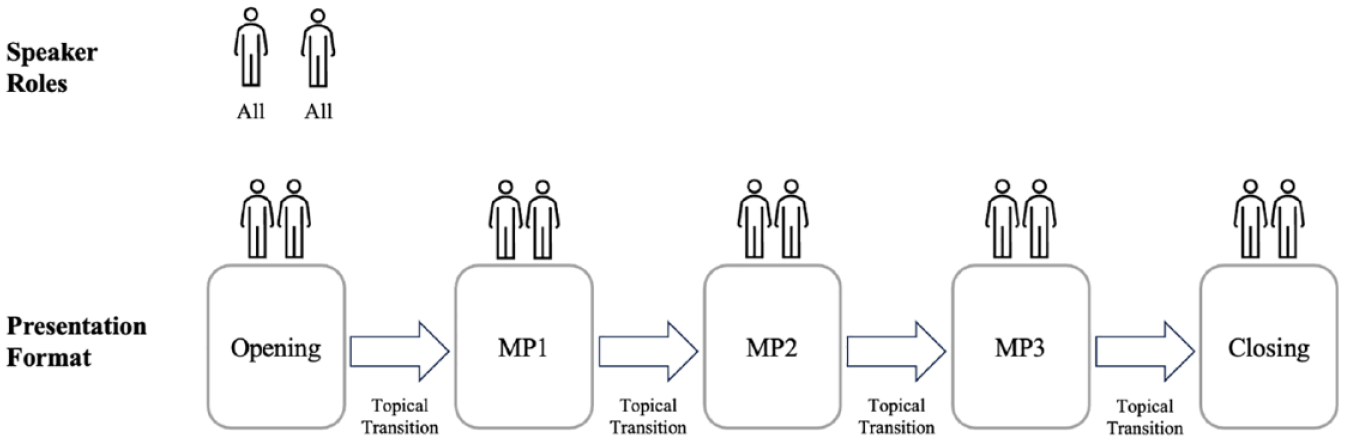
Duo as a format.
As a verb, Duo is a solution for teams with more speakers than main points. Consider a six-member team delivering a five-point presentation with one more presenter than available speaking points. The team could have two speakers deliver one of the main points in a Duo format. For example, the team could have two presenters speak on Main Point 3 or at the conclusion. A Duo format modified for larger teams can have the foundation of any other formats mentioned earlier. However, instead of using one speaker for each point, teams deploy a pair of speakers for a particular point for a strategic purpose. We illustrate this use of Duo in Figure 6.
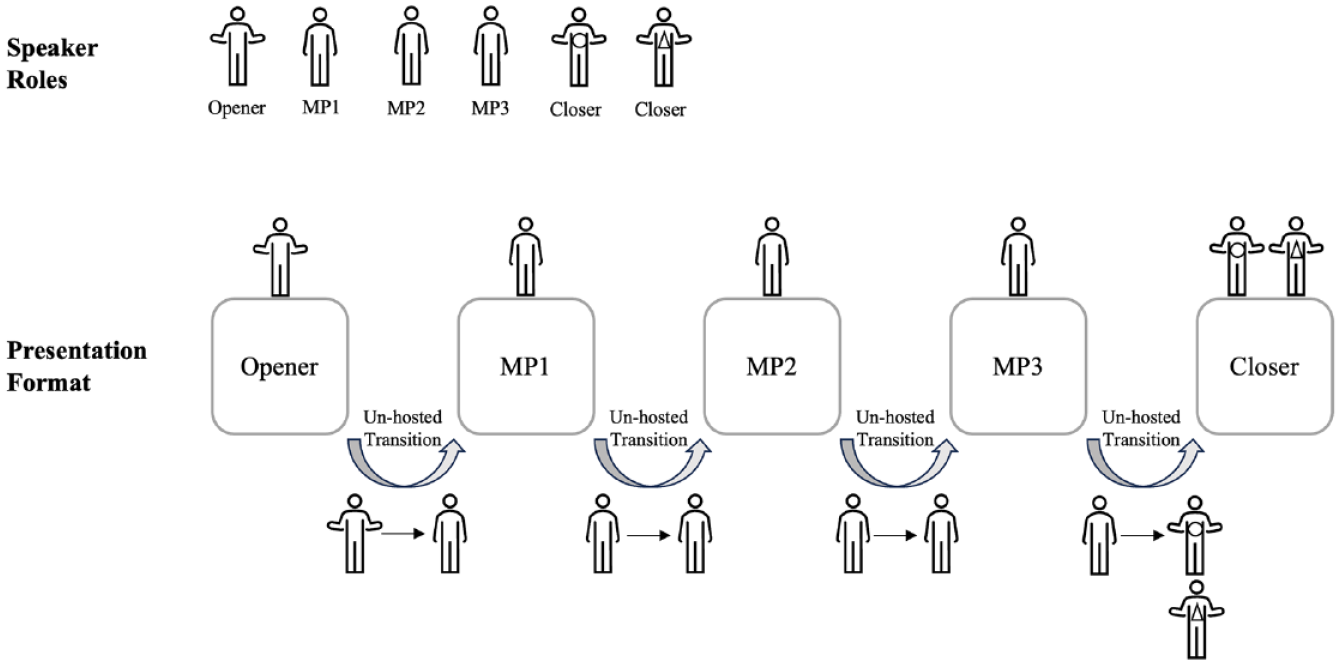
Duo as a strategy for a team of six using a Relay format.
There are a few strategic purposes to Duo a main point. If one team member is a subject matter expert on two main points, the team might want that person present in both. They could have that expert speak on one main point in a solo format and assist another speaker during their main point in a duo format. Another strategic reason would be to assist a weak speaker. For example, if the Main Point 2 speaker struggles, having another speaker assist them through a duo strategy can lighten the burden. Lastly, a team may strategically duo to increase a strong speaker’s presence. Suppose a team prefers a Relay format, but they have a strong speaker whom they want to use at two sensitive points. Using Duo for a particular point would be a solution without fully committing to a Hosted or Hybrid format. For example, they could have the strong speaker deliver Main Point 2 and help conclude the presentation with another speaker.
There are risks to using a Duo format. Paired speakers will require additional coordination and rehearsal to deliver their parts synchronously. For larger teams, the Duo format risks casting a team member as merely an assistant with inadequate stage time. Teams must be careful to allow every member to shine just enough to appear as a valued team member. Lastly, speaking abilities and expertise lanes may not align for teams of two or three, leaving them with fewer options to elevate their strengths and hide their weaknesses.
To conclude, the Duo format can be a solution for both small and large teams. For teams of two, it can be a format to use almost by default. For large teams, it can be a way to involve more presenters without going entirely Popcorn. Like everything else, there are risks and rewards to this format. Teams will have to examine the foundational concepts discussed in the prior section of this article to decide what is best.
Implications and Future Directions
Now that we have established the foundational elements of a team presentation and the five possible formats, we will discuss a few implications for both the practice and theory of designing and delivering team presentations.
Practical and Strategic Implications
In its most rudimentary form, team presentations are speakers speaking in sequence on a shared topic. They write a speech outline and have one person deliver each part. This simplification is the rudimentary understanding of team presentations. However, our exploration of the five formats suggests that there is much more to the design of a team presentation.
An essential strategic decision that all teams must make is how they deploy their speaking talent. The five team presentation formats offer different approaches and trade-offs to this question. For example, the Hosted format highlights one strong speaker throughout the presentation, while the Relay format limits that speaker to one turn. If all team members are strong speakers, then the Popcorn format might be fitting if they are willing to face the trade-offs of no transitions. As scholars and practitioners, we can use the five formats as a foundation to discuss and study optimal approaches to this issue.
Another strategic decision that all teams must make is how they utilize their content experts. Suppose a team is delivering a consulting presentation with a main point discussing the financial impact of their solution. If one team member has a strong background in financial analysis and the remaining members do not, then that member ought to deliver that main point. If that same member is also the team’s strongest speaker, then the five formats and strategies suggested in this article offer different solutions. Teams would have to decide whether they still want this member to open and/or close the presentation. If they do, then the Hosted format might be eliminated since the speaker would have to transition to themself at some point, but a Relay might be optimal. Lastly, teams must decide how to best transition between their main points. Hosted transitions lend themselves to a Hosted format, which requires a speaker the team would want to highlight.
If they do not want hosted transitions, they should decide between underhand or overhand transitions between speakers, which lend themselves to the other remaining formats. If they want to eliminate hand-offs, then Popcorn would be ideal. Different transition styles may come naturally to the speakers, and time limits might prohibit hosted transitions. Teams must consider the speech situation to decide what is best.
In future papers, there can be plenty of debate and empirical investigation of the strategic questions posed in this section. This article aims to lay a theoretical foundation of terms and concepts that can provide insight into these questions. We do not argue that any one format is universally the best. The five formats are creative strategies that have their uses for specific contexts. No strategy is perfect; each has risks and rewards.
Future Studies and Limitations
Our exploration aims to be a first turn in a conversation that will lead to greater insight into team presentations. There are areas of growth and exploration that our discussion can yield.
First, the five formats are not exhaustive. While they are a fundamental set, variations can stem from them since these five formats are mixable. For example, a team could do a dual-hosted format, where one member opens the presentation and facilitates the transitions, but then another member closes the presentation. As another example, a Relay presentation with hosted transitions might be possible by having a different team member serve as the host at each transition. We expect and welcome new formats that are variations or entirely original to the five we explored here.
Second, we discussed possible solutions and trade-offs for initial team presentation challenges. However, we cannot provide empirical solutions to any since there is a lack of study on effective team presentations in the academic literature. Future experiments and studies can use this theoretical discussion to pose interesting research questions about team presentation delivery. For example, they can explore how different formats can impact audience impressions, which types of transitions lead to higher content comprehension, and further clarify the benefits and drawbacks of each format. We can continually revisit and revise these formats and their use cases as we accumulate empirical studies.
Third, to decide speaker roles in a team presentation, teams must decide who their “strong” speakers are and place them in the presentation according to the format they choose. The question is, how do they decide who the strong speakers are? While team members may self-report their perceived level of speaking talent, they may not always be accurate (Ayres, 1986). While scholars have developed rubrics and scientific measures for public speaking abilities for academic purposes (Schreiber et al., 2012), they might be too complex or inaccessible to a general nonacademic audience. There are opportunities for scholars to publish practitioner-oriented strategies and frameworks that a general audience can use to assess their speaking talent for team presentation purposes in a more reliable way than self-report. Scholars can further expand on how to optimize the deployment of team members into the different speaking roles based on psychological and social variables not explored in this article.
Fourth, there are still more team presentation issues unexplored in this article. Team presentations often include opportunities for the audience to ask questions. Q&A sessions can occur at the end of the presentation or throughout it (Stapp & Quagliata, 2022). In either case, teams must coordinate the handling of questions. Additionally, teams must consider their stage blocking for different types of room setups to avoid background distractions and running into each other during hand-offs. Some formations might be more optimal than others, depending on the room arrangement. This article is titled “Team Presentation Theory I” because we anticipate future discussion on other team presentation aspects like Q&A management and stage blocking.
Lastly, we argued that a theoretical discussion of team presentations is vital because these types of presentations are common in case competitions, classroom assignments, and industry. Our theoretical concepts emerged from our personal experiences coaching and competing in MBA business case competitions. A presumptive goal for the competitive context is to have the “best” presentation possible. That means optimizing for impactful delivery, memorability, and connection with the judges to beat the other teams. Our theoretical approach may be risky because it may “overthink” team presentations for noncompetitive contexts. For informal team presentations such as a weekly status update meeting with low stakes and presentation quality expectations, for example, taking the more basic approach mentioned in this article may be simpler to conceptualize and more straightforward to execute.
Suppose fellow scholars and practitioners consider this theory more appropriate to competitive contexts than others. In that case, we will embrace the domain downsizing as a solidifying topical boundary rather than an idea-defeating limitation. However, we would suggest that there is no harm in teaching our students and clients to deliver the “best” presentation possible when they can. Once they have delivered an optimized presentation, they can decide when it is best to be simple and when it is best to be high impact.
Conclusion
How does a group design and deliver an effective team presentation? Clients, students, competitors, and aspiring entrepreneurs benefit from knowing the answer to this question. Business communication scholars, coaches, and influencers can offer unique insights. However, there has not been much systematic discussion of team presentations in the academic literature. We seek to change that by offering foundational concepts and five presentation formats that offer different approaches to the challenges unique to team presentations. Overall, teams must decide how to maintain a logical flow between their speakers, use their content expertise, and maximize the use of their speaking talent. The five formats each offer different possibilities. We hope this article serves as a springboard for the further discovery of formats and the empirical investigation of effective team presentations.
Footnotes
Declaration of Conflicting Interests
The author(s) declared no potential conflicts of interest with respect to the research, authorship, and/or publication of this article.
Funding
The author(s) received no financial support for the research, authorship, and/or publication of this article.
