




Abstract
This study analyzed and compared the sustainability discourse on websites of fashion firms judged as high-rated or low-rated in sustainability ratings by an independent verification body using corpus linguistic techniques. We found that while both types of firms showcase their environmental and social performances to represent a sustainable image, they differ significantly in various aspects. High-rated firms proactively disclose details on workers’ wages and their environmental impacts and reveal hidden industry norms to drive a change from within the industry. Contrarily, low-rated firms are vague about disclosing details regarding workers’ wages and advocate consumer-driven and market-based solutions for industry problems, highlighting a multi-stakeholder approach. We argue that what separates high and low-rated firms regarding their sustainability discourse is their level of transparency and their attitude toward industry-wide problems. We summarize a list of potential greenwashing indicators based on these findings.
Keywords
Introduction
The fashion industry, with its long and complex supply chains, is frequently criticized for its negative environmental and social impacts, being responsible for 2% to 8% of total global carbon emissions (UNECE, 2018). Fast fashion in particular has been singled out for exacerbating environmental issues (Niinimäki et al., 2020). Governments and regulators have increasingly called upon fashion companies to reduce their impacts, and fashion brands appear to have responded by doing so, as seen through increased mentions of their environmental and social commitments in their marketing. Firms market their green credentials to consumers, aiming to profit from the perceived demand for environmentally conscious brands (Delmas & Burbano, 2011; Lee et al., 2020; Zhang et al., 2018). However, alongside the increase in genuine sustainability initiatives, there has also been an increase in misleading claims, known as greenwashing. Greenwashing is prevalent in the fashion industry (Lu et al., 2023) as it allows firms to benefit from having a green image without having to invest in making considerable environmental or social changes (Badhwar et al., 2024), thus worsening the already negative impacts of the fashion industry (Alizadeh et al., 2024).
Greenwashing has been shown to have negative effects on consumers’ perceptions of brands (Akturan, 2018), which may extend to a skepticism of sustainability statements in general (Wang & Walker, 2023). However, this depends on accurate detection of greenwashing. Studies have shown that consumers have difficulties determining the credibility of organizations’ green claims (Parguel et al., 2011, 2015). This also leads to the possibility of false greenwashing, in which an accusation of greenwashing is leveraged at a firm that is not distorting its green messages (Seele & Gatti, 2017), potentially leading to a general skepticism about the integrity of sustainability claims across the market (De Jong et al., 2018) and causing harm to consumers and wider society (Z. Yang et al., 2020). This makes greenwashing a serious barrier standing in the way of achieving a more sustainable fashion industry.
The prevalence of greenwashing and its negative consequences necessitates a better understanding of the differences between genuine sustainability claims and misleading ones. This study attempts to address this issue by examining a large amount of sustainability statements made by fashion firms through corpus linguistics methods. The main questions that this paper addresses are as follows:
RQ1: How do fashion firms with high sustainability ratings and fashion firms with low sustainability ratings present their sustainability image on their websites?
RQ2: What are the similarities and differences in the way they present their sustainability image?
RQ3: What are the practical implications for the public in terms of identifying greenwashing statements on fashion firms’ websites?
We found that more sustainable firms are more transparent and proactive in addressing their own problems and industry problems compared with less sustainable ones. Sustainable firms share detailed information on workers’ wages and environmental impacts, and they emphasize accountability and introspection within the industry. In contrast, less sustainable firms avoid acknowledging these problems. Their solutions focus on consumer-facing strategies and multi-stakeholder approaches, often justifying unfair wages and the status quo without offering clear, accountable details on changes.
One contribution of this study is the development of a list of greenwashing indicators which can serve as alerts for the public to identify potentially misleading corporate disclosures and avoid falling victim to this deceptive strategy. By highlighting these indicators, it aims to combat sustainability illiteracy and empower consumers to make more informed decisions about the brands they support. Furthermore, these insights can guide regulators and policy makers in developing more effective guidelines to combat greenwashing, promoting a culture of genuine sustainability within the fashion industry.
The remainder of this article is organized as follows: Section 2 reviews the literature on sustainability in the fashion industry and greenwashing in general. Section 3 describes the process of collecting data from a third-party verification website, building a sustainability corpus, and the corpus methods used for further analysis. Section 4 highlights the keywords in each sub-corpus by comparing them with each other and against a reference corpus. Section 5 discusses two key markers of greenwashing claims by fashion firms as well as similarities between these firms, from which a list of greenwashing indicators is formulated.
Sustainability, CSR Communication, and Greenwashing
In 1987, the United Nations Brundtland Commission defined sustainability as “meeting the needs of the present without compromising the ability of future generations to meet their own needs” (World Commission on Environment and Development, 1987). Sustainability consists of economic, social, environmental, and institutional dimensions that interact in complex ways, making it impossible to measure (Spangenberg, 2005). The concepts of sustainability and corporate social responsibility (CSR) are closely related and often used interchangeably (Reilly & Larya, 2018). Corporate social responsibility, defined as “a commitment to improve community well-being through discretionary business practices and contributions of corporate resources” (Kotler & Lee, 2005, p. 3), serves as an important vehicle for firms to convey their commitment and actions toward sustainable development (Du et al., 2010; Reilly & Larya, 2018). CSR communication largely represents firms’ specific involvement in social and environmental issues (e.g., striving for access to clean water), discussing their commitment to and association with these issues, the societal impact of their endeavors, and interior or ulterior motives (e.g., Du et al., 2010). CSR communication can operate across different channels: internal and formal channels controlled by the company (e.g., CSR reports or press releases, dedicated corporate websites, TV commercials, magazines, and product packaging; Du et al., 2010), external channels not entirely controlled by the company (e.g., social media platforms; Cheng et al., 2024; Etter, 2014; Reilly & Larya, 2018), and informal communications such as word-of-mouth marketing (Du et al., 2010). Additionally, participating in a third-party sustainability reporting system, such as Global Reporting Initiative (GRI), demonstrates companies’ sustainability endeavors (Fraser & van der Ven, 2022; Rawlins, 2008; Reilly & Larya, 2018).
An often-discussed topic in CSR communication is transparency, which is predominantly understood as the sharing of information (Albu & Flyverbom, 2019; e.g., García-Sánchez et al., 2020; Parris et al., 2016; Schnackenberg & Tomlinson, 2016). Transparency is used to illuminate and reveal what used to be hidden as it is stressed that “information must be openly shared for it to be considered transparent” (Schnackenberg & Tomlinson, 2016, p. 9). Senders and receivers are the two main categories of actors considered when discussing transparency. From an institutional perspective, transparency is defined as information on matters of public concerns disclosed by corporations (senders) so that stakeholders (receivers) can be well-informed to evaluate, decide, and even hold accountable corporations (Parris et al., 2016). For corporations, being transparent means disclosing substantial information, acknowledging room for improvement, and being open to feedback from the public (Rawlins, 2008).
The fashion industry is facing increasing demands for transparency (Fraser & van der Ven, 2022). There are multiple ways for fashion firms to demonstrate transparency to the public, for instance, sharing information on products and processes (Kim et al., 2020), publishing supply chain information to increase the traceability of products (e.g., Caniato et al., 2012; Fraser & van der Ven, 2022), reporting decarbonization plans and the means to track their carbon footprints over time (CDP, 2024), and disclosing the pay of their workers and their plans for narrowing the gender pay gap (e.g., Trotter et al., 2017). However, consumers may be overwhelmed by too much information (Richards, 2021). The amount of information should be made proportional to the audience’s needs (Albu & Flyverbom, 2019) and should take into account the audience’s ability to comprehend the information. Transparency is a necessary component of sustainable fashion supply chains (Garcia-Torres et al., 2022) and, therefore, crucial in enabling sustainable fashion. Despite this, many fashion brands remain laggards regarding transparency (Jestratijevic et al., 2022). This calls for increased transparency in developing sustainable fashion practices.
Sustainable fashion applies the goals of sustainable development to the fashion industry (Aakko & Koskennurmi-Sivonen, 2013). This sustainability lens forces businesses to consider environmental and social concerns without abandoning the driving elements of fashion, making for a potentially challenging proposition. On the environmental side, fashion brands emphasize the use of materials with better environmental profiles, waste reduction, and circular economy initiatives like reducing, reusing, and recycling (de Aguiar Hugo et al., 2021). The fashion industry’s supply chain faces major social challenges regarding fair wages, ethical labor practices, and safe working environment (Beyer & Arnold, 2022; S. Yang et al., 2017). Fashion firms may highlight their efforts to address these issues through partnerships with other stakeholders, participating in socially responsible programs, seeking certifications, or actively working toward improving employee wages (Henninger et al., 2016).
However, as calls for sustainability remain high from a variety of stakeholders, firms may, intentionally or unintentionally, adopt practices that create the appearance of sustainability without fundamentally changing their profit model (Bocken et al., 2019). Such practices are often labeled as greenwashing. Greenwashing is a form of misinformation used by organizations to shape public image (Laufer, 2003) by misleading stakeholders (e.g., investors, government, and consumers) about the green credentials of an organization or its products or services (Delmas & Burbano, 2011). In other words, a firm’s green talk does not match its green walk (Pizzetti et al., 2021; Walker & Wan, 2012). Some researchers see greenwashing exclusively as dealing with environmental issues, in juxtaposition with the concept of bluewashing, which considers social issues (Chen & Chang, 2013; Sailer et al., 2022). In this study, we take the broader view of greenwashing as inclusive of economic, environmental, and social issues.
Greenwashing practices mainly involve two types of behaviors: disclosure and decoupling (Oppong-Tawiah & Webster, 2023). Disclosure suggests that firms selectively disclose positive information and hide negative information to generate a desirable public image (Lyon & Montgomery, 2015; Pizzetti et al., 2021; E. P. Yu et al., 2020). Decoupling sees firms taking symbolic actions to deflect stakeholders’ attention from a lack of concrete sustainability performance (Oppong-Tawiah & Webster, 2023) or firms delivering positive communication about poor environmental performance (Netto et al., 2020). TerraChoice, a sustainable marketing agency, identified “Seven Sins of Greenwashing”: (1) the hidden trade-off, (2) no proof, (3) vagueness, (4) irrelevance, (5) lesser of two evils, (6) fibbing, and (7) false worship (TerraChoice, 2007, 2010). Similarly, Alizadeh et al. (2024) identified five symptoms of greenwashing in the context of the fashion industry: (1) misleading, (2) concealing, (3) vagueness, (4) overselling, and (5) irrelevance. Sailer et al. (2022) identified the types of greenwashing most used in Black Friday advertisements by fashion brands. While more sustainable firms and less sustainable firms have been distinguished in previous research (Delmas & Burbano, 2011), there is scant research about how exactly the sustainability disclosures of these two types of firms differ discursively and linguistically, which is what this research aims to answer.
In linguistic discourse analysis, research on greenwashing has yet to be developed on its own, and is instead mentioned in passing within the broader concept of sustainability or the related concept of climate change (Fuoli, 2012; Fuoli & Beelitz, 2024; Gillings & Dayrell, 2024; Jaworska, 2018; Jaworska & Nanda, 2018). The overwhelming majority of the discourse-analytic strand has focused on CSR reporting as its data source (e.g., Bondi, 2016; Ferguson et al., 2016; Jaworska, 2018; Jaworska & Nanda, 2018; D. Yu & Bondi, 2019). This line of research, combined with corpus linguistic techniques, has centered on two major themes revolving around corporate communication. One considers the discursive construction of corporate identity. For instance, companies tend to use commitment and references to the future to legitimize their conduct (Bondi, 2016; D. Yu & Bondi, 2019), use various stance expressions to present a caring, committed, and responsible image (Fuoli, 2012, 2018), and explore lexical choices to advocate sustainability-oriented values (Malavasi, 2012). Another strand of research is the identification of key themes or patterns related to sustainability in the discourse, usually through comparisons and changes over time (Ferguson et al., 2016; Fuoli & Beelitz, 2024; Jaworska, 2018; Jaworska & Nanda, 2018). For example, Jaworska and Nanda (2018) found the theme of human rights gains increasing in popularity whereas the mentions of climate change remained low in the CSR reports of 21 oil companies. In another study, Jaworska (2018) found that climate change in these reports has undergone a drastic change, from something that can be dealt with to something that is unpredictable. While acknowledging the pressing issue of climate change, firms may employ a range of legitimization strategies to mitigate their responsibility: frequent mentions of future initiatives without detailing an action plan (Bondi, 2016; D. Yu & Bondi, 2019), distancing themselves from core issues (Jaworska, 2018), the use of hedging devices (believe, potentially) to soften the link between greenhouse gas emissions and climate change (Jaworska, 2018), and inconsistency and disconnections between attitudes, proclaimed goals, and the actual representation of and steps to address the climate crisis (Fuoli & Beelitz, 2024; Lischinsky, 2015).
Most of these discourse-analytic studies on sustainability discourse have primarily focused on the environmental dimension (Golob et al., 2023), leaving out the social dimension, with some exceptions, for instance, Jaworska and Nanda (2018), which touches upon the collective concept of human rights alongside climate change. There is a need to understand how socially related sustainability is discursively represented in consumer-facing marketing to paint a fuller picture of corporate sustainability communication (Beyer & Arnold, 2022; Eizenberg & Jabareen, 2017). While this discourse-analytic strand of research has been invaluable in understanding corporate communication strategies, it does not offer systematic linguistic insights, and it is conceptual in nature, as raised by Jaworska and Nanda (2018). One way of tackling this is to elevate these findings and discuss them in the general framework of “matching words with deeds,” which is essentially what studies of greenwashing in the field of business communication are trying to address. To the best of our knowledge, no corpus-assisted discourse-analytic approach has been used to understand firms’ greenwashing discourse in the fashion industry (see Neureiter & Matthes, 2023).
Previous studies have primarily explored corporate social responsibility (CSR) reports as sustainability communication (e.g., Bondi, 2016; Christensen et al., 2013; Fuoli, 2018; Jaworska, 2018; Jaworska & Nanda, 2018; Schoeneborn et al., 2020), while limited attention has been given to exploring alternative channels. This study investigates a less commonly studied channel: sustainability statements appearing on firms’ webpages situated as a company-controlled, official CSR communication. We compare these statements published by high-rated (more sustainable) and low-rated (less sustainable) fashion firms using corpus linguistics methods. The analysis targets words and expressions related to environmental and social aspects of sustainability. Based on our corpus analysis, we propose seven practical recommendations for identifying greenwashing.
Data and Method
In this section, we will explain how we collected sustainability statements from webpages, built the corpus, and analyzed the data. Specifically, we first introduce the database Good on You and its 5-point scoring system. Then we outline how we identified and selected the companies in the database. Next, we explain how we built the corpus with a combination of automatic text-scraping and manual uploading. Lastly, we explicate the corpus methods used for the analysis, that is, keyword analysis, collocation analysis, and concordance analysis.
Data Source: Good on You
We collected our data from the sustainability web pages of selected fashion companies, retrieved from the Good on You database, and then compiled a sustainability corpus for further corpus analysis. Good on You is an independent third-party service that investigates fashion companies and audits their sustainability credentials. It audits publicly available sources and certifications and uses a proprietary methodology 1 to rate firms based on three criteria: people, planet, and animals. Firms receive an individual score for each area and an overall score on a five-point scale from 1 to 5, with higher scores indicating higher levels of sustainability. It should be noted that this rating is not equally distributed; 85% of the brands Good on You rates are given 1 or 2 points, and less than 1% are given 5 points. 2 Good on You’s methodology describes that it uses public data sources, including company websites, in its determination of ratings, but only as a small factor in its dataset, minimizing the risk of our findings merely replicating Good on You’s rating criteria. Additionally, it must be noted that Good on You receives commission from affiliate links from some 4 and 5 points rated brands, thus leading to a potential conflict of interest; however, as less than 1% of surveyed brands meet these criteria, it is unlikely that they are inflating their ratings for profit. Altogether, this makes Good on You’s methodology a reliable means of classifying the overall sustainability of fashion firms.
Data Collection Procedure
We chose one of Good on You’s categories (shoes), in which the majority of companies sold a wide range of fashion products in addition to shoes. We downloaded this data from the Good on You database as an Excel spreadsheet, which contained the names of all relevant companies, their ratings, and various other information, such as their geographic location and price range. From this spreadsheet we selected brands with an overall score of 1 or 2 points or 4 or 5 points for further corpus building. Firms receiving an average rating of 3 points were excluded from our analysis, as they are unlikely to represent good examples of highly sustainable firms or least sustainable firms.
To find companies’ sustainability webpages, we followed the homepage links from Good on You (for 4- and 5-point brands) or searched on Google for the brand’s homepage (for 1- and 2-point brands). From the companies’ homepages, we searched menus and footers for links to pages on environmental or social sustainability (e.g., environment and ethics) or other pages that were likely to feature sustainability discussions (e.g., mission statements). We followed these links and included pages that were judged to feature environmental or social sustainability as their dominant theme. We also clicked through links on these pages and judged these links by the same inclusion criteria. We acknowledge that there is an element of subjectivity here; we tried to be more inclusive than exclusive in borderline cases. Additionally, there were certain categories of pages we did not include due to the scope of this research. We did not include pages or documents likely primarily aimed at a corporate audience, such as corporate reports or pages hosted on a firm’s corporate website, as we wanted to focus on communications of sustainability for potential fashion consumers. Similarly, we excluded legal requirements, such as Modern Slavery Act declarations, and links to third party websites, such as the United Nations’ Sustainability Goals or partner websites, as we wanted to explore the companies’ own disclosures.
Figure 1 shows what we included and excluded from web pages. We aimed to capture firms’ statements on sustainability, focusing on the main page content and headings and subheadings of images, and excluding the header and the footer of the page, or pop-up promotional texts, cookie preferences, and mailing lists, etc. The content on the pages we included pertains to both environmental and social causes in which firms are involved. These statements may describe current initiatives or actions taken (walk), as well as feature aspirational talk (Christensen et al., 2013), such as disclosure of future plans, targets, and strategies. Given the proximity of these texts to product information and sales content, we assume that they primarily target customers or prospective customers. However, we acknowledge that other audiences or unanticipated public (Wakefield & Knighton, 2019), such as the general public, investors, or regulation bodies, may also access and interpret these sustainability messages.
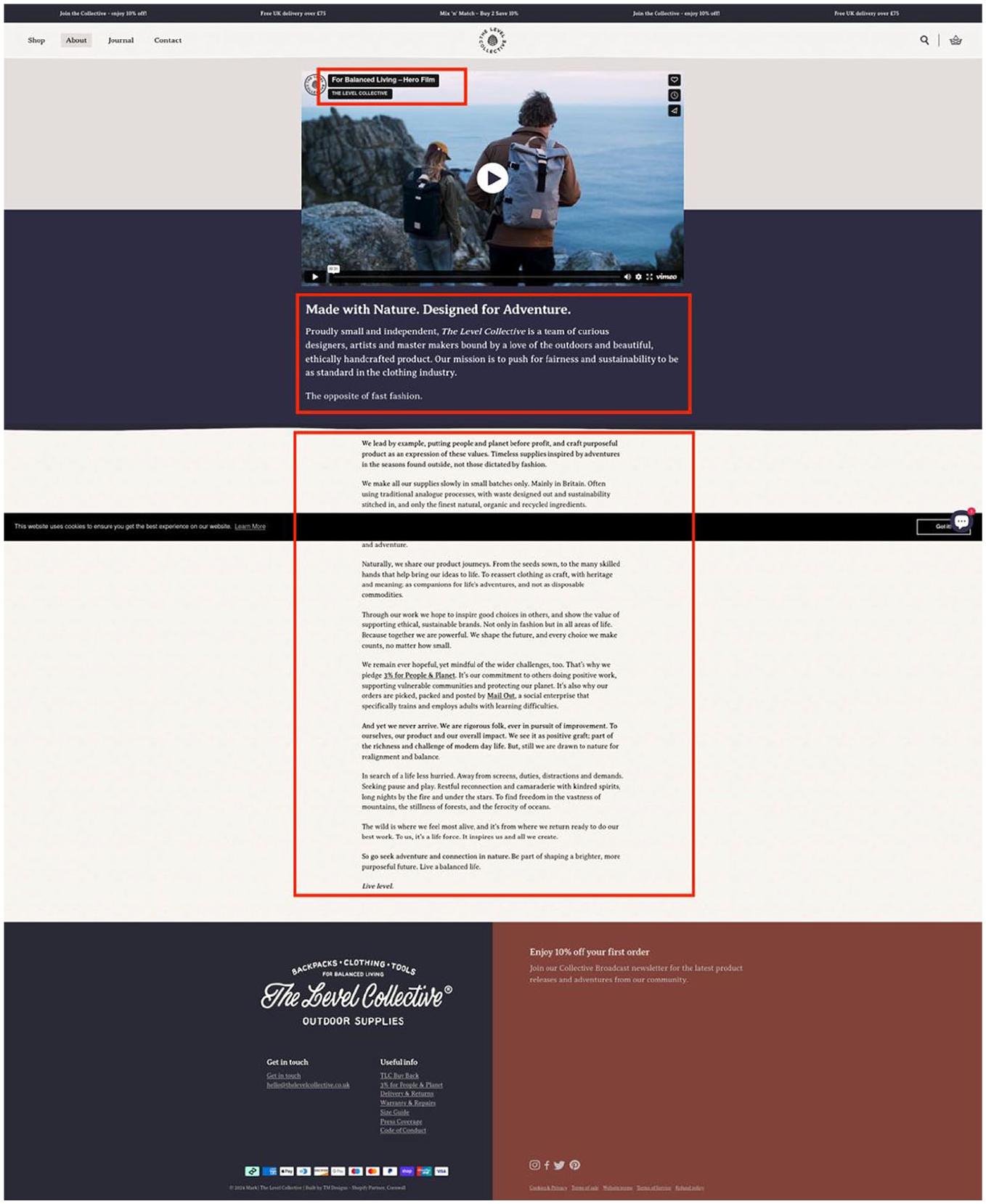
Example of sustainability webpage (https://thelevelcollective.com/pages/about) and texts extracted in the corpus (highlighted in red boxes).
Corpus Building
To build the sustainability corpus we followed a four-step strategy to collect links from these websites. We submitted all URLs to Sketch Engine (Kilgarriff et al., 2014) to automatically scrape and download texts. Twenty URLs failed the automated scraping process. We went back to these failed URLs, manually copied the sustainability texts and pasted them into the plain text format. We then uploaded these manually collected texts to Sketch Engine. The initial corpus therefore contains automatically scraped texts and uploaded texts. Then we downloaded the initial corpus in plain text format and manually cleaned the text files to remove unwanted text and symbols. To do this, we compared the scraped data with the data on company websites and manually deleted unwanted text related to cookie policies, registration and login panels, and promotional coupons and sales that were captured by the web scraping tool. At the same time, we identified a small number of texts that were not captured by automatic scraping, which we then manually added to the plain text file. After we went through all URLs in this manner, we looked to identify additional duplicates by searching for long strings of words (Brookes & Collins, 2024). It came to our attention that more cookies and promotion-related texts appeared in the raw data of low-rated firms, about which we consciously took notes of their typical words and set phrases, for instance, country, language, password, % off, marketing cookie policy, and valid only on. The corpus of the high-rated firms had fewer texts on cookie policies, promotional discounts, and registration prompts.
High-rated firms (rated 4 or 5 overall) generally do well in the sustainability indicators provided by Good on You; therefore, we concluded their sustainability claims to be more likely to be credible and genuine. Contrarily, low-rated firms (rated 1 or 2 overall) generally performed poorly in most of the sustainability indicators, and, therefore, we considered their environmental claims to be less credible. Overall, we regard the sustainability pledges to be on a continuum ranging from least sustainable to most sustainable. Companies with ratings of 4 or 5 lean toward the more sustainable end and companies with ratings of 1 or 2 lean toward the less sustainable end. Throughout the paper, we use “more sustainable firms” and “high-rated firms” interchangeably to refer to firms rated 4 or 5, and we use “less sustainable firms” and “low-rated firms” interchangeably to refer to firms rated 1 or 2.
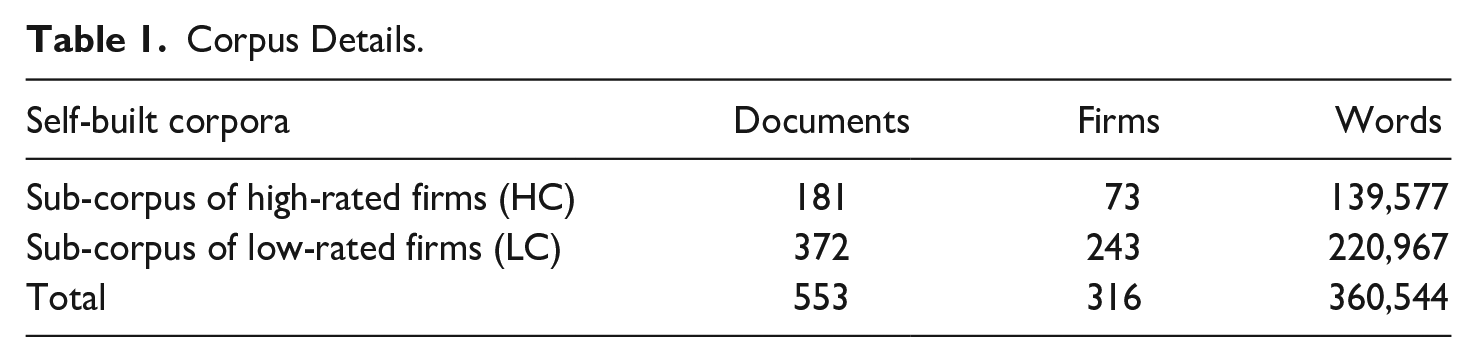
We categorized and compiled the sustainability statements of the two types of firms into a corpus which consists of two sub-corpora: a sub-corpus of high-rated firms (HC for short) and a sub-corpus of low-rated firms (LC for short). The details of the self-built corpus are illustrated in Table 1. As stated previously, high-rated firms are outnumbered by low-rated ones in Good on You, which is reflected in our corpus too. LC accounted for around 61% of words in the entire corpus.
Corpus Details.
Analytical Approach
The analysis was performed using Sketch Engine (Kilgarriff et al., 2014). The main corpus queries we employed are keyword analysis, collocation analysis and concordance analysis. Keywords are words that occur statistically more frequently in a focus corpus than in a comparison corpus (Scott, 1997). The keyword analysis in this study involves two comparisons. To identify distinctive features of more sustainable and less sustainable firms, we compared the two sub-corpora with each other, that is, comparing HC (focus corpus) with LC (reference corpus), and comparing LC (focus corpus) with HC (reference corpus), generating two sets of keywords. Comparing sub-corpora with each other will uncover differences, however, this approach may over-focus on differences and ignore commonalities (Baker, 2023; Rayson & Potts, 2021). To also capture similarities, we compared each sub-corpus against a reference corpus, enTenTen21 3 (a general English web corpus), as “a useful way of determining key concepts across the corpus as a whole” (Baker, 2023, p. 179).
Sketch Engine uses simple maths to identify keywords ranked by keyness score. Simple maths uses relative frequency so that it is possible to compare corpora of unequal size (Kilgarriff, 2009). We are aware that text dispersion—a word’s dispersion across texts in a corpus—is a new approach to the long-standing frequency-based keyword analysis that is discussed centrally or marginally by some corpus linguistics researchers (e.g., Baker, 2004; Egbert & Biber, 2019). We did not take dispersion as a measure of keyness in this study because, while examining the resulting keywords, we realized that a reference to the same entity/concept varies across fashion firms. For example, the property of environmental materials could be referred to using terms like eco-friendly, eco-conscious, sustainable, or green, etc. As also warned by Baker (2023), authors of text may simply avoid repetition by using alternative terms, and therefore, it is not necessarily the exact word that is particularly important, but the general meaning that the word and other similar words refer to. Eventually, we selected the top 100 words to facilitate further in-depth analysis using the simple maths formula (add-N = 1) without taking into consideration dispersion of keywords.
Keyword analysis is complemented by collocation and concordance analysis to “provide a more detailed perspective on specific lexical items, enhancing our understanding of their rhetorical and ideological function” (Fuoli & Beelitz, 2024, p. 9). In corpus linguistics research, collocation analysis studies how certain words appear together more often than would be randomly associated. Collocates may appear immediately before or after the word under examination, or at a certain pre-defined distance, for example, three words to the left. The concordance analysis allows users to examine the search word (or term) in a more detailed context in concordance lines—rows displaying the search word in the center of a line and other words to the left and right (Brookes & Collins, 2024).
The keywords were further grouped into shared semantic/thematic categories to highlight the themes of the two sets of sustainability statements. While corpus methods provide quantitative insights and assist in identifying linguistic patterns at scale, the manual, theory-informed thematic analysis remains indispensable for producing meaningful interpretations. This step is particularly significant for uncovering nuanced meanings and patterns that may not be immediately apparent through automated corpus methods alone. The semantic/thematic categories were developed collaboratively. First, the two authors examined the sets of keywords independently by going through concordance lines to get an overall impression of the themes of keywords generated. Then, the two authors shared their understanding of differences between these keywords and key themes arising from each sub-corpus. Afterwards, the first author examined each keyword by going through their contexts and developed the semantic/thematic categories following an inductive approach. Then the second author checked the coding categories and noted down his disagreement. The two authors met to discuss and resolve inconsistencies. Eventually, the final semantic/thematic categories of keywords were developed collaboratively.
Results
This section discusses the major findings regarding differences and commonalities of sustainability discourse of high-rated and low-rated firms. We discuss the differences through the analyses of keywords obtained by comparing high-rated firms and low-rated firms with each other. Subsequently, we discuss the commonalities through the analyses of shared keywords by comparing high-rated firms and low-rated firms against a third reference corpus.
Comparing With Each Other: Differences of Disclosure
High-Rated Firms: Worker and Impact Calculation
This section discusses the themes of sustainability proclamations by high-rated, more sustainable firms. We compared these firms with the low-rated, or less sustainable firms and generated a list of key lemmas. 4 Table 2 shows the top 150 key lemmas revealed by this comparison. We examined each individual keyword by going through their concordance lines to determine common themes. Overall, high-rated firms place a strong emphasis on transparency, accountability, and innovation, actively addressing critical issues such as workers’ welfare, environmental impact calculations, materials and industry norms. The presence of detailed and specific keywords, such as wage, fair-trade, petroleum-based, and appleskin, demonstrates their engagement with complex sustainability challenges and their commitment to providing solutions.
Top 150 Keywords in High-Rated Firms Compared With Low-Rated Firms.
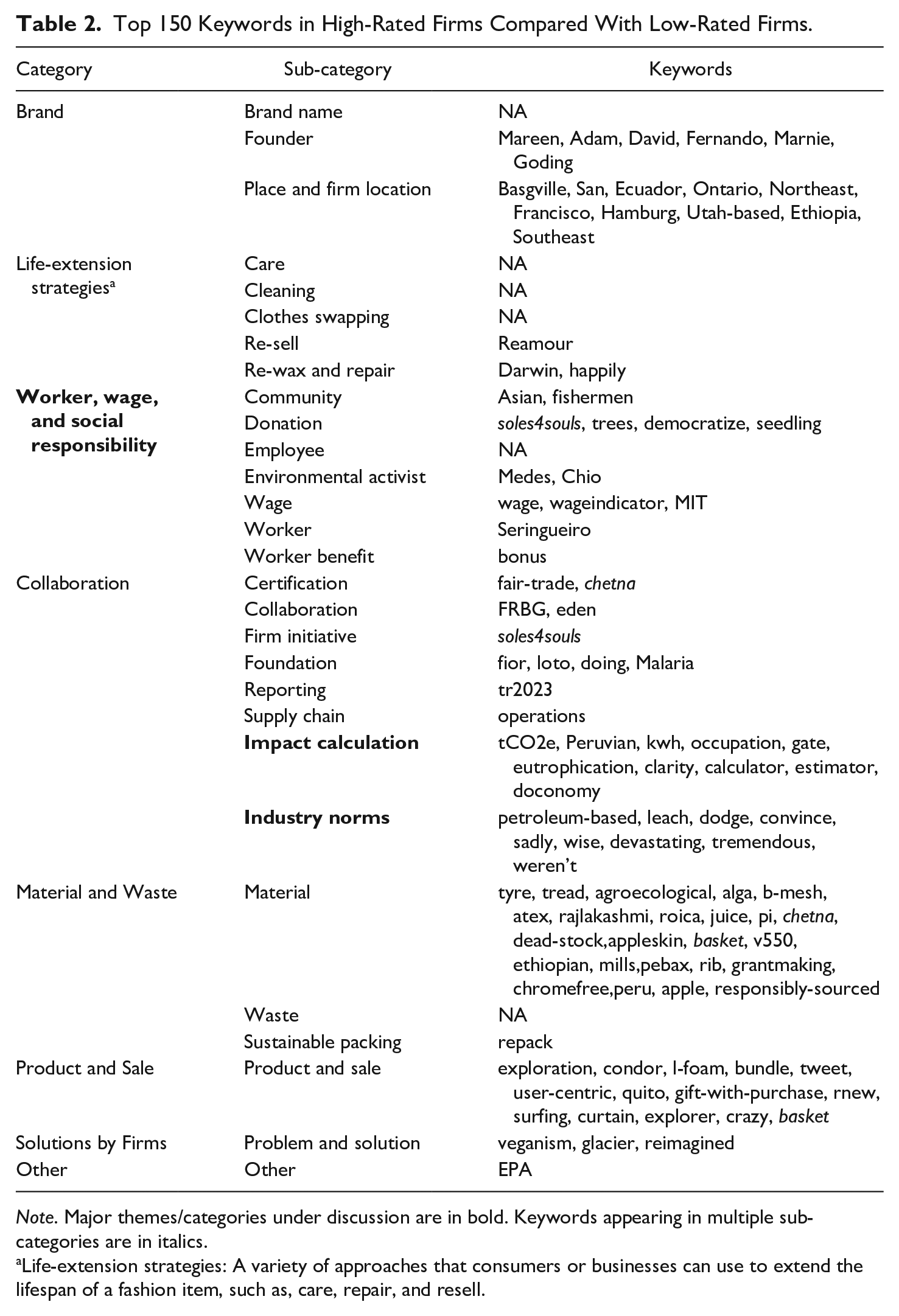
Note. Major themes/categories under discussion are in bold. Keywords appearing in multiple sub-categories are in italics.
Life-extension strategies: A variety of approaches that consumers or businesses can use to extend the lifespan of a fashion item, such as, care, repair, and resell.
Next, we will delve deeper into three conspicuous themes displayed by the high-rated firms: (1) The emphasis of workers’ wages and social responsibility, (2) Impact calculations, and (3) Disclosure of industry norms. High-rated firms have represented themselves as socially and environmentally responsible through these themes.
The first theme is regarding worker and wage. The category Worker, Wage, and Social Responsibility (Table 2) showcases sustainable firms’ attitudes toward treating their garment workers. Workers’ wages are an important part of showcasing the social performance of a corporation. The term wage is much more frequently mentioned by sustainable firms than unsustainable firms (1,826.07 vs. 326.59 per million tokens). Table 3 shows word collocates of WAGE in the sustainable corpus, ranked by Log Dice (a statistical measure for identifying co-occurrence of linguistic items). Collocates that appear in both corpora are marked in italics.
Collocates of WAGE in High-Rated Firms.
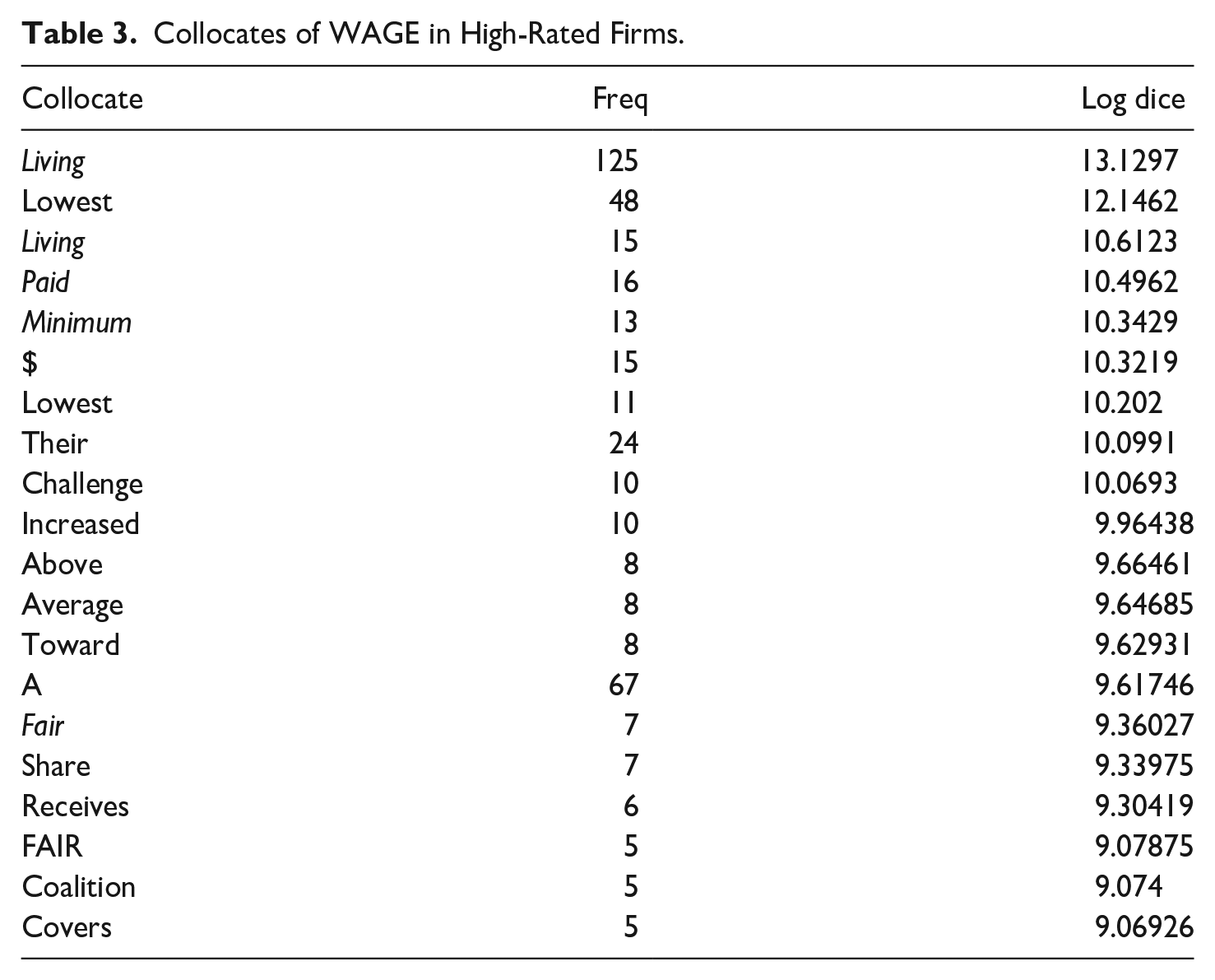
The shared collocates center on types of wages (living wage, minimum wage, and fair wage) and actions related to wages (paying wages). While both types of firms refer to living wage, the differences lie in the frequency of use and the way in which the terms are used. The term living wage is eight times more pronounced in the HC (848.04 vs. 106.24 per million tokens). Less sustainable firms are less likely to talk about paying workers a living wage. Living wages, capable of providing a decent or socially acceptable standard of living (Hirsch, 2018), are voluntary and usually higher than minimum wages. For the more sustainable firms, living wage is used to discuss how firms pay workers a living wage or how firms (re)calculate living wage. Some sustainable firms show clear evidence of paying living wages over the years, as seen by the dollar sign ($) in Table 3. Due to limited space, we present one instance from Nisolo in (1).
(1) In 2020, we raised our lowest wage from $12 an hour to $12.40 an hour to meet MIT’s updated living wage. . . . in 2022, when the
Living wage calculation is mentioned to evidence firms’ commitments to and actions taken toward paying workers a living wage, as seen in (2). The living wage calculation designed by MIT and Wageindicator was mentioned a few times by Able and other more sustainable firms, hence the presence of keywords MIT and Wageindicator in Table 2. This is in stark contrast with low-rated firms, which often attribute their inability to provide a living wage to a lack of resources for calculating it.
(2)
In Table 3, lowest is the only Top 3 collocate to appear in HC but not in LC. It is associated with the Lowest Wage Challenge initiated by Nisolo and ABLE. This campaign encourages brands to publicly disclose their lowest wages and measure how far they fall short of a living wage, ensuring they are on a trajectory toward paying a living wage. The campaign also urges consumers to pressure their favorite brands to share the lowest wages within their supply chains and to have their wage systems audited to hold fashion firms accountable. In contrast, there is not a single mention of lowest wage(s) among less sustainable firms, let alone any effort to share or publish this information for the public.
Paid is one of the top collocates of wage in both types of firms. Among the 16 collocates in HC, all instances are clear statements of wages being paid, with six instances being living wage, two instances about being higher than the living wage, and the rest about being higher than the local minimum wage, as seen in (3) and (4). High-rated firms tend to disclose the number or percentage of workers who are paid certain type of wages.
(3) At Thesus, 100% of our current staff and staff of our direct manufacturers, are (4) Not only are all wages
The second theme in the keywords of high-rated firms involves impact calculations, particularly for carbon and water emissions, as seen in the sub-category Impact calculation (Table 2). Such disclosures generally reflect high-rated firms’ awareness of their environmental impact and a commitment to transparency. Highlighting the specific method used to calculate environmental impacts increases transparency, which is crucial to hold firms accountable for their claims. In examples (5) and 6), two sustainable firms explain their method of calculation.
(5) CO2 emissions reference here are (6) We
A third notable theme is that high-rated firms actively disclose the hidden realities of the fashion industry, as evidenced by some stance words (Biber, 2006; Fuoli, 2018) under the sub-category Industry Norms (Table 2). These industry norms are being openly shared by the more sustainable brands to increase transparency about issues that consumers and outsiders may be unaware of. These firms openly discuss insider information, including the sector’s environmental impact, the prevalence of poverty wages, harsh working conditions, and strategies used by some firms to dodge responsibility. Notably, several high-rated firms adopt an educational approach, exposing the environmental damage caused by common industry practices, such as long shipping distances, which may lead to high greenhouse gas emissions, as seen in (7), and the relocation of the tanning industry to countries with less stringent regulations than the EU, as seen in (8). These revelations are expressed through attitudinal stance words such as devastating, sadly, and tremendous, which convey personal evaluation, judgement, and criticism (Biber, 2006). These stance words underscore the negative impact of these unsustainable practices and condemn firms that perpetuate them.
(7) Most other brands ship their raw materials around the world to be grown, milled or sewn and those vast distances have (8) EU regulations regarding leather production, effluent, and environmental damage are much stricter than those implemented in many countries outside of the EU. This is (9) Today, the materials employed to manufacture running shoes are 99% plastic, especially polymers that are 99%
In (9), Veja exposes that 99% of plastics used in making running shoes are petroleum-based, highlighting their non-renewable nature. This critique of plastic usage is notably absent among less sustainable firms, which instead emphasize their efforts to use recycled plastic without addressing the broader environmental harms caused by plastic use. By spotlighting this issue, Veja challenges the industry’s reliance on petroleum-based plastics, setting itself apart from less sustainable firms that focus on limited recycling efforts and neglect the full environmental impact of plastic use.
Low-Rated Firms: Consumer-Facing, Wage, and Multi-Stakeholder Approaches
Now we turn to the themes emerging from the low-rated firms: consumer-facing initiatives, market-based solutions, a lack of genuine concern about worker’s wages, and multi-stakeholder approaches. As shown in Table 4, low-rated firms place a greater emphasis on consumer actions when discussing their sustainability initiatives.
Top 150 Keywords in Low-Rated Firms Compared With High-Rated Firms.
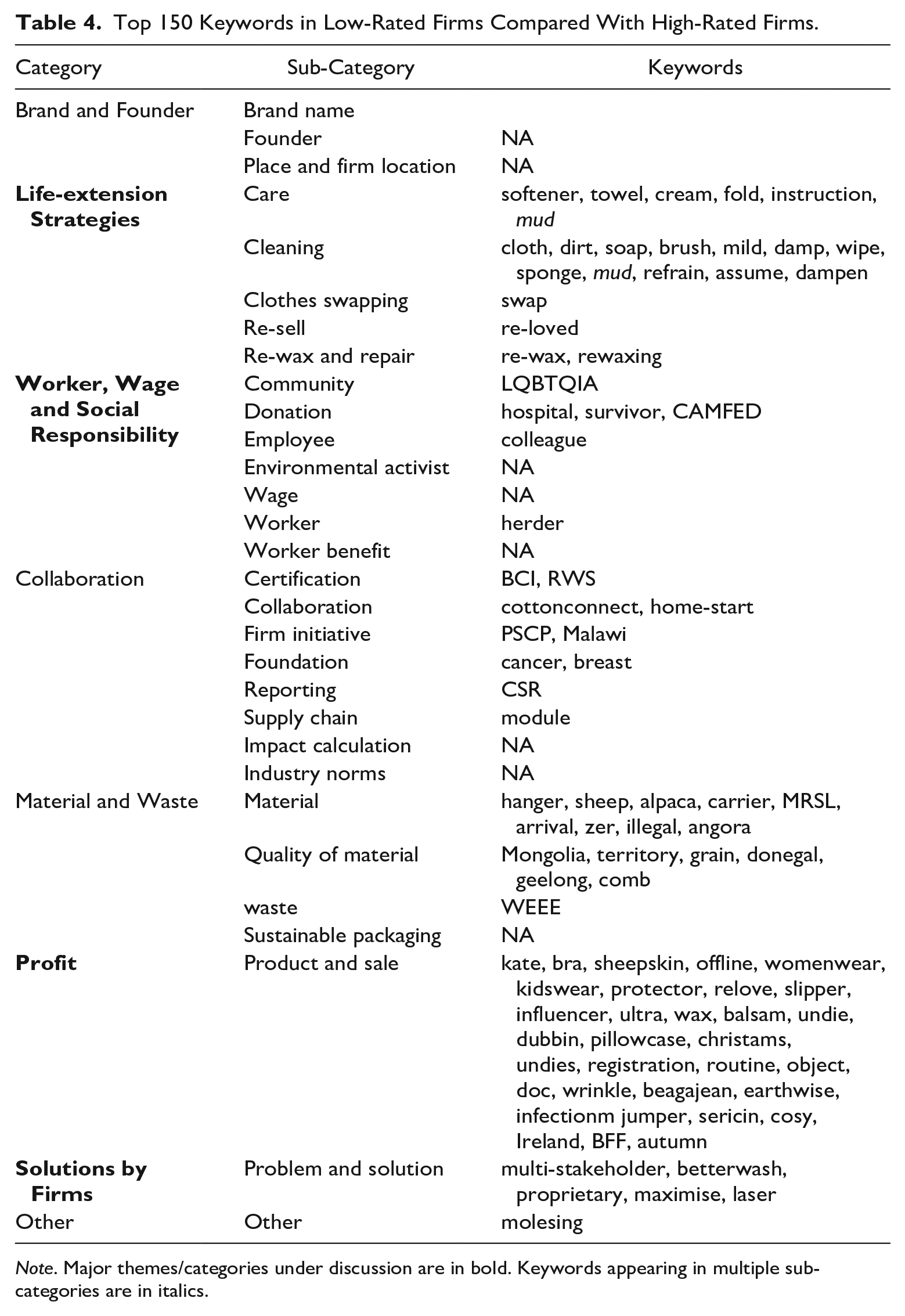
Note. Major themes/categories under discussion are in bold. Keywords appearing in multiple sub-categories are in italics.
Consumer-Facing Efforts and Market-Based Solutions
The first theme that emerged from keywords of low-rated firms regards their efforts in promoting consumer-facing life-extension strategies, which feature market-based solutions. This theme is most realized through keywords under the categories Life-extension Strategies and Profit in Table 4. Strategies such as product care, cleaning, repair, and re-wax are promoted as circular strategies to extend product lifespans. In (10), the sneaker brand P448 explains how customers may clean their shoes using a towel as routine care practice. Likewise, in (11) shoe brand Giuseppe Zanotti advises using a damp cloth with soap to wash dirt off shoes.
(10) Spot clean the interior lining of your shoe by mixing one teaspoon of dishwashing liquid in two cups of warm water. Working small sections, dip a soft toothbrush or cotton (11) To remove a small amount of dirt, we recommend using a soft
However, these initiatives rely heavily on consumers to act sustainably to maintain the longevity of their products. While it is undoubtedly important for consumers to adopt sustainable habits, such as taking good care of their wardrobes, which may reduce future consumption, this approach shifts the sustainability responsibility away from firms. In sustainability statements, “one would expect a stronger focus on company-specific strategies or achieved goals as opposed to generic reference to other stakeholders” (Jaworska, 2018, p. 208). A heavy reliance on other stakeholders, coupled with a reluctance to address the company’s own responsibility, may be indicative of greenwashing.
Apart from these consumer-facing initiatives, some of the product life-extension strategies (e.g., product care and clean) are closely related to product sales or services. For example, among the 24 instances of re-wax, only two instances are instructions for consumers to take care of leather shoes; the remaining instances are related to brands’ re-waxing services or products, for example (12). This shows how firms capitalize on win-win opportunities around sustainability to profit while benefiting the planet.
(12) Once we have confirmed receipt of your jacket, we promise to have your re-wax completed within 10 days, a clean and
The emphasis on product sales through life-extension strategies is intrinsically linked to another theme of these low-rated firms: the promotion of market-based solutions (Ferguson et al., 2016) in category Product and Sale under Profit (Table 4). Low-rated firms tend to link their products and services to sustainability initiatives, for example, through cause-related marketing (Koschate-Fischer et al., 2012), that is, pledging to donate to charities from each purchase, thus painting a caring, ethical, and green image, encouraging consumers to purchase their products. For example, 13 and 14 illustrate how firms link donations to sales, constructing a socially responsible business.
(13) In order to achieve this, we have proudly partnered with i=Change who enable customers through our online store to choose from one of three of our selected charities for us to automatically donate to on their behalf - each and every time an order is placed. (Studio Amelia, LC) (14) And from every teeny tiny jumper we sell, we’ll donate $5 to our charity partner Home-Start UK (via the White Stuff Foundation). (White Stuff, LC)
In (13), Studio Amelia takes pride in making donations through an online portal, however, further examination of the donation scheme through concordance lines and its original webpage does not reveal any specific information regarding amounts donated and whether these donations represent a significant portion of the company’s profit. These strategies might encourage overconsumption and lead to “moral licensing” where consumers feel their contribution justifies other less ethical behaviors (Brønn & Vrioni, 2001). Brands may be perceived as exploiting social causes for profit without properly realizing their commitments. Apart from that, these strategies direct public attention away from pursuing more substantial sustainability solutions. Different from (13), the firm in (14) specifies the amount of donation per purchase, which increases accountability. Compared with (13), (14) presents a more transparent image.
Lack of Concern for Workers
Low-rated firms demonstrate a conspicuous lack of concern for their garment workers. This lack of concern is reflected in (1) their approach to worker pay—examined through the noun collocates and verb collocates of the lemma WAGE, (2) their justification for maintaining the current wage system, and (3) the proposed solutions for improving workers’ pay situation. The first two are mainly derived from examining the keywords in Worker, Wage and Social Responsibility (Table 4) and the third point is mainly derived from keywords in the sub-category Solutions by Firms (Table 4). Notably, collocates in the sub-categories Worker and Worker Benefits are strikingly sparse. The lemma WORKER occurs less often in LC (198 hits, 779.1 per million) compared to HC (179 hits, 1,108.02 per million). Similarly, WAGE is mentioned far less frequently in LC (83 hits, 326.59 per million) than in HC (295 hits, 1826.07 per million). Table 5 shows the top 20 strongest collocates of WAGE in low-rated firms. Collocates that appear in both corpora are marked in italics.
Top 20 Strongest Collocates of WAGE in Low-Rated Firms.
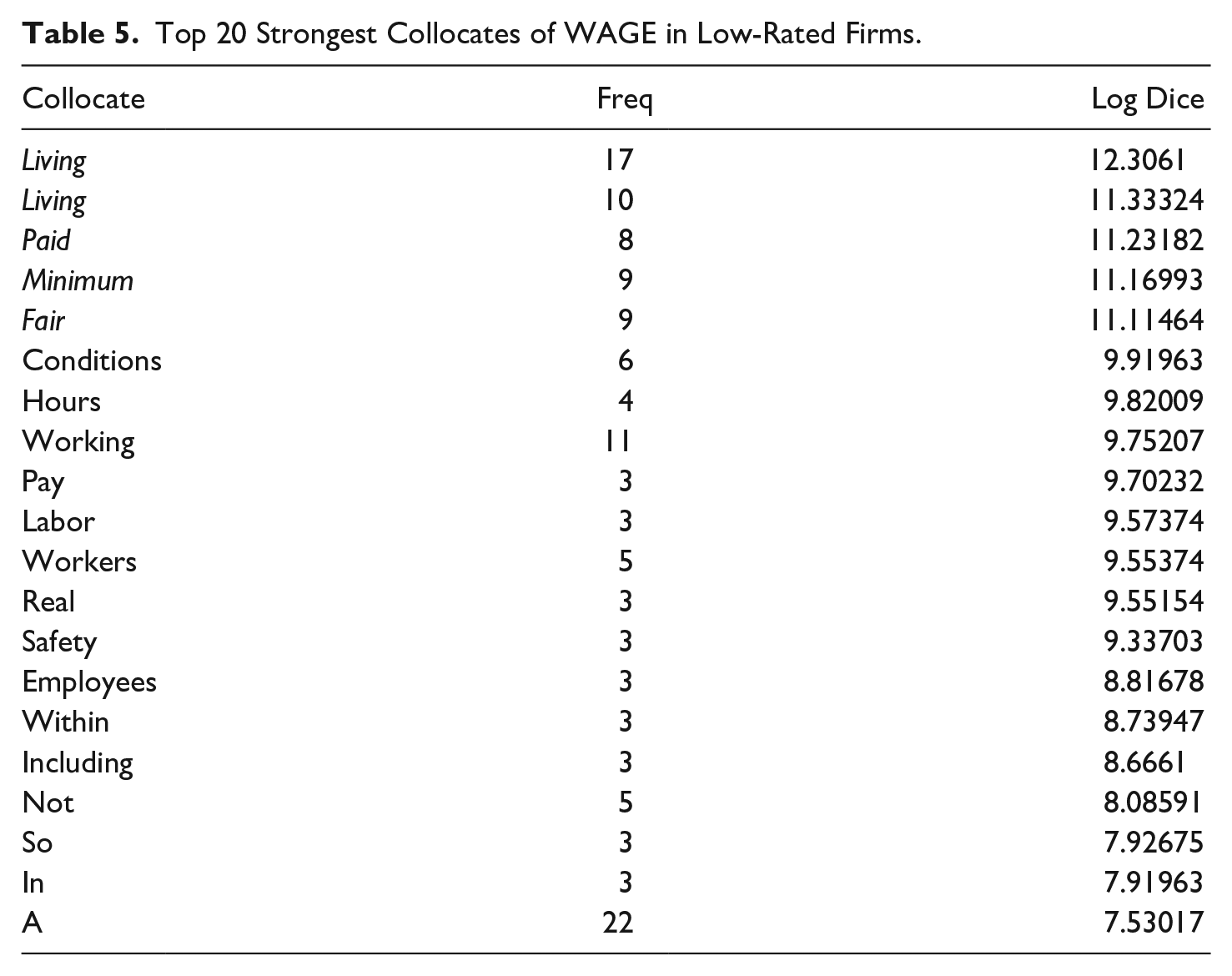
Low-rated firms’ lack of commitment to workers’ wages is revealed through collocates of the lemma WAGE, particularly the modifiers that describe wage types (e.g., living wage) and the verbs that indicate actions toward wage (e.g., wage is paid). Living and minimum are the two strongest collocates, indicating the types of wages paid to workers. A detailed analysis of concordance lines of Living and living reveals that only 3 out of 27 instances refer to living wage being paid to workers. The majority (16 instances) describe firms’ pursuit of and commitment to working toward paying living wage, with six instances concerning the calculation of living wage, and two explaining what living wage means. As seen in (15) and (16), both brands claim that they are committed to living wage; however, these statements lack details about implementation, such as timelines, metrics, actionable plans, etc.
(15) Our Commitment to a (16) Making sure our whole value chain is progressing within
In (16), rather than directly committing to paying a living wage, Lindex shifts the responsibility to suppliers, framing itself as assisting them in achieving the goal. A review of the wider context shows that terms like progressing remain undefined, with no clear explanation of how progress will be measured. This vagueness can be interpreted as greenwashing, as it obscures accountability (Carlson et al., 1993).
Paid is among the strongest verb collocates of WAGE. An analysis of concordance lines of paid reveals vague commitments to action and a stronger emphasis on legal compliance. Among the eight collocates of paid, only two collocates describe instances of living wages being paid, three refer to suppliers being required to pay a minimum or fair wage, two mention plans to investigate pay in their supply chains, and one discusses how its living wage approach exceeds the minimum wage. By emphasizing suppliers (e.g., factories), less sustainable firms shift responsibility to other stakeholders, exemplifying a differentiation strategy as described by Ferguson et al. (2016).
Low-rated firms never fall short of justifying their pay status quo. Three types of justifications emerged from analyses of concordance lines of WAGE: emphasizing the complexity of wage calculations, understating the importance of fair wages, and advocating for multi-stakeholder approaches.
Rather than focusing on paying living wage or increasing wages, low-rated firms highlight the complexities of the wage system and the challenges of paying fair wages. As claimed by Primark in (17), it is the factories that directly pay workers, not the brands themselves. Similarly, Lindex in (18) echoes this sentiment, asserting that wages need to be negotiated rather than directly determined by brands.
(17) (18)
While brands do not directly pay factory workers, they negotiate sewing prices per item and have the power to push factory owners to provide fair wages (Adegeest, 2023). Conversely, as revealed by Nisolo, some large brands use their purchasing power to demand lower prices from factories for the products they buy, forcing factories to underpay workers to minimize costs to retain orders 5 from these brands. These firms are reluctant to take responsibility for ensuring fair payments for garment workers. They also attempt to downplay the importance of paying fair wages. As shown in (19), after introducing the living wage system used to monitor compliance, Primark emphasizes the importance of workers managing their personal finances over increasing their wages, and highlights that Primark wants to offer training in this regard. The importance of financial management aside, by focusing on financial management, Primark shifts the narrative away from the firm’s responsibility for paying fair wages and onto the workers’ ability to manage their income. They seem to insinuate that the reason these workers end up in a difficult financial situation is simply because they lack the capability to manage their income.
(19) It’s important to say that it’s not just
Additionally, by saying they want to—not that they will—offer training in personal finance management, Primark frame their role as a company that cares about workers’ personal development without having to invest resources to do so. This form of legitimation discourse, combined with rationalization, attempts to deflect attention from serious issues around low wages in the fashion industry, which qualifies as greenwashing.
The complexity of wage calculations and the importance of financial management are further used to set up for the necessity of multiple stakeholder approaches to sustainability. This framing suggests that governments, suppliers, and other parties need to collaborate to address wage issues, thereby downplaying the brand’s role in the process. For instance, in (20), Rivers highlights the need for collective action. While multi-stakeholder collaboration is undeniably important, brands could still act independently by voluntarily paying higher wages, even without government intervention.
(20) Paying higher prices for product does not guarantee that workers receive a higher wage. We understand that this requires a
Call for a Multi-Stakeholder Approach
As elaborated above, calls for a multi-stakeholder approach are used to account for the lack of substantial improvement in workers’ wage. This approach is also commonly used by less sustainable firms regarding sustainability in general, as seen keywords in the category Solutions by Firms in Table 4. These firms often take pride in participating in various kinds of initiatives and programs, but at the same time they refer to these initiatives’ multi-stakeholder nature, as seen in (21-22). On the one hand, it shows their willingness to engage in collaborative efforts to protect the environment; on the other, emphasizing this collaborative nature seems to mitigate the effort and responsibility that falls on individual firms. As argued by Brooks in (21), to exert meaningful impact, fashion brands need to work with other stakeholders to become more sustainable.
(21) We recognize that to impact meaningful change, we need to work with brand, industry, and (22) From our early days, we have been at the forefront of improving practices in the leather industry, taking an active role in a number of
Firms may avoid underscoring the blatant discourse of requesting a multi-stakeholder approach and instead embed this concept in depictions of the actions they have taken. For instance, in (22), the term multi-stakeholder is used as a modifier of initiatives that Mulberry has been taking part in, insulating the necessary approach to sustainability in the fashion sector. As warned by Jaworska (2018), such preferences are not merely as innocent as a personal choice, but a reflection of a particular stance.
Comparing Against a Reference Corpus: Similarities of Disclosure
To explore potential similarities of sustainability discourse between high-rated and low-rated firms, we compared each sub-corpus with a reference corpus enTenTen21. Table 6 shows the shared keywords among the Top 150 from each comparison.
Shared Keywords by Comparing Sub-Corpora With a Third Corpus (Top 150 Keywords).
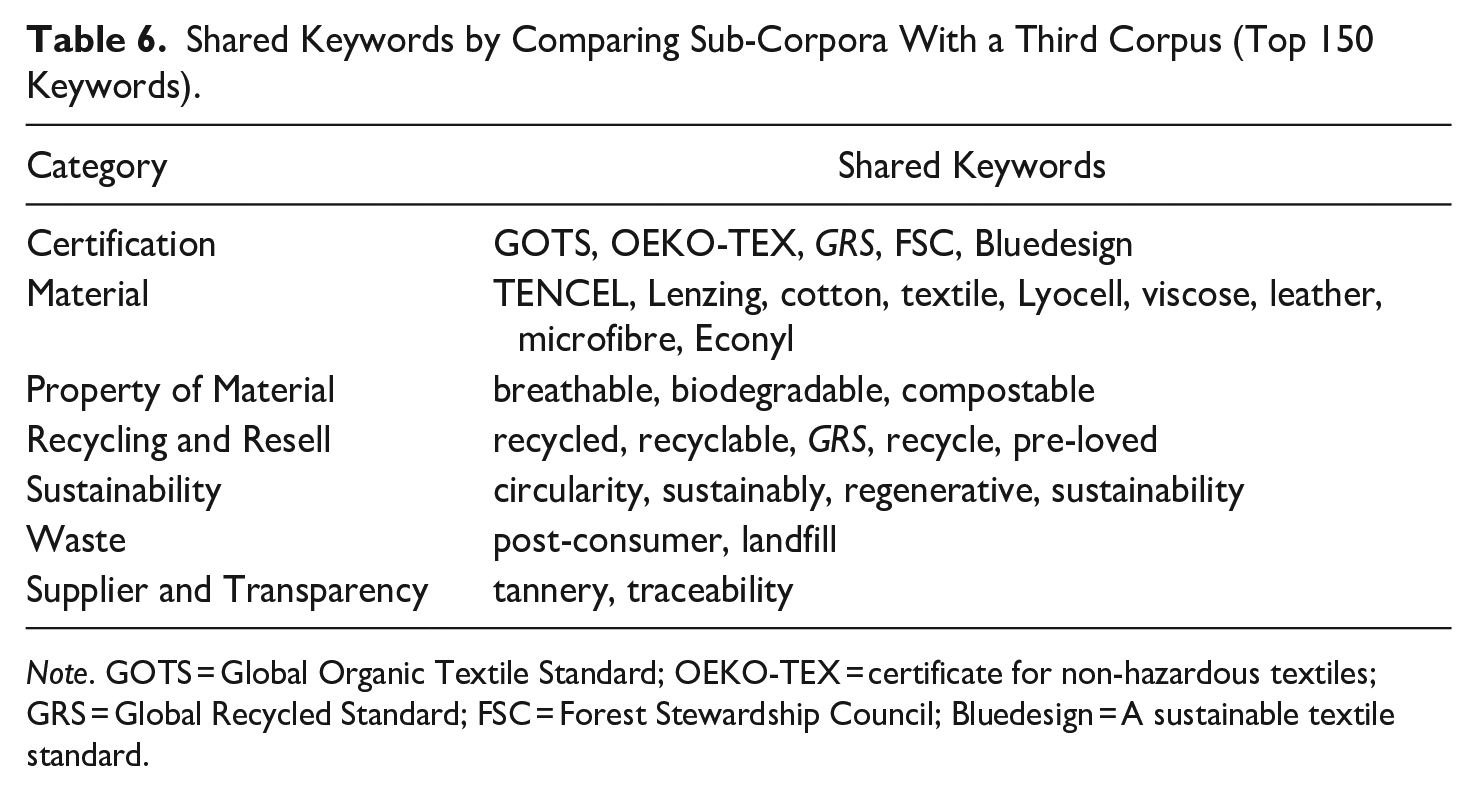
Note. GOTS = Global Organic Textile Standard; OEKO-TEX = certificate for non-hazardous textiles; GRS = Global Recycled Standard; FSC = Forest Stewardship Council; Bluedesign = A sustainable textile standard.
The shared keywords largely revolve around materials, certifications, and recycling. The prominence of certification-related keywords (e.g., GOTS, OEKO-TEX, GRS, FSC, and Bluedesign) indicates a strong reliance on third-party certifications by both firm types to substantiate their sustainability claims, underscoring the importance of external verification in building consumer trust in sustainability discourse (Lee et al., 2020). Most of these certificates are material-related, for instance, GOTS (Global Organic Textile Standard), GRS (Global Recycled Standard), and FSC (Forest Stewardship Council), as seen in (23). Additionally, material-specific keywords like TENCEL, viscose, and leather highlight that the choice of materials is a focal point in the fashion industry’s sustainability narrative. All these materials are mentioned together with modifiers like green, sustainable, or biodegradable, emphasizing the functional and environmental benefits of the materials they use.
(23) Rajlakshmi orients its production around sustainability; it is certified under the Global Organic Textile Standard ( (24) We’re incorporating fabrics like (25) We’re committed to
The emphasis on materials is further evident in the prevalence of recycling-related keywords, such as recycle, recycling, and recycled, which appear 1,392 times in the entire corpus. We randomly shuffled the concordance lines and examined the first 20 instances: 7 referred to the use of recycled materials like recycled polyester, cotton, and plastics; 6 mentioned recycled paper for packaging for shipping products; and 4 were about recycling pre-loved products to reduce apparel waste. The remaining instances focused on commitment and industry problems. In (24), American Eagle Outfitters (AEO) mentions using recycled polyester and nylon but does not mention the percentage of recycled content. Similarly, in (25) Fatface commits to recycling all their waste by 2025. Discussing the metrics regarding the proportion of recycled waste and time would enhance consumer traceability, to a certain extent.
Discussion and Conclusions
This study highlights similarities and significant differences in the sustainability discourse between more sustainable (high-rated) and less sustainable (low-rated) fashion firms using corpus linguistics methods. Both types of firms share similarities in their sustainability proclamations. They both consider the environmental and social dimensions of sustainability. Both demonstrate their environmental responsibilities by referring to recycling and using recycled materials, and to environmental certification; however, it should be noted that recycling is the “loop of last resort” and therefore may be less sustainable than other environmental strategies. Both types of firms pay attention to socially related responsibilities, as showcased by keywords such as worker, wage, and community. The discussion of wages is particularly relevant in this context. The fashion industry is labor-intensive, involves complex supply chains, and often employs workers in developing countries where paying minimum wage is the norm (Kozlowski, 2019). In contrast, in more skill-based industries like the oil industry, workers earn a living wage due to the specialized skills required. Instead, non-wage related issues, such as health, safety, and community relations are more pertinent socially related topics in the oil industry. Even in the fashion industry, paying workers a fair wage is nonetheless far from doing enough; there are other concerning issues, especially around eliminating hazardous working environments and providing social welfare (Beyer & Arnold, 2022). Therefore, paying workers a fair wage may simply be the most pressing issue, and once this issue is resolved, issues of health and safety may become more central.
The corpus methods have also revealed significant differences in firms’ sustainability disclosure. These differences inherently lie in information sharing or transparency. In the context of this study, we see transparency as the amount of information disclosed by fashion firms, particularly in relation to their social and environmental responsibilities, in order for the public to trace delivery of promised goals. In our data, transparency may stem from two sources: internal and industry-wide disclosures. Internally, individual firms may voluntarily share details about their commitments and practices. However, industry-wide transparency involves dissemination of sector norms and practices that are often unknown to the public. Such disclosure enables stakeholders to monitor, assess, and hold firms accountable for their stated goals, as well as evaluate their broader aspirations to drive industry-wide change. However, as warned by researchers, excessive and jargon-loaded disclosures may serve to obscure and conceal rather than clarify and reveal things (Fan & Christensen, 2024) and more information does not necessarily translate to better conduct (Albu & Flyverbom, 2019). In this study, the critical issue with low-rated firms is the failure to provide key information about plans and commitments that would allow stakeholders to track their progress and hold them accountable. In other words, here the problem of low-rated fashion firms lies not in information overload but in information insufficiency, which harms transparency and accountability.
In line with the operationalized definition of transparency, in this study high-rated firms proactively share detailed wage data, disclose their methods used to calculate environmental impacts, and reveal hidden industry norms. These firms recognize the potential for other brands to exploit information gaps and, in response, advocate for industry-wide change through various campaigns and partnerships. By addressing sustainability illiteracy and sharing insider knowledge, high-rated firms aim to hold less sustainable firms accountable. In contrast, low-rated firms tend to withhold information that could cause them trouble. Instead of being transparent, they often adopt an explanatory and vague stance. They are less likely to pay living wages and frequently justify their status quo by citing the complexity of the wage calculation system. Low-rated firms often blame suppliers for not paying adequate wages, arguing that fashion brands do not pay workers directly. Additionally, these firms may shift responsibility to their workers, suggesting that employees’ financial management is more critical than firms paying a fair wage.
Furthermore, the two types of firms propose different solutions for achieving sustainability in the fashion industry. High-rated firms are self-reflexive and advocate for transformations from within, both at the individual brand level and across the entire industry. In other words, they act out of a more genuine concern for sustainability issues in the industry, a feature of intrinsic CSR motives (Du et al., 2010). They lead by example, disclosing their own wage information and methodologies for calculating environmental impacts. They promote transparency and accountability, as evidenced by widespread minimum wage disclosures and consumer education on sustainability. As Marquis et al. (2016) argued, firms are less likely to engage in selective disclosure when organized social movements and public scrutiny are strong. As consumers become more knowledgeable about industry norms and sustainability, information asymmetry between firms and other stakeholders is reduced, which decreases the effectiveness of greenwashing for firms (Gregory, 2023).
On the other hand, low-rated firms typically refrain from mentioning prominent social or environmental issues associated with the fashion industry. This contrasts with the attitude of major carbon emitters in the oil industry, that firms seem to acknowledge the existence of climate change and its need to be addressed (e.g., Fuoli & Beelitz, 2024; Jaworska, 2018). Instead, the low-rated firms start right away by offering solutions which are mainly consumer-oriented (e.g., extending the lifespan of apparel) and requesting multi-stakeholder efforts. In other words, their sustainability solutions are outward-looking and profit-driven, featuring extrinsic CSR motives where sustainability awareness and practices mainly function as a means of profit making (Du et al., 2010; Schaltegger et al., 2019).
Through our comparative linguistic analysis, we argue that low-rated firms, compared with high-rated ones, may engage in greenwashing, where their green “talk” does not match their green “walk.” However, caution should be taken as even greenwashing discourse may not be completely useless from a CSR communication perspective. CSR communication can play dual roles: it is both representational, that is, reflecting companies’ actual practices and serving a backward-looking function, and (per)formative, that is, constituting and shaping future practices, thereby adopting a future-looking function (Schoeneborn et al., 2020). Commitments made by low-rated firms in our data, such as “We will work to pursue a Living Wage,” may initially appear as mere rhetoric, but they could signify that firms are actively considering sustainability or working toward meaningful change. As Christensen et al. (2013, 2021) and Schoeneborn et al. (2020) argue, aspirational talk may be more than just “cheap talk” but rather a potential enabler of corporate transformation. The complexities of material objects and technological infrastructures and affordances involved in the CSR walk are something that needs to be taken into account (Albu & Flyverbom, 2019). Ultimately, the critical lens on greenwashing underscores the complex relationship between CSR communication (talk) and CSR practices (walk; Christensen et al., 2013, 2021; Falkheimer & Heide, 2022; Schoeneborn et al., 2020). Recognizing this complexity allows for a more balanced understanding of low-rated firms’ sustainability narratives and their potential to drive change.
Our study has contributed to the research on sustainability disclosure and CSR communication by introducing a robust research method: a comparative corpus linguistic research design. Our study highlights how corpus linguistic methods—a mixed method approach—can be utilized to explore the large volume of textual data in corporations’ sustainability communications, which mitigates the subjectivity potentially attached to interpretation of results. Specifically, these corpus queries (e.g., keyword analysis, concordance analysis, and collocation analysis) allow us to delve deeper into the linguistic representation of sustainability efforts so that we are able to extract and compare interesting themes emerging from sustainability webpages of firms with different sustainability ratings. However, the findings of this study do not claim to represent the entire fashion industry, as our data sample is mostly Western-based fashion brands. Further research could expand our findings by including more apparel categories and brands from other regions, especially from non-Western countries (see S. Yang et al., 2017). Due to space restrictions, other keywords/themes related to social sustainability, for instance, collaboration and partnerships with other businesses (United Nations Global Compact, 2019) were not examined. Exploration of these aspects would provide a more complete picture of social responsibilities performed by fashion companies.
Based on these findings, we have identified a few greenwashing indicators to warn the public of potentially misleading sustainability claims made by fashion firms. Each indicator is accompanied by an example and a brief explanation of why the practice qualifies as greenwashing. All examples provided are drawn from the sub-corpus of low-rated firms in this study.
Company sets vague, unspecific goals, often lacking a timeline or concrete plans for implementation. For example, statements like “We are committed to build a better future for our next generation” or “We will work to pursue a Living Wage for everyone who makes our clothes” provide no clear steps or measurable benchmarks to track progress.
Company highlights the quality of materials without mentioning how environmentally sustainable these materials are. For instance, “Our Cashmere is made from Grade-A Mongolian materials, making it a luxurious, warm and soft fabric to withstand snow days,” shifting the discussion away from aspects of sustainability, perhaps hoping that customers equate quality and sustainability.
Company elaborates on the complexities of living wage calculations without committing to improving or ensuring wages or paying a living wage. For example, a focus on factors such as brands not paying workers directly or the lack of reliable wage calculation metrics shifts attention away from the brand’s responsibility for workers’ wages. Refer to Example (17).
Company argues that the key to raising workers’ wages lies in collective action from governments, suppliers, and other stakeholders. The company is deflecting responsibilities by calling for a multi-stakeholder approach. Refer to Examples (18), (20), and (21).
Company claims that raising workers’ wages is less important than whatever programs they are proposing and remains vague on these proposed programs. These alternative programs often lack details and clarity, making it difficult to assess their impact. Refer to Example (19).
Company highlights consumer-facing life-extension initiatives, such as cleaning, repairing, and recycling, without providing details about the firm’s own sustainability initiatives. The company deflects attention from its own responsibilities. Refer to Examples (10) and (11).
Company ties consumer-facing sustainability efforts directly to product sales. It leaves the impression that the company’s sustainability efforts are only or mainly profit driven. For instance, “We recommend that you re-wax your jacket annually depending on wear . . . We offer the option for customers to have their smaller waxed items re-waxed.”
Overall, the greenwashing discourse features blaming external factors for any wrongdoings without reflecting on self-conduct and improvement.
These seven indicators provide a useful list of criteria that can help consumers and the public to identify greenwashing in the fashion industry and avoid purchasing garments from these companies if desired. These indicators should be read within the broader context of online corporate sustainability discourse (Rowbottom & Lymer, 2009). While some of these indicators may hold true beyond this context, it is unknown whether they will act as predictors of greenwashing in other contexts, for example, in statements on product labels or packaging. Further studies can employ similar corpus linguistics methods to explore whether these indicators also apply to other contexts or industries, for instance, aviation. Lastly, we must acknowledge one potential downside of this research, that publishing a list of greenwashing indicators may help firms that do not have substantial sustainable initiatives avoid displaying markers of deception and thus better hide their greenwashing. However, we believe that the benefits of this research outweigh any potentially malicious use of these findings.
Supplemental Material
sj-docx-1-job-10.1177_23294884251336358 – Supplemental material for Washing Dirty Laundry: A Corpus Linguistic Analysis of Fashion Firms’ Webpage Sustainability Discourse
Supplemental material, sj-docx-1-job-10.1177_23294884251336358 for Washing Dirty Laundry: A Corpus Linguistic Analysis of Fashion Firms’ Webpage Sustainability Discourse by Yingnian Tao and Mark Ryan in International Journal of Business Communication
Footnotes
Acknowledgements
We would like to thank the editors and two anonymous reviewers for their invaluable comments and feedback in early versions of this article. Also, we would like to acknowledge the support, inspiration, and feedback provided by our colleagues as well as the MYC family, in helping us to complete this research.
Declaration of Conflicting Interests
The author(s) declared no potential conflicts of interest with respect to the research, authorship, and/or publication of this article.
Funding
The author(s) received no financial support for the research, authorship, and/or publication of this article.

Supplemental Material
Supplemental material for this article is available online.
Notes
Author Biographies
References
Supplementary Material
Please find the following supplemental material available below.
For Open Access articles published under a Creative Commons License, all supplemental material carries the same license as the article it is associated with.
For non-Open Access articles published, all supplemental material carries a non-exclusive license, and permission requests for re-use of supplemental material or any part of supplemental material shall be sent directly to the copyright owner as specified in the copyright notice associated with the article.

