




Abstract
Summary
Considerable resources are invested in producing sustainability reports, yet few organizations reap the transparency benefits they promise. This article explores the way ten leading global fashion companies use a combination of data visualization and placement, stakeholder-driven interactive content, and multi-media and immersive content to build the trust necessary to improve their reporting and transparency. While few organizations have the resources of the global fashion giants, this article proposes a four-stage framework that guides managers through a step-change of systematic and targeted improvement.
The single most important ingredient in the recipe for success is transparency, because transparency builds trust.
The last few years have witnessed a shift in thinking about transparency. It was once seen quite simply. Stakeholders and the community would use information provided by governments and organizations to bring about change through their consumption and voting behavior. Today, transparency is seen to deliver multiple outcomes for organizations and communities alike. 1
For communities, information flows throughout society reduce information asymmetries. Better information, shared widely, can lead to efficient markets, 2 efficient resource allocation, and enhanced growth opportunities. 3 Transparency can also strengthen democracy and community empowerment, particularly if it comes with opportunities for meaningful community engagement. 4 Transparency has also come to be seen as an attractive alternative to regulation, mainly because it places control about choices (e.g., sugar consumption) in the hands of consumers rather than governments. 5
For business organizations, sharing information about impacts encourages managers to be responsive to societal issues, 6 which can also improve governance. 7 Being transparent also promises to improve reputation, 8 particularly in relation to sustainability-related outcomes. Transparency can also provide a way to build, repair, and maintain trust with stakeholders. 9
But transparency is not without its challenges. While business organizations have enthusiastically embraced sustainability reporting 10 as one approach to transparency, doubts persist about whether it delivers on its promise. Critics suggest that sustainability reports are often less about transparency and more about reputation building. 11 Many contain errors and omissions, 12 and the standards that sit behind their preparation are rarely enforced. 13 There is ongoing frustration about immature norms within the community that limit how stakeholders can use the information provided to effect change. 14 Sustainability reports do not enjoy the same degree of enforcement, attention, and scrutiny as the organization’s annual financial reports. Some critics doubt that simply being “responsive” to stakeholders equates to the type of responsibility expected of business organizations today. 15
In this article, we explore the way ten leading fashion companies are attempting to improve their reporting and transparency. We focus on the fashion industry because firms in this industry confront significant community pressure about overconsumption, pollution, and worker exploitation 16 —yet they have shown a strong commitment to reporting and transparency. 17 Exploring how these types of engaged, yet controversial, firms attempt to improve transparency offers insights into how it can be improved for others.
Our findings show that combinations of sophisticated data visualization and placement, stakeholder-driven interactive content, and multi-media and immersive formats may improve transparency by fostering trusting relationships between organizations and stakeholders. Leading companies also describe the challenges they grapple with, and the learning journey they have been on. We build on the notion that trust is important for transparency, and the outcomes it offers, but its dimensions are broad and varied. Recognizing how reporting influences trust offers scope to generate the outcomes that transparency promises. Building trust and maturing an organization’s approach to transparency, however, takes time and resources. There are four distinct stages that organizations can progress through in a process of systematic and targeted improvement.
Background
What Is Transparency, and Do Stakeholder Reports Measure Up?
On the face of it, transparency is a relatively simple idea. It is about openness in organizational activities 18 and a willingness to intentionally share information with stakeholders 19 to inform and enhance their decision making. 20 Most understandings emphasize the characteristics of information disclosed—including clarity, reliability, timeliness, comparability, and relevance 21 —with a nod toward its useability. 22 Transparency can take a variety of forms, including product labeling, 23 hospital/school “scorecards,” 24 toxic chemical reporting, 25 and remuneration disclosures. 26
In recent years, sustainability reporting has become a common approach to transparency amongst business organizations, including global fashion companies. 27 It involves organizations publicly and voluntarily disclosing their economic, social, and environmental impacts against indicators and priorities in dedicated publications (or web-based PDF documents). Several outcomes are sought (including improved public relations and reputation management), 28 but transparency has been a mainstay. 29 Indeed, transparency sits at the heart of most frameworks that guide reporting practice. The Global Reporting Initiative (GRI), for example, makes clear that “our mission is to enable organizations to be transparent and take responsibility for their impacts.” 30 The International Integrated Reporting Council (IIRC)’s framework asserts that “an integrated report enhances transparency and accountability, which are essential in building trust and resilience.” 31
Transparency underpins the public dimension of sustainability reports, and guides what is disclosed. Open disclosure of reliable and timely information that stakeholders can use enables them to make choices. Employees, for example, can use information about social performance to shape their employment choices. Customers might make purchasing decisions based on how well an organization addresses its social and environmental impacts.
Yet, despite enthusiasm for sustainability reporting, and the benefits it offers, the transparency outcomes are uncertain. There is little evidence that stakeholders read the reports or find them useful. 32 Many consider sustainability reports to be too dense, poorly targeted, jargon-laden, and lacking basic characteristics of comparability, reliability, and accuracy. 33 A lot of information is reported, but it is unclear exactly what it means. Emissions data are often reported, for example, without benchmarks, making it difficult to interpret. A bank might report its financing of renewable energy but fail to provide its percentage of the bank’s total portfolio. It can also be difficult to determine whether the performance indicators selected are the most appropriate for the organization’s impacts. 34 The implications are that the effort invested by organizations in reporting is wasted (or misdirected), and stakeholders fail to gain the information they need. The benefits that transparency offers are not realized.
Transparency, Trust, and Reporting
Overlooked in most studies of how to improve sustainability reporting and transparency is an understanding of trust. Trust is important to transparency, but its relationship is complicated. For some, transparency is necessary to build trust with stakeholders, but for others, a reservoir of trust needs to exist before transparency efforts are taken seriously. 35
Trust is made up of several different attributes. 36 These include a sense of benevolence, demonstration of integrity, and a display of managerial or technical competence. The importance of each varies for different stakeholders. For some stakeholders’ benevolence and managerial competence are important in forming perceptions of trustworthiness, but other stakeholders place greater weight on integrity and technical competence. 37 Table 1 sets out the different attributes that contribute to trust.
Overview of Trust Attributes.
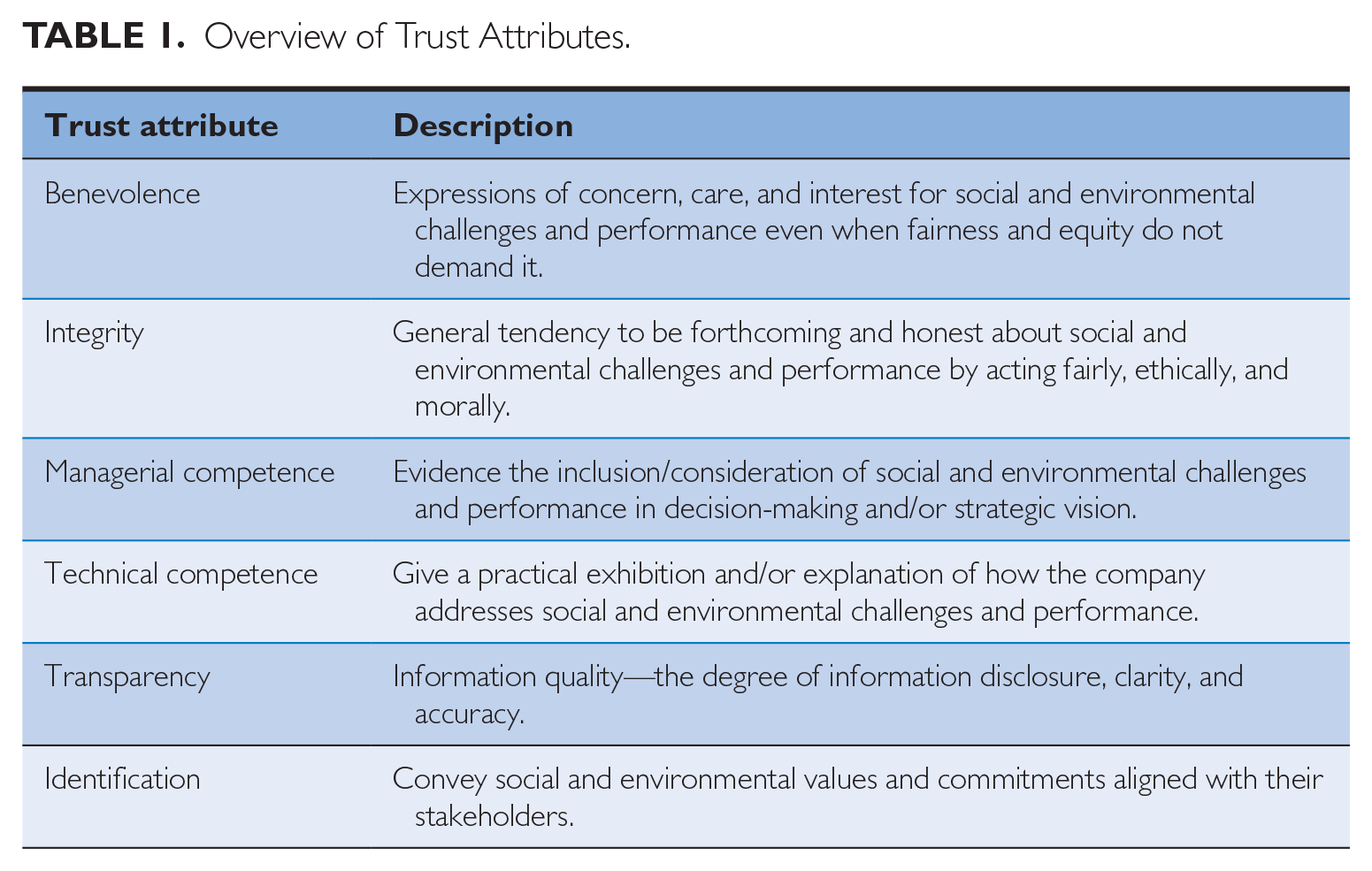
Most suggestions for how to improve reporting and transparency focus on what is reported, but the importance of trust turns attention toward how an organization reports. Prevailing textual/written sustainability reports might meet some stakeholders’ expectations and assist in forming a perception of trustworthiness—but other approaches will be necessary for different stakeholders. Indicators of environmental impact, for example, provide insight into technical competence, but will likely fail to provide assurances about benevolence and integrity.
To date, only a small number of studies have examined ways to navigate the trust and transparency relationship. Some suggest that open information systems and the use of outsider frames have potential, 38 but these studies were not focused on sustainability reporting. Others have examined the potential of online sustainability reporting, 39 but these focus more on technology than transparency. While some studies have examined the sustainability reporting practices of fashion companies, these focus more on “what” is reported, 40 whether companies are open or hostile to disclosure, 41 and the management of specific issues (e.g., supply chains). 42 We build on these studies to explore how leading fashion companies use different approaches in their sustainability reporting to build the trust necessary to improve transparency.
Sample and Research Method
We focus on the global fashion industry because it is one of the most intensely scrutinized for its social and environmental performance. 43 Fashion companies regularly face pressure about supply-chain and labor practices, and calls for greater regulatory oversight of their transparency and performance. The fashion industry represents a “critical case,” 44 or one that has strategic applicability to the research question being explored. A critical case exemplifies the issue under study with the view that if best practice cannot be observed amongst those for which it is most salient, it is unlikely to be seen amongst the general population.
The organizations we studied are the top 10 companies in the Fashion Regulation’s 2020 Fashion Transparency Index. 45 This index reviews 250 of the world’s largest fashion brands and retailers and ranks them according to their extent of disclosure about social and environmental policies, practices, and impacts. Appendix 1 provides an overview of each company and their stated commitments to transparency.
We cast the net wide across the channels each firm uses to communicate sustainability information. We found sustainability information spread across corporate websites, customer-facing online “shopfronts,” and the annual and sustainability reports. We studied this wide selection of sources as we were interested in where disclosure takes place, how it is presented, and the different ways that the attributes of transparency and trust are addressed.
To identify reporting approaches, we used content analysis. This approach is common in case studies 46 and in the analysis of sustainability reports. 47 First, we looked for approaches to disclosure that went beyond the current reporting practice of generalized summative text and basic data visualizations of performance (e.g., a bar graph showing a cross-sectional or time-series of emissions). This yielded several different reporting approaches (e.g., feature films).
Second, we applied a basic transparency matrix to each to ensure the information reported represented transparency rather than advertising or public relations. In this, we were guided by Schnackenberg and Tomlinson’s framework of “disclosure,” “clarity,” and “accuracy.” Disclosure involves the use of open information systems, information that is material to the organization’s operations, includes both negative and positive performance data, and a clear indication of the time to which performance relates. Clarity makes use of outsider frames that makes connections to the company’s product or business function, the information is easily understood, and it does not excessively use technical terms or acronyms without explanation. To identify accuracy, we included those approaches that shared underlying data and explained the methodology used to derive it.
In the third step, we evaluated whether the approaches addressed attributes of trust, including technical and management competence, integrity, benevolence, and identification. In this, we drew on the characteristics of each outlined above in Table 1.
Approaches to Reporting
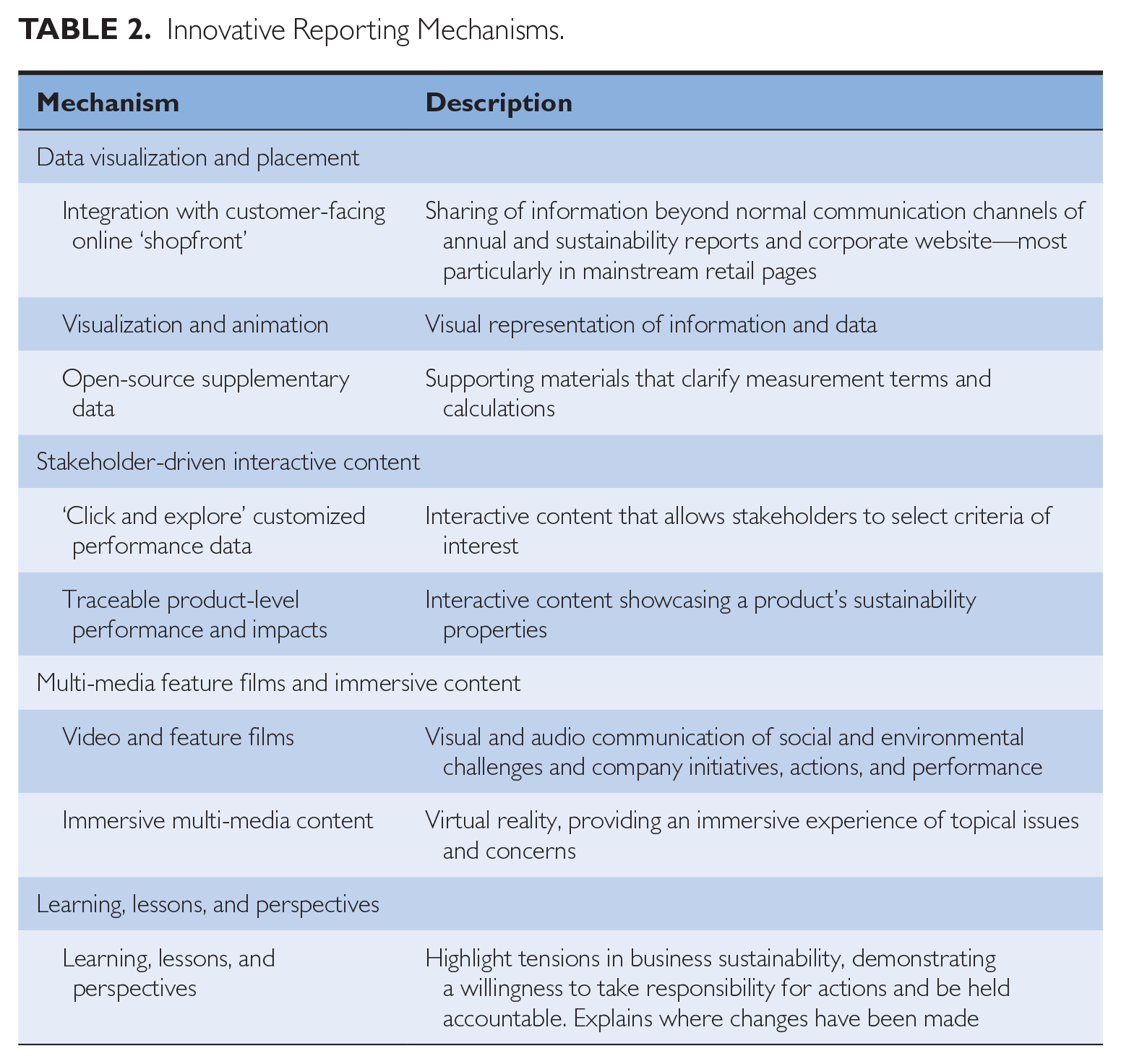
Our analysis reveals that leading fashion companies use four distinct approaches to improving the transparency of their sustainability reporting and generating trusting relationships with stakeholders. These are as follows: data visualization and placement; stakeholder-driven interactive content; multi-media and immersive content; and learning, lessons, and perspectives. Table 2 summarizes the reporting mechanisms we discuss.
Innovative Reporting Mechanisms.
Data Visualization and Placement
Leading reporters go beyond the static presentation of data and its exclusive presentation in sustainability reports. We found sustainability information placed in customer-facing online shopfronts, the use of sophisticated visualization and animation techniques, and the wide use of open-source supplementary data.
Integration with customer-facing online “shopfront.”
Placing sustainability-related information in customer-facing online shopfronts enhances disclosure and clarity 48 and provides an opportunity to demonstrate technical and managerial competency.
Patagonia, for example, provides detailed product notes alongside each product on the online shopfront. The notes describe the materials used, the processes of producing and sourcing the materials, measures to reduce their impact, and information about the supplier. 49 This type of disclosure places impact and performance data where target stakeholders can find it and relates it to the individual product being considered. Placement in the online shopfront ensures accessibility and relevance, and the extent of detail provides opportunities to demonstrate technical and managerial competence.
H&M goes one step further. It provides a direct link to their range of sustainable clothing on their sustainability website. They, too, provide extensive product-level information but also additional consumer-focused sustainability information. This includes washing and drying options that reduce impacts, innovation in the materials sourced and used, and the steps being taken to reduce impacts in the manufacturing process. H&M also provides options for customers to recycle unwanted clothing.
Visualization and animation
Like most reporting organizations, our sample firms make extensive use of tables, graphs, and figures to share performance data. Data visualization in sustainability reports is not new or necessarily innovative. Leading companies, however, utilize these approaches to extend the information provided to improve clarity about impacts. These techniques also offer the potential to assess competency by demonstrating an understanding of connections between operations, performance, and impacts.
PVH Corp (owner of Calvin Klein, Tommy Hilfiger, and Van Heusen) makes extensive use of pictographs that connects the organization to important social issues (e.g., living wages). Their charts extend disclosures to include the wages paid in multiple geographical locations, the country-specific sector averages, and legal minimum wages in each jurisdiction. Pictographs improve clarity as they are easy to read, but they also express a large amount of information simply aiding clarity. 50
European fashion retailer C&A introduces animation. They present dynamic insights into how their climate targets and emissions performance has shifted over time by scope, value chain segments (e.g., design, raw materials, material processing, transportation), garment materials, and an estimate of consumer use activities (e.g., washing and drying).
Data visualization and animation can improve transparency by increasing engagement and improving clarity. 51 Both visualization and animation provide the organization with an opportunity to build trust by demonstrating benevolence and integrity. Going beyond the organizational and product-level impacts to also include detailed issues of wages and compliance data, they offer an insight into management competency.
Open-source supplementary data
Most reporting organizations detail their reporting approach and data assumptions, but not always in easily accessible, comprehensive, or easy to understand ways. 52 Leading companies produce supplementary data that can be downloaded, is typically “live” and updated frequently, and is comprehensive in terms of measurement and calculations.
Many reporters include supplementary documents, case studies, and their submissions to sustainability-related rating indexes and standards agencies. Marks & Spencer, for example, produces an extensive supplementary document. 53 This document defines every sustainability indicator used and outlines its data sources, unit(s) of analysis, baseline data, and methodology. Others make extensive use of supplementary case studies that improve clarity and accuracy. Case studies that extend disclosure to deliberations, choices, and the inter-relationships between complex outcomes provide the detailed insights that contribute to assessing an organization’s technical and management competency.
Both H&M 54 and Marks & Spencer 55 describe how business-community partnerships have contributed to their management of specific challenges. Marks & Spencer outline that working with the Institute for Human Rights and Business and the Ethical Trading Initiative led to improvements on modern slavery. 56
Several expand the typical “how we report” sections of their sustainability websites and/or reports. Whereas most list the sustainability-related indices, frameworks, standards, and agencies to which they adhere, leading companies include the detailed returns submitted to these bodies.
Supplementary information offers much for improving both transparency and trust. Such information is particularly important for improving accuracy, and it adds precision that supports assessments of competency. It can strengthen disclosure for those who seek depth—but maintain brevity for others. Sharing of supplemental material is likely to reduce ambiguity for stakeholders about why companies undertake various initiatives.
Stakeholder-Driven Interactive Content
Static, annual-type sustainability reports remain the most common approach to disclosure. Even where sustainability-related websites exist, they often simply feature a downloadable PDF of the printed report. Leading companies go beyond this and include stakeholder-driven interactive content that enables detailed and customized reporting data.
“Click and explore” customized performance data
“Click and explore” mechanisms enable stakeholders to produce detailed and customizable information about relevant issues and impacts. Given that supply chains remain a constant source of criticism for fashion companies, most of our sample utilizes this approach to extend disclosure about the challenges they face and the approaches being used to address them.
The use of “click and explore” approaches by Kontoor Brands and C&A enables stakeholders to produce detailed site-level information about suppliers’ country of operation, factory name and address, factory type (e.g., manufacturing, processing), product type (e.g., swimwear, underwear, footwear), number of workers, and factory relationship to suppliers (e.g., contractual or owned by). 57 Nike Inc. includes detail about a factory’s worker characteristics (e.g., number of male and female workers and roles). 58
VF Corporation enables a reader to click and explore whether a factory has a sustainable materials certification, environmental and chemical management certification, a health and safety and social responsibility certificate, worker well-being programs, community development programs, and an environmental management system. Marks & Spencer enables stakeholders to investigate factory employee and trade union data and provide additional details, including supplier certificates of compliance with sustainability standards. 59
Traceable product-level performance and impacts
New forms of stakeholder-driven interactive content extend to traceable product-level performance data and impacts.
Some, including H&M, provide customers with a “product background” tab to learn about the environmental issues associated with each garment. 60 This tab provides information about the materials used in the garment, the company’s target for sustainably sourced materials, the name, address, and the number of workers at each supplier’s factory, and a brief overview of the supplier’s commitment to fair wages and working conditions.
VF Corporation includes traceability maps for a selection of its products. 61 The map illustrates the product’s global supply chain (e.g., listing details for factories, textile mills, material suppliers, distribution centers) and key sustainability features (e.g., energy and water efficiency, recycled materials, community, chemicals), as well the date information was updated.
“Click and explore” and “traceability maps” are important for specific challenges. For supply chains, they improve disclosure by enabling customization of data, and they illustrate integrity by investing resources in new approaches to particularly challenging issues.
Multi-Media Feature Films and Immersive Content
Increasingly, leading companies are incorporating video, feature films, and other immersive content to disclose issues and impacts, and to explain the challenges being addressed. This type of multi-media provides an immersive experience, engaging stakeholders in ways that text or still imagery cannot accomplish.
Video and feature films
Half of those we studied communicate their sustainability activities and performance through videos and films. These explain sustainability challenges and demonstrate what the company is doing to address them. Videos and films can enhance clarity by providing more context about an issue, as well as actual footage of activities and initiatives. In doing so, stakeholders who place great weight on competence to form perceptions of trustworthiness can appreciate how an organization understands (rather than responds) to specific issues of concern.
Some, including Nike Inc. and Adidas Group, have micro-websites with short video case studies. 62 Nike Inc.’s video on circular design, 63 for example, explains the concept, showcases innovative practices, and illustrates how the principle is embedded at different stages of a product’s lifecycle. One specific video shows how Nike Inc. employees make decisions based on circular design, offering candid insights about the lived experiences of employees and what circularity means to them. This film provides an important insight into managerial competence, illustrating the process of decision making within organizations.
Others, such as Patagonia, produce feature films that explore important social and environmental debates and explain how the company is addressing them. One focuses on the environmental and social implications of extractive industries operating in the Takayna/Tarkine region of northwestern Tasmania, Australia. 64 This film shares the conflicting narratives of Aboriginal communities, activists, and local residents who rely on the extractive industry for jobs and welfare. The video explains how and why Patagonia is involved, providing insight into benevolence, integrity, and competence.
Films include actual footage that increases authenticity and contributes to the clarity and accuracy of disclosure. Furthermore, films provide a way to communicate the relevancy of various social and environmental topics to the company and allow stakeholders to comprehensively understand the sustainability tensions the company faces. In so doing, films aid interpretation of managerial and technical competency.
Immersive multi-media content
A small number of companies use virtual reality to provide a 360° immersive experience of topical issues and concerns. Virtual reality transfers a viewer/stakeholder to a simulated “real life” situation and engages their senses to explore issues in depth.
Amongst our sample, Patagonia is the clear leader in their use of this approach. One example is their immersive experience of Bears Ears National Monument in Utah, the United States. 65 This virtual reality experience places viewers in the national park to experience the threat that development poses to the cultural heritage and ecological and recreational value of these natural wonders.
Learning, Lessons, and Perspectives
Finally, leading companies go beyond what has typically been the reporting of (selected) “warts and all” performance data. Increasingly, these companies explain their continued involvement in unsustainable practices.
Patagonia, for example, openly acknowledge that fluorinated DWR (durable water repellent) finishes on some of their garments contain environmentally harmful components that are nonbiodegradable. 66 Instead of non-disclosure, or a simple target for reduction, Patagonia explains why they still use the chemical finish. This demonstrates public responsibility for negative business practices and provides stakeholders with information to assess competency in managing issues successfully. It can enable stakeholders to assess benevolence, integrity, and competence.
Patagonia’s discussion of Fluorinated DWR is like their discussion about their wool suppliers after exposure by PETA (People for the Ethical Treatment of Animals) in 2015. PETA accused Patagonia of sourcing wool from farms that mistreat lambs. 67 In both cases, the company outlines the complex decisions necessary, trade-offs, or the state of scientific knowledge surrounding the issue. This enhances disclosure, particularly completeness, and also provides insights into how issues are considered by managers and influence decision making.
H&M Group reflects on the environmental impact of the industry’s plastic consumption and the growing amount of plastic waste from e-commerce. This approach outlines the pilot test of reusable and recyclable packaging solutions made of certified paper instead of plastic and explains how this activity contributes to their sustainability targets.
H&M’s sustainability disclosures all include “Learnings & future focus” insights that highlight the negative impacts and challenges associated with their garments. One, for example, suggests that “tools such as laundry bags do not provide a long-term solution to microfiber emissions. We know we need to continue to research new materials and processes that prevent shedding, rather than removing microfibers during the washing cycle.” 68 The deliberations underway provide some assurances about the extent of technical competence for addressing sustainability issues.
For these leading companies, issues are acknowledged, reasons why they are unresolved are explained, and the reasons for continued unstainable practices are outlined. Like Schnackenberg and Tomlinson, who suggest that incorporating “outsider frames” can improve clarity, open performance reporting that does not excuse, but rather explains, areas of poor performance strengthens authenticity and contributes to perceptions of accuracy. The detail provided also strengthens understanding about management and technical competency by illustrating an understanding of the issues and the work required to address them.
A Step Change of Reporting Improvement
The approaches companies use to report and disclose their sustainability performance are many and varied. Not all contribute equally to satisfying transparency expectations, and not all address the critical issues of trust that are required to deliver the outcomes expected. Sustainability reporting and initiatives to improve transparency are also costly and time consuming. Not all organizations have the resources to address all of the expectations that stakeholders have about an organization’s performance.
Our analysis of 10 leading fashion companies suggests that four distinct stages of transparency exist. For some, a basic level of transparency (sharing) will satisfy minimum stakeholder demands, with the resources available. Others that face extensive demands may aspire to co-creating disclosure with stakeholders. In between lie different combinations that strike a balance between transparency, trust, and the outcomes that can realistically be achieved.
Organizations can progress through each of the four stages of transparency systematically to improve the transparency of their reporting and to address the dimensions of trust for its effectiveness. The four stages can offer a targeted and systematic process of step-change improvements that organizations can consider as needs arise and resources allow. The four stages are as follows: sharing, connecting, embedding, and co-creating (see Figure 1).
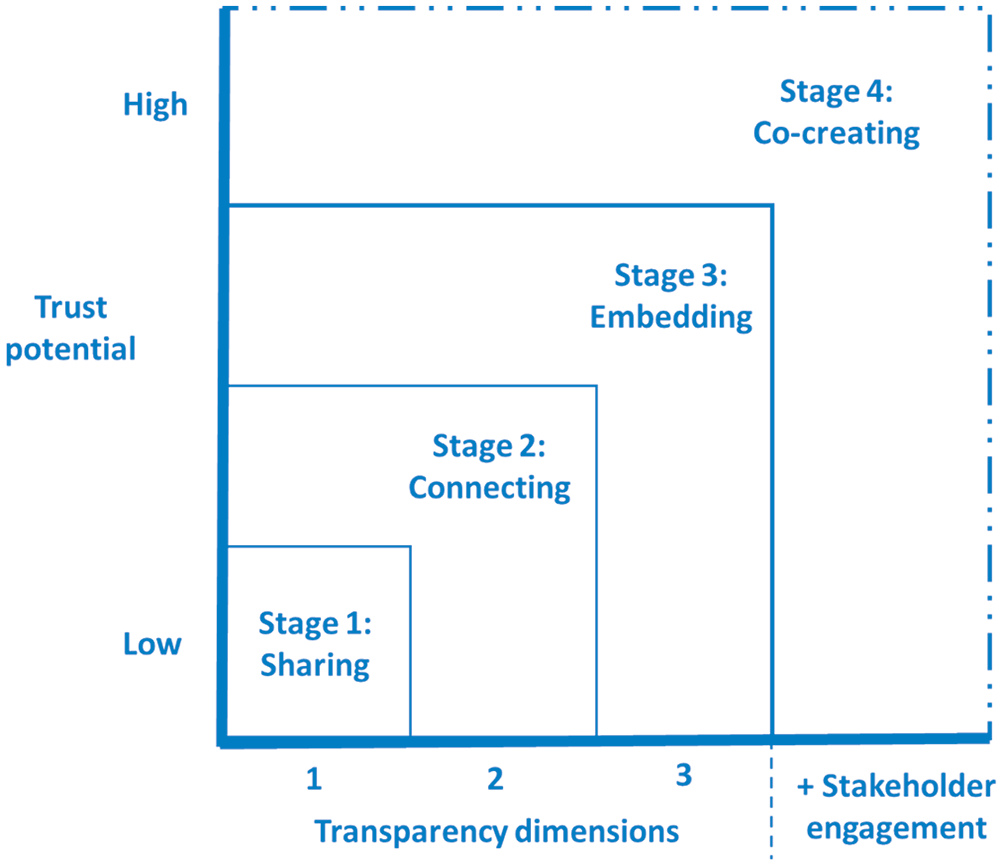
Four stages of transparency.
Sharing
The first stage of sharing reflects most current sustainability reporting practices. While the analysis we undertook showcased mechanisms that go well beyond stage 1, this stage represents basic threshold transparency. At stage 1, sustainability reporting reflects standardized information sharing. Disclosure of social and environmental performance occurs through generalized summative text and data visualizations of performance (e.g., bar graph showing a cross-sectional or time-series of company diversity and inclusion) in static sustainability webpages and a yearly report PDF. Stage 1 reporters list standards, accreditations, and awards achieved, but typically do not explain how they relate to the company.
For the most part, stage 1 transparency only addresses one transparency dimension of disclosure, clarity, and accuracy. At this basic level, reporters limit trust potential because they are likely to fulfill only some, not all, of their stakeholders’ interests and expectations. While shared information is timely and observable, enabling stakeholders to analyze performance trends, their ability to gauge a company’s managerial competence, integrity, and benevolence is limited.
Connecting
In stage 2, connecting, reporters incorporate new forms of visualization and animation, enabling stakeholders to engage issues of interest in depth. Interactive content, such as pictographs and map infographics of supply chains, allows stakeholders to connect the dots of a particular garment’s sustainability journey in an easily digestible and comprehensive format.
Reported information is typically connected to a company’s strategy and/or actions or supplemented by detailed technical notes, providing context or validity to observable data. Emissions data, for example, are both enumerated in a time series of the company’s yearly total and cataloged by source and/or operating region. From this, a stakeholder can determine performance trends and can better understand where the company is performing well or poorly. Similarly, case studies of partnerships explain the relevancy of a collaboration and its connection to business outcomes, demonstrating managerial competency.
At this intermediary level, stage 2 reporters meet two of three transparency dimensions, facilitating broader trust potential than stage 1.
Embedding
Some leading reporters share information that meets all three transparency dimensions. In stage 3 transparency, embedding, shared information is not only clearly explained (reducing ambiguity), allowing performance trends to be observed, but it is also supported by detailed supplemental material about underlying assumptions and calculations, explaining margins of errors.
Stage 3 reporters integrate corporate sustainability and responsibility data beyond normal channels of communication (e.g., corporate website and yearly report PDF). Embedding social and environmental policies, targets, and performance on customer-facing web pages increases the visibility of its technical and managerial competence and communicates the company’s social and environmental consciousness. Customers can identify whether the company aligns with their values.
Stage 3 reporters openly and honestly address grand challenges by discussing sustainability tensions they experience. Explaining the facts of an issue and its relevancy to them, why they are involved, and what their involvement means for their sustainability performance demonstrate attributions of integrity, benevolence, and competency.
The transparency achieved in stage 3 offers stakeholders high potential to form positive expectations of the company’s motivation and intentions—leading to extensive trust potential.
Co-Creating
Stages 1 to 3 reflect ways in which firms can address the transparency trust dynamic through various approaches to reporting. While achieving all three transparency dimensions has the potential to positively affect stakeholders’ perceptions of organizational trustworthiness, we suggest that a fourth stage, co-creating, offers the broadest trust potential.
Co-creation of knowledge and collaborative problem solving with stakeholders and audiences 69 can enhance the relevance of information shared. 70 Stakeholders are more likely to act on information if they see a clear path to engage and can play a role in creating the solutions they see as necessary. Identification of the interests and intentions of stakeholders allows an organization to develop shared values and commitments. Organizations that build identification across all stakeholders can generate a better understanding and appreciation for “the types of vulnerabilities different stakeholders face and the kinds of information that can most clearly signal trustworthiness to them.” 71 The inclusion of stakeholder participation satisfies not just the availability of information but the “active participation in acquiring, distributing and creating knowledge.” 72
Although several of our sample companies indicate that stakeholders are engaged to achieve sustainability commitments and advance sustainable fashion, 73 few provide details about how. Typically, companies offer their stakeholders an opportunity to “contact us” to ask questions, locate or find out more information, and/or provide feedback. We suggest that an iterative continuous two-way dialogue between a company and its stakeholders and engaging them in decision making represents the next frontier of the transparency of sustainability reporting. It is important to note that stage 4 cannot be fast tracked by mere stakeholder inclusion. For trust to flourish, all three transparency dimensions must be achieved in addition to co-creation.
The four-stage framework extends existing work on transparency and trust. 74 It highlights how combinations of different reporting approaches address transparency requirements and can contribute to the trust dimensions that stakeholders use to assess an organization and take it seriously.
Conclusion and Implications
Our focus in this article was on how companies can improve the transparency of their sustainability reports. Organizations invest considerable resources in these reports but, along with target stakeholders, fail to reap the transparency benefits they offer. Transparency can generate positive outcomes for society and organizations, but realizing those outcomes is problematic.
We analyzed ten of the world’s most transparent fashion companies for insights into “how” rather than just “what” they report. We suggest that the way information is reported matters for building the trust with stakeholders that is necessary to generate the positive outcomes of reporting and transparency. The firms we analyzed use a variety of different approaches, which tend not to be a feature of reporting guidelines and frameworks, and also provided more information about “how” they reported alongside “what” to improve transparency and attempt to build trust. These include data visualization and placement, stakeholder-driven interactive content, and multi-media and immersive content. They are also open to debate, appreciate the complexity of sustainability challenges, and demonstrate learnings from the issues they encounter.
While some of the approaches utilized are not necessarily new or unique, it is their combination that offers potential for realizing the benefits of transparency. Combinations of data visualization and interactive content, for example, enable some stakeholders to customize the data they require. Feature films and immersive content provide insights into technical and management competency that other stakeholders find important.
Combinations of the approaches also enable organizations to expand the horizon of their transparency efforts as needs arise and resources allow. The four-stage framework (Figure 1) provides organizations with a starting point to determine areas of priority for improvement. A company might reflect on whether they are openly disclosing relevant information or investigate ways to embed impact and performance information where stakeholders will find it. They may explore ways to use feedback to co-create solutions to the most significant challenges they face.
For the community, our analysis offers stakeholders suggestions to drive improvements from the companies they interact with. They can use the framework to systematically review the transparency of a company, as well as compare the transparency and trust potential of different companies. Likewise, regulators might see value in the framework for guiding their efforts to improve what companies report and how.
We build on, and complement, the work of those who suggest that transparency is not a simple silver bullet for all corporate responsibility, sustainability, and organizational issues. 75 But, with careful attention to stakeholders—and how they come to trust an organization—it can offer the prospect of forming the relationships necessary to realize its benefits. In this context, sustainability reporting can play an important role. While it is not without its critics, 76 with evidence that it has often been more about public relations than transparency—it has become accepted as the way organizations communicate their social and environmental performance. 77 What’s more, it is a practice explicitly pitched at a wide range of organizational stakeholders. 78 Approached carefully, it is an approach to transparency that can build trust for employees (and other internal stakeholders), and it can assist in demonstrating technical and managerial competence for customers and other stakeholders external to the organization.
It is well known that global fashion companies continue to face scrutiny about their performance, so it remains to be seen whether improvements in how companies report do lead to material change in stakeholder trust and performance improvements. Some will inevitably apply new approaches to reporting to do little more than disguise poor performance and enhance their legitimacy. Attempts to improve transparency must sit alongside work that improves the broader transparency eco-system and enables meaningful societal and stakeholder engagement.
Nevertheless, the four different approaches to reporting and the four stages of transparency offer a systematic path to improvement. They provide specific opportunities to improve the transparency of sustainability reports and a systematic process to make step changes in reporting and transparency.
Footnotes
Acknowledgements
The research was conducted when Samuel Tang was a Research Fellow of Leonardo Centre on Business for Society at Imperial College Business School.
Declaration of Conflicting Interests
The author(s) declared no potential conflicts of interest with respect to the research, authorship, and/or publication of this article.
Funding
The author(s) received no financial support for the research, authorship, and/or publication of this article.
Notes
Author Biographies
Samuel Tang is a Lecturer in Business and Sustainable Development at University College London’s Institute for Sustainable Resources (email:
Colin Higgins is a Professor in the Department of Management at the Deakin Business School, Deakin University (email: