




Abstract
Background:
The number of elderly sports participants is increasing, and the possibility of return to sport (RTS) has become an important part of surgical decision making in this population.
Purpose:
To investigate RTS after elective spinal surgery in elderly patients.
Study Design:
Case series; Level of evidence, 4.
Methods:
We enrolled patients aged ≥65 years with a history of preoperative or preinjury sports participation who underwent elective spinal surgery at a single institution between 2019 and 2021. At minimum 12-month follow-up, a questionnaire was administered to each participant to assess postoperative RTS, timing of return, frequency and type of pre- and postoperative activities, and satisfaction (scored 1-10). Descriptive statistical analyses were performed, and regression models were developed to examine the influence of age and sex, as well as surgical site, on RTS.
Results:
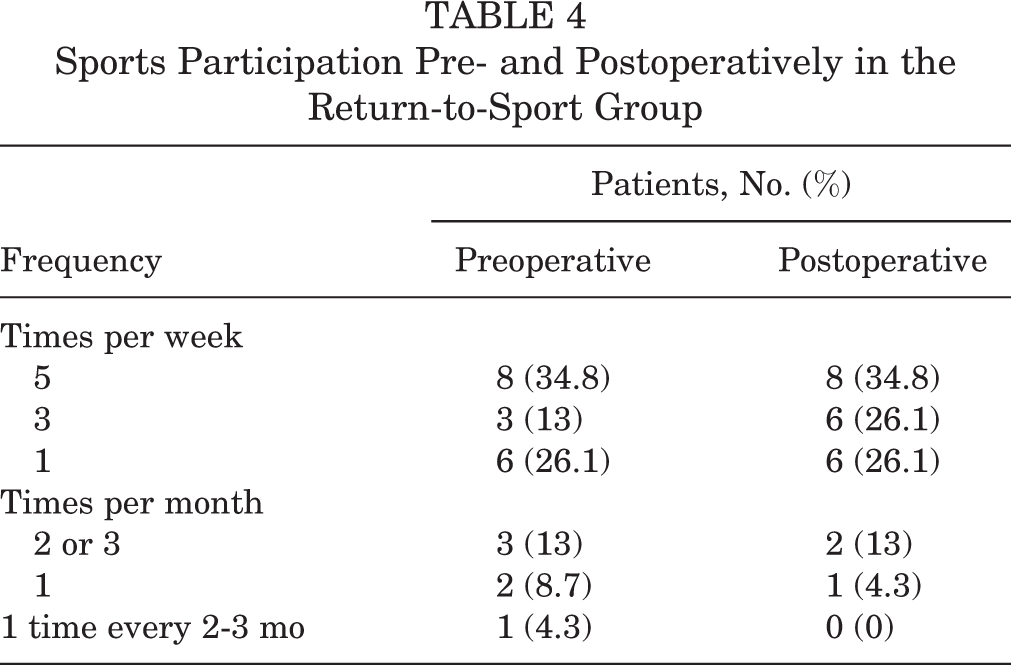
A total of 53 patients (mean ± SD age, 73.8 ± 5.2 years; 24 women) were included, and 23 (43.4%) returned to sports at a median 6 months (interquartile range, IQR, 2-6 months). The RTS rate by surgical site was 17 of 34 (50%) for the lumbar spine and 6 of 17 (35.3%) for the cervical spine. There were no statistically significant differences in RTS rate by surgical site, age, or sex. Overall, 6 of 17 patients returned to golf, 4 of 6 to dance, 2 of 5 to swimming, and 1 of 5 to tennis. Of patients who returned, 34.8% participated in sports 5 times per week and 26.1% participated 3 times per week. The median satisfaction score after RTS was 8 (IQR, 6-9).
Conclusion:
RTS after spinal surgery was achieved in 43% patients at 1-year minimum follow-up, with high satisfaction scores. More than half of the returning patients participated in sports activities ≥3 times per week.
The past few decades have witnessed a progressively aging society, primarily in advanced countries. The global population of people aged ≥60 years is forecast to increase from 1 billion in 2020 to 1.4 billion in 2030, which corresponds to 1 of every 6 people in the world. 18 This trend appears to be irreversible, with the number of people aged ≥80 years expected to triple between 2020 and 2050, reaching 426 million. 18 Owing to rapid medical and economic developments, healthy life expectancy is increasing globally, 19 as is participation in sports among the elderly population. For instance, >70% of the elderly in Japan reported participation in sports activities at least once a week. 11 In a study examining sports participation among 62,224 men and 66,871 women aged ≥65 years, 33.6% of men and 37.4% of women participated in sports and exercise in a group. 11 Golf (11.3%), walking (8.4%), and ground golf (6.3%) were the most practiced sports for men, whereas fitness exercises (13.8%), walking (8.4%), and weight exercises (6.2%) were the most practiced sports for women. The most common frequency of participation was 2 or 3 times per week (10.5%), once per week (7.5%), and ≥4 times per week (6%). Two age groups (65-74 and ≥75 years) were concurrently compared, and no difference was found in participation rates. 15
In contrast, the number of spinal operations has also been increasing, especially in developed countries. In Norway, the rate of lumbar spinal surgery increased by 54%, rising from 78 to 120 per 100,000 people between 1999 and 2013. 4 A similar trend has been reported in the United States and Japan. 7,12 Furthermore, cervical spinal surgery is anticipated to increase by 13% to 19% between 2020 and 2040 in the United States, with the trend being particularly noticeable in the elderly. 8 In addition, most patients undergoing lumbar spinal surgery are reported to be aged ≥60 years, and the number of spinal operations performed on the elderly is expected to rise further. 10,21
One of the greatest concerns during the surgical decision-making process is whether the patient will be able to participate in sports after surgery. Studies investigating return to sport (RTS) in patients after receiving joint prostheses have reported an RTS rate of 80% to 90%, indicating that the results are generally favorable. 6,13,17 However, studies examining postoperative RTS in cases of spinal surgery are few and have been limited to young athletes. 2,3 Jain et al 5 investigated RTS after lumbar fusion surgery in patients with a mean age of 63 years, although the study included several nonelderly patients.
The aims of this study were to (1) report the rate of RTS after spinal surgery in the elderly, (2) investigate the types of sports to which the patients returned and the frequency of their participation, and (3) determine the postoperative satisfaction of patients with their RTS. An emphasis was placed on the influence of patient sex and age as well as surgical site (cervical or lumbar) on RTS. Our hypothesis was that a majority of patients will be satisfied with their postsurgical RTS and able to RTS at a higher or similar frequency as compared with preoperative levels.
Methods
This study was a retrospective case series design approved by the appropriate institutional review board. We reviewed the records of 135 patients (mean ± SD age, 66.6 ± 13.7 years) who underwent elective spinal surgery between April 2019 and September 2021 and visited the outpatient clinic for follow-up at 1 or 2 years postoperatively. All of these patients were given a questionnaire regarding RTS in addition to the routine postoperative follow-up examinations. Study inclusion criteria were age ≥65 years with a history of preoperative or predisease sports activity. Excluded were patients with infectious diseases of the spine or with spinal trauma. A total of 53 patients were included in the final analysis (Figure 1). All included patients provided written informed consent.

Flow diagram for the final analysis.
Evaluation of RTS
For RTS evaluation, all patients were given a questionnaire that assessed their postoperative satisfaction with RTS, type of activities performed pre- and postoperatively, time to RTS after surgery, frequency of participation in sport activities, and satisfaction with RTS (scored 1-10). Preoperative RTS aspirations were rated by asking about postoperative sports participation expectations, with possible responses being yes, no, or neutral. RTS was defined as a condition in which the patient had completed a period of rehabilitation and was returning to sports, even if not back to preoperative levels, according to Ardern et al. 1
Statistical Analysis
All statistical analyses were performed using the R statistical software package (Version 4.2.1; R Development Core Team). Based on previous studies, 3,5,13 age, sex, and surgical site were considered the factors affecting RTS, and logistic regression analysis was applied with RTS as the dependent variable and age, sex, and surgical site as the explanatory variables. The RTS rate was calculated for each sport in which the patient participated, and the mean return time and satisfaction for all patients who achieved RTS were calculated. If the obtained values did not follow a normal distribution, the median (interquartile range [IQR]) was calculated. Postoperative sports frequency was divided into categories (5 times a week, 3 times a week, once weekly, once monthly, once every 2 to 3 months, and once every 6 months), and the percentage of each category was calculated.
Results
Table 1 summarizes the characteristics of the 53 patients (mean age, 73.8 ± 5.2 years; 24 women) in this analysis. Of the 53 patients included in the final analysis, 23 (43.4%) returned to sports. The RTS rate by surgical site was 17 of 34 (50%) for the lumbar spine and 6 of 17 (35.3%) for the cervical spine; however, logistic regression analysis showed no statistically significant difference between the sites (Table 2). In terms of overall sports, 6 of 17 patients returned to golf, 4 of 6 to dance, 2 of 5 to swimming, and 1 of 5 to tennis (Table 3). Table 4 summarizes the changes in the frequency of sports activity participation among patients who achieved RTS. The percentage of patients who engaged in sports ≥3 times per week increased from 47.8% preoperatively to 60.9% postoperatively. The median time to RTS was 6 months (IQR, 2-6) (Figure 2). The median satisfaction score after RTS was 8 (IQR, 6-9) (Figure 3). The preoperative RTS aspirations for surgery were 52.8%, 28.3%, and 18.9% for patients who answered yes, no, and neutral, respectively.
Patient Characteristics a

a Data are reported as No. (%) unless otherwise indicated. LSCS, lumbar spinal canal stenosis; PLIF, posterior lumbar interbody fusion; RTS, return to sport.
b Some patients played multiple sports.
Multivariate Logistic Regression Analysis of Factors Affecting Return to Sport

Pre- and Postoperative Sports Participation

a Some patients played multiple sports.
Sports Participation Pre- and Postoperatively in the Return-to-Sport Group

Histogram depicting time to return to sport.

Histogram representing satisfaction after return to sport.
Discussion
The most important finding of this study was that 43% of the evaluated patients achieved RTS after elective spinal surgery, and those who did were highly satisfied. In addition, more than half of the patients (60.9%) participated in sports activities ≥3 times a week. There were no statistically significant differences with respect to surgical site, age, or sex.
The World Health Organization recommends that elderly people participate in sports ≥3 times a week, and the number of elderly sports enthusiasts worldwide is expected to increase in the future. 20 The number of spinal operations in the elderly is also expected to increase with time. 4,8 It is important for elderly sports enthusiasts to know whether they will be able to resume their presurgical sports activities after spinal surgery. Furthermore, if surgery enables patients to RTS, the benefits of surgery are likely to be greater than mere symptom improvement.
A few studies in the past have investigated RTS after spinal surgery. Most of these have focused on spinal trauma in young populations or investigated RTS after hernia surgery in young athletes. 3 In a review of 1181 lumbar disc herniations with a mean patient age of 28.3 years, 81.5% of patients achieved RTS, with a mean return time of 5.19 months postoperatively. 14 In a study on cervical and lumbar spinal surgery in the military, 83% and 67% of patients who underwent surgery were able to return to full duty, respectively. 16
In this study, the mean patient age was 73.8 ± 5.2 years, and the RTS rate was 43.4%. In the study by Jain et al, 5 117 patients underwent lumbar fusion, their mean age was 63 years, and 27% reported presurgical participation in sports (golfing, swimming, or biking). Remarkably, all of these patients were able to return to their respective sports at 3 to 9 months after surgery. As the current study is the first on RTS after elective spinal surgery in an exclusively elderly cohort, it is unclear if our RTS rate is high or low for this population.
Most reports on RTS in elderly patients undergoing orthopaedic surgery focus on prosthetics. In a study examining RTS after unicompartmental knee arthroplasty in patients with a mean age of 62.3 years, 90% returned to sports, with higher rates for cycling and swimming. 6 In a review study that investigated return to golf after 3 types of prosthetic orthopaedic surgery—total hip, knee, and shoulder arthroplasty—80% of patients returned to play overall, with respective postsurgical rates of 90%, 80%, and 70%. 13 The mean patient age in that review was 66.8 ± 3.37 years. In a study that investigated RTS in patients aged ≥70 years who underwent high tibial osteotomy, 91.2% were able to RTS postsurgery. 9 The 43.4% RTS rate in the current study is relatively low, but the patients who returned were highly satisfied and participated in sports more frequently. This can be attributed to the fact that a higher percentage of patients in our study participated in sports ≥3 times a week after surgery (60.9% vs 47.8% preoperatively). Notably, Kleeblad et al 6 investigated RTS after unicompartmental knee arthroplasty and reported a higher preoperative sports participation rate (81%), suggesting that patients with spinal disease may be less motivated than patients with knee problems to participate in sports before surgery. It is also possible that other complications prevented patients who underwent spinal surgery from returning to sports postsurgery.
Limitations
A limitation of this study was its retrospective design. In addition, we did not have a comparator group of younger individuals. Other limitations were that the details of the surgical procedure were not considered, and postoperative complications that could have affected RTS were not investigated. Last, the follow-up period was a mixture of 1 and 2 years. Despite these limitations, the findings of this study are significant, as this is the first clinical study to analyze the RTS rate, sports type, time to RTS, and postsurgical satisfaction with RTS in elderly individuals after spinal surgery.
Conclusion
In this study, 43% of patients in the final analysis returned to sports after elective spinal surgery, and those who did were extremely satisfied. More than half of the patients were able to participate in sports activities ≥3 times per week. There were no statistically significant differences in the RTS with respect to surgical site, age, or sex. The clinical relevance of this study lies in providing useful results for decision making on whether sports enthusiasts should undergo elective spinal surgery.
Footnotes
Acknowledgment
The authors thank Editage for editing and reviewing this manuscript for English language.
Final revision submitted December 29, 2022; accepted February 8, 2023.
The authors declared that there are no conflicts of interest in the authorship and publication of this contribution. AOSSM checks author disclosures against the Open Payments Database (OPD). AOSSM has not conducted an independent investigation on the OPD and disclaims any liability or responsibility relating thereto.
Ethical approval for this study was obtained from Mitsui Memorial Hospital (MEC2021-C75).