




Abstract
Background:
Bibliometric citation analyses have been widely used in medicine to help researchers gain foundational knowledge about a topic and identify subtopics of popular interest for further investigations.
Purpose:
To identify the 50 most cited research publications related to American football.
Study Design:
Cross-sectional study.
Methods:
The Clarivate Analytics Web of Science database was used to generate a list of publications relating to football. Articles were filtered by the total number of citations, and the top 50 most cited articles studying the sport of football were selected for this analysis. Articles were analyzed by author, publication year, country of origin, institution affiliation, journal, article type, main research topic area, competitive level, and the level of evidence. A total of 247 articles were reviewed to reach the top 50 articles.
Results:
The most studied topic within the top 50 articles was concussion/chronic traumatic encephalopathy (n = 40). Collegiate football was the most studied level of competition (n = 25). The journal publishing the greatest number of top articles was Neurosurgery. Two institutions, the University of North Carolina at Chapel Hill and Boston University School of Medicine, produced over one-third of top 50 articles (n = 18).
Conclusion:
Our analysis indicated that most of the top 50 publications related to the sport of football focused on concussion and CTE, were observational, and were published during or after 2000. The most studied level of competition was collegiate football.
Football is America’s most popular sport, in both participation and fandom. 84 -86,90 The most of any sport, football has more than 1 million high school and 40,000 college participants, and National Football League games consisted of 75 of the 100 most watched telecasts in the United States in 2021. 45,84,85 Despite its popularity, football results in more catastrophic injuries and fatalities than any other American sport. 51 Football-related injuries account for roughly 380,474 emergency department visits in youth aged less than 25 annually. 100 As awareness of football-related injuries has grown, national attention has fallen on the corresponding long-term negative impacts on player health. 40,55
The growing concern surrounding football-related injuries has further increased demand for research to understand injury risk factors and prevention. Topics of research relating to football are broad, ranging from performance to injury-related topics 4,17,56,107 to social and political issues. 38,101,103 With such a wide scope of research, it has become difficult to identify the most significant and impactful findings relating to football injuries. Bibliometric analyses provide a way to condense this ever-growing research, as articles with a greater number of citations are often considered the most influential in a field, and bibliometric citation analyses provide quantitative representation of an article’s impact. 1,16,27,28,95 Bibliometric citation analyses help researchers to focus on the most impactful scientific articles, build foundational knowledge, and identify areas for future work. They have been widely used in medicine, § medical education, 6 biomechanics, 49 ecology, 110 biotechnology, 25 and various other fields. 5,22,66
The purpose of this study was to identify the 50 most frequently cited research publications related to the sport of American football. Because of the increasing national interest and debate surrounding injuries in football and player long-term well-being, we hypothesized that the majority of publications relating to football would be in the field of medicine.
Methods
The present study was deemed minimal risk and exempt from institutional review board approval, as analysis was conducted on publicly available data. The Clarivate Analytics Web of Knowledge database was utilized to query journal articles and their respective citation metrics. A similar study design and data analysis protocol was followed as previously described in other peer-reviewed studies conducting bibliometric analyses on orthopaedic topics. 2,10,11,15,41,57,83,106 No citation tracking service is perfect and all-inclusive; however, the Clarivate Analytics Web of Knowledge database represents a trusted, highly extensive database that archives over 21,000 peer-reviewed journals, including 1.9 billion cited references from more than 171 million records globally. 99 Additionally, articles dating back all the way to 1900 are included in the database and its citation tracking. This database has previously received recognition for its high-quality citation links, citation accuracy, comprehensive and wide-reaching journal coverage, and consistent use by numerous previous citation analyses. 9,108
The Clarivate Analytics Web of Knowledge database was queried on April 14, 2022, for all article titles, abstracts, and keywords including the term “football.” No restrictions on language, journal, date, or country of origin were placed. The initial query resulted in a total of 23,573 articles, which were subsequently arranged in descending order based on the total number of citations they had accumulated. Then, the title and abstract of each article were reviewed to determine its relevance and potential inclusion into the top 50 most cited list. For inclusion, the article in question had to specifically enroll football players at any competitive level into their research study or review. Studies analyzing >1 sport were considered if football was included and was a primary focus of discussion in the paper. If inclusion of a study was in question, the full article was obtained and reviewed independently by 2 authors (J.R.P. and M.L.M.) to decide on inclusion or exclusion. If the authors could not agree, the senior author (A.C.) determined whether or not the article was included. Articles with only a peripheral mention of football in their methods or discussion were excluded. Additionally, articles that studied football (soccer) were excluded.
A total of 247 articles were reviewed to reach the 50 most cited studies that met the inclusion criteria outlined above. The full text for the 50 included studies was obtained and reviewed in order to obtain the following pieces of information: first and last author name, publication year, country of origin (determined by the affiliation of the first author), institutional affiliation (of both the first author and last author), journal name, study type, primary research topic area (concussion/chronic traumatic encephalopathy [CTE], physiology, biomechanics, nutrition, microbiology, training and testing, sports medicine, performance analysis, sports psychology, coaching, and social science), level of competition (high school, college, and/or professional), and level of evidence. Articles were designated as a review article if they incorporated a systematic approach to reviewing the literature or if a meta-analysis was performed. If an article incorporated the results and discussion of previously published literature, but a systematic approach to reviewing the literature was not outlined, the article was classified as expert opinion. Additionally, an article was categorized as being either medical or nonmedical based on whether the focus of the study involved the treatment, assessment, rehabilitation, classification, or diagnosis of medical pathology. Epidemiologic studies that assessed injury or medical condition prevalence or incidence were included. If an article did employ ≥1 of the above focuses in its design, it was categorized as nonmedical (eg, biomechanics, sports performance, exercise testing, etc). The level of evidence was assigned to each article based on the guidelines published by the Centre for Evidence-Based Medicine. 43
Once the top 50 most cited articles were identified and the above information was extracted for each study, summary statistics were calculated. These calculations included the total number of citations and the total number of publications accumulated each year and the total number of articles representing a specific study type, level of evidence, and field of research. Additionally, the most cited and most represented first/last authors, countries of origin, publishing journal, and academic institutions were calculated. The citation density of each article was also calculated by taking the total number of citations divided by the number of years since publication.
Results
The 50 most cited publications related to football are listed in Appendix Table A1, along with their rank, number of citations, and citation density. The number of citations per article ranged from 213 to 1434, and 7 articles were cited over 1000 times. The mean number of citations per articles was 419, and the median was 329. The average citation density was 25.8 (range, 10.7-102.4).
Descriptive characteristics of the top 50 articles are shown in Table 1. Of the top 50 articles relating to football, 46 related to medicine, with 40 articles focusing on concussion or CTE and 6 on sports medicine. The next most common topic was microbiology (n = 2), follwed by sports psychology (n = 1), and training and testing (n = 1). All articles were published in the United States. Over half of the top 50 most cited articles were cohort studies (n = 26), and 11 were descriptive studies. Most of the top 50 articles relating to football focused on 1 specific level of competition, with 16 publications focusing on college football, 14 on professional, and 10 on high school. One article studied both high school and professional football, 4 studied high school and college, and 5 studied all 3 levels. College was the most well-studied level of competition, with half of the top 50 articles including college football in their analysis (n = 25).
Descriptive Characteristics of Top 50 Most Cited Articles Relating to Football

The top 50 articles were all published between 1976 and 2017 (Figure 1). When analyzing which years produced the top-cited publications, we included ranking by citation density as well as number of citations to address the factor of time to accrue citations. The top 5 articles ranked by citation density were published between 2007 and 2013, whereas the top 5 articles ranked by number or citation were published between 1976 and 2017. Of the top 50 articles, 19 were published between 2003 and 2007, and 39 of the top 50 were published in 2000 or later. The number of citations each of the top 50 articles received per year ranged from 0 (in 1981) to 2301 (in 2019) (Figure 2).

Number of top 50 most cited articles relating to American football published by year.
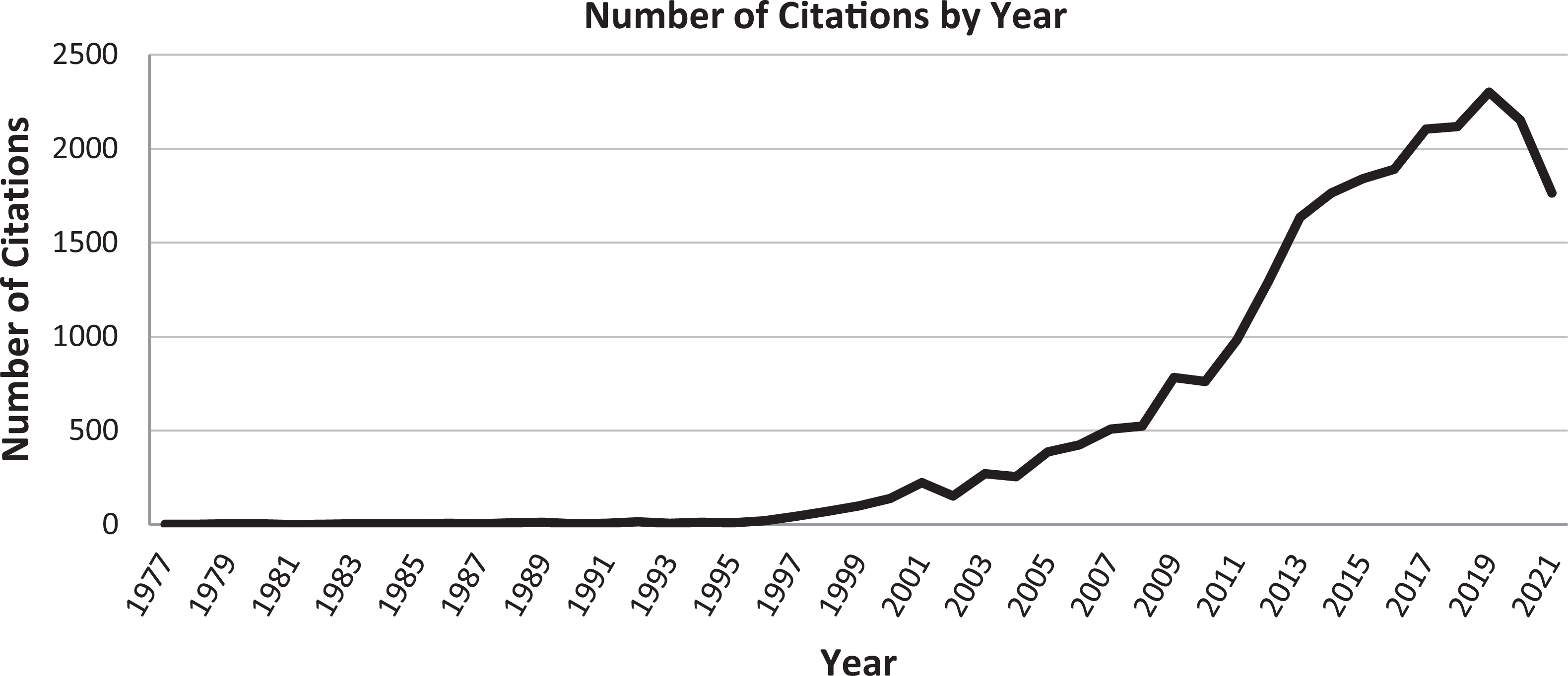
Total number of citations generated by the top 50 most cited articles relating to American football each year.
The majority of the 50 most cited articles had an evidence level of either 2 (n = 11), 3 (n = 18), or 4 (n = 19) (Figure 3). Level 1 (n = 1) and level 5 (n = 1) research comprised less than 4% of top publications.

The level of evidence of the top 50 most cited articles relating to American football.
When assessing author impact, we found that 14 authors published ≥1 of the 50 most cited articles relating to football. Table 2 further breaks down author impact, listing each of these 14 authors’ total number of publications, first author publications, last author publications, total number of citations, and average number of citations per publication. The most prolific author within our analysis was Kevin M. Guskiewicz, with the greatest number of total citations (4113) and publications (n = 6). The affiliated institutions for the first author and last author of the top 50 articles are presented in Table 3. The 2 institutions publishing the greatest number of top 50 articles were the University of North Carolina at Chapel Hill and Boston University School of Medicine, each with 9 publications.
Descriptive Data of Authors Publishing 2 or More of the Top 50 Most Cited Articles Relating to American Football

Institutions of First and Last Authors of Top 50 Most Cited Articles Relating to American Football

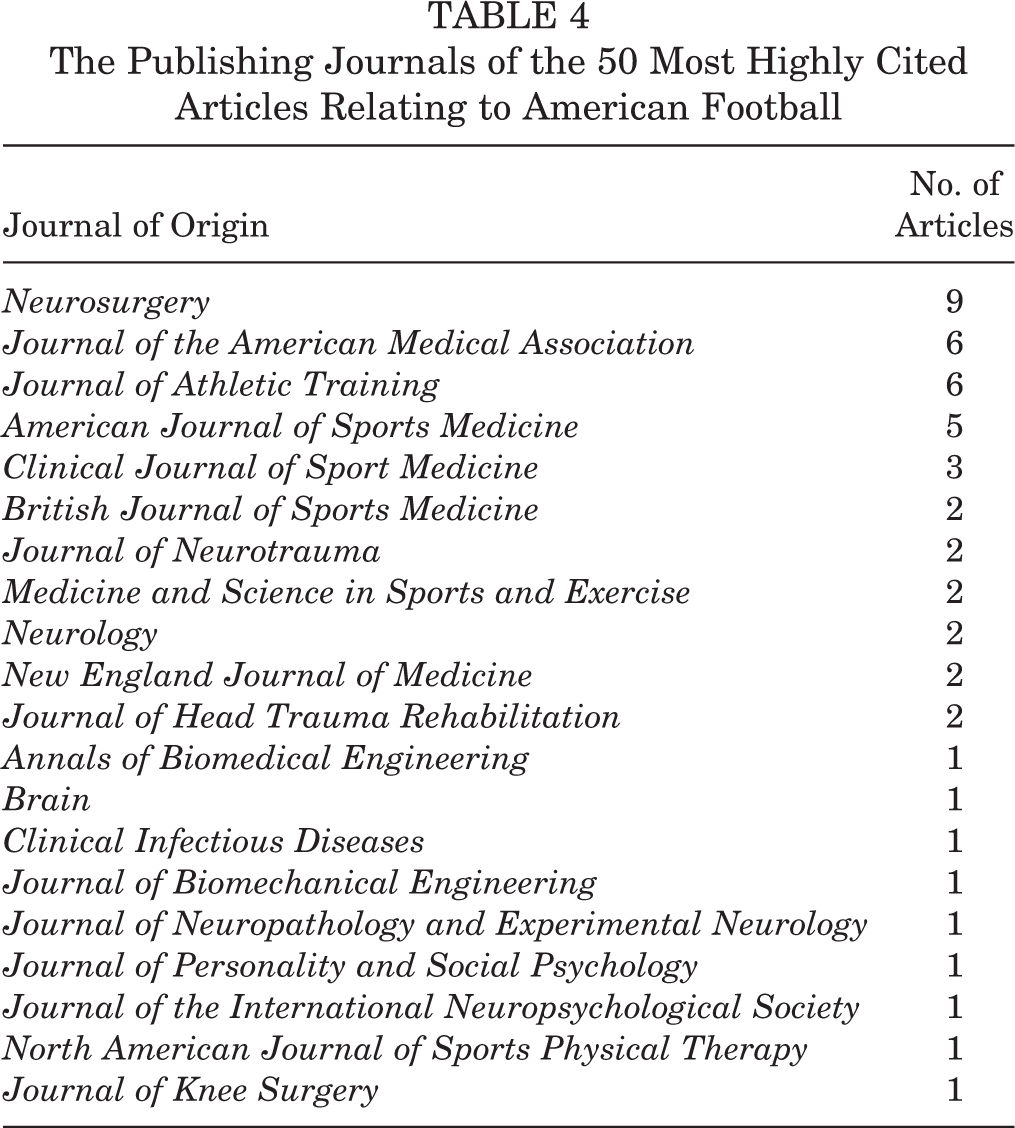
Regarding publication source, the top 50 most cited articles were published in 20 different journals (Table 4). The journal publishing the greatest proportion of top 50 articles was Neurosurgery (n = 9). The next 3 journals with the most publications within the top 50 articles were the Journal of Athletic Training (n = 6), Journal of the American Medical Association (n = 6), and American Journal of Sports Medicine (n = 5). All of the articles published by Neurosurgery and the Journal of the American Medical Association focused on CTE/concussion; half published by the Journal of Athletic Training focused on CTE/concussion. The majority of articles (n = 28) were not open access journals, compared with 22 that were open access.
The Publishing Journals of the 50 Most Highly Cited Articles Relating to American Football
Discussion
As hypothesized, the majority of highly cited publications on American football were medicine related and focused on injuries, although we did not hypothesize that the majority of studied injuries would pertain to concussion and CTE. The major findings of our research showed that of the top 50 publications, 46 (92%) were in the field of medicine, with 40 (80%) studying concussion or CTE. The predominance of concussion and CTE research reflects increasing awareness and concern surrounding head injury in football. 39,69 A review of the publications included in our analysis may help physicians, physical therapists, athletic trainers, and coaches who work with football players to establish foundational knowledge on injury prevention recommendations and treatment guidelines.
The top-cited article in our analysis had 1434 citations, studied concussion and CTE, and was published in 2009. 76 In comparison, a recent bibliometric analysis of concussion-related publications found that the top article was cited 3204 times and was published in 2022. 102 Additionally, we found a mean of 419 citations per article, while the mean citation frequency of top concussion-related publications was reportedly 1033. 18 We postulate that articles in our analysis accrued fewer citations than top concussion-related publications because of a narrower focus on concussions related to football.
Our finding that all top 50 articles were published within the United States is expected given football’s predominantly American domain and is consistent with findings previously reported by Sharma and Lawrence 102 regarding popular concussion literature. As with other bibliometric analyses relating to sports medicine, the majority of our studies were observational, with 48 (96%) of 50 publications having level 2, 3, or 4 evidence. 47
Collegiate football was the most studied level of competition among the top football-related publications. This is somewhat unexpected, given the predominance of competitive football players at the high school level compared with the collegiate level (1 million and 40,000, respectively). 84,85 Our findings may suggest a study bias toward higher-level players and indicate the need for additional research on youth and high school football, especially considering differences in the neural development of younger players, which likely alters injury prevention strategies and treatment practices. The discrepancy between participation rates and the focus of top publications may also reflect differences in funding, with higher-level football attracting more funding for research. Alternatively, it is possible that higher-level players are more studied because of logistical advantages of injury surveillance. Additionally, concussion and CTE are cumulative injuries that become more deleterious as frequency of injury occurs, often presenting later in one’s career (or even postmortem, when CTE cases are confirmed), and therefore more easily studied in older players.
The present analysis revealed that 19 (38%) of the top 50 most cited articles were published between 2003 and 2007, and the top 5 articles by citation density were each published in or after 2007. More recent works have had greater influence in football-related research based on citation density, as public awareness of football-related injuries aligns with an exponential increase in concussion-related research between 2000 and 2020. 102 There has been a shift of national attention on the risks of brain injury specifically in the sport of football; although participation in football has always been associated with an increased risk of concussion, awareness of football-related head injury rapidly increased in the 21st century, a phenomenon that has been termed “the first concussion crisis.” 40 The publications identified in our analysis may have contributed to increased national awareness of football-related head injury; they may also have been a product of media attention on football injury. Our finding that the top 5 articles by citation density were published between 2007 and 2017 may reflect the increase in national awareness of and subsequent concern over football-related injuries that occurred in the early 2000s. 30,39,40
Kevin M. Guskiewicz from the University of North Carolina at Chapel Hill and Michael McCrea from the Medical College of Wisconsin were the top 2 authors in the football-related injury literature. 33,34-36,37,39,71 –75 At the institutional level, the University of North Carolina at Chapel Hill and Boston University School of Medicine were the 2 most proliferative institutions in football injury research. Both institutions had >1 primary author producing top articles, and together these 2 institutions contributed over one-third of the top 50 publications. As bibliometric analyses provide insight into which authors and institutions are most prominent in a particular field, our findings suggest the dominance of the University of North Carolina at Chapel Hill and Boston University School of Medicine in football research. 28,29,60,61 It is also important to consider, however, that most of the top-cited publications studied neuro-related injuries and may have come from investigators whose work specialized in this area. 33 –37,71 –75 As such, in building upon their prior research, these investigators may often cite their prior publications and publications from their own institution. Additionally, certain institutions may have more research funding and larger departments, particularly if orthopaedic/football research is a priority of the institution.
Evaluating journal impact on football-related research, Neurosurgery was the journal with the most publications in the top 50, followed by the Journal of Athletic Training and Journal of the American Medical Association. The articles published by these journals predominantly focused on CTE and concussion, the most highly studied topic. As citation analysis has been used to evaluate journal impact, students and practitioners seeking to remain at the cutting edge of football injury literature may focus their attention on these journals. 28,29 Furthermore, journals that published multiple top publications were exclusively journals with a focus on medical topics, an unsurprising finding given that the overwhelming majority (92%) of published articles in our analysis were medicine related. While the majority of articles were not open access, a significant portion (44%) were, likely lowering barriers to readership and subsequent citation of their publications.
While our analysis indicates areas that are particularly well studied relating to football, it also highlights a few gaps in the current literature. One gap is in the study of injuries unrelated to CTE and head injury: below-the-head injuries occur frequently and, as with concussion and CTE, can cause significant and long-term disability to players. Research relating to the prevention and treatment of these injuries merits attention. Additionally, future research may focus on innovations in faster and safer injury rehabilitation.
Limitations
The top 50 publications were selected by number of accrued citations, a metric that may be influenced by a variety of factors, including research funding disparities by competition level, positive outcome bias, time since publication date, institutional prestige, and dissemination bias. Therefore, while citation frequency is an indicator of article importance, it should not be used as the sole determinant of study quality or study influence on injury protocols and clinical practice. Citation density accounts for time elapsed since study publication date and was included in our analysis to assess article citation frequency equitably across time. Another limitation of our work is the exclusion of the newest publications, a shortcoming of all bibliometric analyses, as newer publications are not allowed adequate time to accrue citations. Often, studies reach prominence several years after their initial publication date. 28 A final limitation is our use of only 1 database. While the database utilized in the present study is commonly employed in bibliometric analyses, other databases may yield slightly different findings. 2,10,11,15,41,57,83 Other commonly utilized databases include PubMed, Scopus, and Google Scholar. 9,26,52
Conclusion
Our analysis indicated that most publications related to American football focused on concussion and CTE, were observational, and were published during or after 2000. The most studied level of competition was college. Our list of the top 50 most cited studies provides researchers, medical students, residents, and fellows with a foundational list of the most important and influential academic contributions to the literature on American football.
Footnotes
Notes
Final revision submitted August 28, 2022; accepted September 15, 2022.
One or more of the authors has declared the following potential conflict of interest or source of funding: A.C. has received education payments from Arthrex and consulting fees from Zimmer Biomet. AOSSM checks author disclosures against the Open Payments Database (OPD). AOSSM has not conducted an independent investigation on the OPD and disclaims any liability or responsibility relating thereto.
Ethical approval was not sought for the present study.
The Top 50 Most Cited Articles Relating to American Football

| Rank | Article Title | Year Published | Total No. of Citations | Citation Density |
|---|---|---|---|---|
| 1 | Chronic traumatic encephalopathy in athletes: progressive tauopathy after repetitive head injury 76 | 2009 | 1434 | 102.4 |
| 2 | Epidemiology of collegiate injuries for 15 sports: summary and recommendations for injury prevention initiatives 42 | 2007 | 1318 | 82.4 |
| 3 | Basking in reflected glory: three (football) field studies 18 | 1976 | 1278 | 27.2 |
| 4 | Sudden death in young competitive athletes: clinical, demographic, and pathological profiles 70 | 1996 | 1229 | 45.5 |
| 5 | The spectrum of disease in chronic traumatic encephalopathy 77 | 2013 | 1202 | 120.2 |
| 6 | Cumulative effects associated with recurrent concussion in collegiate football players: the NCAA Concussion Study 35 | 2003 | 1111 | 55.6 |
| 7 | Acute effects and recovery time following concussion in collegiate football players: the NCAA Concussion Study 72 | 2003 | 1013 | 50.7 |
| 8 | Unreported concussion in high school football players: implications for prevention 73 | 2004 | 797 | 42.0 |
| 9 | Association between recurrent concussion and late-life cognitive impairment in retired professional football players 33 | 2005 | 786 | 43.7 |
| 10 | Concussions among United States high school and collegiate athletes 30 | 2007 | 652 | 40.8 |
| 11 | American Medical Society for Sports Medicine position statement: concussion in sport 39 | 2013 | 647 | 64.7 |
| 12 | Chronic traumatic encephalopathy in a National Football League player 89 | 2006 | 613 | 34.1 |
| 13 | Epidemiology of concussions among United States high school athletes in 20 sports 68 | 2012 | 608 | 55.3 |
| 14 | Recurrent concussion and risk of depression in retired professional football players 34 | 2007 | 587 | 36.7 |
| 15 | Relationship between concussion and neuropsychological performance in college football players 19 | 1999 | 585 | 24.4 |
| 16 | A proposed injury threshold for mild traumatic brain injury 109 | 2004 | 583 | 30.7 |
| 17 | A clone of methicillin-resistant Staphylococcus aureus among professional football players 46 | 2005 | 576 | 32.0 |
| 18 | Epidemiology of concussion in collegiate and high school football players 37 | 2000 | 556 | 24.2 |
| 19 | Clinicopathological evaluation of chronic traumatic encephalopathy in players of American football 79 | 2017 | 478 | 79.7 |
| 20 | Concussion in professional football: reconstruction of game impacts and injuries 92 | 2003 | 451 | 22.6 |
| 21 | Traumatic brain injury in high school athletes 93 | 1999 | 409 | 17.0 |
| 22 | Trends in concussion incidence in high school sports: a prospective 11-year study 62 | 2011 | 391 | 32.6 |
| 23 | Can serious injury in professional football be predicted by a preseason functional movement screen? 48 | 2007 | 388 | 24.3 |
| 24 | Neurodegenerative causes of death among retired National Football League players 58 | 2012 | 335 | 30.5 |
| 25 | Functionally-detected cognitive impairment in high school football players without clinically-diagnosed concussion 105 | 2014 | 334 | 37.1 |
| 26 | Effects of creatine supplementation on body composition, strength, and sprint performance 50 | 1998 | 324 | 13.0 |
| 27 | Injury patterns in selected high school sports: a review of the 1995-1997 seasons 94 | 1999 | 324 | 13.5 |
| 28 | Chronic traumatic encephalopathy in a National Football League player, part II 88 | 2006 | 322 | 18.9 |
| 29 | Neuropsychological functioning and recovery after mild head injury in collegiate athletes 65 | 1996 | 314 | 11.6 |
| 30 | Neuropsychological assessment of the college football player 64 | 1998 | 308 | 12.3 |
| 31 | Head impact severity measures for evaluating mild traumatic brain injury risk exposure 31 | 2008 | 299 | 19.9 |
| 32 | Standardized Assessment of Concussion (SAC): On-Site Mental Status Evaluation of the Athlete 75 | 1998 | 286 | 11.4 |
| 33 | Measurement of head impacts in collegiate football players: relationship between head impact biomechanics and acute clinical outcome after concussion 36 | 2007 | 276 | 17.3 |
| 34 | Neuropsychological test performance prior to and following sports-related mild traumatic brain injury 24 | 2001 | 274 | 12.5 |
| 35 | Knowledge, attitude, and concussion-reporting behaviors among high school athletes: a preliminary study 97 | 2013 | 263 | 26.3 |
| 36 | A systematic review of potential long-term effects of sport-related concussion 67 | 2017 | 262 | 43.7 |
| 37 | Analysis of real-time head accelerations in collegiate football players 23 | 2005 | 260 | 14.4 |
| 38 | Rotational head kinematics in football impacts: an injury risk function for concussion 98 | 2012 | 258 | 23.5 |
| 39 | Epidemiology of sports-related concussion in NCAA athletes from 2009-2010 to 2013-2014: incidence, recurrence, and mechanisms 111 | 2015 | 258 | 32.3 |
| 40 | Emerging histomorphologic phenotypes of chronic traumatic encephalopathy in American athletes 87 | 2011 | 257 | 21.4 |
| 41 | Frequency and location of head impact exposures in individual collegiate football players 20 | 2010 | 254 | 19.5 |
| 42 | A high-morbidity outbreak of methicillin-resistant Staphylococcus aureus among players on a college football team, facilitated by cosmetic body shaving and turf burns 12 | 2004 | 252 | 13.3 |
| 43 | Standard regression-based methods for measuring recovery after sport-related concussion 71 | 2005 | 251 | 13.9 |
| 44 | Cumulative head impact exposure predicts later-life depression, apathy, executive dysfunction, and cognitive impairment in former high school and college football players 80 | 2017 | 248 | 41.3 |
| 45 | An epidemiologic comparison of high school sports injuries sustained in practice and competition 96 | 2008 | 246 | 16.4 |
| 46 | The microfracture technique in the treatment of full-thickness chondral lesions of the knee in National Football League players 104 | 2003 | 234 | 11.7 |
| 47 | Traumatic brain injury—football, warfare, and long-term effects 21 | 2010 | 232 | 17.9 |
| 48 | Syndesmotic ankle sprains 14 | 1991 | 227 | 7.1 |
| 49 | Standardized assessment of concussion in football players 74 | 1997 | 214 | 8.2 |
| 50 | Concussion in professional football: location and direction of helmet impacts—part 2 91 | 2003 | 213 | 10.7 |