



Abstract
Background:
Textbook knowledge and clinical dogma are often insufficient for effective evidence-based decision making when treating musculoskeletal injuries in American football players, given the variability in presentation and outcomes across different sports and different levels of competition. Key evidence can be drawn directly from high-quality published articles to make the appropriate decisions and recommendations for each athlete’s unique situation.
Purpose:
To identify and analyze the 50 most cited articles related to football-related musculoskeletal injury to provide an efficient tool in the arsenal of trainees, researchers, and evidence-based practitioners alike.
Study Design:
Cross-sectional study.
Methods:
The ISI Web of Science and SCOPUS databases were queried for articles pertaining to musculoskeletal injury in American football. For each of the top 50 most cited articles, bibliometric elements were evaluated: citation count and density, decade of publication, journal, country, multiple publications by the same first author or senior author, article content (topic, injury area), and level of evidence (LOE).
Results:
The mean ± SD number of citations was 102.76 ± 37.11; the most cited article, with 227 citations, was “Syndesmotic Ankle Sprains” published in 1991 by Boytim et al. Several authors served as a first or senior author on >1 publication, including J.S. Torg (n = 6), J.P. Bradley (n = 4), and J.W. Powell (n = 4). The American Journal of Sports Medicine published the majority of the 50 most cited articles (n = 31). A total of 29 articles discussed lower extremity injuries, while only 4 discussed upper extremity injuries. The majority of the articles (n = 28) had an LOE of 4, with only 1 article having an LOE of 1. The articles with an LOE of 3 had the highest mean citation number (133.67 ± 55.23; F = 4.02; P = .05).
Conclusion:
The results of this study highlight the need for more prospective research surrounding the management of football-related injury. The low overall number of articles on upper extremity injury (n = 4) also highlights an area for further research.
American football is among the most popular sports in the United States for athletes and viewers alike. Over 1 million high school, 60 70,000 collegiate, 59 and 2000 National Football League (NFL) players 20 actively compete each year, and the NFL generated an astounding $16 billion in revenue in 2019. 28 The incidence of injury is also well reported, with rates between 4.1 and 7.9 injuries per 1000 athlete-exposures in high school football,5,37 9.3 and 40.6 in collegiate football, 71 and 23.1 and 64.7 in the NFL.23,70 Roughly 65% of football-related musculoskeletal injuries are of the lower extremity, and the most common injuries encountered include knee sprains, ankle sprains, hamstring and adductor strains, and shoulder sprains.23,41 Information regarding sports medicine care in the general population is more readily accessible in textbooks and educational resources than is information regarding care for specific sport populations. The management and return-to-play (RTP) timelines often vary depending on the athletic populations, and high-quality evidence must be extracted directly from published articles.3,4,26,44,56,64,75
Bibliometric analysis can serve as an important tool for sports medicine physicians to efficiently evaluate the existing influential literature regarding the management nuances in specific athletic populations. These analyses have been frequently utilized in recent years to allow identification and evaluation of the most influential articles within a field of study, based on total citations and citation density (ie, citations per year since publication).1,2,8,17,21,57,69 Among the many benefits of such analyses is the ability for educators to facilitate creation of efficient reading programs for residents and fellows to cover the most influential articles in a field of study. Second, these data are useful for researchers to ensure that they are abreast of the most influential articles and to identify key evidence before designing their research questions. Finally, these analyses can identify the overall quality (eg, level of evidence [LOE]) and distribution (eg, type and topic of study) of influential articles in a given field.
Sport-specific bibliometric analyses can be particularly valuable, as there is great variability in the epidemiology, presentation, management, and outcomes of musculoskeletal injuries across sports, as well as across levels of competition within the same sport. To continue supporting the use of evidence-based decision making by sports medicine practitioners, an awareness of landmark evidence in the sport is critical.
The purpose of this study was to identify and analyze the 50 most cited articles related to musculoskeletal injury in football to provide an efficient tool in the arsenal of trainees, researchers, and evidence-based practitioners alike.
Methods
The ISI Web of Science (which includes MEDLINE, BIOSIS Citation Index, Scielo Citation Index, KCI–Korean Journal Database, and Russian Science Citation Index) and SCOPUS databases were utilized to conduct a search for articles pertaining to musculoskeletal injury in American football. Articles discussing injuries to the cervical spine were included. Our search was performed on April 27, 2022, and included all articles published up to that date. The Boolean operators utilized were as follows: ((football) AND injury) NOT (concussion OR encephalopathy OR brain OR soccer OR FIFA OR UEFA OR Australian OR rugby). The Web of Science search yielded 2990 articles.
Articles were then screened consecutively by title and abstract, starting with the most cited, to exclude those unrelated to musculoskeletal injury in American football. Articles were excluded if they discussed soccer, Australian football, rugby, multiple sports where American football was not the predominant subject, or nonmusculoskeletal injury (ie, concussion, chronic traumatic encephalopathy). Country and language of publication did not serve as exclusion criteria. Screening of the first 336 articles resulted in exclusion of 236 that were unrelated, generating a preliminary list of the 100 most cited articles with possible relation to musculoskeletal injury in American football. Next, the 3884 articles generated from the SCOPUS search were screened consecutively by title starting with the most cited. After exclusion of duplicates and unrelated articles from the first 222 on the SCOPUS list, an additional 14 not found in the Web of Science search qualified for the 100 most cited list, displacing those less cited (Figure 1).

Search and screening procedure.
From this list, sorted by descending number of total citations, each article was screened consecutively for full text by 2 authors independently (S.S.D, D.B.E.-N.) until the 50 most cited were identified. If 2 articles had the same number of citations, citation density since publication was used as a tiebreaker. After 52 articles were screened and an additional 2 were excluded (1 soccer, 1 Australian football), the final list of the 50 most cited was formed. The full texts of these 50 were further analyzed to collect bibliometric data.
The top 50 articles were evaluated according to citation count, citation density, decade of publication, journal of publication, country of origin, multiple publications by the same first author or senior author, content (study topic, injury area), and LOE. The LOE was determined by a single author via the Oxford evidence-based medicine criteria 32 and verified by the senior author (C.A.P.). Content was classified into 1 of 7 study topics: injury mechanism and biomechanics, epidemiology and outcomes, imaging, nonoperative management, surgical management, prevention and rehabilitation, or comprehensive review. Articles were also classified into 1 of 9 injury areas: foot, ankle, knee, thigh, hip, shoulder, elbow, spine, or nonspecific.
Categorical variables were reported as counts, and continuous variables were reported as means and standard deviations. The Shapiro-Wilk test was performed to examine the distribution of individual variables for normality. One-way analysis of variance was used to compare groups of continuous variables. Bonferroni-adjusted pairwise t tests were performed to analyze any significant differences identified. Fisher exact test was used to evaluate categorical variables. Pearson correlation coefficient was used to assess associations between 2 continuous variables. All analyses were performed with R Version 4.1.0 (R Foundation for Statistical Computing). The threshold for significance was set at P < .05.
Results
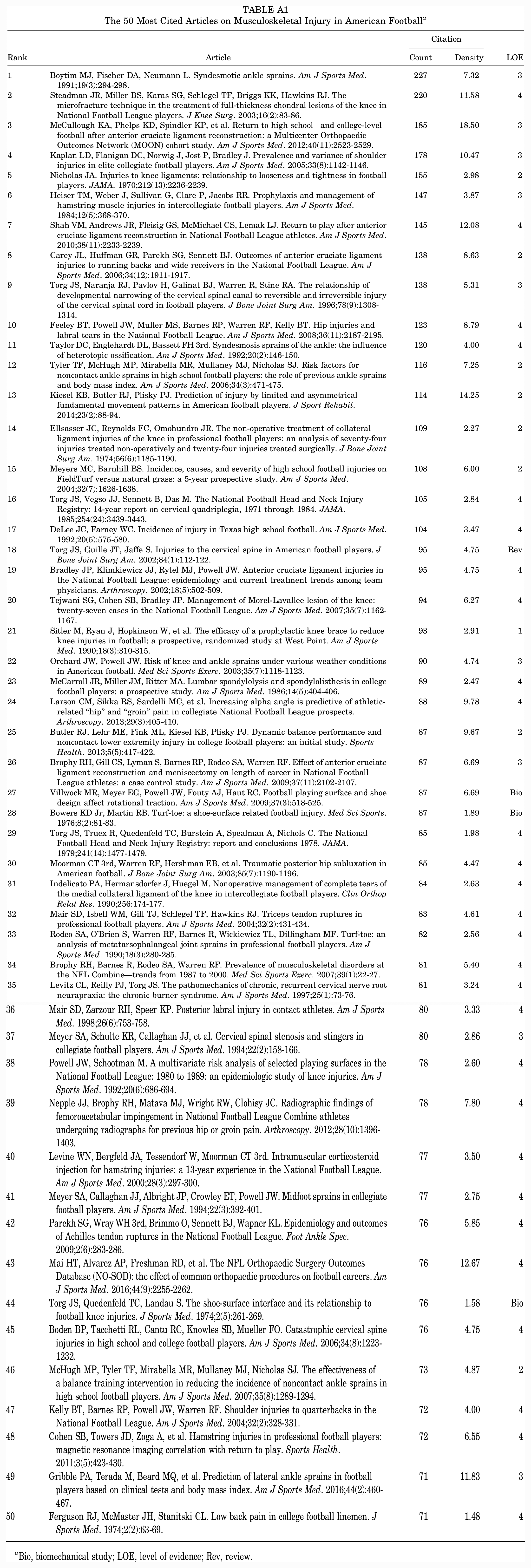
The 50 most cited articles related to musculoskeletal injury in American football are presented in Appendix Table A1. ‖ The mean number of citations was 102.76 ± 37.11, and the median was 87. The most cited article, “Syndesmotic Ankle Sprains” by Boytim et al, 10 was cited 227 times, and the 50th most cited was cited 71 times. The mean citation density since the year of publication was 5.83 ± 3.71.
All articles were published from 1970 to 2016. Of these 5 decades, 2000 to 2009 was the most prolific, producing 20 publications (40%) (Figure 2). The most prolific years were 1974, 1990, 1992, 2003, 2004, 2006, 2007, and 2009, each with 3 articles (6% each). The next most prolific decade was 2010 to 2019, with 9 articles and the highest mean citation density of 11.46 ± 3.59. The earliest published article on the list, by J.A. Nicholas 62 in 1970, was the fifth most cited, with 155 citations. Articles published in the earliest decade (1970-1979) had the lowest mean citation number, at 97.17 ± 31.21. There was no correlation between year of publication and citation count (r = −0.04; P = .77); however, there was a statistically significant strong correlation between year of publication and citation density (r = 0.73; P < .01) (Figure 3).
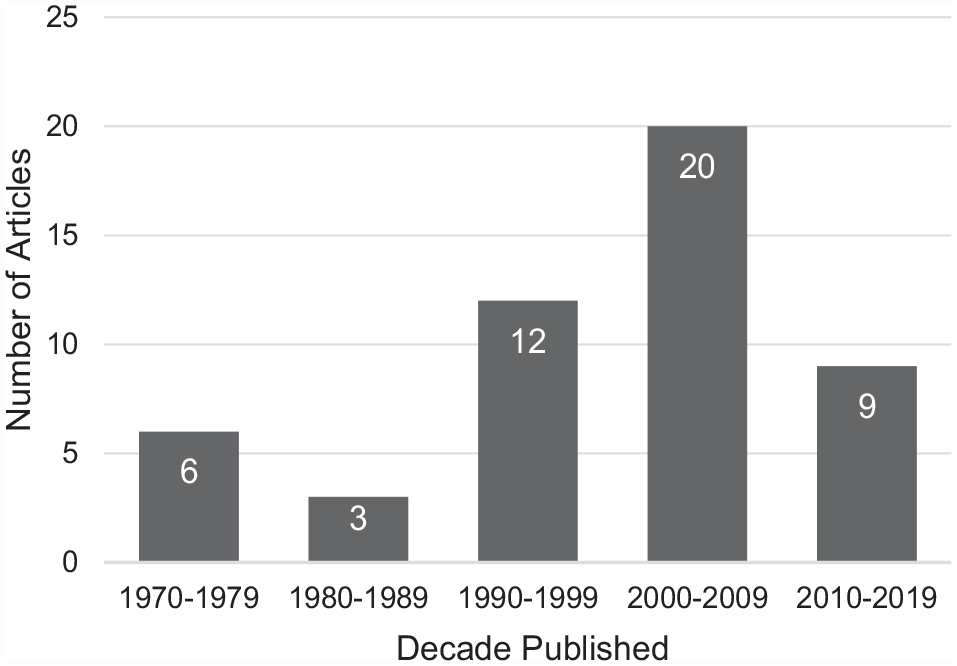
Top 50 cited articles according to decade of publication, 1970-2019.

Correlation between (A) total number of citations and (B) citation density and decade of publication.
The top 50 articles were published in 11 journals. The most prolific journal was the American Journal of Sports Medicine, which published 31 articles (62%). The remaining journals published at most 4 articles, with 5 journals publishing 1 (Figure 4). Multiple authors served as a first or senior author on several publications, such as J.S. Torg (6 articles), J.P. Bradley (4 articles), and J.W. Powell (4 articles) (Table 1). Of the top 50 most cited, 49 were from the United States and 1 was from Australia.

Top 50 cited articles according to journal of publication.
First or Senior Author With Multiple Publications in the Top 50 Cited Articles

Regarding study topic, most of the top 50 articles were related to epidemiology and outcomes (n = 31; 62%). The second most common category was injury mechanism and biomechanics, with 6 articles (12%). Four articles fell under surgical management (8%) and 3 each under nonoperative management and prevention/rehabilitation (6% each). Only 2 articles were categorized under imaging (4%), and a single one was a comprehensive review (Figure 5). There was no difference in total citation count (F = 2.35; P = .13) or citation density (F = 0.74; P = .39) among topics.

Top 50 cited articles according to topic category.
The articles were also classified by injury area, as represented in Figure 6. The greatest number of articles discussed knee injuries (n = 13; 26%). Among the top 50, 8 (16%) were “nonspecific” and did not discuss a single injury location. Additional common injury locations discussed were spine (n = 9; 18%), ankle (n = 6; 12%), and hip (n = 5; 10%), among others. Articles on knee injuries had the highest mean number of citations, with 119.92 ± 45.31. However, there was no difference in total citation count (F = 1.87; P = .18) or citation density (F = 0.002; P = .96) among types of injury.

Top 50 cited articles according to injury area.
The majority of articles (n = 28; 56%) had an LOE of 4. Nine (18%) had an LOE of 3, and 8 (16%) had an LOE of 2 (Figure 7A). Only 1 article had an LOE of 1. Four articles were not given an LOE, because they were either biomechanics studies (n = 3; 6%) or reviews (n = 1; 2%). Articles with an LOE of 3 had the highest mean citation number (133.67 ± 55.23), followed by those with an LOE of 2 (112.50 ± 25.95), the single LOE 1 article (93 citations), and LOE of 4 (92.75 ± 30.34) (Figure 7B). There was no difference in total citation count (F = 4.02; P = .05) or citation density (F = 2.44; P = .13) among the LOE categories.
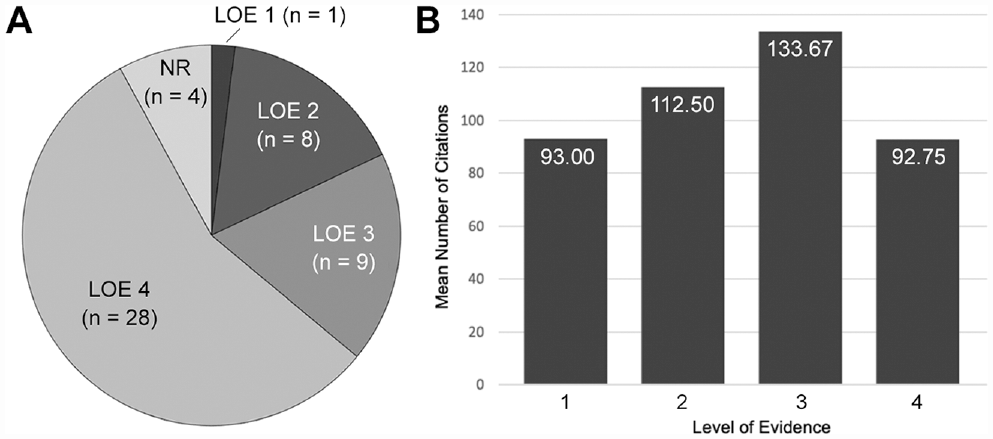
Top 50 cited articles according to (A) LOE and (B) mean number of citations per level of evidence. LOE, level of evidence; NR, not reported.
Discussion
Of the top 50 most cited articles on musculoskeletal injury in American football, the 2 earliest in our analysis were authored by Nicholas 62 in 1970 and Heiser et al 31 in 1984. Nicholas demonstrated the importance of high-quality screening physical examinations for football players, identifying that an increased index of ligamentous laxity was associated with an increased incidence of injury—examination findings that are still of importance today to the practicing physician.39,67 Heiser et al were among the first to show that correction of muscular strength imbalances involving the hamstrings and quadriceps and a rehabilitation program including isokinetic exercises resulted in reduced incidence of hamstring injury and reduced recurrence after injury.
The most cited article overall was by Boytim et al, 10 with 227 citations. Their analysis of 43 ankle sprains among NFL athletes established that syndesmotic sprains led to increased morbidity and games missed when compared with lateral ankle sprains, findings that have consistently been supported in the literature since this article’s publication in 1991.10,18,20,66 Boytim et al emphasized the severity of syndesmotic ankle sprains at a time when this injury was largely unrecognized. Previously, when athletes had continued complaints after 6 weeks with what was thought to be lateral ankle sprains, their motivation to play and toughness were often questioned by the medical staff. The external rotation stress test described in the article also remains an integral component of the evaluation of syndesmotic ankle sprains. 38 With 220 total citations, the second most cited article in our analysis was “The Microfracture Technique in the Treatment of Full-Thickness Chondral Lesions of the Knee in National Football League Players,” by Steadman et al. 77 These authors described outcomes of this technique in 25 active NFL athletes and found improvements in functional outcomes for the players who underwent the procedure, with an RTP rate of 76%.
The article with the highest citation density in our study was “Return to High School– and College-Level Football After Anterior Cruciate Ligament Reconstruction: A Multicenter Orthopaedic Outcomes Network (MOON) Cohort Study” by McCullough et al, 51 with 18.5 citations per year since it was published in 2012. This landmark study demonstrated an RTP rate <70% in both cohorts and a 43% rate of self-evaluated return to previous performance level. Importantly, this study postulated that identification of psychological factors, unaddressed in former studies, was a major barrier to RTP and should be a vital component of the rehabilitation process. 51 In follow-up studies, Nwachukwu et al 63 and Gennarelli et al 27 found that fear of reinjury was the most common psychological reason affecting RTP rates after anterior cruciate ligament injury, while use of psychosocial interventions can promote improved rehabilitation adherence, athlete mood, and pain management.
When articles were analyzed by journal, 31 (62%) of the top 50 most influential were published in the American Journal of Sports Medicine, highlighting the importance of this flagship journal of the American Orthopaedic Society for Sports Medicine in football-related literature (Figure 4). Another 4 were published in the Journal of Bone and Joint Surgery–American Volume (8%), and 3 each were published by Arthroscopy and Medicine and Science in Sports and Exercise (6% each).
Regarding study topic, the majority discussed epidemiology and outcomes (62%), including all 5 articles published after 2013 (Figure 5). It is evident that recent influential literature has surrounded the identification of risk factors and patterns of injury, which ultimately may provide targets for injury prevention. “Prediction of Lateral Ankle Sprains in Football Players Based on Clinical Tests and Body Mass Index,” published in 2016 by Gribble et al, 29 identified that poorer performance on the Star Excursion Balance Test and higher body mass index were associated with lateral ankle sprains. In 2013, Larson et al 40 similarly examined biometric data, finding an association between increasing alpha angle (indicative of larger cam-type deformities) and increased risk of hip/groin pain in NFL prospects.
When injury area was analyzed, the knee was the most frequent subject of influential football-related literature, with 13 articles (26%) focusing on injuries of this joint (Figure 6). ¶ Overall, injuries to the lower extremity (hip, thigh, knee, ankle, foot) totaled 29 articles (58%), while injuries to the upper extremity were discussed in only 4 (8%).34,35,47,48 This predominance of lower extremity injury research is unsurprising given the proportion of NFL injuries that are of the lower extremity (62.3%) and the knee specifically (29.3%).6,45 Bedard and Wyndham Lawrence 6 demonstrated that incidence of knee injuries was declining overall, which they postulated could be related to rule changes such as penalization of chop blocks and augmentation of the horse collar rule. Analyses of injury trends, such as the present analysis, are vital in informing decision making to increase prevention of injuries overall.
After knee injuries, spine injuries were the next most frequently discussed (n = 9; 18%) (Figure 6). # Dr Joseph Torg was the most prolific author, not just among spine-related articles, but across our entire analysis, with 6 first and senior authorships (Table 1). Torg routinely published highly cited manuscripts on the topic of head and neck injury with a focus on cervical spine injury.43,80,81,83,84 His article in 1996 demonstrated that athletes with congenital cervical spine stenosis were at heightened risk of transient cervical neuropraxia but were not at elevated risk for permanent catastrophic injury and thus are safe to compete in contact sports. 81 His research on the National Football Head and Neck Injury Registry provided critical early data on cervical spine injury and sparked future research in the field.83,84
Analysis by LOE revealed only 1 LOE 1 study (2%) and 8 LOE 2 studies (16%) (Figure 7A). This is consistent with previous bibliometric analyses demonstrating that in many cases the most cited articles are not always of the highest LOE.1,2,17 This finding reveals the opportunity and relative need for prospective research to improve the quality of evidence with which football team physicians make evidence-based decisions. We acknowledge, however, that performing randomized and prospective research can be difficult in this population, which often involves teams of ≥50 players with varying schedules outside their sports participation. Furthermore, many athletes will inevitably graduate from their school or switch teams between seasons. Additional challenges arise at the professional level when unique approval from governing bodies such as the National Football League Players Association is required to perform research. The ability of Sitler et al 76 to perform an LOE 1 study may be related to the fact that the study was completed at West Point, where enrollees could be more closely observed and followed. Nonetheless, there remain gaps in knowledge regarding ideal treatment, RTP guidelines, and prevention strategies for football-related injuries, primarily attributed to the vast differences that exist in management of football injuries across levels of competitiveness. These gaps in knowledge will be best addressed with high-quality prospective research. There was no difference in total citation count (F = 4.02; P = .05) or citation density (F = 2.44; P = .13) among the LOE categories, once again suggesting no association between higher LOE and increased citations among the most cited articles.
Limitations
Importantly, our analysis excluded articles that discussed concussion and chronic traumatic encephalopathy. Some of the most cited American football research is centered on these brain pathologies, with the National Collegiate Athletic Association concussion studies published by Guskiewicz et al 30 and McCrea et al 50 amassing 1111 and 1013 citations, respectively, at the time of this analysis. There are additional limitations associated with bibliometric analyses that are important to note. While a careful strategy was employed when searching for articles in the ISI Web of Science and SCOPUS databases, it is possible that relevant highly cited articles were missed by this analysis. Additionally, citation numbers do not necessarily reflect quality or impact of research. Furthermore, citation counts can be influenced by publication in nonindexed journals, textbooks, lectures, and digital media, which are not captured in the ISI Web of Science and SCOPUS databases. Finally, the newest articles, which have not had enough time to gather enough citations to be included in this list, will be excluded from these types of analyses. Thus, a bibliometric analysis as a research tool can serve as an excellent starting point for literature searches but must be supplemented with traditional methods that will capture the full spectrum of articles.
Conclusion
The results of this study highlight the need for more prospective research surrounding the management of football-related injury. The low overall number of articles on upper extremity injury (n = 4) also highlights an area for further research.
Footnotes
Appendix
The 50 Most Cited Articles on Musculoskeletal Injury in American Football a
| Citation | ||||
|---|---|---|---|---|
| Rank | Article | Count | Density | LOE |
| 1 | Boytim MJ, Fischer DA, Neumann L. Syndesmotic ankle sprains. Am J Sports Med. 1991;19(3):294-298. | 227 | 7.32 | 3 |
| 2 | Steadman JR, Miller BS, Karas SG, Schlegel TF, Briggs KK, Hawkins RJ. The microfracture technique in the treatment of full-thickness chondral lesions of the knee in National Football League players. J Knee Surg. 2003;16(2):83-86. | 220 | 11.58 | 4 |
| 3 | McCullough KA, Phelps KD, Spindler KP, et al. Return to high school– and college-level football after anterior cruciate ligament reconstruction: a Multicenter Orthopaedic Outcomes Network (MOON) cohort study. Am J Sports Med. 2012;40(11):2523-2529. | 185 | 18.50 | 3 |
| 4 | Kaplan LD, Flanigan DC, Norwig J, Jost P, Bradley J. Prevalence and variance of shoulder injuries in elite collegiate football players. Am J Sports Med. 2005;33(8):1142-1146. | 178 | 10.47 | 3 |
| 5 | Nicholas JA. Injuries to knee ligaments: relationship to looseness and tightness in football players. JAMA. 1970;212(13):2236-2239. | 155 | 2.98 | 2 |
| 6 | Heiser TM, Weber J, Sullivan G, Clare P, Jacobs RR. Prophylaxis and management of hamstring muscle injuries in intercollegiate football players. Am J Sports Med. 1984;12(5):368-370. | 147 | 3.87 | 3 |
| 7 | Shah VM, Andrews JR, Fleisig GS, McMichael CS, Lemak LJ. Return to play after anterior cruciate ligament reconstruction in National Football League athletes. Am J Sports Med. 2010;38(11):2233-2239. | 145 | 12.08 | 4 |
| 8 | Carey JL, Huffman GR, Parekh SG, Sennett BJ. Outcomes of anterior cruciate ligament injuries to running backs and wide receivers in the National Football League. Am J Sports Med. 2006;34(12):1911-1917. | 138 | 8.63 | 2 |
| 9 | Torg JS, Naranja RJ, Pavlov H, Galinat BJ, Warren R, Stine RA. The relationship of developmental narrowing of the cervical spinal canal to reversible and irreversible injury of the cervical spinal cord in football players. J Bone Joint Surg Am. 1996;78(9):1308-1314. | 138 | 5.31 | 3 |
| 10 | Feeley BT, Powell JW, Muller MS, Barnes RP, Warren RF, Kelly BT. Hip injuries and labral tears in the National Football League. Am J Sports Med. 2008;36(11):2187-2195. | 123 | 8.79 | 4 |
| 11 | Taylor DC, Englehardt DL, Bassett FH 3rd. Syndesmosis sprains of the ankle: the influence of heterotopic ossification. Am J Sports Med. 1992;20(2):146-150. | 120 | 4.00 | 4 |
| 12 | Tyler TF, McHugh MP, Mirabella MR, Mullaney MJ, Nicholas SJ. Risk factors for noncontact ankle sprains in high school football players: the role of previous ankle sprains and body mass index. Am J Sports Med. 2006;34(3):471-475. | 116 | 7.25 | 2 |
| 13 | Kiesel KB, Butler RJ, Plisky PJ. Prediction of injury by limited and asymmetrical fundamental movement patterns in American football players. J Sport Rehabil. 2014;23(2):88-94. | 114 | 14.25 | 2 |
| 14 | Ellsasser JC, Reynolds FC, Omohundro JR. The non-operative treatment of collateral ligament injuries of the knee in professional football players: an analysis of seventy-four injuries treated non-operatively and twenty-four injuries treated surgically. J Bone Joint Surg Am. 1974;56(6):1185-1190. | 109 | 2.27 | 2 |
| 15 | Meyers MC, Barnhill BS. Incidence, causes, and severity of high school football injuries on FieldTurf versus natural grass: a 5-year prospective study. Am J Sports Med. 2004;32(7):1626-1638. | 108 | 6.00 | 2 |
| 16 | Torg JS, Vegso JJ, Sennett B, Das M. The National Football Head and Neck Injury Registry: 14-year report on cervical quadriplegia, 1971 through 1984. JAMA. 1985;254(24):3439-3443. | 105 | 2.84 | 4 |
| 17 | DeLee JC, Farney WC. Incidence of injury in Texas high school football. Am J Sports Med. 1992;20(5):575-580. | 104 | 3.47 | 4 |
| 18 | Torg JS, Guille JT, Jaffe S. Injuries to the cervical spine in American football players. J Bone Joint Surg Am. 2002;84(1):112-122. | 95 | 4.75 | Rev |
| 19 | Bradley JP, Klimkiewicz JJ, Rytel MJ, Powell JW. Anterior cruciate ligament injuries in the National Football League: epidemiology and current treatment trends among team physicians. Arthroscopy. 2002;18(5):502-509. | 95 | 4.75 | 4 |
| 20 | Tejwani SG, Cohen SB, Bradley JP. Management of Morel-Lavallee lesion of the knee: twenty-seven cases in the National Football League. Am J Sports Med. 2007;35(7):1162-1167. | 94 | 6.27 | 4 |
| 21 | Sitler M, Ryan J, Hopkinson W, et al. The efficacy of a prophylactic knee brace to reduce knee injuries in football: a prospective, randomized study at West Point. Am J Sports Med. 1990;18(3):310-315. | 93 | 2.91 | 1 |
| 22 | Orchard JW, Powell JW. Risk of knee and ankle sprains under various weather conditions in American football. Med Sci Sports Exerc. 2003;35(7):1118-1123. | 90 | 4.74 | 3 |
| 23 | McCarroll JR, Miller JM, Ritter MA. Lumbar spondylolysis and spondylolisthesis in college football players: a prospective study. Am J Sports Med. 1986;14(5):404-406. | 89 | 2.47 | 4 |
| 24 | Larson CM, Sikka RS, Sardelli MC, et al. Increasing alpha angle is predictive of athletic-related “hip” and “groin” pain in collegiate National Football League prospects. Arthroscopy. 2013;29(3):405-410. | 88 | 9.78 | 4 |
| 25 | Butler RJ, Lehr ME, Fink ML, Kiesel KB, Plisky PJ. Dynamic balance performance and noncontact lower extremity injury in college football players: an initial study. Sports Health. 2013;5(5):417-422. | 87 | 9.67 | 2 |
| 26 | Brophy RH, Gill CS, Lyman S, Barnes RP, Rodeo SA, Warren RF. Effect of anterior cruciate ligament reconstruction and meniscectomy on length of career in National Football League athletes: a case control study. Am J Sports Med. 2009;37(11):2102-2107. | 87 | 6.69 | 3 |
| 27 | Villwock MR, Meyer EG, Powell JW, Fouty AJ, Haut RC. Football playing surface and shoe design affect rotational traction. Am J Sports Med. 2009;37(3):518-525. | 87 | 6.69 | Bio |
| 28 | Bowers KD Jr, Martin RB. Turf-toe: a shoe-surface related football injury. Med Sci Sports. 1976;8(2):81-83. | 87 | 1.89 | Bio |
| 29 | Torg JS, Truex R, Quedenfeld TC, Burstein A, Spealman A, Nichols C. The National Football Head and Neck Injury Registry: report and conclusions 1978. JAMA. 1979;241(14):1477-1479. | 85 | 1.98 | 4 |
| 30 | Moorman CT 3rd, Warren RF, Hershman EB, et al. Traumatic posterior hip subluxation in American football. J Bone Joint Surg Am. 2003;85(7):1190-1196. | 85 | 4.47 | 4 |
| 31 | Indelicato PA, Hermansdorfer J, Huegel M. Nonoperative management of complete tears of the medial collateral ligament of the knee in intercollegiate football players. Clin Orthop Relat Res. 1990;256:174-177. | 84 | 2.63 | 4 |
| 32 | Mair SD, Isbell WM, Gill TJ, Schlegel TF, Hawkins RJ. Triceps tendon ruptures in professional football players. Am J Sports Med. 2004;32(2):431-434. | 83 | 4.61 | 4 |
| 33 | Rodeo SA, O’Brien S, Warren RF, Barnes R, Wickiewicz TL, Dillingham MF. Turf-toe: an analysis of metatarsophalangeal joint sprains in professional football players. Am J Sports Med. 1990;18(3):280-285. | 82 | 2.56 | 4 |
| 34 | Brophy RH, Barnes R, Rodeo SA, Warren RF. Prevalence of musculoskeletal disorders at the NFL Combine—trends from 1987 to 2000. Med Sci Sports Exerc. 2007;39(1):22-27. | 81 | 5.40 | 4 |
| 35 | Levitz CL, Reilly PJ, Torg JS. The pathomechanics of chronic, recurrent cervical nerve root neurapraxia: the chronic burner syndrome. Am J Sports Med. 1997;25(1):73-76. | 81 | 3.24 | 4 |
| 36 | Mair SD, Zarzour RH, Speer KP. Posterior labral injury in contact athletes. Am J Sports Med. 1998;26(6):753-758. | 80 | 3.33 | 4 |
| 37 | Meyer SA, Schulte KR, Callaghan JJ, et al. Cervical spinal stenosis and stingers in collegiate football players. Am J Sports Med. 1994;22(2):158-166. | 80 | 2.86 | 3 |
| 38 | Powell JW, Schootman M. A multivariate risk analysis of selected playing surfaces in the National Football League: 1980 to 1989: an epidemiologic study of knee injuries. Am J Sports Med. 1992;20(6):686-694. | 78 | 2.60 | 4 |
| 39 | Nepple JJ, Brophy RH, Matava MJ, Wright RW, Clohisy JC. Radiographic findings of femoroacetabular impingement in National Football League Combine athletes undergoing radiographs for previous hip or groin pain. Arthroscopy. 2012;28(10):1396-1403. | 78 | 7.80 | 4 |
| 40 | Levine WN, Bergfeld JA, Tessendorf W, Moorman CT 3rd. Intramuscular corticosteroid injection for hamstring injuries: a 13-year experience in the National Football League. Am J Sports Med. 2000;28(3):297-300. | 77 | 3.50 | 4 |
| 41 | Meyer SA, Callaghan JJ, Albright JP, Crowley ET, Powell JW. Midfoot sprains in collegiate football players. Am J Sports Med. 1994;22(3):392-401. | 77 | 2.75 | 4 |
| 42 | Parekh SG, Wray WH 3rd, Brimmo O, Sennett BJ, Wapner KL. Epidemiology and outcomes of Achilles tendon ruptures in the National Football League. Foot Ankle Spec. 2009;2(6):283-286. | 76 | 5.85 | 4 |
| 43 | Mai HT, Alvarez AP, Freshman RD, et al. The NFL Orthopaedic Surgery Outcomes Database (NO-SOD): the effect of common orthopaedic procedures on football careers. Am J Sports Med. 2016;44(9):2255-2262. | 76 | 12.67 | 4 |
| 44 | Torg JS, Quedenfeld TC, Landau S. The shoe-surface interface and its relationship to football knee injuries. J Sports Med. 1974;2(5):261-269. | 76 | 1.58 | Bio |
| 45 | Boden BP, Tacchetti RL, Cantu RC, Knowles SB, Mueller FO. Catastrophic cervical spine injuries in high school and college football players. Am J Sports Med. 2006;34(8):1223-1232. | 76 | 4.75 | 4 |
| 46 | McHugh MP, Tyler TF, Mirabella MR, Mullaney MJ, Nicholas SJ. The effectiveness of a balance training intervention in reducing the incidence of noncontact ankle sprains in high school football players. Am J Sports Med. 2007;35(8):1289-1294. | 73 | 4.87 | 2 |
| 47 | Kelly BT, Barnes RP, Powell JW, Warren RF. Shoulder injuries to quarterbacks in the National Football League. Am J Sports Med. 2004;32(2):328-331. | 72 | 4.00 | 4 |
| 48 | Cohen SB, Towers JD, Zoga A, et al. Hamstring injuries in professional football players: magnetic resonance imaging correlation with return to play. Sports Health. 2011;3(5):423-430. | 72 | 6.55 | 4 |
| 49 | Gribble PA, Terada M, Beard MQ, et al. Prediction of lateral ankle sprains in football players based on clinical tests and body mass index. Am J Sports Med. 2016;44(2):460-467. | 71 | 11.83 | 3 |
| 50 | Ferguson RJ, McMaster JH, Stanitski CL. Low back pain in college football linemen. J Sports Med. 1974;2(2):63-69. | 71 | 1.48 | 4 |
Bio, biomechanical study; LOE, level of evidence; Rev, review.
Final revision submitted December 21, 2022; accepted January 24, 2023.
One or more of the authors has declared the following potential conflict of interest or source of funding: H.W.S. has received education payments from Medwest and Smith & Nephew. C.A.P. has received education payments from Arthrex. AOSSM checks author disclosures against the Open Payments Database (OPD). AOSSM has not conducted an independent investigation on the OPD and disclaims any liability or responsibility relating thereto. Ethical approval was not sought for the present study.