




Abstract
Background:
Improvements in ultrasound diagnostic equipment and techniques can enable muscle stiffness to be measured quantitatively as muscle elasticity using ultrasound shear wave elastography (USWE), where high muscle elasticity values represent muscle stiffness.
Purpose:
To use USWE to analyze the sequential changes in muscle elasticity in the posterior shoulder before and after pitching.
Study Design:
Descriptive laboratory study.
Methods:
The authors evaluated 14 baseball players who had played in high school or college at an intermediate level. The elasticity of the supraspinatus, infraspinatus (ISP), middle trapezius, lower trapezius (LT), rhomboideus, and serratus anterior muscles of the throwing shoulder was measured using USWE at 3 time points: before, immediately after, and 24 hours after a throwing session of 100 pitches. The authors analyzed the sequential changes in the mean elasticity values of the respective muscles at the 3 time points.
Results:
The mean elasticity values before, immediately after, and 24 hours after throwing were as follows: supraspinatus: 32.9, 53.4, 43.8 kPa; ISP: 22.7, 44.8, 43.7 kPa; middle trapezius: 45.1, 70.3, 59.9 kPa; LT: 32.8, 45.5, 46.5 kPa; rhomboideus: 29.1, 47.5, 38.8 kPa; and serratus anterior: 19.2, 36.9, 26.5 kPa, respectively. The mean elasticity values for all tested muscles were significantly higher immediately after throwing compared with before throwing (P ≤ .0086 for all), and elasticity values in the ISP and LT remained significantly higher 24 hours after throwing compared with before throwing (P ≤ .019 for both).
Conclusion:
The study results indicated that pitching significantly increased ISP and LT muscle elasticity even after 24 hours.
It has been reported that 28% of all injuries sustained by professional baseball pitchers occur at the shoulder joint. 7 The overhead throwing motion generates tremendous load on the glenohumeral joint at excessively high angular velocities. A significant distraction force is generated on the posterior part of the deltoid, the posterior rotator cuff, and the posteroinferior capsule during the release to follow-through phases of the throwing motion. 6,14 This force has been reported to equal approximately 90% to 150% of the pitcher’s body weight 9,43 and can cause glenohumeral internal rotation deficit and glenohumeral horizontal adduction deficit in the throwing arm of baseball players. 3,4,15,30,37 The disparity between the internal rotation of the dominant and nondominant shoulders has been termed “glenohumeral internal rotation deficit.” 6 Previous studies have reported a possible association between changes in glenohumeral internal rotation and the risk of shoulder and elbow injury among baseball pitchers. 10,16,29 Repetitive microtraumas due to overhead throwing and subsequent tissue healing are thought to thicken the posterior aspect of the shoulder capsule. 40 Several other studies have correlated certain muscles with posterior shoulder tightness; 3 studies have suggested that baseball pitching and exercises involving shoulder external rotators are associated with the immediate development of glenohumeral internal rotation deficit, along with exhaustion and mobility deficits of the shoulder’s external rotators. 8,32,34 Repetitive loading of strained force on the muscles could increase the stiffness of the muscles and lead to a decrease in range of motion (ROM). 22 Understanding the acute effects of pitching on posterior shoulder muscle stiffness could help us evaluate injured players and design injury prevention stretching programs. However, there have been no studies on the acute sequential changes in muscle elasticity in the shoulder girdle before and after pitching.
Ultrasound shear wave elastography (USWE) is a relatively new imaging technique. The main principle behind this method is the measurement of shear wave velocity. The shear waves are produced within the tissue using conventional ultrasound waves, which induce horizontally directed shear waves that propagate through the tissue. A previous study reported that the muscle shear modulus measured via USWE is highly correlated with the Young modulus from traditional materials testing. 11 The ability of USWE to measure quantitative elasticity values has been evaluated using phantoms calibrated for different elasticities, obtaining reliable results. 5,19,20 USWE has been applied to musculoskeletal tissues and other parts of the body, such as the thyroid, breasts, and abdominal organs. 24,31,35,38,42
The purpose of this study was to use USWE to analyze the sequential changes in muscle elasticity in the shoulder girdle before and after pitching. We hypothesized that the repeated throwing stress would lead to changes in the muscle stiffness of specific posterior shoulder muscles within 24 hours after pitching.
Methods
Participants
The study was approved by a local ethics committee, and written informed consent was obtained from all participants. In total, 14 baseball players who had played in high school or college at an intermediate level volunteered to participate in this study. Their mean age was 26.6 years (range, 24-33 years); 8 players were infielders, 4 were outfielders, and 1 was a pitcher; 13 were right-handed, and 1 was left-handed. The mean length of their baseball career was 6.7 years (range, 4-10 years). The exclusion criteria included a history of shoulder and elbow injury or surgery and having any symptoms of soreness in the upper extremities at the time of the examination.
Testing Procedures
The elasticity of the supraspinatus, infraspinatus, middle trapezius, lower trapezius, rhomboideus, and serratus anterior muscles of the throwing shoulder was measured using USWE via the Toshiba Aplio 500 system (Toshiba Medical Systems) at 3 time points: before, immediately after, and 24 hours after throwing. USWE uses an acoustic radiation force produced via a transducer to create shear waves, the velocity of which is measured using ultrasonography as they travel through the tissue. The measurements were initially taken before the participants performed any warm-up exercises, other exercises, or the throwing program. After jogging, generalized full-body stretching, and a warm-up of about 10 pitches, all participants began pitching from a standard pitching mound, that is, 18.44 m (60 feet 6 inches, the standard pitching distance for US Major League Baseball). The participants performed 100 pitches at full intensity, and the measurements were repeated within 30 minutes of concluding the pitching. The measurements were repeated using the same procedure 24 hours after the initial testing and before any warm-up exercise.
Ultrasound Assessments of Posterior Shoulder Muscle Stiffness
For the ultrasound assessments, all participants were scanned in the sitting position with their throwing arm relaxed (resting on the ipsilateral thigh) at the side. They were examined using USWE via a 4- to 13-MHz linear array transducer to assess the elasticity of the posterior and inferior shoulder muscles, including the supraspinatus, infraspinatus, middle trapezius, lower trapezius, rhomboideus, and serratus anterior muscles. To measure the supraspinatus and infraspinatus muscles, the transducer was placed 2 cm above and below the center of the scapula spine, respectively. 27,39 For the measurements of the middle trapezius and rhomboideus muscles, the transducer was placed midway between the spinous process of the second and fourth thoracic vertebrae and the medial edge of the scapular body. For the lower trapezius, the lateral edge of the transducer was placed 5 cm below the root of the spine of the scapula, and the body of the transducer was inclined approximately 55° to the long axis of the lower trapezius. 27,28 For the serratus anterior, the transducer was placed on the midaxillary line at the level of the inferior angle of the scapula along the angle of the rib. 28 Previous reports have suggested that it is necessary to measure the muscle elasticity with the probe placed in the longitudinal axis of the muscle fibers in order to achieve accurate and reliable measurements in USWE. 5,17
Figure 1 shows the probe placement for each muscle, and all muscles were scanned along the long axis, displaying B-mode images. A color-coded box showing the shear elastic modulus was superimposed on the B-mode ultrasound image, and the circular region of interest was set near the central part of the muscle (Figure 2). 31 The high muscle elasticity values in the USWE test represent muscle stiffness. We performed each measurement 3 times and used the mean of the 3 values for the analysis.
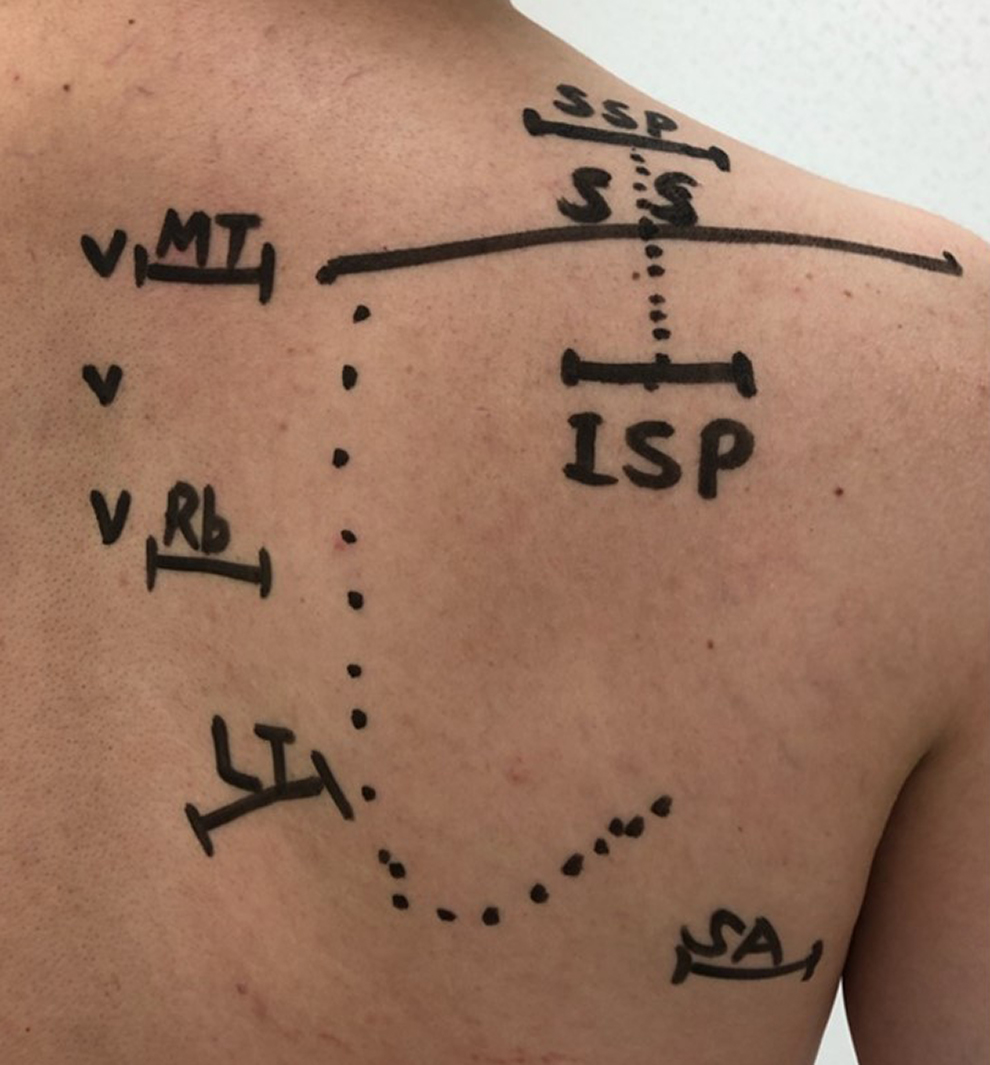
Points measured on ultrasound examination of the throwing shoulder. ISP, infraspinatus; LT, lower trapezius; MT, middle trapezius; Rb, rhomboideus; SA, serratus anterior; SS, spina scapula; SSP, supraspinatus; V, vertebral spinous process.

Assessment of shoulder muscle stiffness using shear wave elastography. Shown is an ultrasound image of the supraspinatus. A color-coded box showing the shear elastic modulus is superimposed on the B-mode ultrasound image.
Intrarater and Interrater Reliability
The assessment of the intrarater and interrater reliability for the ultrasound muscle elasticity measurements involved the 14 nonthrowing shoulders. The elasticity was measured independently by 2 investigators, experienced orthopaedic surgeons (Y.M. and A.I.), to assess interrater reliability. The measurements were repeated 3 times on 1 day by each investigator to assess intrarater reliability.
Statistical Analysis
Data are expressed as mean ± standard deviation. We evaluated the intrarater and interrater reliability using the Pearson correlation and intraclass correlation coefficient (ICC), respectively. ICC values were interpreted as slight (0-0.20), fair (0.21-0.40), moderate (0.41-0.60), substantial (0.61-0.80), and almost perfect (0.81-1.00) according to a previous study. 26 The USWE of the Aplio 500 (Toshiba Medical Systems Corporation), the ultrasound diagnostic device used in this study, was shown to have excellent intraobserver reliability (ICC, 0.97) and interobserver reliability (ICC, 0.98) in a phantom study. 36 We analyzed the sequential changes in the mean elasticity values of the respective muscles at the 3 time points using repeated-measures analysis of variance, followed by a post hoc analysis. Differences were considered statistically significant at P < .05. Statistical analysis was performed using PASW Statistics 18 software (SPSS Inc).
Results
Reliability of Ultrasound Findings for Each Muscle Elasticity
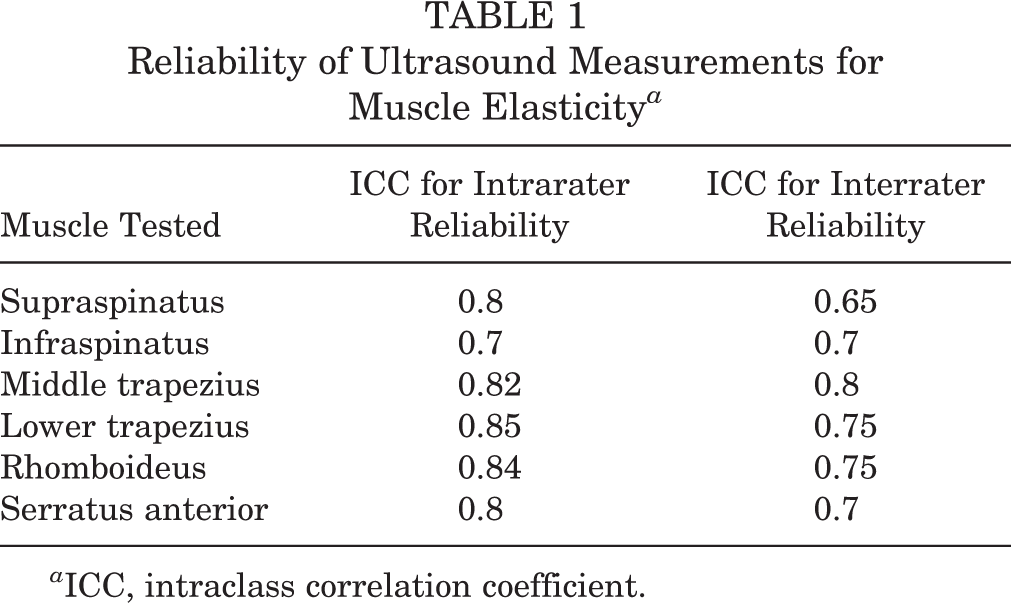
Table 1 shows the reliability values for the elasticity measurements of each muscle tested. The intrarater ICCs were 0.70 to 0.85, while the interrater ICCs were 0.65 to 0.80, indicating good reliability as defined. 26
Reliability of Ultrasound Measurements for Muscle Elasticity a
a ICC, intraclass correlation coefficient.
Ultrasound Findings
The mean elasticity values for the supraspinatus, infraspinatus, middle trapezius, lower trapezius, rhomboideus, and serratus anterior muscles at the 3 time points are shown in Table 2. The mean elasticity values for all of the muscles tested were significantly higher immediately after throwing than before throwing (P ≤ .0086 for all). While there was no significant difference in elasticity values for the supraspinatus, middle trapezius, rhomboideus, and serratus anterior 24 hours after throwing, elasticity in the infraspinatus and lower trapezius remained significantly higher 24 hours after throwing compared with before throwing (P ≤ .019).
Mean Elasticity Values for the Tested Muscles at the 3 Time Points a

a Values are presented as mean ± SD.
b Muscle elasticity is displayed in kPa, which is equivalent to 103 N/m2.
cP values are presented as before versus immediately after throwing; before versus 24 hours after throwing; and immediately after versus 24 hours after throwing. Bolded P values indicate a statistically significant difference between the times compared (P < .05).
Discussion
The primary results of this study indicated that pitching increased the stiffness of posterior shoulder muscles such as the infraspinatus and lower trapezius, even after 24 hours. To our knowledge, this is the first study to analyze the sequential changes in muscle elasticity in the shoulder girdle before and after pitching. In this study, we used USWE to evaluate muscle elasticity in the shoulder girdle before and after pitching. Shear wave velocity can be quantified using ultrafast algorithms to evaluate tissue composition and elasticity. 12 USWE has been reported to be superior to conventional ultrasound axial-strain elastography in terms of reproducibility and quantification. 18 Using this technology, we assessed the shoulder girdle muscle elasticity of throwing shoulders, with good intrarater and interrater reliability in the measurements, a finding consistent with those of previous studies. 20,39 In previous research using USWE, muscle stiffness increased immediately after exercises that resulted in muscle exhaustion and microdamage. 1,25 These reports suggested that USWE could be used as a noninvasive screening method to assess muscle stiffness and identify muscle fatigue and accumulated damage around the shoulder joint.
With regard to the effect of throwing on the lower trapezius, Escamilla and Andrews 13 reported that the lower trapezius is most active in the acceleration and deceleration phases during the throwing motion in baseball athletes. Throwing caused the muscular activities of the lower trapezius to increase during the acceleration phase to stabilize the scapula for the arm and during the deceleration phase to prevent excessive scapular protraction. The lower trapezius was reported to be the most important muscle as a scapular stabilizer. 21 Lower trapezius dysfunction could cause subacromial impingement in overhead athletes. 33
With regard to the effect of throwing on infraspinatus, Bailey et al 2 showed that decreased infraspinatus stiffness resulted in acute gains in shoulder ROM on the throwing side. A recent study showed that stretching was effective in increasing shoulder internal rotation and horizontal adduction ROM and in decreasing the muscle stiffness of the infraspinatus or teres minor muscle. 44 In addition, Mifune et al 27 reported that the elasticity of the infraspinatus and lower trapezius in baseball players who have shoulder ROM deficits was significantly greater than that of players who do not have ROM deficits. In the current study, the elasticity of the infraspinatus and lower trapezius remained significantly higher 24 hours after throwing than before throwing. The results indicated that repeated throwing places a greater load on the infraspinatus and lower trapezius in the shoulder girdle.
Our research showed that pitching immediately increased the stiffness of various muscles in the posterior and inferior shoulder and that the stiffness of the infraspinatus and lower trapezius remained even after 24 hours. Reinold et al 34 and Kibler et al 23 showed that the glenohumeral internal rotation is reduced immediately after pitching. While the current study did not evaluate the relationship between muscle stiffness and ROM deficits, the infraspinatus and lower trapezius may be associated with posterior shoulder tightness in consideration of the acute change of ROM and muscle stiffness due to throwing. These results indicated that the infraspinatus and lower trapezius could be key muscles in posterior shoulder tightness.
This study has several limitations. The first limitation is the nature of USWE and the difference among types of ultrasound equipment. To achieve reliable results, it has been reported to be important to place the probe parallel to the muscle fibers. 5,17 We considered that the probe should be placed in the longitudinal axis of each muscle, based on previous reports. 27,28,39 Second, we did not examine several items that could affect muscle elasticity, such as ROM, humeral torsion, posterior inferior glenohumeral ligament and capsule, and ball velocity and location in this study. Although we examined all participants in approximately the same shoulder position, the actual tension of the muscle varies with the amount of humeral torsion, which could be a potential confounder because the association between muscle stiffness and rotational range can be affected by torsion. 41 In addition, we evaluated not only pitchers but also fielders in this study. We evaluated experienced baseball players but not active players. The different throwing forms for pitchers and fielders and the difference in frequency of playing baseball may have influenced the results. Future studies should evaluate active pitchers and the relationships between muscle elasticity and ball velocity and pitch location.
Conclusion
This study used quantitative analysis to determine the sequential changes in muscle elasticity in the posterior shoulder via USWE. Our results suggested that pitching significantly and immediately increased the stiffness of all muscles in the posterior shoulder, with the stiffness of the infraspinatus and lower trapezius increasing even after 24 hours.
Footnotes

Final revision submitted January 10, 2021; accepted February 23, 2021.
The authors declared that there are no conflicts of interest in the authorship and publication of this contribution. AOSSM checks author disclosures against the Open Payments Database (OPD). AOSSM has not conducted an independent investigation on the OPD and disclaims any liability or responsibility relating thereto.
Ethical approval for this study was obtained from Kobe University Graduate School of Health Sciences.