




Abstract
Background:
Professional rodeo is a sport with a high risk of injuries for which research is needed to support interventions. To date, there have been no epidemiological studies performed specifically on hip conditions sustained during rodeo.
Purpose:
To describe the epidemiology of hip conditions in professional rodeo.
Study Design:
Case series; Level of evidence, 4.
Methods:
Deidentified hip injury data from electronic medical records of the Justin Sportsmedicine Team from 2011 to 2014 were analyzed for risk, frequency, type, location, and mechanism, as well as activity phase, of hip injuries.
Results:
A total of 84 hip injuries among 82 adult male and female athletes were reported, resulting in an overall hip injury density of 0.41 injuries per 1000 competitor-exposures (95% CI, 0.0003-0.0005) and a risk probability of 0.04%. Rough stock athletes sustained 83.3% of hip injuries, with bull riders sustaining 50.0
Conclusion:
Rough stock athletes have the greatest risk for hip injury in professional rodeo, with bull riders sustaining the most hip injuries. Athletes are most likely to be injured during the dismount. Common hip injuries in professional rodeo are contusions, impingement, and strains. The majority of contusions result from collision with the ground. Applicable measures to prevent or reduce the severity of injuries to the hip, such as protective padding, proprioceptive training, and eccentric strength training, should be implemented.
Professional rodeo is a fast-paced, erratic sport with an inevitably high risk of injuries. 2,5,8 The majority of rodeo events start and stop within seconds, but they require extreme physical and athletic ability. Concentration, quick reactions, and strength are essential components in the world of professional rodeo—no different from other intermittent-activity sports, such as football or power lifting. The maximal aerobic capacity of male rodeo athletes is comparable with that of other elite anaerobic athletes, such as Major League Baseball and Olympic basketball, water polo, volleyball, and gymnastic athletes. 13
Although by many accounts comparable with traditional sports, rodeo presents the unique challenge of competing with or against an animal with extraordinary power and unpredictability. Rough stock events (bull riding, saddle bronc riding, and bareback riding) yield the greatest incidence of injury, of which bull riding is the most injurious and bareback has the second highest injury rate. 2,5,8,16 The most commonly reported injuries are sprains/strains and contusions, comprising 16% to 35% and 22% to 42%, respectively. 2,12 A direct correlation between level of experience and rate of injury is seen in rodeo, with experienced riders having a higher rate of injury than that of inexperienced riders, which may relate to the increased aggressiveness of the animals ridden by professional athletes. 3
There is little research on hip injuries in rodeo. Previous studies have identified hip injuries as comprising 6% to 10% of professional rodeo-related injuries. 2,17 These rates are comparable with the rates of hip injuries seen in men’s ice hockey (9%) 11 and men’s soccer (14%). 9
The hip region encompasses the center of gravity and serves as a major force generator. 1 It is responsible for maintaining a rider’s position on the animal in rough stock events and providing stability as the rider transitions from mounted to dismounted. The dynamic stability and extensive range of motion required of the hip region leave the athlete predisposed to a number of injuries to the area. The purpose of this study was to describe the epidemiology of hip injuries reported by the Justin Sportsmedicine Team (JST) in the Professional Rodeo Cowboys Association (PRCA) between 2011 and 2014.
Methods
Data Collection
The study was approved by the University of Colorado Colorado Springs' institutional review board.The JST, consisting of a group of health care professionals, primarily athletic trainers and physicians, provides medical services at approximately 125 PRCA rodeos across the United States (the PRCA sanctions approximately 500 rodeos each year). Deidentified injury reports provided by JST were utilized in this study. Hip injury data from the 2011 to 2014 electronic medical records of the JST were included in the study. Exclusion criteria consisted of injuries sustained to PRCA nonathlete staff (ie, bullfighters) and reaggravations of preexisting conditions. Symptomatic hip impingement and/or labral tears that had been initially evaluated were included as injuries in the study to determine the occurrence within the sport. A total of 82 adult male and female PRCA athletes and 84 total hip injuries were included in this study.
Definitions
The following terms were used in this study:
Competitor-exposure: A reportable competitor-exposure (CE) was defined as 1 athlete participating in 1 PRCA-sanctioned rodeo event in which he or she was exposed to the possibility of injury by entering the rodeo arena with the intent of being scored or timed.
Rough stock event: In rodeo, saddle bronc, bareback riding, and bull riding constitute rough stock events where athletes try to remain on the animal for 8 seconds.
Timed event: In rodeo, steer wrestling, tie-down roping, team roping, and barrels constitute timed events where the athletes are timed to the successful completion of their event.
Activity phase: The activity phase at the athlete’s time of injury was defined as happening (1) in the chute/box, (2) during the ride, (3) during the dismount, (4) while throwing/tying the animal, or (5) outside of the event or as (6) unknown.
Chute/box: An athlete is considered “in the chute/box” from the time of prepping for the ride through the mark-out.
Dismount: Dismount is defined as exiting the animal, whether under one’s own volition or not.
Throwing/tying the animal: The point in the event when a steer wrestler leaves one’s horse to wrestle the steer to the ground, a team roper or tie-down roper is roping the animal, or a tie-down roper is off one’s horse and tying the legs of the calf.
Outside of the event: This is an injury that occurs to a rodeo athlete under circumstances other than during competition.
Eccentric load: This is an injury mechanism that consists of an eccentric contraction, tension force, or straining force.
Hung up: Hung up is an injury mechanism by which an athlete’s appendage or equipment is caught on any part of equipment attached to the animal.
Data Analysis
The data were analyzed using IBM SPSS Statistics Version 24 (IBM Corp) and Microsoft Excel 2016 (Microsoft Corp) software to assess risk and patterns of hip injury sustained during professional rodeo between 2011 and 2014. Frequency analysis was conducted on the data grouped by rodeo event, injury type, mechanism of injury, and activity phase. The analysis included injury density (number of injuries per 1000 CEs) in addition to risk probability.
Results
Hip Injury Risk Probability and Frequency by Event
Of the 109 hip records extracted from the electronic medical record, a total of 84 reported injuries were included in this study. This number includes both incidents that occurred at PRCA rodeos with JST coverage and reported injuries that occurred previously at non-PRCA rodeos but were then evaluated by JST at a later date. Rough stock athletes accounted for 83.3% of all hip injuries. Bull riding accounted for half of all of the hip injuries (50%). The women’s event of barrel racing only accounted for 3.6% of the hip injuries. There was no notable difference in percentage of injuries among steer wrestling and tie-down roping (7% and 6%, respectively). Frequency of injury by event can be seen in Table 1.
Professional Rodeo Athlete Hip Injury Frequency and Risk Probability by Event a

a NA, not applicable.
b Injury frequency of all hip injuries reported by Justin Sportsmedicine Team (JST) from 2011 to 2014 (N = 84).
c Risk probability calculated only from injuries that occurred at Professional Rodeo Cowboys Association rodeos with JST coverage from 2011 to 2014, excluding barrel racing because of lack of exposure data.
Analysis of risk was calculated solely from hip injuries sustained during PRCA rodeos with JST coverage to allow capture of CEs. A total of 57 injuries from 139,098 CEs from 507 rodeos between 2011 and 2014 were included in the risk analysis. Hip injuries sustained during barrel racing were not included in risk analysis because of the unavailability of exposure data from the women’s rodeo governing body, which is separate from the PRCA. The overall hip injury incidence was 0.41 injuries per 1000 CEs (95% CI, 0.0003-0.0005), resulting in an overall risk probability of 0.04%.
Injury Type
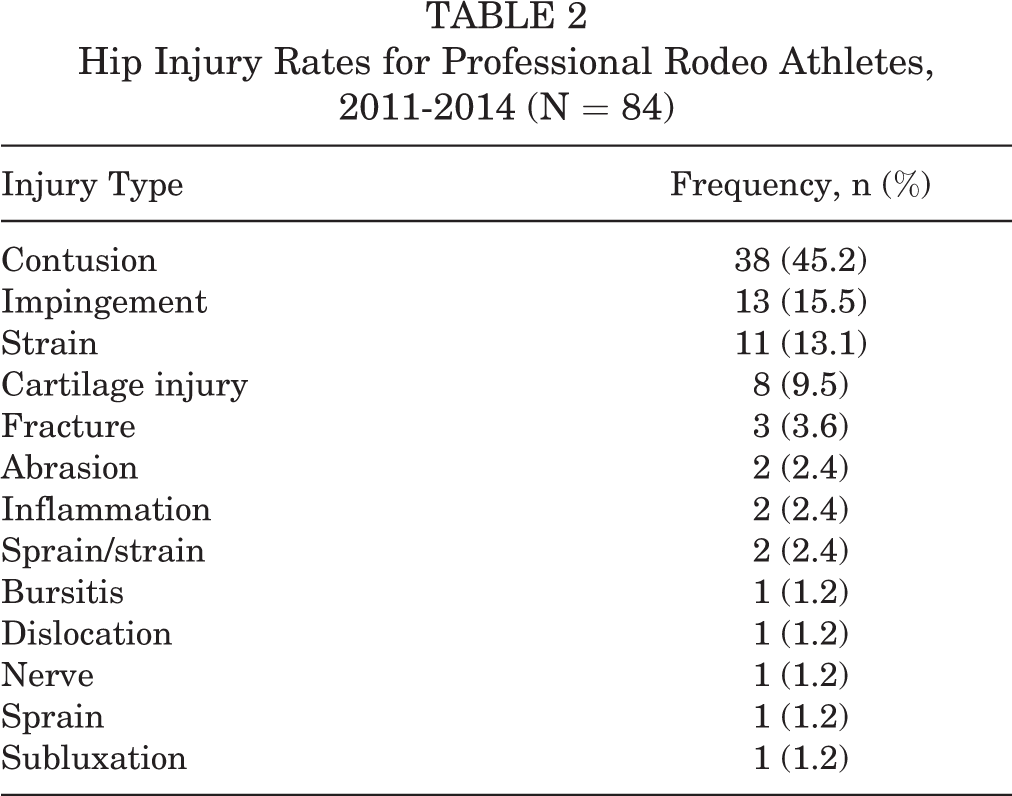
The type of hip injuries reported between 2011 and 2014 can be found in Table 2. The most common hip injuries were contusions (45.2%, n = 38), impingement (15.5%, n = 13), and strains (13.1%, n = 11). During timed events, contusions to various locations of the hip region and muscle strains accounted for 42.9% (n = 6) and 21.4% (n = 3), respectively, of the hip injuries sustained. Despite the high-risk nature of the sport, hip fractures, dislocations, and subluxations (n = 3, n = 1, and n = 1, respectively) comprised only 6.0% of the overall hip injuries and were all sustained during rough stock events.
Hip Injury Rates for Professional Rodeo Athletes, 2011-2014 (N = 84)
Injury Mechanism
Table 3 demonstrates the mechanism of injury by rodeo event. The most common hip injury mechanism in professional rodeo was colliding with the ground (36.9%, n = 31). Combined, 65.5% of hip injuries were the result of contact, be it with the ground, an animal (n = 18), or some component of the arena (ie, chute, gate, fence, or wall; n = 6). Notably, 23.8% (n = 20) of hip injuries had no known mechanism of injury, with the majority of unknown mechanisms of injury presented by the bull riders (n = 10). Of the various events, bull and bareback riding (n = 7) had the highest prevalence of injuries as a result of an eccentric loading mechanism. The resulting injuries by the injury mechanism can be seen in Table 4.
Frequency of Hip Injury Mechanism by Event in Professional Rodeo, 2011-2014 (N = 84) a

a Data are presented as n (%).
Hip Injury Frequency Among Professional Rodeo Athletes by Injury Mechanism (N = 84) a

a Data are presented as n (%).
b Includes infrequent injuries: abrasions, bursitis, hip dislocation, inflammation, nerve, sprain/strain, and subluxation.
Phase of Activity When Injured
When considering the phase of activity when injured (Table 5), an athlete was most likely to sustain a hip injury during the dismount (35.7%, n = 30) and least likely while throwing or tying an animal (1.2%, n = 1). Bull riders sustained more hip injuries during the dismount than did bareback and saddle bronc riders combined (n = 18, n = 5, and n = 5, respectively). The second highest incidence of injury (29.8%, n = 25) occurred while the athlete was in the chute or box. Not surprisingly, contusions were sustained across the phases of activity, as noted in Table 6.
Frequency of Injury During Phase of Activity During Professional Rodeo by Event, 2011-2014 (N = 84) a

a Data are presented as n (%).
Hip Injury Frequency Among Professional Rodeo Athletes by Activity Phase, 2011-2014 a

a Data are presented as n (%).
b Includes infrequent injuries: abrasions, bursitis, hip dislocation, inflammation, nerve, sprain/strain, and subluxation.
c Occurrence of injury not related to the athlete’s competition in the event; may have occurred while assisting another athlete, on the rodeo grounds, or away from the rodeo.
Discussion
This study examined the descriptive epidemiology of hip conditions among PRCA rodeo athletes. Sinclair Elder et al 17 reported the hip as the sixth most injured body region in professional rodeo but with a much smaller occurrence than shoulder, knee, and neurological injuries. To our knowledge, the current study includes the largest sample of professional rodeo hip injuries to date and is the first of its kind looking at hip injuries specifically. The intention was to create a platform to better understand the incidence and mechanism of professional rodeo hip injuries that would inevitably lead to the development of injury mitigation protocols and programs among sports medicine professionals. No different from injury rehabilitation interventions for any other organized sport, this analysis could result in performance enhancement and potentially elongate an athlete’s professional rodeo career.
Event Type
In professional rodeo, the greatest number of hip injuries occurred during bull riding, bareback, and saddle bronc. This is comparable with previous studies of rodeo injuries overall. 2,8,16,17 It would be reasonable to suggest that this is largely the result of the nature of the animals with which these athletes are working and competing. The degree of eccentric contractions about the hip complex required for the athlete to overcome the rotational and whipping maneuvers of the animal, as well as the high prevalence of premature dismounts, could explain this persistently high injury rate.
Injury Type, Mechanism, and Activity Phase
Contusions were the most common hip injury seen in this study. The majority of the contusions were the result of the athlete’s colliding with the ground and the arena fence or chute (65.8%) versus coming in contact with the animal (26.3%). Collisions with the ground resulted in 36.9% of the hip injuries, which can be largely attributed to unanticipated or uncontrolled dismounts from the animal. Although athletes are practiced in safe dismounting, being thrown unexpectedly from an animal at high speeds undoubtedly inhibits an athlete’s ability to brace oneself and employ proper landing mechanics. The incidence of hip contusions in this study is greater than that seen in the National Football League 10 and the National Collegiate Athletic Association men’s ice hockey. 6 Our findings suggest that considerations should be made to decrease the incidence or severity of contusions about the hip, such as padded adhesive tape, self-adhesive foam, and padded compression shorts.
In our study, 53.8% of the hip impingement cases were sustained while the athlete was in the chute or box waiting to be released into the arena and 23.1% while roping or riding (Table 6). The traditional hip impingement position (flexion, adduction, internal rotation) often provokes groin pain. 15 However, evidence has shown that greater hip flexion combined with pelvic tilt can accelerate the occurrence of impingement. 14
While the rodeo athlete is in more of an abducted position while in the chute or box, in some events, such as bull riding, the athlete is also in an anterior pelvic tilt position with increased hip flexion to strategically position his or her center of gravity for a successful ride. Although the brief time spent in the chute or box is not the only mechanism for the hip impingement, it is likely that a rodeo athlete with hip impingement would experience pain repeatedly, if not consistently, during this phase, which would lead to reports of hip pain.
Of the hip impingement cases reported to have occurred during the phase of the actual ride or roping activity, where the athlete actively flexes and extends their hips into terminal ranges while spurring, the extreme flexion in combination with potential anterior pelvic tilt may be a contributing factor of impingment in this phase. 14 In addition, the repetitive terminal hip flexion movement pattern over time can also lead to hip complex muscle imbalances, which can have a reinforcing effect on hip impingement, as well as other conditions. 4,7 It is not surprising that the number of hip cartilage injuries in this study (n = 8) was similar to the number of reported hip impingement cases (n = 13), as hip impingement results in the breakdown of the labrum and articular cartilage within the joint due to increased forces during sporting activities. 4 Conservative management of hip impingement requires the athlete to reduce or eliminate aggravating activities. Individuals with symptomatic femoroacetabular impingement have demonstrated altered coordination of deep hip muscles during ambulation, which could be problematic for the rodeo athlete. 7 While it is difficult to get a rodeo athlete to reduce the aggravating activity that is their sport, a rehabilitation program focused on correcting hip muscle inhibition and imbalances, as well as neutral to slightly posterior pelvic tilt, may be beneficial for those with hip impingement in optimizing the position of the femoral head within the acetabulum, as well as reducing pain due to secondary complications.
Muscle strains about the hip were most likely the result of eccentric loading or colliding with the ground. Proper landing mechanics requires maximal eccentric contraction about the hip to absorb the ground-reaction forces, stabilize the lower extremity, and prevent the body from hitting the ground. Hip torque increases substantially with increased landing height. 18 Understanding the mechanism behind hip muscle strains among rodeo athletes provides direction for strength and conditioning programs. Our findings indicate that rodeo athletes may benefit from incorporating eccentric hip strength training into their preexisting strengthening regimens.
The relatively low rate of hip dislocations, fractures, and subluxations (6.0%) is unique to this study’s focus on professional rodeo injuries about the hip region, as it is not reflective of overall rodeo injury rates in previous studies. In 2002, Butterwick et al 2 identified that dislocations, fractures, and subluxations composed 16% of injuries overall. Our findings are more comparable with those seen in the National Football League (3%). 10 This lower frequency of dislocations, fractures, and subluxations to the hip, specifically, can be attributed to the strength provided by the depth of the hip joint as well as the complexity of the musculotendinous and ligamentous systems to withstand excessive tensile and compressive forces. It may also be speculated that as the physicality of the sport of rodeo has progressed, fitness levels of the athletes, along with training for their sport, anecdotally have also improved; this enhanced fitness and training may be improving reactions that are decreasing the risk of fracture. Future research of this decrease would be of interest.
Table 3 illustrates that 23.8% of all reported hip injuries had an unknown mechanism of injury. There are a multitude of reasons for this statistic, including underreporting of injuries by rodeo athletes, difficulty of the athlete in identifying onset of symptoms, and the fast pace of the sport preventing an athlete from becoming aware of an injury until after the completion of his or her event. JST coverage of rodeo events goes beyond the immediate response of medical emergencies within the arena. The JST provides an invaluable resource to PRCA rodeo athletes who may not otherwise have access to sports-minded medical professionals for treatment and guidance on proper care for acute and chronic conditions. When possible, proper reporting of all injuries only advances the support and care provided to rodeo athletes by sports medicine professionals.
Limitations
The authors recognize that there are limitations to the data collection used in this study. It is difficult to determine how many athletes were participating in rodeo at any given time during the course of the study period, which resulted in the inability to determine hip injury prevalence in the sport. Many diagnoses may have been based on clinical examination alone and did not have diagnostic imaging performed, although some were confirmed via follow-up imaging. The JST is also not able to track time loss due to injury for most athletes, minimizing the ability to categorize severity of injury. Additionally, variance within the JST medical staff providing medical care at rodeos across the country may provide opportunities for inconsistencies in evaluation techniques and injury diagnoses. Furthermore, the culture among cowboys in professional rodeo may lead to gross underreporting of injuries, therefore preventing JST from capturing a more accurate account of rodeo-related athletic injuries.
This study provided awareness of risk, frequency, type, mechanism, and activity phase and time of hip injury in rodeo. Future studies should focus on risk of reinjury to the hip; baseline measurements of hip strength and range of motion; and efficacy of injury prevention strengthening programs, protective equipment, and proprioception training. Additionally, efforts to understand hip impingement in the sport are warranted. Combined, these efforts have the potential to increase rodeo athletes’ professional careers by decreasing the rate and severity of rodeo-related injuries.
Conclusion
Common hip injuries in professional rodeo were contusions, impingement, and strains. Rough stock athletes sustained more hip injuries than did timed-event athletes, with bull riders, specifically, sustaining the most hip injuries among rodeo athletes. It was during the dismount and while in the chute or box that an athlete was most likely to injure his or her hip. The majority of contusions were the result of colliding with the ground. Eccentric forces, as a result of the dismount or eccentric loading by an animal, were the most common cause of muscle strains to the hip complex. This variety of hip conditions seen across the events and across the phases of activity make injury prevention even more challenging for the health care team.
Footnotes
Acknowledgment
The authors thank Rick Foster and Mike Rich of the Justin Sportsmedicine Team and the Professional Rodeo Cowboys Association for providing the data for analysis.
Final revision submitted April 22, 2020; accepted May 8, 2020.
One or more of the authors has declared the following potential conflict of interest or source of funding: A.J.S.E. is a volunteer associate and research coordinator for the Justin Sportsmedicine Team. AOSSM checks author disclosures against the Open Payments Database (OPD). AOSSM has not conducted an independent investigation on the OPD and disclaims any liability or responsibility relating thereto.
Ethical approval for this study was obtained from the University of Colorado Colorado Springs (protocol No. 2020-062).