



Abstract
Background
Despite overuse injuries being previously described as the most frequent in ballet, there are no studies on professional dancers providing the specific clinical diagnoses or type of injury based on the discipline.
Hypothesis
Overuse injuries are the most frequent injuries in ballet, with differences in the type and frequency of injuries based on discipline.
Study Design
Cross-sectional study; Level of evidence, 3.
Methods
This was a descriptive cross-sectional study performed between January 1, 2005, and October 10, 2010, on injuries occurring in professional dancers from leading Spanish dance companies who practiced disciplines such as classical, neoclassical, contemporary, and Spanish ballet. Data, including type of injury, were obtained from specialized medical services at the Trauma Service, Fremap, Madrid, Spain.
Results
A total of 486 injuries were evaluated, a significant number of which were overuse disorders (P < .0001), especially in the most technically demanding discipline of classical ballet (82.60%). Injuries were more frequent among female dancers (75.90%) and classical ballet (83.60%). A statistically significant prevalence of patellofemoral pain syndrome was found in the classical discipline (P = .007). Injuries of the adductor muscles of the thigh (P = .001) and of the low back facet (P = .02) in the Spanish ballet discipline and lateral snapping hip (P = .02) in classical and Spanish ballet disciplines were significant.
Conclusion
Overuse injuries were the most frequent injuries among the professional dancers included in this study. The prevalence of injuries was greater for the most technically demanding discipline (classical ballet) as well as for women. Patellofemoral pain syndrome was the most prevalent overuse injury, followed by Achilles tendinopathy, patellar tendinopathy, and mechanical low back pain.
Clinical Relevance
Specific clinical diagnoses and injury-based differences between the disciplines are a key factor in ballet.
Currently in Spain, the disciplines in ballet consist of classical, neoclassical, contemporary, and the leading discipline, Spanish ballet. These 4 disciplines are founded in the knowledge and performance of classical ballet. Nevertheless, they have technical differences. 31,41,42 Classical ballet is the most structured discipline with the highest technical requirements, hence the characteristic use of pointe shoes by female dancers and half-pointe shoes by both male and female dancers. When performing on both pointe and half-pointe, dancers must perform a relevé, a key technical gesture in which dancers modify the part of the foot bearing weight, ranging from the whole foot flat on the floor to the forefoot (half-pointe) or even the tips of the toes (pointe). In contemporary ballet, there is greater freedom of movement, with fewer rules. Both males and females commonly dance on half-pointe or barefooted. Neoclassical ballet is midway between the well-structured classical ballet and the freedom of contemporary ballet, thus allowing dancing with ballet shoes or barefooted. Spanish ballet has the structure of classical ballet blended with Spanish folklore, with the bolero school or the Spanish classical dance predominant variables that include faster movements and more frequent jumps than classical ballet. 41 Shoes with a higher heel are used in Spanish dance, and a “heeling” technique is used in some performances.
These technical features influence the type of injuries and sex of those injured, with higher technical requirements for women and higher athletic requirements for men. 29,41
In ballet, as in other sports, there are 2 types of musculoskeletal injuries: traumatic injuries with acute features and nontraumatic overuse injuries. 43 It is essential to understand the biomechanical requirements of ballet and the pathophysiology of overuse injuries for optimal treatment of ballet injuries. 41
Overuse injuries in ballet occur as a consequence of pathomechanics when executing different exercises. 41 Additionally, sex and the presence of various individual or environmental risk factors predispose dancers to overuse injuries. Anatomic variations, lower limb alignment, and inadequately treated prior injuries are predisposing risk factors for injuries. Environmental risk factors include changes of choreography, harder floor, and increased workload after prolonged inactivity or periods of lower workload. ¶ In addition to these risk factors, good physical conditioning and good technique are important for injury prevention.
The purpose of this study was to determine the prevalence of overuse injuries in professional ballet, as well as injury-based differences among the ballet disciplines in Spain.
Methods
This descriptive cross-sectional study, performed between January 2005 and October 2010, focused on injuries in professional dancers who performed ballet’s most popular disciplines in Spain: classical, neoclassical, contemporary, and Spanish dance. Data for this study were obtained through the Traumatology Service at Fremap Madrid, mutual insurance company No. 61 for labor accidents and occupational illnesses.
Variables Evaluated
The variables evaluated were classified as quantitative (age and years of professional dancing) and qualitative (sex, discipline, pathogenesis of the injury, injury site, affected tissue, clinical diagnosis). In the present study, each injury was considered a dependant variable because there were dancers who suffered more than 1 injury. Consequently, the parameters were analyzed based on the number of injuries reported and not on the number of dancers.
Statistical Analysis
Statistical analysis was performed using SPSS (v17; IBM Corp). Qualitative variables were described according to frequency distribution with percentages. Quantitative variables were described using the mean and standard deviation. Homogeneity or independence among qualitative variables was carried out using the Pearson χ2 test and Fisher exact test. Linear association between 2 qualitative variables was carried out using the Pearson correlation coefficient, and nonlinear association was performed using the Spearman rank correlation coefficient. Mean comparisons between independent groups were performed using the Student t test or the Welch approximate t test, depending on how homogeneous or heterogeneous variances were (determined by the Levene test), and Mann-Whitney U test if data did not follow normal rules or were from small population samples. The null hypothesis was rejected when the associated P value was ≤.05, considering in this case our findings to bear conventional statistical significance.
Results
Data obtained from the study can be found in Figures 1 and 2, as well as Table 1. There was a significant increase in overuse injuries (P < .0001) with respect to other injuries, and injuries were slightly more common in female dancers compared with males. There was a slightly higher prevalence for overuse injuries among female classical ballet dancers and male contemporary dancers when studying differences based on disciplines and sex. Likewise, a higher prevalence of overuse injuries was established for classical ballet. Values for the sample related to age and years of experience (Table 2) were slightly higher for women.

Sample distribution by number of dancers per discipline and sex.
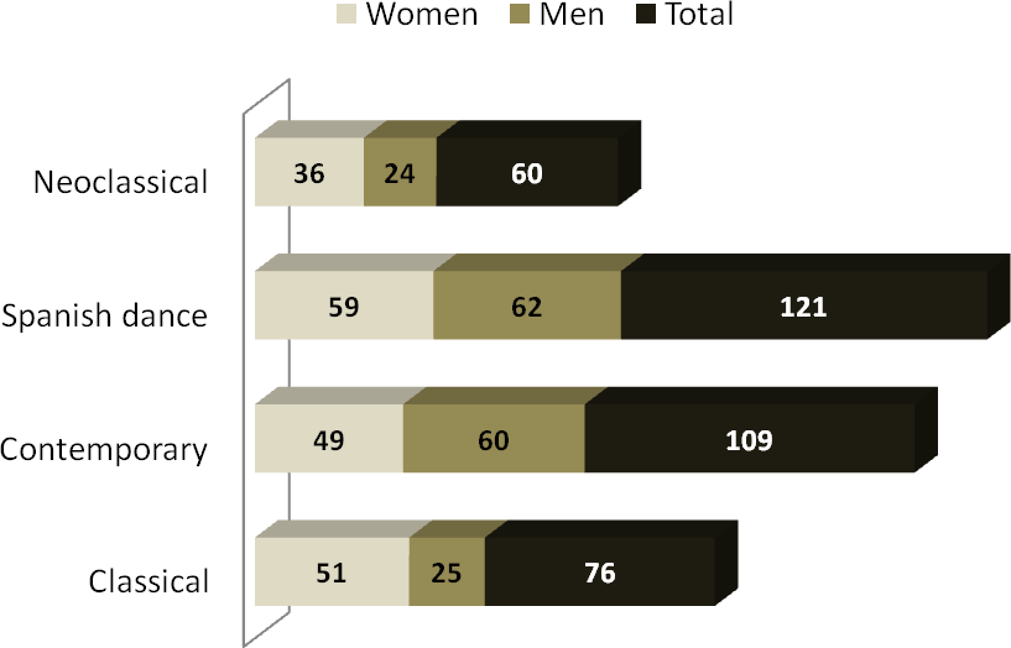
Sample distribution according to the number of injuries per discipline and sex.
Prevalence of Injuries Based on Pathogenesis

Patient Age and Years of Experience a

a Results are reported as mean ± SD.
Patellofemoral syndrome (PF Sd) was the most prevalent overuse injury, being predominant among both sexes (P = .01). Rotator cuff injuries, subachromial syndrome (P = .01), and mechanical overload of the metatarsophalangeal joint of the first toe (MTTF 1) (P = .02) were most common among men, while stress fractures of the base of the second metatarsal (Fx stress 2) (P = .01), collective joint injuries of the hip (P = .01), mechanical overuse injuries of the Lisfranc joint (P = .03), and overuse injuries of the cervical muscles (P = .02) were most common among women.
By discipline (Table 3), the most common injuries were PF Sd (P = .007) in classical ballet, injuries of the adductor muscles of the thigh (P = .001) and low back facet syndrome (P = .02) in Spanish ballet, lateral snapping hip (P = .02) in classical and Spanish ballet, mechanical low back pain in contemporary ballet, and PF Sd in neoclassical ballet.
Distribution of Overuse Injuries by Discipline and Sex a

a F, female; Fx stress 2, stress fractures of the base of the second metatarsal; M, male; MTTF 1, metatarsophalangeal joint of the first toe; PF Sd, patellofemoral syndrome.
When data were analyzed by discipline and sex, there was a significantly higher prevalence of patellar tendinopathy among women in classical and Spanish ballet (P = .04), lumbar disc diseases and mechanical low back pain (P = .01) among men in Spanish and contemporary ballet, overuse injuries of the adductor muscles in Spanish ballet for both sexes (P = .04 for women, P = .005 for men), and dorsal paraspinal muscles among women in Spanish ballet (P = .002).
Discussion
The literature regarding ballet injuries 21 includes heterogeneous cohorts, nonspecific diagnoses, and data collected with poor methodology, including patient surveys. However, there are some studies that accurately document the history and physical examination, 3,9,15,29,33,39 which improves the scientific rigor of these studies. Even so, it is difficult to find research studies documenting the prevalence of overuse injuries in professional ballet, 6 despite indications that overuse injuries are the most common. 2,9,21,29,34
Similar to other research, sex-based differences were found in this study, 29 with the number of overuse injuries being higher in women than men. 3
With regard to injury differences based on ballet discipline, although some studies found differences between classical and modern or contemporary disciplines and less with Spanish dance, 13,21 they usually do so by making reference to a clinical entity or anatomic site. 26,31 In the present study, classical ballet, a more restricted discipline, had a higher prevalence of overuse injuries, followed by Spanish dance, neoclassical, and contemporary—disciplines that have fewer rules and technical constraints.
Injury rates among disciplines are even more obvious among female dancers, who usually have higher technical requirements. The highest number of overuse injuries appears in rehearsals, whenever there are changes in choreography, 8,26,42 and situations where technical gestures must be repeated until perfection is achieved. The repetitiveness of movement or lack of adequate rest periods in between these repetitions may contribute to the significant prevalence of overuse injuries in ballet.
Male contemporary ballet dancers have the second highest prevalence of overuse injuries, the first highest prevalence being among female classical ballet dancers. The injuries in males are often associated with mechanical overload, especially in contemporary ballet, as opposed to overuse injuries in female classical ballet.
The demands of the more technical disciplines (classical and Spanish ballet) may cause uncompensated movements in less gifted dancers, which result in overuse injuries. This is precisely what happens to dancers who try to increase a naturally restricted turn out at an early stage. Increased pronation may contribute to overuse injuries from prolonged exposure to specific technical gestures such as pointe among women, portées among men, or, as a whole, pliés or cambrées among others.
Specific overuse injuries by mechanical overload in contemporary ballet are directly related to the athletic demands, footwear, and greater twisting and forced postures that are beyond the body’s center of gravity. Spanish ballet, which has the structure of classical ballet blended with Spanish folklore, requires fast, repetitive twisting movements that may cause injuries by mechanical overload. There are significantly fewer injuries in neoclassical ballet due to the fact that it is an intermediate discipline between the technical and athletic requirements of the other disciplines.
Despite the methodological weakness in the literature on this subject, there are some studies that document overuse injuries in ballet. The most common overuse injury in our study, patellofemoral pain syndrome, or anterior knee pain, is caused by decompensating mechanisms that increase a naturally restricted turn out. 38,41 Some authors have stated that this is probably the most frequent condition in all of sports 24 as well as being the most common problem in ballet. 37,40 Numerous studies mention the pathomechanical factors that are associated with patellofemoral pain syndrome. 10,41 In the present study, a diagnosis of PF Sd was made after ruling out other causes of anterior knee pain, including patellar tendinopathy, a condition described in some studies 34 as being the most prevalent pathology in the knees of ballet dancers.
Mechanical low back pain is more frequent in the athletic disciplines, such as contemporary ballet, and related disorders of the mobile segment of spine biomechanics. 41 Decompensating mechanisms in turn out (en dehors), together with extension movements of the trunk when performing arabesques and cambreés, cause an anterior pelvic tilt increasing lumbar lordosis, which overloads the posterior elements and plays an important role in development of low back pain. These technical gestures are also responsible for cervical and even thoracic back pain—both considered common aches among Flamenco dancers. 23,30
The prevalence of low back pain in Spanish ballet in this study (15.3%) is similar to that mentioned in other studies 13 ; however, in general, the prevalence of lower back pain in this study is well below that found by other authors using patient surveys (70% to 80%). 12
In the present study, the snapping hip, especially the lateral snap as opposed to the anterior snap, was more common among women who performed technically demanding disciplines such as classical ballet. As has been mentioned for other pathologies, forced external rotation of the full kinetic chain in the lower limbs may cause snapping hip. 27,28,32,36 Although some surveys indicate a prevalence of up to 91% for snapping hip, 46 our results, derived from physical examination, are similar to those found in other studies. 14,42
Among ankle overuse injuries, Achilles tendinopathy was the most frequent in ballet, which demands, to a large degree, jumping and running movements. The prevalence in the present study was similar to that found by other authors. 20,45
In the foot, mechanical overload of the first MTTF joint caused by repetitive dorsal flexion of the first toe, an essential movement for the relevé technique, 16 was more frequent among male dancers and in contemporary ballet. Hallucis longus flexor tendinopathy was found as an isolated injury and associated with os trigonum syndrome. 7,22 It was more prevalent in a study of German dance companies. 3 Most authors have found that Fx stress 2 are most common in ballet dancers. 35 This overuse injury is more common in women and classical ballet due to the use of pointe shoes. 11 There are fewer stress fractures in the present study compared with that of Albisetti et al. 1
The prevalence of overuse injuries in the present study demonstrates the necessity of establishing preventive measures in ballet. 41 Enhancing training in ballet schools and specialized medical teams, including physicians, trainers, and physical therapists, could avoid or reduce the high prevalence of injuries in ballet. Preventive measures should be the subject of much needed rigorous scientific research.
Conclusion
Overuse injuries were most frequent among the professional dancers included in our study. The prevalence of these injuries was higher for the most technical disciplines (classical ballet) and among women. Pathologies showing the highest prevalence were, in order, patellofemoral syndrome, Achilles tendinopathy, patellar tendinopathy, and mechanical low back pain. Patellofemoral syndrome was more frequent among women, and Achilles tendinopathy among men. In classical and neoclassical ballet, the patellofemoral joint was the most prevalent injury site, while in contemporary and Spanish ballet, it was the disorders of the low back. Classical ballet, the most structured discipline with the most regulated technique, proved to have the highest prevalence for overuse injuries, followed, in order, by, Spanish ballet, neoclassical, and comtemporary ballet—disciplines with progressively lower levels of rules and technical constraints.
Footnotes
The authors declared that they have no conflicts of interest in the authorship and publication of this contribution.