




Abstract
Introduction:
With its numerous practical applications, the usage of nanotechnology in the medical profession has been a godsend in our modern technological era. Titanium dioxide (TiO2) is a semiconducting metal oxide with superior inherent qualities which can be utilized in various applications across various fields. Taking into account all of the above information, the current study focused on the mechanism of action of TiO2 nanoparticles mediated by clove and ginger herbal formulations against Lactobacillus species.
Materials and Methods:
Extract of clove and ginger herbal formulation-mediated TiO2 nanoparticles was obtained with acetone in the ratio of 10:1, yielding 9 mg/mL. After overnight incubation and further serial dilutions, the solution was introduced into microplate wells with cultured Lactobacillus species for 4 hours. A 5% of test solution was added into Kimble tubes containing Muller-Hinton broth along with the plant extract, followed by recording of minimum inhibitory concentrations at certain time intervals. The number of samples used for each concentration was 4 using the convenience method. The grouping sample was 3, i.e. test group, antibiotic and positive control group. The results were statistically analysed following one-way analysis of variances using SPSS software version 22.
Result:
Optical density determines the degree of scattering of light that is produced by a bacterium within a culture plate. The more the bacteria, the more the light is scattered. The results (P < .005) show that as the concentration increases, the value of optical density decreases which proves that there occurs a bactericidal process that results in the reduced bacterial count.
Conclusion:
The results of this study suggest that TiO2 nanoparticles enhanced with clove and ginger might be used as an antibacterial agent against Lactobacillus species.
Introduction
The use of nanotechnology in the medical field has been a blessing in our current technological era because of its many practical uses. This is primarily because its particle size varies from 1 to 100 m, giving it a physicochemical feature that permits it to be used in medicinal applications. 1 As a result of this property, nanoparticles (NPs) have been proved to have a deep ability to be used in nanoscales, allowing them to be used in a range of applications. 2
Plant extract-mediated NP synthesis is cost-effective and also beneficial towards developing cleaner technologies that are environmentally friendly and sustainable. 3 Due to their tiny size, dispersion and form, NPs have a high-surface-to-volume ratio that makes them ideal for molecular synergy. 4 Nanoparticle synthesized through green technology has several advantages, including being cost-effective, perseverance towards habitat and less time consuming. Most importantly, the technique does not need the use of any harmful chemicals. 5
Due to their distinctive physicochemical properties during the past several decades, metal oxide NPs such as zinc oxide (ZnO), titanium dioxide (TiO2), stannous oxide (SnO2), silver oxide (AgO), zirconium oxide (ZrO2), manganese oxide (MgO) and iron oxide (Fe2O3) have been widely employed in biological applications. 6 TiO2 is a semiconducting metal oxide with inherent qualities such as wide surface area and shape, economic, easy to control, superior resistance to chemical erosion, biocompatible and non-toxic. These properties have made it universal, and its wide us in applications in electricals (optic fibres, solar cells), electronics (sensors) and biomaterials (as antifungal, antibacterial chemicals).7,8 According to several articles, TiO2 NPs are one of the most commonly researched materials due to their photocatalytic activity which performs a magnificent antibacterial action towards bacterial contamination. 9
The use of NPs as an adjuvant in dental restoration has been researched, and it has been established that they increase unique properties. For example, NPs added to tooth restorative materials were seen to raise antibacterial activity to a certain extent.10,11 Recent research has focused on the incorporation of several NPs for enhancing binding strength and as caries inhibition approaches. 12 They have also been shown to inhibit the viability and formation of dental plaque biofilms while also encouraging remineralization. Nanoparticle incorporation has established a role in increasing aesthetic properties. 13 Titanium oxide, e.g., plays an essential function in enhancing the aesthetic qualities of composite-based restorative materials when incorporated into NPs. 14
The Maluku islands in east Indonesia are home to Syzygium aromaticum, also known as clove.15,16 The clove trade has supported the region’s economic prosperity for many years. Clove’s major bioactive ingredient is eugenol. 16 Clove has been shown to have antibacterial properties against a variety of bacterial and fungal stains. Zingiber officinale, the scientific name for ginger, is a member of the Zingiberaceae family. 10 The plant with medicinal and nutritional properties is the most essential. It has traditionally been used to treat a variety of ailments such as nausea, vomiting, asthma, inflammation and so on in Ayurveda, Siddha and other medicinal systems. 15 The ginger plant has a long history of cultivation and is said to have originated in Asia before spreading to India, Southeast Asia, West Africa and the Caribbean. The distinct flavour of ginger is the result of potent ketones, such as gingerol, which are largely employed in research. 17 It contains several biological properties, including antibacterial, antioxidant and anticancer properties, as well as immune system stimulating properties.
Lactobacillus is a genus of rod-shaped bacteria which are basically harmless. There are several strains available commercially as probiotics with health-promoting qualities. It belongs to the lactic acid bacteria family (LAB). 18 Nanobiotechnology is a new and promising field of LAB applications. Biological NP production technologies based on bacteria have provided an environmentally benign and dependable alternative to chemical and physical approaches.18,19 TiO2 NPs were also synthesized using LAB bacteria. They act as an advantageous substitute that has been widely used as a powerful bactericidal agent against pathogenic bacteria, even those resistant to antibiotics.
Considering all the prior mentioned information, this current study focused on the mechanism of action of clove and ginger herbal formulation-mediated TiO2 NPs against Lactobacillus species. A tube assay analytic approach was used to determine the minimum inhibitory concentration (MIC) and minimal bactericidal concentration of the NPs. Furthermore, a time-kill test analytical approach was used to examine the rate of action of these NPs against Lactobacillus species in order to determine the kinetic impact.
Materials and Methods
Study Organism
The microorganisms used in this current study were acquired from test organisms from the Nanobiomedicine Laboratory’s Culture Lab at Saveetha Dental College in Chennai. The bacterium Lactobacillus acidophilus was used in this investigation.
Acquisition of Plant Extract
The ingredients clove and ginger were procured from local supply and were ground into fine powder using a mixer grinder. Ginger and clove powder of 0.5 g each was dissolved in 100 mL of distilled water. The solution was heated for 10 minutes in a hotplate at 60 °C until it bubbles. Prior to being collected in a flask to get the plant extract, the solution was filtered using a funnel with the Whatman filter paper over it. The extract was then placed in an airtight storage box and was refrigerated overnight.
Amalgamation of TiO2 NPs Using Clove and Ginger Plant Extract
A titration of 6.26 mM of TiO2 powder and 60 mL of distilled water was prepared and was well dissolved. The clove and ginger plant extract of 40 mL was introduced to this titrated solution, and then it was placed over an orbital shaker. Every 2 hours, the colour of the solution was recorded. Ultraviolet (UV) spectrophotometer readings were taken every 2 hours, and after 36 hours, centrifugation at 7,000 rpm for 10 minutes was performed. After centrifugation, TiO2 NP pellets enriched with clove and ginger were produced.
Preparation for the evaluation of MIC
The extract of clove and ginger herbal formulation-mediated TiO2 NPs was obtained with acetone in the ratio of 10:1, yielding the 9 mg/mL solution. After incubating overnight at room temperature, the test solution (25, 50, 100 μL) was serially diluted with 50% water and was introduced into well culture plates consisting of 4 hours culture of Lactobacillus species (37 °C). Later 5% of the diluted test solution along with plant extract were added into sterilized Kimble tubes along with 2 mL of Muller-Hinton broth. The values of MIC were recorded after a certain time interval. The sampling method used was the convenience method. The number of samples used was 4 at each concentration (25, 50, 100 μL) of the test sample. The grouping sample was 3, i.e., the test group, the antibiotic group and the positive control group. The result was collected and was statistically plotted in SPSS software (IBM, India), version 22. Using SPSS power calculation, P value was calculated, followed by degree of freedom. The confidence interval and standard deviation were statistically calculated using one-way analysis of variances (ANOVA). The power calculation of this study was found to be GPower 95.
Results
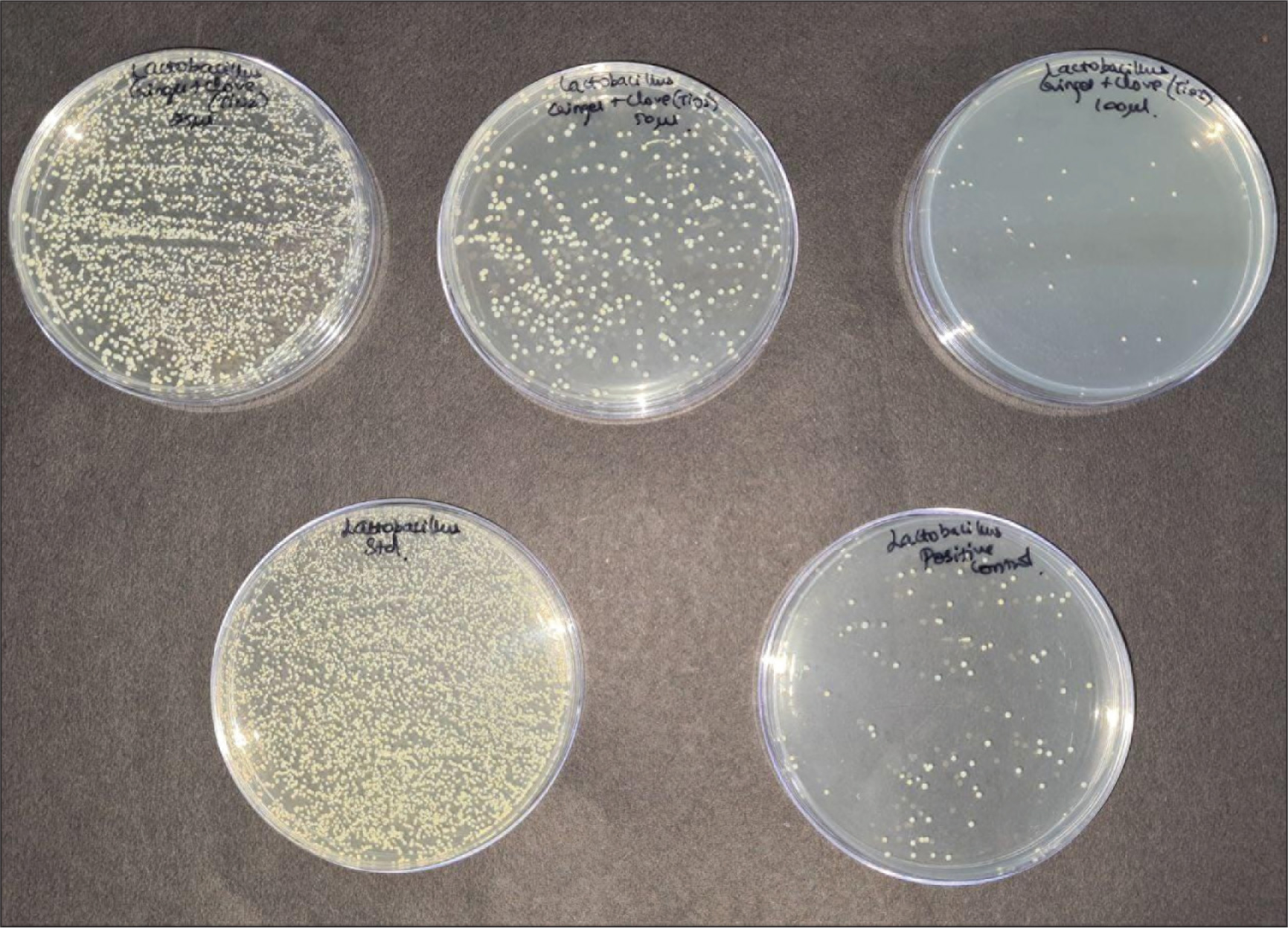
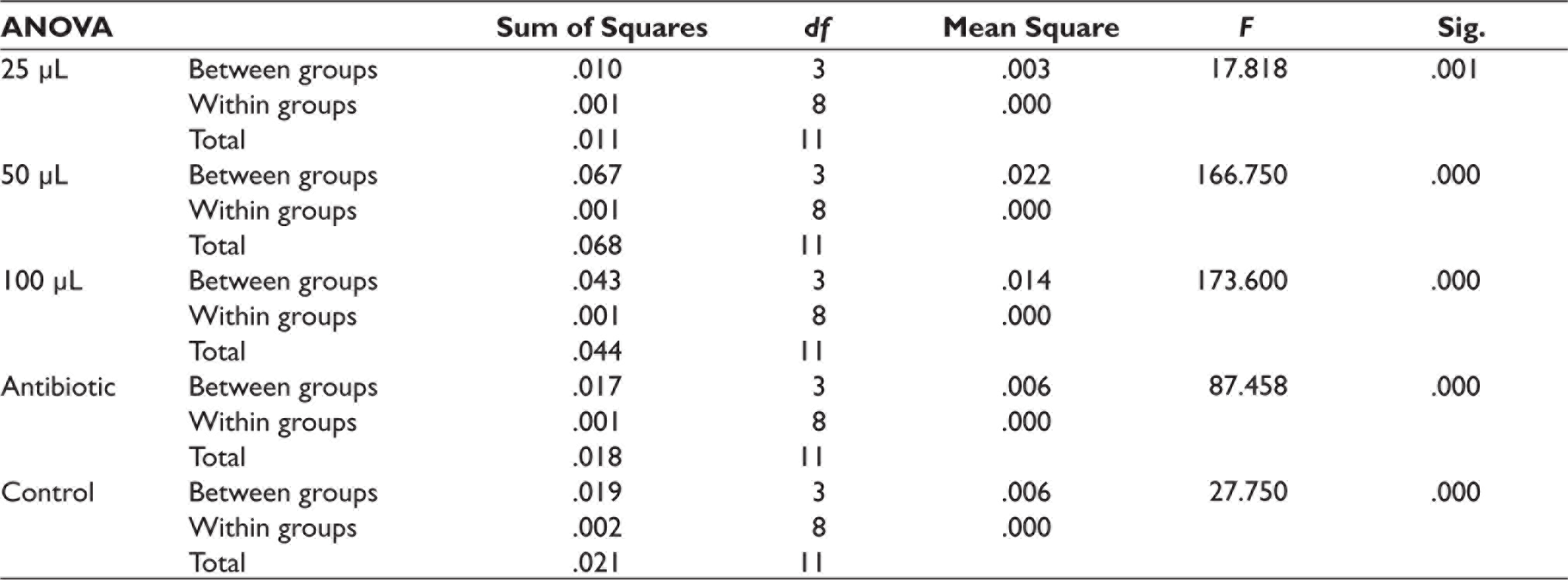
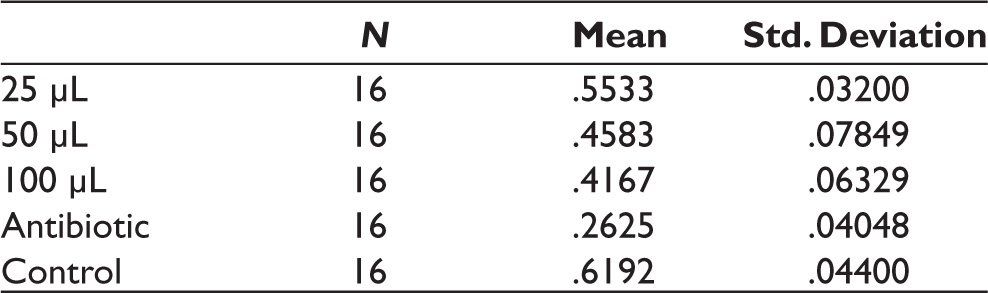
In this study, the mechanism of action of clove and ginger herbal formulation-mediated TiO2 NPs against Lactobacillus species is determined by the measurement of optical density in terms of absorbance at each concentration and at each time interval. Optical density determines the degree of scattering of light that is produced by a bacterium within a culture plate. The more the bacteria, the more the light is scattered. A graph was plotted based on the results that were recorded when comparing the optical density and concentration at each time interval for 4 hours, as shown in Figure 1. It shows that as the concentration increases, the value of optical density decreases, which proves that there occurs a bactericidal process that results in the reduced bacterial count. Figure 2 represents the reduction in the bacterial count as the concentration increases in culture plates of Lactobacillus species. Tables 1 and 2 represent the calculation of degree of freedom and the significant values along with the mean and standard deviation of test samples using one-way ANOVA, respectively. The results show significant difference (P < .005) among the test samples at various concentrations when compared with the control and antibiotic groups.
Pictorial representation of the evaluation of minimum inhibitory concentration (MIC) at a concentration of 25, 50 and 100 µL, standard and positive control at the time intervals of about 1, 2, 3 and 4 hours.
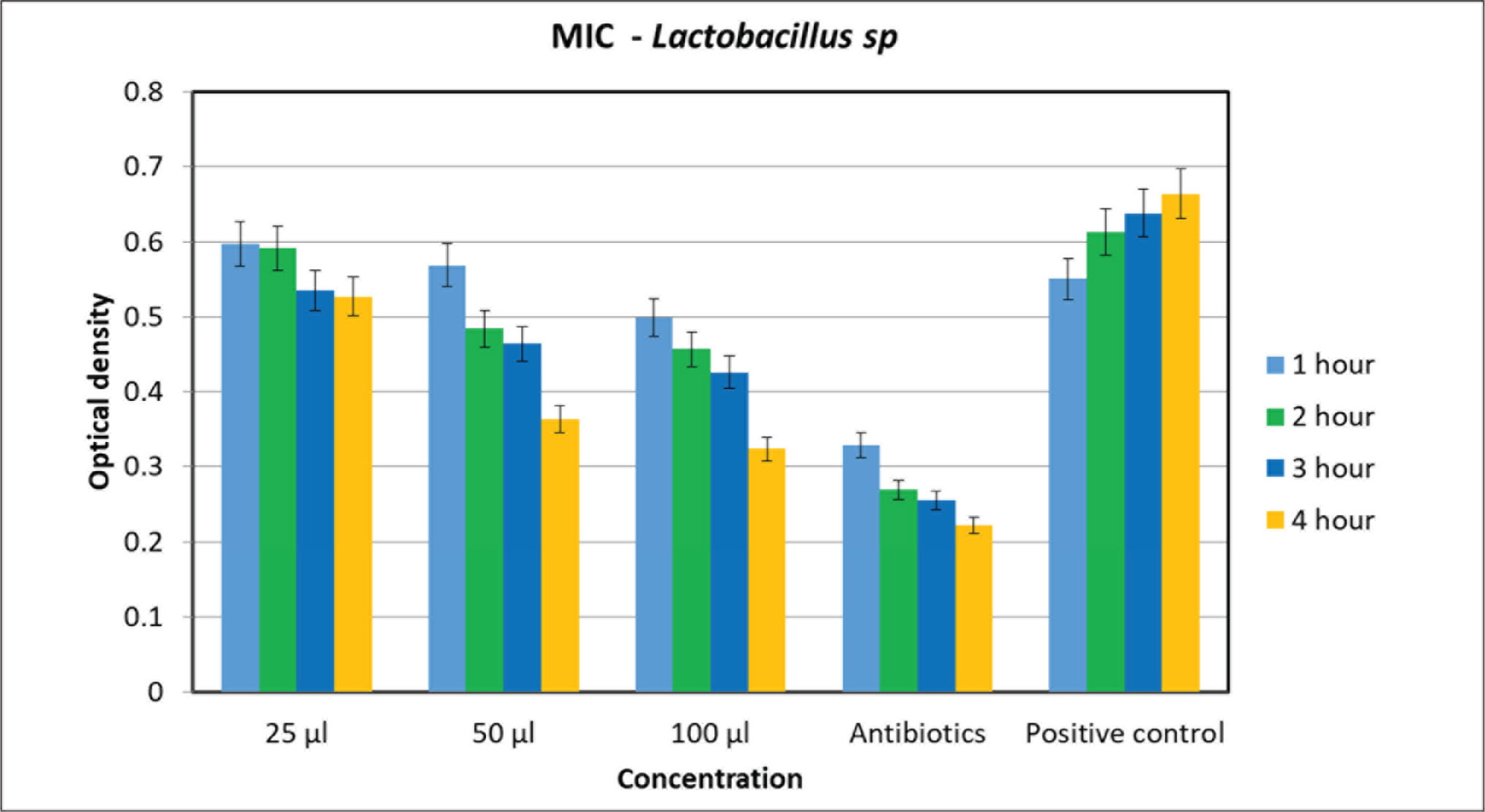
The evaluation of minimum inhibitory concentration at a concentration of 25, 50 and 100 µL, standard and positive control.
One-Way ANOVA Test Describing the Calculation of Degree of Freedom and the Significant Value for the Test Samples.
Mean and Standard Deviation of the Test Samples.
Discussion
Dental caries is a bacterial disease with high incidence and prevalence, which is persistent and damaging to the longevity of a healthy oral environment and may cause irreversible damages if left untreated. In simple terms, dental caries is generally caused by various etiological factors leading to the formation of a biofilm over the tooth surface which has cariogenic potential. Several preventive measures and products have been introduced towards the oral hygiene maintenance with an attempt to introduce antimicrobial substances into the biofilm. 20
With an increased attention towards nanomaterials as drug delivery systems in the current technology, the current study was aimed to create a formulation using TiO2 NPs that may provide antimicrobial effect by effectively penetrating into the biofilm matrix. Studies have proven the antimicrobial efficacy of TiO2 NPs against various gram-positive and gram-negative microorganisms. Because of the characteristic features of low adherence and significance towards the progressive carious lesions, 7 Lactobacilli have been selected to ideally study the antimicrobial efficacy of the formulation.
Reactive oxygen species (ROS) with high oxidative potency created during band-gap irradiation photo-induced charge in the presence of O2 are often linked to TiO2’s antibacterial effect. 21 Reactive oxygen species kills bacterial cells in a number of ways. Antimicrobial agents with broad-range antimicrobial activity are crucial for overcoming drug resistance for various microbes produced by conventional antibiotic site-specificity. 22
Owing to its enormous band-gap energy of 3.2 eV, TiO2 may produce extremely energetic electron–hole pairs when exposed to UV radiation with a wavelength of 385 nm or less. With the extra advantage of being at the nanoscale, TiO2 NPs generated from bulk powder operate on the same principle based on the formation of ROS.22,23 This nanoscale nature indicates both a tiny size that can readily penetrate the cell wall and cell membrane, allowing for an increase in internal oxidative damage, and a considerable rise in the surface-to-volume ratio, allowing for maximal contact with the water and oxygen in the environment. Bacteria have natural antioxidants, including ascorbic acid, carotene and tocopherol, as well as enzymatic antioxidant defence mechanisms such as catalase and superoxide dismutase that prevent lipid peroxidation and the harmful effects of ROS radicals. When these above-mentioned systems are overcome, a sequence of redox events can trigger cell death by affecting various essential components and metabolic pathways. 24
Limitations
Since this study was done in vitro, the results of antibacterial efficacy cannot be presumed to be clinically effective. Study should be conducted with various other carious active microorganisms like streptococcus mutans.
Scope of Future Research
More ex vivo research and clinical trials are needed to determine the exact mechanism of action of these NPs against Lactobacillus species.
Conclusion
According to the findings of this study, TiO2 NPs fortified with clove and ginger have the capacity to be used as a bactericidal against Lactobacillus species. More research is needed to evaluate the characteristics of these reinforced NPs and their potential use in medicine.
Footnotes
Acknowledgements
We would like to thank Saveetha Dental College and Hospital, Chennai, for providing us full support to complete our research.
Author Contribution
Author 1. V: Data curation, investigation, original draft preparation
Author 2: Conceptualization, reviewing, supervision
Author 3: Project administration, formal analysis, visualization
Author 4: Draft writing, data validation
Data Availability Statement
Raw data are available for the current study and will be provided according to the requirement.
Declaration of Conflicting Interests
The authors declared no potential conflicts of interest with respect to the research, authorship and/or publication of this article.
Ethical Policy and Institutional Review Board Statement
In vitro study has been cleared by Saveetha Review Board.
Funding
The present study was supported by the following agencies:
A. R. Dental Clinic M/s Trend Fashions India Pvt. Ltd Saveetha Dental College Saveetha Institute of Medical and Technical Sciences (SIMATS) Saveetha University
Informed Consent
Not applicable