




Abstract
Aim:
COVID-19 is a new illness and a big threat to global health. No specific antiviral agents are available for its treatment. The finest approach to manage this threat is to clean our hands properly. Washing hands under running water is a better way to stop the spread of infections than using a hand sanitizer. The aim of the study is to show that washing hands is efficacious than using a dab of alcohol-based hand sanitizer.
Materials and Methods:
A search was performed using three databases, PubMed, Scopus, and Google Scholar published from 2010 to 2019. The keywords for the survey were “hand-washing,” “hand sanitizer,” and “effective.” After the relevant articles were found, the critical appraisal was made to select those that were suitable for the systematic review. The inclusion criteria of the study were surveys, clinical studies, no sample size restrictions, and only English papers. Any conference abstracts, case reports, and unpublished data were excluded from this study.
Results:
On the basis of the keywords, 22 relevant articles were found, and of those, 17 articles were selected for the systematic review.
Conclusion:
This study evaluated that washing hands with soap and water are more practical and efficacious than using the sanitizer on greasy and soiled hands. An alcohol-based sanitizer, if used correctly and in appropriate volume, can disseminate certain type of micro-organisms.
Introduction
Hand washing is as essential as eating food. It is the best way to be healthy and to stay away from various diseases. Soap plays an important role in removing dust, microbes, and lubrication, maintaining good health every day. In comparison to the hand sanitizer, soap and water are more efficacious in removing certain microbes, pesticides, and other chemical residues that dawdle on hands. 1
Hand sanitizers are more effective in hospitals when hands are in contact with germs, but not soiled or greasy. Other studies also reveal that hand sanitizers might be effective on lubricated hands with certain microbes. When hands are heavily soiled or greasy, for example, after playing outdoor games, gardening, fishing, travelling, executing extension activities such as campaigning, and in certain cases, hand sanitizers may not be effective. In such circumstances, washing hands with soap and water is always preferable. Sanitizers cannot remove soil, dirt, and lubrication rather they will make hands sticky, attracting more dirt.2,3
According to the Center for Disease Control (CDC), hand hygiene encompasses the cleansing of hands by using soap and water, antiseptic hand washes, antiseptic hand rubs such as alcohol-based hand sanitizers (ABHS), foams or gels, or surgical hand antisepsis. Hand sanitizers as a disinfectant are in more use today because of its ease of availability, lack of water and time, and their proven efficacy in lowering microbial load. 3
A review of research works states that limited literature is available in relation to hand sanitizers and washing hands. As COVID-19 has rapidly spread worldwide, panic buying of sanitizers over the coronavirus pandemic has led to stocking up of sanitizer sprays, gels, and so on, without knowing the effect of the sanitizer. The prime aim of this study is to evaluate that washing hand with soap and water is more efficacious and practical than using hand sanitizers in detaching certain micro-organisms.
Materials and Methods
A literature search has been performed by two review authors independently in three different databases, PubMed, Scopus, and Google Scholar, for articles published from 2010 to 2019. At first, two different authors independently analyzed the selected articles according to titles and abstracts, which were related to this study. To avoid missing any related articles during the initial search, we have analyzed the references of the selected studies. Duplicate and cross-referenced studies were removed, records were screened according to inclusion and exclusion criteria, full-text studies were assessed for eligibility, and qualitative synthesis was carried out. The keywords for the survey were “hand-washing,” “hand sanitizer,” and “effective.” After the relevant articles were found, the critical appraisal was made to select those that were suitable for the systematic review. The inclusion criteria of the study were surveys, clinical studies, no sample size restrictions, and only English language papers. Any conference abstracts, case reports, and unpublished data were excluded from this study.
Results
Of 56 articles, 22 abstracts were recruited. These 56 articles were found through the databases. Finally, 17 studies were selected for the review. Five articles were rejected as they included case reports, pilot studies, and incomplete data. All the published articles were written in English. From a total of 22 papers from different databases, 17 papers fulfilled the inclusion criteria. We did not find any papers by hand searching. Very few studies examined the efficacy of hand washing with soap as compared to the hand sanitizer. Also, limited articles were available on the effect of waterless sanitizers.
What Is a Sanitizer?
According to the World Health Organization (WHO), “an alcohol-containing preparation (liquid, gel, or foam) designed for application to the hands to inactivate microorganisms and/or temporarily suppress their growth. Such preparations may contain one or more types of alcohol, other active ingredients with excipients, and humectants.” 3 In 1966, hand sanitizers came into existence in healthcare facilities and was popularized significantly in early 1990s. 4
Types of Hand Sanitizers
Hand sanitizers can be classified as alcohol-based or alcohol-free. Alcohol-based sanitizers comprise between 60 and 95 percent alcohol in the form of ethanol, isopropanol, or n-propanol. Alcohol have tendency to disseminate proteins and counteract certain micro-organisms at this concentration. Alcohol-free products have a property of disinfectants, such as benzalkonium chloride (BAC), or on antimicrobial agents, such as triclosan, which is immediate and purposeful. Several sanitizers comprise emollients (e.g., glycerin) that pacify the skin, thickening agents, and provides aroma.5,6
When to Use? 7
When you do not have access to soap and water.
When hands are not soiled or greasy.
When in direct contact with patients, sanitize hands.
Before wearing sterile gloves, sanitize hands.
When inserting a central intravascular catheter, sanitize hands.
Before the procedures which do not require surgery such as before inserting indwelling urinary catheters, peripheral vascular catheters, or other invasive devices, sanitize hands.
When taking a pulse or blood pressure, and lifting a patient, sanitize hands.
When there is a direct contact with body fluids or excretions, mucous membranes, non-intact skin, and wound dressings, if hands are not visibly soiled, sanitize hands.
After contact with inanimate objects (including medical equipment) in the immediate vicinity of the patient, sanitize hands.
After removing gloves, sanitize hands.
Benefits 8
The advantages of hand sanitizers are that it is more convenient, portable, easy to use and not time consuming.
The families who apply the sanitizer have lower risk of spreading gastrointestinal (stomach) and respiratory infection.
Hand sanitizers which are commercially available contain ingredients which help in preventing dryness of skin.
The frequency of absentees in classroom can be reduced by 20 percent if hand sanitizers are used properly as it will not cause illness.
Limitations 8
The alcohol content of sanitizer should not be less than 60 percent. The proportion of alcohol should be in between 60 and 95 percent when in use. The ingredient should be in the form of ethyl alcohol, isopropanol, or ethanol, which are acceptable. Every sanitizer is not manufactured equally; hence, it should be checked before purchasing.
For the efficacy or proper effectiveness of the sanitizer, it should be used on hands, which are free from soil, dirt, blood, or lubrication.
Hand sanitizers are not an alternative to hand washing; rather, it is a harmonizing habit which is far more effective when used in conjunction with soap and water.
How It Works?
Two elements:
Waterless hand sanitizer Friction
Technique 9
Four steps:
Prior to the application of the waterless sanitizer, hands should be free from dirt, soil, blood, or lubrication. There should be application of very small amount of the waterless hand sanitizer on the palm of one hand or the waterless hand sanitizer wipes can be used. It should cover all surfaces of hands and fingers while rubbing hands with the sanitizer. The process should continue until the waterless sanitizer is completely absorbed.
Effectiveness
Hand sanitizers are more effective when used in appropriate amount. Proper use, duration of exposure, and frequency of use also play an important role in relatable effectiveness of the hand sanitizer. For the outcome of sanitizers, the presence of the infectious agent on the host should be susceptible to the active ingredient present in the product. Alcohol-based waterless sanitizers should be rubbed thoroughly for 30 seconds, which followed by complete air-drying can reduce various micro-organisms. Even alcohol-free formulations, such as the SAB (surfactant, allantoin, and BAC) hand sanitizer, show its effect when used properly. Some study also reveal that many hand sanitizers are ineffective against bacterial spores, enveloped viruses (e.g., norovirus), and encysted parasites (e.g., Giardia). Hand sanitizers are not effective when hands are noticeably soiled, lubricated, and greasy prior to application.
As there is inconsistency in the effectiveness, hand sanitizers can be recommended to control the transmission of infectious diseases, where accessibility to soap and water is difficult.10,11
Potential of Hand Sanitizer—Not as Good as Soap and Water
Quickly smearing an ethanol-based hand sanitizer does not disseminate cold and flu bugs as fingers are still wet with mucus. It has been proven that sanitizers with a lower alcohol concentration or non-ABHS can reduce the growth of microbes but not kill those germs. Traditionally, washing hands with soap and water is far more superior than using a hand sanitizer as soap and water eliminate dirt, germs, and oil to give a proper and overall cleansing.
For proper hand washing, the US Centers for Disease Control and Prevention suggested:
Wash hands with clean running water and lather hands with the application of soap. Scrubbing of palms, backs, fingers, between fingers, and under nails, which should cover all surface. Time period should be for 20 seconds of scrubbing as the time it takes to sing “Happy Birthday” twice. Lastly, rinse under clean, running water, and dry with a clean towel or air dry hands.
12
Discussion
The review focuses on usage and benefits of hand washing against the pure hand sanitizer. People are using the hand sanitizer on a daily basis, sometimes multiple times a day, so the Food and Drug Administration has decided that the companies making hand sanitizers need to provide proof that those chemicals are safe for that level of exposure, especially for pregnant women and children. Three active ingredients—benzalkonium chloride, ethyl alcohol, and isopropyl alcohol—are still under review. 1
Additionally, the efficacy of the hand sanitizer is dependent upon the proper technique, the quantity of the sanitizer used, the ingredient, and its consistency of use. In various circumstances, such as using it on soiled or greasy hands and heavy loading of microbes, a reduction in the effectiveness of the sanitizer is reported. 1 The increment in the purchase of hand gels is not just dependent upon the fear of pandemics, but the sale in the market has been driven in pretty, child-friendly colors and with wellness-friendly fragrance such as lemon and orange flavors, that are far acceptable than the pungent-smelling waterless sanitizers found in hospitals.1,2
As there is lack of sanitizers in the market because of high sale of these gels due to COVID-19 pandemic, there is evolution of active ingredients despite alcohol and recipes to make their own gels, which are available online. There is recommendation of vodka, witch-hazel, and aloe vera to make their own hand gels. It is not yet known how effective these alternative sanitizers are at killing germs.
COVID-19 affects different people in different ways and it is likely to spread through cough droplets from the direct contact of one person to another. It can also be transmitted through objects, food, and packages. For its reproduction, a virus always need host living cells so if hands are contaminated your eyes, mouth, or any type of wounds should not be touched or rubbed. If hand gels or soap and water are not available, the hands should be clear. As soap and water is not accessible everywhere, the hand sanitizer can play an important role in disinfecting the surface. 4
Many a times it has been proven that a dab of gel cannot remove all the dirt, germs, and oil from the hand. A hand sanitizer cannot be replacement of washing hands. In 2019, a study was conducted by the American Society for Microbiology that washing hand with soap and water is far more effective than a dab of gel. It is not the matter of single viral cells as we do not know from where, when, and how much viral cells are present on any given surface. In order to maintain hand hygiene and safety, proper precaution should be taken by washing hands frequently. There is no conclusive proof that how much viral cells will get dislodged from the infected surface, but most of the micro-organisms can be disseminated from hands with the help of soap and water by flushing out the dirt and making the skin more clean and hygiene. 2 So, wet your hands with water and lather them up properly, on both sides, in between the fingers, and under the nails, one hand and then the other. Rinse them thoroughly under running water for 20 seconds (or as the National Health Service puts it, the time it takes to sing Happy Birthday twice). Rinsing thoroughly is the key to washing away any viruses. A disposable towel should be used to dry hands and before throwing it away, a towel should be used for closing the tap. 4
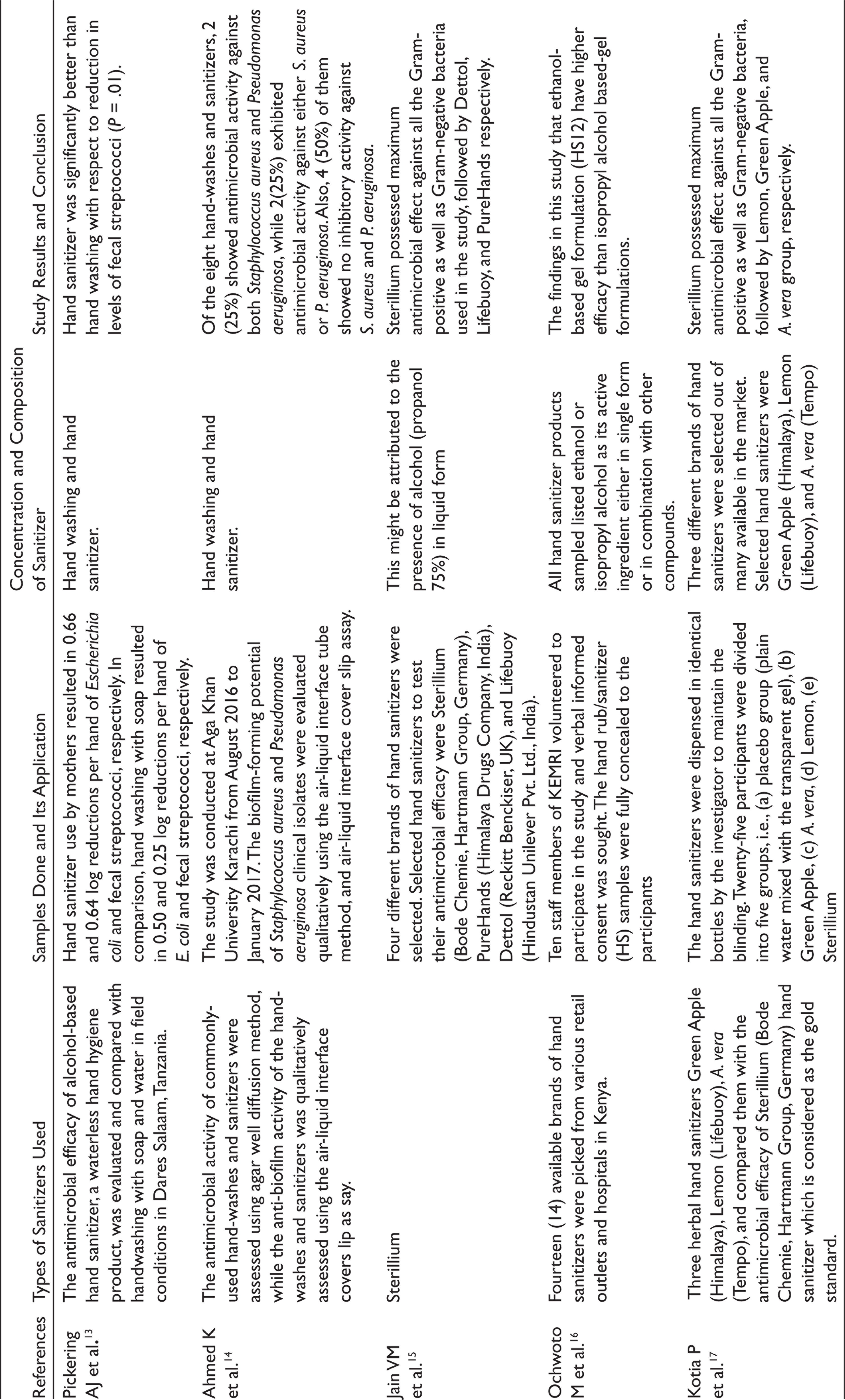
If hands are visibly contaminated with protein or organic matter, soiled, and greasy, hand gels are not an option as it cannot remove dirt. It has been found that after rubbing hands with gel all the dirt will get absorbed. 13 In India, most of the people rely on hand washing. At the time of pandemic, the attention is driven towards hand sanitizers. It is widely and practically acceptable more in hospitals and clinical settings. 14 Table 1 shows the effectiveness of different hand sanitizers on various groups but none of the research works support that the hand sanitizer should be used on soiled or greasy hands.15–17
The hand sanitizer should be used in those conditions where there is no availability of soap and water, which can offer a short-term solution. It can be considered as a temporary standby. At least 60 percent of alcohol should be used for disinfecting the surface. As it should not be used on soiled or greasy hands, sanitizers can disseminate various organisms. Alcohol-free sanitizers may not be as effective as alcohol-based sanitizers. The presence of chemical in alcohol-free sanitizers could irritate skin and make it dry. 1
Limited literature is available on the support of hand washing with soap rather than the hand sanitizer. Majority of the literature tells about the efficacy of different hand sanitizers but not the efficacy of hand washing. The hand sanitizer should not be considered an alternative to hand washing. It is an adjunct to hand washing, which can be used when there is a lack of water and soap. Further research is necessary to evaluate potential health benefits of promoting hand washing in developed countries, where hand washing is often constrained due to lack of time.
Studies on the Application of Types of Sanitizers
Conclusion
The efficacy of hand rubs is dependent on multiple factors such as proper technique, its consistency of use, and the quantity of product used. Hand sanitizers do not contribute much when hands are soiled or greasy and when bacterial load is high. The best way to be safe in such a situation is to wash hands with water and soap, which is available easily everywhere.
Footnotes
Acknowledgements
The authors wish to thank the management and head of the institution, for all the support and help rendered.
Declaration of Conflicting Interests
The authors declared no potential conflicts of interest with respect to the research, authorship, and/or publication of this article.
Funding
The authors received no financial support for the research, authorship, and/or publication of this article.