




Abstract
Background:
In recent years, barium titanate (BaTiO3) has demonstrated advancements in the field of dentistry among dental ceramics. This ceramic substance has piezoelectric qualities that are comparable to those of bone, which is crucial for osseointegration. The biomedical field has made extensive use of barium titanate for its affordability, chemical stability, and non-toxicity. The use of barium titanate in dentistry is encouraged by the fact that many widely used metal alloys have unsightly hues and exhibit chemical interactions in the mouth cavity. Because BaTiO3-based ceramics are more corrosion-resistant, have better color matching that improves esthetics, stronger, and have better radiopacity than traditional biomaterials, their use has grown.
Purpose:
This review will cover the production techniques, mechanism of action, phases, and dental uses of BaTiO3.
Conclusion:
Barium titanate exhibited encouraging qualities for dental uses due to its antibacterial, biocompatible and piezoelectric action.
Introduction
The polycrystalline ceramic substance barium titanate (BaTiO3) possesses a perovskite structure (ABO3) and ferroelectricity. Due to their distinctive qualities and considerable applications in numerous technologies, ferroelectrics are becoming more and more well-liked. 1 Extensive studies have characterized the ferroelectric and dielectric behavior of bulk BaTiO3 in biomedical engineering contexts. 2
Barium titanate is the most popular photocatalyst utilized in environmental applications because of its inexpensive price, biocompatibility and it is also chemically stable. 2
Barium titanate is an inorganic filler that has excellent mechanical, thermal, ferroelectric, dielectric, and antimicrobial qualities. Because of the polarization process and the proper biological reaction, BaTiO3 piezoceramic demonstrated notable bioactivity; consequently, it is a preferred material for numerous dental applications. BaTiO3 is incorporated in dental materials as a radiopacifier due to its high atomic number. 3 When BaTiO3 was applied to various materials such polyvinylsiloxane, hydroxyapatite, and implants, it demonstrated antibacterial activity ranging from 5% to 25% against a variety of microorganisms, including Pseudomonas aeruginosa, Escherichia coli, and Staphylococcus aureus. 4 Moreover, numerous investigations have demonstrated the antifungal properties of barium titanate.5,6
Barium titanate has the capacity to originate a robust interfacial bond with the surrounding bone and exhibits good biocompatibility. Numerous animal studies have verified that BaTiO3 is biocompatible in its nanoparticle form which showed no indications of inflammation or a foreign body at the contact between the implant and the tissue. These findings show that BaTiO3 possesses outstanding systemic non-toxicity, opening the door for the creation of novel biomedical uses for materials based on BaTiO3. 1
In addition to its piezoelectric stimulation, which promotes osteogenesis, osseointegration, and bone repair, BaTiO3 has appropriate mechanical qualities because it is stiffer than other biomaterials like hydroxyapatite (HA). 7 However, sintering and polarization conditions have a significant impact on BaTiO3 performance. 8 Although polymers are lightweight and flexible materials, their piezoelectric performance is not very good. Compared to polymers, BaTiO3 performs better mechanically and piezoelectrically. 9 In contrast to lead zirconate titanate (PZT), an outstanding piezoelectric material, that is, harmful for biological applications, BaTiO3 is a safer option because it is a lead-free piezoelectric material. 8
This study looks into the osseointegration, cytotoxicity, antimicrobial, and piezoelectric properties of barium titanate and its uses in dentistry.
Phases of barium titanate
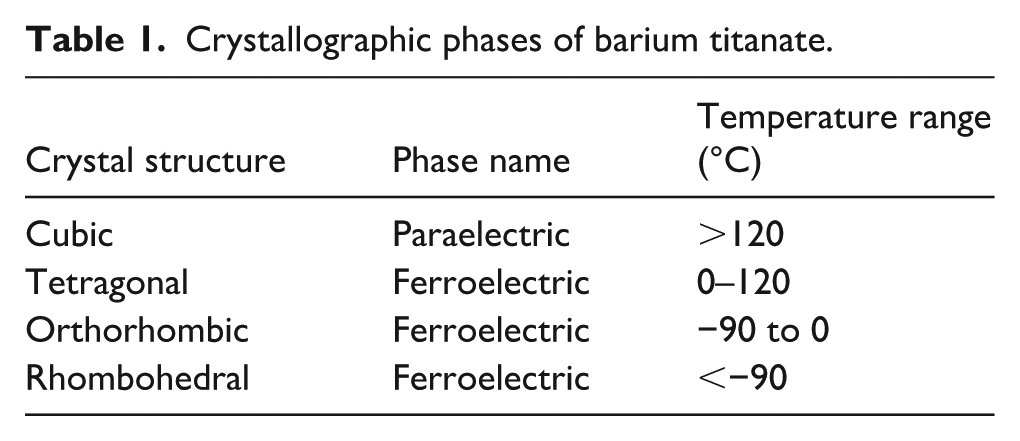
In the bulk form, BaTiO3 exhibits the cubic, tetragonal, orthorhombic, and rhombohedral crystal phases. The substance displays the conventional perovskite structure, which is defined by a cubic phase, at high temperatures, more than Curie temperature (T >120 °C). In this structure (Ba+2) and (O−2) ions are organized in an FCC lattice, with (O−2) ions in the middle of each lattice face and (Ba+2) ions at the corner as seen in Figure 1. Similarly, the smaller cation of (Ti+4) fills the interstitial gaps inside the octahedral structure, forming (TiO6) inside the FCC array.10,11

The cation and anion centers coincide, creating a highly symmetric arrangement that prevents polarization in the crystal structure of the cubic phase. Consequently, the crystal is categorized as paraelectric and shows no ferroelectricity. When the temperature is reduced to <120 °C the initially symmetrical cubic structure of the material becomes asymmetrical. This process occurs when the cation center shifts away from the anion center, causing polarization in the crystal structure. When the material transitions from a non-polar to a polar phase, its structure changes from cubic to tetragonal, giving it ferroelectric properties. As soon as the temperature is reduced to −5 °C and −90 °C, the transition to orthorhombic stage occurs, this transition is defined by the elongation of the cubic unit cell along the face diagonal. However, at temperatures below −90 °C, the rhombohedral phase arises, which denotes a lengthening in the cubic unit cell together with the body diagonal direction. The crystal structure loses its symmetry when deformation along certain orientations causes the center of cation to be moved out of the center of anion. As a result, ferroelectric phases with observable spontaneous polarization are formed, as seen in (Figure 2). 10 Table 1 demonstrate the crystallographic phases of BaTiO3.

The four distinct crystalline formations of BaTiO3. 10
Crystallographic phases of barium titanate.
Methods of synthesis of BaTiO3
Solid-state reaction
An interaction between BaCO3 and TiO2 in a solid state at temperatures higher than 1100 °C was previously used to create BaTiO3 particles. Equation (1) illustrates the whole reaction for the synthesis of BaTiO3 when heating an equimolar mixture of BaCO3 and TiO2 12 :

The shape of BaTiO3 produced by this method is a bulk ceramic. Large particle sizes are one of the numerous drawbacks of the high calcination temperature, which is crucial in dentistry since dental composites need small particles to have the optimum mechanical properties. Agglomeration is another disadvantage, which reduces the surface area. 13
Sol-gel method
A range of methods, including sol-gel and co-precipitation, can be used to create nanocrystalline BaTiO3 powder. In order to create BaTiO3 powders, we have detailed a sol-gel method that combines titanium tetrachloride (TiCL4) with barium hydroxide (Ba (OH)2) via an alkoxide-hydroxide pathway and sol-gel crystallization the powders exhibit enhanced grain formation during the sintering process even if they have high dielectric properties. 14
In the sol-gel method of creating metal oxide glasses and ceramics a chemical precursor being hydrolyzed to create a sol, followed by a gel, that is, pyrolyzed and dried (evaporated) to create an amorphous oxide. Additional thermal processing can promote crystallization:
Metal alkoxide undergoes partial hydrolysis to produce reactive monomers.
Which are then polycondensed to create oligomers that resemble colloids (sol).
Further hydrolysis encourages cross-linking and polymerization to produce a three-dimensional matrix (gel).
Until it reaches the of point sol-gel transition, where viscosity sharply rises and gelation takes place, as polymerization and cross-linking proceed, the sol’s viscosity progressively rises. 15
This method of synthesis is used for thin films and nanoparticles production. The benefit of this synthesis technique is that it produces small particles with a large surface area, which increases the mechanical strength of dental composite. Additionally, this process produces barium titanate with a high degree of purity, which is crucial for use in biocompatible dental materials. The process’s sensitivity and intricacy are among its many disadvantages, which also include raising the price of dental supplies. 16
Method of co-precipitation
The co-precipitation method has been studied in great detail. This is a simple and practical method of maximizing component ions to achieve chemical uniformity at the molecular level under carefully monitored circumstances. When both Ba and Ti cation precipitation occur simultaneously, it is difficult to create the ideal circumstances for co-precipitation via the oxalate route. This is because barium precipitates as BaC2O4 at pH >4, whereas titanium precipitates as titanyl oxalate at pH <2 when alcohol is present. Therefore, during simultaneous precipitation, titanium produces soluble anionic species such as TiO (C2O4) 22 in the pH range of 2–4, which influences the stoichiometry (Ba:Ti ratio). 17
Good chemical homogeneity enhances biological tissue contact, which is advantageous for bone restoration and dental implants. The production of tiny, uniform particle size enhances the mechanical strength of dental applications, and increasing the surface area to improve bioactivity are the benefits of this synthesis technique. It is also a simple and inexpensive method. The agglomeration of the nanoparticles is the drawback of this technique, which reduces the effective dispersion of the nanoparticles in dental resins. 18 The shape of BaTiO3 resulted by this method was spherical or aggregated nanoparticles. 19
Hydrothermal synthesis
A process which has garnered a lot of attention lately and involves producing crystalline BaTiO3 in a single step without calcination (or annealing). This process shows how the ionic reaction equilibrium is affected by the solvent, temperature, and pressure all working together to stabilize desired products and stop the formation of undesirable molecules. Additionally, complex equipment or costly reagents are not required for full synthesis. 14
Nanorods, nanospheres, and nano cubes are the shape of BaTiO3 that resulted by this method. Low-temperature crystallization (100 °C–250 °C) and the production of highly homogenous, tiny nanoparticles—perfect for dental applications—are the method’s advantages. Additionally, it produces well-separated particles that are simpler to spread in a matrix of polymers or resins. It is also a simple and inexpensive method. Long reaction time is a drawback of the hydrothermal synthesis method. 18
Barium titanate electrospinning dispersions
The dry BaTiO3 particles were distributed in an ethyl cellulose and polyvinyl alcohol solution. A 10 wt./v% polyvinyl alcohol solution was made in distilled water at 80 °C while being stirred constantly to improve dissolving 4–5.5 wt.% of BaTiO3 was added to the polymeric solution while being vigorously stirred once it had cooled to room temperature. At the same time, a 20:80 solvent mixture of tetrahydrofuran and N, N-dimethylformamide yielded a 13 wt./v% ethyl cellulose solution, 29.5 wt./v% BaTiO3 particles were added to this solution while being stirred. 20 Electrospinning is a straightforward, cost-effective, and easy method for creating flawless ceramic nanofibers. Nanofibers are one-dimensional solid-state structures that have a high surface area to volume ratio. Ceramic nanofibers are intriguing for a number of practical uses. Through electrospinning of BaTiO3 containing polymer solution nanofibers with a high surface area-to-volume ratio resulting in increased bioactivity and their ability to interact with biological tissues or the surrounding matrix, and enhanced mechanical and chemical stability. 21
Mechanism of action of barium titanate
Antibacterial action of BaTiO3
Barium titanate is a piezoelectric, photocatalysis material, so activating barium titanate’s antibacterial capabilities frequently requires some external stimuli like ultrasound and light. These stimuli enable the substance to produce ROS or electric effects that are capable of efficiently fight bacteria, ROS mainly use their ability to react with bacterial DNA, proteins, cell membranes, and lipids to cause irreparable harm and impair bacterial growth. 22
It was found that after 24 h of testing, polyvinylsiloxane (PVS) specimens containing BaTiO3 exhibited antibacterial activity against S. epidermidis. Because Ba2 is released and TiO2 is subsequently produced, BaTiO3-PVS composites have an antibacterial effect that results in little acidic surroundings. Then, when Ba+2 and TiO2 come into contact with water, they both contribute to the generation of (O−2) free radicals and hydroxyl radicals (OH), which break down bacterial cell walls, nucleic acids, as well as other molecular forms. 4
Kareem and Hamad concluded that the inclusion of barium titanate nanoparticles (BaTiO3 NP) to the VST-50 RTV maxillofacial silicone, the ability to combat Staphylococcus epidermidis was increased due to reduction of the porosity which resulted in reduction in the adhesion of the bacteria. numerous studies demonstrate that adding nanofiller supplies to different substances lowers porosity because the filler fills the void inside the material matrix. 23
A study was carried out in order to ascertain if polarized piezoelectric bio ceramics are good antimicrobial bone graft substances for preventing biofilm. According to the percentage reduction of qualitative and antibacterial rates, positively charged hydroxyapatite-barium titanate composites demonstrated antimicrobial activity against Escherichia coli, Pseudomonas aeruginosa, and Staphylococcus aureus with a significant inhibition zone. Confocal laser scanning microscopy (CLSM) verified decrease in cell counts in polarized specimens. The polarized HA-BaTiO3 specimens significantly suppressed all three species of bacteria. The Research shows a different approach to topical antibacterial therapy at implant locations that works well. 24
The persistence of germs in root canal systems is one of the primary reasons endodontic treatment failures occur. BaTiO3 is one of the piezoelectric materials that has antibacterial properties. Therefore, bio ceramic sealer’s antimicrobial efficiency was increased by adding 5 wt.% of BaTiO3 particles, and an antibacterial piezoelectric endodontic sealer was created. However, the flow characteristics of the sealer are adversely affected when more than 10% BaTiO3 is added. 25
Antifungal action of barium titanate
The oral cavity is frequently home to the opportunistic fungus Candida albicans. It sticks to oral surfaces like mucosa and denture bases. 26 The overgrowth of Candida has been linked to denture-induced stomatitis (CADS). 27 Up to 67% of people who wear dentures suffer from CADS, a frequent recurrent illness. 28 The erythema and inflammation of the oral mucosa regions covered by the dentures are the hallmarks of this condition. 27 A biomaterial called polymethylmethacrylate (PMMA) is frequently utilized in both complete and partial dentures. The absence of antifungal properties is one of PMMA’s main drawbacks. 29
By incorporating BaTiO3 into the PMMA denture base, research seeks to examine the impact of piezoelectric charges against fungi. Consequently, findings demonstrated that, in comparison to commercial PMMA without BaTiO3, piezoelectric charges dramatically decreased metabolic activity, biomass and living cells. The buildup of intracellular reactive oxygen species (ROS), which oxidizes and destroy fungal cells seems to be connected to the antifungal mechanism derived from piezoelectric charges. Furthermore, the findings show that Candida albicans pathogenicity and virulence were made possible by cyclic deformation on PMMA substrate in the absence of antifungal drugs, where biofilms were generated and yeast adhered. 5
Piezoelectric action of barium titanate
By simulating potentials created by natural bone stress that generate micro-electric currents and promote accumulation of calcium salt at the location of bone defect, BaTiO3, piezoelectric ceramic is frequently utilized to encourage the renewal of bone. As native bone deforms, the piezoelectric polarization stimuli produced by BaTiO3 can alter bone growth by reshaping and reassembling the tissue. 30
The term “domain” describes many unit structures that have the same polarity found in piezoelectric ceramic materials. To maintain the material’s net polarization at zero without external electric field (EF), each component has its own polarization direction, which is randomly oriented. 31 The domains line up with the applied EF’s direction. when a high temperature and a strong external voltage are applied. 32
It was found that BaTiO3’s piezoelectric activity promotes osteoblast growth. Noteworthy is the fact that bulk BaTiO3 materials were utilized in the majority of earlier studies. During the initial 4 months of the recovery process of hard tissue substitute materials, bone tissue regeneration mostly takes place at the implant-tissue contact. Tiny micro-scale barium titanate coatings applied to artificial metal implants made of Ti or Zr alloys will therefore become more advantageous. The last one might achieve electroactive performance and offer a protective layer for implants. BaTiO3 coatings or films are made via the reaction in solid-state, sol-gel method, and physical vapor deposition. 33
To improve bone regeneration and speed up healing around the implant site, a study used 36% BaTiO3 incorporated to 18% polycaprolactone as a coating material for pure titanium and Ti13Zr13Nb implants. This increased the coating material’s adhesion strength to the substrate, improved bone regeneration, and sped up healing around the implant site, making it a potential coating material for load-bearing dental and orthopedic implant applications. 34
The differences between ferroelectric and piezoelectric nature of BaTiO3
When an external electrical field is applied, a material with spontaneous electrical polarization that may be switched is said to be ferroelectric. However, due to its ferroelectric nature, barium titanate has a spontaneous electric polarization that can be reversed by an electric field outside of it. 2 The ferroelectric nature of barium titanate is present when the Curie temperature is reduced to <120 °C and it exists in tetragonal, orthorhombic, or rhombohedral phases. The cubic phase is paraelectric and showed no ferroelectricity. 10 As particle size decreases, ferroelectricity steadily decreases as well. 2 It has been demonstrated that changes in temperature, grain size, and external stress impact spontaneous polarization by altering tetragonal strain, which in turn affects phase transitions and influences ferroelectric characteristics. 35
The piezoelectric nature of barium titanate means that the material generates electrical charge when subjected to mechanical stress or deformation. The piezoelectric nature of BaTiO3 presents when BaTiO3’s structure lacks a center of symmetry in tetragonal or rhombohedral phase of BaTiO3. The piezoelectric effect of barium titanate can be obtained by sol-gel and hydrothermal synthesis techniques and by obtaining a grain size of <100 nm, there is a negative correlation between piezoelectric coefficient and grain size. 36 External stimuli like ultrasound and light stimulate the piezoelectric effect of barium titanate. 37
Applications of barium titanate in dentistry
BaTiO3 reinforcement for polymethylmethacrylate denture base
Denture breakage is a frequent clinical occurrence in prosthodontic services and is still an unresolved issue, despite the covert usage of polymethylmethacrylate (PMMA) in dental prosthetics. Nanoparticle reinforcement has been used to help polymers overcome their mechanical and physical constraints. 38
Nano barium titanate (NBT) and PMMA nanocomposites with enhanced mechanical and physical characteristics have been created through research. Purified PMMA and titanate-treated NBT were combined to create material for denture base with enhanced tensile and flexural characteristics, results of tensile strength were (53.57, 61.95, 62.29, 65.71, 61.25, 56.34 MPa) for (PMMA group, 1 wt.% NBT, 3 wt.% NBT, 5 wt.% NBT, 7 wt.% NBT, and 9 wt.% NBT), respectively. Results of flexural strength demonstrated in Figure 3. 39 The uniform dispersion and compression of NBT particles improved surface smoothness by decreasing roughness and increasing surface hardness. These enhancements could increase dental composites’ longevity. 39

Comparison the impact of filler content on the flexural characteristics of the PMMA matrix with NBT and the unfilled PMMA matrix. 39
Flexural modulus of PMMA/NBT increases in tandem together with the loadings of filler. Additionally, the loaded PMMA’s tensile modulus values rise noticeably. As the NBT percentage increased to 5 wt.%, the nanocomposite resin’s tensile and flexural strengths increased; however, as the NBT percentage increased to 7 and 9 wt.%, they dropped. 39
Barium titanate addition to polymethylmethacrylate bone cement
Due to its excellent mechanical qualities and biocompatibility, PMMA bone cement, a polymer that cures itself, is frequently utilized in biological restoration of bone. 40 One efficient technique to increase the osteoinductivity of biomaterials is to incorporate barium titanate particles into them, such as in polymethylmethacrylate bone cement. But too much addition causes mechanical deterioration. The process of achieving piezoelectric characteristics that resemble those of human bones while maintaining adequate mechanical properties is a significant issue to be resolved. Barium titanate powder of 30–80 vol.%, and particle size <3 μm are added to PMMA bone cement to provide the piezoelectric action. The piezoelectric coefficient was low and nearly zero when the BaTiO3 content was <50 vol.%. The piezoelectric coefficient increased noticeably when the BaTiO3 content reached 60 vol.% Based on this, graphene is added to BaTiO3 at a relatively modest amount to get a piezoelectric coefficient, that is, comparable to human bone. It is possible to get high mechanical characteristics. 40
Using barium titanate in implant and bone engineering
Histological examination of the barium titanate implants revealed important information on the tissues that developed within the pores, their great suitability for hard tissues, and the prevalence of direct attachment of bone to the surface of implant. There were more actively depositing osteoblasts close to the implant, according to short-term investigations. On the other hand, long-term research revealed a minor decrease in osteoblasts and conversion of trabecular bone into compact bone, which is a normal reaction between biocompatible implant and healthy bone. Gene expression and histomorphometry analyses were used to compare a PTFE membrane with a composite of poly(vinylidene fluoride trifluoro ethylene) P(VDF-TrFE), and BaTiO3 (P(VDF-TrFE)/BaTiO3) that when placed in rat calvarial bone deficiencies, the latter encourages the growth of new bone. Consequently, the biomaterials now employed in GBR therapies may be replaced by this composite. 41
Scaffolds made of titanium, aluminum, and vanadium alloys were treated with barium titanate (BaTiO3) to treat significant bone defects. In comparison with the porous pure Ti.6Al.4V, the activity of bone marrow- derived mesenchymal stem cells were considerably increased in BaTiO3-Ti-6Al-4V scaffold in both in vitro and in vivo inquiries. Histomorphology, peak pull-out load, mineral apposition rate, and micro-computed tomography all demonstrated that these scaffolding circumstances markedly improved rabbit osseointegration along with osteogenesis. 30
Solution casting was used to generate the barium titanate/polylactic acid composite film (BaTiO3/PLA), which has excellent biocompatibility and piezoelectricity. In an in vitro study of rat cranial abnormalities, it had a good osteogenic impact, directing bone tissue and promoting bone tissue regeneration. 42
Implants coated with barium titanate/polycaprolactone composites (BaTiO3/PCL) had better osseointegration. When compared to uncoated implants, the coated implants showed better mechanical and histological characteristics after 2 and 6 weeks of healing, suggesting a more robust and beneficial bond with bone. The coated implant exhibits increased surface roughness, improved wettability, increased hardness, and increased corrosion resistance following the application of BaTiO3/PCL composite to the implant. 34
For bone therapy, metallic implants are frequently utilized. However, some of those issues, like the human body’s limited resistance to corrosion and its absence of bioactivity, cause loss of bone and weakening. Chronic inflammation is also a result of ions being destroyed and released. 43 Because bones exhibit both pyroelectric and piezoelectric qualities, research in hard tissue engineering has concentrated on materials with piezoelectric qualities, including barium titanate. This substance is a suitable choice to hasten bone development in the body’s physiological environment. 44
The addition of BaTiO3 to the implant coating enhanced the coating’s resistance to corrosion, according to a study that used a hydroxyapatite/barium titanate/chitosan nano composite coating on a 316L stainless steel substrate. 45
Barium titanate added to polyvinyl siloxane (PVS)
Micrometric roughness rose from 0.13 to 0.4 m when BaTiO3 was added to polyvinyl siloxane (PVS) impression materials, whereas micrometric roughness dropped from 1.5 to 0.5 m. This implies that for BaTiO3 percentages of 25% or more, macroscopic and microscopic roughness are equivalent, indicating that BaTiO3-reinforced PVS may provide an affordable substitute for commercial goods, strong resistance to bacterial colonization and inhibiting bacterial infection for both short-term and long-term uses. 4
Barium titanate addition to maxillofacial silicone
Facial prostheses must be constructed from materials similar to the surrounding soft tissue and skin because they are employed to substitute a missing portion of the face. According to research, the maxillofacial silicone elastomer is frequently utilized for this purpose because of its high elasticity, biocompatibility, and ease of pigmentation, either intrinsic or extrinsic. 46
As a family of ceramic materials, nano barium titanate (NBT) has potential biological uses due to its favorable mechanical characteristics. 47 Study performed in 2023 found that the percentage of elongation, tensile strength, and tear strength of RTV maxillofacial silicone were enhanced by the addition of 1% and 2% nano barium titanate. 46
The RTV VST-50 silicone elastomer’s tear strength and heat conductivity were greatly increased by the addition of BaTiO3 nano powder and the enhanced concentration of BaTiO3 has a clear correlation with this impact. Following the inclusion of BaTiO3 to RTV VST-50 silicone, there was an increase in water absorption and solubility. 48
BaTiO3 as radiopacifying material
Denture base radiopacifying material
Pure PMMA is not a radiopaque material for denture bases. Therefore, when a denture breaks and is swallowed or ingested, radiograph cannot identify this substance. It could be fatal if the foreign body is not located or removed right away. According to a study by Grawal et al., partial acrylic dentures without clasps are radiolucent. Due of their small size, partial dentures can be inadvertently swallowed. It is challenging to locate a swallowed denture radiologically. 3
There have been multiple attempts to add some radiopacity to the foundation materials for acrylic dentures. Denture bases can have their radiopacity increased by using barium sulfate (BaSO4). Nevertheless, the incorporation of BaSO4 alters mechanical characteristics of a denture base material (DBM), including impact and flexural strength. 3 Due to their high atomic number, BaTiO3 fillers been used as radio pacifiers in PMMA matrices. Consequently, BaTiO3/PMMA combination possibly a good DBM due to its ability to improve strength and radiopacity, which allows for quick radiological identification to prevent any potential health issues or life-threatening situations, 3 as seen in Figure 4.

Comparison of X-ray images of the flexural strength samples and the aluminum plate: (a) PMMA + 20 wt.% BaTiO3, (b) PMMA + 15 wt.% BaTiO3, (c) PMMA + 10 wt.% BaTiO3, (d) PMMA + 5 wt.% BaTiO3, (e) PMMA matrix, and (f) Al plate. 3
At high BaTiO3 percentages (over 3 wt.%), PMMA’s mechanical qualities significantly declined. Additionally, the results of researches demonstrated that radiopacity was insufficient at percentages below 5 wt.%. 49
Endodontic radiopacifying material
In several endodontic operations, including pulp capping and pulpotomy, root resorption defect repair and repairing perforations, apexification, and root end filler material in apicoectomy, mineral trioxide aggregate (MTA) is utilized extensively. 50 Portland cement serves as the main ingredient of MTA, and bismuth oxide (Bi2O3) is added as a radio pacifier. 51 It has been demonstrated that bismuth oxide negatively impacts MTA performance. In addition to impairing the MTA’s hydration process and calcium hydroxide precipitation, Bi2O3 particles act as a defect that breaks down the cement matrix, increasing the final product’s porosity and solubility. 52
Research is being conducted to find novel radiopacifying compounds in order to get around these drawbacks.
Using barium titanate as a radiopacifying material that has been high energy ball milled for 3 h and then sintered for 2 h at 700 °C–1300 °C added to MTA cement. According to the experimental findings, the crystallinity and crystalline size of BaTiO3 powder made by heat treatment in conjunction with mechanical milling techniques increased as the sintering temperature rose. The best radiopacity was found in barium titanate sintered at 1300 °C. 53
Using BaTiO3 in orthodontics
The design of orthodontic appliances has changed dramatically to satisfy patient requests for improved esthetics during treatment. Because they are invisible, easy to use, hygienic, comfortable, and have less of an effect on mastication, clear appliances have become more and more popular. 54
However, most patients’ teeth may become demineralized and possibly develop cavities if they utilize thermoplastic invisible aligners for an extended period of time. Piezoelectric nanoparticles (BaTiO3) were added to polyethylene terephthalate glycol-modified (PETG) in study done in 2023 55 and their ability to prevent the formation of harmful biofilms at the contact between orthodontic aligners and teeth was assessed. Conclusions indicate that these composites possess strong bacterial combat qualities, as seen by a notable drop in viable bacteria and biofilm mass when compared to the control. The study showed how piezoelectric BaTiO3NP might be used as a new material to fight harmful germs in thermoplastic orthodontic equipment. Long-term delivery of therapeutic effects, no worry about bacterial resistance to medications, no component leaching, and biocompatibility are only a few benefits of the composite materials. This work offers fresh concepts for creating an undetectable antimicrobial device.
Applications of BaTiO3 in periodontics
The hallmark of periodontal disease is a process of inflammation that destroys tooth-supporting structure. Surgical debridement and reconstructive procedures are two conventional surgical interventions used for stopping the advancement of periodontal disease. 56 In order to stop epithelial cells and gingival fibroblasts from migrating to regeneration site, a physical barrier—typically a membrane—is placed between the surgical flap and periodontal abnormality in the guided tissue regeneration (GTR) surgical technique, which was developed by Nyman et al. 57
Numerous membrane varieties, including expanded polytetrafluorethylene (e-PTFE), have been developed for use in GTR operations. 58
Despite the positive effects, e-PTFE can have unsatisfactory results because of infection, gingival fibroblast penetration, and micromovements between the tissues and the membrane. 59
GTR material should meet certain requirements, including biocompatibility, as space maintenance, tissue integration, and cell segregation, in order to promote periodontal regeneration. 60 Polymers typically exhibit durability, flexibility, and ease of processing, whereas ceramics typically exhibit significant piezoelectric responses. Consequently, combining ceramic and polymer might create a composite that could be applied to GTR. 61
A membrane made of the composite poly (vinylidene fluoride-trifluoroethlyene)/barium titanate P(VDF-TrFE)/BaTiO3 was produced by Gimenes et al. that has the required electromechanical qualities. Human periodontal ligament (hPDLF) cells cultured on P(VDF-TrFE)/BaTiO3 membrane showed better outcomes than PTFE regarding the adherence, growth, and differentiation of cells. Cultures on P(VDF-TrFE)/BaTiO3 showed higher proecause the restoration of tooth anchoring apparatus may be aided by the formation of collagen fibers, P(VDF-TrFE)/BaTiO3 membrane contributes to the later phases of the process of healing of the periodontal tissue. 62 Table 2 summery the applications of barium titanate in dentistry.
Applications of barium titanate in dentistry.

PETG: polyethylene terephthalate glycol-modified; PVS: polyvinylsiloxane.
BaTiO3 cytotoxicity investigations
Ba+2, a unique component of human body, that is, found in trace levels in the minerals of natural bone (2.54 ± 0.16 ppb), was released when the BaTiO3 biomaterial broke down. This component could be cytotoxic.63,64 The cytotoxicity that induced was time and dose dependent. Even though research into the fundamental mechanisms behind BaTiO3’s toxicity is still continuing, oxidative damage may result from the overproduction of ROS linked to these pathways. When intracellular ROS levels rise above a particular threshold and impair cells’ capacity for antioxidant defense, The disruption of cellular redox equilibrium and/or damage to cell macromolecules, oxidative stress results.65,66
One study focused on human lung cancer cells (A549) and found that they showed a reduction in cell viability when exposed to a variety of BaTiO3 dosages. 65 Staedler et al. similarly observed comparable results when they investigated the time-dependent cytotoxicity of 50 μg/ml of BaTiO3 on A549 cells, showing rates of survival of cells almost 91%, 84%, and 81% after exposures of 24, 48, and 74 h, respectively. 67
Dosage to be given and the cell survival percentage are greatly influenced by the kind of cell lines and the length of exposure. In a study, 50 μg/ml of BaTiO3 NPs was used to evaluate the cytotoxicity of the adenosquamos carcinoma cell line (HTB-178), Squamous cell carcinoma of the lung (HTB-182) and non-tumorous BEAS-2B cells. Remarkably, following a 72-h exposure, HTB-178 showed the lowest cell survival rate, at roughly 74%. 35
Similar outcomes were seen by Bonacina, who examined the cytotoxic effects of a variety of harmonic nanoparticles, including BaTiO3, on A549, BEAS-2B, HTB-178, and HTB-182 cells throughout exposure times of 5 and 24 h. 68 At a 50 μg/ml dose rate of BaTiO3, the majority of cell lines displayed a 20%–30% decrease in cell viability. Genchi et al. examined the reaction of human neuroblastoma cells (SH-SY5Y) to P (VDF-TrFE)/BaTiO3NPs films and found a minor impact on the proportion of living cells. 69 Barium titanate is non-toxic material at specific form, size, and concentration when exceeded it reveal some cytotoxicity. Much remains to be discovered about the specific mechanisms behind cell reactions to piezoelectric stimulation. A few factors that could affect their internalization, path taken, and related cellular manifestations are the size of BaTiO3, the functionalization process, and the type of cells being studied.70,71 Table 3 summery the cytotoxic effect of BaTiO3.
Cytotoxic effects of barium titanate.

Limitation of the study
Whereas this review offers important information about the manufacture, mode of action, and dental applications of barium titanate. However, a number of challenges must be recognized:
This review draws attention to the dearth of long-term clinical studies.
The majority of the researches were conducted in vitro, with restricted bioactivity and clinical implications.
These studies further emphasize how crucial it is to completely understand how barium titanate affects biocompatibility and potential cytotoxicity, making it challenging to determine whether they are more effective in improving the physical, mechanical, and antibacterial properties than the conventional materials that are used in dentistry.
Conclusion
In conclusion, barium titanate is used extensively in dentistry because of its antibacterial, biocompatible, and piezoelectric/dielectric properties. The radiopacity of PMMA was improved in an in vitro study which includes inclusion of BaTiO3 to PMMA denture base, enabling prompt radiography detection to avert any possible health problems. Mechanical properties (flexural, tensile, and hardness) of PMMA also improved, while surface roughness was decreased. It also enhanced the antibacterial, thermal, water sorption and solubility, tensile strength of maxillofacial silicone in an in vitro study. Because BaTiO3 promotes osteoblast activity, it improves osseointegration when used in implant coating. BaTiO3 NPs was added to (PETG) in an in vitro study to fight harmful germs in thermoplastic orthodontic equipment. However, BaTiO3 nanoparticles have the potential to be cytotoxic in a dose-and time-dependent manner.
Therefore, BaTiO3 exhibits encouraging qualities for dental applications; nevertheless, further long-term clinical research is needed before this technology can be firmly incorporated into evidence-based practice.
Footnotes
Acknowledgements

Funding
The authors received no financial support for the research, authorship, and/or publication of this article.
Declaration of conflicting interests
The authors declared no potential conflicts of interest with respect to the research, authorship, and/or publication of this article.