




Abstract
Background:
Physical activity holds multiple dimensions of value, including health, social, esthetic, and socio-economic impacts, and influences university students’ achievements. This study aimed to determine the level of physical activity among students at the University of Novi Sad (Serbia) and examine its association with anthropometric characteristics and body composition.
Design and methods:
A total of 114 first-year students from the Faculty of Technical Sciences, Faculty of Medicine, and Faculty of Sport and Physical Education of the University of Novi Sad (Serbia) participated in the study. The first part involved completing the Global Physical Activity Questionnaire, based on which participants were categorized as physically active or inactive. The second part included anthropometric measurements, calculation of relevant indices, assessment of body composition (body fat), and measurement of arterial blood pressure.
Results:
The analysis showed that students of both sexes from the Faculty of Sport and Physical Education had the highest physical activity levels. Statistically significant differences were found between physically active and inactive students in body weight, hip and waist circumference, percentage of body fat, body mass index, waist-to-height ratio, and arterial blood pressure. Higher values were recorded in physically inactive students.
Conclusion:
This study found that physically active students had significantly more favorable anthropometric and physiological profiles than their inactive peers. These results highlight the need for universities to promote active lifestyles by reintroducing mandatory Physical Education, offering targeted health education, and creating supportive environments for daily activity.
Introduction
The concept of physical activity as a means of promoting health dates back to antiquity. Over 2500 years ago, physicians such as Hippocrates and Galen emphasized the importance of regular exercise for maintaining health and slowing the effects of aging. 1 Despite its well-established benefits, global levels of physical activity are declining, largely due to technological advances, the prevalence of sedentary occupations, and increased digital media consumption. This trend has contributed to what the World Health Organization (WHO) considers a global epidemic of physical inactivity – currently ranked as the fourth leading risk factor for global mortality, responsible for approximately 6% of deaths worldwide.2,3 Physical inactivity substantially increases the risk of obesity, cardiovascular diseases (e.g. hypertension, myocardial infarction), and type 2 diabetes,4,5 while physically active individuals have up to 40% lower risk of developing cardiovascular disease compared to their inactive peers, with a more pronounced benefit observed in women. 6
To address these risks, the WHO recommends that adults aged 18–64 engage in at least 150 min of moderate-intensity or 75 min of vigorous-intensity physical activity per week, or an equivalent combination of both. 2 The American College of Sports Medicine offers similar guidance, advocating for at least 150 min of moderate-intensity cardiorespiratory activity weekly across all adult age groups.7,8 Physical activity can be classified according to type, intensity, duration, and frequency,9,10 and is often quantified using the metabolic equivalent of task (MET) to express energy expenditure relative to body mass. 11 Mihajilović 12 further divides physical activity into four distinct intensity levels, a framework useful for both research and practical health promotion.
Beyond its physical benefits, sports and recreational activities also enhance self-esteem and self-confidence, reduce anxiety and stress,13,14 prevent depressive states, improve emotional well-being, and positively impact learning ability and academic achievement. In line with previous research, recent evidence highlights that regular exercise in the student population improves cognitive function, supports healthy body composition, and positively influences sleep patterns.15,16 Despite these benefits, inactivity remains a widespread issue. In 2022, nearly 31% of adults worldwide (approximately 1.8 billion people) failed to meet recommended activity levels, marking a five-percentage-point increase since 2010. 17 Women (34%) were consistently less active than men (29%). The highest inactivity rates were reported in the Asia Pacific (48%) and South Asia (45%), with the lowest in Oceania (14%) and high-income Western countries (28%).17,18 Recent longitudinal evidence also shows that university students often experience a decline in physical activity during their first year of study, accompanied by an increase in body weight and fat percentage. 19
In Serbia, only 9% of the population engaged in sports or recreational activities at least three times per week, and just 11% devoted 90 min or more of their free time to such activities. Men (12%) were more active than women (6%). 20 While most developed countries promote lifelong physical activity habits through structured programs, including mandatory physical education at all educational levels, this is not the case in Serbia. Physical education at Serbian universities was compulsory from 1963 until its removal in 1998 under the University Law. 21 The literature on physical education frameworks highlights the need to prioritize physical activity within educational curricula, recognizing schools and universities as key institutions for fostering active lifestyles.22,23
Research shows that physical activity levels tend to decline with age among students,23,24 who often face barriers such as lack of time, academic workload, social commitments, poor time management, limited access to sports facilities, and personal factors like low energy or confidence.25–27 These challenges are often compounded by unhealthy lifestyle behaviors, including alcohol consumption, energy drink use, smoking, and poor dietary habits. 28 Given these factors, the university setting represents a critical context for health promotion interventions. The first step toward raising awareness about the importance of physical activity among students is to assess its current level.
The present study aimed to determine the level of physical activity among students at the University of Novi Sad and to examine its relationship with anthropometric indicators and body composition. Findings are expected to inform strategies for promoting active lifestyles in university settings, including the potential reintroduction of mandatory Physical Education, targeted health education programs, and the creation of supportive environments for daily physical activity.
Design and methods
The study was conducted at the Department of Anatomy, Faculty of Medicine, University of Novi Sad. Students attending anatomy classes were invited to participate. Inclusion criteria were: first-year full-time students aged 18–30 years. A total of 200 students were approached – 60 from the Faculty of Medicine, 60 from the Faculty of Technical Sciences, and 80 from the Faculty of Sport and Physical Education.
Before participation, all students received detailed information regarding the study objectives, procedures, their expected roles, and the potential benefits and outcomes. After applying the exclusion criteria (medical conditions preventing physical activity and incomplete data), 114 students were included in the final analysis. Of the total participants, 38 were students of the Integrated Academic Studies in Medicine at the Faculty of Medicine (11 males and 27 females), 31 were students of the Bachelor Academic Studies in Biomedical Engineering at the Faculty of Technical Sciences (15 males and 16 females), and 45 were students of the Faculty of Sport and Physical Education (32 males and 13 females).
All participants provided written informed consent prior to participation in the study. The Ethics Committee for Clinical Research of the Faculty of Medicine, University of Novi Sad, approved the study to be conducted at the Institute of Anatomy, Faculty of Medicine, University of Novi Sad (approval number 01-39/109/1, June 17, 2019).
The research included two parts. First, students completed the Global Physical Activity Questionnaire (GPAQ) developed by the WHO. 29 This provided data on physical activity in three domains (school/work, transport, recreation) and sedentary behavior. Students were considered physically active if they reported ≥600 MET minutes per week of activity, as per WHO guidelines. 29 Additionally, each participant was asked whether they smoked cigarettes; answers were collected individually through a structured one-on-one interview.
The second part of the research focused on anthropometric measurements and the assessment of participants’ body composition. Anthropometric measurements included measurements of height, weight, waist circumference, and hip circumference. Body height was measured using a GPM anthropometer (Sieber & Hegner, Zürich, Switzerland) to the nearest 0.1 cm, with the participant standing erect, heels together, and toes apart. It represents the distance between the vertex and the floor, with the head positioned in the Frankfurt plane. Body weight was measured with a scale with a measurement accuracy of 0.1 kg. Holtain flexible but non-stretchable anthropometric tape (Holtain Ltd, Croswell, UK) was used for the measurement of the body circumferences.
Waist circumference was measured with the participant standing, arms slightly abducted, during quiet breathing, with measurement values taken at the end of normal expiration. It was measured at the midpoint between the lowest point of the rib arch and the highest point of the iliac crest of the hip bone. Hip circumference was measured with the participant standing, feet together, gluteal muscles relaxed, and hands placed on the chest. It was measured at the level of the most prominent point of the greater trochanter of the femur.
Two anthropometric indices, waist-to-hip ratio (WHR) and waist-to-height ratio (WHtR), were calculated to assess the distribution of adipose tissue among participants.
Body mass index (BMI) was used to evaluate participants’ nutritional status, calculated as the ratio of body weight (kg) divided by the square of body height (m2).
Body composition of participants was analyzed by determining the percentage of body fat (BF%) using bioelectrical impedance with the Omron BF-511 device (Omron Matsusaka Co, Ltd, Matsusaka, Japan), expressed both as percentage (BF%) and in kilograms (BFkg). Additionally, participants’ arterial blood pressure was measured using the PA1 PRO device.
Data were analyzed using IBM SPSS Statistics (version 23.0 for Windows, SPSS, Chicago, IL, US). For descriptive statistics, independent samples t-tests were conducted, and the following parameters were reported: mean values, standard deviations, and minimum and maximum values of measured anthropometric indicators, body composition parameters, and arterial blood pressure among students from the three faculties of the University of Novi Sad. Analysis of variance (ANOVA) with appropriate post-hoc comparisons (Bonferroni test) was applied to determine whether statistically significant differences existed between the measured parameters among students of different study programs by comparing each pair of faculties. The level of statistical significance was set at p < 0.05. In addition to significance testing, the effect size was calculated using partial eta squared (η2 p ) to estimate the magnitude of differences between groups.
Results
Analysis of GPAQ Questionnaire
GPAQ responses provided insight into the type, domain, and intensity of physical activity. Male students from the Faculty of Sport and Physical Education were the most active across all domains (activity at work – school, faculty, mode of transportation to work – school, faculty, recreational activities). Transport-related physical activity (e.g. walking, cycling) was the most prevalent across all faculties. Female students from the Faculty of Sport and Physical Education also reported the highest activity levels, with transport-related activities being the most common.
Male students tended to participate more in vigorous activities (football, tennis, fast swimming, aerobics, ballet), while female students engaged more in moderate activities (cycling, jogging, pilates, yoga).
Analysis of anthropometric indicators and indicators of body composition concerning the level of physical activity of students
Among 58 male participants, 49 (84.48%) were physically active, and 9 (15.52%) were inactive. Table 1 shows mean and standard deviation for anthropometric indicators, body composition, and blood pressure. Among male students (Table 1), statistically significant differences were observed between physically active and inactive participants across several anthropometric and physiological parameters. Inactive males had significantly higher values for body weight (p = 0.005), hip circumference (p = 0.001), waist circumference (p = 0.006), BMI (p = 0.002), body fat percentage (p < 0.001), and body fat mass (p < 0.001), as well as higher systolic blood pressure (p < 0.001). Effect sizes (Hedge’s g) ranged from large to very large, indicating substantial practical differences between groups.
Anthropometric characteristics, indicators of body composition, and values of arterial blood pressure of physically inactive and physically active male students of the University of Novi Sad.

p: significance level (p < 0.05); g: Hedge’s g; hip circ: hip circumference; waist circ: waist circumference; BMI: body mass index; WHR: waist to hip ratio; WHtR: waist to height ratio; systolic/diastolic BP: systolic/diastolic blood pressure.
Brown-Forsythe test is significant (p < 0.05), suggesting a violation of the equal variance assumption.
These results clearly suggest that regular physical activity is associated with a healthier body composition and lower cardiovascular risk among male students.
Among 56 female students, 35 (62.5%) were physically active, and 21 (37.5%) inactive. No significant differences were observed between these groups (p > 0.05; Table 2).
Anthropometric characteristics, indicators of body composition, and values of arterial blood pressure of physically inactive and physically active female students of the University of Novi Sad.

p: significance level (p < 0.05); g: Hedge’s g; hip circ: hip circumference; waist circ: waist circumference; BMI: body mass index; WHR: waist to hip ratio; WHtR: waist to height ratio; systolic/diastolic BP: systolic/diastolic blood pressure.
In contrast to male participants, female students (Table 2) showed no statistically significant differences between physically active and inactive participants across the analyzed parameters. Although body fat percentage and BMI tended to be lower among active females, these differences were not significant, and the effect sizes were small or trivial.
This may indicate that lifestyle factors beyond physical activity – such as dietary habits, sociocultural influences, or energy intake – play a stronger role in shaping body composition among young women.
Analysis of anthropometric indicators and indicators of body composition of students individually from each study program
For the descriptive analysis, presented in Tables 3 and 4, the following parameters were listed: mean values, standard deviations, minimum, and maximum values of measured anthropometric indicators, indicators of body composition, and arterial blood pressure of students from the three faculties of the University of Novi Sad. Analysis of variance with appropriate post-hoc comparisons was used to determine if there is a statistically significant difference between the measured parameters for students of different study programs, by comparing each pair of faculties. The results are presented in Table 5.
Anthropometric characteristics, indicators of body composition, and values of arterial blood pressure of male students from three faculties of the University of Novi Sad.

Hip circ: hip circumference; waist circ: waist circumference; BMI: body mass index; WHR: waist to hip ratio; WHtR: waist to height ratio; systolic/diastolic BP: systolic/diastolic blood pressure.
Anthropometric characteristics, indicators of body composition, and values of arterial blood pressure of female students from three faculties of the University of Novi Sad.

Hip circ: hip circumference; waist circ: waist circumference; BMI: body mass index; WHR: waist to hip ratio; WHtR: waist to height ratio; systolic/diastolic BP: systolic/diastolic blood pressure.
Differences in the values of anthropometric characteristics, indicators of body composition, and arterial blood pressure among participants from three faculties of the University of Novi Sad.
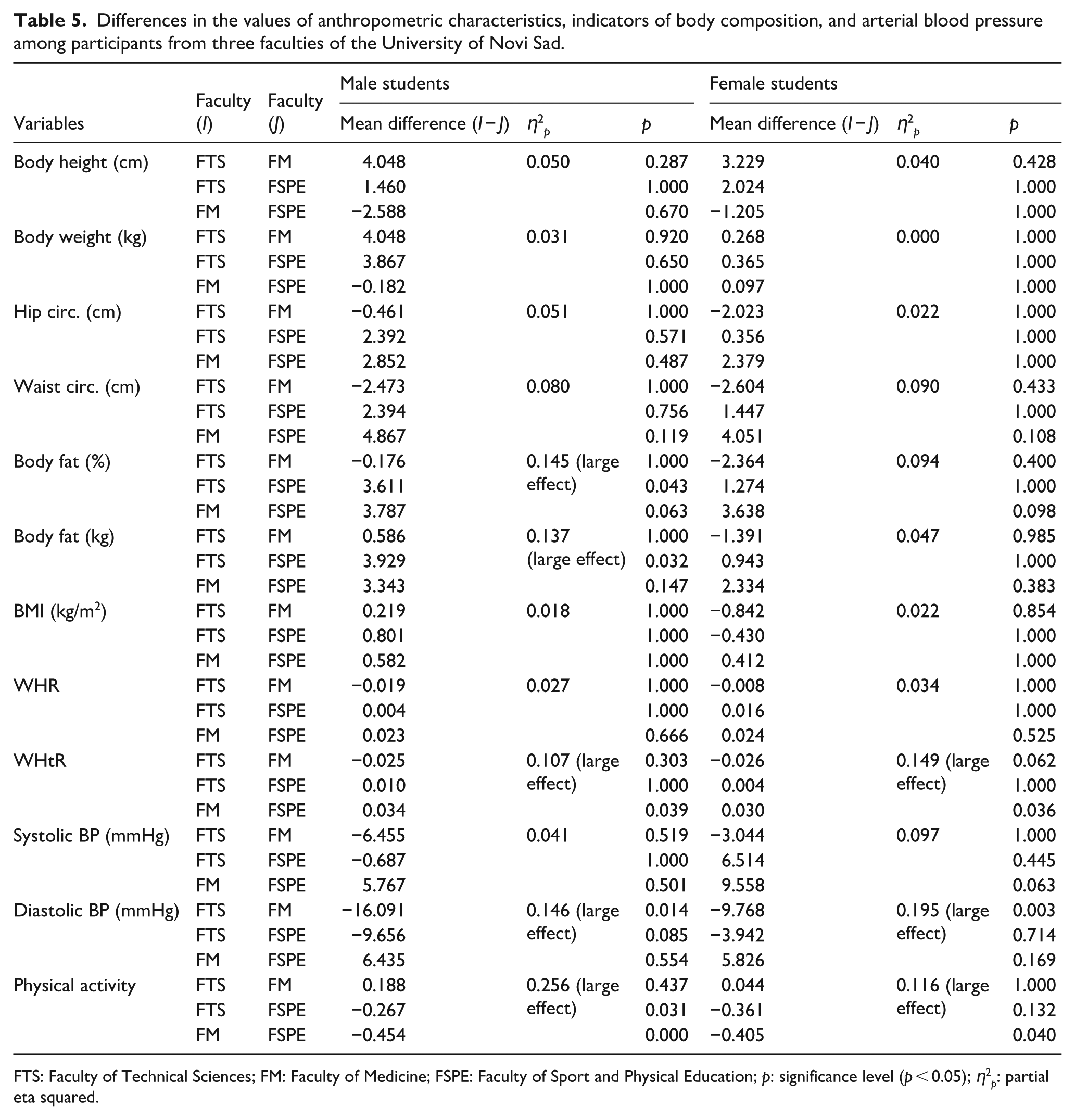
FTS: Faculty of Technical Sciences; FM: Faculty of Medicine; FSPE: Faculty of Sport and Physical Education; p: significance level (p < 0.05); η2 p : partial eta squared.
When comparing students from the three faculties, several variables exhibited notable effect sizes (partial η2).
Among male students, the largest effects were observed for diastolic blood pressure (η2 p = 0.146, p = 0.014), indicating a large effect, with higher values among medical students compared to those from the Faculty of Technical Sciences and the Faculty of Sport and Physical Education. Body fat percentage (η2 p = 0.145) and body fat mass (kg; η2 p = 0.137) also showed large effects, with higher values among students from less physically active faculties. The waist-to-height ratio (η2 p = 0.107) demonstrated a large effect as well, suggesting that central adiposity was more pronounced among less active male students.
Among female students, large effects were also observed for diastolic blood pressure (η2 p = 0.195, p = 0.003), which was significantly higher among medical students. The waist-to-height ratio (η2 p = 0.149, p = 0.062) indicated a notable difference in body composition patterns, while body fat percentage (η2 p = 0.094) was lower among physically active students of the Faculty of Sport and Physical Education.
Additionally, a large effect for overall physical activity (η2 p = 0.256 for males; η2 p = 0.116 for females) confirmed that students of sport sciences were markedly more active compared to those from technical and medical faculties.
The presence of large η2 p values across multiple variables indicates that the students’ faculty affiliation – closely linked to their study program and habitual activity level – explains a substantial proportion of the variance in physiological and anthropometric outcomes. This suggests that structured and regular physical education, as present in sport science curricula, exerts a measurable and meaningful impact on cardiovascular health and body composition. From a practical perspective, these findings emphasize the need to integrate physical activity programs within non-sport faculties as a strategy to prevent early onset of metabolic and cardiovascular risks among university students.
Discussion
Physical activity has a multidimensional impact on health, influencing biological, psychological, and social well-being.30–32 During the transition to university life, students encounter new academic and social demands that often lead to a decline in physical activity. Most study programs do not include mandatory exercise, which can contribute to the development of sedentary habits and unhealthy lifestyle patterns. The well-documented “Freshman 15” phenomenon describes weight gain among first-year students, averaging around 6.8 kg, due to decreased activity and poor dietary habits. 33 This underscores the importance of structured institutional approaches to maintaining students’ physical activity during university education.
In the present study, significant differences were observed in BMI, body fat percentage (BF%), and waist-to-hip ratio between physically active and inactive students, with active participants showing more favorable anthropometric and physiological profiles. These findings align with those of Đurić et al., 34 suggesting that comparable trends in nutritional status and physical activity are observed among university students across the region. Regular physical activity contributes to better body composition by maintaining a healthier muscle-to-fat ratio, confirming the established physiological effects described by McArdle et al. 35 and Hills et al. 36
Recent evidence supports these findings across diverse student populations. Musijowska and Kwilosz 37 reported that higher activity levels are associated with reduced adiposity and improved cellular health, reflected in higher phase angle values measured by bioelectrical impedance analysis (BIA). Similarly, Jaremków et al. 38 found a significant correlation between physical activity and lean mass among medical students, emphasizing that physically active individuals maintain healthier body composition. Although our study relied primarily on anthropometric indicators, integrating advanced methods, as recommended by Bocharin et al., 39 could enhance the precision of future assessments. Furthermore, Sokolovskaya et al. 40 demonstrated that digital and pedagogical interventions can effectively promote students’ awareness and motivation to adopt healthier behaviors – an approach particularly relevant for universities aiming to foster sustainable physical activity habits.
The elevated BMI values among physically inactive students in this study are primarily attributed to higher BF%, suggesting that inactivity, rather than muscle mass, accounts for increased body weight. Active students exhibited a more favorable muscle-to-fat ratio, aligning with previous findings that regular physical activity reduces body fat and supports healthy body composition.31,32,41 A positive correlation between BMI and BF% has been widely reported; however, the strength of this relationship varies depending on sex, age, and ethnicity. 42 The significant difference in waist-to-hip ratio (p = 0.012) further indicates greater central adiposity among inactive students, a key predictor of cardiovascular risk.43–45 These results align with global evidence linking abdominal obesity with physical inactivity and metabolic risk.
Interestingly, among female students, differences in BMI and BF% between active and inactive groups were minimal. Sociocultural factors likely play a role – many female students adopt dietary restriction strategies to maintain body weight, often independently of physical activity levels. Prior research shows that women are more likely to follow vegetarian or restrictive diets for esthetic or ethical reasons46,47 and to experience body dissatisfaction that drives dieting rather than exercise.48–50 These behavioral tendencies highlight the need for integrated interventions addressing both nutrition and body image in promoting women’s health.
Blood pressure findings further support the protective role of physical activity. Systolic blood pressure was significantly lower in active students (118.47 mmHg) compared with inactive peers (132.22 mmHg), confirming its preventive effect against hypertension, as previously emphasized by Warburton et al. 51 and Nelson et al. 52 Regular exercise represents not only a preventive but also a non-pharmacological therapeutic approach to cardiovascular risk reduction.
Analysis of activity domains showed that students from the Faculty of Sport and Physical Education were the most active, particularly in recreational activities, while medical students exhibited the lowest levels of physical activity, likely due to academic workload. These patterns mirror results from European studies showing that students enrolled in sports or physical education programs maintain significantly higher activity levels than peers from other disciplines.51,52
Beyond individual behavior, institutional and societal factors shape students’ physical activity. Studies from Central and Eastern Europe, including those by Bocharin et al. 39 and Sokolovskaya et al., 40 emphasize the role of educational policy and digital technology in promoting active lifestyles. Likewise, recent initiatives in health education and online engagement have shown promise in improving students’ awareness and self-management of health behaviors.40,49 These approaches could inform interventions in Serbian universities, where systemic support for student health remains limited.
The findings of this study, therefore, have practical implications. Introducing or reinstating mandatory Physical Education courses at universities, investing in recreational infrastructure, and promoting active transport options could significantly improve students’ physical and mental health. Educational campaigns emphasizing the dual importance of physical activity and balanced nutrition would also enhance long-term health literacy among young adults.
This study has several limitations, including its relatively small and homogeneous sample, cross-sectional design, and reliance on self-reported physical activity. Future research should involve larger, multi-institutional samples, longitudinal designs, and more objective measurements such as accelerometry. Including nutritional assessments would also provide a more comprehensive understanding of lifestyle determinants of body composition.
Despite these limitations, the present study provides valuable regional evidence on the strong relationship between physical activity, body composition, and cardiovascular health in university students. It highlights the urgent need for institutional policies that promote an active lifestyle and positions universities as key settings for implementing health promotion and preventive strategies in young adult populations.
Conclusion
This study confirmed a strong association between students’ physical activity levels and key anthropometric and physiological indicators. Physically active students had significantly lower body fat percentage (BF%), body mass index (BMI), and arterial blood pressure, as well as more favorable waist and hip circumference values compared to inactive peers. These findings are consistent with previous evidence that regular physical activity supports healthy body composition and cardiovascular function.
The results highlight the urgent need for universities to actively promote physical activity as part of their health and education strategies. Reintroducing mandatory Physical Education courses, organizing health-oriented workshops, and creating supportive environments for daily movement could significantly improve students’ physical and mental well-being.
Given the rising prevalence of sedentary lifestyles driven by digital media use and academic pressure, higher education institutions should integrate structured physical activity programs into their curricula. Doing so represents a cost-effective and sustainable approach to enhancing population health, preventing chronic disease, and fostering lifelong engagement in active living.
Footnotes

Ethical Approval
The study was conducted in accordance with the ethical standards of the 1964 Declaration of Helsinki. The research protocol was approved by the Ethics Committee of the Faculty of Medicine, University of Novi Sad (approval No. 01-39/109/1, June 17, 2019).
Informed Consent
Written informed consent was obtained from all participants prior to their inclusion in the study. Students who did not provide written informed consent were not included in the research.
Author contributions
All authors have read and approved the final version submitted for publication.
• Bojana Krstonošić (first and corresponding author) contributed to the study conceptualization and design, coordinated participant recruitment and data collection, performed statistical analyses, and drafted the manuscript.
• Aleksandra Prpa supported the study design, assisted with data acquisition, and contributed to drafting and critically revising the manuscript.
• Siniša S. Babović provided methodological oversight, supervised anthropometric measurements, and reviewed the manuscript for important intellectual content.
Funding
The authors received no financial support for the research, authorship, and/or publication of this article.
Declaration of conflicting interests
The authors declared no potential conflicts of interest with respect to the research, authorship, and/or publication of this article.