




Abstract
Introduction
In general, undergraduate university students in the north of Jordan have a low level of physical activity.
Objectives
To examine the physical activity level, perceived barriers and benefits to physical activity, and the contributing factors among university students in north of Jordan.
Methods
A cross-sectional study design was used, and data was collected from 235 university students through a self-reported questionnaire. The International Physical Activity Questionnaire (IPAQ) was utilized to calculate the amount of physical activity, while the exercise benefits and barriers scale (EBBS) was used to measure the perceived benefits and barriers of physical activity.
Results
According to the findings, less than half of the students (48.1%) reported engaging in physical activity. Several factors were found to be significantly related to higher levels of physical activity, including being younger, single, having a normal body weight, and reporting excellent health status. Logistic regression analysis revealed that overweight (OR = −0.068, 95% CI 0.025–0.183) and obese (OR = −0.250, 95% CI 0.068–0.924) were less likely to be physically active, while those who rated their health as excellent had higher rates of physical activity (OR = 3.590, 95% CI 1.263–10.201). The students agreed most strongly with the perceived benefit item “Exercise improves the way my body looks,” while the perceived barrier item they identified most strongly with was “There are too few places for me to exercise.”
Conclusion
This study provides important data for health promotion programs aimed at supporting physical activity among university students.
Keywords
Introduction/Background
Physical activity refers to any movement of the skeletal muscles that requires energy expenditure. Extensive research confirms that engaging in physical activity offers health benefits (Thivel et al., 2018). These benefits include reducing obesity (Jakicic et al., 2018), lowering the risk of certain types of cancer (Sangrajrang et al., 2013), alleviating pain (O’Neill et al., 2021), improving symptoms of mental illness (Jakicic et al., 2018), enhancing academic performance (Biddle & Asare, 2011), and preventing the onset of metabolic and cardiac diseases (Al-Kloub et al., 2019). Conversely, the absence of physical activity has negative effects on academic performance (Redondo-Flórez et al., 2022), cardiovascular health (Lavie et al., 2019), and mental health (Rodríguez-Romo et al., 2023).
Review of Literature
Studies indicate that undergraduate students generally exhibit a low level of physical activity (Maselli et al., 2018; Blake et al., 2017). Statistics revealed that about 80% of young individuals do not meet the World Health Organization's (WHO) recommendations regarding levels of physical activity (Guthold et al., 2020). For example, in the United Kingdom, 62% of PhD students and 64% of the administrative workforce do not meet the suggested levels of physical activity (Ndupu et al., 2023). Similarly, in Ethiopia, about 45.5% of the adults are inactive (Abdeta et al., 2018), while in Malaysia, 41.4% of university students do not engage in sufficient physical activity (Goje et al., 2014).
In Jordan, the prevalence of obesity and overweight among adolescents was reported to be 12.5% and 34.9%, respectively, (Thaher et al., 2018). Furthermore, it has been observed that obesity affected 75.6% of females and 60.4% of males, indicating that a significant proportion of both genders were either obese or overweight (Ajlouni et al., 2020). This rise in obesity rates coincided with an increase in the prevalence of hypertension, dyslipidemia, and diabetes in Jordan (Khader et al., 2019). It is important to note that physical inactivity is a major risk factor for obesity, overweight, and chronic illnesses (Patterson et al., 2018). On the other hand, engaging in sufficient physical activity has the potential to reduce the burden of obesity (Street et al., 2015). Several studies have been conducted in Jordan to examine the levels of physical activity among school-going teenagers (ALBashtawy, 2015; Alkhawaldeh et al., 2021; Al-Sheyab et al., 2019; Batiha et al., 2022; Tayyem et al., 2014). Conversely, previous research has focused on exploring the perceived barriers, benefits, and factors influencing physical activity among university students (Aceijas et al., 2016; Alkhateeb et al., 2019; Chaabna et al., 2022; Kgokong & Parker, 2020; Sabharwal, 2018). However, there is limited evidence regarding whether these findings apply to the student population in Jordan. Therefore, this study represents the first comprehensive examination of physical activity among university students in Jordan. By understanding the contributing factors, perceived barriers, and benefits associated with physical activity among this specific population, we can develop targeted interventions to promote physical activity effectively.
Purpose of the Study
The current study aimed to examine physical activity level, perceived barriers and benefits to physical activity, and its contributing factors among university students in northern Jordan.
Methods
Design
A cross-sectional study was carried out among university students in north Jordan over a period of 2 months (November–December 2022).
Sample
In this study, the target population is all students at Jordanian public universities in the northern region of Jordan. These universities offer bachelor's and master's degree programs across various faculties, including medical, scientific, and humanities disciplines.
It is difficult to make suggestions in binary logistic regression to have statistical power (Warner, 2020). It is advised that the minimum N be no less than 10 times K, where K is the number of predictors in the model (Peduzzi et al., 1996). Nonetheless, a higher N may be necessary to get enough statistical power (Warner, 2020). A sample size of fewer than 100 should be avoided, and 500 observations should be sufficient for almost all circumstances (Frees et al., 2014). In this study, there were nine predictors included. As a result, based on the criteria established by Peduzzi et al. (Peduzzi et al., 1996), a convenience sample of 235 university students was recruited to participate in the study.
Inclusion/Exclusion Criteria
Inclusion criteria were (a) registration for the first semester 2022–2023 and (b) Jordanian nationality. The following students were excluded: (a) students at private universities and (b) students who are physically disabled. The response rate of students was 85%.
Instruments for Data Collection
To collect the data, a self-reported questionnaire was utilized, which was divided into three parts: The sociodemographic part included questions on the participant's age, gender, marital status, family monthly income, study year, and faculty. Also, questions on the lifestyle variables: smoking (smoker or non-smoker); body mass index (BMI): the height was measured using meters, and weight was estimated using electronic scales. The BMI was computed using the anthropometric measurements as weight divided by height squared (kg/m2). The Centers for Disease Control and Prevention (CDC) 2000 BMI classification standards were then applied to categorize students as underweight, normal weight, overweight, or obese (Kuczmarski, 2002). Additionally, questions were included on health-related variables such as chronic illness (yes, no) and self-perceived health status (poor health, excellent health, and good health). In regards to physical activity levels, data were collected using the International Physical Activity Questionnaire (IPAQ), short version, to examine physical activity levels among university students (IPAQ Research Committee, 2005). According to IPAQ, students who had 600 met-min/week or more were considered physically active. While students with fewer than 600 met-min/week were considered physically unfit (IPAQ Research Committee, 2005). The perceived benefits and barriers to physical activity part utilized the exercise benefits and barriers scale (EBBS; Sechrist et al., 1987) to assess the students’ perceived benefits and barriers to physical activity. The EBBS scale is graded on a four-point Likert scale, with 1 being strongly agree and 4 being strongly disagree. It consists of 43 questions that examine university students’ perceived benefits and impediments to physical activity. The perceived benefit section is made up of 29 items divided into 5 subscales: life improvement (8 questions), physical performance (8 questions), psychological outlook (6 questions), social interaction (4 questions), and preventative health (3 questions). Similarly, the perceived barrier section includes 14 items divided into 4 subscales: exercise milieu (6 questions), time expenditure (3 questions), physical exertion (3 questions), and family discouragement (2 questions).
Data Collection Procedure
The data collection procedure involved obtaining permission from the faculty of nursing of Al al-Bayt University to conduct the study. The researchers visited each selected university to ensure that the deans of the individual faculties and departments had given their consent for data gathering. Data were collected through face-to-face self-reporting questionnaires, with participants given 20 min to complete them. The data collectors distributed the questionnaires to students from different colleges, providing them with information about the research's purpose, significance, and potential risks and benefits. It was emphasized that participation was voluntary and declining to participate would not have any negative consequences on their academic standing or any other aspect. Participants were assured of the confidentiality of their provided information, with the understanding that their responses would be treated with the utmost confidentiality and used solely for research purposes. The author took care to schedule data collection away from exam times to minimize potential stress levels.
Pilot
A pilot study was conducted with 30 participants to assess the content validity of the questionnaire from the perspective of the recipients. The study also aimed to determine the time required to answer the questionnaire, identify any potential issues with data collection time, and evaluate the suitability of the questionnaire items. This process allowed the author to evaluate and ensure the clarity and familiarity of the terms and phrases used in the questionnaire from the participants’ point of view. According to their feedback, the items were deemed to be clear, comprehensive, suitable, and easy to complete.
Ethical Considerations
The study has been authorized by the Ethics Committee at Al al-Bayt University and relevant universities (Ethics Research No. 1/8/2023). Students were advised that their participation was entirely voluntary and that they could withdraw from the study with no negative consequences. Students were also informed of their anonymity and confidentiality through a covering letter. Each student provided written informed permission.
Statistical Analysis
The Statistical Package for Social Sciences (SPSS) was used to examine the data.
A descriptive statistic (frequencies, means, and standard deviations) was used to report the sample's demographic characteristics. The variables’ relationships were examined using Chi-square associations and Pearson's correlations. To generate odds ratios (OR) with 95% confidence intervals, one logistic regression model was developed with physically active and physically inactive characteristics as dependent variables. The mean ranking was used to describe the benefits and barriers to physical activity. The accepted lowest level of statistical significance was set at p < 0.05.
Results
Sample Characteristics
The study sample consisted of 235 university students. The mean age was 20.6 years (SD = 4.17), male students outnumbering female students (123; 52.3%). The majority of students were single (155; 66.0%). The mean family monthly income was 458 JD (SD = 99.46). About 130 students (55.3%) reported having no work. The dominant group among the students was senior (199; 84.7%), and the faculties were classified as health and engineering (171; 72.8%) or humanistic and business (64; 27.2%). The majority of students were nonsmokers (146; 62.1%), had a normal weight (152; 64.7%), and rated their overall health as excellent or good (188; 80%). According to the IPAQ, just under half of the students (113; 48.1%) were physically active (Table 1).
Characteristics of Students (N = 235).

Factors Associated with Physical Activity among University Students
Younger students who were single, had a normal body weight, and had good self-rated health status were found to have a significantly higher level of physical activity. Their data were included in the logistic model. Gender, family monthly income, year of study, faculty, and smoking were not found to be related to physical activity and were therefore excluded from the logistic model.
Predictors of Physical Activity among University Students
In the logistic regression analysis, the factors meaningfully related to physical activity among students were overweight (OR = −0.068, 95% CI 0.025–0.183), obese (OR = −0.250, 95% CI 0.068–0.924), and self-perceived health status (OR = 3.590, 95% CI 1.263–10.201) (Table 2).
Logistic Regression Analysis of Predictors of Physical Activity Among University Students.

Reference group.
Confidence interval = 95%.
*Odds ratio is significant at the 0.05 level.
**Odds ratio is significant at the 0.001 level.
Perceived Benefits of Physical Exercise
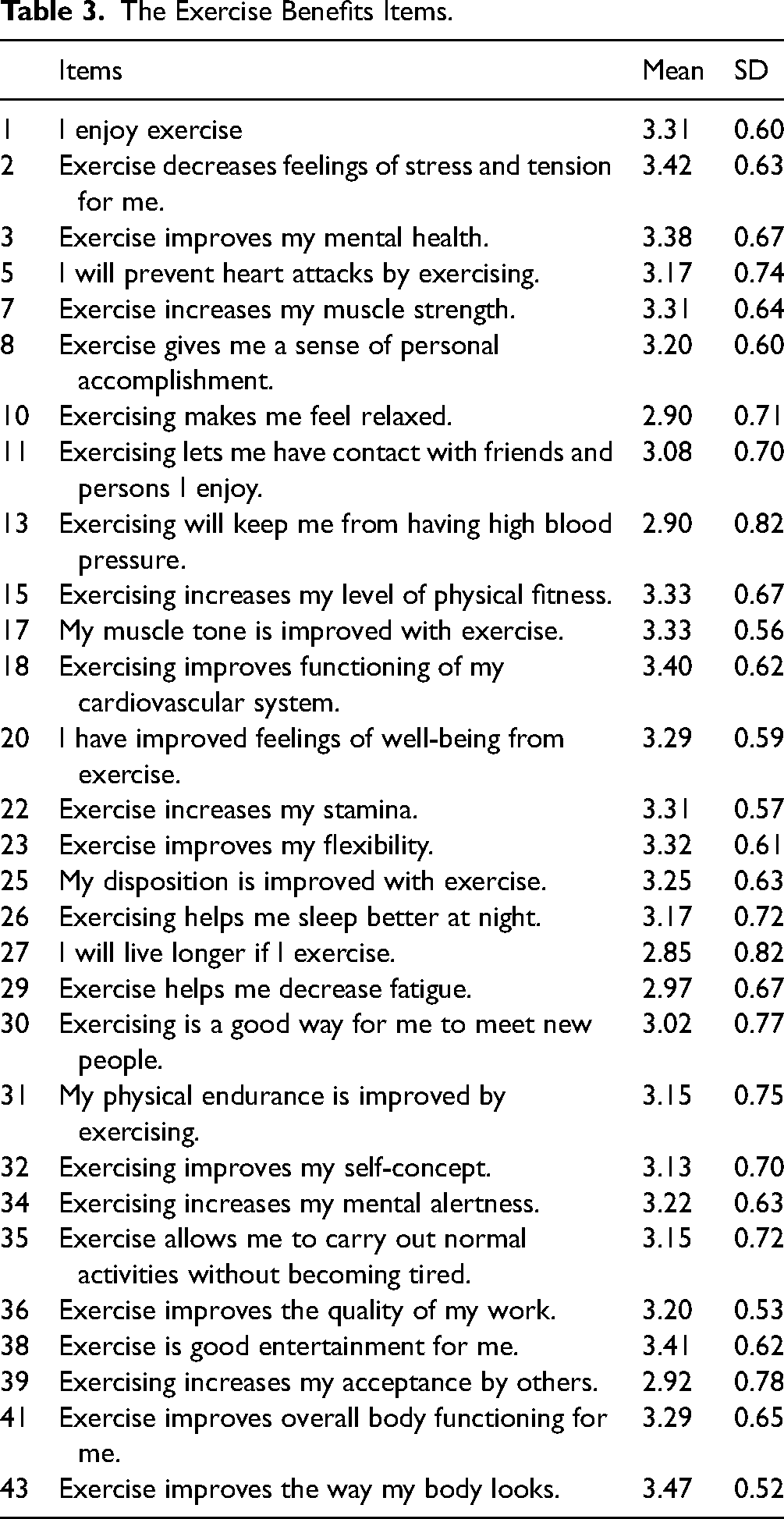
Perceived benefits of physical exercise were considered in 29 parts of the EBBS. The answers accompanying the highest mean scores on declarations concerning the benefits seen from physical exercise were those that had a connection with physical appearance. Students agreed most strongly with the declaration, “Exercise improves the way my body looks.” This was followed by the declarations “Exercise decreases impressions of stress and pressure for me” and “Exercise is a good amusement for me” (Table 3).
The Exercise Benefits Items.
Perceived Barriers to Physical Exercise
Perceived barriers to physical exercise were considered by the 14 parts of the EBBS. The answers with the highest mean scores on declarations concerning perceived barriers to physical exercise were those with related to places to exercise. Students strongly agreed with the declaration, “There are too few places for me to exercise.” This was followed by the declarations, “Exercise facilities do not have convenient schedules for me” and “Places for me to exercise are too far away” (Table 4).
The Exercise Barriers Items.

Discussion
About 51.9% of all students who participated in the present study did not reach the IPAQ recommendations for physical activity (IPAQ Research Committee, 2005). Similarly, a prior Jordanian survey found that less than 50% of university students did not reach the physical activity subscale of the Health-Promoting Lifestyle Profile II (HPLP II) (Hamdan & Shaheen, 2019). According to a Chinese survey, the level of physical activity in Chinese students does not align with the levels recommended by IPAQ (Liu & Dai, 2017). An additional study used the IPAQ to survey 361 medicine and nursing students studying at a UK medical school. The study found that the student's levels of physical activity were 48% for nursing students and 38% medicine students (Blake et al., 2017). A study conducted in Brazil informed us that approximately 55% of the undergraduate university students were physically active according to the WHO recommendations (Monteiro et al., 2019). In Saudi Arabia, a study revealed that about 42% of health college students were physically active according to the IPAQ recommendations (Awadalla et al., 2014). The low physical activity level found among students is likely due to the demands of being a higher education student attending a university (Alkhateeb et al., 2019), which can compromise their health (Aceijas et al., 2016). When interpreting the results, they should be considered with caution due to differences among educational systems, including different faculties in the studies, as well as cultural differences. For example, some past studies have included university students from the faculty of sports, who may have physical activity content included within their curriculum that should be considered. This was established by a past study that found that university students in sports faculty have a higher level of physical activity compared to students’ in physiotherapy faculty (Irēna et al., 2012). Future studies may consider differences in educational systems, different faculties, and cultural differences and their impact on university students’ physical activity. Universities need to implement strategies that incorporate curricular initiatives and learning environments to encourage students to regularly participate in physical activity and influence their choices to increase their physical activity (Aceijas et al., 2016; Alkhateeb et al., 2019).
This study found that certain sociodemographic characteristics, specifically being younger and single, were related to physical activity level. This finding is consistent with a recent study conducted in Qatar, which also found a link between physical activity level and age among university students (Chaabna et al., 2022). Additionally, similar to our study, the study by Al-Baho et al. (2016) found that being single was associated with physical activity levels among Kuwaiti adults. Moreover, our study revealed that normal body weight, as a lifestyle variable, was related to physical activity levels among university students. This finding is in line with the results of the study conducted in Kuwait, which also found a similar association between normal body weight and physical activity levels among adults (Al-Baho et al., 2016).
The findings of this study regarding the association between physical activity and self-perceived health status are in line with past studies conducted in Spain (Denche-Zamorano et al., 2022), among adolescent students (Moral-Garcia et al., 2020), in Jordan among school students (Alkhawaldeh et al., 2021), and in South Korea among university students (Ahn et al., 2014). These studies collectively support the idea that physical activity influences the perception of health throughout the life cycle. Given these consistent findings, it is vital to consider age, marital status, BMI, and perceived health status in the development of future health education plans that focus on physical activity. By addressing these factors, health education programs can effectively support physical activity and improve individuals’ overall health (Goncalves et al., 2022).
In the present study, the predictors of physical activity among university students were examined. The major predictors identified were overweight, obesity, and self-perceived health status. Logistic regression analysis revealed that university students who were overweight were 0.68 times less likely to be physically active compared to those of normal weight. This finding contradicts a Malaysian study conducted by Rajappan et al. in 2015, which showed that overweight students were actually more physically active than normal-weight university students. Similarly, university students who were obese were 0.25 times less likely to engage in physical activity. Additionally, the study found that university students who perceived their health status as excellent or good were 3.59 times more likely to be physically active compared to those who perceived their health status as poor. This association between perceived health status and physical activity is consistent with findings from previous studies conducted in various populations, including the general population in Spain (Denche-Zamorano et al., 2022), children or adolescents (Padilla-Moledo et al., 2020), school students in Jordan (Alkhawaldeh et al., 2021), adult populations in Canada (Cui et al., 2021), and older people in Germany (Trachte et al., 2016). To further understand the factors influencing physical activity among Jordanian university students, future research should explore knowledge, family dynamics, and environmental factors. By gaining insights into these factors, interventions can be developed to motivate more students to engage in regular physical activity.
The findings of this study indicated three important items related to perceived benefits of physical activity among university students with higher rates: “Exercise improves the way my body looks,” “Exercise decreases feelings of stress and tension for me,” and “Exercise is good entertainment for me.” One study stated that the chief perceived benefits of physical activity were to improve body shape, lose weight, improve health, and avoid illness (Alkhateeb et al., 2019). A past study found that university students had the highest levels of agreement about perceived benefits in the areas of “psychological outlook” and “physical performance” (Kgokong & Parker, 2020).
Findings of this study indicated three important items related to perceived barriers to physical activity among students at the university. These barriers were rates ranked as follows: “there are too few places for me to exercise,” “exercise facilities do not have convenient schedules for me,” and “places for me to exercise are too far away.” Past studies have stated that the utmost barrier was a result of limitations in time (Alkhateeb et al., 2019). In two previous studies, lack of time was also identified as a barrier that limited students’ commitments to physical activity (Aceijas et al., 2016; Sabharwal, 2018). The most agreed-upon barrier by Turkish university students was “exercise tires me” (ÖZKUL, 2021). Therefore, universities need to implement policies to improve accessibility and enhance students’ abilities to manage their time so they can fit physical activity into their habits. The reasons for perceived benefits and barriers to physical activity among students may vary between studies, and this may be related to cultural differences that influence motivations for exercise among countries.
Strengths and Limitations
This study represents the first comprehensive examination of physical activity among university students in Jordan. However, the cross-sectional design, which does not permit us to demonstrate cause and effect, and the use of convenience sampling, which may influence the generalizability of results, are potential limitations of this study. Furthermore, the EBBS is regarded as a universal instrument that may be used by whole populations (Harrison et al., 2018); however, it does not measure all significant barriers to physical activity, such as those posed by digital devices. In future studies, qualitative interviews may be used to offer context for the barriers to physical activity reported by university students.
Implications for Practice
The current study provides baseline data that can be used to establish physical activity and health promotion initiatives. It could be suggested that physical exercise classes be included in university education programs. To remove barriers to physical activity, it is crucial to create accessible and acceptable spaces. Additionally, physical activity facilities should offer student-friendly scheduling.
Conclusions
This study revealed a low level of physical activity among university students. Generally, although several factors were evaluated, the major factors associated with physical activity among university students were age, marital status, normal body weight, and self-perceived health status. Additionally, overweight, obesity, and self-perceived health status were found to be predictors of the level of physical activity.
The reasons “Exercise improves the way my body looks,” “Exercise decreases feelings of stress and tension for me,” and “Exercise is good entertainment for me” represent the main benefits of physical activity. On the other hand, reasons such as “There are too few places for me to exercise,” “Exercise facilities do not have convenient schedules for me,” and “Places for me to exercise are too far away” represent the key barriers to physical activity.
Footnotes
Acknowledgments
We express our appreciation to the all university students who participated in this study.
Declaration of Conflicting Interests
The authors declared no potential conflicts of interest with respect to the research, authorship, and/or publication of this article.
Funding
The authors received no financial support for the research, authorship, and/or publication of this article.
Institution Review Board Approval
The present research was conducted in accordance with the general ethical guidelines and the ethical approval was obtained from the Institutional Review Board (IRB) of the University. Written informed consent was obtained from all participants prior to the study.
