




Abstract
Introduction:
Self-care, including self-medication, has become increasingly important in modern healthcare. Many studies revealed the unacceptable knowledge level regarding self-medication. In Sudan, there is a necessity to study this phenomenon, as there are no data that describes Knowledge and attitude toward self-medication among Omdurman citizens.
Methods:
A cross-sectional, descriptive community-based study design targeted adult people living in Omdurman city and agreed to be part of the study were included. Data were collected using a pre-tested self-administered questionnaire and analyzed using The Statistical Package for the Social Sciences program (version. 26) and Microsoft Excel (version 10). Results were considered significant at P value less than 0.05.
Results:
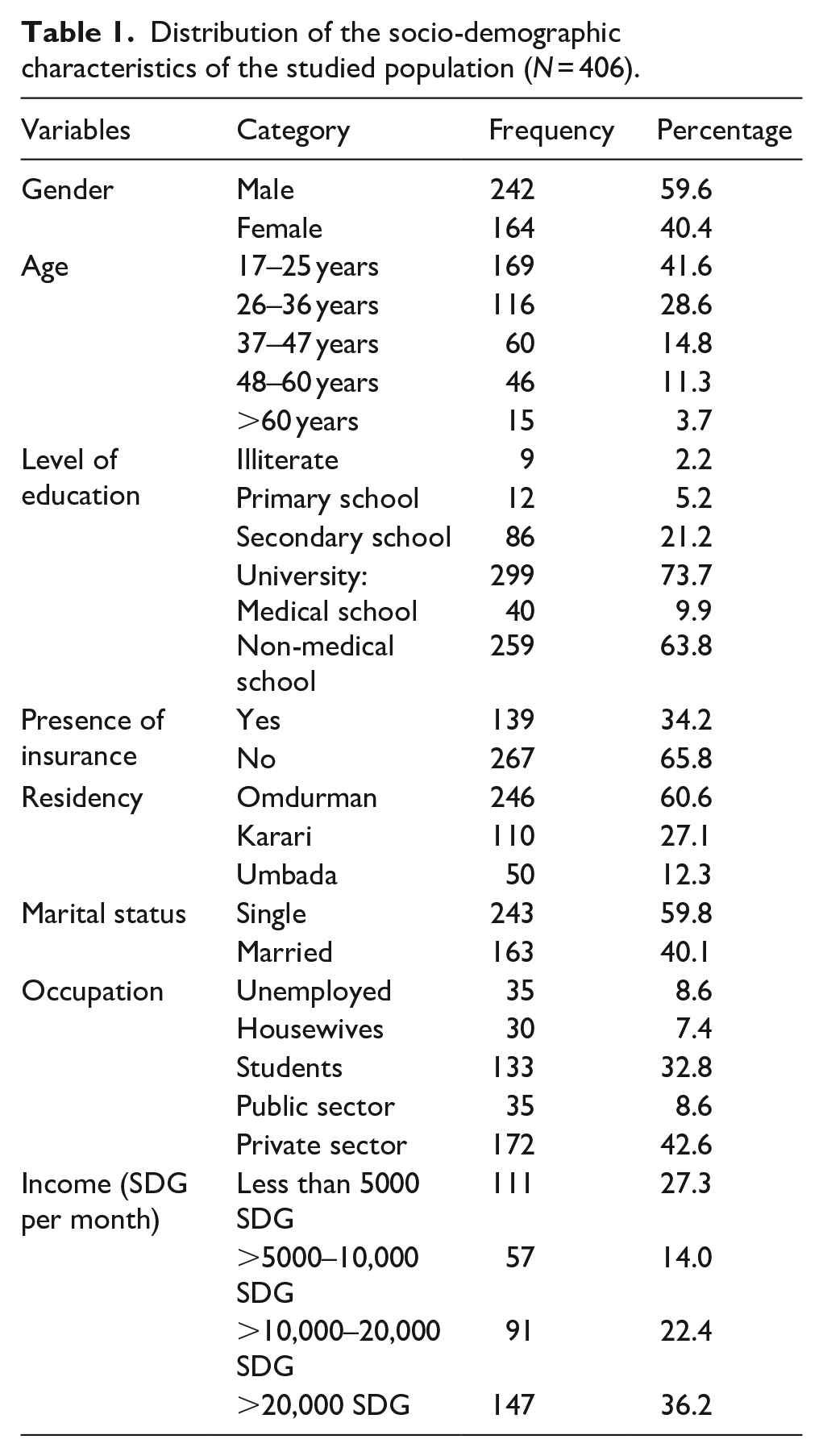
More than half of the participants (59.6%) were males, 41.6% of them were aged 17–25 years, and about three-quarters (73.7%) were university graduates. 56.9% of the participants were found to have moderate level of knowledge regarding self-medication and 58.6% of them showed negative attitude. Level of education and occupation were found to have a statistically significant relationship to participants knowledge regarding self-medication (p < 0.01 and 0.04) respectively, while gender, age, and level of education were found to be significantly associated with participants’ attitude level (p = 0.017, 0.010, <0.01) respectively.
Conclusion:
The majority of participants in Omdurman city possess a moderate level of knowledge and generally hold negative attitudes toward self-medication. Participants’ educational level was found to affect their knowledge and attitude highlighting the critical role of education in enhancing public awareness and shaping responsible self-medication practice.
Introduction
The healthcare sector has undergone substantial transformations in response to the demands of modern life. The practice of self-care has become increasingly crucial for individuals all over the world. 1 Self-care is a multi-step process that begins with accurate diagnosis and followed by the rational and appropriate use of medications. 2
The World Health Organization (WHO) defines self-care as “the care taken by individuals toward their own health and well-being, including the care extended to their family members and others.” 1 Within this broader framework, self-medication is considered a central component of self-care. 2
Self-medication is defined as “obtaining and consuming one (or more) drug (s) without the advice of a physician either for diagnosis, prescription or surveillance of the treatment.” 3 This may involve the use of previous prescriptions, 4 leftover medications, or drugs obtained from relatives and friends. 5
While self-medication confers certain advantages, such as reducing both direct costs to patients and the financial burden on the healthcare system, it also alleviates pressure on healthcare facilities, enabling them to focus resources on more serious medical conditions. 6 Furthermore, self-medication has been shown to enhance patient adherence to prescribed regimens, thereby improving health outcomes and contributing positively societal well-being. 7
The patterns of self-medication are influenced by a variety of factors, including demographic characteristics and individuals’ awareness of medications and their information sources. 6
However, despite its potential benefits, self-medication is associated with various risks when practiced improperly.6,8 As accurate diagnosis is fundamental to effective treatment, self-medication, when misapplied, may delay proper management of health conditions, exacerbate symptoms, and introduce additional risks such as toxicity, drug interactions, and the unnecessary use of medications. 6 This can ultimately result in elevated health-related costs. 8
The investigation of public knowledge regarding self-medication is essential to mitigating these risks. 8 Numerous studies have highlighted the insufficient levels of knowledge about medication use and self-medication practices. In Saudi Arabia, for example, a significant proportion of participants acknowledged the need to enhance both self-medication practices and the general public’s understanding of medication use. 6 Similarly, research from Malaysia suggested that improving patients’ awareness of the harmful consequences of self-medication could reduce medications misuse. 8
In Sudan, a community-based cross-sectional study has reported a notably high prevalence of self-medication, with socioeconomic factors such as low income playing a major role in driving this practice. The study underscores the importance of raising public awareness and providing targeted training for pharmacy professionals to address inappropriate self-medication practices. 9
Self-medication has become a pervasive practice in both developed and developing countries. In developing nations such as Sudan, patients face compounded challenges, including limited education, financial constraints, and restricted access to healthcare professionals, all of which exacerbate the prevalence of irresponsible self-medication. Furthermore, the body of research on this issue remains limited in Sudan. As such, there is an urgent need to explore the knowledge and attitudes toward self-medication within Sudanese populations, particularly in Omdurman, where data on this phenomenon is currently lacking.
Methods
This study aimed to assess the knowledge and attitudes of the general population in Omdurman city in Sudan toward self-medication and the factors.
Study design
A cross-sectional, descriptive community-based study design was conducted.
Study population and inclusion criteria
The study included all adult people living in Omdurman city and agreed to be part of the study.
Exclusion criteria
Participants were excluded if they were below 17 years of age, unable to read or understand Arabic, unwilling to provide verbal informed consent, or exhibited any cognitive impairment or communication barrier that would prevent them from completing the questionnaire accurately.
Study area
This study was conducted in Omdurman city in Sudan. Omdurman is one of the three major cities that comprise Khartoum state, it is the most populous city with a population of about 2,395,013. 10 Omdurman, located on the western bank of the River Nile directly across from Khartoum city situated at geographic coordinates 15.39°N latitude and 32.29°E longitude. 11
Study period
This study was performed over 3 months, from July 2021 to October 2021.
Sample size
The sample size was calculated using the following formula:

Where n is the sample size, Z is z-score (1.96), P is prevalence (50%), and e is margin of error.
The calculated sample size was 384.
To account for potential missing or incomplete responses, 406 participants were ultimately included. Data were collected by convenience sampling method. Data collection took place in public areas such as markets and service centers to ensure a balanced representation of both males and females.
Although convenience sampling has benefits in terms of time, effort and cost, it poses a higher probability of sampling bias and systemic errors than non-convenience sampling which may compromise the representativeness and validity of the study findings. 12
Data collection
Data were collected using a pre-tested self-administered questionnaire.
The questionnaire consisted of three main parts: the first portion contained the socio-demographic characteristics of the studied population, the second one included questions for estimating knowledge of the participants toward self-medication, and the third part was about attitude toward self-medication (Supplementary).
A scoring system was used to measure levels of knowledge and attitude. One point was given to each correct answer and zero point to incorrect answer then the total number of points has been calculated. Knowledge level has been divided it into three categories: low (0–2 points), moderate (3–5 points), and high level (6–7 points) and attitude level was categorized into: negative (4–6 points), fair (7–9 points), and positive attitude (10–12 points).
Piloting and validation process
A structured validation process was conducted to ensure the questionnaire’s clarity, validity, and reliability. The initial version of the questionnaire was reviewed by five academic experts from the Department of Clinical at Omdurman Islamic University. These experts evaluated the questionnaire in terms of clarity, relevance, and appropriateness of the items. Based on their input, the Content Validity Index (CVI) was calculated and found to be 0.89, indicating strong content validity across all items. Minor modifications were made based on expert feedback to improve question wording and alignment with study objectives.
A pilot study was then conducted with 15 participants from the target population to test the clarity and flawless of the questions. These individuals were excluded from the study sample. Based on their responses and feedback, further adjustments were made to ensure comprehensibility and readability.
The questionnaire was also translated into Arabic, the native language of the participants, to facilitate accurate understanding and response.
Data analysis
Data were analyzed using The Statistical Package for the Social Sciences (SPSS) program (version.26) and Microsoft Excel (version 10). Chi-square test was performed to test associations between socio-demographic data and other variables. Results were considered significant at p value less than 0.05.
Results
A total of 406 participants completed the questionnaire, resulting in a 100% response rate.
Socio-demographic characteristics of the participants
Of the respondents, 59.6% were males, and 41.6% were aged between 17 and 25 years. Approximately three-quarters (73.7%) were university graduates (Table 1).
Distribution of the socio-demographic characteristics of the studied population (N = 406).
Clinical characteristics of the participants
Most participants (87.7%) reported having no chronic illnesses. The most commonly reported conditions were asthma (12.3%) and hypertension (10.1%). Other conditions such as diabetes, rheumatoid arthritis, thyroid disorders, and miscellaneous chronic illnesses were reported at lower frequencies (Table 2).
Chronic conditions among the studied population (N = 406).

Knowledge of self-medication
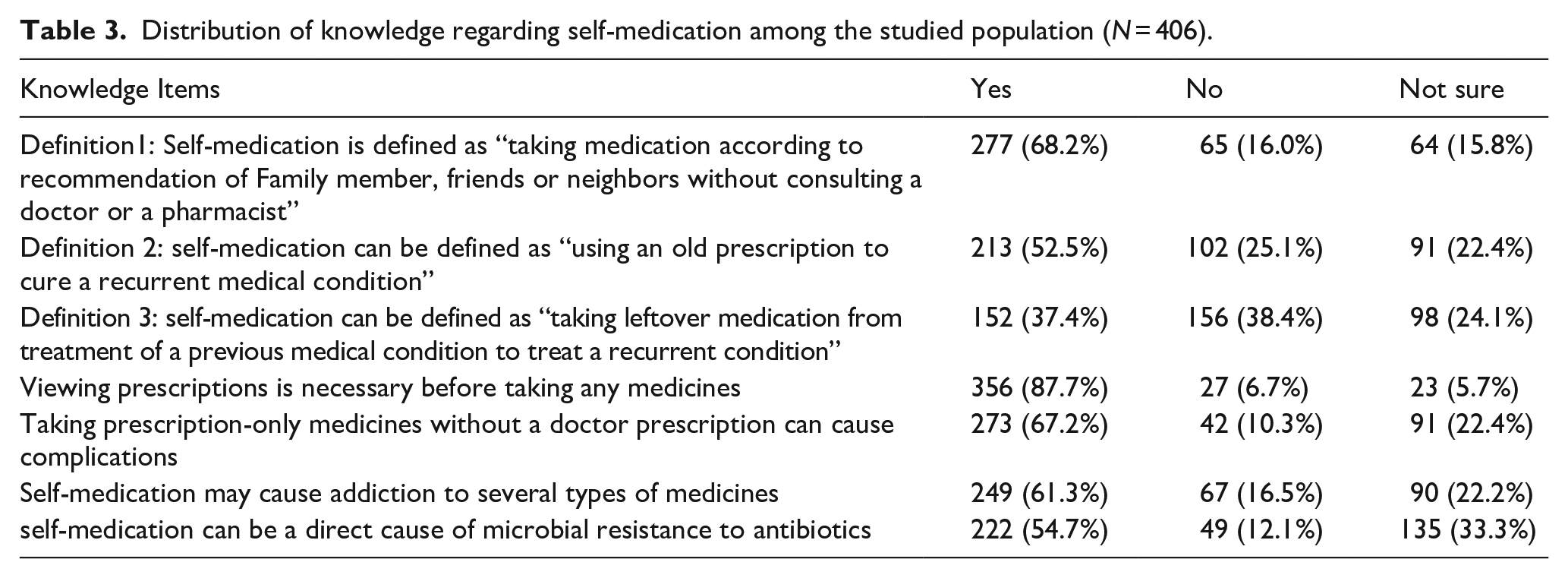
When knowledge scoring system was applied, 56.9% of the participants were found to have a moderate level of knowledge, 25.9% showed high level while 17.2% of them had low level (Table 3).
Distribution of knowledge regarding self-medication among the studied population (N = 406).
Attitudes toward self-medication
Analysis of attitude scores showed that 58.6% of participants held a negative attitude toward self-medication, 34% had a fair attitude, and only 7.4% exhibited a positive attitude (Table 4).
Distribution of attitude regarding self-medication among the studied population (N = 406).

Tests of associations
Statistical analysis revealed significant associations between knowledge levels and both education level (p < 0.001) and occupation (p = 0.04; Table 5). No significant associations were found between knowledge levels and gender, age, insurance status, residency, marital status, or income.
Factors affecting participants level of knowledge regarding self-medication (N = 406).

Gender (p = 0.017), age (p = 0.010), and education level (p < 0.001) were significantly associated with participants’ attitudes toward self-medication (Table 6). Female participants and younger age groups tended to have more negative attitudes. Those with lower educational attainment were more likely to have positive or fair attitudes, while those with university education demonstrated more critical attitudes toward self-medication level (p = 0.017, 0.010, <0.001) respectively (Table 6).
Factors affecting participants attitude level toward self-medication (N = 406).

Discussion
Self-medication is a prevalent global phenomenon, with higher rates observed in developing countries. Prevalence rates in these regions vary significantly, ranging from 12.7% to 95%. 13 Factors contributing to this practice include limited restrictions on medication dispensing and restricted access to healthcare services 4 in addition to the patients’ insufficient awareness regarding the accompanied side effects. 13 The patterns of self-medication are influenced by various factors such as age, financial status, medical knowledge, and satisfaction with healthcare services.5,6
In our study, 56.9% of participants demonstrated a moderate level of knowledge regarding self-medication. This finding aligns with a study conducted by You et al. in Hong Kong, where participants answered an average of 3.71 out of 6 questions correctly, indicating a similar level of knowledge. 7
Regarding the definition of self-medication, 68.2% of our participants correctly identified it as taking medication based on recommendations from family, friends, or neighbors without consulting a healthcare professional. In an Egyptian study published in 2024, approximately 73.25% of the participants showed awareness of the definition of self-medication. 14 In the previously mentioned study that conducted in Hong Kong, 84.5% of participants were aware about the risks associated with sharing medications based solely on symptom similarity, indicating a cautious approach to self-medication practices. 7 In contrast and based on a study published in 2017, a majority of respondents in Selangor, Malaysia (66.6%) expressed support for recommending their own medications to relatives, friends, or neighbors when they are ill, reflecting a more permissive attitude toward informal drug sharing. 8
Our study also assessed awareness of practices such as using old prescriptions and leftover medications. Approximately 52.5% (n = 213) were aware that self-medication includes using old prescriptions, and 37.4% (n = 152) recognized the use of leftover medications as part of self-medication practices. These figures are consistent with findings from Malaysia, where 70.8% of respondents agreed that they would keep leftover medications at home for future use. 8
In terms of prescription awareness, 87.7% (n = 356) of our participants acknowledged the necessity of viewing prescriptions, and 67.2% (n = 273) understood that taking prescription-only medicines without a doctor’s prescription can cause complications. This is in line with study of Alsaad et al. in Saudi Arabia published in 2022, where only 37.8% of participants were confident that there was no need to consult medical practitioners before using a drug for self-medication. Authors added that only 37.5% of them were assure regarding how to use the drug properly. 6
In Malaysia, almost all respondents (94.5%) stated that they would take the prescriptions as prescribed by a healthcare professional or in accordance with the instructions on the label. 8 In Hong Kong, 68.3% agreed with the necessity to consult a pharmacist before taking any over-the-counter (OTC) medication, however, female patients (OR = 1.62; 95% CI 1.18–2.17; p < 0.003) and those aged between 18 and 29 years (OR = 1.99; 95% CI 1.08–3.64; p = 0.026) were found to be most likely to consult pharmacists regarding OTC medications. 7
In Saudi Arabia, 63.8% of participants were unaware that certain medications should be avoided by individuals with chronic diseases, and 64.2% did not recognize that the same active ingredient could appear under different brand names. 6 Conversely, in India, Ahmad et al. found that the majority of the study population acknowledged the adverse effects (75%) and potential dependency (87%) associated with over-the-counter (OTC) drug use, only 25% were aware of potential drug interactions. 15 This discrepancy underscores differing levels of pharmacological literacy across countries.
Despite growing global attention to antimicrobial resistance (AMR), awareness remains insufficient. In our study, only 54.7% of participants identified self-medication as a contributing factor to AMR. Similarly, in Egypt Ghazawy et al. reported that 64% of participants were unaware of the connection between inappropriate antibiotic use and resistance, and 73% mistakenly believed that antibiotics are effective against both bacterial and viral infections. 16 Authors from Thailand in 2021said that 60.5% of participants responded incorrectly when asked about proper antibiotic duration based on infection type. 17 These findings suggest that the current educational campaigns may not be effectively reaching or influencing target populations.
Regarding participants’ attitude, 58.6% of respondents exhibited a negative attitude (4–6 points) toward self-medication, 34% had fair attitude (7–9 points), and only 7.4% had positive attitude (10–12 points). A similar assessment in Malaysia, using a five-point Likert scale, showed 66.6% of participants had satisfactory attitudes, while 33.4% were unsatisfactory. 8 Such variation may reflect differences in public health messaging, regulatory environments, and cultural norms.
Furthermore, only 14.8% of participants in our study considered self-medication a reliable treatment approach, though 31.3% endorsed it for managing minor illnesses. In Hong Kong, 35.5% expressed confidence in the efficacy of OTC drugs. 7
Sociodemographic analysis revealed that attitudes toward self-medication were significantly associated with gender (p = 0.017), age (p = 0.010), and educational level (p < 0.001). Notably, 17.0% (n = 69) of respondents perceived self-medication as safe, whereas 70.7% (n = 287) rejected the idea that relying on advice from family or friends constitutes a safe practice. This is consistent with the results of the study conducted in Hong Kong, as less than half (44.6%) of the participants thought that OTC use is safe 7 In contrast, most of the participants (59.5%) in India agreed with safety of OTC medications use. 15
Educational background emerged as a key determinant of knowledge in both our findings and previous research. In Saudi Arabia, 51.9% of respondents agreed that self-medication knowledge and practices needed improvement. 6 In our study, education level (p < 0.001) and occupation (p = 0.04) were significantly associated with knowledge scores. Similarly, logistic regression analysis in Hong Kong found that lower education levels and older age (≥60 years) were associated with inadequate self-medication knowledge. 7
Public awareness campaigns can help people understand the dangers and advantages of self-medication, allowing them to make more educated decisions. 18 These campaigns should target a variety of people, such as students, 19 nursing students, 20 and mothers with small children, 21 personalizing the message to their unique needs and concerns.
This study has several limitations. The use of a convenience sampling method may introduce selection bias and limit the representativeness of findings. Furthermore, the questionnaire used to assess knowledge and attitudes was relatively brief, potentially omitting nuanced insights. Additionally, as data were collected exclusively in Omdurman city, generalizing the results to the broader Sudanese population should be approached with caution.
Conclusion
The findings of this study indicate that the majority of participants in Omdurman city possess a moderate level of knowledge and generally hold negative attitudes toward self-medication. A statistically significant relationship was observed between socio-demographic factors particularly education and participants’ knowledge and attitudes. These results highlight the critical role of education in enhancing public awareness and shaping responsible self-medication practices.
Recommendations
Several recommendations are put forward to enhance knowledge and attitudes toward self-medication in Omdurman City and Sudan more broadly. It is essential to implement targeted public health education programs aimed at increasing awareness of the risks and proper practices associated with self-medication, encompassing both healthcare professionals and the general population. Furthermore, it is recommended to involve healthcare professionals, particularly pharmacists, in specialized training programs to serve as accessible sources of reliable medication information, especially in underserved regions. Additionally, stakeholders should consider enacting regulations to control the sale of prescription-only medications, thereby reducing the potential for misuse. Finally, further research is necessary, utilizing rigorously designed clinical studies, to comprehensively understand the complexities of public attitudes and behaviors toward self-medication throughout Sudan
Supplemental Material
sj-docx-1-phj-10.1177_22799036251369404 – Supplemental material for Evaluation of knowledge and attitude toward self-medication among general population in Omdurman City, Sudan: A descriptive community-based study
Supplemental material, sj-docx-1-phj-10.1177_22799036251369404 for Evaluation of knowledge and attitude toward self-medication among general population in Omdurman City, Sudan: A descriptive community-based study by Safaa Badi, Amr Siddig Siddig, Shakir Tariq Fayed, Ahmed Altijani Salah Ibrahim, Ahmed Alnaeem Altom, Khalid Yahya Ali and Eiman Eltayeb M. Ibrahim in Journal of Public Health Research
Footnotes
List of abbreviations
WHO: World Health Organization, OTC: over-the-counter

Ethical considerations
The ethical approval was obtained from Omdurman Islamic University ethics committee under reference serial number was (OIU/FP-ClinP-5-2021).
Consent to participate
Verbal informed consent, which was approved by the Omdurman Islamic University ethics committee, was obtained from the participants before being recruited into the study after explaining the main aim of the study. The facts and basis of the study, the confidentiality and voluntary nature of the study were demonstrated to the participants by the principal investigator. Data collected for the research was used for any other purposes. All experiments were performed in accordance with relevant guidelines and regulations (such as the Declaration of Helsinki).
Author contributions
AS, SHF, AI, and KHA, SB, AA, EI have made substantial contributions to the conception or design of the work; and the acquisition, analysis, or interpretation of data for the work. All authors equally contributed for the drafting the work or revising it critically for important intellectual content; all authors did the Final approval of the version to be published.
Funding
The author(s) received no financial support for the research, authorship, and/or publication of this article.
Declaration of conflicting interests
The author(s) declared no potential conflicts of interest with respect to the research, authorship, and/or publication of this article.
Data availability statement
The datasets used and analyzed during the current study are available from the corresponding author on reasonable request.
Supplemental material
Supplemental material for this article is available online.
References
Supplementary Material
Please find the following supplemental material available below.
For Open Access articles published under a Creative Commons License, all supplemental material carries the same license as the article it is associated with.
For non-Open Access articles published, all supplemental material carries a non-exclusive license, and permission requests for re-use of supplemental material or any part of supplemental material shall be sent directly to the copyright owner as specified in the copyright notice associated with the article.
