




Abstract
Background:
The growth and spread of antibiotic-resistant bacteria have become a major global concern, posing a serious threat to public health in the 21st century. Therefore, this study aimed to evaluate public knowledge, attitudes, and practices toward antibiotic use.
Design and methods:
A cross-sectional descriptive study design was used. The study was conducted at the Wad Medani locality, Gezira state, Sudan, from December 2022 to March 2023. Any citizen >18 years from the Wad Medani locality with at least 3 months of residency was included in the study.
Results:
A total of 420 questionnaires were distributed and collected. A total of 253 (56%) of the participants were in the 18–30 year age group, 242 (57%) were male, 254 (60.6%) were at the university level, and 254 (61.2%) had a medical background. Overall, 183 (43.5%) and 172 (41%) participants demonstrated poor knowledge and practice, respectively. However, 236 (56.2%) of the participants agreed that using antibiotics when they are not necessary leads to antibiotic resistance, and 334 (79.5%) believed that antibiotics accelerate recovery from the common cold and coughs.
Conclusions:
Our findings revealed that the majority of Sudanese people have inadequate knowledge, attitudes, and practices toward antibiotics. Most of the participants believed that antibiotics accelerated their recovery from the common cold and cough. Therefore, community leaders and local influencers could be engaged to spread awareness about antibiotic resistance and address misconceptions about antibiotics. In addition, enforcing stricter regulations on pharmacies to prevent the sale of antibiotics without a valid prescription.
Background
The growth and spread of antibiotic-resistant bacteria has become a major global concern in recent decades, posing a serious threat to public health in the 21st century. 1 Antibiotic resistance makes medicines less effective as therapeutic agents, increases treatment failure, and results in longer, more severe sickness episodes with higher costs and death rates. 1 One of the primary causes of the rise and dissemination of resistance is the improper use of antibiotics. 2 The inappropriate use of antibiotics can result from complicated and multiple factors, including the competence and experience of prescribers, uncertainty surrounding diagnosis, patient opinions regarding patient-prescriber relationships, and inadequate patient education provided by healthcare. Furthermore, patients’ knowledge, attitudes, and beliefs regarding the use of antibiotics. 3
Research on the factors influencing the use of antibiotics also demonstrates that a lack of knowledge about antibiotics is frequently linked to inappropriate antibiotic use and attitudes. 4 Improving the general public’s knowledge of antibiotics and antimicrobial resistance to encourage effective behavioral change at the population level is one of the five major priority areas identified in the World Health Organization (WHO) Global Action Plan on antimicrobial resistance (AMR). 1
Globally, numerous studies investigating the knowledge, attitudes, and practices regarding antibiotic use among various populations used different methods. Of these, a study conducted in Hong Kong, the proportions of participants with antibiotic knowledge scores of 0, 1, 2, and 3 were 11%, 27%, 33%, and 29%, respectively, 5 in Shiraz, Iran, 43.7% of faculty members and high school teachers reported self-medicating with antibiotics within the past year, 6 and in Ankara, Turkey, 28% of individuals kept antibiotics at home, and 19.1% reported self-medicating with them in the past year, mainly for sore throat, fever, and cough. 7 Another study that used qualitative and quantitative methods revealed that parents were more cautious when using antibiotics for their children than for themselves. However, fever and the mistaken belief that antibiotics are effective for sore throats were key factors driving their desire to use them for children. 8 In Sudan, 41% of people use antibiotics as a form of self-medication, with amoxicillin being the most commonly used drug, followed by ciprofloxacin, erythromycin, and tetracycline. 9 Another study conducted in Sudan involving adult participants selected from three cities in Khartoum State revealed that 73.9% of the participants had taken antibiotics or antimalarials over the course of the previous month without a prescription. Among the responders, 48.1% had used antibiotics, 43.4% had used antimalarials, and 17.5% had used both. 10 While many studies have been carried out worldwide, few studies have been conducted on public knowledge, attitudes, and practices toward antibiotics in Sudan, and most of them have been limited to Khartoum. Wad Medani, the capital city of Al Gazira State in central Sudan, is a vibrant place that reflects the intricacies of Sudan’s socioeconomic environment. Its distinctive agricultural output, cultural diversity, and strategic significance render it an excellent region for community research. Therefore, to support international efforts to combat AMR, as antibiotic misuse is a global problem by advancing the knowledge of public attitudes and actions toward antibiotics in Sudan, this was a community-based descriptive study conducted in Wad Medani locality, Sudan, aimed to evaluate adult public knowledge, attitudes, and practices toward antibiotic use.
Design and methods
Study area, design, and period
This was a cross-sectional descriptive study design. The study was carried out at the Wad Medani locality, Gezira state, Sudan, between December 2022 and March 2023. This time frame was chosen because the winter season is often associated with a rise in viral infections and increased misuse of antibiotics. Wad Medani city is the capital of Gezira State. The city covers a total area of 65 km2, and the population of the city was 515.230 on the basis of the 2008 census. Wad Medani has seven administrative units, including Middle, South, East Northwest, Hantoub, Al Shaparga, Almarkazi, and Alwaha. The reporting of this study conforms to the STROBE (Strengthening the Reporting of Observational Studies in Epidemiology) statement guidelines for cross-sectional studies 11 (Supplemental File 1).
Sampling technique
Stratified, convenient sampling techniques were used to select the participants. The sampling process was performed in two steps. First, the study area was divided into seven administrative units (Middle, South, East Northwest, Hantoub, Al Shaparga, Almarkazi, and Alwaha), that is, probability stratified sampling. Second, the data were collected from all strata (administrative units) at several convenient roads, stations, and supermarket centers, that is, nonprobability convenience sampling. The difficulty in formulating a sampling frame for all residential neighborhoods within each administrative unit, as well as a sampling frame for all citizens living in these residential neighborhoods, made the random sampling technique too difficult, and the convenience sampling technique more appropriate in this study. The most significant issue with convenience sampling is that it may not represent the overall population. Therefore, we used multiple locations for sample collection, such as markets, supermarkets, transport stations, and bakeries, to capture various perspectives and backgrounds within the population.
Sample size
The sample size was calculated based on the Epi Info population survey:
The minimum sample size calculated was 384. The sample size was further increased to 420 to facilitate distribution into seven administration units.
Inclusion criteria
Any citizen aged more than 18 years from the Wad Medani locality with at least 3 months of residency, regardless of occupation or social status, was included in the study.
Exclusion criteria
Citizens with hearing and speaking problems were excluded, and those with abnormal behavior or psychiatric problems were also excluded.
Questionnaire design and validation
A pre-validated, structured interview, closed-ended questionnaire was created in the English language, translated into Arabic, and then converted back to English. The questionnaire consisted of three parts. The first part was designed to obtain sociodemographic characteristics such as gender, age, occupation, residence, education, and marital status. The second part investigated people’s knowledge, and the following questions were asked: Are antibiotics used to treat any illness caused by fever? Do antibiotics accelerate recovery from the most common cold and cough? Should missed doses of antibiotics be skipped? Stop taking a full course of antibiotics when symptoms are improved? Does the use of antibiotics when it is not necessary lead to antibiotic resistance? In the third part, we evaluate the attitudes and practices of antibiotics as follows: Did you normally check the expiration date of antibiotics before use? Did you purchase antibiotics from a pharmacy without a prescription? Did you go to another pharmacist if he/she did not dispense antibiotics to you without a prescription? Did you share antibiotics from relatives regardless of the physician’s prescription? Did you normally keep the antibiotic stock at home in case of an emergency? Did you usually stop taking an antibiotic when you start feeling better? Did you prefer to buy antibiotics from the pharmacy without a prescription? If one of your family members is sick, do you hand over the antibiotic left over to him/her? Did you use antibiotics when you had a common cold and cough? When you have a sore throat, do you prefer to use an antibiotic? A pilot study that included 40 participants was carried out to determine the internal consistency of the questionnaire using Cronbach’s α (0.69) for the overall questionnaire.
Outcome measure
The knowledge, attitudes, and practices scores were categorized as good, moderate, and poor, respectively. Each correct answer was assigned one point, whereas wrong or uncertain responses were assigned zero points; then, the sum of the responses for each participant was calculated. The maximum knowledge score was five points, and the maximum attitude score was 10 points. Thus, the knowledge scores were categorized as good (4–5/5), moderate (3–2/5), or poor (1–0/5), whereas the attitude scores were divided into good (10–7/10), moderate (6–4/10), and poor (3–0/10).
Statistical analysis
The collected data were analyzed using the Statistical Package for the Social Sciences (SPSS) version 22. Descriptive statistics were used, and qualitative data are presented as frequencies and percentages.
Ethical approval and informed consent
Ethical approval was obtained from the Ministry of Health, Gezira State, N: 44/T/Kh/1, (21/12/2022), and written informed consent was obtained from the study participants.
Results
Sociodemographic characteristics of the participants
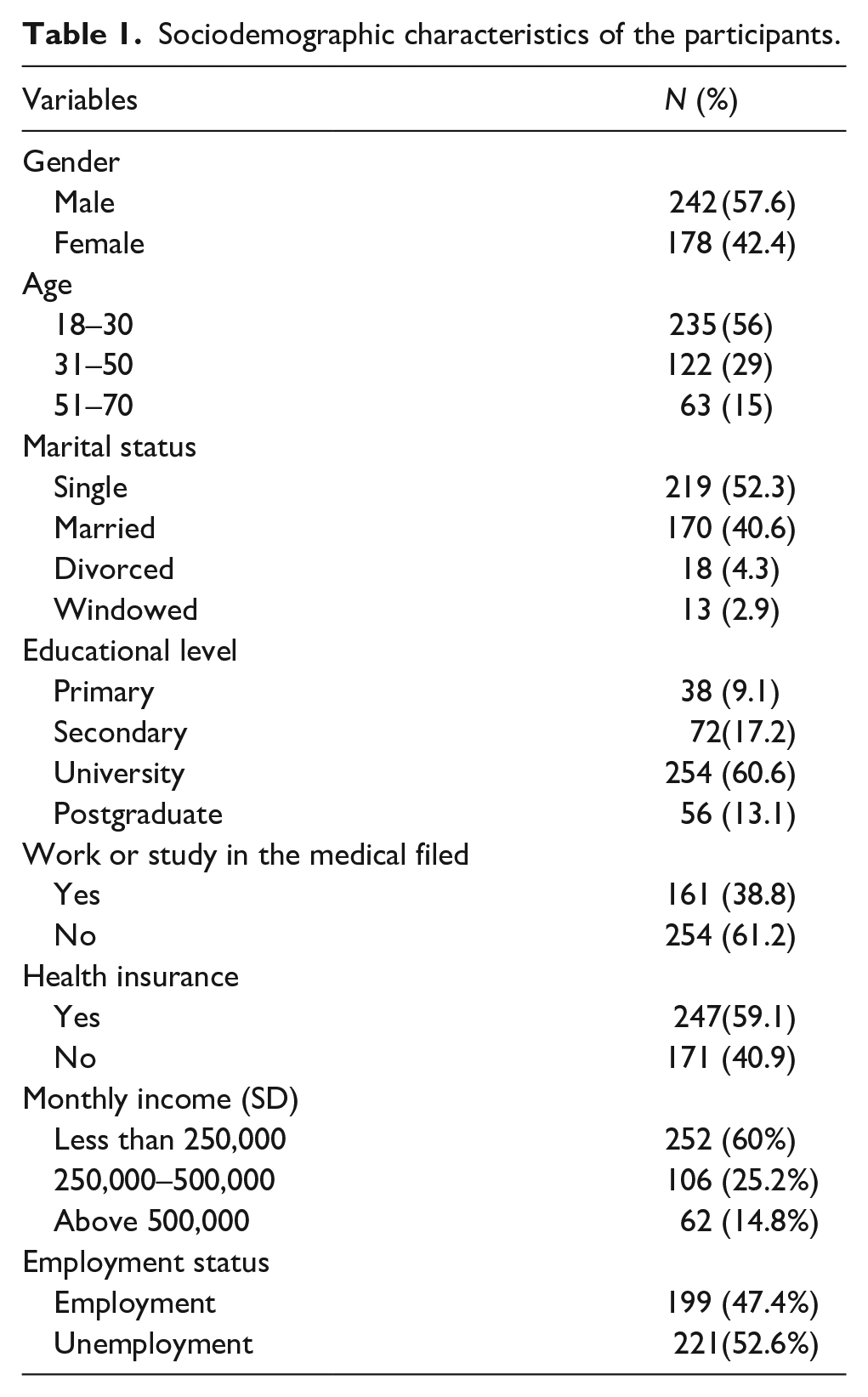
A total of 420 questionnaires were distributed and collected. The largest percentage of participants 235 (56%) was in the 18–30 year age group, which constituted more than half of the study participants. The sample distribution revealed a greater percentage of male 242 (57%) participants than female participants. More than half 219 (52.3%) of the study participants were single, and at the university level 254 (60.6%). Most of the study participants 254 (61.2%), had a medical background. The remaining sociodemographic characteristics of the participants are presented in (Table 1).
Sociodemographic characteristics of the participants.
Knowledge of the study participants toward antibiotic use
The antibiotic knowledge of the study participants was acquired via five statements. Overall, 183 (43.5%) of the study participants had poor knowledge, as shown in Figure 1.

The overall categories of participants’ knowledge toward antibiotic use.
Among the study participants, 135 (32.2%) stopped taking antibiotics once they felt better, 135 (32.2%) believed that antibiotics accelerated their recovery from most of the common cold and cough, and 236 (56.2%) agreed that antibiotic resistance results from the use of antibiotics when antibiotics are not needed, as shown in Figure 2.

Knowledge of the study participants about antibiotic use.
Attitudes and practices of the study participants toward antibiotic use
The attitudes and practices of the participants were assessed by using 10 statements to determine how they dealt with taking antibiotics from pharmacies and how to use them. Overall, most of the study participants 172 (41%) had poor attitudes and practices toward antibiotic use, as shown in Figure 3.

The overall categories of participants’ attitudes and practices toward antibiotic use.
Among the study participants, 206 (49%) preferred to buy antibiotics from the pharmacy without a prescription, 183 (43.6%) normally kept antibiotic stock at home in case of an emergency, (38.8% used antibiotics when they had a common cold and cough, as shown in Figure 4.

Attitudes and practices of the study participants toward antibiotic use.
Discussion
The growing problem of misuse of antibiotics in hospitals and the population exacerbates the global concern of AMR. Antibiotic use is influenced by a variety of factors, including economic, health, and environmental factors, as well as knowledge, expectations, and relationships between prescribers and patients. 1 Therefore, evaluating the public’s knowledge, practices, and attitudes regarding the use of antibiotics is crucial.
Knowledge of the study participants toward antibiotic use
The current study revealed that 43.5% of the participants had poor knowledge. This finding was higher than that of two studies conducted in Sudan to assess medical students’ knowledge, which reported that only 26.7% and 20.3% of participants had inadequate knowledge.12,13 The significant discrepancy may indicate variations in the populations studied (medical students vs the general population) and suggest that while medical students may receive some education on AMR, broader public awareness remains limited. The findings of this study were less than those of the community-based study conducted in Hawassa city, Ethiopia, which reported that 64% of participants had poor knowledge. 14 On the other hand, the results of this study are in agreement with those of a study in the western region of Saudi Arabia, which revealed that 55.29% of the study participants had poor knowledge about antibiotics and AMR. 15 Poor knowledge among medical students and the general population compromises the ability to recognize the importance of responsible antibiotic use. Therefore, implementing awareness programs targeting both medical students and the general public can help improve the understanding of AMR and appropriate antibiotic use. Strategies could involve mass media campaigns, community workshops, and school education programs.
In this study, 32.2% of the investigated individuals stopped taking antibiotics once they felt better, which is higher than a study that was carried out in Sudan to assess medical students’ knowledge and revealed that only 12.3% of participants stopped therapy when their symptoms disappeared. 13 The findings of this study were less than those of a study that was carried out in Sudan to assess medical students’ knowledge and reported that 48% of the study participants agreed that antibiotics should be stopped immediately when the patient is clinically improved, 12 in addition to a study conducted among patients in Amhara, Ethiopia, in which 47.8% of participants stopped taking antibiotics when started feeling better. 16 Compared with the general population, a greater percentage of medical students who agreed that antibiotics should be stopped upon clinical improvement is concerning. This suggests that even healthcare professionals in training may lack sufficient knowledge about AMR, which could perpetuate poor practices in clinical settings. Additionally, a study conducted in 11 Arab countries revealed that 63% of participants should stop antibiotics when they feel better. 17 This behavior contributes significantly to the development and spread of AMR. Addressing these issues requires a multifaceted approach, including public education, healthcare professional training, and stricter regulatory measures. The variation in knowledge highlights the importance of targeted educational campaigns. For example, in Sudan, interventions could focus on both the general population and healthcare professionals to emphasize the importance of completing antibiotic courses.
With respect to the use of antibiotics for the common cold and cough, the majority of respondents (79.5%) in this study believed that antibiotics accelerated their recovery from the common cold and cough. This result was significantly greater than what was reported in a study in Sudan evaluating the knowledge of medical students, in which only 18.3% of them believed that antibiotics can be used to treat cold and flu symptoms, 13 and a study carried out in the United Arab Emirate revealed that 29.7% of the university students surveyed believed that antibiotics accelerate recovery from the most common cold and cough. 18 Additionally, a study was conducted among patients in Amhara, Ethiopia, in which 48.3% believed that antibiotics help them recover from a cold much more quickly. 16 This discrepancy highlights a crucial gap in education and awareness about antibiotic use among different groups. Compared with the general population, medical students, who are expected to have a more informed perspective, appear to be less likely to hold misconceptions about antibiotics. The results of this study, in agreement with those of a study conducted in 11 Arab countries, revealed that 73.3% of them thought that antibiotics could treat cold and flu, 17 and a community-based study conducted in Hawassa city, Ethiopia, reported that 82.9% of participants believed that antibiotics are prescribed for most coughs and colds. 14 The high percentages in some instances point toward the widespread cultural belief that antibiotics accelerate recovery from the common cold and cough, reflecting a lack of effective public health education campaigns. Therefore, enhanced public health campaigns that educate individuals about the proper use of antibiotics and the differences between viral and bacterial infections can help shift these patterns and ultimately reduce AMR risk in Sudan and beyond.
With respect to knowledge of AMR in this study, 56.5% of the population under study agreed that antibiotic resistance results from the use of antibiotics when antibiotics are not needed. These findings, which are less than those of a survey carried out in Sudan to assess medical students’ knowledge, revealed that 75.2% of participants agreed that improper use of antibiotics can lead to antibiotic resistance, 13 and a study carried out in the United Arab Emirate revealed that 76.1% thought that frequent use of antibiotics would decrease their efficacy. 18 Furthermore, a survey on participants’ knowledge and attitudes regarding the use of antibiotics in the western region of Saudi Arabia revealed that 88% believed that overuse of antibiotics led to AMR. 15 The relatively high level of recognition among medical students in Sudan indicates that targeted education for healthcare professionals could be crucial in addressing AMR. This result is considerably greater than that of a study performed in Jordan, which revealed that 36% of respondents believed that the unnecessary use of antibiotics was the cause of antibiotic resistance. 19 The substantial discrepancies in AMR knowledge among different studies should inform tailored interventions that consider local contexts, educate the public on the implications of antibiotic misuse, and ultimately foster a culture of responsible antibiotic use to reduce AMR risk in Sudan and beyond.
Study participants’ attitudes and practices toward antibiotic use
The current study revealed that 41% of the participants had poor attitudes and practices toward antibiotic use. This finding was higher than that of two studies performed in Sudan to assess medical students’ knowledge, which reported that only 15% of the participants had poor attitudes. 12 This discrepancy may indicate a difference in education level, health literacy, or exposure to antibiotic stewardship programs among medical students compared with the general population surveyed in the current study. In contrast, this finding was less than that of a community-based study conducted in Hawassa city, Ethiopia, which reported that 60% of participants had negative attitudes and that 55% had poor practices toward antibiotic use. 14 In addition, a study carried out in the western region of Saudi Arabia reported that 88.42% of participants had inadequate attitudes and that 60.89% had inadequate practices toward antibiotic use. 15 The variations in results could also be influenced by various factors, including healthcare access, antibiotic availability, public health campaigns, and educational programs. In Sudan, limited access to healthcare and lower levels of public health awareness could contribute to higher instances of poor attitudes and practices concerning antibiotics.
According to this study, 27.6% of the participants preferred to purchase antibiotics without a prescription from the pharmacy. This finding is less than that of a study from Sudan, which revealed that 55.9% of medical students prefer to buy antibiotics without a legitimate prescription, 13 and a study conducted in Saudi Arabia revealed that 91.3% of respondents agreed that antibiotics should be taken over the counter without a prescription, 20 in addition to a study conducted among patients at Amhara, Ethiopia, in which 44.8% preferred to be able to buy antibiotics from a pharmacy with a doctor’s prescription. 16 On the other hand, this result is much greater than what has been reported in the research conducted in Kuwait, which concluded that 4.6% of respondents preferred to skip receiving a prescription to purchase antibiotics from the pharmacy. 21 The preference for purchasing antibiotics without prescriptions can lead to inappropriate use. This misuse creates an environment conducive to the development of resistance. These findings underscore the critical need for public health interventions focused on education, stricter regulatory enforcement, and community awareness campaigns to reduce unauthorized and inappropriate antibiotic use. In Sudan, these patterns not only highlight current risks related to AMR but also highlight the urgent need for targeted strategies to mitigate these risks and promote responsible antibiotic use.
With respect to the storage of antibiotics at home, this study revealed that 43.6% of the surveyed population normally keeps their antibiotic stock at home in case of an emergency, which was higher than that reported in a study conducted in Sudan among medical students, which revealed that 24.1% saved the remaining antibiotics for next time. 12 The results of this study are in line with the findings of a study performed in the western region of Saudi Arabia, in which 59% of participants normally keep antibiotic stock at home in case of an emergency, 15 and a study conducted among patients at Amhara, Ethiopia, in which 50% reserve antibiotics to self-medicate for future use. 16 In contrast, the results of this study were less than those of a study carried out in Riyadh, Saudi Arabia, which indicated that 25.5% of patients were keeping antibiotics on hand for emergencies. 22 The high percentage of individuals keeping antibiotics at home raises concerns about the potential for misuse and self-medication, which is a well-documented driver of AMR. In Sudan, the findings highlight the need for updated regulations regarding antibiotic sales and distribution.
According to our survey, 38.8% of the participants used antibiotics for coughs and common colds, which is greater than the study conducted in Sudan among medical students reported that only 20.5% of the participants took an antibiotic when they had a cough or sore throat. 12 In addition, a study conducted among adults living in Riyadh, Saudi Arabia, 21.4% and 31.1% of the participants utilized antibiotics for coughs and the common cold, respectively. 22 The results of this study are in agreement with those of a study conducted among patients in Amhara, Ethiopia, in which 38.8% of participants took an antibiotic when they had a cough and cold. 16 On the other hand, the findings of this study were less than those reported in a Saudi Arabian web-based cross-sectional study, in which 70.29% of respondents believed that antibiotics would hasten the recovery of colds and coughs. 20 The differences in the observed patterns of antibiotic use for coughs and colds among various populations highlight the need for tailored public health strategies. Education initiatives should focus on misunderstandings of the role of antibiotics in treating viral infections, such as colds and coughs, which could significantly reduce the risk of unnecessary prescription and consumption of these medications and consequently reduce the development of AMR.
Limitations of the study
When interpreting our findings, it is important to consider several limitations. First, although the sample size was 420 participants and the study was limited to members of the population who live in the Wad Medani locality provides useful insights, it may not be fully representative of the broader Sudanese population and therefore, the findings may not generalize to rural areas or other regions with different socio-economic and cultural context. For future research, we suggest conducting larger, multi-site studies across different regions of Sudan to explore regional variations and improve generalizability. Second, the majority of the study participants were young, and male sex might not accurately reflect sex. Third, the study used a descriptive study design and statistics; therefore, to explore differences between groups and identify potential predictors of knowledge and attitudes, studies should be conducted in a large population across all Sudan states, and inferential statistical analyses should be implemented. Finally, the use of convenience sampling may not represent the overall population; self-reporting can result in biased responses for several reasons, such as social desirability bias, where people give answers, they think are more positive or acceptable than their actual actions, and the absence of longitudinal data restricts the ability to track changes in knowledge, attitudes, and practices over time.
Conclusions
Our findings revealed that Sudanese people’s knowledge was inadequate and that their attitudes and practices were inappropriate. Most of the participants agreed that the use of antibiotics when it is not necessary led to AMR and believed that antibiotics accelerated recovery from most of the common cold and cough. The high prevalence of misconceptions, such as the belief held by 79.5% of participants that antibiotics accelerate recovery from the common cold and cough, points to the urgent need for targeted health education campaigns. These should focus on correcting false beliefs and promoting responsible antibiotic use, particularly among young adults. Therefore, we recommend (1) nationwide educational campaigns involving radio, TV, social media, and community outreach programs, which are widely accessible in Sudan to improve knowledge about antibiotic resistance and appropriate antibiotic use; (2) workshops and training sessions for doctors, pharmacists, and nurses on antimicrobial stewardship to educate patients and prescribe antibiotics responsibly; (3) Enforce stricter regulations on pharmacies to prevent the sale of antibiotics without valid prescriptions such as penalties for pharmacies and healthcare providers who violate these regulations; (4) Engage community leaders, religious figures, and local influencers to spread awareness about antibiotic resistance and address misconceptions and cultural beliefs about antibiotics; (5) integrated lessons on antibiotic resistance and proper medication use into school curricula to educate the younger generation about responsible antibiotic use; (6) Conduct longitudinal studies to assess the effectiveness of these interventions over time and to continually monitor public knowledge and attitudes toward antibiotic use in Sudan; (7) partnerships with organizations such as the WHO and the Global Antibiotic Resistance Partnership (GARP) to implement best practices; and (8) educating the public about alternative treatments for colds and coughs, such as rest, hydration, and over-the-counter symptom relievers.
Supplemental Material
sj-docx-1-phj-10.1177_22799036251365577 – Supplemental material for Public knowledge attitudes and practices toward antibiotic use among the adult Sudanese community: A cross-sectional descriptive study
Supplemental material, sj-docx-1-phj-10.1177_22799036251365577 for Public knowledge attitudes and practices toward antibiotic use among the adult Sudanese community: A cross-sectional descriptive study by Sigood Omran, Musab Kheyar, Nafisa Alfatih, Ali Abdelatti, Marwa F. Alamin and Yousif B. Hamadalneel in Journal of Public Health Research
Footnotes
Acknowledgements
None.

Funding
The author(s) received no financial support for the research, authorship, and/or publication of this article.
Declaration of conflicting interests
The author(s) declared no potential conflicts of interest with respect to the research, authorship, and/or publication of this article.
Data availability statement
The datasets created and analyzed in this study are not publicly accessible because of the confidentiality of the participants, but can be obtained from the corresponding author upon reasonable request.
Significance for public health
Antibiotics are considered the miracle of medicine that can cure patients with infectious diseases. In Sudan, few studies have evaluated public knowledge attitudes toward and practices related to antibiotics. Most of the published surveys were limited to Khartoum, which is the capital of Sudan. This study provides a baseline understanding of the knowledge and attitudes toward antibiotics among the general population in Wad Medani, which is the second town in Sudan. Therefore, these findings may help policymakers develop plans, laws, and programs to limit the misuse of antibiotics and to preserve the health of the general population of Sudan.
Supplemental material
Supplemental material for this article is available online.
References
Supplementary Material
Please find the following supplemental material available below.
For Open Access articles published under a Creative Commons License, all supplemental material carries the same license as the article it is associated with.
For non-Open Access articles published, all supplemental material carries a non-exclusive license, and permission requests for re-use of supplemental material or any part of supplemental material shall be sent directly to the copyright owner as specified in the copyright notice associated with the article.
