




Abstract
Background:
Dengue fever, a neglected tropical disease, exhibits a total seroprevalence of 27% in Sudan. During the recent outbreak, medical students actively participated in health education and community outreach programs. This study aims to assess the knowledge, attitude, and practice (KAP) of medical students regarding Dengue Fever (DF) during its current outbreak in Sudan.
Design and methods:
We conducted a cross-sectional study involving medical students from more than 15 Sudanese universities, encompassing 11 states. Data collection took place between October 23 and November 10, 2023, utilizing a Google Form questionnaire. A convenient sampling technique was employed to reach students due to its accessibility and feasibility during the ongoing conflict in Sudan. Correlation and regression analyses were used to identify predictors of KAP and establish associations between KAP domains and socio-demographic factors.
Results:
Of 694 medical students, 11% reported a previous infection with DF. Among the participants, 58% demonstrated good knowledge, 74.1% exhibited a positive attitude, and less than half (46.7%) demonstrated good preventive practices. There was a positive correlation between knowledge and attitude levels with the practice level (p < 0.001). Gender, age, and previous DF infection emerged as significant predictors (p < 0.05) of the overall KAP level in multiple logistic regression.
Conclusions:
Our study revealed a commendable level of knowledge and attitude but a suboptimal level of practice regarding DF among medical students. This inadequacy in practice, particularly among medical students who are expected to set an example, is concerning and warrants further investigation.
Introduction
Dengue fever (DF) is a viral illness caused by the dengue virus (DENV), transmitted to humans through the bite of infected mosquitoes, particularly Aedes aegypti, prevalent in tropical and subtropical regions.1,2 The clinical spectrum of the disease ranges from mild symptoms to severe conditions like dengue shock syndrome and dengue hemorrhagic fever. Without appropriate care, the mortality rate from severe dengue can escalate to 20%, particularly affecting children under the age of five and older individuals.3,4
Dengue infections affect approximately 390 million people worldwide annually, spanning 129 nations, including those in Africa.2,5 DF epidemics have been documented in several sub- Saharan African developing nations, including Sudan. 6 Notably, the first recorded outbreak of DENV occurred in 1986 among individuals in the Red Sea State, eastern Sudan. 7 However, a concerning 44% of localities in 12 states (67%) reported dengue fever cases between July 2022 and April 2023. 8 The total seroprevalence of DENV in Sudan stands at 27%, as indicated by a previous meta-analysis. 9 The peak of illnesses is observed between September and November, aligning with the rainy season. 7 Currently, there have been 4097 suspected cases of dengue fever and 13 related deaths since April 2023, with a significant concentration in Gadarif city, eastern Sudan.10–12
Given the absence of specific drugs for treating dengue viral infection, managing dengue fever relies on effective illness management and vector control. Vector control involves limiting contact with mosquitoes that transmit dengue viruses by using mosquito nets, coils, draining stagnant water, and applying insect repellents 4 Medical students, possessing authentic knowledge, play a crucial role in community preparedness. With adequate knowledge and positive attitudes, they can effectively transfer this understanding to their communities, significantly contributing to dengue fever prevention. 13 Despite this potential, there have been limited studies on medical students’ perceptions of dengue fever in Sudan. This study specifically focuses on medical students due to their pivotal role in health education related to disease prevention and control.
The primary objective of our study is to explore the knowledge, attitude, and practice (KAP) of medical students in Sudan concerning dengue fever. It aims to provide valuable insights to enhance future disease prevention efforts.
Design and methods
Study design and population
This cross-sectional study took place between October 23 and November 10, 2023, amid the ongoing dengue fever outbreak across multiple states in Sudan. The focus was on medical students enrolled in the medical colleges of Sudanese universities at time of data collection. We excluded the students who were unwilling to fill the questionnaire or couldn’t access it. The minimum sample size, determined by the Cochran formula, was 384 participants. It was calculated by employing the unknown population formula, considering a confidence level (CI) of 95%, an acceptable margin of error of 5%, an expected frequency of 50%, and an unknown target population (N). Convenience sampling was employed due to its accessibility and feasibility amid the 2023 Sudan war. The questionnaire was disseminated through various social media channels and groups such as Twitter, WhatsApp, Instagram, and Facebook.
Measurement
The questionnaire, previously developed and validated in Dhaka City, Bangladesh, 13 comprised three sections with mandatory response items: socio-demographic and academic information, dengue infection history, and the final Knowledge, Attitude, and Practice (KAP) section.
For the dengue infection history, Yes/No options were provided. The KAP section included twelve knowledge-related questions, eight attitude-related questions (utilizing a 5-point Likert scale), and eight preventive practice-related questions (also on a 5-point Likert scale). The internal consistency reliability of the questionnaire, assessed through Cronbach’s alpha test in pilot survey data, yielded a value of 0.82, indicating very good reliability. 14 This study exhibited good reliability with Cronbach’s alpha values of 0.76 for knowledge, 0.67 for attitude, and 0.69 for practice.
Data management
Data analysis was performed using R programming version 4.2.2. The Shapiro–Wilk test was employed to assess the normality of numeric data, which revealed non-normal distribution. Descriptive statistical analyses were carried out, including frequency and percentage for non- continuous data, and median and inter-quartile range for continuous data.
Spearman’s rank correlation was utilized to determine the correlation within the KAP domain. Eighty percent cut-off scores were established after summing the KAP section’s score to categorize “Good” and “Poor” levels in the KAP domain, following Dhimal et al. (2014).
Univariate logistic regression analysis identified predictors of KAP level, while multiple logistic regression analysis, odds ratios (ORs), and 95% confidence intervals were calculated. All statistical analyses were performed at a significance level of 0.05 (α).
Ethical considerations
The study was approved by the Medical Research Ethics Committee of the Faculty of Medicine and Health Sciences, University of Gadarif, on October 22, 2023 (Ref. No.: GU/FM/REC/Q3.10.23.3). The study was conducted in accordance with the Helsinki Declaration. Data collection was conducted using an online, self-administered questionnaire via Google Forms, ensuring anonymity. All participants provided written informed consent before participation.
Results
Sample characteristics
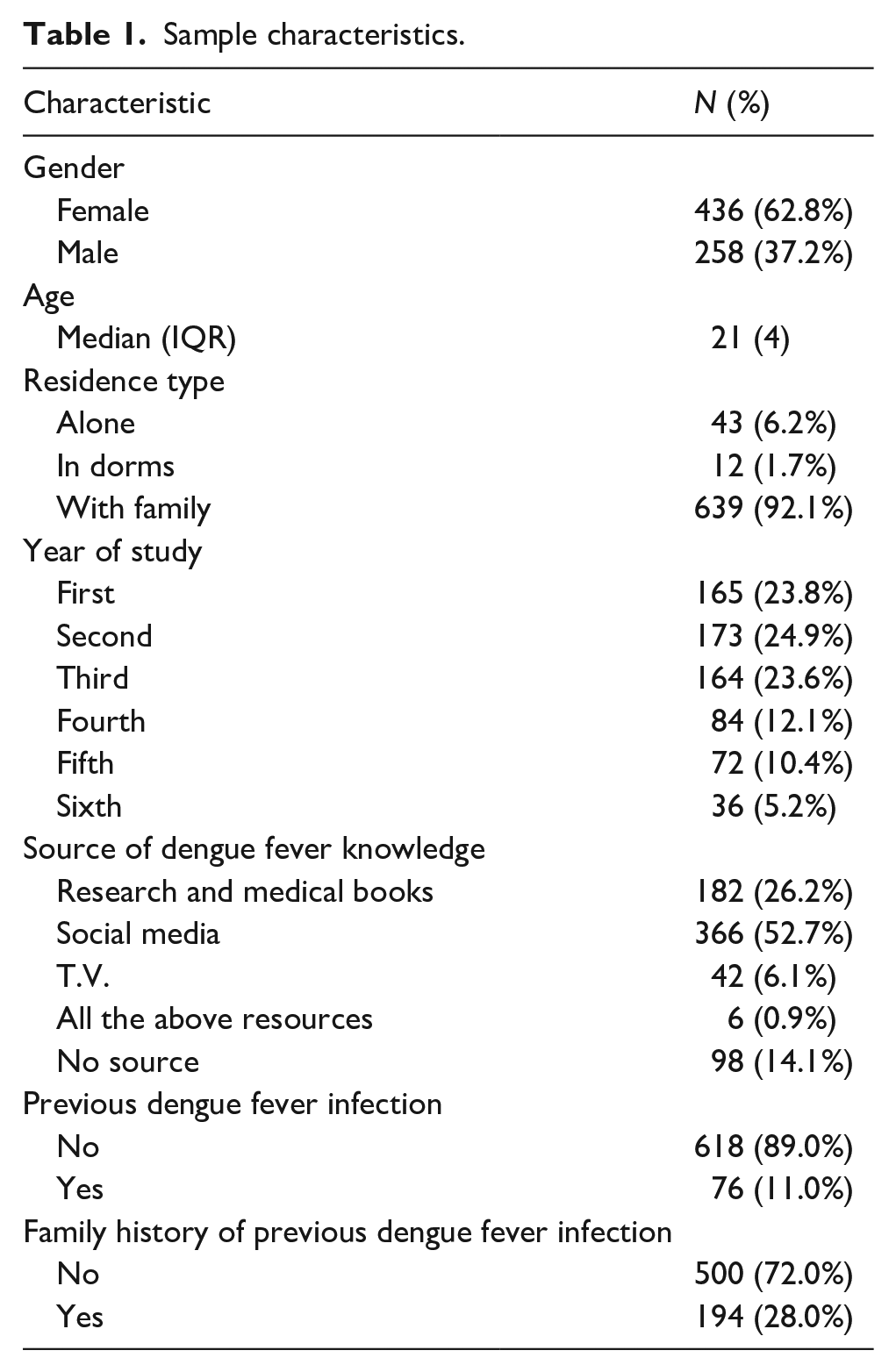
The study included 694 participants, 62.8% were female and 37.2% were male. The median age of the participants was 21 years (IQR: 4). Majority of the participants resided with their family (92.1%), while a smaller percentage lived alone (6.2%) or in dorms (1.7%). In terms of academic status, the distribution was as follows: first year (23.8%), second year (24.9%), third year (23.6%), fourth year (12.1%), fifth year (10.4%), and sixth year (5.2%). Social media was the most common source of Dengue fever knowledge (52.7%), followed by research and medical books (26.2%) and television (6.1%). 89.0% of participants had no previous Dengue fever infection, while 11.0% reported a prior infection. Among the participants, 72.0% had no family history of Dengue fever, while 28.0% reported a positive family history. Table 1 presents the characteristics of the sample. Figure 1 presents universities and States distribution.
Sample characteristics.

Universities and status distribution.
Knowledge about dengue fever
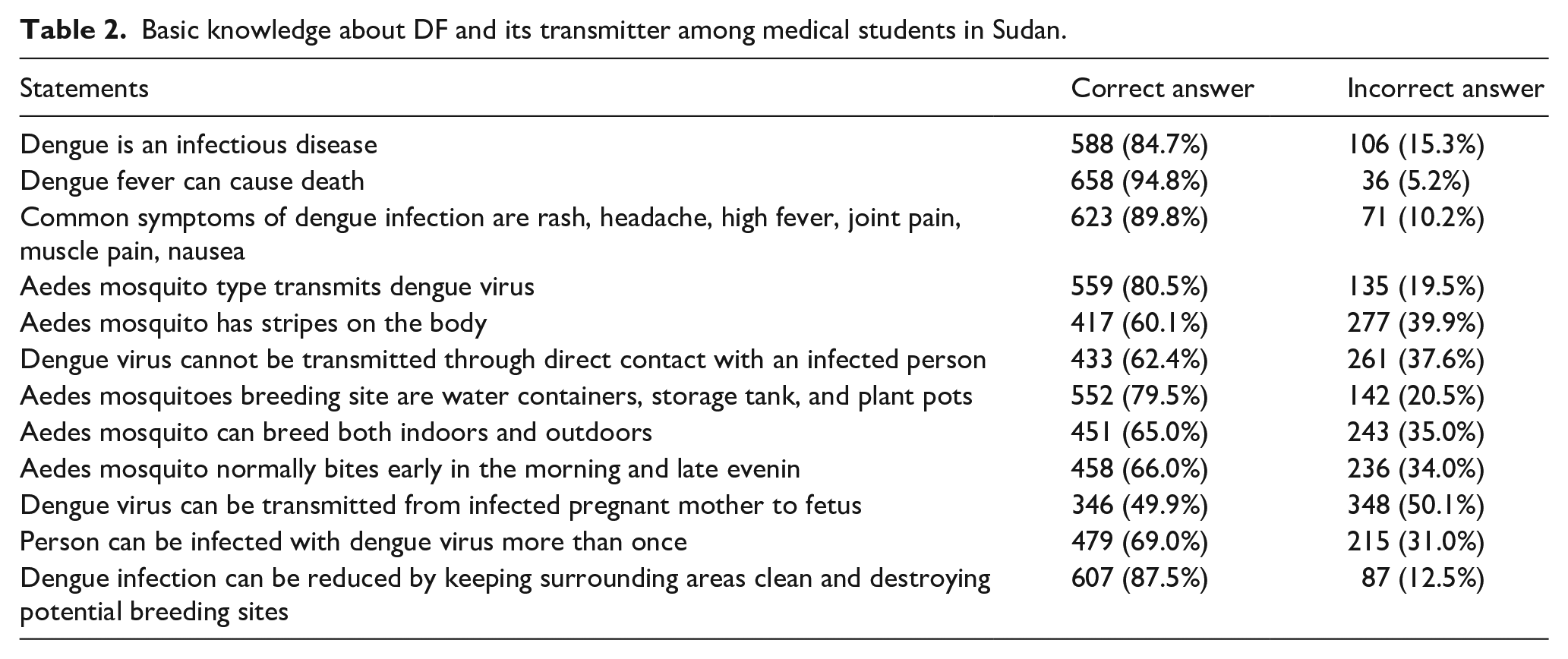
The majority of participants were aware that Dengue is an infectious disease (84.7%) and that it can cause death (94.8%). Regarding the common symptoms of Dengue infection, 89.8% of participants correctly identified rash, headache, high fever, joint pain, muscle pain, and nausea as common symptoms. Additionally, a high percentage of participants knew that the Aedes mosquito is responsible for transmitting the Dengue virus (80.5%) and that it has stripes on its body (60.1%).
However, 39.9% of participants were unaware that Aedes mosquitoes breed in water containers, storage tanks, and plant pots. Furthermore, 34.0% of participants were not aware that Aedes mosquitoes typically bite early in the morning and late evening. In terms of transmission, 50.1% of participants were aware that Dengue virus can be transmitted from an infected pregnant mother to her fetus. Additionally, 69.0% of participants knew that a person can be infected with the Dengue virus more than once. Finally, the majority of participants recognized that Dengue infection can be reduced by keeping the surrounding areas clean and destroying potential breeding sites (87.5%). The participants’ knowledge about Dengue fever is presented in Table 2.
Basic knowledge about DF and its transmitter among medical students in Sudan.
Attitudes toward dengue fever
The participants’ attitudes and behaviors towards Dengue fever control are presented in Table 3. A significant proportion of participants agreed (78.9%) that they have the responsibility to ensure no Aedes eggs and/or larvae are present in their house area. Similarly, a majority agreed (89.4%) that Aedes mosquito breeding sites, such as water containers, storage tanks, and plant pots, should be cleaned 1–3 times a week.
Medical students’ attitudes toward DF in Sudan.
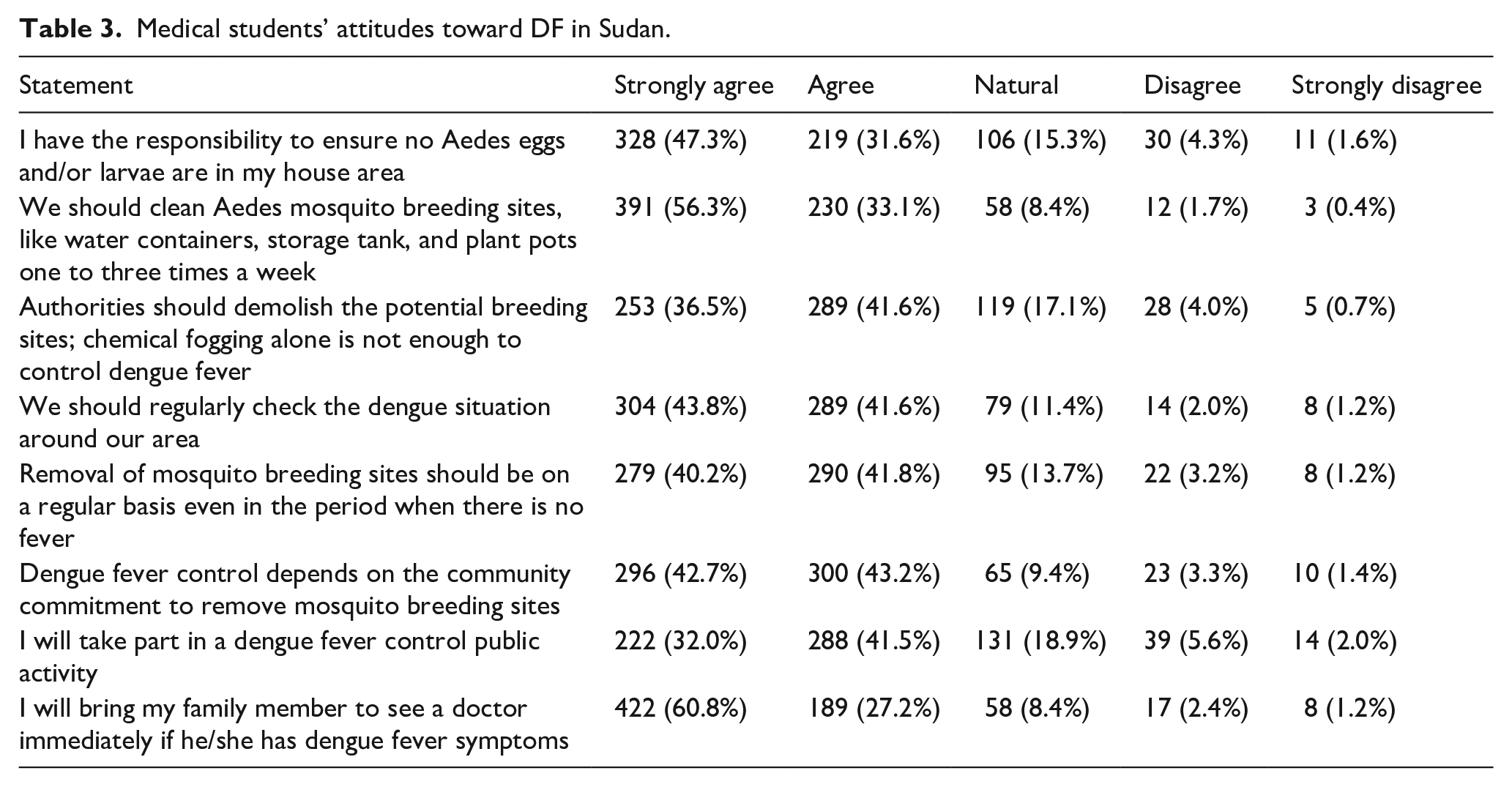
Regarding control measures, participants showed varying opinions. A substantial number agreed (78.8%) that authorities should demolish potential breeding sites and that chemical fogging alone is not enough to control Dengue fever. Additionally, a considerable number agreed (83.4%) that they should regularly check the Dengue situation around their area and remove mosquito breeding sites even in the absence of fever.
The participants acknowledged the importance of community commitment in Dengue fever control, with a significant proportion agreeing (85.9%) that Dengue fever control depends on community commitment to remove mosquito breeding sites. Moreover, a notable percentage agreed (73.4%) that they would participate in Dengue fever control public activities.
In terms of seeking medical attention, the majority agreed (88%) that they would immediately bring their family member to see a doctor if they exhibited Dengue fever symptoms.
Practices toward dengue fever
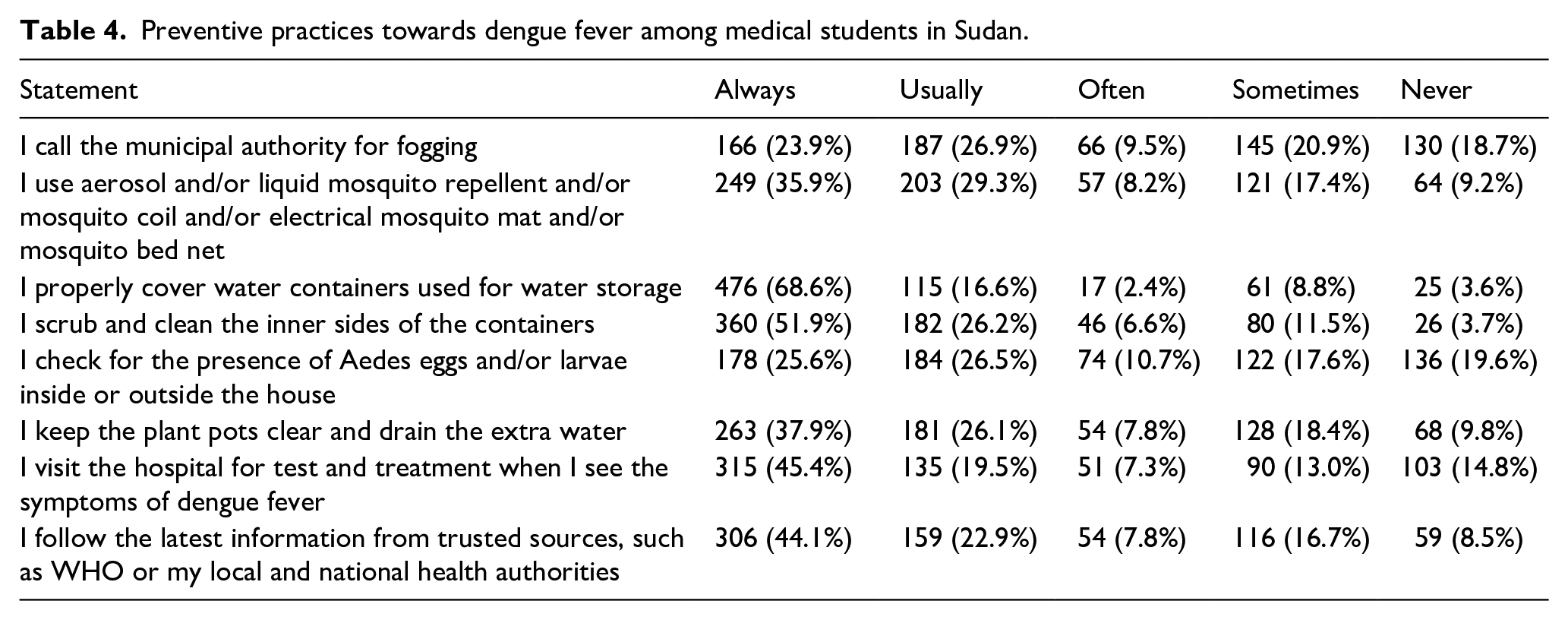
When it comes to fogging, the majority of participants reported that they sometimes (20.9%) or never (18.7%) call the municipal authority for fogging. Similarly, a significant number of participants reported that they sometimes (20.9%) or never (18.7%) use aerosol/liquid mosquito repellents, mosquito coils, electrical mosquito mats, or mosquito bed nets.
However, there were positive responses regarding water storage practices. The majority of participants reported that they always (68.6%) properly cover water containers used for water storage. Similarly, a majority reported that they always (51.9%) scrub and clean the inner sides of the containers. In terms of checking for Aedes eggs and larvae, a significant proportion of participants reported that they sometimes (19.6%) or never (17.6%) check for their presence inside or outside the house. Similarly, a considerable number reported that they sometimes (18.4%) or never (9.8%) keep plant pots clear and drain the extra water. Regarding seeking medical attention, a majority reported that they always (45.4%) visit the hospital for testing and treatment when they see symptoms of Dengue fever. In terms of information sources, the majority of participants reported that they follow the latest information from trusted sources, such as the WHO or their local and national health authorities. The participants’ preventive practices towards Dengue fever are presented in Table 4.
Preventive practices towards dengue fever among medical students in Sudan.
Association in KAP domains
Significant positive correlations (p < 0.001) between knowledge and attitude, knowledge and practices, attitude and practices were determined (Table 5). Linear regression analysis identified knowledge and attitude as significant predictors (p < 0.001) of practices towards DF.
Correlation in KAP domain among medical students in Sudan.

rho, correlation coefficient.
CI, confidence intervals.
KAP domains level towards dengue fever
More than half of the participants demonstrated the good knowledge level (n = 402, 57.9%), the majority exhibited good attitude level (n = 514, 74.1%), however, less than half of them showed good preventive practice level (n = 324, 46.7%), while more than half of them demonstrated good overall KAP level (n = 398, 57.3%). Table 6 summarizes the univariate analysis results. Age was found to be a significant predictor of knowledge (p = 0.020). For each unit increase in age, the odds of having good knowledge increased by 1.07 times (OR = 1.07, 95% CI: 1.01–1.14). In terms of attitude, gender was found to be a significant predictor (p = 0.047). Females had higher odds of having a good attitude compared to males (OR = 1.42, 95% CI: 1.00–2.01). Residence type was also found to be a significant predictor of attitude. Students living in dorms had higher odds of having a good attitude (OR = 1.96, 95% CI: 0.46–8.30, p = 0.360), while those living with family members had higher odds than those living alone (OR = 1.96, 95% CI: 1.03–3.70, p = 0.039).
Univariate analysis predictors of knowledge, attitude, and practices level towards dengue fever among medical students in Sudan.

Regarding practices, the year of study was found to be a significant predictor (p = 0.023). Fourth- year students had higher odds of having good practices compared to first-year students (OR = 1.90, 95% CI: 1.09–3.32). Family history of previous Dengue fever infection was also a significant predictor of practices (p = 0.005). Individuals with a positive family history had higher odds of having good practices (OR = 1.65, 95% CI: 1.17–2.33).
Predictors of overall KAP level
Table 7 summarizes the univariate analysis results of overall KAP. Females had significantly higher odds of having good overall KAP level (OR = 1.53, 95% CI = 1.122–2.09, p = 0.007) compared to males. Age was also found to be a significant predictor of overall KAP (p < 0.001). For each unit increase in age, the odds of having good KAP increased by a factor of 1.111 (OR = 1.111, 95% CI = 1.045–1.180). Regarding residence type, individuals living with their families had significantly higher odds of having good KAP compared to those living alone (p = 0.037), the odds ratio (OR) was 1.948 (95% CI = 1.041–3.64), indicating that individuals living with their families were almost twice as likely to have good KAP. A family history of previous Dengue fever infection was found to be a significant predictor of overall KAP (p = 0.001). Individuals with a family history of previous Dengue fever infection had higher odds of having good overall KAP (OR = 1.76, 95% CI = 1.243–2.49) compared to those without a family history.
Univariate analysis predictors of overall KAP level towards dengue fever among medical students in Sudan.

Multiple regression analysis of overall KAP predictors
Females had higher odds of having good overall KAP compared to males, with an odds ratio of 1.719 (95% CI: 1.226–2.410, p = 0.002). Age was also found to be a significant predictor of overall KAP (p < 0.001). With each unit increase in age, the odds of having good overall KAP increased by a factor of 1.211 (95% CI: 1.094–1.340). Table 8 present multiple logistic regression analysis results of overall KAP predictors.
Multiple analysis predictors of preventive practices and overall KAP level towards dengue fever among medical students in Sudan.

Discussion
The reports on Dengue fever in Sudan date back to 1906, and recently its prevalence has expanded beyond the Eastern region to encompass the entire country. 15 Nonetheless, there are few studies addressing knowledge, attitude and practice towards it.
The majority of the respondents were in their preclinical years . In Sudanese universities, courses on infectious disease and tropical medicine are typically taught in the third or fourth year of medical school. Hence, the knowledge of the students in our study doesn’t reflect what is taught in the curriculum, but rather what is learnt by educated University Sudanese students. This is emphasized by the fact that more than half of the students cited social media as their primary source of information, while only a quarter relied on research and medical literature. The role of social media in health promotion is increasingly recognized by health professionals.16,17
The students demonstrated awareness of the symptoms and the potentially fatal nature of Dengue fever. Nevertheless, over a third of the students lacked knowledge regarding the striped body, indoor and outdoor breeding habits, and early morning and late evening biting behavior of Aedes Aegypti mosquitoes. The general university students in Bangladesh had better knowledge on Aedes Aegypti than our medical students. 13 It is possible that students confused Aedes biting time for Anopheles which is common in Sudan. 18 A similar finding was reported from Ethiopia. 19 The failure to identify mosquito breeding sites and their biting times can significantly impact the effectiveness of preventive measures. Over half of the students were unaware of the potential transmission of Dengue fever from pregnant women to their fetuses. This aligns with similar findings in Bangladesh and Malaysia.13,20
Students had a general positive attitude towards Dengue Fever and this was positively associated with the knowledge . Positive attitude towards Dengue fever has been observed in many areas where the disease is endemic.21–23
The adherence to preventive measures was inadequate, with a quarter of students either never using or only sometimes using mosquito repellents and mosquito nets. The barriers against the use of nets attracted the interest of many researchers and qualitative studies were performed to explore the issue.24–26 The inconvenience of use, culture and perception of cost effectiveness are some of the reported barriers.24–26 Over a quarter of medical students neglect to keep their plant pots clear, a significantly higher proportion compared to the less than 7% of high school students in Myanmar who exhibit similar behavior. 3 We can only speculate about the cause of this behaviour, and it is conceivable that students did not consider the maintenance of plants to be their own responsibility. More than a third of participants don’t check for the presence of Aedes Aegypti larvae or eggs inside and outside the house. Indeed more than a third weren’t even aware of the indoor breeding possibility and their behavior may reflect negligence. Interestingly more than a quarter of the surveyed medical students reported not seeking medical treatment when suspecting Dengue infection. Studies on the health seeking behaviour of medical students showed high prevalence of self-medication practice.27,28
In this study, both knowledge and attitude were positively associated with practice. However it is worth noting that other studies reported that knowledge is not always translated into practice.29,30 The factors that govern the association should be explored in future studies.
Being female was positively associated with attitude and practice . A similar finding was reported in Bangladesh. 31 Females are usually in charge of vector control preventive measures within the household.32,33 Students in the fourth grade had better knowledge, probably because it is the year when tropical medicine is taught in most medical schools. Interestingly, fifth-grade students generally displayed a more positive attitude. Further qualitative research should investigate the reasons behind this association. Individuals who did not acquire knowledge about Dengue fever through any means were more inclined to have poor practice. This aligns with the association between knowledge and practice established in this study. Those who had a family member affected by Dengue fever or had experienced the infection themselves had better knowledge compared to those who did not have a personal or family history of infection. However, having a family history of Dengue fever was linked to positive preventive practices. We hypothesize that participants may believe they can only be infected once, thus, witnessing an infected family member positively influences their preventive practices. However, after experiencing the infection themselves, they may become less vigilant about preventive measures. The misconception of a once-in-a-lifetime infection is documented in the literature. 13
Medical students have social accountability towards their communities. 34 They are expected to actively participate in health education efforts during epidemics.35,36 The first step in ensuring an effective contribution is to guarantee their sufficient level of knowledge and exemplary attitude and behavior. This study revealed an alarmingly inadequate adherence to preventive measures among medical students. It sheds light onto some associations and its results can be used to tailor educational programs as well as behavior change interventions.
Limitations
Despite the valuable insights gained from this study, there are some limitations to consider. Firstly, the study utilized a non-random sampling method. Secondly, the study relied on self-reported data, which may be subject to recall bias or social desirability bias. Additionally, the cross-sectional design of the study limits our ability to establish causal relationships or assess changes over time.
Conclusion
Our research highlights a disconcerting pattern of inadequate preventive practices among medical students concerning dengue fever (DF), despite their commendable levels of knowledge and positive attitudes toward the disease. This incongruence necessitates further exploration to identify underlying reasons and inform the development of targeted interventions aimed at enhancing preventive practices among medical students. Addressing this issue is imperative for effectively mitigating the spread of DF.
Significance for public health
This research is crucial for public health in Sudan as it highlights the gap between knowledge, attitude, and preventive practices among medical students regarding dengue fever. While students show good knowledge and positive attitudes, their preventive practices are suboptimal. As future healthcare leaders, their role in enforcing preventive measures is vital for public health. The identified predictors offer insights for targeted interventions to enhance preventive measures and education strategies among medical students, ultimately strengthening public health responses to dengue fever outbreaks in Sudan.
Footnotes
Acknowledgements
We acknowledge Mahmoud Elsadig Mahmoud Ali; Mujtaba Ammar Osman Yousif; Safiya Abdelrahim Abdallah; Ahmed Hassan Alhaj Alameen; Enass Khaild Abdelgader Mohammed; Mohammed Rahamtallah Alsharif AlNour; Rawnag Mohamed nour Elshaikh Musa; and Moram Elfadel Abdelrhaman Gasmalha for their dedication in data collection. This research would not have been possible without their effort and participation.
Declaration of conflicting interests
The author(s) declared no potential conflicts of interest with respect to the research, authorship, and/or publication of this article.
Funding
The author(s) received no financial support for the research, authorship, and/or publication of this article.
