




Abstract
Background:
Skin lightening products (SLPs) are popular among women for medical and non-medical reasons. Therefore, this study aimed to determine the extent of SLP use among women, identify their sources of information, explore factors associated with SLP use and SLP related knowledge, attitudes, and practices (KAP) among women in the UAE.
Methods:
A structured questionnaire in English and Arabic was distributed to women in the UAE. The questionnaire included demographic characteristics, knowledge (10 items), attitudes (10 items), practices (9 items), and four additional questions on SLP use. Adequate KAP scores were defined as a score of ≥70% out of the maximum score for each KAP section. Chi-square tests were used to test associations between demographic characteristics, dichotomized KAP scores, and SLP use.
Results:
The study included 370 participants, 50% of the respondents were aged 18–24, and 40% were from the Middle East, 64.8% were unmarried, 91% had university degrees, and 50% had healthcare related profession. Among the respondents 25% use SLPs, the majority use SLPs for non-medical reasons. Employment status is significantly associated with SLP use. The percentage of participants with a knowledge, attitude, and practice score of ≥70% is 66.48%, 76.75%, and 74.72% respectively. Type of profession was significantly associated knowledge and practice. In addition, nationality was also associated with practice.
Conclusion:
This study highlighted knowledge, attitude and practice gaps and varied levels of SLP-related KAP among women in the UAE. To promote the rational use of SLPs, educational campaigns and stricter regulations are necessary.
Introduction
Skin lightening products (SLPs), also known as skin bleaching products, are used in the treatment of hyperpigmentation disorders such as melasma, age spots, freckles, under the supervision of a physician. 1 However, nowadays SLPs are commonly used by women to lighten their skin tone. Social media influence, advertisements for SLPs, shadism, and popular beauty standards influence women to use these products. 2 However unsupervised use of these products can have serious consequences. SLPs may contain toxic content such as hydroquinone, mercury, and corticosteroids which can be harmful in higher doses.1–3As a result, cutaneous side effects can occur such as wound healing impairment, dermatitis, skin atrophy, and hirsutism.1,3 In addition, some SLPs can lead to serious systemic effects such as hypertension, diabetes, and Cushing’s syndrome.1,3
Therefore, various stakeholders such as the Ministry of Heath, medical professionnels, distributors, and the public need to work together to ensure only safe and registered products are available for the public. In addition, pharmacists and other medical providers should educate the public regarding the safe selection, optimal use, and potential adverse effects of SLPs.
Recently, the ministry of health UAE has banned three whitening products (AHA Lightening Gel, HQ Lightening Gel, and Bionic Skin Lightening Gel) from the market, because the products contained high concentration of hydroquinone. 5 Various studies from other parts of the world have shown that SLP use is prevalent. The prevalence of use of SLPs ranges from 32.3 to 51.5%.1,3,6 However, there is limited published data on SLP use in the UAE.
The purpose of this survey is to explore the knowledge, attitude, and practice (KAP) regarding skin lightening products (SLPs) among women in the UAE, as well as the factors associated with KAP and SLP use. In addition the study explored reasons for use, source of information, type of SLPs used, and harmful effects associated with SLPs.
Design and methods
Study area, design, and period
This was a cross-sectional survey based on a structured questionnaire in English and Arabic that was distributed to women in the UAE between November 2022 and January 2023.
Study Population
The study population is women in the UAE. The following formula was used to calculate the sample size of the study population [n = (Z2 × p × (1 − p))/(d2)]. We assumed p to be 35% Z = 1.96 and d = 0.05. Based on these assumptions, a sample size of approximately 366 women was required for this study.
Inclusion and exclusion criteria
Adult women, who can read and understand either English or Arabic, were eligible to be included in this study. Girls below 18 years of age, and women who were not willing to participate, and participants who are not UAE residents were excluded.
The questionnaire design and validation
The Survey questionnaire was developed based on previous surveys done in other countries.7–9 The questionnaire included questions about demographic characteristics (such as age, marital status, and education level, profession, region, skin tone, type of skin), Knowledge on SLPs, attitude about SLPs, SLP-related practices by consumers. The knowledge section included 10 items with three level likert scale (correct, incorrect, and unsure) and attitude section included 10 items with five level point likert scale (strongly agree, agree, neutral, disagree, and strongly disagree) and the practice section included 9 items with five-point likert scale (always, often, sometimes, rarely, never). The SLP users are also asked four additional questions with multiple select options on reason for using SLPs, source of information, type of SLPs used, and any adverse effect experienced in the survey. The content and clarity of the survey questionnaire were checked by two assigned pharmacy educators from DPCG. The English version of the questionnaire was translated by Arabic language teacher and the Arabic version of the questionnaire was back translated to check for accuracy by a bilingual language expert. A pilot study which included 20 participants was conducted, the Cronbach alpha score 0.70 was obtained for overall questionnaire.
Ethical consideration
Ethical approval for the study was obtained from the Dubai Pharmacy College for Girls (DPCG) research and Ethics committee on October 5th, 2022 (Reference number of REC/UG/2022/01).
Data collection
Data was collected using google forms which were shared in social media platforms and printed self-administered questionnaires distributed to universities, schools, and public areas such as parks and malls. Explanation regarding the purpose, benefit of the study was provided in the front page of the questionnaire to allow respondents to give informed consent to participate in the study.
Data analysis
For data analysis, IBM SPSS Statistics, version 26, was used. Categorical data such as age groups, employment status, reasons, and purpose of use of skin lightening products were summarized by percentages (frequencies), while quantitative data such as participants’ age and knowledge scores were summarized as mean and standard deviation. Following a previous study on skin lighting products, 7 score of ≥70% of the maximum anticipated score was considered adequate level of knowledge (score of ≥21 out of 30), attitude (score of ≥35 out of 50), and practice (score of ≥32 out of 45). The chi-square test was used to test the association between categorical demographic characteristics and participants’ dichotomized knowledge, attitude and practice levels and SLP use. For all tests, a p-value less than 0.05 was considered statistically significant.
Significance for public health
The results of this study on skin lightening product (SLP) use among UAE women are important for the general public’s health. It identifies the frequency of SLP use and related characteristics, allowing for targeted interventions. The identification of knowledge and practice gaps as well as beliefs regarding SLPs facilitates the creation of educational initiatives to dispel myths. Based on discovered knowledge gaps about permitted components and labeling, stricter rules for SLPs are advised. Promoting rational use encourages educated decision-making, which minimizes potential harm.
Results
The study included a total of 370 respondents. Half of the respondents were between the ages of 18 and 24 years. A total of 150 respondents were from middle east followed by Asia (29%), Africa (28.1%) and Europe and America. Almost half of the respondents were from Dubai (48.9%) and almost two thirds (63.5%) were not married. A total of 187 out of the 370 participants self-reported to have a white or fair skin tone. Most (91%) of the participants were university students or graduated from a university and 59.7% were currently un-employed. There were almost equal number of the respondents having a profession related to healthcare or a profession not related to healthcare.
One quarter of study participants (91) used SLPs. The association between demographic characteristics and the use SLPs is presented in Table 1. Among the factors tested, the employment status was the only factors that showed significant association with the use of skin lightening products (Table 1).
The association between demographic characteristics the use skin lightening products.

Significant p < 0.05.
The average (SD) knowledge score was 15 (3.4) out of the maximum 30. Overall, the respondents showed reasonable knowledge levels regarding SLP’ use and side effects. Almost three quarters (74.3%) of the respondents answered correctly regarding the side effects of SLPs, such as allergic reactions and skin irritation. Slightly higher than half of the respondents were uncertain (54.3%) if injectable glutathione is approved for use as SLP or not.
Most of participants (79.7%) strongly agreed or agreed that the ingredients of the skin lightening products may not be listed appropriately on the product packages while 55.1% of the respondents disagreed/strongly disagreed that the use of SLPs enhances their social and financial opportunity. Moreover, 35.4% were indifferent to the idea that expensive (popular brands) SLPs are safe and effective (Table 2).
Knowledge and attitude regarding skin lightening products.
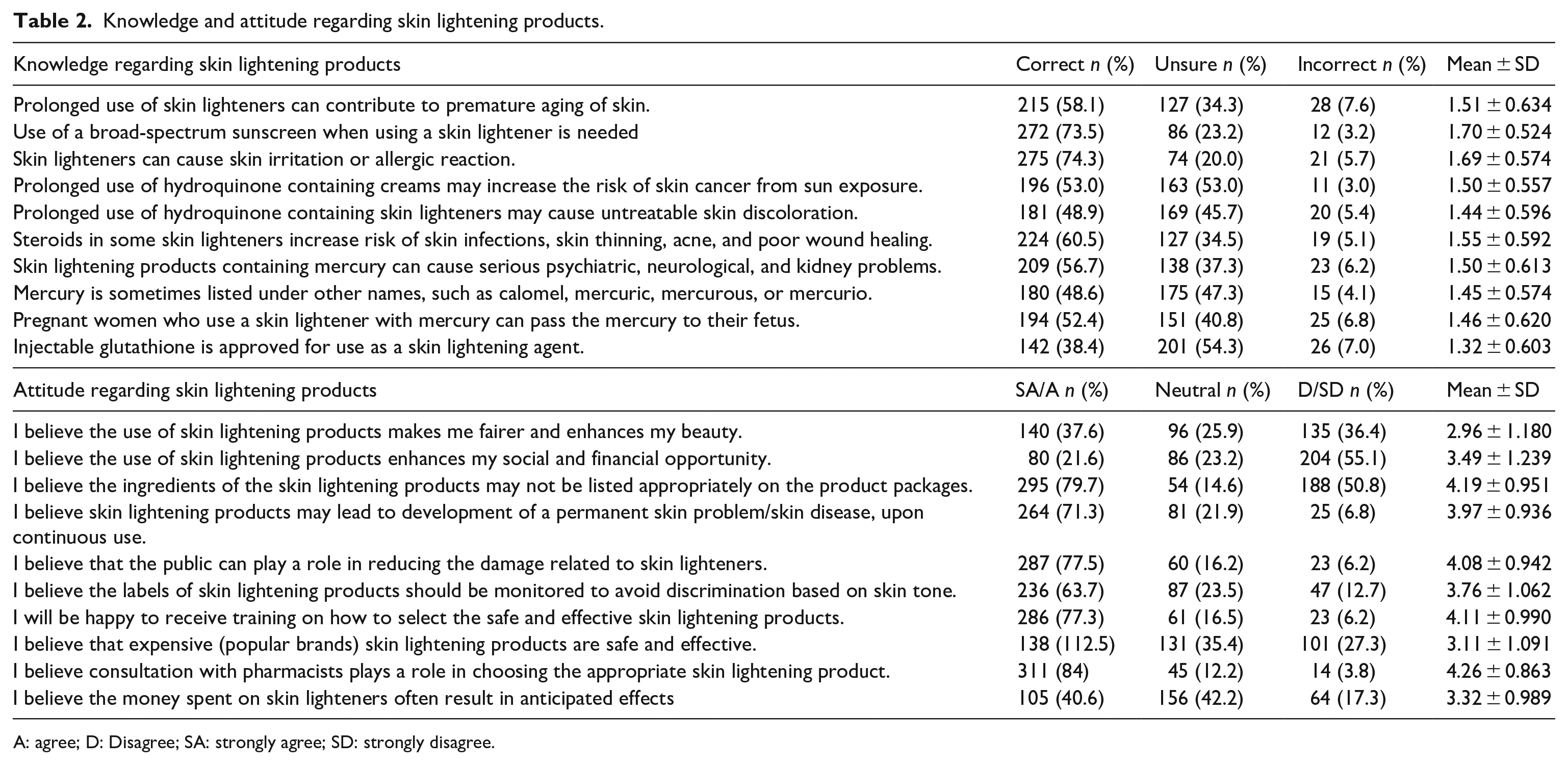
A: agree; D: Disagree; SA: strongly agree; SD: strongly disagree.
Out of 370 participants 91 reported using SLPs. These participants who use SLPs were asked to indicate the type of SLP they used and their source of information. A total of 52,20,16,6,6 or 2 participants reported that they have used creams, serums, natural/herbal soaps and remedies, exfoliators (chemical peels), laser treatments, or tablets/pills as SLPs. They claimed that they get information regarding SLPs from sources such as social media (#49), friends and family (#45), pharmacists (#36), doctors (#33), advertisements in public places (#25), online shopping sites (#23), and TV/Radio (#6). Most of the participants use SLPs for non-medical reasons such as to even out skin tone (#29), to cover spots/acne (#26), and to boost self-confidence (#20) and to have brighter skin (following beauty standards) (#17). Only a few participants claimed to use SLPs to treat hyperpigmentation (#16) and to treat skin disease (#10).
A total of 91 women uses SLPs, among these only 31 (34%) always consulted a healthcare professional before using SLPs. Over half (60%) only used products that were registered with the Ministry of Health and Prevention and checked the ingredients list before using them. Approximately one quarter of the population does use SLPs containing mercury or hydroquinone without the supervision of a medical professional. Half (50%) apply sunscreens and use small amounts of SLPs on the darkened area only. About 80% of the population check expiry date before using them. About 20% of the population rarely or never apply SLPs on limited area for testing before applying to the face. About 3.2% of the participants use SLPs with instructions they don’t understand, while the majority avoid using them (Table 3).
Practice regarding skin lightening products.

Among SLPs users 36% reported to have suffered from harmful effects related to SLPs. burning or stinging sensation, itchy or flaky skin, allergic reactions, skin turning dark or too light, scarring and redness, and swelling were reported by 13, 8, 7, 4, 3, and 2 participants respectively.
Association of demographic characteristics and the knowledge, attitude, and practice categories
The maximum possible knowledge, attitude, and practice score was 30, 50, and 45 respectively. The percentage of participants with a knowledge, attitude, and practice score of 70% or more is 66.48, 76.75, and 74.72% respectively (Table 4).
Association of demographic characteristics and the knowledge, attitude, and practice categories.
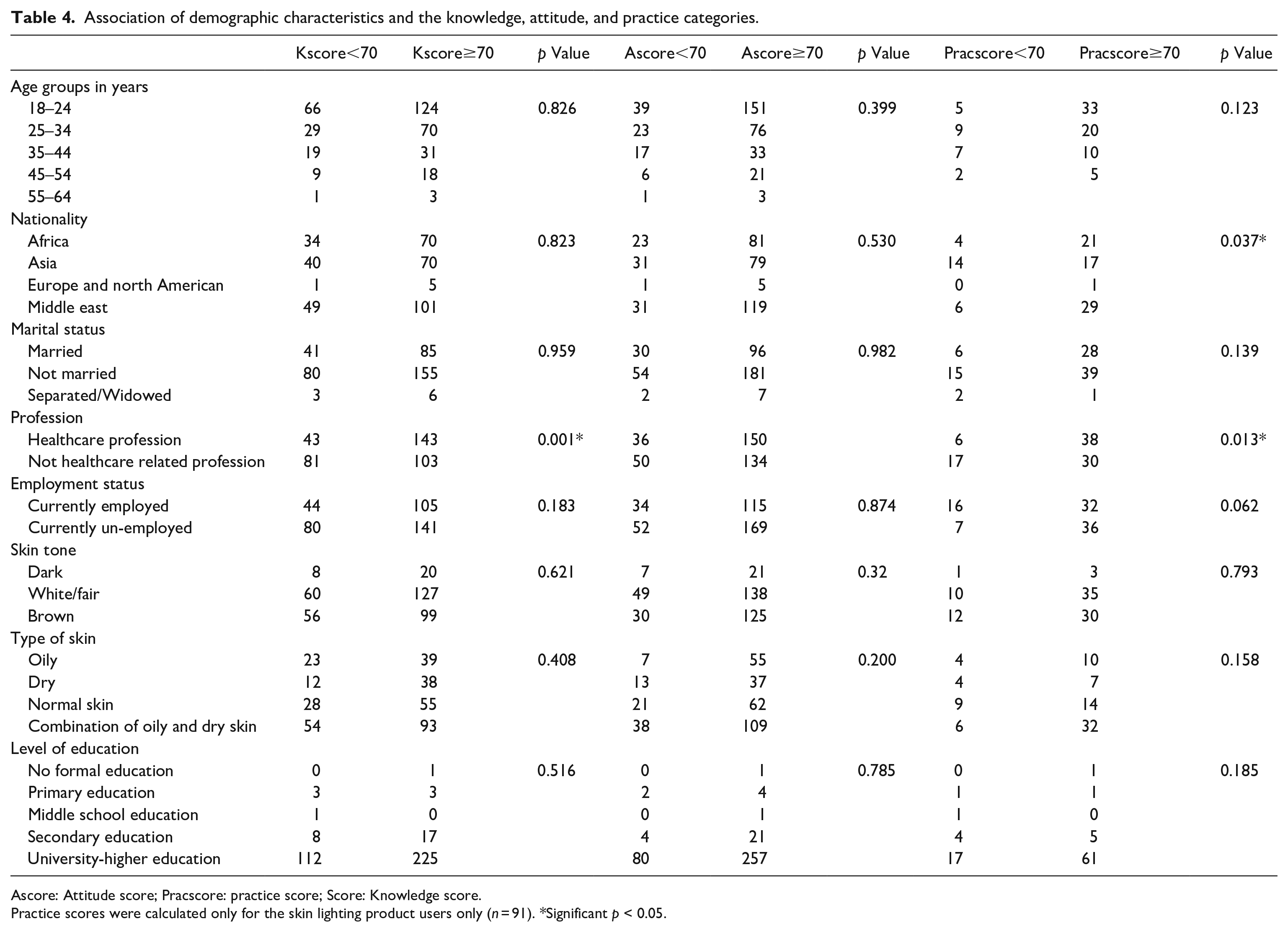
Ascore: Attitude score; Pracscore: practice score; Score: Knowledge score.
Practice scores were calculated only for the skin lighting product users only (n = 91). *Significant p < 0.05.
Type of profession is linked with knowledge and (p < 0.001) and better practice (p = 0.013) scores. Additionally, nationalities were associated with practice (p = 0.037). None of the other demographic characteristics were associated with the attitude of women about SLPs.
Discussion
The participants in this study have a reasonable knowledge, attitude, and practice related to SLPs. However, gaps in knowledge and practice are evident from the survey results. One quarter of the study participants use SLP with most of the users being in the age group of 18 and 24 years, which is a demographic commonly associated with an increased interest in appearance. Similarly, a study conducted among Sudanese female students shows that the skin whitening products were mainly used by participants that were aged 20 and 22 years (58.8%). The results the study conducted in Sudan, revealed that age is one of the prime contributors which promotes the usage of skin whitening products. 10 Most respondents who use SLPs were not married in this study. A similar study conducted in Nigeria showed that most of SLP users were single (69.8%). 11 Single women may be more likely to use SLPs due to social and cultural norms or having more free time and disposable income. Ibekwe et al. 12 suggests that the motivation for using SLPs may be driven by social or cultural norms, rather than a desire to attract a partner.
The results show that a quarter (24.59%) of the participants had used SLPs in the past year, which is higher than a previous study that reported a 12% use of SLPs. 13 Most of SLP users in this study highlighted non-medical reasons such as to even out skin tone, to cover spots/acne, to have brighter skin and to boost self-confidence as reasons for using SLPs. This shows the need to educate the participants regarding safe and optimal use of SLPs. The most used type of SLPs was cream, which is also in line with previous research that found the most popular SLPs are topical SLPs. 6 The main source of information about SLPs for the study participants was social media followed by family and friends. The findings are like the results of a study by Khalil et al. 6 reported social media as their main source of influence for SLP use among 70% of the participants. This raises concerns about the accuracy and reliability of the information available on these platforms. This finding highlights the importance of promoting evidence-based sources of information about SLPs, through healthcare professionals and reputable websites or using social media as a tool to promote evidence-based use of SLPs. However, a study in Jordan: showed that advertisements were the main source of information (77.4%). 14 This could be attributed to the fact that traditional forms of advertising such as television, radio, and print media are still widely used and trusted by the population.
The study found that most respondents had acceptable knowledge regarding the potential harm related to long-term use of SLPs. Most of them knew about the side effects of SLPs, such as allergic reactions and skin irritation. Similarly, a study among female medical undergraduates in Nigeria showed similar results. 3 Additionally, in another study it was reported that 79.1% of the students were aware that the use of SLP can harm the skin. 15
Among demographic characteristics, employment status was the only factors which were significantly associated with SLPs use in this study. This factor was found to be associated with SLP use among participants of a study conducted in India, Indonesia, the Philippines, and Thailand. 16 Likewise, a previous study has shown that employment status and attitude of SLPs were found to be determinants of being a current use. 17 Employment status can influence whether the person can afford SLPs. On the other hand, the study did not find any significant association between marital status and skin type with the use of SLPs, which contrasts with the findings of a previous study. 18
Individuals with darker skin tones may feel pressure to conform to beauty standards that favor fair skin or may use SLPs to address skin damage caused by sun exposure. Additionally, fair skin may be associated with higher social status and prestige in some cultures, further motivating people to use SLPs. However, more than half of the respondents disagreed that the use of SLPs enhances their social and financial opportunities. This finding is consistent with a study in which only 61.4% disagreed that fairer skin is more attractive. 4 As United Arab Emirates (UAE) is a diverse country where individuals from multiple countries live in, individuals may feel accepted, irrespective of their race or ethnicity. However, the findings contrasts results of studies in Ghana, Somaliland, and Zimbabwe that reported higher proportion of respondents who believed that a lighter skin tone is a sign of wealth, power or that being fairer can increase confidence, job opportunities or attractivness.1,19–21 This may be due to a variety of factors, including a colonial legacy that associates fair skin with power and privilege, the rise of global media and advertising that promotes Western beauty standards, a belief that fair skin can lead to greater job opportunities and marriage prospects, and other cultural factors. However, these beliefs are often misguided.
Type of profession and nationality were associated with SLP-related practice. The use of SLPs is likely to vary in different countries and cultures.1,2,19,21 The use of SLPs is more prevalent in Asia-Pacific region. 22 In this study participants with health care related professions had better knowledge scores than those with profession not related to health care. This may be related to better exposure to information on rational use of SLPs. In general, the study has highlighted that there is a knowledge gap regarding the ingredients of SLP and potential adverse effects associated with different ingredients. Similarly, only half of the users use SLPs with sunscreen or check ingredients before use and a very limited number of participants apply SLPs on limited areas before using the SLPs. Furthermore, the study has highlighted that most use SLPs for non-medical reasons and 36% suffer from harmful effects due to SLP use. These gaps in knowledge and practice call for targeted educational interventions to improve informed use of SLPs by healthcare providers such as dermatologists and pharmacists and other stakeholders.
This study on SLP use has several notable strengths. Firstly, it is the first original study that examined this SLP use in the UAE, providing valuable insights into an important area of public health. Secondly, the study included a good proportion of respondents. Furthermore, the study sheds light on the knowledge, attitudes, and practices (KAP) regarding SLPs, providing a understanding of the factors that influence the use of these products. The study can inform future interventions to improve the rational use of SLPs by several stakeholders.
Limitations
To begin with, the research is a cross-sectional analysis that presents a snapshot of the knowledge, attitude, and practice (KAP) of women regarding SLPs at a specific point in time. The study does not consider how attitudes and beliefs towards SLPs may evolve over time. Additionally, the study relied on self-administered questionnaires to collect data, which may result in participants inaccurately reporting their behavior or misinterpreting some aspects of the questions, leading to potential information bias. The study is limited to only women, the study hence the results may not be generalizable to the whole UAE population. In addition due to quantitative nature of the study psychological and sociocultural factors were not explored in depth.
Recommendation
To address these knowledge and practice gaps, education campaigns are necessary to raise awareness about the dangers of SLPs and the importance of using them only under the guidance of a qualified dermatologist or healthcare providers. Healthcare providers should also be trained to recognize signs of skin damage or other adverse effects associated with SLPs and provide appropriate guidance and treatment to those who may be experiencing these issues. Additionally, regulations can play a role in preventing the misuse of SLPs by requiring manufacturers to provide clear instructions on the safe and appropriate use of their products, restricting the use of certain skin lightening agents, and promoting their use only under medical supervision. In addition, manufacturers of SLPs should avoid producing SLPs which contain harmful chemicals or useful chemicals in an amount more than recommended.
Conclusion
In this study, most participants demonstrated reasonable knowledge, attitude, and practice related to SLPs. However, some participants lack awareness about the potential side effects of SLPs, particularly those containing hydroquinone and mercury. These products can have dangerous effects if used incorrectly. 23 Some participants reported not consulting a healthcare provider before starting to use SLPs, using unregistered drugs and not checking the ingredients list before using the product. The misuse of SLPs can be attributed to a lack of awareness about their potential risks and proper use. Individuals may use these products too frequently or excessively, which can lead to adverse effects like skin irritation, redness, and long-term use may increase the risk of skin cancer and other health problems. Hence collaborative efforts are needed by all relevant stakeholders to improve KAP of SLP users.
Footnotes
Acknowledgements
The authors would like to express gratitude to all respondents for participating in the following study. In addition, we would like to thank Dubai Pharmacy College for Girls for facilitating the conduct of the study.
Availability of data and material
Upon reasonable request, the corresponding author of the study can provide access to the datasets used and/or analyzed during the research.
Contributions
The study involved the contributions of SB, ESG, DR, GB, EM, SI, and HH. They collectively contributed to the conception and design of the study, conducted data analysis, interpreted the data, drafted the article, and revised the manuscript. Additionally, they were involved in editing and proofreading the final version of the manuscript. All authors have reviewed and approved the final manuscript and have accepted responsibility for the integrity of the work.
Declaration of conflicting interests
The author(s) declared no potential conflicts of interest with respect to the research, authorship, and/or publication of this article.
Funding
The author(s) received no financial support for the research, authorship, and/or publication of this article.
