




Abstract

In April 2022, the US Food and Drug Administration (FDA) 1 announced that it had received reports of serious side effects, including skin rashes, facial swelling, and ochronosis (discoloration of skin), from the use of over-the-counter (OTC) skin lightening products containing hydroquinone. Hydroquinone and mercury are 2 active ingredients sometimes found in illegally marketed OTC skin lightening products sold in the form of creams, lotions, soaps, or powders. When these ingredients are used on skin, they are absorbed into the body, which can be harmful.
In the United States, skin lightening products are marketed as treatments for uneven skin tone, acne, age spots, freckles, and wrinkles. 1 Companies may describe skin lightening products as skin bleaching, fading, evening, brightening, or whitening products. Some of these products are regulated as drugs, and others, based on their intended use, may be regulated as cosmetics or drug-cosmetics. 2 Skin lightening products are often sold in shops that cater to Hispanic or Latino, Asian, Black or African American, or Middle Eastern and North African communities. 3
The Coronavirus Aid, Relief, and Economic Security (CARES) Act included important reforms that modernized the way certain OTC drugs are regulated. 4 As a result of the CARES Act, OTC skin lightening products containing hydroquinone are deemed new drugs and require an FDA-approved new drug application before these products can be legally marketed. In addition, the Consolidated Appropriations Act of 2021, 5 as enacted into law, provided appropriations for the FDA to educate the public on the potential risks of products containing hydroquinone or mercury.
The FDA is taking a comprehensive approach to protect consumers from the risks posed by skin lightening products, including working with individuals and organizations on education, outreach, and public awareness activities on the use of and potential risks from skin lightening products containing hydroquinone or mercury. To build a foundation for the development of an educational initiative, the FDA’s Office of Minority Health and Health Equity (OMHHE) collaborated with the Reagan-Udall Foundation for the FDA to conduct formative research among diverse communities on their perspectives, attitudes, knowledge, and motivations for the use of and potential risks from skin lightening products containing hydroquinone or mercury. 6 Through listening sessions, this formative research provided an in-depth understanding of consumer perspectives on skin lightening products and informed the development of tailored communications to educate communities on the potential risks and harms of these products. Listening sessions are small, informal, nonregulatory, nonpublic teleconference meetings to increase understanding of patient experiences, perspectives, and needs related to their health or a disease and not about specific medical products (drug, biologic, or device). 7 The Western Institutional Review Board-Copernicus Group, Inc. (1-1464170-1) determined these listening sessions to be exempt from requirements of human research under 45 CFR §46.104(d)(2), and the human subject protections of the FDA (2021-OC-101) concurred the determination.
The OMHHE and the Reagan-Udall Foundation invited more than 140 organizations, representing racial and ethnic minority groups, universities, community-based groups, patient advocacy groups, and public health organizations, to participate. Many of the organizations actively participated in the listening sessions, including reaching out to their member networks and through social media to help recruit participants. The OMHHE and the Reagan-Udall Foundation hosted 6 listening sessions; participants included estheticians in clinical, medical spa, and salon settings and people from racially and ethnically diverse communities (Asian, Native Hawaiian or Other Pacific Islander, American Indian or Alaska Native, Black or African American, and Hispanic or Latino). Participants reported having either personally used or considered using skin lightening products or knowing someone who used such products. During the listening sessions, researchers explored consumer awareness of ingredients, concern about ingredient safety, and information that would be helpful for consumers when selecting skin care products to guide future message development and testing. The study team also conducted 7 separate interviews with experts in dermatology, race, culture, and health communication among racially and ethnically diverse populations.
Listening Sessions: Topline Themes
Listening sessions revealed that consumer motivation to use skin lightening products is driven by multiple factors. Most consumers reported exploring or using products to address various skin issues, such as scarring, melasma, sun damage, psoriasis, and others. Many users of skin lightening products also reported a desire to “even” their skin tone. In interviews, dermatologists reported that most clinical use of skin lightening products was to address melasma, inconsistent pigmentation, and scarring.
Listening sessions also revealed regional differences, often informed by an individual’s country of origin, that impact the use of skin lightening products. For example, participants who closely associate with people from their country of origin, such as living and working in communities where most people speak their native language, reported different motivations (eg, overall skin lightening vs evening of skin tone). Sessions also showed that the type of wording on skin care products motivated or discouraged use among participants (Box).
Keywords identified from listening sessions that motivate or discourage the use of skin lightening products conducted with dermatologists, estheticians, and community members, May 2022–August 2022 a
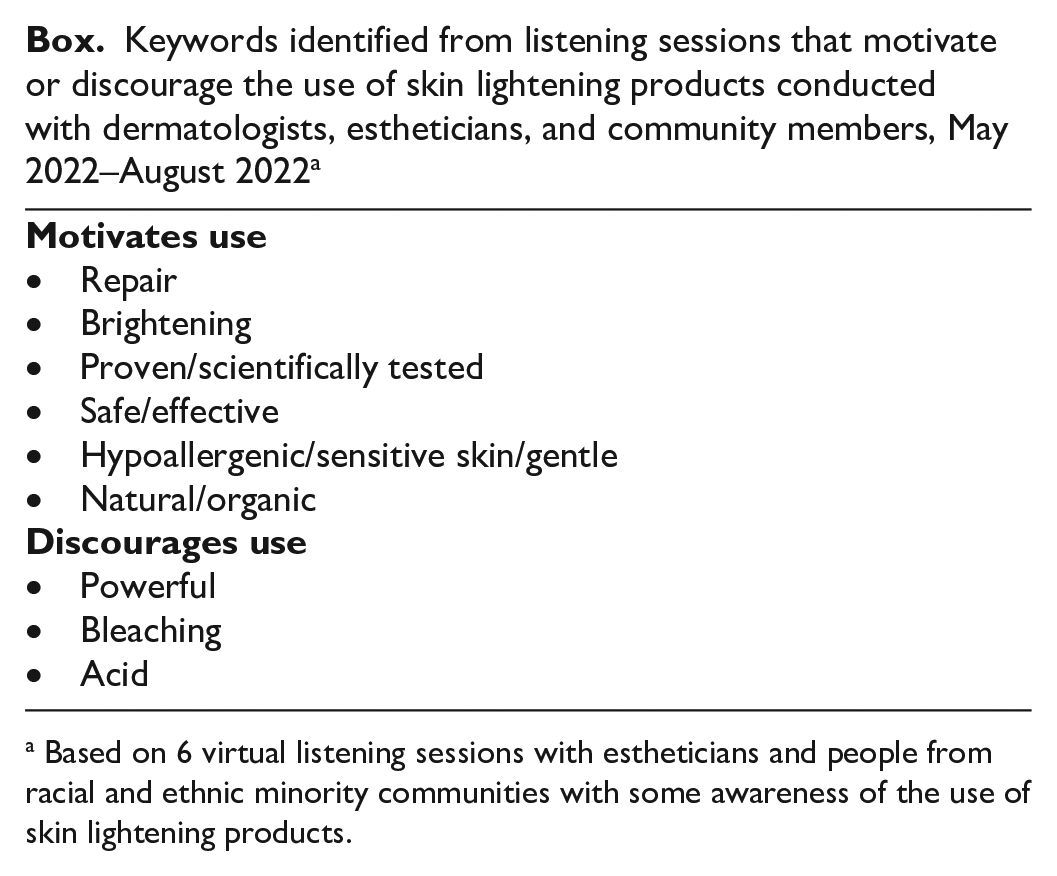
Based on 6 virtual listening sessions with estheticians and people from racial and ethnic minority communities with some awareness of the use of skin lightening products.
Participants in the listening sessions reported that in many cultures, especially among Black or African American communities, it is considered taboo to talk about skin lightening and the use of skin lightening products, and the topic is rarely discussed even among the closest of friends. Expert interviews supported broad research findings that colorism 8 is a driver for some consumers who want to lighten their skin. 9 Some participants in the listening sessions reported that (1) skin lightening is a predominant concept in certain cultures that are caste-based, patriarchal, or affected by colonialism; (2) the practice of skin lightening is often handed down from older generations, and proximity to a person’s country of origin (eg, first-generation immigrants) can influence a person’s perspective on skin lightening; and (3) colorism is a major reason some populations use skin lightening products. However, some dermatologists reported that colorism is a less common motivator than it used to be, especially among US-born patients.
Community participants in listening sessions stated that social media, specifically social media influencers and personal testimonials, influenced their use of skin lightening products. Expert participants stated that personal influencers, such as family members, teachers, community leaders, and counselors, are often uninformed about the dangers of skin lightening products and, therefore, do not teach younger generations about them. However, listening sessions revealed that younger people are open to education on the dangers of skin lightening products. Participants noted that marketing of skin lightening products carried a lot of weight in making decisions to use skin lightening products.
Professional Perspectives
During the listening sessions and interviews with subject matter experts on skin lightening products, dermatologists and estheticians reported seeing themselves as both educators and providers. Dermatologists and estheticians also noted having regular discussions with their patients and customers on skin lightening prescriptions, OTC drug products, and other skin health issues, including sunscreen use, medications, smoking, and other lifestyle factors.
Consumer Perspectives
During the listening sessions, most participants who reported using skin lightening products were generally not aware of the potential dangers of certain ingredients. Some participants were aware of the risks but often decided the risk was worth the potential benefit. Most participants who considered using skin lightening products also did not consider reviewing ingredients and reported that they believed “if a product is on the market, it must be safe” as their reasoning. Among participants who reported paying attention to ingredients, some noted it was primarily from a perspective of how fast an ingredient might work or how effective an ingredient might be. Participants reported obtaining skin lightening products from online retailers, at local/ethnic grocery stores, and from friends and family in other countries.
From listening session feedback, the following challenges were identified on engaging and educating consumers on the risks and harms of skin lightening products:
• Varied reasons for using skin lightening products
• Low levels of awareness of product ingredients
• Low levels of awareness of absorption of skin care products containing potentially harmful ingredients
• Lack of label-checking tendencies
• Low levels of understanding the language on labels
• Assumption of safety for in-store purchases
• High tolerance for risk because of personal perceptions of beauty
Given these challenges, targeted messages that resonate with a diverse consumer base are critical for successful education and outreach efforts on skin lightening products.
Educational Initiative Considerations
A successful educational initiative to raise awareness of the risks and harms from skin lightening products must consider tailoring messages and delivery to appropriate audiences according to product use, race and ethnicity, US-born populations compared with those born outside the United States, and age, among other factors. The first step to any successful educational initiative is to understand the attitudes, beliefs, knowledge, and unmet needs of diverse audiences.
Health literacy, as well as overall literacy, may be a further challenge when encouraging consumers to read labels. 10 Consumers may also not understand that certain wording or claims found on cosmetic labeling, such as “organic” and “all natural,” are not regulated by the FDA.11,12
The sensitive nature and/or stigma of skin lightening may also be barriers to engagement. Social media is a critical component in reaching key audiences, especially young audiences. Engaging “skinfluencers” on social media platforms, such as YouTube, Instagram, and TikTok, may extend reach to populations, especially because many consumers may have limited access to health care professionals.
Conclusions
Education on skin lightening requires a multidimensional approach. Beyond the need to increase knowledge on key facets of skin lightening products, to include increasing the awareness of active ingredients and understanding the FDA’s role in regulation of OTC skin lightening drug products, attention is needed on addressing the cultural sensitivities and stigma that often accompany the topic of skin lightening. Findings from this project led the OMHHE to establish the Skin Facts! Initiative 13 to support consumer awareness on illegally marketed OTC skin lightening products containing hydroquinone or mercury. The multilingual educational materials include a public service announcement, social media messages, and a toolkit. 13
Footnotes
Disclaimer
The contents of this article reflect the views of the authors and should not be construed to represent views or policies of the US Food and Drug Administration (FDA), US Department of Health and Human Services, and US government. No official endorsement by the FDA is intended or should be inferred.
Declaration of Conflicting Interests
The authors declared no potential conflicts of interest with respect to the research, authorship, and/or publication of this article.
Funding
The authors disclosed receipt of the following financial support for the research, authorship, and/or publication of this article: The project was supported by the FDA Office of Minority Health and Health Equity (OMHHE) of the US Department of Health and Human Services as part of a financial assistance award totaling $199 711.00, with 100% funded by FDA OMHHE/US Department of Health and Human Services.
